


Error in Figure
In the original publication [1], a concern was raised that the control image in Figure 8 overlapped with a related article [2], which described different experimental incubation times (12 h vs. 2–10 weeks). The authors have clarified that this overlap occurred unintentionally during the concurrent preparation of the two manuscripts.
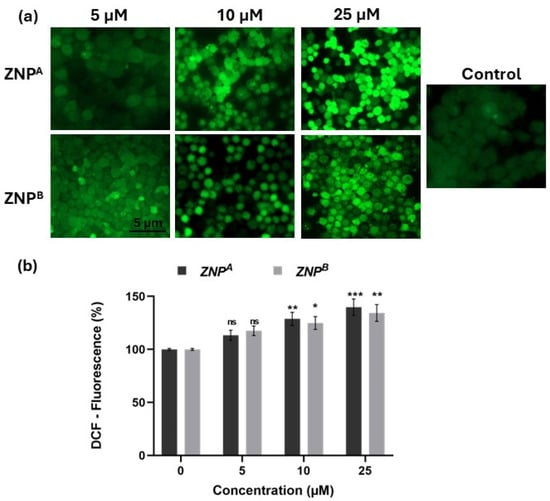
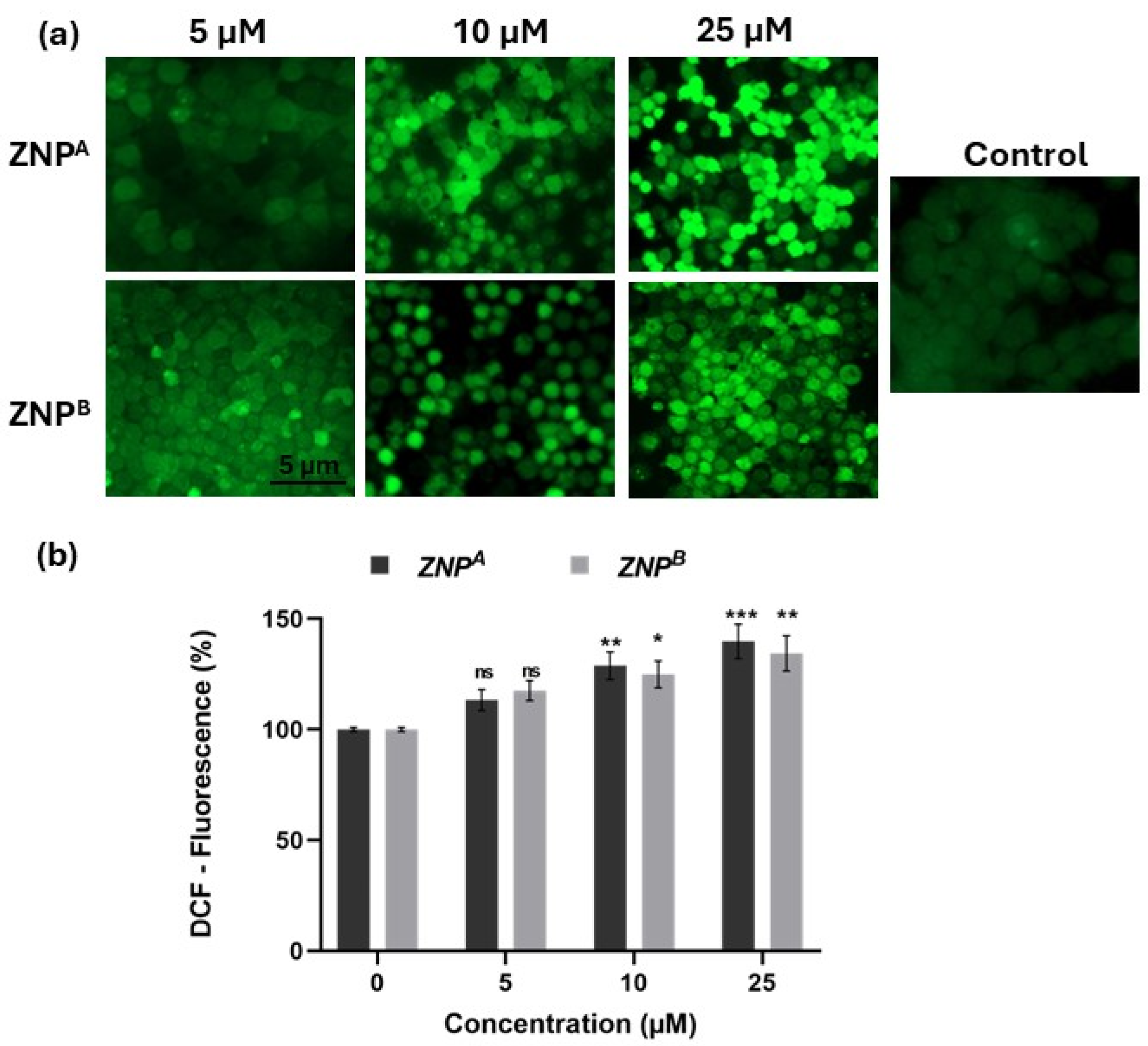
To address this issue, the authors have repeated the experiments under identical conditions and provided new, original, uncropped images for Figure 8. The corrected Figure 8 appears below.
Figure 8.
(a) Photomicrographs showing intracellular ROS generation in human epidermoid carcinoma A431 cell lines induced by control, 5 μM, 10 μM, and 25 μM concentrations of zinc oxide nanoparticles after 2 weeks for ZNPA and 10 weeks for ZNPB, respectively, after 12 h incubation and staining with DCFH-DA. Scale bar = 50 μm. (b) Graph showing extent of ROS generation expressed as the percentage of fluorescence intensity relative to the control. Values are expressed as mean ± SEM of at least three independent experiments. * p < 0.01, ** p < 0.001, *** p < 0.0001, as compared with their respective control (ns, non-significant).
The authors state that the scientific conclusions are unaffected. This correction was approved by the Academic Editor. The original publication has also been updated.
References
- Alhoqail, W.A.; Alothaim, A.S.; Suhail, M.; Iqbal, D.; Kamal, M.; Asmari, M.M.; Jamal, A. Husk-like Zinc Oxide Nanoparticles Induce Apoptosis through ROS Generation in Epidermoid Carcinoma Cells: Effect of Incubation Period on Sol-Gel Synthesis and Anti-Cancerous Properties. Biomedicines 2023, 11, 320. [Google Scholar] [CrossRef] [Scilit] [PubMed]
- Aljohar, A.Y.; Muteeb, G.; Zia, Q.; Siddiqui, S.; Aatif, M.; Farhan, M.; Khan, M.F.; Alsultan, A.; Jamal, A.; Alshoaibi, A.; et al. Anticancer Effect of Zinc Oxide Nanoparticles Prepared by Varying Entry Time of Ion Carriers against A431 Skin Cancer Cells In Vitro. Front. Chem. 2022, 10, 1069450. [Google Scholar] [CrossRef] [Scilit] [PubMed]
Disclaimer/Publisher’s Note: The statements, opinions and data contained in all publications are solely those of the individual author(s) and contributor(s) and not of MDPI and/or the editor(s). MDPI and/or the editor(s) disclaim responsibility for any injury to people or property resulting from any ideas, methods, instructions or products referred to in the content. |
© 2026 by the authors. Licensee MDPI, Basel, Switzerland. This article is an open access article distributed under the terms and conditions of the Creative Commons Attribution (CC BY) license.