


Abstract
Sepsis, characterized by life-threatening organ dysfunction due to a maladaptive host response to infection, and its more severe form, septic shock, pose significant global health challenges. The incidence of these conditions is increasing, highlighting the need for effective treatment strategies. This review explores the complex pathophysiology of sepsis, emphasizing the role of the endothelium and the therapeutic potential of corticosteroids. The endothelial glycocalyx, critical in maintaining vascular integrity, is compromised in sepsis, leading to increased vascular permeability and organ dysfunction. Corticosteroids have been used for over fifty years to treat severe infections, despite ongoing debate about their efficacy. Their immunosuppressive effects and the risk of exacerbating infections are significant concerns. The rationale for corticosteroid use in sepsis is based on their ability to modulate the immune response, promote cardiovascular stability, and potentially facilitate organ restoration. However, the evidence is mixed, with some studies suggesting benefits in terms of microcirculation and shock reversal, while others report no significant impact on mortality or organ dysfunction. The Surviving Sepsis Campaign provides cautious recommendations for their use. Emerging research highlights the importance of genomic and transcriptomic analyses in identifying patient subgroups that may benefit from corticosteroid therapy, suggesting a move toward personalized medicine in sepsis management. Despite potential benefits, the use of corticosteroids in sepsis requires careful consideration of individual patient risk profiles, and further research is needed to optimize their use and integrate genomic insights into clinical practice. This review underscores the complexity of sepsis treatment and the ongoing need for evidence-based approaches to improve patient outcomes.
1. Introduction
Sepsis is recognized as a critical condition characterized by life-threatening organ dysfunction resulting from a maladaptive host response to infection. Septic shock is a more severe form of sepsis, distinguished by profound circulatory, cellular, and metabolic dysfunctions that significantly elevate mortality risk beyond that of sepsis alone [1]. These conditions are part of a growing global health crisis, presenting complex challenges for emergency physicians due to their rising incidence and the intricate interplay of pathophysiological, molecular, genetic, and clinical factors [2]. Since the initial consensus definition in 1991 (Sepsis-1), the global occurrence of sepsis and septic shock has been on an upward trajectory, with estimates indicating around 49 million sepsis cases and 11 million sepsis-related fatalities worldwide in 2017 [3].
Currently, the development of sepsis is understood to involve a complex interplay of numerous pro-inflammatory and anti-inflammatory mediators. Recent advances have also shed light on cellular changes specific to sepsis, with a growing emphasis on the role of microcirculation in the transition from sepsis to septic shock. In this framework, the endothelium emerges as a pivotal element in sepsis pathophysiology due to its critical functions in controlling microcirculation and regulating coagulation, as well as inflammatory and anti-inflammatory pathways [4,5]. The endothelial glycocalyx, made up of proteoglycans and glycoproteins, plays multiple roles, including acting as a physical barrier to control vascular permeability, facilitating leukocyte and platelet adhesion, and moderating inflammatory and anti-inflammatory responses. However, the structural integrity of the glycocalyx can be compromised—referred to as “glycocalyx shedding”—through exposure to oxidants, cytokines, exotoxins, and endotoxins from bacteria. This degradation leads to the migration of leukocytes across the endothelium and heightened vascular permeability, resulting in edema that increases interstitial pressure and exacerbates the impairment of tissue perfusion [6].
2. Corticosteroids as a Therapeutic Option
Over fifty years since the inaugural randomized, controlled trial examining use of corticosteroids for severe infections, their widespread use among physicians continues despite significant disagreements among experts regarding their risk-to-benefit ratio [7]. The widespread and enduring use of corticosteroids in treating severe infections can be attributed to the immediate and observable improvement in critical conditions like shock and respiratory failure observed in clinical settings. The ongoing debate among experts over the use of corticosteroids is not driven by new scientific evidence but by differing interpretations of existing data.
Corticosteroids are recognized for their extensive immunosuppressive properties, which can elevate the risk of infectious complications for patients. Moreover, stress often triggers an immediate surge in inflammatory mediators, leading to a systemic inflammatory response and significant suppression of the immune system [8].
The Rationale for Using Corticosteroids
- -
- Overactivity of proinflammatory pathways relative to endogenous glucocorticoid activity
Experts widely agree that uncontrolled systemic inflammation is a fundamental aspect of severe sepsis, significantly influencing the advancement of organ failure and death. The management of inflammation involves a complex interaction between the neuroendocrine and immune systems [9]. On a microscopic scale, equilibrium within the body is maintained through the interplay of two dynamic systems. The nuclear factor kappa B (NF-κB) pathway triggers the release of substances that promote inflammation, while the synergy between glucocorticoids and the glucocorticoid receptor alpha (G-GRα) complex serves to suppress inflammatory reactions [10]. In all cells, these processes are typically dormant; the NF-κB pathway is restrained by its inhibitor, inhibitory factor kappa B (I-κB), and regulation of the G-GRα complex is achieved by maintaining an equilibrium between its alpha and beta forms. When these systems successfully counteract each other, stability is preserved. Nonetheless, an inclination toward the activation of NF-κB may result in uncontrolled inflammation [10,11].
In cases of extended acute respiratory distress syndrome or septic shock in patients, a disproportion has been observed, with NF-κB being excessively active about the G-GRα complex. This imbalance is recognized as a contributing element to the damage of cells, tissues, and organs. The root reasons for adrenal insufficiency during critical illnesses have been extensively investigated in separate research [12]. Influences including drugs that alter cortisol metabolism, harm to the hypothalamic–pituitary–adrenal axis, and stimulation of the inducible nitric oxide synthase (iNOS) enzyme through cytokines contribute to the death of neuroendocrine cells. This sequence of events subsequently leads to a decreased responsiveness to ACTH (adrenocorticotropic hormone) and glucocorticoids. It has been noted that people who overcome critical illnesses typically regain normal endocrine function within a few weeks to months following their hospital discharge [12].
- -
- Molecular mechanisms through which glucocorticoids act align seamlessly with the underlying pathological processes of sepsis
Glucocorticoids function via both genomic and non-genomic pathways. The non-genomic effects, manifesting within minutes after exposure to glucocorticoids, include decreased platelet aggregation and cell adhesion, reduced activity of intracellular phosphotyrosine kinases, and increased expression of annexin 1 on the cell surface [13]. The rapid effects are believed to result from glucocorticoids interacting with locations on the cell membrane. Conversely, the genomic activities of glucocorticoids are generally divided into two categories: transrepression and transactivation effects [14]. The prevailing view is that glucocorticoids primarily modulate rather than simply suppress immune cell function [15].
Microarray studies have shown that exposure to glucocorticoids activates a greater number of genes than it represses, highlighting their intricate impact on gene expression. Further research has also demonstrated that glucocorticoids encourage the development of specific anti-inflammatory monocyte subtypes, which rapidly migrate to areas of inflammation. Moreover, glucocorticoids extend the survival of these monocytes by activating anti-apoptotic pathways through the A3 adenosine receptor. This detailed function of glucocorticoids in regulating immune responses proves particularly advantageous in controlling the excessive inflammation seen in sepsis [16,17].
- -
- Cardiovascular stability in sepsis
Corticosteroids facilitate the retention of sodium by affecting both mineralocorticoid and glucocorticoid receptors, a process that helps to combat the hypovolemia observed in the early phases of sepsis. Moreover, corticosteroids contribute to the retention of sodium and water within the blood vessel walls, which increases systemic vascular resistance. Through non-genomic actions, corticosteroids can quickly boost the responsiveness of blood vessels to alpha agonists in a matter of minutes to hours, leading to elevated mean arterial pressure and systemic vascular resistance [18]. Corticosteroids also contribute to blocking ATP-dependent potassium channels. Their ability to dampen the gene expression for iNOS and cyclooxygenase II helps to maintain an enhanced response to catecholamines for an extended period, spanning several days. The successful reinstatement of vascular responsiveness to vasopressors might be intricately linked to the degree of disparity in the activities of NF-κB and the G-GRα complex [19]. Administering moderate doses of hydrocortisone in septic shock patients led to improved capillary density and blood flow, effects that were observed as soon as one hour after treatment [20]. The improvement in microcirculation is believed to stem from heightened activity of the endothelial form of nitric oxide synthase, facilitated by a mechanism involving the mitogen-activated protein kinase/Akt pathway [21]. Moreover, corticosteroids might play a role in restoring the inherent fluctuations present in the cardiovascular system [22].
- -
- Organ restoration and ICU length of stay
In septic shock patients, glucocorticoids were found to suppress the release of tumor necrosis factors from vascular and smooth muscle tissues [23]. Additionally, by the fifth day of administering hydrocortisone, there was a total inhibition of NF-κB activity in peripheral mononuclear cells. Corticosteroids have proven successful in diminishing renal iNOS activity after endotoxemia, aiding in the prevention of hypoxic injury to the kidney cortex, improving oxygen supply to the kidneys, and ultimately normalizing the use of oxygen by the kidneys [24]. Similarly, corticosteroids have been shown to enhance the permeability of the glomerular endothelium in septic shock patients [25]. Corticosteroids have a beneficial effect on the cardiovascular, pulmonary, hepatic, and renal systems. Consequently, patients undergoing corticosteroid treatment may rapidly transition off vasopressor support and mechanical ventilation, facilitating their earlier release from the intensive care unit [26].
Although so much evidence about the good side of corticosteroids is to be found in the literature, their administration in sepsis or septic shock is not yet convincing. The latest guidelines from the Surviving Sepsis Campaign for the use of corticosteroids in adults with septic shock recommend intravenous hydrocortisone at a daily dosage of 200 mg. This dosage is typically delivered as 50 mg, given intravenously every 6 h or through a continuous infusion. It is recommended to start this corticosteroid treatment at least 4 h after the initiation of norepinephrine or epinephrine, at a dose of ≥0.25 mcg/kg/min in adults. This is categorized as a weak recommendation with a moderate quality of evidence [2].
This review’s objective is to present the current evidence, based on thoroughly conducted and extensive studies, on the use of corticosteroids in sepsis and septic shock with the scope of creating a clearer image of their use in septic and septic shock patients.
3. Materials and Method
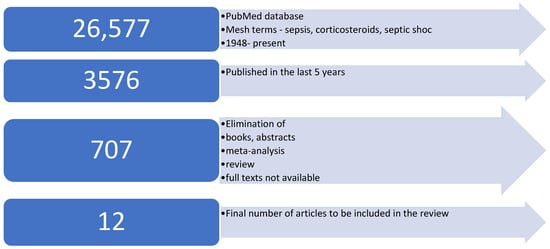
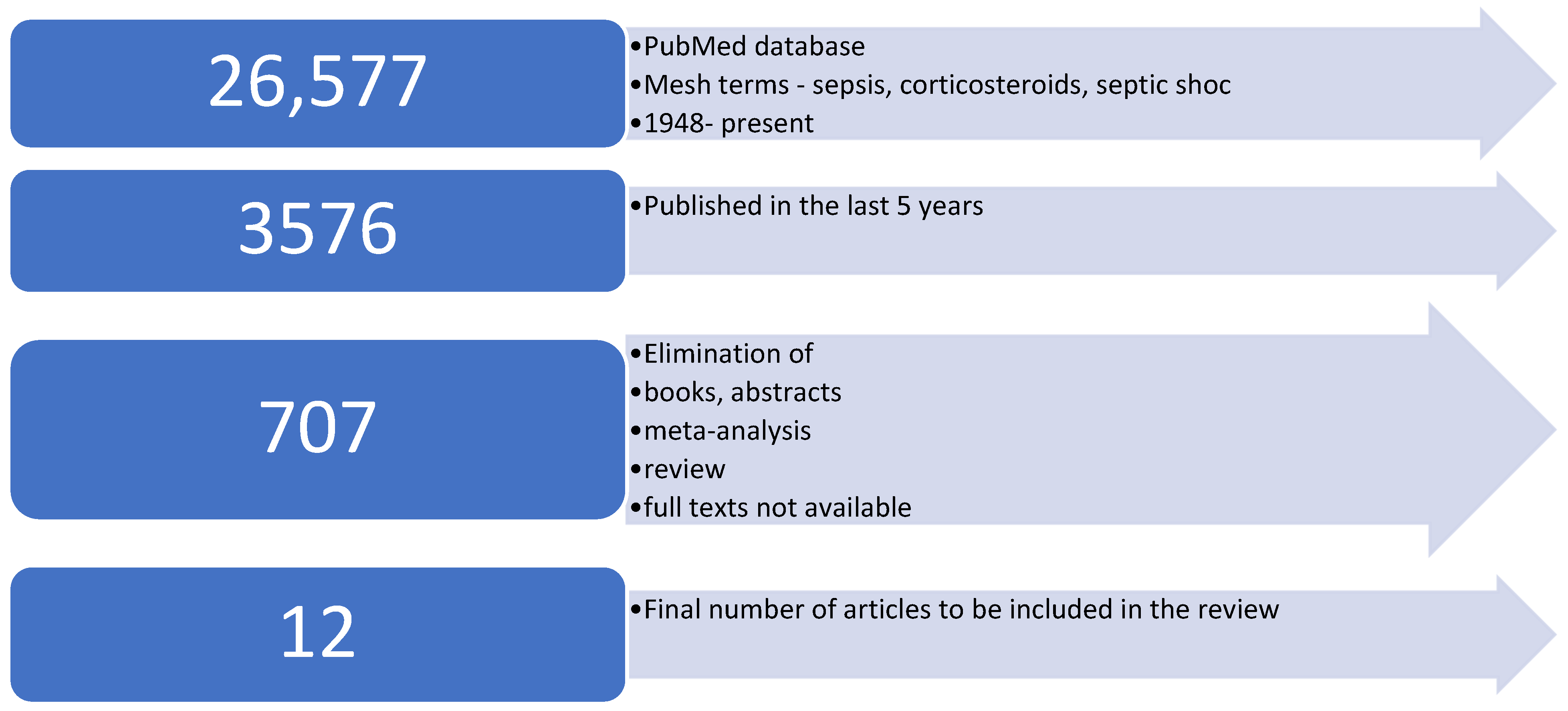
For the study research, the PubMed database was searched using the MesH terms “sepsis”, septic shock”, and “corticosteroids”. The search retrieved 26,577 results, which, after applying filters such as being published in the last five years, randomized controlled studies, exclusion of books, abstracts, and no free full text available, written in a language other than English, as well as reviews and meta-analyses, were narrowed to 12 multicentric, randomized control studies. The flow chart below presents the study’s search process (Figure 1).
Figure 1.
Flow chart of the study’s search process.
The data processed from the final included articles were as follows: if the study was multicentric, the number of patients included, the intervention, the main results, and the conclusions of the study.
4. Results
Our findings are presented in Table 1.
Table 1.
The findings of this study.
The dosages of the corticosteroid treatments and their duration from the selected studies are presented below in Table 2.
Table 2.
Corticosteroid treatment in the selected studies—dose and duration of treatment.
5. Discussion
While corticosteroids are considered for use in certain cases of sepsis and septic shock, their administration is treated with caution due to the possibility of adverse effects, increased risk of exacerbating infections, and unpredictable reactions among individual patients. The decision to employ corticosteroids in treating sepsis requires a nuanced assessment of the potential advantages and dangers for each patient. Corticosteroids, which are potent anti-inflammatory agents, can adjust the immune system’s response. Given the severity of sepsis—a critical, life-endangering reaction to infection that may cause tissue harm, organ failure, and mortality—the application of corticosteroids has sparked significant discussion and investigation.
Some of the reasons for which corticosteroids are included in the last line of sepsis, aspects which constitute the disadvantages of their use in septic shock, include:
- -
- Corticosteroids can suppress the immune system. In the setting of sepsis, where the body is fighting a severe infection, further suppression of the immune response may be counterproductive, potentially allowing the underlying infection to worsen [41].
- -
- Due to their immunosuppressive effects, corticosteroids can increase the risk of secondary infections, which can complicate or exacerbate the patient’s condition [42].
- -
- Corticosteroids can increase blood sugar levels, which could complicate the management of septic patients, especially those with diabetes or those who develop stress-induced hyperglycemia because of their critical illness. One detail is very important about this statement, namely that most of these glucose level impairments related to corticosteroids in septic patients appear mainly when boluses are administered [43].
- -
- They can also cause fluid retention and electrolyte imbalance, potentially exacerbating sepsis-induced organ dysfunction, such as acute kidney injury [44].
6. Different Combinations of Corticosteroids
Despite the theoretical benefits of corticosteroids, vitamin C, and thiamine combination therapy, including anti-inflammatory and antioxidant properties and the potential to preserve endothelial function, the trials found no significant difference in primary outcomes like the change in the SOFA score at 72 h or secondary outcomes such as kidney failure, 30-day mortality, ventilator-free days, and ICU-free days between the intervention and placebo groups. However, the intervention group did have a statistically significant increase in the number of shock-free days compared to the placebo group [31,35,36].
These trials highlight the ongoing debate regarding the utility of ascorbic acid, hydrocortisone, and thiamine in septic shock treatment. Despite initial enthusiasm based on smaller, single-center studies, larger multicenter trials have not demonstrated a significant benefit in reducing organ failure, mortality, or other critical outcomes with this triple therapy therapy. The only consistent finding across trials has been a reduction in the duration of vasopressor support, suggesting a potential role for triple therapy in specific patient subgroups or phenotypes, rather than a universal treatment for all septic shock patients [27,28,29].
The study by Marik et al. published in Chest in June 2017 investigated the effects of a combination treatment involving hydrocortisone, vitamin C, and thiamine on patients with severe sepsis and septic shock. This retrospective before–after study involved comparing the outcomes of 47 consecutive septic patients treated with this combination therapy against 47 historical control patients who received standard of care.
The main findings of the study were significant. The treatment group that received the combination therapy showed a remarkable reduction in mortality compared to the control group (8.5% vs. 40.4%). Furthermore, the patients treated with the combination therapy also demonstrated a reduction in the duration of vasopressor administration, indicating an improvement in vascular responsiveness.
The authors concluded that the administration of hydrocortisone, vitamin C, and thiamine appears to be safe and could lead to a significant reduction in mortality in patients with severe sepsis and septic shock. However, they also suggested that these findings should be validated by randomized controlled trials to confirm the efficacy and safety of this treatment approach [45].
These results underscore the complexity of treating septic shock and the importance of ongoing research to refine and discover effective therapies. Current evidence does not support the widespread use of triple therapy to improve mortality or organ dysfunction in septic shock [27,28,29,31,35,36]. Future trials may provide further insight into whether there are specific patient populations who could benefit from this therapy.
7. Genomics in Sepsis Treatment
An emerging source of significant results in corticoid use in sepsis appears to be genomic subtyping and treatment personalization [33,39]. Wong HR et al. focused on a crucial component of personalized medicine in treating sepsis, especially in cases of septic shock. Their study examined the impact of corticosteroids on patients identified with a particular endotype of septic shock, known as endotype A,. This focus emphasizes the growing recognition and significance of genomics in the treatment of sepsis, showcasing how personalized healthcare strategies are becoming increasingly important in managing this complex condition [33].
The study by Wong and colleagues marks an important advancement in the treatment of sepsis, offering critical perspectives on the utilization of genomic data to enhance patient results. It underscores the shift toward a personalized treatment paradigm in sepsis management, emphasizing the importance of considering an individual’s genetic profile to refine therapeutic approaches. This investigation illuminates both the promising advantages of personalized medicine and the obstacles and factors that need attention as genomics increasingly influences clinical decisions in sepsis and beyond [33].
The research presented by Antcliffe and colleagues represents a significant step forward in the application of genomic technologies in sepsis treatment. By demonstrating how transcriptomic profiles can differentiate responses to corticosteroids among sepsis patients, this work paves the way for more personalized, effective, and safe treatment strategies [39]. This research utilized data from the VANISH (Vasopressin vs. Norepinephrine as Initial Therapy in Septic Shock) randomized trial to examine how genomic technologies, especially transcriptomics, might redefine sepsis management, with a focus on corticosteroid administration [40]. The research uncovered distinct transcriptomic patterns in sepsis patients, linking these patterns to variations in how individuals respond to corticosteroid treatments. These findings provide valuable insight into the biological mechanisms and pathways that are activated in sepsis and their interaction with treatment methods.
The study highlights the capacity of transcriptomics to personalize corticosteroid therapy for sepsis patients. Identifying patients likely to respond favorably to corticosteroids through their transcriptomic profile allows for more precise medical decisions, potentially enhancing patient outcomes and minimizing negative side effects [39].
Transcriptomic analyses shed light on the specific ways in which corticosteroids affect patients with septic shock, offering a clearer understanding of the drugs’ biological actions. Such insight could guide the discovery of biomarkers for treatment prediction and the development of novel treatment avenues.
8. Conclusions
Recent advancements underscore a move toward individualized medicine in managing sepsis, highlighting the potential of genomic and transcriptomic analyses to inform more customized treatment approaches. Such insight could significantly enhance patient outcomes by identifying those who are likely to benefit from corticosteroid therapy and those who may face detrimental effects. However, integrating genomic personalization into clinical practice faces considerable challenges, including the need for rapid, accurate genomic assessments and the creation of clinical protocols to effectively use genomic information.
There is a pressing call for additional studies to validate and expand the use of genomic and transcriptomic data in guiding therapeutic decisions for sepsis and septic shock. This includes exploring further genomic indicators and omics techniques to improve the customization of care and patient outcomes.
In essence, while corticosteroids are crucial in treating sepsis and septic shock, their use requires careful consideration of potential benefits against risks. The introduction of genomic technologies offers the promise of treatment plans tailored to individual patients, yet fully realizing this potential necessitates ongoing research and overcoming current barriers to implementation.
Funding
This research received no funding.
Data Availability Statement
Data sharing is not applicable.
Conflicts of Interest
The author declares no conflicts of interest.
References
- Singer, M.; Deutschman, C.S.; Seymour, C.W.; Shankar-Hari, M.; Annane, D.; Bauer, M.; Bellomo, R.; Bernard, G.R.; Chiche, J.-D.; Coopersmith, C.M.; et al. The Third International Consensus Definitions for Sepsis and Septic Shock (Sepsis-3). JAMA 2016, 315, 801–810. [Google Scholar] [CrossRef] [Scilit] [PubMed]
- Evans, L.; Rhodes, A.; Alhazzani, W.; Antonelli, M.; Coopersmith, C.M.; French, C.; Machado, F.R.; Mcintyre, L.; Ostermann, M.; Prescott, H.C.; et al. Surviving sepsis campaign: International guidelines for management of sepsis and septic shock 2021. Intensive Care Med. 2021, 47, 1181–1247. [Google Scholar] [CrossRef] [Scilit] [PubMed]
- Chiu, C.; Legrand, M. Epidemiology of sepsis and septic shock. Curr. Opin. Anaesthesiol. 2021, 34, 71–76. [Google Scholar] [CrossRef] [Scilit] [PubMed]
- Piechota, M.; Banach, M.; Irzmanski, R.; Barylski, M.; Piechota-Urbanska, M.; Kowalski, J.; Pawlicki, L. Plasma endothelin-1 levels in septic patients. J. Intensive Care Med. 2007, 22, 232–239. [Google Scholar] [CrossRef] [Scilit] [PubMed]
- Ince, C. The microcirculation is the motor of sepsis. Crit. Care 2005, 9, S13–S19. [Google Scholar] [CrossRef] [Scilit] [PubMed]
- Belousoviene, E.; Kiudulaite, I.; Pilvinis, V.; Pranskunas, A. Links between Endothelial Glycocalyx Changes and Microcirculatory Parameters in Septic Patients. Life 2021, 11, 790. [Google Scholar] [CrossRef] [Scilit]
- Hahn, E.O.; Houser, H.B.; Rammelkamp, C.H.; Denny, F.W.; Wannamaker, L.W. Effect of cortisone on acute streptococcal infections and post-streptococcal complications. Effect of cortisone on acute streptococcal infections and post-streptococcal complications. J. Clin. Investig. 1951, 30, 274–281. [Google Scholar] [CrossRef] [Scilit] [PubMed]
- Britt, R.C.; Devine, A.; Swallen, K.C.; Weireter, L.J.; Collins, J.N.; Cole, F.J.; Britt, L.D. Corticosteroid Use in the Intensive Care Unit: At What Cost? Arch. Surg. 2006, 141, 145–149. [Google Scholar] [CrossRef] [Scilit] [PubMed]
- Tracey, K.J. Physiology and immunology of the cholinergic antiinflammatory pathway. J. Clin. Investig. 2007, 117, 289–296. [Google Scholar] [CrossRef] [Scilit]
- Barnes, P.J.; Karin, M. Nuclear factor-kappaB: A pivotal transcription factor in chronic inflammatory diseases. N. Engl. J. Med. 1997, 336, 1066–1071. [Google Scholar] [CrossRef] [Scilit]
- Kashiwabara, M.; Miyashita, M.; Nomura, T.; Makino, H.; Matsutani, T.; Kim, C.; Takeda, S.; Yamashita, K.; Chaudry, I.H.; Tajiri, T. Surgical trauma-induced adrenal insufficiency is associated with postoperative inflammatory responses. J. Nippon. Med. Sch. 2007, 74, 274–283. [Google Scholar] [CrossRef] [Scilit] [PubMed]
- Prigent, H.; Maxime, V.; Annane, D. Science review: Mechanisms of impaired adrenal function in sepsis and molecular actions of glucocorticoids. Crit. Care 2004, 8, 243–252. [Google Scholar] [CrossRef] [Scilit] [PubMed]
- Moraes, L.A.; Paul-Clark, M.J.; Rickman, A.; Flower, R.J.; Goulding, N.J.; Perretti, M. Ligand-specific glucocorticoid receptor activation in human platelets. Blood 2005, 106, 4167–4175. [Google Scholar] [CrossRef] [Scilit] [PubMed]
- Rhen, T.; Cidlowski, J.A. Antiinflammatory action of glucocorticoids: New mechanisms for old drugs. N. Engl. J. Med. 2005, 353, 1711–1723. [Google Scholar] [CrossRef] [Scilit] [PubMed]
- Ehrchen, J.; Steinmüller, L.; Barczyk, K.; Tenbrock, K.; Nacken, W.; Eisenacher, M. Glucocorticoids induce differentiation of a specifically activated, anti-inflammatory subtype of human monocytes. Blood 2007, 109, 1265–1274. [Google Scholar] [CrossRef] [Scilit] [PubMed]
- Barczyk, K.; Ehrchen, J.; Tenbrock, K.; Ahlmann, M.; Kneidl, J.; Viemann, D.; Roth, J. Glucocorticoids promote survival of anti-inflammatory macrophages via stimulation of adenosine receptor A3. Blood 2010, 116, 446–455. [Google Scholar] [CrossRef] [Scilit]
- Varga, G.; Ehrchen, J.; Tsianakas, A.; Tenbrock, K.; Rattenholl, A.; Seeliger, S.; Mack, M.; Roth, J.; Sunderkoetter, C. Glucocorticoids induce an activated, anti-inflammatory monocyte subset in mice that resembles myeloid-derived suppressor cells. J. Leukoc. Biol. 2008, 84, 644–650. [Google Scholar] [CrossRef] [Scilit]
- Boyer, A.; Chadda, K.; Salah, A.; Annane, D. Glucocorticoid treatment in patients with septic shock: Effects on vasopressor use and mortality. Int. J. Clin. Pharmacol. Ther. 2006, 44, 309–318. [Google Scholar] [CrossRef] [Scilit]
- Bianca, R.D.D.V.; Lippolis, L.; Autore, G.; Popolo, A.; Marzocco, S.; Sorrentino, L.; Pinto, A.; Sorrentino, R. Dexamethasone improves vascular hyporeactivity induced by LPS in vivo by modulating ATP-sensitive potassium channels activity. Br. J. Pharmacol. 2003, 140, 91–96. [Google Scholar] [CrossRef] [Scilit]
- Büchele, G.L.; Silva, E.; Ospina-Tascón, G.A.; Vincent, J.L.; De Backer, D. Effects of hydrocortisone on microcirculatory alterations in patients with septic shock. Crit. Care Med. 2009, 37, 1341–1347. [Google Scholar] [CrossRef] [Scilit]
- Hafezi-Moghadam, A.; Simoncini, T.; Yang, Z.; Limbourg, F.P.; Plumier, J.-C.; Rebsamen, M.C.; Hsieh, C.-M.; Chui, D.-S.; Thomas, K.L.; Prorock, A.J.; et al. Acute cardiovascular protective effects of corticosteroids are mediated by non-transcriptional activation of endothelial nitric oxide synthase. Nat. Med. 2002, 8, 473–479. [Google Scholar] [CrossRef] [Scilit] [PubMed]
- Aboab, J.; Polito, A.; Orlikowski, D.; Sharshar, T.; Castel, M.; Annane, D. Hydrocortisone effects on cardiovascular variability in septic shock: A spectral analysis approach. Crit. Care Med. 2008, 36, 1481–1486. [Google Scholar] [CrossRef] [Scilit] [PubMed]
- Newman, W.H.; Zhang, L.M.; Leeper-Woodford, S.K.; Shaker, I.J.; Erceg, S.K.; Castresana, M.R. Inhibition of release of tumor necrosis factor-alpha from human vascular tissue and smooth muscle cells by glucocorticoids. Crit. Care Med. 1997, 25, 519–522. [Google Scholar] [CrossRef] [Scilit] [PubMed]
- Johannes, T.; Mik, E.G.; Klingel, K.; Dieterich, H.J.; Unertl, K.E.; Ince, C. Low-dose dexamethasone-supplemented fluid resuscitation reverses endotoxin-induced acute renal failure and prevents cortical microvascular hypoxia. Shock 2009, 31, 521–528. [Google Scholar] [CrossRef] [Scilit] [PubMed]
- Rinaldi, S.; Adembri, C.; Grechi, S.; De Gaudio, R. Low-dose hydrocortisone during severe sepsis: Effects on microalbuminuria. Crit. Care Med. 2006, 34, 2334–2339. [Google Scholar] [CrossRef] [Scilit] [PubMed]
- Annane, D. Corticosteroids for severe sepsis: An evidence-based guide for physicians. Ann. Intensive Care 2011, 13, 7. [Google Scholar] [CrossRef] [Scilit] [PubMed]
- Schlapbach, L.J.; Raman, S.; Buckley, D.; George, S.; King, M.; Ridolfi, R.; Harley, A.; Cree, M.; Long, D.; Erickson, S.; et al. Resuscitation With Vitamin C, Hydrocortisone, and Thiamin in Children With Septic Shock: A Multicenter Randomized Pilot Study. Pediatr. Crit. Care Med. 2024, 25, 159–170. [Google Scholar] [CrossRef] [Scilit] [PubMed]
- Mohamed, A.; Abdelaty, M.; Saad, M.O.; Shible, A.; Mitwally, H.; Akkari, A.-R.; Elbuzidi, A.; Bintaher, A.; Hashim, A.; Abdelrahim, M.; et al. Evaluation of hydrocortisone, vitamin c, and thiamine for the treatment of septic shock: A randomized controlled trial (THE HYVITS TRIAL). Shock 2023, 1, 697–701. [Google Scholar] [CrossRef] [Scilit] [PubMed]
- Wang, J.; Song, Q.; Yang, S.; Wang, H.; Meng, S.; Huang, L.; Li, Q.; Xu, J.; Xie, J.; Huang, Y. Effects of hydrocortisone combined with vitamin C and vitamin B1 versus hydrocortisone alone on microcirculation in septic shock patients: A pilot study. Clin. Hemorheol. Microcirc. 2023, 84, 111–123. [Google Scholar] [CrossRef]
- Briegel, J.; Möhnle, P.; Keh, D.; Lindner, J.M.; Vetter, A.C.; Bogatsch, H.; Lange, D.; Frank, S.; Hinske, L.C.; Annane, D.; et al. SepNet Critical Care Trials. Corticotropin-stimulated steroid profiles to predict shock development and mortality in sepsis: From the HYPRESS study. Crit. Care 2022, 7, 343. [Google Scholar] [CrossRef] [Scilit]
- Lyu, Q.Q.; Zheng, R.Q.; Chen, Q.H.; Yu, J.Q.; Shao, J.; Gu, X.H. Early administration of hydrocortisone, vitamin C, and thiamine in adult patients with septic shock: A randomized controlled clinical trial. Crit. Care 2022, 28, 295. [Google Scholar] [CrossRef] [Scilit] [PubMed]
- Group, COVID STEROID 2 Trial; Munch, M.W.; Myatra, S.N.; Vijayaraghavan, B.K.T.; Saseedharan, S.; Benfield, T.; Wahlin, R.R.; Rasmussen, B.S.; Andreasen, A.S.; Poulsen, L.M.; et al. Effect of 12 mg vs 6 mg of Dexamethasone on the Number of Days Alive Without Life Support in Adults With COVID-19 and Severe Hypoxemia: The COVID STEROID 2 Randomized Trial. JAMA 2021, 326, 1807–1817. [Google Scholar] [PubMed]
- Wong, H.R.; Hart, K.W.; Lindsell, C.J.; Sweeney, T.E. External Corroboration That Corticosteroids May Be Harmful to Septic Shock Endotype A Patients. Crit. Care Med. 2021, 1, e98–e101. [Google Scholar] [CrossRef] [Scilit] [PubMed]
- Wong, H.R.; Cvijanovich, N.Z.; Anas, N.; Allen, G.L.; Thomas, N.J.; Bigham, M.T.; Weiss, S.L.; Fitzgerald, J.; Checchia, P.A.; Meyer, K.; et al. Developing a clinically feasible personalized medicine approach to pediatric septic shock. Am. J. Respir. Crit. Care Med. 2015, 191, 309–315. [Google Scholar] [CrossRef] [Scilit] [PubMed]
- Moskowitz, A.; Huang, D.T.; Hou, P.C.; Gong, J.; Doshi, P.B.; Grossestreuer, A.V.; Andersen, L.W.; Ngo, L.; Sherwin, R.L.; Berg, K.M.; et al. ACTS Clinical Trial. Effect of Ascorbic Acid, Corticosteroids, and Thiamine on Organ Injury in Septic Shock: The ACTS Randomized Clinical Trial. JAMA 2020, 324, 642–650. [Google Scholar] [CrossRef] [Scilit] [PubMed]
- Fujii, T.; Luethi, N.; Young, P.J.; Frei, D.R.; Eastwood, G.M.; French, C.J.; Deane, A.M.; Shehabi, Y.; Hajjar, L.A.; Oliveira, G.; et al. Effect of Vitamin C, Hydrocortisone, and Thiamine vs Hydrocortisone Alone on Time Alive and Free of Vasopressor Support Among Patients With Septic Shock: The VITAMINS Randomized Clinical Trial. JAMA 2020, 323, 423–431. [Google Scholar] [CrossRef] [Scilit] [PubMed]
- Thompson, K.J.; Taylor, C.B.; Venkatesh, B.; Cohen, J.; Hammond, N.E.; Jan, S.; Li, Q.; Myburgh, J.; Rajbhandari, D.; Saxena, M.; et al. The ADRENAL Management Committee and Investigators and the ANZICS Clinical Trials. The cost-effectiveness of adjunctive corticosteroids for patients with septic shock. Crit. Care Resusc. 2020, 22, 191–199. [Google Scholar] [PubMed]
- Venkatesh, B.; Finfer, S.; Cohen, J.; Rajbhandari, D.; Arabi, Y.; Bellomo, R.; Billot, L.; Glass, P.; Joyce, C.; Li, Q.; et al. Hydrocortisone Compared with Placebo in Patients with Septic Shock Satisfying the Sepsis-3 Diagnostic Criteria and APROCCHSS Study Inclusion Criteria: A Post Hoc Analysis of the ADRENAL Trial. Anesthesiology 2019, 131, 1292–1300. [Google Scholar] [CrossRef] [Scilit]
- Antcliffe, D.B.; Burnham, K.L.; Al-Beidh, F.; Santhakumaran, S.; Brett, S.J.; Hinds, C.J.; Ashby, D.; Knight, J.C.; Gordon, A.C. Transcriptomic Signatures in Sepsis and a Differential Response to Steroids. From the VANISH Randomized Trial. Am. J. Respir. Crit. Care Med. 2019, 99, 980–986. [Google Scholar] [CrossRef] [Scilit]
- Gordon, A.C.; Mason, A.J.; Thirunavukkarasu, N.; Perkins, G.D.; Cecconi, M.; Cepkova, M.; Pogson, D.G.; Aya, H.D.; Anjum, A.; Frazier, G.J.; et al. VANISH Investigators. Effect of early vasopressin vs norepinephrine on kidney failure in patients with septic shock: The VANISH randomized clinical trial. JAMA 2016, 316, 509. [Google Scholar] [CrossRef] [Scilit]
- Coutinho, A.E.; Chapman, K.E. The anti-inflammatory and immunosuppressive effects of glucocorticoids, recent developments and mechanistic insights. Mol. Cell Endocrinol. 2011, 15, 2–13. [Google Scholar] [CrossRef] [Scilit] [PubMed]
- Ritter, L.A.; Britton, N.; Heil, E.L.; Teeter, W.A.; Murthi, S.B.; Chow, J.H.; Ricotta, E.; Chertow, D.S.; Grazioli, A.; Levine, A.R. The Impact of Corticosteroids on Secondary Infection and Mortality in Critically Ill COVID-19 Patients. J. Intensive Care Med. 2021, 36, 1201–1208. [Google Scholar] [CrossRef] [Scilit] [PubMed]
- Loisa, P.; Parviainen, I.; Tenhunen, J.; Hovilehto, S.; Ruokonen, E. Effect of mode of hydrocortisone administration on glycemic control in patients with septic shock: A prospective randomized trial. Crit. Care 2007, 11, R21. [Google Scholar] [CrossRef] [Scilit]
- Imaizumi, T.; Nakatochi, M.; Fujita, Y.; Yamamoto, R.; Watanabe, K.; Maekawa, M.; Yamawaka, T.; Katsuno, T.; Maruyama, S. Glucocorticoid treatment is associated with ICU-acquired hypernatremia: A nested case–control study. Clin. Exp. Nephrol. 2021, 5, 131–139. [Google Scholar] [CrossRef] [Scilit] [PubMed]
- Marik, P.E.; Khangoora, V.; Rivera, R.; Hooper, M.H.; Catravas, J. Hydrocortisone, Vitamin C, and Thiamine for the Treatment of Severe Sepsis and Septic Shock: A Retrospective Before-After Study. Chest 2017, 151, 1229–1238. [Google Scholar] [CrossRef] [Scilit]

Disclaimer/Publisher’s Note: The statements, opinions and data contained in all publications are solely those of the individual author(s) and contributor(s) and not of MDPI and/or the editor(s). MDPI and/or the editor(s) disclaim responsibility for any injury to people or property resulting from any ideas, methods, instructions or products referred to in the content. |
© 2024 by the author. Licensee MDPI, Basel, Switzerland. This article is an open access article distributed under the terms and conditions of the Creative Commons Attribution (CC BY) license (https://creativecommons.org/licenses/by/4.0/).