


Abstract
Background: Lower urinary tract symptoms (LUTS) contribute to erectile dysfunction (ED) and premature ejaculation (PE). However, only a few studies have been conducted with representative groups of men that had well-balanced demographic characteristics. Thus, we aimed to confirm the effect of LUTS on ED and PE and to analyze the association between LUTS and men’s sexual activity in a large representative cohort. In addition, we evaluated the sex-specific and overall quality of life of men who had LUTS with either ED or PE. Methods: We used the latest census and estimated the sample size to build a group of men representative of the population. LUTS, ED, and PE were evaluated with reliable instruments. Regression models were used to analyze the data. Results: All included men were representative in relation to their age and residential location (n = 3001). ED and PE were more common in men who reported LUTS compared with men who did not have LUTS (p < 0.001). Age, comorbidity, and lifestyle did not affect the negative effect of LUTS on ED or PE (regression coefficients of 0.159 and 0.528 for ED and PE, respectively, p < 0.001). However, regression models did not validate the impact of LUTS on sexual activity, defined by intercourse frequency and number of sexual partners (odds ratio of 0.981, CI 0.961–1.001, p = 0.061). Nevertheless, men with LUTS and either ED or PE had worse quality of sexual life and general quality of life compared with the remaining respondents. Conclusion: LUTS worsened ED and PE but had no impact on men’s sexual activity. Our findings confirm the recommendations to assess for LUTS in men reporting ED or PE. Clinical Trial Registration: The study was registered with ClinicalTrials.gov (NCT05462171).
1. Introduction
Lower urinary tract symptoms (LUTS) refer to a group of symptoms that are not disease- or condition-specific. In men, LUTS are commonly associated with bladder outlet obstruction; however, LUTS may be related to other lower urinary tract functional and anatomical abnormalities whose prevalence increases with age. Although LUTS are not considered life-threatening, they negatively affect physical and mental health, work productivity, sleep, and health-related quality of life [1].
Many investigators report that LUTS are often associated with men’s sexual dysfunctions. The European Association of Urology (EAU) Guidelines on Sexual and Reproductive Health indicate that odds ratios (ORs) of erectile dysfunction (ED) among men with LUTS range from 1.52 to 28.7, with prevalence ranging from 58% to 80% [2]. Although the association of LUTS with premature ejaculation (PE) has received less scrutiny compared with LUTS and ED, Sihotang et al., in their recent systematic review with a meta-analysis, hypothesized that there is a correlation between LUTS and PE [3]. ED and PE are the most prevalent and the most stressful of men’s sexual dysfunctions [2,4]; thus, investigators and clinicians should accurately assess LUTS/ED/PE correlations because these conditions independently impair men’s quality of life and psychological well-being [5]. However, the current literature lacks high-quality research based on large representative pools of men with well-balanced demographic characteristics and instruments that are widely accepted and professionally validated for LUTS, ED, and PE assessments [3]. Although there are some population- and community-level investigations on LUTS/ED/PE, these studies were burdened by poor objectivity in the selection of participant characteristics. For example, some studies involved patients seeking treatment at hospitals and outpatient clinics for various medical conditions [6] or respondents who belonged to exclusive patient cohorts [7,8] and specific communities [9,10]. In addition, earlier studies were performed with non-validated instruments, e.g., studies based on only a single-item, self-reported question to assess PE [11,12]. Rigorous population-representative studies provide reliable estimates and precisely uncover significant correlations that may increase awareness to promote health and highlight the potential burden to society.
Considering the aforesaid issues, we aimed to evaluate the effect of LUTS on ED and PE and the association between LUTS and men’s sexual activity in a large population-representative group of men who completed reliable LUTS, ED, and PE questionnaires. In addition, we analyzed the quality of life, both sexual and general, of men who had ED with LUTS or PE with LUTS.
2. Methods
This study is an extension of the ED POLAND, a representative, population-based, cross-sectional survey of Polish men’s sexual health. The extension was devised by the EAU Young Academic Urologists Working Group on Functional Urology. All objectives of this extension were prespecified in the statistical analysis plan prior to conducting the survey. We adhered to prescribed recommendations and standards for conducting observational studies [13].
2.1. Overview
Because of the personal nature of the topic, we surveyed participants through computer-based web interviews. Notably, our population-based analyses with web-based solutions are valid because 93.3% of Polish households had Internet access in 2022, and there was no significant difference between urban and rural populations (data from Eurostat and the Central Statistical Office of Poland [14]). To construct a sample representative of the entire Polish population, we utilized data from the latest Polish population census (2021) and incorporated age and place of residence as quota controls [15]. We included men aged 18 years or older and living in all geographical regions of Poland (i.e., in all 16 states/voivodships with adequate proportions of respondents from urban and rural areas). All data were collected by IPSOS, a certified research agency with relevant expertise (OFBOR, ESOMAR, PKJBI, and PKJPA). The data collection process also included pilot web surveys with cognitive debriefing interviews (n = 200), regular stratification and quality-control checks, and calculations of post-stratification weights.
2.2. Measures
General demographic data were collected for all respondents.
Erectile dysfunction was assessed with the five-item International Index of Erectile Function (IIEF-5), the most used and reliable questionnaire for ED evaluation [2,16]. An IIEF-5 score of 16 or less was a referent for clinically significant ED, with additional analyses of standardized levels of ED severity based on the IIEF-5 score: 22–25, without ED; 17–21, mild ED; 12–16, mild to moderate ED; 8–11, moderate ED; and 5–7, severe ED (i.e., the lower the score, the greater the severity of symptoms).
Premature ejaculation was evaluated with the Premature Ejaculation Diagnostic Tool (PEDT), a valid measuring questionnaire that embraces the multidimensional nature of PE [2,17]. A PEDT score of 11 or more was a reference for clinically significant PE, with additional standardized scale cut-off points: ≤8, without PE; 9–10, probable presence of PE; and ≥11, presence of PE (i.e., the higher the score, the greater the severity of symptoms).
Lower urinary tract symptoms were investigated with the International Prostate Symptom Score (IPSS), the most widely used instrument that evaluates the severity of LUTS in men [18]. An IPSS value was further assigned to the specific level of standardized LUTS severity: 0, no symptoms; 1–7, mild symptoms; 8–19, moderate symptoms; and 20–35, severe symptoms (i.e., the greater the score, the greater the severity of symptoms).
These three surveys underwent thorough translation, adaptation, and validation into Polish [19,20,21], and they are addressed in the pertinent EAU guidelines [2,18].
To evaluate sexual activity, we inquired about the frequency of sexual intercourse and the number of sexual partners. As a guide for these questions, we used the US General Social Survey, a nationally representative review [22].
Lastly, we included questions on sexual life quality (“In the past 4 weeks, how were you satisfied with your sex life?”), on general quality of life (“If you were to spend the rest of your life in your current condition, how would you describe your overall well-being?”), and on relevant comorbidities and lifestyle habits.
2.3. Statistics
Quantitative (ordinal) variables were described using measures such as means, standard deviations, medians, minimum and maximum values (ranges), and a 95% confidence interval (CI). Qualitative (categorical) variables were presented as counts and percentages. For quantitative variables, nonparametric tests were used, such as Mann–Whitney or Kruskal–Wallis with Dunn’s post hoc test, if applicable. The chi-square test or Fisher’s exact test, if the expected counts were low, were used for qualitative variables. The sample size was determined using the age distribution of the population, as obtained from the most recent census [15], with the methodology utilized in other population-based studies focusing on men’s sexual health [23]. Briefly, we estimated the sample size based on the standard deviation in the population, the expected effect size and the drop-out rate, the acceptable level of significance and margins of error, the power of the study, and the hypothesized rate of the events in the population. In addition, we analyzed general recommendations from the recent Polish census for future large population-level studies. Lastly, the sample size was set to 3000 respondents, a size that afforded a 95% certainty that the survey results would be ±1–2% of the results had we surveyed the entire adult Polish population of men.
We employed linear regression models to assess the effect of LUTS on ED and PE, presenting the outcomes as regression coefficients along with a 95% CI. Logistic regression models were utilized to analyze the effect of LUTS on sexual activity, with results reported as ORs and a 95% CI. The dependent variable was ‘no sexual activity’ (i.e., no sexual intercourse in the prior 12 months). For both regression models, questionnaire results were included as raw data (raw scores).
A statistical significance level was set at p < 0.05. Data analysis was performed using R (version 4.3.0, The R Project for Statistical Computing, Vienna, Austria).
3. Results
This analysis was based on data for 3001 men, ensuring representation across different age groups and residential areas (response rate: 51.7%).
3.1. Effects of LUTS on ED and PE
We found a significant correlation between LUTS and ED. Erectile dysfunction was less common in men without LUTS compared with respondents who had LUTS (Table 1, Spearman’s rank correlation coefficient R = −0.34, p < 0.001). The different cut-offs of IIEF-5 confirmed the associations between LUTS and ED (Table 1, p < 0.001).
Table 1.
The effect of lower urinary tract symptoms (LUTS) on erectile dysfunction (ED) and premature ejaculation (PE).
Analogously, LUTS were significantly associated with PE. Premature ejaculation was less common in men without LUTS compared with men who reported LUTS (Table 1, Spearman’s rank correlation coefficient R = 0.34, p < 0.001). By employing various thresholds for PEDT, we substantiated the significant relation between LUTS and PE (Table 1, p < 0.001).
3.2. Age-Specific Effects of LUTS on ED and PE
With univariate linear regression, we analyzed the effects of LUTS on ED and PE in all age subgroups. For all age subgroups considered together, we found a significant association between LUTS and ED, with a regression coefficient of −0.224, i.e., a 1 point increase in the IPSS was reflected in an average 0.224 points decrease in the IIEF-5 score (Table 2). For each age subgroup, the regression coefficient was also statistically significant (Table 2).
Table 2.
The effect of lower urinary tract symptoms (LUTS) on erectile dysfunction (ED) and premature ejaculation (PE) by age groups (raw scores).
We found the same relation between LUTS and PE and calculated a regression coefficient of 0.592 when considering all age subgroups together, i.e., an increase in the IPSS score by 1 point corresponded to an average increase in the PEDT score of 0.592 points (Table 2). The regression coefficient for each specific age subgroup was also statistically significant (Table 2).
3.3. Age-, Comorbidity-, and Lifestyle-Adjusted Effects of LUTS on ED and PE
With multivariate linear regression, we observed statistically significant effects of LUTS on ED and PE after adjusting for age, comorbidities, and lifestyle habits (Table 3). For ED, the regression coefficient was −0.159, indicating that a 1 point increase in the IPSS resulted in an average decrease of 0.159 points in the IIEF-5 score. For PE, the regression coefficient was 0.528, meaning that a 1 point increase in the IPSS led to an average increase of 0.528 points in the PEDT score.
Table 3.
The effect of lower urinary tract symptoms (LUTS) on erectile dysfunction (ED) and premature ejaculation (PE)—multivariable linear regression.
3.4. Item-Specific Effects of LUTS on ED and PE
With additional multivariate linear regression, we investigated which items of the IPSS had effects on the IIEF-5 and PEDT scores (Table 4). The IIEF-5 score was negatively affected by feeling of incomplete emptying (item 1), intermittent stream (item 3), urgency (item 4), straining (item 5), and weak stream (item 6); frequency (item 2) and nocturia (item 7) did not affect the IIEF-5 scores. Items 1, 6, and 4 had the strongest effects on the IIEF-5 score, i.e., the highest absolute regression coefficients.
Table 4.
The effect of IPSS questions on the IIEF and PEDT scores.
The IPSS items 1 (feeling of incomplete emptying), 2 (frequency), 4 (urgency), and 5 (straining) had negative effects on the PEDT score, whereas items 3, 6, and 7 did not have any effects. The strongest effects on the PEDT score were observed with items 1, 5, and 4, defined as the highest absolute regression coefficient values.
3.5. Effect of LUTS on Sexual Activity
Lower urinary tract symptoms significantly correlated with the frequency of sexual intercourse. Men with LUTS were characterized by a significantly lower frequency of sexual intercourse compared with respondents who did not report LUTS (p = 0.001). On the contrary, we did not observe a correlation between LUTS and the number of sex partners (p = 0.544). Moreover, multivariate logistic regression failed to prove an effect of LUTS on men’s sexual activity (OR = 0.981, CI 0.961–1.001, p = 0.061).
3.6. Effects on the Quality of Sexual Life and on General Quality of Life
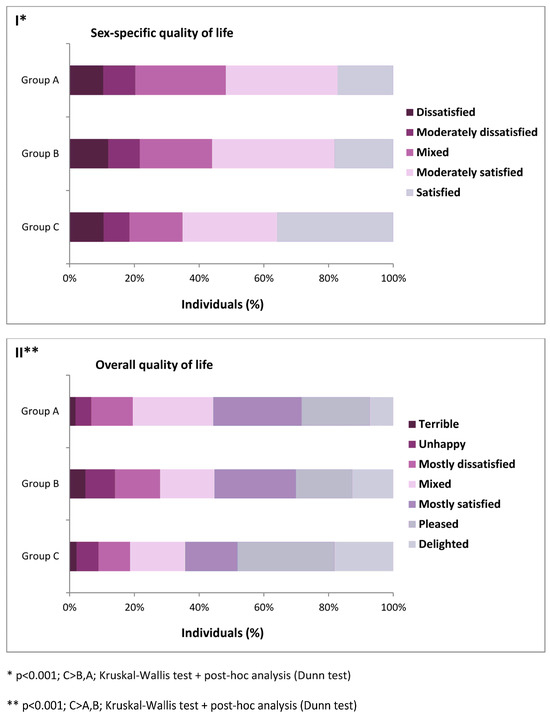
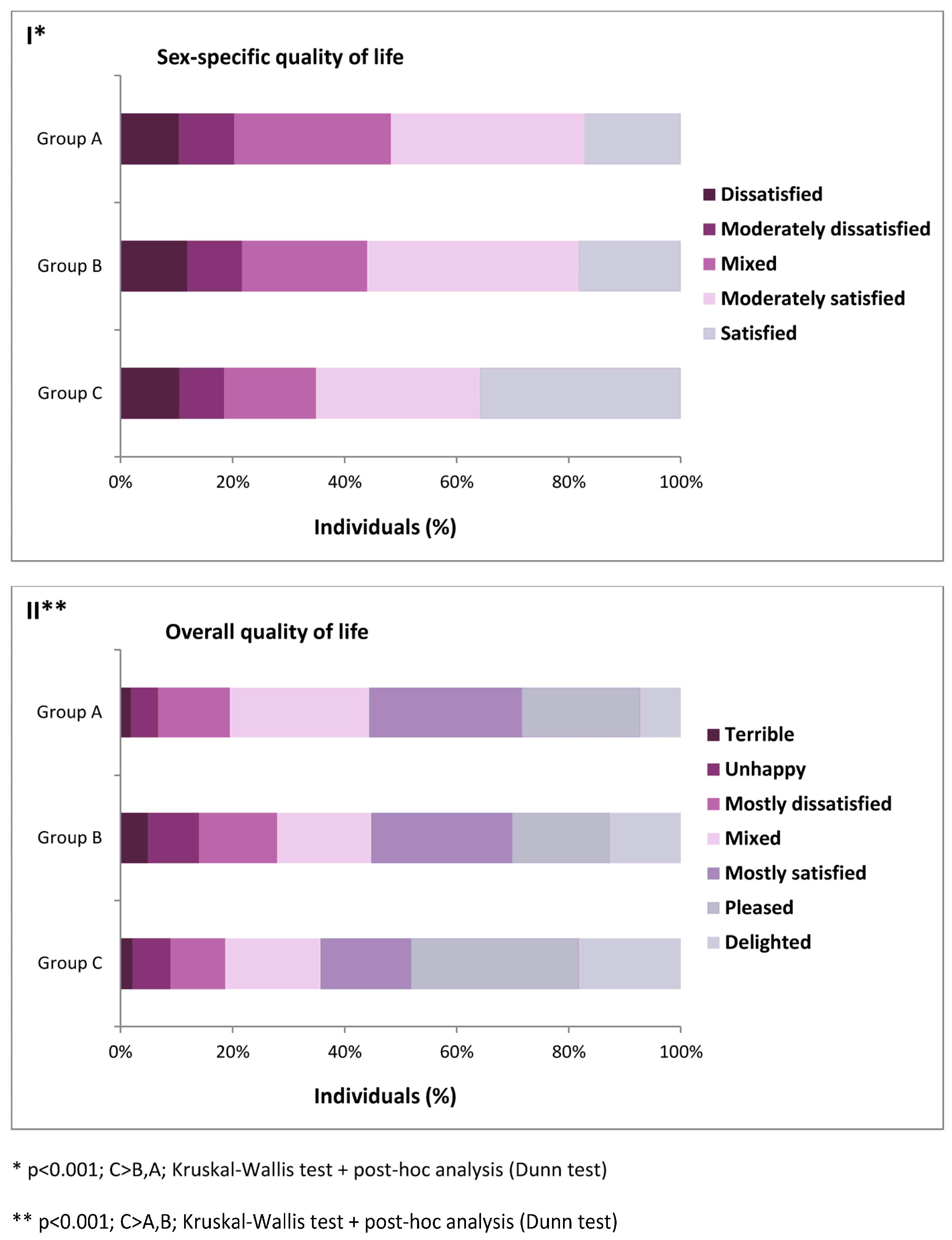
We investigated if coexisting LUTS and ED or LUTS and PE had negative effects on the quality of sexual life. Men with LUTS and ED or LUTS and PE had a worse quality of sexual life than the rest of the participants (Figure 1, p < 0.001).
Figure 1.
Correlation between lower urinary tract symptoms (LUTS), erectile dysfunction (ED), and premature ejaculation (PE), and sex-specific (I) and overall (II) quality of life (Group A—respondents with LUTS and ED; Group B—respondents with LUTS and PE; and Group C—remaining participants).
For overall quality of life, we observed similar correlations. Men experiencing both LUTS and ED or LUTS and PE exhibited lower overall quality of life in comparison to other participants (Figure 1, p < 0.001).
4. Discussion
In this analysis, we report high-quality population-level estimates of the effects of LUTS on men’s sexual health. Our data are of high quality because we surveyed a representative pool of men with well-balanced demographics; further, the participants completed reliable questionnaires for evaluation of LUTS, ED, and PE. In addition, our analysis included many covariates, mainly comorbidities and lifestyle habits.
Using regression models, we showed that LUTS significantly affected ED and PE. Essentially, the effects of LUTS on ED and PE remained significant after adjusting for age, comorbidities, and lifestyle factors. In addition, the coexistence of LUTS and ED or LUTS and PE decreased both the quality of sexual life and the general quality of life. However, LUTS did not have a significant effect on men’s sexual activity, as measured by the frequency of sexual intercourse and by the number of sexual partners.
There is a wealth of published data that supports a link between LUTS and ED, including studies that considered potential confounding factors and effect modifiers [24]. Population- and community-based studies that were conducted in different regions of the world, and that were based on different tools to evaluate LUTS and ED, have provided strong evidence of associations between LUTS and ED [25]. Some epidemiological analyses confirmed that the correlations between LUTS and ED were independent of age and comorbidities [6]. However, only a limited number of studies have focused on country-representative pools of respondents. The Multi-National Survey of the Ageing Male-7 (MSAM-7), conducted in the USA and in six European countries (France, Germany, Italy, the Netherlands, Spain, and the UK), is one of the first representative studies that analyzed the association between LUTS and ED. The study included 12,815 men, representative of the population aged 50–80 years in each country [5]. The study showed that ED was strongly related to LUTS and that this relation was independent of reported comorbidities. Shiri et al. surveyed 1716 men representative of the Finnish population and demonstrated that adjusted ORs of ED for men with LUTS were between 2.6 and 4.4 [26]. Other studies that were representative for specific communities but not for entire countries (e.g., Birmingham, UK; Boxmeer, Netherlands; Auxerre, France; Seoul, Korea; Cologne, Germany; and Boston, US) also showed that LUTS is an age-independent risk factor for developing ED [9,10,27]. Therefore, we must recognize that LUTS and ED affect people worldwide. Importantly, the occurrence of LUTS/ED appears mostly independent of environmental and genetic influences because those factors vary substantially between the locations in which LUTS/ED surveys have been conducted. Our study, performed with a representative group of the uniform Polish population, seems to support this hypothesis.
Investigators have assessed correlations between LUTS and PE to a far lesser degree compared with studies of LUTS and ED. A recent systematic review identified twelve studies on associations between LUTS and PE [3]. Although most of the twelve studies showed a significant relation between LUTS and PE, only one study was population-representative. Wein et al. analyzed the impact of LUTS on men’s sexual health in a group of 11,834 representative men who lived in the USA, UK, and Sweden [11]. Their regression models showed that LUTS were significantly associated with PE, but the authors underlined the fact that their PE model was less robust (with a concordance index of 0.62) than the other logistic regression analyses; therefore, the authors recommended caution in interpreting their results. Notably, the researchers assessed PE using solely a self-reported single-item question regarding ejaculation control. In our study with the PEDT, a well-known instrument with high specificity and sensitivity in detecting PE [2], we showed a significant correlation between LUTS and PE, and notably, the effect of LUTS on PE was not influenced by age, comorbidities, or lifestyle factors.
Although we observed the negative effects of coexisting LUTS and ED or LUTS and PE on both quality of sexual life and overall quality of life, our regression models did not validate the effect of LUTS on men’s sexual activity concerning the frequency of sexual intercourse and the number of sexual partners. Our observation might not agree with findings from other studies that showed LUTS as a negative predictor of men’s sexual life. Interestingly, we identified relatively few studies that specifically evaluated the effect of LUTS on men’s sexual activity in terms of frequency of sexual intercourse and number of sex partners. Rosen et al., in the previously cited MSAM-7 study, revealed a significant association between the level of sexual intercourse and the patient’s IPSS [5]. Fwu et al. showed that severe LUTS were cross-sectionally associated with poor sexual drive, which was assessed with the first two questions of the Brief Male Sexual Function Inventory [28]. However, the authors did not observe the same relation longitudinally. Chung et al. similarly demonstrated that LUTS significantly affected sexual drive, but the effect was marginal [29]. Importantly, the effect of LUTS on sexual drive in a non-age-adjusted analysis was lower than the effect of LUTS on erectile functioning, ejaculatory functioning, problem assessment, and overall sexual satisfaction. Further, sexual drive was not correlated within all age strata (correlation coefficients from −0.06 to −0.11; p > 0.05), i.e., age-stratified analysis did not provide evidence of an association between LUTS and sexual drive. Therefore, are men with LUTS at greater risk of decreased sexual activity and a poorer sexual life? To answer this important question, we must regard low sexual activity and poor sexual life to be more than just ED or PE, and sexual activity and sexual life should be assessed from several different aspects or ‘domains’ of overall sexual function [2]. We suggest that the association between men’s sexual activity and LUTS is more intricate than initially presumed, and the underlying mechanisms remain incompletely elucidated.
This analysis was not free from limitations. The cross-sectional design limited us to longitudinal assessments of correlations between LUTS, ED, and PE. All data were self-reported; hence, we could not verify any outcome by clinical diagnosis, including lower urinary tract functioning and sexual dysfunctions, a recognized limitation of self-reporting in population-based studies [30].
5. Conclusions
In this study, with well-balanced demographic characteristics, we confirmed the contributory effects of LUTS on ED and PE. Notably, the associations between LUTS and ED or LUTS and PE remained unaffected by age, comorbidities, and lifestyle habits. Although respondents with LUTS and ED or LUTS and PE had worse quality of sexual life and general quality of life, we did not observe the effect of LUTS on men’s sexual activity concerning the frequency or the number of partners. Despite this observation, we recommend screening for LUTS in men who report ED or PE.
Author Contributions
Conceptualization: M.P., P.R., S.D.C., C.G.-T., F.H., A.T.F., M.T., M.G.C., P.G., C.S., M.M., P.C., V.P. and N.O.; Formal analysis: M.P.; Funding acquisition: M.P. and P.C.; Investigation: M.P., P.R., S.D.C., C.G.-T., F.H., A.T.F., M.T., M.G.C., P.G., C.S., M.M., P.C., V.P. and N.O.; Methodology: M.P., P.R., S.D.C., C.G.-T., F.H., A.T.F., M.T., M.G.C., P.G., C.S., M.M., P.C., V.P. and N.O.; Project administration: M.P.; Resources: M.P and P.C.; Supervision: M.P.; Validation: M.P.; Visualization: M.P.; Writing—original draft: M.P.; Writing—review and editing: M.P., P.R., S.D.C., C.G.-T., F.H., A.T.F., M.T., M.G.C., P.G., C.S., M.M., P.C., V.P. and N.O. All authors have read and agreed to the published version of the manuscript.
Funding
This study was supported by unrestricted grants from the Jagiellonian University Medical College, the Medicea Foundation, and the Centre for Clinical Trials and Registers LLC in Krakow. The funders had no role in study design, data collection and analysis, the decision to publish, or the preparation of the manuscript. The authors’ work was independent of the funders.
Institutional Review Board Statement
The study was performed in compliance with Good Clinical Practice and in accordance with the Declaration of Helsinki. The research ethics committee of the Jagiellonian University Medical College, Krakow, Poland, approved the study (1072.6120.331.2021, 23 February 2022).
Informed Consent Statement
All participants provided informed consent.
Data Availability Statement
All data generated or analyzed during this study are included in this published article.
Acknowledgments
The authors thank study participants for their time. Mariusz Kordecki, Joanna Lapa, and Monika Borowiack are acknowledged for their assistance with data collection.
Conflicts of Interest
The authors declare no conflict of interest.
References
- Przydacz, M.; Golabek, T.; Dudek, P.; Lipinski, M.; Chlosta, P. Prevalence and bother of lower urinary tract symptoms and overactive bladder in Poland, an Eastern European Study. Sci. Rep. 2020, 10, 19819. [Google Scholar] [CrossRef] [Scilit] [PubMed]
- European Association of Urology (EAU). Non-Oncology Guidelines [Internet]; Sexual and Reproductive Health, Publicated, 2023. Available online: https://uroweb.org/guidelines/sexual-and-reproductive-health (accessed on 1 December 2023).
- Sihotang, R.C.; Alvonico, T.; Taher, A.; Birowo, P.; Rasyid, N.; Atmoko, W. Premature ejaculation in patients with lower urinary tract symptoms: A systematic review. Int. J. Impot. Res. 2021, 33, 516–524. [Google Scholar] [CrossRef] [Scilit] [PubMed]
- Przydacz, M.; Chlosta, M.; Rajwa, P.; Chlosta, P. Population-level prevalence, effect on quality of life, and treatment behavior for erectile dysfunction and premature ejaculation in Poland. Sci. Rep. 2023, 13, 13168. [Google Scholar] [CrossRef] [Scilit] [PubMed]
- Rosen, R.; Altwein, J.; Boyle, P.; Kirby, R.S.; Lukacs, B.; Meuleman, E.; O’Leary, M.P.; Puppo, P.; Robertson, C.; Giuliano, F. Lower urinary tract symptoms and male sexual dysfunction: The multinational survey of the aging male (MSAM-7). Eur. Urol. 2003, 44, 637–649. [Google Scholar] [CrossRef] [Scilit] [PubMed]
- Seftel, A.D.; de la Rosette, J.; Birt, J.; Porter, V.; Zarotsky, V.; Viktrup, L. Coexisting lower urinary tract symptoms and erectile dysfunction: A systematic review of epidemiological data. Int. J. Clin. Pract. 2013, 67, 32–45. [Google Scholar] [CrossRef] [Scilit] [PubMed]
- Lee, J.H. Associations between premature ejaculation, lower urinary tract symptoms, and erectile dysfunction in middle-aged Korean policemen. J. Sex. Med. 2014, 11, 1512–1518. [Google Scholar] [CrossRef] [Scilit] [PubMed]
- Gonen, M.; Kalkan, M.; Cenker, A.; Ozkardes, H. Prevalence of premature ejaculation in Turkish men with chronic pelvic pain syndrome. J. Androl. 2005, 26, 601–603. [Google Scholar] [CrossRef] [Scilit] [PubMed]
- Braun, M.H.; Sommer, F.; Haupt, G.; Mathers, M.J.; Reifenrath, B.; Engelmann, U.H. Lower urinary tract symptoms and erectile dysfunction: Co-morbidity or typical “Aging Male” symptoms? Results of the “Cologne Male Survey”. Eur. Urol. 2003, 44, 588–594. [Google Scholar] [CrossRef] [Scilit] [PubMed]
- Brookes, S.T.; Link, C.L.; Donovan, J.L.; McKinlay, J.B. Relationship between lower urinary tract symptoms and erectile dysfunction: Results from the Boston Area Community Health Survey. J. Urol. 2008, 179, 250–255; discussion 255. [Google Scholar] [CrossRef] [Scilit]
- Wein, A.J.; Coyne, K.S.; Tubaro, A.; Sexton, C.C.; Kopp, Z.S.; Aiyer, L.P. The impact of lower urinary tract symptoms on male sexual health: EpiLUTS. BJU Int. 2009, 103 (Suppl. S3), 33–41. [Google Scholar] [CrossRef] [Scilit]
- Zhang, X.; Tang, D.; Xu, C.; Gao, P.; Hao, Z.; Zhou, J.; Liang, C. The relationship between self-estimated intravaginal ejaculatory latency time and International Prostate Symptom Score in middle-aged men complaining of ejaculating prematurely in China. J. Sex. Med. 2015, 12, 705–712. [Google Scholar] [CrossRef] [Scilit]
- von Elm, E.; Altman, D.G.; Egger, M.; Pocock, S.J.; Gotzsche, P.C.; Vandenbroucke, J.P.; Initiative, S. The Strengthening the Reporting of Observational Studies in Epidemiology (STROBE) Statement: Guidelines for reporting observational studies. Int. J. Surg. 2014, 12, 1495–1499. [Google Scholar] [CrossRef] [Scilit]
- Glowny Urzad Statystyczny (GUS). Spoleczenstwo Informacyjne w Polsce w 2022 r. [Internet]; Publicated, 2022. Available online: https://stat.gov.pl/download/gfx/portalinformacyjny/pl/defaultaktualnosci/5497/2/12/1/spoleczenstwo_informacyjne_w_polsce_w_2022_r.pdf (accessed on 1 December 2023).
- Glowny Urzad Statystyczny (GUS). Narodowe Spisy Powszechne [Internet]; Publicated, 2021. Available online: https://stat.gov.pl/spisy-powszechne/ (accessed on 1 December 2023).
- Rosen, R.C.; Cappelleri, J.C.; Smith, M.D.; Lipsky, J.; Peña, B.M. Development and evaluation of an abridged, 5-item version of the International Index of Erectile Function (IIEF-5) as a diagnostic tool for erectile dysfunction. Int. J. Impot. Res. 1999, 11, 319–326. [Google Scholar] [CrossRef] [Scilit] [PubMed]
- Symonds, T.; Perelman, M.A.; Althof, S.; Giuliano, F.; Martin, M.; May, K.; Abraham, L.; Crossland, A.; Morris, M. Development and validation of a premature ejaculation diagnostic tool. Eur. Urol. 2007, 52, 565–573. [Google Scholar] [CrossRef] [Scilit]
- European Association of Urology (EAU). Non-Oncology Guidelines [Internet]; Management of Non-Neurogenic Male LUTS, Publicated, 2023. Available online: https://uroweb.org/guidelines/management-of-non-neurogenic-male-luts (accessed on 1 December 2023).
- Przydacz, M.; Chlosta, M.; Zembrzuski, M.; Wiatr, T.; Chlosta, P. Polish translation and cross-cultural adaptation of the five-item International Index of Erectile Function. Cent. Eur. J. Urol. 2022, 75, 216–219. [Google Scholar] [CrossRef] [Scilit]
- Symonds, T.; Perelman, M.; Althof, S.; Giuliano, F.; Martin, M.; Abraham, L.; Crossland, A.; Morris, M.; May, K. Further evidence of the reliability and validity of the premature ejaculation diagnostic tool. Int. J. Impot. Res. 2007, 19, 521–525. [Google Scholar] [CrossRef] [Scilit]
- Mapi Research Trust, ePROVIDE. 1992. Available online: https://eprovide.mapi-trust.org/instruments/international-prostate-symptom-score (accessed on 1 December 2023).
- Ueda, P.; Mercer, C.H.; Ghaznavi, C.; Herbenick, D. Trends in Frequency of Sexual Activity and Number of Sexual Partners Among Adults Aged 18 to 44 Years in the US, 2000–2018. JAMA Netw. Open 2020, 3, e203833. [Google Scholar] [CrossRef] [Scilit]
- Chen, K.K.; Chiang, H.S.; Jiann, B.P.; Lin, J.S.; Liu, W.J.; Wu, C.J.; Hsieh, J.T.; Wang, C.J.; Hwang, T.I.; Lee, S.S. Prevalence of erectile dysfunction and impacts on sexual activity and self-reported intercourse satisfaction in men older than 40 years in Taiwan. Int. J. Impot. Res. 2004, 16, 249–255. [Google Scholar] [CrossRef] [Scilit]
- Kirby, M.; Chapple, C.; Jackson, G.; Eardley, I.; Edwards, D.; Hackett, G.; Ralph, D.; Rees, J.; Speakman, M.; Spinks, J.; et al. Erectile dysfunction and lower urinary tract symptoms: A consensus on the importance of co-diagnosis. Int. J. Clin. Pract. 2013, 67, 606–618. [Google Scholar] [CrossRef] [Scilit] [PubMed]
- De Nunzio, C.; Lombardo, R.; Tema, G.; Tubaro, A. Erectile Dysfunction and Lower Urinary Tract Symptoms. Curr. Urol. Rep. 2018, 19, 61. [Google Scholar] [CrossRef] [Scilit] [PubMed]
- Shiri, R.; Häkkinen, J.; Koskimäki, J.; Huhtala, H.; Auvinen, A.; Hakama, M.; Tammela, T.L. Association between the bothersomeness of lower urinary tract symptoms and the prevalence of erectile dysfunction. J. Sex. Med. 2005, 2, 438–444. [Google Scholar] [CrossRef] [Scilit] [PubMed]
- Boyle, P.; Robertson, C.; Mazzetta, C.; Keech, M.; Hobbs, R.; Fourcade, R.; Kiemeney, L.; Lee, C. The association between lower urinary tract symptoms and erectile dysfunction in four centres: The UrEpik study. BJU Int. 2003, 92, 719–725. [Google Scholar] [CrossRef] [Scilit] [PubMed]
- Fwu, C.W.; Kirkali, Z.; McVary, K.T.; Burrows, P.K.; Eggers, P.W.; Kusek, J.W. Cross-sectional and longitudinal associations of sexual function with lower urinary tract symptoms in men with benign prostatic hyperplasia. J. Urol. 2015, 193, 231–238. [Google Scholar] [CrossRef] [Scilit] [PubMed]
- Chung, W.S.; Nehra, A.; Jacobson, D.J.; Roberts, R.O.; Rhodes, T.; Girman, C.J.; Lieber, M.M.; Jacobsen, S.J. Lower urinary tract symptoms and sexual dysfunction in community-dwelling men. Mayo Clin. Proc. 2004, 79, 745–749. [Google Scholar] [CrossRef] [Scilit]
- Coyne, K.S.; Kaplan, S.A.; Chapple, C.R.; Sexton, C.C.; Kopp, Z.S.; Bush, E.N.; Aiyer, L.P.; Epi, L.T. Risk factors and comorbid conditions associated with lower urinary tract symptoms: EpiLUTS. BJU Int. 2009, 103 (Suppl. S3), 24–32. [Google Scholar] [CrossRef] [Scilit]

Disclaimer/Publisher’s Note: The statements, opinions and data contained in all publications are solely those of the individual author(s) and contributor(s) and not of MDPI and/or the editor(s). MDPI and/or the editor(s) disclaim responsibility for any injury to people or property resulting from any ideas, methods, instructions or products referred to in the content. |
© 2024 by the authors. Licensee MDPI, Basel, Switzerland. This article is an open access article distributed under the terms and conditions of the Creative Commons Attribution (CC BY) license (https://creativecommons.org/licenses/by/4.0/).