


Abstract
Let and be two algebraic numbers such that and , where p is a prime number not dividing m. This research is focused on the following two objectives: to discover new conditions under which ; to determine the complete list of values can take. With respect to the first question, we find that if the minimal polynomial of over is neither nor , then necessarily and is a primitive element of . This supplements some earlier results by Weintraub. With respect to the second question, we determine that if and divides m, then for every divisor k of , there exist and such that .
MSC:
11R04; 11R32
1. Introduction
Suppose and are two algebraic numbers such that and , where denotes the degree of an algebraic number over the field . In [1], Dubickas established some necessary and sufficient conditions under which
Unfortunately, most of the conditions found in [1] are rather difficult to check. This motivates a search for alternative criteria allowing us to conclude when the equalities in (1) hold.
The additive case of (1) seems to have been first considered by Nagell [2] and then followed by Kaplansky ([3], Part I, Theorem 63), Isaacs [4], Browkin, and Diviš and Schinzel [5]. A detailed discussion of this question together with some applications can also be found in the work by Cagliero and Szechtman [6]. In contrast, the multiplicative case of (1) to our knowledge has been investigated only by Dubickas [1] and Weintraub [7].
One of the most important results on this topic is due to Isaacs [4], who showed that if a and b are coprime, then . The primary objective of this research is to investigate whether the same condition is sufficient for the multiplicative case of (1) to hold. As the next example shows, the answer is negative. Indeed, we can set and , where is a prime number and is a primitive root of unity; i.e., . Then, and , but
We have found that the example in (2) can be generalized as follows:
Theorem 1.
Let p be a prime number. Then there exist algebraic numbers such that , , and for any divisor k of .
For an illustration, suppose that and . Following the construction process described in the proof of Theorem 1, we should set and , where . Then, by calculations with SAGE one can check that:
Motivated by the investigations that led to Theorem 1, in this paper we restrict our attention to the situation in which is an arbitrary positive integer and is a prime number such that . In this setting, we focus on the following two objectives: to discover new conditions under which ; to determine the complete list of values can take.
Our research methods are similar to the ones applied by Dubickas and Jankauskas [8] in their work on relations between algebraic conjugates. By using Galois theory together with a well-known result of Drmota and Skałba [9] on the multiplicative relations between algebraic conjugates of prime degree, we deduce the following sufficient condition under which :
Theorem 2.
Let p be a prime number and let m be a positive integer such that . Suppose that are algebraic numbers such that , , and the minimal polynomial of β over is .
- (a)
- If and , where , then .
- (b)
- If and , where , then .
These findings supplement some observations on primitive elements of field extensions made by Weintraub [7]. If and are algebraic numbers satisfying the assumptions of Theorem 2, then it immediately follows that is a primitive element of ; i.e., . For example, take
Calculations with SAGE show that the minimal polynomial of is , and that the minimal polynomial of is . We see that , , and the minimal polynomial of is not of the form . Therefore, Theorem 2 implies that the minimal polynomial of has a degree equal to , and that the generating element of the composite field extension can be chosen to be .
It should be noted that Theorem 2 provides a sufficient but not necessary condition, as even if the minimal polynomial of is equal to (or if ), one can always choose of degree m so that and .
As far as our second research objective is concerned, by applying Theorem 2 together with the theory of transitive permutation groups, we provide the complete list of values that can take in the case , , and p is a prime such that :
Theorem 3.
Let p be a prime number and let m be a positive integer such that . Suppose that are algebraic numbers such that and .
- (a)
- If and , then .
- (b)
- If and , then , where k is a divisor of . In fact, for any divisor k of , such α and β exist.
- (c)
- If and , then .
- (d)
- If and , then , where . In fact, for both values of v, such α and β exist.
Theorem 3 has a strong connection with investigations on product-feasible triplets, which, together with similar notions of sum-feasible and compositum-feasible triplets, were introduced by Drungilas, Dubickas, and Smyth [10]. A triplet is called product-feasible if there exist three algebraic numbers , , with degrees over , respectively, such that . To this day, all sum-feasible and compositum-feasible triplets satisfying have been found [11,12,13]. Conversely, due to additional obstacles arising in the multiplicative setting of the problem, the search for all product-feasible triplets satisfying has not been completed yet. We show how Theorem 3 can be directly applied for further research on product-feasible triplets. First, we reformulate it as follows:
Corollary 1.
Let p be a prime number and let a be a positive integer such that . Then, the triplet is product-feasible if and only if at least one of the following conditions holds:
- (a)
- .
- (b)
- and for some divisor k of .
- (c)
- and or .
To illustrate how Corollary 1 works, we find all product-feasible triplets satisfying .
Corollary 2.
The triplet , where , is product-feasible if and only if or and with .
In the next section, we provide some auxiliary results that will be used later. Then, in Section 3, we prove Theorem 1 and show how to construct non-trivial examples satisfying Theorem 1 for any prime p. In Section 4 we investigate the multiplicative relations between the polynomial roots in order to complete the proof of Theorem 2. Finally, via the fundamental theorem of Galois theory and the results from earlier sections, the proofs of Theorem 3 and Corollary 1 and Corollary 2 are derived in Section 5.
2. Auxiliary Results
We start with some basic results from abstract algebra.
Lemma 1
([14], Chapter 4.1, Exercise 9). Assume that G acts transitively on a finite set Ω and let H be a normal subgroup of G. Then, all orbits of H on Ω have the same cardinality.
Lemma 2
([15], Theorem 1.6A). Let G be a group acting transitively on a set Ω and let H be a normal subgroup of G. If the index is finite, then the number of orbits of H divides .
Lemma 3.
Let G be a group acting transitively and faithfully on a set Ω of size m and let N denote a point stabilizer in G. If N is normal in G, then .
Proof.
Consider the group action of G on . Since G acts transitively, we know that all point stabilizers are conjugate to N in G. However, N is normal in G, hence for all . Thus, N stabilizes all points of . Since G acts faithfully, we conclude that N consists only of the identity element; i.e., . Finally, by the orbit-stabilizer theorem, we have that . □
Lemma 4.
Let be the minimal polynomial of α over and suppose L is a normal extension of such that splits in L. Let G denote the Galois group of . Assume that the number of distinct automorphisms in G fixing α is equal to k. Then, .
Proof.
Let and let be the set of all conjugates of . Consider the group action of G on . Then, the set of all automorphisms in G that fix form the stabilizer subgroup . Thus, . Since G is transitive, it is well-known that . Therefore, . □
The following lemma will be frequently used in the proof of Theorem 1.
Lemma 5.
Let p be a prime number and let ζ be a primitive root of unity; i.e., . Let and be two subsets of . If
then .
Proof.
The claim follows easily from the fact that if p is a prime number and , then the only linear relation over between the numbers is
or a non-zero constant multiplied by the above relation (see the proof of Lemma 4 in [16]). □
The next two lemmas were derived by Drungilas, Dubickas, and Smyth in [10].
Lemma 6
([10], Proposition 21). Suppose that α and β are algebraic numbers of degrees m and n over , respectively. Let be the distinct conjugates of α and let be the distinct conjugates of β. If β is of degree n over , then all the numbers , , are conjugate over (although not necessarily distinct).
Lemma 7.
Suppose that , , and . Then, for any positive integer v, there exist algebraic numbers and such that , , and .
Proof.
Recall that a triplet is called product-feasible if there exist three algebraic numbers , , of degrees over , respectively, such that . By assumption, and are algebraic numbers such that , , and . Set . Note that and , hence the triplet is product-feasible. It is also trivial to check that the triplet is product-feasible for any positive integer v. Moreover, the triplet satisfies the exponent triangle inequality with respect to any prime number p (see ([10], Theorem 6)). Therefore, from Theorem 28 in [10], it follows that the triplet is also product-feasible. Thus, there exist algebraic numbers of degrees , respectively, such that . Since , the conclusion follows. □
Now we turn our attention to the multiplicative relations between algebraic conjugates. Let be the roots of a non-zero separable polynomial of degree . A multiplicative relation between is a relation of the kind
where all the . If , the multiplicative relation is called trivial.
Lemma 8
([9], Theorem 1). Let be an irreducible polynomial over of prime degree . If there exists a non-trivial multiplicative relation between the roots of , then .
The fact that the analogous statement to Lemma 8 is no longer true for algebraic conjugates of non-prime degrees prevents us from extending the methods used in this paper to algebraic numbers, whose degrees are non-prime.
The proof of the following lemma mimics the proof of Theorem 2’ in [17], which deals with a slightly different relation.
Lemma 9.
Suppose that α is an algebraic number of degree over and let be a conjugate of α. Assume also that , where . Then, α is a root of unity or .
Proof.
Let K denote the Galois closure of over and let be an automorphism of K defined by
Assume that the order of is equal to m, so that
By definition of in (3), the equality can be rewritten as
By applying repeatedly on (5) and taking into account that , we derive that
for any . Thus, by raising both sides of (6) to the power of , we obtain m equalities of the following form
where . By multiplying all m equalities in (7) and taking into account (4), we obtain
Put . If , then from (8) it follows that is a root of unity.
However, if , then from it follows that . Whence, the proof is complete. □
The final lemma with minor adjustments is a special case of a theorem proved by Dubickas ([17], Theorem 4’), who generalized an earlier result of Smyth ([18], Lemma 1).
Lemma 10.
Suppose that , where are distinct algebraic numbers conjugate over . If are non-zero numbers such that and , then and with integers , and s.
Proof.
If is torsion-free over ( is called torsion-free if none of the ratios with has a root of unity), then the result follows directly by following the proof of Theorem 4’ in [17]. Note, however, that the assumption of being torsion-free in the proof of [17] was needed only to ensure that there is no restriction of generality by considering the case in which
Since in our lemma it is assumed that , the equality in (9) holds. Therefore, it is not necessary to require that be torsion-free. □
3. Proof of Theorem 1
Proof.
If , the claim is trivial. Therefore, for the rest of the proof we assume that . First, we treat the case in which ; i.e., k denotes a non-unit divisor of . It is well-known that for any such k one can choose so that k is the order of r modulo prime p; i.e., k is the least positive integer for which mod p. Set
where . Since mod p, observe that
By the choice of k and r, it immediately follows from (11) that mod p. Moreover, since and mod p, we derive that
Finally, note that are all distinct mod p. Indeed, for any , we see that
because k is the least positive integer such that mod p and .
Let be a primitive root of unity. Set
where are defined in (10). Next, we will prove that as defined in (14) has degree .
Proposition 1.
The degree of α over is .
Proof.
Suppose, conversely, that . It is clear that all the conjugates of lie in . Moreover, the extension is Galois and . Thus, , which implies that there exists a non-identity automorphism of such that . Clearly, for some . Hence,
Since are all distinct mod p, as are the numbers . Thus, Lemma 5 implies that
Consequently,
Since , we must have . However, this is a contradiction to (12). Therefore, . □
Let and be defined as before.
Proposition 2.
The degree of over is .
Proof.
It is well-known that the minimal polynomial of over is . Further, the splitting field of is and . Since
the minimal polynomial of also splits in . Next, we are going to show that there are exactly k automorphisms of that fix . Consider the automorphism defined by and (recall that was chosen so that k be in the order of r mod p). Then, it is not difficult to show that is also of order k; i.e., k is the least positive integer such that and . Further, from the definition of in (11), we derive that
Recall that and , which implies that and . Hence, as a result of the relation in (17), we have
Therefore, all k distinct automorphisms fix . We will show that there are no more automorphisms of that fix .
Assume, conversely, that there exists an automorphism such that and for any . Let
where and (it is well-known that all automorphisms in are of this form). From , it follows that
Hence,
By applying Lemma 5 to the equality in (20), we obtain
Therefore,
Recall from (12) that . If , then . In this case, is the identity automorphism; i.e., , a contradiction. If , then from (21) it follows that
for some . Substituting (11) and (12) into (22) we obtain
The equality in (24) implies that
Consider the automorphism . Note that . We also know that for some . Since , by applying the same arguments as in (19), we deduce that
Therefore,
Consequently, , a contradiction. Thus, we have proved that there are exactly k automorphisms of fixing . Finally, by applying Lemma 4 we obtain that
□
As a result of Proposition 1 and Proposition 2, we obtain that there exist and such that
where can be chosen as any non-unit divisor of .
Finally, we treat separately the case in which ; i.e., . Let be arbitrary algebraic numbers of degrees and p, respectively. Then, it follows easily that the extension over has degree . Therefore, for all but finitely many rational numbers r we have (see [10], Proposition 1). Set . Then, we have:
which finalizes the proof of the remaining case . Therefore, the proof of Theorem 1 is complete. □
For an illustration of the construction process described in the proof of Theorem 1, take and . First, we need to find , which has order 5. It is easy to check that is one possible choice. Then, we calculate the exponents of mod 11:
Thus, and . It is clear that and by calculations with SAGE one can verify that
We recall that examples of this kind cannot be constructed if . In this case, one can simply take and , where is a primitive root of unity.
4. Proof of Theorem 2
Proof. 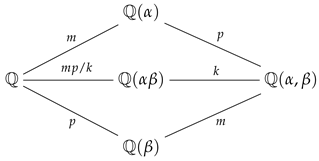
It is clear that and . Since , it easily follows that . Let . Note that . Hence, and therefore,
for some positive integer k.
(a) We have that is a prime number and , where is the minimal polynomial of over . We will show that under these conditions
which is equivalent to .
Assume, conversely, that . Then, (30) holds for some positive integer . If , then for any prime p, a contradiction. Thus, for the rest of the proof we assume that . The relations between the degrees of and are illustrated below.
Let be all the distinct conjugates of over and let be all the distinct conjugates of over . Consider the following list of numbers with and :
Lemma 6 implies that all numbers in (31) are conjugates (not necessarily distinct) of . Since the degree of is , it can be easily deduced that each distinct conjugate of appears exactly k times among the numbers listed in (31). Let
Clearly, for all , because all p elements in the set are distinct. Since , there exists an index such that . Without the restriction of generality, we may assume that and that
Let L denote the Galois closure of over and let denote the Galois group of . Since is of degree p over and the extension is Galois, Cauchy’s theorem implies that there exists an automorphism of order p in G, which fixes and acts as a p-cycle on the conjugates of . Hence, and for any . By applying to equality in (33) we obtain . Therefore, and thus, .
Let r be the least positive integer for which . Then, or . We will treat both cases separately.
Case I. First, consider the case . By multiplying all equalities , where , we obtain
Since , it follows that . By raising both sides of the equality in (33) to the power, we obtain and therefore, . This constitutes a non-trivial multiplicative relation between the conjugates of . Thus, Lemma 8 implies that the minimal polynomial of is , a contradiction.
Case II. Now we consider the case . Let K denote the Galois closure of over and let denote the restriction of to K. From the properties of , it follows that acts as a product of p-cycles on the conjugates of . It is also clear that and . Without loss of generality, assume that represented as a permutation of the conjugates of contains the following p-cycle: . Clearly, this is possible only if the degree of is at least ; i.e., . By multiplying all equalities , where we obtain
Since , it follows that
Since , by applying Lemma 10 to (34) we deduce that
for some integers , and s. We will show that (35) implies a non-trivial multiplicative relation among the conjugates of , which, by applying Lemma 8, forces the minimal polynomial of to be , a contradiction. Throughout, we will implicitly use the fact that is also a conjugate of for any .
With respect to the equalities in (35), Lemma 9 implies that either is a root of unity or and . If is a root of unity, then for some positive integer t we have . Then, analogous to Case I, we deduce that . Suppose now instead that is not a root of unity. Then, and . If , then , which implies that . If and , then . By applying to the equality in (33) we obtain . Thus, and consequently
Since , the equality in (36) constitutes a non-trivial multiplicative relation between the conjugates of . Finally, if and , then from equalities and , it follows that . We also know that
We have and ; thus, by multiplying both equalities in (37) and raising to the suitable power we obtain
Hence,
Because , the equality in (38) constitutes a non-trivial multiplicative relation between the conjugates of .
Analysis of Case I and Case II demonstrates that the assumption of leads to a contradiction. Therefore, ; i.e., , as claimed.
(b) We have that and , where is the minimal polynomial of over . We will show that under these conditions , which is equivalent to . Assume, conversely, that . From (29) it follows then that
for some positive integer . Analogous to part (a) of the proof, we deduce that and that all numbers
are conjugates of . Moreover, all m numbers
are distinct for . Hence, , which, together with (39), forces . Therefore, all numbers in (40) for a fixed j correspond to the full set of conjugates of . By comparing the products of all such numbers with and we derive that
From it follows that . Hence, , where is an root of unity. It is well-known that is also a primitive root of unity for some and that , where denotes Euler’s totient function. Since ; i.e., m is odd, n must also be odd. Further, is quadratic over , hence the splitting field of is . Consequently, and therefore, . Since , we deduce that
From (41), it easily follows that . However, n is odd, whence or . If , then and , a contradiction. If , then is a 3rd root of unity. Thus, , , and . From Vieta’s formulas we obtain and . Thus, and . Set . Then, is a root of . It is clear that is reducible if and only if for some . Hence, and the minimal polynomial of is , a contradiction. □
5. Proofs of Theorem 3 and Corollary 1
Proof of Theorem 3.
We continue to use the same notation as in the proof of Theorem 2.
(a) We have that is a prime number and . We will show that under these conditions
which is equivalent to .
Assume, conversely, that . Thus, for some positive integer . Let be the minimal polynomial of over . If , then Theorem 2 implies that , a contradiction. Thus, for the rest of the proof we assume that . Consider the sets , which were defined in (32). By the same arguments as in the proof of Theorem 2, we deduce that there exists an index such that . Without loss of generality, we may suppose that . Since the minimal polynomial of is , we have
where denotes a primitive root of unity. Hence, and therefore,
for any . Observe that the sets and coincide, as they both represent all p roots of . Therefore, and thus . It is also clear that . Since was chosen arbitrarily, we conclude that if , then and . Recall that appears exactly k times among the numbers listed in (31) and that for each , all p conjugates of belonging to are distinct. Thus,
From the last arguments it also follows that there are exactly k indices in the set , say, such that
From (44) it is clear that for each we have
where . Since all conjugates of are distinct, from (44) it also follows that
Moreover, if , then for any we obtain
as otherwise we would obtain a contradiction to the relations derived in (44). Recall that K denotes the Galois closure of over . Let and let . Thus, acts transitively on . Put
Therefore, the set constitutes a system of blocks for and also forms a partition of . Since and , we deduce that . Since it was assumed that , we obtain that . In view of (46), the last statement implies that
Next, we prove the lemma, which will allow us to finalize the proof of part (a) and will also be essential in the proof of part (b).
Lemma 11..
Let be a prime number and let m be a positive integer such that . Suppose that are algebraic numbers such that and . Finally, let ζ be a primitive root of unity. If , then .
Proof..
Let s be the degree of over . If , then there is nothing to prove. Suppose that . Then there exists an automorphism of K that fixes the subfield and sends to for some . Since , from (48) and (49) it follows that . In view of (44) and (45), we must have that
where and . Therefore,
Since it follows that
If , then there exists a conjugate of , say , which does not belong to block . Thus, we can choose an automorphism of K, which sends to . Clearly, for some positive integer l. Then
As a result of (54) we have that
Observe that is also a conjugate of . Hence, there exists an automorphism of K, which sends to . Clearly, for some positive integer r. Then
Since , we must have
a contradiction, since neither of can be congruent to 0 mod p. Therefore, if , then the degree of over must be equal to 1; i.e., .
However, if , then we must have due to (43). In this case
Thus, is the minimal polynomial of over . However, it follows then that
which implies that mod p, a contradiction. Therefore, we conclude that the degree of over must be equal to 1; i.e., . □
To finish the proof of part (a) it is enough to observe that if , then Lemma 11 implies that . Thus, from the tower law it follows that divides , a contradiction. Therefore, , which implies that . The proof is complete.
(b) First, we prove the conditional part of the statement; namely, that , where k is a divisor of . If , there is nothing to prove. Thus, for the rest of the proof we assume that ; i.e., , which is equivalent to . Lemma 11 implies that and thus, . Let
where t is some positive integer. From the tower law it follows that
i.e., is of degree t over .
Consider the group action of on . For any subgroup of , let denote the orbit of under ; i.e., . Consider the subgroup of corresponding to the fixed subfield of K. From (63) we deduce that . Moreover, as is a normal extension, H is a normal subgroup of . Hence, Lemma 1 implies that all orbits of H have equal cardinality; namely,
It follows that in total H has orbits. Next, we will show that if
for some two distinct conjugates of , then and lie in two different orbits under H.
Assume, conversely, that and lie in the same orbit under H. Then, there exists an automorphism such that and . It is also clear that for some . Thus
By choosing any automorphism in , which maps to , and applying it to the equalities in (67), we obtain p distinct conjugates, whose powers are equal to . In view of (44) and (47), the total number of such conjugates is equal to k, hence . However, this is a contradiction to (50), where we have proved that . Therefore, if , then and lie in two different orbits under H.
Recall that forms a system of blocks for , where was defined in (48). Consider the group action of on . We claim that . Indeed, since , we obtain that due to (64). If , then we can find two automorphisms such that
Suppose that and , where . Let , where is the inverse of . Clearly, . By applying to the equalities in (68), we deduce that . Thus, and in view of (44) this implies that . Consequently, and hence, . Therefore, from the arguments following (65), we deduce that and belong to different orbits under H. However, . Since , it follows that and belong to the same orbit under H, a contradiction. Hence, and since H is normal in , we conclude that each orbit of H has cardinality equal to t. Recalling from (62) that , and using the fact that , we deduce that the total number of orbits in H is equal to
Thus, , as claimed.
To prove the existence part of the statement, recall from Theorem 1 that for any divisor k of there exist algebraic numbers and such that , , and . Then, Lemma 7 implies that for any positive integer v there exist algebraic numbers and such that , , and . Set and the proof is complete.
(c) From the proof of part (b) of Theorem 2, we know that if , then . Hence, if , then we must have .
(d) In the proof of part (b) of Theorem 2, we have already deduced that , where . It remains to show that both values of v are attainable. By Theorem 2, if the minimal polynomial of over is not of the form , then . However, take in the expression of . Then the roots of are and , where is a primitive 3rd root of unity. Set and . Consider the polynomial . It is well-known that is irreducible over . Since , is also a root of . Therefore,
This completes the proof. □
Proof of Corollary 1.
From the arguments in the proof of Lemma 7, it follows that the triplet is product-feasible if and only if there exist algebraic numbers and such that , , and . Hence, the proof follows directly from Theorem 3, by setting and □
Proof of Corollary 2
Since , it is clear that . If , then part (a) of Corollary 1 implies that the triplet is product-feasible if and only if . If , then part (b) of Corollary 1 implies that the triplet is product-feasible if and only if , where k is a divisor of . Hence, . Since corresponds to , we conclude that the triplet , where , is product-feasible if and only if or and with .
Note that Corollary 1 cannot be applied in the search for product-feasible triplets if , because in that case . However, all triplets of the form can be determined using the results in [19]. □
Funding
This research received no external funding.
Data Availability Statement
No new data were created or analyzed in this study.
Acknowledgments
The author thanks A. Dubickas for making many helpful suggestions. The author is also grateful to the reviewers for their constructive comments.
Conflicts of Interest
The author declares no conflict of interest.
References
- Dubickas, A. Two exercises concerning the degree of the product of algebraic numbers. Publ. Inst. Math. 2005, 77, 67–70. [Google Scholar] [CrossRef] [Scilit]
- Nagell, T. Bemerkungen über zusammengesetzte Zahlkörper. Avh. Norske Vid. Akad. Oslo 1937, 4, 1–26. [Google Scholar]
- Kaplansky, I. Fields and Rings; The University of Chicago Press: Chicago, IL, USA, 1969. [Google Scholar]
- Isaacs, I.M. Degrees of sums in a separable field extension. Proc. Am. Math. Soc. 1970, 25, 638–641. [Google Scholar] [CrossRef]
- Browkin, J.; Diviš, B.; Schinzel, A. Addition of sequences in general fields. Monatsh. Math. 1976, 82, 261–268. [Google Scholar] [CrossRef] [Scilit]
- Cagliero, L.; Szechtman, F. On the theorem of the primitive element with applications to the representation theory of associative and Lie algebras. Canad. Math. Bull. 2014, 10, 735–748. [Google Scholar] [CrossRef] [Scilit]
- Weintraub, S.H. Observations on primitive, normal, and subnormal elements of field extensions. Monatsh. Math. 2011, 162, 239–244. [Google Scholar] [CrossRef] [Scilit]
- Dubickas, A.; Jankauskas, J. Simple linear relations between conjugate algebraic numbers of low degree. J. Ramanujan Math. Soc. 2015, 30, 219–235. [Google Scholar]
- Drmota, M.; Skałba, M. On multiplicative and linear independence of polynomial roots. Contrib. Gen. Algebra 1991, 7, 127–135. [Google Scholar]
- Drungilas, P.; Dubickas, A.; Smyth, C.J. A degree problem for two algebraic numbers and their sum. Publ. Mat. 2012, 56, 413–448. [Google Scholar] [CrossRef] [Scilit]
- Drungilas, P.; Dubickas, A.; Luca, F. On the degree of compositum of two number fields. Math. Nachr. 2013, 10, 171–180. [Google Scholar] [CrossRef] [Scilit]
- Drungilas, P.; Dubickas, A. On degrees of three algebraic numbers with zero sum or unit product. Colloq. Math. 2016, 143, 159–167. [Google Scholar] [CrossRef] [Scilit]
- Drungilas, P.; Maciulevičius, L. A degree problem for the compositum of two number fields. Lith. Math. J. 2019, 59, 39–47. [Google Scholar] [CrossRef] [Scilit]
- Dummit, D.S.; Foote, R.M. Abstract Algebra; Prentice Hall: Englewood Cliffs, NJ, USA, 1991. [Google Scholar]
- Dixon, J.D.; Mortimer, B. Permutation Groups; Graduate Texts in Mathematics, 163; Springer: New York, NY, USA, 1996. [Google Scholar]
- Dubickas, A. On sums of two and three roots of unity. J. Number Theory 2018, 192, 65–79. [Google Scholar] [CrossRef] [Scilit]
- Dubickas, A. On the degree of a linear form in conjugates of an algebraic number. Illinois J. Math. 2002, 46, 571–585. [Google Scholar] [CrossRef] [Scilit]
- Smyth, C.J. Conjugate algebraic numbers on conics. Acta. Arith. 1982, 40, 333–346. [Google Scholar] [CrossRef] [Scilit]
- Virbalas, P. Compositum of two number fields of prime degree. N. Y. J. Math. 2023, 29, 171–192. [Google Scholar]
Disclaimer/Publisher’s Note: The statements, opinions and data contained in all publications are solely those of the individual author(s) and contributor(s) and not of MDPI and/or the editor(s). MDPI and/or the editor(s) disclaim responsibility for any injury to people or property resulting from any ideas, methods, instructions or products referred to in the content. |
© 2023 by the author. Licensee MDPI, Basel, Switzerland. This article is an open access article distributed under the terms and conditions of the Creative Commons Attribution (CC BY) license (https://creativecommons.org/licenses/by/4.0/).