


Abstract
Few studies have investigated the existence and uniqueness of solutions for fractional differential equations on star graphs until now. The published papers on the topic are based on the assumption of existence of one junction node and some boundary nodes as the origin on a star graph. These structures are special cases and do not cover more general non-star graph structures. In this paper, we state a labeling method for graph vertices, and then we prove the existence results for solutions to a new family of fractional boundary value problems (FBVPs) on the methylpropane graph. We design the chemical compound of the methylpropane graph with vertices specified by 0 or 1, and on every edge of the graph, we consider fractional differential equations. We prove the existence of solutions for the proposed FBVPs by means of the Krasnoselskii’s and Scheafer’s fixed point theorems, and further, we study the Ulam–Hyers type stability for the given multi-dimensional system. Finally, we provide an illustrative example to examine our results.
1. Introduction
Some natural phenomena throughout the world have been studied using initial and BVPs for many years. Due to the broad diversity of BVPs, many academics have turned to mathematical tools and computer simulation software to explore a variety of practical processes. It has recently been shown that fractional differential equations may be used to describe many diverse applications in the applied sciences (see for examples, [1,2,3,4,5,6,7,8,9,10]). One of our purposes in this work is to extend the theoretical aspects of some applied concepts in chemistry to increase our abilities to model some processes in chemical reactions. Once that is accomplished, computer engineers will be able to build software that allow everyone to conduct chemical experiments without utilizing real materials. This will allow for the most effective management of the environmental resources that are available. We may utilize fractional calculus for this, which is useful in similar situations. It is possible to solve fractional differential-equation-based mathematical models, derive the solution functions, then examine the qualitative behavior of solutions under specific boundary constraints using certain approaches. As may be shown in several published publications, some problems have been addressed before (see for examples, [11,12,13,14,15,16,17,18,19,20,21,22,23]).
Water pipes, gas transmission lines, population increase and computer network expansion are only a few examples of industrial and medical areas where new applied models have been developed to analyze the processes devised by engineers in these disciplines. There has been some interest in studying mathematical models that are expressed on graphs via ordinary or fractional differential equations, due to their graph representation. In fact, on a graph, BVPs are specified on every edge as a set of differential equations, along with particular boundary conditions at every vertex of the graph.
In 1980, Lumer’s work on differential equations defined on graphs is the preliminary stage for this theory [24]. The local operators established on ramification spaces were used to study generic evolution equations. Nicaise explored the propagation of nerve impulses using a similar system [25]. With respect to a geometric graph with linear differential equations, Zavgorodnij investigated those solutions that were coordinated on their inner vertices in 1989 [26]. An adjoint boundary problem was formulated by him, and the adjointness criteria were established [26]. On the basis of graph representation, Gordeziani et al. have studied the uniqueness-existence of solutions to ODEs in 2008 [27] and solved the given BVP using the double sweep method and provided a numerical methodology.
In the majority of the referenced studies, differential equations were evaluated on a graph and their solutions were determined using numerical as well as computational techniques. The existence aspects of solutions to fractional BVPs on graphs is, however, only established in a few publications using approaches from fixed point theory [28,29].
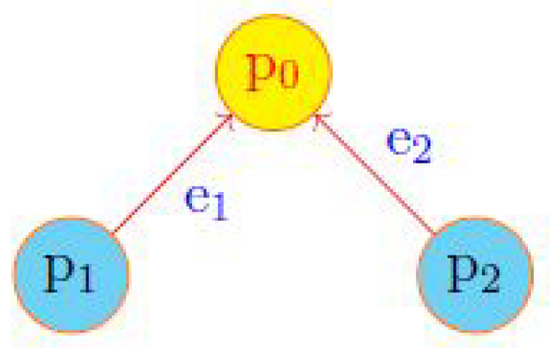
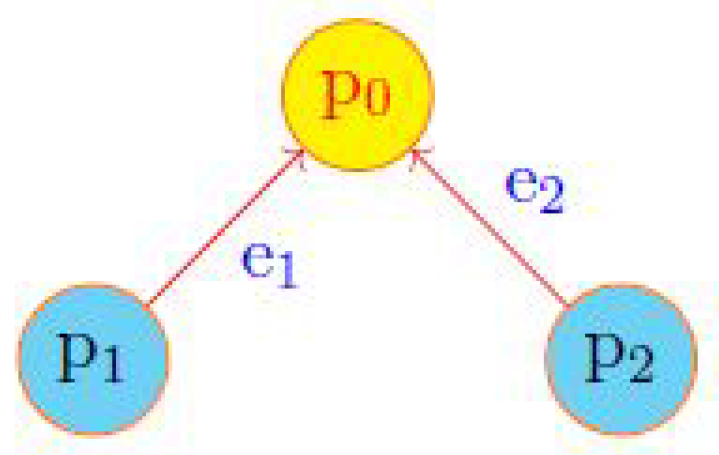
Graef et al. were the first researchers who used fixed point theory to explore the existing results [28]. They presented a three-vertex-star graph , in which and , the vertex regarded as junction node, the edge connecting the vertices to having length for (Figure 1). At every , by considering the origin at boundary vertices and , a local coordinate system is made together with the coordinate . A nonlinear fractional differential equation system was developed by Graef et al. on each edge as follows
in which, via the BCs
where , , and with on , and regarded as RL-fractional derivatives. Their desired results are obtained by applying Schauder’s theorem and the contraction principle.
Figure 1.
Star graph having two edges.
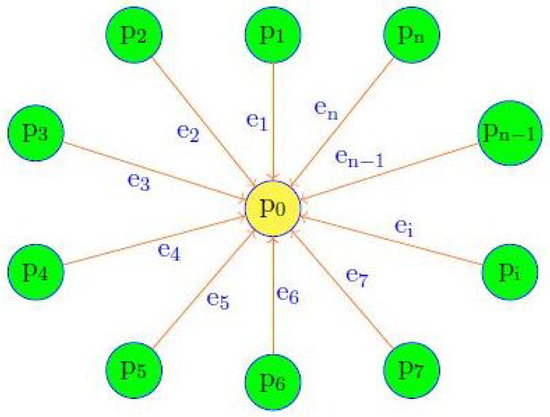
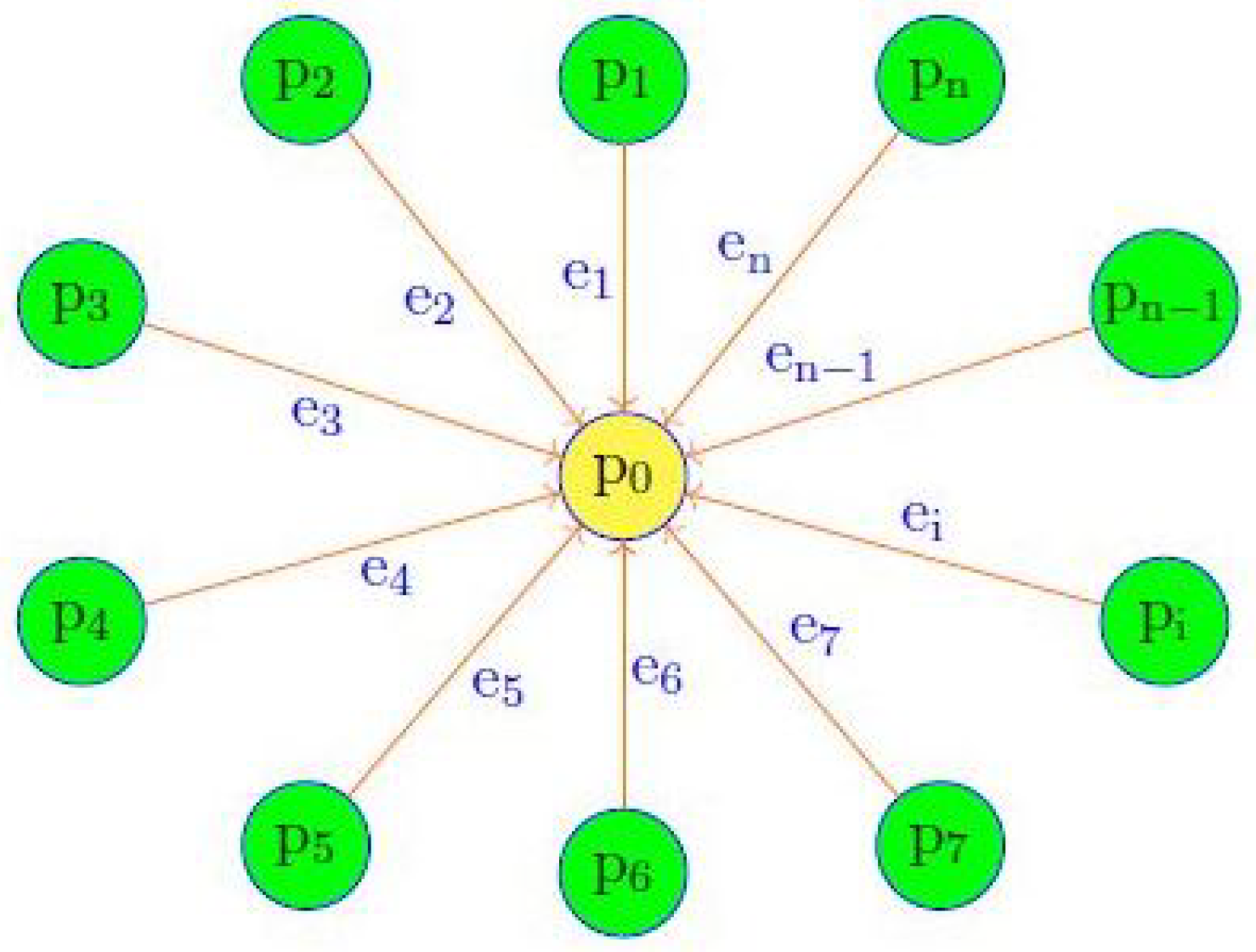
Mehandiratta et al. in 2019 [29] presented an extension of star graph having n edges and vertices. Authors made a generic star graph that including and , in which is considered as the length of joining vertices to .
The following system consists of the BVPs that Mehandiratta et al. defined them on the edges of the above graph as
in which , , , and is the -Caputo derivative. The authors presented the transforms and for , and showed that the equality holds. Next, they transformed the system of FBVPs on the graph (1) to the succeeding system of FBVPs over the interval by performing these transformations
with , for and , with and for .
These works have inspired us to expand their BVPs to a novel BVP on the methylpropane graph. In fact, it is a generalized graph compared to star graphs. In the future, new scholars may generalize these notions to different graphs as new ideas.
2. Preliminaries
The Graph in the context of methylpropane compound is introduced in this section for defining a new category of fractional BVPs on it. Let us first bring the attention of readers to two crucial aspects regarding the methodologies employed in [28,29].
(1) As shown in Figure 1 and Figure 2, the authors of both articles assume that is a star graph with one junction node , but in general, graph G may not be a star graph and may have more than one junction node. Figure 3 shows five junction nodes, as an example.
Figure 2.
Star graph having n edges.
Figure 3.
A non-star graph with five junction nodes.
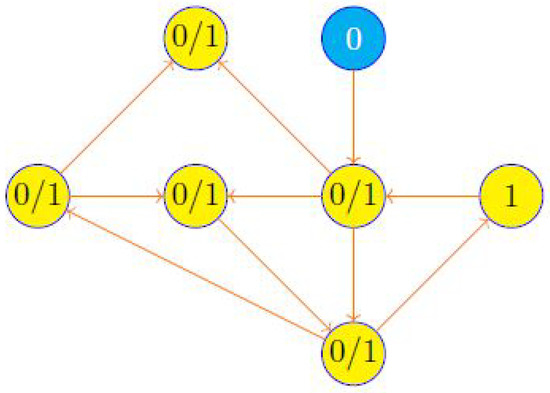
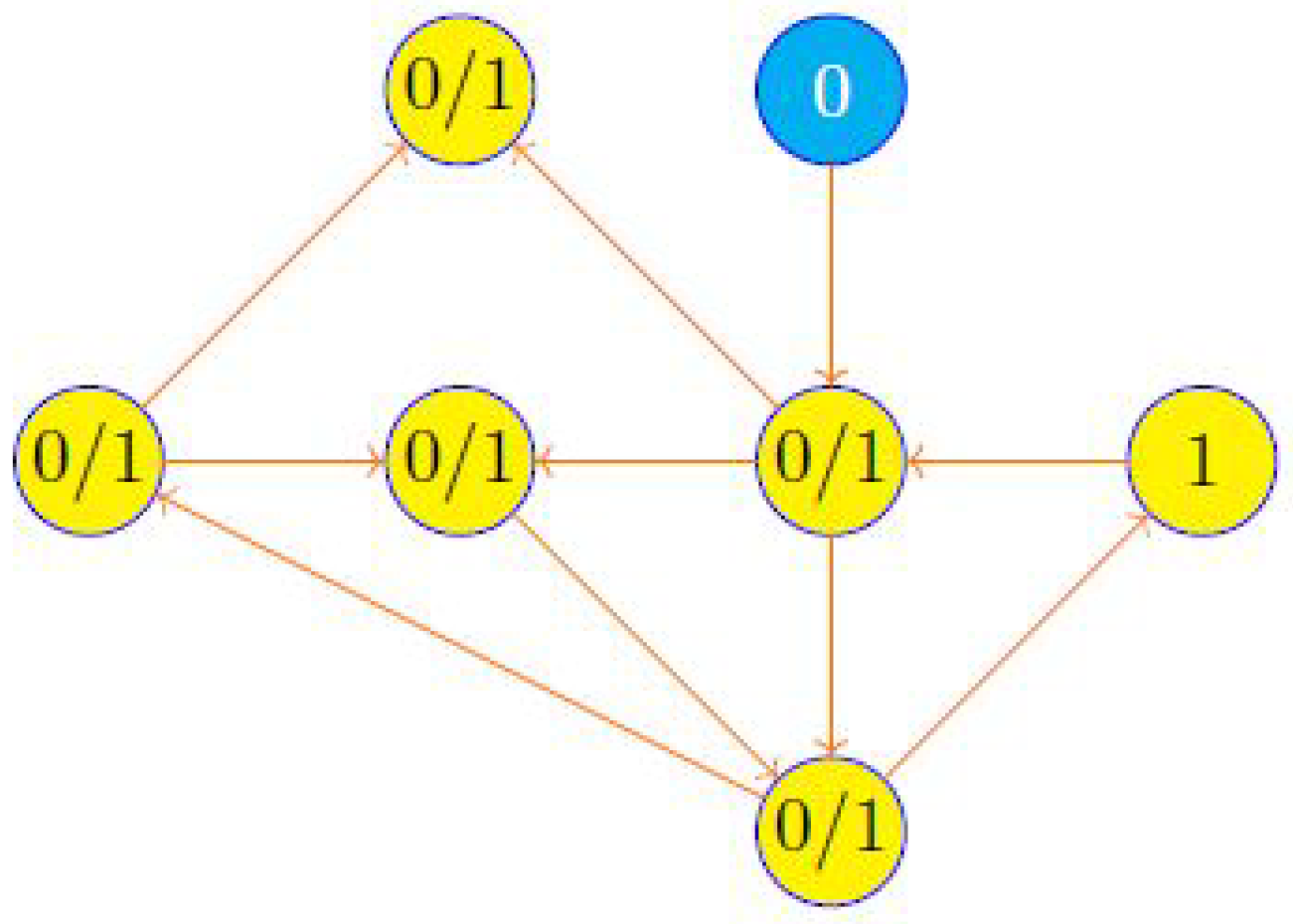
(2) It is important to note that both articles treat the length of every edge as a variable for , where n represents how many vertices there are in the graph . Then, for the normalization of all edges, they use change of variable and transform to interval , whereas in the beginning, one might assume that all edges are the same length without determining boundary vertex as the origin on each edge. A novel approach for labeling the vertices is proposed as a means of achieving this goal. This allows us to label each vertex of the graph with either 0 or 1. To put it as another way, each vertex has a different name (label) based on the direction of related edge. A vertex’s label and its ending vertex’s label are treated as 0 and 1, respectively, when we move along an edge arbitrarily. Hence some labels are 0, some are 1, some are both 0 and 1 and each origin in every edge is not fixed; it is changed with each change in direction of the corresponding edge. It is not necessary to normalize the length of all edges utilizing the mentioned transforms; therefore, we are permitted to select one of the two vertices of each edge as its origin. Figure 4 shows an example of how labeling may be used in this situation. We begin to walk along the edges of this graph in the first step from the blue vertex.
Figure 4.
A general graph with labels 0 or 1.
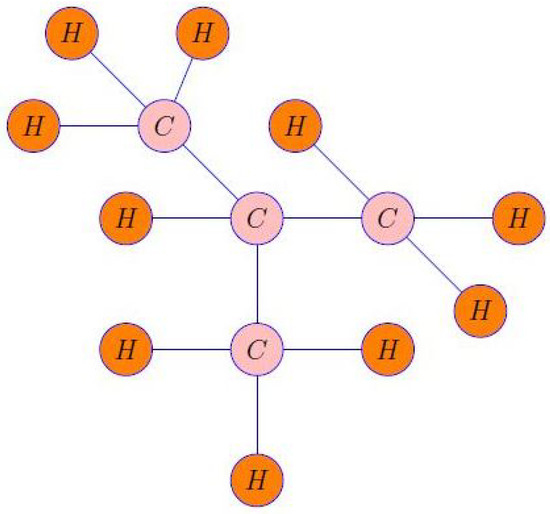
In this paper, on the methylpropane graph, we investigate several desirable existence theorems for solutions of a new class of FBVPs (Figure 5).
Figure 5.
A sketch of methylpropane in the graph settings.
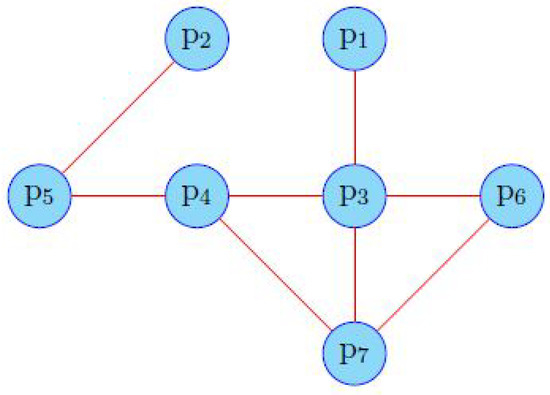
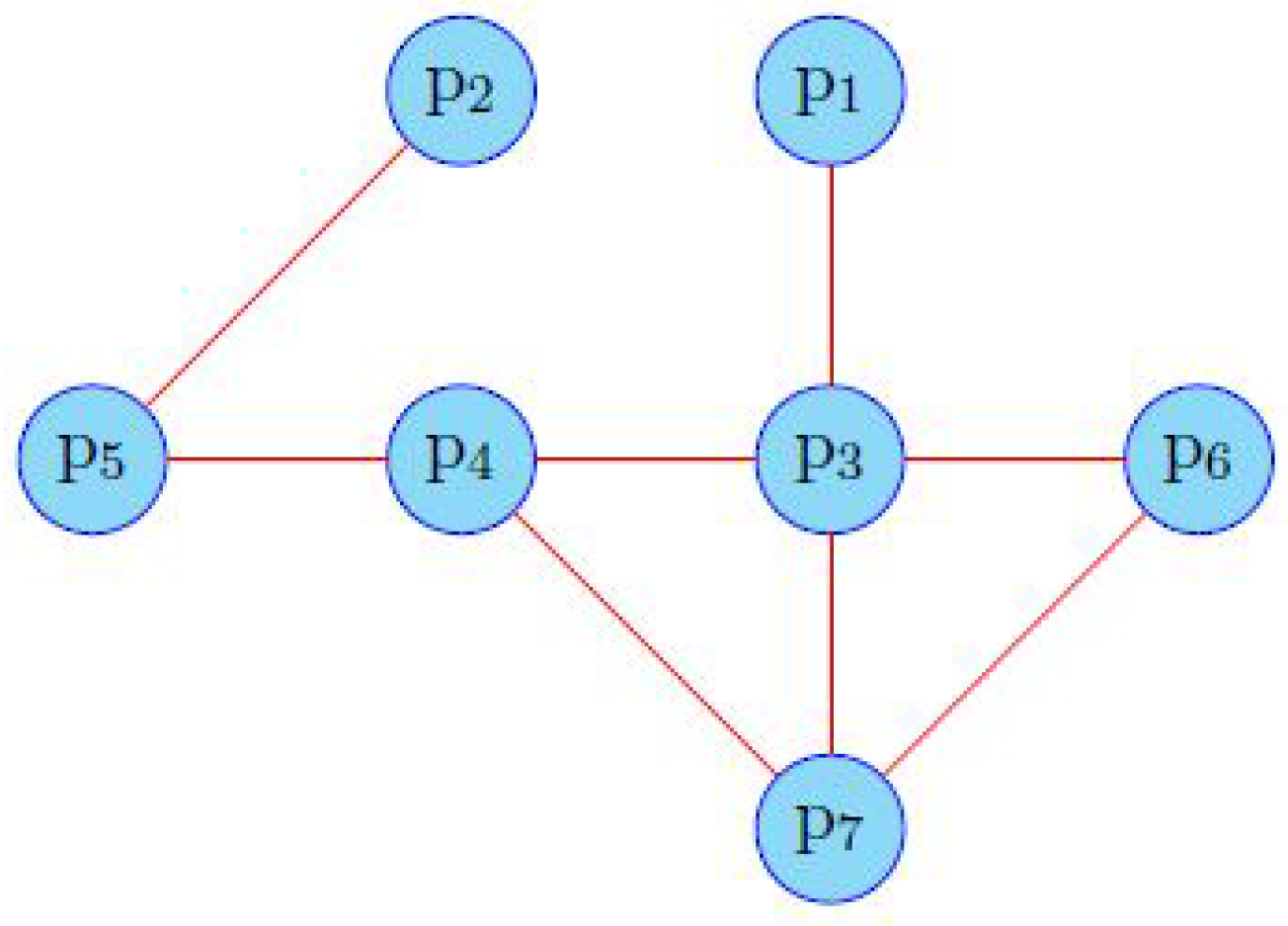
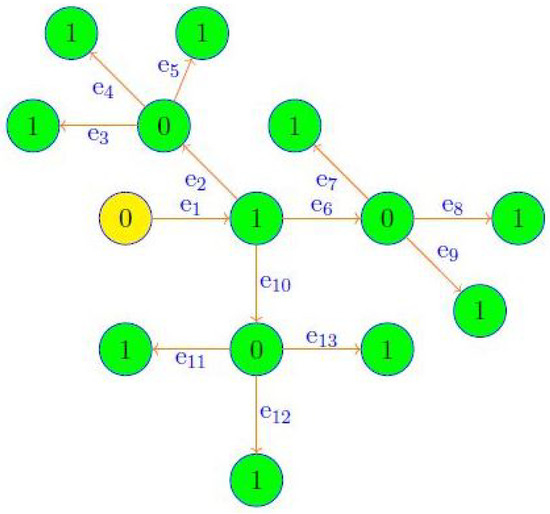
The chemical compound of methylpropane or isobutane has the molecular formula , where () and () are hydrogen and carbon. Methylpropane is an isomer of Butane, which is used as a precursor molecule in the petrochemical industry. This compound consists of three carbon–carbon bonds and three sub-branches . Inspired by this structure, Hydrogen atoms and carbon atoms are regarded as the graph’ vertices. Graph’s edges stand for the chemical bonds that occur between atoms. This molecular graph is not a star graph, thus the technique applied in [28,29] which assigns the origin at boundary nodes except the junction node , will not work here because there exist more than one junction node on this graph (four junction nodes). Consequently, we must adopt a new approach. We may label the vertices of this graph with either 0 or 1, and we can regard unit value as the length of each edge (see Figure 6).
Figure 6.
The graph of with labels 0 or 1.
The existence of solutions in relation to the multi-dimensional nonlinear multi-term FBVPs are studied in this manuscript by defining the graph of methylpropane labeled with 0 or 1, as shown above:
where , , for , in which stands for the number of edges of methylpropane graph s.t. , and regards the -Caputo derivative. Here in the boundary conditions, we consider the values of the unknown functions , and their -derivatives and their first-order derivatives in the terminal points, and also we consider the integral of sum of them in the mid-points of the time domain .
Regarding the relationship between the above system of FBVPs and the molecular graph of methylpropane, it should be noted that the main reason for this study is the growing importance of chemical graph theory. This field of mathematics relates graph theory to chemistry, and investigates the chemical changes resulting from interatomic bonds along bond lines and their effects, and these studies are performed in the form of various models of fractional differential equations. Instances of these new applications can be found in bio-macromolecules and chemical kinetics. As the main idea of this work, the results of the given fractional BVPs (2) about the existence of solutions can be interpreted in various meanings in relation to organic chemistry. As a result, any solution at every edge might represents the bond polarity, bond strength, bond energy, etc. Moreover, the integer and fractional order derivatives of the unknown functions , i.e., and can interpret some chemical notions in this direction. Because has a nonlocal nature, it can show some useful properties of the curves of solutions over a large extent of a time interval during a chemical interaction, while has a local nature and it can interprets the velocity of the same chemical interactions at a specific time . Further, and are defined as functions of these quantities with respect to the time t on each edge .
On the other hand, as we said above, shows the number of edges of the methylpropane graph and this index can be changed by increasing or decreasing the number of edges in different molecular structures. In other words, we can generalize this number to each arbitrary value and this change will not affect the computational disorder. We are sure that in the future, the theory of chemical reactions and also chemical graph theory may benefit from some aspects of these developments. Similarly, see some recent works in this regard [30,31,32,33].
Now, we recall some basic definitions and properties of fractional calculus. Assume . Then we define RL-fractional integral of the continuous function by
such that the above integral exists [34,35].
Let . Then . We define the Caputo derivative of the function as
such that the above integral exists [34,35]. It is known that for , the solution of is ; also, we have
where [36]. The Krasnoselskii and Scheafer fixed point theorems are main tools which we use for our analysis.
Lemma 1
([37]). We assume as bounded, convex closed set in the Banach space . Consider and on so that whenever , and (a) the operator is compact and continuous, (b) the operator is a contraction. Then with .
Lemma 2
([37]). Consider as a Banach space and a completely continuous mapping Υ on . Then is not bounded or there exist a fixed point of Υ inn .
3. Main Theorems Regarding the Existence
The present section is assigned to the results of existence theory on the graph of methylpropane (Figure 6). To begin it, we consider the Banach spaces with for . Then the product space equipped with the norm is a Banach space.
Lemma 3.
Let , and . Then is a solution of the BVPs
which is given by
where and .
Proof.
Thus, we obtain and
and so
By using the first boundary condition, we obtain
Further, by the linearity of the integral in the second boundary condition, we have
and it gives
By some simple calculations on two latter Equations (7) and (8), and by considering the constant , we obtain
Then by substituting into (7), we obtain
Here by considering (3), define the operator on by
where (),
for all and . For convenience in writing, put
We now analyze the fractional BVP (2) with different conditions by terms of the existence criterion.
Theorem 1.
Let and be continuous functions. Suppose that there exist continuous maps and , and continuous non-decreasing maps, and s.t.
Proof.
Set and . We select the appropriate constant so that
where ’s are given in (10). Define subsets
where is given in (11). Define and on as
where
and
for each and . Assume that and . Now for every , we have
and
This yields
and so and . The continuity of is proved from the continuity of the functions . We now prove the uniform boundedness of the operator . We have
Further, note that
for all z in . Thus,
So is uniformly bounded on . Now, we are going to show the compactness of the operator on . To do this, let with ; therefore, we conclude
Hence, as . Similarly, one can see that
as ; therefore, we obtain tends to zero as . Thus, will be equi-continuous, and is compact on due to the Arzela–Ascoli property. Further, take . Therefore
and in the similar manner,
Therefore, we have that
and so
Since , is a contraction on . Utilizing Lemma 1, we deduced that a fixed point of exists that satisfies the fractional BVPs (2). □
In order to demonstrate the validity of the aforementioned conclusion, we give an abstract example.
Example 1.
Consider the multi-term multi-dimensional DEs
under the integral BCs
where , , , and and are derivatives of order of the Caputo type. Set by
and also by
Define as for all and . Further, we know that for each nonnegative real number z, and ; therefore, we have
in which for , are given as , , , and . Further, we define nondecreasing and continuous mappings by for all and . Then we obtain
in which for , are given as , , , and . On the other hand, by the mean value theorem, we know that and for all . Thus, for , we estimate
and
Hence, , , , and , where , , , , and so . According to the obtained values, we obtain , , , and so . Hence,
In the following, we investigate a special case of the fractional BVPs (2) on the methylpropane graph (Figure 6). Assume that are constant functions. Then the fractional problems (2) are converted into the following BVPs on the methylpropane graph under the integral BCs
where , and are continuous functions. By utilizing the Scheafer’s theorem, we prove our next existence criterion. Before that, with adequate regard for Lemma 3, define on as
where
for all , , and . In the following, the existence property for FBVPs (14) are proved under the boundedness assumption for the continuous functions .
Theorem 2.
Regard the continuous functions . Assume that the constants exist with for all , and . Then the FBVPs (14) have solutions on each edge of the methylpropane graph.
Proof.
Regarding the definition of operator , clearly, the fractional BVPs (14) have solutions if and only if there exist a fixed point of on . Initially, we check that is complete continuous. Continuity of implies that of . Assume a bounded set in and . Then we have
, and is introduced in (10). Similarly,
, in which is as (10). Thus , and . From this we deduced that is uniformly bounded. To confirm the equi-continuity of operator , assume and with . Then
The right-side converges to zero (no depending upon ) as . Similarly, we have
as . Hence, as . This gives that is equi-continuous on . Hence is completely continuous by Arzela–Ascoli theorem. Assume a subset
of . We prove the boundedness of . Let . Then
and so for all and . Thus,
and
These inequalities follow that
therefore is bounded. Utilizing Lemmas 2 and 3, we find out that in , possesses a fixed point, which is a solution of (14). □
4. Ulam–Hyers Stability
Since the concept of stability is so important in determining the solutions to many dynamical systems, due to this importance, we here establish two Ulam–Hyers and the generalized version of stabilities in relation to the fractional multi-dimensional BVP on the methylpropane graph (14). For more information, see [38,39,40,41,42,43]. In consistence with [41], we define the following notions:
Definition 1
Definition 2
Remark 1.
Definition 1 ⇒ Definition 2.
Remark 2.
is named as a solution for (16) iff depending on s.t.
- (1)
- .
- (2)
- .
We now study the above stabilities for the fractional multi-dimensional BVP on the methylpropane graph (14).
Theorem 3.
Proof.
and fulfilling
one can find , which satisfies
with . It gives
Consider to be the solution of (14), which is
We estimate
Example 2.
Consider the multi-term multi-dimensional DEs
under the integral BCs
where , , , and and are derivatives of order of the Caputo type. Set by
By the mean value theorem, we know that and for all . Thus, for , we estimate
and
Hence, , , , and . According to the obtained values, we obtain and . Since,
Then by taking the constants
5. Conclusions
In this study, we extended the technique applied in [28,29] to the non-star methylpropane graph and studied a new family of multi-term multi-dimensional FBVPs on every edge of the graph by introducing a labeling method for vertices. We discussed the existence of solutions for aforesaid FBVPs with the aid of Krasnoselskii and Schaefer fixed point theorems. Moreover, the stability analysis in the sense of Ulam–Hyers and generalized Ulam–Hyers was investigated. In addition, we prepared an abstract example to explain one of our results. In view of the importance of differential equations in chemical graph theory, we designed our FBVPs (2) on the molecular graph representation of methylpropane as an example of a non-star graph. This research is of pivotal nature for fractional mathematical modeling on different chemical compounds of molecules in the framework of complicated non-star graphs. Our suggested FBVPs are applicable on a vast range of graph structures, especially digraphs, which are usually utilized in medical technologies in relation to protein networks. In our future projects, we plan to study more problems on the graph representation of different molecular structures by using analytic and numerical methods.
Author Contributions
Conceptualization, S.R. and S.E.; Formal analysis, S.R., C.T.D., A.H., S.E., R.G. and B.A.; Funding acquisition, R.G.; Methodology, S.R., C.T.D., A.H., S.E., R.G. and B.A.; Software, S.E. All authors have read and agreed to the published version of the manuscript.
Funding
This research received no external funding.
Institutional Review Board Statement
Not applicable.
Informed Consent Statement
Not applicable.
Data Availability Statement
Data sharing not applicable to this article as no datasets were generated or analyzed during the current study.
Acknowledgments
The first and fourth authors would like to thank Azarbaijan Shahid Madani University. Also, the authors would like to sincerely thank the reviewers for their constructive comments to improve the quality of the paper.
Conflicts of Interest
The authors declare no conflict of interest.
Abbreviations
The following abbreviations are used in this manuscript:
| FBVP | Fractional Boundary Value Problem, |
| ODEs | Ordinary Differential Equations, |
| BCs | Boundary Conditions, |
| RL | Riemann–Liouville, |
| DEs | Differential Equations. |
References
- Adjabi, Y.; Samei, M.E.; Matar, M.M.; Alzabut, J. Langevin differential equation in frame of ordinary and Hadamard fractional derivatives under three point boundary conditions. AIMS Math. 2021, 6, 2796–2843. [Google Scholar] [CrossRef] [Scilit]
- Rezapour, S.; Etemad, S.; Mohammadi, H. A mathematical analysis of a system of Caputo-Fabrizio fractional differential equations for the anthrax disease model in animals. Adv. Differ. Equ. 2020, 2020, 481. [Google Scholar] [CrossRef] [Scilit]
- Deressa, C.T.; Etemad, S.; Rezapour, S. On a new four-dimensional model of memristor-based chaotic circuit in the context of nonsingular Atangana-Baleanu-Caputo operators. Adv. Differ. Equ. 2021, 2021, 444. [Google Scholar] [CrossRef] [Scilit]
- Nagajothi, N.; Sadhasivam, V.; Bazighifan, O.; El-Nabulsi, R.A. Existence of the class of nonlinear hybrid fractional Langevin quantum differential equation with Dirichlet boundary conditions. Fractal Fract. 2021, 5, 156. [Google Scholar] [CrossRef] [Scilit]
- Khan, H.; Tunc, C.; Chen, W.; Khan, A. Existence theorems and Hyers-Ulam stability for a class of hybrid fractional differential equations with p-Laplacial operator. J. Appl. Anal. Comput. 2018, 8, 1211–1226. [Google Scholar]
- Deressa, C.T.; Etemad, S.; Kaabar, M.K.A.; Rezapour, S. Qualitative analysis of a hyperchaotic Lorenz-Stenflo mathematical model via the Caputo fractional operator. J. Funct. Spaces 2022, 2022, 4975104. [Google Scholar] [CrossRef] [Scilit]
- Salem, A.; Alghamdi, B. Multi-strip and multi-point boundary conditions for fractional Langevin equation. Fractal Fract. 2020, 4, 18. [Google Scholar] [CrossRef] [Scilit]
- Alzabut, J.; Selvam, G.M.; El-Nabulsi, R.A.; Vignesh, D.; Samei, M.E. Asymptotic stability of nonlinear discrete fractional pantograph equations with non-local initial conditions. Symmetry 2021, 13, 473. [Google Scholar] [CrossRef] [Scilit]
- Nieto, J.J.; Pimentel, J. Positive solutions of a fractional thermostat model. Bound. Value Probl. 2013, 2013, 5. [Google Scholar] [CrossRef] [Scilit]
- Mohammadi, H.; Kumar, S.; Rezapour, S.; Etemad, S. A theoretical study of the Caputo-Fabrizio fractional modeling for hearing loss due to Mumps virus with optimal control. Chaos Solitons Fractals 2021, 144, 110668. [Google Scholar] [CrossRef] [Scilit]
- Afshari, H.; Kalantari, S.; Karapinar, E. Solution of fractional differential equations via coupled fixed point. Electron. J. Differ. Equ. 2015, 2015, 286. [Google Scholar]
- Rezapour, S.; Tellab, B.; Deressa, C.T.; Etemad, S.; Nonlaopon, K. H-U-type stability and numerical solutions for a nonlinear model of the coupled systems of Navier BVPs via the generalized differential transform method. Fractal Fract. 2021, 5, 166. [Google Scholar] [CrossRef] [Scilit]
- Baleanu, D.; Etemad, S.; Pourrazi, S.; Rezapour, S. On the new fractional hybrid boundary value problems with three-point integral hybrid conditions. Adv. Differ. Equ. 2019, 2019, 473. [Google Scholar] [CrossRef] [Scilit]
- Bachir, F.S.; Abbas, S.; Benbachir, M.; Benchohra, M. Hilfer-Hadamard fractional differential equations; Existence and attractivity. Adv. Theory Nonlinear Anal. Appl. 2021, 5, 49–57. [Google Scholar]
- Rezapour, S.; Ntouyas, S.K.; Iqbal, M.Q.; Hussain, A.; Etemad, S.; Tariboon, J. An analytical survey on the solutions of the generalized double-order ϕ-integro-differential equation. J. Funct. Spaces 2021, 2021, 6667757. [Google Scholar]
- Abdeljawad, T.; Agarwal, R.P.; Karapinar, E.; Kumari, P.S. Solutions of the nonlinear integral equation and fractional differential equation using the technique of a fixed point with a numerical experiment in extended b-metric space. Symmetry 2019, 11, 686. [Google Scholar] [CrossRef] [Scilit]
- Amara, A.; Etemad, S.; Rezapour, S. Topological degree theory and Caputo-Hadamard fractional boundary value problems. Adv. Differ. Equ. 2020, 2020, 369. [Google Scholar] [CrossRef] [Scilit]
- Alqahtani, B.; Aydi, H.; Karapinar, E.; Rakocevic, V. A solution for Volterra fractional integral equations by hybrid contractions. Mathematics 2019, 7, 694. [Google Scholar] [CrossRef] [Scilit]
- Etemad, S.; Ntouyas, S.K.; Ahmad, B. Existence theory for a fractional q-integro-difference equation with q-integral boundary conditions of different orders. Mathematics 2019, 7, 659. [Google Scholar] [CrossRef] [Scilit]
- Shah, K.; Khan, R.A. Iterative scheme for a coupled system of fractional-order differential equations with three-point boundary conditions. Math. Methods Appl. Sci. 2018, 41, 1047–1053. [Google Scholar] [CrossRef] [Scilit]
- Etemad, S.; Rezapour, S.; Samei, M.E. α-ψ-contractions and solutions of a q-fractional differential inclusion with three-point boundary value conditions via computational results. Adv. Differ. Equ. 2020, 2020, 218. [Google Scholar] [CrossRef] [Scilit]
- Wongcharoen, A.; Ntouyas, S.K.; Tariboon, J. Nonlocal boundary value problems for Hilfer type pantograph fractional differential equations and inclusions. Adv. Differ. Equ. 2020, 2020, 279. [Google Scholar] [CrossRef] [Scilit]
- Thaiprayoon, C.; Sudsutad, W.; Alzabut, J.; Etemad, S.; Rezapour, S. On the qualitative analysis of the fractional boundary value problem describing thermostat control model via ψ-Hilfer fractional operator. Adv. Differ. Equ. 2021, 2021, 201. [Google Scholar] [CrossRef] [Scilit]
- Lumer, G. Connecting of local operators and evolution equations on a network. Lect. Notes Math. 1980, 787, 219–234. [Google Scholar]
- Nicaise, S. Some results on spectral theory over networks applied to nerve impulses transmission. Lect. Notes Math. 1985, 1771, 532–541. [Google Scholar]
- Zavgorodnii, M.G.; Pokornyi, Y.V. On the spectrum of second-order boundary value problems on spatial networks. Usp. Mat. Nauk. 1989, 44, 220–221. [Google Scholar]
- Gordeziani, D.G.; Kupreishvli, M.; Meladze, H.V.; Davitashvili, T.D. On the solution of boundary value problem for differential equations given in graphs. Appl. Math. Lett. 2008, 13, 80–91. [Google Scholar]
- Graef, J.R.; Kong, L.J.; Wang, M. Existence and uniqueness of solutions for a fractional boundary value problem on a graph. Fract. Calc. Appl. Anal. 2014, 17, 499–510. [Google Scholar] [CrossRef] [Scilit]
- Mehandiratta, V.; Mehra, M.; Leugering, G. Existence and uniqueness results for a nonlinear Caputo fractional boundary value problem on a star graph. J. Math. Anal. Appl. 2019, 477, 1243–1264. [Google Scholar] [CrossRef] [Scilit]
- Baleanu, D.; Etemad, S.; Mohammadi, H.; Rezapour, S. A novel modeling of boundary value problems on the glucose graph. Commun. Nonlinear Sci. Numer. Simulat. 2021, 100, 105844. [Google Scholar] [CrossRef] [Scilit]
- Turab, A.; Mitrovic, Z.D.; Savic, A. Existence of solutions for a class of nonlinear boundary value problems on the hexasilinane graph. Adv. Differ. Equ. 2021, 2021, 494. [Google Scholar] [CrossRef] [Scilit]
- Turab, A.; Sintunavarat, W. The novel existence results of solutions for a nonlinear fractional boundary value problem on the ethane graph. Alex. Eng. J. 2021, 60, 5365–5374. [Google Scholar] [CrossRef] [Scilit]
- Etemad, S.; Rezapour, S. On the existence of solutions for fractional boundary value problems on the ethane graph. Adv. Differ. Equ. 2020, 2020, 276. [Google Scholar] [CrossRef] [Scilit]
- Podlubny, I. Fractional Differential Equations; Academic Press: Cambridge, MA, USA, 1999. [Google Scholar]
- Samko, S.G.; Kilbas, A.A.; Marichev, O. Fractional Integrals and Derivatives: Theory and Applications; Gordon and Breach: New York, NY, USA, 1993. [Google Scholar]
- Miller, K.S.; Ross, B. An Introduction to the Fractional Calculus and Fractional Differential Equations; John Wiley Sons: Hoboken, NJ, USA, 1993. [Google Scholar]
- Smart, D.R. Fixed Point Theorems; Cambridge University Press: Cambridge, UK, 1980. [Google Scholar]
- Matar, M.M.; Abu Skhail, E.S. On stability of nonautonomous perturbed semilinear fractional differential systems of order α∈(1,2). J. Math. 2018, 2018, 1723481. [Google Scholar] [CrossRef] [Scilit]
- Ameen, R.; Jarad, F.; Abdeljawad, T. Ulam stability for delay fractional differential equations with a generalized Caputo derivative. Filomat 2018, 32, 5265–5274. [Google Scholar] [CrossRef] [Scilit]
- Ben-Chikh, S.; Amara, A.; Etemad, S.; Rezapour, S. On Hyers-Ulam stability of a multi-order boundary value problems via Riemann-Liouville derivatives and integrals. Adv. Differ. Equ. 2020, 2020, 547. [Google Scholar] [CrossRef] [Scilit]
- Rus, I.A. Ulam stabilities of ordinary differential equations in a Banach space. Carpathian J. Math. 2010, 26, 103–107. [Google Scholar]
- Wang, J.R.; Li, X. A uniform method to Ulam-Hyers stability for some linear fractional equations. Mediterr. J. Math. 2016, 13, 625–635. [Google Scholar] [CrossRef] [Scilit]
- Wang, J.R.; Feckan, M.; Zhou, Y. Ulam’s type stability of impulsive ordinary differential equations. J. Math. Anal. Appl. 2012, 395, 258–264. [Google Scholar] [CrossRef] [Scilit]
Publisher’s Note: MDPI stays neutral with regard to jurisdictional claims in published maps and institutional affiliations. |
© 2022 by the authors. Licensee MDPI, Basel, Switzerland. This article is an open access article distributed under the terms and conditions of the Creative Commons Attribution (CC BY) license (https://creativecommons.org/licenses/by/4.0/).