Charting the Pathway to STEM: How Middle School Socialization and Science Growth Trajectories Predict Adult Career Success





Abstract
1. Introduction
2. Conceptual Framework and Theoretical Rationale for a Dynamic Approach to STEM Development
2.1. The Synergistic Influence of Socialization Agents on Science and STEM Development
- Parental Educational Encouragement is conceptualized as the active promotion of academic values and future educational aspirations by parents or primary caregivers (Dotterer, 2022; Masud et al., 2015). In this study, it is operationalized specifically as parental college push—the extent to which parents signal the importance of and encourage their child to pursue a college education (Miller & Pearson, 2012). This measure captures a form of academic socialization that is more focused on long-term educational goals rather than day-to-day emotional support.
- Peer Academic Support is distinguished from general friendship or social acceptance. It refers to the perceived level to which a student’s friends value and support academic effort, educational planning, and the goal of attending college (Altermatt, 2019; Hoferichter et al., 2022). This construct taps into the normative academic climate within the peer microsystem, where pro-academic attitudes and behaviors are reinforced.
- Constructive school learning environment encompasses the structural and relational qualities of the school that facilitate learning and scholarly development (Stewart, 2008; Zeng et al., 2022). It is measured by parental perceptions of overall school quality, teacher subject-matter expertise, and the degree to which teachers are perceived as caring about students (M. T. Wang & Eccles, 2013; K. Y. Zhao et al., 2023). This agent represents the formal instructional and emotional support system provided by the school institution.
- Student Self-Esteem is conceptualized in this study as a foundational, global personal resource—a relatively stable trait reflecting an individual’s overall sense of self-worth and satisfaction (Booth & Gerard, 2011; Cvencek et al., 2018). While it can be influenced by socialization experiences, we position it here as a key individual-level asset that provides the psychological capital necessary for students to engage with academic challenges and plan for the future, which in turn can be bolstered by positive feedback from parents, peers, and teachers.
2.2. Science Learning Trajectories: Capturing a Dynamic Developmental Process
3. The Present Study
4. Methods
4.1. Data Source and Sample
4.2. Measures
- -
- Engagement in STEM Professions was assessed in 2008 with a dichotomous measure (0 = no, 1 = yes) indicating whether the participant was employed in a STEM field, as classified by LSAY personnel. This classification encompassed careers in science, engineering, mathematics, medical science, and health and life sciences (Ahmed, 2018). This outcome aligns with the post-action pursuing phase in SCCT and the realization of long-term trajectories as per Life Course Theory.
- -
- Graduation with a STEM Degree was measured in 2007, indicating whether the participant had successfully obtained a four-year baccalaureate degree majoring in science, technology, engineering, mathematics, or medicine (0 = no baccalaureate or non-STEM major, 1 = STEM major) (Kang et al., 2021; Wright et al., 2017). This milestone corresponds to the action phase in the SCCT framework.
- -
- Science performance was assessed annually from grades 7 to 9 (1987–1989) using integrated science test scores provided by LSAY. These scores, scaled using Item Response Theory (IRT) to adjust for difficulty and reliability (DeMars, 2010), measured proficiency in core scientific disciplines (biology, physical science, chemistry, environmental science) essential for future STEM development. Scores ranged from 26 to 88 in grade 7 to 27–91 in grade 9, with higher scores indicating better performance. These scores represent the evolving performance attainment and development of academic self-efficacy central to SCCT, captured as a dynamic trajectory.
- -
- Parental educational encouragement was measured in grade 7 in the year 1987 with an item of “parent college push in grade 7” that was rated by the main caregiver parent with a 6-point scale ranging from 0 = low parent college push to 5 = high parent college push, in which higher scores indicate more parental educational expectations and encouragement for students’ higher education. This measure has been used in research to tap into parents’ educational support and expectations for their children to attain a college education (Miller & Pearson, 2012). This LSAY item (parent college push) directly operationalizes the environmental support and contextual affordances emphasized in SCCT and Life Course Theories.
- -
- Peer academic support was measured in grade 7 in the year 1987 with an item of “peer academic push in grade 7” that was rated by the student participants with a 4-point scale ranging from 0 = low academic push to 3 = high academic push to indicate whether friends of the student participant supported the importance of academic performance, educational plan, and college education. Recent research has used similar measures to rate academic support from peers (Altermatt, 2019; Hoferichter et al., 2022). This item (peer academic push in grade 7) serves as a proxy for the peer influence and normative environment within the student’s social context, as outlined in ecological models and SCCT.
- -
- Constructive school learning environment was measured in grade 7 in the year 1987 with three items that include (1) “Overall positive quality of the school”, (2) “Teachers know their subjects”, and (3) “Teachers care about students”, which were rated by the main caregiver parent on a 5-point scale from 1= strongly agree to 5 = strongly disagree. The three items were reverse-coded and averaged to recreate a composite score, with higher scores representing a more positive and pro-learning school environment. Recent research has adopted a similar approach to measure positive learning environments in schools for students (Zeng et al., 2022; K. Y. Zhao et al., 2023). This composite scale captures the environmental support and learning climate at the school level, a key contextual factor in SCCT and Life Course Theories. Cronbach alpha is reliable, α = 0.766.
- -
- Positive self-esteem of students was measured in grade 7 in the year 1987 with four items that include (1) “positive attitude toward self”, (2) “I am a person of worth”, (3) “able to do things as well as others”, and (4) “generally satisfied with self”, which were rated by the student participants on a 5-point scale from 1 = strongly agree to 5 = strongly disagree and averaged as a composite score by inverse coding to indicate higher scores representing better self-esteem. Prior research has employed a similar measure to assess the positive self-esteem of adolescent students (Regnerus & Elder, 2003). This scale measures the personal input factor of global self-worth, which provides the foundational psychological capital for the development of domain-specific self-efficacy as per SCCT. Cronbach alpha is reliable, α = 0.706.
- -
- Several time-invariant covariates were included to control for potential confounding effects: gender (0 = female, 1 = male), family composition (0 = other structures, 1 = two-biological-parent family), and ethnicity, which was used to classify student participants into five ethnic groups (Whites, African Americans, Hispanics, Asians, and Native Americans), with Asian students serving as the reference (0) and the remaining ethnic groups as comparison (1) to create four dummy ethnic variables.
4.3. Modeling Procedures
- -
- is the observed science performance for individual at grade .
- -
- is the intercept of the science performance at time .
- -
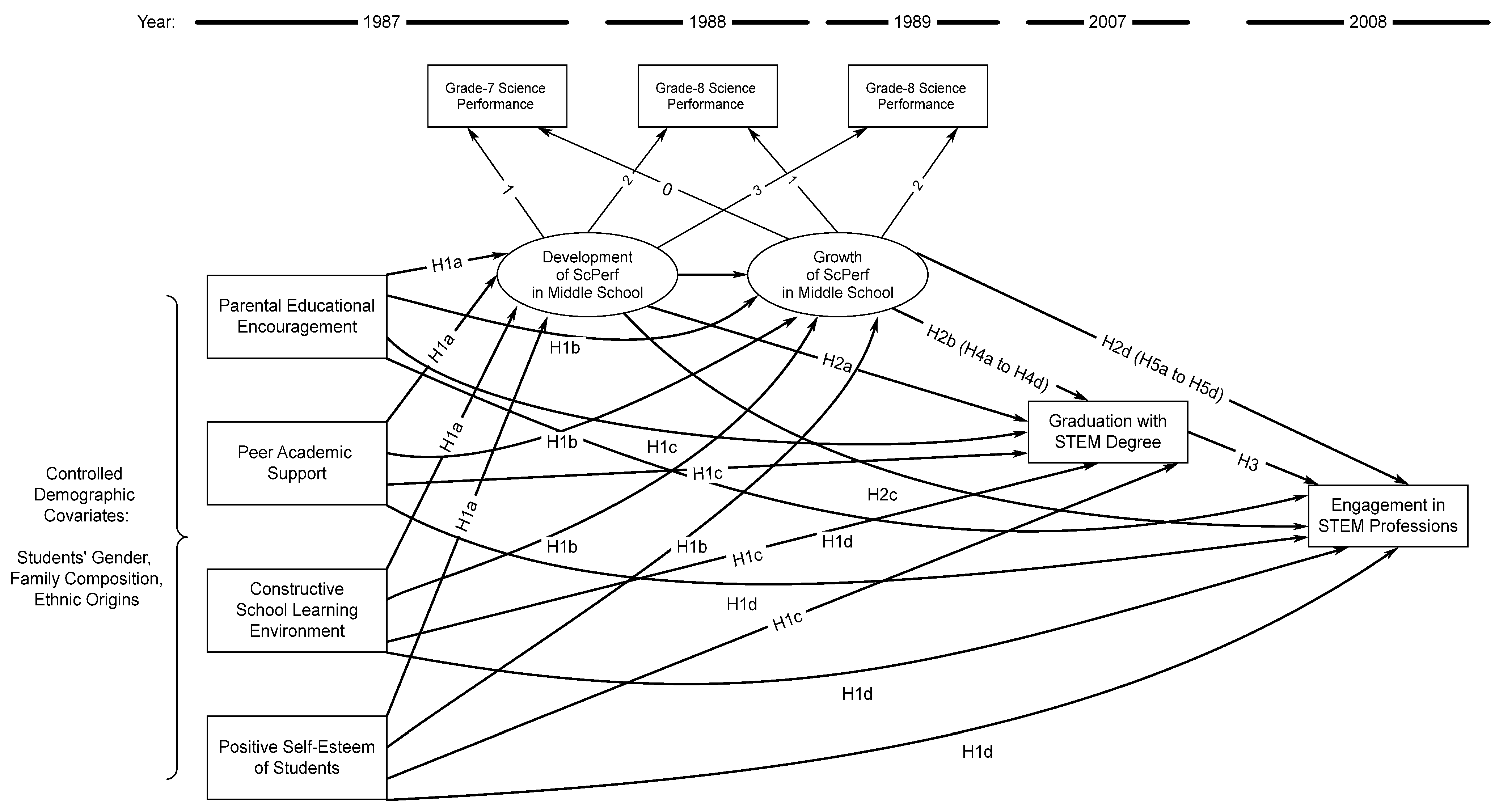
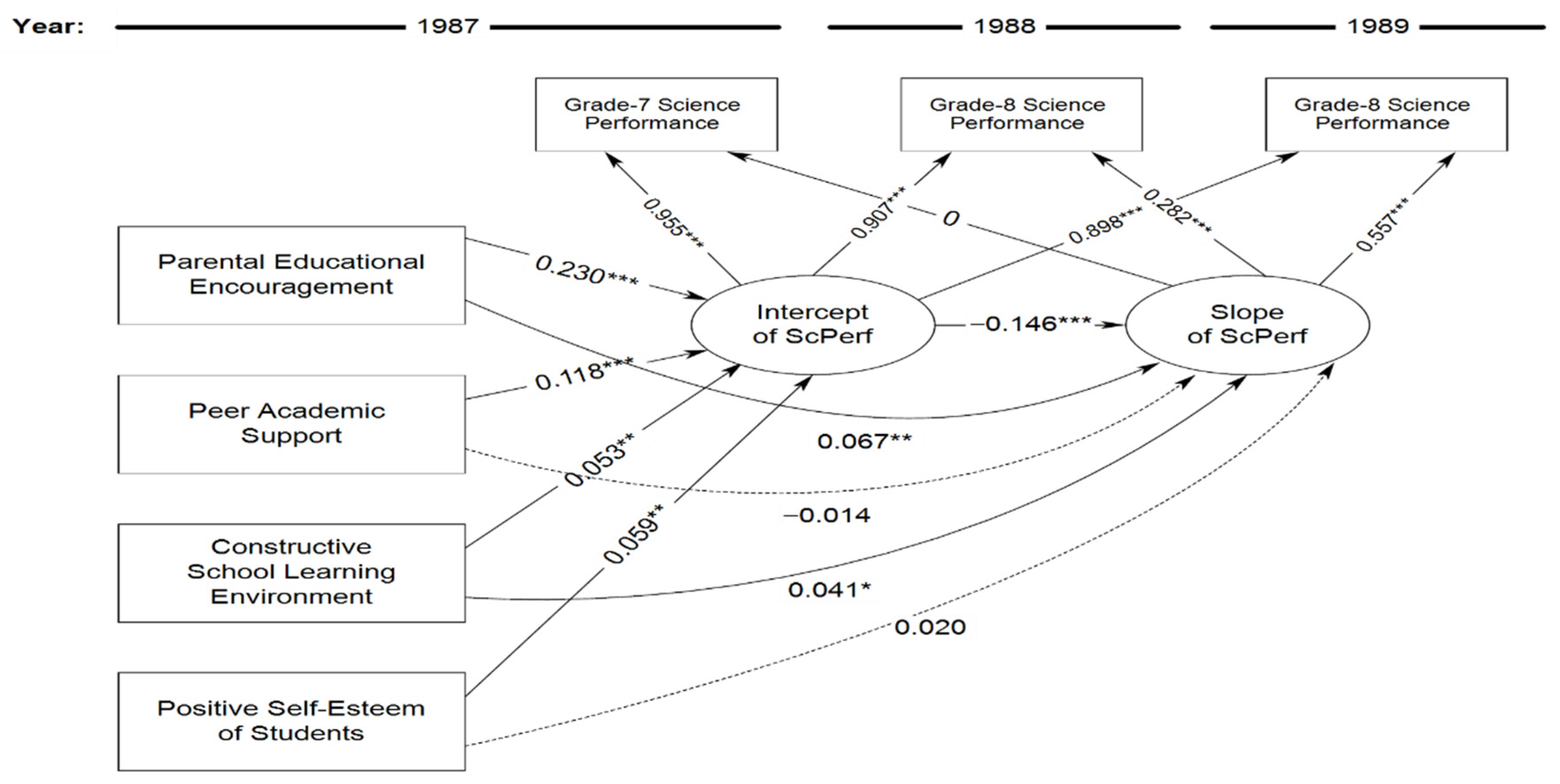
- and are the factor loadings for the intercept and slope factors of science performance, respectively. To define a linear trajectory, the intercept factor loadings were fixed to 1 for all time points, and the slope factor loadings were fixed to 0, 1, 2 for grades 7, 8, and 9.
- -
- and are the latent intercept and slope factors of science performance for individual .
- -
- is the time-specific residual for individual at time , with variance .
- -
- γ00 and γ10 are the mean intercept and mean slope for the developmental and growth trajectories of science performance, respectively.
- -
- zi is a vector of the time-invariant covariates for individual i.
- -
- γ01 and γ11 are vectors of regression coefficients representing the effects of the covariates in terms of the socialization agents and controlled demographic variables on the latent intercept and slope factors.
- -
- ζ0i and ζ1i are the residuals (random effects) of the intercept and slope factors.
- -
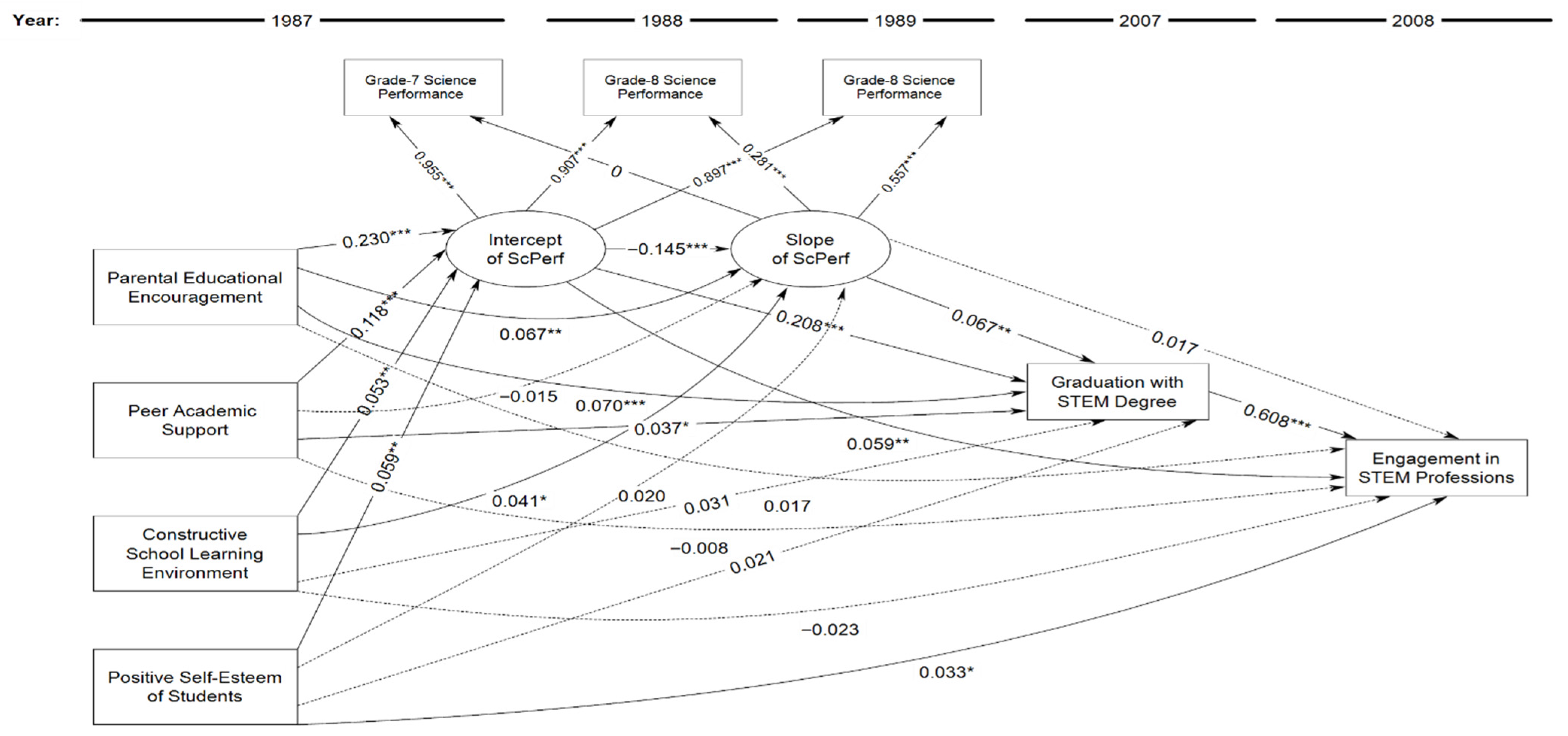
- β1 and β2 quantify the direct effects of the initial science performance level and its growth rate on the distal outcome, e.g., STEM degree attainment and STEM career engagement.
- -
- β3 represents the direct effects of the socialization agents on the distal outcome, controlling for the science trajectories.
- -
- ξDi is the residual variance of the distal outcome.
5. Results
5.1. Descriptive Statistics of the Study Variables
5.2. Results of Unconditional and Conditional LGCM Modeling
5.3. Latent Serial Mediation Effects of Students’ Developmental and Growth Trajectories of Science Performance and Their Graduation with a STEM Degree
5.4. Summary of Supportiveness of the Study Hypotheses and Sensitivity Analysis
6. Discussion
6.1. Theoretical and Empirical Advancements: From Static Snapshots to Dynamic Processes
6.2. The Synergistic Yet Differential Power of Socialization Agents
6.3. Middle School Science Trajectories: The Pivotal Mediating Mechanism
6.4. The Sequential Pathway to STEM Careers: The Non-Negotiable Role of the Degree
6.5. Demographic Nuances: Unpacking Inequality in the Stem Pipeline
6.6. Policy and Intervention Implications: Toward a Synergistic Ecology of Support
- For Parents and Families: Programs should equip parents, especially those in underrepresented communities, with strategies to provide effective educational encouragement, moving beyond general support to specific science-oriented advocacy. This includes guiding them on how to discuss science and math positively and link them to real-world careers; monitor and discuss their child’s science progress; express clear and high educational expectations, particularly regarding college attendance; and actively help their children navigate educational planning for STEM pathways.
- For Schools and Teachers: Investment in professional development for middle school science teachers is paramount to create the supportive and rigorous environment that fuels growth. This includes training in inquiry-based and hands-on pedagogical methods that make science engaging. Furthermore, schools should deliberately structure collaborative, project-based learning to foster pro-academic peer networks and make science engagement socially rewarding. School policies should also prioritize creating a positive school climate characterized by caring teacher–student relationships and high academic standards, as our measure of constructive school learning environment directly predicted science growth.
- For Practitioners: Counselors and educators should use dynamic assessments of science trajectories (initial level and growth) to identify students who, despite a low initial starting point, show strong growth potential, and target them with enrichment resources. Conversely, high-achievers who may be at risk of plateauing need to be challenged to maintain their growth trajectory.
- For Policymakers: Funding priorities should emphasize the middle school years as a critical intervention point. Policies should encourage the integration of family and community engagement into school STEM initiatives, breaking down the walls between these systems. This could include funding for family STEM nights, community-school partnerships, and grants for schools to implement the multi-level supports described above.”
6.7. Limitations, Future Directions, and Concluding Synthesis
7. Conclusions
Supplementary Materials
Author Contributions
Funding
Institutional Review Board Statement
Informed Consent Statement
Data Availability Statement
Acknowledgments
Conflicts of Interest
| 1 | Sensitivity analysis is the study of uncertainty in the output of a mathematical or statistical model attributable to different sources of uncertainty in the model input, which can be used to test the robustness of the study results in the current study when uncertainty is a concern. For this reason, the sources of uncertainty in the current study are ascribable to whether the effects of education-related socialization agents and students’ developmental and growth trajectories of science performance in middle school on the two STEM outcome variables in terms of students’ graduation with a STEM degree in college and their engagement in STEM professions in later adulthood defined by the LSAY personnel are reliable and plausible if a different definition is used to define the STEM development of students in adulthood. For this, we adopted two pertinent STEM-related variables that had not been recodedrecorded by the LSAY personnel to indicate the STEM development of the students in college and adulthood, which are the students’ graduation majors and career categories measured in 2007 and 2008, respectively. As such, recoding of these two nominal variables is needed, in which for comparison and predictive purposes the variable of graduation majors originally containing many categories measuring students’ graduation majors nominally is recoded to three categories: 0 = students with no degree, 1 = students of non-STEM degree, and 2 = students of STEM degree; and then combined students of STEM degree and non-STEM degree to the same category (1) as compared to students with no degree (0). This is logically and mathematically necessary, as the acquisition of a STEM or a non-STEM degree assumes a similar academic level when compared with students with no degree, although STEM and non-STEM degrees are different in academic focus. Moreover, students’ career categories measured in 2008 are recoded by a broad definition to indicate students’ later engagement in STEM professions (see Table S4 in the Supplementary Materials for details). For statistical modeling, it is necessary to recode nominal variables into dichotomous categories, assigning meaning to the comparison and reference groups to enable prediction and calculation. Therefore, the two new STEM outcome variables are dichotomously coded in this sensitivity analysis, and the difference between the new and original STEM outcome variables is put in the same structural model to compare if they are different in terms of model fit and significance of the effects in the study relationships to confirm the tenability of the longitudinal study relationships hypothesized in the current study. |
References
- Ahmed, W. (2018). Developmental trajectories of math anxiety during adolescence: Associations with STEM career choice. Journal of Adolescence, 67, 158–166. [Google Scholar] [CrossRef] [PubMed]
- Almatrafi, O., Johri, A., Rangwala, H., & Lester, J. (2017, June 25–28). Retention and persistence among STEM students: A comparison of direct admit and transfer students across engineering and science. ASEE Annual Conference & Exposition, Columbus, OH, USA. Available online: https://peer.asee.org/27899 (accessed on 21 July 2025).
- Altermatt, E. R. (2019). Academic support from peers as a predictor of academic self-efficacy among college students. Journal of College Student Retention-Research Theory & Practice, 21(1), 21–37. [Google Scholar] [CrossRef]
- Anderson, J., & Li, Y. (2020). Integrated approaches to STEM education: An international perspective. Springer International Publishing. [Google Scholar]
- Arens, A. K., Marsh, H. W., Pekrun, R., Lichtenfeld, S., Murayama, K., & vom Hofe, R. (2017). Math self-concept, grades, and achievement test scores: Long-term reciprocal effects across five waves and three achievement tracks. Journal of Educational Psychology, 109(5), 621–634. [Google Scholar] [CrossRef]
- Ayuso, A., Merayo, N., Ruiz, I., & Fernández, P. (2022). Challenges of STEM vocations in secondary education. IEEE Transactions on Education, 65(4), 713–724. [Google Scholar] [CrossRef]
- Becker, M., Baumert, J., Tetzner, J., Wagner, J., Maaz, K., & Köller, O. (2021). On the interplay of self-esteem, social background, and intelligence in predicting educational attainment and occupational success in adulthood. Zeitschrift Fur Padagogik, 67(5), 682–702. [Google Scholar] [CrossRef]
- Bleeker, M. A., & Jacobs, J. E. (2004). Achievement in math and science: Do mothers’ beliefs matter 12 years later? Journal of Educational Psychology, 96(1), 97–109. [Google Scholar] [CrossRef]
- Boonk, L., Gijselaers, H. J. M., Ritzen, H., & Brand-Gruwel, S. (2018). A review of the relationship between parental involvement indicators and academic achievement. Educational Research Review, 24, 10–30. [Google Scholar] [CrossRef]
- Booth, M. Z., & Gerard, J. M. (2011). Self-Esteem and academic achievement: A comparative study of adolescent students in England and the United States. Compare: A Journal of Comparative and International Education, 41(5), 629–648. [Google Scholar] [CrossRef] [PubMed]
- Bornstein, M. H., Putnick, D. L., & Suwalsky, J. T. D. (2018). Parenting cognitions → parenting practices → child adjustment? The standard model. Development and Psychopathology, 30(2), 399–416. [Google Scholar] [CrossRef]
- Bottia, M. C., Mickelson, R. A., Jamil, C., Moniz, K., & Barry, L. (2021). Factors associated with college stem participation of racially minoritized students: A synthesis of research. Review of Educational Research, 91(4), 614–648, Article 00346543211012751. [Google Scholar] [CrossRef]
- Bottia, M. C., Mickelson, R. A., & Stearns, E. (2023). Racially diverse educational pathways and STEM college outcomes: A quantitative analysis of students in North Carolina. Science Education, 107(4), 964–998. [Google Scholar] [CrossRef]
- Bottia, M. C., Stearns, E., Mickelson, R. A., & Moller, S. (2018). Boosting the numbers of STEM majors? The role of high schools with a STEM program. Science Education, 102(1), 85–107. [Google Scholar] [CrossRef]
- Canales, A., & Maldonado, L. (2023). Do teachers compensate for or compound disparities in academic achievement? International Journal of Educational Research, 117, 102138. [Google Scholar] [CrossRef]
- Chen, F. F. (2007). Sensitivity of goodness of fit indexes to lack of measurement invariance. Structural Equation Modeling: A Multidisciplinary Journal, 14(3), 464–504. [Google Scholar] [CrossRef]
- Chen, Y., Chiu, S. W. K., Zhu, J. X., & So, W. W. M. (2022). Maintaining secondary school students’ STEM career aspirations: The role of perceived parental expectations, self-efficacy, and cultural capital. International Journal of Science Education, 44(3), 434–462. [Google Scholar] [CrossRef]
- Crosnoe, R., & Johnson, M. K. (2011). Research on adolescence in the twenty-first century. Annual Review of Sociology, 37, 439–460. [Google Scholar] [CrossRef]
- Cvencek, D., Fryberg, S. A., Covarrubias, R., & Meltzoff, A. N. (2018). Self-concepts, self-esteem, and academic achievement of minority and majority North American elementary school children. Child Development, 89(4), 1099–1109. [Google Scholar] [CrossRef] [PubMed]
- Delaney, J. M., & Devereux, P. J. (2022). Gender differences in STEM persistence after graduation. Economica, 89(356), 862–883. [Google Scholar] [CrossRef]
- DeMars, C. (2010). Item response theory. Oxford University Press. [Google Scholar]
- Dotterer, A. M. (2022). Parent involvement, expectancy values, and STEM outcomes among underrepresented adolescents. Social Psychology of Education, 25(1), 113–127. [Google Scholar] [CrossRef]
- Ekmekci, A., Sahin, A., & Waxman, H. (2019). Factors affecting students’ stem choice and persistence: A synthesis of research and findings from the second year of a longitudinal high school stem tracking study. Brill. [Google Scholar] [CrossRef]
- English, L. D. (2017). Advancing elementary and middle school STEM education. International Journal of Science and Mathematics Education, 15, S5–S24. [Google Scholar] [CrossRef]
- Friedman-Sokuler, N., & Justman, M. (2016). Gender streaming and prior achievement in high school science and mathematics. Economics of Education Review, 53, 230–253. [Google Scholar] [CrossRef]
- Gecas, V. (2003). Self-agency and the life course. In J. T. Mortimer, & M. J. Shanahan (Eds.), Handbook of the life course (pp. 369–390). Springer. [Google Scholar]
- Gong, H. J., Kwon, J., & Brock, M. (2022). Experiential learning through a peer learning assistant model in STEM. Educational Research, 64(3), 317–333. [Google Scholar] [CrossRef]
- Grimm, K. J., Ram, N., & Estabrook, R. (2017). Growth modeling: Structural equation and multilevel modeling approaches. The Guilford Press. [Google Scholar]
- Heard, H. E. (2007). The family structure trajectory and adolescent school performance-Differential effects by race and ethnicity. Journal of Family Issues, 28(3), 319–354. [Google Scholar] [CrossRef]
- Heck, R. H., & Thomas, S. L. (2020). An Introduction to multilevel modeling techniques: MLM and SEM approaches. Routledge. [Google Scholar]
- Herskovic, L., & Silva, J. (2022). Links between performance in high school and the decision to major in STEM fields: Evidence from Chile. Educational Studies, 50(6), 1575–1602. [Google Scholar] [CrossRef]
- Hoferichter, F., Kulakow, S., & Raufelder, D. (2022). How teacher and classmate support relate to students’ stress and academic achievement. Frontiers in Psychology, 13, 992497. [Google Scholar] [CrossRef] [PubMed]
- Iroaganachi, M. A., Babalola, Y. T., & Soyemi, D. O. (2021). Environmental factors and STEM career path choice intentions of junior secondary school girls in North-Central Nigeria. Cogent Arts & Humanities, 8(1), 1945720. [Google Scholar] [CrossRef]
- Kang, C., Jo, H., Han, S. W., & Weis, L. (2021). Complexifying Asian American student pathways to STEM majors: Differences by ethnic subgroups and college selectivity. Journal of Diversity in Higher Education, 16, 215–225. [Google Scholar] [CrossRef]
- Ketscher, L., Stoeger, H., Vialle, W., & Ziegler, A. (2025). Same classroom, different reality: Secondary school students’ perceptions of STEM lessons-A pioneering study. Education Sciences, 15(4), 467. [Google Scholar] [CrossRef]
- Keung, C. P. C., & Ho, E. S. C. (2019). Social capital and educational expectations exploring adolescents’ capabilities to aspire for postsecondary education. In R. D. Bartee, & P. L. George (Eds.), Contemporary perspectives on social capital in educational contexts (pp. 181–199). Information Age Publishing. [Google Scholar]
- Kloser, M., Wilsey, M., Twohy, K. E., Immonen, A. D., & Navotas, A. C. (2018). “We do STEM”: Unsettled conceptions of STEM education in middle school S.T.E.M. classrooms. School Science and Mathematics, 118(8), 335–347. [Google Scholar] [CrossRef]
- Kohen, Z., & Nitzan, O. (2022). Excellence in mathematics in secondary school and choosing and excelling in STEM professions over significant periods in life. International Journal of Science and Mathematics Education, 20(1), 169–191. [Google Scholar] [CrossRef]
- Larkin, K., & Lowrie, T. (2022). STEM education in the early years—Thinking about tomorrow. Springer. [Google Scholar] [CrossRef]
- LeBeau, B., Harwell, M., Monson, D., Dupuis, D., Medhanie, A., & Post, T. R. (2012). Student and high-school characteristics related to completing a science, technology, engineering or mathematics (STEM) major in college. Research in Science & Technological Education, 30(1), 17–28. [Google Scholar] [CrossRef]
- Lee, T., & Shi, D. X. (2021). A comparison of full information maximum likelihood and multiple imputation in structural equation modeling with missing data. Psychological Methods, 26(4), 466–485. [Google Scholar] [CrossRef] [PubMed]
- Lent, R. W., & Brown, S. D. (2013). Social cognitive model of career self-management: Toward a unifying view of adaptive career behavior across the life span. Journal of Counseling Psychology, 60(4), 557–568. [Google Scholar] [CrossRef]
- Lent, R. W., Brown, S. D., & Hackett, G. (1994). Toward a unifying social cognitive theory of career and academic interest, choice, and performance. Journal of Vocational Behavior, 45(1), 79–122. [Google Scholar] [CrossRef]
- Lent, R. W., Sheu, H. B., Miller, M. J., Cusick, M. E., Penn, L. T., & Truong, N. N. (2018). Predictors of science, technology, engineering, and mathematics choice options: A meta-analytic path analysis of the social-cognitive choice model by gender and race/ethnicity. Journal of Counseling Psychology, 65(1), 17–35. [Google Scholar] [CrossRef] [PubMed]
- Liu, A. R., & Xie, Y. (2016). Why do Asian Americans academically outperform Whites?—The cultural explanation revisited. Social Science Research, 58, 210–226. [Google Scholar] [CrossRef]
- Luo, L. L., Stoeger, H., & Subotnik, R. F. (2022). The influences of social agents in completing a STEM degree: An examination of female graduates of selective science high schools. International Journal of STEM Education, 9(1), 7. [Google Scholar] [CrossRef]
- Magnusson, C., & Nermo, M. (2018). From childhood to young adulthood: The importance of self-esteem during childhood for occupational achievements among young men and women. Journal of Youth Studies, 21(10), 1392–1410. [Google Scholar] [CrossRef]
- Marsh, H. W. (2022). Extending the reciprocal effects model of math self-concept and achievement: Long-term implications for end-of-high-school, age-26 outcomes, and long-term expectations. Journal of Educational Psychology, 115(2), 193–211. [Google Scholar] [CrossRef]
- Marsh, H. W., Hau, K. T., & Wen, Z. L. (2004). In search of golden rules: Comment on hypothesis-testing approaches to setting cutoff values for fit indexes and dangers in overgeneralizing Hu and Bentler’s (1999) findings. Structural Equation Modeling: A Multidisciplinary Journal, 11(3), 320–341. [Google Scholar] [CrossRef]
- Masud, H., Thurasamy, R., & Ahmad, M. S. (2015). Parenting styles and academic achievement of young adolescents: A systematic literature review. Quality & Quantity, 49(6), 2411–2433. [Google Scholar] [CrossRef]
- Mau, W. C., Domnick, M., & Ellsworth, R. A. (1995). Characteristics of female students who aspire to science and engineering or homemaking occupations. Career Development Quarterly, 43(4), 323–337. [Google Scholar] [CrossRef]
- McArdle, J. J. (2012). Latent curve modeling of longitudinal growth data. In R. H. Hoyle (Ed.), Handbook of structural equation modeling (pp. 547–570). Guilford Press. [Google Scholar]
- Miller, J. D. (2014). Longitudinal study of american youth, 1987–1994, 2007–2011: User guide. Inter-University Consortium for Political and Social Research. [Google Scholar]
- Miller, J. D., & Pearson, W. J. (2012). Pathways to STEMM professions for students from noncollege homes. Peabody Journal of Education, 87(1), 114–132. [Google Scholar] [CrossRef]
- Mitsopoulou, A. G., & Pavlatou, E. A. (2021). Factors associated with the development of secondary school students’ interest towards STEM studies. Education Sciences, 11(11), 746. [Google Scholar] [CrossRef]
- Muthen, L. K., & Muthen, B. O. (1998–2017). Mplus user’s guide (8th ed.). Muthen & Muthen. [Google Scholar]
- Newman, J. L., Dantzler, J., & Coleman, A. N. (2015). Science in action: How middle school students are changing their world through STEM service-learning projects. Theory into Practice, 54(1), 47–54. [Google Scholar] [CrossRef]
- Newsom, J. T. (2024). Longitudinal structural equation modeling: A comprehensive introduction. SAGE. [Google Scholar] [CrossRef]
- Ocal, E., Kartal, A., & Yilmaz, D. D. (2021). Middle-school students’ journey from stage to science: Science on stage. International Journal of Science Education, 43(15), 2516–2533. [Google Scholar] [CrossRef]
- Ozulku, E., & Kloser, M. (2023). Middle school students’ motivational dispositions and interest in STEM careers. International Journal of Science Education, 46(4), 382–402. [Google Scholar] [CrossRef]
- Pallas, A. M. (2003). Educational transitions, trajectories, and pathways. In J. T. Mortimer, & M. J. Shanahan (Eds.), Handbook of the life course (pp. 165–184). Springer. [Google Scholar]
- Pekrun, R., Lichtenfeld, S., Marsh, H. W., Murayama, K., & Goetz, T. (2017). Achievement emotions and academic performance: Longitudinal models of reciprocal effects. Child Development, 88(5), 1653–1670. [Google Scholar] [CrossRef] [PubMed]
- Penprase, B. E. (2020). STEM education for the 21st century. Springer International Publishing. [Google Scholar] [CrossRef]
- Perinelli, E., Pisanu, F., Checchi, D., Scalas, L. F., & Fraccaroli, F. (2022). Academic self-concept change in junior high school students and relationships with academic achievement. Contemporary Educational Psychology, 69, 102071. [Google Scholar] [CrossRef]
- Pribesh, S. L., Carson, J. S., Dufur, M. J., Yue, Y. Y., & Morgan, K. (2020). Family structure stability and transitions, parental involvement, and educational outcomes. Social Sciences, 9(12), 229. [Google Scholar] [CrossRef]
- Quintana, R., & Saatcioglu, A. (2022). The long-lasting effects of schooling: Estimating the effects of science and math identity in high school on college and career outcomes in STEM. Socius, 8, 23780231221115405. [Google Scholar] [CrossRef]
- Regnerus, M. D., & Elder, G. H. (2003). Religion and vulnerability among low-risk adolescents. Social Science Research, 32(4), 633–658. [Google Scholar] [CrossRef]
- Sahin, A., Ekmekci, A., & Waxman, H. C. (2018). Collective effects of individual, behavioral, and contextual factors on high school students’ future STEM career plans. International Journal of Science and Mathematics Education, 16(1), S69–S89. [Google Scholar] [CrossRef]
- Scheeren, L. (2022). The differential impact of educational tracking on SES Gaps in educational achievement for boys and girls. European Sociological Review, 38(6), 942–958. [Google Scholar] [CrossRef]
- Scherrer, V., & Preckel, F. (2019). Development of motivational variables and self-esteem during the school career: A meta-analysis of longitudinal studies. Review of Educational Research, 89(2), 211–258. [Google Scholar] [CrossRef]
- Schober, C., Schutte, K., Koller, O., McElvany, N., & Gebauer, M. M. (2018). Reciprocal effects between self-efficacy and achievement in mathematics and reading. Learning and Individual Differences, 63, 1–11. [Google Scholar] [CrossRef]
- Smid, S. C., Depaoli, S., & Van De Schoot, R. (2020). Predicting a distal outcome variable from a latent growth model: ML versus bayesian estimation. Structural Equation Modeling-A Multidisciplinary Journal, 27(2), 169–191. [Google Scholar] [CrossRef]
- Sommerfeld, A. K. (2016). Education as a collective accomplishment: How personal, peer, and parent expectations interact to promote degree attainment. Social Psychology of Education, 19(2), 345–365. [Google Scholar] [CrossRef]
- Song, G., & Wang, Z. H. (2021). Factors influencing middle school students’ interdisciplinary competence in science education. Journal of Research in Science Teaching, 58(7), 1041–1072. [Google Scholar] [CrossRef]
- Starr, C. R., Carranza, P. R., & Simpkins, S. D. (2022). Stability and changes in high school students’ STEM career expectations: Variability based on STEM support and parent education. Journal of Adolescence, 94(6), 906–919. [Google Scholar] [CrossRef]
- Stewart, E. B. (2008). School structural characteristics, student effort, peer associations, and parental involvement-The influence of school- and individual-level factors on academic achievement. Education and Urban Society, 40(2), 179–204. [Google Scholar] [CrossRef]
- Sun, Y. M., & Li, Y. Z. (2011). Effects of family structure type and stability on children’s academic performance trajectories. Journal of Marriage and Family, 73(3), 541–556. [Google Scholar] [CrossRef]
- Tasos, B., Nicky, C., & Grant, C. (2018). STEM education: An emerging field of inquiry. Brill Sense. [Google Scholar] [CrossRef]
- Tey, T. C. Y., Moses, P., & Cheah, P. K. (2020). Teacher, parental and friend influences on STEM interest and career choice intention. Issues in Educational Research, 30(4), 1558–1575. [Google Scholar]
- Wang, J., & Wang, X. (2019). Structural equation modeling: Applications using Mplus. Wiley. [Google Scholar]
- Wang, M. T., & Eccles, J. S. (2013). School context, achievement motivation, and academic engagement: A longitudinal study of school engagement using a multidimensional perspective. Learning and Instruction, 28, 12–23. [Google Scholar] [CrossRef]
- Woo, H., Heo, N., Jang, H., & Jang, Y. (2021). Parental and school factors on American high school students’ academic and career intentions in STEM fields. International Journal for Educational and Vocational Guidance, 23(1), 19–42. [Google Scholar] [CrossRef]
- Wright, R., Ellis, M., & Townley, M. (2017). The matching of STEM degree holders with STEM occupations in large metropolitan labor markets in the United States. Economic Geography, 93(2), 185–201. [Google Scholar] [CrossRef]
- Yang, J. Q., Deng, Y. Z., & Wang, Y. H. (2023). Reciprocal associations among social-emotional competence, interpersonal relationships and academic achievements in primary school. Behavioral Sciences, 13(11), 922. [Google Scholar] [CrossRef]
- Yeung, J. W. K., & Igarashi, A. (2025). Evolving trajectories of educational expectations and science performance during middle school and STEM degree attainment of youth in adulthood. Humanities & Social Sciences Communications, 12(1), 1233. [Google Scholar] [CrossRef]
- Yeung, J. W. K., & Xia, L. L. L. (2023). Family and individual contexts of middle-school years and educational achievement of youths in middle-aged adulthood. International Journal of Environmental Research and Public Health, 20, 3279. [Google Scholar] [CrossRef]
- Zeng, L. H., Hao, Y. W., Hong, J. C., & Ye, J. N. (2022). The relationship between teacher support and bullying in schools: The mediating role of emotional self-efficacy. Current Psychology, 42(36), 31853–31862. [Google Scholar] [CrossRef]
- Zhang, Y. L. (2022). STEM persisters, switchers, and leavers: Factors associated with 6-Year degree attainment for STEM aspiring community college transfer students. Community College Journal of Research and Practice, 46(11), 796–811. [Google Scholar] [CrossRef]
- Zhao, K. Y., Chen, N., Liu, G. L., Lun, Z. J., & Wang, X. H. (2023). School climate and left-behind children’s achievement motivation: The mediating role of learning adaptability and the moderating role of teacher support. Frontiers in Psychology, 14, 1040214. [Google Scholar] [CrossRef] [PubMed]
- Zhao, T., & Perez-Felkner, L. (2022). Perceived abilities or academic interests? Longitudinal high school science and mathematics effects on postsecondary STEM outcomes by gender and race. International Journal of STEM Education, 9(1), 42. [Google Scholar] [CrossRef]



| Study Variables | Mean/Frequency | SD/% | |
|---|---|---|---|
| 1. | Gender | ||
| Female | 1495 | 48% | |
| Male | 1621 | 52% | |
| 2. | Family Composition | ||
| Two-Parent | 2715 | 87.1% | |
| Otherwise | 401 | 12.9% | |
| 3. | Ethnicity | ||
| Non-Hispanic White | 2169 | 69.6% | |
| American African | 504 | 16.2% | |
| Hispanic | 284 | 9.1% | |
| Asian | 112 | 3.6% | |
| Native | 47 | 1.5% | |
| 4. | Grade-7 Parental Educational Encouragement in 1987 | 1.796 | 1.064 |
| 5. | Grade-7 Peer Academic Support in 1987 | 2.035 | 0.998 |
| 6. | Grade-7 Constructive School Learning Environment in 1987 | 2.333 | 0.613 |
| 7. | Grade-7 Students’ Positive Self-Esteem in 1987 | 3.922 | 0.663 |
| 8. | Integrated Scores of Science Performance from 1987 to 1989 | ||
| Grade 7 (1987) | 49.854 | 10.213 | |
| Grade 8 (1988) | 53.282 | 10.814 | |
| Grade 9 (1989) | 57.440 | 10.929 | |
| 9. | STEM Degree in 2007 | ||
| Yes | 281 | 9% | |
| No | 2835 | 91% | |
| 10. | STEM Professions in 2008 | ||
| Yes | 191 | 6.1% | |
| No | 2925 | 93.9% | |
| Intercept Factor | Factor Loadings | SE | 95% CI |
| Grade-7 Science Performance | 0.964 *** | 0.013 | 0.939 to 0.988 |
| Grade-8 Science Performance | 0.908 *** | 0.011 | 0.887 to 0.929 |
| Grade-9 Science Performance | 0.904 *** | 0.016 | 0.872 to 0.935 |
| Slope Factor | Factor Loadings | SE | 95% CI |
| Grade-7 Science Performance | 0.000 | 0.000 | -- |
| Grade-8 Science Performance | 0.292 *** | 0.012 | 0.268 to 0.316 |
| Grade-9 Science Performance | 0.581 *** | 0.026 | 0.530 to 0.633 |
| Model Parameters | Coefficients | SE | 95% CI |
| Intercept and Slope Covariance | −0.134 *** | 1.139 | −6.435 to −1.970 |
| Intercept Variance | 97.419 *** | 4.229 | 89.130 to 105.709 |
| Slope Variance | 10.080 *** | 1.044 | 8.033 to 12.126 |
| No. | Predictor | Mediators/Mediational Paths a | STEM Outcome | βTotInd | Z-Value |
|---|---|---|---|---|---|
| A1 | Parental Educational Encouragement |
| Successful Graduation with a STEM Degree | 0.050 | 7.708 *** |
| A2 | Peers Academic Support | Successful Graduation with a STEM Degree | 0.023 | 3.950 *** | |
| A3 | Supportive School Learning Environment | Successful Graduation with a STEM Degree | 0.013 | 2.888 ** | |
| A4 | Positive Self-Esteem of Student | Successful Graduation with a STEM Degree | 0.013 | 3.453 ** | |
| B1 | Parental Educational Encouragement |
| Engagement in STEM Professions | 0.087 | 7.323 *** |
| B2 | Peer Academic Support | Engagement in STEM Professions | 0.043 | 3.391 ** | |
| B3 | Constructive School Learning Environment | Engagement in STEM Professions | 0.031 | 2.625 ** | |
| B4 | Positive Self-Esteem of Students | Engagement in STEM Professions | 0.024 | 2.004 * |
| Hypothesis | Sub-Hypothesis | Supportiveness | Explanation of Vindications a |
|---|---|---|---|
| Hypothesis 1 (H1) | H1a | ✓ | Among 16 direct effects being tested (the four socialization agents on students’ development and growth of science performance, graduation with a STEM degree, and engagement in STEM professions), 9 are correctly supported, and 7 are not supported (refer to Model 3 in Figure 2). Hypothesis 1 is largely supported. |
| H1b | ⍻ | ||
| H1c | ⍻ | ||
| H1d | ⍻ | ||
| Hypothesis 2 (H2) | H2a | ✓ | Among 4 direct effects being tested (students’ development and growth of science performance on their graduation with a STEM degree and engagement in STEM professions), 3 are correctly supported, and 1 is not supported (refer to Model 3 in Figure 2). Hypothesis 2 is largely supported. |
| H2b | ✓ | ||
| H2c | ✓ | ||
| H2d | ✕ | ||
| Hypothesis 3 (H3) | -- | ✓ | Hypothesis 3 is completely supported (refer to Model 3 in Figure 2). |
| Hypothesis 4 (H4) | H4a | ✓ | The two mediated effects of students’ development and growth of science performance on the relationships between socialization agents and students’ graduation with a STEM degree are tested, they are all correctly supported (refer to Table 3). Hypothesis 4 is completely supported. |
| H4b | ✓ | ||
| H4c | ✓ | ||
| H4d | ✓ | ||
| Hypothesis 5 (H5) | H5a | ✓ | The three mediated effects of students’ development and growth of science performance and graduations with a STEM degree on the relationships between socialization agents and students’ engagement in STEM professions are tested, they are all correctly supported (refer to Table 3). Hypothesis 5 is completely supported. |
| H5b | ✓ | ||
| H5c | ✓ | ||
| H5d | ✓ |
Disclaimer/Publisher’s Note: The statements, opinions and data contained in all publications are solely those of the individual author(s) and contributor(s) and not of MDPI and/or the editor(s). MDPI and/or the editor(s) disclaim responsibility for any injury to people or property resulting from any ideas, methods, instructions or products referred to in the content. |
© 2026 by the authors. Licensee MDPI, Basel, Switzerland. This article is an open access article distributed under the terms and conditions of the Creative Commons Attribution (CC BY) license.
Share and Cite
Yeung, J.W.K.; Lo, H.H.M.; Fung, S.-F.; Young, D.K.W.; Xia, L. Charting the Pathway to STEM: How Middle School Socialization and Science Growth Trajectories Predict Adult Career Success. Educ. Sci. 2026, 16, 166. https://doi.org/10.3390/educsci16010166
Yeung JWK, Lo HHM, Fung S-F, Young DKW, Xia L. Charting the Pathway to STEM: How Middle School Socialization and Science Growth Trajectories Predict Adult Career Success. Education Sciences. 2026; 16(1):166. https://doi.org/10.3390/educsci16010166
Chicago/Turabian StyleYeung, Jerf W. K., Herman H. M. Lo, Sai-Fu Fung, Daniel K. W. Young, and Lili Xia. 2026. "Charting the Pathway to STEM: How Middle School Socialization and Science Growth Trajectories Predict Adult Career Success" Education Sciences 16, no. 1: 166. https://doi.org/10.3390/educsci16010166
APA StyleYeung, J. W. K., Lo, H. H. M., Fung, S.-F., Young, D. K. W., & Xia, L. (2026). Charting the Pathway to STEM: How Middle School Socialization and Science Growth Trajectories Predict Adult Career Success. Education Sciences, 16(1), 166. https://doi.org/10.3390/educsci16010166