Self-Assessment of Teamwork Skills Among Adolescents: Psychometric Properties of the Collaborative Skills Scale

Abstract
1. Introduction
1.1. The Assessment of Teamwork Skills in a Pedagogical Context
1.2. Theoretical Models for Describing Collaborative Problem Solving—The ATS21C Model of ColPS
2. Aims and Research Questions
3. Method
3.1. Sample and Procedure
3.2. Instrument
3.3. Data Analysis
4. Results
5. Discussion
Limitations and Future Research
6. Conclusions
Author Contributions
Funding
Institutional Review Board Statement
Informed Consent Statement
Data Availability Statement
Conflicts of Interest
Appendix A
List of the 36 Items
| Participation | |
| Action | I take part actively in the work. * |
| I leave it to the others. (R) | |
| I stay in the background. (R) | |
| I am engaged. * | |
| Interaction | I keep my thoughts to myself. (R) |
| I react to the others’ ideas and suggestions (e.g., with approval or with questions). * | |
| I share my ideas and thoughts with my peers. * | |
| I comment on other people’s ideas. | |
| Task completion | I keep trying to complete my part of the task until I succeed. * |
| I find it hard to come up with a new strategy for my part if the previous one does not work. (R) | |
| I try another strategy to solve my task if the previous one did not work. * | |
| I do not get to the end of the task I was given. (R) | |
| Perspective taking | |
| Adaptive responsiveness | I come up with a good idea while I am listening to my peers’ suggestions. * |
| I consider other people’s ideas, but I do not add any suggestions. (R) | |
| I develop my peers’ ideas further. * | |
| I find it hard to use other people’s suggestions. (R) | |
| Audience awareness | I find it hard to make myself understood by my groupmates. (R) |
| The others do not understand my explanation. | |
| I find the common ground with everybody. * | |
| I can explain my ideas so that everybody would understand them. * | |
| Social regulation | |
| Negotiation | I can easily acknowledge if I am wrong. * |
| I try to reconcile the parties if there is a disagreement * | |
| I feel bad when my peers criticize my work (R) | |
| I tell my peers if I hold the opposite opinion. * | |
| Self-evaluation | I know what job I am the most suitable for. * |
| I cannot really judge on my own how well I am doing. (R) | |
| I find it hard to decide what kind of task suits me. (R) | |
| I speak up if I feel that I could do another part of the work more effectively. | |
| Transactive memory | I make suggestions who and what task should be done according to what they are skillful in. * |
| I indicate if I believe that the division of work should be changed. * | |
| It does not matter to me who takes which role. (R) | |
| I find it hard to judge who would be suitable for which task. (R) | |
| Responsibility initiative | I don’t feel disappointed even if our group does not succeed, (R) |
| I experience it as my own failure if we do not reach our goal. | |
| I pay attention to how my groupmates get on with their work. * | |
| I help my peers when I have completed my job. * |
Appendix B
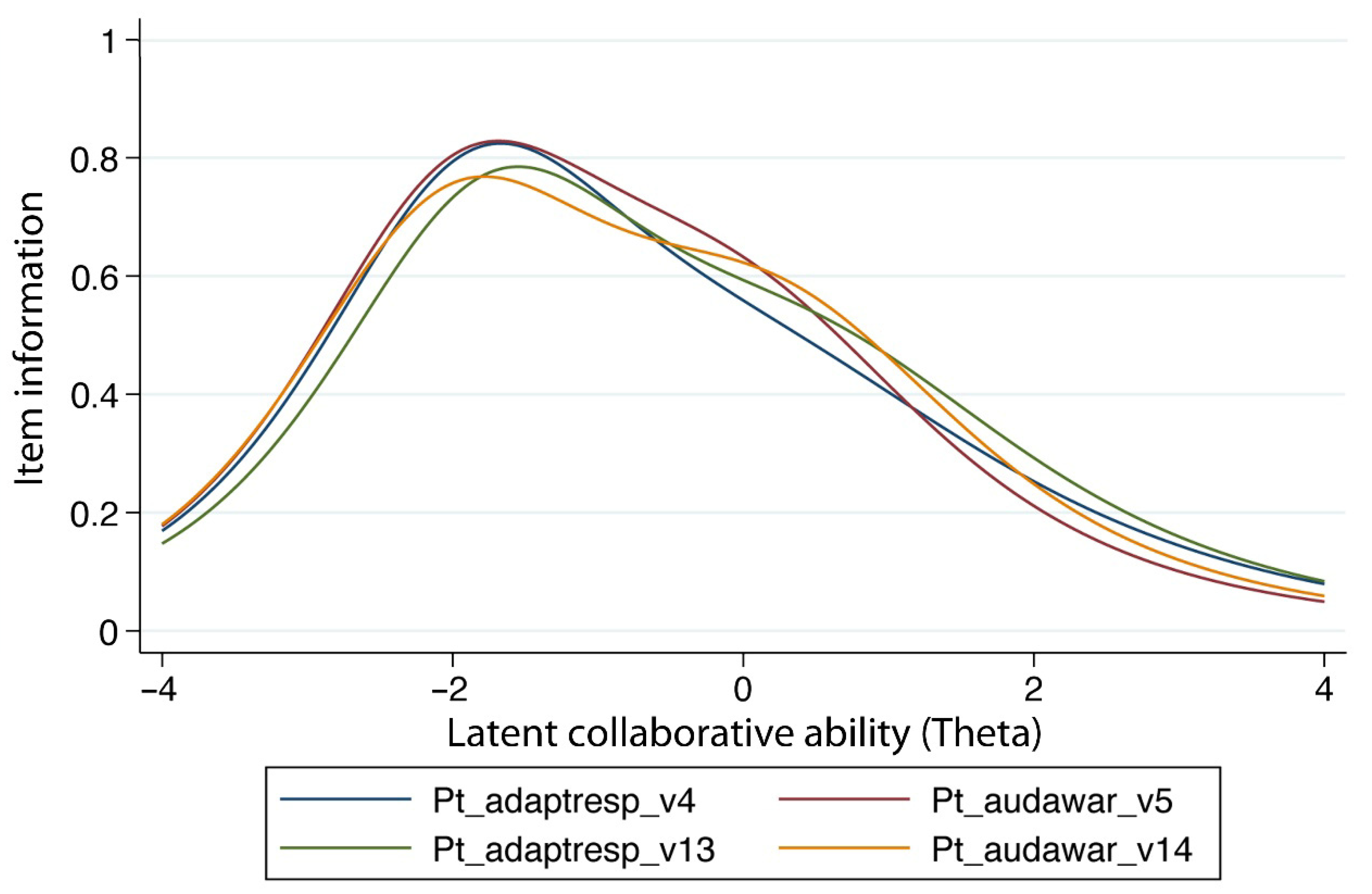
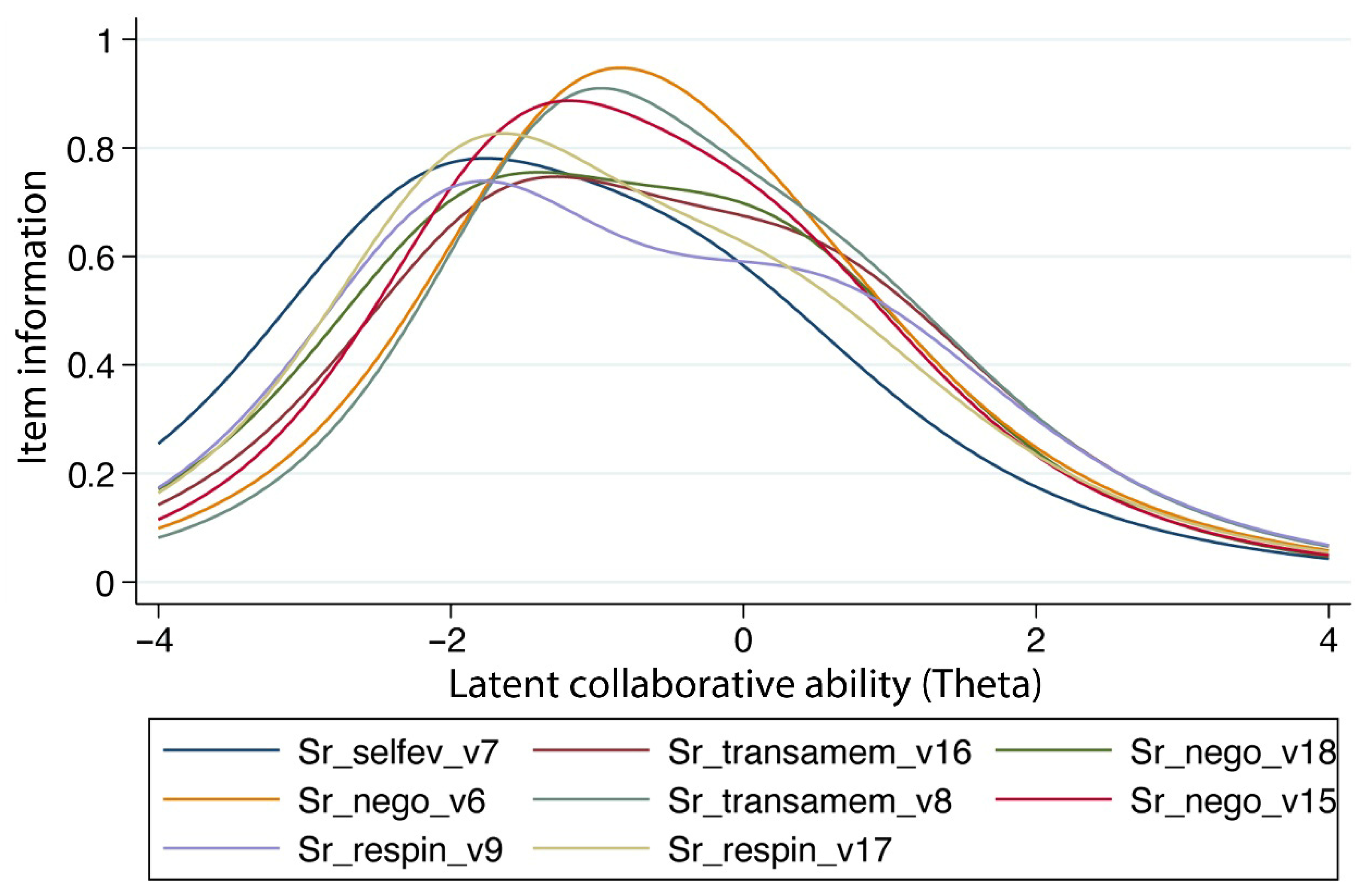
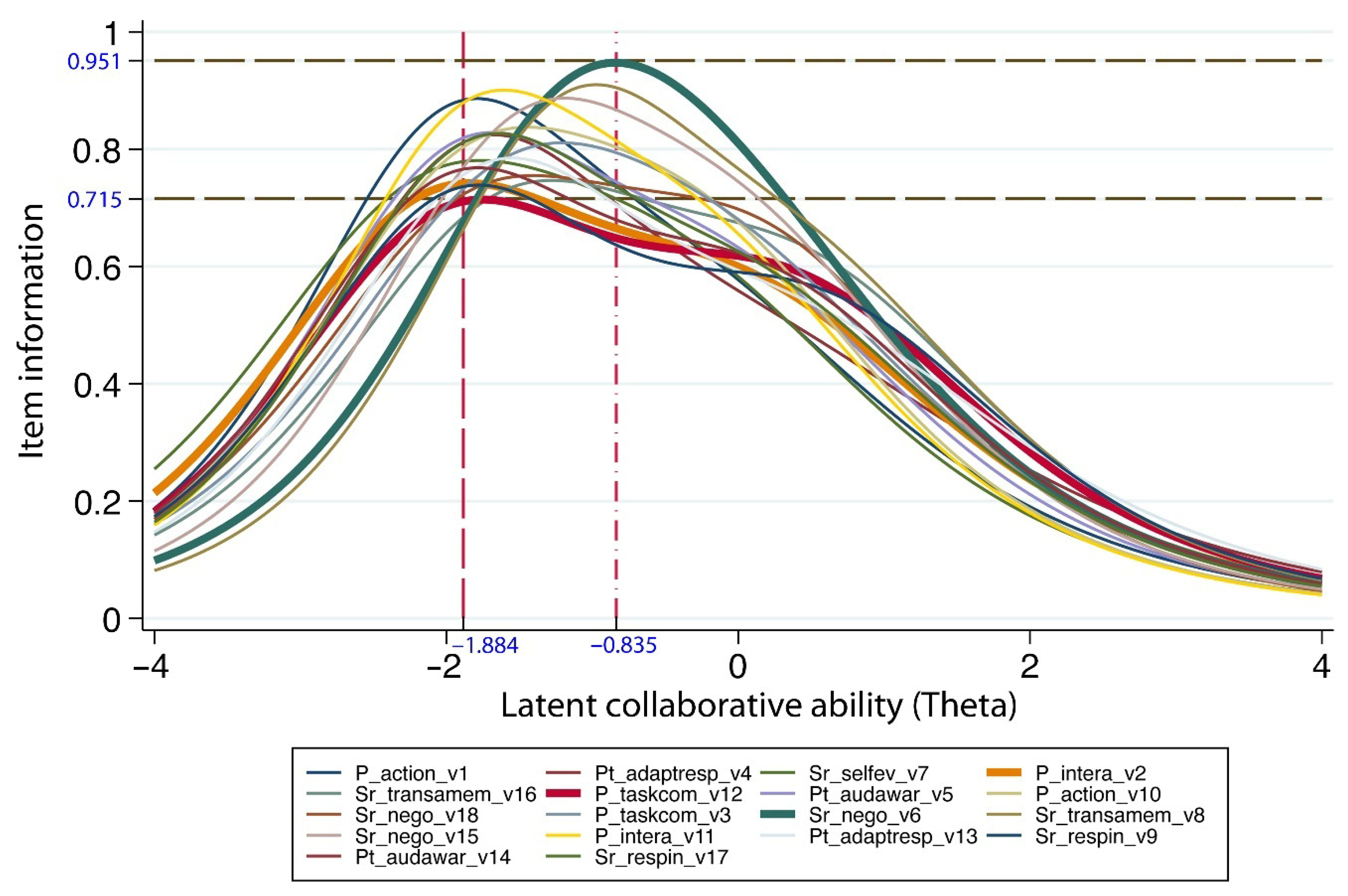
Item Information Functions of the CoSS Subscales
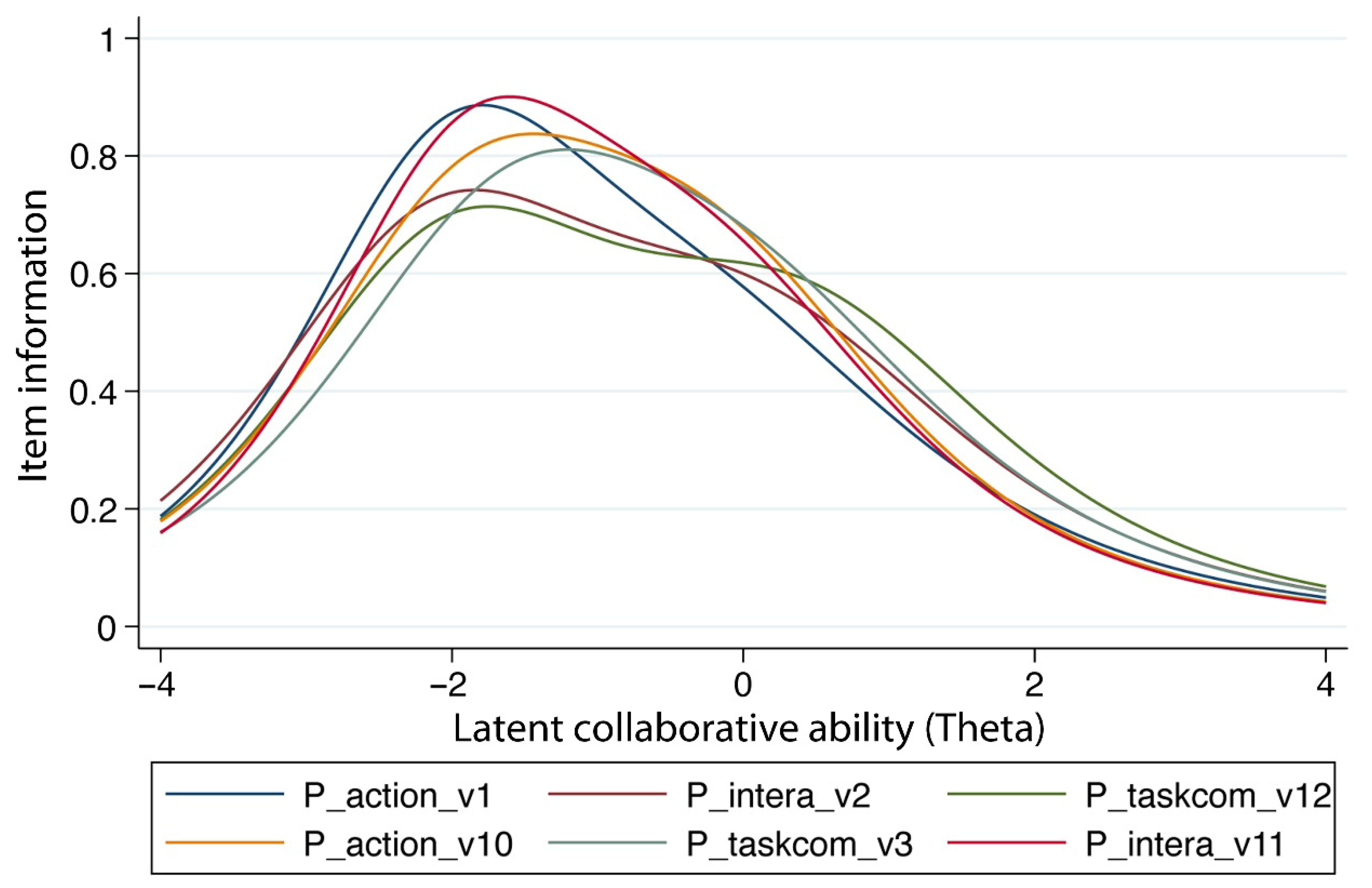


Appendix C
Appendix C.1. The Paper-Based Version of the Collaborative Skills Scale (CoSS)

| 1. | I take part actively in the work. | 1 | 2 | 3 | 4 | 5 | 6 | 7 |
| 2. | I react to the others’ ideas and suggestions (e.g., with approval or with questions). | 1 | 2 | 3 | 4 | 5 | 6 | 7 |
| 3. | I keep trying to complete my part of the task until I succeed. | 1 | 2 | 3 | 4 | 5 | 6 | 7 |
| 4. | I come up with a good idea while I am listening to my peers’ suggestions. | 1 | 2 | 3 | 4 | 5 | 6 | 7 |
| 5. | I find the common ground with everybody. | 1 | 2 | 3 | 4 | 5 | 6 | 7 |
| 6. | I can easily acknowledge if I am wrong. | 1 | 2 | 3 | 4 | 5 | 6 | 7 |
| 7. | I know what job I am the most suitable for. | 1 | 2 | 3 | 4 | 5 | 6 | 7 |
| 8. | I make suggestions who and what task should be done according to what they are skillful in. | 1 | 2 | 3 | 4 | 5 | 6 | 7 |
| 9. | I pay attention to how my groupmates get on with their work. | 1 | 2 | 3 | 4 | 5 | 6 | 7 |
| 10. | I am engaged. | 1 | 2 | 3 | 4 | 5 | 6 | 7 |
| 11. | I share my ideas and thoughts with my peers. | 1 | 2 | 3 | 4 | 5 | 6 | 7 |
| 12. | I try another strategy to solve my task if the previous one did not work. | 1 | 2 | 3 | 4 | 5 | 6 | 7 |
| 13. | I develop my peers’ ideas further. | 1 | 2 | 3 | 4 | 5 | 6 | 7 |
| 14. | I can explain my ideas so that everybody would understand them. | 1 | 2 | 3 | 4 | 5 | 6 | 7 |
| 15. | I try to reconcile the parties if there is a disagreement. | 1 | 2 | 3 | 4 | 5 | 6 | 7 |
| 16. | I indicate if I believe that the division of work should be changed. | 1 | 2 | 3 | 4 | 5 | 6 | 7 |
| 17. | I help my peers when I have completed my job. | 1 | 2 | 3 | 4 | 5 | 6 | 7 |
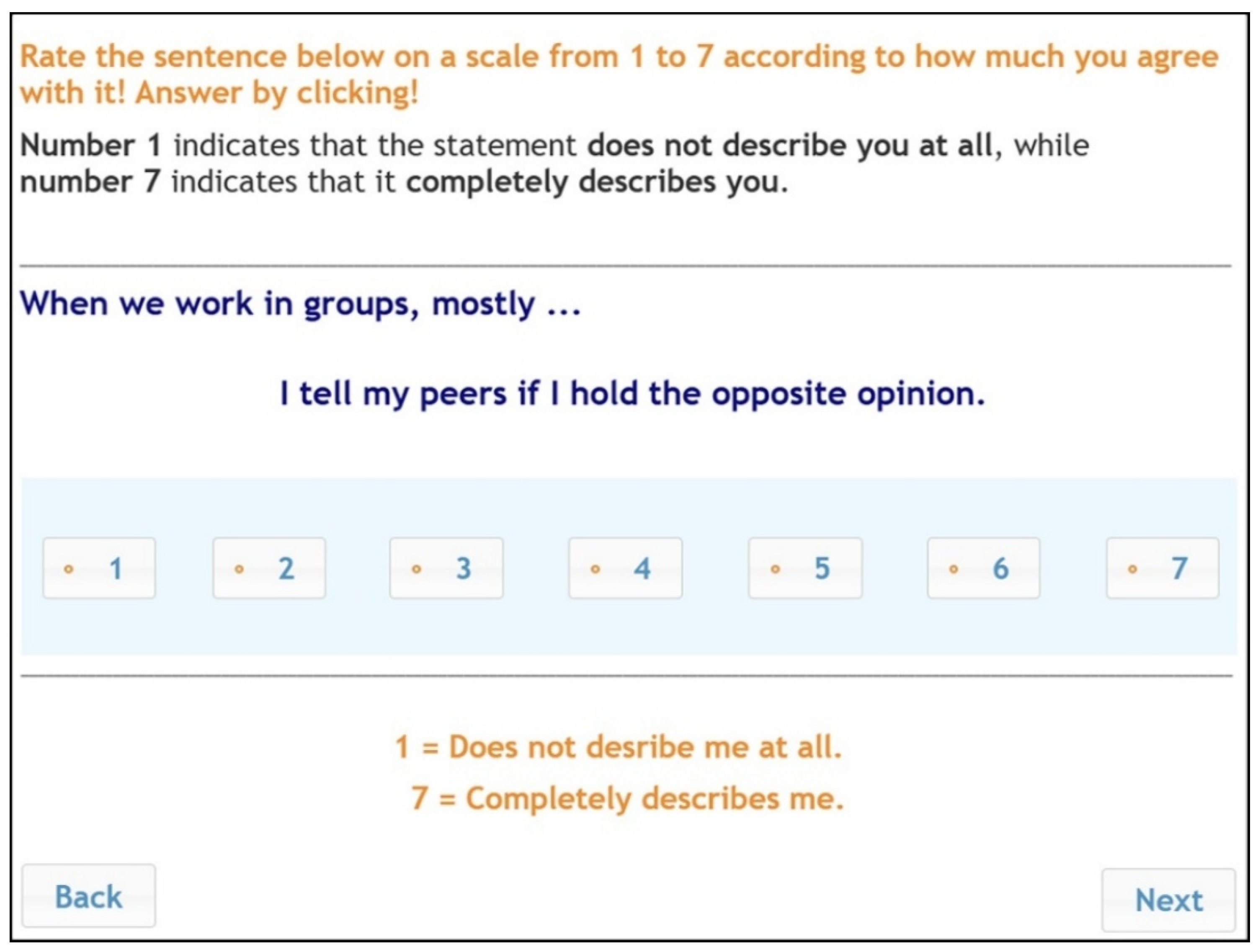
| 18. | I tell my peers if I hold the opposite opinion. | 1 | 2 | 3 | 4 | 5 | 6 | 7 |
Appendix C.2. Scoring Guide
References
- Ahonen, A. K., & Kinnunen, P. (2015). How do students value the importance of twenty-first century skills? Scandinavian Journal of Educational Research, 59(4), 395–412. [Google Scholar] [CrossRef]
- Binkley, M., Erstad, O., Herman, J., Raizen, S., Martin, R., Miller-Ricci, M., & Rumble, M. (2012). Defining twenty-first century skills. In P. Griffin, B. McGaw, & E. Care (Eds.), Assessment & teaching of 21st century skills (pp. 17–66). Springer. [Google Scholar] [CrossRef]
- Britton, E., Simper, N., Leger, A., & Stephenson, J. (2017). Assessing teamwork in undergraduate education: A measurement tool to evaluate individual teamwork skills. Assessment & Evaluation in Higher Education, 42(3), 378–397. [Google Scholar] [CrossRef]
- Brock, S. E., McAliney, P. J., Ma, C. H., & Sen, A. (2017). Toward more practical measurement of teamwork skills. Journal of Workplace Learning, 29(2), 124–133. [Google Scholar] [CrossRef]
- Camara, W., O’Connor, R., Mattern, K., & Hanson, M. A. (2015). Beyond academics: A holistic framework for enhancing education and workplace success. In ACT research report series. ACT, Inc. Available online: https://eric.ed.gov/?id=ED558040 (accessed on 17 January 2026).
- Carter, E. W., & Lunsford, L. B. (2005). Meaningful work: Improving employment outcomes for transition-age youth with emotional and behavioral disorders. Preventing School Failure: Alternative Education for Children and Youth, 49(2), 63–69. [Google Scholar] [CrossRef]
- Chai, H., Hu, T., & Wu, L. (2024). Computer-based assessment of collaborative problem solving skills: A systematic review of empirical research. Educational Research Review, 43, 100591. [Google Scholar] [CrossRef]
- Cheung, G. W., Cooper-Thomas, H. D., Lau, R. S., & Wang, L. C. (2024). Reporting reliability, convergent and discriminant validity with structural equation modeling: A review and best-practice recommendations. Asia Pacific Journal of Management, 41(2), 745–783. [Google Scholar] [CrossRef]
- Chu, S. K. W., Reynolds, R. B., Tavares, N. J., Notari, M., & Lee, C. W. Y. (2021). 21st century skills development through inquiry-based learning from theory to practice. Springer International Publishing. [Google Scholar] [CrossRef]
- Commission for the European Communities. (2008). New skills for new jobs anticipating and matching labour market and skills needs. Available online: https://eur-lex.europa.eu/LexUriServ/LexUriServ.do?uri=COM:2008:0868:FIN:EN:PDF (accessed on 17 January 2026).
- Csapó, B. (2014). A szegedi iskolai longitudinális program [Longitudinal program in Szeged]. In J. Pál, & Z. Vajda (Eds.), Szegedi Egyetemi Tudástár 7. Bölcsészet- és társadalomtudományok (pp. 117–166). Szegedi Egyetemi Kiadó. [Google Scholar]
- Csapó, B., Lőrincz, A., & Molnár, G. (2012). Innovative assessment technologies in educational games designed for young students. In D. Ifenthaler, D. Eseryel, & X. Ge (Eds.), Assessment in game-based learning: Foundations, innovations, and perspectives (pp. 235–254). Springer. [Google Scholar] [CrossRef]
- Csapó, B., & Molnár, G. (2019). Online diagnostic assessment in support of personalized teaching and learning: The eDia system. Frontiers in Psychology, 10, 1522. [Google Scholar] [CrossRef]
- Ferreira, C., Robertson, J., & Pitt, L. (2023). Business (un) usual: Critical skills for the next normal. Thunderbird International Business Review, 65(1), 39–47. [Google Scholar] [CrossRef]
- Greiff, S. (2012). From interactive to collaborative problem solving: Current issues in the Programme for International Student Assessment. Review of Psychology, 19(2), 111–121. [Google Scholar]
- Griffin, P., & Care, E. (Eds.). (2015). Assessment & teaching of 21st century skills. In Methods and approach. Springer. [Google Scholar] [CrossRef]
- Griffin, P., Care, E., & McGaw, B. (2012). Assessment and teaching of 21st century. Springer. [Google Scholar] [CrossRef]
- Hakkarainen, A. M., Holopainen, L. K., & Savolainen, H. K. (2016). The impact of learning difficulties and socioemotional and behavioural problems on transition to postsecondary education or work life in Finland: A five-year follow-up study. European Journal of Special Needs Education, 31(2), 171–186. [Google Scholar] [CrossRef]
- Han, A., Krieger, F., Borgonovi, F., & Greiff, S. (2023). Behavioral patterns in collaborative problem solving: A latent profile analysis based on response times and actions in PISA 2015. Large-Scale Assessments in Education, 11(1), 35. [Google Scholar] [CrossRef]
- Hao, J., Liu, L., von Davier, A. A., & Kyllonen, P. C. (2017). Initial steps towards a standardized assessment for collaborative problem solving (CPS): Practical challenges and strategies. In A. A. von Davier, M. Zhu, & P. C. Kyllonen (Eds.), Innovative assessment of collaboration (pp. 135–156). Springer. [Google Scholar] [CrossRef]
- Hastie, C., Fahy, K., & Parratt, J. (2014). The development of a rubric for peer assessment of individual teamwork skills in undergraduate midwifery students. Women and Birth, 27(3), 220–226. [Google Scholar] [CrossRef]
- Hesse, F., Care, E., Buder, J., Sassenberg, K., & Griffin, P. (2015). A framework for teachable collaborative problem solving skills. In P. Griffin, & E. Care (Eds.), Assessment & teaching of 21st century skills. methods and approach (pp. 37–56). Springer. [Google Scholar] [CrossRef]
- Józsa, K., & Morgan, G. A. (2017). Reversed items in Likert scales: Filtering out invalid responders. Journal of Psychological and Educational Research, 25(1), 7–25. [Google Scholar]
- Karaca-Atik, A., Meeuwisse, M., Gorgievski, M., & Smeets, G. (2023). Uncovering important 21st-century skills for sustainable career development of social sciences graduates: A systematic review. Educational Research Review, 39, 100528. [Google Scholar] [CrossRef]
- Kozma, R. (2009). Assessing and teaching 21st century skills: A call to action. In F. Schueremann, & J. Bjornsson (Eds.), The transition to computer-based assessment: New approaches to skills assessment and implications for large scale assessment (pp. 13–23). European Communities. [Google Scholar]
- Krumpal, I. (2013). Determinants of social desirability bias in sensitive surveys: A literature review. Quality & Quantity, 47(4), 2025–2047. [Google Scholar] [CrossRef]
- Lewis, K. (2003). Measuring transactive memory systems in the field: Scale development and validation. Journal of Applied Psychology, 88(4), 587–604. [Google Scholar] [CrossRef]
- Liu, L., Hao, J., von Davier, A. A., Kyllonen, P., & Zapata-Rivera, D. (2016). A tough nut to crack: Measuring collaborative problem solving. In Y. Rosen, S. Ferrara, & M. Mosharraf (Eds.), Handbook of research on technology tools for real-life skill development (pp. 344–359). IGI Global. [Google Scholar] [CrossRef]
- Loughry, M. L., Ohland, M. W., & Moore, D. (2007). Development of a theory-based assessment of team member effectiveness. Educational and Psychological Measurement, 67(3), 505–524. [Google Scholar] [CrossRef]
- Masters, G. N. (1982). A rasch model for partial credit scoring. Psychometrika, 47(2), 149–174. [Google Scholar] [CrossRef]
- Molnár, G., & Csapó, B. (2019). Making the psychological dimension of learning visible: Using technology-based assessment to monitor students’ cognitive development. Frontiers in Psychology, 10, 1368. [Google Scholar] [CrossRef]
- Ng, Z. J., Lin, S., Niu, L., & Cipriano, C. (2025). Measurement invariance of the children’s social desirability scale–short version (CSD-S) across gender, grade level, and race/ethnicity. Assessment, 32(3), 394–404. [Google Scholar] [CrossRef] [PubMed]
- OECD. (2010). The definition and selection of key competencies [Executive Summary]. Available online: https://one.oecd.org/document/EDU/EDPC/ECEC/RD(2010)26/en/pdf (accessed on 17 January 2026).
- OECD. (2017). PISA 2015 results (volume V): Collaborative problem solving. OECD. [Google Scholar]
- Olsen, J. K., Aleven, V., & Rummel, N. (2017). Exploring dual eye tracking as a tool to assess collaboration. In A. A. von Davier, M. Zhu, & P. C. Kyllonen (Eds.), Innovative assessment of collaboration (pp. 157–172). Springer. [Google Scholar] [CrossRef]
- O’Neil, H. F., Chuang, S., & Chung, G. K. W. K. (2003). Issues in the computer-based assessment of collaborative problem solving. Assessment in Education, 10(3), 361–373. [Google Scholar] [CrossRef]
- Rios, J. A., Ling, G., Pugh, R., Becker, D., & Bacall, A. (2020). Identifying critical 21st-century skills for workplace success: A content analysis of job advertisements. Educational Researcher, 49(2), 80–89. [Google Scholar] [CrossRef]
- Rojas, M., Nussbaum, M., Chiuminatto, P., Guerrero, O., Greiff, S., Krieger, F., & van der Westhuizen, L. (2021). Assessing collaborative problem-solving skills among elementary school students. Computers & Education, 175, 104313. [Google Scholar] [CrossRef]
- Roshid, M. M., & Haider, M. Z. (2024). Teaching 21st-century skills in rural secondary schools: From theory to practice. Heliyon, 10(9), e30769. [Google Scholar] [CrossRef]
- Salas, E., Reyes, D. L., & Woods, A. L. (2017). The assessment of team performance: Observations and needs. In A. A. von Davier, M. Zhu, & P. C. Kyllonen (Eds.), Innovative assessment of collaboration (pp. 21–36). Springer. [Google Scholar] [CrossRef]
- Samejima, F. (1969). Estimation of latent ability using a response pattern of graded scores. Psychometrika Monograph Supplement, 17(4), 2. [Google Scholar] [CrossRef]
- Smith-Jentsch, K. A., Cannon-Bowers, J. A., Tannenbaum, S. I., & Salas, E. (2008). Guided team self-correction: Impacts on team mental models, processes, and effectiveness. Small Group Research, 39(3), 303–327. [Google Scholar] [CrossRef]
- Sortwell, A., Trimble, K., Ferraz, R., Geelan, D. R., Hine, G., Ramirez-Campillo, R., Carter-Thuiller, B., Gkintoni, E., & Xuan, Q. (2024). A systematic review of meta-analyses on the impact of formative assessment on K-12 students’ learning: Toward sustainable quality education. Sustainability, 16(17), 7826. [Google Scholar] [CrossRef]
- Soto, C. J., John, O. P., Gosling, S. D., & Potter, J. (2008). The developmental psychometrics of big five self-reports: Acquiescence, factor structure, coherence, and differentiation from ages 10 to 20. Journal of Personality and Social Psychology, 94(4), 718. [Google Scholar] [CrossRef]
- Stehle, S. M., & Peters-Burton, E. E. (2019). Developing student 21 st Century skills in selected exemplary inclusive STEM high schools. International Journal of STEM Education, 6, 39. [Google Scholar] [CrossRef]
- Stoeffler, K., Rosen, Y., Bolsinova, M., & von Davier, A. A. (2020). Gamified performance assessment of collaborative problem solving skills. Computers in Human Behavior, 104, 106036. [Google Scholar] [CrossRef]
- Strom, P. S., Strom, R. D., & Wang, C. H. (2024). Peer and self-assessment of teamwork skills in high school: Using a multi-rater evaluation method for cooperative learning groups. International Journal of Educational Reform, 33(1), 81–100. [Google Scholar] [CrossRef]
- Taggar, S., & Brown, T. C. (2001). Problem-solving team behaviors: Development and validation of BOS and a hierarchical factor structure. Small Group Research, 32(6), 698–726. [Google Scholar] [CrossRef]
- Thornhill-Miller, B., Camarda, A., Mercier, M., Burkhardt, J. M., Morisseau, T., Bourgeois-Bougrine, S., Vinchon, F., El Hayek, S., Augereau-Landais, M., Mourey, F., Feybesse, C., Sundquist, D., & Lubart, T. (2023). Creativity, critical thinking, communication, and collaboration: Assessment, certification, and promotion of 21st century skills for the future of work and education. Journal of Intelligence, 11(3), 54. [Google Scholar] [CrossRef]
- Tushar, H., & Sooraksa, N. (2023). Global employability skills in the 21st century workplace: A semi-systematic literature review. Heliyon, 9, e21023. [Google Scholar] [CrossRef] [PubMed]
- Von Davier, A. A., Zhu, M., & Kyllonen, P. C. (Eds.). (2017). Innovative assessment of collaboration. Springer. [Google Scholar] [CrossRef]
- Voogt, J., & Roblin, N. P. (2012). A comparative analysis of international frameworks for 21st century competences: Implications for national curriculum policies. Journal of Curriculum Studies, 44(3), 299–321. [Google Scholar] [CrossRef]
- Zhuang, X., MacCann, C., Wang, L., Liu, L., & Roberts, R. D. (2008). Development and validity evidence supporting a teamwork and collaboration assessment for high school students. ETS Research Report Series, 2008(2), 1–51. [Google Scholar] [CrossRef]


| Collaborative problem solving | |
| Social skills | Cognitive skills |
| Participation | Task regulation |
| Action | Organization Setting goals Resource management Flexibility and ambiguity Collect elements of information Systematicity |
| Interaction | |
| Task completion | |
| Perspective taking | |
| Adaptive responsiveness | |
| Audience awareness | |
| Social regulation | Learning and knowledge building |
| Negotiation | Relationships Rules: “If…then” Hypothesis: “what if…” |
| Self-evaluation | |
| Transactive memory | |
| Responsibility initiative | |
| Subscale | Subskill | Number of Items | Sample Item When We Work in Groups, Mostly… |
|---|---|---|---|
| Participation | Action | 4 | I retreat into the background. (R) |
| Interaction | 4 | I add opinions and comments to the others’ suggestions. | |
| Task completion | 4 | I don’t get to the end of the task assigned to me. (R) | |
| Perspective taking | Adaptive responsiveness | 4 | I find it difficult to use the suggestions of the others. (R) |
| Audience awareness | 4 | I find the common ground with everybody. | |
| Social regulation | Negotiation | 4 | I try to reconcile the parties if there is a disagreement. |
| Self-evaluation | 4 | I tell the others if I feel I could do some other part of the work more efficiently. | |
| Transactive memory | 4 | it doesn’t matter to me who takes which task. (R) | |
| Responsibility initiative | 4 | I don’t feel disappointed if our group is not successful. (R) |
| Scale | Nr. of Items | Cronbach-α | McDonald’s ω | Mean (SD) | Theoretical Min.–Max. |
|---|---|---|---|---|---|
| Total scale | 36 | 0.88 | 0.86 | 167.04 (25.58) | 36–252 |
| Participation | 12 | 0.82 | 0.81 | 58.23 (11.35) | 12–84 |
| Action | 4 | 0.74 | 0.75 | 19.82 (5.06) | 4–28 |
| Interaction | 4 | 0.64 | 0.66 | 19.68 (4.43) | |
| Task completion | 4 | 0.47 | 0.43 | 18.73 (4.00) | |
| Perspective taking | 8 | 0.69 | 0.67 | 37.98 (7.13) | 8–56 |
| Adaptive responsiveness | 4 | 0.38 | 0.39 | 18.41 (3.62) | 4–28 |
| Audience awareness | 4 | 0.63 | 0.65 | 2.74 (4.55) | |
| Social regulation | 16 | 0.63 | 0.58 | 7.83 (1.23) | 16–112 |
| Negotiation | 4 | 0.16 | 0.34 | 18.48 (3.62) | 4–28 |
| Self-evaluation | 4 | 0.38 | 0.46 | 18.25 (3.80) | |
| Transactive memory | 4 | 0.44 | 0.45 | 17.12 (4.05) | |
| Responsibility initiative | 4 | 0.33 | 0.37 | 16.98 (3.83) |
| Item | When We Work in Groups, Mostly… |
|---|---|
| Participation (6 items) | |
| P_action_v1 | I take part actively in the work. |
| P_action_v10 | I am engaged. |
| P_intera_v2 | I react to the others’ ideas and suggestions (e.g., with approval or with questions). |
| P_intera_v11 | I share my ideas and thoughts with my peers. |
| P_taskcom_v3 | I keep trying to complete my part of the task until I succeed. |
| P_taskcom_v12 | I try another strategy to solve my task if the previous one did not work. |
| Perspective taking (4 items) | |
| Pt_adaptresp_v4 | I come up with a good idea while I am listening to my peers’ suggestions. |
| Pt_adaptresp_v13 | I develop my peers’ ideas further. |
| Pt_audawar_v5 | I find the common ground with everybody. |
| Pt_audawar_v14 | I can explain my ideas so that everybody would understand them. |
| Social regulation (8 items) | |
| Sr_nego_v6 | I can easily acknowledge if I am wrong. |
| Sr_nego_v15 | I try to reconcile the parties if there is a disagreement. |
| Sr_nego_v18 | I tell my peers if I hold the opposite opinion. |
| Sr_selfev_v7 | I know what job I am the most suitable for. |
| Sr_transamem_v8 | I make suggestions who and what task should do according to what they are skillful in. |
| Sr_transamem_v16 | I indicate if I believe that the division of work should be changed. |
| Sr_respin_v9 | I pay attention to how my groupmates get on with their work. |
| Sr_respin_v17 | I help my peers when I have completed my job. |
| Scale | Nr. of Items | Cronbach-α | McDonald’s ω | Total Score Mean (SD) | Theoretical Min.–Max. |
|---|---|---|---|---|---|
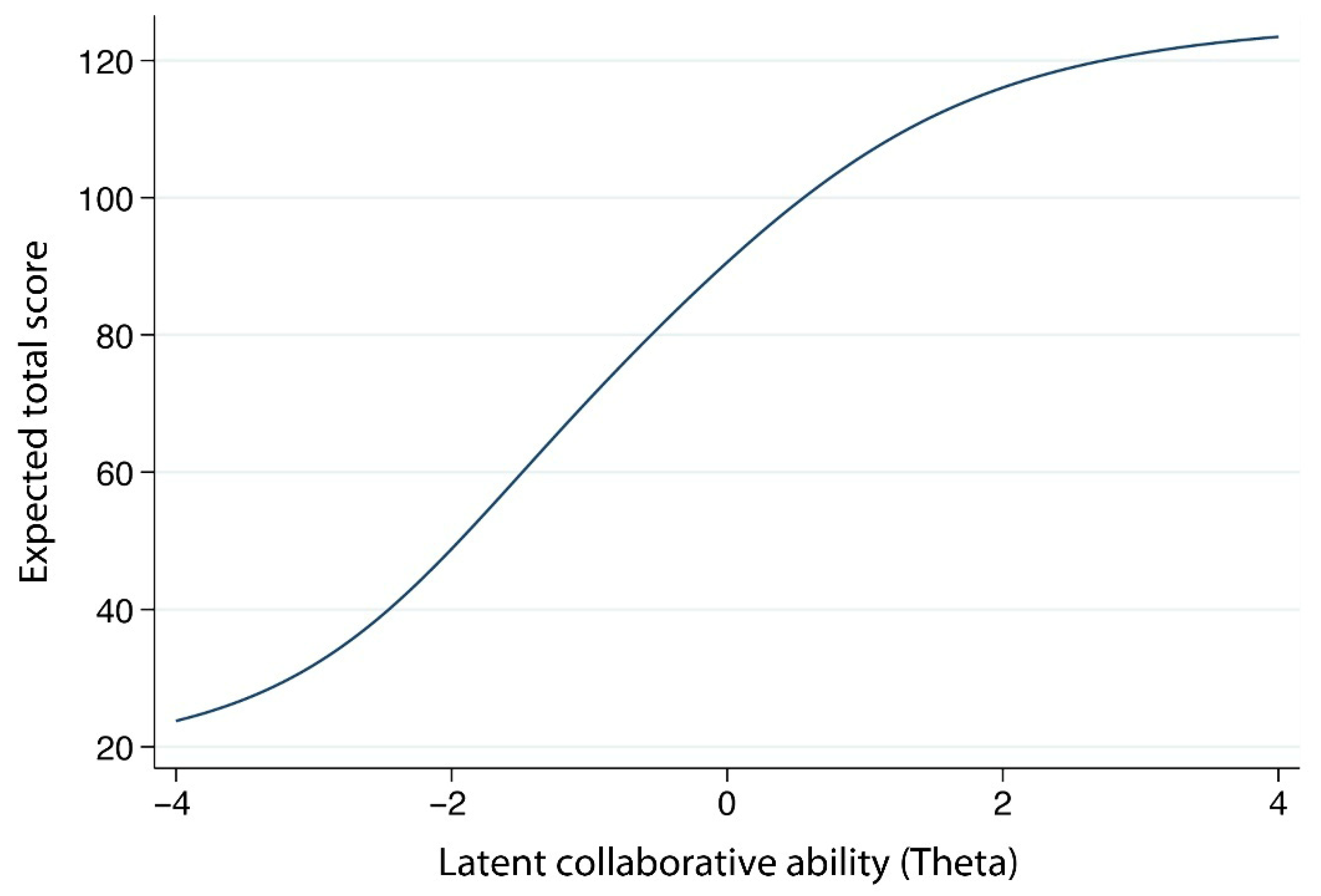
| Total scale | 18 | 0.90 | 0.90 | 88.46 (16.91) | 18–126 |
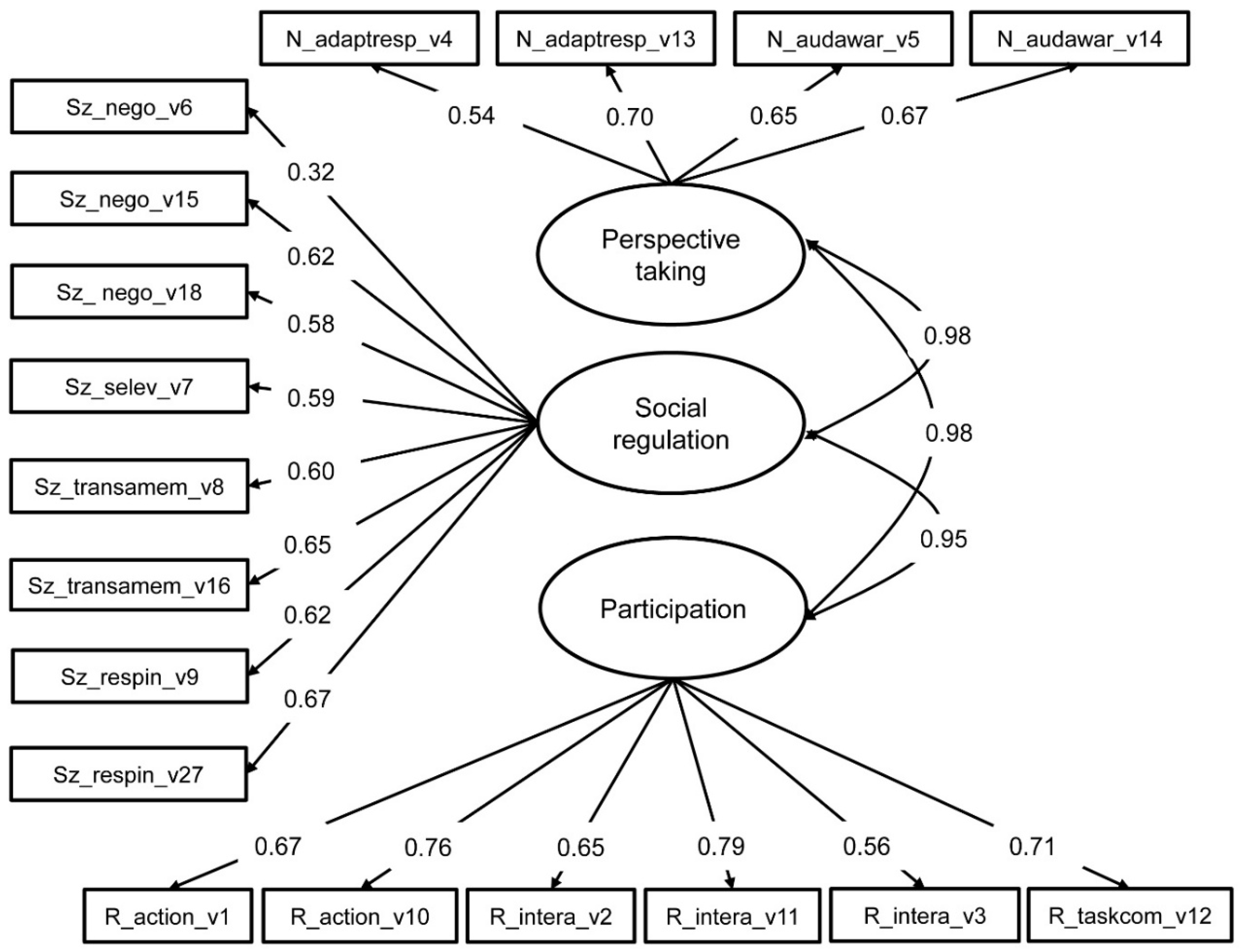
| Participation | 6 | 0.82 | 0.82 | 30.23 (6.55) | 6–42 |
| Perspective taking | 4 | 0.70 | 0.70 | 19.66 (4.27) | 4–28 |
| Social regulation | 8 | 0.76 | 0.77 | 38.57 (7.74) | 8–56 |
| Scale | Total Scale | Participation | Perspective Taking |
|---|---|---|---|
| Participation | 0.92 | ||
| Perspective taking | 0.87 | 0.74 | |
| Social regulation | 0.93 | 0.75 | 0.72 |
| Item | Distribution of the Frequency of Responses (%) 1 = Does Not Describe You at All 7 = Completely Describes You | Mean (Score) | SD (Score) | ||||||
|---|---|---|---|---|---|---|---|---|---|
| 1 | 2 | 3 | 4 | 5 | 6 | 7 | |||
| P_action_v1 | 2.2 | 2.3 | 6.1 | 19.5 | 22.0 | 25.1 | 22.7 | 5.23 | 1.45 |
| P_action_v10 | 2.3 | 3.6 | 7.2 | 22.9 | 17.5 | 22.1 | 24.4 | 5.14 | 1.54 |
| P_intera_v2 | 1.9 | 2.8 | 8.5 | 24.7 | 22.0 | 21.9 | 18.2 | 5.01 | 1.45 |
| P_intera_v11 | 2.8 | 2.5 | 6.9 | 21.4 | 19.0 | 21.8 | 25.6 | 5.19 | 1.54 |
| P_taskcom_v3 | 3.1 | 4.7 | 9.8 | 22.3 | 21.2 | 21.1 | 17.8 | 4.88 | 1.56 |
| P_taskcom_v12 | 2.7 | 3.3 | 10.7 | 28.8 | 20.8 | 18.8 | 15.0 | 4.78 | 1.48 |
| Pt_adaptresp_v4 | 2.7 | 3.2 | 8.3 | 22.2 | 25.7 | 24.1 | 13.8 | 4.93 | 1.44 |
| Pt_adaptresp_v13 | 3.4 | 4.2 | 9.4 | 27.3 | 23.4 | 20.1 | 12.4 | 4.73 | 1.48 |
| Pt_audawar_v5 | 2.5 | 2.8 | 7.5 | 22.9 | 21.1 | 21.7 | 21.6 | 5.09 | 1.50 |
| Pt_audawar_v14 | 2.4 | 3.1 | 8.3 | 27.8 | 20.3 | 20.5 | 17.6 | 4.92 | 1.48 |
| Sr_nego_v6 | 6.3 | 6.2 | 11.2 | 21.2 | 18.6 | 19.4 | 17.2 | 4.66 | 1.73 |
| Sr_nego_v15 | 4.9 | 4.1 | 9.9 | 23.7 | 18.7 | 18.5 | 20.2 | 4.83 | 1.66 |
| Sr_nego_v18 | 2.7 | 4.3 | 9.6 | 26.1 | 19.8 | 17.0 | 20.5 | 4.89 | 1.56 |
| Sr_selfev_v7 | 1.3 | 2.6 | 6.3 | 18.8 | 21.1 | 24.5 | 25.5 | 5.31 | 1.43 |
| Sr_transamem_v8 | 7.8 | 6.1 | 10.2 | 25.7 | 20.2 | 15.3 | 14.8 | 4.50 | 1.72 |
| Sr_transamem_v16 | 4.0 | 5.4 | 11.7 | 27.2 | 21.1 | 15.8 | 14.7 | 4.62 | 1.57 |
| Sr_respin_v9 | 2.8 | 3.4 | 9.2 | 29.8 | 23.3 | 16.9 | 14.7 | 4.77 | 1.46 |
| Sr_respin_v17 | 2.7 | 3.4 | 7.6 | 24.2 | 22.3 | 20.4 | 19.4 | 4.99 | 1.50 |
Disclaimer/Publisher’s Note: The statements, opinions and data contained in all publications are solely those of the individual author(s) and contributor(s) and not of MDPI and/or the editor(s). MDPI and/or the editor(s) disclaim responsibility for any injury to people or property resulting from any ideas, methods, instructions or products referred to in the content. |
© 2026 by the authors. Licensee MDPI, Basel, Switzerland. This article is an open access article distributed under the terms and conditions of the Creative Commons Attribution (CC BY) license.
Share and Cite
Pásztor-Kovács, A.; Pásztor, A.; Liu, Y.; Molnár, G. Self-Assessment of Teamwork Skills Among Adolescents: Psychometric Properties of the Collaborative Skills Scale. Educ. Sci. 2026, 16, 167. https://doi.org/10.3390/educsci16010167
Pásztor-Kovács A, Pásztor A, Liu Y, Molnár G. Self-Assessment of Teamwork Skills Among Adolescents: Psychometric Properties of the Collaborative Skills Scale. Education Sciences. 2026; 16(1):167. https://doi.org/10.3390/educsci16010167
Chicago/Turabian StylePásztor-Kovács, Anita, Attila Pásztor, Yong Liu, and Gyöngyvér Molnár. 2026. "Self-Assessment of Teamwork Skills Among Adolescents: Psychometric Properties of the Collaborative Skills Scale" Education Sciences 16, no. 1: 167. https://doi.org/10.3390/educsci16010167
APA StylePásztor-Kovács, A., Pásztor, A., Liu, Y., & Molnár, G. (2026). Self-Assessment of Teamwork Skills Among Adolescents: Psychometric Properties of the Collaborative Skills Scale. Education Sciences, 16(1), 167. https://doi.org/10.3390/educsci16010167