


The authors wish to make the following corrections to this paper [1]:
Text Correction
- Section 5: The introductory text in Section 5 has been modified to more original content.
- Section 5.1 (Sections 5.1.2–5.1.9): In order to avoid similarities with other relevant work on the same subject, these subsections have been revised, while preserving the original information.
- Section 5.2 (Sections 5.2.1–5.2.3): In order to avoid similarities with other relevant work on the same subject, these subsections have been revised, while preserving the original information.
Figure Updates
- 4.
- Section 5.1.4: In order to pursue originality, Figures 4 and 5 were replaced with equivalent, original images.
- 5.
- Section 5.1.5: In order to pursue originality, Figures 6 and 7 were replaced with equivalent, original images.
The corrected figures appear below.
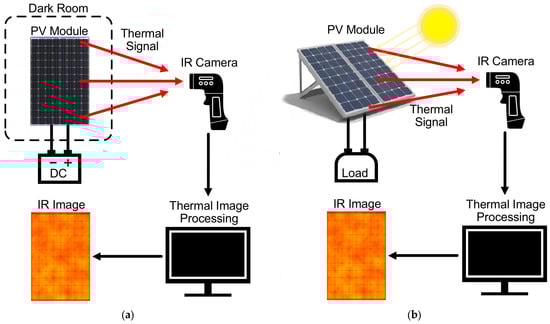
Figure 4.
(a) Indoor and (b) outdoor thermography setups [49].
Figure 4.
(a) Indoor and (b) outdoor thermography setups [49].
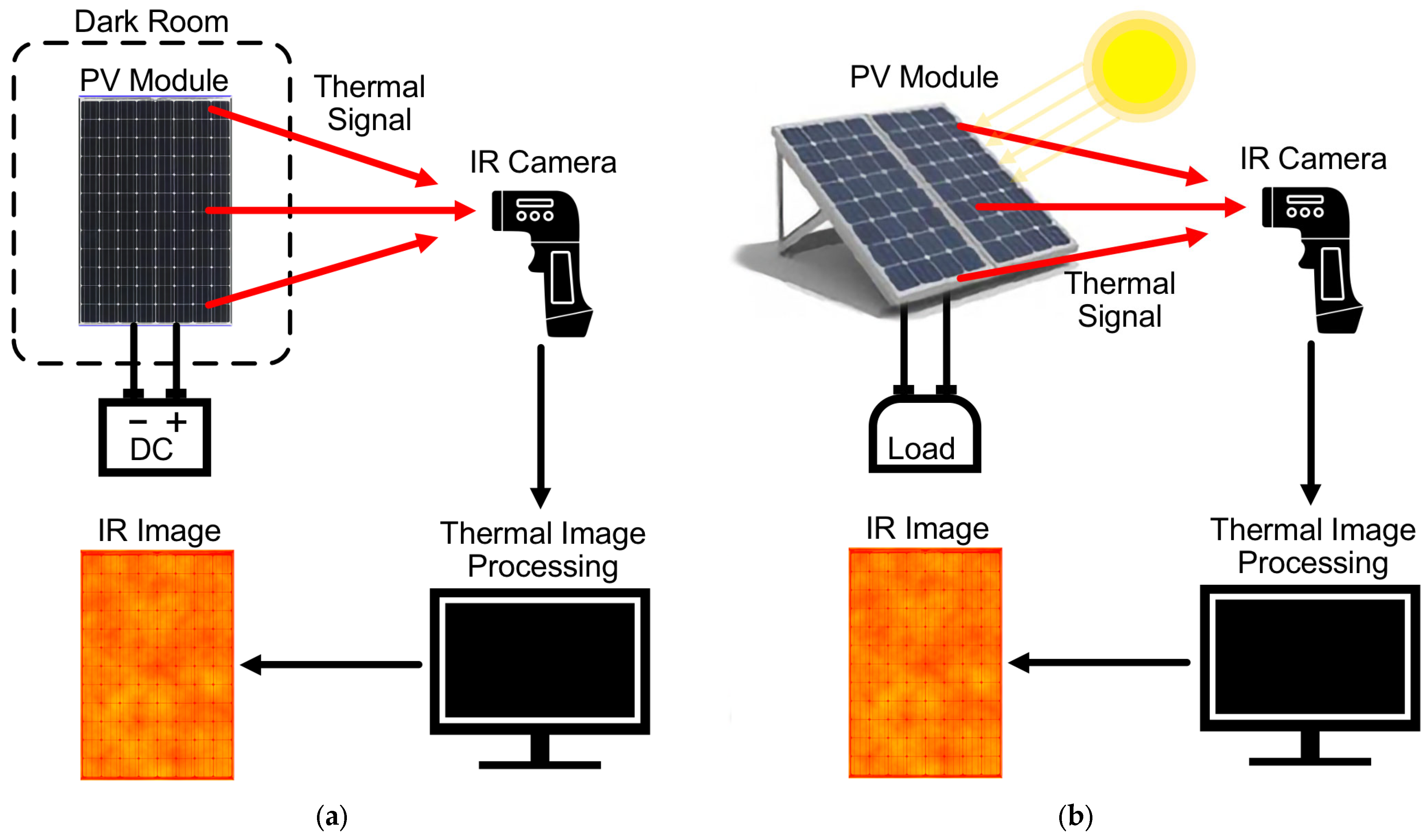
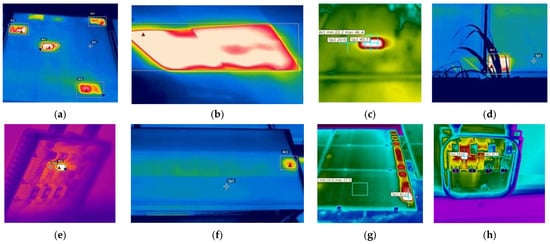
Figure 5.
Defects in IR Imaging: (a) breakage of front glass; (b) overheated cell due to internal cell problems; (c) hot spot; (d) overheating due to external shading; (e) open junction box and overheated diode; (f) overheated junction box; (g) overheating due to shading by neighboring PV module row; (h) overheated bypass diode [56]. Colors from green to red indicate cold to heat-up (defected) areas. Images serve as indicative depictions of the specified defects in IR imaging, and the letterings within them are of no significance.
Figure 5.
Defects in IR Imaging: (a) breakage of front glass; (b) overheated cell due to internal cell problems; (c) hot spot; (d) overheating due to external shading; (e) open junction box and overheated diode; (f) overheated junction box; (g) overheating due to shading by neighboring PV module row; (h) overheated bypass diode [56]. Colors from green to red indicate cold to heat-up (defected) areas. Images serve as indicative depictions of the specified defects in IR imaging, and the letterings within them are of no significance.
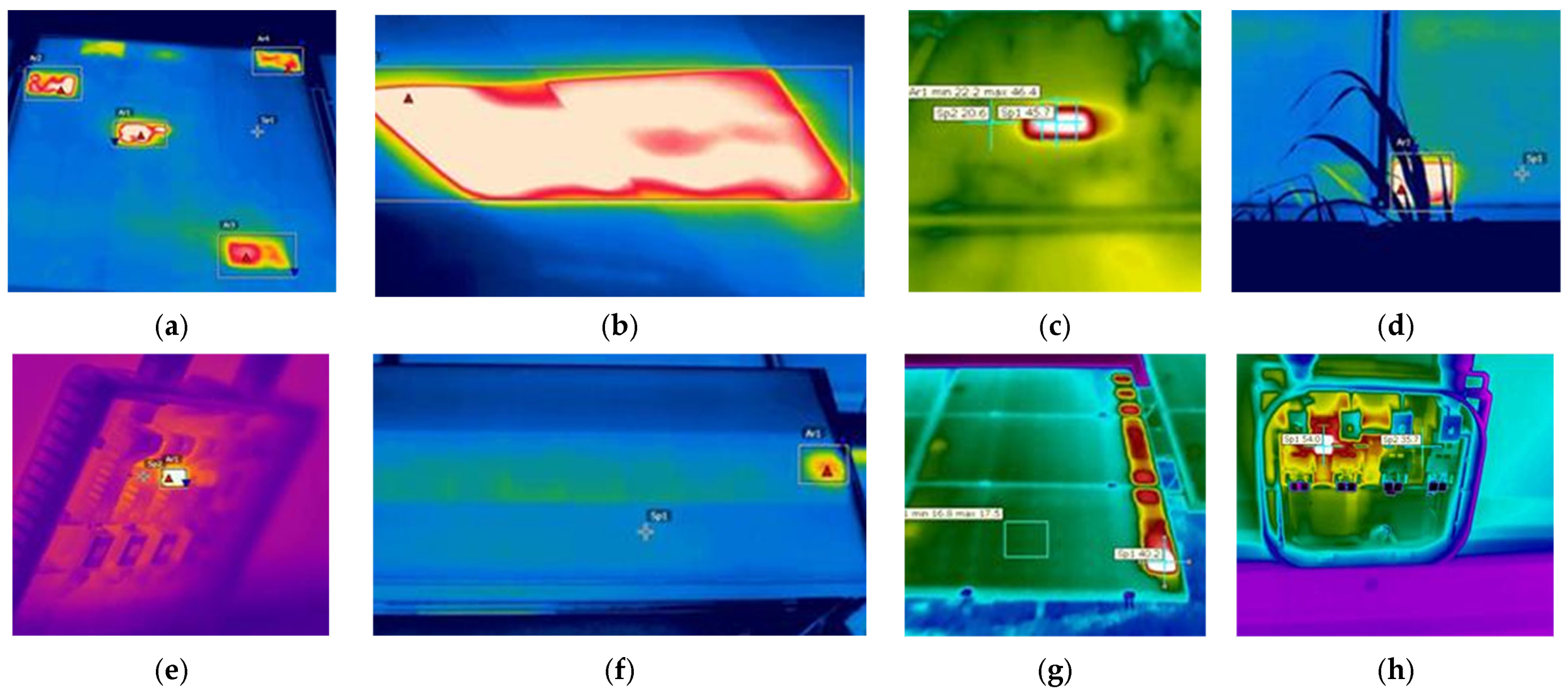
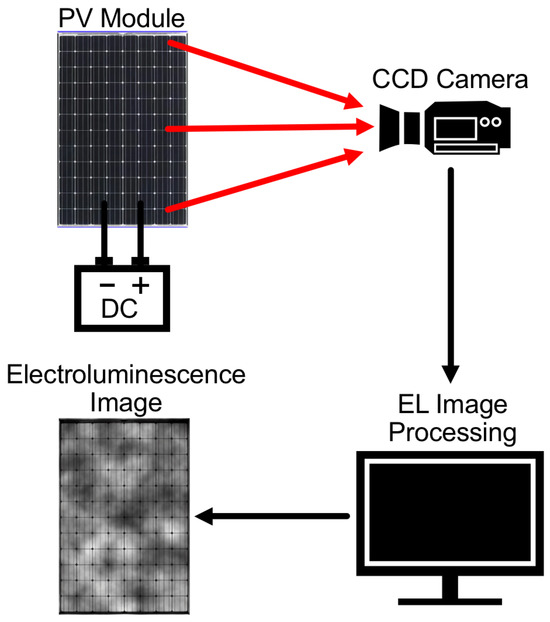
Figure 6.
EL imaging setup [11].
Figure 6.
EL imaging setup [11].
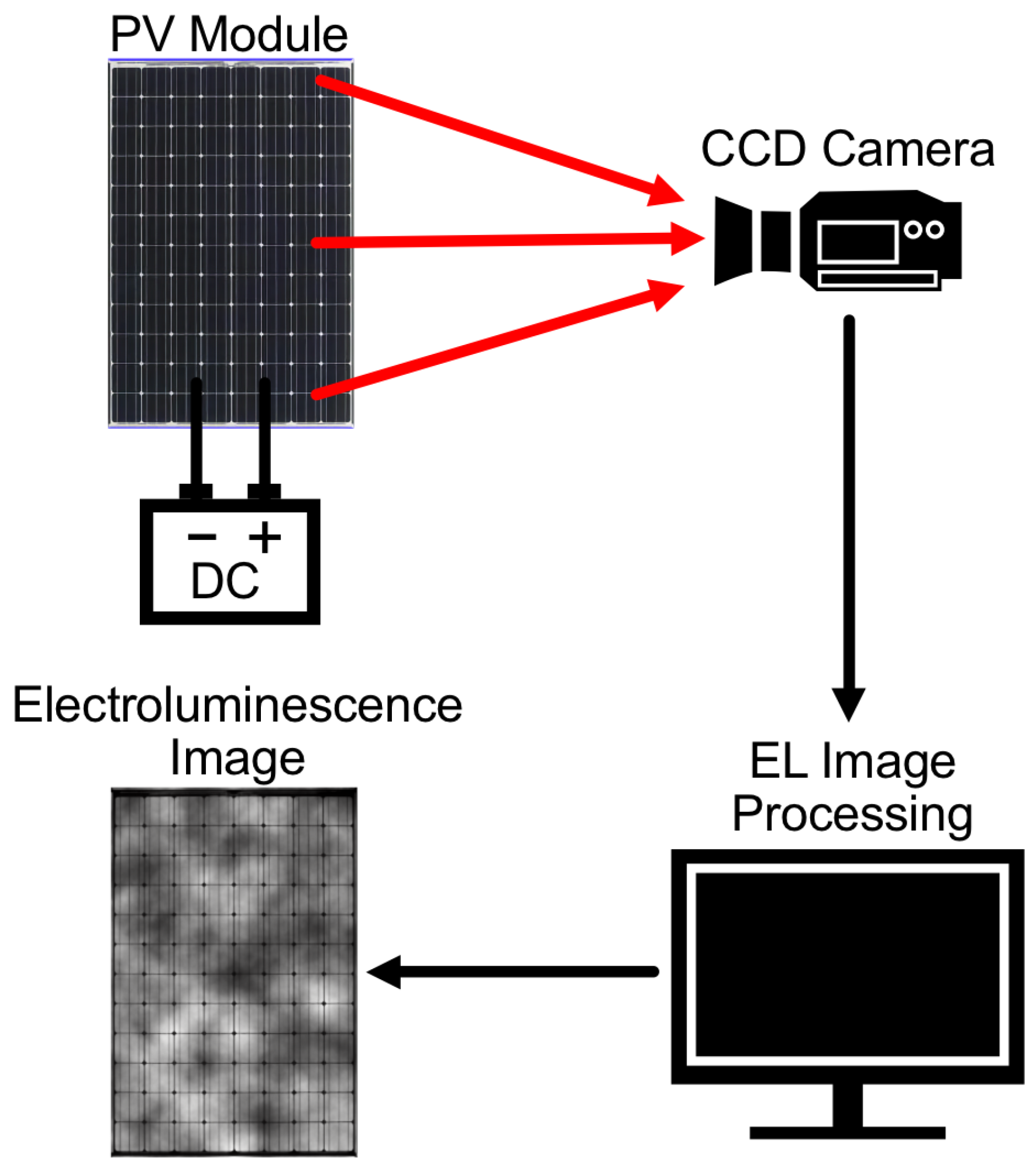
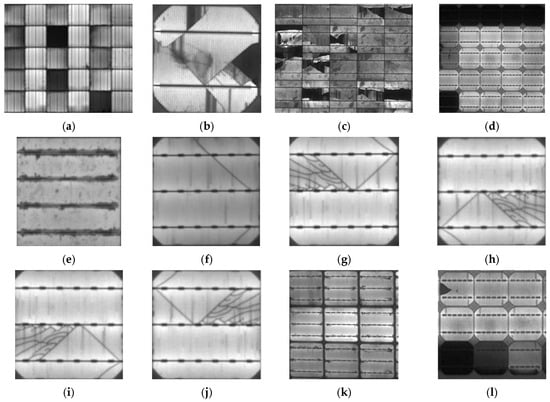
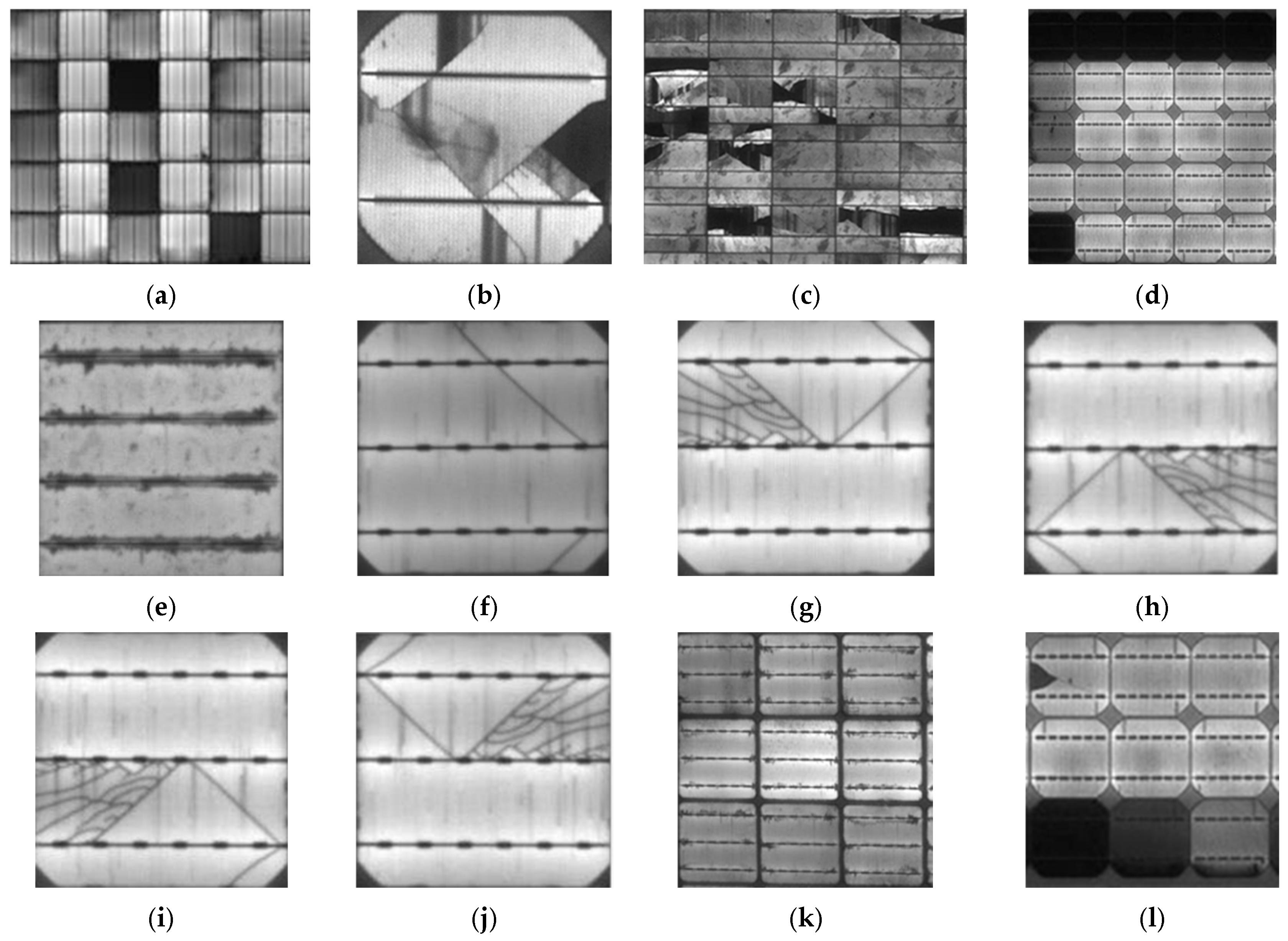
Figure 7.
Different types of defects in EL imaging [56]: (a) PID-s affected module; (b) crack pattern due to impacts; (c) polycrystalline PV module with cracked cells; (d) monocrystalline PV module with potential induced degradation; (e) busbar corrosion in cell; (f) cracked cell; (g) cracked cell of original orientation; (h) cracked cell of different orientation, rotated 180°; (i) cracked cell of different orientation, flipped about x-axis; (j) cracked cell of different orientation, flipped about y-axis; (k) module having undergone damp-heat exposure; (l) monocrystalline PV module with induced degradation.
Figure 7.
Different types of defects in EL imaging [56]: (a) PID-s affected module; (b) crack pattern due to impacts; (c) polycrystalline PV module with cracked cells; (d) monocrystalline PV module with potential induced degradation; (e) busbar corrosion in cell; (f) cracked cell; (g) cracked cell of original orientation; (h) cracked cell of different orientation, rotated 180°; (i) cracked cell of different orientation, flipped about x-axis; (j) cracked cell of different orientation, flipped about y-axis; (k) module having undergone damp-heat exposure; (l) monocrystalline PV module with induced degradation.
The authors state that the scientific conclusions are unaffected. These corrections were approved by the Academic Editor. The original publication has also been updated.
Reference
- Polymeropoulos, I.; Bezyrgiannidis, S.; Vrochidou, E.; Papakostas, G.A. Enhancing Solar Plant Efficiency: A Review of Vision-Based Monitoring and Fault Detection Techniques. Technologies 2024, 12, 175. [Google Scholar] [CrossRef]
Disclaimer/Publisher’s Note: The statements, opinions and data contained in all publications are solely those of the individual author(s) and contributor(s) and not of MDPI and/or the editor(s). MDPI and/or the editor(s) disclaim responsibility for any injury to people or property resulting from any ideas, methods, instructions or products referred to in the content. |
© 2025 by the authors. Licensee MDPI, Basel, Switzerland. This article is an open access article distributed under the terms and conditions of the Creative Commons Attribution (CC BY) license (https://creativecommons.org/licenses/by/4.0/).