


Abstract
Delirium is a transient neuropsychiatric condition that is a severe and prevalent condition affecting 2.6 million older adults each year. Alzheimer’s disease (AD) and anticholinergic medication use are risk factors for delirium. This study evaluated the association between cumulative anticholinergic burden (CAB) and risk of delirium among older adults with AD initiating cholinesterase inhibitors (ChEIs). This retrospective cohort study used 2013–2017 Medicare claims data, and included adults 65 years and older with AD who initiated any of the ChEIs (donepezil, rivastigmine, and galantamine) after a 12-month washout period. CAB, as the primary exposure, was measured on the index date and calculated as the monthly total standardized daily dose of anticholinergic medications. A multivariable Cox proportional hazards regression model with inverse probability of treatment weighting (IPTW) generated using generalized boosted models was used to evaluate the risk of delirium associated with the CAB. This study identified 143,320 older adults with AD who initiated ChEIs. Most patients were in the low/no burden (62.73%) group, followed by high burden (21.12%) and moderate burden (16.14%). Overall, delirium diagnosis was observed in 19.11% of the cohort. The Cox regression model with IPTW found that moderate (aHR, 1.56; 95% CI, 1.52–1.61; p < 0.0001) and high CAB (aHR, 1.45; 95% CI, 1.42–1.49; p < 0.0001) were associated with an increased risk of delirium compared to low/no burden. Among older adults with AD initiating ChEIs, moderate and high CAB were associated with an increased risk of delirium compared with low/no CAB. These findings highlight the need to carefully reduce the CAB, especially dose and duration, along with utilizing anticholinergic alternatives in older adults with AD.
1. Introduction
Delirium is a transient neuropsychiatric condition characterized by inattention and fluctuations in cognition and consciousness. Though acute and abrupt, it is a severe and prevalent condition affecting 2.6 million older adults each year [1]. Delirium is associated with accelerated cognitive decline, increased risk of medical complications, institutionalization, functional decline, and longer hospitalizations, resulting in an annual cost of $164 billion in the US [2]. Rates of morbidity and mortality are high among patients with delirium, with 35–40% of hospitalized patients with delirium dying within one year [3]. Although the pathogenesis of delirium is not fully understood, it is postulated that multiple neurotransmitter abnormalities, especially cholinergic deficiency, are the precipitating factors [4]. Older adults (65 years or older) with an underlying neurocognitive disorder such as dementia/Alzheimer’s disease (AD) are at high risk of developing delirium due to an impairment in cholinergic transmission [5]. A meta-analysis found that delirium increased the risk of mortality by 75% in patients with dementia [6].
Medications with anticholinergic properties act by inhibiting the action of acetylcholine at cholinergic receptors, thereby adding to the cholinergic deficit in AD. Older adults with AD, when exposed to anticholinergic medications, exhibited worse cognitive scores than those without exposure [7]. Anticholinergic medications are an independent risk factor for delirium and, hence, are associated with worsening of cognition, functional decline, and increased mortality [8]. Many validated tools have been developed to quantify the anticholinergic burden. The SHELTER study concluded that anticholinergic burden as measured by the Anticholinergic Cognitive Burden (ACB) scale was associated with an increased risk of delirium in nursing home residents with dementia [9]. This study found that among patients with dementia, delirium prevalence increased with increasing anticholinergic burden according to the ACB scale, from 20% (with no anticholinergic burden) to 25% (with moderate burden) and 27% delirium (with strong burden scores) [9].
Several studies suggested a significant association between anticholinergic use and delirium in older adults with cognitive impairment/dementia/AD [10,11,12,13,14,15,16]. A study among Turkish patients with delirium superimposed on dementia found that the increase in sedative and anticholinergic medication burden increased the hazards of delirium by four-fold (Hazards ratio: 4.09) [15]. Another study found a 52% increased risk of delirium associated with high anticholinergic burden in older Korean adults with mild-to-moderate AD [14]. However, the research by Campbell and colleagues did not find any association between anticholinergic use and delirium [13]. Cholinesterase inhibitors (ChEIs) such as donepezil, rivastigmine, and galantamine, the mainstay pharmacotherapy for mild to moderate AD, inhibit acetylcholinesterase and thereby enhance cholinergic transmission [17]. The co-administration of ChEIs and anticholinergic medications can lead to drug–drug interaction, nullifying the treatment benefit of ChEIs and worsening AD due to the therapeutically opposing mechanisms of action [18,19]. However, no studies have evaluated the risk of delirium using cumulative anticholinergic burden (CAB) in patients concomitantly prescribed with ChEIs. The CAB captures the collective effect of multiple medications having anticholinergic properties, which can have adverse effects on the patient. This study aims to evaluate the risk of delirium associated with CAB after initiating ChEIs among older adults with AD.
2. Methods
2.1. Data Source and Study Design
This study used 2013–2017 Medicare claims data including inpatient, outpatient, prescription drug, demographic, and enrollment files [20]. This study was approved under the exempt category by the University of Houston Committee for the Protection of Human Subjects. We conducted a retrospective cohort study of older adults with AD to examine the association between CAB and risk of delirium after ChEI initiation. Eligible beneficiaries were required to have uninterrupted fee-for-service Medicare coverage, including Parts A, B, and D, with no HMO enrollment during the 12-month baseline period before their first observed ChEI fill, which served as the index date. Beneficiaries were eligible for inclusion if they were at least 65 years old, had evidence of AD based on diagnosis codes (International Classification of Diseases Ninth Revision (ICD) 9-CM 331.0 [21], ICD-10-CM G20, and F00 [22]), and maintained continuous Medicare Parts A, B, and D enrollment throughout the 12-month baseline period preceding ChEI initiation. We excluded beneficiaries with evidence of ChEI use during baseline to restrict the cohort to incident ChEI users. We also excluded patients with baseline memantine use, either as monotherapy or combination therapy, to reduce the inclusion of individuals with more advanced AD. Patients with delirium during baseline were excluded to focus on incident delirium during follow-up. Further, delirium events within one month after the index date were excluded so that we could account for the monthly exposure before the outcome occurred. Patients were followed for one year from the index date until the first occurrence of the event of interest (delirium), disenrollment from the health plan, change in the level of ACH burden, death, discontinuation of ChEI, or end of the one-year follow-up period. Reporting was guided by the Strengthening the Reporting of Observational Studies in Epidemiology (STROBE) recommendations for observational cohort studies [23].
2.2. Exposure and Outcome Definitions
The primary exposure was CAB during the first 30 days after the index date. CAB was calculated using a previously published approach described in detail in our earlier work [24,25]. This method combines medication-specific anticholinergic potency with patient-level dose exposure derived from prescription claims [26,27].
Anticholinergic potency was assigned using the ACB scale, which scores medications from 0 to 3, with higher scores indicating greater anticholinergic activity [28]. Anticholinergic medications were identified using National Drug Codes from Medicare Part D prescription claims [29,30,31]. The medications included in the CAB calculation are listed in Supplementary Table S1.
Patient-specific exposure was derived using prescription fill date, strength, quantity dispensed, and days supplied, as described in Supplementary Table S2 [32]. For each anticholinergic medication, the standardized daily dose was weighted by the medication’s corresponding ACB score to generate drug-specific standardized daily anticholinergic exposure. Monthly drug-specific exposure values were then summed to calculate the total standardized daily anticholinergic exposure sum, referred to as SumSDACE.
CAB during the first month after ChEI initiation was used as the exposure of interest. During follow-up, patients were censored in the month after a change in SumSDACE category. Because established monthly SumSDACE thresholds for older adults with AD are not available, burden categories were defined based on the distribution of values in the study cohort. SumSDACE was classified as no burden, low burden, moderate burden, or high burden using the following thresholds: no burden: SumSDACE = 0; low burden: SumSDACE ≤ 10; moderate burden: SumSDACE 10.1–40; and high burden: SumSDACE > 40. For analysis, the no- and low-burden groups were combined and used as the reference category.
The outcome, delirium, was identified using ICD-9-CM [33] and ICD-10-CM [34] diagnosis codes selected from the validated literature and reviewed by clinicians [35]. The full list of diagnosis codes used to identify delirium events is provided in Supplementary Table S3.
2.3. Conceptual Framework
Covariate selection was guided by the Andersen Behavioral Model and prior delirium prediction literature [36,37]. The Andersen framework was used to organize factors that may be related to both CAB and delirium risk, including demographic characteristics, access-related factors, baseline health status, comorbidity burden, frailty, and medication exposures.
Because several medication classes are associated with delirium risk, opioid load and sedative load were included as covariates. These measures captured exposure to opioids, benzodiazepines, and other sedative medications. The opioid load was calculated by taking the average Morphine Milligram Equivalent (MME) based on the CMS oral MME conversion factors per day over the time period [38]. Opioid use was categorized as low dose (less than 50 MME daily) and high dose (50 or greater MME daily) [39,40]. The medications used to calculate sedative [41,42,43] and opioid load, including morphine milligram equivalent conversion factors, are listed in Supplementary Tables S4 and S5. To avoid double-counting medication exposure, medications appearing in more than one burden measure were counted only once in CAB calculations.
Additional measures of baseline health status included the Elixhauser comorbidity index, claims-based frailty index, and anticholinergic exposure during the 12-month baseline period [44,45]. Comorbid conditions that may influence anticholinergic prescribing were also included, including conditions for which anticholinergic medications may be indicated or contraindicated [46]. Supplementary Tables S6 and S7 provide the full list of comorbidities and diagnosis codes.
2.4. Statistical Analysis
Baseline characteristics were summarized across CAB categories using descriptive statistics. Continuous variables were compared using analysis of variance, and categorical variables were compared using chi-square tests. Kaplan–Meier curves were used to examine unadjusted time to delirium across low/no, moderate, and high CAB groups. The log-rank test was used to compare the survival curves for statistical differences, and the proportional hazards assumption for the Cox model was assessed using the Schoenfeld test, checking the correlation between scaled residuals and time. The inverse probability of treatment weighting (IPTW) was employed in this study to generate unbiased treatment estimates by balancing the differences between CAB groups through weighting. In this study, we generated weights by using a machine learning approach based on the -generalized boosted models, which have been demonstrated to perform better than traditional approaches.
The generalized boosted model propensity score weights were obtained using the Toolkit for Weighting and Analysis of Nonequivalent Groups (TWANG) package with mnps function [47]. The balance was visually assessed using the boxplot for PS overlap and statistically by calculating the absolute standardized mean differences (ASMDs). An ASMD ≤ 0.25 was considered as the threshold for acceptable balance [48]. The Cox proportional-hazards regression model with IPTW based on a generalized boosted model score was used to evaluate the risk of delirium from each burden group. This study also applied the covariate adjustment approach using multiple propensity score techniques as a sensitivity analysis [49]. All statistical analyses were conducted using SAS, version 9.4 [50] and R software (Version 4.2) [51], a two-sided p-value < 0.05 was considered statistically significant.
3. Results
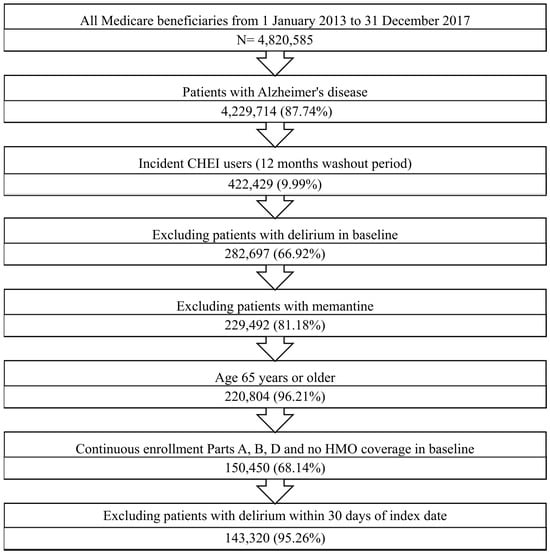
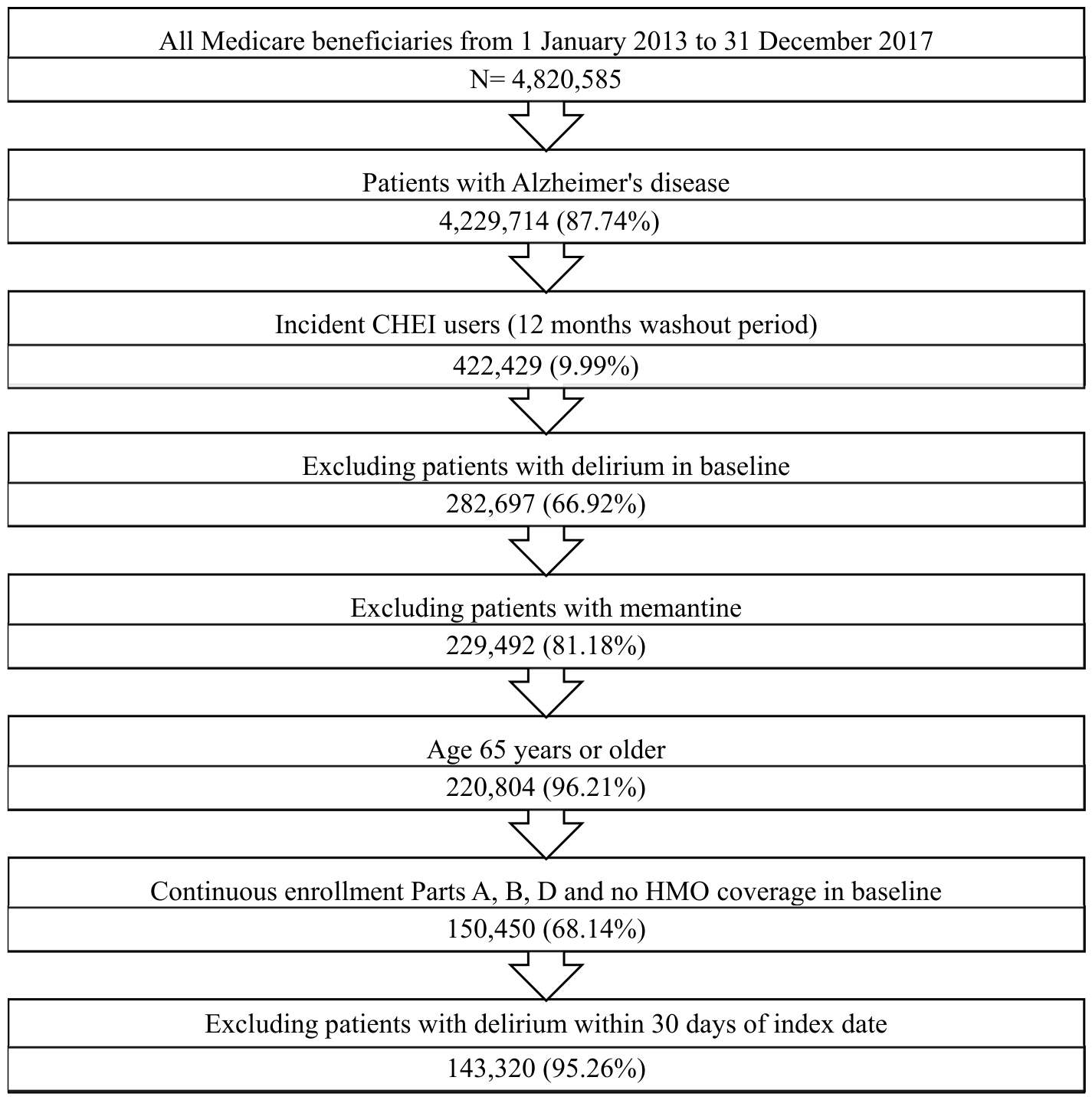
The final cohort included 143,320 older adults with AD who met all eligibility criteria, as shown in Figure 1. At cohort entry, 62.74% of patients were classified as having low/no CAB, 16.14% as having moderate CAB, and 21.12% as having high CAB. The mean (SD) time to delirium event was 9 ± 5.16 months for the low/no burden group, 7 ± 6.77 months for the moderate burden, and 7 ± 6.02 months for the high burden group.
Figure 1.
Attrition chart for developing older adult cohort with Alzheimer’s disease initiating on cholinesterase inhibitors.
The cohort primarily consisted of women (66.40%), White (82.64%), and aged 85–94 years (41.69%) with a mean age of 82.07 ± 7.14 years. More than one-third (36.52%) had dual eligibility status, and 78.61% had a diagnosis of AD for 0–5 years. Dyslipidemia (69.76%), followed by depression (38.69%), muscle spasms/lower back pain (36.66%), and urinary tract infection (35.91%) were the most common comorbidities observed at baseline. The mean Elixhauser comorbidity score was found to be 6.13 ± 10.18, while the mean claims-based frailty index was 0.21 ± 0.06, with most patients in the prefrail category. Additionally, 23% of patients had a high sedative load, with most in the high-burden group. Over 18% of patients had a high opioid load, with most patients in the high-burden group (Table 1). See Table 1 and Supplementary Table S8 for all comorbidities evaluated in the baseline for the cohort.
Table 1.
Baseline characteristics of older adults with Alzheimer’s disease initiating on cholinesterase inhibitors.
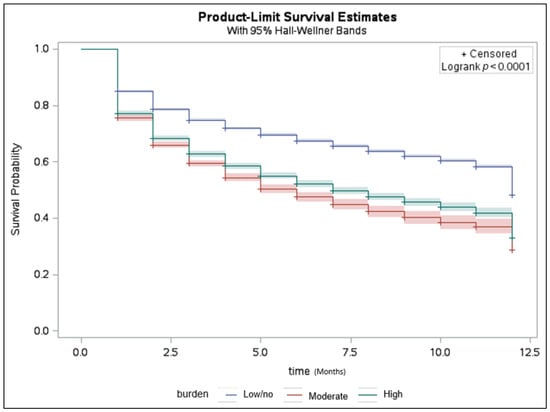
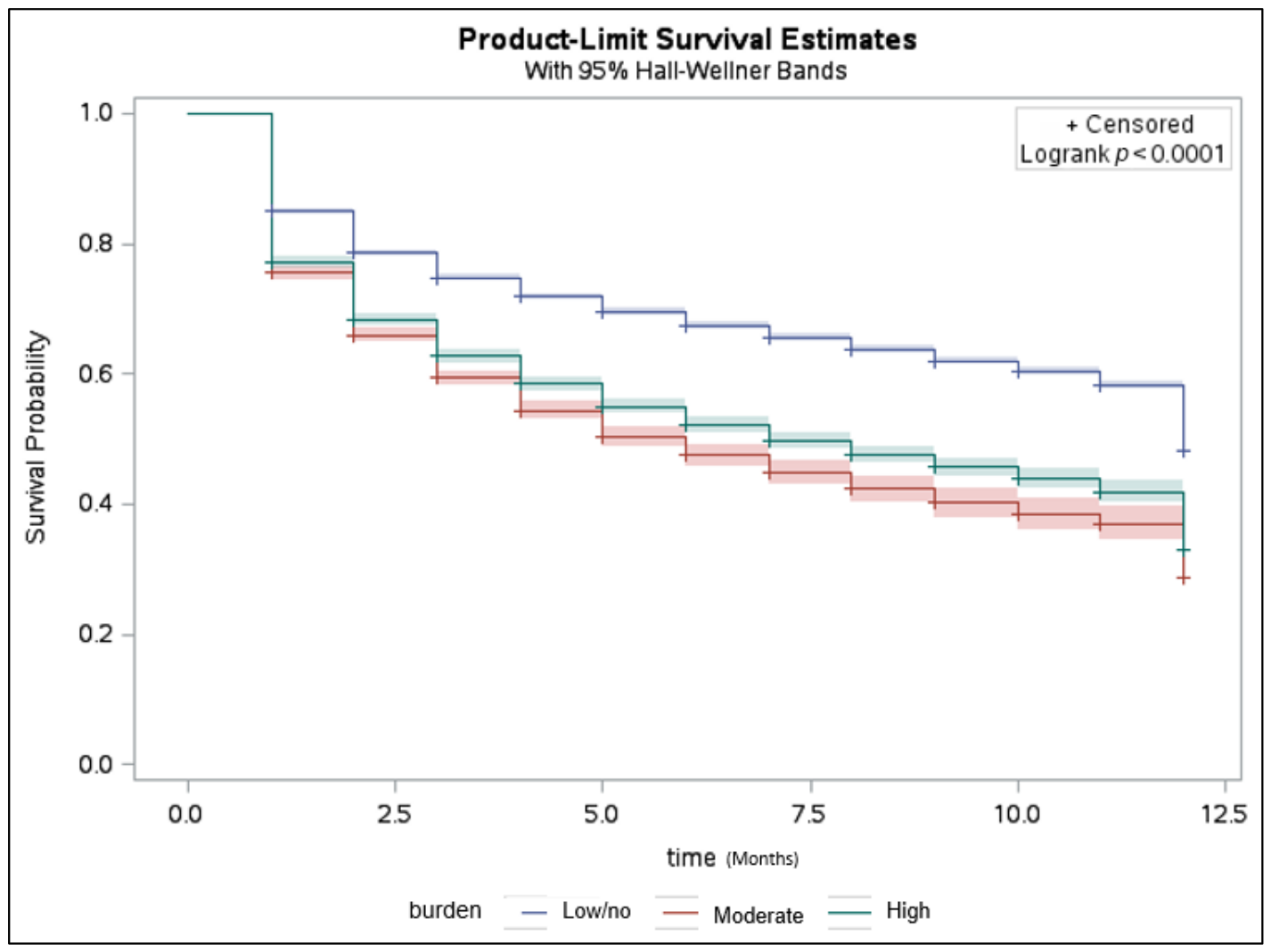
Overall, delirium diagnosis was observed in 19.11% of the cohort within one year of ChEI prescription. Figure 2 shows the Kaplan–Meier survival curves evaluating the risk of delirium among older adults with AD having different burdens. There was no differential censoring among the study groups (See Supplementary Table S9). The survival curve shows a significant crude association between the three burden categories and the risk of delirium (p = 0.0001) by log-rank test. Table 1 provides the distribution of baseline characteristics before and after PS adjustment using IPTW. After IPTW adjustment, measured baseline characteristics were well balanced in each of the categories. Both PS and generalized boosted model approaches helped to balance the baseline covariates (see Supplementary Material Figures S1–S4).
Figure 2.
Kaplan–Meier plot for risk of delirium across three groups.
The primary Cox proportional hazards regression analysis with IPTW, with a low/no burden as the reference group, showed moderate burden (aHR 1.56; 95% CI, 1.52–1.61, p < 0.0001) and high burden (aHR 1.45; 95% CI, 1.42–1.49, p < 0.0001) were associated with an increased risk of delirium (See Table 2). The sensitivity analysis involving the Cox proportional hazards model with multiple PS adjustment methods was similar to those observed in the primary analyses. Moderate burden (aHR, 1.52; 95% CI, 1.48–1.56, p < 0.0001) and high burden (aHR, 1.30; 95% CI, 1.27–1.33, p < 0.0001) were associated with an increased risk of delirium as compared to low/no burden.
Table 2.
Cox-proportional hazards model for the risk of delirium among older adults with Alzheimer’s disease initiating on cholinesterase inhibitors.
4. Discussion
In this Medicare cohort of older adults with AD who newly initiated ChEIs, high and moderate burdens were associated with about 50% increased risk of delirium compared to low/no burden. To the best of our knowledge, this study is among the first to examine delirium risk associated with patient-specific, dose-based CAB among older adults with AD initiating ChEIs. Our study also found that over one-third of older adults with AD had a moderate–high anticholinergic burden after initiating ChEIs. This finding highlights the substantial prevalence of anticholinergic exposure among older adults with AD despite recommendations to minimize the use of these medications in individuals with cognitive impairment. Given that anticholinergic burden is potentially modifiable, these findings underscore the importance of routine medication review and deprescribing efforts to reduce unnecessary anticholinergic exposure in patients receiving ChEI therapy. Since anticholinergic medications and ChEIs act in pharmacologically opposing directions, concurrent exposure may diminish the intended cholinergic benefit of ChEI therapy and increase vulnerability to adverse cognitive outcomes [18,19].
Our study found about a 50% higher risk of delirium with a moderate-to-high anticholinergic burden. The estimates of association for both moderate- and high-burden groups are in the same direction with an overlapping range of confidence intervals. Previous research has also found similar risk patterns for anticholinergic levels, possibly due to underlying effects and/or categorization [52]. Most importantly, studies have found similar results when studying the use of anticholinergics associated with an increased risk of delirium among older adults with dementia/AD using different methods and scales for measuring the burden but did not account for patient-specific dose and duration of medications prescribed and found the range of risk of delirium to be 1.5–4.09 [14,15]. A study utilizing the Delirium Drug Scale (DDS) found similar results for the risk of delirium [OR: 1.52 (weighted DDS score); OR: 1.20 (low exposure); OR: 1.60 (high exposure)] but differed in terms of the patient population [53]. The differences in effect size may be attributed to the study design, exposure measurement, covariates included in their study, and the clinical setting. These findings have important clinical implications. AD is itself a major risk factor for delirium, and delirium can accelerate cognitive and functional decline [5]. Anticholinergic exposure may further increase risk by compounding cholinergic deficits and counteracting the intended effects of ChEI therapy [18,19]. Since anticholinergic medications are potentially modifiable, routine medication review after ChEI initiation may help identify opportunities to reduce avoidable anticholinergic exposure. This is especially relevant for older adults with cognitive impairment, for whom anticholinergic medications are considered potentially inappropriate by guidance such as the American Geriatrics Society Beers Criteria, IPET, and STOPP/START criteria [54,55,56].
Strategies for preventing delirium can lower further adverse consequences, such as falls, fractures, functional deterioration, and mortality. Therefore, interventions that lessen or prevent delirium can mitigate or prevent long-term cognitive damage [5]. The Institute of Medicine-approved guidelines emphasized the value of multifaceted nonpharmacologic prevention strategies, healthcare professional education, medical evaluation of the etiology of delirium, maximizing nonopioid pain management, and avoiding high-risk medications [57]. In addition, multidisciplinary approaches involving pharmacist–physician interventions have demonstrated the potential to improve medication utilization for older patients who are at risk [58,59]. Widespread research has been conducted to offer evidence-based alternative medication treatments that help avoid the use of potent anticholinergic medications [60,61].
The strengths of the current study include the strong pharmacoepidemiologic design, methods, and analytical approaches. This is the first study to calculate CAB using patient-specific dosing, which is a more effective way to calculate the burden as we are accounting for the dose and duration of medication use. The results are highly generalizable due to national-level Medicare beneficiaries. Moreover, the propensity score approach based on the machine learning model helped mitigate the selection and confounding biases by controlling multiple covariates related to both the treatment groups and outcomes. Although anticholinergic medications have previously been associated with delirium [10,11,12,13,14,15,16] in older adults, evidence among patients with Alzheimer’s disease initiating cholinesterase inhibitors is limited. This study extends the existing literature by evaluating CAB in a large, nationally representative cohort of older adults with Alzheimer’s disease and quantifying its association with subsequent delirium risk.
Several limitations should be considered. Claims data do not include detailed clinical measures such as AD stage, cognitive test scores, laboratory values, genetic factors, or clinical rationale for prescribing. Therefore, AD severity could not be directly measured. We attempted to address this limitation by using proxy measures, including years since AD diagnosis, claims-based frailty, baseline anticholinergic burden, and exclusion of baseline memantine users. Delirium may be underdiagnosed or incompletely coded in claims data, which could lead to outcome misclassification. Pharmacy claims indicate that a medication was dispensed but do not confirm that the patient took the medication as prescribed. In addition, over-the-counter medications and medications not covered under Medicare Part D were not captured. The cohort was limited to fee-for-service Medicare beneficiaries with Part D coverage and no Medicare Advantage enrollment, which may limit generalizability to other populations or institutional settings. Finally, as with all observational studies, residual confounding may remain despite adjustment for measured covariates.
5. Conclusions and Implications
This study found that over one-third of patients with AD initiating ChEIs had moderate and high CAB. Most importantly, patients with AD having moderate and high CAB were associated with 56% and 45% increased risk of delirium compared to patients having low/no anticholinergic burden. This study helps recognize the importance of polypharmacy and medication management of anticholinergics to reduce the risk of delirium in AD. Therefore, concerted efforts are needed to reduce the CAB in older adults with AD by focusing on dose and duration, along with utilizing anticholinergic alternatives.
Supplementary Materials
The following supporting information can be downloaded at https://www.mdpi.com/article/10.3390/pharmacy14040089/s1. Table S1: List of drugs with ACB score and defined daily dose for calculating patient-specific dosing; Table S2: Calculation for cumulative anticholinergic burden; Table S3: Codes for identification of delirium; Table S4: Drugs included under the sedative load model; Table S5: Drugs included to calculate opioid load; Table S6: Comorbidities affecting anticholinergic burden; Table S7: ICD codes used for identifying comorbidities; Table S8: Baseline characteristics of older adults with Alzheimer’s disease initiating on cholinesterase inhibitors; Table S9: Extent and time to censoring across study groups; Figure S1: Overlap of propensity scores in each exposure group; Figure S2: Balancing using generalized boosting method for multiple propensity scores; Figure S3: Overlap of propensity scores calculated for multiple propensity score weighting using generalized boosting methods; Figure S4: Log negative Log plot; Strobe Checklist for cohort studies.
Author Contributions
Conceptualization, A.T. and J.S.; Methodology, A.T., J.S., S.A. and R.R.A.; Software, A.T. and R.R.A.; Formal analysis, A.T.; Resources, R.R.A.; Data curation, A.T.; Writing—original draft, A.T. and R.R.A.; Writing—review and editing, A.T., J.S., S.A., S.C. and R.R.A.; Supervision, R.R.A.; Project administration, R.R.A.; Investigation, R.R.A. All authors have read and agreed to the published version of the manuscript.
Funding
This research received no external funding.
Institutional Review Board Statement
This study was approved by the University of Houston Committee for the Protection of Human Subjects under the exempt category.
Informed Consent Statement
Informed consent for participation is not required due to the use of de-identified data.
Data Availability Statement
The data presented in this study are available on request from the corresponding author due to data use agreements and other licenses of Centers for Medicare & Medicaid Services.
Conflicts of Interest
Ashna Talwar is currently an employee of Bausch + Lomb. This work was conducted while she was affiliated with the University of Houston, and Bausch + Lomb had no role in the study design, analysis, interpretation, manuscript preparation, or decision to submit. Aparasu has received research funding from Astellas Inc., Incyte Corp., Gilead, and Novartis Inc. for projects unrelated to the current work. He also receives consulting fees from CHEORS. These financial interests have been disclosed to the University of Houston, and appropriate steps have been taken to address any potential conflicts of interest. The other authors declare no conflicts of interest in this article.
References
- Oh, E.S.; Fong, T.G.; Hshieh, T.T.; Inouye, S.K. Delirium in Older Persons: Advances in Diagnosis and Treatment. JAMA 2017, 318, 1161–1174. [Google Scholar] [CrossRef] [Scilit] [PubMed]
- Leslie, D.L.; Marcantonio, E.R.; Zhang, Y.; Leo-Summers, L.; Inouye, S.K. One-year health care costs associated with delirium in the elderly population. Arch. Intern. Med. 2008, 168, 27–32. [Google Scholar] [CrossRef] [Scilit] [PubMed]
- Siddiqi, N.; Stockdale, R.; Britton, A.M.; Holmes, J. Interventions for preventing delirium in hospitalised patients. Cochrane Database Syst. Rev. 2007, 2, CD005563. [Google Scholar] [CrossRef] [Scilit] [PubMed]
- Hshieh, T.T.; Fong, T.G.; Marcantonio, E.R.; Inouye, S.K. Cholinergic deficiency hypothesis in delirium: A synthesis of current evidence. J. Gerontol. A Biol. Sci. Med. Sci. 2008, 63, 764–772. [Google Scholar] [CrossRef] [Scilit] [PubMed]
- Fong, T.G.; Inouye, S.K. The inter-relationship between delirium and dementia: The importance of delirium prevention. Nat. Rev. Neurol. 2022, 18, 579–596. [Google Scholar] [CrossRef] [Scilit] [PubMed]
- Witlox, J.; Eurelings, L.S.M.; de Jonghe, J.F.M.; Kalisvaart, K.J.; Eikelenboom, P.; van Gool, W.A. Delirium in elderly patients and the risk of postdischarge mortality, institutionalization, and dementia: A meta-analysis. JAMA 2010, 304, 443–451. [Google Scholar] [CrossRef] [Scilit] [PubMed]
- Jenraumjit, R.; Chinwong, S.; Chinwong, D.; Kanjanarach, T.; Kshetradat, T.; Wongpakaran, T.; Wongpakaran, N. Anticholinergics and benzodiazepines on cognitive impairment among elderly with Alzheimer’s disease: A 1 year follow-up study. BMC Res. Notes 2020, 13, 4. [Google Scholar] [CrossRef] [Scilit] [PubMed]
- FitzGerald, J.M.; Perera, G.; Chang-Tave, A.; Price, A.; Rajkumar, A.P.; Bhattarai, M.; O’BRien, J.T.; Ballard, C.; Aarsland, D.; Stewart, R.; et al. The Incidence of Recorded Delirium Episodes Before and After Dementia Diagnosis: Differences Between Dementia With Lewy Bodies and Alzheimer’s Disease. J. Am. Med. Dir. Assoc. 2019, 20, 604–609. [Google Scholar] [CrossRef] [Scilit] [PubMed]
- Oudewortel, L.; van der Roest, H.G.; Onder, G.; Wijnen, V.J.; Liperoti, R.; Denkinger, M.; Finne-Soveri, H.; Topinková, E.; Henrard, J.-C.; van Gool, W.A. The Association of Anticholinergic Drugs and Delirium in Nursing Home Patients With Dementia: Results From the SHELTER Study. J. Am. Med. Dir. Assoc. 2021, 22, 2087–2092. [Google Scholar] [CrossRef] [Scilit] [PubMed]
- Pasina, L.; Rizzi, B.; Nobili, A.; Recchia, A. Anticholinergic load and delirium in end-of-life patients. Eur. J. Clin. Pharmacol. 2021, 77, 1419–1424. [Google Scholar] [CrossRef] [Scilit] [PubMed]
- Kolanowski, A.; Mogle, J.; Fick, D.M.; Campbell, N.; Hill, N.; Mulhall, P.; Behrens, L.; Colancecco, E.; Boustani, M.; Clare, L. Anticholinergic Exposure During Rehabilitation: Cognitive and Physical Function Outcomes in Patients with Delirium Superimposed on Dementia. Am. J. Geriatr. Psychiatry 2015, 23, 1250–1258. [Google Scholar] [CrossRef] [Scilit] [PubMed]
- Zimmerman, K.M.; Salow, M.; Skarf, L.M.; Kostas, T.; Paquin, A.; Simone, M.J.; Rudolph, J. Increasing anticholinergic burden and delirium in palliative care inpatients. Palliat. Med. 2014, 28, 335–341. [Google Scholar] [CrossRef] [Scilit] [PubMed]
- Campbell, N.; Perkins, A.; Hui, S.; Khan, B.; Boustani, M. Association between prescribing of anticholinergic medications and incident delirium: A cohort study. J. Am. Geriatr. Soc. 2011, 59, S277–S281. [Google Scholar] [CrossRef] [Scilit] [PubMed]
- Ah, Y.M.; Suh, Y.; Jun, K.; Hwang, S.; Lee, J. Effect of anticholinergic burden on treatment modification, delirium and mortality in newly diagnosed dementia patients starting a cholinesterase inhibitor: A population-based study. Basic. Clin. Pharmacol. Toxicol. 2019, 124, 741–748. [Google Scholar] [CrossRef] [Scilit] [PubMed]
- Katipoglu, B.; Demircan, S.K.; Naharci, M.I. Association of drug burden index with delirium in community-dwelling older adults with dementia: A longitudinal observational study. Int. J. Clin. Pharm. 2023, 45, 1267–1276. [Google Scholar] [CrossRef] [Scilit] [PubMed]
- Fox, C.; Livingston, G.; Maidment, I.D.; Coulton, S.; Smithard, D.G.; Boustani, M.; Katona, C. The impact of anticholinergic burden in Alzheimer’s dementia-the LASER-AD study. Age Ageing 2011, 40, 730–735. [Google Scholar] [CrossRef] [Scilit] [PubMed]
- Jones, R.W. Drug treatment for people with dementia. Clin. Med. 2011, 11, 67–71. [Google Scholar] [CrossRef] [Scilit] [PubMed]
- Lu, C.J.; Tune, L.E. Chronic exposure to anticholinergic medications adversely affects the course of Alzheimer disease. Am. J. Geriatr. Psychiatry 2003, 11, 458–461. [Google Scholar] [CrossRef] [Scilit]
- Sink, K.M.; Thomas, J.; Xu, H.; Craig, B.; Kritchevsky, S.; Sands, L.P. Dual use of bladder anticholinergics and cholinesterase inhibitors: Long-term functional and cognitive outcomes. J. Am. Geriatr. Soc. 2008, 56, 847–853. [Google Scholar] [CrossRef] [Scilit] [PubMed]
- Centers for Medicare & Medicaid Services. Medicare Standard Analytical Files: Identifiable Data Files. Available online: https://www.cms.gov/data-research/files-for-order/limited-data-set-lds-files/standard-analytical-files-medicare-claims-lds (accessed on 6 November 2021).
- Weiner, M.; Powe, N.R.; Weller, W.E.; Shaffer, T.J.; Anderson, G.F. Alzheimer’s disease under managed care: Implications from Medicare utilization and expenditure patterns. J. Am. Geriatr. Soc. 1998, 46, 762–770. [Google Scholar] [CrossRef] [Scilit] [PubMed]
- Kang, S.Y.; Kim, Y.-J.; Jang, W.; Son, K.Y.; Park, H.S.; Kim, Y.S. Body mass index trajectories and the risk for Alzheimer’s disease among older adults. Sci. Rep. 2021, 11, 3087. [Google Scholar] [CrossRef] [Scilit] [PubMed]
- von Elm, E.; Altman, D.G.; Egger, M.; Pocock, S.J.; Gøtzsche, P.C.; Vandenbroucke, J.P.; STROBE Initiative. The Strengthening the Reporting of Observational Studies in Epidemiology (STROBE) Statement: Guidelines for reporting observational studies. Int. J. Surg. 2014, 12, 1495–1499. [Google Scholar] [CrossRef] [Scilit] [PubMed]
- Talwar, A.; Chatterjee, S.; Sherer, J.; Abughosh, S.; Johnson, M.; Aparasu, R.R. Cumulative Anticholinergic Burden and its Predictors among Older Adults with Alzheimer’s Disease Initiating Cholinesterase Inhibitors. Drugs Aging 2024, 41, 339–355. [Google Scholar] [CrossRef] [Scilit] [PubMed]
- Talwar, A.; Chatterjee, S.; Abughosh, S.; Johnson, M.; Sherer, J.; Aparasu, R.R. Delirium event and associated treatment modifications among older adults with Alzheimer’s disease: An interrupted time-series analysis of Medicare data. Pharmacotherapy 2024, 44, 782–793. [Google Scholar] [CrossRef] [Scilit] [PubMed]
- Gray, S.L.; Anderson, M.L.; Dublin, S.; Hanlon, J.T.; Hubbard, R.; Walker, R.; Yu, O.; Crane, P.K.; Larson, E.B. Cumulative use of strong anticholinergics and incident dementia: A prospective cohort study. JAMA Intern. Med. 2015, 175, 401–407. [Google Scholar] [CrossRef] [Scilit] [PubMed]
- Lozano-Ortega, G.; Johnston, K.M.; Cheung, A.; Wagg, A.; Campbell, N.L.; Dmochowski, R.R.; Ng, D.B. A review of published anticholinergic scales and measures and their applicability in database analyses. Arch. Gerontol. Geriatr. 2020, 87, 103885. [Google Scholar] [CrossRef] [Scilit] [PubMed]
- Boustani, M.; Campbell, N.; Munger, S.; Maidment, I.; Fox, C. Impact of anticholinergics on the aging brain: A review and practical application. Aging Health 2008, 4, 311–320. [Google Scholar] [CrossRef] [Scilit]
- Campbell, N.; Maidment, I.; Fox, C.; Khan, B.; Boustani, M. The 2012 update to the anticholinergic cognitive burden scale. J. Am. Geriatr. Soc. 2013, 61, S142–S143. [Google Scholar]
- Tayebati, S.K.; Nittari, G.; Mahdi, S.S.; Ioannidis, N.; Sibilio, F.; Amenta, F. Identification of World Health Organisation ship’s medicine chest contents by Anatomical Therapeutic Chemical (ATC) classification codes. Int. Marit. Health 2017, 68, 39–45. [Google Scholar] [CrossRef] [Scilit] [PubMed]
- WHO Collaborating Centre for Drug Statistics Methodology. Guidelines for ATC Classification and DDD Assignment 2020; WHO Collaborating Centre for Drug Statistics Methodology: Oslo, Norway, 2019. [Google Scholar]
- Chatterjee, S.; Walker, D.; Kimura, T.; Aparasu, R.R. Prevalence and Factors Associated with Cumulative Anticholinergic Burden Among Older Long-Stay Nursing Home Residents with Overactive Bladder. Drugs Aging 2021, 38, 311–326. [Google Scholar] [CrossRef] [Scilit] [PubMed]
- Israni, J.; Lesser, A.; Kent, T.; Ko, K. Delirium as a predictor of mortality in US Medicare beneficiaries discharged from the emergency department: A national claims-level analysis up to 12 months. BMJ Open 2018, 8, e021258. [Google Scholar] [CrossRef] [Scilit] [PubMed]
- Chuen, V.L.; Chan, A.C.; Ma, J.; Alibhai, S.M.; Chau, V. Assessing the Accuracy of International Classification of Diseases (ICD) Coding for Delirium. J. Appl. Gerontol. 2022, 41, 1485–1490. [Google Scholar] [CrossRef] [Scilit] [PubMed]
- Moura, L.; Zafar, S.M.; Benson, N.M.M.; Festa, N.M.; Price, M.M.; Donahue, M.A.; Normand, S.-L.; Newhouse, J.P.; Blacker, D.M.; Hsu, J.M. Identifying Medicare Benef. Delirium. Med. Care 2022, 60, 852–859. [Google Scholar] [CrossRef] [Scilit] [PubMed]
- Andersen, R.M. Revisiting the behavioral model and access to medical care: Does it matter? J. Health Soc. Behav. 1995, 36, 1–10. [Google Scholar] [CrossRef] [Scilit]
- Xie, Q.; Wang, X.; Pei, J.; Wu, Y.; Guo, Q.; Su, Y.; Yan, H.; Nan, R.; Chen, H.; Dou, X. Machine Learning-Based Prediction Models for Delirium: A Systematic Review and Meta-Analysis. J. Am. Med. Dir. Assoc. 2022, 23, 1655–1668.e6. [Google Scholar] [CrossRef] [Scilit] [PubMed]
- Centers for Medicare & Medicaid Services. Opioid Morphine Equivalent Conversion Factors. 2017. Available online: https://medicaid.utah.gov/Documents/files/Opioid-Morphine-EQ-Conversion-Factors.pdf (accessed on 9 February 2023).
- U.S. Department of Health & Human Services Guidance Portal. Opioid Oral Morphine Milligram Equivalent (MME) Conversion Factors Table for Prescription Drug Coverage. Available online: www.hhs.gov/guidance/document/opioid-oral-morphine-milligram-equivalent-mme-conversion-factors-0 (accessed on 9 February 2023).
- Centers of Medicare & Medicaid Services. Calculating Total Daily Dose of Opioids for Safer Dosage. Available online: https://www.cdc.gov/opioids/providers/prescribing/pdf/calculating-total-daily-dose.pdf (accessed on 9 February 2023).
- Bell, J.S.; Taipale, H.T.; Soini, H.; Pitkälä, K.H. Sedative load among long-term care facility residents with and without dementia: A cross-sectional study. Clin. Drug Investig. 2010, 30, 63–70. [Google Scholar] [CrossRef] [Scilit] [PubMed]
- Linjakumpu, T.; Hartikainen, S.; Klaukka, T.; Koponen, H.; Kivelä, S.-L.; Isoaho, R. A Model Classify Sedative Load drugs. Int. J. Geriatr. Psychiatry 2003, 18, 542–544. [Google Scholar] [CrossRef] [Scilit] [PubMed]
- Ah, Y.-M.; Han, E.; Jun, K.; Yu, Y.M.; Lee, J.-Y. Change in sedative burden after dementia onset using difference-in-difference estimations. PLoS ONE 2019, 14, e0220582. [Google Scholar] [CrossRef] [Scilit] [PubMed]
- Moore, B.J.; Elixhauser, A. Identifying Increased Risk of Readmission and In-hospital Mortality Using Hospital Administrative Data: The AHRQ Elixhauser Comorbidity Index. Med. Care 2017, 55, 698–705. [Google Scholar] [CrossRef] [Scilit] [PubMed]
- Kim, D.H.; Patorno, E.; Pawar, A.; Lee, H.; Schneeweiss, S.; Glynn, R.J. Measuring Frailty in Administrative Claims Data: Comparative Performance of Four Claims-Based Frailty Measures in the U.S. Medicare Data. J. Gerontol. A Biol. Sci. Med. Sci. 2020, 75, 1120–1125. [Google Scholar] [CrossRef] [Scilit] [PubMed]
- Kachru, N.; Carnahan, R.M.; Johnson, M.L.; Aparasu, R.R. Potentially inappropriate anticholinergic medication use in older adults with dementia. J. Am. Pharm. Assoc. 2015, 55, 603–612. [Google Scholar] [CrossRef] [Scilit] [PubMed]
- McCaffrey, D.F.; Burgette, L.F.; Griffin, B.A.; Martin, C. Propensity Scores for Multiple Treatments: A Tutorial for the MNPS Macro in the TWANG SAS Macros; RAND Corporation: Santa Monica, CA, USA, 2015. [Google Scholar]
- Austin, P.C. An Introduction to Propensity Score Methods for Reducing the Effects of Confounding in Observational Studies. Multivar. Behav. Res. 2011, 46, 399–424. [Google Scholar] [CrossRef] [Scilit] [PubMed]
- Spreeuwenberg, M.D.; Bartak, A.; Croon, M.A.; Hagenaars, J.A.; Busschbach, J.J.; Andrea, H.; Twisk, J.; Stijnen, T. The multiple propensity score as control for bias in the comparison of more than two treatment arms: An introduction from a case study in mental health. Med. Care 2010, 48, 166–174. [Google Scholar] [CrossRef] [Scilit] [PubMed]
- SAS-STAT. Changes and Enhancements, Release 8.0; SAS Institute, Inc.: Cary, NC, USA, 2001. [Google Scholar]
- R Core Team. R: A Language and Environment for Statistical Computing; R Foundation for Statistical Computing: Vienna, Austria, 2019; Available online: https://www.R-project.org/ (accessed on 10 March 2023).
- Chatterjee, S.; Bali, V.; Carnahan, R.M.; Chen, H.; Johnson, M.L.; Aparasu, R.R. Anticholinergic burden and risk of cognitive impairment in elderly nursing home residents with depression. Res. Soc. Adm. Pharm. 2020, 16, 329–335. [Google Scholar] [CrossRef] [Scilit] [PubMed]
- Nguyen, P.V.-Q.; Pelletier, L.; Payot, I.; Latour, J. The Delirium Drug Scale is associated to delirium incidence in the emergency department. Int. Psychogeriatr. 2018, 30, 503–510. [Google Scholar] [CrossRef] [Scilit] [PubMed]
- 2023 American Geriatrics Society Beers Criteria® Update Expert Panel. American Geriatrics Society 2023 updated AGS Beers Criteria® for potentially inappropriate medication use in older adults. J. Am. Geriatr. Soc. 2023, 71, 2052–2081. [CrossRef] [Scilit] [PubMed]
- Naugler, C.T.; Brymer, C.; Stolee, P.; A Arcese, Z. Development and validation of an improving prescribing in the elderly tool. Can. J. Clin. Pharmacol. 2000, 7, 103–107. [Google Scholar] [PubMed]
- Gallagher, P.; Ryan, C.; Byrne, S.; Kennedy, J.; O’Mahony, D. STOPP (Screening Tool of Older Person’s Prescriptions) and START (Screening Tool to Alert doctors to Right Treatment). Consensus validation. Int. J. Clin. Pharmacol. Ther. 2008, 46, 72–83. [Google Scholar] [CrossRef] [Scilit] [PubMed]
- American Geriatrics Society Expert Panel on Postoperative Delirium in Older Adults. American Geriatrics Society abstracted clinical practice guideline for postoperative delirium in older adults. J. Am. Geriatr. Soc. 2015, 63, 142–150. [Google Scholar] [CrossRef] [Scilit] [PubMed]
- Fiß, T.; Thyrian, J.R.; Wucherer, D.; Aßmann, G.; Kilimann, I.; Teipel, S.J.; Hoffmann, W. Medication management for people with dementia in primary care: Description of implementation in the DelpHi study. BMC Geriatr. 2013, 13, 121. [Google Scholar] [CrossRef] [Scilit] [PubMed]
- van der Meer, H.G.; Wouters, H.; van Hulten, R.; Pras, N.; Taxis, K. Decreasing the load? Is a Multidisciplinary Multistep Medication Review in older people an effective intervention to reduce a patient’s Drug Burden Index? Protocol of a randomised controlled trial. BMJ Open 2015, 5, e009213. [Google Scholar] [CrossRef] [Scilit] [PubMed]
- Hanlon, J.T.; Semla, T.P.; Schmader, K.E. Alternative Medications for Medications in the Use of High-Risk Medications in the Elderly and Potentially Harmful Drug-Disease Interactions in the Elderly Quality Measures. J. Am. Geriatr. Soc. 2015, 63, e8–e18. [Google Scholar] [CrossRef] [Scilit] [PubMed]
- Abraha, I.; Cruz-Jentoft, A.; Soiza, R.L.; O’MAhony, D.; Cherubini, A. Evidence of and recommendations for non-pharmacological interventions for common geriatric conditions: The SENATOR-ONTOP systematic review protocol. BMJ Open 2015, 5, e007488. [Google Scholar] [CrossRef] [Scilit] [PubMed]

Disclaimer/Publisher’s Note: The statements, opinions and data contained in all publications are solely those of the individual author(s) and contributor(s) and not of MDPI and/or the editor(s). MDPI and/or the editor(s) disclaim responsibility for any injury to people or property resulting from any ideas, methods, instructions or products referred to in the content. |
© 2026 by the authors. Licensee MDPI, Basel, Switzerland. This article is an open access article distributed under the terms and conditions of the Creative Commons Attribution (CC BY) license.