


Scope Without Scope Economy in Null Argument Constructions
Abstract
1. Introduction
| (1) | (Speaker) A: | John-i | taypwupwun-uy | sensayngnim-ul | conkyenghay. | |
| John-nom | most-gen | teacher-acc | respect | |||
| ‘John respects most teachers.’ | ||||||
| (Speaker) B: | Mary-to | e | conkyenghay. | |||
| Mary-also | respect | |||||
| ‘Mary also respects most teachers.’ | ||||||
| (2) | A: | [taypwupwun-uy | sensayngnim-ul]i | enu | yehaksayng-i | ti | conkyenghay. | |||
| most-gen | teacher-acc | some | female.student-nom | respect | ||||||
| lit. ‘Most teachers, some female student respects.’ | ||||||||||
| B: | enu | namhaksayng-to | e | conkyenghay. | (some > most) | (most > some) | ||||
| some | male.student-also | respect | ||||||||
| lit. ‘Some male student also respects.’ | ||||||||||
| (3) | A: | [taypwupwun-uy | sensayngnim-ul]i | enu | yehaksayng-i | ti | conkyenghay. | ||
| most-gen | teacher-acc | some | female.student-nom | respect | |||||
| lit. ‘Most teachers, some female student respects.’ | (some > most) | (*most > some) | |||||||
| B: | John-to | e | conkyenghay. | ||||||
| John-also | respect | ||||||||
| lit. ‘John also respects.’ | |||||||||
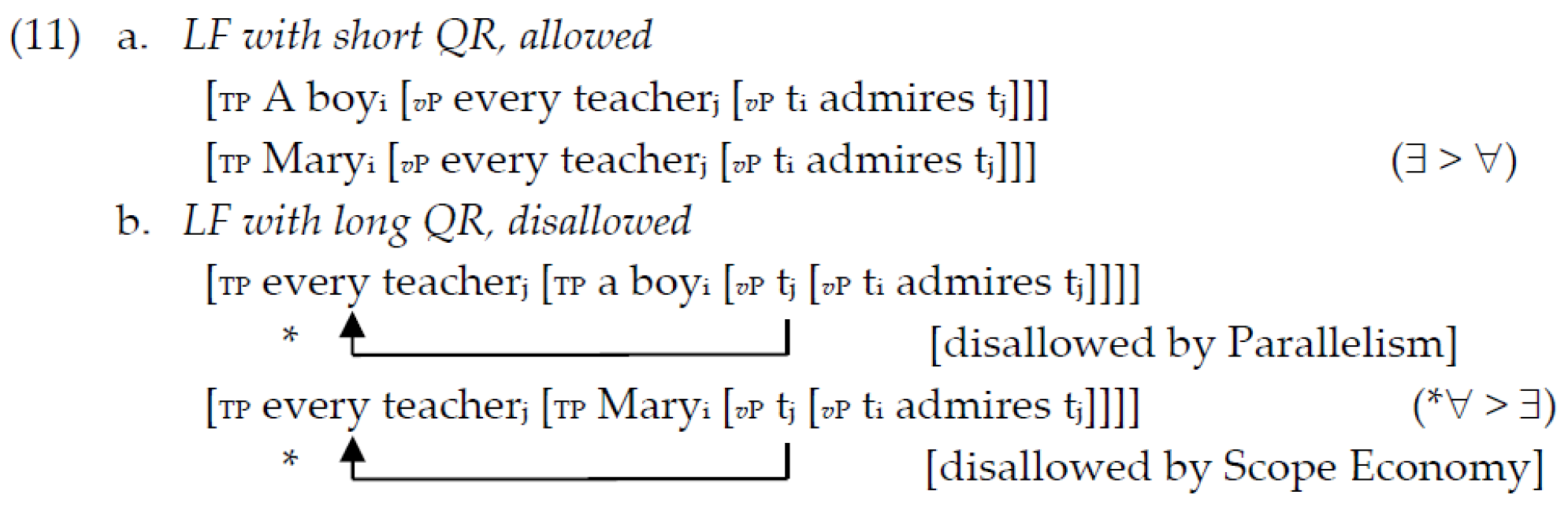
| (4) | a. | A boy admires every teacher. A girl does | (∃ > ∀) (∀ > ∃) |
| b. | A boy admires every teacher. Mary does | (∃ > ∀) (*∀ >∃) |
2. Scope Economy and Parallelism
| (5) | a. | A boy admires every teacher. |
| b. | John admires every teacher. |
| (6) | Scope Economy (Fox, 2000, p. 75) |
| Covert optional operations (i.e., Quantifier Raising and Quantifier Lowing) cannot be | |
| scopally vacuous. |
| (7) | Parallelism (Fox, 2000, p. 91)3 |
| The LF of a sentence that contains the elided/downstressed material, βE, is structurally | |
| isomorphic to a sentence that contains the antecedent, βA. |
| (8) | a. | A boy admires every teacher. A girl does | (∃ > ∀) | (∀ > ∃) |
| b. | A boy admires every teacher. A girl admires every teacher, too. | (∃ > ∀) | (∀ > ∃) |

| (10) | a. | A boy admires every teacher. Mary does | (∃ > ∀) (*∀ > ∃) |
| b. | A boy admires every teacher. Mary admires every teacher, too. | (∃ > ∀) (*∀ > ∃) |
| (12) | a. | An American runner seems to Bill to have won a gold medal. A Canadian runner | |
| does | (∃ > seem) (seem > ∃) | ||
| b. | An American runner seems to Bill to have won a gold medal. A Canadian runner | ||
| seems to Bill to have won a gold medal, too. | (∃ > seem) (seem > ∃) | ||
| (13) | a. | An American runner seems to Bill to have won a gold medal. Mary does | |
| (∃ > seem) (*seem > ∃) | |||
| b. | An American runner seems to Bill to have won a gold medal. Mary seems to Bill to | ||
| have won a gold medal, too. | (∃ > seem) (*seem > ∃) | ||
3. Scope in Null Argument Constructions
3.1. Scope Economy and Null Argument
| (14) | enu | yehaksayng-i | taypwupwun-uy | sensayngnim-ul | conkyenghay. | |
| some | female.student-nom | most-gen | teacher-acc | respect | ||
| ‘Some female student respects most teachers.’ | (some > most) (*most > some) | |||||
| (15) | [taypwupwun-uy | sensayngnim-ul]i | enu | yehaksayng-i | ti | conkyenghay. | |
| most-gen | teacher-acc | some | female.student-nom | respect | |||
| lit. ‘Most teachers, some female student respects.’ | (some > most) (most > some) | ||||||
| (16) | A: | enu | namhaksayng-i | taypwupwun-uy | sensayngnim-ul | conkyenghay. | |||
| some | male.student-nom | most-gen | teacher-acc | respect | |||||
| ‘Some male student respects most teachers.’ | |||||||||
| B: | enu | yehaksayng-to | e | conkyenghay. | (some > most) (*most > some) | ||||
| some | female.student-also | respect | |||||||
| lit. ‘Some female student also respects.’ | |||||||||
| B’: | enu | yehaksayng-to | conkyenghay. | ||||||
| some | female.student-also | most-gen | teacher-acc | respect | |||||
| ‘Some female student also respects most teachers.’ | |||||||||
| (17) | A: | [taypwupwun-uy | sensayngnim-ul]i | enu | yehaksayng-i | ti | conkyenghay. | ||||
| most-gen | teacher-acc | some | female.student-nom | respect | |||||||
| lit. ‘Most teachers, some female student respects.’ | |||||||||||
| B: | enu | namhaksayng-to | e | conkyenghay. | (some > most) (most > some) | ||||||
| some | male.student-also | respect | |||||||||
| lit. ‘Some male student also respects.’ | |||||||||||

| (19) | A: | [OBJ most teachers]i [[SUBJ some female student] | ti | respects] | (most > some) |
| B: | [OBJ most teachers]i [[SUBJ some male student-also] | ti | respects] |
| (20) | A: | [taypwupwun-uy | sensayngnim-ul]i | [enu | yehaksayng-i | ti | conkyenghay]. | ||
| most-gen | teacher-acc | some | female.student-nom | respect | |||||
| lit. ‘Most teachers, some female student respects.’ (some > most) (*most > some) | |||||||||
| B: | John-to | e | conkyenghay. | ||||||
| John-also | respect | ||||||||
| lit. ‘John also respects.’ | |||||||||


| (24) | LF, disallowed | ||||
| A: | [OBJ most teachers]i [[SUBJ some female student] | ti | respects] | ||
| B: | [OBJ most teachers]i [[SUBJ John-also] | ti | respects] | ||
3.2. Phonological Reduction
| (25) | A: | [taypwupwun-uy | sensayngnim-ul]i | enu | yehaksayng-i | ti | conkyenghay. | |||||||
| most-gen | teacher-acc | some | female.student-nom | respect | ||||||||||
| lit. ‘Most teachers, some female student respects.’ | ||||||||||||||
| B: | enu | namhaksayng-to | [taypwupwun-uy | sensayngnim-ul] | conkyenghay. | |||||||||
| some | male.student-also | most-gen | teacher-acc | respect | ||||||||||
| ‘Some male student also respects most teachers.’ | (some > most) (*most > some) | |||||||||||||
| B’: | [taypwupwun-uy | sensayngnim-ul]i | enu | namhaksayng-to | ti | conkyenghay. | ||||||||
| most-gen | teacher-acc | some | male.student-also | respect | ||||||||||
| lit. ‘Most teachers, some male student also respects.’ (some > most) (most > some) | ||||||||||||||
| (26) | A: | [taypwupwun-uy | sensayngnim-ul]i | enu | yehaksayng-i | ti | conkyenghay. | ||||
| most-gen | teacher-acc | some | female.student-nom | respect | |||||||
| lit. ‘Most teachers, some female student respects.’ (some > most) (*most > some) | |||||||||||
| B: | John-to | [taypwupwun-uy | sensayngnim-ul] | conkyenghay. | |||||||
| John-also | most-gen | teacher-acc | respect | ||||||||
| ‘John also respects most teachers.’ | |||||||||||
| B’: | [taypwupwun-uy | sensayngnim-ul]i | John-to | ti | conkyenghay. | ||||||
| most-gen | teacher-acc | John-also | respect | ||||||||
| lit. ‘Most teachers, John also respects.’ | |||||||||||
| (27) | A: | [taypwupwun-uy | sensayngnim-ul]i | Mary-ka | ti | conkyenghay. | ||||
| most-gen | teacher-acc | Mary-nom | respect | |||||||
| lit. ‘Most teachers, Mary respects.’ | ||||||||||
| B: | John-to | e | conkyenghay. | |||||||
| John-also | respect | |||||||||
| lit. ‘John also respects.’ | ||||||||||
| B’: | John-to | [taypwupwun-uy | sensayngnim-ul] | conkyenghay. | ||||||
| John-also | most-gen | teacher-acc | respect | |||||||
| ‘John also respects most teachers.’ | ||||||||||
| (28) | A: | Mary-ka | [taypwupwun-uy | sensayngnim-ul] | conkyenghay. | |
| Mary- nom | most- gen | teacher-acc | respect | |||
| B: | [taypwupwun-uy | sensayngnim-ul]i | John-to | ti | conkyenghay. | |
| most | teacher- acc | John-also | respect | |||
3.3. Fragments
| (29) | A: | enu yehaksayng-i | taypwupwun-uy | paywu-lul | coahay. | |||||||||
| some female.student-nom | most-gen | actor-acc | like | |||||||||||
| ‘Some female-student likes most actors.’ | ||||||||||||||
| B: | [taypwupwun-uy | kaswu-to]i | ||||||||||||
| most-gen | singer-also | some | female.student-nom | like | ||||||||||
| lit. ‘Most singers also (some female student likes).’ | (some > most) (*most > some) | |||||||||||||
| B’: | [taypwupwun-uy | kaswu-to]i | [TP | enu | yehaksayng-i | ti | coahay]. | |||||||
| most-gen | singer-also | some | female.student-nom | like | ||||||||||
| lit. ‘Most singers also, some female student likes.’ | (some > most) (*most > some) | |||||||||||||
| (30) | A: | [taypwupwun-uy | paywu-lul]i | enu | yehaksayng-i | ti | coahay. | |||
| most-gen | actor-acc | some | female.student-nom | like | ||||||
| lit. ‘Most actors, some female-student likes.’ | ||||||||||
| B: | [taypwupwun-uy | kaswu-to]i | ||||||||
| most-gen | singer-also | some | female.student-nom | like | ||||||
| lit. ‘Most singers also (some female student likes).’ | (some > most) (most > some) | |||||||||
| (31) | A: | [taypwupwun-uy | paywu-lul]i | enu | yehaksayng-i | ti | coahay. | |||||
| most-gen | actor-acc | some | female.student-nom | like | ||||||||
| lit. ‘Most actors, some female-student likes.’ | ||||||||||||
| B: | John-to | |||||||||||
| John-also | most- gen | actor-acc like | ||||||||||
| lit. ‘John also (likes most actors).’ | (some > most) (*most > some) | |||||||||||
| (32) | A: | John-i | taypwupwun-uy | paywu-lul | coahay. | |||||
| John-nom | most-gen | actor-acc | like | |||||||
| ‘John likes most actors.’ | ||||||||||
| B: | [taypwupwun-uy | kaswu-to]i | ||||||||
| most-gen | singer-also | John-nom | like | |||||||
| lit. ‘Most singers also (John likes).’ | ||||||||||
| B’: | [taypwupwun-uy | kaswu-to]i | [TP John-i | ti | coahay]. | |||||
| most-gen | singer-also | John-nom | like | |||||||
| lit. ‘Most singers also (John likes).’ | ||||||||||
| (33) | A: | [taypwupwun-uy | paywu-lul]i | Mary-ka | ti | coahay. | |||||
| most-gen | actor-acc | Mary-nom | like | ||||||||
| lit. ‘Most actors, Mary likes.’ | |||||||||||
| B: | John-to | ||||||||||
| John-also | most-gen | actor-acc | like | ||||||||
| lit. ‘John also (likes most actors).’ | |||||||||||
| B’: | John-to | taypwupwun-uy | paywu-lul | coahay. | |||||||
| John-also | most-gen | actor-acc | like | ||||||||
| ‘John also likes most teachers.’ | |||||||||||
4. What if Scrambling Is Not Optional?
4.1. Bošković and Takahashi (1998)
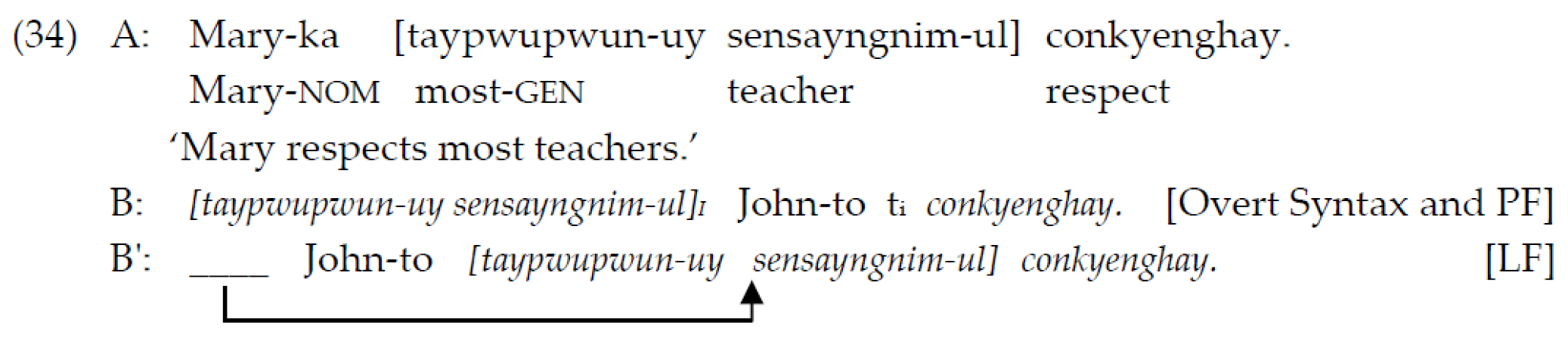
| (35) | A: | [taypwupwun-uy sensayngnim-ul]i enu yehaksayng-i | ti | conkyenghay. | |||||||
| most-gen | teacher-acc some female.student-nom | respect | |||||||||
| ‘Some female student respects most teachers.’ | (some > most) (*most > some) | ||||||||||
| B: | John-to | [taypwupwun-uy | sensayngnim-ul] | conkyenghay. | |||||||
| John-also | most-gen | teacher-acc | respect | ||||||||
| ‘John also respects most teachers.’ | |||||||||||
| B’: | [taypwupwun-uy | sensayngnim-ul] | John-to | conkyenghay. | |||||||
| most-gen | teacher-acc | John-also | respect | ||||||||
| lit. ‘Most teachers, John also respects.’ | |||||||||||
4.2. Miyagawa (2011)
| (36) | taypwupwun-uy | sensayngnim-uli | [enu | yehaksayng-i | ti | conkyenghay]. | ||
| most-gen | teacher-acc | some | female.student-nom | respect | ||||
| lit. ‘Most teachers, some female student respects.’ | (some > most) (most > some) | |||||||
| (37) | a. | most > some | |||||||||
| [CP [TP [taypwupwun-uy | sensayngnim-ul]i [vP ti [vP | enu | yehaksayng-i | [VP ti | |||||||
| most-gen | teacher-acc | some | female.student-nom | ||||||||
| conkyenghay ]]]]] | |||||||||||
| respect | |||||||||||
| b. | some > most (will obtain after reconstruction of the scrambled QP at LF) | ||||||||||
| [CP [taypwupwun-uy | sensayngnim-ul]i [TP | enu | yehaksayng-ij | [vP ti [vP tj [VP ti | |||||||
| most-gen | teacher-acc | some | female.student-nom | ||||||||
| conkyenghay]]]]]] | |||||||||||
| respect | |||||||||||
5. Scope and GIVENness
5.1. Where We Are
| (38) | A: | [taypwupwun-uy | sensayngnim-ul]i | enu | yehaksayng-i | ti | conkyenghay. | ||
| most-gen | teacher-acc | some female.student-nom | respect | ||||||
| lit. ‘Most teachers, some female student respects.’ | (some > most) (*most > some) | ||||||||
| B: | John-to | e | conkyenghay. | ||||||
| John-also | respect | ||||||||
| lit. ‘John also respects.’ | |||||||||
| (39) | A: | [OBJ most teachers]i | [TP some female-student ti likes] | (some > most)(*most > some) | ||
| B: | [TP John-also [OBJ most teachers] | likes] | [Derivation 1: Overt Syntax and PF] | |||
| B’: | [OBJ most teachers]i [TP John-also ti likes] | [Derivation 2: Overt Syntax and PF] | ||||
| (40) | B’: | [OBJ most teachers]i [TP John-also ti likes] | [LF of Derivation 2] |
| (41) | A: | [OBJ most teachers]i [TP some female-student ti likes] | (some > most) (*most > some) | ||
| B: | [TP John-also [OBJ most teachers] likes | [Derivation 1: Overt Syntax, PF and LF] | |||
| B’: | [OBJ most teachers]i [TP John-also | ti likes] | [Derivation 2: Overt Syntax, PF and LF] | ||
5.2. Schwarzschild (1999)
| (42) | GIVENness (Schwarzschild, 1999, p. 155) |
| If a constituent is not F-marked, it must be GIVEN. |
| (43) | Definition of GIVEN (Schwarzschild, 1999, p. 151) | |
| An utterance U counts as GIVEN iff it has a salient antecedent A and: | ||
| a. | if U is type e, then A and U corefer; | |
| b. | otherwise: modulo ∃-type shifting, A entails the Existential F-Closure of U. | |
| (44) | Existential F-Closure of U =def the result of replacing F-marked phrases in U with variables and existentially closing the result, modulo existential-type-shifting (Schwarzschild, 1999, p. 150). | |
| (45) | A: | John ate a green apple. |
| B: | No, he ate a RED apple. |
| (46) | No, [TP he [VP ate [NP a [AP [RED]F apple]]]] |
| (47) | ∃x∃y[ate(x)(y)] entails ∃x∃y[ate(x)(y)] |
| (48) | a. | [NP a [AP RED]F apple]] : ∃P∃x[P(x) & apple(x)] |
| b. | [VP ate [NP a [AP RED]F apple]] : ∃P∃y∃x[P(x) & apple(x) & ate(x)(y)] | |
| c. | [TP he [VP ate [NP a [AP RED]F apple]]] : ∃P∃x[P(x) & apple(x) & ate(x)(John)] |
| (49) | a. | The ∃-Type-Shifted NP [NP a green apple] is ∃x[green(x) & apple(x)] and entails |
| the ∃-F-Closure of NP: ∃P∃x[P(x) & apple(x)]. | ||
| b. | The ∃-Type-Shifted VP [VP ate a green apple] is ∃y∃x[green(x) & apple(x) & | |
| ate(x)(y)] and entails the ∃-F-Closure of VP: ∃P∃y∃x[P(x) & apple(x) & ate(x)(y)]. | ||
| c. | The denotation of TP is ∃x[green(x) & apple(x) & ate(x)(John)] and entails | |
| the ∃-F-Closure of TP: ∃P∃x[P(x) & apple(x) & ate(x)(John)]. |
5.3. GIVENness and Scope Interpretation in Null Argument Constructions
5.3.1. Disambiguation Effect
| (50) | A: | [taypwupwun-uy sensayngnim-ul]i | enu | yehaksayng-i | ti | conkyenghay. | ||||||||
| most-gen teacher-acc | some female.student-nom respect | |||||||||||||
| lit. ‘Most teachers, some female student respects.’ | (some > most) (*most > some) | |||||||||||||
| B: | [John]F-to | [taypwupwun-uy | sensayngnim-ul] | conkyenghay. | ||||||||||
| John-also | most-gen | teacher-acc | respect | |||||||||||
| ‘John also respects most teachers.’ | ||||||||||||||
| B’: | [taypwupwun-uy | sensayngnim-ul]i | [John]F -to | ti | conkyenghay. | |||||||||
| most-gen | teacher-acc | John -also | respect | |||||||||||
| lit. ‘Most teachers, John also respects.’ | ||||||||||||||
| B”: | [John]F-to | e | conkyenghay. | |||||||||||
| John-also | respect | |||||||||||||
| lit. ‘John also respects.’ | ||||||||||||||
- Deriving the Subject-Wide Scope (‘Some > Most’)

| (52) | The constituents that must be evaluated for GIVENness in (51b) | |
| a. | The ∃-Type-Shifted object NP (= [OBJ most teachers]): ∃P[|{x| teacher(x) & P(x)}| | |
| > |{x| teacher(x) & ¬P(x)}|] | ||
| b. | The ∃-Type-Shifted lower vP (= [vP t1 respect t2]): ∃y∃x[respect (x)(y)] | |
| c. | The ∃-Type-Shifted higher vP (= [vP [OBJ most teachers] 2 [vP t1 respect t2]]): ∃y[|{x| | |
| teacher(x) & respect(x)(y)}| > |{x| teacher(x) & ¬respect(x)(y)}|]18 | ||
| d. | The ∃-F-Closure of TP (= [TP [SUBJ John]F-also 1 [vP [OBJ most teachers] 2 [vP t1 respect | |
| t2]]]) : ∃y[|{x| teacher(x) & respect(x)(y)}| > |{x| teacher(x) & ¬respect(x)(y)}|] | ||
| (53) | The ∃-Type-Shifted constituents in (51a) | |
| a. | The ∃-Type-Shifted object NP (= [OBJ most teachers]): ∃P[|{x| teacher(x) & P(x)}| | |
| > |{x| teacher(x) & ¬P(x)}|] entails (52a). | ||
| b. | The ∃-Type-Shifted lower vP: ∃y∃x[respect (x)(y)] entails (52b). | |
| c. | The ∃-Type-Shifted higher vP: ∃y[|{x| teacher(x) & respect(x)(y)}| > |{x| | |
| teacher(x) & ¬respect(x)(y)}|] entails (52c) and (52d). | ||

- Ruling Out the Object-Wide Scope (‘Most > Some’)
| (55) | a. | [TP2 [OBJ most teachers] 2 [TP1 [SUBJ some female-student]1 [vP t1 respect t2 ]]] | |
| [LF of 50A)] | |||
| b. | [TP2 [OBJ most teachers] 2 [TP1 [SUBJ [John]F-also 1 [vP t1 respect t2]]] | [LF of (50B’)] | |
| (56) | The ∃-F-Closure of TP2 in (55b) |
| ∃y[|{x| teacher(x) & respect(x)(y)}| > |{x| teacher(x) & ¬respect(x)(y)}|] |
| (57) | The ∃-Type-Shifted constituents and the denotation of TP2 in (55a) | |
| a. | The ∃-Type-Shifted subject NP (= [SUBJ some female-student]): ∃y[female(y) & | |
| student(y)] | ||
| b. | The ∃-Type-Shifted object NP (= [OBJ most teachers]): ∃P[|{x| teacher(x) & P(x)}| | |
| > |{x| teacher(x) & ¬P(x)}|] | ||
| c. | The ∃-Type-Shifted vP (= [vP t1 respect t2]): ∃y∃x[respect (x)(y)] | |
| d. | The ∃-Type-Shifted TP1 (= [TP1 [some female-student]1 [vP t1 respect t2]]): | |
| ∃y∃x[female(y) & student(y) & respect (x)(y)] | ||
| e. | The denotation of TP2 (= [TP2 [most teachers] 2 [TP1 [some female-student]1 [vP t1 respect | |
| t2]]]): |{x|teacher(x) & ∃y[female(y) & student(y) & respects(x)(y)]}| > | ||
| |{x|teacher(x) & ¬∃y[female(y) & student(y) & respects(x)(y)]}| | ||
5.3.2. Two-Way Parallel Interpretations
| (58) | A: | [taypwupwun-uy | sensayngnim-ul]i | enu | yehaksayng-i | ti | conkyenghay. | ||||||||
| most-gen | teacher-acc | some | female.student-nom | respect | |||||||||||
| lit. ‘Most teachers, some female student respects.’ | |||||||||||||||
| B: | enu | [nam]F-haksayng-to | e | conkyenghay. | (some > most) (most > some) | ||||||||||
| some | male.student-also | respect | |||||||||||||
| lit. ‘Some male student also respects.’ | |||||||||||||||
| B’: | [taypwupwun-uy | sensayngnim-ul]i | enu | [nam]F-haksayng-to | ti | conkyenghay. | |||||||||
| most-gen | teacher-acc | some | male.student-also | respect | |||||||||||
| lit. ‘Most teachers, some male student also respects.’ | |||||||||||||||
- Subject-Wide Scope (‘Some > Most’)

| (60) | a. | The ∃-F-Closure of the subject NP (= [some [male]F-student]) in (59b) is |
| ∃P∃y[P(y) & student(y)] and is entailed by the ∃-Type-Shifted subject NP | ||
| (= [some female-student]) in (59a): ∃y[female(y) & student(y)]. | ||
| b. | The ∃-F-Closure of TP in (59b) is ∃P∃y[P(y) & student (y) & [|{x|teacher(x) & | |
| respect(x)(y)}| > |{x|teacher(x) & ¬respect(x)(y)}|]] is entailed by the denotation | ||
| of TP in (59a): ∃y[female(y) & student(y) & [|{x|teacher(x) & respect(x)(y)}| > | ||
| |{x|teacher(x) & ¬respect(x)(y)}|]]. |
- Object-Wide Scope (‘Most > Some’)
| (61) | a. | [TP2 [OBJ most teachers] 2 [TP1 [SUBJ some female-student]1 [vP t1 respect t2 ]]] |
| b. | [TP2 [OBJ most teachers] 2 [TP1 [SUBJ some [male]F-student]1 [vP t1 respect t2 ]]] |
| (62) | a. | The ∃-F-Closure of the subject NP: ∃P∃y [P(y) & student(y)] |
| b. | The ∃-F-Closure of TP1: ∃P∃y∃x[P(y) & student(y) & respect(x)(y)] | |
| c. | The ∃-F-Closure of TP2: |{x|teacher(x) & ∃P∃y[P(y) & student(y) & | |
| respect(x)(y)]}| > |{x|teacher(x) & ¬∃P∃y[P(y) & student(y) & respect(x)(y)]}| |
| (63) | a. | The ∃-Type-Shifted subject NP in (61a): ∃y[female(y) & student(y)] |
| b. | The ∃-Type-Shifted TP1 in (61a): ∃y∃x[female(y) & student(y) & respect(x)(y)] | |
| c. | The denotation of TP2 in (61a): |{x|teacher(x) & ∃y[female(y) & student(y) & | |
| respect(x)(y)]}| > |{x|teacher(x) & ¬∃y[female(y) & student(y) & respect(x)(y)]}| |
5.3.3. Scope Economy in English Revisited
| (64) | a. | A boy admires every teacher. [A [girl]F] does | |
| (∃ > ∀) (∀ > ∃) | |||
| b. | A boy admires every teacher. [Mary]F does admire every teacher, too. (∃ > ∀) (*∀ > ∃) | ||
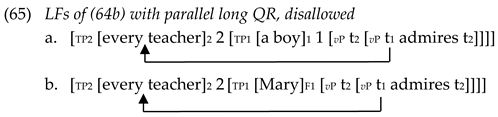
| (66) | The ∃-F-Closure of TP2 in (65b): ∃y∀x [teacher(x) → admire(x)(y)] |
| (67) | Constituents of (65a) | ||
| a. | The ∃-Type-Shifted subject NP is ∃P∃x[boy(x) & P(x)] and does not entail (66). | ||
| b. | The ∃-Type-Shifted object NP is ∃P∀x[teacher(x)→P(x)] and does not entail (66). | ||
| c. | The ∃-Type-Shifted higher/lower vP is ∃y∃x [admire(x)(y)] and does not entail (66). | ||
| d. | The ∃-Type-Shifted TP1 is ∃x∃y[boy(y) & admire(x)(y)] and does not entail (66). | ||
| e. | The denotation of TP2 is ∀x[teacher(x) → ∃y[boy(y) & admire(x)(y)]] and does | ||
| not entail (66). | |||

| (69) | a. | The ∃-F-Closures of TP1 in (68b) is ∃P∃y∃x[P(y) & admire(x)(y)] and is entailed |
| by the ∃-Type-Shifted lower TP1 in (68a): ∃y∃x[boy(y) & admire(x)(y)]. | ||
| b. | The ∃-F-Closures of TP2 in (68b) is ∃P∀x[teacher(x) → ∃y[P(y) & admire(x)(y)]] | |
| and is entailed by the denotation of TP2 in (68a): ∀x[teacher(x) → ∃y[boy(y) & | ||
| admire(x)(y)]]. |
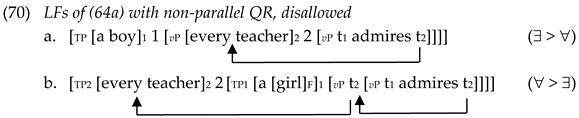
| (71) | The ∃-F-Closures of TP2 in (70b) is ∃P∀x[teacher(x) → ∃y[P(y) & admire(x)(y)]] and is entailed by the denotation of TP in (70a): ∃y[boy(y) & ∀x[teacher(x) → admire(x)(y)]]. |
6. Conclusions
Author Contributions
Funding
Institutional Review Board Statement
Informed Consent Statement
Data Availability Statement
Acknowledgments
Conflicts of Interest
Abbreviations
| ACC | question marker |
| GEN | question marker |
| PAST | question marker |
| DEC | question marker |
| Q | question marker |
| CL | classifier |
| LF | Logical Form |
| PF | Phonetic Form |
| 1 | In this paper, the null object is represented using the symbol e. As will become clearer below, however, this symbol is not intended to indicate the exact syntactic position of the null object. | ||||||||||||||||||||||||||||||||||||||||||||||||||||||||||||||||||||||||
| 2 | In this paper, we focus on Korean null argument constructions, which exhibit the same scope patterns as their Japanese counterparts. | ||||||||||||||||||||||||||||||||||||||||||||||||||||||||||||||||||||||||
| 3 | Fox (2000) derives Parallelism in (7) as a consequence of Rooth’s (1992) Alternative Semantics of Focus. In addition to (7), which he refers to as Direct Parallelism, Fox also proposes Indirect Parallelism to account for phonologically reduced expressions that cannot undergo ellipsis (see fn. 21 for related discussion). However, considerations of Indirect Parallelism are immaterial to the discussion in this paper. | ||||||||||||||||||||||||||||||||||||||||||||||||||||||||||||||||||||||||
| 4 | Small italics are used to indicate phonological reduction. | ||||||||||||||||||||||||||||||||||||||||||||||||||||||||||||||||||||||||
| 5 | Fox (2000) takes extraposition to be an optional overt operation subject to Word Order Economy. As illustrated by the contrast between (ia) and (ib), the obviation of Condition C effect arises only when extraposition applies (see Taraldsen, 1981). Fox suggests that the Condition C effect in (ic) indicates that extraposition has failed to apply, in accordance with Word Order Economy.
| ||||||||||||||||||||||||||||||||||||||||||||||||||||||||||||||||||||||||
| 6 | See also Bobaljik and Wurmbrand (2012) for related discussion. | ||||||||||||||||||||||||||||||||||||||||||||||||||||||||||||||||||||||||
| 7 | In defense of the pro approach to null arguments, Hoji (1998) argues that pro can stand for a bare indefinite argument. Under this approach, the null argument is interpreted as the indefinite NP sensayngnim-ul ‘teacher’ and derives the relevant quantificational interpretations via pragmatic mechanisms (see also H.-D. Ahn & Cho, 2012). However, as noted by Saito (2007) and Park and Bae (2012), this approach faces problems in negative environments as in (i). The sentence in (iB) conveys the interpretation that Max didn’t read two books, a reading that is expected by the ellipsis approach. This interpretation, however, cannot be accounted for if the null argument is analyzed as pro construed as a bare indefinite (see also Park & Oh, 2013; Fujiwara, 2022, for related discussion). As shown in (iB’), when the corresponding overt indefinite chayk-ul ‘book-Acc’ is used in place of the null object, the sentence yields only the reading that Max didn’t read any books, an interpretation that is unavailable in (iB). Throughout this paper, we assume the ellipsis approach, at least for cases in which the null argument is quantificational.
| ||||||||||||||||||||||||||||||||||||||||||||||||||||||||||||||||||||||||
| 8 | In (16B), the null object can also occupy the scrambled position. However, as discussed below, Parallelism ensures that it is reconstructed at LF, yielding the same subject-wide scope (see fn. 23 for related discussion). | ||||||||||||||||||||||||||||||||||||||||||||||||||||||||||||||||||||||||
| 9 | The same scope patterns are observed when the universal QP motun sensayngnim ‘every teacher’ is used in place of taypwupwun-uy sensayngnim ‘most teachers’. | ||||||||||||||||||||||||||||||||||||||||||||||||||||||||||||||||||||||||
| 10 | Takahashi (2008) appears to assume that scrambling of the object in (23B), followed by ellipsis of it, violates Word Order Economy as well, since it is ultimately string-vacuous once ellipsis takes place at PF. This assumption, however, would give rise to a more general problem. If (23B) is ruled out due to a violation of Word Order Economy, then by the same reasoning, scrambling of the object in (17B) should also violate Word Order Economy after ellipsis occurs, as illustrated in (19B). This would incorrectly predict that object-wide scope should be unavailable, contrary to fact. Importantly, the issue arises independently of Scope Economy, since a violation of Word Order Economy alone should suffice to block the derivation. While we acknowledge this as a potential issue, our discussion will center on Scope Economy, unless otherwise noted. A reviewer raises the possibility that scrambling of the elided object as in (23B) might give rise to other semantic effects such as potential differences in information structure, which could allow the derivation in (23B). However, as shown with phonological reduction in the next section, under the current context, scrambling of this kind does not appear to yield any such semantic effects. | ||||||||||||||||||||||||||||||||||||||||||||||||||||||||||||||||||||||||
| 11 | All six of our informants confirmed this judgement. The Japanese counterparts to (26) were also reported to exhibit the same patterns by two Japanese native speakers. | ||||||||||||||||||||||||||||||||||||||||||||||||||||||||||||||||||||||||
| 12 | Park (2005, 2013) offers several arguments (such as connectivity effects) against alternative approaches to fragments in Korean, including the Direct Interpretation Approach, which maintains that fragments are not derived via ellipsis but are interpreted via pragmatic processes (Yanofsky, 1978; Morgan, 1989; Barton, 1990; Stainton, 1995, 2006; Barton & Progovac, 2005), and the cleft approach, which posits that the underlying source of fragments is a cleft structure (Shimoyama, 1995; Nishiyama et al., 1996; Fukaya & Hoji, 1999; Sohn, 2000). See also Bae and Park (2018) for further arguments based on the variability of the Clause-Mate Condition effect. Note further that as shown below, scope interpretations in fragments exhibit the same patterns as their phonological reduction and null argument counterparts. The parallel patterns can most straightforwardly be captured under the ellipsis approach to fragments. | ||||||||||||||||||||||||||||||||||||||||||||||||||||||||||||||||||||||||
| 13 | In this paper, we assume that remnant fronting in this environment can be regarded as scrambling, given that it parallels scrambling in the relevant respects: it appears to be optional, as is characteristic of scrambling, and, as shown below, it yields the same scope interpretations as scrambling in null argument constructions. Alternatively, one might assume that remnant fronting is an instance of focus movement. However, insofar as it exhibits the properties noted above, this assumption does not affect the present discussion. | ||||||||||||||||||||||||||||||||||||||||||||||||||||||||||||||||||||||||
| 14 | Park (2003) suggests that the reconstruction of the scrambled object in (32) and (33) is allowed without violating Scope Economy, as it can be motivated by feature checking at LF, in the sense of Bošković and Takahashi (1998). However, as discussed in Section 4.1, this analysis remains insufficient to account for the relevant facts. | ||||||||||||||||||||||||||||||||||||||||||||||||||||||||||||||||||||||||
| 15 | As the reader can verify, the proposed analysis below is also compatible with Bošković and Takahashi’s (1998) approach to scrambling. | ||||||||||||||||||||||||||||||||||||||||||||||||||||||||||||||||||||||||
| 16 | We assume that the scrambled object QP is reconstructed to the outer edge of vP, allowing it to be interpreted without inducing the type-mismatch problem (see Section 2 for relevant discussion). | ||||||||||||||||||||||||||||||||||||||||||||||||||||||||||||||||||||||||
| 17 | Likewise, at the level of individual words, the verb respect in (51b) is entailed by the identical verb in the antecedent in (51a) (with ∃-Type-Shifting), as discussed in Section 5.2. In what follows, we set aside entailment relations holding between identical constituents or elements | ||||||||||||||||||||||||||||||||||||||||||||||||||||||||||||||||||||||||
| 18 | This is read as: there exists a y such that the number of teachers whom y respects is greater than the number of teachers whom y does not respect (Barwise & Cooper, 1981; Chierchia & McConnell-Ginet, 1990; Heim & Kratzer, 1998). | ||||||||||||||||||||||||||||||||||||||||||||||||||||||||||||||||||||||||
| 19 | To be precise, the object QP raises to the outer edge of vP at LF, due to type considerations (fn. 16). | ||||||||||||||||||||||||||||||||||||||||||||||||||||||||||||||||||||||||
| 20 | Fujiwara (2022) argues that argument ellipsis can only take place in a fronted position, i.e., CP. Under this analysis, the elided object QP in (50B”) always occupies this position. Fujiwara’s analysis is compatible with the proposed analysis in this paper, as long as the fronted object QP in (50B”) is allowed to be reconstructed at LF, as in (54b) (due to the considerations of Parallelism). In contrast, Fujiwara’s analysis may not be compatible with the Scope-Economy based account, which prohibits scrambling of an elided object QP across a non-quantified NP. | ||||||||||||||||||||||||||||||||||||||||||||||||||||||||||||||||||||||||
| 21 | It should be noted that not all instances of phonological reduction are eligible for ellipsis (Rooth, 1992; Tancredi, 1992; Wold, 1995). For example, the VP/vP in (ia) may undergo phonological reduction but cannot be elided. Given that no entailment relation holds, we can assume that implicational bridging (Rooth, 1992), as incorporated into Schwarzschild’s theory, may also serve as a licensing condition for phonological reduction. The basic idea is that if someone is called an idiot, it implicates that the person is insulted but, not vice versa, as illustrated in (ib) (see Tomioka, 1997, for detailed discussion). What, then, prevents VP-ellipsis in (ia)? One possibility is that ellipsis is subject to additional licensing conditions, such as LF-identity (Fiengo & May, 1994) or mutual entailment between the antecedent and the elliptical VP (Merchant, 2001). Such issues do not arise for argument ellipsis discussed in this paper, since the elided and antecedent arguments are (literally) identical.
| ||||||||||||||||||||||||||||||||||||||||||||||||||||||||||||||||||||||||
| 22 | We assume that contrasting with ye ‘female’ in the antecedent, the modifier nam ‘male’ is F-marked (Selkirk, 1996). | ||||||||||||||||||||||||||||||||||||||||||||||||||||||||||||||||||||||||
| 23 | Thus far, we have assumed Parallelism in deriving the appropriate scope interpretation (see Fox & Lasnik, 2003; Hartman, 2011, among others, for approaches that treat Parallelism as an independent condition). Parallelism also straightforwardly accounts for the scope interpretation in an example like (i). The pair (iA) and (iB) allows only the subject-wide scope interpretation. This interpretation is correctly predicted by Parallelism, since it demands that the scrambled object in (iB) be reconstructed at LF. The resulting LFs are identical to those in (59), which yield only the subject-wide scope interpretation.
| ||||||||||||||||||||||||||||||||||||||||||||||||||||||||||||||||||||||||
| 24 | The higher and lower vPs and the object NP in (68b) are entailed (via ∃-Type-Shifting) by the corresponding identical constituents in the antecedent in (68a). | ||||||||||||||||||||||||||||||||||||||||||||||||||||||||||||||||||||||||
| 25 | Tomioka (1997) also applies an earlier version of Schwarzschild’s GIVENness constraint (Schwarzschild, 1996) to scope interactions in English examples such as (64). Unlike the current study, Tomioka (1997) does not assume Parallelism and argues that English scope interactions can be explained by the GIVENness constraint, without recourse to Scope Economy. Under this approach, however, Scope Economy still remains a possible alternative. By contrast, we adopt the standard assumption that Parallelism is operative and make a stronger cross-linguistic claim that Scope Economy cannot be maintained as a uniform account for both English and Korean. Moreover, setting aside Parallelism, Tomioka appears to leave unresolved issues concerning logical entailment relations between LFs, as in (70), which would incorrectly allow non-parallel interpretations. He suggests instead that contextual entailment (or, implicational bridging), rather than logical entailment, can factor into the calculation of GIVENness, ruling out the non-parallel interpretations (see Tomioka, 1997, for details). While contextual entailment can certainly play a role, it does not necessarily preclude logical entailment. Excluding logical entailment altogether from the calculation of GIVENness would also be theoretically puzzling (see also Fox, 2000, for adopting both notions of entailment; Merchant, 2001, for the mutual entailment condition on ellipsis). Despite these differences, we are greatly indebted to Tomioka (1997) for setting an important research direction, based on the GIVENness constraint, which has inspired the current study. | ||||||||||||||||||||||||||||||||||||||||||||||||||||||||||||||||||||||||
References
- Ahn, H.-D., & Cho, S. (2012). On the nature of zero realization of arguments: A reply to Lee (2011). Linguistic Research, 29(1), 1–20. [Google Scholar] [CrossRef]
- Ahn, S.-H. (1990). Korean quantification and universal grammar [Doctoral dissertation, University of Connecticut]. [Google Scholar]
- Bae, S., & Park, B.-S. (2018). Processing the clause-mate condition effects in Korean. Korean Journal of Linguistics, 43(3), 545–569. [Google Scholar] [CrossRef]
- Barton, E. (1990). Nonsentential constituents: A theory of grammatical structure and pragmatic interpretation. John Benjamins Publishing. [Google Scholar]
- Barton, E., & Progovac, L. (2005). Nonsententials in minimalism. In R. Elugardo, & R. J. Stainton (Eds.), Ellipsis and nonsentential speech (pp. 71–93). Springer. [Google Scholar]
- Barwise, J., & Cooper, R. (1981). Generalized quantifiers and natural language. Linguistics and Philosophy, 4(2), 159–219. [Google Scholar] [CrossRef]
- Bobaljik, J., & Wurmbrand, S. (2012). Word order and scope: Transparent interfaces and the ¾ signature. Linguistic Inquiry, 43(3), 371–421. [Google Scholar] [CrossRef]
- Bošković, Ž., & Takahashi, D. (1998). Scrambling and last resort. Linguistic Inquiry, 29(3), 347–366. [Google Scholar] [CrossRef]
- Chierchia, G., & McConnell-Ginet, S. (1990). Meaning and grammar: An introduction to semantics. MIT Press. [Google Scholar]
- Chomsky, N., & Lasnik, H. (1993). The theory of principles and parameters. In J. Jacobs, A. von Stechow, W. Sternefeld, & T. Vennemann (Eds.), Syntax: An international handbook of contemporary research (pp. 506–569). Mouton de Gruyter. [Google Scholar]
- Cinque, G. (1993). A null theory of phrase and compound stress. Linguistic Inquiry, 24(2), 239–297. [Google Scholar]
- Evans, G. (1980). Pronouns. Linguistic Inquiry, 11(2), 337–362. [Google Scholar]
- Fiengo, R., & May, R. (1994). Indices and identity. MIT Press. [Google Scholar]
- Fox, D. (2000). Economy and semantic interpretation. MIT Press. [Google Scholar]
- Fox, D., & Lasnik, H. (2003). Successive-cyclic movement and island repair: The difference between sluicing and VP-ellipsis. Linguistic Inquiry, 34(1), 143–154. [Google Scholar] [CrossRef]
- Fujiwara, Y. (2022). Movement approach to ellipsis in Japanese [Doctoral dissertation, University of Connecticut]. [Google Scholar]
- Fukaya, T., & Hoji, H. (1999). Stripping and sluicing in Japanese and some implications. In S. Bird, A. Carnie, J. D. Haugen, & P. Norquest (Eds.), WCCFL 18: Proceedings of the 18th west coast conference on formal linguistics (pp. 145–158). Cascadilla Press. [Google Scholar]
- Hartman, J. (2011). The semantic uniformity of traces: Evidence from ellipsis parallelism. Linguistic Inquiry, 42(3), 367–388. [Google Scholar] [CrossRef]
- Heim, I., & Kratzer, A. (1998). Semantics in generative grammar. Blackwell Publishers. [Google Scholar]
- Hirschbühler, P. (1982). VP-deletion and across-the-board quantifier scope. In J. Pustejovsky, & P. Sells (Eds.), Proceedings of the 12th North East Linguistic Society (pp. 132–139). GLSA, University of Massachusetts. [Google Scholar]
- Hoji, H. (1985). Logical form constraints and configurational structures in Japanese [Doctoral dissertation, University of Washington]. [Google Scholar]
- Hoji, H. (1998). Null object and sloppy identity in Japanese. Linguistic Inquiry, 29(1), 127–152. [Google Scholar] [CrossRef]
- Huang, C. T. J. (1991). Remarks on the status of the null object. In R. Freidin (Ed.), Principles and parameters in comparative grammar (pp. 56–76). MIT Press. [Google Scholar]
- Kim, H. (2023). Diving into Silence: A Study on the Internal Structure of Null Arguments. Studies in Generative Grammar, 33(3), 291–312. [Google Scholar]
- Kim, J.-S. (1997). Syntactic focus movement and ellipsis: A minimalist approach [Doctoral dissertation, University of Connecticut]. [Google Scholar]
- Kim, S. (1999). Sloppy/strict identity, empty objects, and NP ellipsis. Journal of East Asian Linguistics, 8(4), 255–284. [Google Scholar] [CrossRef]
- Kuno, S. (1973). The structure of the Japanese language. MIT Press. [Google Scholar]
- Kuroda, S.-Y. (1971). Remarks on the notion of subject with reference to words like also, even, and only. In Annual Bulletin 4 (pp. 127–152). Research Institute of Logopedics and Phoniatrics, University of Tokyo. [Google Scholar]
- Lasnik, H. (1972). Analyses of negation in English [Doctoral dissertation, MIT]. [Google Scholar]
- Lee, W. (2011). Zero realization of arguments revisited. Korean Journal of Linguistics, 36(4), 1031–1052. [Google Scholar] [CrossRef]
- Merchant, J. (2001). The syntax of silence: Sluicing, islands, and the theory of ellipsis. Oxford University Press. [Google Scholar]
- Merchant, J. (2004). Fragments and ellipsis. Linguistics and Philosophy, 27(6), 661–738. [Google Scholar] [CrossRef]
- Merchant, J. (2010). Three types of ellipsis. In F. Recanati, I. Stojanovic, & N. Villanueva (Eds.), Context-dependence, perspective and relativity (pp. 141–192). Mouton de Gruyter. [Google Scholar]
- Miyagawa, S. (2001). The EPP, scrambling, and wh-in-situ. Current Studies in Linguistics Series, 36, 293–338. [Google Scholar]
- Miyagawa, S. (2011). Genitive subjects in Altaic and specification of phase. Lingua, 121(7), 1265–1282. [Google Scholar] [CrossRef]
- Morgan, J. (1973). Sentence fragments and the notion ‘sentence’. In B. Jashru, R. Lees, Y. Malkiel, A. Pietrangeli, & S. Saporta (Eds.), Issues in Linguistics (pp. 719–751). University of Illinois Press. [Google Scholar]
- Morgan, J. (1989). Sentence fragments revisited. In B. Music, R. Graczyk, & C. Wiltshire (Eds.), CLS 25: Papers from the 25th annual regional meeting of the Chicago Linguistic Society (pp. 228–241). Chicago Linguistic Society. [Google Scholar]
- Nishiyama, K., Whitman, J., & Yi, E.-Y. (1996). Syntactic movement of overt wh-phrases in Japanese and Korean. Japanese/Korean Linguistics, 5, 337–351. [Google Scholar]
- Oku, S. (1998). A theory of selection and reconstruction in the minimalist perspective [Doctoral dissertation, University of Connecticut]. [Google Scholar]
- Park, B.-S. (2003, ). When can scope economy be violated? [Paper presentation (Aug. 23)]. The 4th GLOW in Asia, Seoul, Republic of Korea. [Google Scholar]
- Park, B.-S. (2005). Locality and identity in ellipsis [Doctoral dissertation, University of Connecticut]. [Google Scholar]
- Park, B.-S. (2013). Multiple fragment answers in Korean. Linguistic Research, 30(3), 453–472. [Google Scholar] [CrossRef]
- Park, B.-S., & Bae, S. (2012). Identifying null arguments: Sometimes pro, sometimes ellipsis. Korean Journal of Linguistics, 37(4), 845–866. [Google Scholar] [CrossRef]
- Park, B.-S., & Oh, S.-R. (2013). Re-identifying null arguments with ellipsis: A reply to Ahn and Cho (2013). Studies in Generative Grammar, 23(4), 155–169. [Google Scholar] [CrossRef]
- Rooth, M. (1992). Ellipsis redundancy and reduction redundancy. In S. Berman, & A. Hestvik (Eds.), Proceedings of the stuttgart workshop on ellipsis. Universitat of Stuttgart. [Google Scholar]
- Rooth, M. (2005). Scope Disambiguation by ellipsis and focus without scope economy. In P. Dekker, & M. Franke (Eds.), Proceedings of fifteenth Amsterdam colloquium (pp. 197–202). University of Amsterdam. [Google Scholar]
- Sag, I. (1976). Deletion and logical form [Doctoral dissertation, MIT]. [Google Scholar]
- Saito, M. (1989). Scrambling as semantically vacuous A’-movement. In M. R. Baltin, & A. S. Kroch (Eds.), Alternative conception of phrase structure (pp. 182–200). University of Chicago Press. [Google Scholar]
- Saito, M. (2007). Notes on East Asian argument ellipsis. Language Research, 43, 203–227. [Google Scholar]
- Sakamoto, Y. (2020). Silently structured silent argument. John Benjamins Publishing Company. [Google Scholar]
- Schwarzschild, R. (1996). In defense of Givenness [Unpublished manuscript]. Rutgers University.
- Schwarzschild, R. (1999). Givenness, avoid F and other constraints on the placement of accent. Natural Language Semantics, 7(2), 141–177. [Google Scholar] [CrossRef]
- Selkirk, E. (1996). Sentence prosody: Intonation, stress, and phrasing. In J. A. Goldsmith (Ed.), The handbook of phonological theory. Blackwell. [Google Scholar]
- Shimoyama, J. (1995). On ‘sluicing’ in Japanese [Unpublished manuscript]. University of Massachusetts.
- Sohn, K.-W. (1995). Negative polarity items, scope, and economy [Doctoral dissertation, University of Connecticut]. [Google Scholar]
- Sohn, K.-W. (2000). A non-sluicing, non-clefting approach to copular constructions. Studies in Generative Grammar, 10, 267–294. [Google Scholar]
- Stainton, R. (1995). Non-sentential assertions and semantic ellipsis. Linguistics and Philosophy, 18(3), 281–296. [Google Scholar] [CrossRef]
- Stainton, R. (2006). Words and thoughts: Subsentences, ellipsis, and the philosophy of language. Oxford University Press. [Google Scholar]
- Takahashi, D. (2008). Quantificational null objects and argument ellipsis. Linguistic Inquiry, 39(2), 307–326. [Google Scholar] [CrossRef]
- Takahashi, D. (2013). A note on parallelism for elliptic arguments. In K. Yatsushiro, & U. Sauerland (Eds.), Proceedings of FAJL 6: Formal approaches to Japanese linguistics (pp. 203–214). MIT Press. [Google Scholar]
- Takahashi, D. (2025). Argument ellipsis and grammatical function mismatches [Unpublished manuscript]. Tohoku University.
- Takita, K. (2011). An argument for argument ellipsis from -sika NPIs. In S. Lima, & K. Mullin (Eds.), Proceedings of the 39th North East Linguistic Society (pp. 771–784). GLSA, University of Massachusetts. [Google Scholar]
- Tancredi, C. (1992). Deletion, deaccenting and presupposition [Doctoral dissertation, MIT]. [Google Scholar]
- Taraldsen, T. (1981). The theoretical interpretation of a class of marked extractions in Theory of markedness in generative grammar. In A. Belletti, L. Brandi, & L. Rizzi (Eds.), Theory of markedness in generative grammar (pp. 475–516). Schuola Normale Superiore. [Google Scholar]
- Tomioka, S. (1997). Focus effects and NP interpretation in VP ellipsis [Doctoral dissertation, University of Massachusetts]. [Google Scholar]
- Truckenbrodt, H. (1995). Phonological phrases—Their relation to syntax, focus, and prominence [Doctoral dissertation, MIT]. [Google Scholar]
- Watanabe, A. (1998). Absorption: Interpretability and feature strength [Unpublished manuscript]. University of Tokyo.
- Williams, E. (1977). Discourse and logical form. Linguistic Inquiry, 8, 101–139. [Google Scholar]
- Wold, D. (1995). Identity in ellipsis: Focal structure and phonetic deletion [Unpublished manuscript]. MIT.
- Yanofsky, N. (1978). NP utterances. In D. Farkas, W. Jacobson, & K. Todrys (Eds.), CLS 14: Papers from the 14th annual regional meeting of the Chicago Linguistic Society (pp. 491–502). Chicago Linguistic Society. [Google Scholar]
- Yatsushiro, K. (2001). The distribution of mo and ka and its implications. In M. C. Cuervo, D. Harbour, K. Hiraiwa, & S. Ishihara (Eds.), Proceedings of FAJL 3: Formal approaches to Japanese linguistics (pp. 181–198). MIT Press. [Google Scholar]
Disclaimer/Publisher’s Note: The statements, opinions and data contained in all publications are solely those of the individual author(s) and contributor(s) and not of MDPI and/or the editor(s). MDPI and/or the editor(s) disclaim responsibility for any injury to people or property resulting from any ideas, methods, instructions or products referred to in the content. |
© 2025 by the authors. Licensee MDPI, Basel, Switzerland. This article is an open access article distributed under the terms and conditions of the Creative Commons Attribution (CC BY) license (https://creativecommons.org/licenses/by/4.0/).
Share and Cite
Park, B.-S.; Oh, S.-R. Scope Without Scope Economy in Null Argument Constructions. Languages 2025, 10, 278. https://doi.org/10.3390/languages10110278
Park B-S, Oh S-R. Scope Without Scope Economy in Null Argument Constructions. Languages. 2025; 10(11):278. https://doi.org/10.3390/languages10110278
Chicago/Turabian StylePark, Bum-Sik, and Sei-Rang Oh. 2025. "Scope Without Scope Economy in Null Argument Constructions" Languages 10, no. 11: 278. https://doi.org/10.3390/languages10110278
APA StylePark, B.-S., & Oh, S.-R. (2025). Scope Without Scope Economy in Null Argument Constructions. Languages, 10(11), 278. https://doi.org/10.3390/languages10110278
