


Abstract
Airport aprons are complex, multi-node operational hubs frequently affected by queue congestion resulting from control handovers, taxi conflicts, and external factors. To enable proactive congestion management, we propose a new and accurate method for apron queue length prediction. The core of our approach is a multi-queue network model in which queues are systematically divided by control position and taxi direction. This framework, which applies the Fluid Flow Approximation and is calibrated with historical data, effectively captures the dynamics of multi-node traffic flow. In a validation case study at Beijing Daxing International Airport (ZBAD), the model achieved high accuracy, with the mean absolute error of queue length prediction averaging 0.5 aircraft. The results demonstrate the model’s ability to characterize queue dynamics on a minute-level scale across a full day.
1. Introduction
With the continuous growth in global air transportation demand, the ground operation systems at hub airports are facing increasing pressures from resource constraints and efficiency requirements. Current airport capacity planning and evaluation primarily rely on runway capacity as the core metric, with the implicit assumption that apron capacity consistently exceeds runway capacity. As a result, aprons are incorporated into the overall operating system as unregulated links [1,2]. However, studies [3] have shown that the apron, which serves as the central hub connecting parking stands, taxiways, and runways, is particularly vulnerable to queue congestion during three critical phases of aircraft ground movement: taxiing, parking, and pushback. Its operational efficiency has become a key bottleneck that limits the overall throughput capacity of airport ground systems.
The complexity of apron operations exceeds that of runway systems: on the one hand, in major airports, aircraft must complete authority handovers among three types of control positions—tower, ground, and apron—and both complex taxi paths and taxi conflicts cause taxi delays (By contrast, in minor airports, the same control position handles both taxi and tower duties). On the other hand, apron taxiing (regardless of airport size) is also susceptible to external disturbances: for instance, adverse weather conditions reduce taxi speeds, and aircraft types lead to variations in service time.
Currently, apron queue management primarily relies on post-event responses, meaning that control strategies are adjusted only after congestion has occurred. The absence of predictive, proactive intervention capabilities results in excessive aircraft ground waiting times and increased fuel consumption, which not only raises operational costs but also diminishes the passenger travel experience.
To address these limitations, we propose a multi-queue network prediction model based on the Fluid Flow Approximation. We first develop a novel approach that classifies apron queues by control positions and taxi directions. Meanwhile, we integrate the Jackson network routing matrix to characterize traffic transfer between multiple nodes. Then, we incorporate delayed differential equations to quantitatively capture the dynamic variations in taxi delays. Finally, we calibrate delays using historical operational data and dynamically adjust key parameters, including service rates. This dynamic adjustment significantly enhances the robustness of the model.
The remainder of this paper is structured as follows: Section 2 presents a comprehensive literature review. Section 2.1 and Section 2.2 systematically summarize the mathematical and simulation methods for airport surface operation dynamics, respectively; Section 2.3 identifies limitations of existing approaches and clarifies the research gaps addressed. Section 3 focuses on methodology development: Section 3.1 and Section 3.2 define model assumptions, boundary conditions, queue classification rules, and apron traffic characteristics as the foundational framework; Section 3.3, Section 3.4 and Section 3.5 elaborate on the model’s mathematical formulation, parameter calibration strategies (incorporating delay coupling effects), and specific solution process; Section 3.6 concisely summarizes the model architecture. Section 4 conducts an empirical case study on Beijing Daxing International Airport: Section 4.1, Section 4.2, Section 4.3 and Section 4.4 detail the airport’s ground topology, routing matrix, queue delay, service rate, and actual traffic distribution as core data support; Section 4.5 and Section 4.6 analyze the model’s predictive performance and discuss prediction error sources. Finally, Section 5 synthesizes the study’s core findings, clarifies its academic contributions and limitations, and proposes directions for future research.
2. Literature Review
Currently, extensive research has been conducted on airport surface operations, and the methods for analyzing surface operational dynamics can be broadly categorized into two types: data-driven mathematical methods and simulation methods. Data-driven mathematical methods center on mathematical equations. These approaches quantify surface traffic relationships to describe dynamic patterns, rely on historical data as the driving force, and ultimately generate computational results. Simulation methods focus on replicating real operational scenarios. They construct models based on topological information (e.g., airport structures and parking stand layouts) and simulate real-world processes through discrete-time iteration.
2.1. Mathematical Methods
Badrinath et al. [4,5] developed an integrated ground-air departure model, used queue network equations to represent multi-resource congestion on the ground, and achieved end-to-end travel time prediction from boarding gates to departure points. However, they did not divide queues by control positions, failed to distinguish queue differences across different stages, and did not provide a detailed characterization of the apron.
Du Jinghan et al. [6] proposed a weakly supervised evaluation method for airport traffic dynamics based on metric learning and validated the method’s effectiveness using data from Shanghai Pudong International Airport. Simaiakis [7] developed an analytical model for airport departure queuing and built a framework for calculating queue delay times based on transient analysis of the D/E/1 queuing system, though the focus was solely on runway waiting. David J et al. [8] transformed random fluctuations in flight flow into a continuous process using diffusion approximation and established a mathematical model for a single-airport queuing system. Itoh et al. [9,10] applied a time-varying fluid queue model to a single departure runway and a mixed takeoff-landing runway, sequentially estimating the departure queue waiting time for each runway. Most of these studies are limited to individual stages, fail to fully account for the interdependencies between multiple nodes on the apron, and provide insufficient detailed characterization of internal apron dynamics.
Cai et al. [11] proposed a stochastic hybrid system framework and used chance-constrained optimization to calculate the probabilistic reachable sets of input-output states, characterizing the multi-time-scale dynamics of apron congestion from formation to recovery. However, its high computational complexity limits its ability to meet the demand for minute-level real-time prediction.
Yang et al. [12] integrated ground-airspace models: for the ground segment, they used linear regression-random forest to model taxi time and delays, and for the airspace segment, they applied the G(t)/GI/s(t) fluid queuing model to construct network topology, thus completing airport capacity analysis. Yet their model is a data-driven black-box model that does not reveal the intrinsic mechanism between taxi time and queue length, making it difficult to guide specific air traffic control optimizations.
Zhao et al. [13] developed a queue network model for multi-airport systems, analyzed the inter-airport delay propagation mechanism via the flow conservation equation. Nikolas et al. [14] developed an approximate network delay model to simulate delay effects among multiple hub airports in the United States. These studies focus on inter-airport delay propagation as their core, do not conduct research on traffic patterns and queue characteristics within a single airport, and thus have limited applicability to multi-airport network scenarios.
2.2. Simulation Methods
NASA ATD-2 [15] developed a ground queuing simulation framework to simulate the collaborative operation of multiple ground resources at airports. However, model accuracy is highly dependent on pre-set empirical parameters, parameter calibration requires large volumes of historical data, and it has poor adaptability to scenarios such as new airports or adjustments to operational modes.
Chen et al. [16] combined queuing network theory with machine learning to develop an apron ground operation simulation model, used simulation results to train prediction models, and analyzed apron parameter sensitivity and traffic dynamic changes. Davidrajuh [17], based on the Petri net simulation tool GPenSIM (2009), developed an airport traffic management simulation model to simulate ground dynamic scenarios under discrete events. The design of place-transition relationships in Petri nets for multi-node coupling scenarios is cumbersome, making it difficult to extend to the complex apron topology of large hub airports. The SIMMOD Plus software (https://www.atac.com/simmod-pro/, accessed before 5 December 2025) developed by the FAA abstracts airport runways and parking stands as nodes, and is used for capacity evaluation and layout planning [18]. Among these studies, some models overly simplify topological structures to reduce complexity, failing to capture the actual characteristics of aprons. While other models incorporate detailed features, they involve complex modeling processes and are difficult to scale to large hub airports.
Malandri et al. [19] used AnyLogic 8 to build a discrete-event simulation model to simulate the impact of unplanned flight diversions on airport ground operations. However, its simulation efficiency is low. Discrete-event simulation requires event-by-event iteration, leading to excessive simulation time for large apron scenarios and making it unable to meet real-time decision support needs.
2.3. Limitations of Current Approaches and Problem Statement
The airport apron serves as the core hub of ground operations, acting as a critical interface connecting parking stands, taxiways, and runways. Efficient apron queue management directly affects flight on-time performance, operational costs, and passenger experience. At large-scale airports, control responsibilities are divided among tower control positions, tower ground control positions, and apron control positions, each with distinct operational roles. This functional segmentation increases the complexity of apron operations, particularly under sustained growth in flight traffic.
Current research and operational practices reveal several challenges:
- 1.
- Reactive operational strategies: Existing scheduling relies heavily on post-incident adjustments, responding only after congestion occurs. This reactive approach prolongs aircraft ground holding times, increases fuel consumption, raises operational costs, and reduces passenger satisfaction.
- 2.
- Insufficient coordination across control positions: Apron control positions manage parking and taxiway scheduling, tower ground control positions handle main taxiway handoffs, and tower control positions coordinate runway sequences. The absence of unified modeling for these interdependent processes creates bottlenecks, reducing operational efficiency under high-density traffic.
- 3.
- Inadequate modeling of service heterogeneity: Most mathematical models adopt holistic simplifications but fail to differentiate service processes across control positions, such as those in References [4,5]. Differences in operational logic and responsibilities among tower, ground, and apron control positions are not captured, leading to inaccurate representations of apron dynamics. References [7,8,9,10] focus solely on the single link of waiting before the runway, and insufficiently depict the internal conditions of the apron.
- 4.
- Oversimplification and scalability issues in simulation models: While simulation approaches reproduce apron topology and basic operations, they often overlook dynamic interactions between queues, such as eastbound and westbound taxiing interference, as shown in References [15,16], and lack predictive modules for queue lengths. Complex simulation models are computationally intensive and poorly scalable, as illustrated in References [17,18,19], and simplified models compromise predictive accuracy, for example, Reference [16].
- 5.
- Static parameter assumptions: Existing studies commonly treat key parameters, such as service rates and time lags, as fixed values, ignoring their dynamic variability under real operational conditions.
Taken together, these limitations highlight a notable and critical research gap. Existing approaches lack a predictive, dynamic, and position-sensitive framework for apron queue management. To address this gap, we propose a multi-queue network prediction model grounded in the Fluid Flow Approximation. Specifically, it addresses two key drawbacks of conventional methods. These include insufficient modeling of service heterogeneity and the inherent over-simplification of simulation models. This approach incorporates a queue partitioning framework tailored to control positions and taxi directions. To resolve issues associated with static parameters, it further embeds dynamically adjusted service rates that depend on the queue length of opposing directions within the same sector. This model enables three core capabilities. They are refined topological decomposition of the apron network, differentiated modeling of service processes across distinct control areas, and real-time dynamic prediction of queue lengths. Ultimately, the proposed framework aims to overcome four critical limitations of current practices. These limitations involve excessive simplification of operational dynamics, inadequate characterization of interference factors, reliance on reactive rather than proactive operations, and deficient coordination between adjacent control positions. It thereby lays a solid technical foundation for the efficient scheduling of aprons at large hub airports.
3. Methodology
Figure 1 illustrates the model construction. We construct a single-queue model based on the Pointwise Stationary Fluid Flow Approximation (PSFFA), a widely used approximation method in queuing theory specifically designed for dynamic and complex queuing systems such as transportation scheduling and service systems [20,21].
Figure 1.
Mathematical Process of Prediction Methods.
We extend the single-queue model to a multi-queue model using the principle of flow conservation: if queues are interconnected, the output of one queue becomes the input of another. Drawing on the routing matrix concept of the Jackson network, let R be the routing matrix, where the element represents the proportion of traffic that flows into Queue j after being served at Queue i.
Real-world queuing networks exhibit an additional characteristic: time delays induced by propagation. Therefore, we incorporate the transmission delay of customers (i.e., aircraft) between nodes into the queuing network [22,23].
Ultimately, solving the delayed differential equations yields the queue length.
3.1. Model Assumptions and Boundary Conditions
To balance the complexity of the model and practical adaptability, we establish the following theoretical assumptions based on the physical characteristics and control rules of the apron operations.
- The arrival processes of inbound and outbound flights both follow a non-homogeneous Poisson distribution.
- Their arrival rate functions (for inbound) and (for outbound) exhibit piecewise continuity, which characterizes the tidal fluctuations of intraday traffic.
The apron operating system comprises three types of control sectors, each with independent functions. Apron control sectors are responsible for connecting and scheduling parking stands and apron taxiways. Tower ground control sectors manage the handover of aircraft on main taxiways. Tower control sectors oversee the takeoff and landing sequences of runways. Authority transfer between nodes is achieved through standardized handover procedures.
The service time of each node includes taxi guidance, conflict avoidance, instruction execution, and other links, and follows a wide-sense stationary random distribution. Its coefficient of variation, defined as the ratio of standard deviation to mean, remains stable within the range of traffic load fluctuations.
For the model’s boundaries: we determine the spatial boundaries based on the actual layout, which cover the apron control area and tower control area. We set the temporal boundary to 24 consecutive hours (UTC 00:00–24:00), and set the solution time step to one minute to match the granularity of control decisions.
3.2. Queue Classification and Traffic Characterization
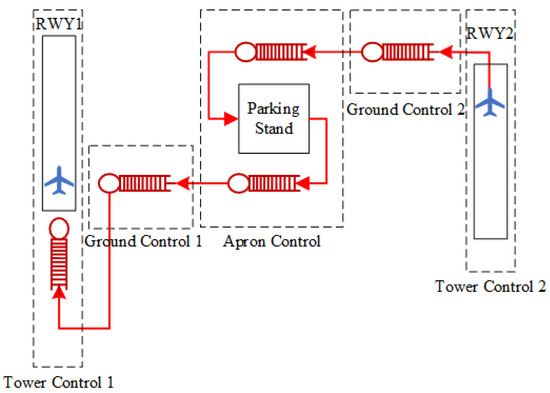
Based on the two-dimensional classification method of control positions and taxi directions, the apron system is decomposed into multiple mutually coupled queues, as shown in Figure 2. The physical meaning and service objects of each queue are defined as follows:
Figure 2.
Control Sector and Queue Example.
Apron queues serve inbound flights during the parking process from taxiways to parking stands, outbound flights during the pushback process from parking stands to taxiways, and the taxiing process of flights on taxiways. Ground queues are divided into eastbound and westbound queues by taxi direction, corresponding to the waiting process on main taxiways. Tower queues serve outbound flights during the release waiting process from taxiways to runways and inbound flights during the exit waiting process from runways to taxiways.
The extended Jackson network theory is adopted to describe the traffic interaction between queues. A routing matrix R is defined, where the element represents the proportion of traffic transferred to Queue j after completing service at Queue i. Typical transfer rules are set based on control procedures and path characteristics:
After outbound flights complete service at the parking stand queue, they are transferred proportionally to the eastbound and westbound apron queues. After inbound flights complete service at the queue in the tower control position area, they are fully transferred to the corresponding queue in the tower ground control position area, with no reverse flow.
The instantaneous inflow rate of each queue is composed of two parts: external arrival traffic (inbound and outbound flights entering the queue directly) and internal transfer traffic (flights transferred in after completing service at other queues).
3.3. Mathematical Formulation
3.3.1. PSFFA Core Principles and Applicability
The Pointwise Stationary Fluid Flow Approximation (PSFFA) serves as the theoretical foundation of our queuing model. Its core idea is built on two key assumptions, which lay the groundwork for simplifying complex apron queuing dynamics while retaining essential system characteristics:
- 1.
- The pointwise stationarity assumption, which posits that at any instantaneous time point, the queuing system behaves as a stationary system. Specifically, the arrival rate, service rate, and queue length satisfy the balance relationship of stationary queuing theory locally.
- 2.
- The fluid flow analogy assumption, which approximates discrete queuing entities (in this study, aircraft) as a continuous fluid flow. This analogy converts the discrete, stochastic dynamics of aircraft arrival, queuing, and departure into continuous deterministic differential equations, and it effectively simplifies the mathematical description of time-varying queue lengths while retaining the core dynamic characteristics of the system.
PSFFA is particularly suitable for our apron operation scenario for three reasons:
- 1.
- It avoids the computational complexity of discrete stochastic models such as Markov chains when dealing with time-varying arrival and service rates of aircraft;
- 2.
- The continuous approximation enables concise and accurate characterization of dynamic queue evolution during peak and trough traffic periods;
- 3.
- It provides a tractable framework for subsequent parameter calibration and delay coupling analysis.
To leverage these advantages, we further develop single- and multi-queue models based on PSFFA, as detailed below.
3.3.2. Single-Queue Model Development
We conduct a quantitative description by combining it with the ordinary differential equations constructed based on the principle of flow conservation. From the flow conservation theorem, we obtain:
where denotes the rate of change of the queue length at time t, while and represent the inflow rate to the queue and the outflow rate from the queue at time t, respectively.
Assuming the queue has no capacity constraint, we have:
where is the average arrival rate, which refers to the number of aircraft entering the queue per unit time. serves as the external driving variable of the model; it does not depend on the queue’s own state and only varies with time.
The outflow rate depends not only on the service rate but also on the server utilization rate:
where represents the server’s service rate at time t, describing its maximum service capacity; denotes the server’s utilization rate at time t, reflecting how busy it is; specifically, means the server is fully loaded, while means it is idle. The outflow rate is not directly equal to the server’s maximum service capacity but is constrained by its utilization rate.
Therefore, we can derive the dynamic queue length equation from Equations (1) and (3), as shown in Equation (4):
Using the Pollaczek-Khinchine formula from classical queuing theory (M/G/1 queue), we establish a quantitative relationship between the queue length, server utilization rate, and the degree of service time fluctuation, as shown in Equation (5):
where denotes the steady-state average queue length after the queue has operated for a long period; represents the steady-state server utilization rate; and is the coefficient of variation of service time, defined as the ratio of the standard deviation to the mean of service time, which is used to describe the degree of fluctuation in service time.
We derive an explicit analytical solution for in terms of based on Equation (5):
Equation (6) is a cubic polynomial in terms of , characterized by high computational complexity and poor model coupling. To balance accuracy and practicality, we approximate the equation with a rational function in hyperbolic form, which replaces the complex explicit solution [22]:
We note that Equation (7) is an approximate form of the complex solution, satisfying the following boundary conditions: when the queue is empty, the service rate is 0; when the queue is saturated, the service rate is 1. Additionally, it exhibits consistent monotonicity: the longer the queue, the busier the server.
We determine Parameter k by minimizing the integral error, as shown in Equation (8):
where represents the expected maximum queue length.
In the Equation (9), is the effective outflow rate, jointly constrained by the server’s maximum service capacity and the queue length; is the external input rate, which drives queue growth. With the above equation, we can solve for the queue length at any time using numerical integration methods.
3.3.3. Multi-Queue Network Model Extension
We extend the single-queue model to a multi-queue model based on the principle of flow conservation; specifically, when queues are interconnected, the output of one queue serves as the input of another. The Jackson network is a classic open-loop network in queuing theory. We draw on the idea of the routing matrix from the Jackson network and define R as the routing matrix, where the element represents the proportion of traffic that flows into Queue j after being served at Queue i. Thus, we obtain the following expression:
where a represents the outflow from its own service; represents direct external input (e.g., arrivals and departures); b represents the sum of inflows from other queues.
3.3.4. Inter-Queue Delay Incorporation
We note that another characteristic of real-world queuing networks is the time delay caused by propagation, and it does not include waiting time in the queue. We therefore incorporate the transmission delay of customers between nodes into the queuing network [23].
We define as the taxi time from service desk i to service desk j; we thus obtain the updated expression:
where a denotes the outflow of this queue through service provided by its own service desk; denotes direct external input; c denotes the inflow to this queue, which comes from the services of other queues, arrives after propagation delay, and is routed to this queue in proportion.
3.4. Parameter Calibration and Delay Coupling
In the airport ground traffic queue network, delay is defined as the travel time required for an aircraft to move from one control area to another. It includes only the travel time under normal operating conditions, and excludes the queuing waiting time in the departure queue or target queue. Such propagation delay is a key factor in inter-queue coupling, as it determines the time difference between the output flow of one queue and that flow becoming the input of another queue.
Through statistical analysis of historical taxi data, we identify the median taxi time within a control area as the normal taxi time. The median better aligns with the taxi time experienced by aircraft in most cases, so we use this time as the propagation delay between queues associated with that sector.
We quantitatively determine whether a queue is in a queuing state based on the deviation between actual travel time and baseline time. We define the baseline time as the average travel time calculated by grouping control sectors, using one month of historical data from the Airport Collaborative Decision Making (ACDM) system. Outliers are filtered out using a 95 percent confidence interval to ensure the reliability of the baseline time.
Service rate reflects the service efficiency of each queue. It is based on historical data, with the guarantee that service rates remain non-negative and within a reasonable range. When a queue is in a queuing state, we extract the time difference between two consecutive aircraft exiting the queue and use this difference as a single service time sample.
To balance temporal resolution and data stability, we adopt a fixed five-minute statistical window. This window size avoids excessive data fluctuations caused by overly short intervals while preventing the obscuration of operational dynamic characteristics from overly long windows (as a larger window would lead to an increase in cumulative queue length caused by multiple queuing events rather than continuous queuing), making it suitable for capturing the time-varying features of airport surface queuing.
Using this window, we calculate key operational indicators in the model, including the average number of queued aircraft and the number of arriving aircraft, for each time interval. To ensure uniform indicator dimensions and consistent calculation logic, service rates are also computed based on the same five-minute window.
For each five-minute statistical window, we count the total number of aircraft exiting the queue within the window (i.e., the number of aircraft that have completed service). We then divide this total by the duration of the window to obtain the service rate corresponding to that five-minute window, with the unit being aircraft per minute. For example, if 10 aircraft complete service and exit the queue within a five-minute window, the service rate for that window is 2 aircraft per minute.
3.5. Solution Process
We use the Python 3.9 ddeint numerical integration library to solve the delay differential equations (DDEs) of the airport queue network. This method is specifically designed for DDEs with historical state dependence and is compatible with the stiff and nonlinear characteristics of the system in simulations. We set the solution time step to one minute, a choice that directly matches the time scale of taxi time lags in the DDEs while ensuring computational accuracy and logical consistency. The specific design basis is as follows:
The core of DDEs is to quantify the lagged impact of taxi time lags (including conflict waiting time lags and position handover time lags) on queue evolution. In actual apron operations, taxi time lags typically fall within the range of 0.5 to 2 min, based on statistics from control communication and taxi trajectory data. A 1-min solution time step can accurately capture the dynamic changes in time lags while balancing accuracy and efficiency.
Although indicators such as the number of queued aircraft and service rate in the model adopt a fixed 5-min statistical window, the 1-min time step functions as a micro-level calculation unit to capture fine-grained dynamic changes in surface operations. It provides basic data support for indicator statistics in the 5-min window and ensures logical consistency between microscopic solution and macroscopic statistics.
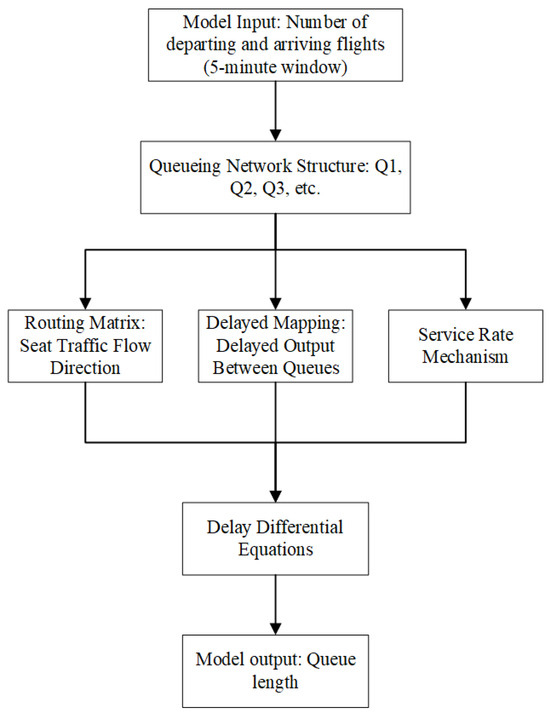
3.6. Summary of Model Architecture
We take the DDEs as the core algorithm framework. From the input layer, we obtain the number of pushed-back and landing flights aggregated in 5-min time windows, which serve as the external traffic driver for the system.
Based on the airport queue set defined in the queue network structure layer, we construct the physical topology that governs traffic flow transitions. This topology forms the foundational structure for modeling how aircraft move between different queue nodes.
Then three key modules provide the core parameters to support the DDEs. The routing matrix module clarifies the probability distribution of traffic flow directions between control positions. The delay mapping module quantifies transfer time lags between queues, capturing the temporal gaps in aircraft movement across different control areas. The service rate mechanism module dynamically adjusts the traffic processing speed of each queue, adapting to real-time operational conditions.
We solve the DDEs using a numerical integration method tailored to its characteristics. From the output layer, we derive the dynamic length of each queue across the entire operational period. These results offer quantitative insights for congestion analysis and resource optimization of the airport queue network. The model architecture is illustrated in Figure 3. In the diagram, Q1, Q2, and Q3 represent Queue 1, Queue 2, and Queue 3, and the Specific input and output details are presented in Table 1.
Figure 3.
Model Architecture.
Table 1.
Input and output parameters representation.
4. Case Study
Beijing Daxing International Airport (ZBAD) is selected as a case study. The airport operates under two primary operational modes, northbound operation and southbound operation, determined by key factors such as air traffic flow direction, meteorological conditions, and airspace capacity constraints. Among the two, the northbound operation mode serves as the airport’s dominant daily operational mode, accounting for over 75 percent of the annual operational hours. It boasts stable flight flow, complete historical operational data, and minimal frequent mode-switching interference, which can provide sufficient and reliable support for model validation and result analysis. Given its dominant status and data advantages, this study focuses on the northbound operation mode.
In this mode, runways 11L and 35R are designated for takeoff, while runways 01L and 35L are allocated for landing. Together, they handle approximately 68 percent of the total airport traffic, as shown in Table 2. Based on the operational characteristics and the runway positional layout of the northbound mode, we applied the queuing network model established earlier to airport surface operations.
Table 2.
Operational mode of Beijing Daxing International Airport percentage of operating time.
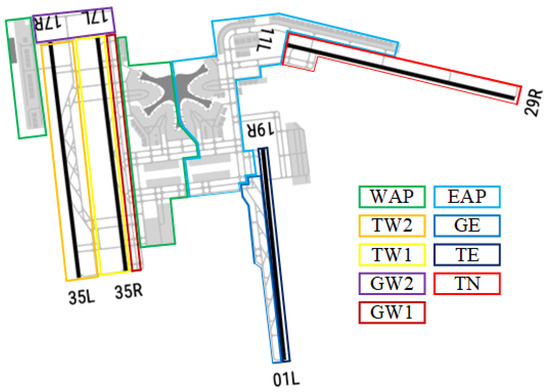
All control sectors are also clearly marked in Figure 4. Tower positions include TW1 (West Tower Position 1), TW2 (West Tower Position 2), TE (East Tower Position), and TN (North Tower Position). Tower ground positions consist of GW1 (West Ground Position 1), GW2 (West Ground Position 2), and GE (East Ground Position). Apron control positions cover WAP (West Apron Position) and EAP (East Apron Position).
Figure 4.
Beijing Daxing International Airport Control Sector Layout.
4.1. Ground Topology Structure
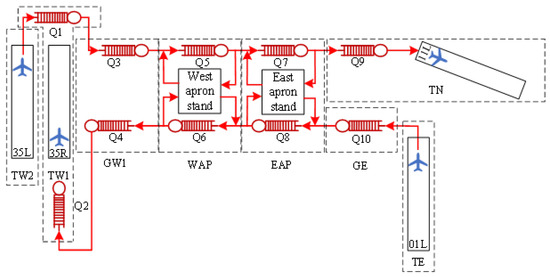
To evaluate congestion at multiple ground resource points, we analyzed the queue status in each ground control sector as a measure of service capacity. As illustrated in Table 3 and Figure 5, each sector is divided into separate eastbound and westbound queues, which are linked accordingly. An aircraft is considered to be in a sector’s taxi queue if its travel time through that sector exceeds a typical taxi-time threshold. Aircraft that enter either queue Q11 or Q12 are deemed to have reached their parking stands and thus have exited the system.
Table 3.
Queue code explanation.
Figure 5.
Ground topology network structure of Beijing Daxing International Airport.
The dataset was sourced from the ACDM system at Beijing Daxing International Airport. It comprises records for 12,976 inbound and 12,995 outbound flights. Approximately 70 percent of these data were utilized for training the model parameters, while the remaining 30 percent were reserved for testing. Representative samples of the arrival and departure data are shown in Table 4 and Table 5, respectively. The time each flight spent within a control sector was calculated based on key timestamps recorded in the ACDM data, such as the off-block and on-block times.
Table 4.
ACDM Arrival Flight Data.
Table 5.
ACDM Departure Flight Data.
4.2. Routing Matrix and Queue Delay
In the construction of the airport ground traffic queue network model, the routing matrix and queue delay are two core elements that characterize the network coupling relationships and temporal response characteristics. These two elements jointly support the model’s dynamic simulation capability for actual ground traffic flow.
To accurately capture the realistic characteristics of airport ground operations, the model relies on historical data-driven approaches.
Each element of the routing matrix is defined as the proportion of traffic that enters queue i after completing service in the preceding queue j. Specifically, the actual output of this preceding queue j within a specific time window is proportionally distributed to preset target queues. Notably, the distributed traffic will incur a certain propagation delay before reaching their respective target queues.
The routing matrix R serves two functions. One is to undertake apron topological connections and quantify the directed connectivity relationships between queues, as shown in Equation (13). The other is to reflect traffic allocation rules and determine how queue output is split among downstream parallel paths.
In the ground queue network model divided by control positions, the routing matrix and the propagation delay are two core elements that determine the network’s coupling structure and temporal response. The routing matrix provides rules for allocating traffic among paths, while the propagation delay clarifies the time lag for traffic to reach the target queue. Combined, they transform the static network topology into a dynamic system with clear time-delay coupling characteristics, ultimately constructing a multi-queue network model that incorporates delays.
4.3. Service Rate Specification
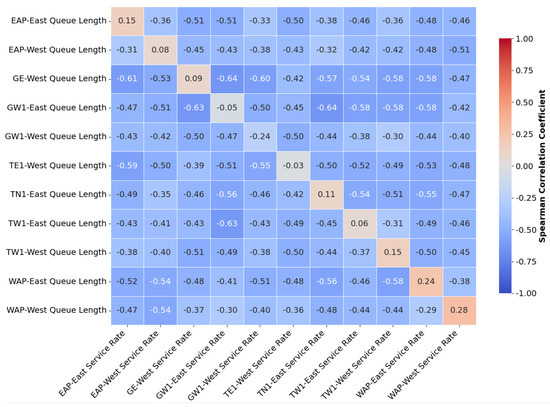
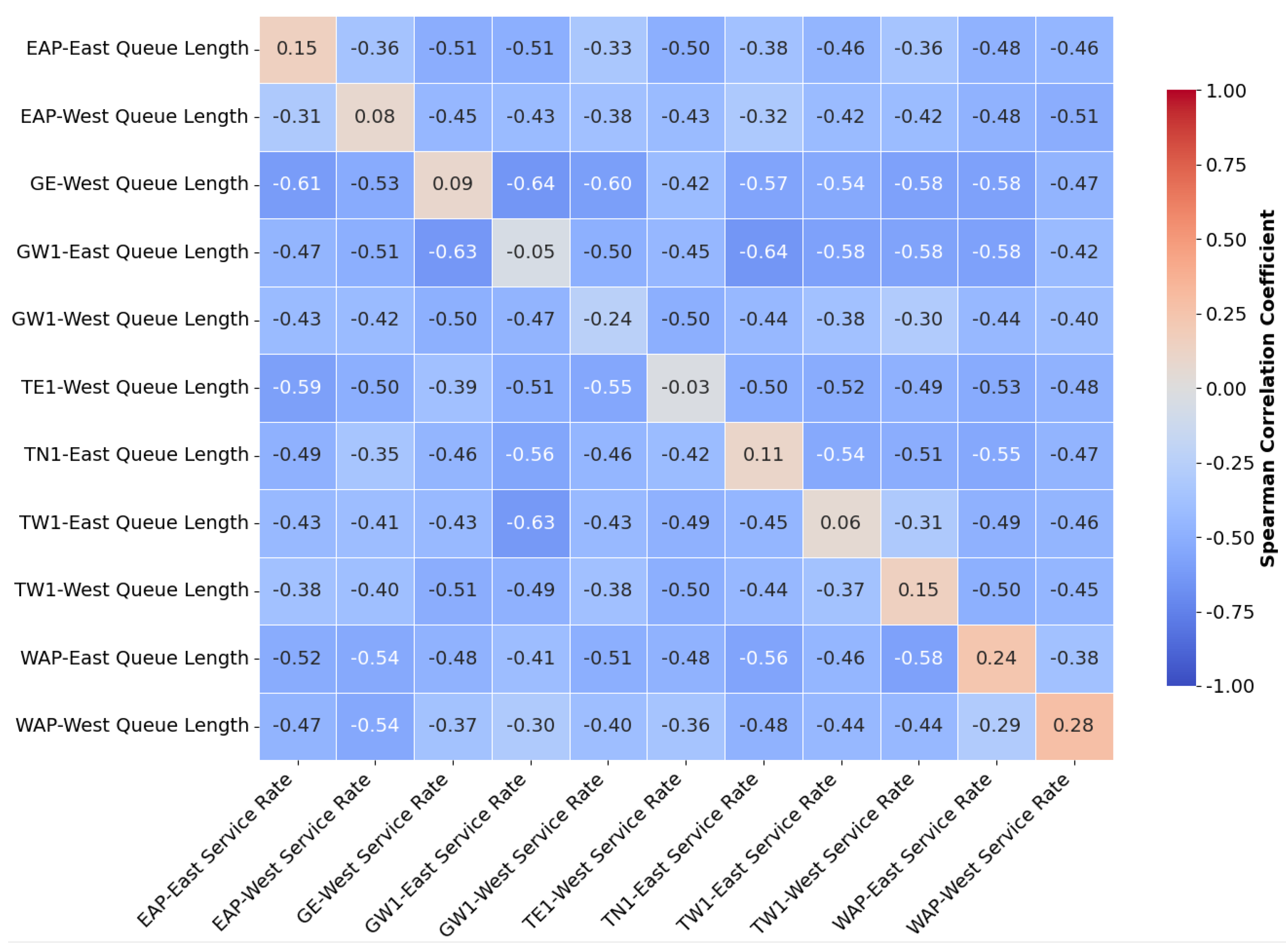
Based on the actual operational conditions of Beijing Daxing International Airport, we assume that the congestion of a control sector is caused by the sector managing the taxiing of inbound and outbound flights in different directions. Therefore, the service rates of queues in different directions within the same control sector interact with each other. We observe the interaction between queues by generating a heatmap of Spearman correlation coefficients between queues and service rates, as shown in Figure 6.
Figure 6.
Sector Correlation Heatmap.
As shown in Figure 6, there is a general negative correlation between eastbound and westbound queues within the same sector. Examples include the number of EAP westbound queues and the EAP eastbound service rate, as well as the number of WAP eastbound queues and the WAP westbound service rate. Spearman’s correlation coefficient indicates that when one direction has a significant queue backlog, it may reduce the service efficiency of the other direction, revealing phenomena of resource competition and service bottlenecks.
Among queues across different sectors, the heatmap shows a mixed pattern of positive and negative correlations. For example, the EAP eastbound queue and GE westbound queue exhibit a negative correlation, while the TN1 eastbound queue and TW1 westbound queue show a certain positive correlation. This suggests that the service and queuing processes between some control areas (e.g., East Tower and West Tower areas) are relatively independent with minimal mutual interference. In contrast, other areas (e.g., apron and ground positions) may have a strong negative correlation due to connected taxi paths. These observations provide a theoretical basis for further optimizing coordination and traffic control strategies between different sectors. Additionally, the heatmap validates the hypothesis regarding inter-queue interactions: queues in different directions within the same sector have a significant mutual influence. For some control sectors with only one-way queues (either inbound or outbound), their service rates need to be directly fitted using historical data.
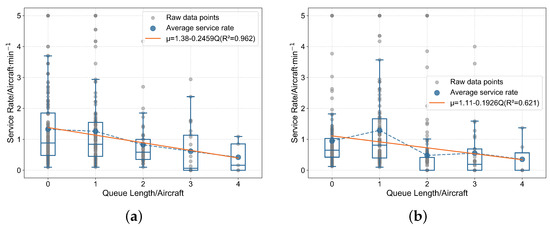
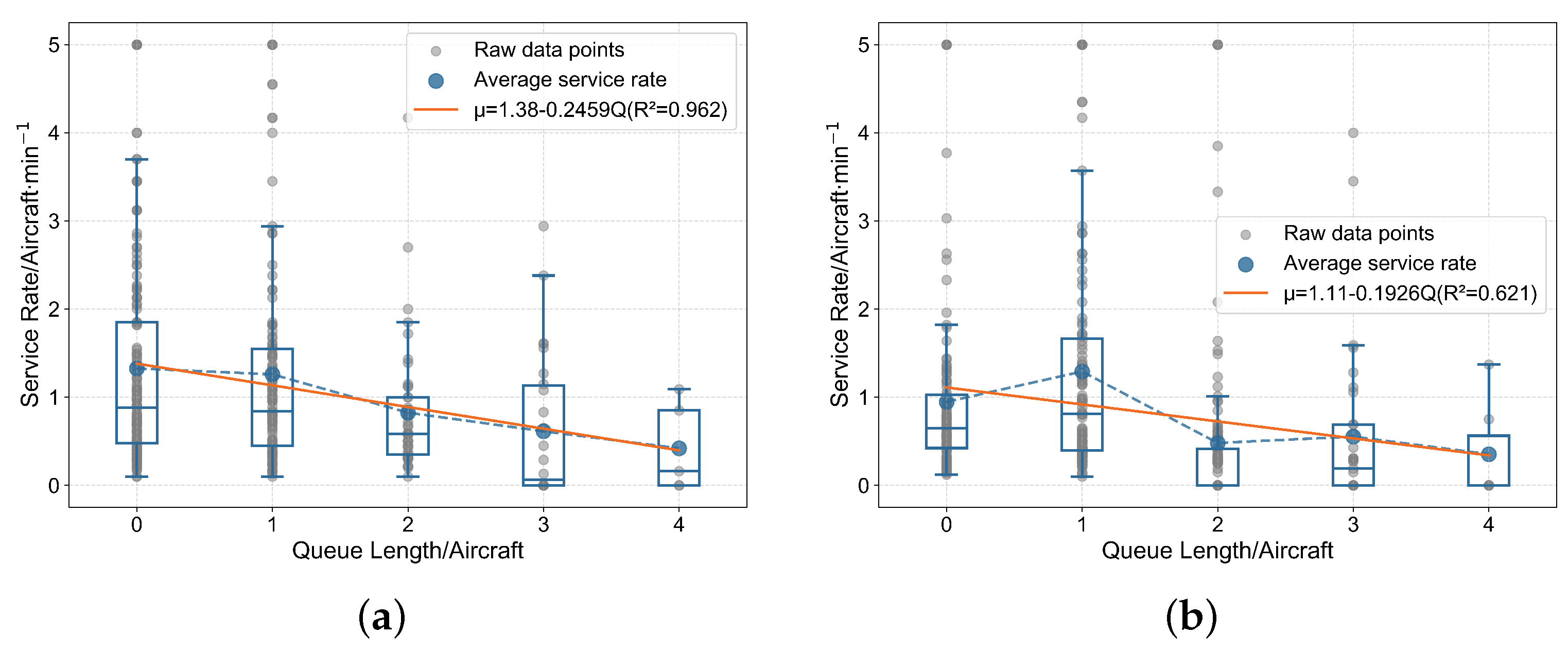
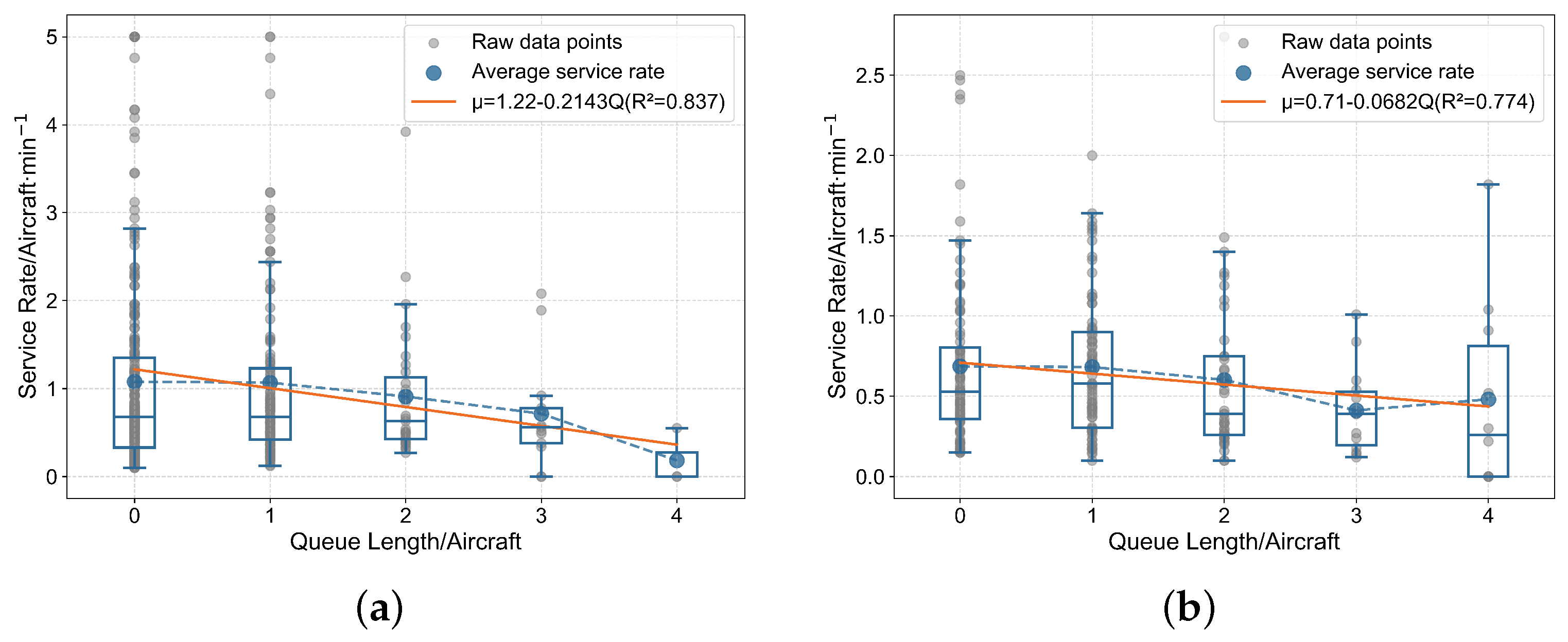
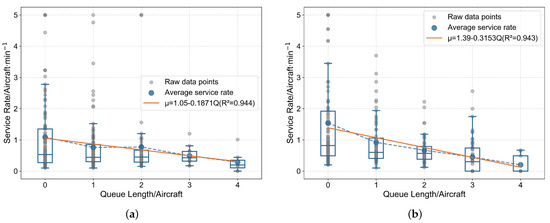
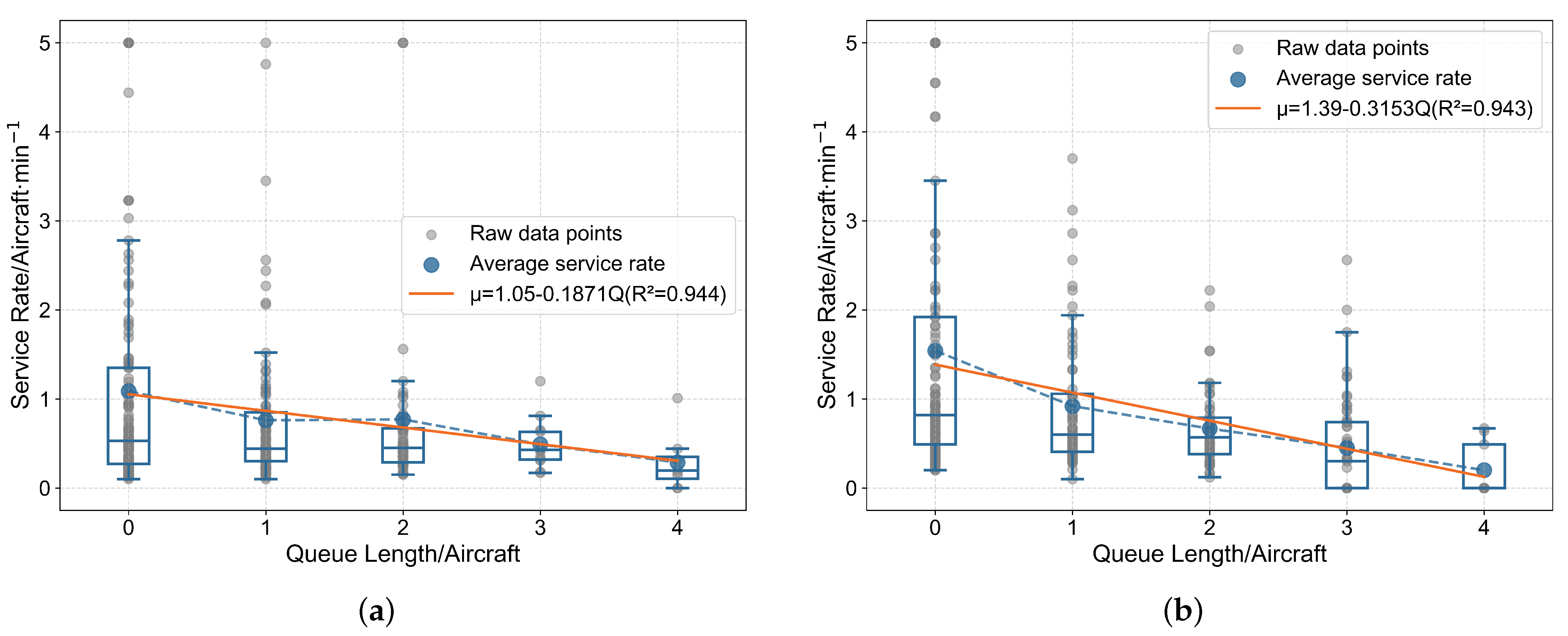
Therefore, through statistical analysis, we established a fitting relationship between queue length and the average service rate of opposite queues, with results shown in Figure 7, Figure 8, Figure 9 and Figure 10. In the fitting results, the slopes of the eastbound and westbound service rates differ. As shown in Figure 7a,b, the absolute value of the slope for the eastbound queue service rate in the EAP control sector is significantly larger than that for the westbound queue, indicating that the eastbound queue in this sector is more significantly affected by the westbound queue. Considering that the eastbound queue mainly consists of departing flights using Runway 11L, with only a small number diverting to the WAP (West Apron) for parking, this data characteristic reflects the tendency of prioritizing arriving flights in the EAP control strategy.
Figure 7.
Overall relationship between EAP queue lengths and service rates. (a) EAP Queue Eastbound Length and Westbound Service Rate. (b) EAP Queue Westbound Length and Eastbound Service Rate.
Figure 8.
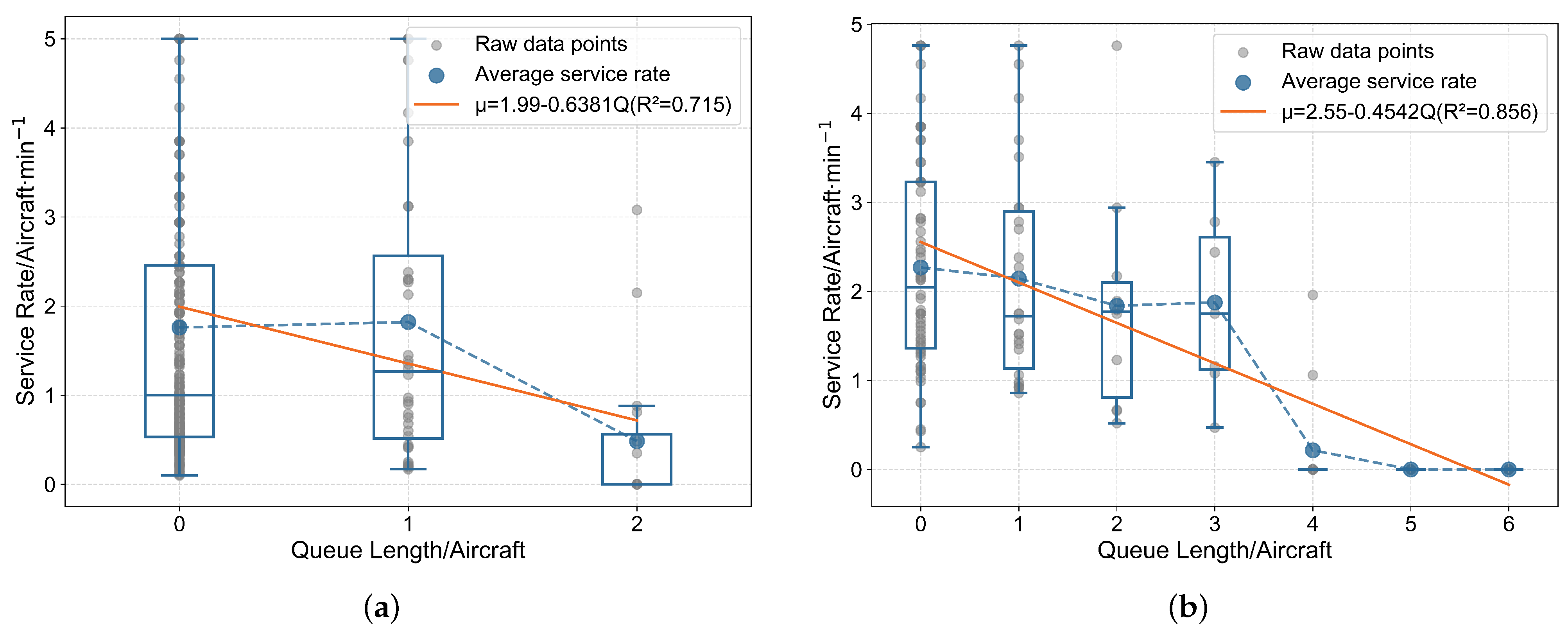
Overall relationship between WAP queue lengths and service rates. (a) WAP Queue Eastbound Length and Westbound Service Rate. (b) WAP Queue Westbound Length and Eastbound Service Rate.
Figure 9.
Overall relationship between GW1 queue lengths and service rates. (a) GW1 Queue Eastbound Length and Westbound Service Rate. (b) GW1 Queue Westbound Length and Eastbound Service Rate.
Figure 10.
Overall relationship between TW1 queue lengths and service rates. (a) TW1 Queue Eastbound Length and Westbound Service Rate. (b) TW1 Queue Westbound Length and Eastbound Service Rate.
As illustrated in Figure 8a,b, the WAP control sector exhibits the same pattern as the EAP: the absolute value of the slope for its eastbound queue service rate is also larger than that for the westbound queue, meaning the eastbound queue is more prominently influenced by the westbound queue. The core flow direction of the eastbound queue in this sector is departing flights to Runway 11L, which echoes the directional characteristic of the eastbound queue in the EAP.
For the eastbound queue of TN1 and the westbound queue of TE, only a single-directional queue exists within their respective control sectors, resulting in no cross-directional queue interference. Thus, the service rates of these queues are directly fitted.
4.4. Actual Routing Traffic Distribution
We obtained the flight traffic distribution through statistical analysis based on historical operational data, thereby deriving the route matrix in Equation (14). The rows and columns of the matrix’s elements both follow a fixed order.
Equation (14) serves to reflect traffic allocation rules and determine how the output of each queue is split among downstream parallel paths. For example, the transition matrix, where each row represents the output distribution of a queue, can be interpreted as follows:
- The first row, , indicates that the entire output from Q1 is transferred to Q3.
- The fifth row, , signifies that 24 percent of the output from Q5 is directed to Q7, while the remaining 76 percent is routed to Q1.
- The second row, which consists entirely of zeros, implies that no aircraft flow from queue Q2 is distributed to any other queue within the system; it represents an absorption state or a sink.
4.5. Predictive Performance
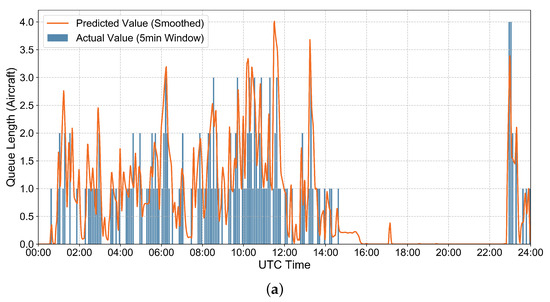
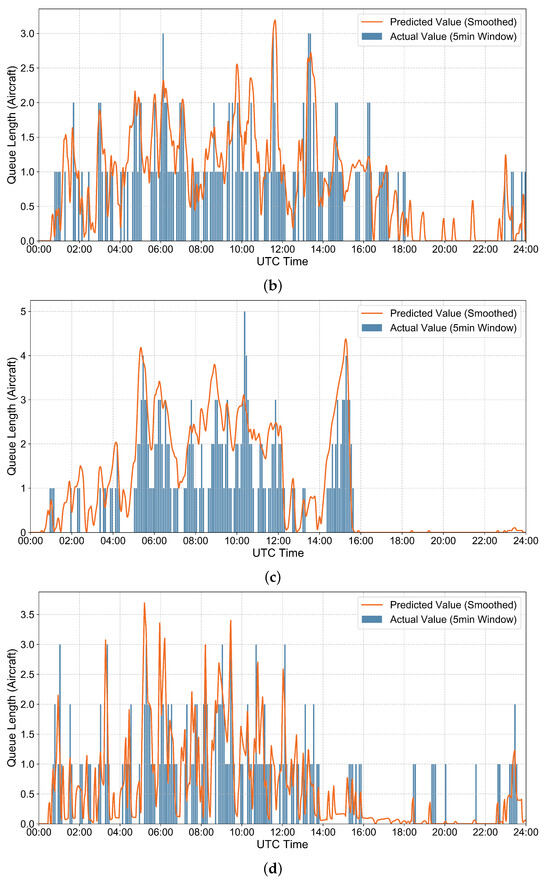
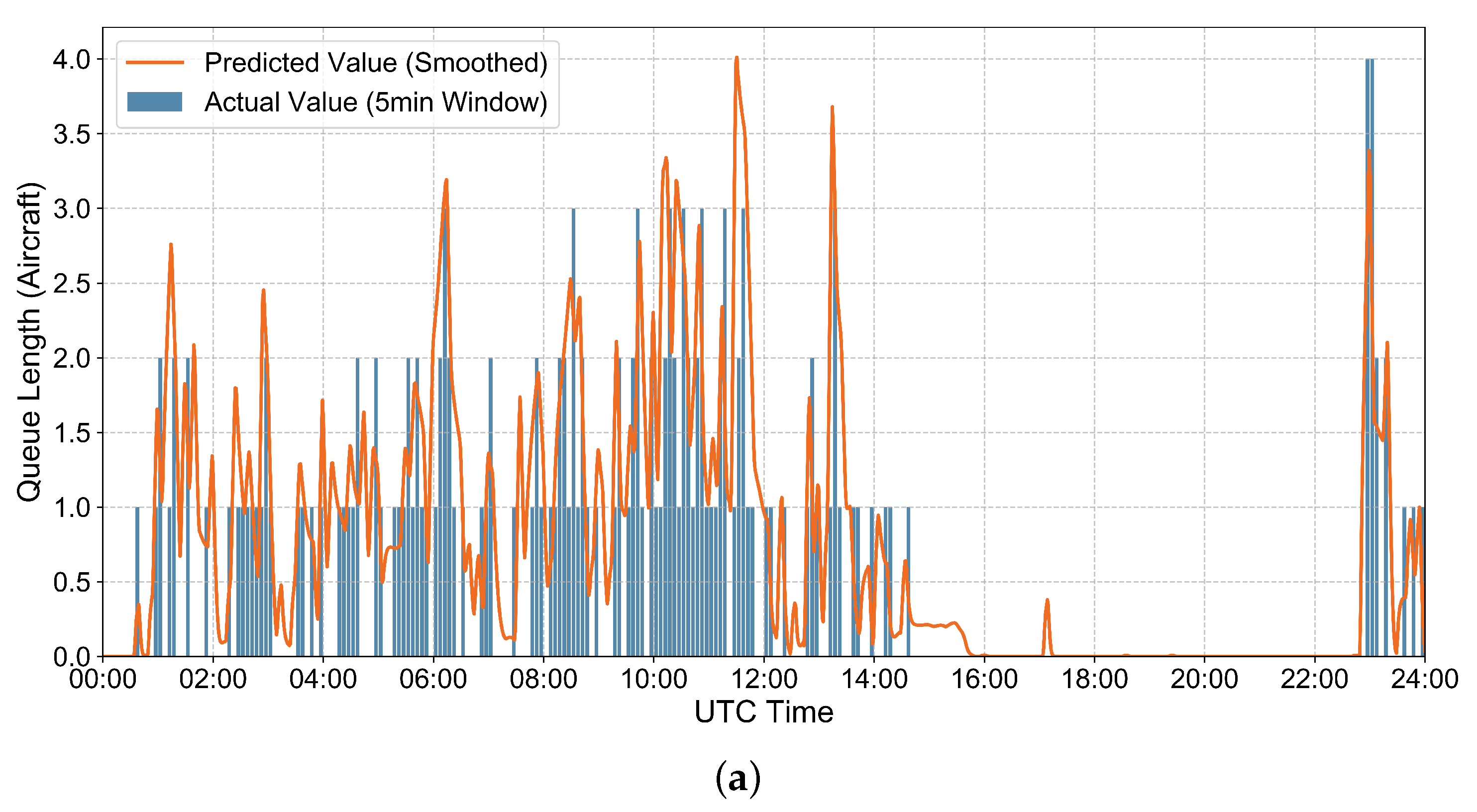
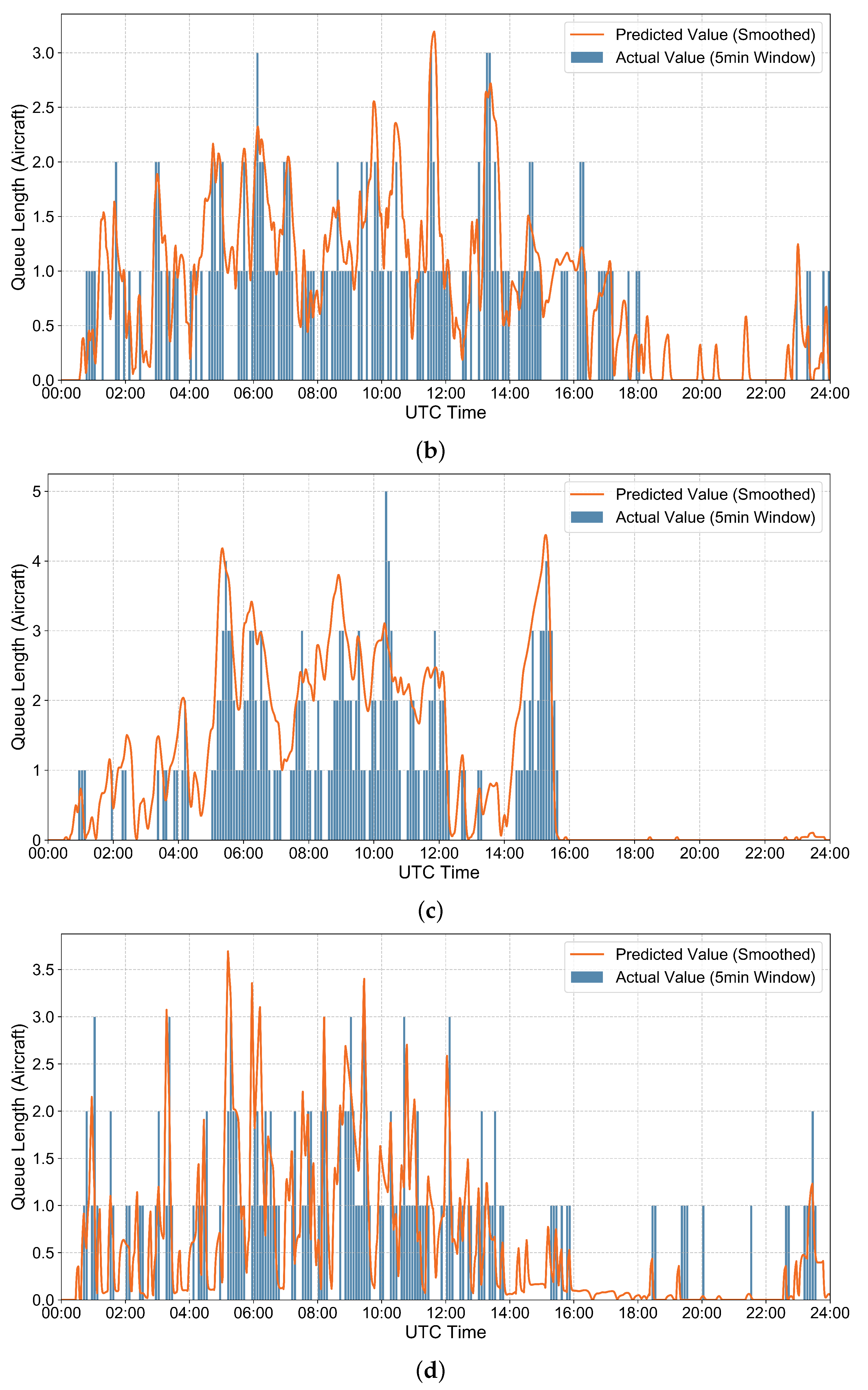
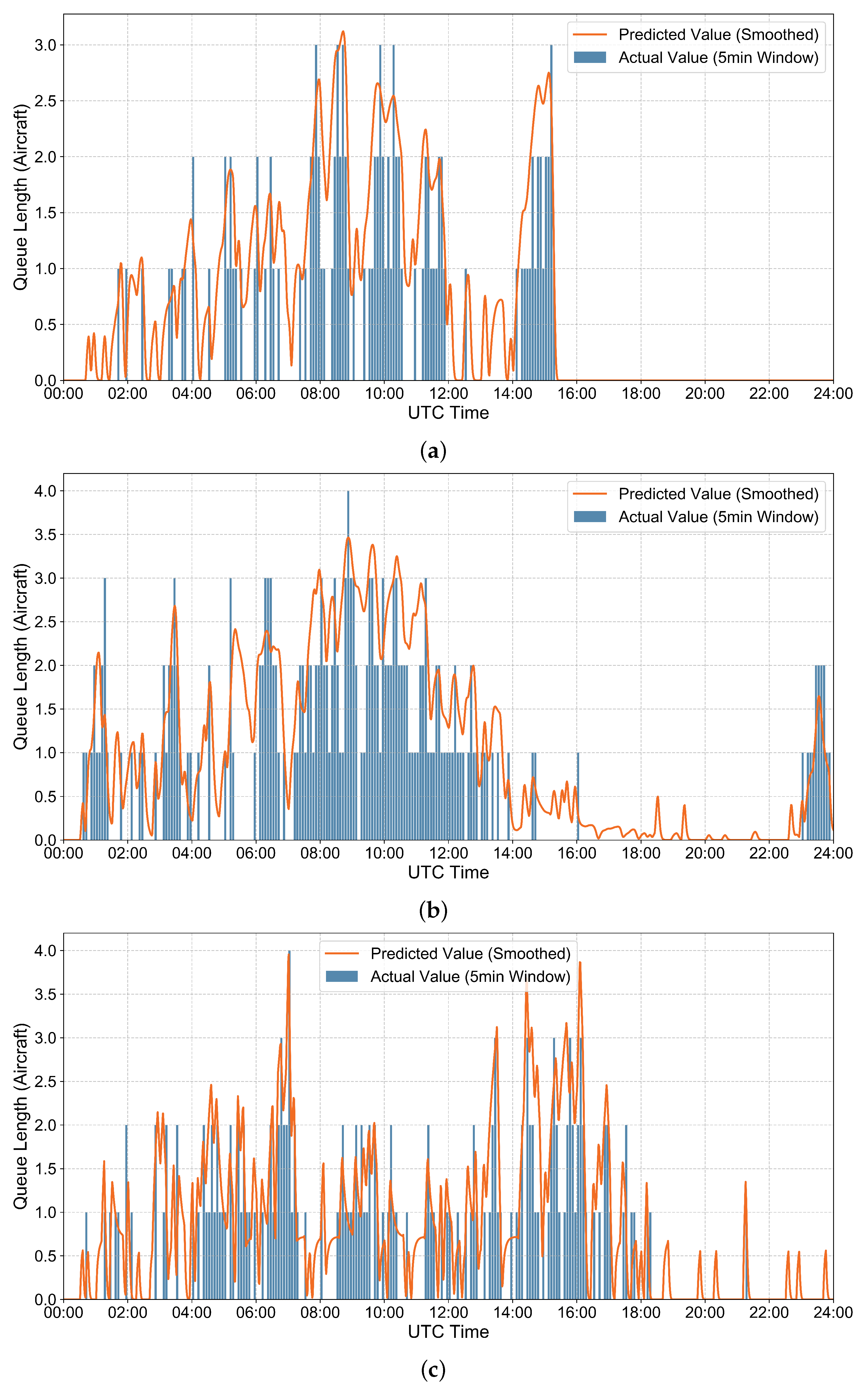
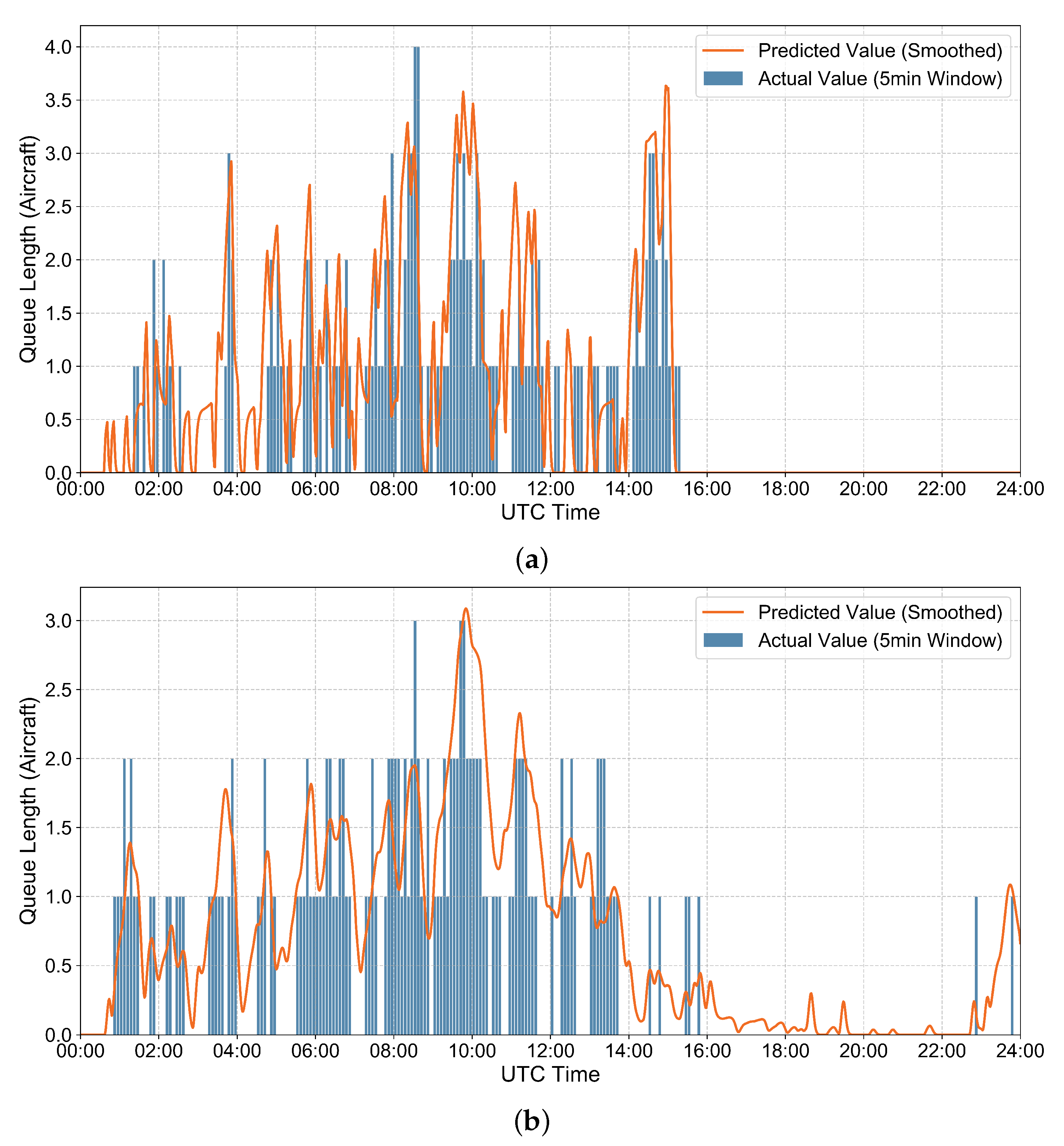
We performed forward numerical integration on the queuing dynamic equation from the start of a single day. Time is expressed in UTC, and queue lengths are averaged over 5-min windows. Predicted values were smoothed through interpolation to enhance visualization.
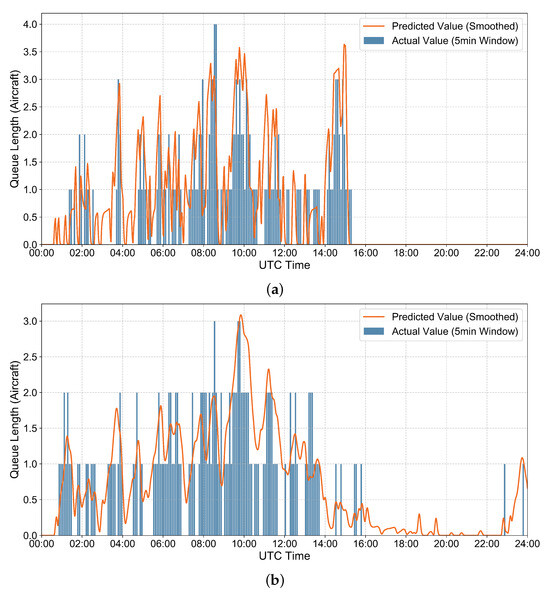
To intuitively demonstrate the model’s performance, we select queue lengths from a typical day in the test dataset for prediction analysis. The queue prediction results are shown in Figure 11, Figure 12 and Figure 13.
Figure 11.
The queue prediction results for apron control sectors. (a) Comparison of EAP Eastbound Queue Length Prediction and Actual Results; (b) Comparison of EAP Westbound Queue Length Prediction and Actual Results; (c) Comparison of WAP Eastbound Queue Length Prediction and Actual Results; (d) Comparison of WAP Westbound Queue Length Prediction and Actual Results.
Figure 12.
The queue prediction results for ground control sectors. (a) Comparison of GW1 Eastbound Queue Length Prediction and Actual Results; (b) Comparison of GW1 Westbound Queue Length Prediction and Actual Results; (c) Comparison of GE Westbound Queue Length Prediction and Actual Results.
Figure 13.
The queue prediction results for tower control sectors. (a) Comparison of TW1 Eastbound Queue Length Prediction and Actual Results; (b) Comparison of TW1 Westbound Queue Length Prediction and Actual Results.
As shown in Figure 11, Figure 12 and Figure 13, the model’s predicted values align closely with the actual values throughout the diurnal tidal fluctuations of the full UTC day. Changes in queue length during both off-peak hours (00:00–08:00 Beijing Time) and peak hours are accurately captured, demonstrating the model’s consistency across all control sectors and time periods. The model thus demonstrates cross-sector and full-time universality.
4.6. Discussion of Prediction Error
This section systematically evaluates the predictive performance of the location-based delayed queue network model across three core control areas: tower control positions, tower ground control positions, and apron control positions. It quantitatively characterizes the error distribution under different control scenarios, interprets the results from both operational mechanism and methodological innovation perspectives, and finally extends to practical optimization suggestions for airport ground operations—providing quantitative support and decision-making basis for improving airport ground operational efficiency.
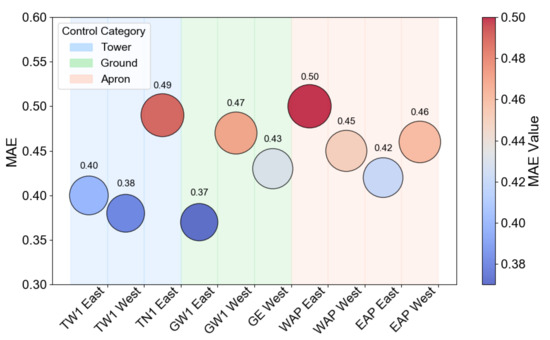
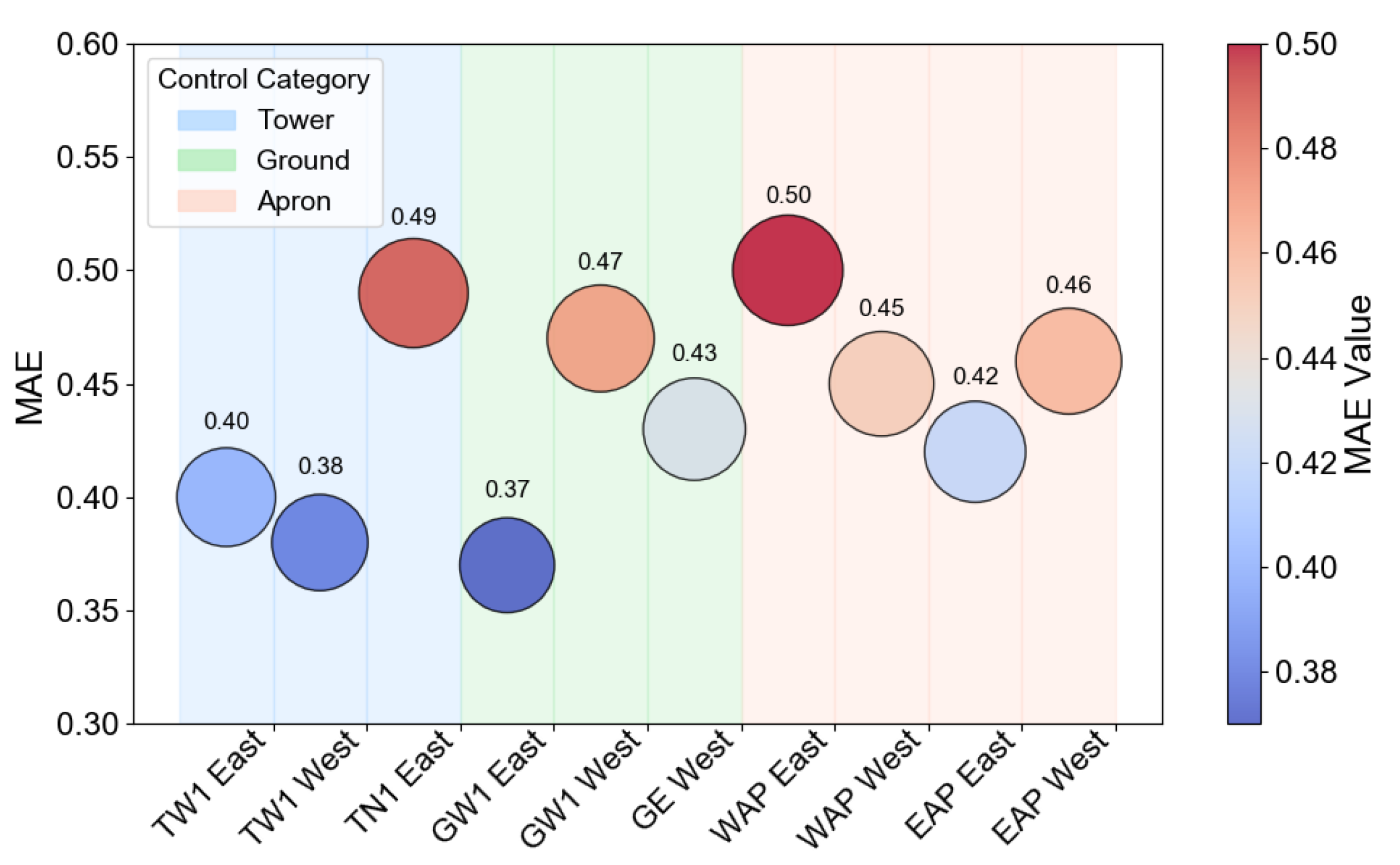
Figure 14 presents the Mean Absolute Error of the prediction results for queues at different control positions.
Figure 14.
MAE Distribution Bubble Chart for Each Prediction Queue.
4.6.1. Tower Control Positions: High-Precision Prediction and Takeoff Process Optimization Potential
Predictive results for tower control positions fully reflect the differentiated impacts of runway operational characteristics. The MAE for eastbound and westbound queues in the TW1 sector reaches as low as 0.40 and 0.38, achieving the highest precision across all areas. This directly confirms strong regularity and predictability in the queue dynamics of the tower control area. This outcome is not accidental but a natural outcome, rooted in the close alignment between our model’s methodology and the operational mechanism of tower control. In terms of control logic, the tower acts as the core node for takeoff sequencing, with its scheduling strictly following specialized operational procedures. Key links such as runway release intervals and flight priority determination are bound by standardized processes, which minimize random interference.
From the perspective of traffic-bearing characteristics, Runway 35R serves as the primary departure runway and handles over 60 percent of the airport’s departure traffic. Its highly concentrated traffic distribution forms stable takeoff and taxiing rhythms. Examples include the morning peak between 06:00 and 09:00, flat midday traffic, and the evening peak from 17:00 to 20:00. This further reduces prediction uncertainty caused by multi-source interference, allowing the model to accurately fit the queue evolution trend.
The MAE for Runway 11L (TN control sector) stands at 0.49, in sharp contrast to the TW1 sector. Though still within the acceptable range for operational decision-making, this value is notably higher than that of other tower positions. The core cause of this error difference lies in the coupled relationship between geographical location and operational processes. Runway 11L is situated at the northern edge of the airport, so departing flights must cross multiple transverse taxiways when traveling from the terminal area to the runway end. Compared with Runway 35R, its longer average taxi distance not only increases routing delays but also frequently causes conflicts with arriving flights at intersecting taxiways, reducing prediction stability.
From a broader operational perspective, the tower area’s overall MAE of less than 0.40 provides a critical data foundation. The model’s accurate prediction of takeoff queues enables controllers to refine scheduling decisions, laying the groundwork for improved runway operational efficiency.
4.6.2. Tower Ground Control Positions: Cross-Sector Coordination Bottlenecks Behind Directional Differences
Tower ground control predictive accuracy shows marked east-west differences. GW1’s eastbound queue has an MAE of only 0.37, while the westbound reaches 0.47. This 27 percent error increase quantifies east-west differences in operational complexity and scheduling logic. The eastbound queue’s low error comes from dual advantages of service objects and environment. It mainly serves arriving flights, with taxi routes along the eastern one-way corridor reducing intersections with departures. The tower-ground handoff process is also fixed, transferring immediately after aircraft exits the runway. This gives strong regularity to operational dynamics, easily captured by the model via linear evolution traits.
In contrast, the westbound queue’s high error arises from overlapping complex factors. Traffic-wise, it must handle both west apron departures and north cargo apron crossing flights, leading to higher traffic mixing than the eastbound queue. Handoff-wise, flights go through three stages: pre-handoff from tower, ground control acceptance, and apron handoff. More critically, arrival-priority scheduling requires departures to wait/yield when conflicting with arrivals on taxiways. This non-standard scheduling makes westbound traffic fluctuations far larger than eastbound, directly widening prediction deviation.
The GE position has balanced predictive performance (MAE 0.43), a trait matching its specialized operational scenario. It supports landings on single Runway 01L, handling half of GW1’s daily average flights. This results in smaller traffic volume and simpler structure. Its Y-shaped taxiway network lets arriving flights diverge directly to east/west aprons without crossing core taxiways, minimizing arrival-departure path conflicts. Control scheduling is also simplified to sequential guidance by landing order, effectively avoiding multi-source interference.
This balance offers valuable insights for the airport. The GE sector’s operational model can act as a tower-ground collaboration benchmark, guiding process optimization for complex sectors like GW1. For example, designating exclusive departure taxi corridors and standardizing handoff timelines can bring westbound queue error closer to GE’s level.
4.6.3. Apron Control Positions: Operational Roots of High Errors and Optimization Directions for Resource Scheduling
Apron control prediction results reflect the area’s operational essence—high complexity and disturbance. WAP’s east/west queue MAEs are 0.50 and 0.45, EAP’s 0.42 and 0.46; overall errors are much higher than tower control, with WAP’s eastbound MAE (0.50) the highest across all areas. The core cause is the apron’s multi-factor coupling. Unlike tower/ground control (only flight-runway interaction), apron taxiing requires avoiding obstacles (occupied jet bridges, baggage trailers, maintenance vehicles). Frequent conflicts and sudden waits reduce queue regularity; dense taxiways (more intersections than tower sectors) and narrow single-aircraft taxiways force frequent deceleration, amplifying queue uncertainty and making the model less accurate in fitting real-time dynamics.
WAP handles high-frequency domestic short-haul flights (45-min average turnaround, fast turnover). Severe traffic fluctuations boost prediction residuals. Domestic flights also change pushback times due to weather/passenger load, increasing prediction difficulty.
In contrast, EAP focuses on international long-haul flights, with standardized turnarounds (1–2 h), fixed schedules, and low schedule changes—stable traffic fluctuations. These stable inputs improve prediction accuracy, leading to lower errors than WAP. This suggests apron optimization should abandon one-size-fits-all approaches and adopt flight attribute-based classification management. Based on the operational differences between the eastern and western aprons, an optimized apron resource scheduling system featuring classified management and targeted measures can be established.
4.6.4. Overall Insights: Model Value and Optimization Directions for Airport Ground Operations
Integrating predictive results across three core control areas reveals a distinct performance gradient: tower control leads (MAE < 0.40), followed by tower ground control (MAE 0.37–0.47), with apron control (MAE 0.42–0.50) showing the highest errors. This mirrors airport operational complexity hierarchy—areas with centralized control, standardized processes, and minimal interference yield better predictions, while errors rise in less regulated scenarios. This regularity verifies the model’s practical validity. Its framework, centered on positional characteristics and stationarity, aligns with real operations and clarifies directions for model iteration.
In terms of operational value, the model’s quantitative results provide tools for targeted, refined optimization of airport ground operations, with value spanning the entire efficiency improvement chain.
Tower area’s MAE < 0.40 enables compressing takeoff intervals to boost departure volumes, enhancing capacity.
GW1’s east-west error gap calls for a differentiated taxi schedule: priority for eastbound arrivals and dynamic adjustment for westbound departures. For example, temporary corridors can be set for GW1’s westbound departure queue during high-conflict peaks (e.g., evening), with handoff processes tuned to conflict priority rules to minimize delays.
Apron controllers can proactively guide flights using the model’s queue length predictions. Previously, data silos between apron support and ground control systems disconnected flight pushback plans from queue dynamics, raising congestion risks. The model’s accurate predictions break this barrier, enabling controllers and support staff to share real-time flight status and future queue trends. Controllers can thus pre-allocate taxi routes and coordinate resources. This reduces handoff delays and route conflicts from information gaps, shifting apron guidance from “congestion response” to “proactive regulation” to boost on-site efficiency, ease congestion at the source and optimize overall operations.
These prediction-based optimization ideas offer clear technical routes to enhance airport ground operations.
4.7. Model Sensitivity Analysis
To address the review comment regarding the robustness of the proposed model to key assumptions, this section conducts sensitivity analyses on two critical parameters that underpin the multi-queue network: propagation delay () and routing matrix transition ratios (). All experiments reuse the same test dataset (30% of Beijing Daxing International Airport’s ACDM historical data) and retain the original model framework (e.g., PSFFA-based differential equations, 1-min solution time step) to ensure result comparability. The core evaluation metric remains the MAE of queue length predictions, consistent with Section 4.6.
4.7.1. Sensitivity to Propagation Delay
The propagation delay in the model is originally defined as the median taxi time between adjacent queues (calibrated from historical ACDM data), which reflects the typical travel time of aircraft across control sectors. To verify how deviations from this baseline affect prediction accuracy, we adjusted the propagation delay by (simulating real-world fluctuations in taxi time due to minor conflicts or speed variations) and compared the resulting MAEs with the baseline.
Table 6 summarizes the three propagation delay scenarios tested.
Table 6.
Propagation Delay Adjustment Scheme.
Table 7 presents the MAE of queue length predictions under the three delay scenarios, showing minimal fluctuations across all queues.
Table 7.
MAE Comparison of Queue Length Predictions (Propagation Delay Scenarios).
As shown in Table 7, the MAE of most queues (e.g., TW1-East/West, EAP-East/West) remains unchanged, and the maximum deviation from the baseline (e.g., GW1-West: 0.47 → 0.48) is only 0.01. The average MAE across all queues stays constant at 0.44, confirming the model’s strong robustness to propagation delay fluctuations. This is attributed to the PSFFA framework’s ability to smooth small taxi time variations and the dynamic service rate calibration (Section 3.4) that compensates for minor delays.
4.7.2. Sensitivity to Routing Matrix Transition Ratios
The routing matrix (R) defines the proportion of traffic transferred between queues (e.g., means 24% of aircraft from Queue Q5 (WAP-East) are routed to Queue Q7 (EAP-East)). To test the model’s sensitivity to changes in traffic distribution, we adjusted the transition ratios of two key apron queues (Q5 and Q6, handling 60% of west apron outbound traffic) by and analyzed the impact on MAE.
Table 8 details the three routing ratio scenarios, focusing on the critical transitions of Q5 (WAP-East) and Q6 (WAP-West).
Table 8.
Routing Matrix Transition Ratio Adjustment Scheme.
Table 9 summarizes the MAE results under the three routing scenarios, highlighting the model’s sensitivity to apron-to-ground traffic adjustments.
Table 9.
MAE Comparison of Queue Length Predictions (Routing Ratio Scenarios).
Key observations from Table 9:
- 1.
- The model is most sensitive to adjustments in apron-to-ground routing (e.g., ): New Distribution 1 (increasing to 0.85) causes a sharp MAE rise in GW1 (GW1-West: 0.47 → 1.23), as excess traffic exceeds GW1’s service capacity.
- 2.
- Apron-to-stand queues (e.g., ) show minimal MAE changes (≤0.04), as parking stand operations are less affected by routing shifts.
- 3.
- Although the prediction performance degrades to some extent (average MAE rising from the baseline 0.44 to 0.57 for New Distribution 1 and 0.47 for New Distribution 2) due to the intentional adjustment of routing ratios away from real-world traffic distributions, the average MAE remains ≤0.57 across all modified scenarios. This outcome demonstrates the model’s robust adaptability: even when subjected to non-negligible deviations in key routing parameters (±5% for core apron queues), it retains acceptable prediction accuracy for practical airport operational applications rather than experiencing catastrophic performance failure.
4.7.3. Summary of Sensitivity Analysis
The proposed model exhibits strong robustness to propagation delay fluctuations ( changes, average MAE unchanged at 0.44) and acceptable stability to routing matrix adjustments (average MAE ). These results confirm that the model can adapt to real-world operational variations, enhancing its reliability for practical apron queue length prediction.
5. Summary and Outlook
To solve apron queue congestion prediction challenges from multi-node coupling and multi-factor interference in airport ground operations, we propose a Fluid Flow Approximation-based multi-queue network model. We divide queues by control position and taxi direction, and calibrate key parameters with historical data, effectively enhancing prediction targeting and accuracy.
Key results show the model’s queue length prediction MAE is around 0.5 aircraft, meeting practical operational accuracy needs. Unlike traditional fixed-parameter models, it supports full-time dynamic prediction and adapts to time-varying ground traffic features such as peak fluctuations and off-peak adjustments. We also integrated apron control position differences and taxi delays into the model, enabling it to capture negative correlations between opposite queues in the same sector. This overcomes low accuracy issues of previous models that ignored sector-specific control features and queue interactions, balancing theoretical rigor and practicality.
The model’s practical value goes beyond congestion mitigation, providing multi-dimensional insights for ground operation optimization. By pre-identifying potential congested sectors, operators can use their outputs to adjust taxi sequences and optimize control instructions, reducing delay risks via rational taxiway resource allocation. Its quantitative results also aid ground situational awareness, helping operators grasp real-time status and make scientific decisions. Furthermore, the model offers quantitative basis for taxiway allocation, gate scheduling and emergency planning, enhancing operational flexibility, anti-interference ability and resilience against unexpected events like gate changes.
However, our study has limitations. First, it does not incorporate extreme weather impacts (e.g., heavy rain, dense fog, snow and ice). These conditions alter taxi speeds and service efficiency, which may reduce the model’s robustness in unconventional scenarios. Second, with key parameters calibrated using historical data from one airport, we have not tested their generalization between airports of different scales or runway layouts, which may cause parameter adaptation biases in other scenarios. Another key optimization direction focuses on the dynamic setting of propagation delays in the model. In future research, we plan to refine the parameter by differentiating taxi times across distinct time periods (e.g., morning peak, evening peak, and off-peak hours) based on more detailed operational data. This refinement will enable the model to capture the dynamic interaction between taxiing efficiency and congestion levels, further improving its realism and prediction accuracy.
To address the current limitations and enhance the model’s performance, subsequent research will focus on three key macro directions: first, a coupled meteorology-operation database will be established, and a weather-driven dynamic parameter adjustment module embedded into the model to improve robustness in unconventional scenarios caused by extreme weather; second, representative airports with varied scales and layouts will be selected to resolve parameter adaptation biases for cross-airport generalization; third, granular time slices and a congestion feedback loop will be adopted to refine the parameter, enabling the model to capture real-time interactions between taxi efficiency and congestion and further boosting prediction accuracy.
Author Contributions
Conceptualization, N.L. and J.A.; data curation, J.A., J.P., X.L. and Z.G.; formal analysis, N.L. and J.A.; funding acquisition, N.L.; investigation, N.L. and J.A.; methodology, N.L. and J.A.; project administration, N.L., J.P., X.L. and Z.G.; resources, J.A., J.P., X.L. and Z.G.; software, N.L. and J.A.; supervision, N.L.; validation, N.L. and J.A.; visualization, J.A.; writing—original draft preparation, N.L. and J.A.; writing—review and editing, X.O. All authors have read and agreed to the published version of the manuscript.
Funding
This research was funded by the National Natural Science Foundation of China, grant number U2333204.
Data Availability Statement
The datasets presented in this article are not readily available because the data are part of an ongoing study. Requests to access the datasets should be directed to the Civil Aviation Administration of China.
Conflicts of Interest
The authors declare no conflicts of interest.
References
- Gentry, J.; Duffy, K.; Swedish, W.J. Airport Capacity Profiles; Technical report; Federal Aviation Administration (FAA): Washington, DC, USA, 2014. [Google Scholar]
- Chen, Z.L.; Chong, X.L.; Liu, C.J.; Ceng, H.; Zhang, J.J.; Xu, J.H. Runway capacity evaluation based on multi-agent modeling and Monte Carlo simulation. J. Traffic Transp. Eng. 2023, 23, 244–256. [Google Scholar]
- Khadilkar, H.; Balakrishnan, H. Network congestion control of airport surface operations. J. Guid. Control. Dyn. 2014, 37, 933–940. [Google Scholar] [CrossRef] [Scilit]
- Badrinath, R.; Li, S.; Balakrishnan, H. Integrated surface–airspace model of airport departures. J. Guid. Control. Dyn. 2019, 42, 2174–2188. [Google Scholar] [CrossRef] [Scilit]
- Badrinath, R. Modeling and Control of Queuing Networks: Applications to Airport Surface Operations. Ph.D. Thesis, Massachusetts Institute of Technology, Cambridge, MA, USA, 2021. [Google Scholar]
- Du, J.H.; Hu, M.H.; Zhang, W.N.; Yin, J. Weakly supervised evaluation of airport traffic situation based on metric learning. J. Beijing Univ. Aeronaut. Astronaut. 2023, 49, 1772–1778. [Google Scholar]
- Simaiakis, I.; Balakrishnan, H. A queuing model of the airport departure process. Transp. Sci. 2015, 50, 94–109. [Google Scholar] [CrossRef] [Scilit]
- Lovell, D.J.; Vlachou, K.; Rabbani, T.; Bayen, A. A diffusion approximation to a single airport queue. Transp. Res. Part C Emerg. Technol. 2013, 33, 227–237. [Google Scholar] [CrossRef] [Scilit]
- Itoh, E.; Mitici, M.; Schultz, M. Modeling Aircraft Departure at a Runway Using a Time-Varying Fluid Queue. Aerospace 2022, 9, 119. [Google Scholar] [CrossRef] [Scilit]
- Iwata, D.; Itoh, E. Developing Aircraft Departure Queueing Models for a Mixed Takeoff/Landing Operational Runway. In Proceedings of the International Conference on Advanced Systems and Control, Nanjing, China, 15–17 November 2024; p. 48. [Google Scholar]
- Cai, K.; Zhang, M.; Zhu, Y.; Yang, Y.; Zhu, Y. Modeling Multi-Timescale Dynamics for Airport Surface Congestion and Recovery. IEEE Trans. Intell. Transp. Syst. 2024, 25, 20657–20672. [Google Scholar] [CrossRef] [Scilit]
- Yang, L.; Wang, Y.; Liu, S.; Wang, M.; Wang, S.; Ren, Y. Multi-Airport Capacity Decoupling Analysis Using Hybrid and Integrated Surface–Airspace Traffic Modeling. Aerospace 2025, 12, 237. [Google Scholar] [CrossRef] [Scilit]
- Zhao, X.; Wang, Y.; Li, L.; Delahaye, D. A Queuing Network Model of a Multi-Airport System Based on Point-Wise Stationary Approximation. Aerospace 2022, 9, 390. [Google Scholar] [CrossRef] [Scilit]
- Pyrgiotis, N.; Malone, K.M.; Odoni, A. Modelling delay propagation within an airport network. Transp. Res. Part C Emerg. Technol. 2013, 27, 60–75. [Google Scholar] [CrossRef] [Scilit]
- NASA Airspace Technology Demonstration 2 (ATD-2) Team. Surface Metering and Departure Scheduling for Airports; Technical Report; NASA: Washington, DC, USA, 2020. [Google Scholar]
- Chen, Z.; Chong, X.; Liu, C.; Qiao, Y.; Wang, G.; Tan, W. An Airfield Area Layout Efficiency Analysis Method Based on Queuing Network and Machine Learning. Buildings 2024, 14, 628. [Google Scholar] [CrossRef] [Scilit]
- Davidrajuh, R.; Lin, B. Exploring airport traffic capability using Petri net based model. Expert Syst. Appl. 2011, 38, 10923–10931. [Google Scholar] [CrossRef] [Scilit]
- Odoni, A.R.; Bowman, J.; Delahaye, D.; Deyst, J.J.; Feron, E.; Hansman, R.J.; Khan, K.; Kuchar, J.K.; Pujet, N.; Simpson, R.W. Existing and Required Modeling Capabilities for Evaluating ATM Systems and Concepts; Technical report; National Aeronautics and Space Administration: Washington, DC, USA, 2015. [Google Scholar]
- Malandri, C.; Mantecchini, L.; Paganelli, F.; Postorino, M.N. Impacts of unplanned aircraft diversions on airport ground operations. Transp. Res. Procedia 2020, 47, 537–544. [Google Scholar] [CrossRef] [Scilit]
- Ibe, O.C. Approximations of queueing systems and networks. In Fundamentals of Stochastic Networks; John Wiley & Sons, Inc.: Hoboken, NJ, USA, 2011; pp. 150–171. [Google Scholar] [CrossRef] [Scilit]
- Di, A.M. Revolutionary Analysis of the Pointwise Stationary Fluid Flow Approximation Model of the Non-Stationary Queue with Pointwise Stationary Fluid Flow Approximation Applications to the Internet of Things. Mech. Technol. Eng. Insights 2024, 1, 71–80. [Google Scholar] [CrossRef] [Scilit]
- Whitt, W. The Queueing Network Analyzer. Bell Syst. Tech. J. 1983, 62, 2779–2815. [Google Scholar] [CrossRef] [Scilit]
- Gross, D.; Shortle, J.F.; Thompson, J.M.; Harris, C.M. Fundamentals of Queueing Theory, 4th ed.; Wiley: Hoboken, NJ, USA, 2020; pp. 520–525. [Google Scholar]



Disclaimer/Publisher’s Note: The statements, opinions and data contained in all publications are solely those of the individual author(s) and contributor(s) and not of MDPI and/or the editor(s). MDPI and/or the editor(s) disclaim responsibility for any injury to people or property resulting from any ideas, methods, instructions or products referred to in the content. |
© 2026 by the authors. Licensee MDPI, Basel, Switzerland. This article is an open access article distributed under the terms and conditions of the Creative Commons Attribution (CC BY) license.