Skip to Content

Plants, Volume 6, Issue 1

2017 March - 14 articles

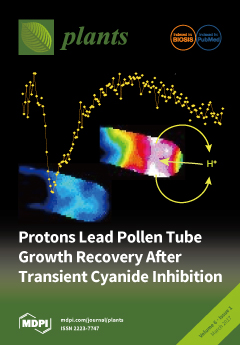
Cover Story: Pollen tube tip growth requires timely and location specific coordination of exocytosis and enzyme activity - inside the cell membrane, and outside in the cell wall. Using transient growth inhibition, we show that a gradient in protons, manifest as an alkaline band just behind the tube tip, disappears as growth stops, and is re-established well before growth resumes. A tip-focused calcium ions gradient also reforms, but co-incident with resumed growth. Thus, a proton gradient precedes and may direct growth, while the calcium gradient follows growth, marking the region of greatest expansion. View the paper
  • Issues are regarded as officially published after their release is announced to the table of contents alert mailing list .
  • You may sign up for email alerts to receive table of contents of newly released issues.
  • PDF is the official format for papers published in both, html and pdf forms. To view the papers in pdf format, click on the "PDF Full-text" link, and use the free Adobe Reader to open them.

Articles (14)

  • Article
  • Open Access
16 Citations
6,475 Views
18 Pages

Combined Effects of Ozone and Drought on the Physiology and Membrane Lipids of Two Cowpea (Vigna unguiculata (L.) Walp) Cultivars

  • Deborah Moura Rebouças,
  • Yuri Maia De Sousa,
  • Matthieu Bagard,
  • Jose Helio Costa,
  • Yves Jolivet,
  • Dirce Fernandes De Melo and
  • Anne Repellin

3 March 2017

The interactive effects of drought and ozone on the physiology and leaf membrane lipid content, composition and metabolism of cowpea (Vigna unguiculata (L.) Walp.) were investigated in two cultivars (EPACE-1 and IT83-D) grown under controlled conditi...

  • Communication
  • Open Access
26 Citations
10,548 Views
12 Pages

2 March 2017

The Himalayas are well known for high diversity and ethnobotanical uses of the region’s medicinal plants. However, not all areas of the Himalayan regions are well studied. Studies on ethnobotanical uses of plants from the Eastern Himalayas are still...

  • Review
  • Open Access
61 Citations
15,905 Views
14 Pages

1 March 2017

Positional information is crucial for the determination of plant cell fates, and it is established based on coordinated cell-to-cell communication, which in turn is essential for plant growth and development. Plants have evolved a unique communicatio...

  • Review
  • Open Access
23 Citations
9,811 Views
13 Pages

21 February 2017

The ethnopharmacology, chemistry and pharmacology of four Malian medicinal plants, Biophytum umbraculum, Burkea africana, Lannea velutina and Terminalia macroptera are reviewed. These plants are used by traditional healers against numerous ailments:...

  • Communication
  • Open Access
46 Citations
6,821 Views
7 Pages

Caffeoylquinic Acids from the Aerial Parts of Chrysanthemum coronarium L.

  • Chunpeng Wan,
  • Shanshan Li,
  • Lin Liu,
  • Chuying Chen and
  • Shuying Fan

17 February 2017

To elucidate the chemical compositions of the aerial parts of Chrysanthemum coronarium L., the ethanol extracts of Ch. coronarium L. were firstly isolated by the MCI-gel resin column. The caffeoylquinic acid-rich fractions were further purified by va...

  • Article
  • Open Access
46 Citations
10,098 Views
10 Pages

14 February 2017

Syringe infiltration is an important transient transformation method that is widely used in many molecular studies. Owing to the wide use of syringe agroinfiltration, it is important and necessary to improve its transformation efficiency. Here, we st...

  • Feature Paper
  • Article
  • Open Access
101 Citations
9,991 Views
16 Pages

Quantification of Climate Warming and Crop Management Impacts on Cotton Phenology

  • Shakeel Ahmad,
  • Qaiser Abbas,
  • Ghulam Abbas,
  • Zartash Fatima,
  • Atique-ur-Rehman,
  • Sahrish Naz,
  • Haseeb Younis,
  • Rana Jahanzeb Khan,
  • Wajid Nasim and
  • Mirza Hasanuzzaman
  • + 4 authors

10 February 2017

Understanding the impact of the warming trend on phenological stages and phases of cotton (Gossypium hirsutum L.) in central and lower Punjab, Pakistan, may assist in optimizing crop management practices to enhance production. This study determined t...

  • Review
  • Open Access
38 Citations
9,776 Views
17 Pages

10 February 2017

Included among the many signals that traffic through the sieve element system are full-length mRNAs that function to respond to the environment and to regulate development. In potato, several mRNAs that encode transcription factors from the three-ami...

  • Article
  • Open Access
183 Citations
11,675 Views
15 Pages

Heat Stress Decreases Levels of Nutrient-Uptake and -Assimilation Proteins in Tomato Roots

  • Anju Giri,
  • Scott Heckathorn,
  • Sasmita Mishra and
  • Charles Krause

19 January 2017

Global warming will increase root heat stress, which is already common under certain conditions. Effects of heat stress on root nutrient uptake have rarely been examined in intact plants, but the limited results indicate that heat stress will decreas...

  • Communication
  • Open Access
6 Citations
4,842 Views
9 Pages

6 January 2017

An alternative way to increase plant productivity through the use of nitrogen fertilizers is to improve the efficiency of nitrogen utilization via genetic engineering. The effects of overexpression of pine glutamine synthetase (GS) gene and nitrogen...

  • Article
  • Open Access
21 Citations
7,112 Views
17 Pages

30 December 2016

Pollen tubes grow by spatially and temporally regulated expansion of new material secreted into the cell wall at the tip of the tube. A complex web of interactions among cellular components, ions and small molecule provides dynamic control of localiz...

  • Feature Paper
  • Article
  • Open Access
8 Citations
6,367 Views
14 Pages

29 December 2016

In temperate climates, most plants flower during the warmer season of the year to avoid negative effects of low temperatures on reproduction. Nevertheless, few species bloom in midwinter and early spring despite severe and frequent frosts at that tim...

  • Article
  • Open Access
9 Citations
9,241 Views
7 Pages

A High-Throughput RNA Extraction for Sprouted Single-Seed Barley (Hordeum vulgare L.) Rich in Polysaccharides

  • Abdur Rashid,
  • Thomas Baldwin,
  • Michael Gines,
  • Phil Bregitzer and
  • Kathy Esvelt Klos

22 December 2016

Germinated seed from cereal crops including barley (Hordeum vulgare L.) is an important tissue to extract RNA and analyze expression levels of genes that control aspects of germination. These tissues are rich in polysaccharides and most methods for R...

Get Alerted

Add your email address to receive forthcoming issues of this journal.

XFacebookLinkedIn
Plants - ISSN 2223-7747