


Abstract
Paulownia plantations are established in large numbers worldwide for their high production of quality wood. Paulownia tomentosa is considered an invasive plant in many countries; however, other species, and mainly their hybrids that grow in plantations, are classified neither as invasive nor non-invasive plants, although the risk of spontaneous spreading of its seeds can be very great. In April and September 2022, we conducted a germination experiment where we used three species and six hybrids of Paulownia. The germination rates of all selected species and hybrids were very high, especially if the seeds were left at a temperature of +4 °C—almost 90% (April) and around 60% (September). When the seeds were exposed to below-zero temperatures (i.e., −15 °C), the germination rates were still high and, moreover, those of Hybrids were higher than those of Species. Therefore, all species of Paulownia, and mainly the hybrids, have the potential to be invasive.
1. Introduction
The taxonomy of individual plants of the Paulownia genus (Siebold & Zucc.) is very complicated. This is because there are several traits according to which they are classified under individual families. In 1781, ThunBerg classified Bignonia tomentosa Thunb. and its entire genus under the family Bignoniaceae Juss. In 1835, Zuccarini and Siebold transferred this genus under the family Scrophulariaceae Juss, and gradually the genus grew to as many as 23 species. In 1959, more detailed research was conducted, and only six species remained. To this date, however, there have been discussions regarding the similarity and classification of individual species. Therefore, the Paulownia genus is either classified under the Paulowniaceae Nakai [1] or assigned to the Scrophulariaceae [2,3] or Bignoniaceae [2,4] family. Moreover, the Paulownia genus is divided into three types, according to the degree of cultivation [5,6,7,8], namely:
- Wild, which are unsuitable for plantations because the species do not have good growth characteristics, for example, Paulownia albiphloea Z.H. Zhu sp.nov, P. catalpifolia T. Gong ex D.Y. Hong, or P. kawakamii T.Itô (syn.: P. rehderiana, P. thyrsoidea, P. viscosa) [2,6,9];
- Semi-wild, species (hereinafter referred to as Species) that have better growth characteristics, greater resistance to disease than wild types, and, moreover, can be planted in smaller plantations, for example, Paulownia fortunei (Seem) Hemsl, P. elongata S.Y. Hu, and P. tomentosa (Thunb.) Steud. [2,6,9];
- Art, which are kinds of Paulownia (hereinafter referred to as Hybrid) with a great yield of quality wood, have been artificially selected and planted since the 1980s [6,7,8]. Currently, there are dozens of hybrids that have different growth characteristics and have been cultivated for various regions with different climates.
Paulownia is originally from China, which means that it had been introduced to Europe and America [2]. It starts to produce seeds at the age of 4–10 [10,11,12], and produces up to 20 million seeds per year [13,14]. These seeds survive 2–3 years on the soil surface and up to 15 years in the soil [10,15,16,17], and they have a high emergence rate [10,18]. They are transported by wind and water over considerable distances [19,20]. New plants commonly occur almost 4 km from the parent tree [18], and have been located even at a distance of 10 km [10].
Non-native plants that had been introduced up to 1492 are called “archaeophytes”, later “neophytes” [21]. If these non-native plants have an undesirable impact on native plants, they are called “invasive” [22]. There is no official definition of “invasive tree species”. There are many versions stated by individual authors. For example, invasive species are the following:
- Naturalized plants that produce offspring (often in very large numbers) at considerable distances (even more than 100 m in less than 50 years for species spreading by seeds or more than 6 m in 3 years for species spreading by vegetative reproduction) [23].
- Plants capable of surviving, reproducing, and spreading across landscape, sometimes at alarming rates [24].
- “Alien” species that settle down in natural or semi-natural ecosystems or habitats. They are a change agent that threatens native biological diversity [25].
- “Alien” species that must successfully out-compete native organisms for food and habitat, spread through their new environment, increase their population, and harm ecosystems [26].
The environmental impact of invasive plants is assessed using Environmental Impact Classification for Alien Taxa (EICAT) [27]. It is important to distinguish non-native plants that are
- Cultivated in forests, for example, Pinus strobus L. (major EICAT score) [28]; Robinia pseudoacacia L. (massive EICAT score) [29]; or Quercus rubra L. (major EICAT score) [30].
- Not legally permitted to be grown in forests, for example, Ailanthus altissima (Mill.) Swingle (major EICAT score) [31].
- Neither legally permitted nor prohibited (for example, Paulownia ssp.).
The designation of P. tomentosa as an invasive or casual species is a subject of discussion. Numerous authors [32,33,34,35,36] have conducted ecological assessments of Paulownia in European and North American regions, from which there are no definitive statements about its invasiveness. It is not included in the updated list of invasive alien species of the European Union (European Commission) [37]. However, a number of studies [15,38,39,40,41,42] state that Paulownia is spreading across Europe and the USA. The European and Mediterranean Plant Protection Organization [43] included P. tomentosa on the “Alert List” of geographically non-native organisms. In the Czech Republic (CR), P. tomentosa acquired the status of an alien species requiring constant monitoring [42], and Pergl et al. [44] classified it into the “Watch List” (i.e., a list of the plants that have a potentially large impact on the environment). It has been found in other European countries with similar natural conditions, but it does not occur in the wild in the CR. It was legally considered invasive in Austria [32] and in the USA [45]. Less is published about P. elongata, and all other species and hybrids of Paulownia are (usually) omitted. According to some opinions, P. elongata is not considered an invasive species, but is accepted reluctantly [38,42]. However, Huber et al. [21] show that, due to global climate change, it can become invasive. The invasiveness of Paulownia hybrids is not taken into consideration at all, although there is a risk of their spread from the plantations, which are currently being established in large numbers.
Therefore, we set out to test and confirm two assumptions:
- (I)
- There is a difference between individual species/hybrids in seed germination.
- (II)
- There is the danger that more species and hybrids could be invasive (besides P. tomentosa).
2. Results
2.1. Germination Rate (GR)
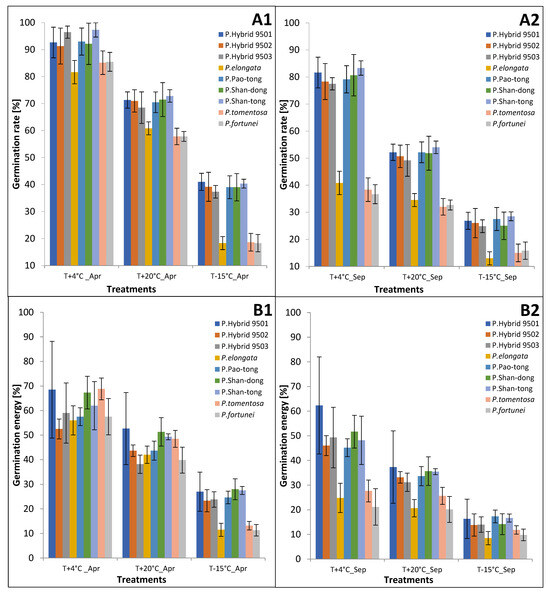
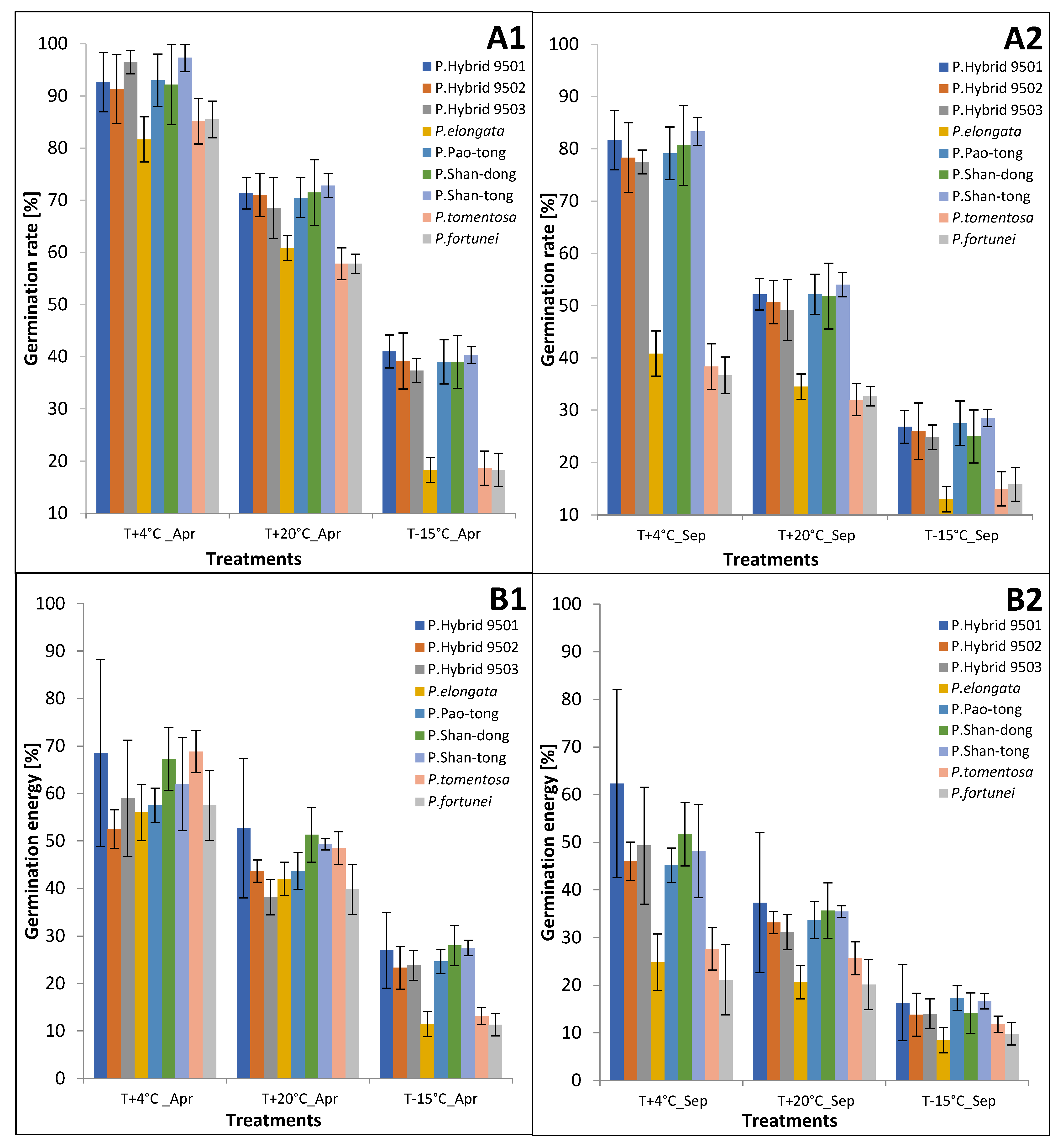
The treatments of seeds that germinated in April always had higher GRs than those in September (Temperature+4 °C: p = 0.0001–0.0072; Temperature+20 °C: p = 0.0001–0.0103; Temperature−15 °C: p = 0.0001–0.0047; Figure 1). The highest GRs always appeared in the Temperature+4 °C treatment (from 82 to 97% in April and from 37 to 83% in September), and there were differences among all Species and Hybrids, where Species had lower GRs (April: p = 0.0071–0.0349; September: p = 0.0138–0.0418). The second highest GRs were recorded in the Temperature+20 °C treatment (from 58 to 73% in April and from 32 to 54% in September). There were differences among all Species and Hybrids, where Species had lower GRs (April: p = 0.0287–0.0473; September: p = 0.0249–0.0464). In the Temperature−15 °C treatment, the GRs were the lowest of all treatments. The GRs of all Hybrids were similar (around 38% in April and 26% in September, without statistically significant differences among them) and also higher than those of Species (around 18% in April and around 14% in September, without statistically significant differences among them). The statistically significant differences among Hybrids and Species were between 0.0089 and 0.0254.
Figure 1.
Germination rates (A1,A2) and germination energies (B1,B2) of Paulownia species and hybrids. 1—in April; 2—in September; T+4 °C—treatment at +4 °C temperature; T+20 °C—treatment at +20 °C temperature; T−15 °C—treatment at +4 °C and −15 °C temperatures; Apr—in April; Sep—in September. Whiskers denote standard deviations.
2.2. Germination Energy (GE)
In both April and September, GE was always highest in the Temperature+4 °C treatment and the second highest in the Temperature+20 °C treatment (Figure 1). There were statistically significant differences between the corresponding GEs of P. elongata, P. Pao-tong, P. Shan-tong, P. tomentosa, and P. fortunei in these two treatments (p values were from 0.0479 to 0.0001 in April and from 0.0412 to 0.0001 in September). The lowest GEs occurred in the Temperature−15 °C treatment. There were statistically significant differences between the corresponding GEs of all Species and Hybrids in the Temperature+4 °C and Temperature−15 °C treatments (p values being 0.0001) and between the corresponding GEs of all Species and Hybrids (p values being 0.0001) in the Temperature+20 °C and Temperature−15 °C treatments.
In the Temperature+4 °C treatment, the GE values varied in the range of 53–69% in April and 21–62% in September. In April, the highest values were recorded on the seeds of P. tomentosa and P. Shan-dong. Paulownia Hybrid 9502, P. elongata, P. Pao-tong, P. Shan-tong, and P. fortunei had the second highest values (p values of the individuals in this group and those in the highest one were in the range of 0.0001–0.411). The smallest values were found on the seeds of P. Hybrid 9503 (p values of P. Hybrid 9503 and the individuals in the other groups (i.e., the highest group and the second highest group) were in the range of 0.0001–0.0008). In September, the highest value was recorded on the seeds of P. Hybrid 9501. Paulownia Hybrid 9502, P. Hybrid 9503, P. Pao-tong, P. Shan-tong, and P. Shan-dong had the second highest values (p values of the individuals in this group and those in the highest one were in the range of 0.0157–0.0397). The smallest values were found at seeds of the others (p values of the individuals in this group, and those in the highest one were in the range of 0.0001–0.0032).
In the Temperature+20 °C treatment, the GE values varied in the range of 38–53% in April and 20–37% in September. In April, the highest values were recorded on the seeds of P. Hybrid 9501, P. Shan-tong, P. Shan-dong, and P. tomentosa. The other Hybrids and Species had statistically smaller values than those in the first group (p values of the individuals in the first group and those in the second group were in the range of 0.0001–0.0473). In September, the highest values were recorded on the seeds of all Hybrids, and all Species had statistically smaller values than the Hybrids (p values of Hybrids and Species were in the range of 0.0315–0.0482).
In the Temperature−15 °C treatment, the GE values varied in the range of 11–28% in April and 9–17% in September. In April, the highest values were recorded on the seeds of all the Hybrids, and all Species had statistically smaller values than the Hybrids (p values of Hybrids and Species were in the range of 0.0137–0.0439). In September, the highest values were recorded on the seeds of all the Hybrids, and all Species had statistically smaller values than the Hybrids (p values of Hybrids and Species were in the range of 0.0234–0.0401).
2.3. The Dynamic of Germination
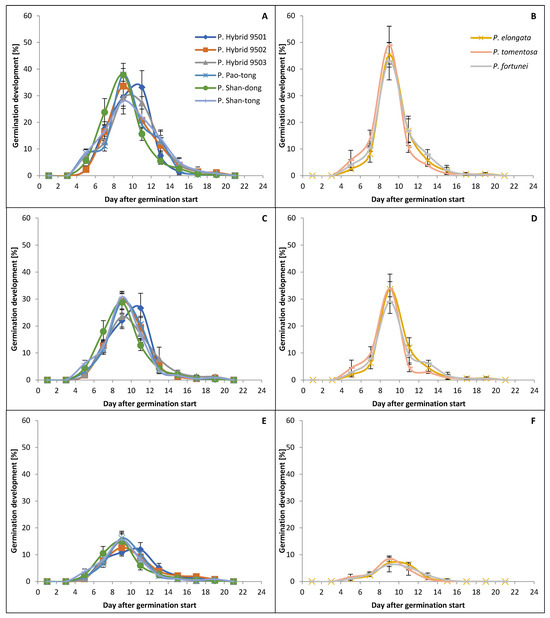
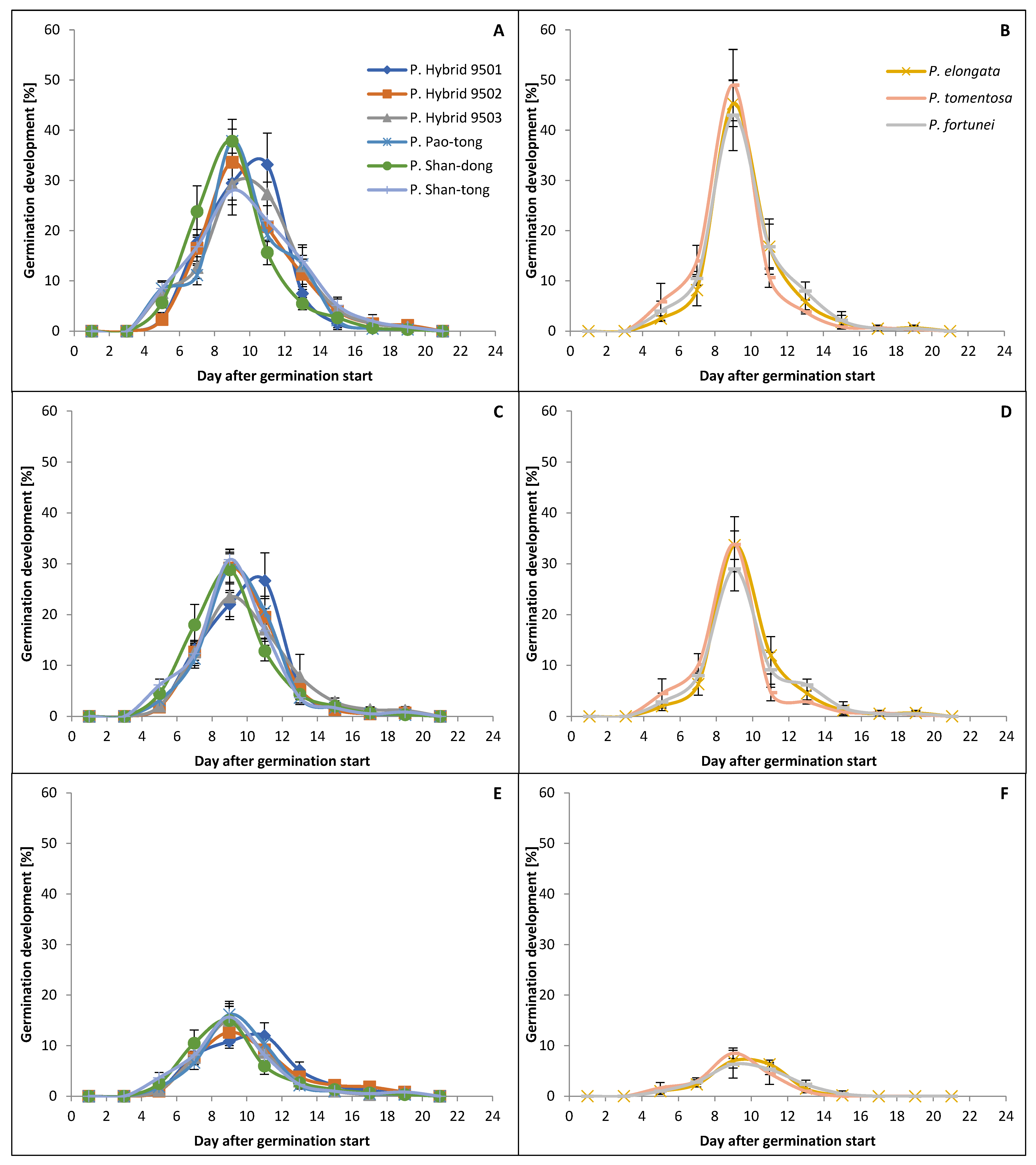
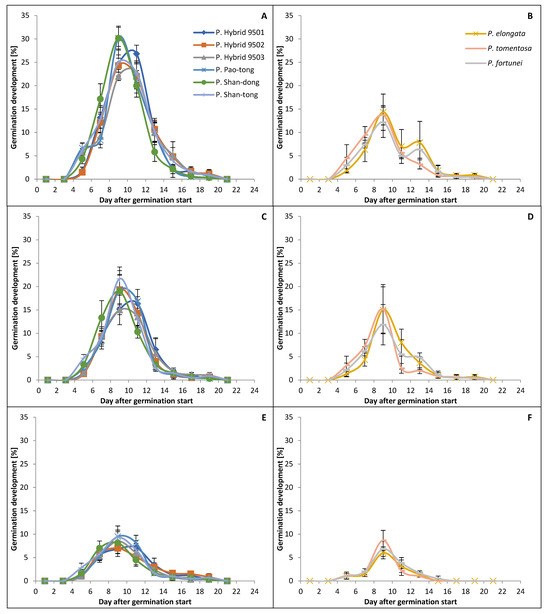
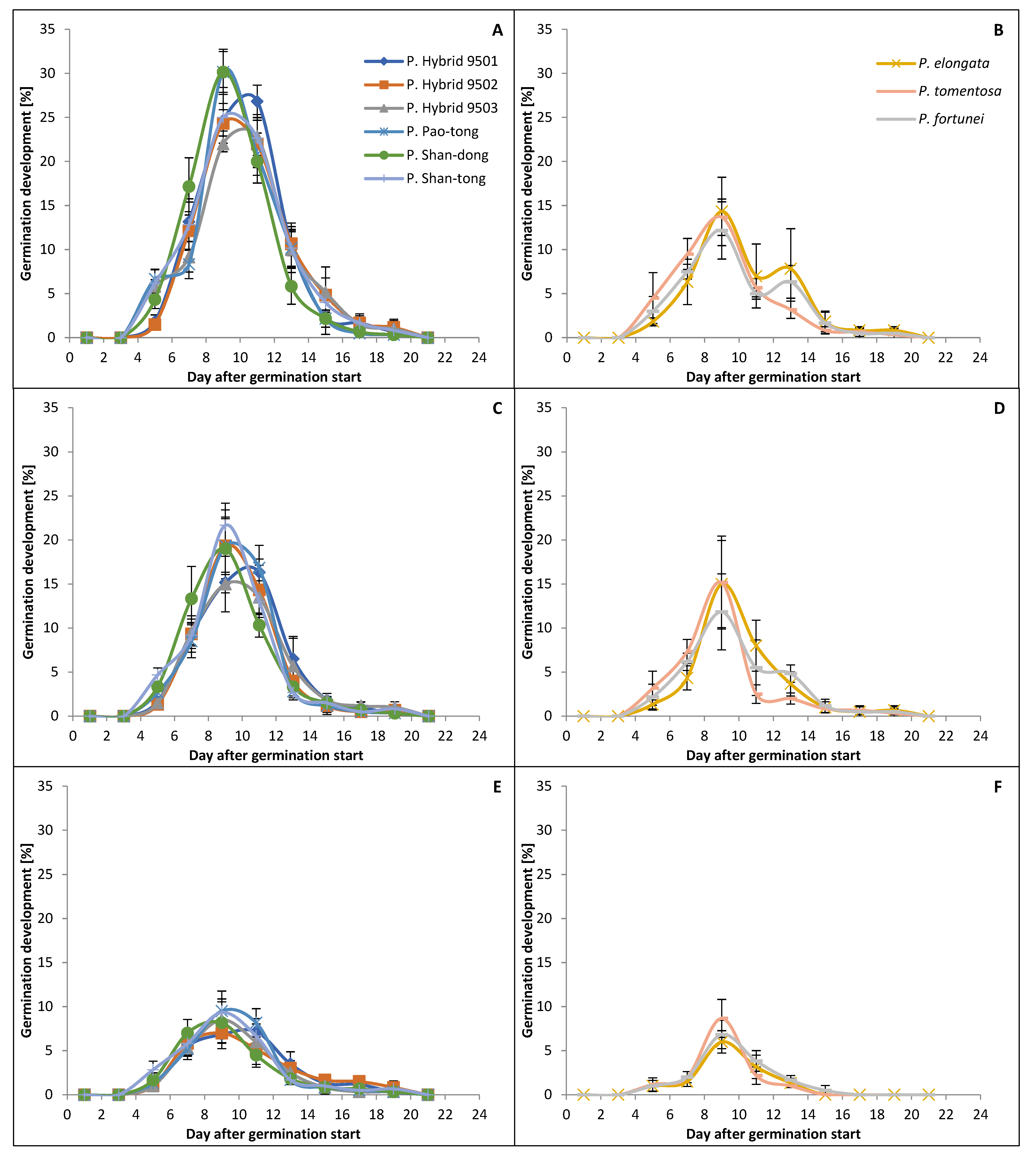
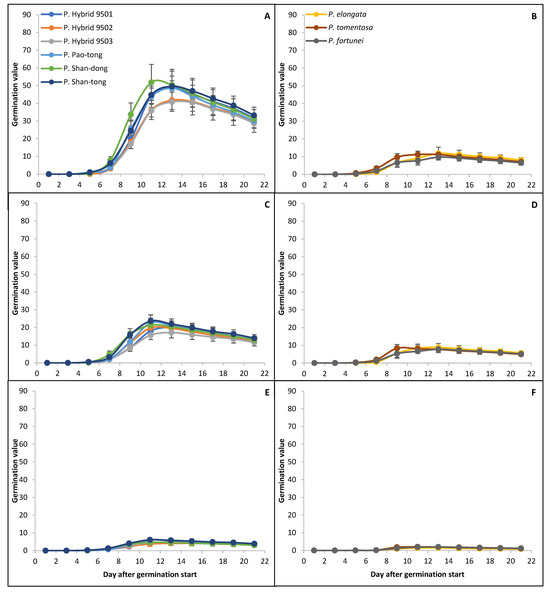
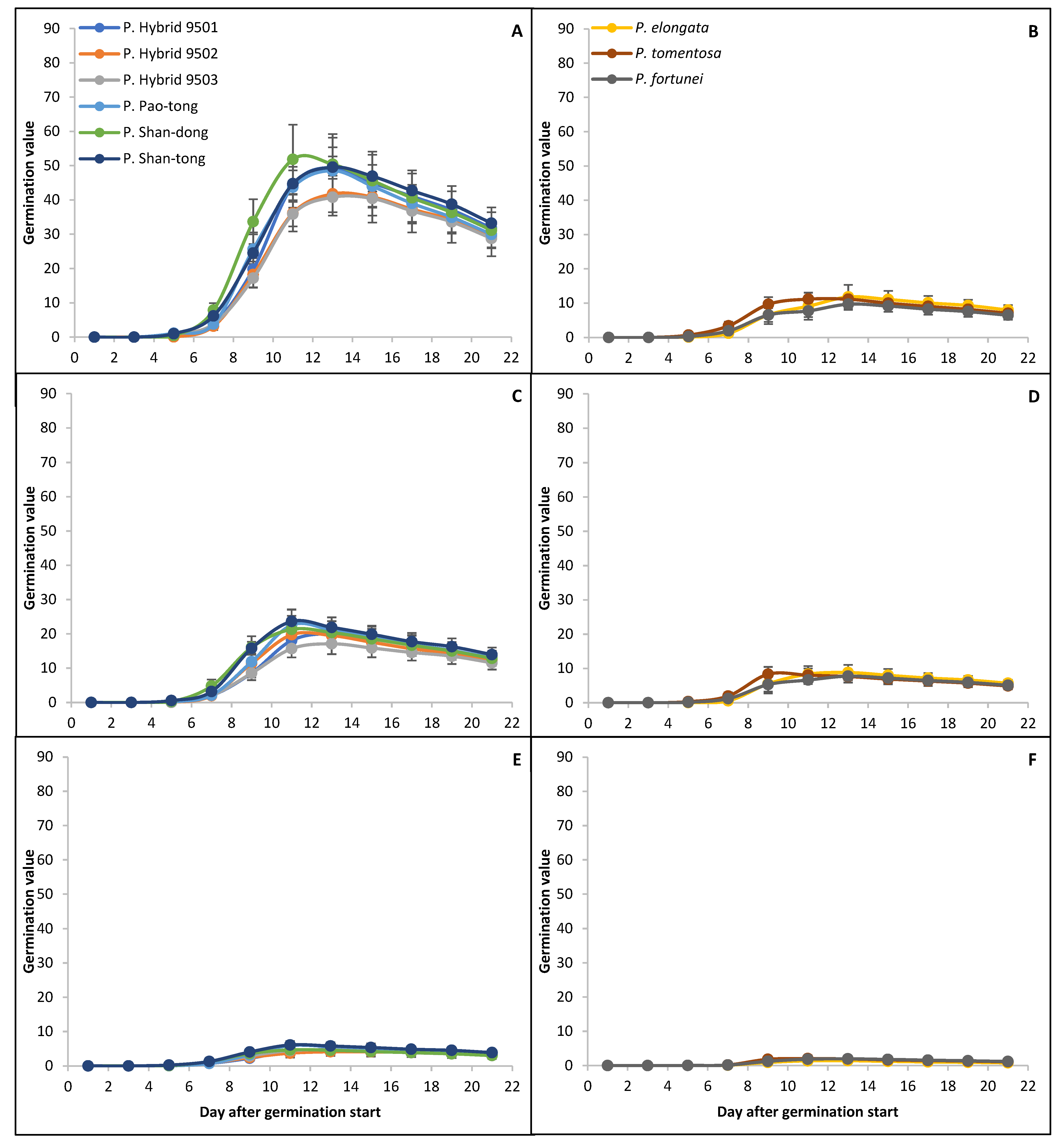
The germination (both in April and September) began each time no later than the fourth day after the start of the experiment and ended no later than the eighteenth day (Figure 2 and Figure 3). The germination peaks of Hybrids/Species in April were higher than those in September in all treatments. In the Temperature+4 °C treatment, the germination peaks in April were higher than those in September, and the differences varied from 10 to 72%, where P. Shan-tong had the smallest and P. tomentosa, together with P. fortunei, had the greatest. In the Temperature+20 °C treatment, the germination peaks in April were higher than those in September, and the differences varied from 30 to 55%, where P. Shan-tong had the smallest and P. fortunei had the greatest. In the Temperature−15 °C treatment, the germination peaks in April were higher (except for those of P. tomentosa and P. fortunei, which had higher germination peaks in September than in April) than those in September, and the differences varied from 14 to 45%, where P. elongata had the smallest and P. Shan-dong had the greatest. Moreover, the germination peaks of Hybrids/Species were the highest in the Temperature+4 °C treatment. The second highest peaks appeared in the Temperature+20 °C treatment (on average 27% and 29% lower than those in the Temperature+4 °C treatment in April and September, respectively). The lowest peaks appeared in the Temperature−15 °C treatment (those in the Temperature+4 °C treatment in April and September were, on average, higher by 267% and 180%, respectively, and those in the Temperature+20 °C treatment in April and September were higher by 179% and 116%, respectively). Species (i.e., P. elongata, P. tomentosa and P. fortunei) had higher peaks in almost all cases than all Hybrids in the Temperature+4 °C and Temperature+20 °C treatments in April and September; however, in the Temperature−15 °C treatment, Species had lower peaks than all Hybrids.
Figure 2.
Dynamic of germination of Paulownia in April. (A,B)—the Temperature+4 °C treatment; (C,D)—the Temperature+20 °C treatment; (E,F)—the Temperature−15 °C treatment. Whiskers denote standard deviations.
Figure 3.
Dynamic of germination of Paulownia in September. (A,B)—the Temperature+4 °C treatment; (C,D)—the Temperature+20 °C treatment; (E,F)—the Temperature−15 °C treatment. Whiskers denote standard deviations.
2.4. Mean Daily Germination
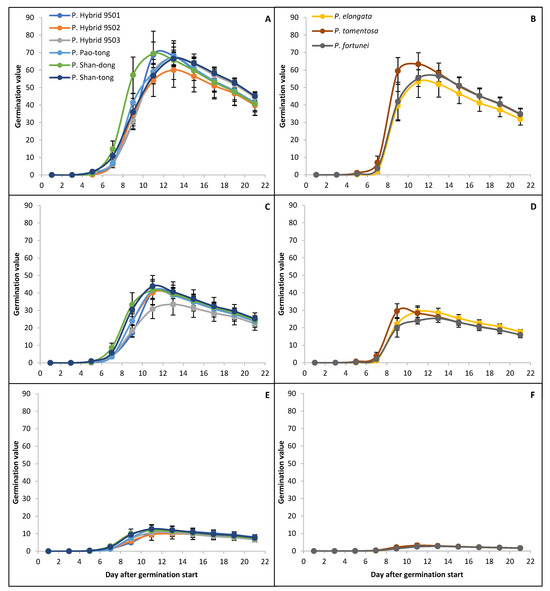
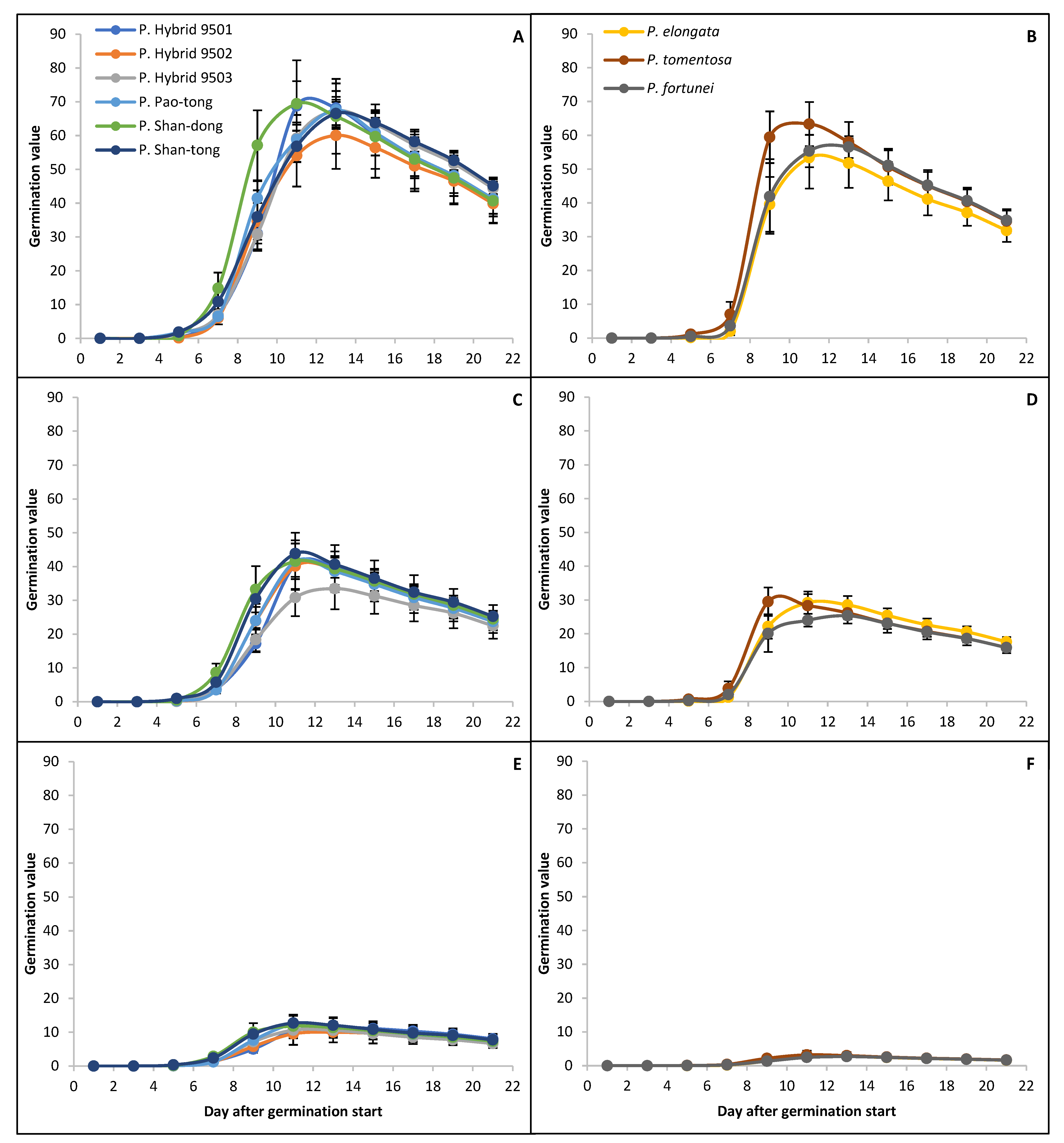
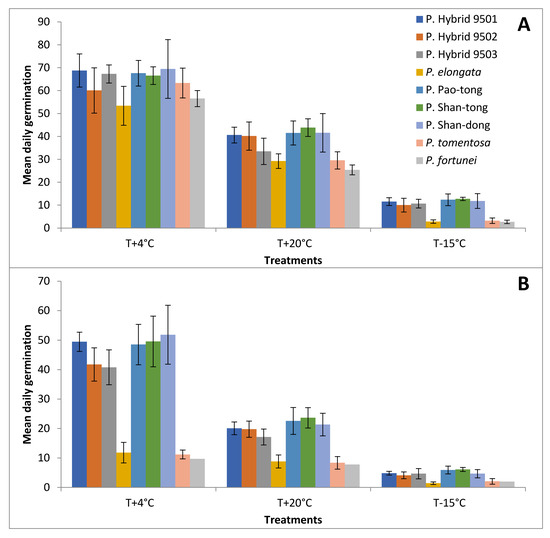
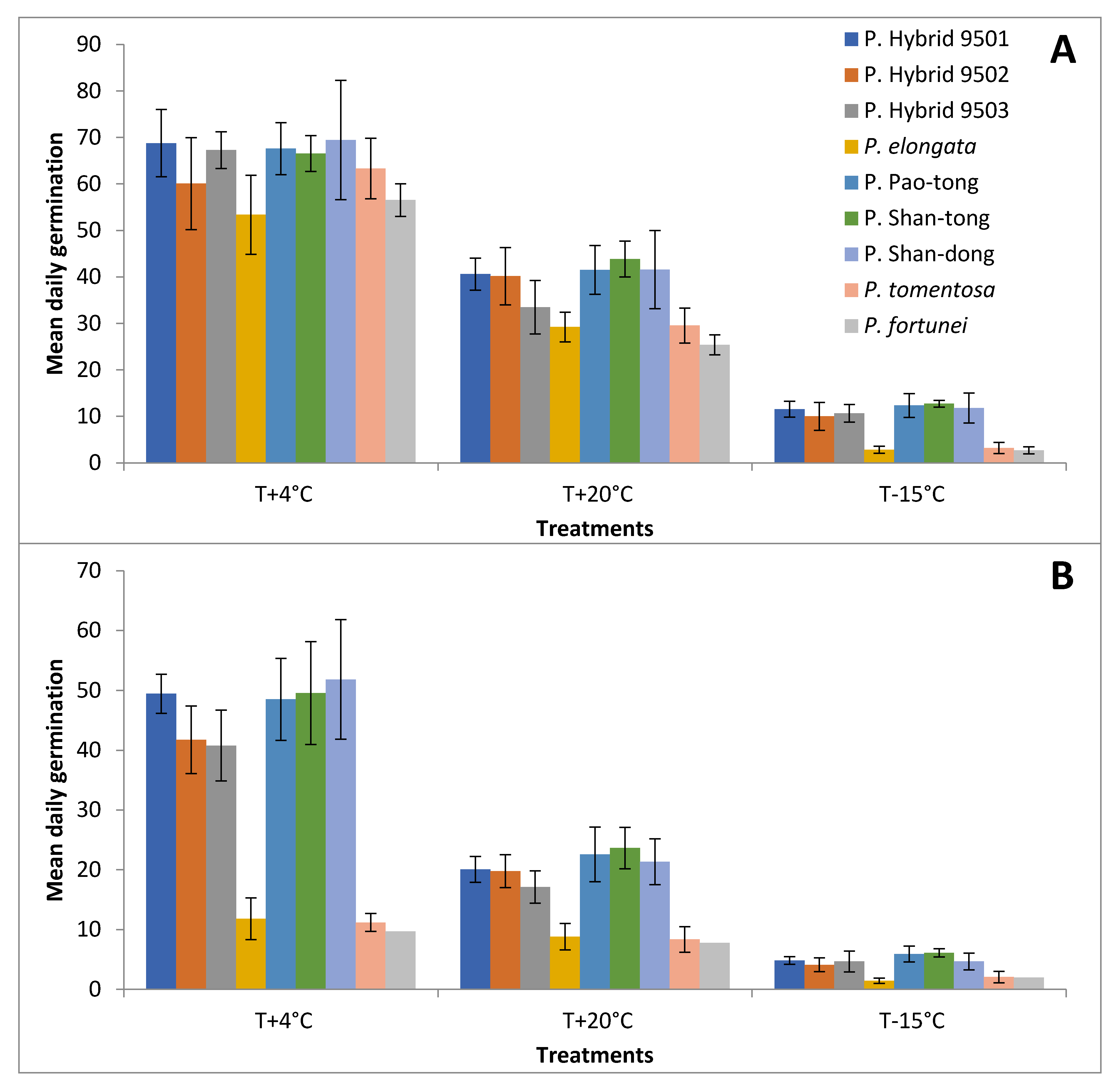
The seeds of all Paulownia Species/Hybrids germinated in the first week of the experiment in both April and September (Figure 4 and Figure 5). In April, the germination values (GV) increased quickly, and we recorded the peaks (Figure 6) of all Species/Hybrids from the middle to the end of the second week in all treatments. P. Hybrid 9501, P. Hybrid 9503, P. Pao-tong, P. Shan-dong, and P. Shan-tong had the highest peaks—almost 70 in the Temperature+4 °C treatment in April. In this treatment, P. Hybrid 9502 and P. tomentosa had the second highest peaks and P. elongata and P. fortunei the lowest (53 and 56, respectively). Statistically significant differences occurred only between the highest and lowest peaks (p values were in the range of 0.0148–0.0367). In the Temperature+20 °C and Temperature−15 °C treatments in April, the group with the highest peaks comprised all Hybrids and the group with the lowest comprised all Species (p values between Hybrids and Species were in the range of 0.0001–0.0312). From the peaks, the GVs of all Hybrids and Species in all treatments slowly decreased.
Figure 4.
Germination values of Paulownia in April. (A,B)—the Temperature+4 °C treatment; (C,D)—the Temperature+20 °C treatment; (E,F)—the Temperature−15 °C treatment. Whiskers denote standard deviations.
Figure 5.
Germination values of Paulownia in April. (A,B)—the Temperature+4 °C treatment; (C,D)—the Temperature+20 °C treatment; (E,F)—the Temperature−15 °C treatment. Whiskers denote standard deviations.
Figure 6.
Mean daily germination of Paulownia in April (A) and September (B). T+4 °C—the Temperature+4 °C treatment; T+20 °C—the Temperature+20 °C treatment; T−15 °C—the Temperature−15 °C treatment. Whiskers denote standard deviations.
In September, the differences between Hybrids and Species were visible in all sections of the curves (i.e., the increase, the peaks and decrease) in all treatments. While Hybrids always increased very quickly and, after reaching high peaks, decreased slowly, Species increased slowly, reached only low peaks, and then decreased very slowly. Statistical differences between the peaks of Hybrids and Species were always 0.0001. In the Temperature+4 °C treatment, Hybrids were split into two statistical groups, according to the heights of their peaks. Group 1 consisted of P. Hybrid 9501, P. Pao-tong, P. Shan-dong, and P. Shan-tong, and group 2 of P. Hybrid 9502 and P. Hybrid 9503 (p values were in the range of 0.0186–0.0455). There were no statistical differences among Hybrids in the Temperature+20 °C and Temperature−15 °C treatments.
3. Discussion
In April, the germination rate of the seeds was 70% (Hybrids) and 55% (Species) when they were stored at +20 °C, and in September it was around 50% (Hybrids) and 35% (Species). These germination rates are relatively low and do not correspond with the observations of Liu et al. [46], according to whom almost all seeds should germinate. Also, Barnhill et al. [47] observed a high germination rate of seeds left at room temperature, and Bonner & Burton [48] showed a high germination rate, 86%, after nine days.
After cold stratification, the germination rates were more than when the seeds were stored at +20 °C: 90% (Hybrids) and 60% (Species) when the seeds germinated in April and around 80% (Hybrids) and 40% (Species) in September. However, after cold stratification, almost 100%, 90%, or 85% of all seeds should germinate, according to Carpenter & Smith, Liu et al., or Bonner & Karrfalt [13,46,49], respectively.
It seems that the germination rate can be increased via cold stratification. Therefore, we can deduce that Paulownia is dormant. However, Toda & Isikawa, Borthwick et al., and Pasiecznik [50,51,52] state that P. tomentosa seeds do not enter dormancy or that it is very shallow. On the other hand, according to Liu et al. [46], P. elongata shows non-deep dormancy. Kuppinger, Bonner & Karrfalt, and Oung & Young [10,49,53] distinguish seed dormancy relative to the time that the seeds fell from the tree. Paulownia seed is not dormant immediately after falling from its capsule during late summer and the beginning of autumn [11]. It becomes dormant (whether still on the tree or fallen) when exposed to unfavorable conditions (for a brief period at lower temperatures) or is soaked with water in the dark [54,55]. This secondary dormancy can change germination time and germination speed, and it can reduce or eliminate the need for light or the temperature range, within which germination comes about; and if some mechanism does not disturb dormancy, the seeds do not germinate [10,47,56,57]. In the past, smoke, high-exposure to light, exposure to mineral soil, or adequate moisture were used for awakening from dormancy [47,51,57,58]. In the present, cold stratification of different durations (i.e., around 3–4 °C; the duration of action varies, according to many authors), pre-soaking, red light (not far-red light), exposure to exogenous GA3, etc., are used in the laboratory [46,59,60,61].
The germination rate, energy, and the other parameters were always higher for seeds that had germinated in April than for those in September. All the seeds used in this study were produced in the previous growing season. They should therefore have the highest germination capacity. This is confirmed by many authors [13,62,63] who found that germination is highest during the first two years, and by Bonner & Karrfalt [49], who stated that germination is at its highest within the first three years after seed production. However, there are differences in germination among individual seasons. Seeds can be sown in all seasons, where the most common and appropriate for most plants is spring [64]. Winter temperatures help to overcome dormancy of seeds sown in autumn and winter, and they germinate in spring [65,66] or after two years [67], depending on their life cycles. Wahlenberg [68] recorded that seeds of western white pine sown in the spring show more germination and germination energy than in autumn.
Paulownia comes from China [2], and it grows in areas where the northern border is located on ca the −5 °C isotherm and the temperature at the highest altitude is around −10 °C [2]. Paulownia is mostly frost-hardy, for example, P. tomentosa tolerates temperatures down to −22 °C, P. elongata and P. catalpifolia in the range of −15 °C to −18 °C, and P. fortunei and P. kawakamii in the range of −5 °C to −10 °C. These values were measured for plants and not seeds. Paulownia seeds are orthodox [69], which means that they can endure extreme frost [70]. Seeds of many orthodox species are generally frost-tolerant down to −196 °C [71]; however, the typical temperature used is above −20 °C [72]. Unfortunately, they lose frost hardiness with the onset of germination [73]. Baskin & Baskin [69] state that germinating seeds can either grow or wither. Seeds of P. tomentosa, P. elongata, and P. fortunei had very low values of all parameters both in the spring and in the autumn when we put them into the refrigerator with the temperature set at −15 °C. We expected similar values because Hyatt [74] observed that Paulownia seeds rarely, if at all, germinate in wildlands in southeastern Pennsylvania, where the climate is humid continental with a warm summer [75]. We recorded a germination rate of up to 17% with Species. On the other hand, 15% of seeds germinated in natural conditions in Ohio [15], which is also located in a humid continental climate [75]. This value is similar to our Species values. However, the seeds of Hybrids achieved even higher values (almost 30%), which is alarming. According to many authors who found the spreading of Paulownia via seeds [2,10,11,12,13,14,15,16,17,18,19,20], it is obvious that these species can have the potential to become invasive, which our results confirm; however, our findings show that seeds of Paulownia hybrids have greater potential than those of artificially uncrossed species.
4. Materials and Methods
4.1. Plant Material
Small plantings or very large plantations are usually established with seeds obtained from common sellers or using plant material from forest nurseries that also purchase seeds. For this experiment, all seeds (that had been collected in the fall of 2021) were purchased from three different sellers to ensure that the material used was diverse. Nine Species/Hybrids were bought; each seller had more than 9 species and hybrids of Paulownia, but only the ten listed below could be purchased from all three. Moreover, the sellers had to declare that the seeds were collected in the fall of 2021. The acquired seeds were stored in marked permeable bags under controlled conditions (i.e., a constant temperature of +10 °C, low air moisture, and away from direct sunlight and fluorescent lighting [76]), which does not break dormancy up to beginning of the preparatory part of the first experiment.
4.1.1. Species
Paulownia tomentosa (“P. tomentosa”; synonym: Bignonia tomentosa, Incarvillea tomentosa, Paulownia grandifolia, P. imperialis, P. lilacina, P. recurva) occurs at an altitude of up to 1800 m a.s.l. [9] with precipitation from 500 to 1500 mm and a temperature range from −20 °C to +40 °C [2].
Paulownia elongata (“P. elongata”) is one of the fastest-growing species of Paulownia, producing a lot of biomass [77,78]. It occurs at altitudes of up to 2000 m a.s.l. [9] with precipitation from 600 to 1500 mm and a temperature range from −15 °C to +40 °C [2].
Paulownia fortunei (“P. fortunei”; synonym: P. duclouxii, P. meridionalis, P. mikado) plays important roles in wood production, farmland, and environmental protection [79], and is susceptible to phytoplasma infection during its growth and development, resulting in a large number of clumps of indefinite buds, thereby reducing the yield and quality of Paulownia wood substantially [2]. It occurs at altitudes of up to 1100 m a.s.l. with precipitation from 1200 to 2500 mm and a temperature range from −10 °C to +40 °C [2].
4.1.2. Hybrids
Paulownia Hybrid 9501 (“P. Hybrid 9501”; synonym: P. Royal Treeme; P. Nordmax 21) is a hybrid of P. fortunei and P. tomentosa and is a fast-growing plant resistant to disease, cold, frost and drought [80]. It can be a source of quality saw timber, but the branches grow to greater diameters with unsuitable silvicultural treatments, which devalues quality of saw timber [5].
Paulownia Hybrid 9502 (“P. Hybrid 9502”) is a hybrid of P. fortunei and P. tomentosa, which grows fast, produces high-quality wood and is resistant to disease, frost and drought [5].
Paulownia Hybrid 9503 (“P. Hybrid 9503”) is a hybrid of P. fortunei and P. tomentosa, which grows fast, produces high-quality wood and is resistant to disease, frost and drought and, moreover, it has fine branches [5].
Paulownia Pao-tong Z07 (“P. Pao-tong”) is a hybrid of P. fortunei, P. tomentosa and P. kawakami [81] with the greatest recorded frost resistance (down to temperatures as low as −33 °C). It is a fast-growing plant with a cylindrical stem and is therefore suitable for saw timber [5].
Paulownia Shan Dong (“P. Shan Dong”) is resistant down to −25 °C and is suitable for extreme climate conditions [82]. It is used in the form of wood chips in the production of furniture [5].
Paulownia Shan-tong (“P. Shang-tong”) is a hybrid of P. fortunei and P. tomentosa and is used in the form of biomass and as saw timber. It is highly resistant to drought and frost [5].
4.2. Experimental Design
Paulownia tomentosa is the most widespread species of Paulownia and is often marked as an invasive or casual species, unlike other Paulownia species, which is why it was used as a reference in this study.
The twenty-one-day experiment was initiated twice:
- On 20 April 2022, the experiment imitated the natural germination of seeds in the spring;
- On 29 August 2022, the experiment was repeated with worse conditions before the beginning of the experiment (i.e., longer storage of seeds).
In the preparatory part (i.e., three months before the beginning) of the experiment on 20th April, the seeds were pulled out from the controlled conditions. Half of the seeds were used for the experiment on 20th April 2022, and the second half (in their bags) was spread in controlled conditions (i.e., a constant temperature of +20 °C, air moisture of 50% and away from direct sunlight and fluorescent lighting).
In the preparatory parts of the two experiments, we started preparations. For each individual Species/Hybrid, we set up 18 units of 100 (purchased) seeds each—six units of seeds from each of the three sellers. The seeds of each unit were spread out on a separate filter paper inside a marked germinator. The two units (i.e., 2 germinators) from the first seller, the two from the second, and the two from the third—6 units in total—were used for one treatment. The following three treatments were performed:
- Temperature+20 °C: Fifty-four germinators (eighteen from each seller), where six always contained the same individual Species/Hybrid, were laid out on germination tables at a temperature of +20 °C and air moisture of 60–70%. Seed moisturizing was performed before the start of the experiment. This temperature was chosen as the maximum temperature for storing seeds, and, moreover, these seeds were not exposed to lower temperatures.
- Temperature+4 °C: Fifty-four germinators (eighteen from each seller), where six always contained the same individual Species/Hybrid, were opened, moisturized, closed, and placed inside a refrigerator (with a constant temperature of +4 °C and air moisture of 80%). Each week, the filter papers were observed and moisturized whenever necessary. This temperature was chosen as the temperature necessary for the breaking of dormancy naturally.
- Temperature−15 °C: Fifty-four germinators (eighteen from each seller), where six always contained the same individual Species/Hybrid, were opened, moisturized, closed, and placed inside a refrigerator (with a constant temperature of +4 °C and air moisture of 80%). Each week, the filter papers were observed and moisturized whenever necessary. In the middle of the period, the units were placed inside a freezer (with a constant temperature of −15 °C and air moisture of 40%) for two weeks and, subsequently, returned into the refrigerator. This temperature was chosen as one of the lowest temperatures (in winter months) that most areas located in Dfa and Dfb (i.e., Central and Eastern Europe and 40–50° North latitude of North America) reach [75].
After three months, the germinators that had been left on the germination tables were opened, moisturized, and closed. All other units placed inside the refrigerator were taken out and placed on germination tables. All units were observed every 2 days for a period of 21 days, during which the germinated seeds were counted and removed from the test. A seed was considered germinated upon the appearance of the primary leaf.
Data was processed and evaluated, with focus on the following parameters:
- The dynamic of germination: A curve representing the dynamic of germination during the first 21 days after setting up the germination trial.
- The germination rate (%): The number of germinated seeds at the end of the experiment (i.e., after 21 days) out of the total number of seeds [83].whereGR—germination rate;Nge—number of germinated seeds;Nt—total number of seeds.
- The germination energy (%): The number of germinated seeds (recorded until the peak) divided by the total number of seeds [84].whereGE—germination energy;Nge—number of germinated seeds;Nt—total number of seeds.
- The mean daily germination (MDG): The highest value of all germination values (GV; a vigor index, which combines total percentage of seed germination and speed to evaluate seed lot quality) [83,85,86]. Each GV is calculated in three steps for each observation. Step 1: Calculation of the daily germination speed (DGS; i.e., cumulative count of germinated seeds divided by the number of days from the start of the experiment) for each observation. Step 2: The sum of the DGSs divided by the number of observations (the seeds were observed each second day, i.e., the number of observations was always half the number of days). Step 3: The DGS multiplied by the cumulative count of the germinated seeds divided by 100 and multiplied by 10.whereDGS—daily germination speed;Ng—number of germinated seeds;Nday—number of days from the start of the experiment to observation.whereGV—the highest value of all germination values;DGS—daily germination speed;Nobservation—number of observations;Ng—number of germinated seeds;Nday—number of days from the start of the experiment to observation.
4.3. Statistical Analysis
Data in this study was processed in Microsoft® Excel 2010 (Microsoft Corporation, Redmont, WA, USA). Statistical analysis of the data was performed using TIBCO Statistica™ 14.0.0 (TIBCO Software Inc., San Ramon, CA, USA) with a confidence interval of 95%. Normality of the data distribution was examined by the Shapiro–Wilk test before the main analysis. The main effects (i.e., Species/Hybrids and treatments) were analyzed using two-way analysis of variance (ANOVA), after which Fisher’s LSD test was applied to identify differences among the Species/Hybrids and treatments and their statistically homogenous groups.
4.4. Limitations
We bought the seeds from sellers. Although these sellers declared that the seeds were collected in fall 2021, they may have been older and their storage may not have been in accordance with the relevant standards. The results (especially in the case of the +4 °C treatment) indicate that the conditions were within acceptable limits. Another very important factor influencing this study is the number of samples. This study required a great number of germinators and much space on the germination tables, and therefore we set up only 6 samples (of 100 seeds each) from each Species/Hybrid per individual treatment: 162 germinators in April and 162 in August in total. The 16,200 seeds (with a gradually decreasing number) on the germination tables were monitored every other day, and each germinated seed had to be removed. Furthermore, we tried to reduce human error to a minimum, and the authors always worked in pairs. Despite the possibility of minor errors that were made during the experiment and the smaller number of samples, the results should be homogeneous and relevant.
5. Conclusions
We asked two basic questions about germination of Paulownia: “Does Paulownia have varying seed germination among species and hybrids?” and “Can they become invasive via their seeds?” We performed an experiment in which we split the seeds into three groups, each of which was left at one of the following temperatures:
(1) +20 °C throughout the entire experiment;
(2) +4 °C three months before the start of the experiment;
(3) +4 °C three months before the start of the experiment and at −15 °C for two weeks in the middle of the +4 °C phase.
Subsequently, we determined their germination. The results are alarming. The values of the germination rate and energy of P. tomentosa, P. elongata and P. fortunei were very high in the Temperature+20 °C and Temperature+4 °C treatments because it was thanks to these temperatures that the dormancy was broken. The values were lower in the Temperature−15 °C treatment; however, the germination rate stayed at around 20%. On the other hand, our tested hybrids had a germination rate of almost 100% in the Temperature+4 °C treatment and slightly less (more than 70%) in the Temperature+20 °C treatment. It is important to add that the values of the germination rate and the other parameters in the Temperature−15 °C treatment were double those of Species. Based on our results and on those of other authors, it is possible to say that not only P. tomentosa, but also P. fortunei and P. elongata seem to be invasive. However, hybrids of Paulownia have an even greater potential to be invasive.
Author Contributions
Conceptualization, J.K. and K.N.; methodology, J.K. and K.N.; software, J.K. and K.N.; validation, J.K. and K.N.; formal analysis, K.N.; investigation, J.K., K.N., K.M. and P.S.; resources, J.K.; data curation, J.K. and K.N.; writing—original draft preparation, J.K. and K.N.; writing—review and editing, J.K. and K.N.; visualization, J.K. and K.N.; supervision, R.P.; project administration, J.K.; funding acquisition, J.K. and R.P. All authors have read and agreed to the published version of the manuscript.
Funding
This work was supported by the Internal Grant Agency (IGA) of the Faculty of Forestry and Wood Technology, Mendel University in Brno under Grant numbers LDF_VP_2018018; LDF_VP_2019011 and LDF_VP_2020034 and by Ministry of Agriculture under Grant number QK21010198 (Adaptation of forestry for sustainable use of natural resources).
Data Availability Statement
The data is available from the first author upon request.
Acknowledgments
The authors thank Jan Hobl for the revision of the English language.
Conflicts of Interest
The authors declare no conflicts of interest.
References
- Chase, M.W.; Christenhusz, M.J.; Fay, M.F.; Byng, J.W.; Judd, W.S.; Soltis, D.E.; Mabberley, D.J.; Sennikov, A.N.; Soltis, P.S.; Stevens, P.F. An update of the Angiosperm Phylogeny Group classification for the orders and families of flowering plants: APG IV. Bot. J. Linn. Soc. 2016, 181, 1–20. [Google Scholar] [CrossRef] [Scilit]
- Zhu, Z.-H.; Chao, C.-J.; Lu, X.-Y.; Xiong, Y.G. Paulownia in China: Cultivation and Utilization; International Development Research Centre: Ottawa, ON, Canada, 1986; p. 451. [Google Scholar]
- Woods, V.B. Paulownia as a Novel Biomass Crop for Northern Ireland? Agri-Food and Biosciences Institute, Global Research Unit: Hillsborough, UK, 2008; p. 48. [Google Scholar]
- Innes, R.J. Paulownia tomentosa. Available online: http://www.fs.fed.us/database/feis/ (accessed on 20 September 2025).
- Paulowniamoravia. Paulownia. Available online: https://paulowniamoravia.cz// (accessed on 21 November 2025).
- Mal’ová, M.; Jankovič, J.; Sujová, K.; Longauerová, V.; Mútňáková, M. Paulownia—Potenciál a riziká pestovanie na Slovensku [Paulownia—Potential and risk of its cultivation in Slovakia]. In Proceedings of the Aktuálne Problémy v Ochrane lesa 2016, Nový Smokovec, Slovakia, 21–22 January 2016. [Google Scholar]
- Weinan Research & Promotion Center for High Resistance Paulownia of Shaanxi. Species of Paulownia. Available online: https://www.chinesepaulownia.com/species-of-paulownia/ (accessed on 21 November 2025).
- Paulownia Slovakia. Important Information About Paulownia Types. Available online: https://www.paulownia-slovakia.eu/ekologia/paulownia-v-eu/ (accessed on 21 November 2025).
- Zhengyi, W.; Raven, P.H.; Deyuan, H. Paulownia Siebold & Zuccarini. Available online: http://www.efloras.org/florataxon.aspx?flora_id=2&taxon_id=124177 (accessed on 21 November 2025).
- Kuppinger, D.M. Post-Fire Vegetation Dynamics and the Invasion of Paulownia tomentosa in the Southern Appalachians. Doctoral Dissertation, University of North Carolina, Chapel Hill, NC, USA, 2008. [Google Scholar]
- Hu, S.-Y. The economic botany of the Paulownias. Econ. Bot. 1961, 15, 11–27. [Google Scholar] [CrossRef] [Scilit]
- Niemeier, J. I had to kill the empress. Univ. Wash. Arbor. Bull. 1984, 47, 21–23. [Google Scholar]
- Carpenter, S.B.; Smith, N.D. Germination of paulownia seeds after stratification and dry storage. Tree Plant. Notes 1979, 30, 4–6. [Google Scholar]
- Tang, R.C.; Carpenter, S.B.; Wittwer, R.F. Paulownia—A crop tree for wood products and reclamation of surface-minded land. South. J. Appl. For. 1980, 4, 19–24. [Google Scholar] [CrossRef] [Scilit]
- Longbrake, A.C.W. Ecology and Invasive Potential of Paulownia tomentosa (Scrophulariaceae) in a Hardwood Forest Landscape. Doctoral Dissertation, The College of Arts and Sciences of Ohio University, Athens, OH, USA, 2001. [Google Scholar]
- Dobberpuhl, J.M. Seed Banks of Forest Soils in East Tennessee. Master’s Thesis, University of Tennessee, Knoxville, TN, USA, 1980. [Google Scholar]
- Hyatt, L.A.; Casper, B.B. Seed bank formation during early secondary succession in a temperate deciduous forest. J. Ecol. 2000, 88, 516–527. [Google Scholar] [CrossRef] [Scilit]
- Langdon, K.R.; Johnson, K.D. Additional notes on invasiveness of Paulownia tomentosa in natural areas. Nat. Areas J. 1994, 14, 139–140. [Google Scholar]
- Bean, E.; McClellan, L. Tennessee Exotic Plant Management Manual, 1st ed.; Warner Parks Nature Center: Nashville, TN, USA, 1996; p. 118. [Google Scholar]
- Duncan, W.H.; Duncan, M.B. Trees of the Southeastern United States, 1st ed.; The University of Georgia Press: Athens, GA, USA, 1988; p. 336. [Google Scholar]
- Huber, C.; Moog, D.; Stingl, R.; Pramreiter, M.; Stadlmann, A.; Baumann, G.; Praxmarer, G.; Gutmann, R.; Eisler, H.; Müller, U. Paulownia (Paulownia elongata S.Y.Hu)—Importance for forestry and a general screening of technological and material properties. Wood Mater. Sci. Eng. 2023, 18, 1663–1675. [Google Scholar] [CrossRef] [Scilit]
- Pyšek, P.; Sádlo, J.; Chrtek, J., Jr.; Chytrý, M.; Kaplan, Z.; Pergl, J.; Pokorná, A.; Axmanová, I.; Čuda, J.; Doležal, J.; et al. Catalogue of alien plants of the Czech Republic (3rd edition): Species richness, status, distributions, habitats, regional invasion levels, introduction pathways and impacts. Preslia 2022, 94, 447–577. [Google Scholar] [CrossRef] [Scilit]
- Richardson, D.M.; Pysek, P.; Rejmánek, M.; Barbour, M.G.; Panetta, F.D.; West, C.J. Naturalization and Invasion of alien Plants: Concepts and Definitions. Divers. Distrib. 2000, 6, 93–107. [Google Scholar] [CrossRef] [Scilit]
- Van Wilgen, B.W.; Richardson, D.M.; Le Maitre, D.C.; Marais, C.; Magadlela, D. The economic consequences of alien plant invasions: Examples of impacts and approaches to sustainable management in South Africa. Environment. Dev. Sustain. 2001, 3, 145–168. [Google Scholar] [CrossRef] [Scilit]
- Clout, M. IUCN guidelines for the prevention of biodiversity loss due to biological invasion. Species 1999, 31/32, 28–42. [Google Scholar]
- CBD. Invasive Alien Species. A Threat To Biodiversity, 1st ed.; Secretariat of the Convention on Biological Diversity: Montreal, QC, Canada, 2009. [Google Scholar]
- Blackburn, T.M.; Essl, F.; Evans, T.; Hulme, P.E.; Jeschke, J.M.; Kühn, I.; Kumschick, S.; Marková, Z.; Mrugała, A.; Nentwig, W.; et al. A unified classification of alien species based on the magnitude of their environmental impacts. PLoS Biol. 2014, 12, e1001850. [Google Scholar] [CrossRef] [Scilit]
- Podrázký, V.; Remeš, J. Soil-forming role of important introduced conifers—Douglas fir, grand fir and eastern white pine. Zprávy Lesn. Výzkumu 2008, 53, 29–36. [Google Scholar]
- Chikowore, G.; Mutamiswa, R.; Sutton, G.F.; Chidawanyika, F.; Martin, G.D. Reduction of grazing capacity in high-elevation rangelands after black locust invasion in South Africa. Rangel. Ecol. Manag. 2021, 76, 109–117. [Google Scholar] [CrossRef] [Scilit]
- Gentili, R.; Ferré, C.; Cardarelli, E.; Montagnani, C.; Bogliani, G.; Citterio, S.; Comolli, R. Comparing negative impacts of Prunus serotina, Quercus rubra and Robinia pseudoacacia on native forest ecosystems. Forests 2019, 10, 842. [Google Scholar] [CrossRef] [Scilit]
- Terzi, M.; Fontaneto, D.; Casella, F. Effects of Ailanthus altissima invasion and removal on highbiodiversity Mediterranean grasslands. Environ. Manag. 2021, 68, 914–927. [Google Scholar] [CrossRef] [Scilit]
- Essl, F. From ornamental to detrimental? The incipient invasion of Central Europe by Paulownia tomentosa. Preslia 2007, 79, 377–389. [Google Scholar]
- Stringer, J. Forest health. Invasive plant hit list: Paulownia. Ky. Woodl. Mag. 2009, 4, 10–11. [Google Scholar]
- Kleinbauer, I.; Dullinger, S.; Klingenstein, F.; May, R.; Nehring, S.; Essl, F. Spread Potential of Selected Neophytic Vascular Plants Under Climate Change in Germany and Austria, 1st ed.; Bundesamt für Naturschutz (BfN): Boon, Germany, 2010; p. 74. [Google Scholar]
- Essl, F.; Rabitsch, W.; Rahmstorf, S. Biodiversität und Klimawandel; Springer Spektrum: Berlin, Germany, 2013; p. 457. [Google Scholar]
- Marana, B. A Green GIS Solution against Air Pollution in the Province of Bergamo: The Paulownia Tree. J. Geogr. Inf. Syst. 2018, 10, 193–218. [Google Scholar] [CrossRef]
- Barbu, M.C.; Tudor, E.M.; Buresova, K.; Petutschnigg, A. Assessment of Physical and Mechanical Properties Considering the Stem Height and Cross-Section of Paulownia tomentosa (Thunb.) Steud. x elongata (S.Y.Hu) Wood. Forests 2023, 14, 589. [Google Scholar] [CrossRef] [Scilit]
- Snow, W.A. Ornamental, crop, or invasive? The history of the Empress tree (Paulowna) in the USA. For. Trees Livelihoods 2014, 24, 85–96. [Google Scholar] [CrossRef] [Scilit]
- Lovenshimer, J.B.; Madricht, M.D. Plant Community Effects and Genetic Diversity of Post-fire Princess Tree (Paulownia tomentosa) Invasions. Invasive Plant Sci. Manag. 2017, 10, 125–135. [Google Scholar] [CrossRef] [Scilit]
- Badalamenti, E. Notes about the naturalization in Sicily of Paulownia tomentosa (Paulowniaceae) and remarks about its global spread. Flora Mediterr. 2019, 29, 67–70. [Google Scholar] [CrossRef] [Scilit]
- Chongpinitchaik, A.R.; Williams, R.A. The response of the invasive princess tree (Paulownia tomentosa) to wildland fire and other disturbances in an Appalachian hardwood forest. Glob. Ecol. Conserv. 2021, 29, e01734. [Google Scholar] [CrossRef] [Scilit]
- Jakubowski, M. Cultivation Potential and Uses of Paulownia Wood: A Review. Forests 2022, 13, 688. [Google Scholar] [CrossRef] [Scilit]
- EPPO. Paulownia tomentosa (Paulowniaceae). Available online: https://www.eppo.int/ACTIVITIES/plant_quarantine/alert_list_plants/paulownia_tomentosa (accessed on 21 November 2025).
- Pergl, J.; Sádlo, J.; Petrusek, A.; Laštůvka, Z.; Musil, J.; Perglová, I.; Šanda, R.; Šefrová, H.; Šíma, J.; Vohralík, V.; et al. Black, grey and watch lists of alien species in the Czech Republic based on environmental impacts and management strategy. NeoBiota 2016, 28, 1–37. [Google Scholar] [CrossRef] [Scilit]
- Ghazzawy, H.S.; Bakr, A.; Mansour, A.T.; Ashour, M. Paulownia trees as a sustainable solution for CO2 mitigation: Assessing progress toward 2050 climate goals. Front. Environ. Sci. 2024, 12, 1307840. [Google Scholar] [CrossRef] [Scilit]
- Liu, J.; Xue, T.T.; Shen, Y.B. Seed dormancy and germination of Paulownia elongata in response to light, temperature, cold stratification, after-ripening and GA3. Seed Sci. Technol. 2017, 45, 708–713. [Google Scholar] [CrossRef] [Scilit]
- Barnhill, M.A.; Cunningham, M.; Farmer, R.E. Germination characteristics of Paulownia tomentosa. Seed Sci. Technol. 1982, 10, 217–221. [Google Scholar]
- Bonner, F.T.; Burton, J.D. Paulownia tomentosa (Thunb.) Sieb. & Zucc., royal paulownia. In Seeds of Woody Plants in the United States; Schopmeyer, C.S., Ed.; Agricultural Handbook: Washington, DC, USA, 1974; pp. 572–573. [Google Scholar]
- Bonner, F.T.; Karrfalt, R.P. The Woody Plant Seed Manual; Agricultural Handbook: Washington, DC, USA, 2008; p. 1223. [Google Scholar]
- Toda, R.; Isikawa, H. Effect of diffused light on the germination of Paulownia seeds. J. Jpn. For. Soc. 1952, 34, 250. [Google Scholar]
- Borthwick, H.A.; Toole, E.H.; Toole, V.K. Phytochrome control of Paulownia seed germination. Isr. J. Bot. 1964, 13, 122–133. [Google Scholar]
- Pasiecznik, N. Paulownia tomentosa (paulownia). CABI Compendium 2022, 39100. [Google Scholar] [CrossRef] [Scilit]
- Oung, J.A.; Young, C.G. Seeds of Woody Plants in North America; Dioscorides Press: Portland, OR, USA, 1992; p. 407. [Google Scholar]
- Zhen, L. Effect of prechilling on the germination of seeds of Paulownia tomentosa. Acta Agric. 1999, 33, 279–281. [Google Scholar]
- Grubisic, D.; Neskovic, M.; Konjevic, R. Changes in light sensitivity of Paulownia tomentosa and P. fortunei seeds. Plant Sci. 1985, 39, 13–16. [Google Scholar] [CrossRef] [Scilit]
- Grubisic, D.; Konjevic, R. Light and temperature action in germination of seeds of the empress tree (Paulownia tomentosa). Physiol. Plant. 1992, 86, 479–483. [Google Scholar] [CrossRef] [Scilit]
- Carpenter, S.B.; Smith, N.D. Germination of Paulownia seeds in the presence and absence of light. Tree Plant. Notes 1981, 32, 27–29. [Google Scholar]
- Beckjord, P.R. Containerized and nursery production of Paulownia tomentosa. Tree Plant. Notes 1982, 33, 29–33. [Google Scholar]
- Markovic, M.; Grbić, M.; Skocajic, D.; Djunisijević Bojović, D.; Milutinovic, M. Germination of Paulownia Fortunei (Seem.) Hemsl. Seed after different red and far-red light treatments. In Book of Proceedings. XII International Scientific Agriculture Symposium “AGROSYM 2021”, 1st ed.; Kovačević, D., Ed.; Faculty of Agriculture, Universita in Sarajevo: Sarajevo, Bosnia and Herzegovina, 2021; pp. 228–233. [Google Scholar]
- Poşta, D.-S.; Rózsa, S.; Gocan, T.-M.; Cântar, I.-C. Research on seed germination stimulation at Paulownia tomentosa Thunb. Steud. Curr. Trends Nat. Sci. 2022, 11, 231–239. [Google Scholar] [CrossRef] [Scilit]
- Ivaniuk, A.; Kharachko, T.; Lysiuk, R.; Danchuk, O.; Cheban, O. Paulownia tomentosa (Thunb.) Steud. Seed quality from different geographical locations in Ukraine. For. Ideas 2023, 29, 314–326. [Google Scholar]
- Graves, D.H. Paulownia: A potential alternative crop for Kentucky, 1st ed.; FOR-11; Kentucky University Cooperative Extension Service: Lexington, KY, USA, 1989. [Google Scholar]
- Graves, D.H.; Stringer, J.W. Paulownia: A Guide to Establishment and Cultivation, 1st ed.; FOR-39; Kentucky University Cooperative Extension Service: Lexington, KY, USA, 1989. [Google Scholar]
- Rice, G.A. Handbook of Annuals and Bedding Plants, 1st ed.; Croom Helm: London, UK; p. 240.
- Spaeth, S.C.; Bennett, J.M.; Paulsen, G.M.; Boote, K.J.; Sinclair, T.R. Germination and Seedling Establishment. In Physiology and Determination of Crop Yield; Boote, K.J., Bennett, J.M., Sinclair, T.R., Paulsen, G.M., Eds.; American Society of Agronomy: Madison WI, USA, 1994; pp. 61–63. [Google Scholar]
- Takos, I.A.; Efthimiou, G.S. Germination Results on Dormant Seeds of Fifteen Tree Species Autumn Sown in a Northern Greek Nursery. Silvae Genet. 2003, 52, 67–71. [Google Scholar]
- Karlsson, L.M.; Ericsson, J.A.L.; Milberg, P. Seed dormancy and germination in the summer annual Galeopsis speciosa. Weed Res. 2006, 46, 353–361. [Google Scholar] [CrossRef] [Scilit]
- Wahlenberg, W.G. Fall sowing and delayed germination of western white pine seed. J. Agric. Res. 1924, 28, 1127–1131. [Google Scholar]
- Baskin, C.C.; Baskin, J.M. Seeds: Ecology, Biogeography, and Evolution of Dormancy and Germination, 2nd ed.; Academic Press: San Diego, CA, USA, 2017; p. 1600. [Google Scholar]
- Fatima, H.; Ishaque, S.; Hashim, M.; Hano, C.; Abbasi, B.H.; Anjum, S. Role of hydrogen peroxide in plant and crosstalk with signaling networks, growth, and development. Plant Biol. Sustain. Clim. Change 2023, 1, 195–244. [Google Scholar]
- Sakai, A.; Larcher, W. Frost Survival of Plants, 1st ed.; Springer Science & Business Media: Berlin/Heidelberg, Germany, 1987; p. 321. [Google Scholar]
- Zeng, L.; Sun, Z.; Fu, L.; Gu, Y.; Li, R.; He, M.; Wei, J. Cryopreservation of Medicinal Plant Seeds: Strategies for Genetic Diversity Conservation and Sustainability. Plants 2024, 13, 2577. [Google Scholar] [CrossRef] [Scilit] [PubMed]
- Marcante, S.; Sierra-Almeida, A.; Spindelböck, J.P.; Erschbamer, B.; Neuner, G. Frost as a limiting factor for recruitment and establishment of early development stages in an alpine glacier foreland? J. Veg. Sci. 2012, 23, 858–868. [Google Scholar] [CrossRef] [Scilit]
- Hyatt, A.L. Differences between Seed Bank Composition and Field Recruitment in a Temperate Zone Deciduous Forest. Am. Midl. Nat. 1999, 142, 31–38. [Google Scholar] [CrossRef] [Scilit]
- Köppen, W. Handbook of Climatology. The Geographic System of Climates; Verlag von Gebrüder Borntraeger: Berlin, Germany, 1936; p. 44. (In German) [Google Scholar]
- Pottorff, L.; Blunt, T.; Novak, R. Seed Conditioning 106—Seed Carryover, Inventory and Storage. Available online: https://colostate.pressbooks.pub/seedconditioning106/ (accessed on 10 March 2026).
- Abreu, M.; Reis, A.; Moura, P.; Fernando, A.L.; Luís, A.; Quental, L.; Patinha, P.; Gírio, F. Evaluation of the Potential of Biomass to Energy in Portugal—Conclusions from the CONVERTE project. Energies 2020, 13, 937. [Google Scholar] [CrossRef] [Scilit]
- Rodríguez-Seoane, P.; Díaz-Reinoso, B.; Moure, A.; Domínguez, H. Potential of Paulownia sp. for biorefinery. Ind. Crops Prod. 2020, 155, 112739. [Google Scholar] [CrossRef] [Scilit]
- Barbu, M.C.; Radauer, H.; Petutschnigg, A.; Tudor, E.M.; Kathriner, M. Lightweight Solid Wood Panels Made of Paulownia. Plant. Wood. Appl. Sci. 2023, 13, 11234. [Google Scholar]
- Heze Fortune. Dry and Cold Resistant Hybrid Paulownia—Paulownia Shan Tong—Paulownia 9501, 9502, 9503 for Planting. Available online: https://www.chinapaulownia.com/products/dry-and-cold-resistant-hybrid-paulownia-paulownia-shan-tong-paulownia-9501-9502-9503-for-planting.html (accessed on 11 March 2026).
- Palijon, A.M. Nursery Propagation and Field Planting of Kawayan Tinik Branch Cuttings, 1st ed.; UPLB: Los Baños, PH, USA, 1983. [Google Scholar]
- BIO TREE. One Green Future. Available online: https://biotree.bg/bul/wp-content/uploads/2019/09/BIO-TREE_PAULOWNIA.pdf (accessed on 21 November 2025).
- Czabator, F.J. Germination value: An index combining speed and completeness of pine seed germination. For. Sci. 1962, 8, 386–396. [Google Scholar] [CrossRef] [Scilit]
- Lee, H.; Han, G.; Cheong, E.J. Effect of different treatments and light quality on Ulmus pumila L. germination and seedling growth. For. Sci. Technol. 2021, 17, 162–168. [Google Scholar] [CrossRef] [Scilit]
- Djavanshir, K.; Pourbeik, H. Germination value-A new formula. Silvae Genet. 1976, 25, 79–83. [Google Scholar]
- Brown, R.F.; Mayer, D.G. Representing cumulative germination. 1. A critical analysis of single-value germination indices. Ann. Bot. 1988, 61, 117–125. [Google Scholar] [CrossRef] [Scilit]
Disclaimer/Publisher’s Note: The statements, opinions and data contained in all publications are solely those of the individual author(s) and contributor(s) and not of MDPI and/or the editor(s). MDPI and/or the editor(s) disclaim responsibility for any injury to people or property resulting from any ideas, methods, instructions or products referred to in the content. |
© 2026 by the authors. Licensee MDPI, Basel, Switzerland. This article is an open access article distributed under the terms and conditions of the Creative Commons Attribution (CC BY) license.