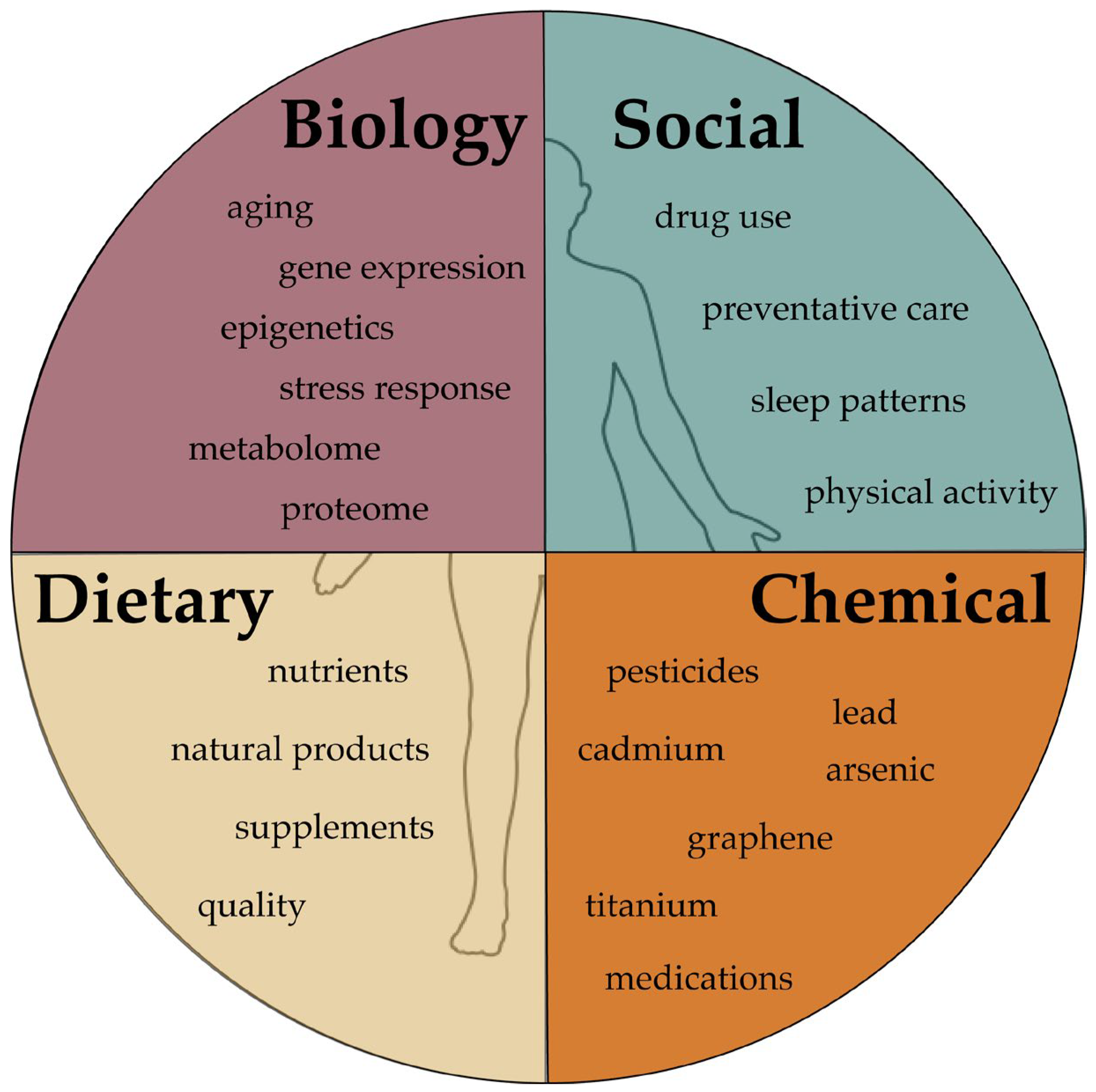

Genomic Impacts of Biological Exposures

Abstract
1. Introduction
2. Exposure Biology and Precision Medicine
2.1. Pharmacogenomics

| Compound Name | Uses | Genetic Associations; Gene (SNP) | Clinical Impact | Refs. |
|---|---|---|---|---|
| Warfarin | Anticoagulation, venous thrombosis, pulmonary embolism | VKORC1 (c.-1639: G > A) CYP2C9 (alele: 2, 3, 5, 6, 8, 11, 12, 13, 15) CYP4F2 (rs12777823) | Increased sensitivity Reduced clearance Increased sensitivity | [21,22,23,24,25] |
| Adalimumab | Rheumatoid arthritis, ankylosing spondylitis, Crohn’s disease, ulcerative colitis, hidradenitis suppurativa, psoriatic arthritis, plaque psoriasis | Tumor necrosis factor (rs1800629) FCGR2A (rs1801274-GG) ATG16L1 (rs2241880) IL-6 (rs1800795: GG > CC) MAP2K6 | Increased drug response Decreased drug response Decreased drug response Increased drug response Increased drug response | [12,26,27,28,29] |
| Infliximab | Crohn’s disease, ulcerative colitis, rheumatoid arthritis, ankylosing spondylitis, psoriatic arthritis, plaque psoriasis | HLA-B*39:01, B*08:01 HLA-C*12:03 HLA-DPB1*10:01 HLA-DQB1*02:01 HLA-DRB1*04:04 | Drug-induced liver injury Drug-induced liver injury Drug-induced liver injury Drug-induced liver injury Anti-drug antibody formation | [30,31,32,33,34] |
| Etanercept | Rheumatoid arthritis, psoriasis, psoriatic arthritis, ankylosing spondylitis | HLA-DRB1 *04:01 TNF-⍺ (rs1800629: AA > GG) | Increased drug response Decreased drug response | [35,36,37,38] |
| Temozolomide | Squamous cell carcinomas of the head and neck, glioblastoma | RYK (rs4470517: AA > GG) O-6-methylguanine-DNA methyltransferase (MGMT) (rs2308321-G) Isocitrate dehydrogenase (IDH) Peptidylarginine deiminase 4 (PADI4) Spliceosome-Associated Protein 4 (SDF4) Tumor Protein p53 Inducible Transcript 1 | Higher drug sensitivity Decreased drug response Increased drug resistance Increased drug resistance Increased drug resistance Increased drug resistance | [39,40,41,42] |
2.2. Nanomedicine and Drug Delivery Systems
3. External Exposures and Development
4. Genetics and Chemical Exposures
5. Synthetic Biology and the Exposome
| Chemical/Agent Name | Biological Significance | Sources of Exposure | Refs. |
|---|---|---|---|
| Amanitin | hepatic cell apoptosis, oxidative stress | death cap mushroom | [119,120] |
| Ammonium nitrate | nephritis, methemoglobinemia | fertilizer, explosives, household cleaning products | [121,122] |
| Benzene | myelotoxicity, hepatotoxicity, inhibition of mDNA synthesis, endocrine disruption, skin cancers | petroleum refining, coal burning, detergents, paint, solvents | [123,124] |
| Bisphenols | endocrine disruption, oxidative stress, neurotoxicity, apoptosis, hepatoxicity | packaging, production of polycarbonate plastics, synthesis of epoxy resins, diet, dental sealants | [125,126] |
| Carbon nanotubes | formation of superoxides and reactive oxygen species, mutagenicity, tissue engineering | drug delivery, biosensors, cancer therapy | [127,128] |
| Carbon tetrachloride | nephrosis, pulmonary edema, dyspepsia, anemia, hepatotoxicity, nephritis, CNS depression, death | refrigerants, cleaning materials, construction materials, fire extinguishers, dry cleaning materials | [129,130] |
| Crimean–Congo hemorrhagic fever virus | myalgia, neck stiffness, photophobia, petechial rashes, hepatomegaly, splenomegaly, prolonged prothrombin and activated partial prothrombin time, disseminated intravascular coagulation | ticks (Hyalomma), infected animals (cattle, sheep, ostriches), contaminated body fluids | [131,132,133] |
| Hexabromocyclododecanes | highly lipophilic, neurotoxicity, thyroid and breast cancers, thyroid toxicity, cardiovascular toxicity, decreased cell viability, inflammation, transplacental | textiles, building insulation, flame retardants, contaminated water, textile products, dust, contaminated food | [134,135,136] |
| Hydrogen cyanide | inhibition of cellular respiration, hypoxia, rapid absorption via skin, GI, and respiratory tracts, hemodynamic instability, cardiovascular system toxicity, seizures, nausea, vomiting, coma, confusion, neuropathy, death | combustion of wools, silk, and nitrogen polymers; industrial fires; pesticides; photography; metal processing; electroplating | [137,138] |
| Lewisite (dichloro(2-chlorovinyl) arsine) | vesicant, multiorgan damage, mucous membrane toxicity, Lewisite shock, erythema, blindness, respiratory failure, enzyme toxicity: pyruvate dehydrogenase, glutathione, acute kidney injury | chemical warfare | [139,140,141] |
| Mustard agents | vesicant, carcinogen, DNA damage, free radical generation, alkylating agent, inhibition of cellular respiration, cell death | occupational exposures on military sites, previous warfare sites | [142,143,144,145] |
| Ochratoxin A | nephrotoxicity, hepatotoxicity, teratogenic, formation of DNA adducts | contaminated beverages, wheat, corn, meat products, or fruit | [146,147,148,149] |
| Organophosphate agents | neurotoxins, cholinergic toxicity, respiratory failure | flame retardants, plasticizers, pesticides, herbicides, warfare | [150,151] |
| Phosgene | damage to the respiratory tract, pulmonary edema | polycarbonate and polyurethane manufacturing, pesticides | [152] |
| Polybrominated diphenyl ethers | endocrine disruption, carcinomas | flame retardants, construction materials, household products | [153] |
| Ricin | ribosome inactivation, cell death, organ necrosis | castor beans, Ricinus communis (castor oil plant) | [154,155,156] |
| Saxitoxin | neurotoxin, ion channel dysfunction | marine/freshwater algae and cyanobacteria | [157,158] |
6. Conclusions
Author Contributions
Funding
Institutional Review Board Statement
Informed Consent Statement
Data Availability Statement
Conflicts of Interest
References
- Pristner, M.; Warth, B. Drug-Exposome Interactions: The Next Frontier in Precision Medicine. Trends Pharmacol. Sci. 2020, 41, 994–1005. [Google Scholar] [CrossRef]
- Waxman, D.J.; Holloway, M.G. Sex differences in the expression of hepatic drug metabolizing enzymes. Mol. Pharmacol. 2009, 76, 215–228. [Google Scholar] [CrossRef]
- Powell, N.R.; Liang, T.; Ipe, J.; Cao, S.; Skaar, T.C.; Desta, Z.; Qian, H.R.; Ebert, P.J.; Chen, Y.; Thomas, M.K.; et al. Clinically important alterations in pharmacogene expression in histologically severe nonalcoholic fatty liver disease. Nat. Commun. 2023, 14, 1474. [Google Scholar] [CrossRef]
- Rushing, B.R.; Thessen, A.E.; Soliman, G.A.; Ramesh, A.; Sumner, S.C. The Exposome and Nutritional Pharmacology and Toxicology: A New Application for Metabolomics. Exposome 2023, 3, osad008. [Google Scholar] [CrossRef]
- Goey, A.K.; With, M.; Agema, B.C.; Hoop, E.O.; Singh, R.K.; van der Veldt, A.A.; Mathijssen, R.H.; van Schaik, R.H.; Bins, S. Effects of pharmacogenetic variants on vemurafenib-related toxicities in patients with melanoma. Pharmacogenomics 2019, 20, 1283–1290. [Google Scholar] [CrossRef] [PubMed]
- Ibrahim, M.; Illa-Bochaca, I.; Jour, G.; Vega-Saenz de Miera, E.; Fracasso, J.; Ruggles, K.; Osman, I.; Schober, M. NF1 Loss Promotes EGFR Activation and Confers Sensitivity to EGFR Inhibition in NF1 Mutant Melanoma. Cancer Res. 2025, 85, 3348–3364. [Google Scholar] [CrossRef] [PubMed]
- Agrawal, S.; Heiss, M.S.; Fenter, R.B.; Abramova, T.V.; Perera, M.A.; Pacheco, J.A.; Smith, M.E.; Rasmussen-Torvik, L.J.; George, A.L., Jr. Impact of CYP2C9-Interacting Drugs on Warfarin Pharmacogenomics. Clin. Transl. Sci. 2020, 13, 941–949. [Google Scholar] [CrossRef]
- Qahwaji, R.; Ashankyty, I.; Sannan, N.S.; Hazzazi, M.S.; Basabrain, A.A.; Mobashir, M. Pharmacogenomics: A Genetic Approach to Drug Development and Therapy. Pharmaceuticals 2024, 17, 940. [Google Scholar] [CrossRef] [PubMed]
- Pirmohamed, M.; Burnside, G.; Eriksson, N.; Jorgensen, A.L.; Toh, C.H.; Nicholson, T.; Kesteven, P.; Christersson, C.; Wahlstrom, B.; Stafberg, C.; et al. A randomized trial of genotype-guided dosing of warfarin. N. Engl. J. Med. 2013, 369, 2294–2303. [Google Scholar] [CrossRef]
- Kimmel, S.E.; French, B.; Kasner, S.E.; Johnson, J.A.; Anderson, J.L.; Gage, B.F.; Rosenberg, Y.D.; Eby, C.S.; Madigan, R.A.; McBane, R.B.; et al. A pharmacogenetic versus a clinical algorithm for warfarin dosing. N. Engl. J. Med. 2013, 369, 2283–2293. [Google Scholar] [CrossRef]
- Steiner, H.E.; Giles, J.B.; Patterson, H.K.; Feng, J.; El Rouby, N.; Claudio, K.; Marcatto, L.R.; Tavares, L.C.; Galvez, J.M.; Calderon-Ospina, C.A.; et al. Machine Learning for Prediction of Stable Warfarin Dose in US Latinos and Latin Americans. Front. Pharmacol. 2021, 12, 749786. [Google Scholar] [CrossRef] [PubMed]
- Lim, S.H.; Kim, K.; Choi, C.I. Pharmacogenomics of Monoclonal Antibodies for the Treatment of Rheumatoid Arthritis. J. Pers. Med. 2022, 12, 1265. [Google Scholar] [CrossRef] [PubMed]
- Gagnon, A.L.; Beauchesne, W.; Tessier, L.; David, C.; Berbiche, D.; Lavoie, A.; Michaud-Herbst, A.; Tremblay, K. Adalimumab, Infliximab, and Vedolizumab in Treatment of Ulcerative Colitis: A Long-Term Retrospective Study in a Tertiary Referral Center. Crohn’s Colitis 360 2021, 3, otab049. [Google Scholar] [CrossRef] [PubMed]
- Culmsee-Holm, F.B.; Buhl, E.; Kraaer, M.T.; Steenholdt, C.; Ainsworth, M.A. Identifying Genetic Factors Influencing the Development of Anti-Drug Antibodies in Inflammatory Bowel Disease: A Scoping Review. J. Inflamm. Res. 2025, 18, 17589–17610. [Google Scholar] [CrossRef] [PubMed]
- Liao, H.; Al-Hillawi, L.; Neary, E.; Camesella Perez, B.; Bedke, N.; Brain, O.; Satsangi, J.; Ternette, N.; OASIS. OP06 HLA-DQA1*05:01 is associated with loss of response to infliximab, and HLA DQA1*05:05 with loss of response to adalimumab in the Oxford OASIS study. J. Crohn’s Colitis 2025, 19, i11–i12. [Google Scholar] [CrossRef]
- Hodges, P.; Roberts, C.; Parkes, M.; Kennedy, N.A.; Goodhand, J.; Ahmad, T.; Consortium, P. Clinical utility of pre-treatment four-digit-resolution HLA genotyping to guide anti-tumor necrosis factor choice and concomitant immunomodulator use. J. Crohn’s Colitis 2025, 20, jjaf233. [Google Scholar] [CrossRef]
- Colman, R.J.; Xiong, Y.; Mizuno, T.; Hyams, J.S.; Noe, J.D.; Boyle, B.; D’Haens, G.R.; van Limbergen, J.; Chun, K.; Yang, J.; et al. Antibodies-to-infliximab accelerate clearance while dose intensification reverses immunogenicity and recaptures clinical response in paediatric Crohn’s disease. Aliment. Pharmacol. Ther. 2022, 55, 593–603. [Google Scholar] [CrossRef]
- Lin, S.; Hannon, E.; Reppell, M.; Waring, J.F.; Smaoui, N.; Pivorunas, V.; Guay, H.; Chanchlani, N.; Bewshea, C.; Bai, B.Y.H.; et al. Whole Blood DNA Methylation Changes Are Associated with Anti-TNF Drug Concentration in Patients with Crohn’s Disease. J. Crohn’s Colitis 2023, 18, 1190–1201. [Google Scholar] [CrossRef]
- Zhang, H.; Kalla, R.; Chen, J.; Zhao, J.; Zhou, X.; Adams, A.; Noble, A.; Ventham, N.T.; Wellens, J.; Ho, G.T.; et al. Altered DNA methylation within DNMT3A, AHRR, LTA/TNF loci mediates the effect of smoking on inflammatory bowel disease. Nat. Commun. 2024, 15, 595. [Google Scholar] [CrossRef]
- Dean, L.; Kane, M. Metoprolol Therapy and CYP2D6 Genotype. In Medical Genetics Summaries; Pratt, V.M., Scott, S.A., Pirmohamed, M., Esquivel, B., Kattman, B.L., Malheiro, A.J., Eds.; Bethesda: Rockville, MD, USA, 2012. [Google Scholar]
- Kaminsky, L.S.; Zhang, Z.Y. Human P450 metabolism of warfarin. Pharmacol. Ther. 1997, 73, 67–74. [Google Scholar] [CrossRef] [PubMed]
- Dean, L. Warfarin Therapy and VKORC1 and CYP Genotype. In Medical Genetics Summaries; Pratt, V.M., Scott, S.A., Pirmohamed, M., Esquivel, B., Kattman, B.L., Malheiro, A.J., Eds.; Bethesda: Rockville, MD, USA, 2012. [Google Scholar]
- Pratt, V.M.; Cavallari, L.H.; Del Tredici, A.L.; Hachad, H.; Ji, Y.; Kalman, L.V.; Ly, R.C.; Moyer, A.M.; Scott, S.A.; Whirl-Carrillo, M.; et al. Recommendations for Clinical Warfarin Genotyping Allele Selection: A Report of the Association for Molecular Pathology and the College of American Pathologists. J. Mol. Diagn. 2020, 22, 847–859. [Google Scholar] [CrossRef] [PubMed]
- Patel, S.; Singh, R.; Preuss, C.V.; Patel, N. Warfarin; StatPearls: Treasure Island, FL, USA, 2025. [Google Scholar]
- Hirsh, J.; Fuster, V.; Ansell, J.; Halperin, J.L.; American Heart Association/American College of Cardiology Foundation. American Heart Association/American College of Cardiology Foundation guide to warfarin therapy. J. Am. Coll. Cardiol. 2003, 41, 1633–1652. [Google Scholar] [CrossRef] [PubMed]
- Ellis, C.R.; Azmat, C.E. Adalimumab; StatPearls: Treasure Island, FL, USA, 2025. [Google Scholar]
- Marquez Pete, N.; Maldonado Montoro, M.D.M.; Perez Ramirez, C.; Martinez Martinez, F.; Martinez de la Plata, J.E.; Daddaoua, A.; Jimenez Morales, A. Influence of the FCGR2A rs1801274 and FCGR3A rs396991 Polymorphisms on Response to Abatacept in Patients with Rheumatoid Arthritis. J. Pers. Med. 2021, 11, 573. [Google Scholar] [CrossRef]
- Zapata-Cobo, P.; Salvador-Martin, S.; Velasco, M.; Palomino, L.M.; Clemente, S.; Segarra, O.; Moreno-Alvarez, A.; Fernandez-Lorenzo, A.; Perez-Moneo, B.; Montraveta, M.; et al. Polymorphisms indicating risk of inflammatory bowel disease or antigenicity to anti-TNF drugs as biomarkers of response in children. Pharmacol. Res. 2023, 194, 106859. [Google Scholar] [CrossRef]
- Dávila-Fajardo, C.L.; Márquez, A.; Pascual-Salcedo, D.; Moreno Ramos, M.J.; García-Portales, R.; Magro, C.; Alegre-Sancho, J.J.; Balsa, A.; Cabeza-Barrera, J.; Raya, E.; et al. Confirmation of -174G/C interleukin-6 gene promoter polymorphism as a genetic marker predicting antitumor necrosis factor treatment outcome. Pharmacogenet. Genom. 2014, 24, 1–5. [Google Scholar] [CrossRef]
- Jan, Z.; El Assadi, F.; Velayutham, D.; Mifsud, B.; Jithesh, P.V. Pharmacogenomics of TNF inhibitors. Front. Immunol. 2025, 16, 1521794. [Google Scholar] [CrossRef] [PubMed]
- Bruno, C.D.; Fremd, B.; Church, R.J.; Daly, A.K.; Aithal, G.P.; Bjornsson, E.S.; Larrey, D.; Watkins, P.B.; Chow, C.R. HLA associations with infliximab-induced liver injury. Pharmacogenet. J. 2020, 20, 681–686. [Google Scholar] [CrossRef]
- Fatima, R.; Bittar, K.; Aziz, M. Infliximab; StatPearls: Treasure Island, FL, USA, 2025. [Google Scholar]
- Brun, M.K.; Bjorlykke, K.H.; Viken, M.K.; Stenvik, G.E.; Klaasen, R.A.; Gehin, J.E.; Warren, D.J.; Sexton, J.; Sandanger, O.; Kvien, T.K.; et al. HLA-DQ2 is associated with anti-drug antibody formation to infliximab in patients with immune-mediated inflammatory diseases. J. Intern. Med. 2023, 293, 648–655. [Google Scholar] [CrossRef]
- Liu, M.; Degner, J.; Davis, J.W.; Idler, K.B.; Nader, A.; Mostafa, N.M.; Waring, J.F. Identification of HLA-DRB1 association to adalimumab immunogenicity. PLoS ONE 2018, 13, e0195325. [Google Scholar] [CrossRef]
- De Simone, C.; Farina, M.; Maiorino, A.; Fanali, C.; Perino, F.; Flamini, A.; Caldarola, G.; Sgambato, A. TNF-alpha gene polymorphisms can help to predict response to etanercept in psoriatic patients. J. Eur. Acad. Dermatol. Venereol. 2015, 29, 1786–1790. [Google Scholar] [CrossRef]
- Pan, A.; Gerriets, V. Etanercept; StatPearls: Treasure Island, FL, USA, 2025. [Google Scholar]
- Viatte, S.; Plant, D.; Han, B.; Fu, B.; Yarwood, A.; Thomson, W.; Symmons, D.P.; Worthington, J.; Young, A.; Hyrich, K.L.; et al. Association of HLA-DRB1 haplotypes with rheumatoid arthritis severity, mortality, and treatment response. JAMA 2015, 313, 1645–1656. [Google Scholar] [CrossRef]
- Guis, S.; Balandraud, N.; Bouvenot, J.; Auger, I.; Toussirot, E.; Wendling, D.; Mattei, J.P.; Nogueira, L.; Mugnier, B.; Legeron, P.; et al. Influence of -308 A/G polymorphism in the tumor necrosis factor alpha gene on etanercept treatment in rheumatoid arthritis. Arthritis Rheumatol. 2007, 57, 1426–1430. [Google Scholar] [CrossRef] [PubMed]
- Gonzalez, R.D.; Small, G.W.; Green, A.J.; Akhtari, F.S.; Havener, T.M.; Quintanilha, J.C.F.; Cipriani, A.B.; Reif, D.M.; McLeod, H.L.; Motsinger-Reif, A.A.; et al. RYK Gene Expression Associated with Drug Response Variation of Temozolomide and Clinical Outcomes in Glioma Patients. Pharmaceuticals 2023, 16, 726. [Google Scholar] [CrossRef]
- Zhang, Z.; Wang, L.; Wei, S.; Liu, Z.; Wang, L.E.; Sturgis, E.M.; Wei, Q. Polymorphisms of the DNA repair gene MGMT and risk and progression of head and neck cancer. DNA Repair 2010, 9, 558–566. [Google Scholar] [CrossRef]
- Guerra, G.; Wendt, G.; McCoy, L.; Hansen, H.M.; Kachuri, L.; Molinaro, A.M.; Rice, T.; Guan, V.; Capistrano, L.; Hsieh, A.; et al. Functional germline variants in DNA damage repair pathways are associated with altered survival in adults with glioma treated with temozolomide. Neuro Oncol. 2025, 27, 1385–1398. [Google Scholar] [CrossRef] [PubMed]
- Carter, T.; Valenzuela, R.K.; Yerukala Sathipati, S.; Medina-Flores, R. Gene signatures associated with prognosis and chemotherapy resistance in glioblastoma treated with temozolomide. Front. Genet. 2023, 14, 1320789. [Google Scholar] [CrossRef] [PubMed]
- Colwell, M.L.; Townsel, C.; Petroff, R.L.; Goodrich, J.M.; Dolinoy, D.C. Epigenetics and the Exposome: DNA Methylation as a Proxy for Health Impacts of Prenatal Environmental Exposures. Exposome 2023, 3, osad001. [Google Scholar] [CrossRef] [PubMed]
- Huang, Y.; Wang, J.; Jiang, K.; Chung, E.J. Improving kidney targeting: The influence of nanoparticle physicochemical properties on kidney interactions. J. Control. Release 2021, 334, 127–137. [Google Scholar] [CrossRef]
- Chen, W.; Wang, B.; Liang, S.; Wang, M.; Zheng, L.; Xu, S.; Wang, J.; Fang, H.; Yang, P.; Feng, W. Renal clearance of graphene oxide: Glomerular filtration or tubular secretion and selective kidney injury association with its lateral dimension. J. Nanobiotechnol. 2023, 21, 51. [Google Scholar] [CrossRef]
- Soltysova, A.; Begerova, P.; Jakic, K.; Kozics, K.; Sramkova, M.; Meese, E.; Smolkova, B.; Gabelova, A. Genome-wide DNA methylome and transcriptome changes induced by inorganic nanoparticles in human kidney cells after chronic exposure. Cell Biol. Toxicol. 2023, 39, 1939–1956. [Google Scholar] [CrossRef]
- Qu, L.; Yin, T.; Zhao, Y.; Lv, W.; Liu, Z.; Chen, C.; Liu, K.; Shan, S.; Zhou, R.; Li, X.; et al. Histone demethylases in the regulation of immunity and inflammation. Cell Death Discov. 2023, 9, 188. [Google Scholar] [CrossRef] [PubMed]
- Abdelhalim, M.A. Exposure to gold nanoparticles produces cardiac tissue damage that depends on the size and duration of exposure. Lipids Health Dis. 2011, 10, 205. [Google Scholar] [CrossRef] [PubMed]
- Liu, G.W.; Pippin, J.W.; Eng, D.G.; Lv, S.; Shankland, S.J.; Pun, S.H. Nanoparticles exhibit greater accumulation in kidney glomeruli during experimental glomerular kidney disease. Physiol. Rep. 2020, 8, e14545. [Google Scholar] [CrossRef] [PubMed]
- Tabish, A.M.; Poels, K.; Byun, H.M.; Luyts, K.; Baccarelli, A.A.; Martens, J.; Kerkhofs, S.; Seys, S.; Hoet, P.; Godderis, L. Changes in DNA Methylation in Mouse Lungs after a Single Intra-Tracheal Administration of Nanomaterials. PLoS ONE 2017, 12, e0169886. [Google Scholar] [CrossRef]
- Yuan, Y.G.; Zhang, Y.X.; Liu, S.Z.; Reza, A.; Wang, J.L.; Li, L.; Cai, H.Q.; Zhong, P.; Kong, I.K. Multiple RNA Profiling Reveal Epigenetic Toxicity Effects of Oxidative Stress by Graphene Oxide Silver Nanoparticles in-vitro. Int. J. Nanomed. 2023, 18, 2855–2871. [Google Scholar] [CrossRef]
- Kunovac, A.; Hathaway, Q.A.; Pinti, M.V.; Goldsmith, W.T.; Durr, A.J.; Fink, G.K.; Nurkiewicz, T.R.; Hollander, J.M. ROS promote epigenetic remodeling and cardiac dysfunction in offspring following maternal engineered nanomaterial (ENM) exposure. Part. Fibre Toxicol. 2019, 16, 24. [Google Scholar] [CrossRef]
- Gamberoni, F.; Borgese, M.; Pagiatakis, C.; Armenia, I.; Grazu, V.; Gornati, R.; Serio, S.; Papait, R.; Bernardini, G. Iron Oxide Nanoparticles with and without Cobalt Functionalization Provoke Changes in the Transcription Profile via Epigenetic Modulation of Enhancer Activity. Nano Lett. 2023, 23, 9151–9159. [Google Scholar] [CrossRef]
- Patil, N.A.; Gade, W.N.; Deobagkar, D.D. Epigenetic modulation upon exposure of lung fibroblasts to TiO(2) and ZnO nanoparticles: Alterations in DNA methylation. Int. J. Nanomed. 2016, 11, 4509–4519. [Google Scholar]
- Pogribna, M.; Word, B.; Lyn-Cook, B.; Hammons, G. Effect of titanium dioxide nanoparticles on histone modifications and histone modifying enzymes expression in human cell lines. Nanotoxicology 2022, 16, 409–424. [Google Scholar] [CrossRef]
- Sánchez-Jaramillo, E.A.; Gasca-Lozano, L.E.; Vera-Cruz, J.M.; Hernández-Ortega, L.D.; Gurrola-Díaz, C.M.; Bastidas-Ramírez, B.E.; Vargas-Guerrero, B.; Mena-Enríquez, M.; Martínez-Limón, F.J.; Salazar-Montes, A.M. Nanoparticles Formulation Improves the Antifibrogenic Effect of Quercetin on an Adenine-Induced Model of Chronic Kidney Disease. Int. J. Mol. Sci. 2022, 23, 5392. [Google Scholar] [CrossRef]
- Paul, P.; Chacko, L.; Dua, T.K.; Chakraborty, P.; Paul, U.; Phulchand, V.V.; Jha, N.K.; Jha, S.K.; Kandimalla, R.; Dewanjee, S. Nanomedicines for the management of diabetic nephropathy: Present progress and prospects. Front. Endocrinol. 2023, 14, 1236686. [Google Scholar] [CrossRef]
- Sooklert, K.; Nilyai, S.; Rojanathanes, R.; Jindatip, D.; Sae-Liang, N.; Kitkumthorn, N.; Mutirangura, A.; Sereemaspun, A. N-acetylcysteine reverses the decrease of DNA methylation status caused by engineered gold, silicon, and chitosan nanoparticles. Int. J. Nanomed. 2019, 14, 4573–4587. [Google Scholar] [CrossRef]
- Wright, M.L.; Starkweather, A.R.; York, T.P. Mechanisms of the Maternal Exposome and Implications for Health Outcomes. Adv. Nurs. Sci. 2016, 39, E17–E30. [Google Scholar] [CrossRef]
- Kimble, J.; Nusslein-Volhard, C. The great small organisms of developmental genetics: Caenorhabditis elegans and Drosophila melanogaster. Dev. Biol. 2022, 485, 93–122. [Google Scholar] [CrossRef]
- Sparrow, D.B.; Chapman, G.; Smith, A.J.; Mattar, M.Z.; Major, J.A.; O’Reilly, V.C.; Saga, Y.; Zackai, E.H.; Dormans, J.P.; Alman, B.A.; et al. A mechanism for gene-environment interaction in the etiology of congenital scoliosis. Cell 2012, 149, 295–306. [Google Scholar] [CrossRef]
- Fonseca, M.I.; Lorigo, M.; Cairrao, E. Evaluation of the bisphenol A-induced vascular toxicity on human umbilical artery. Environ. Res. 2023, 226, 115628. [Google Scholar] [CrossRef]
- Ye, Y.; Tang, Y.; Xiong, Y.; Feng, L.; Li, X. Bisphenol A exposure alters placentation and causes preeclampsia-like features in pregnant mice involved in reprogramming of DNA methylation of WNT2. FASEB J. 2019, 33, 2732–2742. [Google Scholar] [PubMed]
- Muller, J.E.; Meyer, N.; Santamaria, C.G.; Schumacher, A.; Luque, E.H.; Zenclussen, M.L.; Rodriguez, H.A.; Zenclussen, A.C. Bisphenol A exposure during early pregnancy impairs uterine spiral artery remodeling and provokes intrauterine growth restriction in mice. Sci. Rep. 2018, 8, 9196. [Google Scholar] [CrossRef] [PubMed]
- Cao, Y.; Chen, S.; Lu, J.; Zhang, M.; Shi, L.; Qin, J.; Lv, J.; Li, D.; Ma, L.; Zhang, Y. BPA induces placental trophoblast proliferation inhibition and fetal growth restriction by inhibiting the expression of SRB1. Environ. Sci. Pollut. Res. Int. 2023, 30, 60805–60819. [Google Scholar] [PubMed]
- Wang, Z.; Alderman, M.H.; Asgari, C.; Taylor, H.S. Fetal Bisphenol-A Induced Changes in Murine Behavior and Brain Gene Expression Persisted in Adult-aged Offspring. Endocrinology 2020, 161, bqaa164. [Google Scholar]
- Sugiyama, K.I.; Kinoshita, M.; Gruz, P.; Kasamatsu, T.; Honma, M. Bisphenol-A reduces DNA methylation after metabolic activation. Genes Environ. 2022, 44, 20. [Google Scholar] [CrossRef]
- Fujioka, K.; Nishida, K.; Ashina, M.; Abe, S.; Fukushima, S.; Ikuta, T.; Ohyama, S.; Morioka, I.; Iijima, K. DNA methylation of the Rtl1 promoter in the placentas with fetal growth restriction. Pediatr. Neonatol. 2019, 60, 512–516. [Google Scholar] [CrossRef]
- Kadan, G.; Aral, N. Effects of Mycotoxins on Child Development. Curr. Mol. Pharmacol. 2021, 14, 770–781. [Google Scholar] [CrossRef]
- Mesfin, A.; Lachat, C.; Gebreyesus, S.H.; Roro, M.; Tesfamariam, K.; Belachew, T.; De Boevre, M.; De Saeger, S. Mycotoxins Exposure of Lactating Women and Its Relationship with Dietary and Pre/Post-Harvest Practices in Rural Ethiopia. Toxins 2023, 15, 285. [Google Scholar] [CrossRef]
- Das Trisha, A.; Hafsa, J.M.; Hasan, A.; Habib, A.; Tuba, H.R.; Degen, G.H.; Ali, N. Occurrence of ochratoxin A in breast milk and urine samples of nursing mothers in Bangladesh. Mycotoxin Res. 2024, 40, 135–146. [Google Scholar] [CrossRef]
- Wang, J.S.; Groopman, J.D. DNA damage by mycotoxins. Mutat. Res. 1999, 424, 167–181. [Google Scholar] [CrossRef] [PubMed]
- Feng, W.H.; Xue, K.S.; Tang, L.L.; Williams, P.L.; Wang, J.S. Aflatoxin B -Induced Developmental and DNA Damage in. Toxins 2017, 9, 9. [Google Scholar] [CrossRef] [PubMed]
- Martin, J.L.; Lin, M.Z.; McGowan, E.M.; Baxter, R.C. Potentiation of Growth Factor Signaling by Insulin-like Growth Factor-binding Protein-3 in Breast Epithelial Cells Requires Sphingosine Kinase Activity. J. Biol. Chem. 2009, 284, 25542–25552. [Google Scholar] [CrossRef] [PubMed]
- Erceg, S.; Mateo, E.M.; Zipancic, I.; Rodriguez Jimenez, F.J.; Perez Arago, M.A.; Jimenez, M.; Soria, J.M.; Garcia-Esparza, M.A. Assessment of Toxic Effects of Ochratoxin A in Human Embryonic Stem Cells. Toxins 2019, 11, 217. [Google Scholar] [CrossRef]
- Gromadzka, K.; Pankiewicz, J.; Beszterda, M.; Paczkowska, M.; Nowakowska, B.; Kocylowski, R. The Presence of Mycotoxins in Human Amniotic Fluid. Toxins 2021, 13, 409. [Google Scholar] [CrossRef]
- Lauer, J.M.; Duggan, C.P.; Ausman, L.M.; Griffiths, J.K.; Webb, P.; Wang, J.S.; Xue, K.S.; Agaba, E.; Nshakira, N.; Ghosh, S. Maternal aflatoxin exposure during pregnancy and adverse birth outcomes in Uganda. Matern. Child Nutr. 2019, 15, e12701. [Google Scholar] [CrossRef]
- Hernandez-Vargas, H.; Castelino, J.; Silver, M.J.; Dominguez-Salas, P.; Cros, M.P.; Durand, G.; Le Calvez-Kelm, F.; Prentice, A.M.; Wild, C.P.; Moore, S.E.; et al. Exposure to aflatoxin B1 in utero is associated with DNA methylation in white blood cells of infants in The Gambia. Int. J. Epidemiol. 2015, 44, 1238–1248. [Google Scholar] [CrossRef]
- Owolabi, I.O.; Siwarak, K.; Greer, B.; Rajkovic, A.; Dall’asta, C.; Karoonuthaisiri, N.; Uawisetwathana, U.; Elliott, C.T.; Petchkongkaew, A. Applications of Mycotoxin Biomarkers in Human Biomonitoring for Exposome-Health Studies: Past, Present, and Future. Expo. Health 2023, 16, 837–859. [Google Scholar] [CrossRef]
- Eeza, M.N.H.; Bashirova, N.; Zuberi, Z.; Matysik, J.; Berry, J.P.; Alia, A. An integrated systems-level model of ochratoxin A toxicity in the zebrafish (Danio rerio) embryo based on NMR metabolic profiling. Sci. Rep. 2022, 12, 6341. [Google Scholar] [CrossRef]
- Marin-Kuan, M.; Ehrlich, V.; Delatour, T.; Cavin, C.; Schilter, B. Evidence for a role of oxidative stress in the carcinogenicity of ochratoxin a. J. Toxicol. 2011, 2011, 645361. [Google Scholar] [CrossRef]
- Loboda, A.; Stachurska, A.; Podkalicka, P.; Sobczak, M.; Mucha, O.; Witalisz-Siepracka, A.; Jozkowicz, A.; Dulak, J. Effect of heme oxygenase-1 on ochratoxin A-induced nephrotoxicity in mice. Int. J. Biochem. Cell Biol. 2017, 84, 46–57. [Google Scholar] [CrossRef]
- Klibaner-Schiff, E.; Simonin, E.M.; Akdis, C.A.; Cheong, A.; Johnson, M.M.; Karagas, M.R.; Kirsh, S.; Kline, O.; Mazumdar, M.; Oken, E.; et al. Environmental exposures influence multigenerational epigenetic transmission. Clin. Epigenetics 2024, 16, 145. [Google Scholar] [CrossRef]
- Babayan, N.; Tadevosyan, G.; Khondkaryan, L.; Grigoryan, R.; Sarkisyan, N.; Haroutiounian, R.; Stopper, H. Ochratoxin A induces global DNA hypomethylation and oxidative stress in neuronal cells in vitro. Mycotoxin Res. 2020, 36, 73–81. [Google Scholar] [CrossRef]
- Cui, F.; Tang, L.; Li, D.; Ma, Y.; Wang, J.; Xie, J.; Su, B.; Tian, Y.; Zheng, X. Early-life exposure to tobacco, genetic susceptibility, and accelerated biological aging in adulthood. Sci. Adv. 2024, 10, eadl3747. [Google Scholar] [CrossRef]
- López-Otín, C.; Blasco, M.A.; Partridge, L.; Serrano, M.; Kroemer, G. The Hallmarks of Aging. Cell 2013, 153, 1194–1217. [Google Scholar] [CrossRef]
- Pal, S.; Tyler, J.K. Epigenetics and aging. Sci. Adv. 2016, 2, e1600584. [Google Scholar] [CrossRef]
- Zhuang, X.; Wang, Q.; Joost, S.; Ferrena, A.; Humphreys, D.T.; Li, Z.; Blum, M.; Krause, K.; Ding, S.; Landais, Y.; et al. Ageing limits stemness and tumorigenesis by reprogramming iron homeostasis. Nature 2025, 637, 184–194. [Google Scholar] [CrossRef]
- Gendron, C.M.; Chakraborty, T.S.; Duran, C.; Dono, T.; Pletcher, S.D. Ring neurons in the Drosophila central complex act as a rheostat for sensory modulation of aging. PLoS Biol. 2023, 21, e3002149. [Google Scholar] [CrossRef]
- Hara, T.; Asatsu, M.; Yamagishi, T.; Ohata, C.; Funatsu, H.; Takahashi, Y.; Shirai, M.; Nakata, C.; Katayama, H.; Kaji, T.; et al. Cadmium Induces Vascular Endothelial Cell Detachment by Downregulating Claudin-5 and ZO-1 Levels. Int. J. Mol. Sci. 2024, 25, 11035. [Google Scholar] [CrossRef]
- Almeida-Silva, M.; Cardoso, J.; Alemao, C.; Santos, S.; Monteiro, A.; Manteigas, V.; Marques-Ramos, A. Impact of Particles on Pulmonary Endothelial Cells. Toxics 2022, 10, 312. [Google Scholar] [CrossRef]
- Pandics, T.; Major, D.; Fazekas-Pongor, V.; Szarvas, Z.; Peterfi, A.; Mukli, P.; Gulej, R.; Ungvari, A.; Fekete, M.; Tompa, A.; et al. Exposome and unhealthy aging: Environmental drivers from air pollution to occupational exposures. Geroscience 2023, 45, 3381–3408. [Google Scholar] [CrossRef]
- Pan, Z.; Gong, T.; Liang, P. Heavy Metal Exposure and Cardiovascular Disease. Circ. Res. 2024, 134, 1160–1178. [Google Scholar] [CrossRef]
- Moutsianas, L.; Jostins, L.; Beecham, A.H.; Dilthey, A.T.; Xifara, D.K.; Ban, M.; Shah, T.S.; Patsopoulos, N.A.; Alfredsson, L.; Anderson, C.A.; et al. Class II HLA interactions modulate genetic risk for multiple sclerosis. Nat. Genet. 2015, 47, 1107–1113. [Google Scholar] [CrossRef]
- Matsuzaki, R.; Gunnigle, E.; Geissen, V.; Clarke, G.; Nagpal, J.; Cryan, J.F. Pesticide exposure and the microbiota-gut-brain axis. ISME J. 2023, 17, 1153–1166. [Google Scholar] [CrossRef]
- Elsayed, N.S.; Valenzuela, R.K.; Kitchner, T.; Le, T.; Mayer, J.; Tang, Z.Z.; Bayanagari, V.R.; Lu, Q.; Aston, P.; Anantharaman, K.; et al. Genetic risk score in multiple sclerosis is associated with unique gut microbiome. Sci. Rep. 2023, 13, 16269. [Google Scholar] [CrossRef]
- Nasr, Z.; Schoeps, V.A.; Ziaei, A.; Virupakshaiah, A.; Adams, C.; Casper, T.C.; Waltz, M.; Rose, J.; Rodriguez, M.; Tillema, J.M.; et al. Gene-environment interactions increase the risk of paediatric-onset multiple sclerosis associated with household chemical exposures. J. Neurol. Neurosurg. Psychiatry 2023, 94, 518–525. [Google Scholar] [CrossRef]
- Zhou, Y.; Cui, C.; Ma, X.; Luo, W.; Zheng, S.G.; Qiu, W. Nuclear Factor kappaB (NF-kappaB)-Mediated Inflammation in Multiple Sclerosis. Front. Immunol. 2020, 11, 391. [Google Scholar] [CrossRef]
- Pamphlett, R.; Buckland, M.E.; Bishop, D.P. Potentially toxic elements in the brains of people with multiple sclerosis. Sci. Rep. 2023, 13, 655. [Google Scholar] [CrossRef]
- Goutman, S.A.; Savelieff, M.G.; Jang, D.G.; Hur, J.; Feldman, E.L. The amyotrophic lateral sclerosis exposome: Recent advances and future directions. Nat. Rev. Neurol. 2023, 19, 617–634. [Google Scholar] [CrossRef]
- Garretti, F.; Monahan, C.; Sloan, N.; Bergen, J.; Shahriar, S.; Kim, S.W.; Sette, A.; Cutforth, T.; Kanter, E.; Agalliu, D.; et al. Interaction of an α-synuclein epitope with HLA-DRB1(∗)15:01 triggers enteric features in mice reminiscent of prodromal Parkinson’s disease. Neuron 2023, 111, 3397–3413.e3395. [Google Scholar] [CrossRef]
- Lopez-Pingarron, L.; Almeida, H.; Soria-Aznar, M.; Reyes-Gonzales, M.C.; Terron, M.P.; Garcia, J.J. Role of Oxidative Stress on the Etiology and Pathophysiology of Amyotrophic Lateral Sclerosis (ALS) and Its Relation with the Enteric Nervous System. Curr. Issues Mol. Biol. 2023, 45, 3315–3332. [Google Scholar] [CrossRef]
- Paul, K.C.; Sinsheimer, J.S.; Rhodes, S.L.; Cockburn, M.; Bronstein, J.; Ritz, B. Organophosphate Pesticide Exposures, Nitric Oxide Synthase Gene Variants, and Gene-Pesticide Interactions in a Case-Control Study of Parkinson’s Disease, California (USA). Environ. Health Perspect. 2016, 124, 570–577. [Google Scholar] [CrossRef]
- da Silva, D.R.F.; Bittencourt, L.O.; Aragao, W.A.B.; Nascimento, P.C.; Leao, L.K.R.; Oliveira, A.C.A.; Crespo-Lopez, M.E.; Lima, R.R. Long-term exposure to lead reduces antioxidant capacity and triggers motor neurons degeneration and demyelination in spinal cord of adult rats. Ecotoxicol. Environ. Saf. 2020, 194, 110358. [Google Scholar] [CrossRef]
- Xu, Z.; Hu, T.; Xu, C.; Liang, X.; Li, S.; Sun, Y.; Liu, F.; Wang, J.; Tang, Y. Disease progression in proposed brain-first and body-first Parkinson’s disease subtypes. npj Park. Dis. 2024, 10, 111. [Google Scholar] [CrossRef]
- Costa, L.G.; Cole, T.B.; Furlong, C.E. Gene-environment interactions: Paraoxonase (PON1) and sensitivity to organophosphate toxicity. Labmedicine 2006, 37, 109–113. [Google Scholar] [CrossRef]
- Li, W.F.; Costa, L.G.; Richter, R.J.; Hagen, T.; Shih, D.M.; Tward, A.; Lusis, A.J.; Furlong, C.E. Catalytic efficiency determines the efficacy of PON1 for detoxifying organophosphorus compounds. Pharmacogenetics 2000, 10, 767–779. [Google Scholar] [CrossRef]
- Medina-Diaz, I.M.; Ponce-Ruiz, N.; Ramirez-Chavez, B.; Rojas-Garcia, A.E.; Barron-Vivanco, B.S.; Elizondo, G.; Bernal-Hernandez, Y.Y. Downregulation of human paraoxonase 1 (PON1) by organophosphate pesticides in HepG2 cells. Environ. Toxicol. 2017, 32, 490–500. [Google Scholar] [CrossRef]
- Feng, J.; Zheng, Y.; Ma, W.; Weng, D.; Peng, D.; Xu, Y.; Wang, Z.; Wang, X. A synthetic antibiotic class with a deeply-optimized design for overcoming bacterial resistance. Nat. Commun. 2024, 15, 6040. [Google Scholar] [CrossRef]
- Schambach, A.; Buchholz, C.J.; Torres-Ruiz, R.; Cichutek, K.; Morgan, M.; Trapani, I.; Buning, H. A new age of precision gene therapy. Lancet 2024, 403, 568–582. [Google Scholar] [CrossRef]
- Laurent, M.; Geoffroy, M.; Pavani, G.; Guiraud, S. CRISPR-Based Gene Therapies: From Preclinical to Clinical Treatments. Cells 2024, 13, 800. [Google Scholar] [CrossRef]
- Zhang, R.; Yan, X.; Gao, L.; Fan, K. Nanozymes expanding the boundaries of biocatalysis. Nat. Commun. 2025, 16, 6817. [Google Scholar] [CrossRef]
- Hynek, N. Synthetic biology/AI convergence (SynBioAI): Security threats in frontier science and regulatory challenges. Ai Soc. 2025, 41, 951–968. [Google Scholar] [CrossRef]
- Wittmann, B.J.; Alexanian, T.; Bartling, C.; Beal, J.; Clore, A.; Diggans, J.; Flyangolts, K.; Gemler, B.T.; Mitchell, T.; Murphy, S.T.; et al. Strengthening nucleic acid biosecurity screening against generative protein design tools. Science 2025, 390, 82–87. [Google Scholar] [CrossRef]
- Hoffmann, S.A.; Diggans, J.; Densmore, D.; Dai, J.; Knight, T.; Leproust, E.; Boeke, J.D.; Wheeler, N.; Cai, Y. Safety by design: Biosafety and biosecurity in the age of synthetic genomics. iScience 2023, 26, 106165. [Google Scholar] [CrossRef]
- Lovato, T.L.; Blotz, B.; Bileckyj, C.; Johnston, C.A.; Cripps, R.M. Modeling a variant of unknown significance in the Drosophila ortholog of the human cardiogenic gene NKX2.5. Dis. Model. Mech. 2023, 16, dmm050059. [Google Scholar] [CrossRef]
- Platt, R.J.; Chen, S.; Zhou, Y.; Yim, M.J.; Swiech, L.; Kempton, H.R.; Dahlman, J.E.; Parnas, O.; Eisenhaure, T.M.; Jovanovic, M.; et al. CRISPR-Cas9 knockin mice for genome editing and cancer modeling. Cell 2014, 159, 440–455. [Google Scholar] [CrossRef]
- Musunuru, K.; Grandinette, S.A.; Wang, X.; Hudson, T.R.; Briseno, K.; Berry, A.M.; Hacker, J.L.; Hsu, A.; Silverstein, R.A.; Hille, L.T.; et al. Patient-Specific In Vivo Gene Editing to Treat a Rare Genetic Disease. N. Engl. J. Med. 2025, 392, 2235–2243. [Google Scholar] [CrossRef]
- Siegert, M.J.; Knittel, C.H.; Sussmuth, R.D. A Convergent Total Synthesis of the Death Cap Toxin alpha-Amanitin. Angew. Chem. Int. Ed. Engl. 2020, 59, 5500–5504. [Google Scholar] [CrossRef]
- Le Dare, B.; Ferron, P.J.; Gicquel, T. Toxic Effects of Amanitins: Repurposing Toxicities toward New Therapeutics. Toxins 2021, 13, 417. [Google Scholar] [CrossRef]
- Mathur, M.; Beniwal, P.; Prasad, D.; Malhotra, V. Occupational kidney disease: Is exposure to ammonium nitrate a risk factor? Indian J. Occup. Environ. Med. 2014, 18, 164–165. [Google Scholar] [CrossRef]
- DeTata, D.; D’Uva, J.A.; Lewis, S.W. Source determination of homemade ammonium nitrate using ATR-FTIR spectroscopy, trace elemental analysis and chemometrics. Forensic Chem. 2022, 28, 100411. [Google Scholar] [CrossRef]
- U.S. Department of Health and Human Services. Toxicological Profile for Benzene. In Agency for Toxic Substances and Disease Registry (ATSDR) Toxicological Profiles; U.S. Department of Health and Human Services: Atlanta, GA, USA, 2007. [Google Scholar]
- Angelini, M.; Seyyedsalehi, M.S.; Boffetta, P. Occupational benzene exposure and skin cancers: A systematic review and meta-analysis. Occup. Med. 2025, 75, 163–170. [Google Scholar] [CrossRef]
- Hahladakis, J.N.; Iacovidou, E.; Gerassimidou, S. An overview of the occurrence, fate, and human risks of the bisphenol-A present in plastic materials, components, and products. Integr. Environ. Assess. Manag. 2023, 19, 45–62. [Google Scholar] [CrossRef]
- Vinod, V.; Amritha, P.S.; Harathi, P.B. A systematic review on bisphenols-Sources, health impacts, and analytical determination of bisphenol A in aqueous samples. Sep. Sci. Plus 2023, 6, 2300072. [Google Scholar] [CrossRef]
- Murjani, B.O.; Kadu, P.S.; Bansod, M.; Vaidya, S.S.; Yadav, M.D. Carbon nanotubes in biomedical applications: Current status, promises, and challenges. Carbon Lett. 2022, 32, 1207–1226. [Google Scholar] [CrossRef]
- Brito, C.L.; Silva, J.V.; Gonzaga, R.V.; La-Scalea, M.A.; Giarolla, J.; Ferreira, E.I. A Review on Carbon Nanotubes Family of Nanomaterials and Their Health Field. ACS Omega 2024, 9, 8687–8708. [Google Scholar] [CrossRef]
- U.S. Department of Health and Human Services. Toxicological Profile for Carbon Tetrachloride. In Agency for Toxic Substances and Disease Registry (ATSDR) Toxicological Profiles; U.S. Department of Health and Human Services: Atlanta, GA, USA, 2005. [Google Scholar]
- Cohen, S.M.; Bevan, C.; Gollapudi, B.; Klaunig, J.E. Evaluation of the carcinogenicity of carbon tetrachloride. J. Toxicol. Environ. Health B Crit. Rev. 2023, 26, 342–370. [Google Scholar] [CrossRef]
- Garrison, A.R.; Moresco, V.; Zeng, X.; Cline, C.R.; Ward, M.D.; Ricks, K.M.; Olschner, S.P.; Cazares, L.H.; Karaaslan, E.; Fitzpatrick, C.J.; et al. Nucleocapsid protein-specific monoclonal antibodies protect mice against Crimean-Congo hemorrhagic fever virus. Nat. Commun. 2024, 15, 1722. [Google Scholar] [CrossRef]
- Swanepoel, R.; Gill, D.E.; Shepherd, A.J.; Leman, P.A.; Mynhardt, J.H.; Harvey, S. The clinical pathology of Crimean-Congo hemorrhagic fever. Rev. Infect. Dis. 1989, 11, S794–S800. [Google Scholar] [CrossRef]
- Hawman, D.W.; Feldmann, H. Crimean-Congo haemorrhagic fever virus. Nat. Rev. Microbiol. 2023, 21, 463–477. [Google Scholar] [CrossRef]
- Marques, M.L.; Cairrao, E. Occurrence and Health Effects of Hexabromocyclododecane: An Updated Review. Toxics 2023, 11, 409. [Google Scholar] [CrossRef] [PubMed]
- Marvin, C.H.; Tomy, G.T.; Armitage, J.M.; Arnot, J.A.; McCarty, L.; Covaci, A.; Palace, V. Hexabromocyclododecane: Current understanding of chemistry, environmental fate and toxicology and implications for global management. Environ. Sci. Technol. 2011, 45, 8613–8623. [Google Scholar] [CrossRef] [PubMed]
- Li, Y.; Wang, L.; Shi, L.; Lou, Y.; Liu, A.; Lin, Y.; Yang, R.; Gao, W.; Qu, G. Bioaccumulation and Maternal Transfer of Brominated Flame Retardants in Poultry and the Health Risks from Dietary Exposure. Environ. Health 2025, 3, 723–732. [Google Scholar] [CrossRef]
- Jasani, S. Smoke inhalation. In Small Animal Critical Care Medicine; Elsevier: Amsterdam, The Netherlands, 2015; pp. 785–788. [Google Scholar]
- Das, S. Toxic gases. In Toxicology Cases for the Clinical and Forensic Laboratory; Elsevier: Amsterdam, The Netherlands, 2020; pp. 387–396. [Google Scholar]
- Li, C.; Srivastava, R.K.; Athar, M. Biological and environmental hazards associated with exposure to chemical warfare agents: Arsenicals. Ann. N. Y. Acad. Sci. 2016, 1378, 143–157. [Google Scholar] [CrossRef]
- Watson, A.P.; Griffin, G.D. Toxicity of vesicant agents scheduled for destruction by the Chemical Stockpile Disposal Program. Environ. Health Perspect. 1992, 98, 259–280. [Google Scholar] [CrossRef]
- Srivastava, R.K.; Muzaffar, S.; Khan, J.; Traylor, A.M.; Zmijewski, J.W.; Curtis, L.M.; George, J.F.; Ahmad, A.; Antony, V.B.; Agarwal, A.; et al. Protective role of HO-1 against acute kidney injury caused by cutaneous exposure to arsenicals. Ann. N. Y. Acad. Sci. 2020, 1480, 155–169. [Google Scholar] [CrossRef]
- IARC. Chemical Agents and Related Occupations; IARC Monographs on the Evaluation of Carcinogenic Risks to Humans Volume 100F; IARC: Lyon, France, 2012; pp. 9–562. [Google Scholar]
- Armoo, A.; Diemer, T.; Donkor, A.; Fedorchik, J.; Van Slambrouck, S.; Willand-Charnley, R.; Logue, B.A. Methimazole, an Effective Neutralizing Agent of the Sulfur Mustard Derivative 2-Chloroethyl Ethyl Sulfide. ACS Bio Med Chem Au 2023, 3, 448–460. [Google Scholar] [CrossRef]
- Jowsey, P.A.; Williams, F.M.; Blain, P.G. DNA damage, signalling and repair after exposure of cells to the sulphur mustard analogue 2-chloroethyl ethyl sulphide. Toxicology 2009, 257, 105–112. [Google Scholar] [CrossRef]
- Malaviya, R.; Laskin, J.D.; Laskin, D.L. Long-term Respiratory Effects of Mustard Vesicants. Toxicol. Lett. 2020, 319, 168–174. [Google Scholar] [CrossRef]
- Szoke, Z.; Babarczi, B.; Mezes, M.; Lakatos, I.; Poor, M.; Fliszar-Nyul, E.; Oldal, M.; Czeh, A.; Bodo, K.; Nagyeri, G.; et al. Analysis and Comparison of Rapid Methods for the Determination of Ochratoxin a Levels in Organs and Body Fluids Obtained from Exposed Mice. Toxins 2022, 14, 634. [Google Scholar] [CrossRef]
- Bui-Klimke, T.R.; Wu, F. Ochratoxin A and human health risk: A review of the evidence. Crit. Rev. Food Sci. Nutr. 2015, 55, 1860–1869. [Google Scholar] [CrossRef]
- el Khoury, A.; Atoui, A. Ochratoxin a: General overview and actual molecular status. Toxins 2010, 2, 461–493. [Google Scholar] [CrossRef]
- Wieckowska, M.; Szelenberger, R.; Niemcewicz, M.; Harmata, P.; Poplawski, T.; Bijak, M. Ochratoxin A-The Current Knowledge Concerning Hepatotoxicity, Mode of Action and Possible Prevention. Molecules 2023, 28, 6617. [Google Scholar] [CrossRef]
- Robb, E.L.; Regina, A.C.; Baker, M.B. Organophosphate Toxicity; StatPearls: Treasure Island, FL, USA, 2025. [Google Scholar]
- Boczkowski, M.; Popiel, S.; Nawala, J.; Suska, H. History of Organophosphorus Compounds in the Context of Their Use as Chemical Warfare Agents. Molecules 2025, 30, 1615. [Google Scholar] [CrossRef]
- Bast, C.B.; Glass-Mattie, D.F. Phosgene. In Handbook of Toxicology of Chemical Warfare Agents; Elsevier: Amsterdam, The Netherlands, 2020; pp. 341–351. [Google Scholar]
- Renzelli, V.; Gallo, M.; Morviducci, L.; Marino, G.; Ragni, A.; Tuveri, E.; Faggiano, A.; Mazzilli, R.; Natalicchio, A.; Zatelli, M.C.; et al. Polybrominated Diphenyl Ethers (PBDEs) and Human Health: Effects on Metabolism, Diabetes and Cancer. Cancers 2023, 15, 4237. [Google Scholar] [CrossRef]
- Hayoun, M.A.; Kong, E.L.; Smith, M.E.; King, K.C. Ricin Toxicity; StatPearls: Treasure Island, FL, USA, 2025. [Google Scholar]
- Bolt, H.M.; Hengstler, J.G. Ricin: An ancient toxicant, but still an evergreen. Arch. Toxicol. 2023, 97, 909–911. [Google Scholar] [CrossRef]
- Reisler, R.B.; Smith, L.A. The need for continued development of ricin countermeasures. Adv. Prev. Med. 2012, 2012, 149737. [Google Scholar] [CrossRef]
- Chen, Z.; Zakrzewska, S.; Hajare, H.S.; Alvarez-Buylla, A.; Abderemane-Ali, F.; Bogan, M.; Ramirez, D.; O’Connell, L.A.; Du Bois, J.; Minor, D.L., Jr. Definition of a saxitoxin (STX) binding code enables discovery and characterization of the anuran saxiphilin family. Proc. Natl. Acad. Sci. USA 2022, 119, e2210114119. [Google Scholar] [CrossRef]
- Cusick, K.D.; Sayler, G.S. An overview on the marine neurotoxin, saxitoxin: Genetics, molecular targets, methods of detection and ecological functions. Mar. Drugs 2013, 11, 991–1018. [Google Scholar] [CrossRef]
- Bick, A.G.; Metcall, G.A.; Mayo, K.R.; Lichtenstein, L.; Rura, S.; Carroll, R.J.; Musick, A.; Linder, J.E.; Jordan, I.K.; Nagar, S.D.; et al. Genomic data in the All of Us Research Program. Nature 2024, 627, 340–346. [Google Scholar] [CrossRef]
- Safarlou, C.W.; Jongsma, K.R.; Vermeulen, R.; Bredenoord, A.L. The ethical aspects of exposome research: A systematic review. Exposome 2023, 3, osad004. [Google Scholar] [CrossRef]
- Coughlin, S.S.; Dawson, A. Ethical, Legal and Social Issues in Exposomics: A Call for Research Investment. Public Health Ethics 2014, 7, 207–210. [Google Scholar] [CrossRef]
- Martin-Sanchez, F.J.; Lopez-Campos, G.H. The New Role of Biomedical Informatics in the Age of Digital Medicine. Method. Inform. Med. 2016, 55, 392–402. [Google Scholar]

Disclaimer/Publisher’s Note: The statements, opinions and data contained in all publications are solely those of the individual author(s) and contributor(s) and not of MDPI and/or the editor(s). MDPI and/or the editor(s) disclaim responsibility for any injury to people or property resulting from any ideas, methods, instructions or products referred to in the content. |
© 2026 by the authors. Licensee MDPI, Basel, Switzerland. This article is an open access article distributed under the terms and conditions of the Creative Commons Attribution (CC BY) license.
Share and Cite
Parra, A.S.; Johnston, C.A. Genomic Impacts of Biological Exposures. J. Dev. Biol. 2026, 14, 12. https://doi.org/10.3390/jdb14010012
Parra AS, Johnston CA. Genomic Impacts of Biological Exposures. Journal of Developmental Biology. 2026; 14(1):12. https://doi.org/10.3390/jdb14010012
Chicago/Turabian StyleParra, Amalia S., and Christopher A. Johnston. 2026. "Genomic Impacts of Biological Exposures" Journal of Developmental Biology 14, no. 1: 12. https://doi.org/10.3390/jdb14010012
APA StyleParra, A. S., & Johnston, C. A. (2026). Genomic Impacts of Biological Exposures. Journal of Developmental Biology, 14(1), 12. https://doi.org/10.3390/jdb14010012