


Abstract
Human following by quadruped robots is a coupled perception–control problem in which detection availability, identity continuity, ranging reliability, and latency jointly determine behavior. This study experimentally evaluates a camera-based human-following pipeline on Boston Dynamics Spot. The final RGB-only follow loop combines YOLOv8n person-detection, DeepSORT tracking, monocular geometric ranging from bounding-box width, and bounded linear/yaw velocity control; spot depth was evaluated only as an alternative range source. YOLOv8n achieved 59.0% frame-level detection success indoors (36/61; 95% CI 46.5–70.5%) at 113.7 ms mean inference latency, and 38.75% outdoors (31/80; 95% CI 28.8–49.7%) at 118.1 ms. DeepSORT produced zero observed ID switches and fragmentations in 51 indoor and 45 outdoor multi-person frames, at about 3.2 FPS. On 12 outdoor frames with field-reference distances, geometric ranging yielded MAE 0.264 m and RMSE 0.323 m; spot depth was valid in only three frames. Continuous velocity control provided qualitatively smoother following than discrete commands and stopped on target loss. The study contributes a reproducible system-level analysis of practical design trade-offs and failure modes in camera-based human following by a commercial quadruped robot.
1. Introduction
Quadruped robots are increasingly used in industrial inspection, infrastructure monitoring, emergency response, and other environments that are difficult, dangerous, or inconvenient for human operators [1,2,3]. Their locomotion capability allows traversal of stairs, uneven surfaces, and cluttered areas that may be inaccessible to conventional wheeled robots. However, practical deployment also requires interaction capabilities that allow the robot to respond to human operators in a natural and reliable manner. Among these capabilities, autonomous person following is particularly relevant because it can support mobile inspection, payload transport, guided navigation, and human-aware assistance [2,4,5,6].
Person following is a closed-loop robotics problem rather than a stand-alone computer-vision task. The robot must repeatedly detect a person, preserve the identity of the intended target, estimate relative geometry, and transform perception into locomotion commands. Failures in any one stage propagate to the others. A missed detection interrupts target localization; an identity switch may cause the robot to follow the wrong individual; an unstable distance estimate produces unnecessary acceleration or braking; and excessive perception latency can make even a well-designed controller react to outdated information.
The challenge is more pronounced on legged platforms. A quadruped such as Boston Dynamics Spot has substantial mobility and an integrated sensor suite, but custom autonomous behavior must still respect platform-specific communication, software-development-kit (SDK), camera, and computational constraints [1,7]. Human-following behavior must therefore be designed around the complete perception–control loop and validated on the physical robot rather than inferred solely from detector benchmarks.
Vision-based follower performance is affected by external sensing conditions. Nowakowski et al. [8] reported a “follow-me” implementation for unmanned ground vehicles and discussed vision limitations under atmospheric variability, motivating auxiliary range sensing for adverse conditions. Unlike their marker-assisted and sensor-fusion arrangement, the present follow loop does not depend on an external target marker or additional spatial sensor, but this design choice entails sensitivity to illumination and loss of the visual target.
This work develops and evaluates a camera-based human-following architecture on Boston Dynamics Spot. The research was structured as an engineering comparison of alternative approaches at each major stage. Human detection was evaluated quantitatively, using lightweight YOLOv5 and YOLOv8 variants; YOLOv11n was additionally explored in later development runs but was not included in the formal uncertainty analysis because complete frame denominators were not preserved for all of those runs. Relative distance was evaluated using both spot depth-camera measurements and a monocular geometric method based on detected bounding-box width. Target identity was maintained first through simple bounding-box logic and later through DeepSORT. Finally, locomotion evolved from discrete SE(2) trajectory commands to continuous velocity control with a distance-dependent speed ramp and proportional yaw correction. In this paper, the term camera-only refers to the sensing required by the final follow loop: no LiDAR, UWB, GNSS, external beacons, or motion-capture infrastructure is required for target following; spot depth is analyzed as a candidate onboard range source but is not required by the final monocular controller.
The central contribution is the physical experimental validation and decomposition of an integrated detection–tracking–ranging–control pipeline for a commercial quadruped robot under indoor and outdoor conditions. The study emphasizes system-level trade-offs among detector latency, temporal identity consistency, measurement availability, computational load, and closed-loop motion behavior. It does not claim a new detector or tracking algorithm; instead, it shows how established components can be selected, parameterized, and integrated—and where they fail—when executed as a complete robotic system on real hardware.
The main contributions are: (1) a modular human-following architecture using only camera-based human perception and Spot motion commands, without external positioning infrastructure; (2) a comparative evaluation of lightweight YOLO detectors under robot-operation sequences; (3) an experimental comparison of depth-camera and geometric bounding-box distance estimation; (4) an evaluation of simple bounding-box tracking versus DeepSORT, under single- and multi-person conditions; (5) the development of continuous linear and yaw velocity control for smoother following; and (6) experimental identification of real-world failure modes, including depth-sensor dropout, prolonged occlusion, obstacle conflicts, and constrained-space rotation.
- Research Questions and Study Contributions
Because the available experiments consist of temporally ordered robot-operation sequences rather than independent benchmark samples, the study is organized around four research questions instead of null-hypothesis significance testing.
RQ1: Which lightweight YOLO configuration provides the most useful operating compromise between frame-level person-detection availability and inference latency on the deployed computing platform?
RQ2: Under indoor and outdoor operation, which available ranging signal provides the more continuous and practically useful feedback for closed-loop human following: spot depth measurements or geometric monocular ranging from the detected person width?
RQ3: Does appearance-aware temporal association with DeepSORT improve target-identity continuity in multi-person and occlusion scenarios sufficiently to justify its additional computational cost relative to simple bounding-box association?
RQ4: How does replacing discrete SE(2) trajectory actions with bounded continuous velocity control change the responsiveness and qualitative smoothness of the integrated person-following behavior?
The study contributes (I) a physical implementation on the Boston Dynamics Spot platform; (II) controlled engineering comparisons of detector, ranging, tracking, and control alternatives; (III) a retrospective statistical reanalysis of logged detection and distance data, using uncertainty intervals and field-reference error metrics; and (IV) explicit reporting of failure cases, threats to validity, and reproducibility constraints. The novelty is therefore system-level and experimental: the paper examines which combinations remain operationally useful when the complete perception–control loop is executed on a commercial quadruped, rather than evaluating detector or tracker performance in isolation.
2. Related Work
2.1. Human-Following Mobile Robots
Human-following robots have been studied across ground, aerial, underwater, assistive, service, and logistics platforms. Islam et al. categorized person-following systems by sensing modality, operating environment, autonomy level, and target interaction strategy, showing that robust following requires coordinated perception, target association, and control rather than isolated localization [4]. Recent review work has further emphasized guidance behavior, socially acceptable following distance, and integration with human intent [2].
Human-aware control is important because purely geometric following can result in uncomfortable or socially inappropriate robot motion. Montesdeoca et al. proposed a socially acceptable person-following controller that incorporates interpersonal spacing, while predictive approaches have used human motion forecasting to improve alignment and reduce abrupt reactions [5,6]. These studies motivate the present focus on smooth motion and stable target association rather than only detector accuracy.
2.2. Human Detection and Tracking
Real-time person-detection in mobile robotics requires a compromise between recognition reliability and computation time. YOLO detectors are widely used because the full object-detection operation is performed in a single forward network pass and lightweight variants can operate on resource-constrained systems [8,9,10]. Comparative studies indicate that newer YOLO generations generally improve the speed–accuracy trade-off, although practical performance depends strongly on hardware, scene complexity, and integration overhead [9,10].
Single-frame detection, however, does not preserve identity. SORT combines a Kalman filter and data association to provide efficient multi-object tracking, while DeepSORT extends this approach with appearance embeddings that improve re-identification and identity consistency under occlusion [11]. In mobile robotics, identity stability is especially important because an ID switch can alter the control target. The present work therefore evaluates tracking from the perspective of robot-following continuity rather than only multi-object tracking throughput.
2.3. Distance Estimation for Human Following
Robot following also requires a relative range estimate. RGB-D sensors provide direct depth, but may degrade under sunlight, reflective surfaces, missing pixels, alignment errors, or range limitations. Monocular alternatives estimate range from geometric cues or learned depth representations [12,13,14]. Bounding-box-based methods are attractive for low-computation robotic systems because they reuse detector output and avoid a second dense depth-estimation network. Their limitation is their dependence on assumptions about target dimensions, pose, and camera calibration. This study explicitly evaluates that trade-off against spot depth-camera measurements.
2.4. Human Following on Quadruped Robots
Legged human-following systems must combine perception with a locomotion platform whose dynamics and sensing differ from typical wheeled robots. Zhao et al. presented a low-computation outdoor human-following framework for legged robots using visual and range information [15]. Liu et al. proposed a monocular person-following method for quadruped robots with human tracking and re-identification [16]. Other research on Spot has focused on long-range autonomous exploration in GPS-denied environments and multisensor navigation [17], while Li et al. combined ultra-wideband localization and 3D laser sensing for personnel following and obstacle avoidance [18]. These systems demonstrate the benefit of sensor fusion but may require additional infrastructure or sensors. The present study instead evaluates how far a primarily camera-based pipeline can be taken using the standard Spot platform and an external laptop.
2.5. Positioning Relative to Recent Quadruped Human-Following Research
Recent work has moved from isolated perception modules toward tightly integrated quadruped-following systems. Zhao et al. combined RGB-D and 3D LiDAR sensing for low-computation outdoor leader-following, whereas Liu et al. used monocular vision with motion prediction and re-identification for target recovery on a quadruped platform [15,16]. Zhang et al. later fused vision and LiDAR in an adaptive day/night leader-following framework [19]. Scheidemann et al. combined a radio-frequency transponder, RGB vision, LiDAR, and a local avoidance planner to enable obstacle-aware leader-following on ANYmal [20]. These studies demonstrate the robustness benefits of sensor fusion, explicit target-recovery mechanisms, and obstacle-aware planning, while also introducing additional sensing, calibration, or carried-device requirements.
More recent systems increasingly integrate deep detection and tracking with closed-loop locomotion. A 2025 IFAC study combined YOLO and an optimized DeepSORT pipeline with adaptive velocity and steering on a quadruped robot [21]. In 2026, Kurumbaparambil et al. reported a ZED 2 stereo-camera person-following system on a Unitree Go1 with a mean processing latency of 66.5 ± 4.3 ms, zero intrusion into the defined intimate safety zone, and velocity synchronization in the 0.47–0.54 m/s range [22]. These results raise the expected standard for experimental validation: contemporary contributions should quantify latency, safety-related behavior, and failure modes, in addition to demonstrating basic following functionality.
The present study is differentiated by its use of the Boston Dynamics Spot platform and by the experimental decomposition of the complete pipeline into competing alternatives. In particular, it examines detector latency versus frame-level detection availability, compares spot depth measurements with a monocular bounding-box ranging alternative, quantifies identity continuity and computational load for DeepSORT, and documents the control transition from discrete trajectory commands to a bounded continuous velocity law. The paper does not claim a new detector or tracking algorithm; instead, it contributes a reproducible engineering analysis of how established components interact under the sensing, computing, and SDK constraints of a commercial quadruped robot.
Predictive visual control provides a relevant alternative for handling interruptions of the camera signal. The framework reported in Neurocomputing [20] predicts human motion during occlusion using a recurrent model; this function is not implemented in the present DeepSORT-based system. Separately, Hu et al. [21] investigated resilient event-triggered model predictive control for automotive cruise control under sensor attacks. This work motivates uncertainty-aware control and bounded measurement freshness, but its simulations do not constitute a quadruped experiment or a like-for-like benchmark. Accordingly, these studies are cited as control design context, not as directly comparable performance results.
Unlike predictive and event-triggered schemes, the implemented controller uses present-frame visual estimates and bounded reactive commands. It does not forecast the target trajectory or solve a constrained horizon optimization, and the measured perception rates do not constitute evidence of a verified closed-loop stability margin.
Control-method positioning. The implemented policy is reactive visual servoing: distance error sets a bounded forward command and image-centroid error sets a bounded yaw command. It does not estimate future person trajectories, solve a predictive optimization problem, or implement adaptive event-triggered updates. The published quadruped systems discussed above use differing sensor suites and planning assumptions, so this study compares design properties rather than claiming a controlled performance ranking. Adaptive or model-predictive strategies could explicitly account for target acceleration, latency, and obstacle constraints, but were not evaluated here.
3. Materials and Methods
3.1. Experimental Platform
The experimental platform was a Boston Dynamics Spot quadruped robot. Spot provides integrated perception and mobility capabilities, including fisheye/stereo vision for navigation, depth sensing, proprioceptive state estimation, and SDK interfaces for image acquisition and locomotion commands [1,7]. The arm-mounted RGB camera was selected as the primary human-perception source because it provided a comparatively clear, adjustable view of the tracked person. Early tests with front fisheye cameras were limited by distortion, lower effective human image resolution, and difficulties in combining multiple views without duplicate person-detections.
All detection, tracking, visualization, logging, and custom control computations were performed on an Apple MacBook Pro (Apple Inc., Cupertino, CA, USA) equipped with an M1 processor, an 8-core CPU, an 8-core GPU, and 16 GB of RAM. The computer communicated with Spot over a local network using the Boston Dynamics Spot SDK [7].
The software environment included Python 3.10 or later (documented minimum requirement), the Boston Dynamics Spot SDK, Ultralytics YOLO (YOLOv5 and YOLOv8, with YOLOv11 evaluated during exploratory development), OpenCV, NumPy, PyTorch, and deep_sort_realtime. The exact installed release numbers of these software packages are not documented in the available experimental records. Official software documentation websites are therefore provided for reference.
Because direct connection to the robot could preclude normal Internet access, all software dependencies were installed and tested before experimental sessions. The principal hardware and software configuration is summarized in Table 1.
Table 1.
Main hardware and software configurations used in the experiments.
3.2. System Architecture
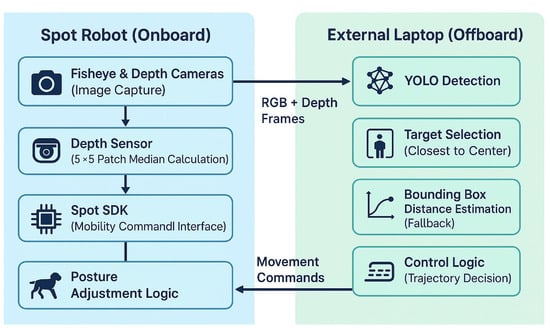
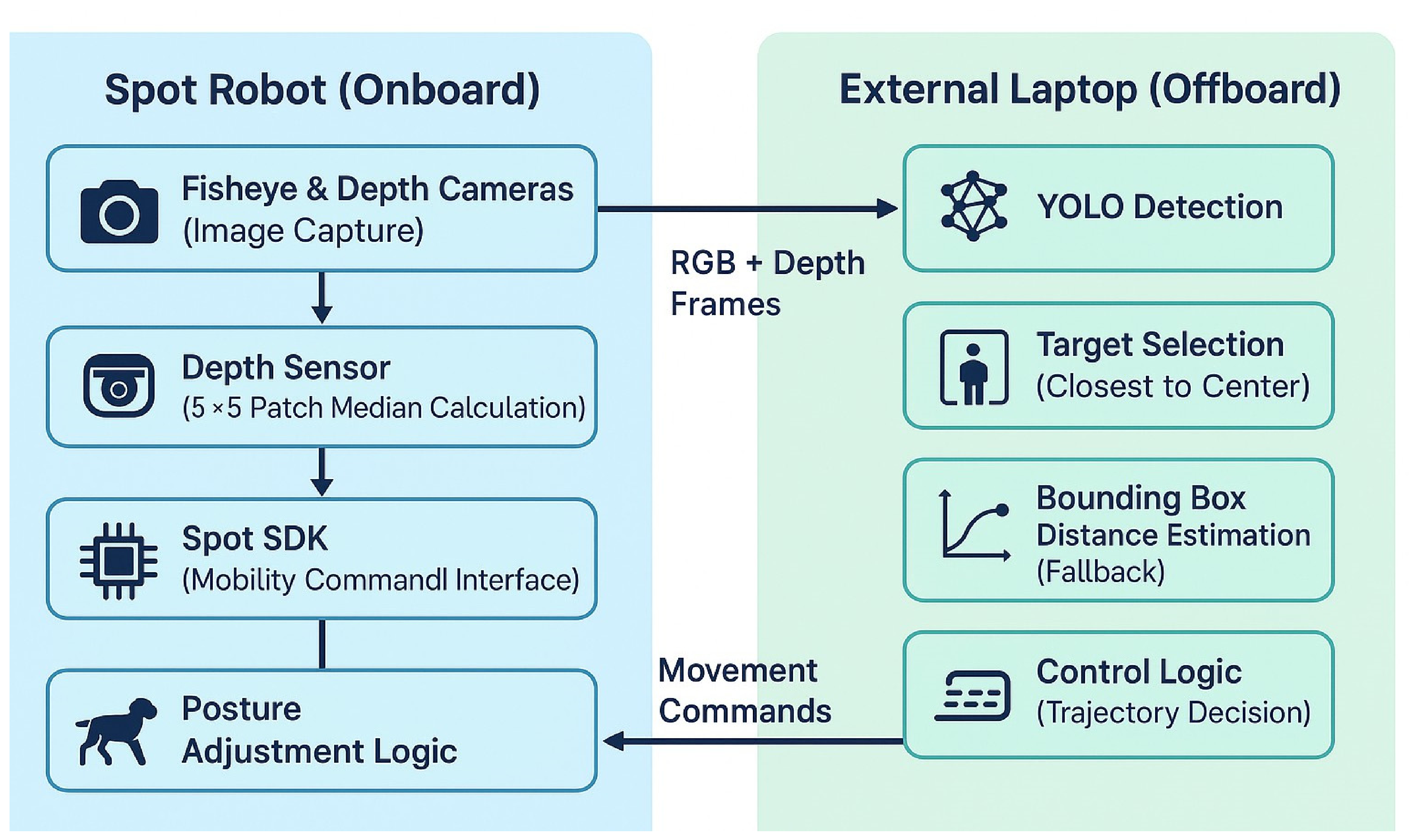
The software was organized as a closed loop: image acquisition → human detection → identity tracking → distance estimation → linear/yaw control → Spot velocity command → next image. The development architecture shown in Figure 1 initially used simple target selection and evaluated spot depth together with bounding-box ranging. In the final implementation, DeepSORT replaced simple target selection for identity-aware association, and geometric bounding-box ranging provided the control distance signal. YOLO returned person bounding boxes and confidence values; DeepSORT maintained track IDs; the selected target bounding-box width was converted to an estimated distance; and the horizontal position of the target centroid provided the yaw error. If no valid target was available, the commanded velocities were set to zero.
Figure 1.
Development-stage modular architecture of the Boston Dynamics Spot human-following system. The diagram shows image acquisition, depth sampling, simple target selection, bounding-box ranging, and Spot control. In the final implementation, the target-selection block was replaced by DeepSORT identity tracking, as described in Section 3.5, and geometric ranging was used for the closed-loop distance signal.
3.3. Human Detection
YOLOv5 and YOLOv8 were evaluated quantitatively in nano and small configurations where available. YOLOv11n was also explored during later development, but the retained logs did not preserve complete frame denominators for all runs; those exploratory results are therefore not used for the formal uncertainty analysis below. Quantitative tests were performed in controlled indoor and natural outdoor environments while the human target moved through close, medium, and far image scales. The purpose was not to produce a standardized object-detection benchmark, but to identify a detector suitable for the complete robot-control pipeline. Accordingly, the principal operational metric was the proportion of evaluated frames in which a valid person-detection was produced. To avoid overstating this quantity, it is referred to throughout as frame-level detection success rate rather than recall or accuracy.
For each processed frame, the system logged detector output, confidence, inference time, CPU load, and RAM consumption. Only class “person” detections above the confidence threshold were passed to subsequent modules.
3.4. Distance Estimation Methods
Two relative-distance methods were compared. The first used spot depth images registered to the arm RGB image. For each person-detection, a small depth patch around the bounding-box centroid was sampled and median filtering was used to reduce the influence of invalid or noisy pixels. Values outside the useful 0–5 m range were rejected.
The second method estimated distance from the detected human width, using a pinhole-camera approximation. With an assumed shoulder/torso width W = 0.45 m, manually calibrated focal length f = 580 pixels, and detected bounding-box width wpx, the estimated range d was calculated as
This estimator is computationally inexpensive and available whenever a valid person bounding box exists. It is not a general metric-depth method, because body size, pose, perspective, partial occlusion, and bounding-box behavior introduce uncertainty. Its suitability was therefore assessed empirically for control rather than assumed from the geometric model.
Analytical sensitivity to effective body width (model-derived, not a new experiment). For a fixed measured pixel width, the geometric estimate is directly proportional to the width assumed by the estimator: . Under an ideal pinhole model in which the actual projected width is W_actual,. At W_assumed = 0.45 m, effective widths of 0.40, 0.45, 0.50 and 0.55 m imply relative range biases of +12.5%, 0%, −10.0% and −18.2%, respectively. For small perturbations, δd/d ≈ δW/W + δf/f − δw_px/w_px. These calculations illustrate sensitivity to projected torso width and detector geometry; they do not establish performance across different participants, orientations, clothing, or occlusions.
3.5. Target Tracking
A tracker parameter max_age = 60 specifies tolerance for unmatched updates, not a verified duration of full occlusion or a guarantee of target re-identification. At 3.2 processed frames per second, 60 frames correspond nominally to about 18.75 s only if the effective update cadence remains constant; this theoretical conversion must not be presented as a measured recovery duration. Track fragmentation in the difficult sequence (6/37) shows a practical re-acquisition limitation.
Two target-association methods were tested. The baseline method used bounding-box continuity and a simple target-selection rule. This approach has minimal overhead but does not represent identity explicitly. The final method used DeepSORT, through the deep_sort_realtime library. DeepSORT combines motion prediction with appearance embeddings, enabling a track to persist across short missed detections and helping to prevent identity switches when multiple people are visible.
The final DeepSORT configuration used max_age = 60 frames, n_init = 3, nn_budget = 100, max_cosine_distance = 0.25, a MobileNet embedder, full-precision embeddings, and CPU execution for the embedder. The first confirmed track was locked as the primary follow target for each session. Tracking experiments logged ID switches, fragmentation events, FPS, CPU usage, and scenario type.
3.6. Motion Control
3.6.1. Discrete Trajectory Control
The initial proof-of-concept used Spot synchronized SE(2) trajectory commands. If the human was too close, the robot moved backward by a short fixed step; if too far, it moved forward. Lateral displacement triggered discrete heading changes of up to approximately ±15°. Although functional, the method introduced pauses between commands and caused jerky, delayed responses when the target moved continuously.
3.6.2. Continuous Velocity Control
The final controller sent synchronized velocity commands rather than discrete pose targets. Forward velocity v_x was computed from the estimated distance using a continuous linear ramp:
v_x = 0, d ≤ d_min or d ≥ d_max;
v_x = v_max · (d − d_min)/(d_max − d_min), d_min < d < d_max.
v_x = v_max · (d − d_min)/(d_max − d_min), d_min < d < d_max.
The implemented parameters were d_min = 0.5 m, d_max = 5.0 m, and v_max = 1.0 m/s. For example, at d = 1.95 m the controller produces approximately 0.32 m/s. The controller therefore accelerates progressively as the person moves away and decelerates as the target approaches the safety region.
Mathematical qualification of Equation (2): The velocity command is continuous only within the open active-follow interval (d_min, d_max). At the upper threshold, its left-hand limit is v_max = 1.0 m/s, whereas the stated out-of-range stop rule commands zero velocity for . The resulting discontinuity may lead to abrupt command changes when range estimates fluctuate around 5.0 m. Accordingly, the implemented law must not be described as globally continuous or as proof of bounded physical acceleration. A hysteresis condition, a separate deceleration region, command-rate limiting, or a time-to-collision-aware controller could mitigate this effect; these modifications were not experimentally evaluated in the reported study.
Quantitative command-law sensitivity (analytical, not measured robot dynamics): within 0.5 < d < 5.0 m, . Thus, a 0.1 m change in estimated target range changes the commanded forward speed by approximately 0.0222 m/s within this interval. These numbers do not quantify robot acceleration, jerk, stopping distance, or overshoot. The implementation described by Equation (2) is retained for historical fidelity; replacing it with a hysteretic, continuously tapered or predictive stop mechanism would require a new implementation and validation.
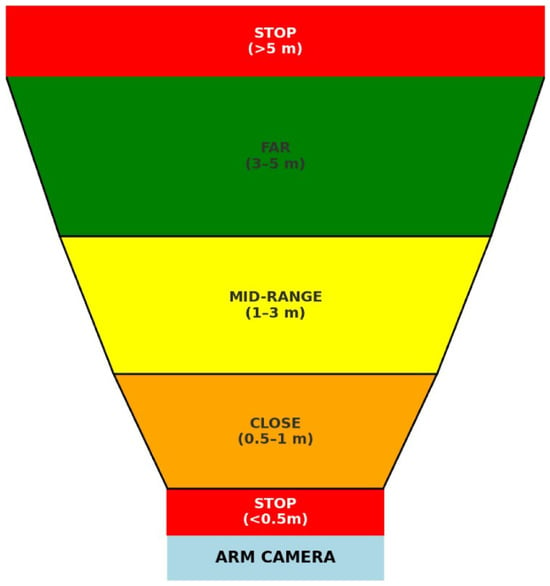
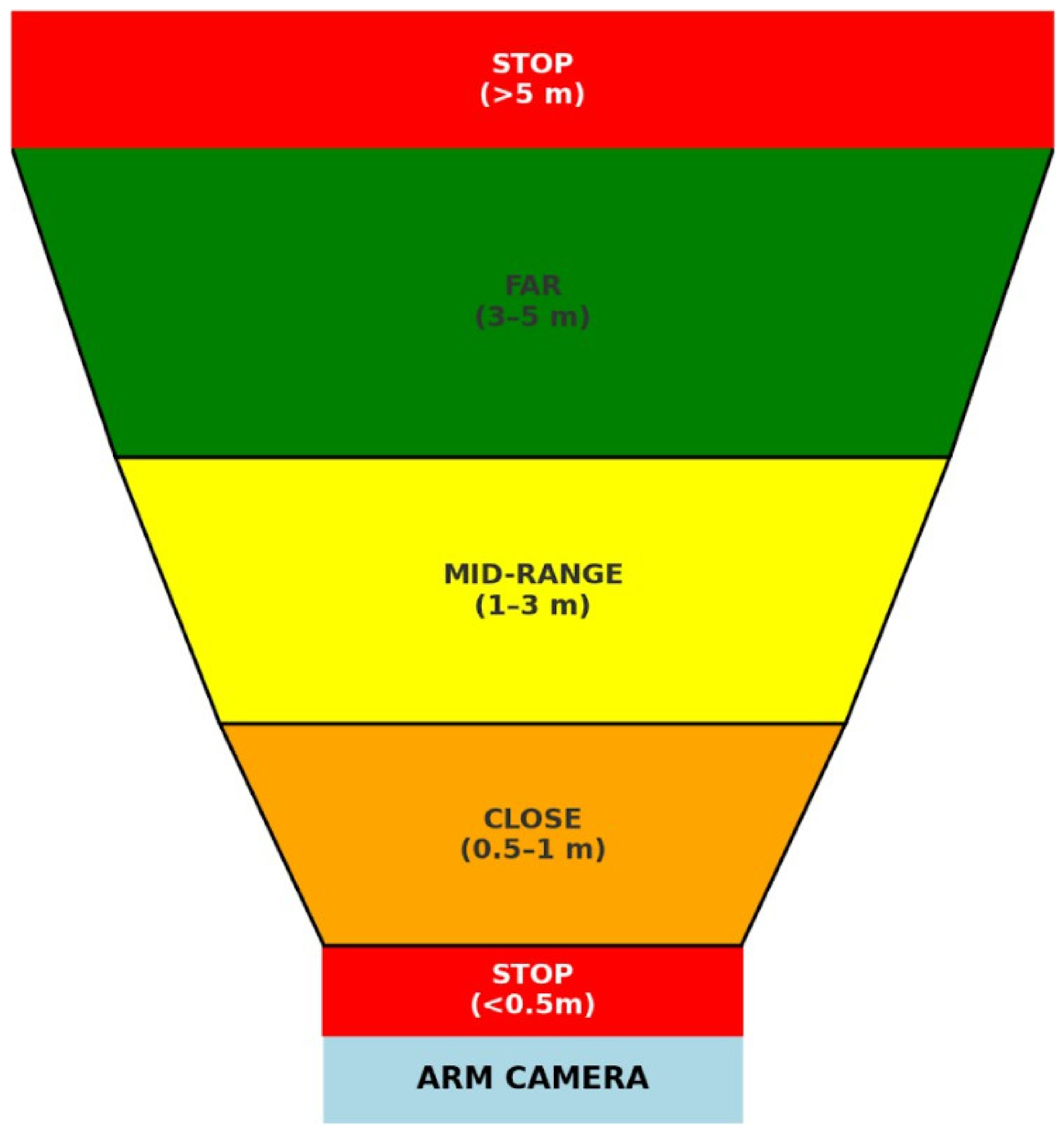
Yaw control used the horizontal target-center error. If x_c is the target bounding-box center and x_0 is the image center, normalized error e = (x_c − x_0)/x_0 was converted to yaw rate ω using a proportional gain. The command was saturated to ±0.5 rad/s and a deadband of approximately 0.05 was used to reduce jitter from small detection fluctuations. The final controller parameters are summarized in Table 2, while the earlier threshold-based distance zones used during controller development are shown in Figure 2.
Table 2.
Final control parameters used for human following.
Figure 2.
Distance zones used during development of the threshold-based velocity controller. The final implementation replaced discrete speed levels with the within-range linear ramp in Equation (2).
Latency and missed-detection implications: Detection latency (approximately 114–118 ms for YOLOv8n in the reported sequences) and DeepSORT throughput (approximately 3.2 frames/s in multi-person sequences) are measured at different stages and must not be added or converted into a verified end-to-end latency without synchronized stage timestamps. A nominal 3.2-frame/s throughput corresponds to about 0.31 s between processed frames if regular; this is an indicative period, not a measured closed-loop response time. Missed detections may extend the time since the last valid target observation. The zero-command behavior on an invalid target is a documented logical safeguard, not a measured stopping-distance guarantee.
4. Experimental Design and Evaluation Metrics
Safety boundary: Built-in obstacle handling by the Spot platform was enabled according to the experimental record, and an illustrative avoidance event was documented. However, a ladder-related follow-path failure was also reported. The custom human-following loop has no independently validated collision-avoidance planner, braking-distance bound, or formal collision-free guarantee. Commands should not be deployed in densely occupied settings without additional safety validation.
The experiments were designed as engineering validation trials under realistic operation rather than as a standardized perception benchmark. Indoor tests used stable illumination, structured backgrounds, and flat flooring. Outdoor tests introduced natural lighting, shadows, variable backgrounds, and larger target ranges. The human target moved between close, medium, and far distances. Tracking tests additionally included zigzag motion, temporary visual interference, and a second person entering the scene.
Detector evaluation used frame-level detection success rate, mean confidence on successful detections, inference time, CPU utilization, and RAM utilization. Tracking evaluation used number of evaluated frames, ID switches, fragmentation events, retained identities, FPS, and CPU utilization. Distance experiments compared measurement availability and representative deviations against approximate reference distances. Because the reference distances were not acquired with a laboratory motion-capture system for every frame, inter-method differences are reported as discrepancies and are not interpreted as strict metrological mean absolute error.
The integrated system was evaluated qualitatively and quantitatively with respect to target retention, responsiveness, stopping behavior, smoothness, and known failure modes. No unsupported mAP, HOTA, IDF1, trajectory RMSE, or statistical significance values are introduced in this manuscript; such metrics require additional labeled data or external ground-truth measurements that were not part of the original experiment.
Statistical and Retrospective Data Analysis
Source-data provenance: The experiments and engineering observations underlying this article are documented in the research record prepared by coauthor M. Kossakov (2025) [22]. The present journal manuscript adds a system-level synthesis, uncertainty-bounded reanalysis, and explicit limitations. The study was conducted through the collective research activities of the author team; the contributions of all seven authors are detailed in the Author Contributions section. Permissions for the reuse of previously documented figures and identifiable images should be verified before publication.
The experimental sequences were originally collected as engineering validation runs. For the present analysis, the logged frame-level outputs were re-evaluated using metrics that can be computed without introducing unobserved data. Detection availability is reported as k/n, together with a two-sided 95% Wilson score interval for the binomial proportion. The interval is descriptive: adjacent video frames are temporally correlated and must not be interpreted as independent biological or experimental replicates.
For outdoor ranging frames with an available field-reference distance, geometric and valid depth estimates were compared using mean absolute error (MAE), root-mean-square error (RMSE), signed bias, and mean absolute percentage error (MAPE): MAE = N-1 and RMSE = sqrt[N-1 ^2]. The field reference was obtained with a practical handheld measurement method and is not equivalent to motion-capture or metrological ground truth; therefore, the resulting error values are reported as field-reference errors rather than sensor-calibration accuracy.
Tracking results are normalized by sequence length, using fragmentation events per 100 processed frames in addition to raw ID-switch counts, FPS, and CPU utilization. No inferential p-values are reported, because the available experiments do not provide independent repeated trials of each configuration. This conservative analysis avoids pseudo-replication and restricts conclusions to the recorded operating conditions.
Generative AI tools were used during the preparation of the manuscript to assist with language and structural editing, literature organization, and checking analytical derivations. No additional robot trials or measured trajectory data were generated as part of this revision. The authors retain responsibility for verification of all sources, calculations, and claims.
5. Results
5.1. Human Detection Performance
YOLOv5s detected the target in 17 of 39 indoor frames (43.6%), with mean confidence 0.857 and mean inference time 159.75 ms. Outdoors, YOLOv5s detected the person in 26 of 70 frames (37.1%), with confidence 0.797 and inference time 167.36 ms. The YOLOv5n outdoor sequence produced 29 detections from 80 frames (36.25%), with a faster mean inference time of 123.75 ms but lower confidence of 0.746.
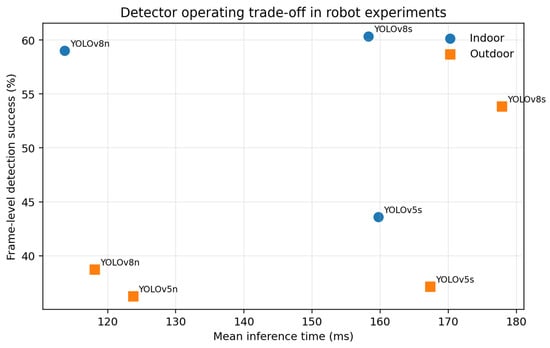
YOLOv8 provided the most favorable observed latency–availability trade-off among the quantitatively logged configurations. YOLOv8n produced 36 detections from 61 indoor frames, corresponding to a 59.0% frame-level success rate. Mean confidence was 0.878 and mean inference time was 113.7 ms. Mean CPU and RAM utilization were 36.0% and 78.7%, respectively. YOLOv8s achieved a similar indoor frame-level success rate of 60.3% (35/58 frames) but required 158.3 ms per frame on average.
Outdoor conditions reduced YOLOv8n detection availability to 38.75% over 80 frames, with mean confidence 0.802 and mean inference time 118.1 ms. YOLOv8s achieved 53.8% (28/52 frames) but required 177.9 ms mean inference time and produced occasional far-range false-positive person-detections. Later YOLOv11n development runs were competitive qualitatively, but their incomplete retained frame denominators prevent a defensible Wilson-interval comparison, and they are therefore excluded from Table 3. YOLOv8n was retained for the integrated system because it provided the lowest logged YOLOv8 latency, stable resource use, and an already validated interface to the downstream tracking and control modules.
Table 3.
Quantitative detector results from experimental sequences with complete retained frame counts. “Success” denotes frame-level person-detection success, not benchmark recall or accuracy.
Uncertainty-Aware Interpretation of Detection Availability
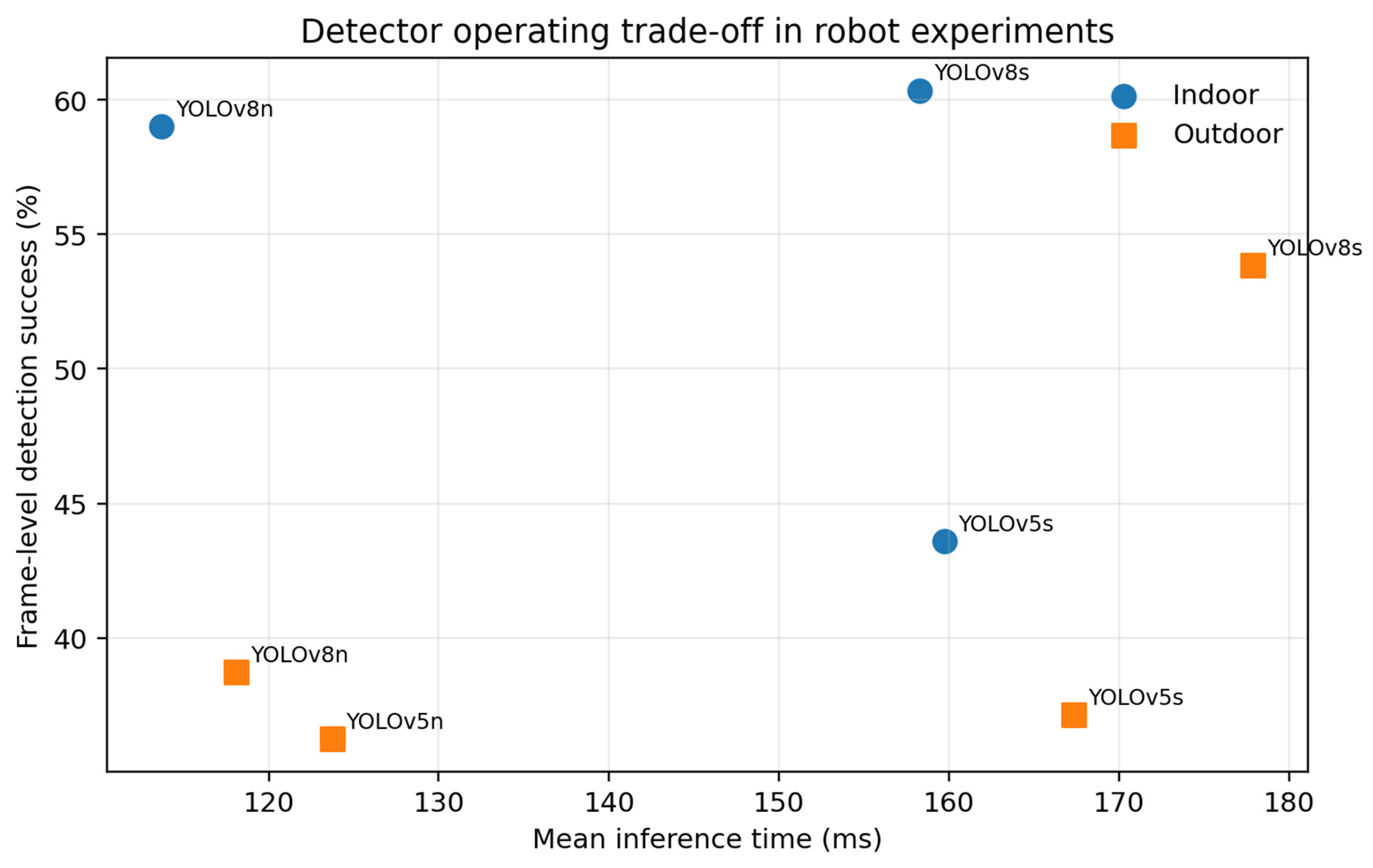
Wilson intervals show substantial overlap between several detector configurations, which is expected given the limited sequence lengths and temporal dependence between adjacent frames. For YOLOv8n, the frame-level success estimate was 59.0% indoors (36/61; 95% CI 46.5–70.5%) and 38.75% outdoors (31/80; 95% CI 28.8–49.7%). YOLOv8s produced 60.3% indoors (35/58; 95% CI 47.5–71.9%) and 53.8% outdoors (28/52; 95% CI 40.5–66.7%). The key deployment distinction was therefore not a statistically asserted difference in recognition probability, but the latency/availability trade-off: YOLOv8n reduced mean inference time by approximately 44 ms indoors and 60 ms outdoors relative to YOLOv8s while remaining compatible with the downstream tracker and control loop. The resulting latency–availability trade-off is visualized in Figure 3, and representative indoor and outdoor detection sequences are shown in Figure 4.
Figure 3.
Operating trade-off between frame-level detection success and mean inference latency for the recorded indoor and outdoor detector sequences. The plotted points are descriptive sequence-level summaries; temporally adjacent frames are not treated as independent experimental replicates.
Figure 4.
Representative YOLOv8 human-detection sequences under indoor and outdoor experimental conditions. (a) Indoor sequence showing the participant at close, intermediate, and longer distances, illustrating partial visibility and changes in apparent target size. (b) Outdoor sequence under natural illumination showing close-range partial framing and changes in target scale and background conditions at increasing distances. The green rectangles indicate the person-detection bounding boxes generated by YOLOv8.
5.2. Distance Estimation Results
Indoors, the depth camera produced valid outputs in 37 of 46 evaluated frames. Nevertheless, individual failures were operationally consequential for closed-loop ranging. At a physical separation of approximately 1.5–2.0 m, the depth stream returned approximately 3.74 m in representative frames, whereas the geometric estimate was approximately 1.7 m. At approximately 0.6 m range, the depth stream returned an invalid value while the geometric method estimated approximately 0.61 m.
Across the indoor sequence, mean depth-camera distance was 2.06 m and mean geometric distance was 1.09 m, corresponding to an average inter-method discrepancy of approximately 0.95 m. These values should not be interpreted as an absolute MAE against independent ground truth; rather, they quantify disagreement between the two estimators in the recorded sequence.
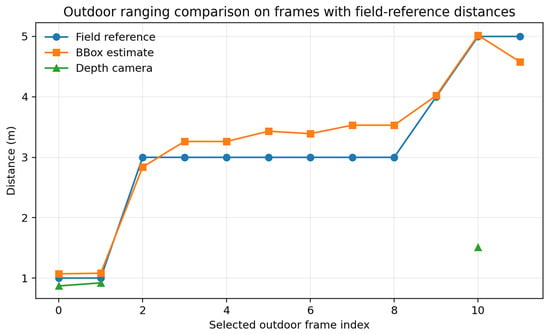
Table 4 shows that 16 of 44 outdoor frames (36.36%) yielded valid spot depth measurements; in the remaining 28 frames (63.64%), the geometric estimator provided the fallback range signal. The original experimental summary listed a mean depth estimate of 1.44 m and a mean geometric estimate of 3.17 m. However, these aggregate means were not demonstrably calculated on the same set of valid paired frames; consequently, their difference (1.73 m) is not an inter-method mean absolute error. The previously reported discrepancy of approximately 2.85 m cannot be reconstructed from those aggregate means and is not retained as a verified performance metric. The preserved 12-frame outdoor field-reference table does include three frames with simultaneously valid depth and geometric estimates (frame_0006, frame_0007, and frame_0027). Their paired absolute inter-method differences are 0.20, 0.16, and 3.51 m, respectively, giving a descriptive mean absolute inter-method difference of 1.29 m on this specifically identified three-frame subset. This subset is not representative of all 44 outdoor frames and must not be interpreted as the outdoor-sequence MAE or as error against independent ground truth.
Table 4.
Availability of spot depth and descriptive outdoor range comparison (aggregation denominators clarified).
Paired-frame verification of the outdoor field-reference subset:
- frame_0006: geometric 1.07 m; depth 0.87 m; |difference| = 0.20 m.
- frame_0007: geometric 1.08 m; depth 0.92 m; |difference| = 0.16 m.
- frame_0027: geometric 5.02 m; depth 1.51 m; |difference| = 3.51 m.
Mean absolute inter-method difference = (0.20 + 0.16 + 3.51)/3 = 1.29 m. These three observations originate from the 12-frame field-reference subset; the remaining nine frames in that subset have invalid depth readings. The calculation describes agreement between instruments, not distance accuracy or a population-level performance estimate.
Field-Reference Error Reanalysis
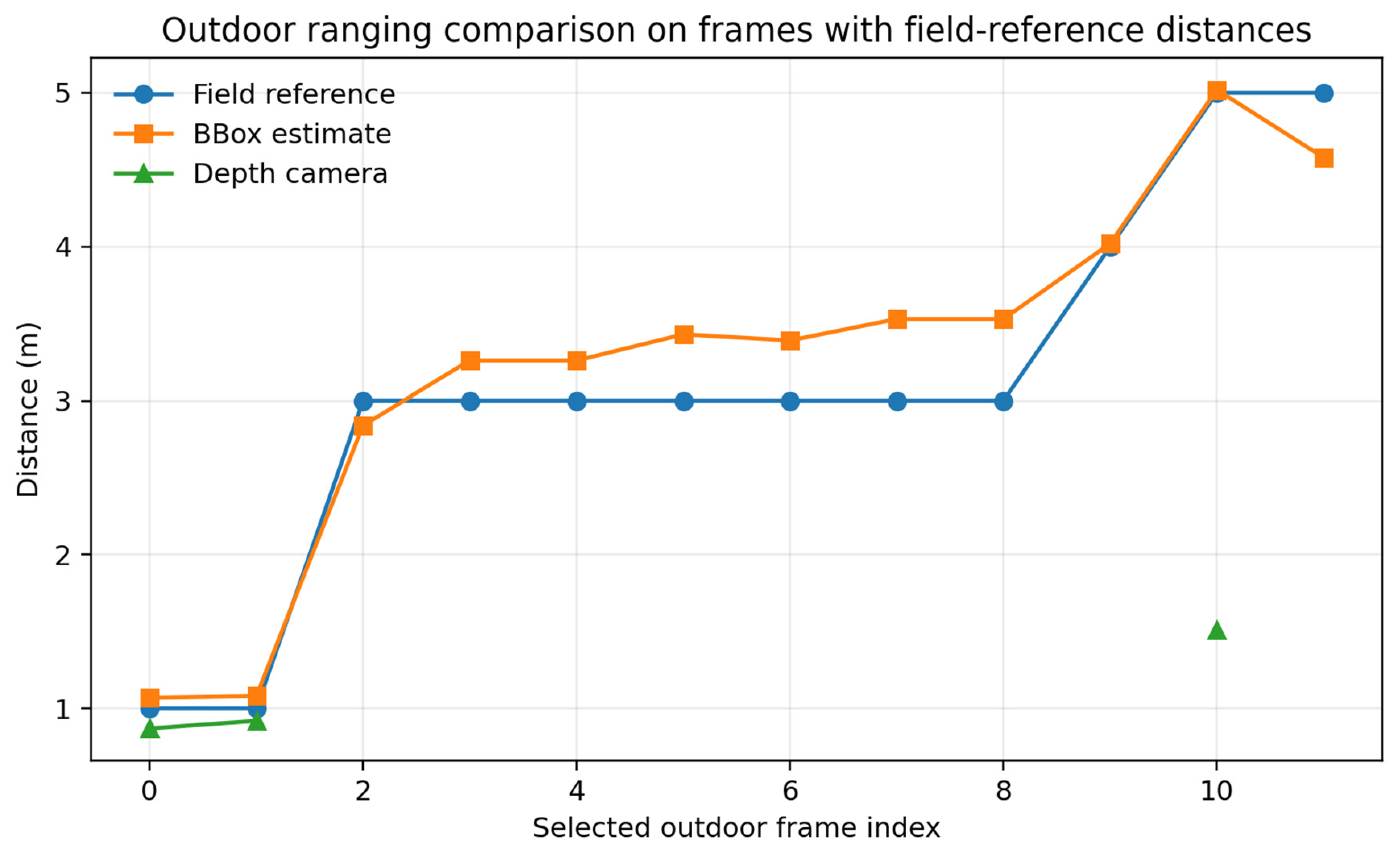
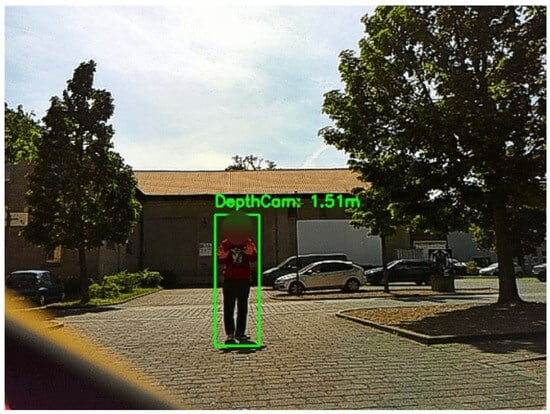
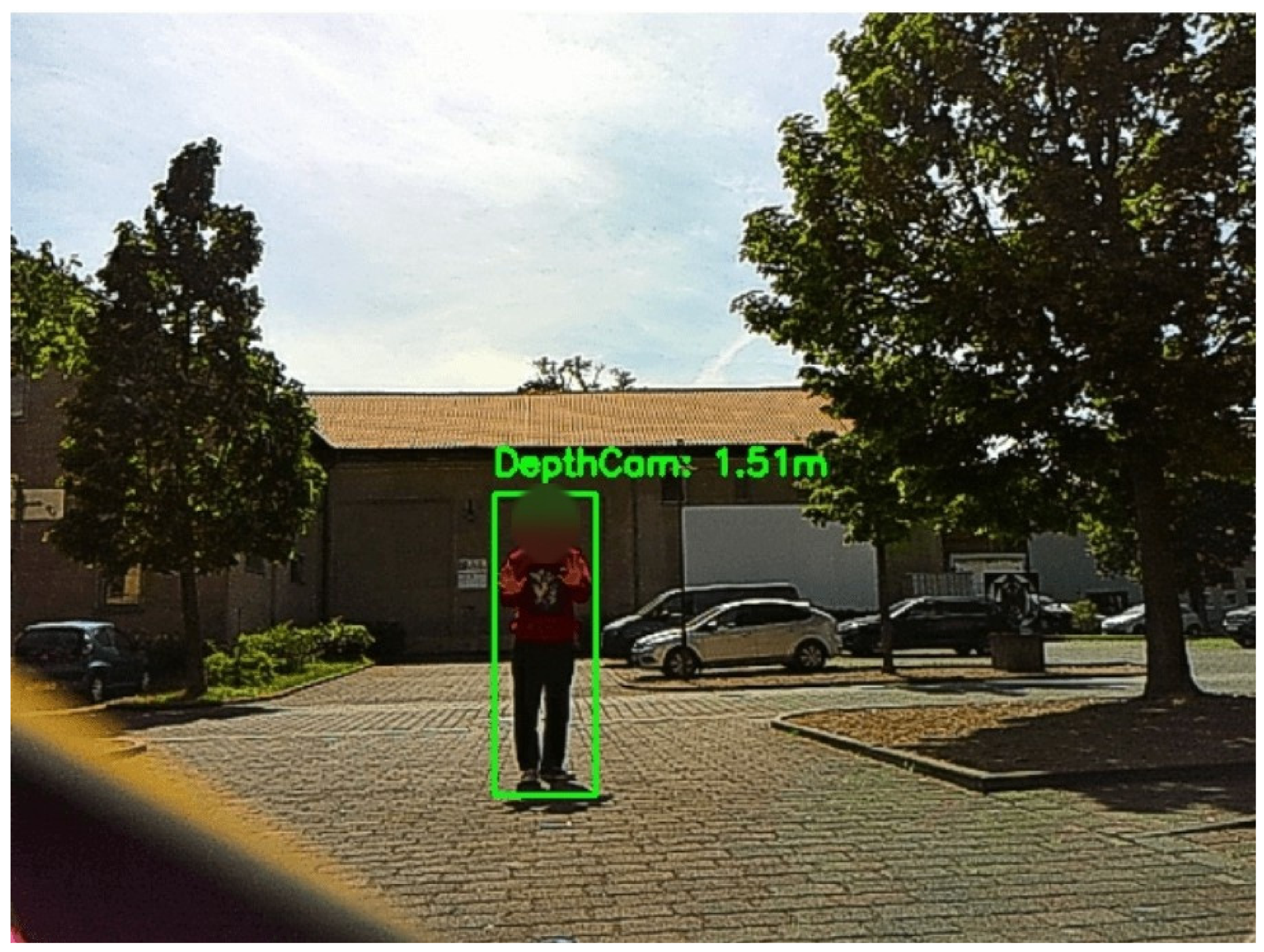
Twelve outdoor frames contained an explicit field-reference distance together with a geometric bounding-box estimate. Across these frames, the geometric estimator yielded MAE = 0.264 m, RMSE = 0.323 m, signed bias = +0.168 m, and MAPE = 9.14%. The depth stream was valid in only three of the same 12 frames; on that small valid subset, MAE was 1.233 m and RMSE was 2.017 m, driven primarily by a 1.51 m depth estimate at an approximately 5 m reference distance. These values should not be generalized as intrinsic sensor accuracy, because the reference measurement was approximate and the valid-depth sample was very small. They do, however, quantify the practical observation that the geometric estimate remained available across the selected field-reference sequence while depth availability was intermittent. The selected field-reference sequence is plotted in Figure 5, and a representative outdoor range-estimation frame is shown in Figure 6.
Figure 5.
Outdoor distance estimates for the 12 selected frames with field-reference distances. Invalid depth values are omitted; the geometric bounding-box estimate was available in all shown frames. Reference measurements were field measurements and not laboratory-grade ground truth.
Figure 6.
Representative outdoor range-estimation frame showing simultaneous person-detection and distance estimation. Outdoor tests exposed frequent invalid or unstable depth-camera measurements, motivating geometric bounding-box ranging for the final controller.
5.3. Tracking Performance
The baseline bounding-box tracker was computationally faster but did not encode appearance-based identity. Indoors, it processed 68 frames, with zero ID switches and two fragmentation events, at 6.59 FPS and 78.9% average CPU usage. Outdoors, it processed 95 frames, with zero ID switches and two fragmentations, at 5.96 FPS and 74.7% CPU usage. These baseline sequences were comparatively simple; when another person entered the scene or the target left and re-entered, the method had no appearance model for verifying that a newly selected box corresponded to the original target.
In the tested multi-person sequences, DeepSORT maintained explicit track identities without observed ID switches or fragmentation. The indoor sequence comprised 51 frames with two consistent identities, zero ID switches, and zero fragmentation events; average processing rate was 3.22 FPS and CPU utilization was 85.1%. The outdoor multi-person sequence comprised 45 frames with the same zero-switch/zero-fragmentation outcome at 3.16 FPS and 81.2% CPU. A deliberately difficult 37-frame sequence involving occlusion, misalignment, and abrupt motion produced six fragmentation events but still no observed ID switch, with CPU utilization increasing to 90.3%. Because the baseline and DeepSORT sequences were not identical controlled repeats, these results are interpreted as engineering evidence of identity-management behavior rather than as an inferential head-to-head tracking benchmark. The tracking results are summarized in Table 5.
Table 5.
Tracking results for baseline bounding-box association and DeepSORT.
Normalized by sequence length, the baseline BBox tracker produced 2.94 fragmentations per 100 frames indoors (2/68) and 2.11 per 100 frames outdoors (2/95). DeepSORT produced 0 fragmentations per 100 frames in the nominal indoor and outdoor multi-person sequences, although the deliberately difficult 37-frame sequence yielded 16.2 fragmentations per 100 frames. DeepSORT reduced throughput from 6.59 to 3.22 FPS indoors (−51.1%) and from 5.96 to 3.16 FPS outdoors (−47.0%), while increasing CPU load by 6.2 and 6.5 percentage points, respectively. The selection of DeepSORT therefore reflects an explicit robustness-versus-throughput decision rather than a claim of computational superiority. Representative indoor and outdoor multi-person tracking sequences are shown in Figure 7.
Figure 7.
Representative DeepSORT-based human-tracking experiments under indoor and outdoor conditions. (a) Indoor multi-person sequence showing the tracking of the selected human target in the presence of another person, illustrating target-identity continuity during movement. (b) Outdoor multi-person sequence showing the selected target being tracked while another person enters and moves through the scene under natural illumination. Green bounding boxes highlight the tracked human target, while additional bounding boxes indicate other detected individuals. The sequences illustrate the role of appearance-aware tracking in maintaining target identity under different experimental conditions.
Tracking interpretation. The simple bounding-box and DeepSORT measurements were collected in different scene sequences. Thus, the indoor rates of 6.59 versus 3.22 FPS and outdoor rates of 5.96 versus 3.16 FPS characterize the respective test conditions, but cannot serve as a matched-sequence ablation or evidence that one tracker always outperforms another. A fair study of lightweight appearance embeddings, SORT/ByteTrack-style association, and accelerated Re-ID requires replaying the same annotated sequences under controlled hardware and software settings.
5.4. Motion-Control Performance and Integrated Following
Trajectory-based motion confirmed that the robot could be moved toward a visually selected person, but the command structure produced visible pauses and abrupt changes. The first continuous velocity controller improved responsiveness by updating linear and yaw commands within a short loop. However, a five-zone threshold strategy still created step changes in speed near zone boundaries, occasionally producing overshoot or oscillation.
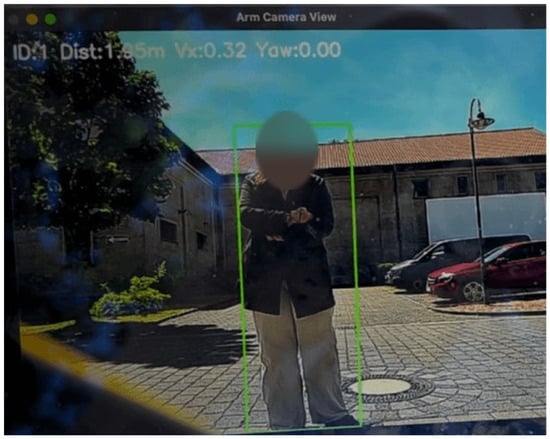
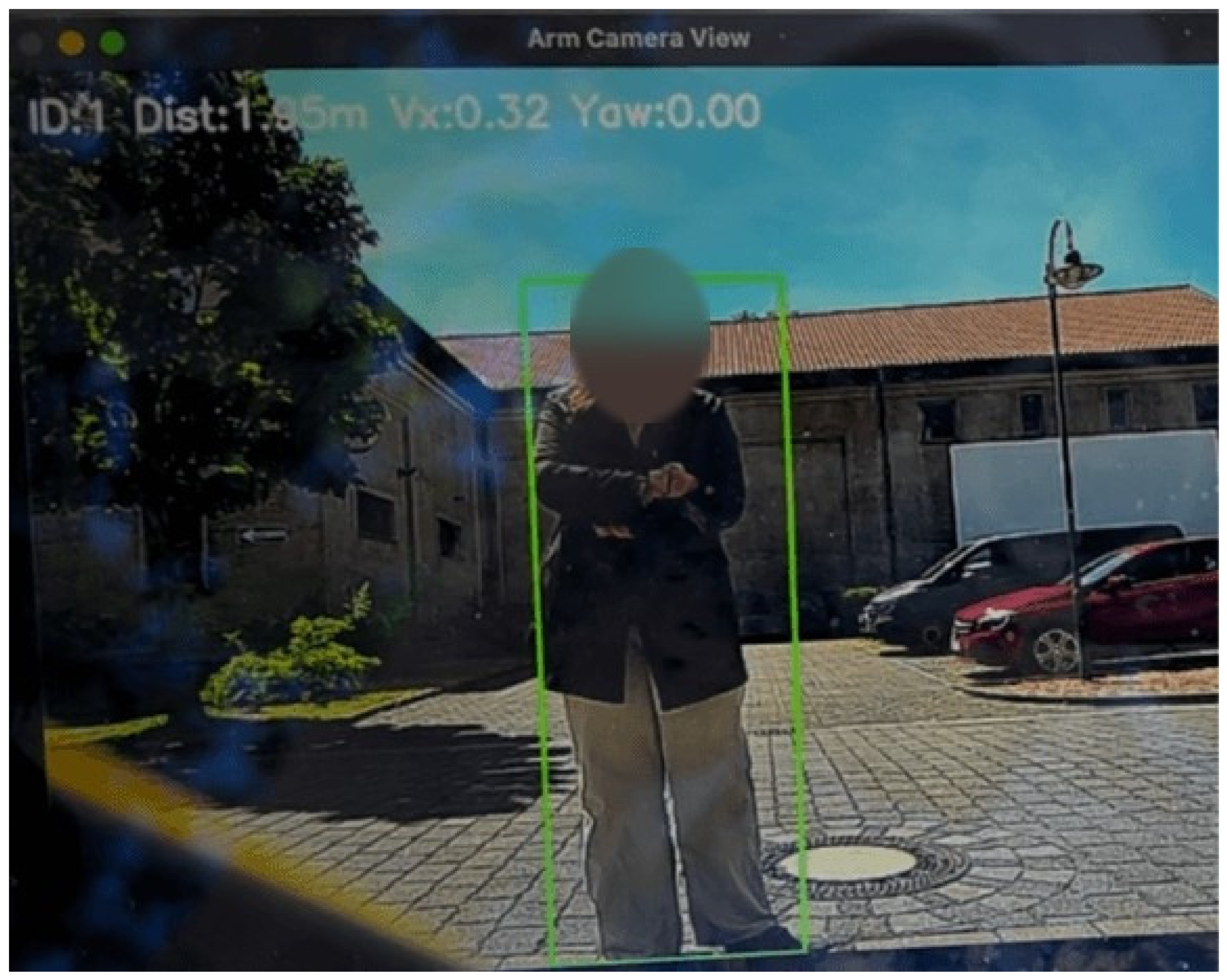
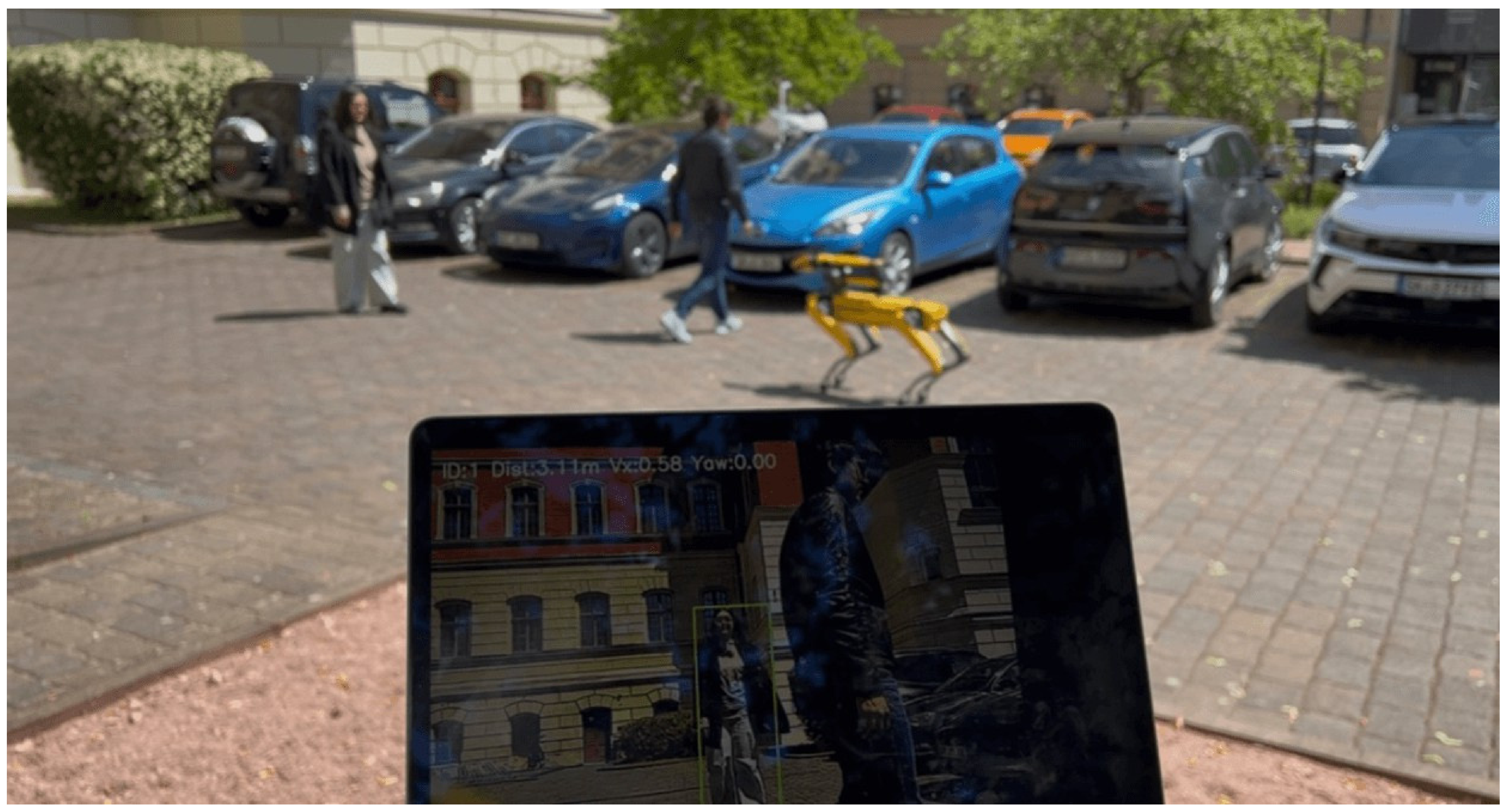
Within the active-follow interval, the final linear ramp replaced stepwise speed-zone commands with a linear dependence of commanded forward speed on estimated distance. The out-of-range stop rule nevertheless introduces a discontinuity at d_max, as clarified in Section 3.6.2. The robot gradually accelerated as the person moved farther away and decelerated as the person approached. The proportional yaw controller maintained orientation toward lateral target motion and could rotate the robot even when forward velocity was near zero. Timing results must be interpreted at module level: YOLOv8n inference was approximately 114–118 ms in the logged sequences, whereas DeepSORT multi-person processing reduced overall tracking throughput to about 3.2 FPS. Velocity commands were issued only when valid target information was available, and the command-validity logic zeroed motion when the selected track became invalid or the target moved outside the defined range. The observed motion was qualitatively smoother than with the preceding discrete trajectory and threshold-based strategies, but no synchronized external trajectory ground truth was available for a quantitative smoothness metric. Figure 8 shows the real-time diagnostic overlay, and Figure 9 shows the outdoor experimental setup.
Figure 8.
Real-time OpenCV diagnostic visualization of the camera-based human-following system during outdoor operation. The green bounding box indicates the detected and tracked human target. The on-screen overlay displays the target identification number (ID), estimated distance to the target (Dist), commanded forward velocity (Vx), and yaw rate (Yaw). These parameters were used to monitor the performance of the integrated detection, tracking, distance estimation, and motion-control system.
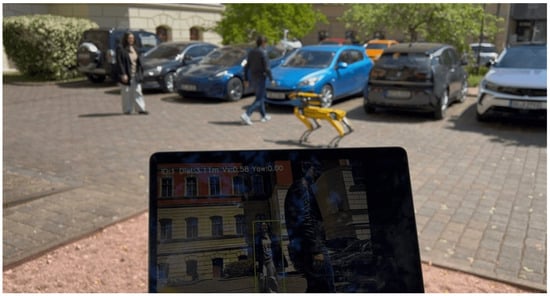
Figure 9.
Outdoor experimental setup of the camera-based human-following system using the Boston Dynamics Spot robot and an external Apple MacBook Pro M1. The photograph illustrates the physical arrangement of the robot and computing equipment. Detailed diagnostic information from the human-following interface is presented separately in Figure 8.
5.5. Failure Cases
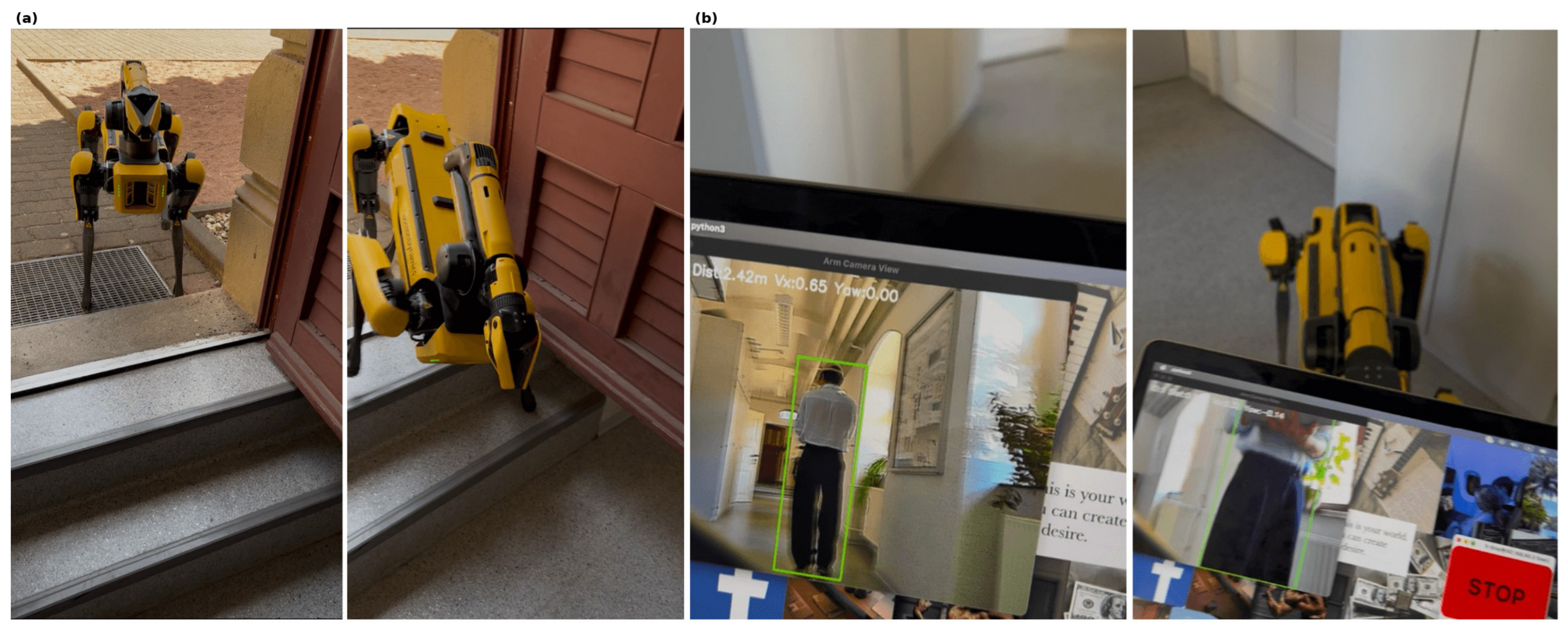
Two failure modes were especially relevant. First, the person-following logic did not constitute a complete obstacle-mapping and path-planning system. In a recorded case, a ladder partially obstructing the path was not handled adequately while human following was prioritized. Second, in a narrow indoor space, the robot could not rotate effectively because the controller lacked a spatially aware fallback behavior. Additional failures included strong outdoor backlighting, long visual occlusions, very close target positions, and crowded scenes in which the first locked track may not be sufficient for persistent target verification. Representative examples of these real-world limitations are shown in Figure 10.
Figure 10.
Representative operational limitations observed during indoor human-following experiments. (a) Two views of the Boston Dynamics Spot robot maneuvering through a narrow doorway and over a threshold, illustrating limited maneuvering clearance and potential obstacle-interaction constraints. (b) Two views of the robot operating in a confined indoor environment with the camera-based human-tracking interface, illustrating limitations in target visibility and visual monitoring. The green bounding box displayed on the interface indicates the detected human target.
Safety-system boundary. The experimental source describes use of Spot built-in obstacle avoidance and illustrates an instance of obstacle-response behavior. That platform function must be distinguished from the custom camera-based person-following control law, which has no independent obstacle map or collision-free local planner. The documented ladder interaction shows that obstacle conflicts can remain. No collision rate, minimum obstacle clearance, or safety guarantee can be inferred from the available records. Future evaluation should include controlled obstacles, emergency-stop testing and synchronized minimum-clearance measurements.
6. Discussion
6.1. System-Level Detector Selection
The detector results illustrate why robot perception should be selected according to closed-loop operating requirements rather than a single computer-vision metric. YOLOv8s achieved higher outdoor frame-level detection success in its recorded sequence, yet YOLOv8n required substantially less inference time and left more processing headroom for tracking, visualization, logging, and command generation. The final detector choice therefore reflects an engineering trade-off for the deployed pipeline rather than a claim that YOLOv8n is universally more accurate than newer or larger models.
The relatively modest frame-level detection success rates also emphasize the importance of temporal association. Successful detections generally had high confidence, but short sequences of missed frames occurred during close occlusion, scale transitions, partial framing, shadows, and backlighting. A person-following robot cannot simply stop or reselect a target on every missed frame; the tracking layer is therefore essential to bridge short perception gaps.
6.2. Identity Preservation Versus Computation
DeepSORT reduced available processing throughput and raised CPU utilization to approximately 80–90%, yet it was retained because the application requires explicit target identity when multiple people are present. In the nominal multi-person sequences, the selected identity was maintained without observed switches. For human-following applications, this distinction is operationally important: selecting a different person changes the behavioral target, whereas a missed detection can instead be handled by temporary persistence or a stop command.
The difficult sequence demonstrates that DeepSORT is not equivalent to persistent re-identification. Six fragmentation events occurred under strong visual variability. If the target is absent for a prolonged interval, the system can still lose continuity. Future systems should therefore distinguish short-term tracking, long-term re-identification, and explicit target authorization.
6.3. Measurement Availability Versus Nominal Depth Accuracy
The depth-estimation comparison produced an important practical result. A dedicated depth sensor is theoretically preferable because it measures range directly. However, the recorded spot depth stream sometimes returned invalid or implausible values, particularly outdoors. In contrast, the geometric estimator is inherently approximate but remains available whenever a person bounding box is available. In a closed-loop controller, continuous, bounded, and predictable estimates can be more useful than a nominally more accurate sensor that intermittently fails.
This should not be interpreted as evidence that bounding-box ranging is inherently more accurate than RGB-D sensing. The geometric method depends on assumed human width, camera calibration, pose, and detector geometry. The conclusion is narrower: for the specific system and conditions tested, the geometric estimate provided a more consistent signal for velocity control. Future work should fuse multiple sensors rather than permanently discard depth information.
6.4. Control Evolution and Human-Aware Motion
The clearest behavioral improvement arose from the transition from discrete trajectory commands to continuous velocity control. SE(2) point commands were useful for validating end-to-end connectivity and safe motion, but they produced a stop–start response when the human moved continuously. Threshold-based velocity control removed most command pauses but still introduced discontinuities at distance boundaries. The final linear ramp mapped perception directly to speed and reduced these boundary effects.
A limitation remains when the human stops abruptly. The controller reacts to current estimated distance but does not explicitly predict target velocity. Spot can therefore overshoot before the measured separation becomes small enough to reduce the command. Human-motion prediction, acceleration limiting, or model-predictive control could improve this behavior.
6.5. Comparison with Recent Quadruped Person-Following Systems
Table 6 positions the present system relative to representative recent quadruped person-following studies. The comparison highlights both a limitation and a contribution. In control and navigation sophistication, predictive and obstacle-aware systems such as the recent ANYmal leader-following framework [20] exceed the present proportional follow controller. Conversely, the present study provides an explicit engineering record of how detector, range source, tracker, and command mode were selected and evaluated on a commercial Spot platform. This distinction is central to the paper: the contribution is the experimentally documented system-level trade-off analysis and failure characterization, not a claim of state-of-the-art trajectory-tracking accuracy.
Table 6.
Comparison with representative recent quadruped human-following systems. Reported metrics are not directly comparable because platforms, sensors, environments, and evaluation protocols differ.
6.6. Scientific Scope, Threats to Validity, and Generalizability
Four threats to validity are particularly important. First, the unit of analysis for detector experiments is the frame, but adjacent frames are temporally correlated; confidence intervals therefore describe sequence uncertainty rather than independent repeated trials. Second, only a limited number of people and environments were used, so body-size variation, clothing, gait, and crowd density are underrepresented. Third, the outdoor reference distances were obtained using a practical handheld measurement method instead of synchronized motion capture, limiting the metrological interpretation of ranging errors. Fourth, motion-control quality was assessed from command logs, live overlays, and observed robot behavior rather than from synchronized robot/person trajectories; consequently, the study cannot report path RMSE, overshoot distributions, or stopping-distance confidence intervals. These limitations are explicitly retained to prevent the paper from overstating the evidence.
The experiments provide a physical validation of a working system, but they do not constitute a population-level human–robot interaction trial or a standardized computer-vision benchmark. Frame counts were limited, the number of participants was small, and several reference distances were obtained using practical field-measurement tools. Consequently, the numerical results should be interpreted as engineering evidence supporting algorithm selection for this prototype. A similar emphasis on physical prototype validation and explicitly bounded engineering claims has been used by members of the author team in prior field-validation work in another engineering domain [23].
This distinction is important for reproducibility and scientific accuracy. Future validation should include synchronized external ground truth for human and robot pose, repeated runs with multiple participants, controlled illumination conditions, statistical analysis across trials, and standard tracking metrics such as IDF1 or HOTA. Detector comparison should also be repeated on a labeled sequence derived from the actual Spot camera viewpoint so that precision, recall, and mAP can be calculated correctly.
Occlusion and participants. In the 37-frame difficult DeepSORT test, six fragmentation events were recorded; this is evidence of interrupted track continuity despite zero observed ID switches. The configuration parameter max_age = 60 concerns internal track retention, not demonstrated long-term re-acquisition or recognition of a person after full loss of sight. The limited and incompletely characterized participant sample precludes conclusions about robustness across clothing, body shape, and gait. New repeated trials stratified by these variables are required to test generalization.
6.7. Reproducibility and Data Traceability
The original implementation was separated into modules for human detection, tracking, distance estimation, and velocity-based motion control. Logged variables included timestamps, frame identifiers, detection state, confidence, inference time, CPU/RAM usage, tracking ID, fragmentation events, FPS, bounding-box width, distance estimates, selected range source, and visualization outputs. This structure enables independent reanalysis of the perception subsystems even when synchronized robot–human trajectory ground truth is unavailable.
Reproducibility clarification: Statements that synchronized robot–human trajectory ground truth, population-level gait generalization, long-duration full-occlusion recovery, or head-to-head competitor benchmarks were quantitatively established would go beyond the documented experimental data. The paper therefore limits claims of improved smoothness to qualitative movement observations and mathematical properties of the commanded velocity law. End-to-end latency cannot be inferred by adding unrelated mean detector inference time and tracking FPS, because measurements were not recorded for an identical synchronized loop.
The available underlying research record documents detector and tracking summaries, the outdoor field-reference subset, and implementation parameters. Full original frame-level logs and source code have not been verified as publicly accessible; consequently, this manuscript does not imply that a public dataset or repository has been released.
7. Limitations and Future Work
A natural extension is multi-sensor perception. Camera detections can be fused with depth, odometry, inertial state, and environmental range sensing so that individual sensor failures do not directly propagate to the controller. If raw range information becomes readily accessible through the deployed Spot configuration, confidence-weighted fusion could preserve the responsiveness of the current system while improving range accuracy and obstacle awareness. The principal limitations and corresponding research directions are summarized in Table 7.
Table 7.
Principal limitations identified in the experiments, and corresponding research directions.
The second priority is obstacle-aware following. Instead of commanding velocity directly from human location, the tracked person should define a moving navigation objective. A local planner can then choose a collision-free robot velocity while preserving a socially appropriate separation. This architecture would also improve behavior in narrow corridors and around static obstacles.
Third, long-term person identity should be separated from short-term tracking. A persistent Re-ID representation, explicit visual registration, wearable tag, or multimodal identity cue could allow the robot to re-acquire the correct person after long occlusion or complete departure from the camera view. In crowded environments, target verification is necessary even when DeepSORT maintains stable local track IDs.
Finally, future experiments should use external metric ground truth to quantify distance error, following-distance regulation, heading error, stopping distance, reacquisition time, and path smoothness. Repeated trials with multiple participants would allow confidence intervals and significance testing. These measurements would move the system from proof-of-feasibility engineering validation toward a rigorous comparative robotics benchmark.
8. Conclusions
This study developed and experimentally evaluated a closed-loop vision-based human-following pipeline on the Boston Dynamics Spot quadruped robot. The final system combined YOLOv8n person-detection, DeepSORT identity tracking, monocular geometric ranging from bounding-box width, and bounded distance-dependent linear/yaw velocity control. In the recorded sequences, YOLOv8n provided lower latency than YOLOv8s while retaining usable detection availability; DeepSORT maintained zero observed ID switches in the nominal indoor and outdoor multi-person tests but reduced tracking throughput to approximately 3.2 FPS; and the geometric ranging method remained available across the 12-frame outdoor field-reference subset, with MAE = 0.264 m and RMSE = 0.323 m, whereas spot depth was intermittently unavailable. Replacing discrete trajectory and threshold-based speed commands with a continuous distance-dependent velocity ramp produced qualitatively smoother following behavior and explicit zero-velocity behavior when the selected target became invalid or left the active range.
The scientific contribution is a system-level experimental analysis of how detector latency, target-identity continuity, range-signal availability, computational load, and motion-control design interact on a commercial quadruped robot. The evidence supports the feasibility of an RGB-based final follow loop without external positioning infrastructure, while the documented failure cases show that practical deployment still requires obstacle-aware navigation, multisensor fusion or confidence-aware ranging, persistent re-identification, predictive motion control, and validation with synchronized external ground truth and repeated participant trials. The conclusions are therefore limited to the tested operating conditions and are intended as reproducible engineering guidance rather than as a universal performance benchmark.
Author Contributions
Conceptualization, D.K., N.S. and J.U.; methodology, D.K., M.M., N.S. and J.U.; software, M.M., M.K. and A.K.; validation, N.S., J.U., M.T. and A.K.; formal analysis, D.K., N.S. and M.K.; investigation, N.S., M.M., J.U., M.T. and A.K.; resources, D.K. and J.U.; data curation, M.M., M.K. and A.K.; writing—original draft preparation, N.S., M.M. and D.K.; writing—review and editing, D.K., J.U., M.T., M.K. and A.K.; visualization, M.M., M.K. and A.K.; supervision, D.K.; project administration, D.K. All authors have read and agreed to the published version of the manuscript.
Funding
This research received no external funding. All research activities were carried out independently by the authors without financial support from grants, sponsors, or external funding organizations.
Institutional Review Board Statement
The experiments involved the voluntary participation of university researchers and staff as visual tracking targets; no external participants were recruited. Photographic and video illustrations included in the manuscript were anonymized. No institutional ethics approval or exemption identifier is reported because the available documentation does not establish a verified ethics-review determination.
Informed Consent Statement
The university researchers and staff took part voluntarily and, according to the author team, provided verbal consent for participation and experimental recordings. Illustrations included in the manuscript were anonymized. No written consent to publish identifiable images is claimed.
Data Availability Statement
The numerical results analyzed in this study are reported in the article and in the cited underlying research record. The original frame-level experimental logs and source code have not been deposited in a public repository, and their availability has not been independently verified. No additional raw data availability is claimed.
Acknowledgments
During the preparation of this manuscript, the authors used ChatGPT (OpenAI, San Francisco, CA, USA; web application, https://chatgpt.com/; accessed on 23–24 September 2026; exact model version not recorded) for language refinement, structural editing, bibliographic consistency checks, and assistance in verifying descriptive statistical calculations. The authors reviewed and edited all AI-assisted outputs and take full responsibility for the content of this publication.
Conflicts of Interest
The authors declare no conflicts of interest.
References
- Boston Dynamics. Spot. Available online: https://bostondynamics.com/products/spot/ (accessed on 23 September 2026).
- Eirale, A.; Martini, M.; Chiaberge, M. Human Following and Guidance by Autonomous Mobile Robots: A Comprehensive Review. IEEE Access 2025, 13, 42214–42253. [Google Scholar] [CrossRef] [Scilit]
- Halder, S.; Afsari, K. Robots in Inspection and Monitoring of Buildings and Infrastructure: A Systematic Review. Appl. Sci. 2023, 13, 2304. [Google Scholar] [CrossRef] [Scilit]
- Islam, M.J.; Hong, J.; Sattar, J. Person-Following by Autonomous Robots: A Categorical Overview. Int. J. Robot. Res. 2019, 38, 1581–1618. [Google Scholar] [CrossRef] [Scilit]
- Montesdeoca, J.; Toibero, J.M.; Jordan, J.; Zell, A.; Carelli, R. Person-Following Controller with Socially Acceptable Robot Motion. Robot. Auton. Syst. 2022, 153, 104075. [Google Scholar] [CrossRef] [Scilit]
- Wang, A.; Makino, Y.; Shinoda, H. Real-Time Person-Following Robot: Front-Following Using Human Motion Prediction. In Proceedings of the 2024 IEEE International Conference on Systems, Man, and Cybernetics (SMC), Kuching, Sarawak, Malaysia, 6–10 October 2024; IEEE: Piscataway, NJ, USA, 2024; pp. 3851–3856. [Google Scholar] [CrossRef] [Scilit]
- Boston Dynamics. Spot SDK Documentation. Available online: https://dev.bostondynamics.com/ (accessed on 23 September 2026).
- Ultralytics. Ultralytics YOLO Documentation. Available online: https://docs.ultralytics.com/ (accessed on 23 September 2026).
- Mota, K.O.S.; De Oliveira, D.S.; Garrote, L.; Premebida, C. Multimodal Human Detection Using YOLO and Representation Learning for Robot Perception. In Proceedings of the 2024 7th Iberian Robotics Conference (ROBOT 2024), Madrid, Spain, 6–8 November 2024; IEEE: Piscataway, NJ, USA, 2024; pp. 1–6. [Google Scholar] [CrossRef] [Scilit]
- Sary, I.P.; Andromeda, S.; Armin, E.U. Performance Comparison of YOLOv5 and YOLOv8 Architectures in Human Detection using Aerial Images. Ultim. Comput. J. Sist. Komput. 2023, 15, 8–13. [Google Scholar] [CrossRef] [Scilit]
- Pereira, R.; Carvalho, G.; Garrote, L.; Nunes, U.J. Sort and Deep-SORT Based Multi-Object Tracking for Mobile Robotics: Evaluation with New Data Association Metrics. Appl. Sci. 2022, 12, 1319. [Google Scholar] [CrossRef] [Scilit]
- Franke, M.; Gopinath, V.; Reddy, C.; Ristić-Durrant, D.; Michels, K. Bounding Box Dataset Augmentation for Long-Range Object Distance Estimation. In Proceedings of the IEEE/CVF International Conference on Computer Vision Workshops (ICCVW), Virtual Conference, 11–17 October 2021; IEEE: Piscataway, NJ, USA, 2021; pp. 1669–1677. [Google Scholar] [CrossRef] [Scilit]
- Yu, J.; Choi, H. YOLO MDE: Object Detection with Monocular Depth Estimation. Electronics 2022, 11, 76. [Google Scholar] [CrossRef] [Scilit]
- Mertan, A.; Duff, D.J.; Unal, G. Single Image Depth Estimation: An Overview. Digit. Signal Process. 2022, 123, 103441. [Google Scholar] [CrossRef] [Scilit]
- Zhao, Y.; Gao, Y.; Sun, Q.; Tian, Y.; Mao, L.; Gao, F. A Real-Time Low-Computation Cost Human-Following Framework in Outdoor Environment for Legged Robots. Robot. Auton. Syst. 2021, 146, 103899. [Google Scholar] [CrossRef] [Scilit]
- Liu, J.; Chen, X.; Wang, C.; Zhang, G.; Song, R. A Person-Following Method Based on Monocular Camera for Quadruped Robots. Biomim. Intell. Robot. 2022, 2, 100058. [Google Scholar] [CrossRef] [Scilit]
- Bouman, A.; Ginting, M.F.; Alatur, N.; Palieri, M.; Fan, D.D.; Touma, T.; Pailevanian, T.; Kim, S.; Otsu, K.; Burdick, J.; et al. Autonomous Spot: Long-Range Autonomous Exploration of Extreme Environments with Legged Locomotion. In Proceedings of the 2020 IEEE/RSJ International Conference on Intelligent Robots and Systems (IROS), Las Vegas, NV, USA, 25–29 October 2020; IEEE: Piscataway, NJ, USA, 2020; pp. 2518–2525. [Google Scholar] [CrossRef] [Scilit]
- Li, Z.; Li, B.; Liang, Q.; Liu, W.; Hou, L.; Rong, X. A Quadruped Robot Obstacle Avoidance and Personnel Following Strategy Based on Ultra-Wideband and Three-Dimensional Laser Radar. Int. J. Adv. Robot. Syst. 2022, 19, 1–16. [Google Scholar] [CrossRef] [Scilit]
- Kossakov, M. Development and Evaluation of an Autonomous Human-Following System Using Camera-Based Detection Methods on Boston Dynamics Spot Robot. Master’s Thesis, Anhalt University of Applied Sciences, Köthen, Germany, 2025. [Google Scholar]
- Hu, Z.; Su, R.; Zhang, K.; Xu, Z.; Ma, R. Resilient Event-Triggered Model Predictive Control for Adaptive Cruise Control Under Sensor Attacks. IEEE/CAA J. Autom. Sin. 2023, 10, 807–809. [Google Scholar] [CrossRef] [Scilit]
- Zou, J. Predictive visual control framework of mobile robot for solving occlusion. Neurocomputing 2021, 423, 474–489. [Google Scholar] [CrossRef] [Scilit]
- Nowakowski, M.; Kurylo, J.; Dabrowski, P. Object Tracking-Based “Follow-Me” for Optionally Unmanned Ground Vehicles. Def. Sci. J. 2025, 75, 199–205. [Google Scholar] [CrossRef] [Scilit]
- Karmanov, D.; Umbetbekov, A.; Tulyubaeva, Z.; Utemuratov, J.; Duisengali, A.; Seiitkazy, N. Engineering Optimization and Field Validation of a Low-Traction Rotary Strip-Tillage and Precision Seeding System for Irrigated Sierozem Soils of Southern Kazakhstan. AgriEngineering 2026, 8, 168. [Google Scholar] [CrossRef] [Scilit]





Disclaimer/Publisher’s Note: The statements, opinions and data contained in all publications are solely those of the individual author(s) and contributor(s) and not of MDPI and/or the editor(s). MDPI and/or the editor(s) disclaim responsibility for any injury to people or property resulting from any ideas, methods, instructions or products referred to in the content. |
© 2026 by the authors. Licensee MDPI, Basel, Switzerland. This article is an open access article distributed under the terms and conditions of the Creative Commons Attribution (CC BY) license.