You are currently viewing a new version of our website. To view the old version click .

Atoms, Volume 12, Issue 4

April 2024 - 8 articles

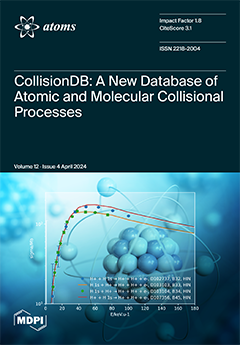
Cover Story: CollisionDB is an open, free, robust and long-term repository of data on plasma collisional processes. The database contains peer-reviewed data on cross sections and rate coefficients for collisions of electrons, photons and heavy particles with atomic and molecular species. Each dataset is associated with verified metadata in a standardized, machine-readable format. CollisionDB offers both a browser-based search interface and an application programming interface (API) that allows users to filter, process and compare collisional datasets. We present an overview of the technical developments, including data schemas, standards and the user interface, underlying the CollisionDB application, with particular emphasis on the API developed to support the integration of data into modeling and other codes. View this paper
  • Issues are regarded as officially published after their release is announced to the table of contents alert mailing list .
  • You may sign up for email alerts to receive table of contents of newly released issues.
  • PDF is the official format for papers published in both, html and pdf forms. To view the papers in pdf format, click on the "PDF Full-text" link, and use the free Adobe Reader to open them.

Articles (8)

  • Feature Paper
  • Review
  • Open Access
3 Citations
2,716 Views
55 Pages

17 April 2024

Modeling plasmas in terms of atoms or ions is theoretically appealing for several reasons. When it is relevant, the notion of atom or ion in a plasma provides us with an interpretation scheme of the plasma’s internal functioning. From the stand...

  • Article
  • Open Access
2 Citations
2,221 Views
8 Pages

Bond Rearrangement Produces Oxygen from Carbon Dioxide

  • Kamal Kumar,
  • Jibak Mukherjee,
  • Harpreet Singh and
  • Deepankar Misra

17 April 2024

We present a direct observation where fragmentation of the CO22+ dication, upon highly charged ion impact, leads to the formation of molecular oxygen. We assert that molecular bending and bond stretching modes of the dication represent the underlying...

  • Article
  • Open Access
3 Citations
2,056 Views
37 Pages

17 April 2024

The broad emission bump in the electromagnetic spectra observed following the detection of gravitational waves created during the kilonova event of the merging of two neutron stars in August 2017, named GW170817, has been linked to the heavy elements...

  • Perspective
  • Open Access
2 Citations
2,819 Views
44 Pages

16 April 2024

Multipulse laser–matter interactions initiate nonlinear and nonequilibrium plasma fluid flow dynamics and their instability creating microscale vortex filaments, loop-soliton chains, and helically paired structures, similar to those at the astr...

  • Article
  • Open Access
5 Citations
2,175 Views
17 Pages

Enhancement of the NORAD-Atomic-Data Database in Plasma

  • Sultana N. Nahar and
  • Guillermo Hinojosa-Aguirre

9 April 2024

We report recent enhancements to the online atomic database at the Ohio State University, NORAD-Atomic-Data, that provide various parameters for radiative and collisional atomic processes dominant in astrophysical plasma. NORAD stands for Nahar Osu R...

  • Review
  • Open Access
6 Citations
3,370 Views
27 Pages

1 April 2024

This article reviews the advances made during the past two decades in the application of Laser-Induced Breakdown Spectroscopy (LIBS) to biological samples, specifically soft tissues (both animal and human). The first sections include a historical ove...

  • Article
  • Open Access
4 Citations
2,740 Views
18 Pages

27 March 2024

The Atomic and Molecular Data Unit of the International Atomic Energy Agency has developed a new database, CollisionDB, to provide an open, free, robust and long-term repository of data on plasma collisional processes. The database contains data on c...

  • Article
  • Open Access
2 Citations
2,026 Views
13 Pages

22 March 2024

Spectral line shapes code in plasmas (SLSPs) code comparison workshops have been organized in the last decade with the aim of comparing the spectra obtained with independently developed analytical and numerical models. Here, we consider the simultane...

Get Alerted

Add your email address to receive forthcoming issues of this journal.

XFacebookLinkedIn
Atoms - ISSN 2218-2004