

You are currently viewing a new version of our website. To view the old version click .

Universe, Volume 6, Issue 7

July 2020 - 12 articles

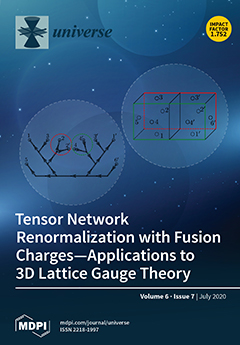
Cover Story: Tensor network methods are powerful tools to study the properties of statistical and quantum systems. Here we present a new tensor network algorithm for (2+1)-dimensional lattice gauge theory, based on the fusion basis. The fusion basis diagonalizes a hierarchical set of Wilson and ’t Hooft loops. It therefore allows direct access to these observables. As opposed to the previously employed spin network basis, the fusion basis is stable under coarse graining. Furthermore, the algorithm implements predefined disentanglers that remove short-scale entanglement. We apply this new algorithm to lattice gauge theories defined for a quantum deformation of SU(2) and identify the critical couplings for different deformations. The results indicate the absence of a deconfining phase for the undeformed case. View this paper.
  • Issues are regarded as officially published after their release is announced to the table of contents alert mailing list .
  • You may sign up for email alerts to receive table of contents of newly released issues.
  • PDF is the official format for papers published in both, html and pdf forms. To view the papers in pdf format, click on the "PDF Full-text" link, and use the free Adobe Reader to open them.

Articles (12)

  • Article
  • Open Access
16 Citations
4,885 Views
23 Pages

The generation of relativistic jets in active sources such as blazars is a complex problem with many aspects, most of them still not fully understood. Relativistic jets are likely produced by the accretion of matter and magnetic fields onto spinning...

  • Article
  • Open Access
7 Citations
3,547 Views
16 Pages

A Plausible Model of Inflation Driven by Strong Gravitational Wave Turbulence

  • Sébastien Galtier,
  • Jason Laurie and
  • Sergey V. Nazarenko

It is widely accepted that the primordial universe experienced a brief period of accelerated expansion called inflation. This scenario provides a plausible solution to the horizon and flatness problems. However, the particle physics mechanism respons...

  • Article
  • Open Access
15 Citations
3,621 Views
48 Pages

Tensor Network Renormalization with Fusion Charges—Applications to 3D Lattice Gauge Theory

  • William J. Cunningham,
  • Bianca Dittrich and
  • Sebastian Steinhaus

Tensor network methods are powerful and efficient tools for studying the properties and dynamics of statistical and quantum systems, in particular in one and two dimensions. In recent years, these methods have been applied to lattice gauge theories,...

  • Article
  • Open Access
4 Citations
2,381 Views
20 Pages

We suggest the phenomenological model of emergence of the dynamic aether as a result of decay of the SU(N) symmetric field configuration containing the multiplet of vector fields. The scenario of the transition to the dynamic aether, which is charact...

  • Article
  • Open Access
11 Citations
3,580 Views
9 Pages

We compute the two-dimensional correlation functions of the binary black hole coalescence detections in LIGO-Virgo’s first and second observation runs. The sky distribution of binary black hole coalescence events is tested for correlations at d...

  • Article
  • Open Access
3 Citations
3,978 Views
30 Pages

Gravitational Fluctuations as an Alternative to Inflation III. Numerical Results

  • Herbert W. Hamber,
  • Lu Heng Sunny Yu and
  • Hasitha E. Pituwala Kankanamge

Power spectra play an important role in the theory of inflation, and their ability to reproduce current observational data to high accuracy is often considered a triumph of inflation, largely because of a lack of credible alternatives. In previous wo...

  • Article
  • Open Access
12 Citations
3,857 Views
15 Pages

The WKB approximation plays an essential role in the development of quantum mechanics and various important results have been obtained from it. In this paper, we introduce another method, the so-called uniform asymptotic approximations, which is an a...

  • Article
  • Open Access
1 Citations
2,835 Views
18 Pages

Correlation Functions of Quantum Artin System

  • Hrachya Babujian,
  • Rubik Poghossian and
  • George Savvidy

It was conjectured by Maldacena, Shenker and Stanford that the classical chaos can be diagnosed in thermal quantum systems by using an out-of-time-order correlation function. The Artin dynamical system defined on the fundamental region of the modular...

of 2

Get Alerted

Add your email address to receive forthcoming issues of this journal.

XFacebookLinkedIn
Universe - ISSN 2218-1997