

Skip Content
You are currently on the new version of our website. Access the old version .

Universe, Volume 6, Issue 6

2020 June - 17 articles

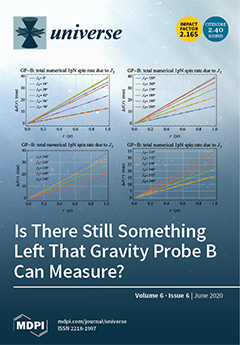
Cover Story: We perform a full analytical and numerical treatment to the 1 PN order, of the general relativistic long-term spin precession of an orbiting gyroscope due to the oblateness of its primary without any restriction on either gyro’s orbital configuration or the orientation in space of the symmetry axis of the central body. We apply our results to the past GP-B mission by finding a secular rate of its spin declination, which may be as large as $\lesssim 30-40\,\mathrm{milliarcseconds\,per\,year}$, depending on the initial orbital phase $f_0$. Both our analytical and numerical calculations confirm such a finding. For GP-B, the reported mean error in measuring the spin declination rate amounts to $18.3\,\mathrm{milliarcseconds\,per\,year}^{-1}$. Our results can also be extended to other scenarios of interest such as, e.g., stars orbiting supermassive black holes, exoplanets, and tight binaries hosting compact stellar corpses. View this paper
  • Issues are regarded as officially published after their release is announced to the table of contents alert mailing list .
  • You may sign up for email alerts to receive table of contents of newly released issues.
  • PDF is the official format for papers published in both, html and pdf forms. To view the papers in pdf format, click on the "PDF Full-text" link, and use the free Adobe Reader to open them.

Articles (17)

  • Article
  • Open Access
6 Citations
3,269 Views
35 Pages

One of the most important issues in an inflationary theory as standard or quintessential inflation is the mechanism to reheat the universe after the end of the inflationary period in order to match with the Hot Big Bang universe. In quintessential in...

  • Article
  • Open Access
6 Citations
2,271 Views
10 Pages

We consider the structure of excited states and low-energy interaction of hadronic dark matter with photons, leptons, and nucleons. Description of the lowest excited levels is fulfilled in an analogy with the standard heavy-light mesons. Using the ef...

  • Article
  • Open Access
14 Citations
3,017 Views
12 Pages

Neutron stars, and magnetars in particular, are known to host the strongest magnetic fields in the Universe. The origin of these strong fields is a matter of controversy. In this preliminary work, via numerical simulations, we study, for the first ti...

  • Article
  • Open Access
79 Citations
5,091 Views
22 Pages

Was GW170817 a Canonical Neutron Star Merger? Bayesian Analysis with a Third Family of Compact Stars

  • David Blaschke,
  • Alexander Ayriyan,
  • David Edwin Alvarez-Castillo and
  • Hovik Grigorian

We investigate the possibility that GW170817 was not the merger of two conventional neutron stars (NS), but involved at least one if not two hybrid stars with a quark matter core that might even belong to a third family of compact stars. To this end,...

  • Article
  • Open Access
26 Citations
3,248 Views
13 Pages

The generalized hybrid metric-Palatini theory of gravity admits a scalar-tensor representation in terms of two interacting scalar fields. We show that, upon an appropriate choice of the interaction potential, one of the scalar fields behaves like dar...

  • Article
  • Open Access
19 Citations
3,809 Views
70 Pages

In this work, we study the impact of quantum entanglement on the two-point correlation function and the associated primordial power spectrum of mean square vacuum fluctuation in a bipartite quantum field theoretic system. The field theory that we con...

of 2

Get Alerted

Add your email address to receive forthcoming issues of this journal.

XFacebookLinkedIn
Universe - ISSN 2218-1997