


Abstract
We present a non-collisional mechanism for the formation of symmetric ring galaxies based on the dynamical relaxation of gas on top of quantized vortex configurations in Bose–Einstein Condensate Dark Matter (BECDM) solutions. For this we solve the fully coupled Gross–Pitaevskii–Poisson–Euler (GPPE) system in 3D, allowing for complete gravitational back-reaction between the baryonic gas and the dark matter component. Initializing the luminous matter as an ideal gas with random initial conditions on top of a vortex line with a topological winding number , we systematically explore three dark matter self-interaction regimes, attractive, collisionless, and repulsive, for a characteristic ultra-light boson mass of . Our simulations reveal that the baryonic gas relaxes into stable, highly symmetric rings whose physical diameters from 11 to 16 kpc and total enclosed masses of order match the scales of intensely studied benchmarks like Arp 147. We use the detailed data from Arp 147 purely as a physical baseline to provide a structural proof of concept for our model. However, this self-consistent mechanism can be an interesting explanation for isolated ring galaxies-like Hoag-type objects, which lack the nearby companions or tidal debris required by standard collision models.
1. Introduction
Arp 147 is one of the best-studied collisional ring galaxies, consisting of a nearly circular ring interacting with an early-type companion due to an off-center, inclined collision that triggered an outwardly propagating density wave [1]. It is part of the broader population of collisional ring galaxies identified through their characteristic morphology [2].
X-ray observations with the Chandra X-ray Observatory [3] indicate intense recent star formation that compressed the interstellar medium. Integral-field spectroscopic observations obtained with SWIFT [1] provided a detailed kinematic characterization, measuring a ring expansion velocity of approximately and a collision timescale estimated to be less than 50 Myr, showing a stellar population with an old pre-collision component along with a younger population. More recently, high-resolution Hubble Space Telescope observations [4] resolved star clusters and massive star-forming clumps along the ring, where approximately of the detected clusters are younger than 10 Myr and nearly two thirds have masses larger than . Taken together, these observational studies establish Arp 147 as an exceptionally well characterized collisional ring galaxy. Numerical models of off-center galaxy collisions have also reproduced several of its characteristic morphological features [5,6], supporting the interpretation of Arp 147 within the classical collisional scenario.
In this work, we present a different dynamical process for the formation of such ring-like structures, based on the Bose–Einstein Condensate Dark Matter (BECDM) framework without the need of a collisional trigger. This type of dark matter assumes the dark particles to be ultralight bosons in a coherent state, and in the case when there is no self-interaction between bosons, it is called fuzzy dark matter (FDM) [7]. Its dynamics are described with a macroscopic wave function governed by the Gross Pitaevskii equation [8,9] coupled to Poisson equation sourced by the gravitational potential generated by the bosons themselves, a system called a Gross–Pitaevskii–Poisson system of equations. This model is an alternative to cold dark matter because one of its most important properties are wave effects that prevent the formation of small-scale structure and, instead, its collapse leads to the formation of solitonic cores [7,10,11,12,13,14]. Its dynamics leads the behavior of baryonic components during structure formation [15,16,17,18], black holes [19,20,21,22,23,24] and test particles [25,26,27]. Structure formation also leads to the formation of vortices [28,29,30,31,32,33,34], whose properties can depend on the self–interaction strength [35] and, most recently, it has been shown that vortex solutions have a radically new influence on an ideal gas, including the formation of rings of gas around [36]. In this context, we would like to investigate whether vortices produce ring-like structures of the size of galaxies in order to at least know what conditions would be required on the BECDM parameters to support such a structure. The case of Arp 147 is one of the most studied ones, and although its origin is well understood in terms of a binary collision, it serves as an observation to callibrate parameters of the model and to learn under which conditions such type of structures could form when not from collisional origin as found in [36].
For our analysis we evolve an ideal gas modeling luminous matter, starting from random initial conditions, on top of a quantum vortex solution of BEC DM. The evolution couples the ideal gas and the BEC by coupling the GPP system with Euler equations of the ideal gas, thorugh Poisson equation that takes into account the densities of both components. By exploring three regimes of the dark matter self-interaction, our hydrodynamic simulations reveal that the ambient gas naturally relaxes and accommodates into stable ring structures whose characteristic physical sizes and total baryonic masses closely match those observed in systems like Arp 147. We emphasize that the primary objective of this study is not to reinterpret Arp 147 itself, whose origin via a high velocity galactic collision is well established. Instead, this mechanism is proposed as a structural proof-of-concept. Our results demonstrate that topological phase singularities in BECDM halos can mimic classical collisional morphologies, providing a clear set of distinct kinematic predictions that can be systematically tested by the next generation of deep field observations, for instance, with the James Webb Space Telescope (JWST).
This mechanism allows us to speculate on the origin of truly isolated ring galaxies, such as the prototype Hoag’s Object [37,38,39] and other peculiar detached like LEDA 1000714 [40], which present a persistent puzzle for standard collisional models due to the total absence of a visible early-type companion or recent tidal debris. While Arp 147 provides the high-resolution observational dataset required to benchmark our model’s parameters in this initial work, we propose that isolated, empty rings may represent the baryonic signatures of unperturbed dark matter vortices. This offers a potential observational prediction that distinguishes the BECDM topological model from classical interaction scenarios.
The paper is organized as follows. In Section 2, we describe the equations describing the coupled system; in Section 3, we describe how an observation can be associated to a ring simulation; in Section 4, we present the specific identification with the ring of Arp 147; and in Section 5, we present our conclusions.
2. Becdm Vortices and Gas
2.1. The GPPE System of Equations
The dynamics of ultralight bosonic dark matter coupled through gravity with an ideal gas (IG), is described by the Gross–Pitaevskii–Poisson–Euler (GPPE) system of equations, as described in [41,42]:
where is the parameter order that describes the mean field behavior of the cloud of bosons composing the BECDM component, whose mass density is given by , with the boson mass, ℏ is the reduced Planck constant, and is the self-interaction coefficient between bosons, with the s-wave scattering length. For the Euler equations describing the dynamics of the ideal gas, each volume element is described bt the mass density , the velocity field , the total energy density where is the specific internal energy, and is the identity tensor. We consider the equation of state (6) that relates the pressure and internal energy , where is the adiabatic index.
Poisson equation couples gravitationally the two components through the gravitational potential because it is sourced by the addition of the two densities and the spatial average . The average density is added to ensure a consistent solution of the Poisson equation under periodic boundary conditions and non-isolated environments [43]. For its solution, we express these equations using Cartesian coordinates .
2.2. Non-Dimensionalization
The numerical solution of this system uses dimensionless units [41], where all variables are rescaled as follows:
The tilted quantities denote dimensional physical variables, whereas the not tilded ones are dimensionless.
The scaling parameters are fixed based on the boson mass and a characteristic length scale that we choose to be . This suffices to determine the remaining scale factors:
The scaling factors for pressure, energy, potential, and internal energy, can be derived from these scale factors. For a specific unit conversion one has to specify and . Finally, the GPPE system written in dimensionless units reads
which is the system we solve to construct our numerical simulations.
2.3. Initial Conditions
For the bosonic component, we use as initial conditions a stationary vortex solution of the GPP equations, which is constructed from the initial wave function anzats as in [32,33]
where m is the winding number of the vortex, and is the wave function that satisfies the stationary GPP equations subject to the boundary conditions , and vanishing of and its derivatives at infinity. Stationary solutions are constructed in cylindrical coordinates as described in [36,44]. This setup results in a rotating structure with a vortex line aligned along the z-axis, which we use as the initial conditions for the BEC part of the equations.
The initial conditions for the IG component on the other hand are random and are generated using the auxiliary wave function.
where A is a normalization constant that fixes the mass of the ideal gas. Here, denotes Cartesian components of the momentum coordinates, and is a phase randomly chosen from a uniform distribution in the interval for each mode, following the recipe in [18,45]. The density of the gas at initial time is given by . The velocity field is limited by the condition , where is a maximum speed at initial time. The initial pressure is defined with a polytropic equation of state
where K is the polytropic constant that fixes the energy scale of the gas. Finally, the internal energy at initial time is calculated from the ideal gas EoS
as defined in Equation (6).
2.4. Numerical Setup
The simulations are performed in code units and subsequently converted to physical units using the scaling factors (8)–(12). For this we use the code CAFE-BECDM, described in [41], where the system of equations is solved in a 3D periodic domain described with Cartesian coordinates.
The numerical methods are summarized as follows. Time integration uses the Method of Lines coupled with a third-order Runge–Kutta scheme. For spatial discretization, we evaluate the Gross–Pitaevskii system (1) in spectral space using a Fast Fourier Transform (FFT) algorithm and solve the Poisson Equation (5) with an FFT-based solver at every Runge–Kutta substep. Meanwhile, we handle the hydrodynamic Euler Equations (2)–(4) through high-resolution shock-capturing (HRSC) techniques, employing a Minmod limiter for linear spatial reconstruction alongside an Harten–Lax–van Leer–Einfeldt (HLLE) approximate Riemann solver to evaluate inter-cell numerical fluxes.
We integrate the system up to dimensionless time units within a cubic domain of side length . The spatial grid uses points per axis, corresponding to a uniform grid spacing of . To ensure numerical stability, we fix the time step according to the Courant–Friedrichs–Lewy constraint , as recommended in [45].
2.5. Parameter Setup
We explore a set of vortex–gas simulations characterized by the following simulation parameters . Here, denotes the initial IG-to-BEC mass ratio. In all simulations, we fix the winding number to , the BEC mass to , the polytropic constant to , the adiabatic index to , and the maximum gas speed to . We consider three values of the self-interaction parameter, , 0, and 1, and two initial mass ratios, and 1.
3. Morphological and Physical Analysis
Surface Density. Since observational images provide a two-dimensional projection of a galaxy on the plane of the sky, while our simulations evolve the full three-dimensional gas density, a projection of the numerical data is required before any morphological comparison can be performed. If we consider that the observational plane is perpendicular to the z-axis, the projected surface density is calculated as
The dimensionless surface density contains the projected information of the three-dimensional density distribution. Its dimensional counterpart is obtained as , where the surface-density scale is .
Unsharp Masking. Observational studies often apply filters to images to enhance structures [46,47,48]. We applied an image processing technique to the surface density of gas to enhance the morphology and characteristic scales of the resulting rings. The projected surface density was processed using an unsharp masking filter
where the ∗ denotes convolution and is a Gaussian smoothing kernel with standard deviation . Among the different image-enhancement techniques explored, unsharp masking was adopted because it preserves the projected density distribution while enhancing low-contrast structures. The filtered image is then used to determine the characteristic morphological parameters of the ring.
Ring Characterization. Once the ring-like structure is detected in a simulation, we calculate the radial average of the surface density as
where are the polar coordinates in the image plane which are in physical units.
From the radial profile we define as the radius at which the surface density reaches its maximum. The inner and outer radii, and are defined by the full width at half maximum of the profile, while the ring thickness is given by and ring diameter is . Finally, we define the ring mass as the projected mass enclosed within
BECDM Vortex Characterization. Although the ring morphology is characterized from the gas distribution, the BECDM component contributes to the gravitational potential of the system. Therefore, we also estimate the mass enclosed by the central vortex. First, we calculate the angle-average density profile respect to the coordinate origin in all time
over the solid angle domain. Then, calculate the the enclosed BECDM mass in the surface as
where is the outer characteristic radii of the BECDM vortex that we defined by the full width at half maximum of the profile. Finally, the enclosed mass is the sum of each mass component
The physical quantities defined above inherit their scaling from the characteristic length and mass scales. In particular, all radial quantities scale with the characteristic length , while the ring, vortex and enclosed mass scale with . Thus, for fixed , the characteristic radii are independent of , whereas all mass-related quantities scale as . These quantities are used in the next section to compare the simulated rings with the observed properties of the galaxy ring ARP 147.
4. Results
In our analysis, all quantities are translated from code units into physical units obtained from the scaling relations (8)–(12).
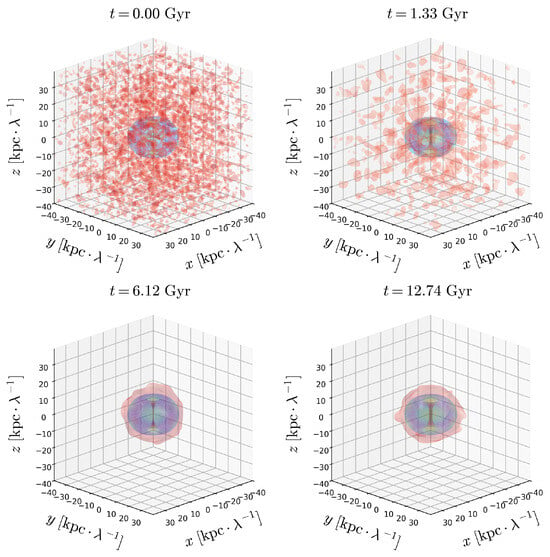
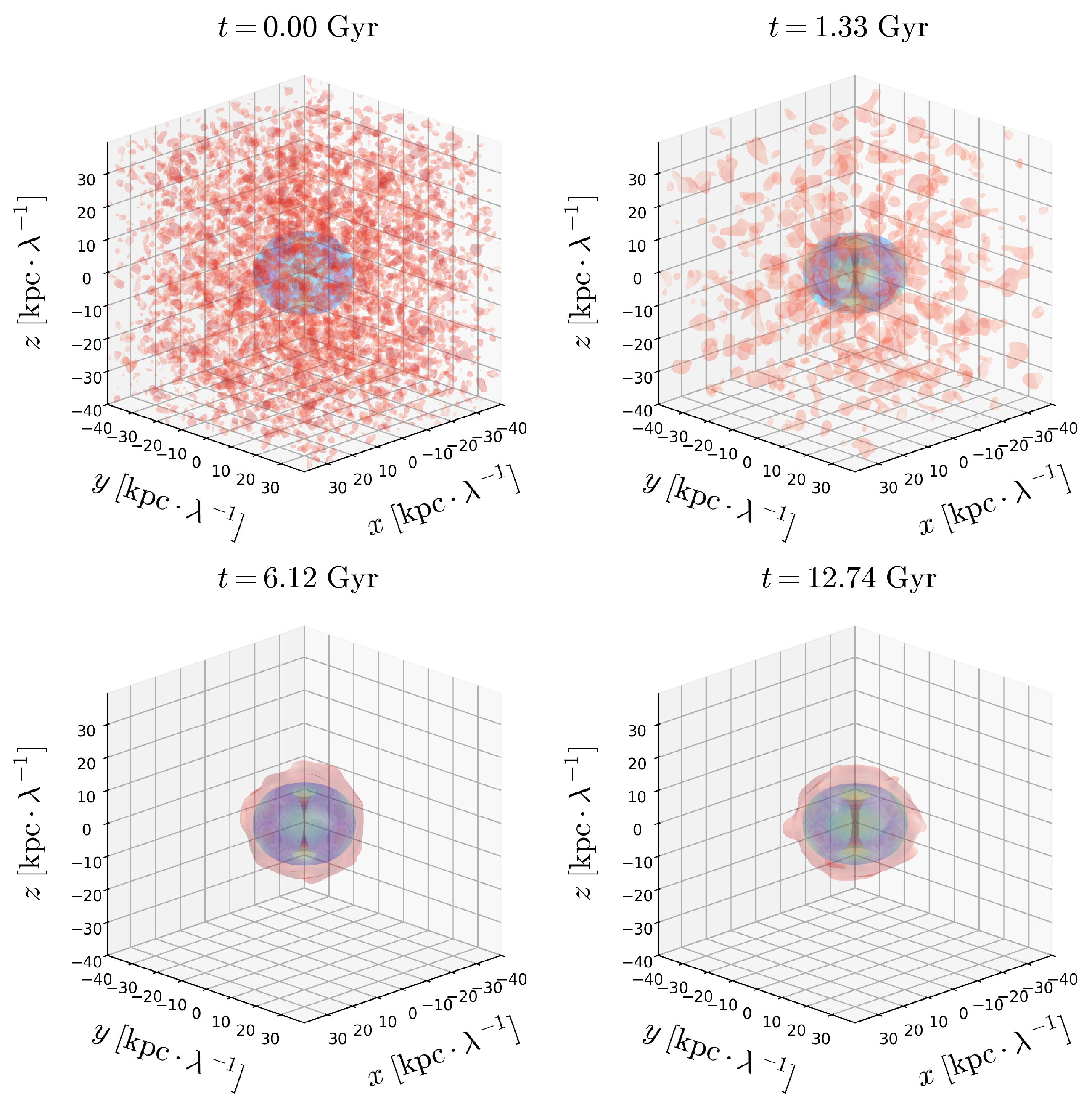
Ideal Gas accumulation. Figure 1 shows the three-dimensional time evolution of the BEC vortex and ideal gas density distributions for one simulation with and . The sequence, from left to right and top to bottom, illustrates the development of the gas distribution around the BEC vortex from the initial state to . This shows that the vortex–gas configurations remain approximate stable after the gas accumulates around the BEC vortex with a ring-like shape.
Figure 1.
Three-dimensional visualization of the evolution of the BEC and IG density distributions for the case and configuration. The BEC density is represented by the blue isosurface, while the IG density is represented by the translucent red isosurfaces. Each panel shows a snapshot of the densities at times and . At , we noticed the ideal gas density randomly distributed throughout the computational domain. Later on, the gas begins to accumulate around the vortex and remains in this state for approximately .
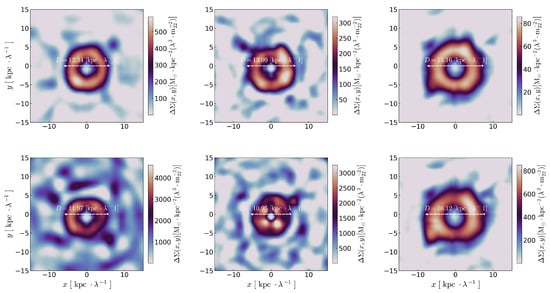
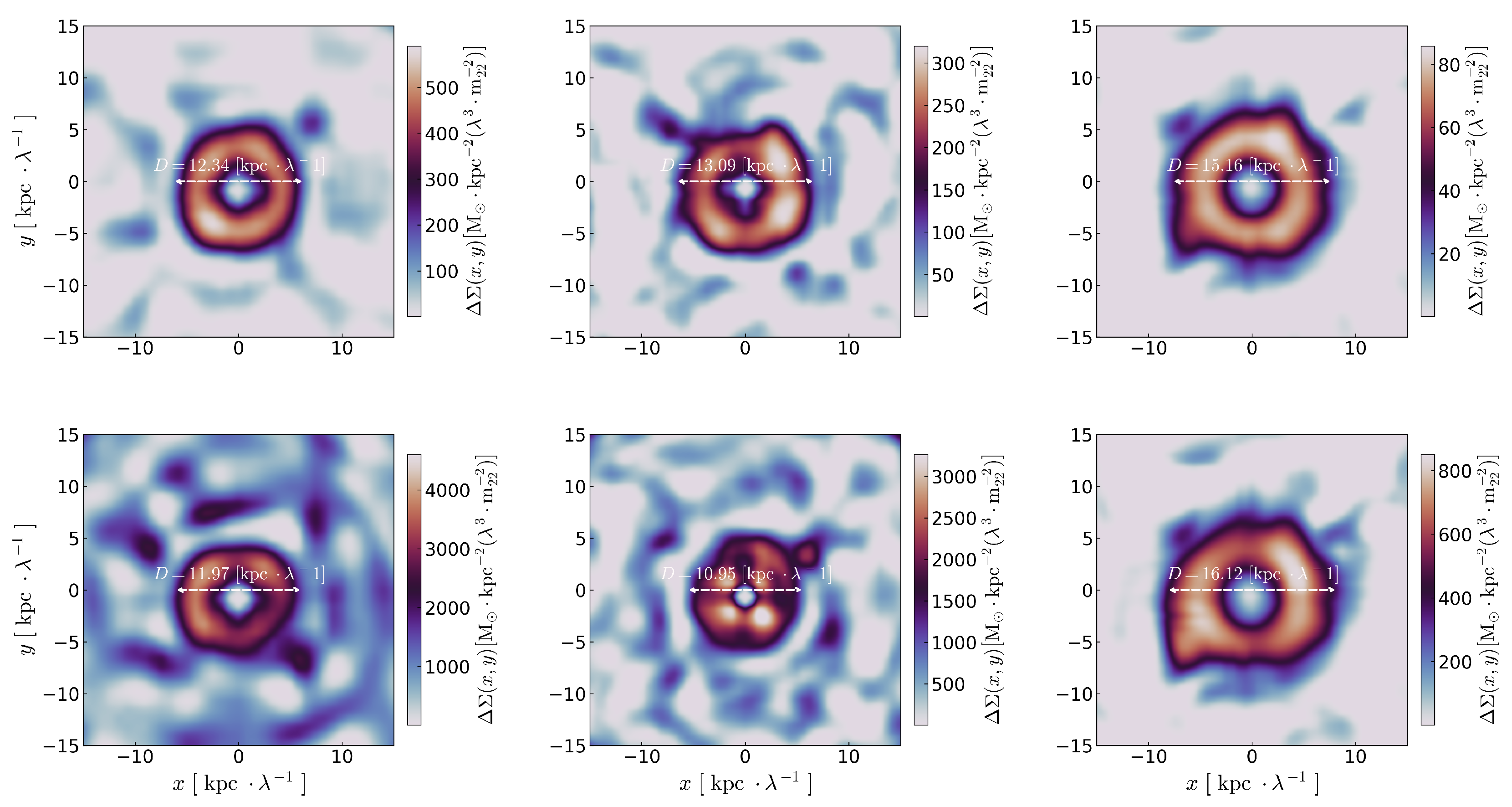
Morphological Comparison. In Figure 2, we show the IG surface density (23) after applying the unsharp masking filter (24). We present six vortex–gas simulations corresponding to attractive (), non-interacting (), and repulsive () self-interaction strengths, each evolved for two initial mass ratios, and and assuming mass and length scales and .
Figure 2.
Filtered surface density of the ideal gas. Each column corresponds to different self-interaction values (left), (middle) and (right). Simulations correspond to two mass ratios (upper row) and (bottom row). The central white arrow denotes the characteristic ring diameter.
In all cases, the ideal gas follows the morphology induced by the BECDM vortex, producing a well-defined ring-like structure. Previous work demonstrated that the self-interaction strength modifies the radial profile of BECDM vortices [36]. This behavior is directly transferred to the gas component. Figure 2 shows that the ring diameter systematically increases from the attractive () to the repulsive () regime.
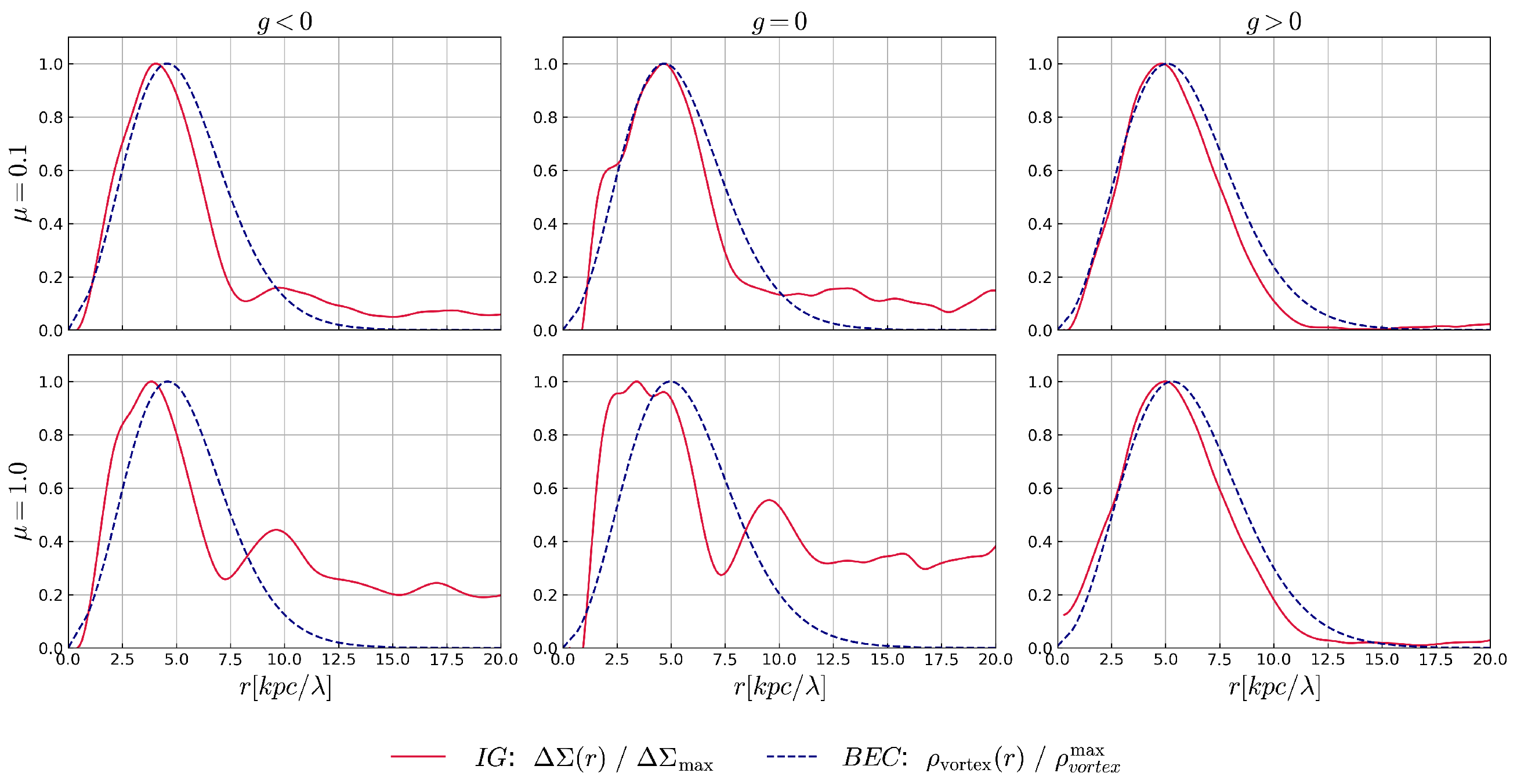
Vortex–gas Correspondence. Figure 3 compares the radial distributions of the IG and BEC components for the six simulated configurations. The IG profiles closely follow the radial structure of the corresponding BEC vortices, including the location of the density enhancement associated with the ring-like structure.
Figure 3.
Radial profiles of the IG and BEC density distributions for the six simulated configurations. The IG profiles, , are obtained from the radially projected IG density, while the BEC profiles correspond to the radially averaged density . Columns correspond to the three values of the self-interaction parameter, and , while rows correspond to the IG-to-BEC mass ratio and 1.0. All profiles are normalized to their respective maximum values.
The close correspondence between the IG and BEC radial profiles indicates that the gas morphology is primarily shaped by the gravitational structure of the BECDM vortex. This correspondence is observed for the different self-interaction regimes and mass ratios explored, which shows that the ring-like gas structure is a property of the vortex–gas configurations. Together with the evolution shown in Figure 1, these results indicate that the condensed gas remains approximately stable over the timescales considered.
Physical Characterization. Now let us compare as an exercise with ARP 147 properties. It has a total stellar mass of approximately and a ring diameter close to , although the exact values depend on the adopted stellar population model and observational method [1,4]. These quantities constitute the primary observational constraints used in this work.
To compare the numerical models with ARP 147, each simulation was rescaled by adjusting the characteristic length such that the simulated ring diameter matched the observed value of approximately . This procedure fixes the physical length scale associated with each numerical model.
Once the spatial scale is fixed, the enclosed mass depends primarily on the adopted boson mass through the scaling relation . We find that choosing produces enclosed masses in the range , in good agreement with the stellar mass estimated for ARP 147.
The resulting values of the scaling parameter , the physical self–interaction strength , and the corresponding masses are summarized in Table 1. Although all models reproduce the observed ring diameter after rescaling, they require different physical values of and predict different enclosed masses. Therefore, observational constraints on both the ring size and the enclosed mass provide a way to restrict the allowed parameter space of the BECDM vortex model.
Table 1.
Physical properties of the simulated vortex–gas systems after rescaling each model to reproduce the observed ring diameter of ARP 147 (). The boson mass was fixed to , yielding enclosed masses consistent with the observational estimate of . Additionally, we show the maximum radial surface density of the ideal gas and the maximum radial density of the BECDM component of the system.
The required values of differ by less than about 35% among all models, indicating that the simulated ring sizes are already naturally close to the observed diameter of ARP 147.
The density properties of the vortex–gas configurations provide an additional quantitative characterization. The maximum radial surface density of the ideal gas, , varies systematically among the different configurations, while the maximum radial density of the BECDM vortex, , remains of the same order of magnitude in all the models explored. Together with the radial profiles shown in Figure 3, these quantities confirm that the ideal gas forms a well-defined density enhancement associated with the BECDM vortex structure. The variations in reflect the different gas distributions produced by the vortex configurations, for the two mass ratios considered.
5. Conclusions
In this paper, we have presented a non-collisional mechanism for the formation of ring galaxies based on the hydrodynamic relaxation of gas on top of quantized vortex solutions in Bose–Einstein Condensate Dark Matter (BECDM) configurations.
Our numerical simulations show that a randomly distributed ideal gas naturally distributes into stable baryonic rings. For different values of self-interaction, including negative and positive values, assuming a characteristic ultra-light boson mass of , the resulting structures consistently yield physical radii and total baryonic masses of the same order of magnitude as those for Arp 147.
The time evolution also shows that the initially random gas distribution condenses around the BECDM vortex and remains approximately stable for several Gigayears. The radial density profiles confirm that the ideal gas traces the BECDM densities and provides an additional quantitative characterization of these configurations across the explored self-interaction strength and mass ratios.
We explicitly selected Arp 147 as the physical benchmark for this proof-of-concept because it represents one of the most thoroughly observed in the literature, providing multi-wavelength dataset that allows for calibration of our model’s structural parameters. However, while the classical collisional framework remains the most robust explanation for heavily perturbed systems with visible, high-velocity companions like Arp 147, our topological BECDM model provides an alternative evolutionary scenario for isolated non-collisional rings.
Regarding the ring evolution, we find that the radial position of the peak density does not change significantly over the simulated time interval, unlike collisional ring galaxies in which the ring is commonly associated for significant radial expansion of the ring [4]. This represents a qualitative difference between the present vortex–gas mechanism and the classical collisional scenario.
The coupling between the gas and the BEC dark matter offers a potential solution to an astrophysical puzzle, namely the existence of completely isolated Hoag-type ring objects, such as Hoag’s Object itself [37,38,39] or the detached double-ring system LEDA 1000714 [40], which are not related to standard collisional models due to their total lack of tidal remnants. Having successfully benchmarked our code against an observational standard, we can now extend this framework to a dedicated sample of isolated Hoag-type objects in the very near future. Ultimately, our results demonstrate that future high-resolution kinematic and spectroscopic surveys using advanced observations of the deep field will be crucial to detect the distinct rotational velocity fields and signatures predicted by our vortex-trapping mechanism, opening an observational window into the macroscopic quantum nature of dark matter.
Author Contributions
Conceptualization, C.T.-C., I.Á.-R. and F.S.G.; methodology, C.T.-C., I.Á.-R. and F.S.G.; software, I.Á.-R.; validation, C.T.-C., I.Á.-R. and F.S.G.; formal analysis, C.T.-C., I.Á.-R. and F.S.G.; investigation, C.T.-C., I.Á.-R. and F.S.G.; resources, I.Á.-R. and F.S.G.; data curation, C.T.-C.; writing—original draft preparation, C.T.-C., I.Á.-R. and F.S.G.; writing—review and editing, C.T.-C., I.Á.-R. and F.S.G.; visualization, C.T.-C.; supervision, F.S.G.; project administration, F.S.G.; funding acquisition, F.S.G. All authors have read and agreed to the published version of the manuscript.
Funding
This research is supported by SECIHTI Grant No. CFB-2025-I-759, Laboratorio Nacional de Cómputo de Alto Desempeño Grant No. 2026-8, and CIC-UMSNH Grant No. 4.9.
Data Availability Statement
The numerical results produced for this paper, as well as the data needed to reproduce all the plots are publicly available at [49].
Conflicts of Interest
The authors declare no conflicts of interest.
References
- Fogarty, L.; Thatte, N.; Tecza, M.; Clarke, F.; Goodsall, T.; Houghton, R.; Salter, G.; Davies, R.L.; Kassin, S.A. SWIFT observations of the Arp 147 ring galaxy system: Arp147. Mon. Not. R. Astron. Soc. 2011, 417, 835–844. [Google Scholar] [CrossRef] [Scilit]
- Romano, R.; Mayya, Y.D.; Vorobyov, E.I. Stellar Disks of Collisional Ring Galaxies. I. New Multiband Images, Radial Intensity and Color Profiles, and Confrontation with N-Body Simulations. Astron. J. 2008, 136, 1259–1289. [Google Scholar] [CrossRef] [Scilit]
- Rappaport, S.; Levine, A.; Pooley, D.; Steinhorn, B. ULTRALUMINOUS X-RAY SOURCES IN ARP 147. Astrophys. J. 2010, 721, 1348–1355. [Google Scholar] [CrossRef] [Scilit]
- Randriamanakoto, Z.; Rakototafika, M.; Mongwane, B.; Väisänen, P.; Rakotomanga, M. Massive star clusters and clumps in the collisional ring galaxy Arp 147. Mon. Not. R. Astron. Soc. 2026, 549, stag739. [Google Scholar] [CrossRef] [Scilit]
- Gerber, R.A.; Lamb, S.A.; Balsara, D.S. A Model for Ring Galaxies: ARP 147–like Systems. Astrophys. J. Lett. 1992, 399, L51. [Google Scholar] [CrossRef] [Scilit] [PubMed]
- Mapelli, M.; Mayer, L. Ring galaxies from off-centre collisions: Ring galaxies from off-centre collisions. Mon. Not. R. Astron. Soc. 2011, 420, 1158–1166. [Google Scholar] [CrossRef] [Scilit]
- Hui, L.; Ostriker, J.P.; Tremaine, S.; Witten, E. Ultralight scalars as cosmological dark matter. Phys. Rev. D 2017, 95, 043541. [Google Scholar] [CrossRef] [Scilit]
- Gross, E.P. Structure of a quantized vortex in boson systems. Nuovo Cimento 1961, 20, 454–477. [Google Scholar] [CrossRef] [Scilit]
- Pitaevskii, L.P. Vortex lines in an imperfect Bose gas. Sov. Phys. JETP 1961, 13, 451–454. [Google Scholar]
- Matos, T.; Urena-Lopez, L.A. A Further analysis of a cosmological model of quintessence and scalar dark matter. Phys. Rev. D 2001, 63, 063506. [Google Scholar] [CrossRef] [Scilit]
- Hu, W.; Barkana, R.; Gruzinov, A. Cold and fuzzy dark matter. Phys. Rev. Lett. 2000, 85, 1158–1161. [Google Scholar] [CrossRef] [Scilit] [PubMed]
- Ferreira, E.G.M. Ultra-Light Dark Matter. Astron. Astrophys. Rev. 2021, 29, 7. [Google Scholar] [CrossRef] [Scilit]
- Niemeyer, J.C. Small-scale structure of fuzzy and axion-like dark matter. Prog. Part. Nucl. Phys. 2020, 113, 103787. [Google Scholar] [CrossRef] [Scilit]
- Hui, L. Wave Dark Matter. Annu. Rev. Astron. Astrophys. 2021, 59, 247–289. [Google Scholar] [CrossRef] [Scilit]
- Mocz, P.; Fialkov, A.; Vogelsberger, M.; Becerra, F.; Shen, X.; Robles, V.H.; Amin, M.A.; Zavala, J.; Boylan-Kolchin, M.; Bose, S.; et al. Galaxy formation with BECDM – II. Cosmic filaments and first galaxies. Mon. Not. R. Astron. Soc. 2020, 494, 2027–2044. [Google Scholar] [CrossRef] [Scilit]
- Nori, M.; Bhatia, S.; Macciò, A.V. Fuzzy Gasoline: Cosmological hydrodynamical simulations of dwarf galaxy formation with Fuzzy Dark Matter. arXiv 2024, arXiv:2411.09733. [Google Scholar]
- Pozo, A.; Broadhurst, T.; Emami, R.; Mocz, P.; Vogelsberger, M.; Hernquist, L.; Conselice, C.J.; Luu, H.N.; Smoot, G.F.; Windhorst, R. A smooth filament origin for distant prolate galaxies seen by JWST and HST. Nat. Astron. 2026, 10, 306–316. [Google Scholar] [CrossRef] [Scilit]
- Alvarez-Rios, I.; Guzmán, F.S.; Niemeyer, J. Fermion-Boson Stars as Attractors in Fuzzy Dark Matter and Ideal Gas Dynamics. Phys. Rev. Lett. 2025, 135, 161003. [Google Scholar] [CrossRef] [Scilit] [PubMed]
- Chiu, H.H.S.; Schive, H.Y.; Yang, H.Y.K.; Huang, H.; Gaspari, M. Boosting Supermassive Black Hole Growth in the Early Universe by Fuzzy Dark Matter Solitons. Phys. Rev. Lett. 2025, 134, 051402. [Google Scholar] [CrossRef] [Scilit] [PubMed]
- Lancaster, L.; Giovanetti, C.; Mocz, P.; Kahn, Y.; Lisanti, M.; Spergel, D.N. Dynamical friction in a Fuzzy Dark Matter universe. J. Cosmol. Astropart. Phys. 2020, 2020, 001. [Google Scholar] [CrossRef] [Scilit]
- El-Zant, A.A.; Roupas, Z.; Silk, J. Ejection of supermassive black holes and implications for merger rates in fuzzy dark matter haloes. Mon. Not. R. Astron. Soc. 2020, 499, 2575–2586. [Google Scholar] [CrossRef] [Scilit]
- Wang, Y.; Easther, R. Dynamical friction from ultralight dark matter. Phys. Rev. D 2022, 105, 063523. [Google Scholar] [CrossRef] [Scilit]
- Boey, R.; Wang, Y.; Kendall, E.; Easther, R. Dynamical friction and black holes in ultralight dark matter solitons. Phys. Rev. D 2024, 109, 103526. [Google Scholar] [CrossRef] [Scilit]
- Palomares-Chávez, C.; Álvarez-Rios, I.; Guzmán, F.S. Black holes as condensation points of fuzzy dark matter cores. Phys. Rev. D 2025, 112, 023545. [Google Scholar] [CrossRef] [Scilit]
- Li, X.; Hui, L.; Yavetz, T.D. Oscillations and random walk of the soliton core in a fuzzy dark matter halo. Phys. Rev. D 2021, 103, 023508. [Google Scholar] [CrossRef] [Scilit]
- Widmark, A.; Yavetz, T.D.; Li, X. Fuzzy dark matter dynamics in tidally perturbed dwarf spheroidal galaxy satellites. J. Cosmol. Astropart. Phys. 2024, 2024, 052. [Google Scholar] [CrossRef] [Scilit]
- Álvarez Rios, I.; Guzmán, F.S. Unveiling orbital chaos: The wild heart of fuzzy dark matter structures. Class. Quantum Gravity 2025, 42, 085013. [Google Scholar] [CrossRef] [Scilit]
- Kain, B.; Ling, H.Y. Vortices in Bose-Einstein condensate dark matter. Phys. Rev. D 2010, 82, 064042. [Google Scholar] [CrossRef] [Scilit]
- Zinner, N.T. Vortex Structures in a Rotating BEC Dark Matter Component. Phys. Res. Int. 2011, 2011, 734543. [Google Scholar] [CrossRef] [Scilit]
- Rindler-Daller, T.; Shapiro, P.R. Angular momentum and vortex formation in Bose-Einstein-condensed cold dark matter haloes: Angular momentum in BEC-CDM haloes. Mon. Not. R. Astron. Soc. 2012, 422, 135–161. [Google Scholar] [CrossRef] [Scilit]
- Korshynska, K.; Bidasyuk, Y.M.; Gorbar, E.V.; Jia, J.; Yakimenko, A.I. Dynamical galactic effects induced by solitonic vortex structure in bosonic dark matter. Eur. Phys. J. C 2023, 83, 451. [Google Scholar] [CrossRef] [Scilit]
- Nikolaieva, Y.O.; Olashyn, A.O.; Kuriatnikov, Y.I.; Vilchynskii, S.I.; Yakimenko, A.I. Stable vortex in Bose-Einstein condensate dark matter. Low Temp. Phys. 2021, 47, 684–692. [Google Scholar] [CrossRef] [Scilit]
- Nikolaieva, Y.O.; Bidasyuk, Y.M.; Korshynska, K.; Gorbar, E.V.; Jia, J.; Yakimenko, A.I. Stable vortex structures in colliding self-gravitating Bose-Einstein condensates. Phys. Rev. D 2023, 108, 023503. [Google Scholar] [CrossRef] [Scilit]
- Alexander, S.; Capanelli, C.; Ferreira, E.G.M.; McDonough, E. Cosmic filament spin from dark matter vortices. Phys. Lett. B 2022, 833, 137298. [Google Scholar] [CrossRef] [Scilit]
- Zeng, Y.; Zhang, B.; Chen, J. Self-interaction controls vortex scale in soliton mergers. Phys. Rev. D 2026, 113, 103043. [Google Scholar] [CrossRef] [Scilit]
- Álvarez Rios, I.; Tena-Contreras, C.; Guzmán, F.S. Kinematic imprints of vortex lines of BEC dark matter on baryonic matter. Phys. Rev. D 2025, 111, 123039. [Google Scholar] [CrossRef] [Scilit]
- Hoag, A.A. A peculiar object in Serpens. Astron. J. 1950, 55, 170. [Google Scholar] [CrossRef] [Scilit] [PubMed]
- Finkelman, I.; Moiseev, A.; Brosch, N.; Katkov, I. Hoag’s Object: Evidence for cold accretion on to an elliptical galaxy. Mon. Not. R. Astron. Soc. 2011, 418, 1834–1849. [Google Scholar] [CrossRef] [Scilit]
- Brosch, N.; Finkelman, I.; Oosterloo, T.; Jozsa, G.; Moiseev, A. H I in HO: Hoag’s Object revisited. Mon. Not. R. Astron. Soc. 2013, 435, 475–481. [Google Scholar] [CrossRef] [Scilit]
- Mutlu Pakdil, B.; Mangedarage, M.; Seigar, M.S.; Treuthardt, P. A photometric study of the peculiar and potentially double ringed, non-barred galaxy: PGC 1000714. Mon. Not. R. Astron. Soc. 2017, 466, 355–368. [Google Scholar] [CrossRef] [Scilit]
- Álvarez-Rios, I.; Guzmán, F.S. Exploration of simple scenarios involving fuzzy dark matter cores and gas at local scales. Mon. Not. R. Astron. Soc. 2022, 518, 3838–3849. [Google Scholar] [CrossRef] [Scilit]
- Álvarez-Rios, I.; Guzmán, F.S. Stationary solutions of the Schrödinger-Poisson-Euler system and their stability. Phys. Lett. B 2023, 843, 137984. [Google Scholar] [CrossRef] [Scilit]
- Álvarez-Rios, I.; Guzmán, F.S.; Shapiro, P.R. Effect of boundary conditions on structure formation in fuzzy dark matter. Phys. Rev. D 2023, 107, 123524. [Google Scholar] [CrossRef] [Scilit]
- Álvarez Rios, I.; Guzmán, F.S. Equilibrium core and vortex solutions of Bose-Einstein condensate dark matter around a black hole. Phys. Rev. D 2026, 113, 124081. [Google Scholar] [CrossRef] [Scilit]
- Chen, J.; Du, X.; Lentz, E.W.; Marsh, D.J.E.; Niemeyer, J.C. New insights into the formation and growth of boson stars in dark matter halos. Phys. Rev. D 2021, 104, 083022. [Google Scholar] [CrossRef] [Scilit]
- Bureau, M.; Aronica, G.; Athanassoula, E.; Dettmar, R.J.; Bosma, A.; Freeman, K.C. K-band observations of boxy bulges—I. Morphology and surface brightness profiles. Mon. Not. R. Astron. Soc. 2006, 370, 753–772. [Google Scholar] [CrossRef] [Scilit]
- Ramos Almeida, C.; Tadhunter, C.N.; Inskip, K.J.; Morganti, R.; Holt, J.; Dicken, D. The optical morphologies of the 2 Jy sample of radio galaxies: Evidence for galaxy interactions. Mon. Not. R. Astron. Soc. 2011, 410, 1550–1576. [Google Scholar] [CrossRef] [Scilit]
- Herrera-Endoqui, M.; Díaz-García, S.; Laurikainen, E.; Salo, H. Catalogue of the morphological features in the Spitzer Survey of Stellar Structure in Galaxies (S4G). Astron. Astrophys. 2015, 582, A86. [Google Scholar] [CrossRef] [Scilit]
- Tena-Contreras, C.A.; Álvarez-Rios, I.; Guzmán, F.S. Vortex Solutions of Ultralight BEC Dark Matter and Structures of Galactic Size: The Test Case of the Ring Galaxy ARP 147. 2026. Available online: https://zenodo.org/records/21303840 (accessed on 11 July 2026).

Disclaimer/Publisher’s Note: The statements, opinions and data contained in all publications are solely those of the individual author(s) and contributor(s) and not of MDPI and/or the editor(s). MDPI and/or the editor(s) disclaim responsibility for any injury to people or property resulting from any ideas, methods, instructions or products referred to in the content. |
© 2026 by the authors. Licensee MDPI, Basel, Switzerland. This article is an open access article distributed under the terms and conditions of the Creative Commons Attribution (CC BY) license.