


Abstract
Nova eruptions exhibit diverse photometric and spectroscopic properties traditionally classified using empirical light-curve morphology and spectral taxonomy. However, these observational classifications do not uniquely constrain the underlying eruption physics. This review examines the coupling between light-curve evolution, spectral development, ejecta dynamics, and multi-wavelength emission in classical and recurrent novae, with particular emphasis on the role of shocks and multi-phase outflows. Recent observations across optical, radio, X-ray, and gamma-ray wavelengths demonstrate that nova ejecta are intrinsically structured, anisotropic, and dynamically interacting systems, challenging the traditional interpretation of novae as spherically symmetric thermonuclear explosions. We synthesise observational and theoretical studies that link decline timescales, spectral transitions, expansion velocities, and high-energy emission to fundamental physical parameters, including white dwarf mass, accretion rate, ejecta geometry, and shock energetics. Using a compiled multi-parameter dataset of classical, recurrent, and symbiotic novae, we demonstrate that many commonly used observational diagnostics are intrinsically degenerate, with similar observable properties arising from different physical conditions. We argue that nova diversity is better understood within a continuous multi-dimensional parameter space rather than through purely empirical classifications. The implications of this framework for mass retention efficiency and the evolution of recurrent novae toward Type Ia supernova progenitors are discussed. Finally, we outline a predictive observational framework integrating photometric, spectroscopic, and high-energy diagnostics for future nova studies.
1. Introduction
Nova explosions are some of the most spectacular stellar transient events resulting from nuclear burnouts at the surface of a white dwarf in a compact binary system. After many years of advances in observation and theory of novae, much remains unknown about the processes behind the variety observed in nova behaviour. Historically, empirical classifications of nova types, based primarily on light-curve shape and spectral types such as Fe II, He/N, and hybrid, have formed the basis for understanding their behaviour [1]. While these frameworks provide a useful descriptive taxonomy, they lack a direct and unique connection to the underlying physical processes driving the eruption. One of the major limitations in nova research today is that the photometric and spectroscopic behaviour of these objects is often treated separately, even though both arise from a single dynamic ejecta system. The study of light-curve shape, in terms of decline rates (, ), pulsation, and rebrightening phenomena, has historically been used to infer parameters such as the mass of the white dwarf and the ejecta velocity [2]. Nevertheless, the failure of empirical scaling laws such as the maximum magnitude rate of decline (MMRD) law demonstrates that morphology is an unsuitable diagnostic parameter on its own [3]. Spectroscopic classification has long been used to infer ejecta density and ionisation conditions [4], but new observational results show that these properties are time-dependent [5]. Recent developments in time-domain and multi-wavelength astronomy have led to a dramatic paradigm shift in our understanding of nova outbursts. Specifically, γ-ray radiation detected in classical novae demonstrates particle acceleration during shocks, confirming that shock interactions are a prevalent process in the evolution of novae [6,7]. Moreover, high-resolution spectroscopy shows that nova ejecta are not produced in a single, uniform event but rather represent anisotropic emissions generated by the interplay among multiple phases [8,9]. Taken together, these discoveries pose significant challenges to the classic paradigm, which viewed nova outbursts as uniform, spherical events powered by nuclear reactions. These developments indicate that nova observables cannot be interpreted solely through isolated empirical classifications. Instead, photometric, spectroscopic, and high-energy properties must be understood as interconnected signatures of the same evolving eruptive system. The goal of this paper is to fill this gap through a comprehensive discussion of classical and recurrent novae. This review aims to accomplish the following goals:
- Demonstrating the link between light curves and spectra and analysing whether those observables allow the determination of parameters for the nova eruption process consistently or ambiguously.
- Exploring the physical drivers of nova diversity (white dwarf masses, their mass accretion rates, ejecta composition, and shock interactions) and understanding how these affect the observed behaviour of novae.
- Examining the consequences of the connections for mass-loss efficiencies and evolutionary paths to the formation of type Ia supernovae, especially in the case of recurrent novae.
Beyond these objectives, the principal contribution of this review is the development of a unified physical framework that integrates photometric morphology, spectroscopic evolution, and multi-wavelength diagnostics within a continuous multi-parameter interpretation of nova eruptions. Rather than considering these observables independently, the proposed framework links them to the coupled physical processes governing nova evolution, providing a physically motivated basis for interpreting the diversity of both classical and recurrent novae.
This review combines published observational studies with representative archival photometric and spectroscopic datasets to illustrate the physical relationships discussed throughout the manuscript. Photometric observations of the 2021 eruption of RS Ophiuchi were obtained from the American Association of Variable Star Observers (AAVSO) International Database, while representative optical spectra were obtained from the Astronomical Ring for Access to Spectroscopy (ARAS) database. Comparative analyses presented in this review were constructed using published measurements of representative classical and recurrent novae compiled from the literature cited throughout the manuscript. These datasets are used to illustrate the unified physical framework developed in this review rather than to present new observational discoveries.
2. Observational Framework
This section first introduces the key observational quantities used throughout the review. Representative light-curve and spectral examples are placed here deliberately, so that the temporal phenomena discussed in later sections are visible before the physical interpretation is developed.
2.1. Photometric Evolution of Novae
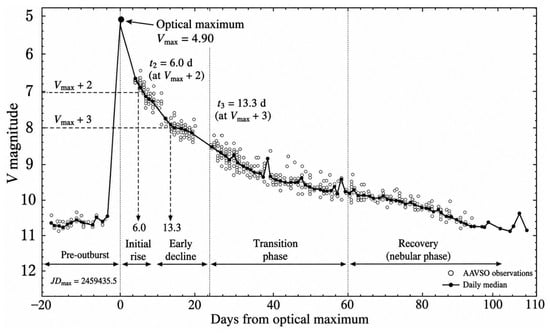
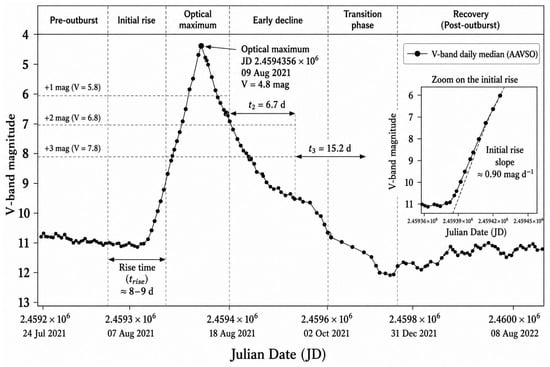
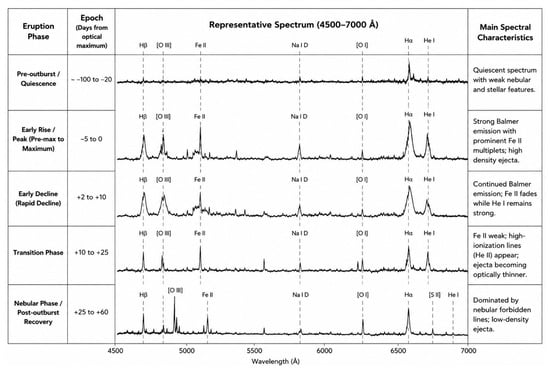
Photometric observations provide the primary observational record of nova eruptions, tracing the evolution of optical brightness from quiescence through eruption and back to the pre-outburst state. Although individual novae exhibit considerable diversity, most eruptions follow a broadly similar sequence consisting of an initial rise, optical maximum, early decline, transition phase, and post-outburst recovery. As a representative example, Figure 1 presents the V-band light curve of the 2021 eruption of the recurrent nova RS Ophiuchi (hereafter RS Oph), illustrating these principal stages and providing the temporal framework used throughout this review.
Figure 1.
Optical V-band light curve of the 2021 eruption of the recurrent nova RS Oph. The figure illustrates the principal phases of photometric evolution, including the initial rise, optical maximum, early decline, transition, and post-outburst recovery. The optical maximum occurred at JDmax = 2,459,435.5, which is adopted as the reference epoch (Day 0) for the time axis. The decline times and are marked and defined as the elapsed time for the nova to fade by 2 and 3 magnitudes from the optical maximum, respectively.
Following the optical maximum, the decline of a nova is commonly characterised by the parameters and , defined as the times required for the optical brightness to decrease by two and three magnitudes, respectively, from maximum light. These quantities are widely used to classify novae by decline speed and form the basis of the MMRD relation. However, extensive observational studies have demonstrated that the MMRD relation exhibits substantial intrinsic scatter and significant selection biases, indicating that the decline rate alone cannot uniquely determine the underlying physical properties of nova eruptions [10,11,12].
Beyond the decline timescale, nova light curves exhibit a wide variety of morphological behaviours, including smooth declines, oscillations, plateaus, secondary maxima, cusps, dust dips, and prolonged rebrightening episodes [13,14]. This diversity demonstrates that a single empirical parameter cannot explain photometric morphology; instead, it reflects the complex evolution of the erupting system.
Recent multi-wavelength observations indicate that nova light curves are shaped by the combined effects of thermonuclear energy release, ejecta expansion, radiative cooling, and shock interactions within structured outflows [15,16,17]. Consequently, photometric evolution should be interpreted as a time-dependent manifestation of the evolving ejecta rather than as a purely descriptive classification, providing the observational context for the spectroscopic evolution discussed in the following section.
2.2. Spectral Evolution of Novae
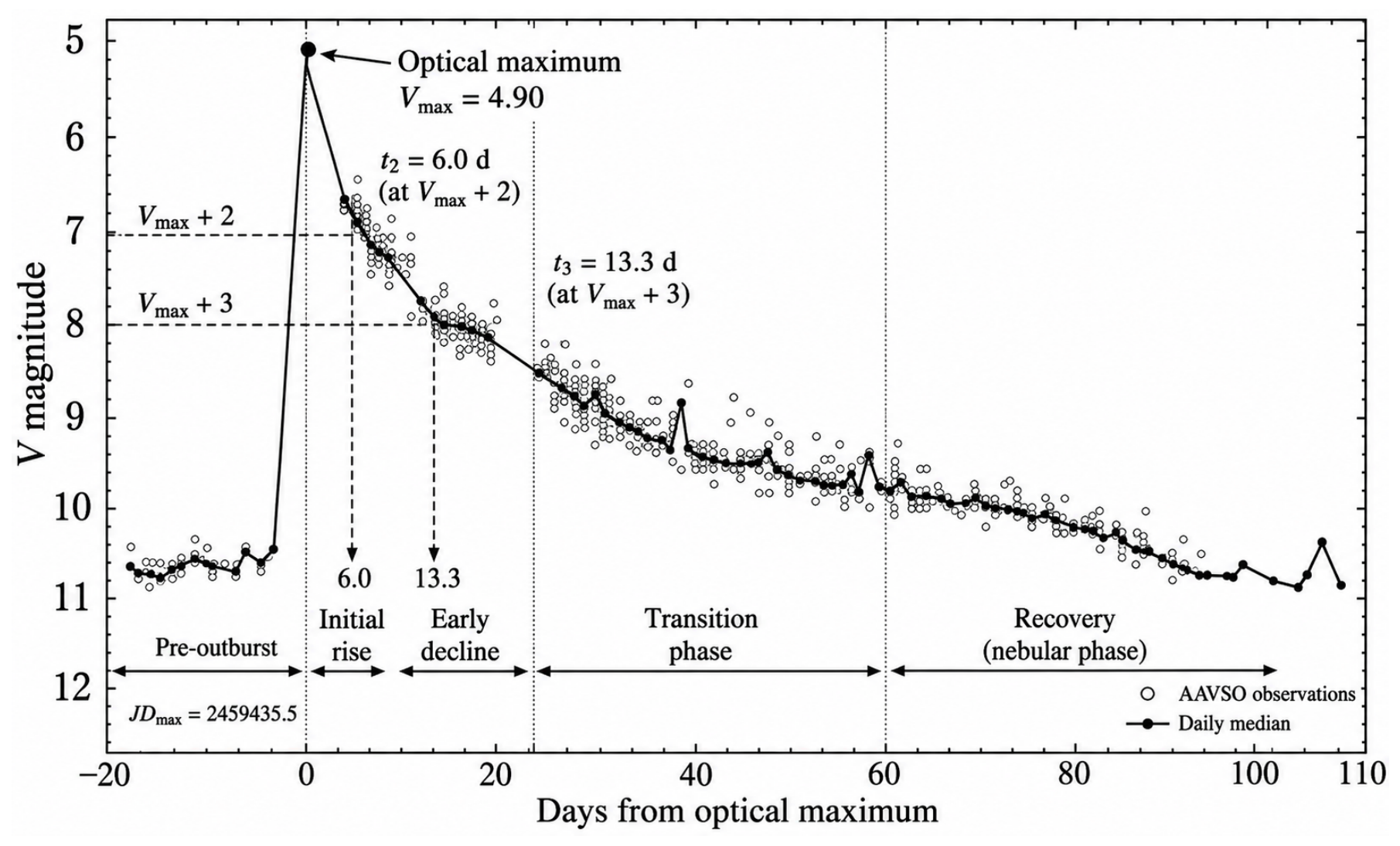
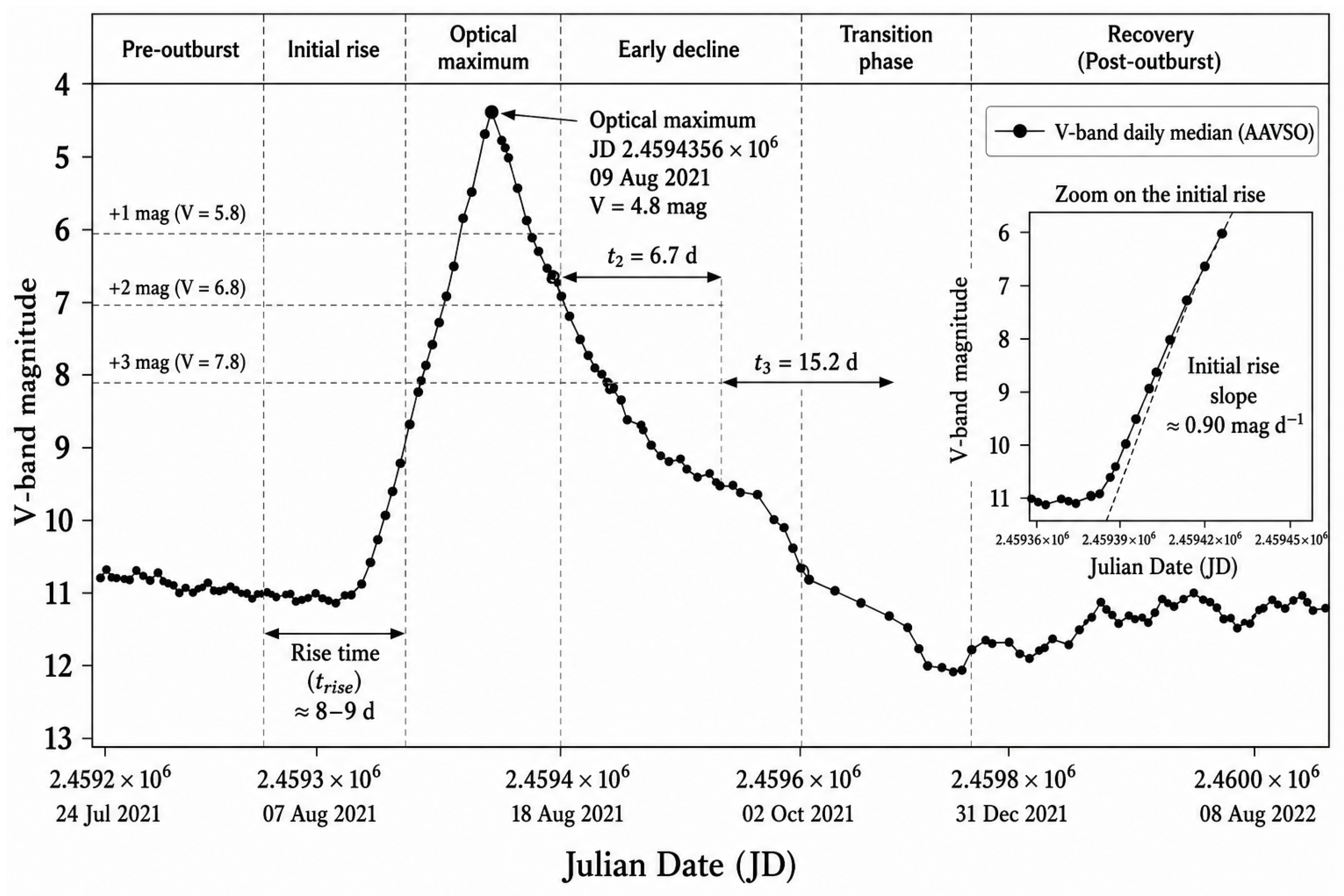
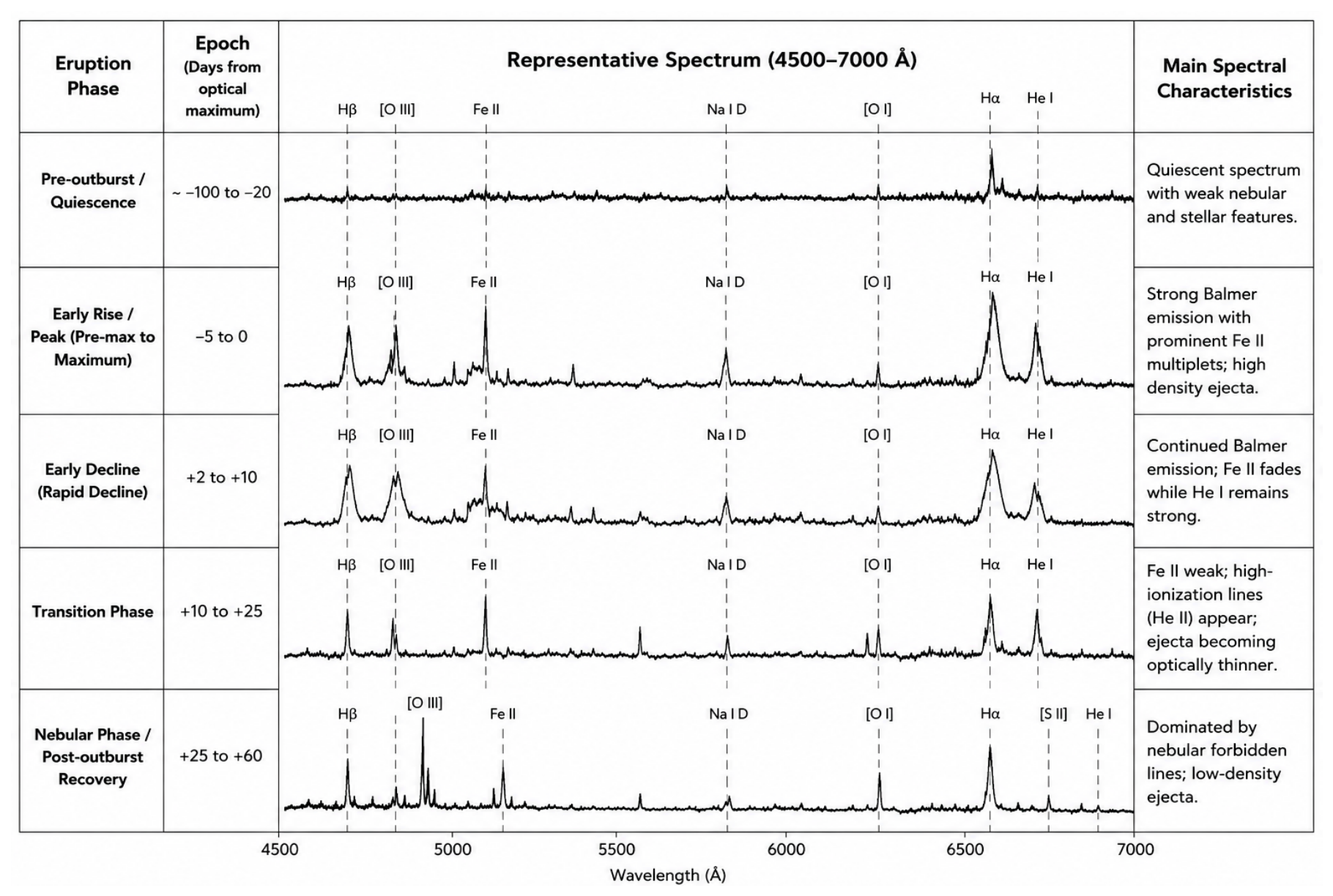
Spectroscopic observations provide complementary diagnostics to photometric monitoring by tracing the temporal evolution of the expanding ejecta throughout a nova eruption. While the light curve establishes the temporal evolution of the eruption, optical spectra reveal the changing physical conditions of the ejecta through variations in emission-line strengths, ionisation state, and line profiles. Figure 2 presents a representative spectral sequence of the 2021 eruption of the recurrent nova RS Oph, spanning the pre-maximum, optical maximum, early decline, transition, and post-outburst recovery stages. Although based on RS Oph, the sequence illustrates the general pattern of spectroscopic evolution observed in many novae and provides the observational framework for the discussion that follows.
Figure 2.
Representative spectral evolution of RS Oph across major eruption stages, from pre-outburst quiescence through peak eruption, rapid decline, transition, and post-outburst recovery. The spectra illustrate the strong time dependence of nova emission-line morphology and ionisation structure, including the evolution of Balmer, Fe II, Na I, [O I], and He I features. The displayed spectra are continuum-normalised and vertically offset for clarity.
The spectral evolution of novae reflects continuous changes in density, temperature, ionisation state, and optical depth within the expanding ejecta. During the early stages of an eruption, spectra are typically dominated by strong Balmer emission together with prominent Fe II or He/N features. As the ejecta expand and become progressively more ionised, helium emission strengthens, and forbidden nebular lines emerge. Time-resolved spectroscopic observations further demonstrate that many novae evolve through multiple spectroscopic phases during a single eruption, including transitions between Fe II, He/N, hybrid, and nebular states. Consequently, spectroscopic classifications should be regarded as evolutionary phases of the eruption rather than fixed indicators of the intrinsic properties of the progenitor system [5,18].
High-resolution spectroscopy further reveals that nova ejecta are highly structured, comprising multiple velocity components and density regimes rather than homogeneous expanding shells [15]. Consequently, the observed spectra evolve in response to changes in ionisation state, optical depth, ejecta geometry, and shock interaction, making spectroscopy a powerful diagnostic of the evolving physical conditions throughout the eruption rather than a static classification tool.
2.3. Multi-Wavelength Constraints
Multi-wavelength observations have fundamentally changed the interpretation of nova eruptions by demonstrating the importance of shocks in both the dynamics of the ejecta and the production of radiation. The detection of GeV gamma-ray emission by the Fermi Gamma-ray Space Telescope established that non-relativistic shocks in novae can efficiently accelerate particles, while simultaneous X-ray and radio observations reveal thermal plasma and synchrotron-emitting relativistic electrons within the ejecta [6,7,13]. Current models indicate that nova ejecta commonly consist of multiple outflow components, including slow, dense ejecta followed by faster winds. Collisions between these components generate shocks capable of producing gamma-ray emission through hadronic and leptonic processes, as well as synchrotron radio emission from accelerated particles. These observations demonstrate that shock interactions are not secondary phenomena but important contributors to nova energetics and spectral evolution.
Although shock interactions are now established as the principal origin of gamma-ray emission in novae, the dominant particle acceleration mechanism remains uncertain. Current models invoke either hadronic interactions involving relativistic protons or leptonic processes associated with accelerated electrons, and both mechanisms may contribute under different ejecta conditions [7].
Observational evidence suggests that both mechanisms may contribute under different ejecta conditions, although the relative importance of each process remains actively debated. Multi-wavelength observations show that shock contributions vary among systems and evolve throughout the eruption. Consequently, nova emission cannot be interpreted solely in terms of thermonuclear luminosity or purely ballistic ejecta expansion. Instead, observed radiation reflects the combined influence of thermonuclear runaway, hydrodynamic interaction, radiative cooling, and shock dissipation operating simultaneously within an evolving multi-phase outflow [6,14].
3. Physical Drivers of Nova Diversity
3.1. White Dwarf Mass and Accretion Rate
The diversity of nova eruptions is fundamentally governed by the physical properties of the accreting white dwarf system, particularly the white dwarf mass () and mass accretion rate () [10]. These parameters strongly influence the ignition conditions required for thermonuclear runaway and therefore regulate the energetics, recurrence behaviour, and evolutionary timescales of nova eruptions.
The ignition conditions for thermonuclear runaway are strongly dependent on both white dwarf mass and the accumulated envelope mass. To first order, the recurrence timescale, may be expressed as:
where is the ignition mass required to trigger thermonuclear runaway and is the mass accretion rate. Equation (1) demonstrates that the recurrence timescale is controlled by both the ignition mass and the mass accretion rate. High-mass white dwarfs require smaller ignition masses because stronger surface gravity compresses the accreted envelope more efficiently, allowing thermonuclear runaway to occur earlier. These trends are consistent with numerical nova models, which show that massive white dwarfs produce shorter recurrence intervals, faster ejecta, and more rapid photometric evolution [11,12].
Consequently, systems with both high white dwarf mass and high accretion rate naturally produce recurrent novae with short recurrence intervals. However, observational recurrence times also depend on detection completeness and eruption amplitude, introducing additional uncertainty into empirical classifications of recurrent and classical novae. The characteristic ejecta velocity is similarly expected to scale with the white dwarf escape velocity:
where and are the white dwarf mass and radius, respectively. Since massive white dwarfs possess smaller radii, higher escape velocities naturally produce faster ejecta and more rapid photometric decline rates. Since the white dwarf radius decreases with increasing mass, the escape velocity rises rapidly for massive white dwarfs. This provides a physical explanation for why fast novae and recurrent novae frequently exhibit broader spectral lines and larger ejecta velocities. Nevertheless, the observed expansion velocity also depends on ejecta geometry, viewing inclination, and shock acceleration within the outflow, implying that measured line widths cannot be interpreted solely as direct tracers of white dwarf mass.
The observational and theoretical evidence reviewed here indicates that white dwarf mass and accretion rate establish the fundamental ignition conditions governing nova eruptions. Massive, rapidly accreting white dwarfs generally produce recurrent novae characterised by faster ejecta, shorter recurrence intervals, and more rapid photometric evolution, whereas lower-mass systems tend to generate slower eruptions with more massive ejecta. Nevertheless, these intrinsic parameters alone cannot account for the observed diversity of nova behaviour, indicating that ejecta evolution, shock interaction, and environmental effects must also be considered.
3.2. Mass Ejection and Multi-Phase Outflows
Modern observations indicate that nova eruptions involve multiple episodes of mass ejection rather than a single homogeneous ballistic outflow. Interactions between slower dense ejecta and subsequent faster winds generate internal shocks that strongly influence the photometric, spectroscopic, and high-energy evolution of novae [14,17]. The energy available to drive these interactions depends on both the ejecta mass and its expansion velocity, which may be approximated by
where represents the ejecta mass and is the characteristic expansion velocity. Typical classical novae exhibit ejecta masses of with expansion velocities ranging from several hundred to several thousand , implying kinetic energies sufficient to power strong internal shocks. Because kinetic energy scales with the square of the expansion velocity, even modest increases in ejecta velocity substantially enhance shock energetics and particle acceleration, explaining why fast and recurrent novae are more frequently associated with gamma-ray emission and other non-thermal signatures [17].
3.3. Shock Formation
The interaction between multiple ejecta components naturally leads to shock formation, which is now recognised as a central element of nova evolution. Internal shocks occur when faster ejecta collide with slower material expelled earlier in the eruption, while external shocks may form through interaction between nova ejecta and pre-existing circumstellar material [7].
Shock interactions efficiently convert kinetic energy into thermal and non-thermal radiation. Observations across gamma-ray, X-ray, optical, and radio wavelengths demonstrate that shocks can strongly influence both the energetics and spectral evolution of novae [13,18]. Gamma-ray detection has provided direct evidence for particle acceleration in nova shocks, confirming that these interactions can generate relativistic particles within the ejecta.
The power dissipated through shock interaction may be estimated from:
where represents the mass flux through the shock and is the relative shock velocity between colliding ejecta components. Even moderate velocity contrasts between slow and fast ejecta can therefore generate substantial radiative luminosity.
The quadratic dependence on shock velocity implies that relatively small differences between fast and slow ejecta components can produce substantial radiative luminosity. Consequently, internal shocks may contribute significantly to optical emission in addition to producing X-ray and gamma-ray radiation. This interpretation naturally explains why some novae exhibit optical flares, rebrightening episodes, and high-energy emission simultaneously during eruption evolution. The post-shock temperature is approximately given by:
where is the post-shock temperature, is the mean molecular weight of the shocked plasma (typically for fully ionised gas of approximately solar composition), is the proton mass, is the Boltzmann constant, and is the shock velocity. Equation (5) shows that the post-shock temperature increases with the square of the shock velocity, implying that even modest increases in collision velocity can produce substantially hotter shocked gas, which yields temperatures exceeding K for shock velocities of order . Such temperatures are consistent with the observed X-ray emission detected in many classical and recurrent novae. For shock velocities approaching several thousand km s−1, Equation (5) predicts post-shock temperatures exceeding K, consistent with observed hard X-ray emission in many classical and recurrent novae. The strong velocity dependence further implies that systems with more energetic multi-phase outflows are expected to produce stronger high-energy signatures.
Importantly, the role of shocks extends beyond high-energy emission alone. Shock heating can influence ionisation structure, radiative cooling, ejecta opacity, and optical luminosity evolution, thereby contributing directly to observed photometric and spectroscopic diversity. Consequently, shock interaction should not be regarded as a secondary effect, but rather as an important component of the overall eruption dynamics.
3.4. Geometry and Environment
Imaging and spectroscopic studies demonstrate that nova ejecta are frequently non-spherical, exhibiting bipolar structures, equatorial rings, and clumpy outflows [19]. Viewing inclination and circumstellar environment therefore modify the observed line profiles, expansion velocities, and light-curve evolution. Consequently, observational diversity reflects both intrinsic eruption physics and projection effects, reinforcing the need for a multi-parameter interpretation.
Environmental interaction provides an additional layer of complexity to nova evolution, particularly in symbiotic and recurrent novae, where collisions between the ejecta and dense circumstellar material enhance shock formation and modify both the photometric and spectroscopic evolution [19]. Consequently, nova behaviour is governed by the coupled influence of intrinsic system properties, ejecta structure, shock evolution, and the surrounding environment rather than by any single controlling parameter.
4. Physical Evolution of Nova Eruptions
The physical evolution of a nova eruption begins with thermonuclear runaway on the surface of an accreting white dwarf but rapidly develops into a complex sequence of coupled hydrodynamic, radiative, and shock-driven processes. Although the classical picture interpreted nova eruptions primarily as rapidly expanding envelopes powered by thermonuclear energy release, modern observational and theoretical studies demonstrate that they are substantially more complex, involving coupled hydrodynamic expansion, radiative transfer, shock formation, and evolving ejecta structure [6,7]. Following ignition, mass loss frequently proceeds through multiple ejection phases characterised by different densities and velocities rather than a single impulsive event [14]. Collisions between slower and faster ejecta naturally generate internal shocks that convert a substantial fraction of the ejecta kinetic energy into thermal and non-thermal radiation.
The observational evidence synthesised in this review demonstrates that internal shocks are a fundamental component of nova evolution, contributing to the optical, radio, X-ray, and gamma-ray emission observed throughout nova eruptions [7,20,21,22,23]. The growing number of gamma-ray detections from both classical and recurrent novae, together with simultaneous X-ray and radio observations, provides compelling evidence that shock dissipation is an essential component of nova eruptions rather than a secondary consequence of the outflow.
The efficiency with which shocked gas cools depends primarily on the local density and radiative cooling rate. Because nova ejecta are typically dense during the early stages of the eruption, shock-heated plasma can cool rapidly, producing radiative shocks that efficiently convert kinetic energy into observable optical and X-ray emission. As the ejecta continue to expand and their density decreases, radiative cooling becomes progressively less efficient, altering the thermal structure of the shocked plasma and the resulting emission properties.
Radiative transfer and hydrodynamic expansion govern the evolving ionisation structure and optical depth of the ejecta, driving the transition from Fe II-dominated spectra to nebular and coronal phases as the eruption progresses [24,25]. Together with shock interaction, these processes shape the evolution of emission-line profiles, continuum radiation, and light-curve morphology, providing the physical link between the intrinsic system parameters discussed in Section 3 and the observational diagnostics synthesised in Section 5.
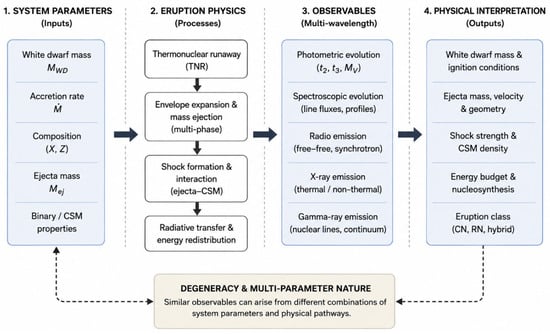
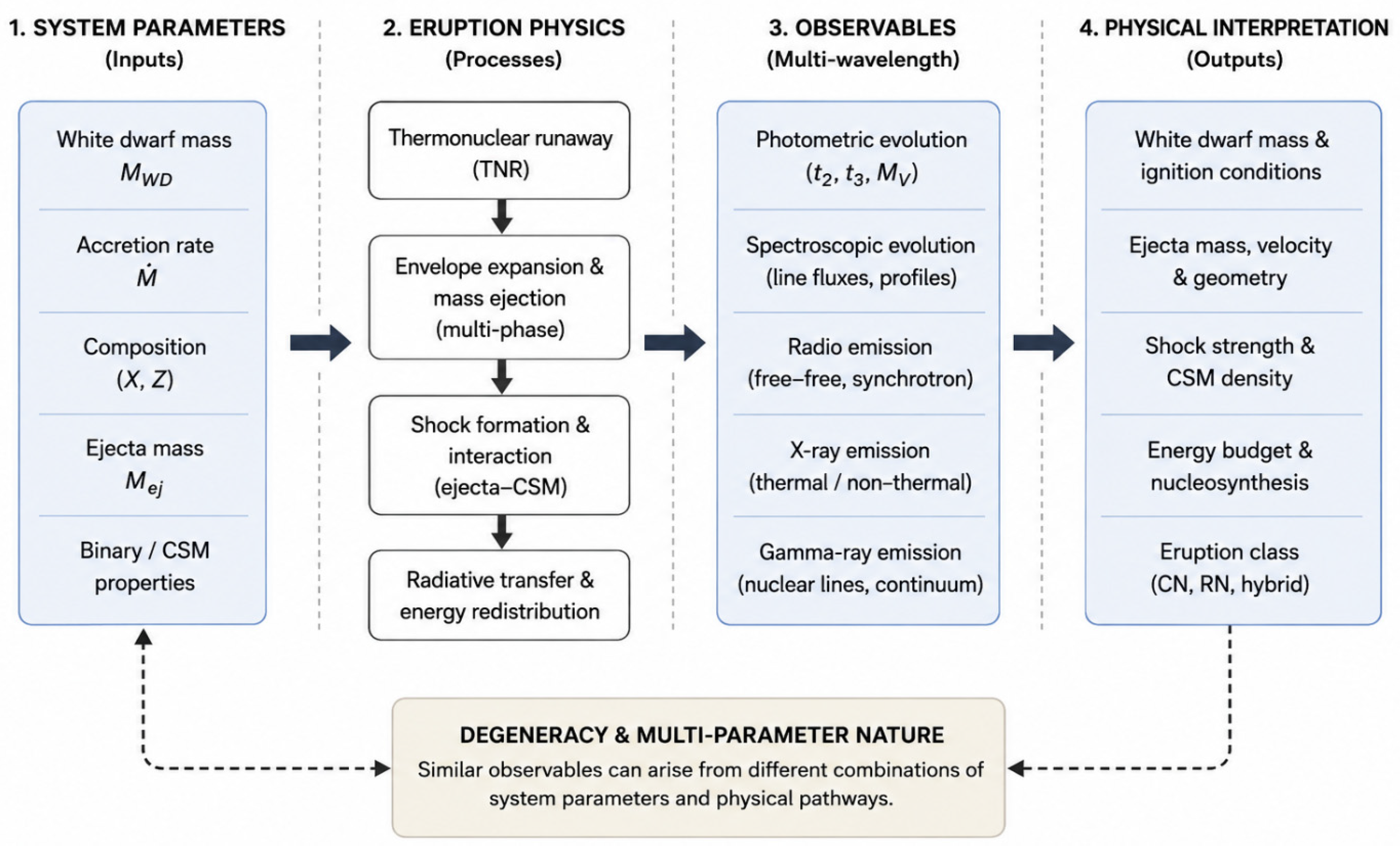
Nova eruptions are inherently dynamic systems in which thermonuclear energy release, multi-phase mass ejection, shock interaction, radiative cooling, and radiative transfer operate simultaneously. The resulting photometric, spectroscopic, and high-energy observables therefore arise from the coupled action of these processes rather than from any single physical mechanism. Figure 3 summarises the relationships between intrinsic system parameters, eruption dynamics, and the resulting multi-wavelength observables that form the basis of the unified framework developed in this review. These coupled physical processes provide the foundation for interpreting the observational diagnostics discussed in the following section, where photometric and spectroscopic measurements are synthesised within a unified multi-parameter framework.
Figure 3.
Unified nova framework. The interplay between fundamental system parameters governs nova eruptions (1), driving the thermonuclear runaway and subsequent physical processes (2). The large horizontal arrows represent the overall causal progression from system parameters to physical interpretation, whereas the smaller vertical arrows indicate the chronological sequence of physical processes during the eruption. Dashed arrows denote the inverse inference and degeneracy between observables and system parameters, illustrating that similar observational signatures may arise from different combinations of physical conditions and evolutionary pathways. Consequently, robust physical interpretation requires a multi-parameter approach.
5. Observational Synthesis: Linking Light Curves, Spectra, and Shocks
5.1. Empirical Mapping of Observables to Physical Drivers
The connection between light-curve behaviour and spectral development remains a significant yet unresolved issue in nova theory. Although correlations do exist, they are neither universal nor specific [14,19]. However, the reason for this failure is clear. As seen in Section 3, nova outflows are inherently multi-phase and dynamic systems, and, as seen in Section 4, their behaviour is strongly influenced by shock-wave interactions. Observable properties arise from the combined effects of ejecta dynamics, radiative transfer, and shock interaction rather than from a single controlling parameter.
Consequently, observable parameters may be expressed more generally as coupled functions of multiple physical variables:
where represents a measured observable, is the shock efficiency, is the viewing inclination, and represents the evolutionary phase. Equation (6) formalises the interpretation that nova observables are coupled functions of multiple evolving physical parameters rather than unique diagnostics of a single property. For example, the declining timescale depends not only on white dwarf mass but also on ejecta mass, opacity evolution, radiative diffusion, and shock heating. Similarly, spectral classification depends on ionisation structure, density evolution, viewing geometry, and the temporal evolution of ejecta optical depth. Consequently, observational degeneracy arises naturally because multiple combinations of physical parameters may produce similar observable behaviour. Indeed, more recent time-domain studies have indicated that light-curve morphology is already established in the very early stages of an outburst, including pre-maximum halts, flares, and oscillations before the optical maximum [26]. On the other hand, multi-wavelength studies have shown that spectral evolution correlates with these dynamical processes, in which ionisation states follow changes in the temperature and density of shock-heated gas [14].
Thus, degeneracies are inevitable, as analogous light-curve morphologies can arise from fundamentally different physical developments. For instance, plateau behaviour in one nova may indicate sustained nuclear burning, whereas in another system it may result from prolonged shock-powered emission or radiative diffusion within dense ejecta [7,14]. To break the degeneracies, the link between observables and physics must be explicitly stated. Such a process is carried out using Table 1.
Table 1.
Mapping Light Curve Morphology and Spectral Evolution to Physical Drivers.
Table 1 demonstrates that photometric and spectroscopic classifications are physically interconnected rather than independent descriptive frameworks. Light-curve morphology, spectral evolution, and high-energy emission instead represent different observational manifestations of the same evolving ejecta system governed by white dwarf mass, ejecta structure, shock interaction, and radiative evolution.
5.2. Compiled Multi-Parameter Dataset
To provide a quantitative framework for the observational synthesis presented in this review, Table 2 compiles a dataset of 20 representative recurrent, symbiotic, and classical novae. The sample is grouped according to observational class and ordered by increasing decline timescale () within each group to facilitate comparison of photometric evolution, spectroscopic characteristics, expansion velocity, and high-energy emission. The dataset integrates key photometric, spectroscopic, and multi-wavelength diagnostics, including the decline timescales ( and ), spectroscopic classifications, expansion velocities derived from emission-line profiles, and the presence of gamma-ray and X-ray emission. Together, these parameters provide a basis for examining how observable properties relate to the underlying physical drivers of nova eruptions, particularly white dwarf mass, ejecta structure, and shock interaction.
The observational trends summarised in Table 2 indicate that fast novae preferentially occupy the high-velocity, short-decline region of parameter space and are predominantly associated with He/N spectra. This behaviour is consistent with eruptions on relatively massive white dwarfs, where stronger surface gravity results in smaller ignition masses, higher escape velocities, and consequently more rapid photometric evolution [11,12,29]. In contrast, slow novae are more commonly characterised by Fe II spectra, lower expansion velocities, and longer decline timescales, reflecting denser ejecta and longer radiative diffusion times within the expanding ejecta [30,31,32].
To investigate the relationships between photometric, spectroscopic, and high-energy properties, a comparative dataset was compiled from representative published studies of classical and recurrent novae. Only systems with well-documented photometric evolution, spectroscopic classifications, ejecta velocities, and supporting multi-wavelength observations were included. The corresponding literature sources for each nova are listed in Table 2. The compiled dataset is intended to identify general physical trends rather than to derive new empirical scaling relations.
Table 2.
Compiled multi-parameter dataset of representative nova systems used in this review. The sample is grouped according to observational class (recurrent, symbiotic, and classical novae) and ordered by increasing decline timescale () within each group to facilitate comparison of photometric evolution, spectroscopic classification, expansion velocity, and high-energy emission.
The compiled dataset also highlights the systematic differences between fast and slow novae. Fast novae, typically characterised by short decline timescales (–15 d) and expansion velocities exceeding , are predominantly associated with He/N spectra and eruptions on relatively massive white dwarfs, leading to more rapid photometric and spectroscopic evolution [11,12,35]. In contrast, slow novae generally exhibit longer decline timescales ( d), lower expansion velocities, Fe II spectra, and denser ejecta that remain optically thick for longer, resulting in a more gradual evolutionary sequence [30,32,36].
These trends, however, should be regarded as statistical rather than deterministic. Hybrid novae and several gamma-ray-detected systems occupy intermediate regions of parameter space, indicating that decline timescale and expansion velocity alone cannot uniquely characterise nova eruptions. Additional factors, including ejecta mass, shock interaction, circumstellar environment, and viewing geometry, collectively influence the observed diversity of nova eruptions and contribute to departures from simple photometric–spectroscopic scaling relations [9,14,33,34,37].
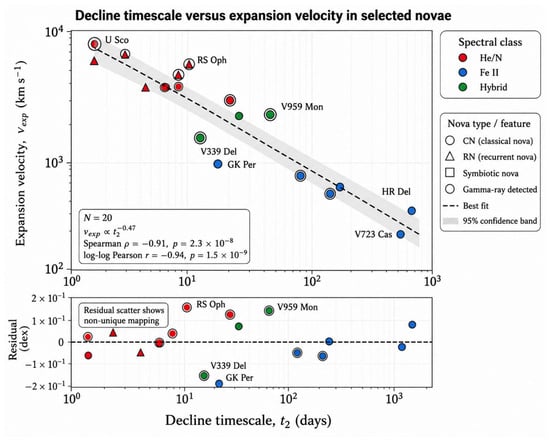
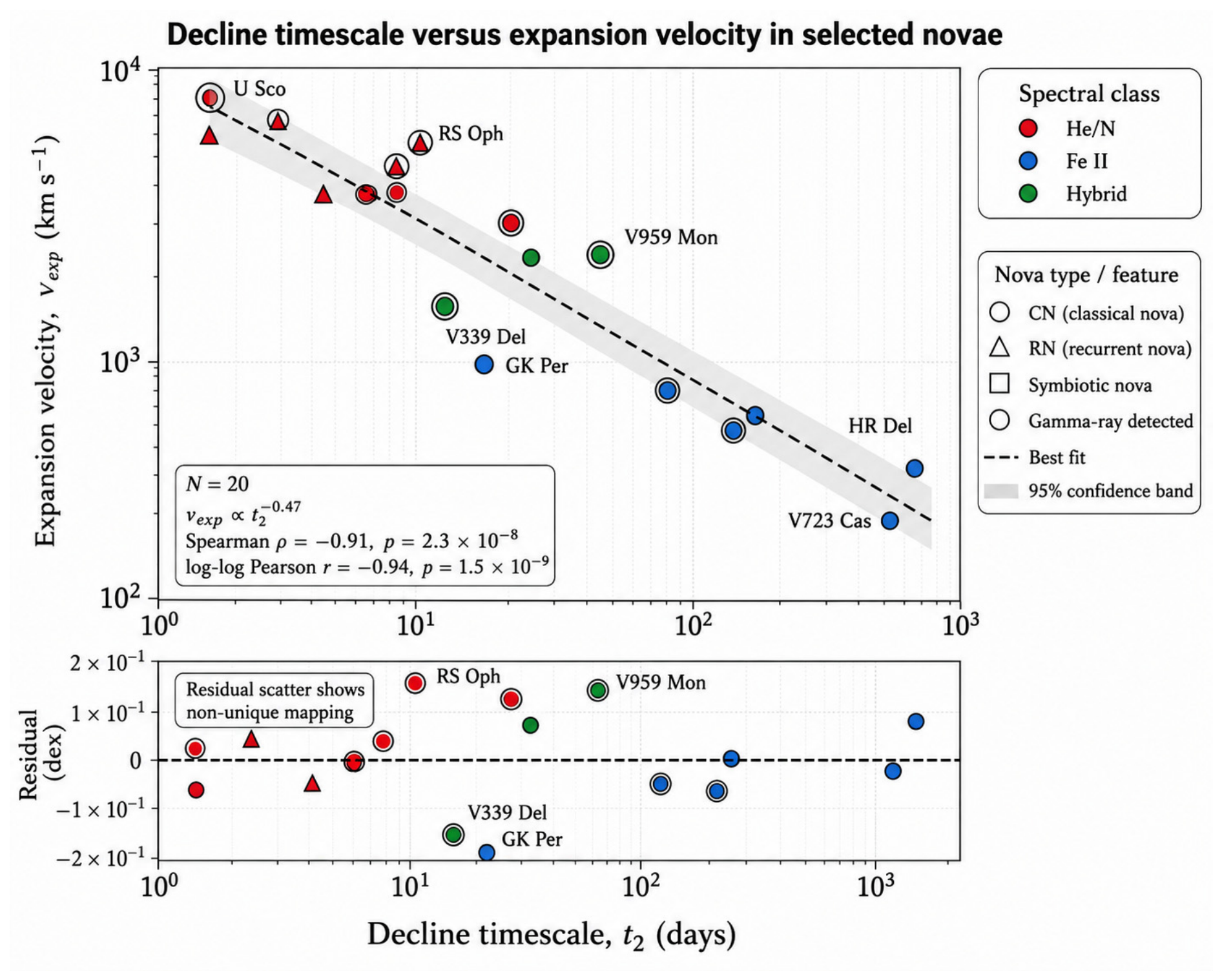
These relationships are examined quantitatively in Figure 4, which shows an inverse correlation between the decline timescale (t2) and the expansion velocity for the compiled nova sample. The fitted relation provides a quantitative framework for evaluating how photometric evolution is linked to ejecta kinematics across different nova subclasses.
Figure 4.
Relationship between photometric decline timescale (t2) and ejecta expansion velocity for selected classical, recurrent, and symbiotic novae. Symbol colour denotes spectral class, marker shape denotes nova type, and open rings indicate gamma-ray-detected systems. The dashed line shows a best-fit power-law relation, vexp ∝ t2−0.47, with a 95% confidence band. The lower panel shows residuals from the fit, illustrating that although fast novae generally exhibit higher velocities, the scatter demonstrates that t2 alone is not a unique diagnostic of nova eruption physics. The increased scatter among hybrid and gamma-ray-detected novae suggests that shock interaction and multi-phase ejecta evolution contribute significantly to deviations from simple decline-rate scaling relations [38,39].
Although the overall inverse relationship between decline timescale and expansion velocity is statistically significant, the compiled sample exhibits substantial scatter, particularly among hybrid and gamma-ray-detected novae (Figure 4). These systems frequently occupy intermediate regions of parameter space and deviate from the general photometric–spectroscopic trends, indicating that the decline timescale alone cannot uniquely characterise eruption energetics or ejecta structure. Their large deviations from the best-fit relation suggest that shock-powered emission, multi-phase outflows, circumstellar interaction, and ejecta geometry contribute significantly to the observed diversity of nova eruptions [6,14,23,38]. Consequently, novae with similar decline rates may exhibit markedly different spectral evolution and high-energy behaviour despite comparable global photometric properties.
Hybrid novae and systems such as V959 Monocerotis provide a clear observational example of this behaviour, demonstrating that binary geometry and anisotropic ejecta can significantly influence the relationship between decline timescale and expansion velocity, producing deviations from simple empirical trends [38].
These observational trends are quantified by a log–log least-squares fit to the compiled dataset, which yields . The inverse correlation is statistically strong (Spearman , ; log–log Pearson , ). Nevertheless, the deviations from the best-fit relation confirm that the decline timescale is a valuable but non-unique indicator of eruption energetics, reinforcing the need for a unified multi-parameter framework that combines photometric evolution, spectroscopic diagnostics, and shock-related phenomena to explain the diversity of nova eruptions.
The observational trends summarised in Table 2 and quantified in Figure 4 demonstrate that no single photometric or spectroscopic observable can uniquely constrain the underlying physical properties of a nova eruption. Instead, decline timescale, spectral class, expansion velocity, and high-energy emission should be interpreted as complementary diagnostics that collectively reflect the combined influence of white dwarf mass, ejecta structure, shock interaction, radiative evolution, and viewing geometry. The comparative analysis presented in this review therefore demonstrates that nova diversity is more appropriately understood within a continuous multi-parameter physical framework than through isolated empirical classification schemes. This synthesis provides the conceptual basis for interpreting photometric, spectroscopic, and high-energy diagnostics as complementary manifestations of the same underlying physical processes.
5.3. Spectral-Line Diagnostics as Quantitative Links Between Light Curves and Ejecta Physics
Time-resolved spectral-line diagnostics provide one of the most direct observational probes of nova ejecta dynamics and eruption evolution. Unlike photometric morphology alone, spectral-line evolution simultaneously traces expansion kinematics, ionisation structure, ejecta density, radiative cooling, and shock interaction throughout the eruption sequence. The temporal evolution of Balmer emission lines (e.g., Hα and Hβ), helium transitions (He I and He II), and forbidden lines such as [O III] therefore provides a physically coupled view of the changing conditions within the expanding ejecta [39,40,41,42]. The full width at half maximum (FWHM) of emission lines provides a first-order proxy for ejecta expansion velocity, while equivalent width (EW) evolution traces the balance between recombination emission and continuum luminosity. Variations in line asymmetry, peak separation, and V/R ratios further provide insight into ejecta geometry, optical-depth evolution, and internal shock interaction. In the representative RS Ophiuchi case study presented below, these spectroscopic diagnostics were derived from continuum-normalised optical spectra obtained from the ARAS Spectral Database using standard spectroscopic line-profile analysis. Consequently, spectral-line diagnostics establish an important quantitative connection between observed light-curve behaviour and the underlying hydrodynamic evolution of nova ejecta [28].
To illustrate the physical framework developed in the preceding sections, the 2021 eruption of RS Ophiuchi is presented as a representative case study. The V-band photometric data were obtained from the American Association of Variable Star Observers (AAVSO) International Database, while the optical spectra were obtained from the Astronomical Ring for Access to Spectroscopy (ARAS) Spectral Database. Representative spectra spanning the principal stages of the eruption were continuum-normalised prior to analysis, and the resulting photometric and spectroscopic measurements were used to examine the temporal evolution of the eruption. These analyses are intended to illustrate the physical interpretation developed throughout this review rather than to provide a comprehensive observational study of RS Ophiuchi.
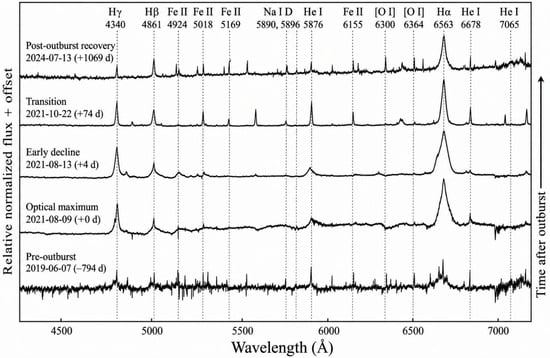
Figure 5 presents the V-band light curve of the 2021 RS Oph eruption, constructed from daily median observations obtained through the American Association of Variable Star Observers (AAVSO). The principal photometric phases provide the temporal framework for interpreting the evolution of spectroscopic diagnostics, thereby linking changes in light-curve morphology to the evolving physical conditions within the ejecta. While the light curve records the global evolution of the eruption, each photometric stage reflects distinct physical conditions within the expanding ejecta, thereby linking light-curve morphology with the evolution of spectroscopic diagnostics. The initial rise and optical maximum are associated with rapid mass ejection and optically thick conditions, whereas the early decline and transition phases coincide with decreasing optical depth, increasing ionisation, and the onset of internal shock interaction.
Figure 5.
V-band light curve of the 2021 eruption of RS Ophiuchi constructed from daily median observations obtained from the AAVSO International Database. The figure identifies the principal stages of photometric evolution together with the rise time (), optical maximum, and the decline times ( and ). The inset enlarges the initial rise and indicates the corresponding average brightening rate. The dashed line in the inset represents the best-fitting linear regression to the initial-rise data, from which an average brightening rate of approximately 0.90 mag d−1 is derived.
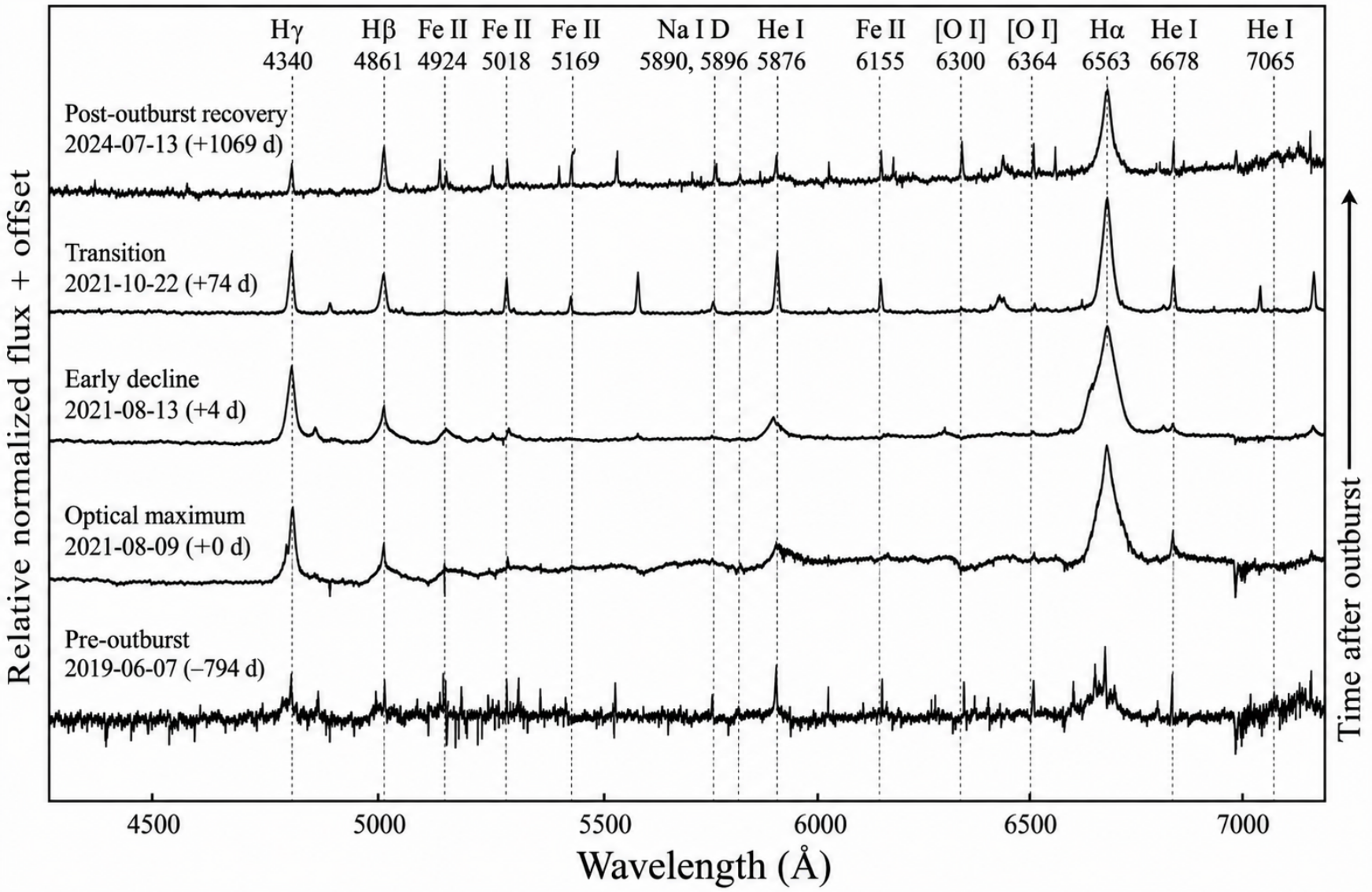
Figure 6 illustrates the systematic evolution of the optical spectrum throughout the eruption and demonstrates how changes in emission-line morphology trace the evolving physical conditions within the ejecta. The early spectra are dominated by broad Balmer and prominent Fe II emission, characteristic of dense, optically thick ejecta. As the eruption progresses through the decline and transition phases, helium emission strengthens as the ionisation state increases and the optical depth decreases. At later times, the appearance of nebular forbidden emission lines, including [O III], [N II], and [O I], marks the development of low-density nebular conditions. Concurrent changes in line width, profile asymmetry, and relative line strengths reflect the combined effects of ejecta expansion, radiative cooling, evolving geometry, and internal shock interaction. These spectral changes provide the observational basis for the quantitative diagnostics discussed in the following sections.
Figure 6.
Representative continuum-normalised optical spectra of the 2021 eruption of RS Ophiuchi obtained from the ARAS Spectral Database. The spectra are arranged according to the principal photometric phases and illustrate the evolution of the dominant emission features from the pre-outburst state through the nebular phase. The corresponding epochs relative to the optical maximum and the principal spectral characteristics of each phase are summarised alongside the spectra.
Consequently, quantitative measurements of spectral-line properties are most meaningful when interpreted within the context of the photometric evolution rather than as isolated observables. This observational framework provides the basis for the quantitative spectral diagnostics presented in the following sections.
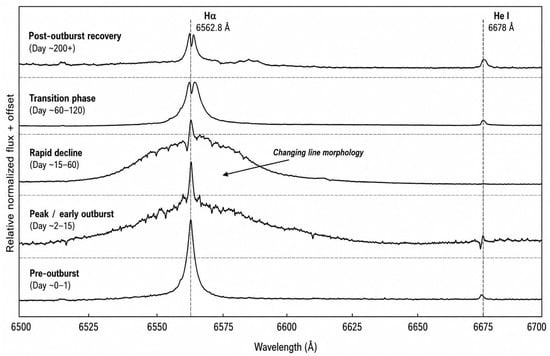
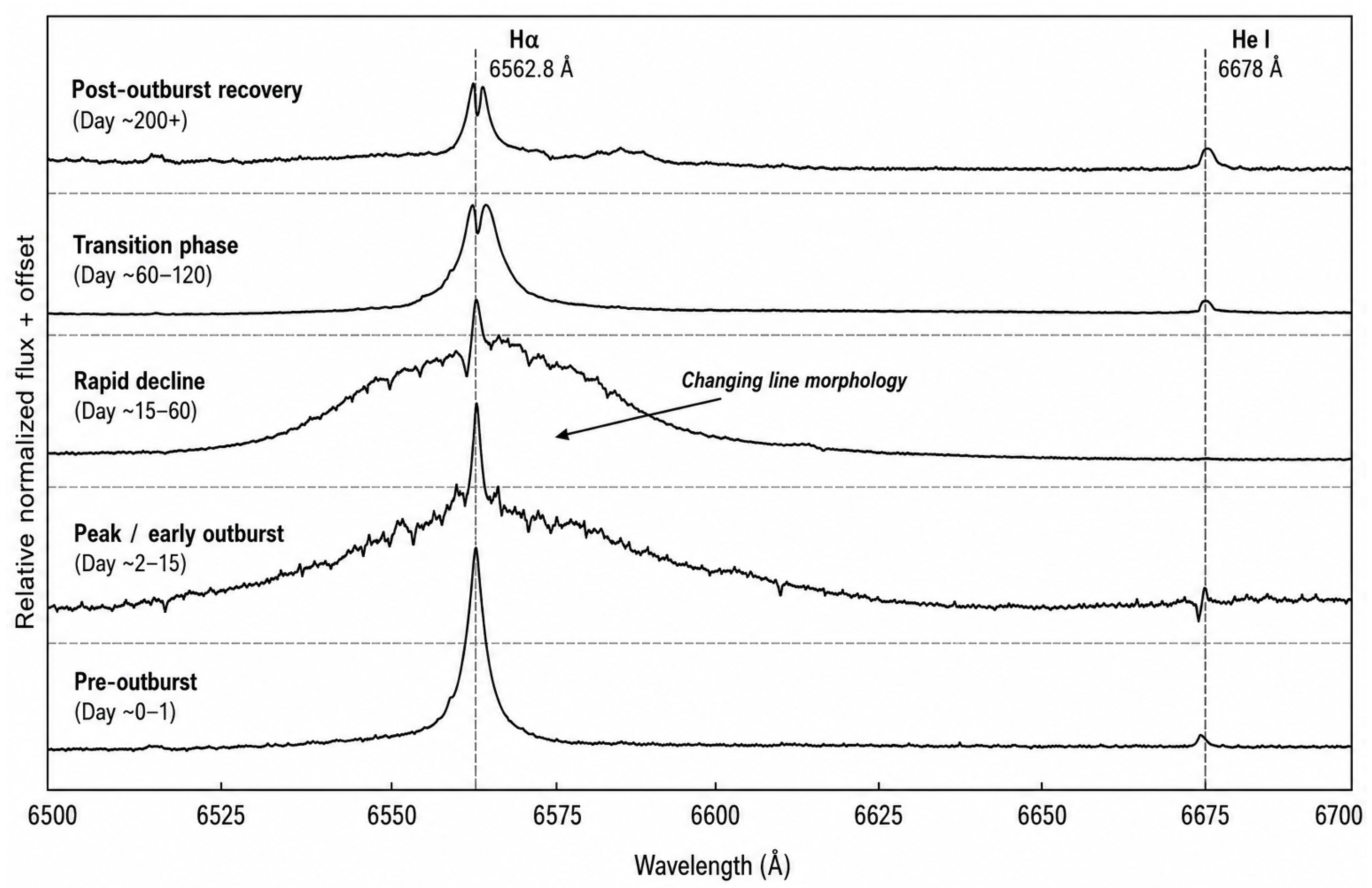
Figure 7 highlights the evolution of the Hα emission-line profile, one of the most sensitive tracers of ejecta kinematics and shock evolution during nova eruptions. The early spectra exhibit broad emission profiles characteristic of rapidly expanding, optically thick ejecta. As the eruption progresses, the line profile narrows and develops increasing asymmetry and substructure, indicating changes in ejecta geometry and the interaction between faster and slower outflow components. Together with the evolving continuum, these morphological changes reflect the combined influence of ejecta expansion, declining optical depth, and shock interaction, providing the basis for the quantitative Hα diagnostics presented in the following sections.
Figure 7.
Evolution of the Hα emission-line profile during the 2021 eruption of RS Oph. The profiles were extracted from continuum-normalised spectra obtained from the ARAS Spectral Database and vertically offset for clarity. The figure illustrates the temporal evolution of the Hα line profile, including changes in line width, asymmetry, and surrounding continuum associated with the evolving ejecta.
As the eruption progresses, the emergence of asymmetries, profile substructure, and evolving peak morphology indicates the development of multi-component outflows and increasing dynamical interaction within the ejecta [43,44]. The progressive evolution of line width and profile asymmetry further suggests that a simple homologous expanding spherical shell cannot describe the ejecta. Instead, the observed spectral evolution is more consistent with structured, anisotropic outflows, in which shock interaction between fast and slow ejecta components progressively modifies both the velocity distribution and the ionisation structure of the expanding ejecta [34,38]. The appearance of evolving broad-wing emission and changing continuum structure during later phases additionally supports the growing influence of shock heating and radiative cooling throughout the eruption [6,14,42].
Assuming Doppler broadening dominates the observed emission-line profiles, the characteristic expansion velocity, may be estimated from the measured FWHM:
where is the full width at half maximum is the rest wavelength of the transition and is the speed of light. Broad asymmetric line profiles therefore directly trace the velocity distribution and geometry of the ejecta. However, nova emission-line profiles are also influenced by optical-depth effects, radiative transfer, inclination angle, and unresolved multiple velocity components. Consequently, measured line widths should be interpreted as effective diagnostics of ejecta kinematics rather than exact measures of spherical expansion velocity.
The EW(t) of Balmer emission lines further provides a proxy for the balance between recombination emission and continuum luminosity:
where is the observed spectral flux density at wavelength and time ; is the corresponding local continuum flux density; and define the wavelength interval over which the line profile is integrated; and is the differential wavelength element. The equivalent width therefore represents the integrated excess emission above the local continuum and provides a quantitative measure of the relative line strength independent of the absolute continuum flux.
Time-dependent variations in provide insight into the evolving density, ionisation state, and shock contribution within the nova ejecta. Large equivalent widths generally indicate strong recombination emission relative to the continuum and are commonly associated with dense or shock-heated ejecta. However, the evolution of also depends on continuum fading, optical-depth effects, and changes in ionisation, making its temporal behaviour more physically informative than single-epoch measurements. Interpreted together with line width and ionisation-sensitive transitions, provides a valuable diagnostic of the coupling between ejecta expansion, radiative cooling, and shock-powered emission.
High-cadence spectroscopic observations further reveal evolving line asymmetries, multiple velocity components, and changes in peak morphology, providing strong evidence for structured, multi-phase ejecta and internal shock interaction [5,9,21,28]. In particular, the emergence of broad emission wings and evolving V/R ratios in Balmer lines is consistent with collisions between fast outflows and slower, denser ejecta, producing internal shocks that modify both the velocity field and ionisation structure.
The appearance of high-ionisation lines, such as He II, together with the subsequent emergence of forbidden transitions including [O III], marks the progressive transition from dense, optically thick ejecta to low-density nebular conditions. These changes are driven by decreasing density, increasing transparency, and continued shock evolution, often coinciding with phases of enhanced high-energy emission [6,14,33].
Taken together, emission-line width, equivalent width, Balmer decrement, ionisation-sensitive transitions, forbidden emission lines, and line-profile morphology provide complementary diagnostics of ejecta kinematics, density, ionisation state, geometry, and shock interaction throughout the eruption. Their combined temporal evolution demonstrates that nova eruptions are dynamically evolving, structured outflows rather than simple ballistic expansions. Table 3 summarises the principal spectroscopic diagnostics, their physical significance, representative evolutionary stages, and the key references supporting their interpretation.
Table 3.
Diagnostic framework linking spectroscopic observables with the physical evolution of nova eruptions.
Table 3 highlights that no individual spectroscopic diagnostic provides a unique measure of the physical state of a nova eruption. Instead, the combined interpretation of emission-line kinematics, equivalent width, ionisation-sensitive transitions, forbidden emission lines, and profile morphology offers a more complete description of the evolving ejecta. Integrated with photometric evolution and multi-wavelength observations, these complementary diagnostics support the unified physical framework developed throughout this review, in which nova diversity emerges from the coupled effects of white dwarf properties, ejecta dynamics, radiative evolution, and shock interaction rather than from any single observable parameter.
6. From Classification to Physical Parameter Space
6.1. Classical and Recurrent Novae as a Continuum
Classical and recurrent novae have traditionally been distinguished according to their observed recurrence times, with recurrent novae exhibiting eruptions on timescales of decades, whereas only a single eruption has been recorded for classical novae [19]. However, this observational distinction does not imply a fundamental physical difference between the two classes. Both result from thermonuclear runaway on the surface of an accreting white dwarf and are governed by the same underlying physical processes [6,15].
As discussed in Section 3.1, the recurrence timescale is controlled primarily by the combined effects of white dwarf mass, ignition mass, and mass accretion rate. High-mass white dwarfs require smaller ignition masses to initiate thermonuclear runaway, while higher accretion rates replenish the accreted envelope more rapidly, naturally producing shorter recurrence intervals [11,12,16]. Conversely, systems with lower white dwarf masses or lower accretion rates require longer periods to accumulate sufficient material for ignition, resulting in recurrence times that may exceed historical observational records and are therefore commonly classified as classical novae.
Accumulating observational evidence increasingly supports interpreting classical and recurrent novae as occupying different regions of a continuous physical parameter space rather than representing intrinsically distinct populations. Systems such as KT Eridani exhibit several characteristics commonly associated with recurrent novae despite having only one confirmed eruption, suggesting that the traditional classification is influenced not only by the underlying physics but also by observational completeness and historical coverage [26].
6.2. Physical Parameter Space and Observational Degeneracy
The synthesis presented in Section 5 demonstrates that nova observables cannot be uniquely mapped to physical properties. Instead, photometric evolution, spectral development, and high-energy emission arise from the coupled effects of white dwarf mass, accretion rate, ejecta structure, shock interaction, and viewing geometry [6,14].
A physically motivated description of nova systems can therefore be expressed through a multi-dimensional parameter space:
where is the white dwarf mass, is the accretion rate, is the white dwarf core temperature, and represent the ejecta mass and velocity distribution, and describes the efficiency of shock energy conversion into radiation, is the viewing inclination, and characterises the surrounding circumstellar density.
Observable quantities such as decline timescale, spectral evolution, line-profile morphology, and high-energy emission, therefore, represent coupled projections of this evolving parameter space rather than independent physical diagnostics.
Within this framework, observable quantities such as decline rates, spectral classes, gamma-ray emission, X-ray luminosity, and spectral-line evolution represent manifestations of a single evolving ejecta system rather than independent classification criteria. Consequently, systems with different physical properties may exhibit similar observational signatures, while comparable systems may display distinct behaviours due to geometry, inclination, and environmental interaction. Although empirical classifications remain valuable observational descriptors, they should not be interpreted as unique indicators of the underlying physical state of the system.
This interpretation explains why empirical classifications alone are insufficient for uniquely constraining nova physics. Classical and recurrent novae, therefore, should not be viewed as fundamentally distinct categories, but as different manifestations of a continuous physical parameter space governed by eruption energetics, ejecta dynamics, and shock interaction.
6.3. Evolutionary Implications for Type Ia Supernova Progenitors
The parameter-space framework has important implications for the long-term evolution of nova systems and their connection to Type Ia supernova progenitors. Recurrent novae containing high-mass white dwarfs and high accretion rates are considered promising progenitor candidates because repeated eruptions may allow the white dwarf to approach the Chandrasekhar limit gradually [15].
However, the efficiency of mass retention remains uncertain due to the complex role of shocks, ejecta interaction, and mass loss during eruptions. Multi-wavelength observations indicate that a substantial fraction of eruptive energy may be dissipated through shock-driven outflows, potentially affecting the long-term mass evolution of the white dwarf [7,14]. Future time-resolved photometric, spectroscopic, and high-energy observations will therefore be essential for constraining the evolutionary pathways linking recurrent novae to Type Ia supernovae.
7. Conclusions
This review demonstrates that the observed diversity of classical and recurrent novae is best understood as the outcome of multiple coupled physical processes rather than any single controlling parameter. By synthesising photometric morphology, spectroscopic evolution, and multi-wavelength observations, we show that white dwarf mass, accretion rate, ejecta structure, shock interaction, radiative evolution, and environmental effects collectively determine the observable properties of nova eruptions.
The principal contribution of this review is the development of a unified physical framework that links these observational diagnostics within a continuous multi-parameter interpretation of nova evolution. This framework explains why similar observational characteristics may arise from different physical conditions and why no individual observable provides a unique diagnostic of eruption physics.
The proposed framework provides a physically motivated basis for interpreting future high-cadence photometric, spectroscopic, and multi-wavelength observations. It offers a coherent approach for investigating nova evolution, white dwarf mass growth, and the long-term evolutionary pathways of accreting white dwarf systems.
Author Contributions
Conceptualisation, N.A.; methodology, S.M.A.; validation, N.A.; formal analysis, N.A. and S.M.A.; investigation, S.M.A.; resources, N.A.; data curation, S.M.A.; writing—original draft preparation, S.M.A.; writing—review and editing, N.A.; visualisation, S.M.A.; supervision, N.A.; project administration, N.A.; funding acquisition, N.A. and S.M.A. All authors have read and agreed to the published version of the manuscript.
Funding
This research received no external funding. The APC was funded by Saad Mohammed Alshehri.
Data Availability Statement
No new observational data were acquired for this study. All observational data discussed in this review were obtained from publicly available archival resources, including the American Association of Variable Star Observers (AAVSO) International Database and the Astronomical Ring for Access to Spectroscopy (ARAS) Spectral Database, together with the published literature cited throughout the manuscript.
Acknowledgments
The authors gratefully acknowledge the American Association of Variable Star Observers (AAVSO) and its worldwide observer community for providing the photometric observations used in this study through the AAVSO International Database. The authors also acknowledge the Astronomical Ring for Access to Spectroscopy (ARAS) Spectral Database for providing the archival spectroscopic observations analysed in this work. We sincerely thank Olivier Thizy, Colin Eldridge, and T. Lester for acquiring and contributing the RS Ophiuchi spectra used in this study, and acknowledge the continued efforts of the ARAS community in maintaining this valuable public spectroscopic archive. The use of AAVSO and ARAS data follows their respective data-use policies. The authors further acknowledge the support provided by the Department of Physics, Faculty of Science, Universiti Malaya, and the Optical Astronomy Research Laboratory (OpARL) in facilitating this research. The authors also express their sincere gratitude to the staff of the Future Economy Sector, Earth and Space Science Institute, King Abdulaziz City for Science and Technology (KACST), Riyadh, Saudi Arabia, for their valuable guidance and continuous support throughout this study. During the preparation and revision of this manuscript, the authors used Claude Opus 4.7 to assist in drafting and refining selected passages in the Abstract, Introduction, Section 3 and Section 4, and the synthesis discussion in Section 5. Claude was also used to refine language and improve textual coherence throughout the manuscript. The authors determined the scientific scope and arguments, selected and verified the literature, evaluated the observational evidence, and critically revised and approved all AI-assisted passages. No data analysis or independent scientific conclusions were generated using Claude. The authors take full responsibility for the accuracy, interpretation, and integrity of the manuscript. We confirm that Claude was used as a drafting and language-support tool. The authors have critically reviewed and revised all AI-assisted passages and verified the scientific statements and cited literature, and they take full responsibility for the final manuscript.
Conflicts of Interest
The authors declare no conflicts of interest.
References
- Özdönmez, A.; Ege, E.; Güver, T.; Ak, T. A New Catalogue of Galactic Novae: Investigation of the MMRD Relation and Spatial Distribution. Mon. Not. R. Astron. Soc. 2018, 476, 4162–4186. [Google Scholar] [CrossRef] [Scilit]
- Selvelli, P.; Gilmozzi, R. A UV and Optical Study of 18 Old Novae with Gaia DR2 Distances: Mass Accretion Rates, Physical Parameters, and MMRD. Astron. Astrophys. 2019, 622, A186. [Google Scholar] [CrossRef] [Scilit]
- Schaefer, B.E. The Distances to Novae as Seen by Gaia. Mon. Not. R. Astron. Soc. 2018, 481, 3033–3051. [Google Scholar] [CrossRef] [Scilit]
- Mason, E.; Diaz, M.P.; Williams, R.E.; Preston, G.W.; Bensby, T. The Peculiar Nova V1309 Scorpii/Nova Scorpii 2008. Astron. Astrophys. 2010, 516, A108. [Google Scholar] [CrossRef] [Scilit]
- Aydi, E.; Chomiuk, L.; Strader, J.; Sokolovsky, K.V.; Williams, R.E.; Buckley, D.A.H.; Ederoclite, A.; Izzo, L.; Kyer, R.; Linford, J.D.; et al. Revisiting the Classics: On the Evolutionary Origin of the ‘Fe Ii’ and ‘He/N’ Spectral Classes of Novae. Mon. Not. R. Astron. Soc. 2023, 527, 9303–9321. [Google Scholar] [CrossRef] [Scilit]
- Chomiuk, L.; Metzger, B.D.; Shen, K.J. New Insights into Classical Novae. Annu. Rev. Astron. Astrophys. 2021, 59, 391–444. [Google Scholar] [CrossRef] [Scilit]
- Metzger, B.D.; Finzell, T.; Vurm, I.; Hascoët, R.; Beloborodov, A.M.; Chomiuk, L. Gamma-Ray Novae as Probes of Relativistic Particle Acceleration at Non-Relativistic Shocks. Mon. Not. R. Astron. Soc. 2015, 450, 2739–2748. [Google Scholar] [CrossRef] [Scilit]
- Pavana, M.; Raj, A.; Bohlsen, T.; Anupama, G.C.; Gupta, R.; Selvakumar, G. Spectroscopic and Geometrical Evolution of the Ejecta of the Classical Nova ASASSN-18fv. Mon. Not. R. Astron. Soc. 2020, 495, 2075–2087. [Google Scholar] [CrossRef] [Scilit]
- Sokolovsky, K.V.; Li, K.-L.; de Oliveira, R.L.; Ness, J.; Mukai, K.; Chomiuk, L.; Aydi, E.; Steinberg, E.; Vurm, I.; Metzger, B.D.; et al. The First Nova Eruption in a Novalike Variable: YZ Ret as Seen in X-Rays and γ-Rays. Mon. Not. R. Astron. Soc. 2022, 514, 2239–2258. [Google Scholar] [CrossRef] [Scilit]
- Shara, M.M.; Prialnik, D.; Hillman, Y.; Kovetz, A. The Masses and Accretion Rates of White Dwarfs in Classical and Recurrent Novae. Astrophys. J. 2018, 860, 110. [Google Scholar] [CrossRef] [Scilit]
- Yaron, O.; Prialnik, D.; Shara, M.M.; Kovetz, A. An Extended Grid of Nova Models. II. The Parameter Space of Nova Outbursts. Astrophys. J. 2005, 623, 398–410. [Google Scholar] [CrossRef] [Scilit]
- Hillman, Y.; Prialnik, D.; Kovetz, A.; Shara, M.M. Growing White Dwarfs to the Chandrasekhar Limit: The Parameter Space of the Single Degenerate SNIa Channel. Astrophys. J. 2016, 819, 168. [Google Scholar] [CrossRef] [Scilit]
- The Fermi-LAT Collaboration. Fermi Establishes Classical Novae as a Distinct Class of Gamma-Ray Sources. Science 2014, 345, 554–558. [CrossRef] [Scilit] [PubMed]
- Aydi, E.; Sokolovsky, K.V.; Chomiuk, L.; Steinberg, E.; Li, K.-L.; Vurm, I.; Metzger, B.D.; Strader, J.; Mukai, K.; Pejcha, O.; et al. Direct Evidence for Shock-Powered Optical Emission in a Nova. Nat. Astron. 2020, 4, 776–780. [Google Scholar] [CrossRef] [Scilit]
- Starrfield, S.; Iliadis, C.; Hix, W.R. The Thermonuclear Runaway and the Classical Nova Outburst. Publ. Astron. Soc. Pac. 2016, 128, 51001. [Google Scholar] [CrossRef] [Scilit]
- Kato, M.; Hachisu, I. Optically Thick Winds in Nova Outbursts. Astrophys. J. 1994, 437, 802–826. [Google Scholar] [CrossRef] [Scilit] [PubMed]
- Della Valle, M.; Izzo, L. Observations of Galactic and Extragalactic Novae. Astron. Astrophys. Rev. 2020, 28, 3. [Google Scholar] [CrossRef] [Scilit]
- Cheung, C.C.; Jean, P.; Shore, S.N.; Stawarz, Ł.; Corbet, R.H.D.; Knödlseder, J.; Starrfield, S.; Wood, D.L.; Desiante, R.; Longo, F.; et al. Fermi-LAT Gamma-Ray Detections of Classical Novae V1369 Centauri 2013 and V5668 Sagittarii 2015. Astrophys. J. 2016, 826, 142. [Google Scholar] [CrossRef] [Scilit]
- Darnley, M.J.; Hounsell, R.; O’Brien, T.J.; Henze, M.; Rodríguez-Gil, P.; Shafter, A.W.; Shara, M.M.; Vaytet, N.; Bode, M.F.; Ciardullo, R.; et al. A Recurrent Nova Super-Remnant in the Andromeda Galaxy. Nature 2019, 565, 460–463. [Google Scholar] [CrossRef] [Scilit] [PubMed]
- Martin, P.; Dubus, G.; Jean, P.; Tatischeff, V.; Dosne, C. Gamma-Ray Emission from Internal Shocks in Novae. Astron. Astrophys. 2018, 612, A38. [Google Scholar] [CrossRef] [Scilit]
- Steinberg, E.; Metzger, B.D. Internal Shocks from Variable Outflows in Classical Novae. Mon. Not. R. Astron. Soc. 2019, 491, 4232–4246. [Google Scholar] [CrossRef] [Scilit]
- Sokoloski, J.L.; Lawrence, S.; Crotts, A.P.; Mukai, K. Flows and Shocks: Some Recent Developments in Symbiotic Star and Nova Research. arXiv 2017, arXiv:1702.05898. [Google Scholar] [CrossRef] [Scilit]
- Vlasov, A.D.; Vurm, I.; Metzger, B.D. Shocks in Nova Outflows—II. Synchrotron Radio Emission. Mon. Not. R. Astron. Soc. 2016, 463, 394–412. [Google Scholar] [CrossRef] [Scilit]
- Pandey, R.; Habtie, G.R.; Bandyopadhyay, R.; Das, R.; Teyssier, F.; Fló, J.G. Study of 2021 Outburst of the Recurrent Nova RS Ophiuchi: Photoionization and Morphokinematic Modelling. Mon. Not. R. Astron. Soc. 2022, 515, 4655–4668. [Google Scholar] [CrossRef] [Scilit]
- Shore, S.N.; Augusteijn, T.; Ederoclite, A.; Uthas, H. The Spectroscopic Evolution of the Recurrent Nova T Pyxidis during Its 2011 Outburst. Astron. Astrophys. 2011, 533, L8. [Google Scholar] [CrossRef] [Scilit]
- Shafter, A.W.; Hornoch, K.; Benáček, J.; Galád, A.; Janík, J.; Jurýšek, J.; Kotková, L.; Kurfürst, P.; Kučáková, H.; Kušnirák, P.; et al. A Survey of Novae in M83. Astrophys. J. 2021, 923, 239. [Google Scholar] [CrossRef] [Scilit]
- Strope, R.J.; Schaefer, B.E.; Henden, A.A. Catalog of 93 nova light curves: Classification and properties. Astron. J. 2010, 140, 34–62. [Google Scholar] [CrossRef] [Scilit]
- Aydi, E.; Chomiuk, L.; Izzo, L.; Harvey, E.; Leahy-McGregor, J.; Strader, J.; Buckley, D.; Sokolovsky, K.V.; Kawash, A.; Kochanek, C.S.; et al. Early Spectral Evolution of Classical Novae: Consistent Evidence for Multiple Distinct Outflows. Astrophys. J. 2020, 905, 62. [Google Scholar] [CrossRef] [Scilit]
- Shore, S.N.; De Gennaro Aquino, I.; Schwarz, G.J.; Augusteijn, T.; Cheung, C.C.; Walter, F.M.; Starrfield, S. The Spectroscopic Evolution of the γ-Ray Emitting Classical Nova Nova Mon 2012. I. Implications for the ONe Subclass of Classical Novae. Astron. Astrophys. 2013, 553, A123. [Google Scholar] [CrossRef] [Scilit]
- Starrfield, S.; Bose, M.; Iliadis, C.; Hix, W.R.; Woodward, C.E.; Wagner, R.M. Carbon–Oxygen Classical Novae Are Galactic 7Li Producers as well as Potential Supernova Ia Progenitors. Astrophys. J. 2020, 895, 70. [Google Scholar] [CrossRef] [Scilit]
- Darnley, M.J.; Henze, M. On a Century of Extragalactic Novae and the Rise of the Rapid Recurrent Novae. Adv. Space Res. 2020, 66, 1147–1168. [Google Scholar] [CrossRef] [Scilit]
- Metzger, B.D.; Hascoët, R.; Vurm, I.; Beloborodov, A.M.; Chomiuk, L.; Sokoloski, J.L.; Nelson, T. Shocks in Nova Outflows—I. Thermal Emission. Mon. Not. R. Astron. Soc. 2014, 442, 713–731. [Google Scholar] [CrossRef] [Scilit]
- Abdo, A.A.; Ackermann, M.; Ajello, M.; Atwood, W.B.; Baldini, L.; Ballet, J.; Barbiellini, G.; Bastieri, D.; Bechtol, K.; Bellazzini, R.; et al. Gamma-Ray Emission Concurrent with the Nova in the Symbiotic Binary V407 Cygni. Science 2010, 329, 817–821. [Google Scholar] [CrossRef] [Scilit] [PubMed]
- Chomiuk, L.; Linford, J.D.; Yang, J.; O’Brien, T.J.; Paragi, Z.; Mioduszewski, A.J.; Beswick, R.; Cheung, C.C.; Mukai, K.; Nelson, T.; et al. Binary Orbits as the Driver of γ-Ray Emission and Mass Ejection in Classical Novae. Nature 2014, 514, 339–342. [Google Scholar] [CrossRef] [Scilit] [PubMed]
- Aydi, E.; Monnier, J.D.; Mérand, A.; Schaefer, G.; Chomiuk, L.; Otulakowska-Hypka, M.; Fan, J.-L.; Li, K.-L.; Sokolovsky, K.V.; Salinas, R.; et al. Multiple Outflows and Delayed Ejections Revealed by Early Imaging of Novae. Nat. Astron. 2025, 10, 271–280. [Google Scholar] [CrossRef] [Scilit] [PubMed]
- Aharonian, F.; Benkhali, F.A.; Angüner, E.O.; Ashkar, H.; Backes, M.; Baghmanyan, V.; Martins, V.B.; Batzofin, R.; Becherini, Y.; Berge, D.; et al. Time-Resolved Hadronic Particle Acceleration in the Recurrent Nova RS Ophiuchi. Science 2022, 376, 77–80. [Google Scholar] [CrossRef] [Scilit] [PubMed]
- Nelson, T.; Mukai, K.; Chomiuk, L.; Sokoloski, J.L.; Linford, J.D.; Finzell, T.; Mioduszewski, A.J.; Rupen, M.P.; Weston, J.; Oliveira, R.L. de X-Ray Evolution of the Nova V959 Mon Suggests a Delayed Ejection and a Non-Radiative Shock. Mon. Not. R. Astron. Soc. 2020, 500, 2798–2812. [Google Scholar] [CrossRef] [Scilit]
- Ribeiro, V.A.R.M.; Munari, U.; Valisa, P. Optical Morphology, Inclination, and Expansion Velocity of the Ejected Shell of Nova Monocerotis 2012. Astrophys. J. 2013, 768, 49. [Google Scholar] [CrossRef] [Scilit]
- Munari, U.; Giroletti, M.; Marcote, B.; O’Brien, T.J.; Vereš, P.; Yang, J.; Williams, D.R.; Woudt, P.A. Radio Interferometric Imaging of RS Oph Bipolar Ejecta for the 2021 Nova Outburst. Astron. Astrophys. 2022, 666, L6. [Google Scholar] [CrossRef] [Scilit]
- Dukiya, N.; Gangopadhyay, A.; Misra, K.; Hosseinzadeh, G.; Bostroem, K.A.; Ailawadhi, B.; Howell, D.A.; Valenti, S.; Arcavi, I.; McCully, C. Probing the Circumstellar Environment of Highly Luminous Type IIn SN ASASSN-14il. Astrophys. J. 2024, 976, 86. [Google Scholar] [CrossRef] [Scilit]
- Brennan, S.; Fraser, M.; Johansson, J.; Pastorello, A.; Kotak, R.; Stevance, H.F.; Chen, T.W.; Eldridge, J.J.; Bose, S.; Brown, P.; et al. Photometric and Spectroscopic Evolution of the Interacting Transient AT 2016jbu(Gaia16cfr). Mon. Not. R. Astron. Soc. 2022, 513, 5642–5665. [Google Scholar] [CrossRef] [Scilit]
- Bottorff, M.C.; Ferland, G.J.; Straley, J.P. Two-Photon Transitions and Continuous Emission from Hydrogenic Species. Publ. Astron. Soc. Pac. 2006, 118, 1176–1179. [Google Scholar] [CrossRef] [Scilit]
- Babul, A.; Sokoloski, J.L.; Chomiuk, L.; Linford, J.D.; Weston, J.; Aydi, E.; Sokolovsky, K.V.; Kawash, A.; Mukai, K. Shocks and Dust Formation in Nova V809 Cep. Mon. Not. R. Astron. Soc. 2022, 515, 3028–3036. [Google Scholar] [CrossRef] [Scilit]
- Aydi, E.; Orio, M.; Beardmore, A.P.; Ness, J.-U.; Page, K.L.; Kuin, N.P.M.; Walter, F.M.; Buckley, D.A.H.; Mohamed, S.; Whitelock, P.; et al. Multi-wavelength Observations of V407 Lupi (ASASSN-16kt)—A Very Fast Nova Erupting in an Intermediate Polar. Mon. Not. R. Astron. Soc. 2018, 480, 572–609. [Google Scholar] [CrossRef] [Scilit]

Disclaimer/Publisher’s Note: The statements, opinions and data contained in all publications are solely those of the individual author(s) and contributor(s) and not of MDPI and/or the editor(s). MDPI and/or the editor(s) disclaim responsibility for any injury to people or property resulting from any ideas, methods, instructions or products referred to in the content. |
© 2026 by the authors. Licensee MDPI, Basel, Switzerland. This article is an open access article distributed under the terms and conditions of the Creative Commons Attribution (CC BY) license.