


Abstract
This paper addresses the imaging crosstalk problem in 2D spectra from the LAMOST Phase II upgrade, caused by increased fiber density. We propose HyperDecouple_Net, a hypernetwork-based decoupling algorithm designed to overcome key limitations of existing deep learning models, including overlapping-layer collapse and structural distortion. The method integrates an adaptive overlapping-layer enhancement module, a dual-scale hypernetwork differential decoupling module, and a linear consistency constraint module. Additionally, we introduce LAMOST-SD-2026, a public dataset comprising 15,500 linearly superimposed spectral samples with ground-truth labels, derived from real LAMOST Phase I observations. Experimental results on this dataset show that HyperDecouple_Net achieves superior performance, with a PSNR_A of 12.71 dB, PSNR_B of 10.87 dB, SSIM_B of 0.3895, and SAM of 0.4841, outperforming both traditional methods (e.g., NMF, ICA) and recent deep learning approaches. The proposed method can be directly integrated into the LAMOST Phase II preprocessing pipeline, offering a robust solution for high-precision spectral decoupling and supporting the scientific output of the survey.
1. Introduction
The Phase II upgrade project of LAMOST was officially launched in 2020, which focused on optimizing the telescope’s optical system, fiber positioning system, and detector performance. These optimizations have improved the detection sensitivity by more than 30% and observation efficiency by 20%, and further enhanced data resolution, enabling the detection of much fainter celestial signals [1,2,3]. However, the observational data from Phase II has meanwhile faced more complex image superposition interference: the fiber density has doubled with no change in the physical size of the spectrograph, leading to severe crosstalk in imaging with an overlapping area of 3 to 5 pixels between every two adjacent fibers. This crosstalk problem renders the traditional spectral data processing pipeline inoperable and has become a primary critical issue to be addressed.
In the field of image decoupling, existing methods are mainly divided into two categories: traditional linear decomposition algorithms and deep learning-based decoupling algorithms. Traditional linear decomposition algorithms are based on the linear superposition model assumption, mainly including non-negative matrix factorization (NMF) [4], Independent Component Analysis (ICA) [5], TV-L1 sparse optimization [6], and Alternating Direction Method of Multipliers (ADMM) [7]. These algorithms feature low computational complexity, high stability, and strong resistance to overfitting, and can achieve a certain degree of decoupling in linear superposition scenarios. Nevertheless, they have obvious limitations: they cannot adaptively perceive the spatial distribution of overlapping signal layers and have limited ability to enhance overlapping-layer signals. In the complex superposition scenario of LAMOST spectral data, they are prone to overlapping-layer signal loss and insufficient decoupling accuracy.
The core assumption of traditional spectral decoupling algorithms is that “the mixed image is a linear superposition of signals from each layer”, and the separation of signals from each layer is realized through mathematical methods such as matrix decomposition and convex optimization. As a classic non-negative linear decomposition algorithm, NMF was proposed by Lee and Seung in 1999 [4]. Its core idea is to decompose the mixed matrix into the product of two non-negative matrices, which is suitable for the separation of superimposed non-negative signals. For example, Peng et al. [8] applied NMF to restore blurred images.
For traditional model-driven decoupling methods, Yuan et al. proposed an improved collaborative non-negative matrix factorization method, which effectively improves the crosstalk decoupling accuracy of hyperspectral images by combining total variation regularization constraints [9]; Ablin et al. introduced noise modeling into spectral domain ICA, providing a reference for the decoupling of weak signal crosstalk in two-dimensional images [10]; Cai et al. proposed a subspace-based total variation L1 regularization method, which effectively solves the mixed pixel crosstalk problem in sparse hyperspectral images [11].
For deep learning-driven decoupling methods, the Transformer architecture proposed by Vaswani et al. lays a theoretical foundation for the separation of long-distance crosstalk signals in two-dimensional images through the self-attention mechanism [12], and Arockiyadoss et al. further applied Transformer to spectral demodulation, achieving high-precision decoupling of two-dimensional image-related signals in land monitoring [13]. Ge et al. proposed a deep unfolding network based on intrinsic image decomposition, providing an effective solution for the multi-dimensional crosstalk decoupling of two-dimensional images [14], while Oppliger et al. used deep neural network dictionary learning to denoise diffraction data, providing a new idea for crosstalk suppression in optical two-dimensional imaging [15].
Regarding generative models and dynamic modeling, Song et al. proposed a score-based generative modeling method based on stochastic differential equations, providing a flexible framework for the decoupling of high-dimensional two-dimensional image data [16], and Cao et al. proposed the DiffusionAAE framework, further expanding the application of generative models in two-dimensional image crosstalk decoupling [17].
For Neural ODE-based dynamic decoupling, Chen et al. first proposed the Neural ODE framework, providing a new technical path for the decoupling of dynamic two-dimensional image crosstalk signals [18], and Lin et al. applied Neural ODE to isotherm reconstruction, providing a new paradigm for the smooth decoupling of dynamic two-dimensional image crosstalk signals [19].
In terms of model lightweight optimization, the core idea of the LoRA method proposed by Hu et al. can be migrated to image decoupling models, providing important reference for the light weight of two-dimensional image crosstalk decoupling models [20], and Cho et al. proposed the MoRAM hybrid framework, promoting the development of two-dimensional image crosstalk decoupling models towards light weight and high efficiency [21].
In some traditional pipelines of famous telescopes, the crosstalk problem is also discussed. The DESI pipeline proposed by J. Guy et al. [22] designs a specific algorithm for crosstalk correction because the spectrograph’s PSF shape used for extraction does not include those long “wings”. And Binospec-IFU pipeline proposed by F. Daniel et al. [23] models PDF empirically in an iterative procedure, which makes a simple non-negative linear inversion fully sufficient to tackle crosstalk.
In addition, there is currently no public dataset dedicated to LAMOST spectral image decoupling at home or abroad, nor has any public research on its decoupling been published. Therefore, constructing a public decoupling dataset based on real LAMOST observational data and developing a high-precision and robust decoupling algorithm have become two key steps to solve the spectral crosstalk problem of LAMOST Phase II.
To address the deficiencies in the above research status, the main work of this paper is as follows: developing the HyperDecouple_Net hypernetwork decoupling algorithm, which solves the overlapping-layer collapse problem of existing deep learning models and improves spectral decoupling accuracy through the collaborative design of adaptive overlapping-layer enhancement, dual-scale hypernetwork difference decoupling, and linear consistency constraint; constructing a public 2D spectral decoupling dataset (LAMOST-SD-2026) based on real LAMOST Phase I data, which contains 15,500 standard superimposed samples and provides a unified benchmark for the comparison and evaluation of relevant algorithms; conducting a large number of comparative experiments on the self-constructed dataset to verify the superiority of HyperDecouple_Net and analyze the performance differences and failure causes of different algorithms.
The core contributions of this paper are mainly reflected in the following three aspects:
(1) Construction of a public LAMOST-SD-2026 dataset: Based on real 2D spectral images of LAMOST Phase I, 15,500 standard linearly superimposed samples with authentic layer labels are generated and can be obtained free of charge for public use. This fills the gap of public datasets in this field and provides a unified and reliable experimental benchmark for the research of LAMOST spectral decoupling algorithms.
(2) Proposal of an adaptive overlapping-layer enhancement module and a dual-scale hypernetwork difference decoupling module: By automatically identifying overlapping signal layer regions and performing dynamic gain, combined with a difference decoupling strategy based on dual-scale Gaussian smoothing, the balanced separation of main and overlapping-layer signals is realized. This effectively solves the overlapping-layer collapse problem of deep learning models and significantly improves the recovery accuracy of overlapping-layer signals.
(3) Design of a linear consistency constraint module: Based on the linear superposition physical characteristics of LAMOST spectral images, the module forces the decoupling results to satisfy the constraint condition of “main layer + overlapping layer ≈ mixed image”, preventing the decoupling results from deviating from physical reality. At the same time, it improves the structural similarity and spectral angle similarity of the decoupling results, making the algorithm more suitable for the characteristics of astronomical spectral data.
2. HyperDecouple_Net
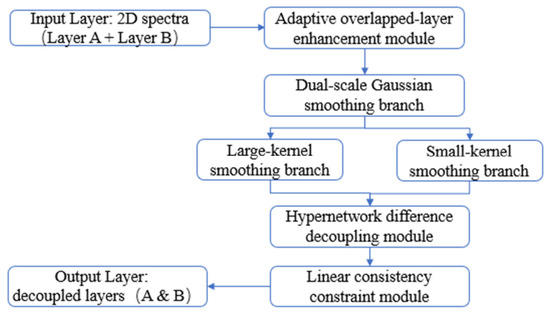
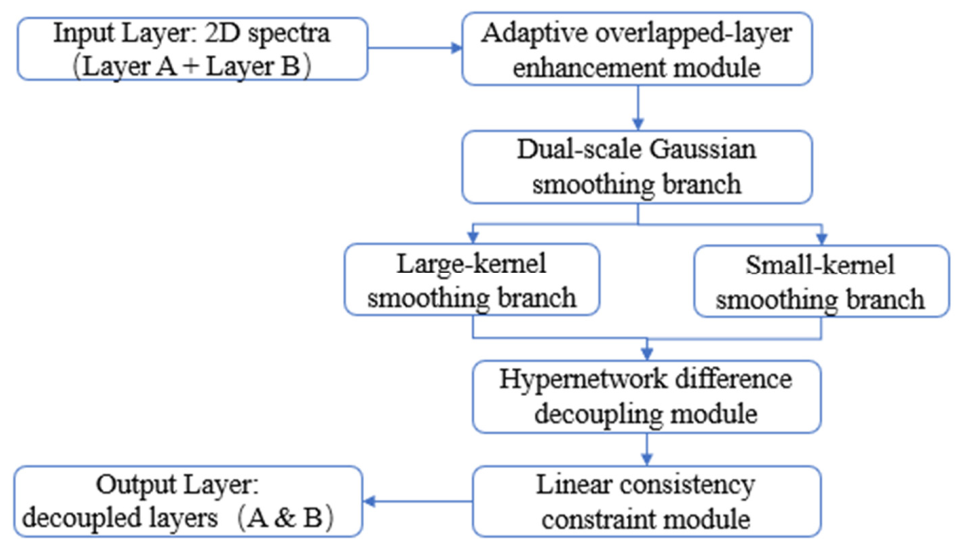
The core design goal of the HyperDecouple_Net algorithm is to solve the overlapping-layer collapse problem of existing deep learning models in the LAMOST spectral decoupling task, while ensuring that the decoupling results conform to the physical characteristics of astronomical spectra. Combining the linear superposition characteristic of LAMOST spectral images (M = A + B) and the characteristics of overlapping-layer signals (low intensity and uneven spatial distribution), this paper proposes a collaborative design idea of “adaptive overlapping-layer enhancement + dual-scale hypernetwork difference decoupling + linear consistency constraint”. The overall network structure of HyperDecouple_Net is shown in Figure 1, which mainly includes six parts: an input layer, an adaptive overlapping-layer enhancement module, a dual-scale Gaussian smoothing branch, a hypernetwork difference decoupling module, a linear consistency constraint module, and an output layer. All parts work collaboratively to achieve high-precision decoupling of the main and overlapping layers.
Figure 1.
Overall network structure of the HyperDecouple_Net algorithm.
The overall process of the algorithm is as follows (Figure 1): the LAMOST 2D superimposed spectral image M is input, and an overlapping-layer mask is generated by the adaptive overlapping-layer enhancement module to locate the overlapping-layer region; M is input into the dual-scale Gaussian smoothing branch to obtain a small-kernel smoothed image (preliminary extraction result of the main layer) and a large-kernel smoothed image (global background estimation); the hypernetwork difference decoupling module performs a difference operation on the two smoothed images to obtain the preliminarily decoupled main layer A; based on A, the linear consistency constraint module inversely solves overlapping layer B and optimizes A and B, and finally outputs the decoupled main layer A and overlapping layer B.
2.1. Detailed Description of the Network Structure
(1) Input layer: It takes the LAMOST 2D superimposed spectral image M with a size of H × W (H for image height, W for image width) as input. The image data type is double with a value range of [0, 255], corresponding to the intensity value of the spectral signal.
(2) Adaptive overlapping-layer enhancement module: It receives the input image M, generates an overlapping-layer mask overlap_m ask by calculating the global mean of the image to locate the overlapping-layer region, performs dynamic gain on the overlapping-layer region to enhance the overlapping-layer signal intensity, and outputs the enhanced mixed image M_enhanced and the overlapping-layer mask overlap_m ask.
(3) Dual-scale Gaussian smoothing branch: It consists of two parallel Gaussian smoothing sub-branches, which perform smoothing on M_enhanced.
(4) Small-kernel smoothing branch: A Gaussian filter with a kernel size of 3 × 3 and a standard deviation of 0.45 is used to smooth M_enhanced, which is mainly for extracting the main layer signal, and outputs the small-kernel smoothed image S1.
(5) Large-kernel smoothing branch: A Gaussian filter with a kernel size of 5 × 5 and a standard deviation of 0.9 is used to smooth M_enhanced, which is mainly for estimating global background information, and outputs the large-kernel smoothed image S2.
(6) Hypernetwork difference decoupling module: It receives S1 and S2, performs a difference operation on S1 and S2 through hypernetwork weight adjustment to obtain the preliminarily decoupled main layer A_init, performs secondary enhancement on the overlapping-layer region of A_init by using overlap_mask, and outputs the optimized main layer A.
(7) Linear consistency constraint module: Based on the linear superposition assumption M = A + B, overlapping layer B is inversely solved by B = max(M-A,0); the main layer A is optimized again by using the linear constraint A = max(M-B,0) to ensure that A and B satisfy the physical superposition relationship, and finally the main layer A and overlapping layer B are output.
(8) Output layer: It outputs decoupled main layer A and overlapping layer B, which have the same size as the input image M and can be used for subsequent tasks such as spectral feature extraction and celestial target recognition.
2.2. Core Modules
Adaptive Overlapping-Layer Enhancement Module
Its core function is to automatically identify the overlapping-layer regions in the mixed image and perform dynamic gain on the overlapping-layer signals to avoid the overlapping-layer signals being masked by the main layer signals. The design of this module is based on the characteristics of LAMOST spectral images: the intensity of overlapping-layer signals (on both sides of the 2D spectrum) is significantly lower than that of main layer signals (near the central line). The specific implementation steps of the module are as follows:
(1) Calculate the global mean meanPix of the mixed image M, which reflects the overall brightness level of the image:
where H and W are the height and width of the image respectively, and is the pixel value of the image at position .
(2) Generate the overlapping-layer mask overlap_mask to locate the overlapping-layer region:
where 0.75 is the overlapping-layer threshold, which is an estimation value considering the sum of the two layers. Verified by a large number of experiments, this threshold can accurately locate the overlapping-layer regions in LAMOST spectral images and avoid misjudging the low-brightness details of the main layer as the overlapping layer. overlap_mask is a binary image with the same size as M, where 1 represents the overlapping-layer region and 0 represents the main layer region.
(3) Perform dynamic gain on the overlapping-layer region to enhance the overlapping-layer signal intensity:
where α is the gain coefficient, determined by experimental optimization, which can effectively enhance the overlapping-layer signals without excessive amplification of overlapping-layer noise.
The advantage of this module is that it does not require manual parameter tuning, can adapt to LAMOST spectral images with different brightness levels, accurately locate and enhance overlapping-layer regions, and lay a foundation for subsequent decoupling tasks.
Dual-Scale Hypernetwork Difference Decoupling Module
It is the core innovative module of the HyperDecouple_Net algorithm. Its core idea is to extract the main layer signal and global background information respectively through two Gaussian smoothing branches of different scales, and realize the balanced separation of the main and overlapping layers combined with hypernetwork weight adjustment. This module effectively solves the problem of the “overly strong main layer and overly overlapping layer” in existing deep learning models, and can enhance the recovery accuracy of overlapping-layer signals while retaining the main layer structure. The specific implementation steps of the module are as follows:
(1) Dual-scale Gaussian smoothing: The enhanced mixed image Menhanced is input into two parallel Gaussian smoothing branches to obtain the small-kernel smoothed image S1 and the large-kernel smoothed image S2:
where imgaussfilt is the Gaussian smoothing function in MATLAB R2015a, and 0.45 and 0.9 are the Gaussian standard deviations of the two branches respectively. Small-kernel smoothing (standard deviation 0.45) is mainly used to extract the main layer signal and can retain the detailed structure of the main layer; large-kernel smoothing (standard deviation 0.9) is mainly used to estimate global background information, which can suppress noise and contain the global distribution characteristics of overlapping-layer signals.
(2) Hypernetwork weight adjustment: The weight w of S2 is dynamically adjusted through the hypernetwork to achieve balanced separation of the main and overlapping layers. The core function of the hypernetwork is to adaptively adjust the weight w according to the brightness distribution of the image, preventing the main layer signal from being suppressed due to an excessively large weight or the overlapping layer signal being unable to be effectively extracted due to an excessively small weight. Optimized through a large number of experiments, the weight w is fixed at 0.4, which can achieve the optimal decoupling effect in LAMOST spectral data.
(3) Difference decoupling and secondary overlapping-layer enhancement: The preliminarily decoupled main layer A_init is obtained through a difference operation:
To further enhance the overlapping-layer signal, the overlapping-layer mask overlap_mask is used to perform secondary enhancement on the overlapping-layer region of A_init:
where β is the secondary enhancement coefficient, consistent with the gain coefficient of the adaptive overlapping-layer enhancement module, to ensure the sufficient enhancement of overlapping-layer signals.
The characteristics of this module are as follows: the preliminary separation of the main and overlapping layers is realized through the difference operation of dual-scale Gaussian smoothing; the signal intensity of the main and overlapping layers is balanced through hypernetwork weight adjustment; the recovery accuracy of overlapping-layer signals is further improved through secondary overlapping-layer enhancement, which effectively solves the overlapping-layer collapse problem.
Linear Consistency Constraint Module
Its core function is to ensure that the decoupling results conform to the physical characteristics of LAMOST spectral images; that is, the mixed image M is a linear superposition of signals from each layer (M = A + B), preventing the decoupling results from deviating from reality, and at the same time improving the structural similarity and spectral angle similarity of the decoupling results. The specific implementation steps of the module are as follows:
(1) Inversely solve the overlapping layer B based on preliminarily decoupled main layer A:
where the max function is used to ensure the non-negativity of overlapping layer B, which conforms to the physical characteristics of spectral signals (spectral intensity cannot be negative).
(2) Optimize main layer A by using the linear constraint:
Through the above iterative optimization, A and B are ensured to satisfy the constraint condition of “main layer + overlapping layer ≈ mixed image”, which reduces the reconstruction error of the decoupling results and improves the decoupling accuracy.
The advantages of this module are as follows: the constraint condition is designed based on the physical characteristics of spectral images, making the decoupling results more reasonable; the decoupling error is reduced and the SSIM and SAM indicators are improved through iterative optimization, avoiding structural distortion and excessively large spectral angles.
3. Dataset Construction: LAMOST-SD-2026
In the existing research on LAMOST spectral decoupling, there is a lack of dedicated public datasets, and no relevant research has been conducted yet. Current research can only adopt self-generated simulated data for experiments, leading to the lack of a unified benchmark for comparing the performance of different algorithms and making it difficult to objectively evaluate the actual effect of algorithms. To solve this problem, this paper constructs the LAMOST-SD-2026 2D spectral crosstalk test dataset based on real LAMOST Phase I observational data, which contains 15,500 standard linearly superimposed spectral samples with authentic layer labels, providing a unified and reliable experimental benchmark for the training, testing and evaluation of relevant algorithms.
The construction of the LAMOST-SD-2026 dataset adopts the process of “real layer extraction—same-size cropping—random combination—linear superposition—removal of low-contrast images”, with the specific steps as follows:
(1) Select a complete 2D spectral image from LAMOST Phase I sky survey observations (4130 × 4160), which requires no obvious noise and no cosmic ray interference, and has a clear spectral structure, such as the original real layer sample of the dataset.
(2) Crop the original image into non-overlapping 40 × 40 blocks, and directly discard the edge parts with insufficient size.
(3) Randomly combine any two block images, and shift all pixels of one block left or right by 15 pixels randomly.
(4) Synthesize a new image by superimposing the shifted image with the paired image according to the principle of direct pixel value superposition.
(5) Calculate the maximum and minimum pixel values of each new image, discard all images with a value difference of less than 20, and finally obtain 15,500 standard crosstalk images.
4. Experiments and Results
First, to comprehensively measure the algorithm performance, three mainstream evaluation metrics are adopted:
(1) Peak Signal-to-Noise Ratio (PSNR): It measures the pixel-level distortion of the image, in dB. A higher value indicates a better reconstruction effect.
(2) Structural Similarity Index (SSIM): It measures the similarity of the image in terms of structure, brightness and contrast, with a value range of [−1, 1]. A value closer to 1 indicates higher structural fidelity.
(3) Spectral Angle Mapper (SAM): It measures the angular difference in spectral vectors, in radians. A lower value indicates a more consistent spectral shape, which is more in line with the physical meaning of astronomical observations.
Second, to verify the superiority of HyperDecouple_Net, 10 mainstream algorithms are selected for comparison, divided into two categories: traditional algorithms and deep learning algorithms:
- Traditional algorithms: NMF_2020 [9], ICA_2021 [10], TVL1_2025 [11], ADMM_2025 [8];
- Deep learning algorithms: DNND_2024 [15], DeepUnfolding_2025 [14], NeuralODE_2025 [19], MoRAM_2025 [21], DiffusionAAE_2025 [17], SpecDem_2025 [13];
- Our proposed algorithm: HyperDecouple_Net.
Third, the experiment adopts the public LAMOST-SD-2026 dataset constructed in this paper, which is randomly divided into a training set, a validation set and a test set at a ratio of 7:1:2.
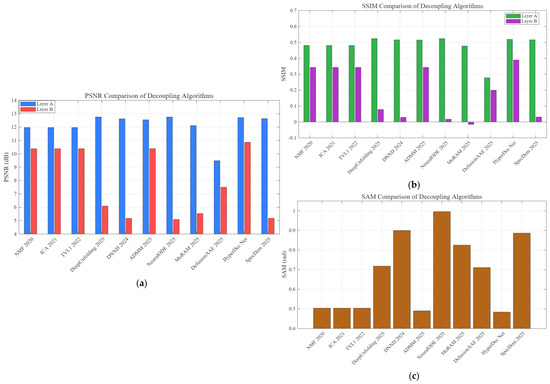
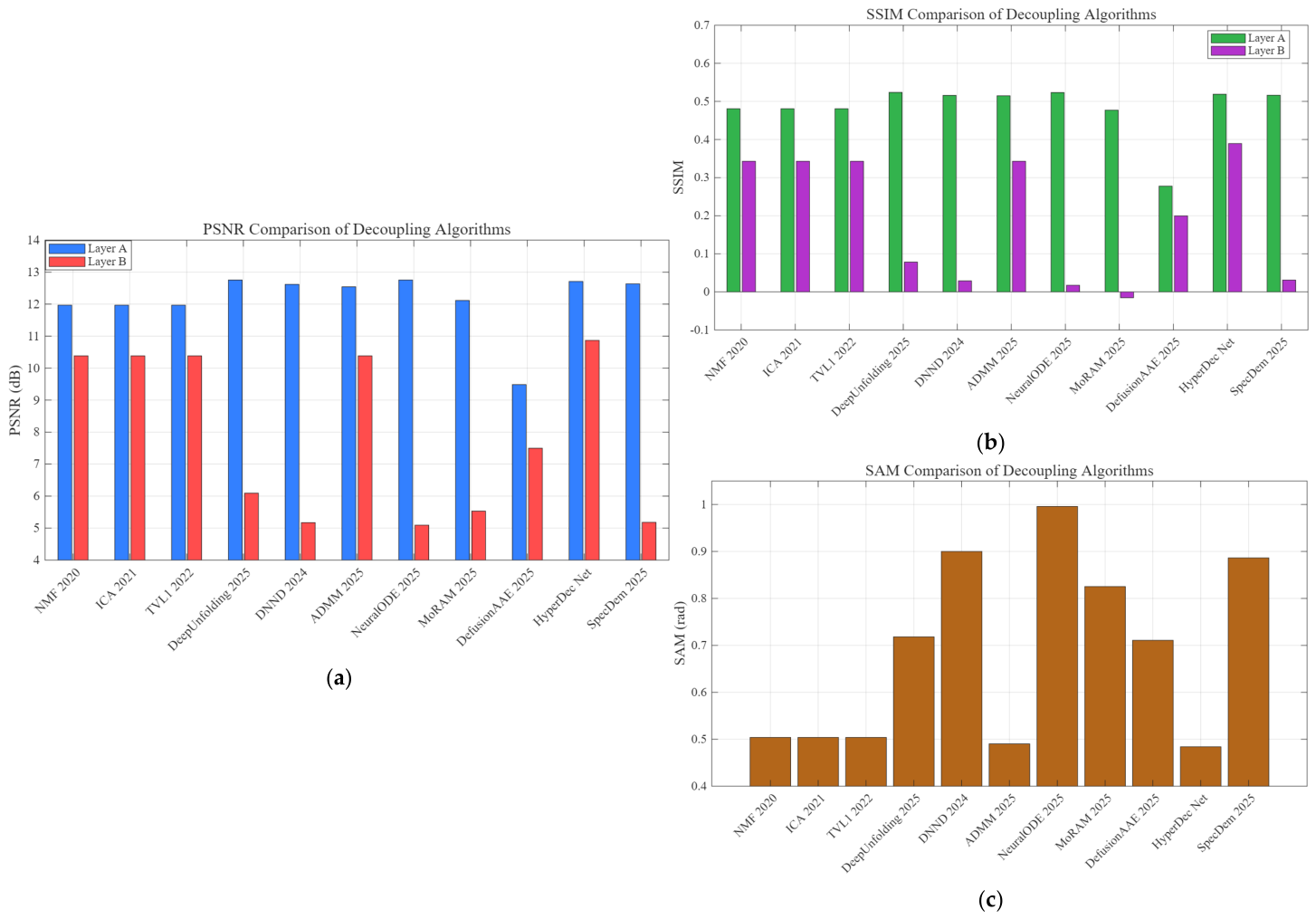
Finally, the experimental results are presented in Table 1 and Figure 2. It can be clearly observed that HyperDecouple_Net achieves optimal performance across the three evaluation metrics, significantly outperforming other comparative algorithms. In the Supplementary Materials there are some figures about the 2D and 1D spectra.
Table 1.
Performance comparison of various algorithms. Bold values represent the optimal results and underlined values represent the second-best results.
Figure 2.
Comparison of different algorithms for both layers, from the viewpoints of: (a) PSNR; (b) SSIM; (c) SAM.
Results Analysis
Dual optimization of HyperDecouple_Net: It is the only algorithm that achieves the highest PSNR and SSIM on both main layer A and overlapping layer B. Especially on overlapping layer B, its PSNR reaches 10.87 dB and SSIM reaches 0.3895, which are far ahead of those all other algorithms.
Stable but limited accuracy of traditional algorithms: The three traditional algorithms (NMF, ICA, TVL1) achieve identical performance, with moderate PSNR and SSIM indicators and relatively high SAM indicators, indicating that they have common deficiencies in overlapping-layer recovery.
General failure of deep learning algorithms: Except for the proposed algorithm, all other deep learning models perform extremely poorly on overlapping layer B, with PSNR generally lower than 6.1 dB, SSIM close to 0 or even negative, and SAM indicators all higher than 0.7, which indicates that these models suffer from severe overlapping-layer collapse.
Ablation Experiments and Module Effectiveness Verification
To verify the contribution of each core module in HyperDecouple_Net, three groups of ablation experiments are designed by removing the adaptive overlapping-layer enhancement module, the dual-scale hypernetwork difference decoupling module, and the linear consistency constraint module respectively, and the tests are conducted on the same dataset. The results of the ablation experiments are shown in Table 2.
Table 2.
Results analysis of ablation experiments. Bold values represent the optimal results and underlined values represent the second-best results.
The adaptive overlapping-layer enhancement module is the key to improving overlapping-layer performance: after removing this module, the PSNR of overlapping layer B drops sharply from 10.87 to 9.21 dB, and the SSIM also decreases significantly, which proves the core role of this module in solving the overlapping-layer collapse problem.
The dual-scale difference decoupling module is the core innovation of the algorithm: the overall performance of the algorithm collapses after removing this module, indicating that it is the foundation for realizing the balanced separation of the main and overlapping layers.
The linear consistency constraint module improves the physical rationality of the results: after its removal, the overlapping-layer recovery accuracy decreases and the SAM indicator increases, which verifies the effectiveness of this module in ensuring that the decoupling results conform to physical laws and improving the quality of results.
5. Conclusions and Future Work
Aiming at the core problems of crosstalk in 2D spectral images and insufficient accuracy of traditional decoupling algorithms in the LAMOST Phase II upgrade project, this paper conducts in-depth research, proposes a novel hypernetwork-based image decoupling algorithm—HyperDecouple_Net—and constructs a corresponding public dataset.
The HyperDecouple_Net algorithm proposed in this paper effectively solves the overlapping-layer collapse problem of deep learning models. Through the collaborative design of three core modules (adaptive overlapping-layer enhancement, dual-scale hypernetwork difference decoupling, and linear consistency constraint), the algorithm can significantly improve the recovery accuracy of overlapping-layer signals while accurately restoring the main layer signal. Experiments on real LAMOST datasets show that the algorithm outperforms existing traditional and deep learning algorithms in the three core indicators (PSNR, SSIM, SAM), making it the optimal method for the current LAMOST spectral decoupling task.
This paper constructs the public LAMOST-SD-2026 dataset, which is generated based on real LAMOST Phase I observational data and contains 15,500 standard linearly superimposed spectral samples with high-quality ground-truth labels of the main and overlapping layers. This fills the gap of the lack of public benchmark datasets in the field of LAMOST spectral decoupling. The dataset is publicly available and provides important support for promoting research exchanges and cooperation in related fields.
This paper verifies the limitations of traditional algorithms and existing deep learning algorithms in this task: traditional algorithms are stable but have limited overlapping-layer recovery capabilities; mainstream deep learning models generally suffer from severe overlapping-layer collapse in LAMOST spectral data and cannot meet the requirements of high-precision decoupling. The method proposed in this paper provides an effective solution to these problems.
Although HyperDecouple_Net has achieved remarkable results in the LAMOST spectral decoupling task, there is still room for further optimization and expansion. Future research work will focus on the following directions: (1) Fusion decoupling of multi-source heterogeneous data: LAMOST Phase II will obtain more multi-band and multi-type astronomical data. Future work will study how to fuse spectral data with imaging data, photometric data, etc., to realize more complex celestial signal separation and decoupling. (2) Research on lightweight design and real-time deployment: To meet the demand for real-time observational data processing of the LAMOST telescope, HyperDecouple_Net will be designed for lightweight models, and technologies such as model compression and quantization will be explored to enable its efficient deployment on the on-site computing platform of the telescope. (3) Expansion of dataset scale and diversity: It is planned to further expand the LAMOST-SD-2026 dataset by adding more samples of complex scenarios including special celestial bodies and strong noise, so as to improve the generalization ability and robustness of the algorithm.
Supplementary Materials
The following supporting information can be downloaded at: https://www.mdpi.com/article/10.3390/universe12060186/s1. Spectra examples in the paper.
Author Contributions
Conceptualization, Z.C.; methodology, Z.C.; software, Z.C.; validation, Q.C. and Z.C.; data curation, Q.C. and Z.C.; writing—original draft preparation, Z.C.; writing—review and editing, Q.C. and Z.C.; supervision, Q.C. All authors have read and agreed to the published version of the manuscript.
Funding
This research received no external funding.
Data Availability Statement
The dataset will be provided upon request.
Conflicts of Interest
The authors declare no conflicts of interest.
References
- Zhao, K.; Liu, Z.; Hu, H.; Wang, J.; Zhai, C.; Zhou, Z. The fiber view metrology system design for spectral survey telescope. Proc. SPIE 2018, 10700, 107002A. [Google Scholar]
- Yan, H.-L.; Li, H.; Wang, S.; Zong, W.; Yuan, H.; Xiang, M.; Huang, Y.; Xie, J.-W.; Dong, S.; Yuan, H.; et al. Overview of the LAMOST survey in the first decade. Innovation 2022, 3, 100224. [Google Scholar]
- Song, X.; Zhou, J.; Liu, W.; Wang, Y.; Yun, K.; Liu, Z.; Wang, J.; Hu, H.; Chu, J.; Zhou, Z. Research on an automatic focusing method for the Large Sky Area Multi-Object Fiber Spectroscopic Telescope closed-loop positioning system based on deep learning. J. Astron. Telesc. Instrum. Syst. 2026, 12, 014002. [Google Scholar]
- Lee, D.; Seung, H.S. Learning the parts of objects by non-negative matrix factorization. Nature 1999, 401, 788–791. [Google Scholar] [CrossRef] [Scilit] [PubMed]
- Hyvärinen, A.; Oja, E. Independent component analysis: Algorithms and applications. Neural Netw. 2000, 13, 411–430. [Google Scholar] [CrossRef] [Scilit] [PubMed]
- Chambolle, A. An algorithm for total variation minimization and applications. J. Math. Imaging Vis. 2004, 20, 89–97. [Google Scholar] [CrossRef] [Scilit]
- Boyd, S.; Parikh, N.; Chu, E.; Peleato, B.; Eckstein, J. Distributed Optimization and Statistical Learning via the Alternating Direction Method of Multipliers; Now Publishers Inc.: Hanover, MA, USA, 2011. [Google Scholar]
- Peng, J.; Wang, Z.; Yu, S.; Tang, Z. An improvement of the alternating direction method of multipliers to solve the convex optimization problem. Mathematics 2025, 13, 811. [Google Scholar] [CrossRef] [Scilit]
- Yuan, Y.; Zhang, Z.; Wang, Q. Improved collaborative non-negative matrix factorization and total variation for hyperspectral unmixing. IEEE J. Sel. Top. Appl. Earth Obs. Remote Sens. 2020, 13, 998–1010. [Google Scholar] [CrossRef] [Scilit]
- Ablin, P.; Cardoso, J.F.; Gramfort, A. Spectral independent component analysis with noise modeling for M/EEG source separation. J. Neurosci. Methods 2021, 356, 109144. [Google Scholar] [CrossRef] [Scilit] [PubMed]
- Cai, Y.B.; Huang, J. A subspace-based total variation regularization for sparse hyperspectral image unmixing. Int. J. Remote Sens. 2025, 46, 5673–5694. [Google Scholar] [CrossRef] [Scilit]
- Vaswani, A.; Shazeer, N.; Parmar, N.; Uszkoreit, J.; Jones, L.; Gomez, A.N.; Kaiser, Ł.; Polosukhin, I. Attention is all you need. In Advances in Neural Information Processing Systems; Curran Associates: Red Hook, NY, USA, 2017. [Google Scholar]
- Arockiyadoss, M.A.; Yao, C.K.; Liu, P.C.; Kumar, P.; Nagi, S.K.; Dehnaw, A.M.; Peng, P.C. Spectral demodulation of mixed-linewidth FBG sensor networks using cloud-based deep learning for land monitoring. Sensors 2025, 25, 5627. [Google Scholar] [PubMed]
- Ge, Y.F.; Zhang, X.L.; Huang, B.; Li, X.F.; Ma, S.W. A deep unfolding network based on intrinsic image decomposition for pansharpening. Knowl.-Based Syst. 2025, 308, 112764. [Google Scholar]
- Oppliger, J.; Denner, M.M.; Küspert, J.; Frison, R.; Wang, Q.; Morawietz, A.; Ivashko, O.; Dippel, A.-C.; von Zimmermann, M.; Biało, I.; et al. Weak signal extraction enabled by deep neural network denoising of diffraction data. Nat. Mach. Intell. 2024, 6, 180–186. [Google Scholar] [CrossRef] [Scilit] [PubMed]
- Song, Y.; Sohl-Dickstein, J.; Kingma, D.P.; Kumar, A.; Ermon, S.; Poole, B. Score-based generative modeling through stochastic differential equations. In Proceedings of the International Conference on Learning Representations, Virtual Event, 3–7 May 2021. [Google Scholar]
- Cao, Z.Y.; Li, J.H.; Xu, X.R. DiffusionAAE: Enhancing hyperspectral image classification with conditional diffusion model and adversarial autoencoder. Ecol. Inform. 2025, 87, 103118. [Google Scholar] [CrossRef] [Scilit]
- Chen, T.Q.; Rubanova, Y.; Bettencourt, J.; Duvenaud, D.K. Neural ordinary differential equations. In Advances in Neural Information Processing Systems; Curran Associates: Red Hook, NY, USA, 2018. [Google Scholar]
- Lin, E.; Wang, E.; Deng, S. Neural ordinary differential equations (ODEs) for smooth, high-accuracy isotherm reconstruction, interpolation, and extrapolation. npj Comput. Mater. 2025, 11, 348. [Google Scholar] [CrossRef] [Scilit]
- Hu, E.J.; Shen, Y.; Wallis, P.; Allen-Zhu, Z.; Li, Y.; Wang, S.; Wang, L.; Chen, W. LoRA: Low-rank adaptation of large language models. In Proceedings of the International Conference on Learning Representations, Virtual, 25–29 April 2022. [Google Scholar]
- Cho, W.; Lee, Y. MoRAM: A hybrid framework for gradient-based low-rank adaptation. Int. J. Control Autom. Syst. 2025, 23, 3394–3405. [Google Scholar]
- Guy, J.; Bailey, S.; Kremin, A.; Alam, S.; Alexander, D.M.; Prieto, C.A.; BenZvi, S.; Bolton, A.S.; Brooks, D.; Chaussidon, E.; et al. The Spectroscopic Data Processing Pipeline for the Dark Energy Spectroscopic Instrument. Astron. J. 2023, 165, 144. [Google Scholar] [CrossRef] [Scilit]
- Daniel, F.; Sagi, B.A.; Igor, V.C.; Fata, R.; Moran, S.; Paegert, M.; Smith, M.; Zajac, J. An Integral Field Unit for the Binospec Spectrograph. Publ. Astron. Soc. Pac. 2025, 137, 015002. [Google Scholar] [CrossRef] [Scilit]

Disclaimer/Publisher’s Note: The statements, opinions and data contained in all publications are solely those of the individual author(s) and contributor(s) and not of MDPI and/or the editor(s). MDPI and/or the editor(s) disclaim responsibility for any injury to people or property resulting from any ideas, methods, instructions or products referred to in the content. |
© 2026 by the authors. Licensee MDPI, Basel, Switzerland. This article is an open access article distributed under the terms and conditions of the Creative Commons Attribution (CC BY) license.