


Abstract
Weak power-law central potentials of the form appear in extensions of the Standard Model, such as short-range modifications to gravity and certain types of dark matter models. We present experimental constraints on obtained from an analysis of the silicon structure factors recently measured to high precision by neutron Pendellösung interferometry, and compare them with other constraints in the literature. With the three Bragg reflections of that measurement, we constrain for . We analyze the same data in terms of Casimir–Polder forces induced by a sub-GeV dark scalar bilinearly coupled to nucleons, obtaining lower limits on the effective field theory scale of GeV, MeV and MeV, at a mediator mass of 1 eV, for the three operators generating , and forces, respectively. We also compare with constraints from keV neutron total cross sections, which reach momentum transfers three orders of magnitude larger, using transmission data from the Oak Ridge Electron Linear Accelerator (ORELA), and obtain limits similar to or slightly stronger than the earlier neutron bounds for –7. We fit the power-law amplitude directly to published data and use current determinations of the neutron polarizability and the neutron–electron interaction. Our results are broadly consistent with the general conclusions of the earlier analyses.
1. Introduction and Theoretical Overview
Newton’s inverse square law is obeyed with high accuracy over macroscopic distance scales. Many theoretical speculations, however, propose that the gravitational force law can be greatly modified at shorter distances. Examples of these speculations include the idea of compact extra dimensions of spacetime accessible only to the gravitational field, which can explain the unnaturally small strength of gravity relative to the other known forces [1,2,3,4], and the idea that gravity might be modified on the length scale of 100 microns corresponding to the scale set by the dark energy density [5]. Experiments which search for possible modifications to gravity at short range [6,7,8,9,10,11,12,13,14,15] are also sensitive to new nongravitational interactions of various types. Many extensions to the Standard Model of particle physics produce weakly coupled, long-range interactions [16,17].
The power law corrections to the gravitational force law can be expressed in the form
where G is the gravitational constant, are the masses of two objects separated by a distance r, and is the length scale of the power law correction. We reserve the symbol n for the exponent of the exotic potential itself,
so that the two parametrizations are related by
(The one-unit offset between and n is a frequent source of confusion when comparing results across the literature and we state it explicitly here.) Equation (1) is the parametrization adopted in the recent compilation of short-range inverse-square-law tests by Murata, Fujiie and Suzuki [18], which updates an earlier review [19] and which we use as the reference compilation throughout this work. The same parametrization is used in the spectroscopic analysis of Ref. [20].
Limits on the same correction from experiments with macroscopic bodies have been compiled by Klimchitskaya [21] in an equivalent parametrization; the present results are compared with them in Section 7.
Power-law potential modifications to gravity at short distances occur in the extra dimensions model of Arkani-Hamed, Dimopoulos, and Dvali (the ADD model). Power-law potentials also appear in a recent effective field theory analysis of dark matter-induced interactions among Standard Model particles. Any sub-GeV particle bilinearly coupled to nucleons can induce Casimir–Polder-type interactions between them [22,23], with power-law dependence with ranges from nuclear to atomic scales. Following Ref. [23] we consider three effective interactions between a dark scalar and the nucleon field N,
which generate the potentials
where m is the mass of the dark scalar and is the i-th modified Bessel function of the second kind. In the limit , these reduce to
so that the three operators correspond to , 5 and 7 in the notation of Equation (2). In general, an operator of dimension gives rise to a potential behaving at short distance as [23]. Note that the scalar channel produces an attractive force while the vector channel produces a repulsive one.
Below 100 nanometers, the most stringent experimental limits for many of these weakly coupled exotic interactions come from experiments using neutrons. The electrical neutrality of the neutron coupled with its small magnetic moment and very small electric polarizability make it insensitive to many of the electromagnetic backgrounds such as the Casimir effect which can plague experiments that employ test mass pairs made of atoms. The ability of slow neutrons to penetrate macroscopic amounts of matter and to interact coherently with the medium allows the quantum amplitudes governing their motion to accumulate large phase shifts which can be sensed with interferometric measurements [24,25,26]. These features of slow neutron interactions with matter and external fields have been exploited in a number of recent experiments which search for possible new weakly coupled interactions of various types [27,28,29,30,31,32,33,34,35,36,37,38,39,40,41,42,43,44]. This strategy can succeed despite the uncertainties in our knowledge of the neutron–nucleus strong interaction. In the slow neutron regime with where k is the neutron wave vector and R is the range of the neutron–nucleus strong interaction, neutron–nucleus scattering amplitudes are dominated by s-wave scattering lengths which are accurately measured experimentally. This makes coherent neutron interactions with matter sufficiently insensitive to the complicated details of the strong nucleon-nucleus interaction that one can cleanly interpret and analyze searches for smaller effects.
For the case of slow, unpolarized neutrons incident upon unpolarized atoms with energies far from neutron–nucleus resonances, the s-wave neutron–atom scattering amplitude as a function of the momentum transfer q can be expressed as [45,46]
Here is normalized to the number of electrons, , and , so that the neutron–electron term vanishes in the forward direction. The first term describes the low-energy (s-wave) coherent neutron scattering from the nucleus of the atom from the neutron–nucleus strong interaction. The second term describes the interaction between the internal radial charge density of the neutron and the electric field of the atom. It is proportional to the neutron electron scattering length and depends on the atomic form factor of the electron distribution around a nucleus of charge Z, which is measured by X-ray scattering. The neutron–electron scattering length is related to the mean square neutron charge radius by [47], and the Particle Data Group recommended value is [48]. The third term is proportional to the very small but nonzero electric polarizability of the neutron and comes from the neutron electric dipole moment induced by the very large electric field near and inside the nucleus. It is the Born amplitude of the polarizability potential outside a nucleus of radius R [49], with MeV fm, so that its dependence on the momentum transfer, , is independent of R. For the silicon data analyzed here, it is negligible at the present level of precision: with and we find at the largest momentum transfer of Table 1, nearly three orders of magnitude below the smallest experimental uncertainty there. For the 208Pb cross-section data of Section 6, where it enters in proportion to , it is instead the dominant background, and the exotic term is exactly degenerate with it. Finally the fourth term comes from applying the Born approximation to calculate the scattering amplitude corresponding to the power law potential of interest in this work.
In this paper, we analyze the constraints on exotic power-law potentials from the neutron dynamical diffraction measurements in perfect silicon crystals reported by Heacock et al. [47], which use the neutron interferometric techniques reviewed in Ref. [50]. These measurements are discussed in detail there and will only be summarized here. They determine with high precision the ratio of the neutron coherent scattering amplitude at three nonzero values of the momentum transfer, corresponding to the (111), (220) and (400) reciprocal lattice vectors of silicon, to the forward amplitude measured by neutron interferometry over the same crystal volume. Forming this ratio isolates the momentum dependence of the scattering amplitude and removes the need to determine the crystal thickness independently. We reproduce the measured values in Table 1.
The phenomenon of dynamical diffraction has been known and developed with increasing degrees of sophistication for more than a century, starting with x-rays [51,52,53,54,55,56] and later adapted to neutrons [57,58,59]. Dynamical diffraction can be thought of as the extreme multiple-scattering limit of diffraction, which can be realized for neutron and X-ray transmission through large perfect crystals. Since a neutron which diffracts from some cluster of atoms also satisfies the diffraction condition for another cluster of atoms if both clusters are perfectly aligned through being part of the same, large-enough perfect crystal, one can realize a mode of propagation in which the neutron probability current zigzags back and forth through the crystal for the component of the neutron wave vector parallel to one of the crystal’s reciprocal lattice vectors . The characteristic length beyond which one needs to take multiple-scattering dynamical diffraction effects into account is about m in silicon. This zigzag mode of motion means that the neutron inside the crystal is scattering from the atoms with a nonzero momentum transfer .
Here we provide a very brief outline of this physics following the neutron interferometry book of Rauch and Werner [50]. Outside the crystal, the neutron wave propagates as either the transmitted or the diffracted beam. Inside the crystal, however, the neutron probability current propagates as a linear combination of free-particle states in a manner which depends on the boundary conditions of the crystal slab relative to the Bragg planes. For a monoenergetic neutron entering a flat slab of perfect crystal at an angle corresponding to the Bragg condition in the Laue geometry, with the crystal lattice planes perpendicular to the surface of the slab so that the diffracted beam is transmitted through the crystal, as in the measurements of Ref. [47], there is no change in the component of the neutron wave vector parallel to the crystal surface, due to the phase matching of the wave function at the crystal boundary. However, the neutron inside the crystal sees the periodic potential of the crystal along , which generates an energy gap of size in the dispersion relation of the neutron inside the crystal, where is the Fourier component of the periodic crystal potential; since the neutron energy and the component of its wave vector parallel to the surface are fixed, this gap appears as a splitting of the component of the neutron wave vector normal to the crystal surface. For wave vectors that meet this diffraction condition, therefore, the neutron sees a potential , where is the neutron optical potential of the crystal medium. By expressing in terms of the neutron scattering lengths of the different atoms j in the crystal unit cell of volume using the theory of neutron optics, one can relate to the structure factor of the unit cell, , where is the number of atoms in the cell. The solutions of the Schrödinger equation in the potential are therefore linear combinations of plane waves of wave vectors and . At the exact Bragg condition, these two waves possess equal amplitudes, with one linear combination possessing wave amplitude nodes at the atomic positions and the other linear combination with wave amplitude nodes in between the atomic positions. Finally, there is also a small additional splitting of each of the neutron wave vectors and because, due to the neutron optical potential , inside the crystal medium is slightly different from the incident neutron wave vector .
After enforcing the boundary conditions, one finds a total of four neutron propagation modes in the crystal near the Bragg condition, two with wave vectors very close to and two very close to . The coherent superposition of one pair of modes from the transmitted and diffracted directions generates a standing wave moving normal to which peaks between the lattice planes, and the coherent superposition of the other pair peaks on top of the lattice planes. Certain observables, such as the diffracted intensity as a function of crystal thickness and neutron energy or the spin transport through the crystal, are then very sensitive to the potential between the neutron and the scattering centers in the crystal through the interference between these four different neutron propagation modes inside the crystal [60,61,62].
Table 1.
Neutron-silicon structure factor ratios measured by Pendellösung interferometry [47], scaled to 295.5 K. Momentum transfers are computed with Å [63]. The room-temperature X-ray form factors , in units of the elementary charge, are those of Ref. [64] as tabulated in the analysis of Ref. [47]. The last column gives the anharmonic factor of Equation (23), with ; among the reflections measured here, only (111) is affected, and it enters with a minus sign.
2. Scattering Amplitudes for the Power-Law Potentials
In all cases, we assume that our power-law interactions are weak enough that the application of the Born approximation to the calculation of the neutron–nucleus scattering amplitude is justified. We regulate the short-distance behavior of the potential with a hard cutoff at the nuclear radius R,
The cutoff is a device for doing the integrals. As shown later in this section, the part of the amplitude that the data can attribute to the power law is independent of R, and the R-dependent remainder is absorbed into free parameters of the fit, so that the cutoff carries no physical content.
Carrying out the Born integral gives the closed form
where
which satisfy the recursions
terminating on and . Writing , the explicit amplitudes are
for , as
for , as
for , as
for , as
for , as
for , as
for , and as
for . All of these expressions follow from Equations (9)–(11) and have been verified numerically against direct quadrature of the Born integral.
The cases were obtained by Pokotilovski [65] in the context of fast-neutron scattering from heavy nuclei, and we reproduce his results exactly. The case is the Born amplitude for the neutron polarizability potential and is due to Thaler [49]. The closed form (9), the recursion that generates it, and the remaining cases appear to be new. We note in passing that the degeneracy is exact: an exotic potential has precisely the momentum dependence of the neutron polarizability term in Equation (7), so our result should be read as a constraint on the sum of the two contributions. Expressed as a bound on the neutron electric polarizability, it corresponds to , four orders of magnitude weaker than dedicated determinations, for the reason discussed in Section 5. The same degeneracy read in the other direction turns a measured polarizability into a constraint on from neutron cross-section data; we use it that way in Section 6.
The Long-Wavelength Limit
For the data analyzed in this paper, we are in the limit , where R is the nuclear radius; for silicon and the momentum transfers of Table 1 one has . This allows us to expand these results to provide the following simplified expressions,
with the non-analytic term
where is the Euler–Mascheroni constant and is the j-th harmonic number. The sum runs over all integers and converges for all x. For odd n the term with is omitted from the sum, being replaced by the logarithm.
Two properties of this expansion govern the entire analysis. First, since , the non-analytic term is proportional to
which is independent of R. The non-analytic term is therefore fixed by the long-distance tail of the potential alone.
Second, every term of the analytic sum in Equation (20) is a polynomial in whose coefficient is set by the potential near . The forward value is absorbed into . The terms with scale as and diverge as , and for odd n the term with carries . These coefficients are not small. For and eV the term shifts at the (400) reflection by about standard deviations at fm, and the shift grows as for larger n; no prior on the Debye–Waller parameter can absorb it. Equivalently, a potential of the strength probed here, continued down to the nuclear radius, would reach eV at , far outside the domain of the Born approximation. The amplitude near is then not that of a weak power law, and the data cannot be allowed to constrain it as if it were.
We therefore make no assumption about the potential at short distance. Each cutoff-dependent analytic term, with , is represented by a free coefficient with no prior, in the same way that the local four-nucleon operators are treated in the effective theory of Section 4. The resulting limits depend only on the non-analytic term and are independent of R by construction; varying R between 2 and 10 fm changes none of them by more than . The price is a loss of sensitivity, which is largest for odd n, where the signal must be separated from a free term over a factor of in Q. With three reflections, the number of free shape parameters, together with the charge-radius and anharmonic terms, exceeds what the data can determine for ; we therefore quote limits for .
The case requires separate treatment: diverges logarithmically as , so that the forward amplitude is infrared divergent for a pure power law. This is an artefact of the idealized form; in the dark sector realization of Equation (5) the potential is cut off at long distance by the mass of the exchanged particle and no divergence occurs. We therefore treat the case in Section 4.
3. Fit Model and Treatment of Nuisance Parameters
The quantum interference between the two dynamical diffraction modes discussed above in Section 1 creates a spatial beating between the diffracted and transmitted intensities as the incident neutron momentum is varied, called Pendellösung oscillations. The phase shift of the Pendellösung interference fringes depends on the structure factor of the material in terms of the neutron–atom coherent elastic scattering amplitude , where ℏ is the reduced Planck constant, m is the neutron mass, and is the Fourier transform of the neutron–atom potential defined above.
We fit the three measured ratios of Table 1 to
following Ref. [47], where is the Debye–Waller exponent, B is related to the mean square thermal atomic displacement by , and is the anharmonic correction to the Debye–Waller factor, which affects only the (111) reflection among those measured. The sign of the anharmonic term is negative when is divisible by four and positive when is; of the reflections used here only (111) has , and it takes the minus sign. The (311) reflection, not measured here, would enter as . The quantities are the room-temperature X-ray form factors of silicon in units of the elementary charge [64], listed in Table 1; their quoted uncertainties are near relative, so that their contribution to the error budget is negligible besides the measurement uncertainties. The exotic contribution is
of which only the difference is observable, since the forward value is absorbed into the measured normalization . Of that difference only the non-analytic part, in the present sign convention, is retained; the analytic remainder is represented by the free counterterms of Section 2, which for odd n also absorb the of . We follow the neutron-optics convention used in Equation (7), which accounts for the sign of Equation (24) relative to Equations (9) and (22). The convention does not affect , but the sign of relative to and is physically meaningful, distinguishing an attractive from a repulsive exotic interaction.
Three measurements cannot simultaneously determine B, , and . Following the procedure of Ref. [47], we therefore impose Gaussian priors on the three nuisance parameters, , and , and profile the likelihood over them. The prior on B is the conservative choice of Ref. [47], whose 68% confidence region encompasses the values obtained from X-ray data under different assumptions about the electron-shell-dependent Debye–Waller factors. The counterterms are profiled as well, with no prior. The 95% confidence level limit on is obtained from .
With no exotic term, the fit returns for three degrees of freedom, three measurements and three priors less the three nuisance parameters, corresponding to . The residuals of the three measurements are , and standard deviations and those of the three priors are , and , so that the priors and the data are not in tension. The fitted values, , and , each lies within one standard deviation of the corresponding prior. The correlation coefficient between B and is when they are determined by the three measurements alone, which is the degeneracy analyzed in Section 3.2 expressed as a number, and once the priors are included. Including and the counterterms leaves two degrees of freedom at , one at and 6, and none at and 8, where the limit rests on the priors on and .
3.1. Validation of the Procedure
To validate the analysis, we first replaced the power-law amplitude in Equation (23) by the Yukawa form used in Ref. [47],
where m is the neutron mass, is the strength of the Yukawa interaction relative to gravity between the same pair of masses and is its range; for which the prefactor evaluates to , in agreement with the value quoted in Ref. [47]. Using the neutron–atom reduced mass instead would change the prefactor by , but the fit constrains the ratio of the exotic term to the term, in which the choice cancels; we keep the neutron mass for consistency with the companion analysis of Ref. [66]. Our analysis then returns , , and at , , and m, respectively, reproducing the published exclusion curve of Ref. [47] across three decades in .
3.2. Degeneracy with the Nuisance Parameters
The exotic form factor is strongly correlated with the Debye–Waller and charge-radius contributions. Let be the unit vector along the direction in the -weighted three-dimensional data space and Π the orthogonal projector onto the plane spanned by the B and directions. The quantity , the cosine of the angle between and its projection onto that plane, exceeds for all n considered. The practical consequence is a loss of sensitivity, which we quantify in Table 2 as the ratio of the profiled uncertainty on to the uncertainty that would be obtained with the nuisance parameters held fixed and no counterterms. With the nuisance parameters alone, this dilution factor would range from at to at . The peak at is not an artefact: by Equation (21) the non-analytic term there varies as , while the Debye–Waller factor to first order contributes , that is, exactly . Once the counterterm of Section 2 is free as well, the two are separated only by the logarithm and the dilution at rises to 41; at and 8 the additional counterterm raises it to 330 and 29. Power-law limits obtained by re-interpreting published Yukawa bounds through the approximate relations of Ref. [18] incorporate neither effect and should therefore be regarded as optimistic.
Table 2.
95% confidence level upper limits on the strength of a power-law neutron-silicon interaction , from the non-analytic part of the Born amplitude. “c.t.” lists the free counterterms of Section 2. The dilution factor is the ratio of the profiled uncertainty on to the uncertainty obtained with B, and held fixed and no counterterms. For the three reflections do not determine .
3.3. Correlated Systematics
The systematic uncertainties tabulated in Ref. [47] include components common to all three reflections, such as the Bragg stage calibration and the air scattering correction, as well as components specific to each reflection, such as the crystal translation and temperature gradients. In the absence of a published covariance matrix, and of a published split between the statistical and systematic contributions, we repeated the fit of Table 2 treating a fraction f of each quoted variance as systematic, with , and , and that component as fully uncorrelated, as correlated, and as fully correlated between reflections. The limits move by 6– for , by 14– for and by 25– for ; within each set the larger figure belongs to and 8, where two counterterms are free and the fit retains no degrees of freedom. In all fifteen cases the limit is weakest when the systematic component is treated as uncorrelated, which is the treatment adopted in Table 2: imposing any correlation between reflections strengthens the limits. The entries quoted are therefore the conservative ones, and the residual dependence on the correlation model is small compared with the dilution factors of the same table and with the variation between neighbouring n.
4. Results
Table 2 collects the 95% confidence level limits on . The fit with no exotic term describes the data well, with the goodness of fit and residuals given in Section 3: the Debye–Waller factor comes out consistent with the literature value for silicon at room temperature and the neutron–electron term consistent with the recommended charge radius. No evidence for an exotic interaction is found and we quote upper limits.
Without counterterms the limits would alternate with n, odd n being better constrained because the logarithm in Equation (21), , is for an order of magnitude larger than the factor of the even case. That advantage rests on , which is precisely the cutoff-dependent piece absorbed by the counterterm, and it does not survive in Table 2. What remains for odd n is the variation of across the three reflections, so that the odd cases, which include the and dark-sector forces, are the more weakly constrained.
A caveat applies when translating limits on into limits on through Equation (3). For the lower values of n, the resulting lies many orders of magnitude above the Å distance scale actually probed by the measurement, and the translation amounts to an extrapolation of the assumed power law far outside the region where the experiment has sensitivity. The limits on are therefore the primary result of this work, and the translation to should be regarded as meaningful only where the two length scales are comparable.
Constraints on Quantum Dark Forces
We now interpret the same data in terms of the Casimir–Polder forces of Equation (5). The neutron–atom potential is obtained by summing over the nucleons of the silicon atom, assuming as in Ref. [23] a universal coupling of the dark scalar to protons and neutrons. The natural isotopic mixture gives , and fm [67] is itself the composition average; the resulting effect is well below the uncertainties quoted here. Because the short-distance behavior of these potentials is more singular than , the Born integral for contains divergent pieces which are polynomial in . These correspond to the local four-nucleon operators discussed in Ref. [23], whose coefficients are fixed by the unspecified ultraviolet completion. They are exactly the counterterms of Section 2, for and and for , and are left free in the fit.
The computation is cleanest in the dispersive representation of the two- exchange. Each potential of Equation (5) is a superposition of Yukawa potentials, , with
which reproduce Equation (5) identically. The Born quantity is then , whose divergent parts are polynomials in ; subtracting them once more for and twice more for leaves convergent integrals in which no short-distance cutoff appears.
The resulting limits are given in Table 3. As the and columns reproduce the power-law results of Table 2 through Equation (6), MeV and MeV, to , and the column reproduces the direct calculation from the potential of Equation (5) with a hard cutoff at every mass, which checks the normalization of Equation (26). For no power-law entry exists, the forward amplitude of a pure potential being infrared divergent, and no counterterm is needed beyond the constant absorbed into .
Table 3.
The 95% confidence level lower limits on the effective field theory scale for the three operators of Equation (4), as a function of the mass m of the exchanged dark scalar. The second column gives the corresponding reduced Compton wavelength . The and counterterms of Section 2 are free for and .
The three columns behave differently with mass. The limit falls by a factor of between eV and keV, because the scale that cuts off the infrared divergence is the mass itself. The dependence is logarithmic while , which accounts for rather less than half of that factor; the remainder comes from the threshold of the spectral integral once approaches the measured momentum transfers, as it does in the last rows. The and limits are flat to better than one percent up to eV and fall by and , respectively, at keV: their amplitudes are dominated by distances of order and below, the branch point of the two- exchange lies at , and the measured momentum transfers stay above it throughout the range tabulated, if only by a factor of two in the last row, where eV at the (111) reflection against keV.
It is useful to establish over what range of mediator mass the power-law reduction of Equation (6) may be used, since Table 3 is computed from the full potentials while Table 2 is not. Using and in Equation (5) gives
Only generates a new non-analytic structure at finite mass, a term; for the two more singular operators the leading mass correction is itself a power law, of index , and is therefore partly degenerate with the template for that index. Equivalently, the two- exchange amplitude has its branch point at , so the non-analyticity in the momentum transfer that carries the signal, Equation (21), is unmodified for .
The leading mass correction is therefore the source of the fall at the upper end of Table 3. For it is a term, whose non-analytic part varies as and is not absorbed by the counterterm; it grows as up to a logarithm, reaching the change in at keV, which corresponds to a change in the limit on the amplitude. For the corresponding term changes the limit on the amplitude by , and reduces that to the seen in the table.
Reference [23] obtains neutron scattering bounds from two distinct comparisons, both traced to the analysis of Ref. [68], and the distinction matters here. The first, their Equation (4.5), compares the “optical” scattering length , measured in the forward direction by methods based on the neutron optical potential such as interferometry or reflectometry, with the “Bragg” scattering length measured by Bragg diffraction, at a momentum transfer keV, that is . The small momentum transfer sampled by reflectometry, discussed in Section 8, is negligible on this scale. The Pendellösung data used here reach and are the more precise, so with respect to that comparison alone the present analysis does improve, by a factor of roughly in the raw amplitude before the degeneracy dilution of Section 3.2 is taken into account.
Their second comparison, Equation (4.7), is the stronger one and is not of that kind. It compares the optical scattering length with the angular average of the total cross section at a neutron energy of 40 keV, and therefore samples momentum transfers up to , some three orders of magnitude beyond the Pendellösung range. Evaluating their Equations (4.2)–(4.7) at eV gives GeV, MeV and MeV, so that the entries of Table 3 are weaker by factors of , 63 and 260, respectively. This is the same kinematic statement made in Section 5 and made quantitative in Section 6: for potentials more singular than the momentum-transfer reach of the fast-neutron measurements is not overcome by the precision of the Pendellösung measurement. We therefore present Table 3 as the result of the atomic-scale measurement interpreted in this effective theory; for and it is not a competitive bound on , while for it is within ten percent of the published one. The comparison at equal momentum transfer is made in Section 6.
5. Comparison with Other Experimental Approaches
Table 4 places the present results in the context of the other experimental methods that constrain short-range non-Newtonian interactions. The distance scale probed by each method is the natural organizing variable: the methods populate a sequence from the sub-millimetre scale down to m, and no single technique dominates over the whole range.
Table 4.
Experimental methods constraining short-range deviations from Newtonian gravity, ordered by the distance scale they probe. For the Pendellösung entries the scale quoted is the range of the Yukawa exclusion; the reflections themselves sample – Å. The last column indicates the parametrization in which each result is normally reported. A consistent re-expression of most of these results in the –, n– and n– planes is given in Ref. [18]. J-PARC: Japan Proton Accelerator Research Complex.
Two features of this landscape deserve emphasis. First, as noted in Ref. [23], the hierarchy of bounds is inverted between Yukawa-like and power-law forces. For a Yukawa interaction, the constraint on degrades very steeply below the torsion balance scale, roughly as ; for a interaction with this loss is overcome by the growth of the force itself at short distance, so that the experiments operating at the smallest scales, namely neutron scattering and molecular spectroscopy, become the leading ones. The present analysis sits at the short-distance end of this sequence and is therefore of most interest for the more singular potentials.
Second, the neutron entries in the power-law compilation of Ref. [18] were not obtained from a power-law fit. They were derived from published Yukawa limits through the approximate relations of Equations (22)–(24) of that reference, applied to the same Pendellösung data analyzed here. That procedure accounts neither for the degeneracy quantified in Section 3.2 nor for the cutoff dependence of Section 2, which together weaken the constraint by factors from about three to several hundred depending on n. The limits of Table 2 are correspondingly weaker, but follow from a direct fit to the measured momentum dependence rather than from a translated Yukawa bound, and we present them as a complement to that compilation.
Comparison with Earlier Neutron Scattering Constraints
Constraints on non-Newtonian interactions from neutron scattering were obtained by Pokotilovski from two distinct sets of observations [78,79,80]. The first uses the measured energy dependence of the total neutron cross section of 208Pb in the eV to keV range, fitted simultaneously with the s-wave scattering radius and a distant-resonance term; the second examines the angular dependence of fast-neutron elastic scattering from heavy nuclei, where a long-range component of the potential would distort the diffraction pattern at small angles.
Both approaches probe distances some three orders of magnitude shorter than the present work, as quantified below, and it is worth stating plainly what else differs. In those analyses the exotic term must be separated from the nuclear scattering amplitude itself, so the achievable sensitivity is set by how well the strong neutron–nucleus interaction is modeled: by optical-model or R-matrix descriptions in the fast-neutron case, and by the assumed A dependence of the potential scattering term in the cross-section case. These are theoretical inputs whose uncertainties are difficult to propagate.
The Pendellösung measurement is differential in a different variable. It determines the ratio for a single material at a single energy, so that the nuclear scattering length cancels identically in the ratio and only its Q dependence survives. The remaining Standard Model contributions to that Q dependence are two in number, the Debye–Waller factor and the neutron charge radius, and both are separately measurable. The price of this cleanliness is the degeneracy quantified in Section 3.2: with three reflections the exotic term is only partially separable from those two contributions and from the short-distance counterterms, and the limits depend on the priors imposed on the former. We regard the trade as favourable, because the residual model dependence is now carried by parameters with quoted uncertainties rather than by a nuclear model, and it can be reduced systematically by measuring additional reflections.
A second difference is kinematic. Reference [65] emphasizes the point that underlies our Equation (21): at the only feature distinguishing a long-range potential from a short-range one is the non-even term in the Born expansion, and that term is suppressed by . Fast-neutron scattering in the MeV range reaches , whereas the Bragg reflections used here reach . For a potential sourced at the nucleus and unbroken down to nuclear distances, the factor therefore favours the fast-neutron measurements by many orders of magnitude at large n, and no attainable gain in precision compensates. This is why our limit, recast as a bound on above, is far weaker than the dedicated polarizability measurements.
The two approaches make different assumptions about the range over which the power law holds. The fast-neutron interpretation requires the form to persist from nuclear distances outward; the Pendellösung interpretation requires it only over the Å scale sampled by the reflections. In the effective field theory of Section 4 the power law is the limit of Equation (5), and for a dark scalar of mass in the eV range the Compton wavelength is of order Å, so both regimes lie inside it and the comparison is meaningful. More precisely, the branch point of the two- exchange amplitude lies at , so the reduction to a power law is controlled by rather than by the Compton wavelength alone; the momentum transfers of the two data sets, –9 keV for the Pendellösung reflections and up to 18 MeV for the keV cross-section measurements analyzed in Section 6, place both far inside the power-law regime for the masses considered here. For scenarios in which the short-distance behavior is modified below the atomic scale, only the atomic-scale measurement applies. We carry out the quantitative comparison with Ref. [78] in Section 6. For the limits of Table 2, which come from the Pendellösung data alone, we claim no precedence over Refs. [65,78] for the more singular potentials; the re-analysis of the keV cross sections in Section 6 is a separate matter and is compared with that work there.
6. Quantitative Comparison with keV Neutron Cross Sections
Section 5 left the comparison with the neutron cross-section constraints qualitative. We make it quantitative here.
It is worth stating plainly at the outset what distinguishes the present treatment from the two bodies of work we compare against, since the difference is one of method rather than of conclusion. Relative to the compilation of Ref. [18], we fit the power-law amplitude directly to the published data rather than translating a Yukawa bound through approximate relations. By comparison to the analysis presented in Ref. [78], we analyze measurements available in the literature, and we use the present determinations of the neutron electric polarizability and of the neutron–electron interaction as compiled by the Particle Data Group [48]. Where our numbers differ from theirs they differ for these reasons, and we emphasize that although the analyses differ in many details, our results are broadly consistent with the general conclusions of both works.
Two things make the present treatment possible. The first is that the degeneracy noted in Section 2 can be turned around: on the cross-section side it relates the exotic strength directly to a published coefficient, so that no fit to raw data is needed. We also use the transmission data measured at the Oak Ridge Electron Linear Accelerator (ORELA) by Schmiedmayer et al. [81].
6.1. Normalization
Reference [78] analyzed the 208Pb total cross sections of Refs. [82,83,84], measured between eV and 24 keV, with a three-parameter fit in which the s-wave scattering radius , a distant-resonance term and the exotic amplitude were free, while the neutron–electron scattering length and the neutron electric polarizability were scanned as systematics. In the notation of that work the potential is with and fm, so that and
M and m being the nuclear and neutron masses. To compare with Table 2 we rescale Equation (28) to the neutron–silicon mass pair, consistent with the mass-proportional normalization of Equation (3).
The Born amplitude for in that notation is
which we have re-derived independently from the Born integral for . Equation (29) is the angle-averaged form of the limit of our Equation (9), not that limit itself: Equations (9) and (21) give , and the factor that converts into arises from averaging the momentum transfer over the solid angle,
as is appropriate for the total cross section, in which q is integrated from 0 to . Since the polarizability potential has the same radial form, the degeneracy noted in Section 2 carries over exactly, with
that is, corresponds to . We note that the term linear in k of the polarizability amplitude is independent of the nuclear charge radius, so that Equation (31) involves no nuclear-structure input.
The combination in which enters every amplitude of Ref. [78] is , and by Equation (28) this equals with μ the reduced mass, so that cancels identically once the constraint is written in terms of . We work directly in throughout, which makes the result independent of that constant. The point is not academic: evaluating for 208Pb we obtain , against the quoted below Equation (32) of Ref. [78], a difference of twelve percent.
Two checks of the normalization. First, the coefficient linear in k predicted by Equation (31) for is b fm, against the b fm measured in Ref. [81], the residual being accounted for by the p-wave interference term. Second, evaluating the definition of the polarizability amplitude given in Ref. [78] we obtain mfm at that value of , against the mfm quoted there; the ratio is to four digits, which is the leading term of the form factor used in the same equation. We adopt the normalization that reproduces Ref. [81].
6.2. The ORELA Data
Schmiedmayer et al. [81] measured the transmission of 208Pb at ORELA between 50 eV and 40 keV with a cross-section accuracy of one part in , and report, in barns,
over , with a systematic uncertainty equivalent to in . This data set is both more precise and higher in k than those used in Ref. [78], and was not used there.
One qualification on the use of the Particle Data Group compilation is needed, and it applies only here and in Section 6.4. The polarizability must be taken from a determination independent of neutron transmission on heavy nuclei, since that is the measurement being analyzed. The Particle Data Group average, , includes Ref. [81] itself and cannot be used here without circularity. Averaging instead the two modern Compton-scattering determinations that enter that average, [85] and [86] in units of , gives . The central value is unchanged and the uncertainty grows by , so the circularity is numerically unimportant here; we nonetheless use the Compton-only value. With it, and in place of the band adopted in Ref. [78], the exotic residual in the coefficient linear in k is b fm, consistent with zero.
For the remaining n we fit the non-analytic parts of the corresponding amplitudes of Ref. [78], averaged over the solid angle as in Equation (30), to the reduced data of Ref. [81], which we recovered by digitizing Figure 2 of that work; this plots , so that a term of the cross section appears there as a term quadratic in k. The result is shown in Figure 1. The digitization returns 99 points with axis calibration residuals below px and an rms scatter about Equation (32) of b fm.
Figure 1.
Reduced 208Pb total cross section of Ref. [81], recovered by digitizing Figure 2 of that work (circles), against the published parametrization of Equation (32) (line). Lower panel: residuals. The digitization returns 99 points; the paper quotes 100 energies. In this representation, a term of the cross section appears as a term quadratic in k.
Each exotic template is fitted together with the background . We do not impose the coefficients of Equation (32) as priors: they were determined from the same data under the assumption that no exotic term is present, so using them would reintroduce the circularity discussed for in Section 6.4. The point is not formal. The templates for –7 have correlation coefficients between and with or , so the quoted uncertainties of Equation (32), and , would in effect fix the background and attribute to the exotic term a precision it does not have; imposing them narrows the uncertainty on by factors of 12, 11 and 38 at , 6 and 7. The offset d and the coefficients and are therefore left free. The coefficient linear in k is the exception: it is fixed by the polarizability through Equation (31), and the Compton-scattering value above, independent of neutron transmission, gives b fm once the systematic of Ref. [81] and for the p-wave term are added in quadrature. We impose that as the one prior. It is the same external input that determines the limit, and it tightens the others by factors of , , and at , 5, 6 and 7 relative to a fit with no external input at all. Leaving and free also absorbs the cutoff-dependent analytic parts of the exotic amplitude, and , exactly as the counterterms of Section 2 do, so these limits too depend only on the non-analytic term. The uncertainty of each point is taken from the scatter about the background fit: with b fm, the rms about Equation (32), that fit returns , and we rescale the uncertainty to b fm so that it returns unity.
Because these limits rest on a digitized figure, we have checked Equation (32) against the independent tabulated measurements of the same cross section. A search of the EXFOR experimental nuclear reaction database [87,88] for 208Pb between 1 eV and 50 keV returns the nine data sets of Table 5. Six of them are usable; the exclusions are stated in the caption. Over the 333 points of those six that fall inside the range of validity of Equation (32), the weighted mean of is b, that is, agreement at one part in of the cross section. Restricting to the five sets of highest precision gives b. The point-to-point scatter exceeds the quoted uncertainties, for that subset, as is usual between independent transmission measurements with unquoted normalization systematics; the agreement of the means is nonetheless a direct confirmation both of the published parametrization and of our recovery of it.
Table 5.
Tabulated 208Pb data sets retrieved from the EXFOR experimental nuclear reaction database [87,88] and compared with Equation (32) over its range of validity, in units of . The last column is the mean of over the points of that set in range. The three sets marked with a dagger are excluded from the comparison of the text: Harvey is inconsistent with every other set by b throughout the keV region, in the manner of an uncorrected sample-bypass background, and carries the single “doubtful” flag of the EXFOR statistical verification, while the two 1960s sets quote no uncertainties.
The tabulated data also permit an independent, if weaker, determination of the same limits. Fitting the exotic templates to the six usable sets with the same background treatment, a free normalization for each set relative to that of Ref. [92], and per-set error scale factors chosen so that each returns , gives limits weaker than those of Table 6 by factors of 11, 12, 13 and 15 at , 5, 6 and 7. The factor is accounted for by the precision of Ref. [81], one part in per point, against 2– for the tabulated sets that reach comparable k. The fitted central values are negative, at between and , whereas those of the digitized ORELA data are positive, at between and . Two measurements of the same cross section thus pull the exotic amplitude in opposite directions at the level of their precision, which shows that the residual momentum dependence at the level is set by the systematics of each measurement rather than by a common physical effect. We retain the digitization-based numbers and record the tabulated fit as a consistency check.
Table 6.
Limits on from keV neutron total cross sections, normalized to the neutron–silicon mass pair for comparison with Table 2, in eV . Column 3 is the first of the two neutron cross-section curves of Figure 2 of Ref. [78] (90% C.L.), recovered by digitization; the second is discussed in the text. Column 4 is the present Section (95% C.L.); the last column gives its origin, “” denoting Section 6.4, “Equation (32)” the published coefficient linear in k, and “fit” a fit of the non-analytic part of the corresponding amplitude of Ref. [78] to the data of Figure 1, with the background free apart from the coefficient linear in k (Section 6.2).
The case deserves separate mention. The polarizability form factor contains terms in , , and but none in , and the distant-resonance contribution to the term is ∼ b at 20 keV [78]. Since the amplitude is proportional to , it is the one power of the low-energy expansion that carries no electromagnetic background at all, and Equation (32) contains no term, so this coefficient has never been determined. Our fit gives , consistent with zero at . With the coefficients of Equation (32) imposed as priors, the same fit would return excesses of at and at ; with the background free they are and , and the tabulated data of Table 5 return the opposite sign. We find no evidence for an exotic term and quote upper limits. Where the fitted central value is not zero we quote , a deliberately conservative two-sided construction; a one-sided interval or a bounded-physical-region prescription would give a smaller number.
One feature of the digitized set requires comment. Its points extend to , whereas Equation (32) is quoted as valid only to ; nine of the ninety-nine points lie beyond that bound, where the polynomial background is formally an extrapolation. Those nine also lie above 40 keV, the upper end of the range quoted in the text of Ref. [81]: corresponds to 62 keV, so Figure 2 of that work evidently plots somewhat further than the range over which the fit is quoted. Those nine points can be checked directly against the tabulated data of Table 5: that set extends well beyond the window listed in Table 5, and 239 of its points fall inside in units of . Interpolated to the same k, they agree with the nine digitized points with a mean difference of b and an rms of b, against a point-to-point scatter of b in Ref. [92] itself over that window; the same nine agree with Equation (32) extrapolated to b. The parametrization therefore continues to describe the cross section beyond the range over which its validity was claimed, and the digitization is not distorted at its upper end. We accordingly retain the full range. Repeating the fits with the nine points removed changes the limits by factors of , , and at , 5, 6 and 7, and we take that spread as the systematic associated with the choice of fit window.
6.3. Limits from the keV Data
These data also permit a direct comparison with the effective field theory bounds of Ref. [23], which are obtained from the same 40 keV transmission regime, but from a generic bound on the change in the scattering length between zero and the angular average at k, their Equation (4.7), rather than from a fit to the momentum dependence. Converting the entries of Table 6 through Equation (6) gives GeV, MeV and MeV, against GeV, 192 MeV and 70 MeV from their Equations (4.2)–(4.7) evaluated at eV. For the two more singular operators, ours are weaker by a factor of and . That is the expected direction: the generic bound treats the background as known, whereas the fit leaves free the background terms with which the templates are nearly degenerate. Agreement to within a factor of two is nonetheless a useful check on the normalization of Section 6.1, since it is made against an independent calculation performed in a different formalism. The case is not a like-for-like comparison: as noted in Section 2, the forward amplitude of a pure potential is infrared divergent, so their bound depends explicitly on m through the scale that cuts the divergence off, whereas Table 6 is a massless power-law limit, in which the divergent constant is absorbed into the scattering radius and only the dependence is constrained.
Table 6 and Figure 2 collect the result, and make quantitative the statement of Section 5 that the kinematic factor does not favour the Pendellösung measurement. The keV cross-section data are more constraining on than Table 2 by close to four orders of magnitude at and nine at , over a lever arm of in momentum transfer. The lever arm is quoted as , since in a total cross section the momentum transfer is integrated from 0 to . This is a property of the kinematics and not of the precision: the Pendellösung measurement is the more precise of the two in amplitude, with relative uncertainties of in Table 1 against about in amplitude, or in cross section, that is by roughly a factor of ten.
Figure 2.
Limits on the strength of a power-law neutron–nucleus potential as a function of n, shown as divided by a reference distance to the n-th power, so that all n are placed on a common energy scale. Upper panel: fm, the normalization of Ref. [78]. Lower panel: nm, the scale probed by the Pendellösung data. Circles: Table 2. Squares (labeled “Pokotilovski (2006)” in the legend): the first of the two neutron cross-section curves of Figure 2 of Ref. [78] (90% C.L.), recovered by digitization. Diamonds: Table 6 (95% C.L.). The region above each curve is excluded. The two panels differ only by the choice of ; the comparison is meaningful only under the assumption discussed in the text.
Our limits are stronger than those of Ref. [78] by factors of , and at , 5 and 6, and equal to them at . The result uses only the published coefficient linear in k and the Compton determinations of the polarizability, and is unaffected by the treatment of the background. For , the higher momentum transfer of the ORELA data is largely offset by the near-degeneracy of the templates with the background polynomial. At and 3 the earlier measurements remain the stronger, by factors of and . The comparison is between our 95% and their 90% confidence levels, and is therefore conservative; at a common 90% level the ratios grow by a further factor . The reason at and 3 is again kinematic but runs the other way: those amplitudes vary as and as and are therefore constrained at the low-energy end of the range, where the data of Refs. [82,83,84] extend down to while Ref. [81] begins at . The two cross-section data sets are thus complementary. A combined fit to both could improve the limits of Table 6.
The distance-scale caveat of Section 5 applies to Table 6 with full force, and we do not present it as superseding Table 2. The cross-section measurements probe fm and the Pendellösung data nm, three decades apart. Where the underlying interaction has structure on an intermediate scale—a finite range, a mass threshold, a compactification radius—the two constrain different regions. We therefore regard Table 2 as the constraint at the atomic scale and Table 6 as the constraint near 70 fm, both distances being defined as .
One point of comparison we have not been able to settle should be recorded. Figure 2 of Ref. [78] gives two curves for the neutron cross-section constraint, the second differing from the first by the inclusion of the interference terms for extended sources of Equations (40)–(42) of that work. Reading those expressions as we do, Equation (41) differs from the corresponding entry of Equation (32) only by a factor , which is under ten percent at the relevant , so that we would expect the two curves to coincide closely at ; the published figure separates them by roughly two and a half decades. We have not been able to reproduce that separation. Since we cannot exclude that we have misunderstood how those terms are intended to enter, we compare in Table 6 and Figure 2 against the first curve, for which our reading and the published figure agree. Because the second curve lies two and a half decades below the first at , the comparison for depends on which of the two is the published result; if it is the second, the earlier limits are the stronger at those n. The comparison is not affected, since the extended-source terms do not enter at that order.
6.4. Why Improved Knowledge of Does Not Help at
For the exotic amplitude varies as , which is the dependence carried by the atomic form factor of the interaction, since , where is the angle-averaged atomic form factor of the interaction and with the inverse screening length, for , a condition satisfied above 1 eV at . The constraint is thus fixed entirely by the uncertainty in , and it is tempting to use the present recommended value, whose quoted uncertainty is some six times smaller than the scan adopted in Ref. [78].
That would be circular. The recommended is itself obtained from 208Pb and 209Bi transmission measurements of precisely this type [91,96], analyzed under the assumption that no exotic interaction is present. Determinations independent of neutron–heavy-nucleus transmission—the chiral effective field theory (EFT) extraction from the deuteron structure radius [97], , and the Pendellösung result of Ref. [47], —carry uncertainties of and , only marginally better than the scan already used in 2006 and far short of what the recommended value would give. We use the former, taking the larger of its asymmetric errors. The limit of Table 6 is accordingly not an improvement on Ref. [78]; what it gains is independence from the assumption it is meant to test. The same consideration does not affect , where the polarizability enters instead and the Compton determinations are independent of neutron transmission.
7. Comparisons with Previous Constraints from Experiments with Macroscopic Bodies
The strongest current limits on power-law corrections from experiments with macroscopic bodies are collected in Table 1 of the review of Klimchitskaya [21]. That work writes the correction as , with and fm, trading the length scale of Equation (1) for a dimensionless coupling referred to a fixed . Its index is the exponent of the potential itself, so that and not , and comparison with Equation (3) gives and . The limits come from an Eötvös-type experiment at and from the submillimeter Cavendish experiment of Ref. [70] for –5. Table 7 converts the entries for –5 to the neutron–silicon pair and sets them beside the limits of the present work.
Table 7.
Limits on a power-law correction from experiments with macroscopic bodies, from Table 1 of Ref. [21] (Ref. [70]), against the present work, both normalized to the neutron–silicon pair. is in eV ; is the dimensionless coupling of Ref. [21] with fm. For the present work, the stronger of Table 2 and Table 6 is given: the keV cross sections for and the Pendellösung data for .
The two sets of limits cross. At and 3 the macroscopic experiments are stronger by twenty and twelve orders of magnitude, and at by a factor of about . At the ordering reverses, the keV cross-section limit being tighter by a factor of . Table 1 of Ref. [21] stops at , so that for , 7 and 8 the present work provides limits where no macroscopic entry exists. The crossing at is the inversion discussed in Section 5: a potential more singular than grows at short distance faster than the reach of a macroscopic experiment declines, so that beyond that point the advantage passes to the measurements made at the smallest separations. Reference [21] anticipates this, naming experiments on neutron scattering and molecular spectroscopy [23] as a route to strengthening Table 1 of that review, and the present analysis is a step along that route, carried out directly in the power-law parametrization rather than by translating a Yukawa bound.
8. Possibilities for Future Improvements
The dominant limitation of the present analysis is not the statistical precision of the structure factor measurements but the degeneracy of the exotic form factor with the Debye–Waller factor, the neutron charge radius and the short-distance counterterms, quantified in Section 3.2. Progress therefore requires either precision data from additional reflections or independent determinations of the nuisance parameters. Each additional reflection also allows one more counterterm to be left free, and so extends beyond the range of n for which a cutoff-independent limit exists.
Measurements of higher-order reflections in silicon would increase the number of constraints and lift the degeneracy directly. The (333) reflection is additionally sensitive to three-phonon terms through the anharmonic Debye–Waller factor, whose contribution grows as , and a measurement of that structure factor at a precision similar to Table 1 would determine the average cubic displacement along the silicon bond direction at the 5% level [47]. This would provide an independent handle on the anharmonic nuisance parameter.
Extending the measurements to germanium, for which precision data currently exist only for the (111) reflection [98], could improve the constraints by about a factor of five, because the different ratio of germanium breaks the correlation between the exotic term and the charge-radius term [47]. Such measurements would also reduce the uncertainty on to approximately even with the Debye–Waller factors of both species left unconstrained.
Improved determinations of B would tighten the most important prior. The value used here has a relative uncertainty of , chosen conservatively to encompass the spread of X-ray determinations. Reference [47] estimates that a determination of B at the level is achievable from neutron inelastic scattering data combined with fully anharmonic lattice dynamical models. For , where no counterterm is needed, this would remove the prior as a limiting factor; for the counterterm absorbs the same direction and the gain is smaller.
Preparations for systematic improvements to the measurement itself are underway. A large vacuum chamber with cryogenic sample access has recently been described [99] which could remove the temperature-gradient and absolute-temperature systematics of the present data set and reduces the normalization uncertainty of the forward-scattering measurement. Cryogenic operation would additionally allow the temperature dependence of the Debye–Waller factor to be mapped directly, and would give access to the regime in which quantum zero-point anharmonic vibrations dominate.
We note that the analysis presented here is generic. The tabulated structure factors constrain any proposed modification of the neutron–atom potential once its momentum dependence is specified, and the constraints will improve as the number of measured structure factors increases.
Additional neutron measurements in different systems to constrain exotic power-law potentials can be realized. Reference [100] proposes scattering neutrons from a medium structured on nanometer scales, so that small-angle neutron scattering is coherently enhanced precisely in the region where a new force of that range is strongest, while the nuclear contribution does not benefit from the same enhancement. Reference [101] also proposes a small-angle neutron scattering measurement, but in this case from vanadium nanoparticles doped with an appropriate mixture of nuclei with positive and negative neutron scattering lengths so that the strong neutron–nucleus scattering is suppressed. Both of these approaches try to improve the signal/background ratio for the exotic interaction compared with the neutron–nucleus strong interaction. The sensitivity estimates for these approaches suggest substantial gains over distance scales similar to those accessed by the Pendellösung data.
One can also compare neutron coherent scattering lengths measured by neutron interferometry, which involves , with those measured by neutron gravity reflectometry, which involves , which can give different results for exotic forces with ranges [102]. The fractional difference between the results from these two methods, averaged over the seven elements for which high-precision data exist from both, is , consistent with zero. The change in the reflection amplitude produced by an exotic Yukawa potential was computed by Taketani [103], and the corresponding analysis for a power-law potential has not been carried out. Since the potential does not fall off exponentially, the integral over the bulk of the mirror and the contribution from the tail outside its surface both behave differently, and the near-exact cancellation between the two measurement methods found for the Yukawa case need not persist.
One can in principle improve on the existing slow neutron beam reflectometry measurements by another 1-2 orders of magnitude using ultracold neutrons (UCN) at instruments like the GRANIT UCN spectrometer [104,105] and the qBOUNCE gravity resonance spectrometer [106,107,108] and very cold neutrons (VCN) using a Lloyd’s mirror interferometer for neutrons [79,80,109] at the Institut Laue–Langevin (ILL), Grenoble. Several nontrivial systematic errors would need to be controlled and understood to enable this approach. We regard this whole line of measurement as the natural companion analysis to the present work and intend to pursue it separately.
9. Conclusions
We present the results of constraints on possible exotic interactions of the neutron with atoms through power law potentials of the form , obtained from a direct fit to neutron dynamical diffraction data in perfect silicon crystals. We derived closed-form Born amplitudes for together with their long-wavelength expansions, and showed that a limit independent of the short-distance cutoff requires every cutoff-dependent analytic term of the expansion to be treated as a free counterterm, the physical signal being carried by the non-analytic term in the momentum transfer. With that treatment the Pendellösung data constrain , and we quoted cross-section limits for . We quantified the degeneracy between the exotic form factor and the Debye–Waller, charge-radius and counterterm contributions, which weakens the limits by factors from three to several hundred and which is not captured by power-law limits derived indirectly from published Yukawa bounds. Interpreting the same data in terms of quantum forces from a dark sector, we obtain limits on the effective field theory scale of the three operators generating , and Casimir–Polder forces between nucleons, computed from the dispersive representation of the two-scalar exchange so that no cutoff enters. We then made a quantitative comparison with the neutron cross-section constraints of Ref. [78]. With the ORELA transmission data, the coefficient linear in energy taken from Compton determinations of the polarizability and the rest of the background left free, we obtain limits stronger by factors of , and at , 5 and 6 and equal at , and showed that is the one power of the low-energy expansion carrying no electromagnetic background. Imposing instead the published background coefficients, which were fitted to the same data assuming no exotic term, would overstate the sensitivity by an order of magnitude or more. At and 3 the earlier data remain stronger, and a combined fit to the two cross-section data sets would be stronger than either. We also showed that the much improved modern knowledge of does not strengthen the constraint, because the value in question is itself extracted from measurements of the same type. Compared with the torsion-balance limits compiled in Ref. [21] (Section 7), the macroscopic experiments remain stronger for , while for the neutron constraints are the leading ones. We outlined a number of ongoing measurement possibilities using slow neutrons, some now in progress, which could be used to improve the sensitivity of neutron-based exotic interaction searches. The dynamical diffraction measurements used in our analysis can be improved by up to an order of magnitude in precision in the foreseeable future.
Bright MW-class pulsed spallation neutron sources enable paths for further improvement on these measurements. At such sources, the use of neutron time-of-flight measurements makes it practical to excite and observe dynamical diffraction at multiple reciprocal lattice vectors in the same crystal at the same time, which opens up new methods for systematic error suppression and for the simultaneous measurement of many different neutron momentum transfers. Measurements at the Japan Proton Accelerator Research Complex (J-PARC) [110,111] have observed the oscillations coming from the interference between neutron waves within the crystal at different neutron energies corresponding to .
In addition to the spin-independent power-law potentials considered in this paper, we note that spin-dependent power-law potentials can exist and can also be sought using neutron dynamical diffraction methods. Neutron dynamical diffraction has already been used to search for and constrain possible exotic spin-dependent neutron interactions with matter with a spin-dependent Yukawa form. Polarized neutron dynamical diffraction in a non-centrosymmetric crystal has been used to search for T-odd interactions proportional to , which can come from axion-like particle exchange between the neutron and the atoms in the crystal. This measurement is especially sensitive to axion-like particles (ALPs) with keV masses, which correspond to interaction ranges near the Ångström scale. In fact, neutron dynamical diffraction measurements in perfect crystals of quartz now set the most stringent experimental constraints on neutron ALP interactions near this mass scale [112,113,114] and constrain the product of the ALP scalar and pseudoscalar couplings for interaction ranges between and m. A non-centrosymmetric diffracting crystal which supports large atomic electric fields between the lattice planes, of order V/cm, can also interact with a neutron electric dipole moment (EDM) through a term proportional to . If the neutrons are polarized, the large electric field in the crystal rotates the plane of polarization of the neutron spin, which can be detected using the standard techniques of slow neutron polarimetry. Polarized neutron dynamical diffraction measurements to look for the neutron electric dipole moment were pioneered by Shull and Nathans long ago [115]. Later work made it clear [116,117,118,119] that neutrons in dynamical diffraction can experience large electric fields in non-centrosymmetric perfect crystals. Fedorov and collaborators sought the neutron EDM in large quartz crystal dynamical diffraction at the ILL, Grenoble. The best present result using this method, e cm, is published in Refs. [112,113] and improves on the old limits from Shull and Nathans by two orders of magnitude. The experimenters used polarized neutron spin rotation from the Mott–Schwinger interaction in auxiliary measurements to confirm the very large electric fields in non-centrosymmetric quartz. If it were possible to control all of the systematic errors in this technique, one could imagine a sensitivity to the neutron EDM that approaches e cm using continuous-wave (CW) reactor sources (V. V. Voronin, private communication). Another way to realize a resonator-type amplification of the signal of interest uses multiple reflections of a polarized neutron from a channel-cut perfect silicon crystal, with an applied external magnetic field chosen to amplify the T-odd signal of interest and suppress systematic effects [120]. It would therefore be interesting to analyze polarized neutron measurements in these systems using dynamical diffraction to see how they can constrain possible spin-dependent exotic interactions with a power-law form.
Supplementary Materials
The following supporting information can be downloaded at https://www.mdpi.com/article/10.3390/universe12110360/s1, File S1: input data of the Pendellösung fit, the 99 points digitized from Figure 2 of Ref. [81], and the analysis scripts that reproduce Table 2 and Table 6, the limits of Table 3 and Table 7, together with their expected output.
Author Contributions
Conceptualization, B.M., O.A.-M. and S.A.; methodology, V.K. and B.M.; software, B.M.; validation, S.A.; formal analysis, O.A.-M.; investigation, O.A.-M. and W.M.S.; resources, S.A. and W.M.S.; data curation, W.M.S.; writing—original draft preparation, W.M.S.; writing—review and editing, V.K. and W.M.S.; visualization, O.A.-M.; supervision, V.K. and B.M.; project administration, V.K.; funding acquisition, V.K. and W.M.S. All authors have read and agreed to the published version of the manuscript.
Funding
This research was funded by the Science Committee of the Ministry of Science and Higher Education of the Republic of Kazakhstan, grant number AP23484023, and by the US National Science Foundation, grant number PHY-2209481. W.M.S. also acknowledges support from the Indiana University Center for Spacetime Symmetries.
Data Availability Statement
The original contributions presented in this study are included in the article and in the Supplementary Materials (File S1), which contain the input data of the fits, the data digitized from Figure 2 of Ref. [81] and the analysis scripts. The neutron Pendellösung structure factors analyzed here are those published in Ref. [47], and the tabulated 208Pb total cross sections are available from the EXFOR database [87,88]. Further inquiries can be directed to the corresponding authors.
Conflicts of Interest
The authors declare no conflicts of interest.
References
- Arkani-Hamed, N.; Dimopoulos, S.; Dvali, G. The hierarchy problem and new dimensions at a millimeter. Phys. Lett. B 1998, 429, 263. [Google Scholar] [CrossRef] [Scilit]
- Arkani-Hamed, N.; Dimopoulos, S.; Dvali, G. Phenomenology, astrophysics, and cosmology of theories with submillimeter dimensions and TeV scale quantum gravity. Phys. Rev. D 1999, 59, 086004. [Google Scholar] [CrossRef] [Scilit]
- Adelberger, E.G.; Heckel, B.R.; Nelson, A.E. Tests of the gravitational inverse-square law. Annu. Rev. Nucl. Part. Sci. 2003, 53, 77. [Google Scholar]
- Frank, A.; Van Isacker, P.; Gómez-Camacho, J. Probing additional dimensions in the universe with neutron experiments. Phys. Lett. B 2004, 582, 15. [Google Scholar] [CrossRef] [Scilit]
- Adelberger, E.G.; Gundlach, J.H.; Heckel, B.R.; Hoedl, S.; Schlamminger, S. Torsion balance experiments: A low-energy frontier of particle physics. Prog. Part. Nucl. Phys. 2009, 62, 102. [Google Scholar] [CrossRef] [Scilit]
- Kapner, D.J.; Cook, T.S.; Adelberger, E.G.; Gundlach, J.H.; Heckel, B.R.; Hoyle, C.D.; Swanson, H.E. Tests of the gravitational inverse-square law below the dark-energy length scale. Phys. Rev. Lett. 2007, 98, 021101. [Google Scholar] [CrossRef] [Scilit] [PubMed]
- Chiaverini, J.; Smullin, S.J.; Geraci, A.A.; Weld, D.M.; Kapitulnik, A. New experimental constraints on non-Newtonian forces below 100 μm. Phys. Rev. Lett. 2003, 90, 151101. [Google Scholar] [CrossRef] [Scilit] [PubMed]
- Geraci, A.A.; Smullin, S.J.; Weld, D.M.; Chiaverini, J.; Kapitulnik, A. Improved constraints on non-Newtonian forces at 10 microns. Phys. Rev. D 2008, 78, 022002. [Google Scholar] [CrossRef] [Scilit]
- Geraci, A.A.; Papp, S.B.; Kitching, J. Short-range force detection using optically cooled levitated microspheres. Phys. Rev. Lett. 2010, 105, 101101. [Google Scholar] [CrossRef] [Scilit] [PubMed]
- Mohideen, U.; Roy, A. Precision measurement of the Casimir force from 0.1 to 0.9 μm. Phys. Rev. Lett. 1998, 81, 4549. [Google Scholar] [CrossRef] [Scilit]
- Klimchitskaya, G.L.; Roy, A.; Mohideen, U.; Mostepanenko, V.M. Complete roughness and conductivity corrections for Casimir force measurement. Phys. Rev. A 1999, 60, 3487. [Google Scholar] [CrossRef] [Scilit]
- Roy, A.; Mohideen, U. Demonstration of the nontrivial boundary dependence of the Casimir force. Phys. Rev. Lett. 1999, 82, 4380. [Google Scholar] [CrossRef] [Scilit]
- Harris, B.W.; Chen, F.; Mohideen, U. Precision measurement of the Casimir force using gold surfaces. Phys. Rev. A 2000, 62, 052109. [Google Scholar] [CrossRef] [Scilit]
- Sushkov, A.O.; Kim, W.J.; Dalvit, D.A.R.; Lamoreaux, S.K. New experimental limits on non-Newtonian forces in the micrometer range. Phys. Rev. Lett. 2011, 107, 171101. [Google Scholar] [CrossRef] [Scilit] [PubMed]
- Rider, A.D.; Moore, D.C.; Blakemore, C.P.; Louis, M.; Lu, M.; Gratta, G. Search for screened interactions associated with dark energy below the 100 μm length scale. Phys. Rev. Lett. 2016, 117, 101101. [Google Scholar] [CrossRef] [Scilit] [PubMed]
- Jaeckel, J.; Ringwald, A. The low-energy frontier of particle physics. Annu. Rev. Nucl. Part. Sci. 2010, 60, 405. [Google Scholar] [CrossRef] [Scilit]
- Antoniadis, I.; Baessler, S.; Büchner, M.; Fedorov, V.V.; Hoedl, S.; Lambrecht, A.; Nesvizhevsky, V.V.; Pignol, G.; Protasov, K.V.; Reynaud, S.; et al. Short-range fundamental forces. C. R. Phys. 2011, 12, 755. [Google Scholar] [CrossRef] [Scilit]
- Murata, J.; Fujiie, T.; Suzuki, S. Short-range tests of the gravitational inverse-square law. arXiv 2026, arXiv:2605.18212. [Google Scholar]
- Murata, J.; Tanaka, S. A review of short-range gravity experiments in the LHC era. Class. Quantum Grav. 2015, 32, 033001. [Google Scholar] [CrossRef] [Scilit]
- Lemos, A.S. Submillimeter constraints for non-Newtonian gravity from spectroscopy. Europhys. Lett. 2021, 135, 11001. [Google Scholar] [CrossRef] [Scilit]
- Klimchitskaya, G.L. Constraints on theoretical predictions beyond the Standard Model from the Casimir effect and some other tabletop physics. Universe 2021, 7, 47. [Google Scholar] [CrossRef] [Scilit]
- Fichet, S. Quantum forces from dark matter and where to find them. Phys. Rev. Lett. 2018, 120, 131801. [Google Scholar] [CrossRef] [Scilit] [PubMed]
- Brax, P.; Fichet, S.; Pignol, G. Bounding quantum dark forces. Phys. Rev. D. 2018, 97, 115034. [Google Scholar] [CrossRef] [Scilit]
- Nico, J.S.; Snow, W.M. Fundamental neutron physics. Ann. Rev. Nucl. Part. Sci. 2005, 55, 27. [Google Scholar] [CrossRef] [Scilit]
- Dubbers, D.; Schmidt, M.G. The neutron and its role in cosmology and particle physics. Rev. Mod. Phys. 2011, 83, 1111. [Google Scholar] [CrossRef] [Scilit]
- Pignol, G. Probing dark energy models with neutrons. Int. J. Mod. Phys. A 2015, 30, 1530048. [Google Scholar] [CrossRef] [Scilit]
- Leeb, H.; Schmiedmayer, J. Constraint on hypothetical light interacting bosons from low-energy neutron experiments. Phys. Rev. Lett. 1992, 68, 1472. [Google Scholar] [CrossRef] [Scilit] [PubMed]
- Baessler, S.; Nesvizhevsky, V.V.; Protasov, K.V.; Voronin, A.Y. Constraint on the coupling of axionlike particles to matter via an ultracold neutron gravitational experiment. Phys. Rev. D. 2007, 75, 075006. [Google Scholar] [CrossRef] [Scilit]
- Serebrov, A. New constraints for CP-violating forces between nucleons in the range 10−4 cm–1 cm. Phys. Lett. B 2009, 680, 423. [Google Scholar]
- Ignatovich, V.K.; Pokotilovski, Y.N. Limits on a nucleon-nucleon monopole-dipole coupling from spin relaxation of polarized ultra-cold neutrons in traps. Eur. Phys. J. C 2009, 64, 19. [Google Scholar] [CrossRef] [Scilit]
- Piegsa, F.M.; Pignol, G. Limits on the axial coupling constant of new light bosons. Phys. Rev. Lett. 2012, 108, 181801. [Google Scholar] [CrossRef] [Scilit] [PubMed]
- Yan, H.; Snow, W.M. New limit on possible long-range parity-odd interactions of the neutron from neutron-spin rotation in liquid 4He. Phys. Rev. Lett. 2013, 110, 082003. [Google Scholar] [CrossRef] [Scilit] [PubMed]
- Lehnert, R.; Snow, W.M.; Yan, H. A first experimental limit on in-matter torsion from neutron spin rotation in liquid 4He. Phys. Lett. B 2014, 730, 353, Erratum in Phys. Lett. B 2015, 744, 415. [Google Scholar] [CrossRef] [Scilit]
- Jenke, T.; Cronenberg, G.; Burgdörfer, J.; Chizhova, L.; Geltenbort, P.; Ivanov, A.; Lauer, T.; Lins, T.; Rotter, S.; Saul, H.; et al. Gravity resonance spectroscopy constrains dark energy and dark matter scenarios. Phys. Rev. Lett. 2014, 112, 151105. [Google Scholar] [CrossRef] [Scilit] [PubMed]
- Lemmel, H.; Brax, P.; Ivanov, A.N.; Jenke, T.; Pignol, G.; Pitschmann, M.; Potocar, T.; Wellenzohn, M.; Zawisky, M.; Abele, H. Neutron interferometry constrains dark energy chameleon fields. Phys. Lett. B 2015, 743, 310. [Google Scholar] [CrossRef] [Scilit]
- Li, K.; Arif, M.; Cory, D.; Haun, R.; Heacock, B.; Huber, M.; Nsofini, J.; Pushin, D.; Saggu, P.; Sarenac, D.; et al. Neutron limit on the strongly-coupled chameleon field. Phys. Rev. D. 2016, 93, 062001. [Google Scholar] [CrossRef] [Scilit] [PubMed]
- Lehnert, R.; Snow, W.M.; Xiao, Z.; Xu, R. Constraining spacetime nonmetricity with neutron spin rotation in liquid 4He. Phys. Lett. B 2017, 772, 865. [Google Scholar] [CrossRef] [Scilit]
- Haddock, C.; Amadio, J.; Anderson, E.; Barrón-Palos, L.; Crawford, B.; Crawford, C.; Esposito, D.; Fox, W.; Francis, I.; Fry, J.; et al. A search for possible long range spin dependent interactions of the neutron from exotic vector boson exchange. Phys. Lett. B 2018, 783, 227. [Google Scholar] [CrossRef] [Scilit]
- Cronenberg, G.; Brax, P.; Filter, H.; Geltenbort, P.; Jenke, T.; Pignol, G.; Pitschmann, M.; Thalhammer, M.; Abele, H. Acoustic Rabi oscillations between gravitational quantum states and impact on symmetron dark energy. Nat. Phys. 2018, 14, 1022. [Google Scholar] [CrossRef] [Scilit]
- Kamyshkov, Y.; Tithof, J.; Vysotsky, M. Bounds on new light particles from high-energy and very small momentum transfer np elastic scattering data. Phys. Rev. D. 2008, 78, 114029. [Google Scholar] [CrossRef] [Scilit]
- Zimmer, O.; Kaiser, N. Comment on ‘Constraints on non-Newtonian gravity from the experiment on neutron quantum states in the Earth’s gravitational field’. Class. Quant. Grav. 2006, 23, 6077. [Google Scholar] [CrossRef] [Scilit]
- Nesvizhevsky, V.V.; Protasov, K.V. Reply to ‘Comments on “Constraints on non-Newtonian gravity from the experiment on neutron quantum states in the Earth’s gravitational field”’. Class. Quant. Grav. 2006, 23, 6081. [Google Scholar] [CrossRef] [Scilit]
- Greene, G.L.; Gudkov, V. Neutron interferometric method to provide improved constraints on non-Newtonian gravity at the nanometer scale. Phys. Rev. C 2007, 75, 015501. [Google Scholar] [CrossRef] [Scilit]
- Snow, W.M.; Dickerson, K.A.; Devaney, J.S.; Haddock, C. Calculations of neutron reflectivity in the eV energy range from mirrors made of heavy nuclei with neutron-nucleus resonances. Phys. Rev. A 2019, 100, 023612. [Google Scholar] [CrossRef] [Scilit]
- Sears, V.F. Electromagnetic neutron-atom interactions. Phys. Rep. 1986, 141, 281. [Google Scholar] [CrossRef] [Scilit]
- Sears, V.F. Local-field refinement of neutron scattering lengths. Z. Phys. A 1985, 321, 443. [Google Scholar] [CrossRef] [Scilit]
- Heacock, B.; Fujiie, T.; Haun, R.W.; Henins, A.; Hirota, K.; Hosobata, T.; Huber, M.G.; Kitaguchi, M.; Pushin, D.A.; Shimizu, H.; et al. Pendellösung interferometry probes the neutron charge radius, lattice dynamics, and fifth forces. Science 2021, 373, 1239. [Google Scholar] [CrossRef] [Scilit] [PubMed]
- Takahashi, F. et al. [Particle Data Group] Review of particle physics. Int. J. Mod. Phys. A 2026, 41, 2630011. [Google Scholar]
- Thaler, R.M. Polarizability of the neutron. Phys. Rev. 1959, 114, 827. [Google Scholar] [CrossRef] [Scilit]
- Rauch, H.; Werner, S.A. Neutron Interferometry, 2nd ed.; Oxford University Press: Oxford, UK, 2015. [Google Scholar]
- Darwin, C.G. The theory of X-ray reflexion. Phil. Mag. 1914, 27, 315. [Google Scholar] [CrossRef] [Scilit]
- Darwin, C.G. The theory of X-ray reflexion. Part II. Phil. Mag. 1914, 27, 675. [Google Scholar] [CrossRef] [Scilit]
- Ewald, P.P. Zur Begründung der Kristalloptik. Ann. Phys. 1916, 49, 1. [Google Scholar] [CrossRef] [Scilit]
- von Laue, M. Ergeb. Exakt. Naturwiss. 1931, 10, 133. [Google Scholar]
- Zachariasen, W.H. Theory of X-Ray Diffraction in Crystals; Dover: New York, NY, USA, 1967. [Google Scholar]
- Kato, N. X-Ray Diffraction; Azaroff, L.V., Kaplow, R., Kato, N., Weiss, R.J., Wilson, A.J.C., Young, R.A., Eds.; McGraw-Hill: New York, NY, USA, 1974. [Google Scholar]
- Stassis, C.; Oberteuffer, J.A. Neutron diffraction by perfect crystals. Phys. Rev. B 1974, 10, 5192. [Google Scholar] [CrossRef] [Scilit]
- Rauch, H.; Petrascheck, D. Dynamical neutron diffraction and its application. In Neutron Diffraction; Dachs, H., Ed.; Topics in Current Physics; Springer: Berlin, Germany, 1978; Volume 6, p. 303. [Google Scholar]
- Sears, V.F. Dynamical theory of neutron diffraction. Can. J. Phys. 1978, 56, 1261. [Google Scholar] [CrossRef] [Scilit]
- Abov, Y.G.; Gulko, A.D.; Krupchitsky, P.A. Polarized Slow Neutrons; Atomizdat: Moscow, Russia, 1966. (In Russian) [Google Scholar]
- Forte, M.J. Neutron-optical effects sensitive to P and T symmetry violation. Phys. G Nucl. Phys. 1983, 9, 745–754. [Google Scholar]
- Baryshevskii, V.G.; Cherepitsa, S.V. Neutron spin precession and spin dichroism of nonmagnetic unpolarized single crystals. Phys. Status Solidi B 1985, 128, 379. [Google Scholar] [CrossRef] [Scilit]
- Kessler, E.G.; Szabo, C.I.; Cline, J.P.; Henins, A.; Hudson, L.T.; Mendenhall, M.H.; Vaudin, M.D. The lattice spacing variability of intrinsic float-zone silicon. J. Res. NIST 2017, 122, 24. [Google Scholar] [CrossRef] [Scilit] [PubMed]
- Cummings, S.; Hart, M. Redetermination of absolute structure factors for silicon at room and liquid nitrogen temperatures. Aust. J. Phys. 1988, 41, 423. [Google Scholar] [CrossRef] [Scilit]
- Pokotilovski, Y.N. Form of the long-range potential observed in fast-neutron scattering by heavy nuclei. Phys. At. Nucl. 2000, 63, 1903. [Google Scholar] [CrossRef] [Scilit]
- Kurmangaliyeva, V.; Massak, B.; Agyl-Mussapar, O.; Amangeldinova, S.; Snow, W.M. Constraints on neutron–Electron quantum dark forces. arXiv 2026, arXiv:2609.09336. [Google Scholar]
- Ioffe, A.; Jacobson, D.L.; Arif, M.; Vrana, M.; Werner, S.A.; Fischer, P.; Greene, G.L.; Mezei, F. Precision neutron-interferometric measurement of the coherent neutron-scattering length in silicon. Phys. Rev. A 1998, 58, 1475. [Google Scholar] [CrossRef] [Scilit]
- Nesvizhevsky, V.V.; Pignol, G.; Protasov, K.V. Neutron scattering and extra-short-range interactions. Phys. Rev. D. 2008, 77, 034020. [Google Scholar] [CrossRef] [Scilit]
- Lee, J.G.; Adelberger, E.G.; Cook, T.S.; Fleischer, S.M.; Heckel, B.R. New test of the gravitational 1/r2 law at separations down to 52 μm. Phys. Rev. Lett. 2020, 124, 101101. [Google Scholar] [CrossRef] [Scilit] [PubMed]
- Tan, W.H.; Du, A.-B.; Dong, W.-C.; Yang, S.-Q.; Shao, C.-G.; Guan, S.-G.; Wang, Q.-L.; Zhan, B.-F.; Luo, P.-S.; Tu, L.-C.; et al. Improvement for testing the gravitational inverse-square law at the submillimeter range. Phys. Rev. Lett. 2020, 124, 051301. [Google Scholar] [CrossRef] [Scilit] [PubMed]
- Chen, Y.-J.; Tham, W.K.; Krause, D.E.; Lopez, D.; Fischbach, E.; Decca, R.S. Stronger limits on hypothetical Yukawa interactions in the 30–8000 nm range. Phys. Rev. Lett. 2016, 116, 221102. [Google Scholar] [CrossRef] [Scilit] [PubMed]
- Haddock, C.; Oi, N.; Hirota, K.; Ino, T.; Kitaguchi, M.; Matsumoto, S.; Mishima, K.; Shima, T.; Shimizu, H.M.; Snow, W.M.; et al. Search for deviations from the inverse square law of gravity at nm range using a pulsed neutron beam. Phys. Rev. D. 2018, 97, 062002. [Google Scholar] [CrossRef] [Scilit]
- Kamiya, Y.; Itagaki, K.; Tani, M.; Kim, G.N.; Komamiya, S. Constraints on new gravitylike forces in the nanometer range. Phys. Rev. Lett. 2015, 114, 161101. [Google Scholar] [CrossRef] [Scilit] [PubMed]
- Wilzewski, A.; Spieß, L.J.; Wehrheim, M.; Chen, S.; King, S.A.; Micke, P.; Filzinger, M.; Steinel, M.R.; Huntemann, N.; Huber, L.I.; et al. Nonlinear calcium King plot constrains new bosons and nuclear properties. Phys. Rev. Lett. 2025, 134, 233002. [Google Scholar] [CrossRef] [Scilit] [PubMed]
- Door, M.; Yeh, C.-H.; Heinz, M.; Kirk, F.; Lyu, C.; Miyagi, T.; Berengut, J.C.; Bieroń, J.; Blaum, K.S.; Dreissen, L.; et al. Probing new bosons and nuclear structure with ytterbium isotope shifts. Phys. Rev. Lett. 2025, 134, 063002. [Google Scholar] [CrossRef] [Scilit] [PubMed]
- ATLAS Collaboration. Search for new phenomena in events with an energetic jet and missing transverse momentum in pp collisions at = 13 TeV with the ATLAS detector. Phys. Rev. D. 2021, 103, 112006. [Google Scholar] [CrossRef] [Scilit]
- CMS Collaboration. Search for new physics in high-mass diphoton events from proton-proton collisions at = 13 TeV. J. High Energy Phys. 2024, 8, 215. [Google Scholar] [CrossRef] [Scilit]
- Pokotilovski, Y.N. Constraints on new interactions from neutron scattering experiments. Phys. At. Nucl. 2006, 69, 924. [Google Scholar] [CrossRef] [Scilit]
- Pokotilovski, Y.N. Potential of the neutron Lloyd’s mirror interferometer for the search for new interactions. J. Exp. Theor. Phys. 2013, 116, 609, Erratum in J. Exp. Theor. Phys. 2014, 119, 1. [Google Scholar] [CrossRef] [Scilit]
- Pokotilovski, Y.N. Strongly coupled chameleon fields: Possible test with a neutron Lloyd’s mirror interferometer. Phys. Lett. B 2013, 719, 341. [Google Scholar] [CrossRef] [Scilit]
- Schmiedmayer, J.; Riehs, P.; Harvey, J.A.; Hill, N.W. Measurement of the electric polarizability of the neutron. Phys. Rev. Lett. 1991, 66, 1015. [Google Scholar] [CrossRef] [Scilit] [PubMed]
- Enik, T.L.; Mitsyna, L.V.; Nikolenko, V.G.; Popov, A.B.; Samosvat, G.S.; Prokof’evs, P.; Murzin, A.V.; Waschkiwki, W. Precise measurements of σtot for 208Pb. In Proceedings of the III International Seminar on Interaction of Neutrons with Nuclei (ISINN-3), Dubna, Russia, 26–28 April 1995; JINR: Dubna, Russia, 1995; p. 238. [Google Scholar]
- Gritzay, O.O.; Libman, V.A.; Murzin, A.V.; Nikolenko, V.G.; Popov, A.B.; Samosvat, G.S.; Waschkowski, W. Preliminary measurements of the neutron total cross section of 208Pb at 24 keV and the neutron polarizability. In Proceedings of the VIII International Seminar on Interaction of Neutrons with Nuclei (ISINN-8), Dubna, Russia, 17–20 May 2000; JINR E3-2000-192; JINR: Dubna, Russia, 2000; p. 165. [Google Scholar]
- Guseva, I.S.; Laptev, A.B.; Petrov, G.A.; Shcherbakov, O.A.; Karpihin, I.L.; Krupchitsky, P.A. Preprint NP-55-1999 (2340); Petersburg Nuclear Physics Institute: Gatchina, Russia, 1999. [Google Scholar]
- Myers, L.S.; Annand, J.; Brudvik, J.; Feldman, G.; Fissum, K.; Grießhammer, H.; Hansen, K.; Henshaw, S.; Isaksson, L.; Jebali, R.; et al. Measurement of Compton scattering from the deuteron and an improved extraction of the neutron electromagnetic polarizabilities. Phys. Rev. Lett. 2014, 113, 262506. [Google Scholar] [CrossRef] [Scilit] [PubMed]
- Kossert, K.; Camen, M.; Wissmann, F.; Ahrens, J.; Annand, J.R.M.; Arends, H.-J.; Beck, R.; Caselotti, G.; Grabmayr, P.; Jahn, O.; et al. Quasi-free Compton scattering and the polarizabilities of the neutron. Eur. Phys. J. A 2003, 16, 259. [Google Scholar] [CrossRef] [Scilit]
- Otuka, N.; Dupont, E.; Semkova, V.; Pritychenko, B.; Blokhin, A.I.; Aikawa, M.; Babykina, S.; Bossant, M.; Chen, G.; Dunaeva, S.; et al. Towards a more complete and accurate experimental nuclear reaction data library (EXFOR): International collaboration between nuclear reaction data centres (NRDC). Nucl. Data Sheets 2014, 120, 272. [Google Scholar] [CrossRef] [Scilit]
- EXFOR Experimental Nuclear Reaction Database; IAEA Nuclear Data Section. Available online: https://www-nds.iaea.org/exfor (accessed on 28 September 2026).
- Laptev, A.B. EXFOR subentry 41517005. Ph.D. thesis, PNPI, Gatchina, Russia, 2004. [Google Scholar]
- Mitsyna, L.V.; Nikolenko, V.G.; Popov, A.B.; Samosvat, G.S. EXFOR subentry 41520002 (208Pb neutron total cross section). In Proceedings of the XV International Seminar on Interaction of Neutrons with Nuclei (ISINN-15), Dubna, Russia, 11–14 June 2008; JINR: Dubna, Russia, 2009; p. 44. [Google Scholar]
- Koester, L.; Waschkowski, W.; Mitsyna, L.V.; Samosvat, G.S.; Prokofjevs, P.; Tambergs, J. Neutron-electron scattering length and electric polarizability of the neutron derived from cross sections of bismuth and of lead and its isotopes. Phys. Rev. C 1995, 51, 3363. [Google Scholar] [CrossRef] [Scilit] [PubMed]
- Carlton, R.F.; Winters, R.R.; Harvey, J.A.; Hill, N.W.; Johnson, C.H.; Schmiedmayer, J. R-matrix analysis of an ORELA measurement of the n+208Pb total cross section from 78 to 1700 keV. Bull. Am. Phys. Soc. 1991, 36, 1349. [Google Scholar]
- Harvey, J.A. 208Pb neutron total cross section, EXFOR subentry 13732002 (private communication to the data centre, 1999). EXFOR Experimental Nuclear Reaction Database; IAEA Nuclear Data Section.
- Gibbons, J.H.; Macklin, R.L. Neutron total cross section of 204Pb for 5 < En < 80 keV and of 208Pb for 25 < En < 84 keV. Phys. Rev. 1967, 153, 1356. [Google Scholar] [CrossRef] [Scilit]
- Farrell, J.A.; Kyker, G.C., Jr.; Bilpuch, E.G.; Newson, H.W. A possible ‘doorway’ state in 209Pb and 208Pb. Phys. Lett. 1965, 17, 286. [Google Scholar] [CrossRef] [Scilit]
- Kopecky, S.; Harvey, J.A.; Hill, N.W.; Krenn, M.; Pernicka, M.; Riehs, P.; Steiner, S. Neutron charge radius determined from the energy dependence of the neutron transmission of liquid 208Pb and 209Bi. Phys. Rev. C 1997, 56, 2229. [Google Scholar] [CrossRef] [Scilit]
- Filin, A.A.; Baru, V.; Epelbaum, E.; Krebs, H.; Möller, D.; Reinert, P. Extraction of the neutron charge radius from a precision calculation of the deuteron structure radius. Phys. Rev. Lett. 2020, 124, 082501. [Google Scholar] [CrossRef] [Scilit] [PubMed]
- Shull, C.G.; Shaw, W.M. Neutron Pendellösung fringe structure in the Laue diffraction by germanium. Z. Naturforsch. A 1973, 28, 657. [Google Scholar] [CrossRef] [Scilit]
- Valdillez, R.; Cory, D.G.; Haun, R.W.; Heacock, B.; Heikes, C.; Hoogerheide, S.F.; Huber, M.G.; Mineeva, T.; Paster, J.W.; Sarenac, D.; et al. Environmental stabilization of perfect-crystal neutron interferometry using a large vacuum chamber with cryogenic sample access. Nucl. Instrum. Methods Phys. Res. A 2026, 1092, 171845. [Google Scholar] [CrossRef] [Scilit]
- Bogorad, Z.; Graham, P.W.; Gratta, G. Detecting nanometer-scale new forces with coherent neutron scattering. Phys. Rev. D. 2023, 108, 055005. [Google Scholar] [CrossRef] [Scilit]
- Hiromoto, M.; Shima, T.; Haddock, C.C.; Hirota, K.; Kitaguchi, M.; Kondo, R.; Nakabe, R.; Mishima, K.; Shimizu, H.M.; Yoshikawa, Y.; et al. Development and characterization of low-scattering vanadium nanoparticle targets for short-range interaction searches. arXiv 2026, arXiv:2606.26732. [Google Scholar]
- Snow, W.M.; Apanavicius, J.; Dickerson, K.A.; Devaney, J.S.; Drabek, H.; Reid, A.; Shen, B.; Woo, J.; Haddock, C.; Alexeev, E.; et al. Internal consistency of neutron coherent scattering length measurements from neutron interferometry and from neutron gravity reflectometry. Phys. Rev. D. 2020, 101, 062004. [Google Scholar] [CrossRef] [Scilit]
- Taketani, K. Effect of non-Newtonian gravity on the amplitude of neutron reflection from bulk materials. J. Phys. Conf. Ser. 2012, 340, 012050. [Google Scholar] [CrossRef] [Scilit]
- Nesvizhevsky, V.V.; Börner, H.G.; Petukhov, A.K.; Abele, H.; Baeßler, S.; Rueß, F.J.; Stöferle, T.; Westphal, A.; Gagarski, A.M.; Petrov, G.A.; et al. Quantum states of neutrons in the Earth’s gravitational field. Nature 2002, 415, 297. [Google Scholar] [CrossRef] [Scilit] [PubMed]
- Schmidt-Wellenburg, P.; Andersen, K.H.; Courtois, P.; Kreuz, M.; Mironov, S.; Nesvizhevsky, V.V.; Pignol, G.; Protasov, K.V.; Soldner, T.; Vezzu, F.; et al. Ultracold-neutron infrastructure for the gravitational spectrometer GRANIT. Nucl. Instrum. Methods A 2009, 611, 267. [Google Scholar] [CrossRef] [Scilit]
- Jenke, T.; Geltenbort, P.; Lemmel, H.; Abele, H. Realization of a gravity-resonance-spectroscopy technique. Nat. Phys. 2011, 7, 468. [Google Scholar] [CrossRef] [Scilit]
- Abele, H. The neutron. Its properties and basic interactions. Prog. Part. Nucl. Phys. 2008, 60, 1. [Google Scholar] [CrossRef] [Scilit]
- Sedmik, R.I.P.; Bosina, J.; Achatz, L.; Geltenbort, P.; Heiß, M.; Ivanov, A.N.; Jenke, T.; Micko, J.; Pitschmann, M.; Rechberger, T.; et al. Proof of principle for Ramsey-type gravity resonance spectroscopy with qBounce. EPJ Web Conf. 2019, 219, 05004. [Google Scholar] [CrossRef] [Scilit]
- Gudkov, V.P.; Opat, G.I.; Klein, A.G. Neutron reflection interferometry: Physical principles of surface analysis with phase information. J. Phys. Condens. Matter 1993, 5, 9013. [Google Scholar] [CrossRef] [Scilit]
- Itoh, S.; Nakaji, M.; Uchida, Y.; Kitaguchi, M.; Shimizu, H.M. Pendellösung interferometry by using pulsed neutrons. Nucl. Instrum. Methods Phys. Res. A 2018, 908, 78. [Google Scholar] [CrossRef] [Scilit]
- Nakaji, M.; Itoh, S.; Uchida, Y.; Kitaguchi, M.; Shimizu, H.M. Search for neutron EDM by using crystal diffraction method. JPS Conf. Proc. 2018, 22, 011040. [Google Scholar]
- Fedorov, V.V.; Jentschel, M.; Kuznetsov, I.A.; Lapin, E.G.; Lelievre-Berna, E.; Nesvizhevsky, V.; Petoukhov, A.; Semenikhin, S.Y.; Soldner, T.; Tasset, F.; et al. Measurement of the neutron electric dipole moment by crystal diffraction. Nucl. Instrum. Methods Phys. Res. A 2009, 611, 124. [Google Scholar] [CrossRef] [Scilit]
- Fedorov, V.V.; Jentschel, M.; Kuznetsov, I.A.; Lapin, E.G.; Lelièvre-Berna, E.; Nesvizhevsky, V.; Petoukhov, A.; Semenikhin, S.Y.; Soldner, T.; Voronin, V.V.; et al. Measurement of the neutron electric dipole moment via spin rotation in a non-centrosymmetric crystal. Phys. Lett. B 2010, 694, 22. [Google Scholar] [CrossRef] [Scilit]
- Voronin, V.V.; Fedorov, V.V.; Kuznetsov, I.A. Neutron diffraction test on spin-dependent short range interaction. JETP Lett. 2009, 90, 5. [Google Scholar] [CrossRef] [Scilit]
- Shull, C.G.; Nathans, R. Search for a neutron electric dipole moment by a scattering experiment. Phys. Rev. Lett. 1967, 19, 384. [Google Scholar] [CrossRef] [Scilit]
- Alekseev, V.L.; Lapin, E.G.; Leushkin, E.K.; Rumyantsev, V.L.; Sumbaev, O.I.; Fedorov, V.V. Gravitational effect in neutron diffraction by a curved quartz single crystal. Sov. Phys. JETP 1988, 67, 1727. [Google Scholar]
- Alexeev, V.L.; Fedorov, V.V.; Lapin, E.G.; Leushkin, E.K.; Rumiantsev, V.L.; Sumbaev, O.I.; Voronin, V.V. Observation of a strong interplanar electric field in a dynamical diffraction of polarized neutrons. Nucl. Instrum. Methods Phys. Res. A 1989, 284, 181. [Google Scholar] [CrossRef] [Scilit]
- Alekseev, V.L.; Voronin, V.V.; Lapin, E.G.; Leushkin, E.K.; Rumyantsev, V.L.; Sumbaev, O.I.; Fedorov, V.V. Measurement of the strong intracrystalline electric field in the Schwinger interaction with diffracted neutrons. Sov. Phys. JETP 1989, 69, 1083. [Google Scholar]
- Forte, M.; Zeyen, C.M.E. Neutron optical spin-orbit rotation in dynamical diffraction. Nucl. Instrum. Methods Phys. Res. A 1989, 284, 147. [Google Scholar] [CrossRef] [Scilit]
- Dombeck, T.; Ringo, R.; Koetke, D.D.; Kaiser, H.; Schoen, K.; Werner, S.A.; Dombeck, D. Measurement of the neutron reflectivity for Bragg reflections off a perfect silicon crystal. Phys. Rev. A 2001, 64, 053607. [Google Scholar] [CrossRef] [Scilit]
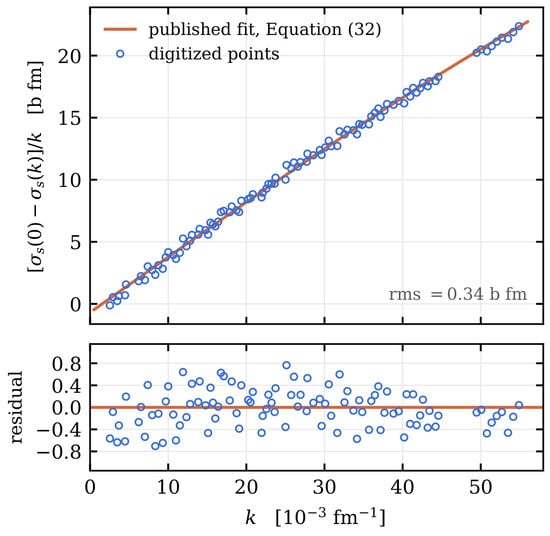
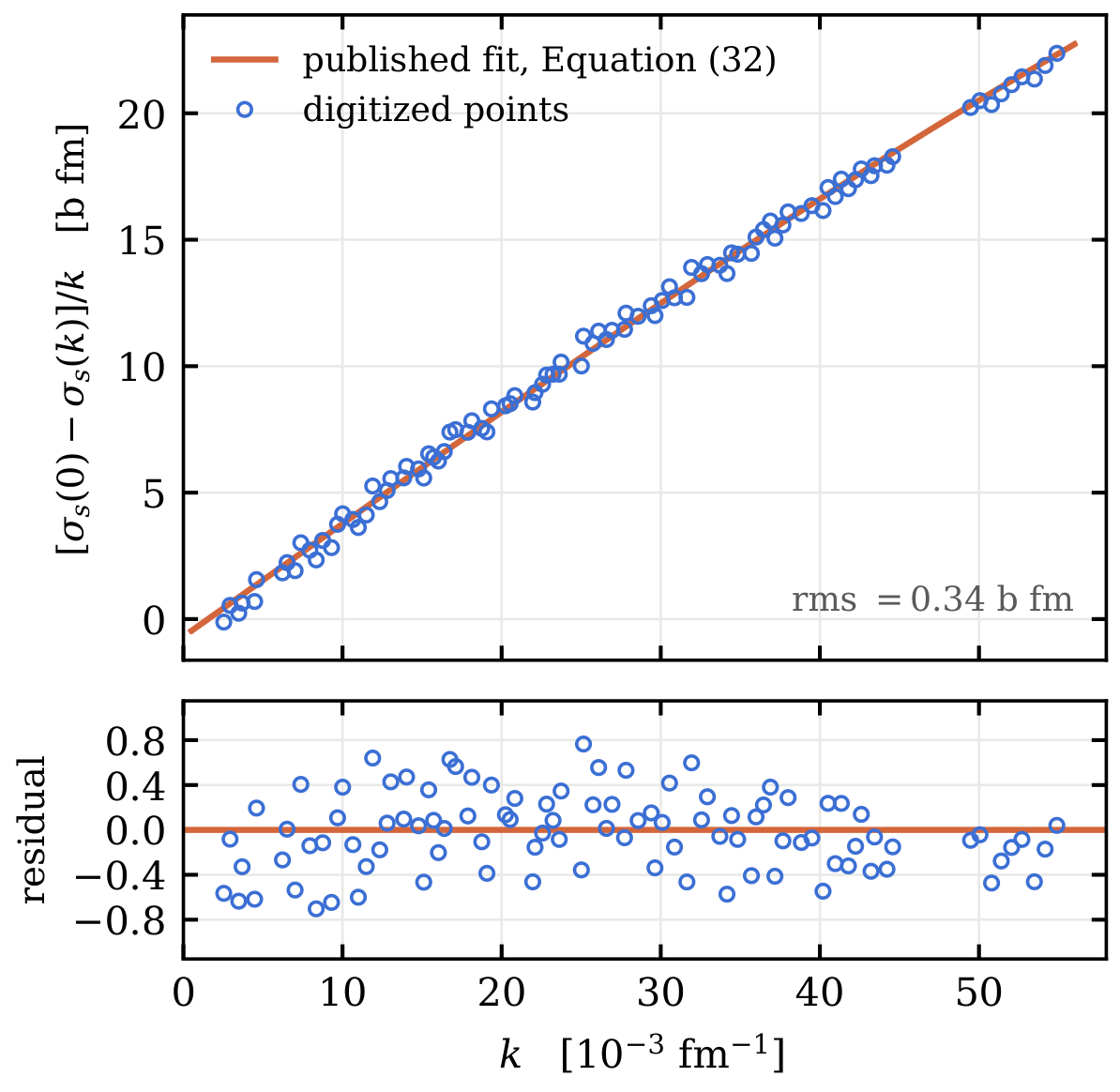
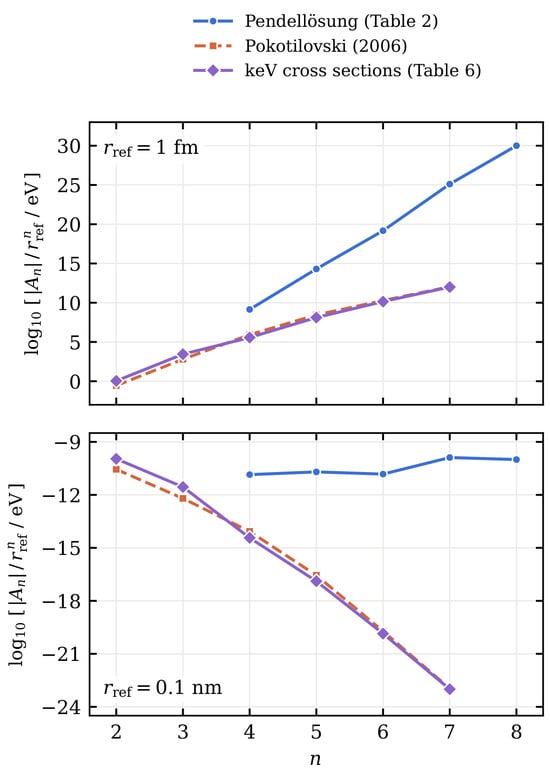
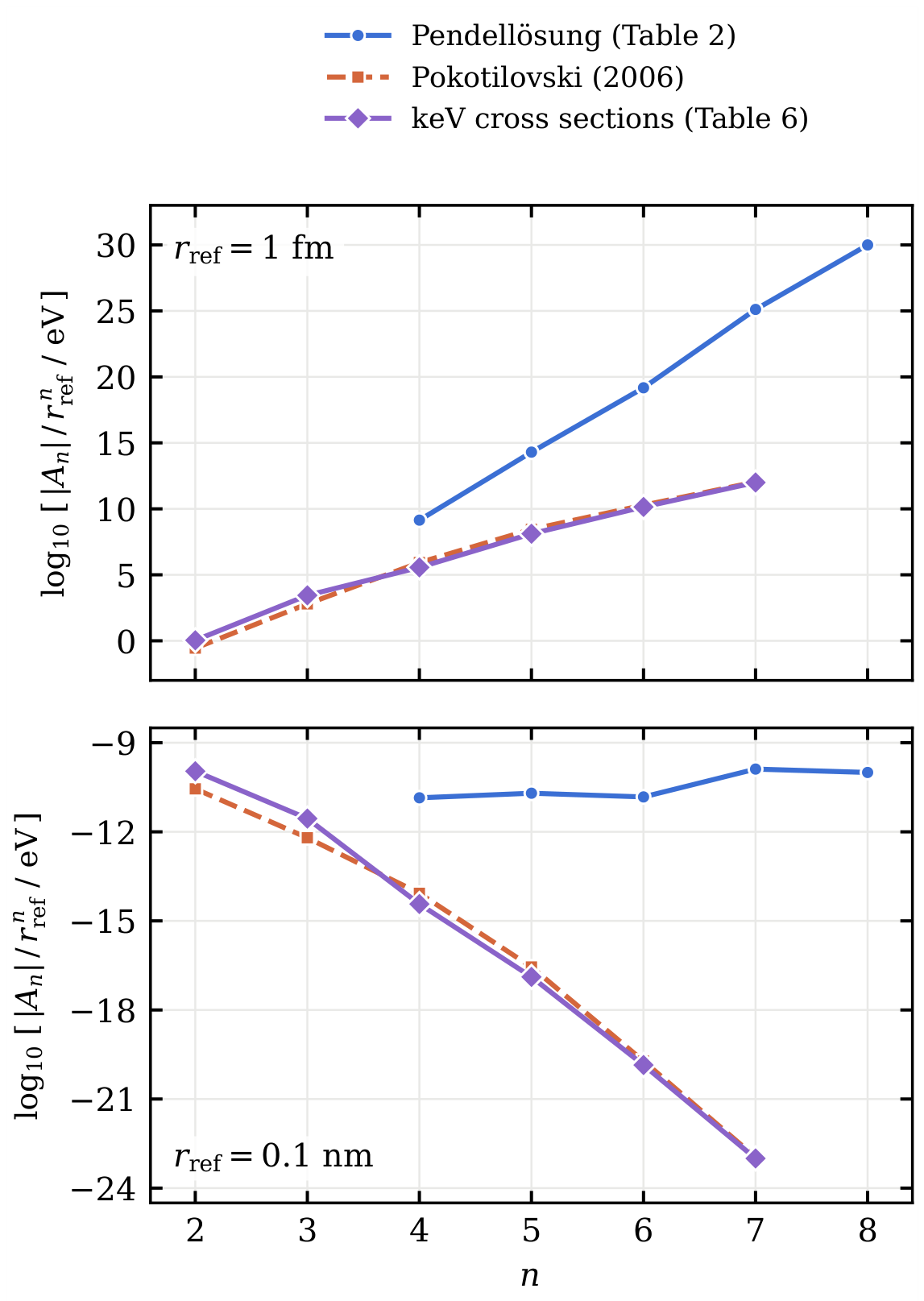

Disclaimer/Publisher’s Note: The statements, opinions and data contained in all publications are solely those of the individual author(s) and contributor(s) and not of MDPI and/or the editor(s). MDPI and/or the editor(s) disclaim responsibility for any injury to people or property resulting from any ideas, methods, instructions or products referred to in the content. |
© 2026 by the authors. Licensee MDPI, Basel, Switzerland. This article is an open access article distributed under the terms and conditions of the Creative Commons Attribution (CC BY) license.