


Abstract
The recent discovery of an extremely light and small central compact object (CCO) within the supernova remnant HESS J1731-347, with mass and radius km, is challenging our understanding of neutron stars. In this article, we identify it as an ultra-light neutron star (NS) and constrain the chiral invariant mass of nucleon from the observational data of NS using an extended parity doublet model with the isovector scalar meson . We show that the data from the HESS J1731-347 impose a very narrow constraint on the allowed values of and in the crossover model: for MeV, and for MeV. We also study the higher-order asymmertic matter properties such as the symmetry incompressibility and the symmetry skewness in the presence of the meson. We find that and are very sensitive to in the presence of the meson.
1. Introduction
The neutron star (NS) is one of the most compact objects in the universe. It is an excellent cosmic laboratory under extreme conditions for studying dense QCD matter. NSs allow us to study the equation of state (EoS) of the QCD matter in high density, which is difficult to access in the experiments. Recently, more and more NS observations are available and provide us valuable information about the EoS. For example, the NS merger event GW170817 provided insights into the mass and radius of NSs, with an estimation of approximately and a radius of km [1,2]. The NS observations from NICER have also played a crucial role in advancing our understanding of NSs. The analyses [3,4] have focused on NSs with masses around and . The results show that the radii of these NSs are rather similar for different masses, with a radius of approximately 12.45 ± 0.65 km for a NS and 12.35 ± 0.75 km for a NS.
Recently, a report on a central compact object (CCO) HESS J1731-347 [5] with a very small mass and radius km has challenged our understanding to the NS. The observation of HESS J1731-347 implies that the NS EoS is very soft in the low-density region [6]. There are also studies that consider HESS J1731-347 as a quark star [7,8,9,10], an exotic object made from deconfined quarks rather than the usual hadronic matter. Understanding this CCO is therefore important to the study of NSs and the EoS.
Chiral symmetry and its spontaneous breaking play a fundamental role in quantum chromodynamics (QCD) and low-energy hadron physics. This symmetry breaking is responsible for the generation of the hadron masses and the mass differences between chiral partners. In dense environments, such as the interior of NSs, chiral symmetry is expected to be partially restored. Investigating how hadron masses change under such conditions can provide valuable insights into the origin of hadron masses and the properties of strongly interacting matter.
The parity doublet model (PDM) [11] is an extended linear sigma model that incorporates a parity doubling structure of nucleons. In this model, the negative-parity excited nucleon is considered as the chiral partners of the ground state nucleons, with spontaneous symmetry breaking generating the mass difference between them. When chiral symmetry is restored, these nucleons degenerate into the same mass, which is called chiral invariant mass of nucleon . Studies such as lattice simulations [12,13,14] and QCD sum rule [15] suggest that part of the nucleon mass is independent of the chiral symmetry breaking. Both quantitative and qualitative studies of the chiral invariant mass are therefore crucial for advancing our understanding of the origin of hadron masses.
Previous analyses have attempted to constrain by analyzing nucleon properties in vacuum. Ref. [16] suggests that is smaller than 500 MeV based on an analysis of the decay width of , while Ref. [17] includes higher-derivative interactions in the model, resulting in larger values of that are consistent with the decay width from experiments.
The PDM has also been applied to study dense mediums in several studies, such as in Refs. [18,19,20,21,22,23,24,25,26,27,28,29,30,31,32,33,34,35,36,37,38,39,40,41,42,43,44,45]. Recently, several studies [35,36,38,41,46,47] have constructed the NS EoS using an extended PDM [26,48]. In these studies, the hadronic EoS is smoothly interpolated to a NJL-type quark matter EoS, under the assumption of a crossover hadron–quark phase transition, following the approach of Ref. [49]. Reference [35] had constrained the chiral invariant mass of nucleon to 600 MeV MeV using the observational data of NSs given in Refs. [1,2,50,51,52,53]. Reference [54] constrained to 580 MeV MeV with the presence of the isovector scalar meson. Reference [41] showed that MeV, with the consideration of a central compact object (CCO) within the supernova remnant HESS J1731-347 [5]. The discovery of this ultra-light compact object HESS J1731-347, with a mass of approximately and a radius of about km, has opened a new window for studying compact objects and provides additional constraints on the dense matter equation of state. Such light and small CCOs pose challenges to the existing theories and require careful theoretical modeling.
Recently, the effect of the isovector-scalar (980) meson (also called the meson) on asymmetric matter such as NSs is gaining attention. The (980) meson accounts for the attractive force in the isovector channel [55,56,57,58,59]. The effect of (980) to the symmetry energy and asymmetric matter EoS was studied in Refs. [56,57,60,61,62,63,64,65] using Walecka-type relativistic mean-field (RMF) models, and in Refs. [66,67] using density-dependent RMF models. The existence of (980) is shown to increase the symmetry energy [56,57,60,62,64,65,68], and stiffen the NS EoS [56,57,61,62,63] and asymmetric matter EoS [67]. Recently, the stiffening effect of on the NS EoS was also confirmed in an extended PDM, and the constraint to the chiral invariant mass is obtained as 580 MeV MeV in Ref. [54]. The stiffening of the NS EoS due to the meson therefore may make the interpretation of HESS 1731-347 as an ultra-light NS difficult.
In this work, we extend previous studies by incorporating the isovector scalar meson into the PDM and explore its effects on the properties of neutron stars, with updated NS observations including the ultra-light compact object HESS J1731-347. Through this analysis, we aim to provide tighter constraints on the chiral invariant mass with the consideration of HESS J1731-347. Unless otherwise stated, natural units with are used in this work.
This paper is organized as follows: in Section 2.1, we review an extension of the PDM by including the isovector scalar meson based on the chiral U(2)L × U(2)R symmetry with the U(1)A anomaly included, as constructed in Ref. [54]. In Section 2.2, we construct the matter with PDM under the mean-field approximation. Then, in Section 3, we study effect of the meson and chiral invariant mass of nucleon to the asymmetric matter properties such as the symmetry incompressibility and the symmetry skewness coefficient . By comparing to the results to recent constraints from experiments and theoretical works, we constrain the value of . In Section 4, we study neutron star matter using a unified equation of state with hadron–quark crossover, and analyze the mass–radius relationship to constrain the model parameters and using recent NS observations, including the ultra-light compact object HESS J1731-347. We then compare the results from hadronic EoSs based on PDM and the constraint from nuclear matter properties to the constraints from NS observations. Finally, a summary is given in Section 5.
2. Dense Nuclear Matter with Parity Doublet Model
2.1. A Parity Doublet Model with U(2)L × U(2)R Symmetry
In this work, we use an parity doublet model (PDM) based on the U(2)L × U(2)R chiral symmetry, as constructed in Ref. [54]. The Lagrangian is given by
where is the nucleons, is the scalar and pseudoscalar mesons, and is the vector mesons Lagrangian.
In this model, the scalar meson field M is introduced as the representation under the SU(2)L × SU(2)R × U(1)A symmetry, which transforms as
where and . M is parameterized as
where are the sigma meson, pions, the lightest isovector scalar meson , and meson field, respectively. are the Pauli matrices. The vacuum expectation value (VEV) of M is given by
where is the VEV of the field equal to the pion decay constant MeV. Then, the Lagrangian is given by
where is the potential for M. In the current model, is given by [54].
where terms up to the sixth order that are invariant under SU(2)L × SU(2)R × U(1)A symmetry are included. In addition, a determinant-type Kobayashi–Maskawa–’t Hooft interaction is included in the current model to implement the U(1)A anomaly.
The iso-triplet meson and iso-singlet meson are considered based on the hidden local symmetry (HLS) [69,70,71]. The HLS is introduced by performing polar decomposition of the field M as
where is the matrix field for scalar mesons. are transforming as
where and . We note that for and for . In the unitary gauge of the HLS, are parameterized as
where is the matrix field for pseudoscalar mesons. The vector mesons are the gauge bosons in HLS and transform as
where and are the gauge bosons of SU(2)HLS and U(1)HLS, respectively. and are the corresponding HLS gauge coupling constants.
The HLS-invariant Lagrangian is given by
where and are the field strengths of the meson and meson that are given by
and are the covariantized Maurer−Cartan 1-forms, defined as
and the covariant derivatives of are given by
with , and being the external gauge fields corresponding to SU(2)L × SU(2)R × U(1)A global symmetry.
The last term in the Lagrangian (12) is a mixing interaction of and mesons, as introduced in Ref. [54] to reduce the slope parameter [41,72].
The baryonic Lagrangian based on the parity doubling [11,16] is given by
where () () is the left-handed (right-handed) component of the nucleon fields , and the covariant derivatives are defined as
where is the external gauge field corresponding to the U(1) baryon number. and are the Yukawa couplings of the nucleon and is called the chiral invariant mass of nucleon. Two baryon fields and , corresponding to the positive-parity and negative-parity nucleon fields, can be obtained by diagonalizing , and their vacuum masses are given by [11,16]:
In the present work, we identify the fields and as the ground state N(939) and its excited state .
2.2. PDM with Mean Field Approximation
In this work, the mean-field approximation is adopted as in [54]:
and the matrix M is given by
Then, the mean potential is written as
where the parameters are redefined as
The vector meson mean fields are given by
and the mean field Lagrangian of the vector mesons is given by
with
The thermodynamic potential of the nucleons is given by
denotes the parity and denotes the iso-spin of nucleons ( for proton and for neutron). The effective chemical potential is given by
is the nucleon energy as defined by , where and are the momentum and the effective mass of the nucleon. In the present model, the effective mass is given by
Altogether, the hadronic thermodynamic potential is
where the vacuum potential,
is subtracted from .
2.3. Determination of Model Parameters
In the present model, the model parameters are determined to reproduce the nuclear saturation properties and the vacuum properties of the hadrons. There are 11 parameters to be determined for a given value of chiral invariant mass :
The vacuum expectation value of is taken to be , with the pion decay constant 92.4 MeV. The Yukawa coupling constants and are determined by fitting to the nucleon masses in vacuum given in Equation (20). In this study, we identify the nucleon as and its parity partner as the excited state , with MeV and MeV. The values of , , , are determined from the saturation properties: saturation density , the binding energy , and the incompressibility , together with the stationary condition of the potential in vacuum,
The value of the nuclear saturation properties are summarized in Table 1. As investigated in Refs. [54,73], terms with coefficient are of sub-leading order in the large expansion and have a small effect on the matter properties. Therefore, we set in this work for simplicity. The parameters and are fitted to the meson masses and the other parameters,
where and are the masses of and . The values of meson masses used in this work are listed in Table 2. The values of the parameters for various are presented in Table 3. In the present model, the vector mixing interaction with coefficient are included to control behavior of the asymmetric matter at density beyond the saturation. The parameters and are related and fitted to the symmetry energy as well as the slope parameter . As summarized in Ref. [74], the recent accepted value of MeV. Therefore, we carry out the calculations over the range –80 MeV in this work. The values of and are shown in Table 4 and Table 5.
Table 1.
Saturation properties that are used to determine the model parameters: saturation density , binding energy , incompressibility , and symmetry energy .
Table 2.
Values of meson masses and pion decay constant in the vacuum in MeV.
Table 3.
Values of for = 600–900 MeV.
Table 4.
Values of for various , .
Table 5.
Values of for various , .
3. Asymmetric Nuclear Matter Properties
The neutron star is a highly asymmetric matter, mainly composed of neutrons. Therefore, the properties of asymmetric matter such as the symmetry energy at the saturation , the slope parameter , the symmetry incompressibility , and the symmetry skewness coefficient , which determine the EoS of the asymmetric matter, have a strong impact on the neutron star properties, such as their mass and radius. In this section, we compute and . By comparing with the recent constraint of , we constrain the chiral invariant mass of nucleon and see whether the constraints for asymmetric nuclear matter properties agree with the NS observations in the present model.
The symmetry energy at arbitrary baryon density is defined as
where is the energy per nucleon defined from the energy density . Here, , . The isospin density is given by , with and being the proton and neutron densities, respectively. and are defined as the coefficients of the Taylor expansion of the symmetry energy about the saturation density :
where
They are the higher-order coefficients that control the high density behavior of the asymmetric nuclear matter EoS. characterizes the curvature of the symmetry energy with respect to density, analogous to the role of the incompressibility coefficient in symmetric nuclear matter. encodes how rapidly the curvature of the symmetry energy changes as density increases. For the definition of the and the symmetry energy parameters, such as and , readers are referred to the review by Lattimer [75], which also presents recent constraints on the symmetry energy parameters. The full density dependence of in the PDM and the effect of meson on it is studied in our previous works [54,73].
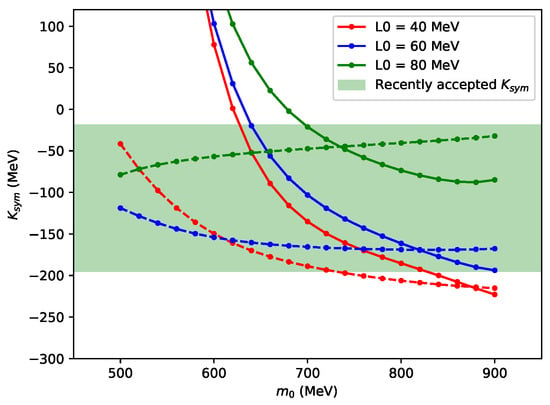
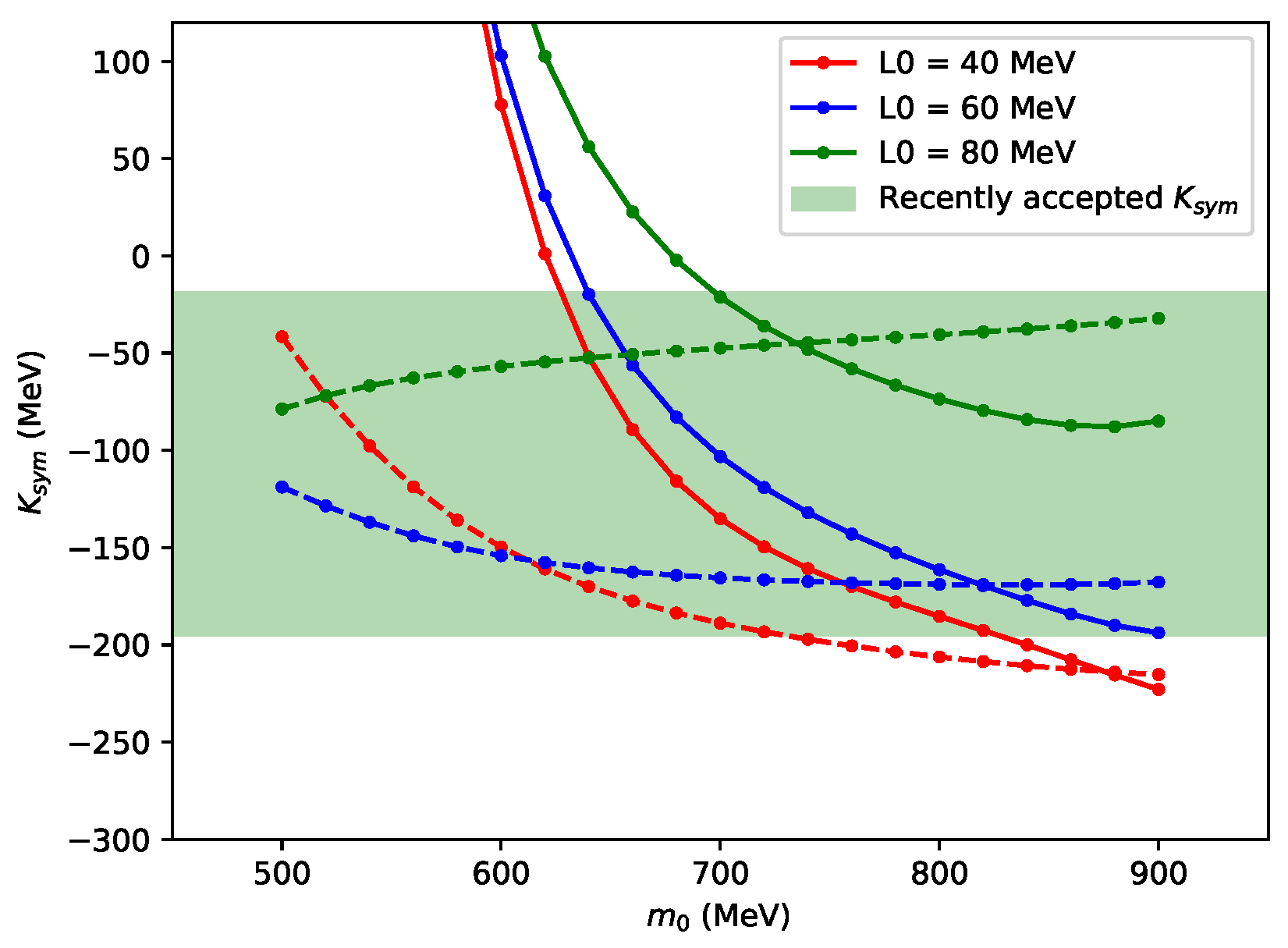
Figure 1 shows the as a function of in the models with and without the meson, for various values of . We observe that the inclusion of the meson has a significant impact on , especially when is small. In particular, becomes positive and increases rapidly as decreases in the model: MeV when MeV for MeV. We also note that while larger values lead to larger values of , its influence is weaker than that of when –700 MeV in the model. However, for larger values, where the sensitivity to diminishes, the effect of becomes dominant. In contrast, shows much less variation with in the absence of the meson. The recently accepted value of MeV, as reported in Ref. [74], is shown as the green band for comparison. We note that the value of is still difficult to determine from the experiments and we are not going to constrain tightly here. However, several systematic studies of theoretical models and experiments such as [74,76,77] concluded that is likely to be negative. In the present model, when –700 MeV, which is consistent with the constraints derived from NS observations, as discussed in Section 4.
Figure 1.
dependence of with MeV. Solid curves represent the results from the model with meson and dashed curves are from the model without meson. The green region shows the recent accepted value of as summarized in Ref. [74].
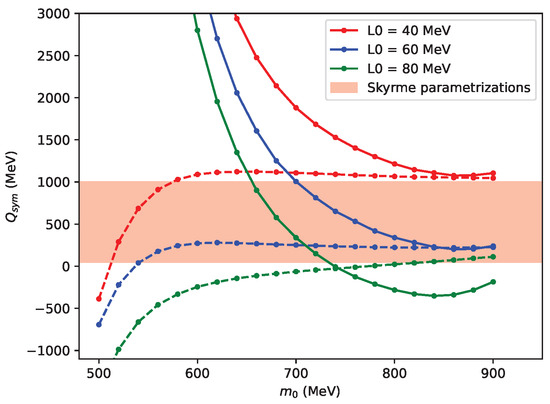
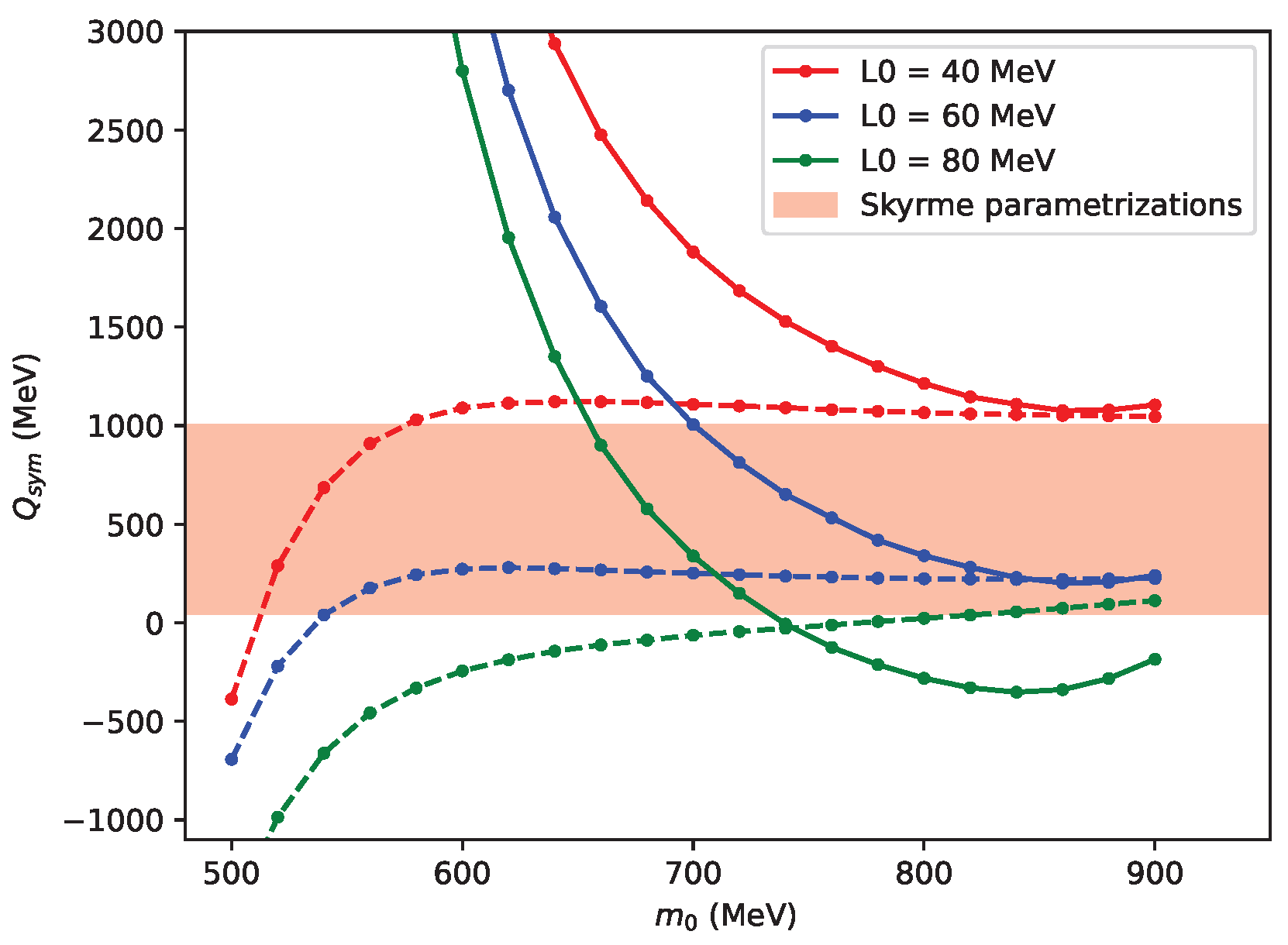
Figure 2 shows the dependence of on in the present models with and without meson for different values. The pink band represents the range of estimated from Skyrme models, as summarized in Ref. [78]. Similar to the case of , the meson has a significant impact on . has a very different -dependence in the models with and without the meson. While is negative for a small in the model without the meson, is positive and considerably large when is small in the model. In particular, exceeds several thousand MeV in the model when –700 MeV, depending on the value of , which is much larger than the typical predictions from Skyrme models.
Figure 2.
dependence of with different . Solid curve represents the model with meson and dashed curve represents the model without . The pink region shows the predictions of from Skyrme parameterization as summarized in Ref. [78] for comparison.
Our results suggest that higher-order asymmetry properties, such as and , are sensitive to the existence of the meson. Due to the difficulties in measuring and experimentally, we are not able to properly constrain the value of from them in this work. We believe that future constraints on them could provide valuable insight into the properties of asymmetric nuclear matter, such as the equation of state (EoS) of neutron star matter, and help further our understanding of the chiral invariant mass of the nucleon.
4. Neutron Star Matter
Neutron stars (NSs) provide unique cosmic laboratories for studying matter under extreme conditions. Recent precise measurements of NS masses and radii have significantly constrained the equation of state (EoS) of strongly interacting matter at densities beyond nuclear saturation [1,2,52,53,79]. Of particular significance is the discovery of the central compact object in the supernova remnant HESS J1731-347, characterized by an unusually low mass of approximately and a radius of about km [5]. This object presents a new challenge for theoretical models that must now accommodate both massive neutron stars () and this remarkably light compact object. After including the meson effect, we will study the implication of recent NS observations to the nucleon chiral invariant mass.
4.1. Unified EoS with Crossover Phase Transition
At densities several times of nuclear saturation density ( fm−3), the interior of NSs likely undergo a transition from hadronic to quark degrees of freedom. Traditional approaches often model this as a sharp first-order phase transition, producing discontinuities in the EoS [80,81,82,83,84]. However, these treatments typically rely on extrapolating hadronic and quark models far beyond their regions of established validity, leading to significant uncertainties in the predicted phase transition behavior and neutron star properties.
In our approach, we adopt a more physically motivated picture of hadron–quark continuity, where the transition occurs smoothly over a finite density range. To implement this, following Refs. [35,38,41], we expand the pressure as a function of baryon chemical potential in polynomial form . By imposing six boundary conditions together with the thermodynamic stability and causality conditions, we interpolate the EoS of the PDM and that of an NJL-type quark model, as constructed in Ref. [35] in the intermediate density region , to obtain a smoothly connected unified EoS. To account for the neutron star crust, we adopt the BPS EoS [85] at low densities (), matched to our hadronic/crossover EoS at higher densities. In what follows, all neutron star EoSs are constructed with this crust–core matching procedure.
4.2. NS Mass-Radius Relation
By solving the Tolman–Oppenheimer–Volkoff (TOV) equation for spherically symmetric and static stars, we obtain the NS mass–radius (M-R) relation.
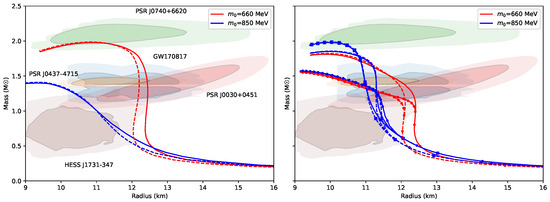
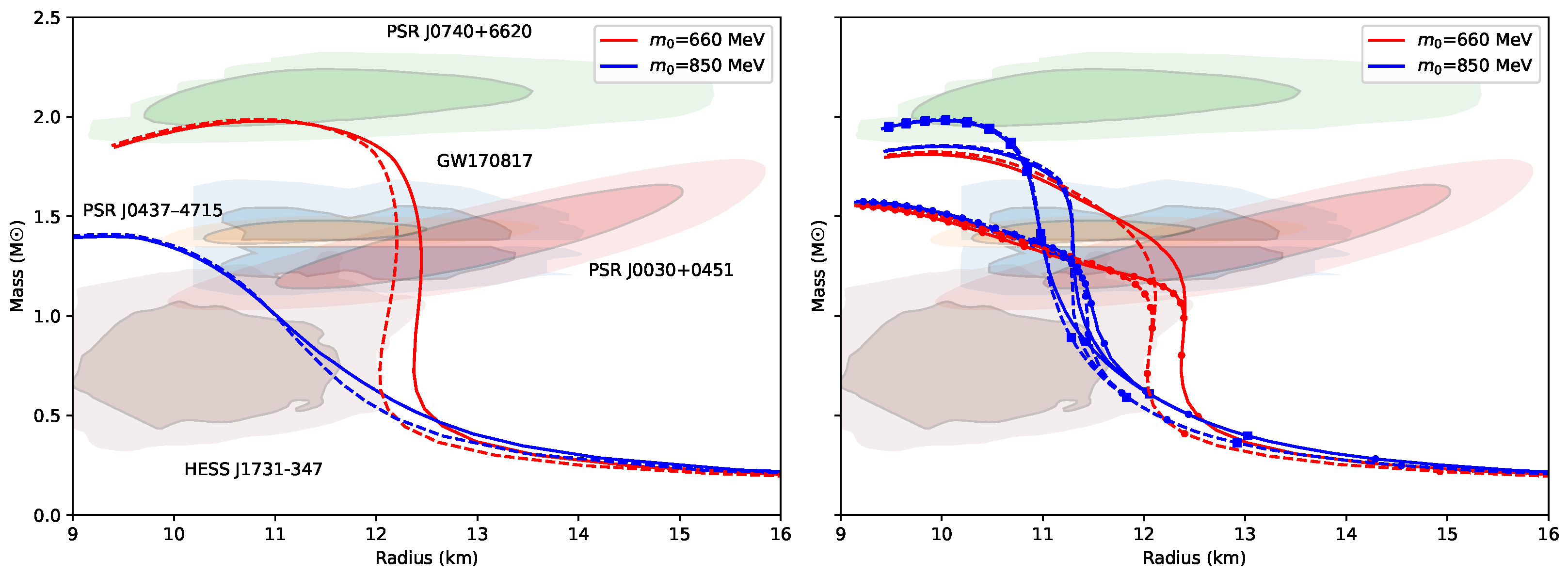
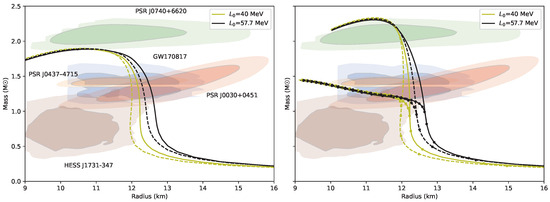
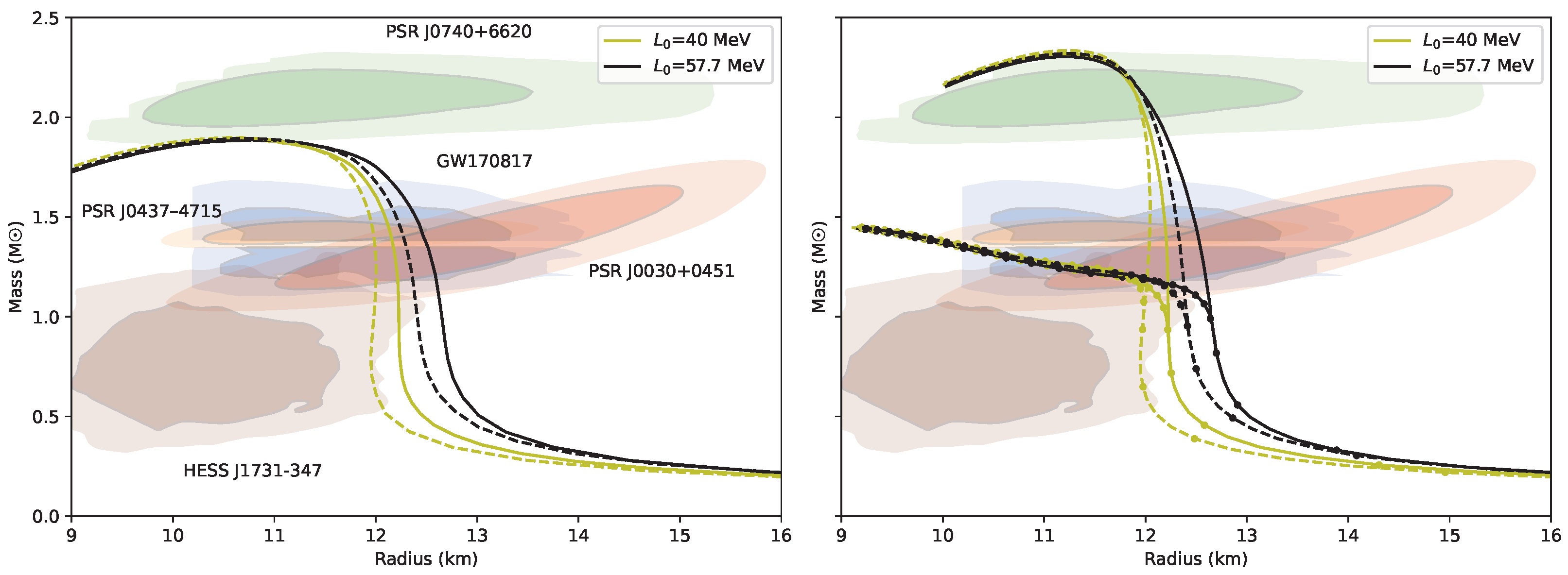
In the PDM, the chiral invariant mass and the slope parameter play crucial roles in determining the stiffness of the EoS. Larger values of lead to a softer EoS in the hadronic region, while larger values of the slope parameter result in a stiffer EoS. To illustrate these effects, we examine the NS M–R relations under different parameter combinations. In Figure 3, we fix MeV and vary the chiral invariant mass. The left panel shows the M–R relations obtained from the hadronic EoS constructed from the PDM, while the right panel presents the M–R relations from the crossover model. As increases, the hadronic EoS becomes progressively softer, leading to M–R curves with systematically smaller radii and smaller masses. In both the hadronic model and the crossover model, the hadronic part largely controls the radius of intermediate to low-mass NS. The crossover region, however, is strongly influenced by both the hadronic and quark sectors: a stiffer hadronic EoS enlarges the radii of NSs, while a stiffer quark EoS increases the mass of the NSs that have central densities in the crossover regime. Although a larger further reduces the radius of low-mass NSs and is consistent with the HESS J1731-347 observational constraint, it simultaneously makes it harder for the M–R curve to support a NS. Conversely, in Figure 4, we fix MeV and vary . The left panel displays the M–R relations obtained from the hadronic EoS, whereas the right panel shows those for the crossover model. Here, decreasing values of correspond to a softer EoS and smaller radii in both of the models. On the other hand, the change in has a limited effect on the maximum mass of the curves in the PDM. A large makes the EoS difficult to satisfy the observational constraint on the radius of HESS J1731-347. Furthermore, we note that the masses of the heavy NSs are primarily determined by the quark matter EoS at high densities in the crossover model. As shown in the right panels of Figure 3 and Figure 4, the masses of heavy NSs are nearly identical for EoSs with the same NJL parameters and , regardless of the chosen values of and . In contrast, the crossover EoSs can support a large maximum mass, allowing the model to satisfy constraints from massive NSs even with large and small . By treating these two parameters as variables, we can investigate how recent neutron star observations constrain their allowed values in the present model.
Figure 3.
(Left) Mass–radius relation for MeV with fixed value of MeV computed from PDM. The solid and dashed curves show the M-R relations obtained from the models with and without meson, respectively. (Right) Mass–radius relation for MeV with fixed value of MeV computed from the PDM-NJL crossover model. The PDM EoSs are connected to the quark EoS using the NJL model with parameters = (1.3, 0.2) (lines with point markers), (1.4, 0.5) (lines without markers), and (1.5, 0.7) (lines with square markers). See Ref. [35] for details of the NJL model.
Figure 4.
(Left) Mass–radius relation for MeV with fixed value of MeV calculated from PDM. The solid and dashed curves show the M-R relations obtained from the models with and without meson, respectively. (Right) Mass–radius relation for MeV with fixed value of MeV calculated from the PDM-NJL crossover model. The PDM EoSs are connected to the quark EoS using the NJL model with parameters = (1.25, 0.1) (lines with markers) and (1.6, 1.3) (lines without markers). See Ref. [35] for details of the NJL model.
In the present models, the , also known as the meson, an isovector scalar meson, is incorporated into the PDM with proper treatment of the chiral symmetry. It provides an attractive contribution in the isovector channel and affects isospin asymmetric matter, such as NS matter. By comparing neutron star properties, such as mass and radius, in models with and without the meson, we find that the meson increases the radii of intermediate- to low-mass NSs and makes it more difficult for the EoS to satisfy the observational constraint on the radius of HESS J1731-347. The effect of is stronger when is smaller, due to the larger coupling. We also observe that the effect of the meson vanishes for heavy NSs. As shown in Figure 3 and Figure 4, the M–R curves obtained from both the PDM and the crossover model, with and without the meson, are almost the same for massive NSs, regardless of the value of and . Therefore, the existence of light NSs with small radii, such as HESS J1731-347, place strong constraints on the chiral invariant mass in the models with the meson.
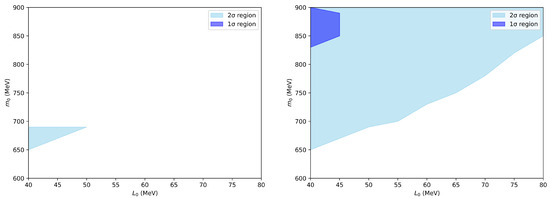
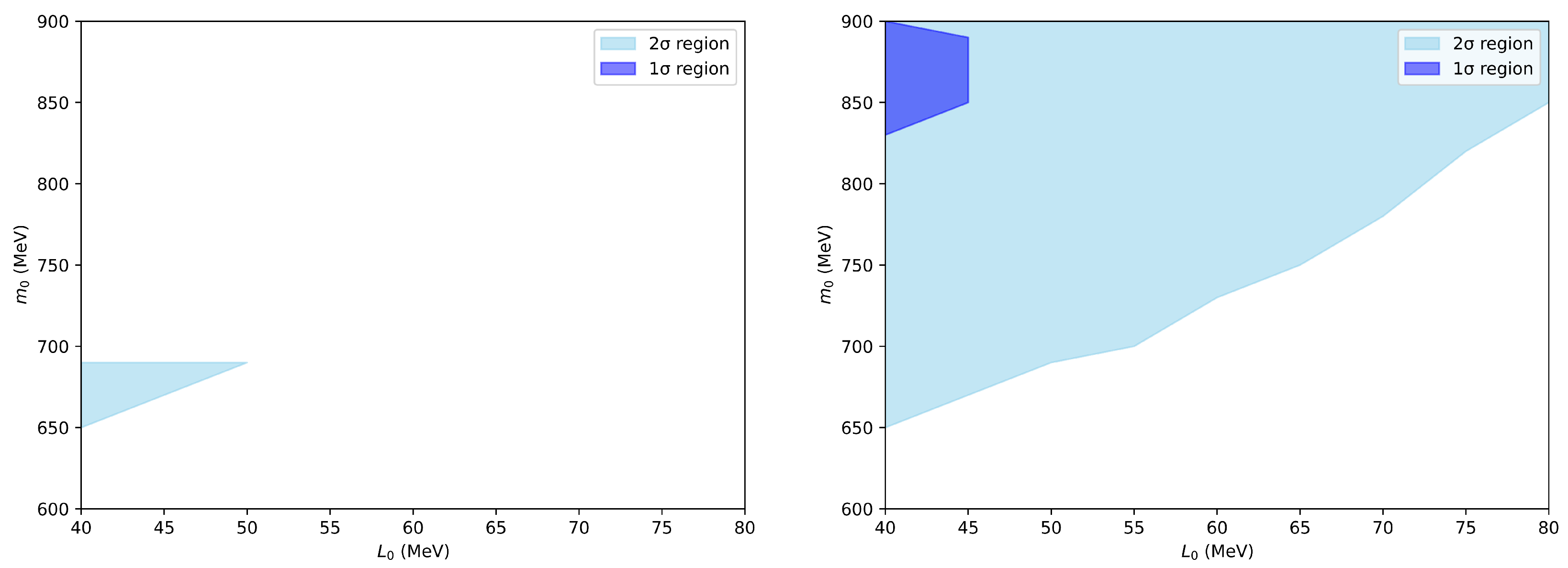
Our results are then compared with the observational data of HESS J1731-347 [5], GW170817 [2], PSR J0740+6620 [3], and PSR J0030+0451 [52] to constrain the value of and . The plot on the left of Figure 5 shows the constraint to as a function of from the and observations of the above NSs for the PDM-NJL crossover model with the meson. We observe that the 1 neutron star (NS) constraint for the PDM-NJL crossover model is very tight, allowing only a narrow region in the plane to satisfy the condition, as indicated by the dark-blue band in the right panel of Figure 5. The constraint of is given by
for MeV and
for MeV. This implies that only very soft EoSs reproduce the NS observations, due to the small mass and radius of HESS J1731-347. At the level, however, the allowed region broadens substantially with
for MeV. Since the presence of the meson increases the radii of light NSs, soft EoSs with large are required to reproduce the observational constraint on the radius of HESS J1731-347.
Figure 5.
(Left) Allowed region for and from the hadronic PDM with meson. (Right) Allowed region for and from the PDM-NJL crossover model with meson. The blue regions show the value of and and the MR relations satisfy the and constraints from the NSs observational data.
For comparison, the constraints on as a function of derived from the and observations for the hadronic PDM are also presented in the left panel of Figure 5. The constraints are significantly tighter and favor smaller values of compared to the crossover model. In particular, the constraint is given by the region between for MeV, for MeV, and MeV for MeV. On the other hand, the hadronic EoS cannot satisfy the constraints, reflecting that the hadronic EoS in the present model cannot simultaneously reproduce the small radius of HESS J1731-347 while supporting a neutron star with a mass around .
Our results imply that a relatively large is required to reproduce the observational constraints from the NSs, suggesting that the contribution of the chiral symmetry breaking to the mass of nucleon is small. This finding is consistent with other studies, such as lattice simulations [12,13], which indicate that a large portion of the nucleon masses persist even near the chiral phase transition temperature. However, the nature and the origin of the chiral invariant mass remain unclear, and further studies are needed to understand the mass generation of the hadron.
5. Summary
In this work, we first studied the effect of the meson to the higher-order asymmetric matter properties such as the symmetry incompressibility and the symmetry skewness . We find that and are sensitive to the chiral invariant mass of nucleon in the presence of the meson. In particular, –700 MeV gives .
Then, we studied the neutron star M-R relation and gave constraints to the slope parameter and . We find that the chiral invariant mass predominantly controls the radii of light NSs, while the slope parameter governs their compactness without strongly affecting the maximum mass of the M–R relations. The masses of heavy NSs are however largely affected by the quark matter EoS in the crossover model and thus insensitive to the hadronic part. We also examined the role of the meson and found that it increases the radii of light NSs, while its effect on heavy NSs is vanishing and has a very limited effect on their masses. Consequently, The ultra-light compact object HESS J1731-347 provides particularly stringent constraints on our hadronic model parameters. With its unusually small radius and low mass, this object requires a very soft EoS in the hadronic region, which requires large and small values in our model. The 1 data from HESS J1731–347 impose a very narrow constraint on the allowed values of and in the crossover model. Our calculations demonstrate that for MeV, and for MeV, , our unified EoS can simultaneously satisfy all observational constraints within the credible region, including that of HESS J1731-347 observation. In contrast, the constraint is looser, allowing for MeV. For comparison, we also analyzed the hadronic model and found that it fails to reproduce the observational data of the NSs. The constraint is satisfied only within a narrow range between for MeV, for MeV, and MeV for MeV. This occurs because a soft hadronic EoS that reproduces the small radius of HESS J1731-347 is difficult to support NSs with a heavy mass ∼ .
In the present work, higher-order symmetry energy parameters such as and are not used to impose constraints, as they are not yet well-established experimentally. Nevertheless, we emphasize that the NS constraints obtained from our crossover model are consistent with the general trends of asymmetry nuclear matter properties: our results predict for –700 MeV, in agreement with constraints inferred from neutron star observations. Future experiments on the asymmetric matter EoS will help us to further constrain the chiral invariant mass of the nucleon as well as the behavior of asymmetric matter at a high density.
Our finding suggests that, if confirmed as a neutron star, HESS J1731-347 would significantly narrow the allowed parameter space of the model, offering valuable insights into the nature of the chiral invariant mass of the nucleon and the behavior of dense asymmetric matter, which are otherwise difficult to probe in terrestrial experiments.
The current study suggests that the chiral invariant mass of the nucleon is large, in agreement with other theoretical investigations of nucleon mass. However, the nature and origin of the chiral invariant mass remain unclear, and further studies such as constructing the chiral invariant mass at the quark model level may help us to deepen our understanding of the generation of hadron mass.
Author Contributions
Writing—original draft preparation, Y.K.K., B.G. and M.H.; writing—review and editing, Y.K.K., B.G. and M.H. All authors have read and agreed to the published version of the manuscript.
Funding
This work is supported in part by JSPS KAKENHI Grants, No. 23H05439, and No. 24K07045 and JST SPRING, Grant No. JPMJSP2125. Y.K.K. and B.G. would like to take this opportunity to thank the “Interdisciplinary Frontier Next-Generation Researcher Program of the Tokai Higher Education and Research System”.
Data Availability Statement
The original contributions presented in this study are included in the article. Further inquiries can be directed to the corresponding author.
Acknowledgments
The authors would like to thank the organizers of “Compact Stars in the QCD phase diagram (CSQCD2024)” for giving this opportunity to write this contribution.
Conflicts of Interest
The authors declare no conflicts of interest.
References
- Abbott, B.P.; Abbott, R.; Abbott, T.D.; Acernese, F.; Ackley, K.; Adams, C.; Adams, T.; Addesso, P.; Adhikari, R.X.; Adya, V.B.; et al. GW170817: Observation of Gravitational Waves from a Binary Neutron Star Inspiral. Phys. Rev. Lett. 2017, 119, 161101. [Google Scholar] [CrossRef] [Scilit]
- Abbott, B.P.; Abbott, R.; Abbott, T.D.; Acernese, F.; Ackley, K.; Adams, C.; Adams, T.; Addesso, P.; Adhikari, R.X.; Adya, V.B.; et al. GW170817: Measurements of neutron star radii and equation of state. Phys. Rev. Lett. 2018, 121, 161101. [Google Scholar] [CrossRef] [Scilit] [PubMed]
- Miller, M.C.; Lamb, F.K.; Dittmann, A.J.; Bogdanov, S.; Arzoumanian, Z.; Gendreau, K.C.; Guillot, S.; Ho, W.C.G.; Lattimer, J.M.; Loewenstein, M.; et al. The Radius of PSR J0740+6620 from NICER and XMM-Newton Data. Astrophys. J. Lett. 2021, 918, L28. [Google Scholar] [CrossRef] [Scilit]
- Riley, T.E.; Watts, A.L.; Ray, P.S.; Bogdanov, S.; Guillot, S.; Morsink, S.M.; Bilous, A.V.; Arzoumanian, Z.; Choudhury, D.; Deneva, J.S.; et al. A NICER View of the Massive Pulsar PSR J0740+6620 Informed by Radio Timing and XMM-Newton Spectroscopy. Astrophys. J. Lett. 2021, 918, L27. [Google Scholar] [CrossRef] [Scilit]
- Doroshenko, V.; Suleimanov, V.; Pühlhofer, G.; Santangelo, A. A strangely light neutron star within a supernova remnant. Nat. Astron. 2022, 6, 1444–1451. [Google Scholar] [CrossRef] [Scilit]
- Tewari, S.; Chatterjee, S.; Kumar, D.; Mallick, R. Analyzing the dense matter equation of states in the light of the compact object HESS J1731-347. Phys. Rev. D 2025, 111, 103009. [Google Scholar] [CrossRef] [Scilit]
- Chu, P.C.; Li, X.H.; Liu, H.; Ju, M.; Zhou, Y. Properties of isospin asymmetric quark matter in quark stars. Phys. Rev. C 2023, 108, 025808. [Google Scholar] [CrossRef] [Scilit]
- Oikonomou, P.T.; Moustakidis, C.C. Color-flavor locked quark stars in light of the compact object in the HESS J1731-347 and the GW190814 event. Phys. Rev. D 2023, 108, 063010. [Google Scholar] [CrossRef] [Scilit]
- Yang, S.H.; Pi, C.M.; Zheng, X.P.; Weber, F. Confronting Strange Stars with Compact-Star Observations and New Physics. Universe 2023, 9, 202. [Google Scholar] [CrossRef] [Scilit]
- Kourmpetis, K.; Laskos-Patkos, P.; Moustakidis, C.C. Confronting recent light compact star observations with color-flavor locked quark matter. Front. Astron. Space Sci. 2025, 12, 1600563. [Google Scholar] [CrossRef] [Scilit]
- DeTar, C.; Kunihiro, T. Linear sigma model with parity doubling. Phys. Rev. D 1989, 39, 2805–2808. [Google Scholar] [CrossRef] [Scilit] [PubMed]
- Aarts, G.; Allton, C.; Hands, S.; Jäger, B.; Praki, C.; Skullerud, J.I. Nucleons and parity doubling across the deconfinement transition. Phys. Rev. D 2015, 92, 014503. [Google Scholar] [CrossRef] [Scilit]
- Aarts, G.; Allton, C.; De Boni, D.; Hands, S.; Jäger, B.; Praki, C.; Skullerud, J.I. Light baryons below and above the deconfinement transition: Medium effects and parity doubling. J. High Energy Phys. 2017, 2017, 34. [Google Scholar] [CrossRef] [Scilit]
- Aarts, G.; Allton, C.; De Boni, D.; Jäger, B. Hyperons in thermal QCD: A lattice view. Phys. Rev. D 2019, 99, 074503. [Google Scholar] [CrossRef] [Scilit]
- Kim, J.; Lee, S.H. Masses of hadrons in the chiral symmetry restored vacuum. Phys. Rev. D 2022, 105, 014014. [Google Scholar] [CrossRef] [Scilit]
- Jido, D.; Oka, M.; Hosaka, A. Chiral Symmetry of Baryons. Prog. Theor. Phys. 2001, 106, 873–908. [Google Scholar] [CrossRef] [Scilit]
- Yamazaki, T.; Harada, M. Chiral partner structure of light nucleons in an extended parity doublet model. Phys. Rev. D 2019, 99, 034012. [Google Scholar] [CrossRef] [Scilit]
- Hatsuda, T.; Prakash, M. Parity Doubling of the Nucleon and First Order Chiral Transition in Dense Matter. Phys. Lett. B 1989, 224, 11–15. [Google Scholar] [CrossRef] [Scilit]
- Zschiesche, D.; Tolos, L.; Schaffner-Bielich, J.; Pisarski, R.D. Cold, dense nuclear matter in a SU(2) parity doublet model. Phys. Rev. C 2007, 75, 055202. [Google Scholar] [CrossRef] [Scilit]
- Dexheimer, V.; Schramm, S.; Zschiesche, D. Nuclear matter and neutron stars in a parity doublet model. Phys. Rev. C 2008, 77, 025803. [Google Scholar] [CrossRef] [Scilit]
- Dexheimer, V.; Pagliara, G.; Tolos, L.; Schaffner-Bielich, J.; Schramm, S. Neutron stars within the SU(2) parity doublet model. Eur. Phys. J. A 2008, 38, 105–113. [Google Scholar] [CrossRef] [Scilit]
- Sasaki, C.; Mishustin, I. Thermodynamics of dense hadronic matter in a parity doublet model. Phys. Rev. C 2010, 82, 035204. [Google Scholar] [CrossRef] [Scilit]
- Gallas, S.; Giacosa, F.; Pagliara, G. Nuclear matter within a dilatation-invariant parity doublet model: The role of the tetraquark at nonzero density. Nucl. Phys. A 2011, 872, 13–24. [Google Scholar] [CrossRef] [Scilit]
- Steinheimer, J.; Schramm, S.; Stocker, H. The hadronic SU(3) Parity Doublet Model for Dense Matter, its extension to quarks and the strange equation of state. Phys. Rev. C 2011, 84, 045208. [Google Scholar] [CrossRef] [Scilit]
- Dexheimer, V.; Steinheimer, J.; Negreiros, R.; Schramm, S. Hybrid Stars in an SU(3) parity doublet model. Phys. Rev. C 2013, 87, 015804. [Google Scholar] [CrossRef] [Scilit]
- Motohiro, Y.; Kim, Y.; Harada, M. Asymmetric nuclear matter in a parity doublet model with hidden local symmetry. Phys. Rev. C 2015, 92, 025201, Erratum in Phys. Rev. C 2017, 95, 059903. [Google Scholar] [CrossRef] [Scilit]
- Suenaga, D. Examination of N*(1535) as a probe to observe the partial restoration of chiral symmetry in nuclear matter. Phys. Rev. C 2018, 97, 045203. [Google Scholar] [CrossRef] [Scilit]
- Takeda, Y.; Kim, Y.; Harada, M. Catalysis of partial chiral symmetry restoration by Δ matter. Phys. Rev. C 2018, 97, 065202. [Google Scholar] [CrossRef] [Scilit]
- Mukherjee, A.; Schramm, S.; Steinheimer, J.; Dexheimer, V. The application of the Quark-Hadron Chiral Parity-Doublet Model to neutron star matter. Astron. Astrophys. 2017, 608, A110. [Google Scholar] [CrossRef] [Scilit]
- Paeng, W.G.; Kuo, T.T.S.; Lee, H.K.; Ma, Y.L.; Rho, M. Scale-invariant hidden local symmetry, topology change, and dense baryonic matter. II. Phys. Rev. D 2017, 96, 014031. [Google Scholar] [CrossRef] [Scilit]
- Marczenko, M.; Blaschke, D.; Redlich, K.; Sasaki, C. Chiral symmetry restoration by parity doubling and the structure of neutron stars. Phys. Rev. D 2018, 98, 103021. [Google Scholar] [CrossRef] [Scilit]
- Marczenko, M.; Blaschke, D.; Redlich, K.; Sasaki, C. Parity Doubling and the Dense Matter Phase Diagram under Constraints from Multi-Messenger Astronomy. Universe 2019, 5, 180. [Google Scholar] [CrossRef] [Scilit]
- Yamazaki, T.; Harada, M. Constraint to chiral invariant masses of nucleons from GW170817 in an extended parity doublet model. Phys. Rev. C 2019, 100, 025205. [Google Scholar] [CrossRef] [Scilit]
- Marczenko, M.; Blaschke, D.; Redlich, K.; Sasaki, C. Toward a unified equation of state for multi-messenger astronomy. Astron. Astrophys. 2020, 643, A82. [Google Scholar] [CrossRef] [Scilit]
- Minamikawa, T.; Kojo, T.; Harada, M. Quark-hadron crossover equations of state for neutron stars: Constraining the chiral invariant mass in a parity doublet model. Phys. Rev. C 2021, 103, 045205. [Google Scholar] [CrossRef] [Scilit]
- Minamikawa, T.; Kojo, T.; Harada, M. Chiral condensates for neutron stars in hadron-quark crossover: From a parity doublet nucleon model to a Nambu–Jona-Lasinio quark model. Phys. Rev. C 2021, 104, 065201. [Google Scholar] [CrossRef] [Scilit]
- Marczenko, M.; Redlich, K.; Sasaki, C. Chiral symmetry restoration and Δ matter formation in neutron stars. Phys. Rev. D 2022, 105, 103009. [Google Scholar] [CrossRef] [Scilit]
- Minamikawa, T.; Gao, B.; Kojo, T.; Harada, M. Chiral Restoration of Nucleons in Neutron Star Matter: Studies Based on a Parity Doublet Model. Symmetry 2023, 15, 745. [Google Scholar] [CrossRef] [Scilit]
- Minamikawa, T.; Gao, B.; Kojo, T.; Harada, M. Parity doublet model for baryon octets: Diquark classifications and mass hierarchy based on the quark-line diagram. Phys. Rev. D 2023, 108, 076017. [Google Scholar] [CrossRef] [Scilit]
- Gao, B.; Kojo, T.; Harada, M. Parity doublet model for baryon octets: Ground states saturated by good diquarks and the role of bad diquarks for excited states. Phys. Rev. D 2024, 110, 016016. [Google Scholar] [CrossRef] [Scilit]
- Gao, B.; Yan, Y.; Harada, M. Reconciling constraints from the supernova remnant HESS J1731-347 with the parity doublet model. Phys. Rev. C 2024, 109, 065807. [Google Scholar] [CrossRef] [Scilit]
- Gao, B.; Yuan, W.L.; Harada, M.; Ma, Y.L. Exploring the first-order phase transition in neutron stars using the parity doublet model and a Nambu–Jona-Lasinio–type quark model. Phys. Rev. C 2024, 110, 045802. [Google Scholar] [CrossRef] [Scilit]
- Gao, B.; Harada, M. Quarkyonic matter with chiral symmetry restoration. Phys. Rev. D 2025, 111, 016024. [Google Scholar] [CrossRef] [Scilit]
- Yuan, W.L.; Gao, B.; Yan, Y.; Xu, R. Hybrid stars with large quark cores within the parity doublet model and modified NJL model. arXiv 2025, arXiv:2502.17859. [Google Scholar] [CrossRef] [Scilit]
- Gao, B. Constraints on the strength of first-order phase transition in the low density region. arXiv 2025, arXiv:2505.21970. [Google Scholar] [CrossRef] [Scilit]
- Marczenko, M. Anatomy of critical fluctuations in hadronic matter. Phys. Rev. D 2024, 110, 014018. [Google Scholar] [CrossRef] [Scilit]
- Marczenko, M.; Redlich, K.; Sasaki, C. Probing the nuclear liquid-gas phase transition with isospin correlations. Phys. Rev. C 2025, 111, 065203. [Google Scholar] [CrossRef] [Scilit]
- Gao, B.; Minamikawa, T.; Kojo, T.; Harada, M. Impacts of the U(1)A anomaly on nuclear and neutron star equation of state based on a parity doublet model. Phys. Rev. C 2022, 106, 065205. [Google Scholar] [CrossRef] [Scilit]
- Baym, G.; Hatsuda, T.; Kojo, T.; Powell, P.D.; Song, Y.; Takatsuka, T. From hadrons to quarks in neutron stars: A review. Rep. Prog. Phys. 2018, 81, 056902. [Google Scholar] [CrossRef] [Scilit]
- Cromartie, H.T.; Fonseca, E.; Ransom, S.M.; Demorest, P.B.; Arzoumanian, Z.; Blumer, H.; Brook, P.R.; DeCesar, M.E.; Dolch, T.; Ellis, J.A.; et al. Relativistic Shapiro delay measurements of an extremely massive millisecond pulsar. Nat. Astron. 2019, 4, 72–76. [Google Scholar] [CrossRef] [Scilit]
- Abbott, B.P.; Abbott, R.; Abbott, T.D.; Acernese, F.; Ackley, K.; Adams, C.; Adams, T.; Addesso, P.; Adhikari, R.X.; Adya, V.B.; et al. Multi-messenger Observations of a Binary Neutron Star Merger. Astrophys. J. Lett. 2017, 848, L12. [Google Scholar] [CrossRef] [Scilit]
- Miller, M.C.; Lamb, F.K.; Dittmann, A.J.; Bogdanov, S.; Arzoumanian, Z.; Gendreau, K.C.; Guillot, S.; Harding, A.K.; Ho, W.C.G.; Lattimer, J.M.; et al. PSR J0030+0451 Mass and Radius from NICER Data and Implications for the Properties of Neutron Star Matter. Astrophys. J. Lett. 2019, 887, L24. [Google Scholar] [CrossRef] [Scilit]
- Riley, T.E.; Watts, A.L.; Bogdanov, S.; Ray, P.S.; Ludlam, R.M.; Guillot, S.; Arzoumanian, Z.; Baker, C.L.; Bilous, A.V.; Chakrabarty, D.; et al. A NICER View of PSR J0030+0451: Millisecond Pulsar Parameter Estimation. Astrophys. J. Lett. 2019, 887, L21. [Google Scholar] [CrossRef] [Scilit]
- Kong, Y.K.; Minamikawa, T.; Harada, M. Neutron star matter based on a parity doublet model including the a0(980) meson. Phys. Rev. C 2023, 108, 055206. [Google Scholar] [CrossRef] [Scilit]
- Li, B.A.; Krastev, P.G.; Wen, D.H.; Zhang, N.B. Towards Understanding Astrophysical Effects of Nuclear Symmetry Energy. Eur. Phys. J. A 2019, 55, 117. [Google Scholar] [CrossRef] [Scilit]
- Li, F.; Cai, B.J.; Zhou, Y.; Jiang, W.Z.; Chen, L.W. Effects of Isoscalar- and Isovector-scalar Meson Mixing on Neutron Star Structure. Astrophys. J. 2022, 929, 183. [Google Scholar] [CrossRef] [Scilit]
- Liu, B.; Guo, H.; Toro, M.D.; Greco, V. Neutron stars with isovector scalar correlations. Eur. Phys. J. A 2005, 25, 293–298. [Google Scholar] [CrossRef] [Scilit]
- Ma, Y.; Ma, Y.L. Quark structure of isoscalar- and isovector-scalar mesons and nuclear matter property. Phys. Rev. D 2024, 109, 074022. [Google Scholar] [CrossRef] [Scilit]
- Ma, Y.; Ma, Y.L. Composition of Scalar Mesons and Their Effects on Nuclear Matter Properties in an Extended Linear Sigma Model. arXiv 2025, arXiv:2507.10049. [Google Scholar] [CrossRef] [Scilit]
- Kubis, S.; Kutschera, M. Nuclear matter in relativistic mean field theory with isovector scalar meson. Phys. Lett. B 1997, 399, 191–195. [Google Scholar] [CrossRef] [Scilit]
- Kubis, S.; Kutschera, M.; Stachniewicz, S. Neutron Stars in Relativistic Mean Field Theory with Isovector Scalar Meson. Acta Phys. Polon. B 1998, 29, 809–822. [Google Scholar]
- Miyatsu, T.; Cheoun, M.K.; Saito, K. Asymmetric Nuclear Matter in Relativistic Mean-field Models with Isoscalar- and Isovector-meson Mixing. Astrophys. J. 2022, 929, 82. [Google Scholar] [CrossRef] [Scilit]
- Thakur, V.; Kumar, R.; Kumar, P.; Kumar, V.; Kumar, M.; Mondal, C.; Agrawal, B.K.; Dhiman, S.K. Effects of an isovector scalar meson on the equation of state of dense matter within a relativistic mean field model. Phys. Rev. C 2022, 106. [Google Scholar] [CrossRef] [Scilit]
- Rabhi, A.; Providência, C.; Providência, J.D. Effect of the δ meson on the instabilities of nuclear matter under strong magnetic fields. Phys. Rev. C 2009, 80, 025806. [Google Scholar] [CrossRef] [Scilit]
- Liu, B.; Greco, V.; Baran, V.; Colonna, M.; Di Toro, M. Asymmetric nuclear matter: The role of the isovector scalar channel. Phys. Rev. C 2002, 65, 045201. [Google Scholar] [CrossRef] [Scilit]
- Wang, S.; Zhang, H.F.; Dong, J.M. Neutron star properties in density-dependent relativistic mean field theory with consideration of an isovector scalar meson. Phys. Rev. C 2014, 90, 055801. [Google Scholar] [CrossRef] [Scilit]
- Roca-Maza, X.; Viñas, X.; Centelles, M.; Ring, P.; Schuck, P. Relativistic mean-field interaction with density-dependent meson-nucleon vertices based on microscopical calculations. Phys. Rev. C 2011, 84, 054309. [Google Scholar] [CrossRef] [Scilit]
- Kong, Y.K.; Harada, M. A Study of Effects from a0(980) Meson to Asymmetric Matter Based on a Parity Doublet Model. Nucl. Phys. Rev. 2024, 41, 787–793. [Google Scholar] [CrossRef]
- Bando, M.; Kugo, T.; Uehara, S.; Yamawaki, K.; Yanagida, T. Is the ρ Meson a Dynamical Gauge Boson of Hidden Local Symmetry? Phys. Rev. Lett. 1985, 54, 1215–1218. [Google Scholar] [CrossRef] [Scilit] [PubMed]
- Bando, M.; Kugo, T.; Yamawaki, K. Nonlinear Realization and Hidden Local Symmetries. Phys. Rep. 1988, 164, 217–314. [Google Scholar] [CrossRef] [Scilit]
- Harada, M.; Yamawaki, K. Hidden local symmetry at loop: A New perspective of composite gauge boson and chiral phase transition. Phys. Rep. 2003, 381, 1–233. [Google Scholar] [CrossRef] [Scilit]
- Sun, X.; Miao, Z.; Sun, B.; Li, A. Astrophysical Implications on Hyperon Couplings and Hyperon Star Properties with Relativistic Equations of States. Astrophys. J. 2023, 942, 55. [Google Scholar] [CrossRef] [Scilit]
- Kong, Y.K.; Kim, Y.; Harada, M. Nuclear Matter and Finite Nuclei: Recent Studies Based on Parity Doublet Model. Symmetry 2024, 16, 1238. [Google Scholar] [CrossRef] [Scilit]
- Li, B.A.; Cai, B.J.; Xie, W.J.; Zhang, N.B. Progress in Constraining Nuclear Symmetry Energy Using Neutron Star Observables Since GW170817. Universe 2021, 7, 182. [Google Scholar] [CrossRef] [Scilit]
- Lattimer, J.M. Constraints on Nuclear Symmetry Energy Parameters. Particles 2023, 6, 30–56. [Google Scholar] [CrossRef] [Scilit]
- Margueron, J.; Hoffmann Casali, R.; Gulminelli, F. Equation of state for dense nucleonic matter from metamodeling. II. Predictions for neutron star properties. Phys. Rev. C 2018, 97, 025806. [Google Scholar] [CrossRef] [Scilit]
- Mondal, C.; Agrawal, B.K.; De, J.N.; Samaddar, S.K.; Centelles, M.; Viñas, X. Interdependence of different symmetry energy elements. Phys. Rev. C 2017, 96, 021302. [Google Scholar] [CrossRef] [Scilit]
- Dutra, M.; Lourenco, O.; Sá Martins, J.S.; Delfino, A.; Stone, J.R.; Stevenson, P.D. Skyrme interaction and nuclear matter constraints. Phys. Rev. C 2012, 85, 035201. [Google Scholar] [CrossRef] [Scilit]
- Abbott, B.P.; Abbott, R.; Abbott, T.D.; Acernese, F.; Ackley, K.; Adams, C.; Adams, T.; Addesso, P.; Adhikari, R.X.; Adya, V.B.; et al. Properties of the Binary Neutron Star Merger GW170817. Phys. Rev. X 2019, 9, 011001. [Google Scholar] [CrossRef] [Scilit]
- Lenzi, C.H.; Lugones, G. Hybrid stars in the light of the massive pulsar PSR J1614-2230. Astrophys. J. 2012, 759, 57. [Google Scholar] [CrossRef] [Scilit]
- Benic, S.; Blaschke, D.; Alvarez-Castillo, D.E.; Fischer, T.; Typel, S. A new quark-hadron hybrid equation of state for astrophysics—I. High-mass twin compact stars. Astron. Astrophys. 2015, 577, A40. [Google Scholar] [CrossRef] [Scilit]
- Contrera, G.A.; Blaschke, D.; Carlomagno, J.P.; Grunfeld, A.G.; Liebing, S. Quark-nuclear hybrid equation of state for neutron stars under modern observational constraints. Phys. Rev. C 2022, 105, 045808. [Google Scholar] [CrossRef] [Scilit]
- Christian, J.E.; Schaffner-Bielich, J.; Rosswog, S. Which first order phase transitions to quark matter are possible in neutron stars? Phys. Rev. D 2024, 109, 063035. [Google Scholar] [CrossRef] [Scilit]
- Li, J.J.; Sedrakian, A.; Alford, M. Confronting new NICER mass-radius measurements with phase transition in dense matter and twin compact stars. J. Cosmol. Astropart. Phys. 2025, 2, 002. [Google Scholar] [CrossRef] [Scilit]
- Baym, G.; Pethick, C.; Sutherland, P. The Ground State of Matter at High Densities: Equation of State and Stellar Models. Astrophys. J. 1971, 170, 299. [Google Scholar] [CrossRef] [Scilit]

Disclaimer/Publisher’s Note: The statements, opinions and data contained in all publications are solely those of the individual author(s) and contributor(s) and not of MDPI and/or the editor(s). MDPI and/or the editor(s) disclaim responsibility for any injury to people or property resulting from any ideas, methods, instructions or products referred to in the content. |
© 2025 by the authors. Licensee MDPI, Basel, Switzerland. This article is an open access article distributed under the terms and conditions of the Creative Commons Attribution (CC BY) license (https://creativecommons.org/licenses/by/4.0/).