


Abstract
3D bird pose estimation plays a pivotal role in ecological conservation research. However, it remains a formidable challenge due to extensive joint deformation, severe self-occlusion, and the scarcity of 3D ground truth data. Therefore, practical solutions typically rely on accurate 2D keypoint detection from monocular images and subsequent 3D lifting. Although the High-Resolution Network (HRNet) has established a benchmark in 2D pose estimation by preserving high-resolution feature representations, its architecture, which relies on small convolution kernels, faces difficulties in capturing the global long-range dependencies necessary to resolve severe occlusions. To address these deficiencies, the core contributions of this work are summarized as follows: (1) We design a Gated LS-Block with a partial channel gating strategy to decouple channel mixing from spatial mixing, and extract global long-range dependencies via the proposed Large–Small Convolution (LSConv) to minimize feature redundancy. (2) We embed this block into Stage 2 of HRNet, enhancing multi-scale feature learning while slightly reducing model parameters and computational overhead; (3) To alleviate the ill-posed nature of monocular 3D lifting without paired supervision, we develop an unsupervised 3D reconstruction algorithm. Experimental results on the Animal Kingdom dataset demonstrate that our method achieves a 0.9% improvement in PCK@0.05 while reducing GFLOPs by 3.3%. These results verify that the proposed architecture enhances the model’s representation capability for bird poses while ensuring efficient inference. Meanwhile, we validate the applicability of the proposed 3D reconstruction algorithm via qualitative experiments, and further demonstrate that our unsupervised 3D lifting algorithm successfully preserves low symmetry error and robust bone length consistency with proxy metrics.
1. Introduction
Animal pose estimation has become a crucial tool in fields such as ethology analysis, wildlife conservation, and veterinary medicine [1,2,3]. At its core, it involves localizing anatomical keypoints on animals’ bodies. Among these animals, bird species constitute a research domain of particular significance and complexity. As environmental “indicator species”, their behaviors provide critical metrics for assessing ecosystem health [4,5,6,7]. However, birds’ maneuverable and lightweight bodies, coupled with complex and variable motion patterns, make traditional sensor-based tracking highly impractical. In recent years, research on vision-based human keypoint extraction technology has continued to deepen [8,9]. With the characteristics of non-invasiveness, no sensor attachment, and strong adaptability to complex motions, this technology provides a feasible and highly scalable solution for bird behavior analysis [10]. Yet, precise quantification of bird motion and behavior via pose estimation remains elusive. This task is challenged by the intricacies of unconstrained natural backgrounds and high variations both across and within bird species. Most critically, a fundamental lack of 3D ground truth data for training hinders the learning of reliable 2D-to-3D lifting.
This challenge is magnified by birds’ unique anatomy and motion. Their highly flexible skeletal joints allow for extreme non-rigid deformations, unlike the more constrained kinematics of terrestrial quadrupeds [11,12,13]. Consequently, birds exhibit drastic morphological variations, ranging from compact folded wings adhering to the torso to fully extended flight postures. Such variability mandates that models possess the capacity to capture long-range spatial dependencies, thereby effectively correlating distant keypoints like wingtips and shoulders. Although prevailing convolutional neural networks (CNNs), exemplified by the widely adopted High-Resolution Network (HRNet) [14], have established a baseline for bird pose estimation, they suffer from inherent structural drawbacks. Their reliance on stacks of small-kernel convolutions builds a strong local inductive bias but confines the effective receptive field, making them suboptimal for modeling global articulation patterns. This architectural shortcoming manifests directly as unreliable performance in associating widely separated body parts. Maintaining estimation consistency under severe occlusion is precisely one of the most ubiquitous challenges in avian flight and perching behaviors.
Recent research on human pose estimation has revealed that the interactive fusion of global and local joint features can significantly improve the model’s robustness to severe occlusion and non-rigid deformations [15]. We recognize that capturing long-range dependencies in bird poses, such as the spatial correlation between wingtips and torso during flight, demands a balance between global perception and local precision. Existing attempts to model global contexts, such as Vision Transformers (ViTs) [16], introduce prohibitive computational costs for high-resolution pose estimation, while recent State Space Models (SSMs) [17] prioritize sequential modeling that is not inherently aligned with the spatial nature of pose tasks. Instead, inspired by the MambaOut [18] architecture, we draw on the strengths of gating mechanisms to regulate information flow and large-kernel convolutions to expand receptive fields, integrating these into a high-resolution backbone. Specifically, we design a novel partial channel gating strategy that structurally decouples spatial mixing from channel mixing. This specific design resolves a critical dilemma in wild bird pose estimation: it allows the network to effectively capture the global long-range dependencies required for extreme non-rigid deformations (e.g., fully extended wings) while simultaneously acting as a dynamic mask to filter out complex, high-frequency background clutter.
We strategically embed this hybrid module into a specific stage of the backbone, where high-resolution feature maps are preserved to maximize the utility of large-kernel spatial modeling, thereby avoiding the degradation of performance that occurs when large-kernel operations are applied to downsized features.
In addition to 2D pose estimation, we address the severe scarcity of 3D annotations in the zoological domain. While optimization-based 3D reconstruction is well-established in human pose estimation, such methodologies rely heavily on strong, pre-trained statistical parametric models (e.g., SMPL). The domain of wild birds, however, involves immense inter-species variance, encompassing hundreds of diverse species, with zero 3D parametric models available. To overcome this fundamental data constraint, we successfully formulate an unsupervised, species-agnostic 3D lifting framework utilizing exclusively weak biological priors. By incorporating generic constraints such as bilateral symmetry and consistent bone-length ratios into an optimization-based framework, our method effectively regularizes the highly ill-posed 3D search space.
The main contributions of this work are as follows:
- 1.
- Efficient Gated LS-Block for long-range dependency modeling: We propose a Gated LS-Block, which adopts a partial channel gating strategy to decouple channel mixing from spatial mixing, and extracts global long-range dependencies via LSConv [19]. Such global feature interaction enables the model to learn the intrinsic correlations between features from different regions, thereby better capturing fine-grained details and pose variations in bird images.
- 2.
- Enhanced HRNet Architecture with Gated Perception: We embed the proposed Gated LS-Block into Stage 2 of the HRNet backbone, which is the critical transition phase where multi-resolution branches start information exchange. Our design performs large-kernel perception on high-resolution feature maps, which enables the network to capture multi-scale features and long-range dependencies without losing fine-grained spatial details. This modification preserves the inherent high-resolution advantage of HRNet, and further enriches semantic information while slightly reducing model parameters and computational overhead.
- 3.
- Unsupervised 3D reconstruction with bird biological priors: To address the scarcity of 3D ground truth annotations for wild birds, we propose an optimization-based unsupervised 3D lifting framework. Without requiring any paired 3D supervision or temporal information, our method can recover physiologically plausible 3D bird skeletons from a single monocular image, and it effectively avoids anatomically unreasonable reconstruction results.The code is available at https://github.com/jopjoper/Gated-ls-block (accessed on 9 April 2026).
2. Related Work
Our work is mainly related to three research directions: animal and bird pose estimation, efficient long-range modeling in computer vision, and weakly-supervised 3D pose reconstruction. We systematically review the progress of each direction, clarify the existing research gaps, and highlight the differences between our work and existing methods.
2.1. Animal and Bird Pose Estimation
Animal pose estimation has witnessed substantial advancements, primarily driven by the adaptation of techniques from human pose estimation to the zoological domain. Early endeavors concentrated on general-purpose frameworks tailored for laboratory animals, such as DeepLabCut [20] and SLEAP [21], which significantly facilitated behavioral analysis within controlled environments. With the advent of large-scale datasets such as AP-10K [22] and Animal Kingdom [23], the research focus has shifted toward addressing diverse species in unconstrained, wild environments. While the mainstream HRNet architecture [14] and its variants [24,25] have established robust baselines by preserving high-resolution features, their reliance on local convolutions limits their ability to capture the long-range dependencies necessary for resolving severe self-occlusions in highly articulated bird poses [11,12,13]. Some recent works have attempted to introduce Vision Transformers (e.g., ViTPose [26]) or hybrid CNN–Transformer architectures (e.g., HRFormer [27]) to model global context. However, these paradigms face distinct challenges in wild bird pose estimation. Pure transformer-based models are inherently reliant on extensive annotated pre-training datasets and introduce prohibitive computational costs for high-resolution tasks [16], making them suboptimal when pre-training data is limited. Conversely, while lightweight hybrid models attempt to mitigate this complexity, they often struggle to strike an optimal balance between parameter efficiency and spatial representation capability, especially when handling severe non-rigid deformations.
To address these limitations, our work proposes a Gated LS-Block that integrates large-kernel convolution and the gating mechanism and embeds them into the high-resolution stage of HRNet. Our design not only retains the high-resolution spatial precision advantage of HRNet, but also effectively captures long-range spatial dependencies, while maintaining high computational efficiency.
2.2. Efficient Long-Range Modeling in Vision
Capturing long-range dependencies is fundamental to dense prediction tasks. ViTs [28] have demonstrated the effectiveness of global self-attention mechanisms; however, their quadratic computational complexity and lack of inductive bias often make them inefficient for high-resolution pose estimation tasks. Recently, State Space Models (SSMs), such as Mamba [29], have gained significant traction due to their linear complexity and sequence modeling capabilities. Nevertheless, recent research, exemplified by MambaOut [18], posits that the success of SSMs in vision tasks is primarily attributable to their gating mechanisms and expansive effective receptive fields, rather than their sequential state transition characteristics. Inspired by this insight, we refrain from directly adopting complex SSM architectures. Instead, we propose the Gated LS-Block, which synergizes the efficiency of CNNs with the global perception capabilities inherent in large-kernel designs. Akin to approaches such as RepLKNet [30] and Large Kernel Attention (LKA) [31], our method employs large-kernel convolutions to emulate attention-like behaviors, yet it distinguishes itself by leveraging a novel partial channel gating strategy to further mitigate redundancy and computational overhead.
2.3. Weakly-Supervised 3D Pose Reconstruction
Recovering 3D structures from monocular 2D imagery constitutes an inherently ill-posed problem due to fundamental depth ambiguity. While fully supervised methodologies (e.g., standard 3D human pose estimation works) have achieved high precision, they rely heavily on motion capture data [32,33,34,35], the acquisition of which is impractical for wild bird species. Consequently, optimization-based and weakly-supervised paradigms have emerged as viable alternatives. These methods typically lift 2D detections into 3D space by minimizing reprojection errors and enforcing temporal smoothness [36,37,38]. Furthermore, 2D representation learning with minimal 3D object priors has also been proposed, which further reduces the reliance on aligned 3D scene annotations [39]. Despite their potential, existing approaches often lack accurate 3D ground truth and geometric constraints specific to bird 3D reconstruction, frequently resulting in biologically implausible reconstructions. To bridge this gap, we propose an unsupervised reconstruction framework grounded in weak biological priors. By incorporating constraints such as bone length consistency and bilateral symmetry directly into the optimization objective, our method effectively regularizes the 3D search space, achieving high-fidelity reconstruction without requiring 3D ground truth annotations.
3. Method
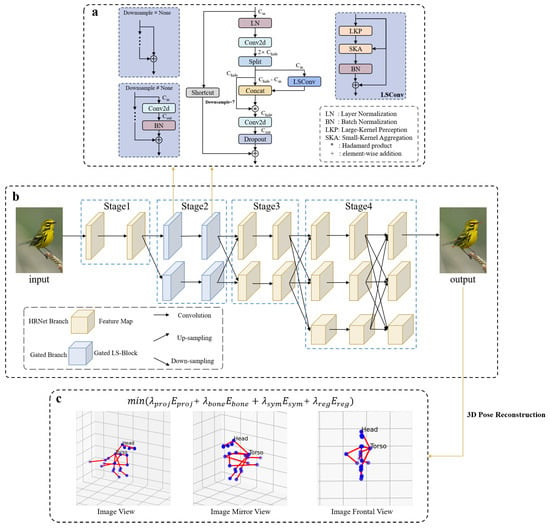
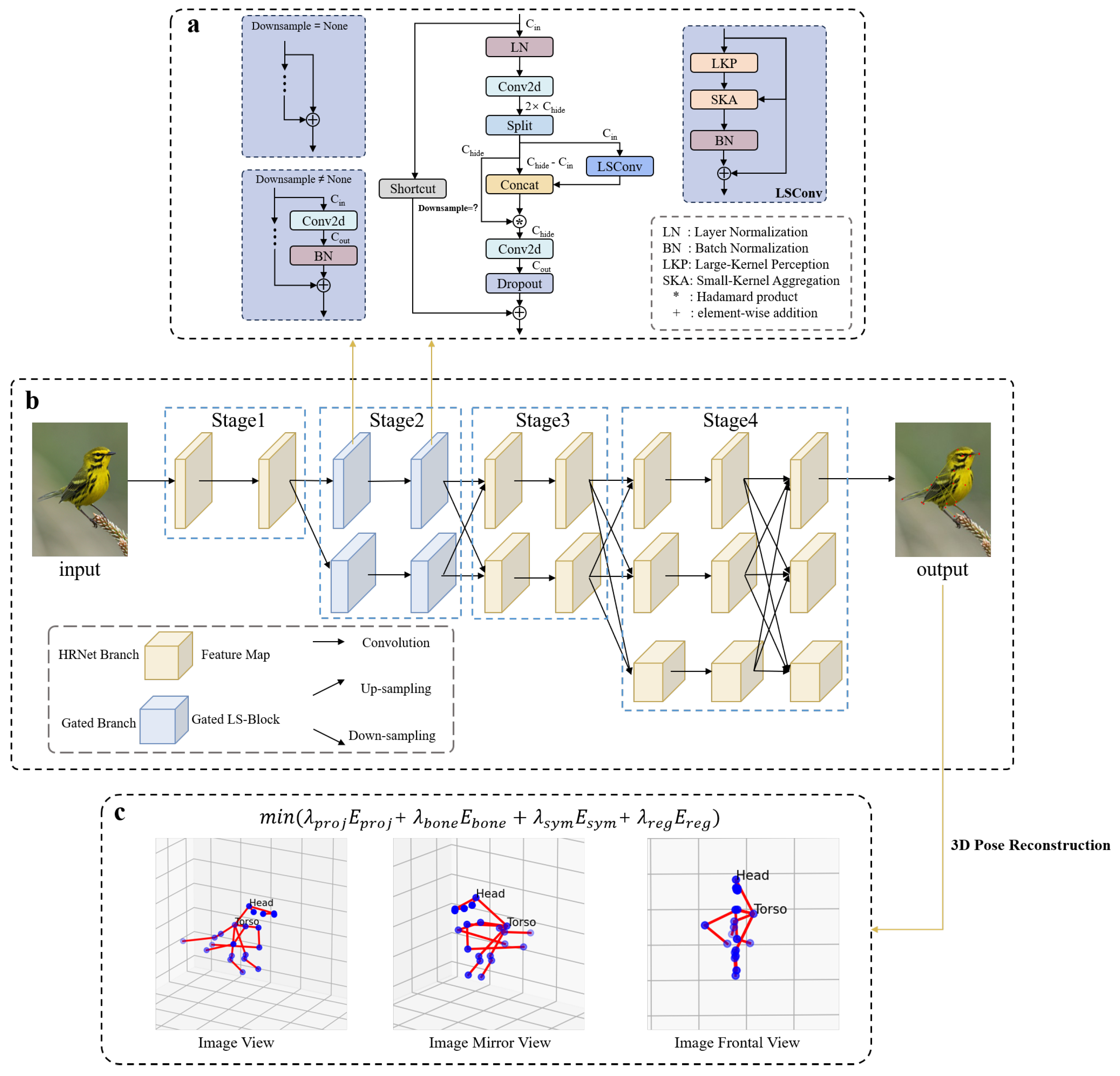
As illustrated in Figure 1, we propose a robust framework for monocular 3D pose reconstruction. This framework is designed to effectively capture multi-scale features and long-range spatial features, and perform 3D reconstruction based on the constraints of geometric consistency and bilateral symmetry. The overall pipeline consists of three core components: (a) the Gated LS-Block for capturing global long-range spatial features, (b) an Enhanced HRNet that incorporates long-range spatial features while preserving its high-resolution architecture, and (c) a 3D pose reconstruction module optimized by a geometric composite loss function. Each component is elaborated in detail in the subsequent sections.
Figure 1.
Overall architecture of our work: (a) Schematic diagram of the proposed Gated LS-Block, which integrates dynamic LSConv and residual gating mechanisms. (b) Illustration of embedding the Gated LS-Block into the deep semantic extraction stage of HRNet for multi-scale feature interaction and fusion. (c) Visualization of the weak-prior 3D pose reconstruction algorithm with multi-view constraint losses.
3.1. Gated LS-Block
To effectively capture long-range dependencies while modulating feature activation, we propose the Gated LS-Block. Resonating with the recent findings in MambaOut [18], which highlight the supremacy of Gated CNN architectures over complex State Space Models in visual recognition, our design leverages the potential of the channel-mixing and spatial-mixing decoupling paradigm. Inspired by the success of GLU in natural language processing and Gated [40], this module integrates a channel-wise gating mechanism with our Large-Kernel Perception module (LSConv) [19]. However, distinct from standard Gated CNNs that process full channel features, we identify that applying spatial operators to all expanded channels introduces computational redundancy. To mitigate this, we incorporate a partial channel strategy.
Formally, let denote the input feature map. The block adopts a pre-normalization design, where the input is first processed by a Layer Normalization (LN) module. To facilitate inter-channel interaction, we employ a convolution () to project the normalized features into a higher-dimensional space with an expansion ratio . The projected feature map is split into two primary components along the channel dimension: a gating branch G and a content branch.
To balance receptive field size and computational cost, we adopt a partial channel strategy [41,42]. Specifically, the content branch is further divided into an identity part I and a convolution part C. Only the partition C is processed by the LSConv module, which utilizes decomposed large kernels to extract spatial features. This design significantly reduces redundancy by avoiding heavy convolutions on the entire feature map. The process can be formulated as
where , , , and (in this paper, we set ). The core idea is to decouple feature selection from spatial aggregation. Intuitively, the partition C is tasked with capturing global geometric structures (e.g., the long-range relationship between a bird’s extended wingtip and its torso), while the identity branch I acts as a computational shortcut that preserves fine-grained local textures without undergoing expensive convolutions.
The gating mechanism modulates the aggregated features via the Hadamard product:
where denotes the GELU activation function, ⊙ represents element-wise multiplication, and denotes channel concatenation. The term acts as a semantic gate, controlling the flow of information from both the raw context and the spatially refined features . From a visual perspective, this gating mechanism functions as a dynamic attention mask: it actively suppresses irrelevant background clutter commonly found in wild environments (such as branches, water, or sky) and dynamically amplifies the feature activations of the bird’s anatomical keypoints.
For the LSConv module, we adopt the decomposed large-kernel design proposed in LSNet [19], which uses a 7 × 7 depth-wise convolution combined with a 1 × 7 and 7 × 1 dilated convolution to simulate a 13 × 13 large-kernel convolution. This design can effectively expand the receptive field while significantly reducing the computational complexity compared with standard large-kernel convolutions. The 13 × 13 equivalent receptive field can fully cover the entire body of the bird in the Stage 2 feature map (1/4 input size), which ensures that the model can effectively capture the long-range dependencies between distant keypoints such as wingtips and torso.
Finally, a second linear projection restores the channel dimension to C, and a residual connection is applied to facilitate gradient flow:
Specifically, when the model does not require downsampling, we have ; when the model performs downsampling, a convolution layer is used to adjust the channel dimension, resulting in , where BN means Batch Normalization and reconstructs the channel dimension.
By restricting the computationally intensive LSConv to a subset of channels, the Gated LS-Block achieves a favorable trade-off between performance and efficiency. The gating mechanism introduces non-linearity and data-dependent feature selection, enabling the network to focus on pose-relevant regions while filtering out background clutter.
3.2. Enhanced HRNet Architecture with Gated Perception
Standard CNNs often struggle to capture long-range dependencies due to the limited effective receptive field of local convolutions. To mitigate this limitation and better accommodate the complex, non-rigid deformations characteristic of bird poses, we propose an Enhanced HRNet architecture. Instead of relying solely on the original residual blocks, we strategically integrate the Gated LS-Block into the backbone. Specifically, we replace the conventional BasicBlocks in Stage 2 of the HRNet with our proposed Gated LS-Blocks. Theoretically, the integration of the Gated LS-Block specifically into Stage 2 is motivated by three architectural principles. First, it optimizes the receptive field proportion. In Stage 2, the feature map maintains a resolution (e.g., ). The equivalent receptive field of our LSConv geometrically aligns with the typical anatomical span of a bird within the cropped bounding box. If applied to deeper stages (e.g., resolution), the kernel would exceed the effective spatial dimensions, suffering from severe padding artifacts and degenerating into generic global pooling. Second, Stage 2 marks the genesis of multi-scale information flow. It is the exact point where parallel multi-resolution branches first exchange information. Injecting long-range dependencies here ensures that globally-aware, contextually enriched features are propagated to all subsequent downstream branches. Finally, the design preserves resolution-sensitive gating. Our spatial gate is designed to filter high-frequency background clutter (e.g., leaves, branches). This filtering requires the fine-grained spatial details preserved in Stage 2, which are otherwise irreversibly blurred in the heavily compressed feature maps of Stages 3 and 4.
This design leverages the partial channel strategy inherent in the Gated LS-Block. By applying large-kernel operations to only a subset of channels while keeping the rest as identity mappings, we effectively reduce computational redundancy. This channel-wise separate processing paradigm enables the Enhanced HRNet to retain the high-resolution spatial precision essential for localization tasks while significantly bolstering its capacity to model global geometric structures and large-scale pose variations without incurring excessive computational costs.
3.3. Optimization-Based 3D Reconstruction
Given 2D keypoints estimated by the backbone network, our objective is to lift these 2D detections into a 3D pose . As monocular 3D reconstruction is inherently ill-posed, we adopt a geometric optimization framework that integrates physiological priors to ensure pose plausibility. Compared with traditional optimization-based improvement methods, in human or common quadruped pose estimation, optimization frameworks typically rely on strong statistical parametric models (such as SMPL or SMAL) trained on massive 3D motion capture datasets. However, the domain of wild birds entirely lacks such 3D parametric models. Furthermore, modeling birds is exceptionally challenging due to their extreme non-rigid deformations and the massive inter-species variance (e.g., 850 distinct species in the Animal Kingdom dataset). Therefore, our primary contribution in this module lies in formulating a generalized, species-agnostic framework. Instead of relying on data-driven 3D statistical models, we design an energy function exclusively grounded in weak yet universally applicable biological priors. By carefully balancing these handcrafted constraints, our method successfully regularizes the highly ill-posed 3D search space across diverse unseen species without requiring any paired 3D supervision.
We define a kinematic tree , where denotes the set of 23 keypoints and represents the set of bone edges. We fix the torso length (defined as the distance from Torso_Mid_Back to Tail_Top_Back) as the reference unit length . For each edge , we define a target ratio relative to , which encodes species-specific morphological priors. The bone length ratio prior is calculated based on the statistical average of the 3D bird skeletal data [37,43]. This ratio prior serves as a soft constraint to avoid implausible bone stretching. We leverage the strong left–right symmetry inherent in avian skeletons. To exploit this property, we define a set of symmetric keypoint pairs , where and denote corresponding left and right keypoints, respectively. For each pair, we enforce that their Euclidean distances to the root node (defined herein as Torso_Mid_Back) are equal:
We model the reconstruction as an energy minimization problem. The objective function is composed of four terms:
Each of the four terms is detailed separately in the following.
- 1.
- Reprojection Consistency: This term ensures that the orthographic projection of the reconstructed 3D points matches the detected 2D inputs:where drops the Z-axis and j represents different keypoints.
- 2.
- Bone Length Constraint: This term ensures that the length of each reconstructed 3D bone segment aligns with the target length derived from the avian morphological prior, effectively preventing implausible stretching or deformation of the skeleton:
- 3.
- Symmetry Constraint: This term enforces the inherent left–right symmetry of the bird skeleton by ensuring that each pair of corresponding left and right 3D keypoints has an identical Euclidean distance to the root node, effectively eliminating unreasonable asymmetric pose artifacts:
- 4.
- Depth Regularization: This term ensures that the depth coordinates of all reconstructed 3D keypoints are constrained near the zero depth plane, effectively resolving the inherent depth ambiguity of monocular reconstruction and preventing uncontrolled divergence or explosion of the bird skeleton along the Z-axis:
The total energy is minimized using the Levenberg–Marquardt algorithm. We initialize the depth z values to zero, with slight offsets applied to the wingtips to avoid local minima during the gradient descent process. The final effect is shown in Figure 1c. In this work, the weights are empirically set as , , , and .
3.4. Experimental Setup
3.4.1. Dataset
We adopt the bird pose subset from the Animal Kingdom dataset, a large-scale benchmark proposed by Ng et al. at CVPR 2022 and constructed by ISTD of Singapore University of Technology and Design [23]. As a core part of the dataset’s 33k pose estimation frames, this subset selects diverse bird species from 850 total species, with samples collected from wild environments to simulate real-world scenarios. Following the MPII annotation standard, each bird image is annotated with 23 anatomical keypoints. The subset provides JSON annotation files, supports mainstream frameworks, and is publicly available, ensuring the rigor and reproducibility of experiments.
3.4.2. Experimental Design
All experiments are conducted under the MMPose framework [44], an open-source universal toolbox for pose estimation affiliated with the OpenMMLab ecosystem and built upon PyTorch. It supports multiple keypoint detection tasks such as 2D/3D human pose estimation and animal pose estimation, is compatible with mainstream datasets including COCO and Animal-Pose, and reproduces various state-of-the-art (SOTA) algorithms in the field of pose estimation, effectively facilitating the development, tuning, and validation processes of models.
To clarify that the proposed module is sensitive to large feature maps, we integrate our module into different stages of HRNet to demonstrate that when the feature map size is too small, the large-map perception and small-map aggregation in the designed Gated LS-Block degenerate into an ordinary convolution. Additionally, we investigate the impact of different input sizes (256 × 256 and 328 × 328). The proposed design is compared with various classical and efficient pose modules, including ResNet-50 [45], ResNet-101 [45], HRNet-W32 [14], HRNet-W48 [14], Hourglass [46] and CSPNeXt [47].
All experiments are performed on a server equipped with a 24 GB RTX 4090 GPU and a 16-vCPU Intel(R) Xeon(R) Platinum 8352V CPU @ 2.10GHz. The software environment includes CUDA 11.8, PyTorch 2.0.0, Python 3.8, MMCV 2.0.0, and MMDetection 3.0.0. For fair comparison among all methods, pre-training and self-distillation strategies are excluded from all evaluated models [48,49]. All models adopt the same learning rate of 0.0005, Adam optimizer, and batch size of 32, and are trained for 300 epochs, with the best-performing model selected for final results. The mean Percentage of Correct Keypoints (PCK) [50] is adopted as the evaluation metric for method comparison, where the mean PCK@ is defined as the percentage of keypoints whose normalized Euclidean distance to the ground-truth keypoint is less than . In practice, = 0.05 is taken. The PCK of the HRNet-W32 model obtained by our training is 0.766, which is close to the officially reported 0.7671, indicating that our reproduction is relatively successful.
4. Results and Discussions
4.1. Parallel Experiment
To provide a comprehensive evaluation of our proposed architecture, we benchmark Gated LS-Block against three categories of representative pose estimation frameworks. Reported performance of our method and the primary baseline (HRNet-W32) is averaged over five independent runs with different random seeds, which ensures the reliability of our results and mitigates the impact of training randomness.
- 1.
- Classic Methods (SimpleBaseline [45]): We select SimpleBaseline equipped with ResNet-50 and ResNet-101 backbones as representative classic approaches. These models follow a top-down paradigm, utilizing a deep residual encoder to extract semantic contexts through aggressive downsampling, followed by a series of deconvolutional layers to recover the spatial resolution for heatmap regression.
- 2.
- Efficient Methods: To benchmark architectural efficiency, we include Stacked Hourglass [46] and CSPNeXt [47]. The Hourglass network features a repeated bottom-up and top-down architecture designed to capture multi-scale information through intermediate supervision. Conversely, CSPNeXt represents the SOTA in lightweight design, optimizing depth-wise convolutions for real-time inference speed.
- 3.
- Transformer and Hybrid Models: To compare our method with prevailing global context modeling paradigms, we include ViTPose [26] and HRFormer [27]. ViTPose employs a pure Vision Transformer structure, designed to model long-range spatial dependencies for pose estimation tasks. Conversely, HRFormer represents the SOTA in lightweight hybrid CNN–Transformer design, combining CNN local feature learning and transformer global attention for efficient inference.
- 4.
- High-Resolution Architectures (HRNet [14]): As our primary baseline, we compare against the HRNet family (W32 and W48). Unlike serial downsampling networks, HRNet maintains high-resolution representations throughout the entire process by connecting multi-resolution sub-networks in parallel, setting the current standard for precise keypoint localization.
The quantitative results regarding Params, GFLOPs, and estimation accuracy (PCK@0.05) are summarized in Table 1. Our Gated-HRNet achieves a SOTA PCK@0.05 score of 0.775, demonstrating comprehensive superiority over competing methods in both accuracy and efficiency. Specifically, our method outperforms the classic SimpleBaseline-Res50 and Res101 by significant margins of 1.7% and 3.1%, respectively. This advantage stems from our architecture’s ability to preserve high-resolution spatial details, avoiding the irreversible information loss caused by the 32× downsampling in ResNet encoders. Interestingly, the deeper ResNet-101 exhibits performance degradation compared to ResNet-50, suggesting that, without structural regularization, increasing depth leads to overfitting on the animal pose dataset.
Table 1.
Comparison of different methods for pose estimation.
Crucially, compared to the direct baseline HRNet-W32 and its wider variant HRNet-W48, which both plateau at a PCK of 0.766, our method breaks this performance bottleneck with an improvement of 0.9%. This phenomenon indicates that simply scaling network width (as in W48) yields diminishing returns, as it fails to address the limited effective receptive field of standard convolutions. In contrast, our Gated LS-Block explicitly captures long-range dependencies and filters background noise, proving that enhancing feature quality via gating is more effective than mere parameter scaling.
Furthermore, our method achieves this accuracy with remarkable efficiency. While the lightweight CSPNeXt offers low computational cost, it sacrifices significant accuracy (trailing ours by 3.0%). Our Gated-HRNet strikes an optimal balance, requiring only 9.91 GFLOPs, which is 3.3% lower than HRNet-W32 and nearly 3× more efficient than the Hourglass network. For transformer and hybrid CNN–Transformer architectures, our method also exhibits clear superiority. The pure transformer-based ViTPose-B, with 89.994 M parameters and 17.864 G GFLOPs, only achieves a PCK@0.05 of 0.751 (2.4% lower than ours), limited by its lack of CNN-like local inductive bias for learning robust anatomical features on medium-scale datasets. The lightweight hybrid HRFormer-S, despite its compact 7.747 M parameters, only reaches a PCK@0.05 of 0.758 (1.7% lower than ours), failing to balance lightweight inference and robust global-local feature fusion for highly articulated bird poses.
This validates that the partial channel strategy effectively reduces computational redundancy without compromising the model’s representation capability. To rigorously support these theoretical efficiency claims with practical deployment metrics, we further measured the physical inference runtime on a single RTX 4090 GPU. Under identical conditions (batch size of 1, input size of ), the actual deployment performances are compared in Table 2.
Table 2.
Comparison of physical inference efficiency.
As Table 2 explicitly shows, our Gated-HRNet significantly outperforms the standard HRNet-W32 baseline in physical deployment. The ∼24% improvement in actual inference speed (FPS) alongside a lower latency confirms that our architectural design successfully avoids memory-bound bottlenecks, translating theoretical GFLOPs reductions into tangible real-world acceleration.
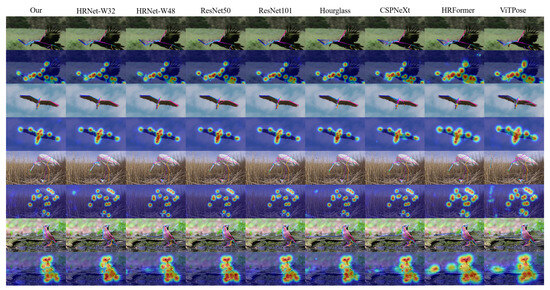
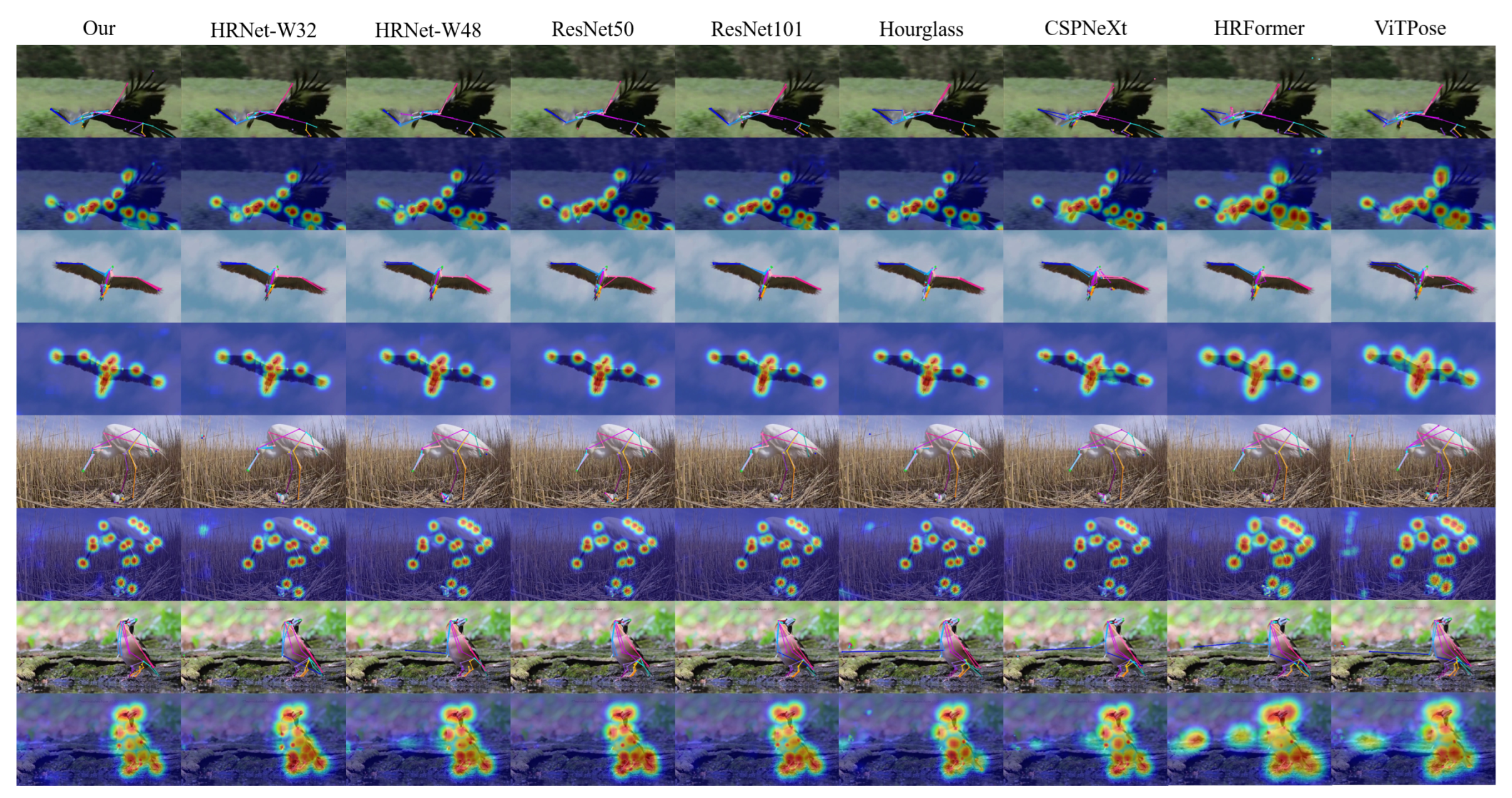
To further intuitively verify the superiority of our model in discriminative feature extraction and precise keypoint localization, the heatmap visualization results for bird keypoint detection are displayed in Figure 2. As observed from the visualization, our method generates heatmaps with spatially compact activations that are precisely anchored to the critical anatomical regions of birds (e.g., wing joints, leg bones, necks, and body trunks). In contrast, the lightweight CSPNeXt suffers from severe response diffusion and spurious activations in background regions, leading to ambiguous keypoint positioning. Traditional baselines including ResNet-50, ResNet-101 and Hourglass produce either blurry heatmap responses or over-dispersed activations that spread to irrelevant background areas, failing to capture fine-grained keypoint details. Although HRNet-W32 and HRNet-W48 achieve relatively concentrated responses, their localization accuracy for subtle keypoints (e.g., the distal joints of bird wings) is still inferior to our method. Furthermore, the transformer-based mainstream pose models HRFormer and ViTPose also exhibit non-negligible defects in bird pose keypoint localization. Despite their inherent strong global context modeling capability, HRFormer presents noticeable activation dispersion and partial spurious responses in background regions, with far less compact keypoint activation regions compared with our method. ViTPose suffers from more severe response diffusion and massive false activations in irrelevant background areas, and its activation for fine-grained distal keypoints (e.g., wingtips and toe joints) is blurred and shifted, failing to achieve accurate and stable keypoint positioning. This visual evidence strongly corroborates that our Gated-HRNet effectively suppresses background noise while enhancing the representation of target keypoints.
Figure 2.
Visualization of bird pose estimation results. Upper panel: Detected keypoints (colored dots) and skeletal connections (colored lines) of the bird, with different colors corresponding to different body parts. Lower panel: Keypoint heatmaps, where the pseudo-color gradient from blue to red represents the increase of keypoint detection confidence.
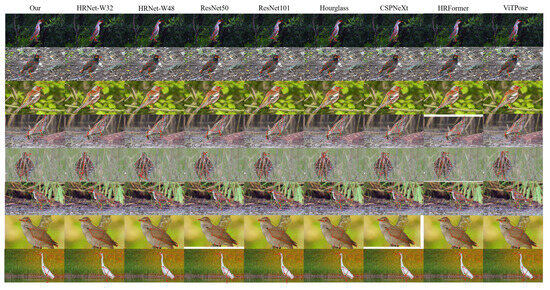
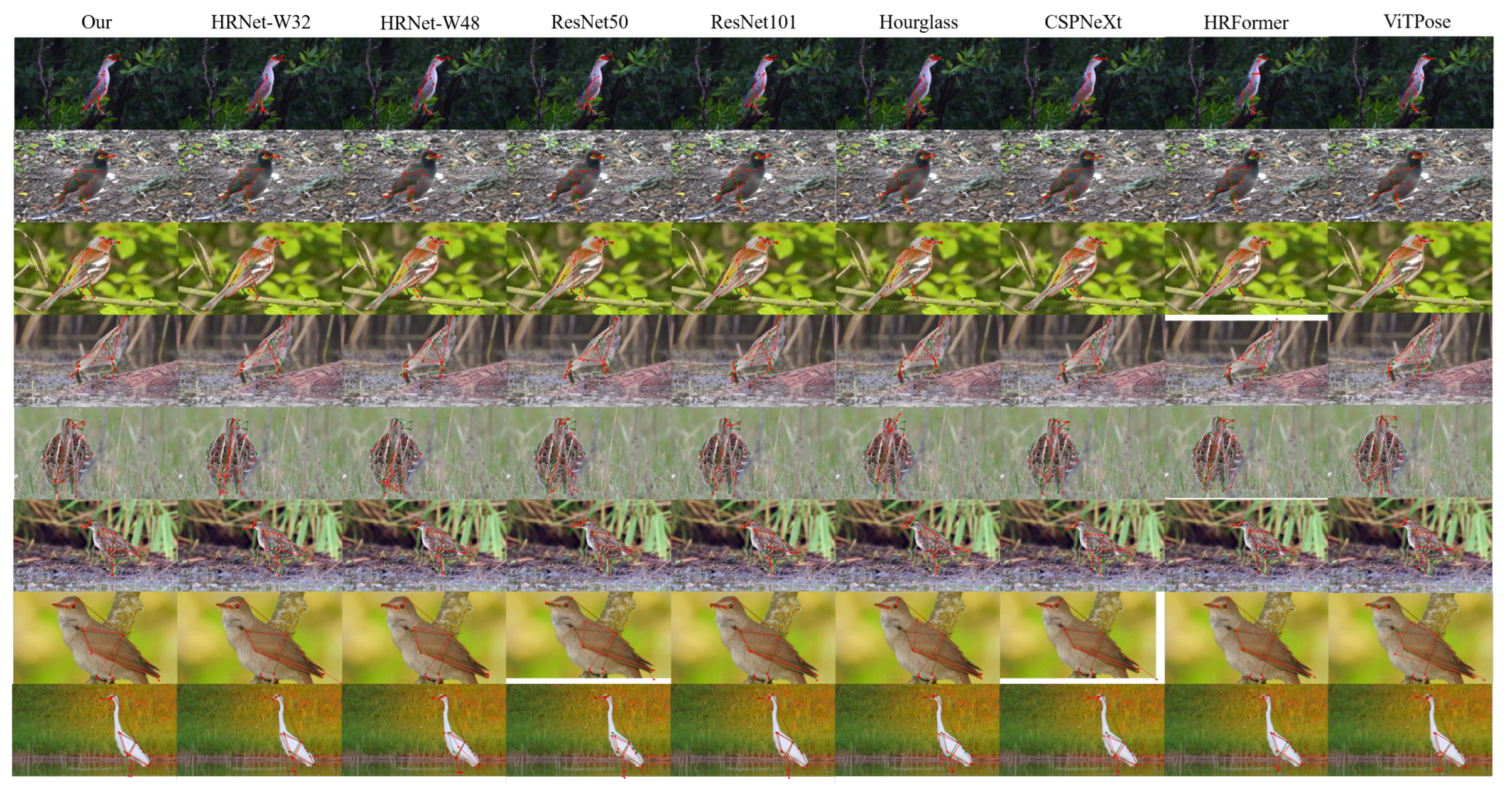
Figure 3 illustrates the visualized predicted keypoints and corresponding bird skeletons. These images are randomly sampled from the testing dataset. The predicted keypoints and skeletons are depicted in red, whereas the ground truth is represented by the green color. We select a series of test samples covering common challenges in real-world scenarios to comprehensively evaluate the generalization ability of different models. Benefiting from the effective learning of long-range dependencies between keypoints, our method exhibits superior accuracy in predicting occluded keypoints.
Figure 3.
Visualization of bird keypoint detection results by different models. Predicted keypoints and skeletal connections are shown in red, while the ground truth is shown in green.
4.2. Ablation Experiments
To determine the optimal integration strategy for the Gated LS-Block, we investigate its behavior when embedded into different stages (Stage 2, 3, and 4) of the HRNet-W32 backbone. The quantitative results are detailed in Table 3.
Table 3.
Ablation study on the insert stage of the Gated LS-Block and the impact of input size.
Our empirical results demonstrate that integrating the Gated LS-Block at Stage 2 yields superior performance, achieving a PCK@0.05 of 0.775 (at ), which outperforms the baseline HRNet by 0.9%. This improvement can be attributed to the specific characteristics of early-stage features. In Stage 2, the feature maps maintain a relatively high resolution, containing rich local textures but lacking global context due to the limited receptive field of standard convolutions. The Gated LS-Block effectively addresses this by introducing large-kernel perception to capture long-range dependencies early on, while the gating mechanism filters background noise from the detailed spatial information. Conversely, inserting the module at deeper stages (Stage 3 and Stage 4) leads to performance degradation (0.765 and 0.761, respectively). We attribute this to two factors: In deeper stages, the feature map resolution is significantly reduced ( or ). Standard convolutions at these depths already possess a receptive field sufficient to cover the relevant semantic regions. Consequently, the additional large-kernel operations provide diminishing returns and may introduce redundancy; the proposed gating mechanism is designed to modulate spatial details. At deep layers where features are highly abstract and spatially compressed, the effectiveness of spatial gating is diminished, leading to suboptimal representation learning compared to the original residual blocks.
We further evaluate the robustness of our design by increasing the input resolution to . As shown in Table 3, the performance of the Stage 2 model further improves to 0.779. This positive correlation confirms that our Gated LS-Block is resolution-sensitive and thrives on richer spatial information. The larger input size provides finer-grained details, allowing the LSConv and gating branch to function more effectively, thereby validating our design rationale of prioritizing high-resolution processing for fine-grained bird pose estimation.
Finally, to further validate the internal design choices of the Gated LS-Block, we conducted detailed ablation studies on the gating mechanism and the channel split ratio (). Note that the equivalent kernel size was adopted directly based on the optimal efficiency–performance balance established in the original LSNet [19] literature. The empirical results regarding gating and split ratios are summarized in Table 4.
Table 4.
Ablation study on the gating mechanism and channel split ratio () in the Gated LS-Block, where ✓ indicates the gating mechanism is enabled and × indicates it is disabled.
As shown in Table 4, removing the gating mechanism results in a noticeable performance drop to 0.768, verifying that dynamic spatial gating is essential for suppressing background clutter in wild environments. Furthermore, varying the channel split ratio reveals that achieves the optimal performance. Increasing the ratio to 1.5 or 2.0 leads to a performance degradation (0.743). This is likely because excessive channel expansion prior to the spatial operations dilutes the core semantic features and introduces redundant parameters, thereby increasing the risk of overfitting on the limited dataset.
4.3. Quantitative and Qualitative 3D Reconstruction
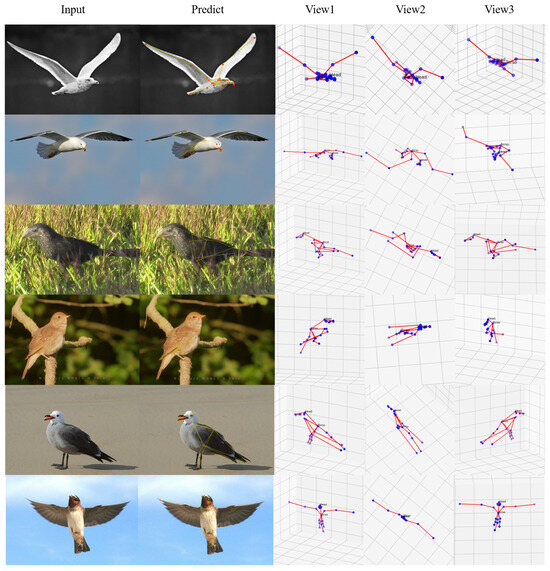
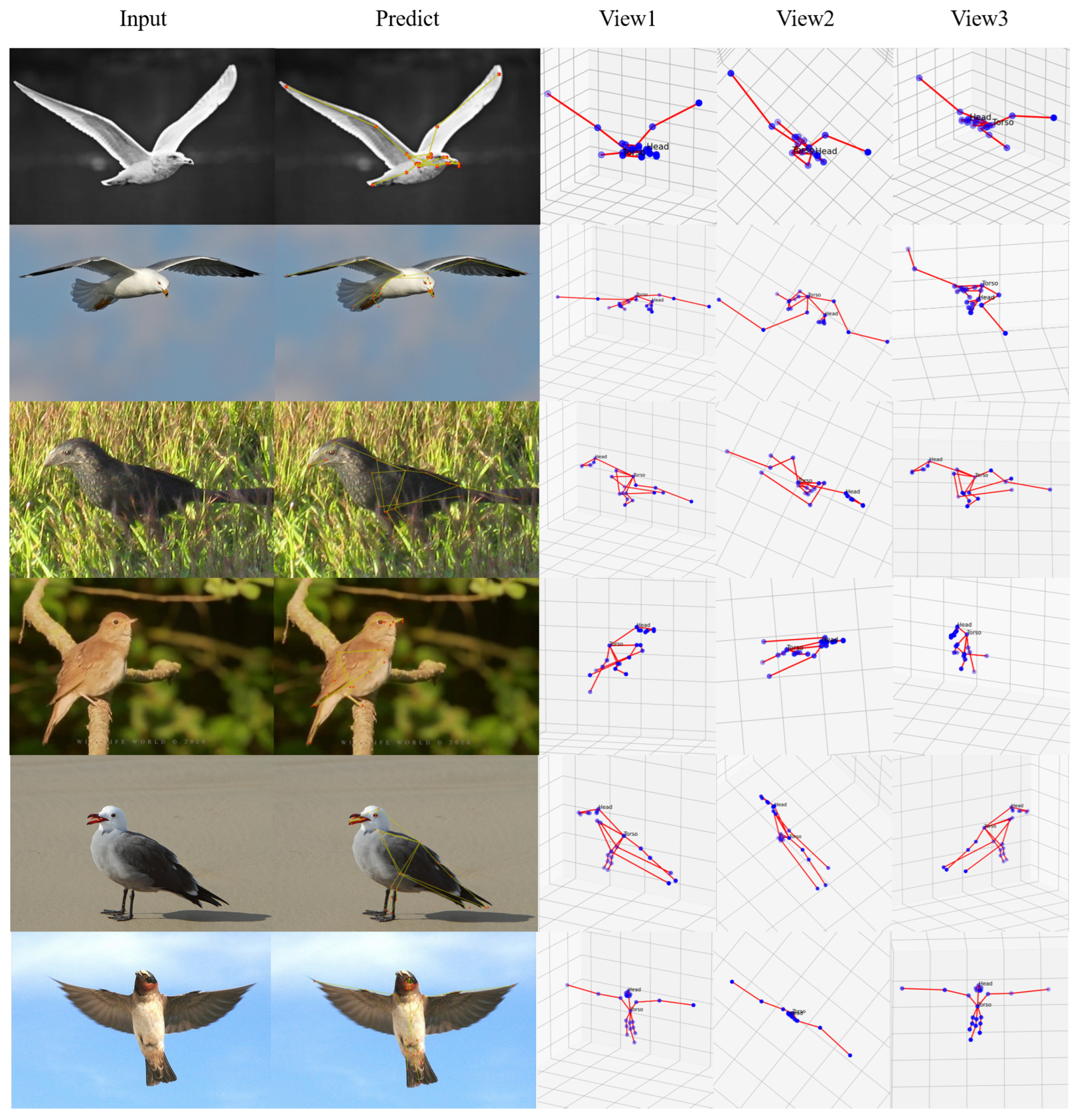
Given the complete absence of ground truth 3D annotations in the Animal Kingdom dataset [23], employing conventional fully supervised learning methods is fundamentally impractical for this task. To overcome this limitation, we establish a training-free and optimization-based framework designed to resolve the inherent ambiguity of monocular 3D lifting without requiring data-driven supervision. In this mathematical formulation, the precise 2D observations provided by our backbone serve as robust anchors that strictly constrain the spatial alignment of the projected skeleton. Simultaneously, we leverage weak prior information intrinsic to biological structures, such as bilateral symmetry and kinematic bone length consistency, which effectively regularize the ill-posed depth estimation process. As visualized in Figure 4, this synergetic approach ensures that the solver generates physiologically plausible poses solely through geometric optimization, successfully recovering complex anatomical details including correct wing folding angles and coherent limb placement. These results demonstrate the capacity of our method to recover spatially consistent 3D skeletons from monocular images and highlight the significant potential of our framework for downstream 3D applications in scenarios where 3D training data is scarce. Notably, partial samples visualized in Figure 4 are sourced from the CUB-200-2011 dataset [51], which are adopted to further validate the cross-dataset generalization performance of our proposed framework.
Figure 4.
3D reconstruction effect based on geometric constraints, where the red dots indicate the predicted keypoints and the yellow lines indicate the corresponding skeletal connections.
To rigorously assess the actual effectiveness of our optimization-based 3D lifting component in the absence of 3D ground truth annotations, we introduce three proxy metrics for quantitative evaluation: (1) 2D reprojection error (N-MPJPE), which calculates the normalized mean per joint position error between the projected 3D joints and the 2D predictions to evaluate fidelity; (2) mean 3D symmetry error, which measures the geometric distance differences between corresponding left–right joint pairs to evaluate biological plausibility; and (3) overall bone length CV (Coefficient of Variation), which calculates the relative standard deviation of core rigid bone lengths across diverse poses to verify cross-pose consistency. To provide stronger comparative evidence, we evaluated the 3D reconstruction performance using 2D keypoints generated by different baseline backbones, including ResNet-50 [45], standard HRNet-W32 [14], and our proposed Gated-HRNet. The quantitative results are summarized in Table 5.
Table 5.
Quantitative evaluation of unsupervised 3D reconstruction using proxy metrics on the Animal Kingdom dataset.
As shown in Table 5, our unsupervised 3D lifting module successfully maintains low symmetry errors and robust bone length consistency across complex avian poses. Furthermore, the comparative analysis validates that the enhanced 2D spatial features and precise keypoint localizations extracted by our Gated-HRNet backbone significantly improve the downstream 3D reconstruction quality, outperforming both ResNet-50 and HRNet-W32 across all proxy metrics.
5. Conclusions
In this paper, we propose an efficient monocular 3D bird pose estimation framework to address two core bottlenecks in existing avian pose research: the difficulty of modeling extreme non-rigid deformations and severe self-occlusion, and the scarcity of 3D ground truth annotations. Our core contributions are threefold: first, we design a Gated LS-Block, which integrates large-kernel convolution with a partial channel gating strategy, and construct an Enhanced HRNet backbone by embedding this block into its Stage 2, which preserves the high-resolution feature advantage of the original architecture while enhancing multi-scale feature learning and global long-range dependency modeling. This design enables the network to capture the global long-range dependencies essential for correlating spatially distant keypoints. The gating mechanism of the block achieves a synergy between global context perception and local detail retention, which significantly enhances the model’s robustness to severe self-occlusion, and achieves a superior balance between representation capability and computational efficiency compared with mainstream transformer-based and hybrid global modeling methods. Complementing this architectural innovation, we develop an optimization-based unsupervised 3D reconstruction algorithm driven by universal weak biological priors of birds. By explicitly enforcing geometric constraints including bone length consistency and bilateral skeletal symmetry, our method recovers physically plausible 3D bird skeletons from monocular images without any paired 3D supervision, effectively avoiding anatomically invalid reconstruction artifacts such as unrealistic wing folding angles.
Ablation experiments verify the optimal design of the block and its embedding strategy, and quantitative comparison results show that our approach achieves a 0.9% improvement in PCK@0.05 over the HRNet-W32 baseline, while reducing computational overhead by 3.3% GFLOPs on the Animal Kingdom dataset. This favorable balance between feature representation capability and inference efficiency validates the practical potential of our framework for real-world ecological monitoring applications, providing a quantitative and non-invasive technical tool for avian behavior analysis, ecosystem health assessment and other ecological conservation research.
For future work, we have two main research directions: First, we aim to extend this paradigm by incorporating temporal consistency constraints from video sequences to further improve the robustness of 3D bird pose reconstruction in unconstrained dynamic wild environments. Second, we will introduce the maximum bone folding angle prior of avian skeletons into the 3D reconstruction optimization framework. This anatomical prior can further constrain the rationality of joint motion range, eliminate the artifacts of over-folded wings and limbs in reconstruction results, and improve the physiological plausibility of 3D bird skeletons in extreme motion poses.
Author Contributions
Methodology, J.P. and D.L.; software, J.P. and R.L.; resources, Y.C. and G.L.; formal analysis, Y.M.; investigation, Y.C.; writing—original draft, J.P. and R.L.; writing—review and editing, J.P., R.L., Y.M., Y.C., D.L. and G.L.; supervision, J.P., R.L., Y.M. and D.L.; project administration, J.P. and Y.C. All authors have read and agreed to the published version of the manuscript.
Funding
This research received no external funding.
Data Availability Statement
Restrictions apply to the availability of these data. Data was obtained from SUTD Computer Vision and Learning Group and are available at https://github.com/sutdcv/Animal-Kingdom (accessed on 9 April 2026) with the permission of SUTD Computer Vision and Learning Group. The Caltech-UCSD Birds-200-2011 (CUB-2011) dataset used in this study is publicly available at https://www.vision.caltech.edu/datasets/cub_200_2011/ (accessed on 9 April 2026).
Conflicts of Interest
The authors declare no conflicts of interest.
References
- Perez, M.; Toler-Franklin, C. CNN-based action recognition and pose estimation for classifying animal behavior from videos: A survey. arXiv 2023, arXiv:2301.06187. [Google Scholar] [CrossRef] [Scilit]
- Fang, C.; Zhang, T.; Zheng, H.; Huang, J.; Cuan, K. Pose estimation and behavior classification of broiler chickens based on deep neural networks. Comput. Electron. Agric. 2021, 180, 105863. [Google Scholar] [CrossRef] [Scilit]
- Jiang, L.; Lee, C.; Teotia, D.; Ostadabbas, S. Animal pose estimation: A closer look at the state-of-the-art, existing gaps and opportunities. Comput. Vis. Image Underst. 2022, 222, 103483. [Google Scholar] [CrossRef] [Scilit]
- Gregory, R.D.; Van Strien, A.; Vorisek, P.; Gmelig Meyling, A.W.; Noble, D.G.; Foppen, R.P.; Gibbons, D.W. Developing indicators for European birds. Philos. Trans. R. Soc. B 2005, 360, 269–288. [Google Scholar] [CrossRef] [Scilit] [PubMed]
- Díaz, M.; Grim, T.; Markó, G.; Morelli, F.; Ibáñez-Álamo, J.D.; Jokimäki, J.; Kaisanlahti-Jokimäki, M.L.; Tätte, K.; Tryjanowski, P.; Møller, A.P. Effects of climate variation on bird escape distances modulate community responses to global change. Sci. Rep. 2021, 11, 10012. [Google Scholar] [CrossRef] [Scilit]
- Green, A.J.; Elmberg, J. Ecosystem services provided by waterbirds. Biol. Rev. 2014, 89, 105–122. [Google Scholar] [CrossRef] [Scilit]
- Crick, H.Q.P. The impact of climate change on birds. IBIS 2004, 146, 48–56. [Google Scholar] [CrossRef] [Scilit]
- Feng, J.; Zhang, R.; Wang, Y.; Gao, S.; Guo, L. PoseDucer: Implicit relation inducement for invisible keypoint reconstruction in real-world occluded scenes. Neurocomputing 2025, 640, 130328. [Google Scholar] [CrossRef] [Scilit]
- Yao, W.; Zhang, H.; Sun, Y.; Tang, J. STAF: 3D human mesh recovery from video with spatio-temporal alignment fusion. arXiv 2024, arXiv:2401.01730. [Google Scholar] [CrossRef] [Scilit]
- Xiao, S.; Wang, Y.; Perkes, A.; Pfrommer, B.; Schmidt, M.; Daniilidis, K.; Badger, M. Multi-view tracking, re-ID, and social network analysis of a flock of visually similar birds in an outdoor aviary. Int. J. Comput. Vis. 2023, 131, 1532–1549. [Google Scholar] [CrossRef] [Scilit]
- Demuth, O.E.; Hutchinson, J.R.; La Barbera, V.; Warner, S.E.; Field, D.J. Soft tissue constraints on joint mobility in the avian shoulder. J. Exp. Biol. 2025, 228, jeb250952. [Google Scholar] [CrossRef] [Scilit]
- Baier, D.B.; Gatesy, S.M.; Dial, K.P. Three-dimensional, high-resolution skeletal kinematics of the avian wing and shoulder during ascending flapping flight and uphill flap-running. PLoS ONE 2013, 8, e0063982. [Google Scholar] [CrossRef] [Scilit]
- Meyers, R.A. Comparative anatomy of the postural mechanisms of the forelimbs of birds and mammals. J. Ornithol. 2019, 160, 869–882. [Google Scholar] [CrossRef] [Scilit]
- Sun, K.; Xiao, B.; Liu, D.; Wang, J. Deep high-resolution representation learning for human pose estimation. In Proceedings of the 2019 IEEE/CVF Conference on Computer Vision and Pattern Recognition (CVPR), Long Beach, CA, USA, 15–20 June 2019; pp. 5686–5696. [Google Scholar] [CrossRef] [Scilit]
- Wang, Y.; Liu, P.; Kang, H.; Wu, D.; Miao, D. ICFNet: Interactive-complementary fusion network for monocular 3D human pose estimation. Neurocomputing 2025, 616, 128947. [Google Scholar] [CrossRef] [Scilit]
- He, R.; Wang, X.; Chen, H.; Liu, C. VHR-BirdPose: Vision transformer-based HRNet for bird pose estimation with attention mechanism. Electronics 2023, 12, 3643. [Google Scholar] [CrossRef] [Scilit]
- Gu, A.; Goel, K.; Ré, C. Efficiently modeling long sequences with structured state spaces. arXiv 2021, arXiv:2111.00396. [Google Scholar] [CrossRef] [Scilit]
- Yu, W.; Wang, X. MambaOut: Do we really need mamba for vision? In Proceedings of the 2025 IEEE/CVF Conference on Computer Vision and Pattern Recognition (CVPR), Nashville, TN, USA, 10–17 June 2025; pp. 4352–4362. [Google Scholar] [CrossRef] [Scilit]
- Wang, A.; Chen, H.; Lin, Z.; Han, J.; Ding, G. LSNet: See large, focus small. In Proceedings of the 2025 IEEE/CVF Conference on Computer Vision and Pattern Recognition (CVPR), Nashville, TN, USA, 10–17 June 2025; pp. 9718–9729. [Google Scholar] [CrossRef] [Scilit]
- Mathis, A.; Mamidanna, P.; Cury, K.M.; Abe, T.; Murthy, V.N.; Mathis, M.W.; Bethge, M. DeepLabCut: Markerless pose estimation of user-defined body parts with deep learning. Nat. Neurosci. 2018, 21, 1281–1289. [Google Scholar] [CrossRef] [Scilit]
- Pereira, T.D.; Tabris, N.; Matsliah, A.; Turner, D.M.; Li, J.; Ravindranath, S.; Papadoyannis, E.S.; Normand, E.; Deutsch, D.S.; Wang, Z.Y.; et al. SLEAP: A deep learning system for multi-animal pose tracking. Nat. Methods 2022, 19, 465–475. [Google Scholar] [CrossRef] [Scilit]
- Yu, H.; Xu, Y.; Zhang, J.; Zhao, W.; Guan, Z.; Tao, D. AP-10K: A benchmark for animal pose estimation in the wild. arXiv 2021, arXiv:2108.12617. [Google Scholar] [CrossRef] [Scilit]
- Ng, X.L.; Ong, K.E.; Zheng, Q.; Ni, Y.; Yeo, S.Y.; Liu, J. Animal Kingdom: A large and diverse dataset for animal behavior understanding. In Proceedings of the 2022 IEEE/CVF Conference on Computer Vision and Pattern Recognition (CVPR), New Orleans, LA, USA, 19–24 June 2022; pp. 19023–19034. [Google Scholar]
- Yu, C.; Xiao, B.; Gao, C.; Yuan, L.; Zhang, L.; Sang, N.; Wang, J. Lite-HRNet: A lightweight high-resolution network. In Proceedings of the 2021 IEEE/CVF Conference on Computer Vision and Pattern Recognition (CVPR), Nashville, TN, USA, 20–25 June 2021; pp. 10440–10450. [Google Scholar]
- Wu, H.; Liang, C.; Liu, M.; Wen, Z. Optimized HRNet for image semantic segmentation. Expert Syst. Appl. 2021, 174, 114532. [Google Scholar] [CrossRef] [Scilit]
- Xu, Y.; Zhang, J.; Zhang, Q.; Tao, D. ViTPose: Simple Vision Transformer Baselines for Human Pose Estimation. In Proceedings of the Advances in Neural Information Processing Systems, New Orleans, LA, USA, 28 November–9 December 2022. [Google Scholar]
- Yuan, Y.; Fu, R.; Huang, L.; Lin, W.; Zhang, C.; Chen, X.; Wang, J. HRFormer: High-Resolution Transformer for Dense Prediction. In Proceedings of the Advances in Neural Information Processing Systems, Online Conference, 6–14 December 2021. [Google Scholar]
- Dosovitskiy, A.; Beyer, L.; Kolesnikov, A.; Weissenborn, D.; Zhai, X.; Unterthiner, T.; Dehghani, M.; Minderer, M.; Heigold, G.; Gelly, S.; et al. An image is worth 16 × 16 words: Transformers for image recognition at scale. arXiv 2021, arXiv:2010.11929. [Google Scholar]
- Gu, A.; Dao, T. Mamba: Linear-time sequence modeling with selective state spaces. arXiv 2024, arXiv:2312.00752. [Google Scholar]
- Ding, X.; Zhang, X.; Han, J.; Ding, G. Scaling up your kernels to 31 × 31: Revisiting large kernel design in CNNs. In Proceedings of the 2022 IEEE/CVF Conference on Computer Vision and Pattern Recognition (CVPR), New Orleans, LA, USA, 19–24 June 2022; pp. 11953–11965. [Google Scholar] [CrossRef] [Scilit]
- Guo, M.H.; Lu, C.Z.; Liu, S.M. Visual attention network. Comput. Vis. Media 2023, 9, 733–752. [Google Scholar] [CrossRef] [Scilit]
- Ionescu, C.; Papava, D.; Olaru, V.; Sminchisescu, C. Human3.6M: Large scale datasets and predictive methods for 3D human sensing in natural environments. IEEE Trans. Pattern Anal. Mach. Intell. 2014, 36, 1325–1339. [Google Scholar] [CrossRef] [Scilit]
- Mehta, D.; Rhodin, H.; Casas, D.; Fua, P.; Sotnychenko, O.; Xu, W.; Theobalt, C. MPI-INF-3DHP: A large dataset of 3D human pose annotations from multiple viewpoints. In Proceedings of the 2017 IEEE Conference on Computer Vision and Pattern Recognition (CVPR), Honolulu, HI, USA, 21–26 July 2017; pp. 5162–5171. [Google Scholar]
- Martinez, J.; Hossain, R.; Romero, J.; Little, J.J. A simple yet effective baseline for 3D human pose estimation. In Proceedings of the 2017 IEEE International Conference on Computer Vision (ICCV), Venice, Italy, 22–29 October 2017; pp. 2640–2649. [Google Scholar] [CrossRef] [Scilit]
- Pavllo, D.; Feichtenhofer, C.; Grangier, D.; Auli, M. 3D human pose estimation in video with temporal convolutions and semi-supervised training. In Proceedings of the 2019 IEEE/CVF Conference on Computer Vision and Pattern Recognition (CVPR), Long Beach, CA, USA, 15–20 June 2019; pp. 7052–7061. [Google Scholar] [CrossRef] [Scilit]
- Hägerlind, J.; Hentati-Sundberg, J.; Wandt, B. Temporally-consistent 3D reconstruction of birds. arXiv 2024, arXiv:2408.13629. [Google Scholar] [CrossRef] [Scilit]
- Badger, M.; Wang, Y.; Modh, A.; Perkes, A.; Kolotouros, N.; Pfrommer, B.G.; Schmidt, M.F.; Daniilidis, K. 3D bird reconstruction: A dataset, model, and shape recovery from a single view. In Proceedings of the 16th European Conference on Computer Vision (ECCV 2020), Glasgow, UK, 23–28 August 2020; pp. 450–466. [Google Scholar]
- Waldmann, U.; Chan, A.H.H.; Naik, H.; Nagy, M.; Couzin, I.D.; Deussen, O.; Goldluecke, B.; Kano, F. 3D-MuPPET: 3D multi-pigeon pose estimation and tracking. Int. J. Comput. Vis. 2024, 132, 1499–1517. [Google Scholar] [CrossRef] [Scilit]
- Wang, Z.; Li, Y.; Yang, L.; Liang, X.; Cao, X.; Wang, Q.; Zhang, B. M3DP: Optimizing 2D vision tasks with minimal 3D object information. Neurocomputing 2025, 652, 130905. [Google Scholar] [CrossRef] [Scilit]
- Takikawa, T.; Acuna, D.; Jampani, V.; Fidler, S. Gated-SCNN: Gated shape CNNs for semantic segmentation. In Proceedings of the 2019 IEEE/CVF International Conference on Computer Vision (ICCV), Seoul, Republic of Korea, 27 October–2 November 2019; pp. 5229–5238. [Google Scholar] [CrossRef] [Scilit]
- Ma, N.; Zhang, X.; Zheng, H.T.; Sun, J. ShuffleNet V2: Practical guidelines for efficient CNN architecture design. In Proceedings of the 15th European Conference on Computer Vision (ECCV 2018), Munich, Germany, 8–14 September 2018; pp. 122–138. [Google Scholar] [CrossRef] [Scilit]
- Chen, J.; Kao, S.-H.; He, H.; Zhuo, W.; Wen, S.; Lee, C.-H.; Chan, S.-H.G. Run, don’t walk: Chasing higher FLOPS for faster neural networks. In Proceedings of the 2023 IEEE/CVF Conference on Computer Vision and Pattern Recognition (CVPR), Vancouver, BC, Canada, 18–22 June 2023; pp. 11979–11989. [Google Scholar] [CrossRef] [Scilit]
- Kanazawa, A.; Tulsiani, S.; Efros, A.A.; Malik, J. Learning category-specific mesh reconstruction from image collections. arXiv 2018, arXiv:1803.07549. [Google Scholar] [CrossRef] [Scilit]
- MMPose Contributors. OpenMMLab Pose Estimation Toolbox and Benchmark. Available online: https://github.com/open-mmlab/mmpose (accessed on 12 March 2026).
- Xiao, B.; Wu, H.; Wei, Y. Simple baselines for human pose estimation and tracking. In Proceedings of the 15th European Conference on Computer Vision (ECCV 2018), Munich, Germany, 8–14 September 2018; pp. 466–481. [Google Scholar]
- Newell, A.; Yang, K.; Deng, J. Stacked hourglass networks for human pose estimation. In Proceedings of the 14th European Conference on Computer Vision (ECCV 2016), Amsterdam, The Netherlands, 11–14 October 2016; pp. 483–499. [Google Scholar] [CrossRef] [Scilit]
- Chen, X.; Yang, C.; Mo, J.; Sun, Y.; Karmouni, H.; Jiang, Y.; Zheng, Z. CSPNeXt: A new efficient token hybrid backbone. Eng. Appl. Artif. Intell. 2024, 132, 107886. [Google Scholar] [CrossRef] [Scilit]
- Li, C.; Li, L.; Geng, Y.; Jiang, H.; Cheng, M.; Zhang, B.; Ke, Z.; Xu, X.; Chu, X. YOLOv6 v3.0: A full-scale reloading. arXiv 2023, arXiv:2301.05586. [Google Scholar] [CrossRef] [Scilit]
- Wang, C.; He, W.; Nie, Y.; Guo, J.; Liu, C.; Han, K.; Wang, Y. Gold-YOLO: Efficient object detector via gather-and-distribute mechanism. arXiv 2023, arXiv:2309.11331. [Google Scholar]
- Andriluka, M.; Pishchulin, L.; Gehler, P.; Schiele, B. 2D human pose estimation: New benchmark and state of the art analysis. In Proceedings of the 2014 IEEE Conference on Computer Vision and Pattern Recognition (CVPR), Columbus, OH, USA, 23–28 June 2014; pp. 3686–3693. [Google Scholar]
- Wah, C.; Branson, S.; Welinder, P.; Perona, P.; Belongie, S. The Caltech-UCSD Birds-200-2011 Dataset; California Institute of Technology: Pasadena, CA, USA, 2011. [Google Scholar]

Disclaimer/Publisher’s Note: The statements, opinions and data contained in all publications are solely those of the individual author(s) and contributor(s) and not of MDPI and/or the editor(s). MDPI and/or the editor(s) disclaim responsibility for any injury to people or property resulting from any ideas, methods, instructions or products referred to in the content. |
© 2026 by the authors. Licensee MDPI, Basel, Switzerland. This article is an open access article distributed under the terms and conditions of the Creative Commons Attribution (CC BY) license.