


Abstract
In the context of the cross-disciplinary integration of data science and archival management, archival openness auditing stands as a critical process for public information access but faces challenges in processing long texts with sparse core information. To address this, this paper proposes an Assisted Archival Auditing Model (ALC-MCFN) based on deep semantic understanding and decision transparency. The model aims to leverage intelligent analytics to optimize the decision-making process of archival openness. Regarding deep semantic understanding, a semantic-aware dynamic truncation mechanism is first employed to effectively remove redundancy while preserving key logical structures. Subsequently, by fusing global, local, and logical semantic features extracted by BERT, TextCNN, and TextGCN, the model overcomes the limitations of single-view feature representation. Furthermore, to address the “black box” issue of deep learning in compliance auditing, the SHAP method is introduced to provide post hoc interpretability. By visualizing the contribution of key textual features to the auditing results, the model enhances the transparency and trustworthiness of decision-making. Experimental results demonstrate that ALC-MCFN outperforms mainstream baseline models, with a 77.21% F1-score on the self-built archival domain OParchives dataset (1.15 percentage points higher than the BERT baseline), providing robust data science support for risk control and efficiency improvement in intelligent archival management.
1. Introduction
In the process of advancing archive openness, automated content review is crucial for enhancing management efficiency. However, traditional methods struggle to meet the classification and review requirements of complex archives due to insufficient feature representation and difficulties in deep semantic understanding, often leading to misjudgments or omissions that hinder archive openness. With the new Archives Law imposing stricter requirements for archive accessibility, review work now faces more complex legal and policy constraints, particularly regarding sensitive information processing, demanding higher accuracy and efficiency. The traditional archive management system (AMS) relies heavily on manual operations, which struggle to cope with the rapid growth of data volume and the complexity of information retrieval. This often leads to issues such as information redundancy, low retrieval efficiency, and both false positives and negatives in detection, thereby affecting the efficiency and accuracy of archive management [1]. In this context, intelligent technologies like Natural Language Processing (NLP) and machine learning enable deep analysis, semantic understanding, and automated classification of archive content, reducing manual intervention while improving review efficiency and accuracy [2,3,4]. This represents an urgent yet highly promising breakthrough direction for the archival industry. Recent studies have further validated that integrating Natural Language Processing (NLP) into auditing frameworks significantly enhances the detection of risks and irregularities, serving as a critical moderator in modern accounting information systems [5]. In parallel, research on high-stakes risk detection domains has demonstrated that explainable and interpretable algorithms not only achieve superior detection performance but also meet the regulatory requirements for decision traceability in sensitive scenarios [6,7], which further confirms the necessity of introducing interpretability design in archival openness auditing.
The emergence and development of pre-trained language models in NLP have significantly advanced text understanding. While these models capture local linguistic patterns and contextual information through massive corpus pre-training, limitations persist in acquiring global text features. Traditional pre-trained language models typically focus on short-term dependencies, struggling to model long-range dependencies and global semantic structures. To address this, researchers have explored advanced model architectures. The BERT (Bidirectional Encoder Representations from Transformers) model [8] uses transformer structures as feature extractors to maximize semantic information across abstraction levels, feeding extracted features into downstream models to significantly enhance text vector representation. Current text classification models increasingly integrate or improve BERT. Rai et al. [9] proposed combining BERT with LSTM for text classification, while Li Quanxin et al. [10] developed a model integrating pre-trained models with hypergraph convolutional networks. The BERTGCN model [11] combines pre-trained models with graph convolutional networks, where semantic logic layers correct global semantic errors in BERT. For example, in the sentence “We almost caught the bus”, local features might misinterpret it as “We caught the bus” by focusing on keywords, while global features might oversimplify it as “We missed the bus,” neglecting the critical logical nuance of “almost.” By fusing local, global, and logical features, classification models can better capture true semantic meaning. Jia [12] proposed a Text Augmentation Contrastive Learning Representation model TACLR. It integrates simple text augmentation techniques (synonym replacement, random insertion, random swapping, and random deletion) with contrastive learning.
Meanwhile, beyond text classification, many NLP tasks face challenges in processing long texts [13]. Numerous preprocessing models and improved long-text classification models are emerging to address these challenges [14], and large language models have also shown strong capabilities in semantic understanding and decision-making modeling for complex textual data [15]. However, as deep learning and pre-trained language models are increasingly applied in sensitive and regulated domains, the gap between model performance and practical interpretability has become a prominent bottleneck, especially for NLP tasks that require strict compliance review [16]. Inspired by BERT, Carnegie Mellon University and Google jointly released the XLNET model [17], which combines autoregressive training with attention mechanisms to capture bidirectional context. Using Permutation Language Modeling (PLM) enhances contextual understanding through multiple input permutations. However, its high computational complexity, GPU memory demands, and inefficiency with long texts limit practical applications. The Longformer model [18] proposed by the Allen Institute for AI employs sparse self-attention mechanisms, enabling efficient long-text processing by restricting token interactions to local and selected global positions, though it insufficiently captures comprehensive global dependencies. Ai [19] developed a flexible heterogeneous information graph to model the long texts by extracting information. It can integrate the semantic relationship and condense the global information.
To address these challenges and improve text understanding and classification in archive openness review, this paper proposes a Long-Text Classification Model (ALC-MCFN) based on Multi-channel Feature Fusion.
The main contributions are:
- We propose a mechanism that intelligently filters redundancy from long archival texts while strictly preserving logical coherence. This directly addresses the challenge of sparse core information, ensuring high-quality input for the auditing model.
- We integrate global, local, and logical semantics to capture deep textual relationships. This multi-view approach overcomes the limitations of single-feature models, significantly boosting classification accuracy for complex archives.
- A MAC-CorNet module before the classification output layer to capture critical feature information and enhance overall classification performance.
- We incorporate SHAP to visualize the specific contributions of textual features to the auditing results. This solves the “black box” trust issue, providing the explainability and compliance essential for automated archival openness auditing.
2. Related Work
2.1. Machine Learning-Based Text Classification
In machine learning-based text classification tasks, feature representation is a critical step. Texts are typically unstructured, while machine learning models require structured inputs. Therefore, these methods first perform word segmentation, cleaning, and statistical analysis on raw data. After necessary preprocessing, texts are converted into representation vectors to extract key textual features, followed by training and prediction using appropriate classifiers to achieve text analysis and classification. Common models in text representation learning include: Bag-of-Words (BOW), TF-IDF, and Word2vec [20]. BOW is one of the earliest and most widely used text representation methods. It represents each document as a vector, where each dimension corresponds to a specific word, with values indicating its frequency or occurrence count in the document. While simple and efficient, BOW’s major drawbacks include ignoring word order and contextual information, as well as producing high-dimensional feature vectors, leading to computational inefficiency and significant storage demands. TF-IDF is an improved feature representation method that combines term frequency (TF) with inverse document frequency (IDF). By reducing the weight of common words (such as “of,” “is,” and other stopwords) and enhancing the weight of discriminative keywords, TF-IDF effectively mitigates the impact of high-frequency words and improves classification performance. It evaluates term relevance based on a word’s frequency within a document and its rarity across the corpus, where higher intra-document frequency and lower cross-document frequency indicate greater importance. Word2vec trains neural networks to map words into fixed-dimensional vectors, capturing semantic relationships between terms. Compared to traditional feature representation methods, word embeddings preserve semantic information effectively and enable transfer learning using pre-trained models on large-scale corpora, significantly enhancing classification accuracy and generalization capabilities.
Traditional machine learning models typically rely on manually extracted features for tasks with predefined characteristics. For small datasets, they often achieve ideal classification performance with manageable computational complexity. However, such approaches heavily depend on labor-intensive feature engineering, requiring substantial domain expertise and time investment. In contrast, deep learning methods automate feature learning, reducing reliance on manual feature design. Yet, deep learning tends to underperform traditional models on small datasets and involves higher computational complexity during training. Nevertheless, with sufficient data, deep learning demonstrates superior learning capabilities by automatically extracting latent patterns from large datasets, significantly improving model accuracy and generalization.
2.2. Deep Learning-Based Text Classification
Deep learning-based classification methods have become a focal point in current research on text classification tasks. In 2014, Kim [21] made modifications to the input layer of traditional Convolutional Neural Networks (CNNs) and proposed the TextCNN model, which is suitable for text classification. This model is capable of extracting shared features among multiple adjacent words in the text and uses these features as local semantic representations of the text. To address the limitation of CNNs in neglecting the sequential nature of text inputs, Lai et al. [22] improved upon the TextCNN model by replacing the convolutional layers with Recurrent Neural Networks (RNNs). They introduced the TextRCNN model, which further enhanced the performance of text classification.
Graph Neural Networks (GNNs) are models based on information connection and transmission, capturing the dependencies and relationships between graph nodes by propagating messages through the edges connecting the nodes. In 2019, Yao et al. introduced TextGCN [23], which employs Graph Convolutional Networks (GCN) for text classification tasks. This model constructs a heterogeneous graph using documents and words as nodes, leveraging the information transformation techniques during the graph convolution process to enhance the model’s ability to understand the semantics of text. To further exploit the advantages of GCNs, several models integrating GCNs have been proposed. Dai et al. [24] proposed a Graph Fusion Network (GFN) to address the limitations of traditional Graph Neural Networks in text classification tasks. GFN can transform external knowledge into structured information and easily adapt to new documents. Lin et al. [11] introduced BERTGCN, a model that combines the strengths of large-scale pretraining and graph convolutional networks. Large-scale pretraining leverages vast amounts of raw data, while the graph convolutional network propagates label information through the graph to jointly learn the representations of both labeled training data and unlabeled test data. Li [25] proposed a multi-label text classification model called DV-MALC, which is based on a dual-view graph convolutional network to predict multiple labels for text.
2.3. Pre-Trained Language Model
Pretrained language models, trained on large text corpora, are capable of learning text representations through the contextual information of words. Additionally, these models can be fine-tuned for downstream tasks in the field of Natural Language Processing (NLP), capturing the semantic relationships between texts. For instance, ELMo [26] employs Convolutional Neural Networks (CNNs) for low-level character-level encoding, followed by a bidirectional LSTM network to capture syntactic and grammatical information from the context, with features fused through bidirectional concatenation.
The introduction of BERT, a Transformer-based bidirectional model, significantly improved the performance across various NLP tasks. BERT is trained using a masked language model, which randomly masks tokens within the text sequence and subsequently adjusts the encoding vectors obtained through bidirectional Transformers [27] to recover the masked tokens. While BERT-like models demonstrate remarkable advantages in extracting semantic features from text, they often fail to fully represent document structural information and global features. Graph structures, on the other hand, have a natural advantage in encoding and expressing such information.
2.4. Synthesis and Limitations of Existing Methods
In summary, while existing paradigms have progressively advanced text classification, they each present distinct limitations when applied to the complex requirements of archival openness auditing. Traditional machine learning approaches heavily depend on labor-intensive feature engineering and struggle with capturing contextual nuances. Deep learning methods successfully automate feature learning and can effectively extract local semantic representations using models like TextCNN; however, they often lack the capacity to model broad, logical document structures. Furthermore, while pre-trained models like BERT demonstrate remarkable advantages in extracting deep semantic features, they often fail to fully represent document structural information and global features, a gap where graph structures possess a natural encoding advantage.
Our proposed ALC-MCFN model is specifically designed to overcome these fragmented limitations. By establishing an adaptive long-text clipping mechanism tailored for sparse archival data, and simultaneously fusing the complementary strengths of BERT (global semantics), TextCNN (local semantics), and TextGCN (logical structure), our contribution directly addresses the critical shortcomings of relying on any single prior method. This multi-channel synthesis ensures that both deep semantic meaning and complex structural dependencies are captured, providing a robust foundation for automated archival auditing.
3. Methodology
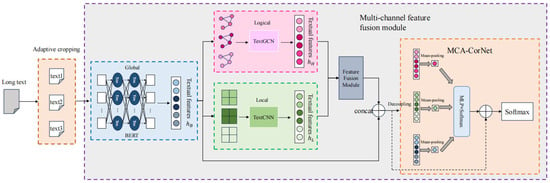
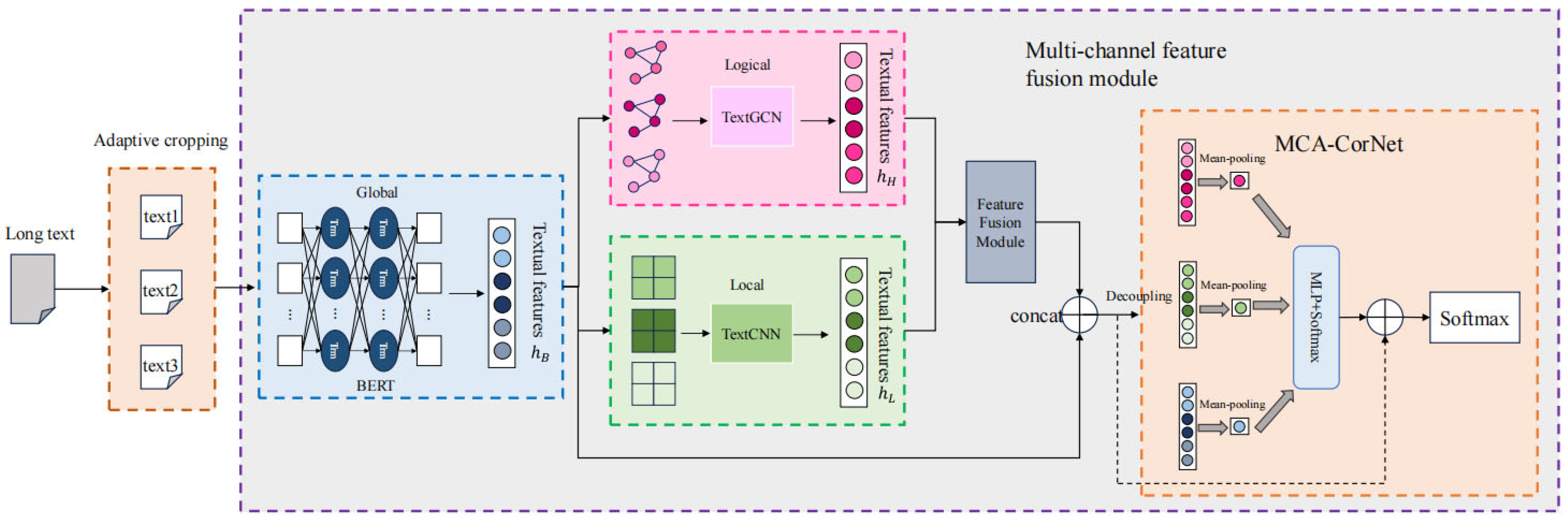
To address the challenges faced by existing classification models in effectively handling long-text data such as archival documents, as well as the insufficient consideration of text structural dependencies and semantic relationships, this paper proposes an Adaptive Long-text Clipping and Multi-Channel Feature Fusion Network (ALC-MCFN). The overall structure of the model is illustrated in Figure 1. The ALC-MCFN model primarily consists of the following components: long-text truncation mechanism, BERT, Graph Convolutional Network (GCN), Text Convolutional Network (TextCNN), CorNet module, and the final classification module. To provide a clear overview of the ALC-MCFN architecture, Table 1 summarizes the input, output, and functional role of each core module within the network.
Figure 1.
ALC-MCFN model.
Table 1.
Summary of the ALC-MCFN Model Modules.
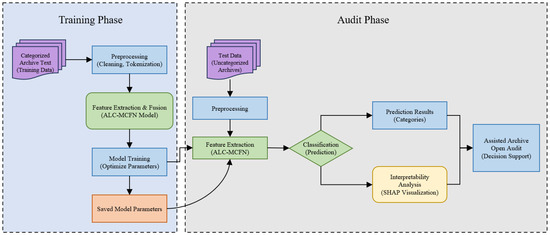
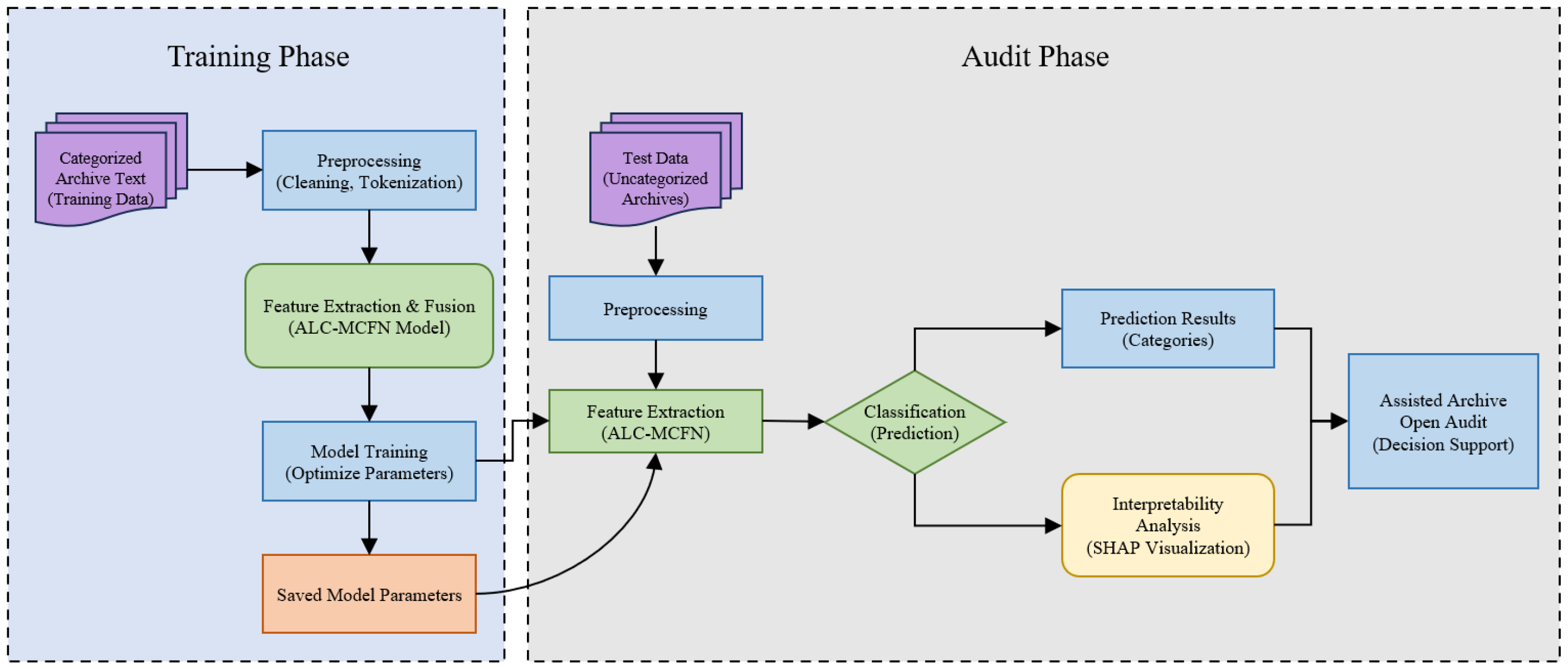
This model effectively integrates various feature extraction techniques and optimizes the fusion of different types of text features to enhance classification performance, particularly for long and complex documents. In the training and testing process of the model, the already categorized archive text is first trained, and after the model training is completed, the model parameters are saved, and the model is loaded in the testing phase to preprocess, feature extract and classify the test data, and output the prediction results to assist the archive open audit. The specific process is shown in Figure 2.
Figure 2.
Model-assisted file review flowchart.
3.1. Adaptive Long-Text Clipping
In the scenario of archival openness auditing, long-text archival data is characterized by sparse core information (e.g., sensitive clauses in meeting minutes, identity attributes in citizen privacy archives) and a high proportion of redundant content (e.g., repetitive background descriptions, generic administrative wording). The original fixed-length cropping method—truncating 256 tokens from the head, tail, and middle segments respectively—can meet the maximum input length limit of 512 tokens for the BERT pre-trained model but easily causes two critical issues: it disrupts semantic coherence by splitting complete sensitive sentences (such as “demolition compensation clauses requiring confidential revision”) into separate segments, and it loses key information when redundant content is concentrated in the head or tail, severely affecting the accuracy of archival openness auditing.
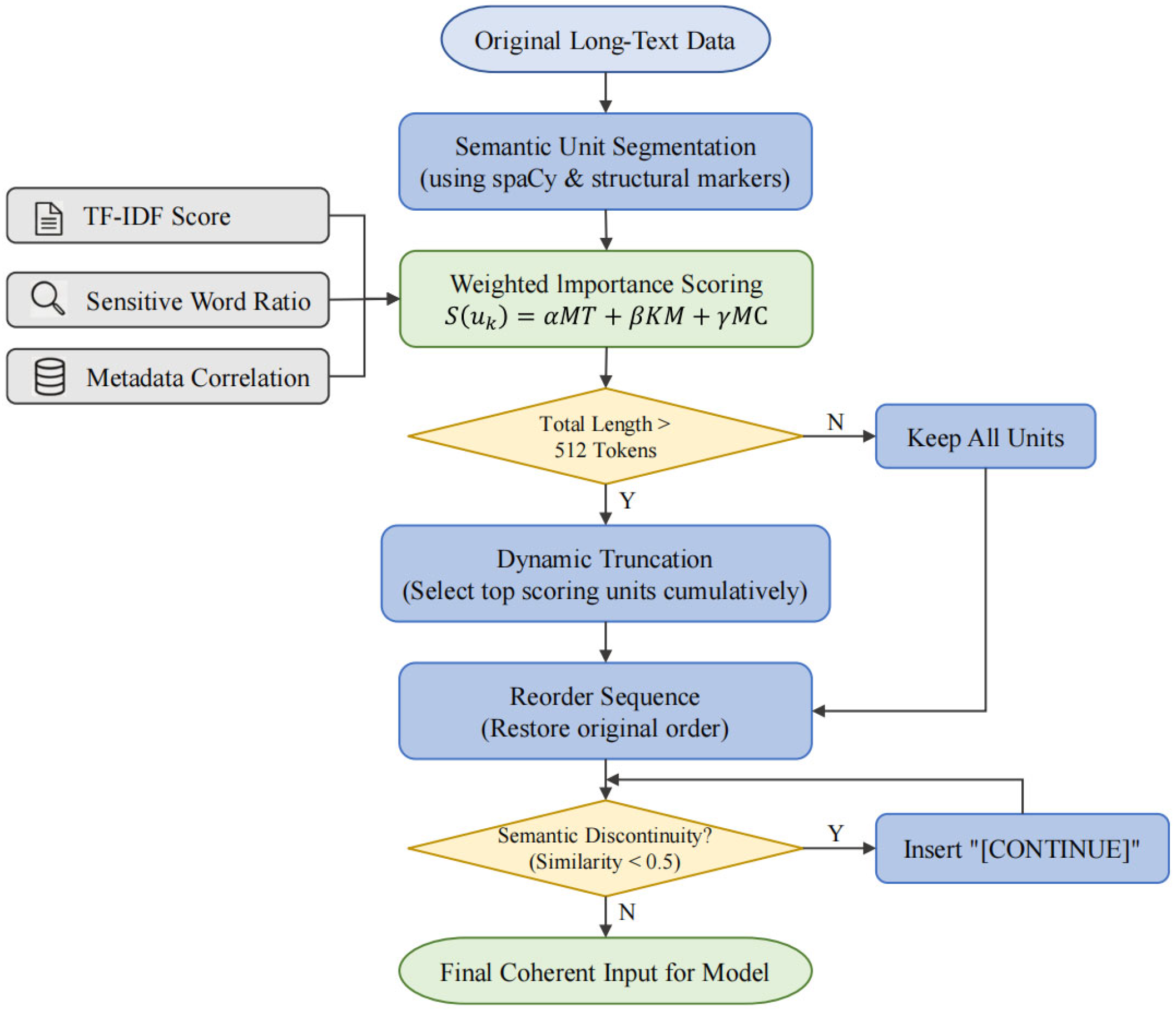
To address these problems, a long-text semantic-aware dynamic truncation mechanism is proposed. First, the original long-text data , where represents the i-th token of the text and N is the total number of tokens, is segmented into semantic units using the spaCy toolkit for sentence boundary detection and archival structural markers (e.g., “Chapter,” “Resolution:” “Summary:”). Each unit consists of consecutive sentences with coherent semantics, ensuring no cross-sentence truncation and preserving the integrity of sensitive semantic information.
Next, a weighted key degree scoring function is designed to quantify the importance of each semantic unit, with the score of unit calculated as follows:
Here, are the optimal weight coefficients determined through heuristic initial setting based on archival domain expertise and systematic grid search tuning. The weight selection follows a two-step process: (1) heuristic initialization: we set the highest initial weight for β (sensitive word ratio) as the identification of sensitive information is the primary goal of archival openness auditing, while setting equal initial weights for α and γ to balance domain relevance and metadata matching, aligning with archival management compliance requirements; (2) grid search tuning: we conducted a grid search on the OParchives validation set with a step size of 0.1 (weight range 0.1–0.8, sum constraint of 1), using the classification F1-score as the optimization objective. This combination achieved the highest validation performance and the most stable generalization ability on public datasets, as excessive β weight leads to overfocus on individual sensitive words, while insufficient β weight weakens core sensitive information capture. denotes the average TF-IDF value of tokens in , focusing on high-weight archival domain terms; is the ratio of archival sensitive words in to the total number of tokens in , is the count of sensitive words in and is the number of tokens; (Metadata Correlation Score) is the cosine similarity between the sentence embedding of and archival metadata generated by the Sentence-BERT model, ensuring units strongly correlated with metadata are prioritized.
For the truncation process, if the total length of is less than or equal to 512 tokens, U is used directly; otherwise, U is sorted in descending order of . Units are selected cumulatively until the total length reaches 512 tokens, and the selected units are reordered to their original sequence in T to maintain contextual logic. To avoid semantic discontinuity, the cosine similarity between consecutive selected units is computed using Sentence-BERT; If the similarity is less than 0.5, a “[CONTINUE]” marker is inserted at the end of the previous unit to inform the model of the semantic connection between segments. This threshold was determined by testing a range of values (0.3 to 0.7) on the validation set; values lower than 0.5 failed to filter semantic noise, while higher values led to excessive textual fragmentation. The 0.5 threshold yielded the highest F1-score and accuracy during preliminary testing.
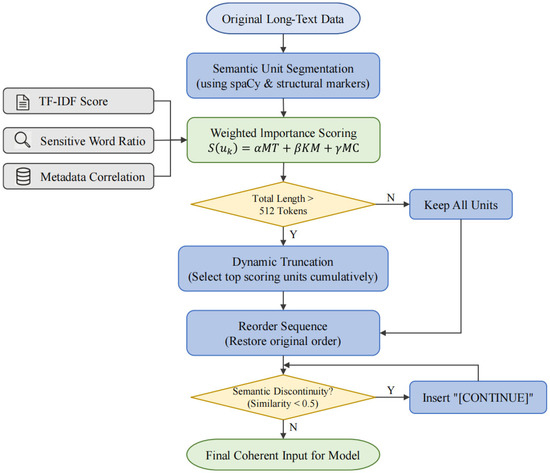
Priority should be given to retaining high-scoring . If the total length exceeds BERT input limit, priority shall be assigned to truncating redundant detail units with scores below the threshold, rather than mechanically truncating the head or tail segments. The specific process is shown in Figure 3.
Figure 3.
Long-Text Semantic-Aware Dynamic Truncation.
3.2. Global Semantic Features
After cutting the long text, the next step is to extract the global semantic features of the text. Global semantic features can help the model to understand the overall meaning of the text and provide important context information for the subsequent classification tasks, which is particularly critical for capturing the overall policy context and thematic attributes of archival documents. To this end, we use the BERT (Bidirectional Encoder Representations from Transformers) pre-training model to extract the global semantic features of the text.
BERT is built on the Transformer encoder architecture, and its core is the self-attention mechanism, which enables the model to capture bidirectional contextual dependencies and long-range semantic relationships in the text. The classic formulation of the self-attention and multi-head attention mechanisms has been elaborated in detail in the foundational work of Vaswani et al. [8], so we do not repeat the full mathematical derivation here. For the specific adaptation to archival text processing, we fine-tune the BERT-base pre-trained model with our archival corpus and use the CLS token output of the last Transformer encoder layer as the global semantic feature vector of the archival text, denoted as with a fixed dimension of 768. This design enables the model to focus on the overall thematic semantics and policy context of the archival document, rather than just local word-level features, which is highly consistent with the compliance review requirements of archival openness auditing.
3.3. Local Semantic Features
In addition to global semantic features, local semantic features are also an important part of understanding text content. Local semantic features can capture the semantic relationship between adjacent words in the text, which helps the model to better understand the details of the text. For this purpose, we employ a Textual Convolutional Network (TextCNN) to extract local semantic features. Local semantics contains local features of the text, which can focus on the deeper semantics embedded in the adjacent word region blocks.
The textual representation of local semantics typically involves converting each word into a k-dimensional vector. For a sentence of length , the word is represented by a k-dimensional vector , and the entire sentence can be represented as the concatenation of these word vectors.
where represents the concatenation operation, and represents the subsequence from the first word to the word.
The convolution operation uses a filter W of size h, which is a window containing h words, to extract features from adjacent sub-phrase blocks. For example, the features extracted by the window on the words can be represented as:
where is the bias term and is a nonlinear activation function. Multiple convolution kernels with different sizes and weights are used to capture local contextual information of varying scales. Each convolution kernel produces a feature map, and all feature maps together form a two-dimensional feature map. After the convolutional layer, a pooling layer is applied to reduce the feature dimensionality and extract the most important features. Max pooling is the most commonly used pooling method, where the maximum value is selected from each feature map to generate a fixed-length feature vector.
3.4. Logical Semantic Features
Unlike global and local semantic features, logical semantic features pay more attention to the logical relationships between documents and between documents and words. This feature can help the model to understand the structural information of the text, so as to classify more accurately. To this end, we employ a graph convolutional network (TextGCN) to extract the logical semantic features of the text.
First, a text heterogeneous graph is constructed, where the nodes in the graph consist of word-type nodes and document-type nodes. Traditional TextGCN models typically represent the initial node features using an identity matrix: where represents the number of document-type nodes and represents the number of word-type nodes. The edges between word-type nodes in the graph are defined using Pointwise Mutual Information (PMI), while the edges between document-type and word-type nodes are defined using Term Frequency-Inverse Document Frequency (TF-IDF). The weight of the edge between two nodes and is defined as in [23]:
The PPMI value of a word pair , is computed as:
where represents the number of sliding windows in the corpus that contain the word , denotes the number of sliding windows in the corpus that contain both words and , and refers to the total number of sliding windows in the corpus.
After constructing the text heterogeneous graph, in a transductive manner, we input the feature matrix into a model with two layers of Graph Convolutional Networks (GCN), which iteratively propagates information across both the training and test sets. After layer-wise computations, the final output is a feature set that can represent the logical and semantic meaning of the text. The specific computation process is given by the following equation:
where denotes the adjacency matrix of the text heterogeneous graph, and represents the degree matrix of the graph, where is the activation function. The weight matrix for the first layer is , and for the second layer, it is . These two weight parameters can be trained using gradient descent. In this context, d is the dimensionality of the node feature vectors, while and represent the output dimensions of the first and second layers of the GCN, respectively.
3.5. Feature Fusion Module
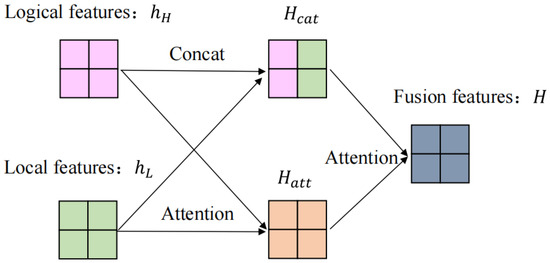
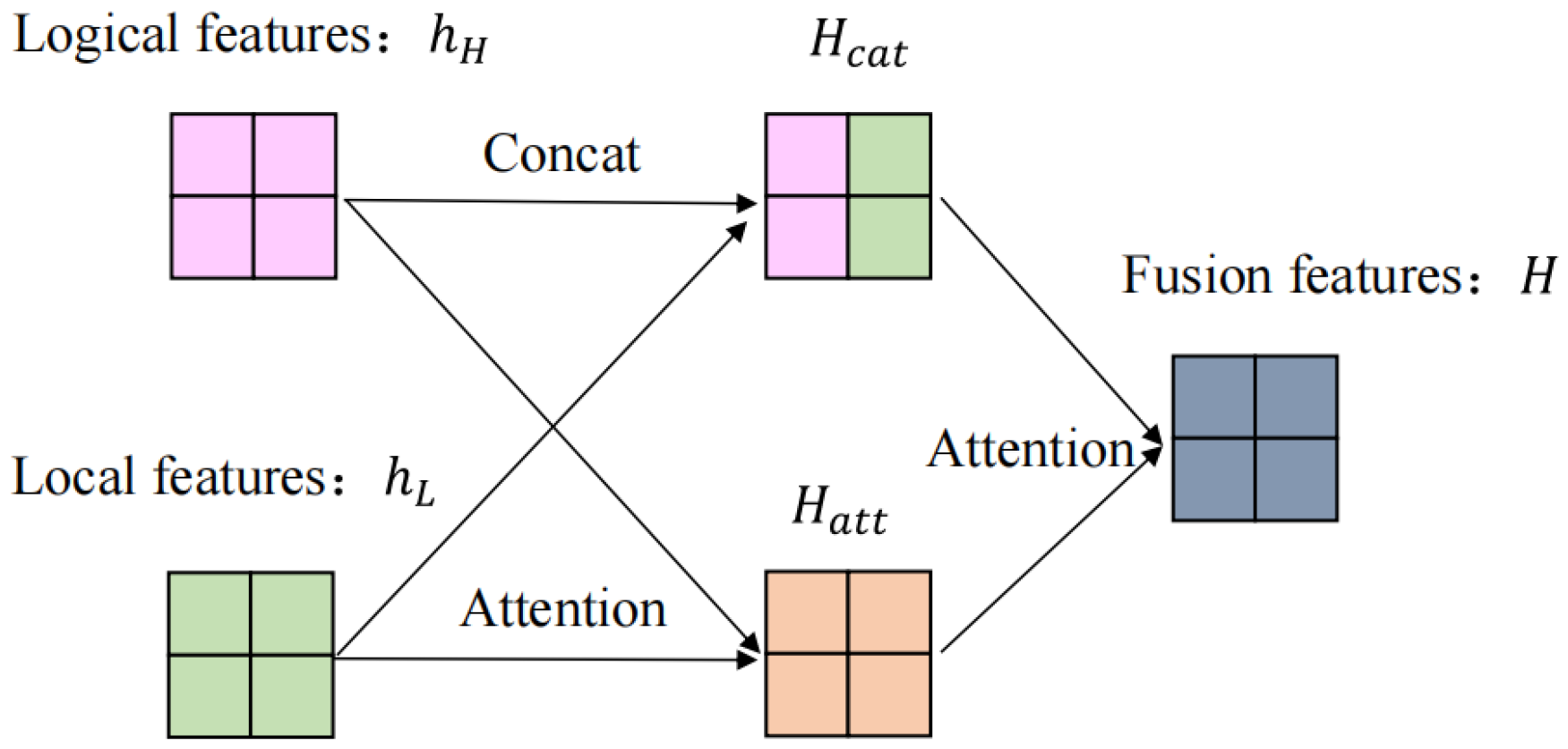
A single fusion approach often leads to the loss of critical information, as it can only integrate a limited set of features and fails to fully capture the complex information within the text. In contrast, multi-fusion methods can better leverage various information sources by complementing different types of features, thus improving model performance. Therefore, this paper proposes a feature fusion strategy based on multi-fusion complementarity, particularly at the feature extraction layer. By combining logical semantic features and local semantic features, this approach enables a more comprehensive capture of the deep meanings and nuances within the text, thereby enhancing the model’s comprehension ability, as illustrated in Figure 4.
Figure 4.
Feature fusion.
The specific operation involves concatenating the logical semantic features and the local semantic features , followed by attention-based fusion. The feature concatenation operation is given by the following equation:
where , represent the logical semantic features and local semantic features from the feature extraction layer, respectively. denotes the concatenation operation, and refers to the concatenated features.
The attention fusion operation is given by the following equation:
where represents the activation function, is the vector representation of after applying the activation function, denotes the corresponding weight, and refers to the feature vector obtained after attention fusion. The concatenation operation combines the logical semantic information and the local semantic information by merging them into a unified representation, thereby enhancing the model’s understanding of the text. However, a simple concatenation operation may not fully capture the relationships between different types of information. Therefore, the introduction of an attention fusion operation becomes particularly important. Through the attention mechanism, the model can automatically assign varying importance weights to different features, enabling it to focus on task-relevant features, specifically those that are most crucial for the final task outcome. This attention mechanism effectively guides the model to concentrate on features with high informational content and relevance, thereby improving model performance and preventing a decline in performance due to overemphasis on less important information.
3.6. MCA-CorNet Module
To further enhance the extraction of key features after the fusion stage, an MCA-CorNet module is integrated just before the classification output layer. The original CorNet module applies uniform enhancement across multi-channel features, which limits its representational capacity. To overcome this limitation, the proposed MCA-CorNet introduces a channel-specific adaptation mechanism while preserving the core architecture of residual connections. Specifically, the module takes the fused feature vector from the multi-channel feature fusion module as input and generates an enhanced feature vector through a four-step process.
Firstly, feature channel decoupling is performed, and the fused vector is split into sub-vectors: , so as to preserve semantic integrity. Secondly, the importance weight of each channel is calculated using a lightweight MLP and softmax to achieve dynamic focusing on key channels. Global average pooling is applied to the three sub-vectors to obtain channel-level statistics. Then, weight prediction is conducted, and normalized weights are output through a single-hidden-layer MLP:
where is the learnable weight matrix, is the bias term, and .
Thirdly, channel-specific enhancement is implemented: an independent enhancement path is designed for each channel, and the GELU activation, which is more suitable for semantic features, is adopted.
where , are the weight matrices, and , are the bias terms.
Finally, adaptive residual fusion is performed: the attention-weighted enhanced features are fused with the original input to avoid feature deviation.
To clarify its execution, the following pseudo-code describes the four-stage enhancement process, as shown in Algorithm 1:
| Algorithm 1: MCA-CorNet Feature | |
| 1. Feature Decoupling: | Split fused vector into global (), local (), and logical () sub-vectors. |
| 2. Weight Prediction: | Calculate importance weights , , using a lightweight MLP and Softmax to achieve dynamic focusing. |
| 3. Channel-Specific Enhancement: | Design independent paths for each channel using GELU activation to refine semantic features. |
| 4. Adaptive Residual Fusion: | Fuse attention-weighted features with the original input to prevent feature deviation. |
3.7. Shapley Additive exPlanations (SHAP)
Although deep learning models like ALC-MCFN demonstrate superior performance in archival classification, their “black box” nature often hinders their adoption in sensitive domains like archival openness auditing, where transparency is mandated by regulations. To address this, we introduce SHAP, a unified framework based on cooperative game theory, to provide post hoc interpretability for the model’s decisions [28]. Recent comprehensive evaluations of XAI methods in text classification highlight that feature-based explanation tools like SHAP provide higher fidelity and trustworthiness compared to rule-based alternatives, making them particularly suitable for high-stakes domains [29].
The SHAP values refer to the Shapley values of the conditional expectation function of a model’s predicted outcome, and can be calculated as follows:
where represents the model to be interpreted; is the interpretability model; is the input variable for ; is the simplified input variable related to ; is the number of input variables; is the baseline SHAP value (the average output of the model on the training set); and is the SHAP value for the kth input variable.
In the context of our ALC-MCFN model, we utilize the SHAP explainer to approximate these values efficiently. By mapping the SHAP values back to the original text, we can visualize which keywords (e.g., “confidential,” “public,” “sensitive”) positively or negatively influence the model’s classification probability for categories like “Extended-C” or “Open.” This visualization helps auditors verify whether the model relies on semantically meaningful legal and factual descriptors rather than learning spurious correlations, thereby enhancing trust in the automated auditing process.
4. Experimental
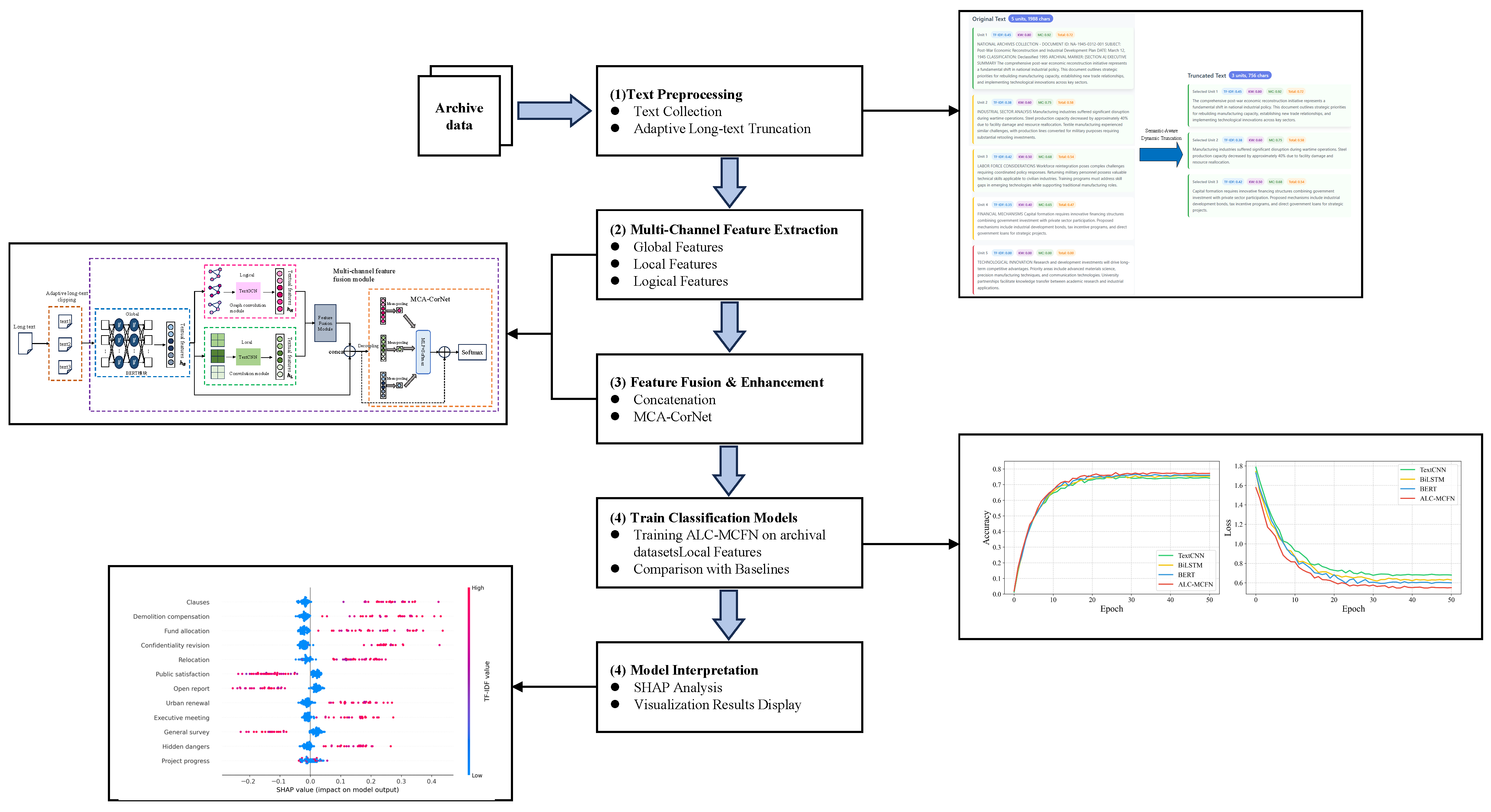
To improve the accuracy of document classification, a classification model based on multi-channel feature fusion is proposed. In this section, to validate the effectiveness of the model, we use two publicly available text classification datasets: the Fudan University dataset and THUCNews, as well as a self-constructed dataset related to archival open review (OParchives). Experimental results and processes on these three datasets are presented, as shown in Figure 5.
Figure 5.
Overall experimental procedure.
4.1. Datasets
- Fudan University Dataset [30]: This is a long-text classification dataset provided by the Natural Language Processing Group at the International Database Center of the Department of Computer Science and Technology, Fudan University. It consists of 19,636 long text documents, categorized into 20 classes.
- THUCNews News Dataset [31]: This is a short-text classification dataset containing 14 categories and 740,000 documents. For this study, 200,000 documents from 10 categories were selected.
- Archival Open Review Dataset (OParchives): This is a long-text archival classification dataset containing five categories, with four categories representing delayed-release archives and one representing open-access archives. Due to the strict confidentiality and legal restrictions associated with real government records, the dataset is a self-constructed virtual archival dataset, and its thematic categories, labels, and main content are shown in Table 2. For model training and evaluation, we adopted a stratified random sampling strategy to split the dataset into a training set (70%), a validation set (15%), and a test set (15%), which ensures the category distribution of each subset is consistent with the overall dataset. The annotation work was completed by 2 file review personnel. We formulated a detailed annotation manual and completed pre-annotation calibration before formal annotation, ensuring high annotation consistency and data reliability.
In order to verify the accuracy and stability of the word model, the categories more appropriate to the content of the archives were selected from two open data sets for classification experiments, and six categories were selected from the data set of Fudan University for experiments. The detailed information is shown in Table 3. Five categories were selected in the THUCNews news dataset for the experiment, and the details are shown in Table 4.
Table 2.
OParchives dataset categories.
Table 3.
Fudan University Dataset statistics.
Table 4.
THUCNews Dataset statistics.
4.2. Experimental Environment and Evaluation Indicators
To ensure the full reproducibility of our experimental results, all models were trained and evaluated in a unified hardware and software environment. The experiments were conducted on an Ubuntu 20.04 operating system equipped with an Intel Core i7 CPU, 64 GB of RAM, and a single NVIDIA GeForce RTX 3080 GPU (12 GB VRAM). The ALC-MCFN model and all baselines were implemented using the PyTorch 2.1 deep learning framework. During the training phase, we utilized the AdamW optimizer to update the network parameters. Due to the pre-trained nature of the global semantic module, we applied differential learning rates: 2 × 10⁻⁵ for the BERT encoder to prevent catastrophic forgetting, and 1 × 10⁻³ for the randomly initialized TextCNN, TextGCN, and MCA-CorNet modules. The models were trained with a batch size of 32 for a maximum of 50 epochs.
To evaluate the performance of different classification methods, this paper uses a confusion matrix, which includes the following components: True Positive (TP), False Positive (FP), True Negative (TN), and False Negative (FN). For the performance evaluation of the ALC-MCFN model, commonly used classification task evaluation metrics are employed: Accuracy (A), Precision (P), Recall (R), and F1-score (F). The formulas for these metrics are as follows:
This paper adopts two evaluation metrics: accuracy (Acc) and F1-score. Due to the imbalanced sample sizes among different categories in the dataset, the weighted average F1-score is used to avoid the resulting impact.
4.3. Baseline Models
To validate the effectiveness of the proposed model, we compare its performance with six commonly used models on the three datasets mentioned earlier:
- TextCNN [21]: This model uses Word2Vec to generate word embeddings and applies convolutional kernels of different sizes to extract local key features from the text. The most significant features are retained through a max-pooling operation, and classification is performed using a Softmax layer.
- BiLSTM [32]: Word2Vec is used to generate word embeddings, and a BiLSTM layer is employed to capture the semantic information and dependencies within the text. The output is then passed through a fully connected layer for classification.
- RCNN [22]: Word2Vec is used for word embedding generation, and bidirectional RNNs along with the max-pooling layer from CNNs are applied to extract features from the text. These features are then input into a fully connected layer for classification.
- TextCNN-BiLSTM [33]: Word2Vec is used to generate word embeddings, and a combination of convolutional operations and BiLSTM layers is employed to extract richer textual features. The final classification is performed by passing the output through a fully connected layer.
- TextCNN-Attention: Word2Vec is used to generate word embeddings, and both TextCNN and an attention mechanism are applied to extract local features. The attention mechanism enhances key sentences, improving classification performance.
- BERT [8]: The BERT pretrained language model is used to extract text feature vectors, which are then combined with a fully connected layer for classification.
- Longformer [18]: A powerful transformer-based model specifically designed for long-document processing. It employs a sparse self-attention mechanism, allowing it to efficiently process sequences up to 4096 tokens without the need for truncation, making it a strong baseline for long-text classification tasks.
These models represent a range of traditional and advanced approaches for text classification, allowing for a thorough comparison to assess the advantages of the proposed ALC-MCFN model.
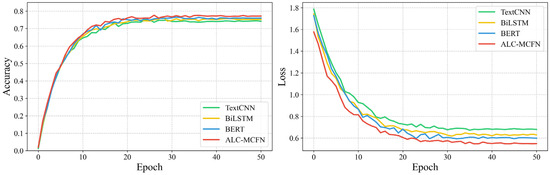
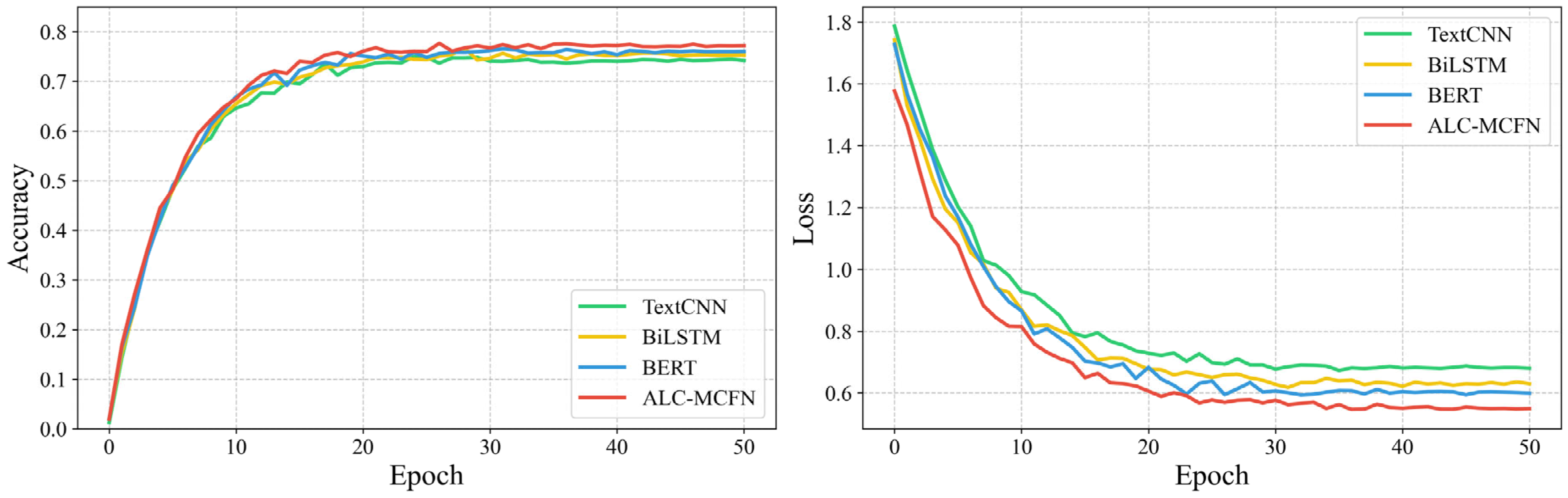
We compare the convergence speed of ALC-MCFN with that of other models. All models are kept in the same training environment, and the changes in accuracy and loss values are recorded separately during the training process, as shown in Figure 6.
Figure 6.
Comparison of the convergence of commonly used models (OParchives).
Multiple experiments were conducted on the three datasets, and the classification accuracy results are presented in Table 5. The experimental results show that the proposed ALC-MCFN model outperforms other baseline models in terms of classification accuracy. Among the baseline models, the TextCNN-Attention model performs the worst. The main reason for this is that the model struggles to capture complete and accurate text features when processing long texts. Due to its truncation mechanism, important textual features are lost.
Table 5.
Comparative experimental results (mean ± std).
On the Fudan University and THUCNews datasets, the BERT model performs better than models that use Word2Vec for word embedding generation. This indicates that, for long-text classification tasks, global semantic features are more important than local semantic features. BERT’s effective learning of text semantics enables it to capture rich semantic features, enhancing the significance of these features in text representation. Our proposed model improves upon BERT by approximately 1.0%, which suggests that the Graph Convolutional Network (GCN) module is capable of capturing deeper information within the text and effectively modeling long-distance relationships between text elements. Furthermore, while Longformer achieved significant improvements over Word2Vec-based models by natively processing longer contexts, ALC-MCFN still outperformed it. This indicates that our semantic-aware dynamic truncation mechanism not only successfully filters out redundant noise—which can sometimes confuse even long-sequence models like Longformer—but the multi-channel fusion (MCA-CorNet) also extracts richer logical and local dependencies than a single transformer backbone.
The performance superiority of the ALC-MCFN model over other baseline models can be attributed to two main factors:
- Compared to other models, the proposed model includes a long-text truncation algorithm, which allows for more accurate extraction of semantic information from long texts.
- The model incorporates logical semantic information that is not limited to the text itself, enabling it to link context and capture deeper meanings.
When fusing multiple semantics, the model employs a feature fusion module with an attention mechanism to obtain more accurate textual features. This mechanism helps gradually correct misunderstandings in other semantic features, discarding features with less contribution and retaining more valuable ones.
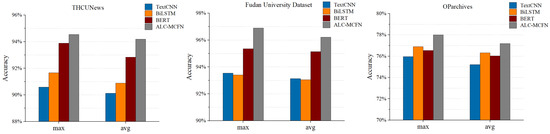
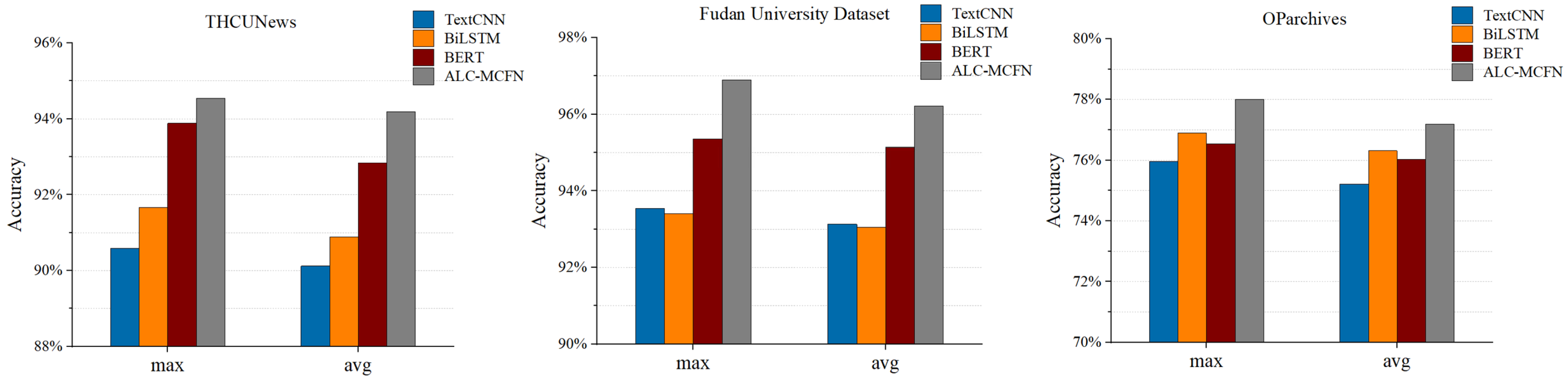
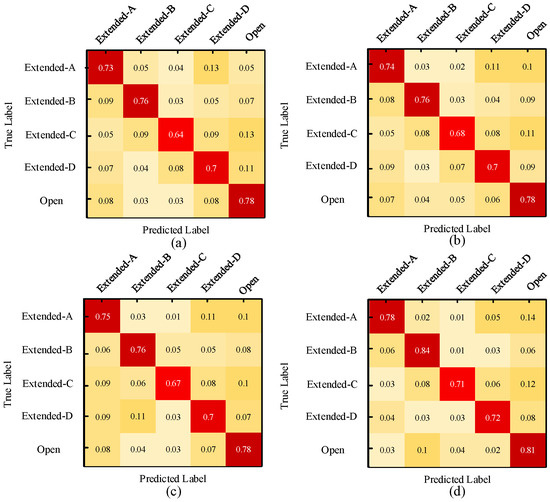
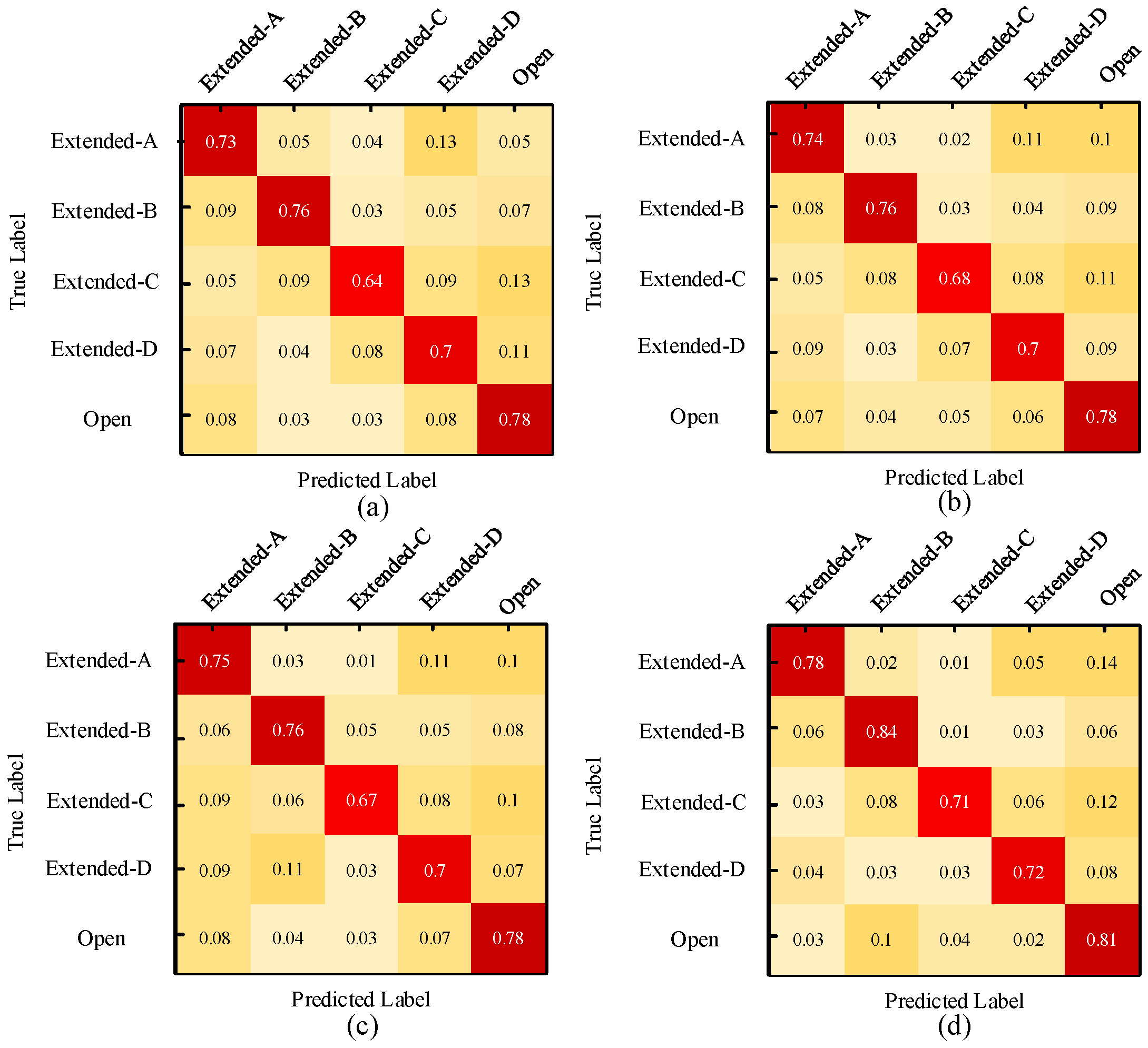
Figure 7 compares the proposed model (ALC-MCFN) with the TextCNN, BiLSTM, and BERT baseline models across different datasets. Figure 8 presents the confusion matrix showing the prediction accuracy for each category in the OParchives dataset. The darker the color, the higher the classification accuracy. The deeper the color on the diagonal, the better the model’s classification performance. From the figures, it is evident that on the OParchives dataset, the ALC-MCFN model outperforms the other three baseline models in terms of performance.
Figure 7.
Experimental results of different datasets.
Figure 8.
Confusion matrix: (a) TextCNN; (b) BiLSTM; (c) BERT; (d) ALC-MCFN.
4.4. Ablation Experiments
To evaluate the impact of each component in the proposed model on its overall performance, three ablation experiments were conducted for comparative validation:
- BERT-TextCNN: This model is a widely adopted approach in the field of text classification, and it was selected as a baseline model for comparison. Compared to ALC-MCFN, it removes the long-text truncation mechanism and the parallel TextGCN module.
- BERT-TextGCN: In this model, BERT is used as the pre-trained model, and a Graph Convolutional Network (GCN) module is employed for text classification. Compared to ALC-MCFN, this model excludes the long-text truncation mechanism and the parallel TextCNN module.
- MCFN: This model is similar to ALC-MCFN, but the long-text truncation mechanism is removed to evaluate its impact on the overall performance of the model.
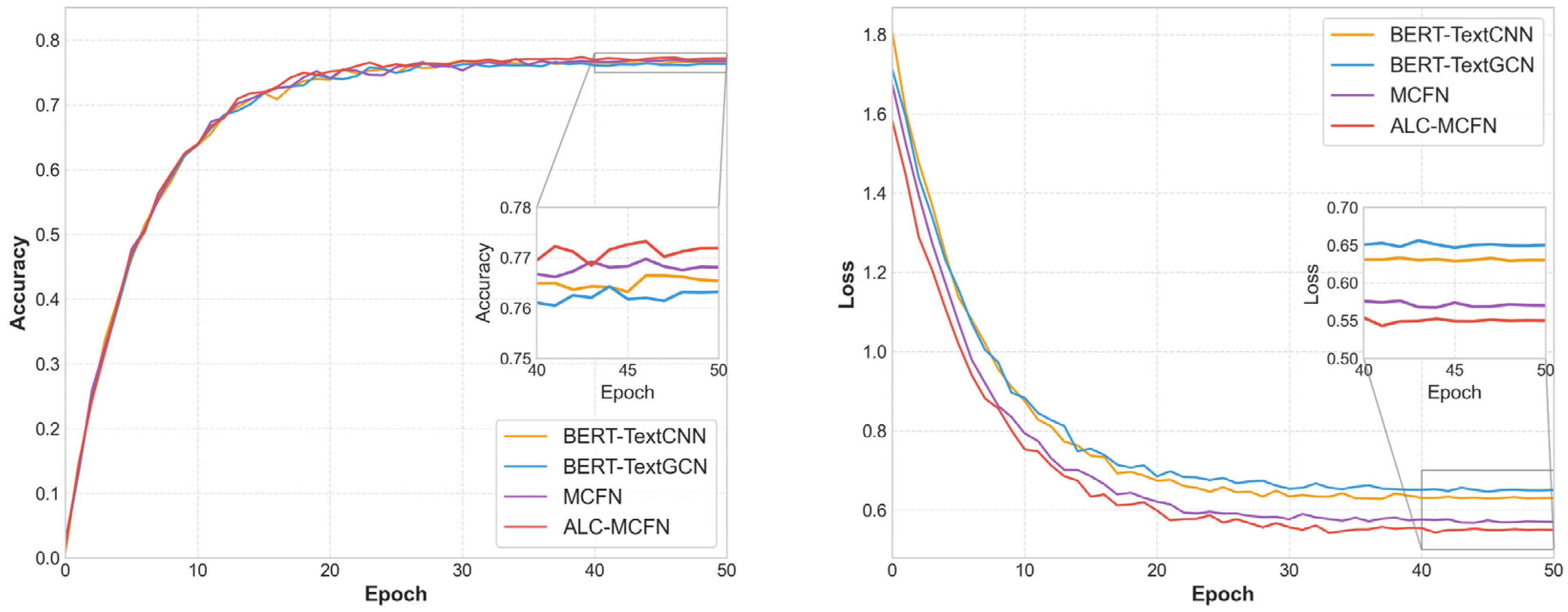
The results of the ablation experiments are shown in Table 6 and Figure 9. Compared to the baseline models, the proposed ALC-MCFN model outperforms them on all datasets. On the Fudan University and THUCNews long-text datasets, the performance metrics improved by 1.5% to 1.8%. On the OParchives dataset, the accuracy of the model increased by 0.4%.
Table 6.
Results of ablation experiments.
Figure 9.
Comparison of the convergence of ablation experiments (OParchives).
These results clearly demonstrate that the proposed ALC-MCFN model performs better than the baseline models across all datasets and exhibits strong learning ability. Even with limited data, the model significantly boosts performance. Additionally, comparing the models MCFN with BERT-TextCNN and BERT-TextGCN shows that the introduction of the multi-channel feature fusion mechanism compensates for the loss of long-distance semantic information in the text, which effectively improves classification accuracy.
Furthermore, comparing MCFN with ALC-MCFN, we observe that removing the long-text truncation mechanism in long-text datasets leads to the model’s inability to effectively capture meaningful text information. This omission results in the introduction of a large amount of noisy, redundant information, which in turn negatively impacts the final classification results. This highlights the critical role of the long-text truncation mechanism in improving the model’s performance in long-text classification tasks.
To empirically validate the selection of the cosine similarity threshold used in the semantic-aware dynamic truncation mechanism, we conducted a sensitivity analysis on the OParchives dataset. We varied the threshold from 0.3 to 0.7 to observe its impact on the model’s classification performance. When the threshold is set too low (e.g., 0.3 or 0.4), the mechanism fails to identify subtle semantic breaks, leading to disjointed contextual inputs. Conversely, setting the threshold too high (e.g., 0.6 or 0.7) makes the model overly sensitive, resulting in the excessive insertion of “[CONTINUE]” markers, which disrupts the natural semantic flow of the text. The experimental results confirm that a threshold of 0.5 achieves the highest accuracy and F1-score, providing the optimal balance between preserving semantic continuity and accurately indicating necessary structural breaks. The quantitative results are shown in Table 7.
Table 7.
Model performance under different cosine similarity thresholds (OParchives).
4.5. Model Interpretation and Case Analysis
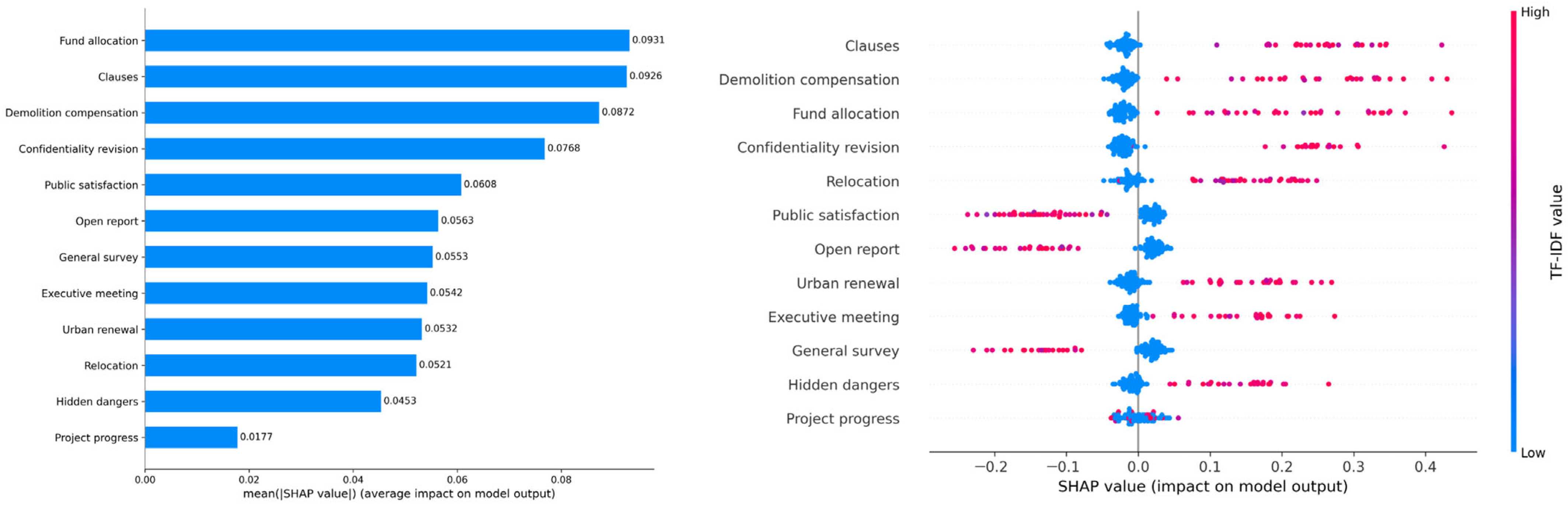
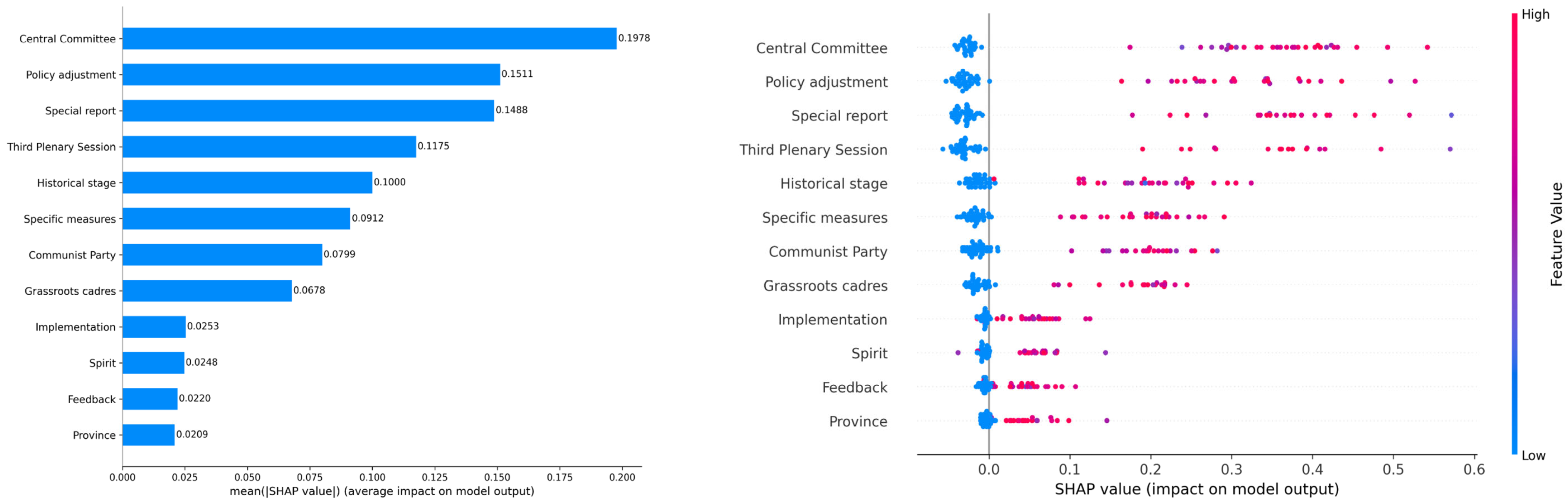
To further validate the reliability and transparency of the ALC-MCFN model in the sensitive domain of archival auditing, we utilized SHAP (SHapley Additive exPlanations) to visualize the decision-making logic of the model. We extracted the top contributing keywords from the test set of the OParchives dataset and analyzed their global importance and directional impact on the prediction results. The visualization results are shown in Figure 10 and Figure 11.
Figure 10.
The impact of keywords on the classification of meeting minutes.
Figure 11.
The impact of keywords on the classification of political events.
The left figure displays the global feature importance ranking based on the mean absolute SHAP values. It can be observed that terms related to administrative decisions and sensitive civil interests, such as “Fund allocation” (0.0931), “Clauses” (0.0926), “Demolition compensation” (0.0872), and “Confidentiality revision” (0.0768), have the highest impact on the model’s output. This indicates that the ALC-MCFN model has successfully learned to focus on substantive semantic content rather than functional stopwords or noise, aligning with the core criteria of archival openness laws.
The right figure provides a detailed view of how these features influence specific classification decisions. The x-axis represents the SHAP value (impact on model output), and the color represents the feature value (TF-IDF intensity, where red indicates high frequency/importance). Positive Correlation with Sensitivity: Features like “Confidentiality revision,” “Demolition compensation,” and “Clauses” show a clear pattern where high feature values (red points) correspond to high positive SHAP values. This means the presence of these terms strongly pushes the model to classify the archive as “Extended” (Restricted). This is consistent with the auditing logic that archives involving financial allocation or privacy (e.g., demolition details) require strict control. Negative Correlation with Sensitivity (Indicators of Openness): Conversely, features such as “Public satisfaction,” “Open report,” and “General survey” exhibit negative SHAP values when their feature values are high. This indicates that the frequent appearance of these terms reduces the probability of the document being classified as sensitive, driving the prediction towards the “Open” category.
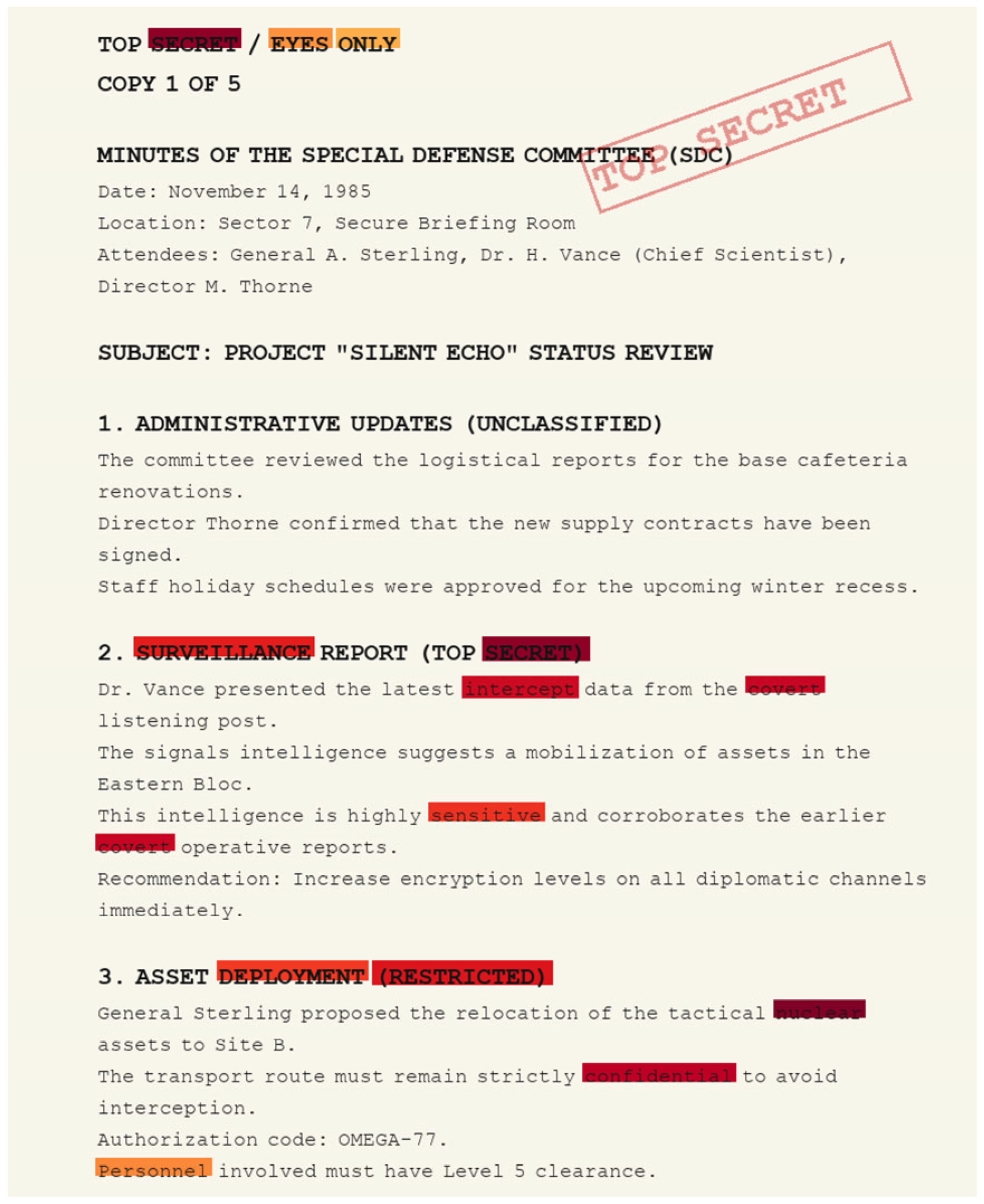
This interpretability analysis confirms that the ALC-MCFN model captures the correct semantic logic: it associates administrative sensitivity with restricted access and general public feedback with openness. This transparency significantly enhances trust in the intelligent auditing system. To provide a more intuitive understanding of how the ALC-MCFN model identifies sensitive clauses within specific contexts, Figure 12 presents a token-level SHAP visualization on a virtual archival document instance (a sample from the ‘Archives of meeting minutes’ category). In this text-level heatmap, terms with high positive SHAP values—which strongly drive the model towards an “Extended” (restricted) classification—are highlighted in red, while secondary metadata correlations are highlighted in orange.
Figure 12.
Token-level SHAP visualization on a concrete archival text instance.
As demonstrated in Figure 12, the model successfully localizes the sparse core sensitive information amidst the text. It accurately assigns high feature importance to explicit restriction markers and sensitive operational terms such as “SECRET”, “EYES ONLY”, “SURVEILLANCE”, “RESTRICTED”, “intercept”, and “confidential”. Conversely, the model correctly ignores the non-sensitive “ADMINISTRATIVE UPDATES” section (e.g., “cafeteria renovations”, “holiday schedules”), assigning these background tokens near-zero SHAP values. This concrete example directly confirms that the model’s auditing decisions are grounded in actual sensitive clauses and relevant metadata, rather than spurious background noise, fulfilling the transparency requirements for practical archival management.
To validate the multi-dimensional feature understanding capability of the ALC-MCFN model in archive openness review, three typical case categories were selected for comparative analysis: political event archives (Extended-C), meeting record archives (Extended-B), and open archives (Open). Experimental comparisons were conducted with traditional models (TextCNN, BiLSTM, and BERT), and results are shown in Table 8 (The check result √ indicates the check result is correct, × indicates the check result is incorrect).
Table 8.
Results of the case analysis.
For Case 1, which involves lengthy and complex archival text, conventional single-semantic classification models often fail to fully capture critical information or incorrectly focus on non-essential content, leading to misclassification. For example, TextCNN’s local features prioritized high-frequency terms like “provincial policies” and “specific measures,” neglecting document structure. In contrast, ALC-MCFN retained policy context from opening/closing segments and execution details through long-text trimming. By integrating document-keyword heterogeneous graphs constructed via TextGCN, it identified strong logical associations between “historical phases” and “specific measures,” then applied attention-weighted temporal features to correctly classify the archive as Extended-C. For Case 2, BiLSTM overemphasized positive semantics like “urban renewal” and “fund allocation,” overlooking the implicit sensitivity of “confidentiality revisions.” BERT’s global features categorized the text as administrative affairs, failing to recognize the privacy implications of “relocation compensation.” ALC-MCFN addressed this by using convolutional kernels to capture semantic combinations of “confidentiality revisions” and adjacent terms like “clauses,” leveraging structural features (e.g., template identifiers, deliberation items) in meeting records, and linking “relocation compensation” to privacy policies via the logical semantic layer. The CorNet module further amplified confidentiality-related feature weights, enabling accurate Extended-B classification. For Case 3, traditional models misclassified the archive due to training data biases associating terms like “coverage rate” and “satisfaction” with government performance reports (typically Extended categories). ALC-MCFN focused on non-sensitive “public satisfaction” data in the concluding segment via long-text trimming, weakened PMI associations between “nationwide” and “government” using TextGCN, and identified technical attributes through convolutional features on “effectiveness analysis.” The attention module dynamically reduced policy-related term weights while boosting neutral descriptors, correctly classifying the archive as Open.
In summary, for complex long-text archives, the proposed model demonstrates superior multi-layer semantic extraction and reduced critical information loss compared to baseline models, validating its advantages in handling nuanced archival classification tasks.
As shown in Table 9, compared with the vanilla BERT model, our ALC-MCFN model breaks through the 512-token length limit of the standard BERT through the semantic-aware dynamic truncation mechanism, and can support archival texts of any length in practical applications, which fully meets the needs of long-text processing in real archival auditing. Meanwhile, the model maintains a medium level of deployment complexity and has stronger incremental data adaptability: the multi-channel feature fusion architecture can be fine-tuned with a small amount of incremental archival data to adapt to new audit rules and archive categories, which is more suitable for the iterative update needs of the archival management system.
Table 9.
Practical Performance Comparison of Different Models in Real Archival Auditing Scenarios.
4.6. Computational Efficiency Analysis
To demonstrate the practical feasibility of ALC-MCFN for large-scale archival systems, we evaluated its runtime and memory consumption against baseline models during the inference phase. The test was conducted on a single NVIDIA RTX 3080 GPU with a batch size of 16. As shown in Table 10, while ALC-MCFN requires marginally more parameters than a standalone BERT model due to the TextCNN and TextGCN modules, its memory consumption remains highly manageable (approx. 3.5 GB).
Table 10.
Comparison of Runtime and Memory Consumption (Inference Phase).
Crucially, when compared to models designed for full-document processing like Longformer (which processes up to 4096 tokens), ALC-MCFN consumes significantly less memory (3.5 GB vs. 6.8 GB) and achieves a much faster inference speed (42 ms/doc vs. 85 ms/doc). This efficiency is primarily attributed to the adaptive long-text clipping mechanism, which reduces the input length to <512 tokens prior to the heavy feature extraction phase. Consequently, ALC-MCFN avoids the severe computational overhead associated with modeling thousands of tokens, proving its suitability for deployment in high-throughput intelligent archival auditing systems.
5. Conclusions
To address the challenges of sparse core information and complex semantics in long-text archival classification, this paper proposes an interpretable intelligent classification model named ALC-MCFN. First, a semantic-aware dynamic truncation mechanism is introduced to effectively remove redundancy from long texts while preserving critical logic. Second, by integrating BERT, TextCNN, and TextGCN, the model captures global, local, and logical semantic features, respectively, overcoming the limitations of single-view feature representation. The MCA-CorNet module is further employed to adaptively enhance key feature channels before classification.
Significantly, to solve the “black box” problem in sensitive auditing domains, this study incorporates the SHAP method for model interpretability. The visualization results confirm that the model correctly associates administrative sensitive terms with restricted categories and public feedback terms with open categories, thereby ensuring the transparency and reliability of the auditing process. Furthermore, it is crucial to acknowledge the inherent limitations of post hoc explanation techniques like SHAP in legally sensitive auditing environments. Because SHAP provides a localized approximation of the model’s decision boundary rather than a strictly causal representation of its internal mechanics, there is a risk of generating plausible but mathematically approximated explanations. In the context of strict archival compliance, blind reliance on these approximations without human oversight could pose legal and ethical risks. Therefore, our ALC-MCFN framework is designed strictly as an assisted decision-support tool, requiring human auditors to cross-verify SHAP visualizations against statutory regulations.
Experimental results on the Fudan, THUCNews, and self-constructed OParchives datasets demonstrate that ALC-MCFN outperforms mainstream baseline models in terms of accuracy and F1-score. However, the construction of text heterogeneous graphs and the calculation of SHAP values involve considerable computational overhead. Therefore, future research will focus on optimizing the computational efficiency of the graph module and exploring lightweight interpretability methods to facilitate real-time archival openness auditing.
Author Contributions
Conceptualization, L.F. and Z.C.; methodology, Z.C.; software, Z.C.; validation, L.F., Y.J. and L.S.; formal analysis, J.S.; investigation, L.S.; resources, D.W.; data curation, Y.J.; writing—original draft preparation, L.F., Z.C.; writing—review and editing, L.F., D.W.; visualization, Z.C., Y.J.; supervision, J.S. and D.W.; project administration, L.S.; funding acquisition, L.F. and L.S. All authors have read and agreed to the published version of the manuscript.
Funding
This work was supported by Jiangsu Provincial Science and Technology Program (BZ2024057).
Data Availability Statement
The Fudan University Dataset (https://gitcode.com/open-source-toolkit/6a679) and THUCNews (http://thuctc.thunlp.org) belong to public datasets and can be accessed publicly. The OParchives dataset cannot be made public due to privacy and confidentiality.
Conflicts of Interest
The authors declare no conflicts of interest.
References
- Ngoepe, M.; Jacobs, L.; Mojapelo, M. Inclusion of digital records in the archives and records management curricula in a comprehensive open distance e-learning environment. Inf. Dev. 2024, 40, 190–201. [Google Scholar] [CrossRef] [Scilit]
- Benmakhlouf, H.; Chouaou, A. Electronic document, information, and archive management systems in economic institutions: A descriptive study of the onbase system. Int. J. Prof. Bus. Rev. 2024, 9, 11. [Google Scholar] [CrossRef] [Scilit]
- Jaillant, L. How can we make born-digital and digitised archives more accessible? Identifying obstacles and solutions. Arch. Sci. 2022, 22, 417–436. [Google Scholar] [CrossRef] [Scilit]
- Jaillant, L.; Caputo, A. Unlocking digital archives: Cross-disciplinary perspectives on AI and born-digital data. AI Soc. 2022, 37, 823–835. [Google Scholar] [CrossRef] [Scilit]
- Al-Sayyed, S.M.; Al-Afeef, M.A.; Al-Qudah, A.A. The role of artificial intelligence in auditing and fraud detection in accounting information systems: Moderating role of natural language processing. Int. J. Organ. Anal. 2024, 33, 1391–1409. [Google Scholar] [CrossRef] [Scilit]
- Trillo, J.R.; González-López, F.; Morente-Molinera, J.A.; Magán-Carrión, R.; García-Sánchez, P. Evaluation of Explainable, Interpretable and Non-Interpretable Algorithms for Cyber Threat Detection. Electronics 2025, 14, 3073. [Google Scholar] [CrossRef] [Scilit]
- Trillo, J.R.; Del Moral, M.J.; Tapia, J.M.; García-Cabello, J.; Cabrerizo, F.J. Explainable classifier with adaptive optimisation for medical data. Appl. Intell. 2026, 56, 77. [Google Scholar] [CrossRef] [Scilit]
- Devlin, J.; Chang, M.W.; Lee, K.; Toutanova, K. BERT: Pre-training of deep bidirectional transformers for language understanding. In Proceedings of the 2019 Conference of the North American Chapter of the Association for Computational Linguistics: Human Language Technologies, Minneapolis, MN, USA, 2–7 June 2019; Volume 1, pp. 4171–4186. [Google Scholar]
- Rai, N.; Kumar, D.; Kaushik, N.; Raj, C.; Ali, A. Fake News Classification using transformer based enhanced LSTM and BERT. Int. J. Cogn. Comput. Eng. 2022, 3, 98–105. [Google Scholar] [CrossRef] [Scilit]
- Li, Q.X.; Pang, J.; Zhu, F.R. Text Classification Method Based on Integration of Bert and Hypergraph Convolutional Network. Comput. Eng. Appl. 2023, 59, 107–115. [Google Scholar]
- Lin, Y.; Meng, Y.; Sun, X.; Han, Q.; Kuang, K.; Li, J.; Wu, F. BertGCN: Transductive text classification by combining GCN and BERT. arXiv 2021, arXiv:2105.05727. [Google Scholar]
- Jia, O.; Huang, H.; Ren, J.; Li, Y. Contrastive learning with text augmentation for text classification. Appl. Intell. 2023, 53, 19522–19531. [Google Scholar] [CrossRef] [Scilit]
- Kowsari, K.; Jafari Meimandi, K.; Heidarysafa, M.; Mendu, S.; Barnes, L.; Brown, D. Text classification algorithms: A survey. Information 2019, 10, 150. [Google Scholar] [CrossRef] [Scilit]
- Adhikari, A.; Ram, A.; Tang, R.; Lin, J. DocBERT: BERT for document classification. arXiv 2019, arXiv:1904.08398. [Google Scholar] [CrossRef] [Scilit]
- González-Quesada, J.C.; Trillo, J.R.; Porcel, C.; Pérez, I.J.; Cabrerizo, F.J. Modelling Large-Scale Group Decision-Making Through Grouping with Large Language Models. Future Internet 2025, 17, 381. [Google Scholar] [CrossRef] [Scilit]
- Huang, G.; Li, Y.; Jameel, S.; Long, Y.; Papanastasiou, G. From explainable to interpretable deep learning for natural language processing in healthcare: How far from reality? Comput. Struct. Biotechnol. J. 2024, 24, 362–373. [Google Scholar] [CrossRef] [Scilit]
- Yang, Z.; Dai, Z.; Yang, Y.; Carbonell, J.; Salakhutdinov, R.R.; Le, Q.V. XLNet: Generalized autoregressive pretraining for language understanding. Adv. Neural Inf. Process. Syst. 2019, 32, 5753–5763. [Google Scholar]
- Beltagy, I.; Peters, M.E.; Cohan, A. Longformer: The long-document transformer. arXiv 2020, arXiv:2004.05150. [Google Scholar] [CrossRef] [Scilit]
- Ai, W.; Wang, Z.; Shao, H.; Li, X. A multi-semantic passing framework for semi-supervised long text classification. Appl. Intell. 2023, 53, 20174–20190. [Google Scholar] [CrossRef] [Scilit]
- Mikolov, T.; Chen, K.; Corrado, G.; Dean, J. Efficient estimation of word representations in vector space. arXiv 2013, arXiv:1301.3781. [Google Scholar] [CrossRef] [Scilit]
- Kim, Y. Convolutional neural networks for sentence classification. In Proceedings of the 2014 Conference on Empirical Methods in Natural Language Processing (EMNLP), Doha, Qatar, 25–29 October 2014; pp. 1746–1751. [Google Scholar]
- Lai, S.; Xu, L.; Liu, K.; Zhao, J. Recurrent convolutional neural networks for text classification. In Proceedings of the AAAI Conference on Artificial Intelligence, Austin, TX, USA, 25–30 January 2015; Volume 29. [Google Scholar]
- Yao, L.; Mao, C.; Luo, Y. Graph convolutional networks for text classification. In Proceedings of the AAAI Conference on Artificial Intelligence, Honolulu, HI, USA, 27 January–1 February 2019; Volume 33, pp. 7370–7377. [Google Scholar]
- Dai, Y.; Shou, L.; Gong, M.; Xu, J.; Jiang, D. Graph fusion network for text classification. Knowl.-Based Syst. 2022, 236, 107659. [Google Scholar] [CrossRef] [Scilit]
- Li, X.; You, B.; Peng, Q.; Zhang, J. Dual-view graph convolutional network for multi-label text classification. Appl. Intell. 2024, 54, 9363–9380. [Google Scholar] [CrossRef] [Scilit]
- Sarzynska-Wawer, J.; Wawer, A.; Pawlak, A.; Szymanowska, J.; Stefaniak, I.; Jarkiewicz, M.; Okruszek, L. Detecting formal thought disorder by deep contextualized word representations. Psychiatry Res. 2021, 304, 114135. [Google Scholar] [CrossRef] [Scilit] [PubMed]
- Vaswani, A.; Shazeer, N.; Parmar, N.; Uszkoreit, J.; Jones, L.; Gomez, A.N.; Kaiser, Ł.; Polosukhin, I. Attention is all you need. Adv. Neural Inf. Process. Syst. 2017, 30. [Google Scholar]
- Lundberg, S.M.; Lee, S.I. A unified approach to interpreting model predictions. In Advances in Neural Information Processing Systems 30; Neural Information Processing Systems Foundation: South Lake Tahoe, NV, USA, 2017; pp. 4765–4774. [Google Scholar]
- Ates, N.E.; Aksu, D.; Turkmen, A.C.; Akyokus, S. Explainable AI for Text Classification: Lessons from a Comprehensive Evaluation of Post Hoc Methods. Cogn. Comput. 2024, 16, 3077–3095. [Google Scholar] [CrossRef] [Scilit]
- Natural Language Processing Group. Fudan University. Fudan University Chinese Text Categorization Dataset. Available online: https://gitcode.com/open-source-toolkit/6a679 (accessed on 17 July 2019).
- Natural Language Processing Laboratory, Tsinghua University. Chinese Text Classification Dataset THUCNews. Available online: http://thuctc.thunlp.org (accessed on 30 May 2022).
- Liu, P.; Qiu, X.; Huang, X. Recurrent neural network for text classification with multi-task learning. arXiv 2016, arXiv:1605.05101. [Google Scholar] [CrossRef] [Scilit]
- Zhou, C.; Sun, C.; Liu, Z.; Lau, F. A C-LSTM neural network for text classification. arXiv 2015, arXiv:1511.08630. [Google Scholar] [CrossRef] [Scilit]

Disclaimer/Publisher’s Note: The statements, opinions and data contained in all publications are solely those of the individual author(s) and contributor(s) and not of MDPI and/or the editor(s). MDPI and/or the editor(s) disclaim responsibility for any injury to people or property resulting from any ideas, methods, instructions or products referred to in the content. |
© 2026 by the authors. Licensee MDPI, Basel, Switzerland. This article is an open access article distributed under the terms and conditions of the Creative Commons Attribution (CC BY) license.