


Abstract
Utilizing unmanned aerial vehicles (UAVs) to achieve accurate direction finding of radiation sources in hazardous and complex regions is an important means of information recon- naissance. However, the significant multipath effects of UAVs in complex environments cause serious signal coherence problems. Conventional signal decoherence techniques such as spatial smoothing (SS) and matrix reconstruction suffer from array aperture loss, which makes it difficult to meet the requirements of UAVs for high-resolution direction finding in severe multipath environments. Therefore, resolving the signal coherence problem has become a key bottleneck for high-resolution direction-of-arrival (DOA) estimation techniques in severe multipath environments. This paper proposes a joint high-precision DOA estimation method based on conjugate cross-correlation Toeplitz reconstruction and the Parallel Factor Analysis (PARAFAC) tensor model. First, we introduce the conjugate cross-correlation values of array element data collected by the UAV to conduct Toeplitz reconstruction without dimensionality-reduced reconstruction, achieving signal decoherence. Furthermore, we conduct cross-snapshot cross-correlation between the reconstruction matrix and the data of each array element collected by the UAV, which effectively suppresses noise accumulation and improves the signal-to-noise ratio (SNR). Finally, we stack the set of matrices into a three-dimensional tensor, employing PARAFAC tensor decomposition to enhance the UAV DOA estimation performance. Simulation results show that at low SNR, the proposed method can effectively improve estimation accuracy and solve the problem of signal correlation in strong multipath scenarios that limits traditional UAV lateral methods.
1. Introduction
In extreme scenarios such as emergency rescue and urban operations, unmanned aerial vehicles (UAVs) [1,2,3] equipped with detection loads can accurately localize key radiation sources, playing an important role in enhancing situational awareness in complex environments [4,5,6]. By utilizing onboard detection systems, UAVs use their onboard detection systems to intercept radio signals emitted by radiation sources at different positions along their flight trajectories. After the direction-of-arrival (DOA) estimation, the DOA [7,8,9] of the signal is obtained, providing favorable conditions for subsequent accurate positioning. However, urban environments are characterized by dense buildings, streets, trees, etc., which gives rise to a significant urban canyon effect. When UAVs are operated at low altitudes [10,11], this urban canyon effect causes the received signals to contain numerous multipath components [12,13,14]. The multipath signals and direct signals from the same radiation source exhibit strong coherence, leading to rank deficiency in the covariance matrix of the received data [15,16,17,18]. As a result, the performance of conventional subspace-based DOA estimation algorithms degrades significantly. In addition, a UAV is a typical resource-constrained platform, so its detection system is subject to strict limitations in size, power consumption, and antenna array aperture. This inherent “small-aperture” characteristic severely restricts the theoretical resolution capability of the detection system. Furthermore, the pervasive noise and interference in urban environments places the received radiation source signals at low SNR, which further increases the difficulty of achieving high-precision DOA estimation.
Among conventional UAV DOA estimation methods, multiple signal classification (MUSIC) and estimation of signal parameters by rotational invariance techniques (ESPRIT) are typical high-precision estimation methods. However, the mathematical models of these algorithms are established under the assumption that the covariance matrix of the received signals is full-rank. That is, all received signals are mutually independent. In typical strong multipath environments such as urban areas, the UAV-received signals contain multipath and direct components from the same radiation source. These components are highly coherent, resulting in a rank-deficient covariance matrix that violates the fundamental requirement that the rank of the covariance matrix equals the number of incident sources. Consequently, such algorithms cannot correctly obtain the subspace dimensionality, leading to misestimation of the number of signal sources and a failure of UAV DOA estimation or a sharp decline in accuracy. To address the rank deficiency of the UAV signal covariance matrix caused by signal coherence, subspace-based decoherence techniques provide feasible technical approaches. Existing studies on subspace-based decoherence techniques mainly focus on spatial smoothing (SS) and matrix reconstruction, which restore the rank deficiency of the covariance matrix by adjusting the subspace structure. The spatial smoothing method divides the entire array into partially overlapping subarrays and restores the rank of the covariance matrix by averaging the subarray covariance matrices. The forward and backward spatial smoothing (FBSP) algorithm method proposed in reference [19] effectively restored the rank of the coherent source covariance matrix and enabled the application of subspace-based algorithms by introducing forward and backward smoothing. The matrix reconstruction method utilizes one or multiple rows of observation information of the signal covariance matrix to reconstruct a Toeplitz matrix that satisfies the array characteristics, restoring the full-rank characteristic of the covariance matrix, achieving signal decoherence. Reference [20] proposed the multiple Toeplitz matrix reconstruction (MTOEP) method, which reconstructed a Toeplitz matrix by using multiple rows of information of the array output covariance matrix to achieve signal decoherence. However, the matrix reconstruction process amplified noise energy quadratically, which led to relatively low DOA estimation performance at low SNR.
Conventional matrix-based methods have inherent limitations in information dimensionality and resolution capability when processing coherent signals. Tensor methods effectively retain the structural information of signals in multidimensional space by modeling the received data as high-order tensors, fundamentally avoiding the information loss caused by vectorization or smoothing in conventional methods. Due to the representational capacity of multidimensional and complete signals, tensor methods have been introduced to coherent signal processing so as to achieve high-precision and robust signal parameter estimation. They have application potentials in severe multipath and signal coherence scenarios such as emergency rescue and urban operations. Reference [21] proposed a structured tensor reconstruction method for two-dimensional coherent DOA estimation, in which the planar array covariance matrix was reconstructed as a fourth-order tensor to restore the Toeplitz characteristic of the planar array and achieved signal decoherence. However, that method also adopted a dimensionality-reduced reconstruction strategy, which still could not avoid nearly 50% array aperture loss. Therefore, current tensor-based spatial smoothing and matrix reconstruction methods [22,23] face a fundamental limitation: although these kinds of methods can restore the full-rank characteristic of covariance matrix and achieve signal decoherence through tensor optimization, none of them can retain the complete physical apertures of the array. This critical defect seriously constrains the extended applications of tensor methods, highlighting an urgent need for novel tensor decoherence methods that combine signal decoherence capability with aperture retaining.
Integrated sensing and communication (ISAC) is also an important research direction for UAV positioning. ISAC can leverage multiple UAVs to further extend sensing/localization coverage and, through information sharing and data fusion, reduce redundant probing and improve target-tracking accuracy, thereby demonstrating the network gain of cooperative localization. Specifically, reference [24] incorporates the sensing-parameter CRB and the achievable rate into a unified optimization framework to balance the trade-off, while reference [25] combines ULA and beamforming to enable ISAC cooperation for an aerial dual-functional access point. Moreover, reference [26] utilizes the sensing information obtained via ISAC fusion to support the cooperative UAV localization process. However, ISAC typically relies on communication signals from cooperative nodes to perform sensing. In disaster rescue and battlefield scenarios, it is often difficult to guarantee stable and reliable cooperative communication signals. Therefore, it is necessary to investigate new wireless techniques for precise radio localization and environmental sensing.
To sum up, there is still a lack of effective solutions for achieving high-precision DOA estimation of coherent signals using UAVs in severe multipath environments such as urban areas. As shown in Table 1, conventional methods such as MUSIC and ESPRIT conduct UAV DOA estimation mainly based on a full-rank covariance matrix, which fundamentally limits their applicability in coherent signal scenarios. Spatial smoothing and matrix reconstruction methods based on subspaces can partially restore the matrix rank but suffer from significant array aperture loss, which limits their range of application. Spatial smoothing and matrix reconstruction methods after the introduction of tensors fully leverage the advantages of retaining multidimensional data structures to improve estimation accuracy. However, as these methods are still built upon the framework of spatial smoothing or conventional matrix reconstruction, the problem of aperture loss remains unresolved. Therefore, it is of great significance to achieve high-precision DOA estimation for UAVs in coherent signals by restoring effective ranks, maximally retaining or even enhancing the inherent array apertures.
Table 1.
Comprehensive comparative analysis of algorithm performance.
To solve the above problems, this paper proposes a UAV DOA estimation method suitable for coherent signals. First, we introduce the conjugate cross-correlation values of array element data collected by the UAV to conduct Toeplitz reconstruction without dimensionality-reduced reconstruction, avoiding aperture loss and achieving signal decoherence. Furthermore, we conduct cross-snapshot cross-correlation between the reconstruction matrix and each array element, which effectively suppresses noise accumulation and improves the SNR. Finally, we stack the set of matrices obtained from the cross-correlation between the reconstruction matrix and each array element into a three-dimensional tensor, employing PARAFAC tensor decomposition to enhance the DOA estimation performance of the UAV platform. The research results of this paper are as follows:
1. Full-aperture conjugate cross-correlation Toeplitz reconstruction: To address the problem of significant array aperture loss in conventional DOA estimation methods for UAVs, this paper proposes a Toeplitz reconstruction method that uses conjugate cross-correlation to incorporate all array elements without dimensionality reduction. By applying conjugate cross-correlation processing to the array data collected by the UAV, cross-correlation and conjugate cross-correlation values are used to construct a Toeplitz matrix. All array elements are incorporated into reconstructed matrix, achieving signal decoherence, avoiding aperture loss, and ensuring full utilization of array elements.
2. PARAFAC tensor decomposition for direction matrix estimation: To address the problem that conventional methods fail to solve the subspace decomposition when noise is a non-scalar matrix, this paper proposes a signal subspace extraction method based on PARAFAC tensor decomposition. The observation data are stacked into MXMXM tensors which are decomposed by PARAFAC into a sum of rank-one tensors. The factor matrices are directly estimated by using the alternating least squares (ALS) algorithm, and the subspace information is extracted. This eliminates the requirement of conventional eigendecomposition methods that the noise covariance matrix be a scalar one. The remaining sections of this paper are arranged as follows: Section 2 introduces system scenarios, basic principles of mathematical model, and the system model. Section 3 presents a joint high-precision DOA estimation method based on conjugate cross-correlation matrix reconstruction and the PARAFAC tensor model. Section 4 is about the simulation study, verifying the effectiveness of the proposed method in coherent signal environments. Finally, Section 5 concludes the paper.
In summary, the key distinctions between the proposed method and existing approaches, such as traditional Toeplitz reconstruction, MTOEP, and tensor-based DOA methods are summarized as follows: Compared with traditional Toeplitz matrix reconstruction methods (e.g., MTOEP), by leveraging the inherent high-resolution properties of tensor structures, the proposed method constructs a third-order tensor model and employs PARAFAC decomposition. This enables superior performance under conditions of low SNR and limited snapshots; compared with conventional tensor-based DOA methods, our approach adopts a novel cross-correlation strategy for constructing tensor slices. By utilizing a cross-snapshot conjugate cross-correlation mechanism, the proposed method effectively avoids the aperture loss and noise accumulation typically encountered in traditional methods.
2. UAV DOA Estimation System Model
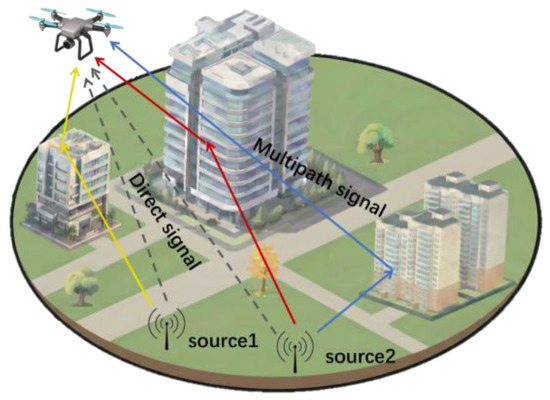
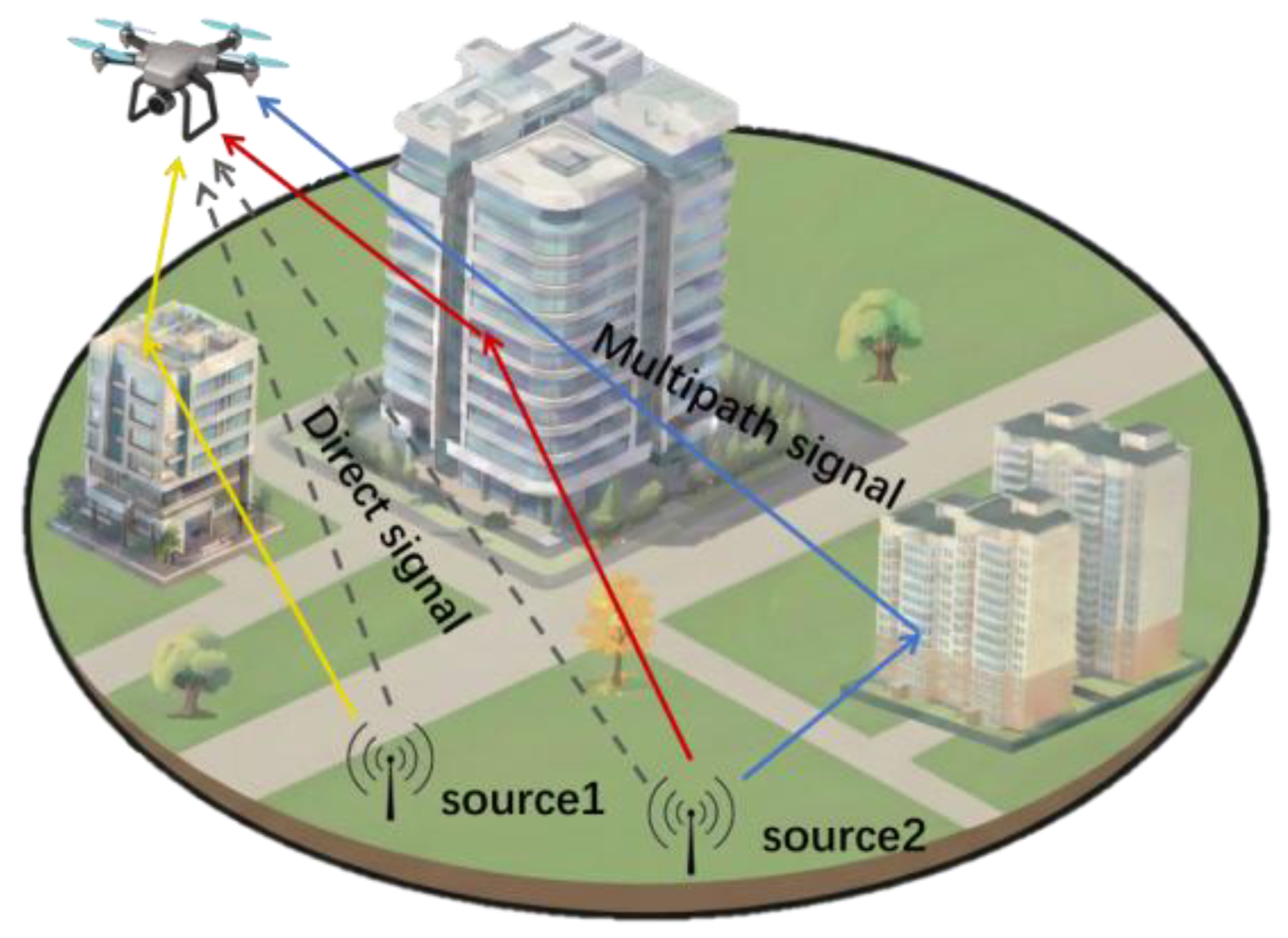
Considering the UAV reconnaissance scenario in urban environments, the radiation sources of interest for reconnaissance are mainly narrowband signals. Since there are extensive multipath effects and noise signals in urban environments, the signals received by the UAV antenna include coherent components comprising direct and multipath signals from the same source and incoherent components and interference signals from different sources. The considered scenario is shown in Figure 1. Considering that communication signals are the predominant form in practical urban reconnaissance scenarios, we assume the signal type to be OFDM narrowband signals. Modern airborne reconnaissance payloads offer high sampling rates and short sampling periods; thus, parameters such as the amplitude and direction of the received signals do not change significantly within a short sampling interval, allowing them to be treated as quasi-static snapshots. To simplify the system model without loss of generality, we assume the noise is additive, independent of the signals, and spatially white across the array elements. Finally, given the requirement for high stability of the array antenna in direction-finding systems, we assume the UAV’s attitude remains stable and constant during its movement.
Figure 1.
System scenario diagram.
Without loss of generality, we define that the array receives K far-field narrowband signals. Considering the practical multipath scenarios, some of these signals are assumed to be coherent. The i-th radiation source signal si(t) is expressed as
where is the amplitude envelope of the signal, is the angular frequency of the signal, and is the phase of the signal .
The antenna array is assumed to be a uniform linear array (ULA) composed of M elements. In particular, the noise is considered to be additive and independent of the signals, and the noises of different array elements are also independent from each other.
The observation value of the m-th sensor at the l-th time snapshot is expressed as
where denotes the steering vector of the m-th array element corresponding to the k-th signal, is the signal wavelength, d is the spacing between array elements, and is the incident angle of the k-th signal. is the additive noise of the array element m at the l-th snapshot. is the complex amplitude of the k-th signal at the l-th time snapshot. is the received noise of the m-th element at the l-th time snapshot.
After L snapshots are collected by the antenna array, the complete observation matrix X can be expressed as
Let , , . Then, the observation matrix X can be simplified as
where is the signal matrix, and is the noise matrix.
The spatial correlation information of the array-received signals X is primarily hidden in its covariance matrix whose calculation serves as a key link in DOA estimation. The covariance matrix R of the array-received signals is defined as
When the signals are completely independent, the covariance matrix is a diagonal one. When the signals are partially independent, the signal covariance matrix becomes singular, resulting in a rank-deficient problem. As the ideal covariance matrix depends on statistical results from an infinite number of snapshots, it is difficult to obtain the covariance matrix directly in practical scenarios. Therefore, it must be approximated by using a limited number of snapshots to calculate the sample covariance matrix. In addition, as noise is independent of the signal, the sample covariance matrix can effectively reflect the statistical characteristic of the signal. The sample covariance matrix is defined as
3. Joint High-Precision DOA Estimation Method Based on Conjugate Cross-Correlation Matrix Reconstruction and PARAFAC Tensor Model
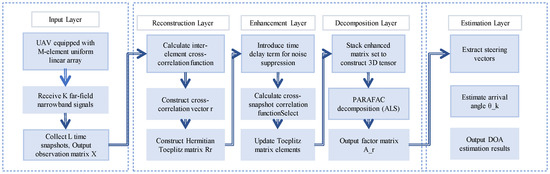
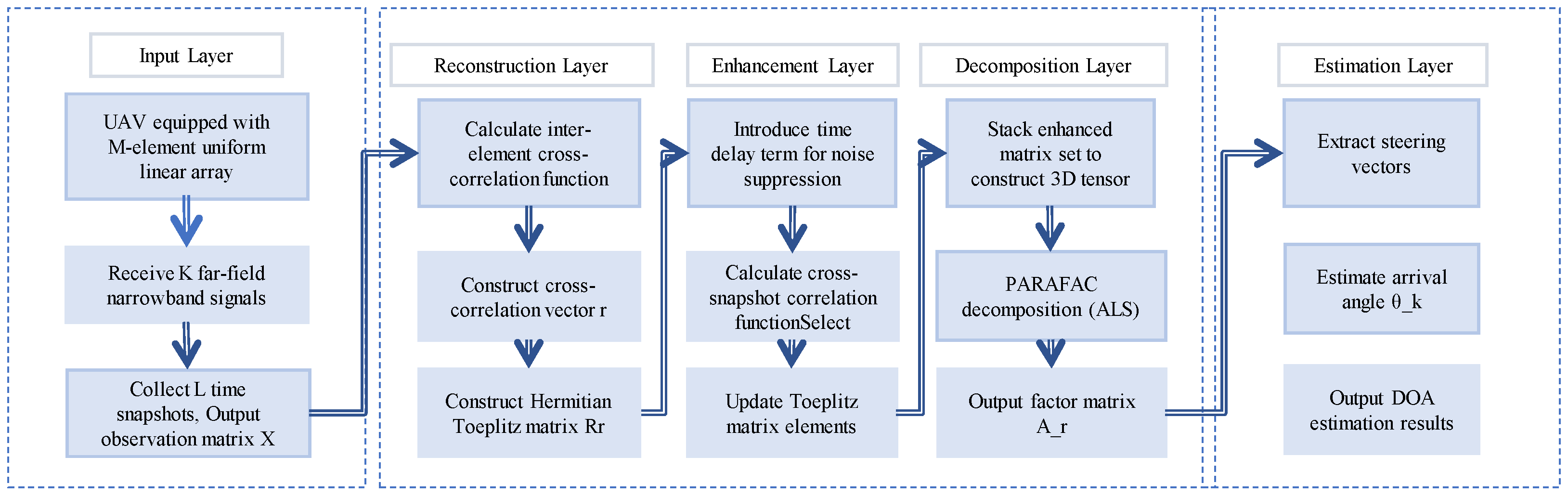
The extensive multipath effects in urban environments introduce coherent characteristics among the signals received by the UAV array, leading to a rank deficiency of the covariance matrix of the received signals and significantly degrading DOA estimation performance. Conventional decoherence methods can restore the full-rank characteristics of the covariance matrix, but they cannot solve the problem of array aperture loss. To solve these problems, this section proposes a novel joint high-precision DOA estimation method based on conjugate cross-correlation Toeplitz reconstruction and the PARAFAC tensor model. The system block diagram is shown in Figure 2. First, a conjugate cross-correlation-based Toeplitz reconstruction method using all array elements without dimensionality reduction method is employed to restore the rank of the covariance matrix, avoid array aperture loss, and maximize the utilization of all array element information. Second, noise is suppressed, and the SNR is enhanced by conducting cross-snapshot cross-correlation between the reconstruction matrix and the array element data. Finally, we stack the set of matrices obtained from the cross-correlation between the reconstruction matrix and each array element into a three-dimensional tensor, achieving high-precision UAV DOA estimation through PARAFAC tensor decomposition.
Figure 2.
System block diagram.
3.1. Full Array Toeplitz Reconstruction Without Dimensionality Reduction
To address the rank deficiency of the signal covariance matrix caused by coherent signals, the rank of the matrix can be fundamentally restored by reconstructing the rank-deficient covariance matrix into a Toeplitz matrix. Conventional Toeplitz reconstruction methods are constrained by dimensionality-reduced reconstruction and eigenvalue decomposition of the reconstruction matrix, which inevitably leads to aperture loss and the incompleteness of array element information. This subsection proposes a conjugate cross-correlation Toeplitz reconstruction method, which not only restores the rank of the covariance matrix but also avoids array aperture loss and fully utilizes all array element information.
3.1.1. Conventional Toeplitz Reconstruction Method
The fundamental mathematical principle of restoring the rank of the covariance matrix by using Toeplitz reconstruction is as follows. The positive semi-definite Hermitian-Toeplitz matrix T of any can be exclusively decomposed according to the Vandermonde decomposition theorem:
where is a Vandermonde matrix of , and is a diagonal matrix composed of the eigenvalues of T (nonnegative real numbers). If T is the covariance matrix of the array-received signals, then it represents the array manifold vector whose column vector describes the phase response of a signal arriving from the direction at each array element. The diagonal matrix is the signal source matrix whose diagonal elements represent the power of each array-received signal.
Therefore, once the original rank-deficient matrix is reconstructed into a Toeplitz matrix, the Vandermonde decomposition theorem guarantees that the Toeplitz matrix can be decomposed into the product of the Vandermonde matrix and a diagonal matrix. The resulting matrix equals the number of detected signal sources, effectively overcoming the rank deficiency of the covariance matrix caused by signal coherence.
Dimensionality-reduced reconstruction partition is a commonly used strategy for Toeplitz matrix reconstruction. Assuming that a ULA comprises 2M + 1 sensor elements numbered from −M to M, the observation matrix at time t reconstructed by using the observed data from this array is expressed as:
Based on the Vandermonde decomposition principle, the above equation can be rewritten as
According to the above content, represents the array manifold matrix, and denotes the diagonal matrix composed of signal sources. Since the array manifold matrix A is full-rank and the signal source matrix is a nonsingular diagonal matrix, the rank of A is the same as that of S. This ensures the full-rank characteristic of the covariance matrix, effectively solving the rank deficiency problem caused by coherent signals. However, due to the above matrix reconstruction strategy, only an (M + 1)-dimensional Toeplitz matrix can be reconstructed by using 2M + 1 array elements. This results in a severe array aperture loss, reducing the number of discernible signal sources.
After the rank deficiency of the covariance matrix is restored, the signal subspace and the noise subspace can be further distinguished. To avoid noise contamination and optimize the utilization of array element data in subsequent processing, we introduce a correlation matrix that analyzes the correlation between the subspace and each array element. In conjunction with Equation (8), we define the correlation matrix of and the data of the i-th array element as
where represents the signal component, is the matrix with all elements as zero except the unit element on the i-th diagonal and denotes the power of the additive noise.
The above equation reveals that noise is confined to the i-th diagonal corresponding to the i-th element. However, using a non-central element as the reference results in a non-scalar noise matrix. Conventional eigenvalue decomposition methods, which are employed to separate signal and noise subspaces, fail to address this subspace ambiguity and thus lead to decomposition errors. Consequently, they are limited to using the central element as the reference, causing a substantial loss of information.
In summary, conventional Toeplitz reconstruction methods can effectively restore the rank deficiency of the covariance matrix. However, their strategy reduces the dimensionality of the reconstruction matrix, resulting in aperture loss and reducing the number of discernible signal sources. Furthermore, these methods employ subspace partitioning based on eigenvalue decomposition (EVD), and EVD is highly sensitive to noise contamination. Therefore, conventional methods can only utilize the signals of the central array elements, resulting in a low utilization efficiency of the UAV array element information.
3.1.2. The Proposed Reconstruction Method
To overcome the aperture loss and low utilization efficiency of array element information in conventional Toeplitz reconstruction methods, we propose a novel conjugate cross-correlation Toeplitz reconstruction method without dimensionality reduction. This method reconstructs an M-dimensional Toeplitz matrix by using all M array elements, avoiding aperture loss caused by dimensionality reduction and fully utilizing all array element information of the UAV. It restores the rank deficiency of covariance matrix, eliminates aperture loss, and improves the utilization efficiency of the UAV array element information.
First, we define the i-th array element as a reference element. The cross-correlation function between the i-th array element and the j-th element is expressed as
where denotes the signal covariance matrix, is the noise power, is the Dirac function, and equals 1 only when . According to Equation (11), for a ULA with M elements, the cross-correlation vector between array elements can be expressed as
To avoid aperture loss caused by dimensionality reduction, we introduce the conjugate form r*(k) of the cross-correlation function r(k) and utilize r(k) and r*(k) to construct an Hermitian Toeplitz matrix as
whose the (m, n) element is
According to the Vandermonde decomposition principle, any reconstructed Toeplitz matrix can be decomposed into the product of a Vandermonde matrix and a diagonal matrix whose rank equals the number of detected signal sources, resolving the rank-deficiency problem. Moreover, it can be seen after comparing Equations (8) and (13) that the conventional Toeplitz reconstruction method using 2M + 1 array elements can only construct an M + 1-dimensional Toeplitz matrix. In contrast, the newly proposed method in this paper can construct an M-dimensional Toeplitz matrix by using M array elements, avoiding the dimensionality reduction of conventional methods and eliminating aperture loss.
Combining the Vandermonde decomposition principle, Equations (5) and (13) can be further expressed as
Since the signal and noise are mutually independent, we have
Equation (15) can be further simplified as
where is an M × M matrix with all elements as zero except the unit element on the -th diagonal. Notably, the residual noise is not proportional to an identity matrix but concentrates on the i-th diagonal induced by the reference-element construction. Therefore, instead of directly applying an eigendecomposition-based procedure, we proceed to a tensor formulation that explicitly exploits the multilinear structure across different reference elements. Let , . Then,
As the noise term is only distributed along the i-th diagonal, the noise covariance matrix cannot be transformed into a scalar matrix, which makes it difficult for conventional eigendecomposition methods to effectively extract the signal subspace. Therefore, a novel subspace processing strategy must be introduced. In this paper, we employ the PARAFAC tensor-based method for subspace decomposition (see Section 3.3 for details). This method uses rank-1 tensors as the basic decomposition units, separating signals from noise even when the noise covariance matrix is non-scalar.
3.2. Cross-Snapshot Correlation Processing
The pervasive noise and interference in urban environments adversely affect the interception of radiation source signals by UAVs. Enhancing the SNR of observation data through signal processing techniques is therefore essential for enhancing DOA estimation accuracy. As signal correlation across snapshots is generally stronger than noise correlation, correlation operations can be employed to enhance useful signal energy accumulation, suppress random noise, and achieve effective SNR improvement.
Based on the radiation source signal model defined in Equation (1), we define the signals received by the arrays from different snapshots as
where is the amplitude envelope of the signal, is the angular frequency of the signal, is the phase of the signal, and is the time delay between snapshots.
We consider the signal to be a quasi-static narrowband signal, and the amplitude and phase of the received signal change little within a short observation time. That is, ,. After substituting them into Equation (19), it can be expressed as
Furthermore, the cross-snapshot cross-correlation function received by the i-th array element is defined as
Considering that the signal and noise are mutually independent and the noises at different snapshots are also independent, the above equation can be simplified by combining it with Equation (17),
It can be observed from this equation that after the cross-correlation operation, the energy of the signal s(t) is retained or even enhanced, and its phase relationship is retained in the term . In contrast, random noise is effectively suppressed. It achieves signal energy accumulation and noise signal suppression, improving the SNR of the received signals.
To further enhance the SNR of the observation data, this section introduces a cross-snapshot correlation processing method based on Equation (14) in Section 3.1.2. In Equation (23), denotes the snapshot interval, and i represents the reference array element. The Toeplitz matrix element in Equation (14) is updated as (m, n) after cross-snapshot processing:
in Equation (18) is updated as :
where denotes the time-delay term brought by cross-snapshots, and ⊙ represents the Hadamard product (element-by-element multiplication).
Let . Then, we have
In practical scenarios, as the number of received snapshots is limited, the cross-snapshot cross-correlation cannot completely eliminate noise interference, and there is still some noise left. Therefore, the final can be expressed as
After performing signal decoherence in Section 3.1 and SNR enhancement in Section 3.2, the Toeplitz matrix can be obtained from Equation (27). The next step is to extract the signal subspace from . As shown in Equation (27), the noise terms are distributed along the i-th diagonal, preventing the noise covariance matrix from being transformed to a scalar matrix. However, scalar noise covariance matrix is a theoretical prerequisite for conventional EVD methods. Therefore, a novel subspace processing method is used to extract the signal subspace under such conditions.
3.3. Signal Subspace Extraction Method Based on PARAFAC Tensor Decomposition
To solve this problem, we use the idea of Toeplitz matrix reconstruction, stack the observation data into MXMXM tensors, and extract signal subspace by using PARAFAC tensor decomposition. Different from conventional EVD, the PARAFAC method decomposes the tensors based on multilinear algebra, representing the Toeplitz matrix as a sum of multiple rank-1 tensors, and directly estimates the factor matrices by using algorithms such as the ALS algorithm to extract the subspace information. Noise is treated as a fitting residue, which is naturally separated in the process of optimization. Consequently, PARAFAC tensor decomposition does not rely on such a stringent condition that noise covariance matrix must be a scalar matrix.
First, each array element is successively selected as a reference array element, and the matrix reconstruction is conducted according to Equation (27). The reconstructed M matrices are then stacked along the array element dimension to form MXMXM tensors :
where m denotes the matrix obtained from the cross-correlation between the reconstruction matrix and the m-th array element. Specifically, the m-th frontal slice of the tensor corresponds to the reconstructed matrix . Under the PARAFAC model, the factor matrices capture the shared direction steering information across modes, which allows the DOAs to be extracted from the estimated direction matrix without altering the preceding Toeplitz reconstruction. According to the PARAFAC tensor model, the tensor can be further expressed as
where is the core tensor, and are the direction matrices and their conjugates, respectively, is the signal matrix, and is the noise tensor. The construction process of this tensor model effectively utilizes all the information contained in the covariance matrix and avoids aperture loss caused by matrix reconstruction.
After obtaining the tensor , we conduct model expansion for to transform the high-dimensional tensor into low-dimensional matrices so as to extract the signal subspace. The matrix is obtained after expanding in the first model:
where represents the noise matrix expanded in the first model.
Next, the matrix is obtained after expanding in the second model:
where represents the noise matrix expanded in the second model.
Finally, the matrix is obtained after expanding in the third model:
where represents the noise matrix expanded in the third mode.
After obtaining the expanded matrices YA, YB, and YC, we employ the trilinear ALS algorithm to estimate the steering vectors. This algorithm is an efficient trilinear decomposition algorithm, using the LS cost function to alternately calculate the direction matrix and the signal matrices , and . When the fitting error reaches the expected range, the factor matrices can be solved, and the steering vector can be obtained.
Fix and , and update by the least squares (LS):
Therefore, the LS estimate of is estimated as
Similar to the LS estimation process of , we construct the cost functions for the second and third models,
and obtain the estimation values of and :
Finally, the fitting error of the current iteration is evaluated. If the relative error falls below the preset threshold value, the iteration stops.
The convergence threshold is a critical parameter in the alternating least squares (ALS) algorithm. If the threshold is set too high, the algorithm may terminate prematurely before convergence, resulting in insufficient solution accuracy. Conversely, if the threshold is set too low, it significantly increases unnecessary iterations, causes computational resource waste and low training efficiency, and may even prevent convergence due to numerical errors. In signal processing, this key threshold is typically selected based on empirical knowledge. Reference [27] investigated the same ALS tensor decomposition algorithm adopted in this paper, setting the iterative stopping threshold for the ALS algorithm to . Furthermore, in the widely used Matrix Laboratory (MATLAB) Tensor Toolbox for tensor decomposition, the default iterative stopping threshold for the ALS algorithm is , which represents an ideal trade-off determined by the developers through extensive numerical experiments and practical experience. Based on these considerations, this paper adopted the empirical value of as the iterative stopping threshold.
The initialization sensitivity and convergence behavior of PARAFAC-ALS are critical considerations in the practical deployment of tensor decomposition methods. PARAFAC-ALS minimizes the tensor reconstruction error via alternating least squares; however, as the global objective function is non-convex, different initialization values can lead to varying convergence trajectories—a common characteristic of ALS-based methods. Consequently, initialization sensitivity and convergence properties must be carefully addressed when employing PARAFAC-ALS. In this paper, PARAFAC-ALS is utilized to perform low-rank decomposition on a structured Toeplitz tensor constructed from correlation statistics. Since the constructed tensor satisfies the uniqueness condition, the PARAFAC decomposition is essentially unique up to scaling and permutation ambiguities. Therefore, the solutions obtained from different initialization values tend to converge to the same physical interpretation, effectively achieving robustness against initial conditions and ensuring stable convergence.
For the PARAFAC tensor model, the uniqueness of the decomposition is guaranteed by the Kruskal condition, as shown in the following equation:
where denotes the Kruskal rank of matrix (i.e., the maximum number of linearly independent column vectors of a matrix). As and are Vandermonde matrices and the signal directions are different from each other, their Kruskal ranks are . Given that the incident signals are mixed, the Kruskal rank of is ≥2. Therefore, the uniqueness condition is:
When the number of incident signals does not exceed K, the decomposition is guaranteed to be unique, ensuring accurate DOA estimation. After the ALS algorithm completes the decomposition, we obtain the estimated factor matrices , , and . Due to the uniqueness of the PARAFAC decomposition, the columns of these factor matrices are automatically paired, eliminating the need for any additional pairing procedures.
After is obtained, the DOA information can be extracted. If is the i-th normalized column of , then its phase is
The phase information is then used to construct the steering vector and obtain the phase difference through adjacent array elements. That is, the angle of arrival can be estimated.
After completing the above derivations, the overall implementation of the proposed method is summarized in Algorithm 1.
| Algorithm 1 Proposed method |
|
4. Simulation Experiments
In this section, simulation experiments were conducted to evaluate the performance of the proposed method in a UAV-based reconnaissance scenario involving ground radiation sources. We assumed the UAV was equipped with a uniform linear array of M = 9 mainly reflecting engineering constraints on UAV payload and array installation size, serving as a representative scale for compact arrays while still providing the basic spatial degrees of freedom required for multi-source DOA estimation and algorithm comparison. In the angle configuration, source A consisted of a direct path at 10° superimposed with a dominant coherent reflected path from −20°, modeling a typical challenging “direct-path–strong coherent multipath” scenario caused by urban building reflections; source B contained only a direct path at 30°, forming a more realistic mixed scenario where coherent and non-coherent signals coexist. To ensure stable statistical conclusions, 500 Monte Carlo trials were used to reduce the impact of random fluctuations on the RMSE curves and error bars. Therefore, the simulated reconnaissance scenario included both coherent and non-coherent signals, which aligns with the signal characteristics of typical scenarios. To further analyze the effectiveness of the proposed method in this paper, we compared it with traditional methods such as MUSIC, FSS, and MTOEP. Additionally, numerical simulations were conducted using 500 Monte Carlo trials to ensure the statistical reliability of the experimental results. The above parameter choices are summarized in Table 2 for clarity and reproducibility.
Table 2.
Key simulation parameters.
4.1. Experiment 1: Spatial Spectrum Analysis in DOA Estimation
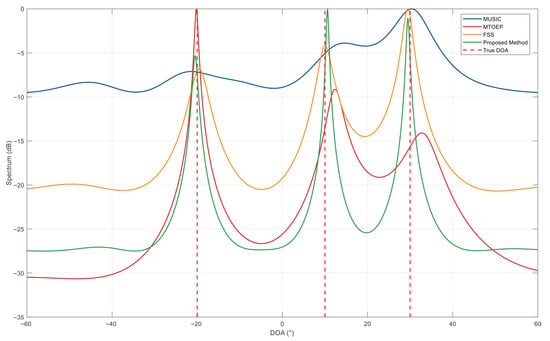
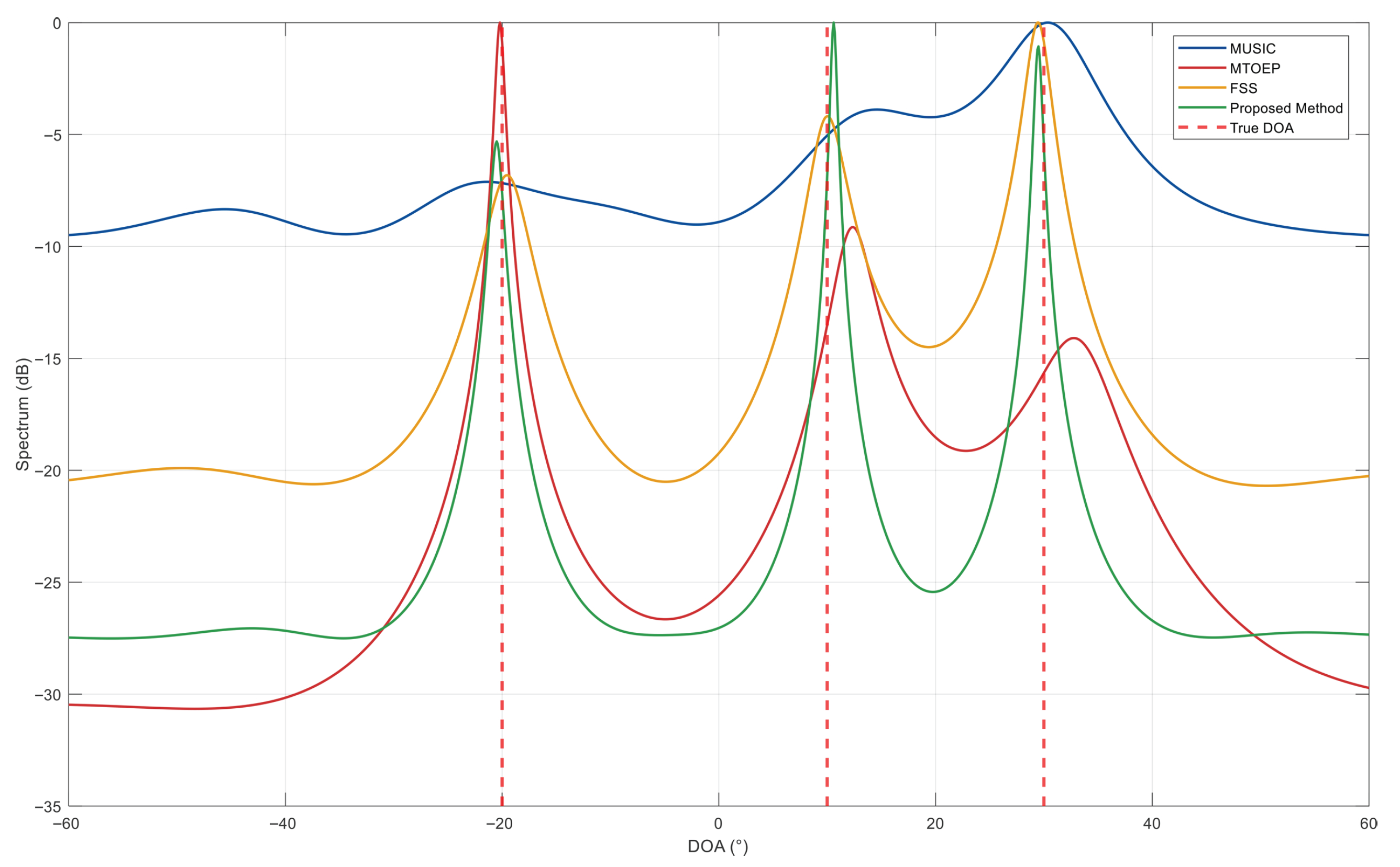
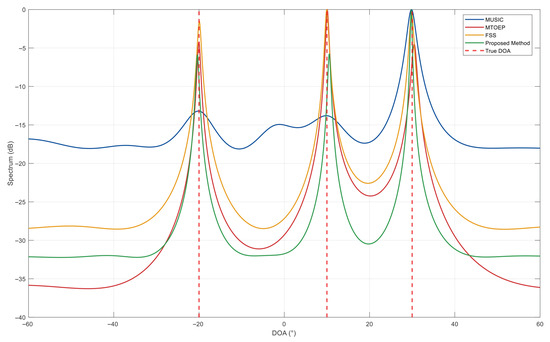
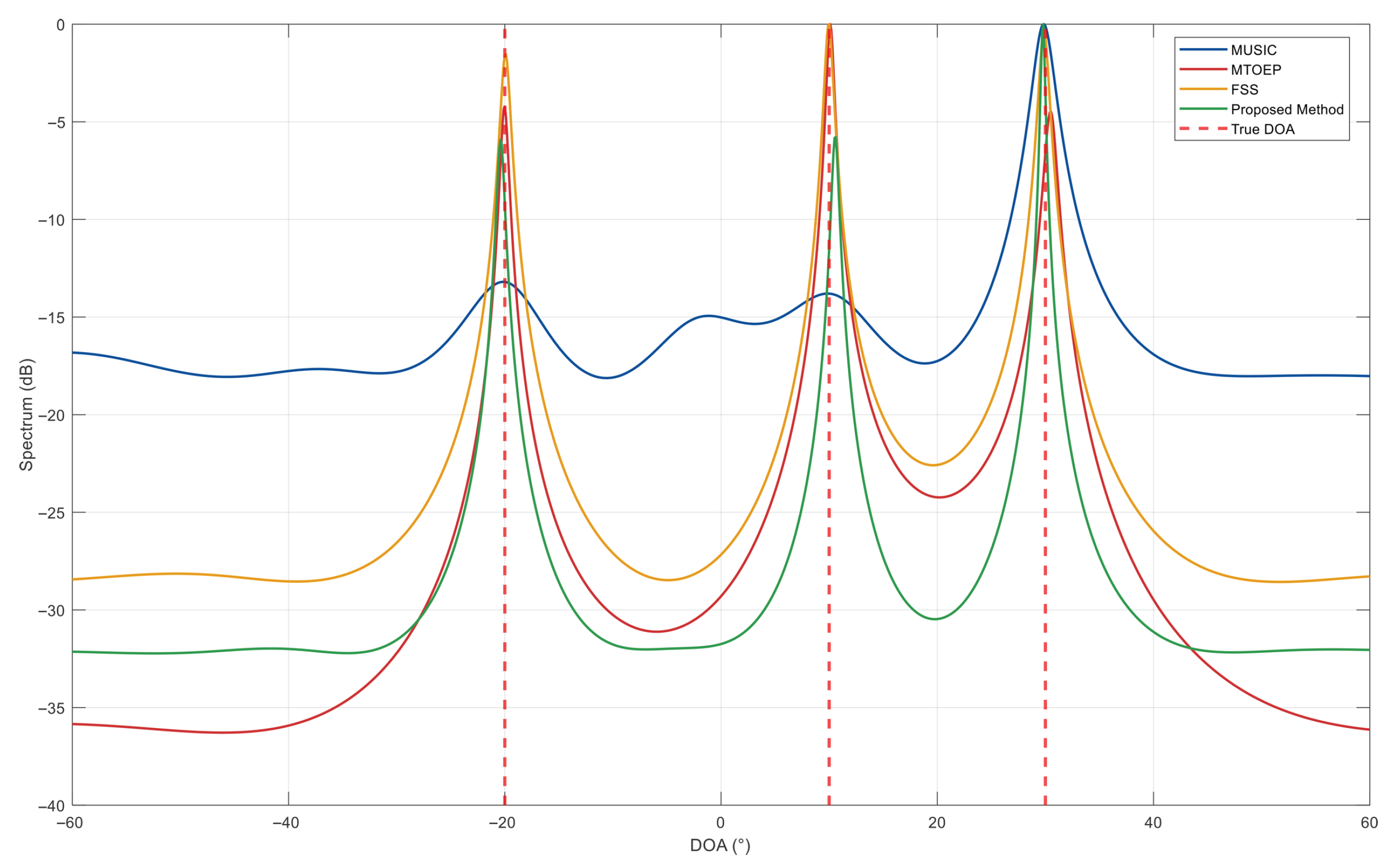
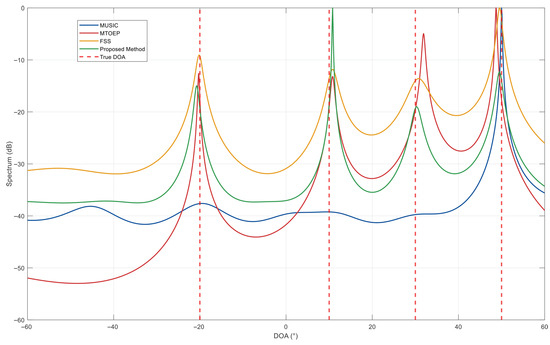
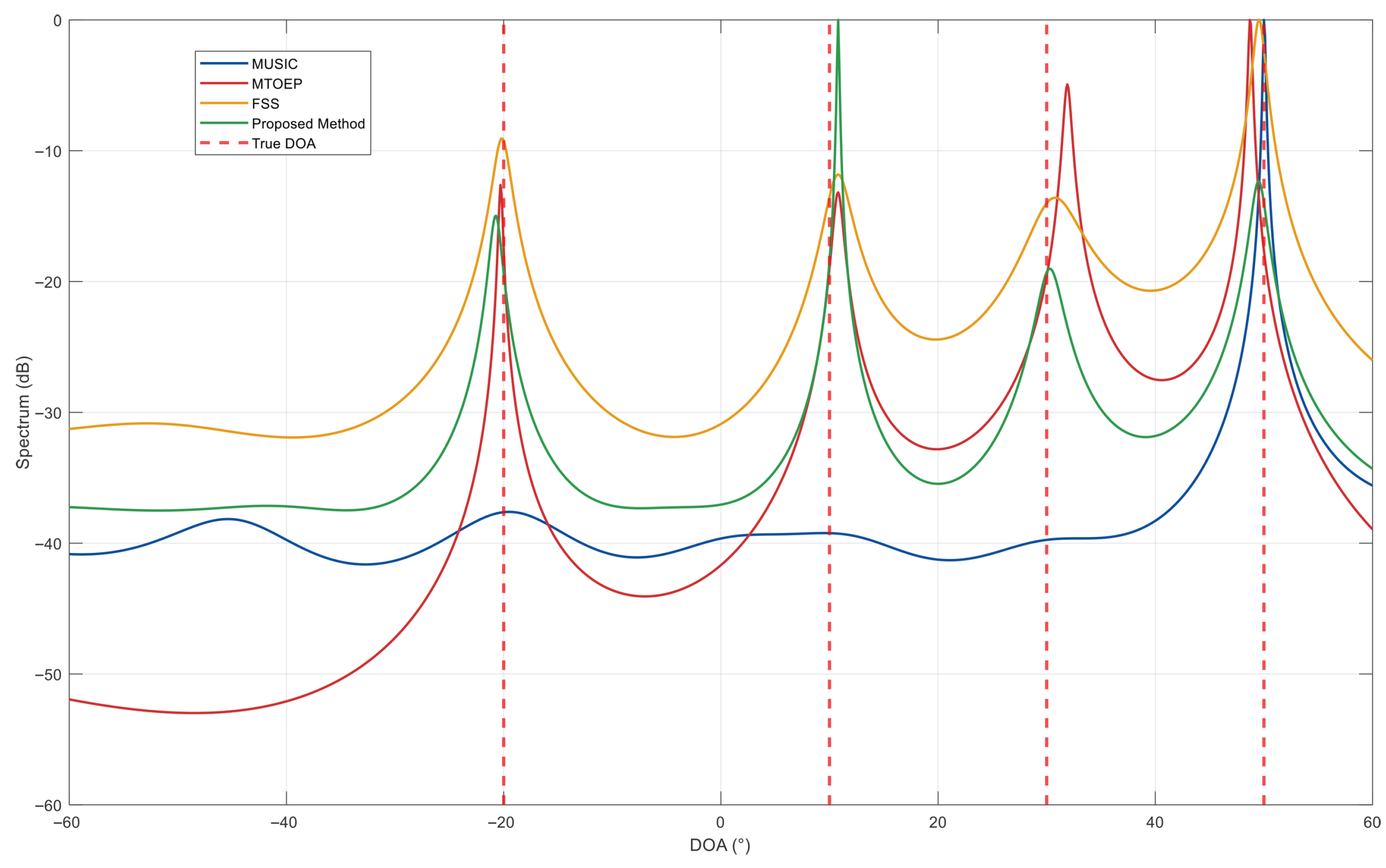
This experiment compared the proposed method with the three conventional methods under two SNR and snapshot conditions, as shown in Figure 3 (SNR = −5 dB, L = 100) and Figure 4 (SNR = 5 dB, L = 200). The setting SNR = dB and represents a difficult scenario with low SNR and limited observation time, whereas SNR = 5 dB and represents a relatively mild observation condition. These two cases were used to compare the peak resolvability and robustness of different algorithms under changing observability. The experimental results demonstrated that in different conditions, the conventional subspace-based MUSIC algorithm failed completely in coherent signal scenarios. The MTOEP matrix reconstruction method, FSS spatial smoothing method, and the proposed Toeplitz-tensor decomposition method could resolve three distinct spectral peaks. However, the proposed algorithm generated significantly sharper and smoother peaks, which showed its superior performance in coherent signal processing.
Figure 3.
Spatial spectrum of different algorithms (SNR = dB, ).
Figure 4.
Spatial spectrum of different algorithms (SNR = 5 dB, ).
4.2. Experiment 2: Analysis of DOA Estimation Accuracy and Robustness
Estimation accuracy is a key indicator for evaluating the DOA algorithm. In this experiment, the root-mean-square error (RMSE) was used to assess the effects of SNR, number of snapshots, and signal correlation on algorithm performance. To better reflect the performance of the algorithm, the experimental results are presented with RMSE curves as well as error bars to assess the accuracy and stability of DOA estimation for different methods.
- 1.
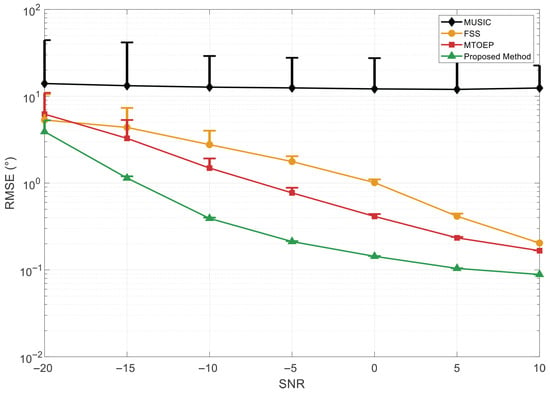
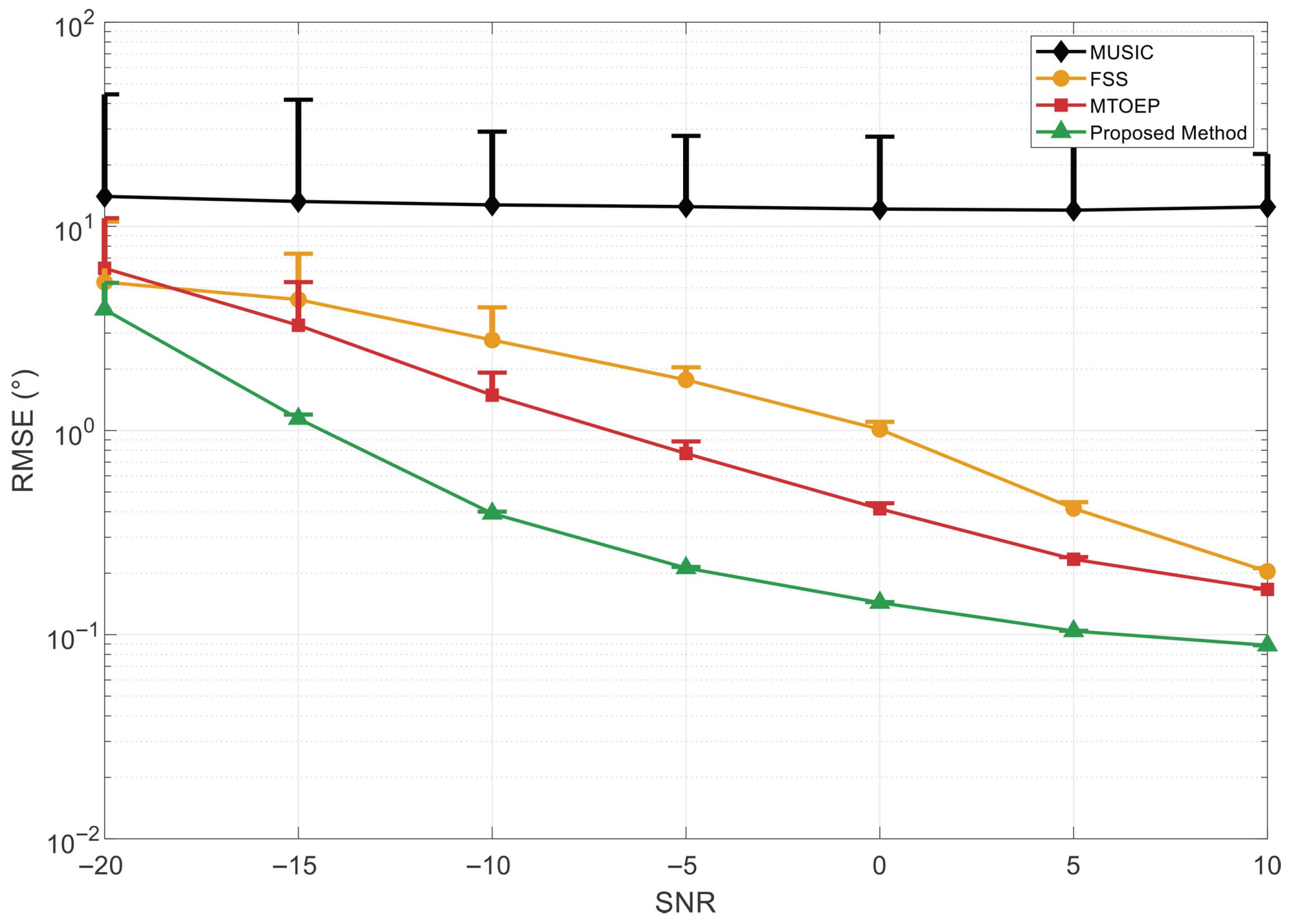
- Effect of SNR on RMSE: Figure 5 shows the relationship between RMSE and SNR in different algorithms under snapshots. From the error bars, it can be observed that the length of the error bar for the MUSIC algorithm was the longest, indicating that the algorithm failed due to the rank deficiency of the covariance matrix in the presence of correlated signals, leading to poor DOA estimation results. Regarding RMSE performance, the proposed method in this paper achieved the smallest error, with its RMSE curve consistently closest to the Cramér–Rao Bound (CRB), demonstrating particularly significant advantages in the low SNR region. As both the MTOEP method and the method proposed in this paper fall into subspace-based methods and share the same simulation conditions, their theoretical lower bounds were comparable. When the SNR was −20 dB, the estimation errors of the two methods were similar. As the SNR increased, the estimation accuracy of the proposed method surpassed that of the MTOEP method significantly. When the SNR further increased to high levels, both methods gradually converged toward the error’s lower bound, and the performance gap narrowed accordingly. This phenomenon occurred because the SNR gain introduced by the cross-snapshot correlation processing was not significant at approximately −20 dB, where the signal was still largely submerged by noise. As the SNR increased, the effect of this gain gradually became apparent. However, when the SNR continued to increase to 5 dB, the noise influence was weak, and this gain effect weakened again. Specifically, in the above figure, the proposed method achieved root-mean-square error (RMSE) values of 1.19°, 0.75°, and 0.4° at SNRs of −15 dB, −10 dB, and −5 dB, respectively. In contrast, for the MTOEP method to achieve the above RMSE values, the required SNRs were −7 dB, −1 dB, and 4dB, respectively. In summary, the proposed method achieved optimal estimation accuracy due to two key advantages: on one hand, the construction of the Toeplitz matrix through cross-snapshot correlation enhanced the SNR; on the other hand, the application of tensor PARAFAC decomposition further improved parameter estimation precision.Figure 5. RMSE variation of DOA estimation with SNR (L = 500).
- 2.
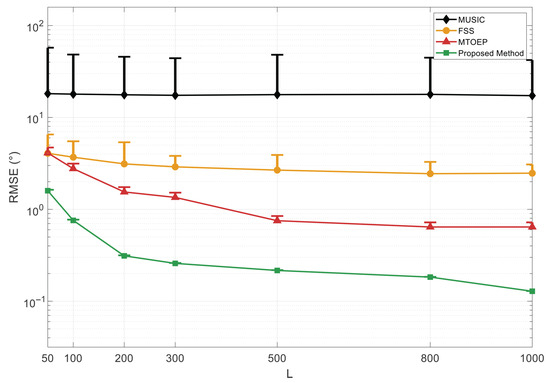
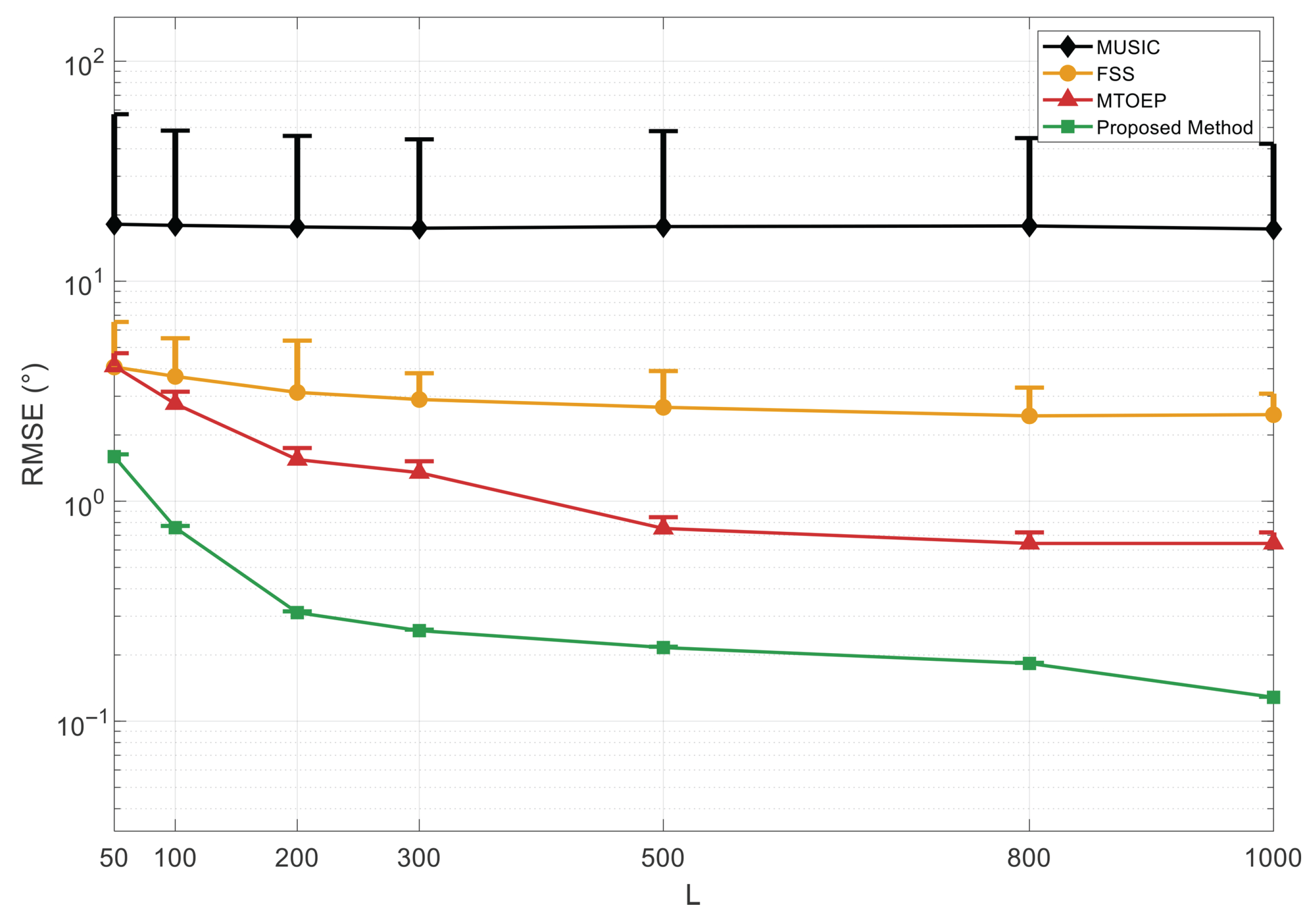
- Effect of the number of snapshots on RMSE: Figure 6 shows the relationship between RMSE and the number of snapshots L for different algorithms at SNR = dB, evaluating their convergence performance under limited snapshots. The results show that the proposed method required only 200 snapshots foe the RMSE to converge below 1°, achieving the fastest convergence rate among all methods. In contrast, the MTOEP algorithm required more than 500 snapshots to reach a similar accuracy. By adopting tensor decomposition, the proposed method did not rely on the statistical averaging of the covariance matrix due to the uniqueness of tensor decomposition, reducing its dependence on snapshots and demonstrating its suitability for practical scenarios with limited snapshots.Figure 6. RMSE variation of DOA estimation with L (SNR = −10 dB).
- 3.
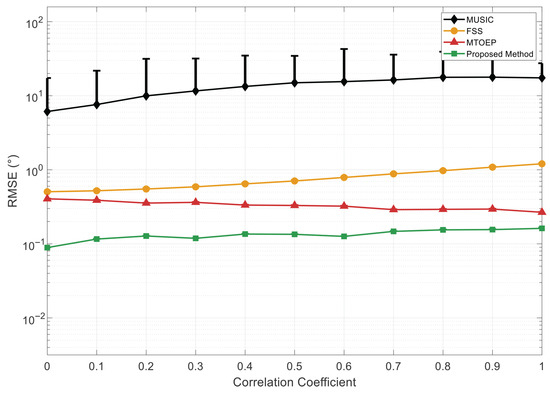
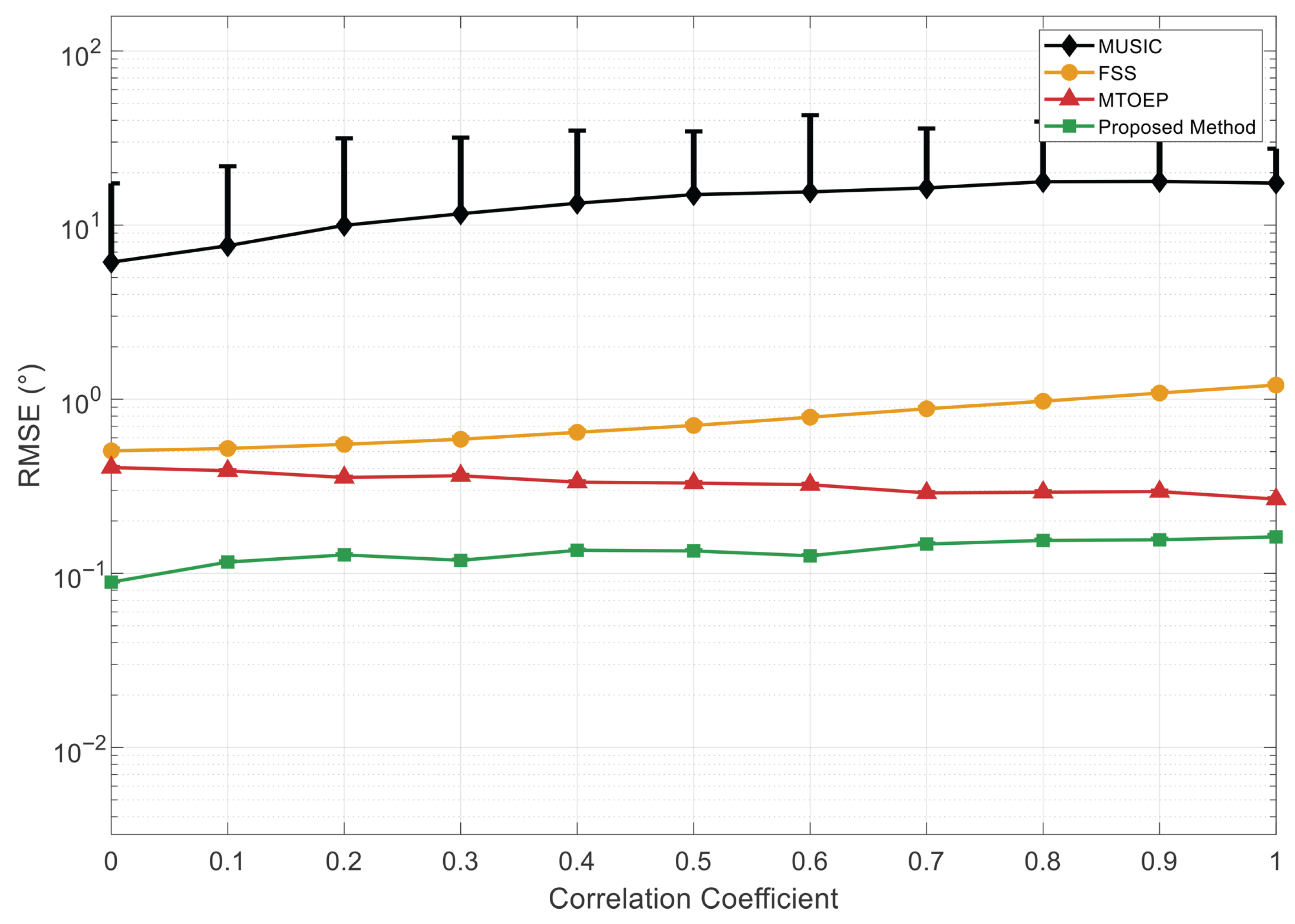
- Effect of correlation coefficient on RMSE: Figure 7 illustrates the RMSE performance of different algorithms versus the inter-signal correlation coefficient when SNR dB and the snapshot number L = 500. In the simulation, the correlation between signals was modeled via an autoregressive parameterization process, where the parameter varied within the interval [0, 1] to quantify the degree of coherence: indicated fully coherent signals, while indicated statistically independent signals. This advantage originates primarily from its core Toeplitz matrix reconstruction operation, which effectively eliminates inter-signal correlation and makes the final azimuth estimation independent of the original correlation characteristics of the incident signals. The spatial smoothing-based FSS method exhibited performance degradation as signal correlation increased. Although such methods are essentially phase averaging and can restore the rank of the covariance matrix to some extent, they remain sensitive to inter-signal correlation and cannot thoroughly resolve the coherence issue. The MTOEP method also adopts the concept of matrix reconstruction and thus showed certain capabilities in handling signal correlation, with its performance being relatively less affected by variations in . However, under high coherence conditions (), the proposed method continued to outperform the comparison methods, highlighting the advantage of tensor decomposition in fully exploiting data structure information.Figure 7. RMSE variation of DOA estimation with correlation coefficient.
4.3. Experiment 3: Analysis of Multi-Source Estimation Capability
In this experiment, we set SNR = dB and , with the number of signal sources increasing from three to six. The MTOEP algorithm, which is limited by its dimensionality-reduced Toeplitz matrix reconstruction, can resolve at most sources. Thus, when the number of sources exceeded four, it completely lost DOA estimation capability. In contrast, the FSS method and the proposed method were able to estimate DOA under different numbers of sources. The RMSE of the proposed method was consistently lower than that of the FSS method. This advantage originated from the use of tensor decomposition in the proposed method, which demonstrated higher estimation accuracy and stronger multi-source resolution capability compared with the matrix decomposition in the FSS method.
4.4. Comprehensive Analysis of Algorithm Performance
Table 3 summarizes the overall performance comparison among different algorithms. In terms of decoherence capability, as shown in the spatial spectrum comparison between Figure 3 and Figure 4, the traditional MUSIC algorithm was completely ineffective under coherent signals. Although the MTOEP and FSS methods were able to produce spectral peaks, their resolution and sharpness were inferior to those of the proposed method. This verifies that by constructing the Toeplitz matrix through conjugate cross-correlation and combining it with PARAFAC decomposition, the proposed method can more effectively restore the rank of the signal subspace and achieve robust estimation in a strongly coherent environment. In terms of estimation accuracy and robustness, the RMSE curves in Figure 5 indicate that the estimation error of the proposed method under a low SNR of −18 dB was much lower than that of other comparison methods. Meanwhile, the results in Figure 6 show that the proposed method exhibited faster convergence speed under the condition of a limited number of snapshots. This is attributed to its enhanced signal accumulation through cross-snapshot cross-correlation operations and the use of the PARAFAC model which avoids the reliance of conventional methods on the statistical average of a large number of snapshots.
Table 3.
Comprehensive analysis of algorithm performance.
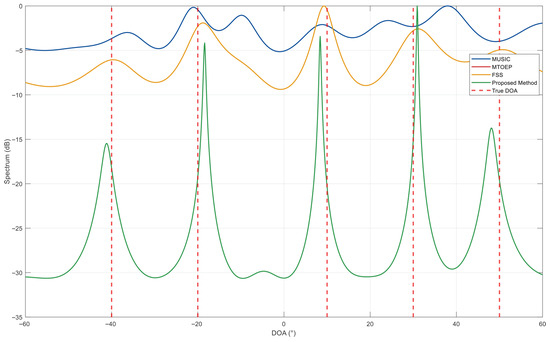
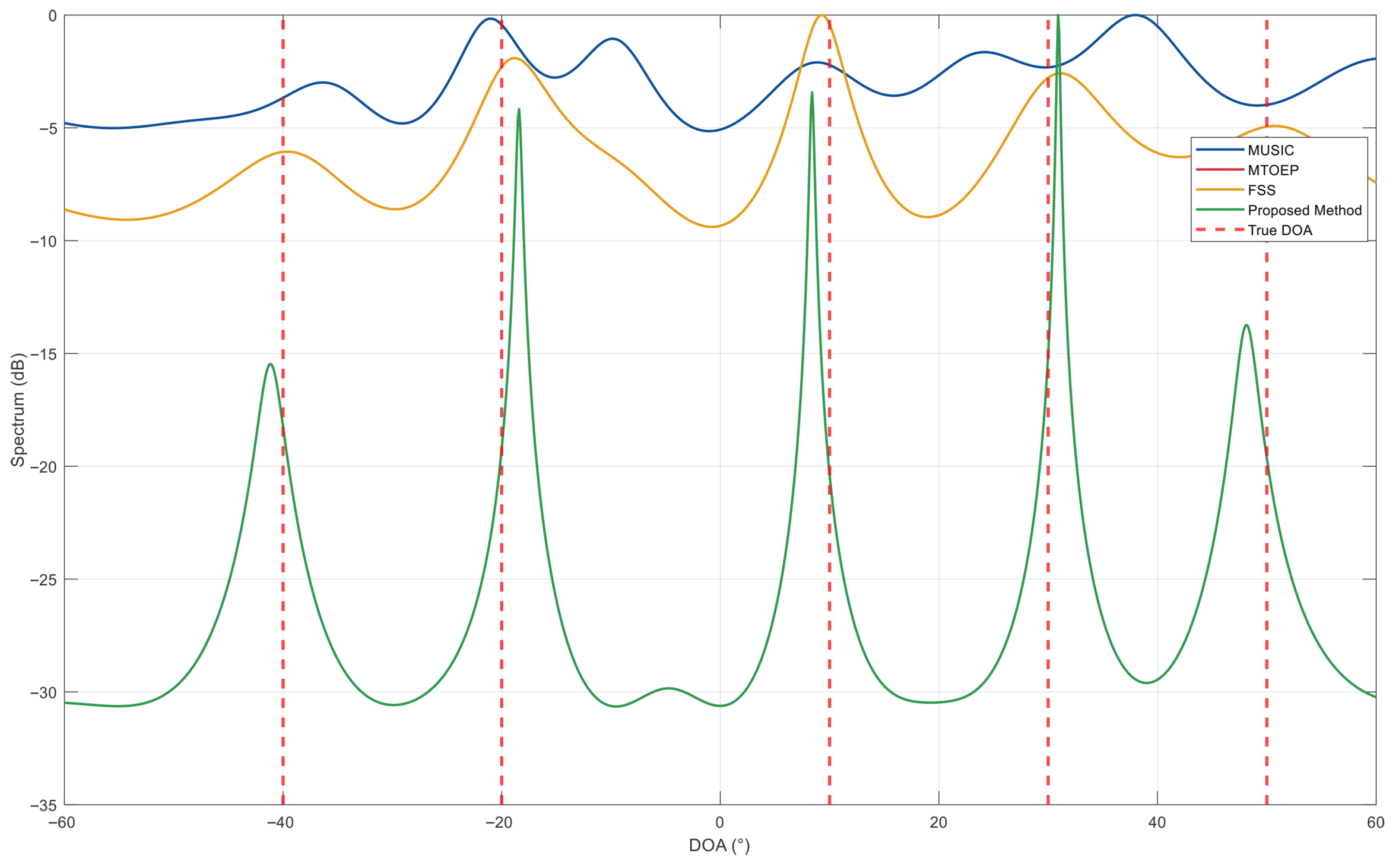
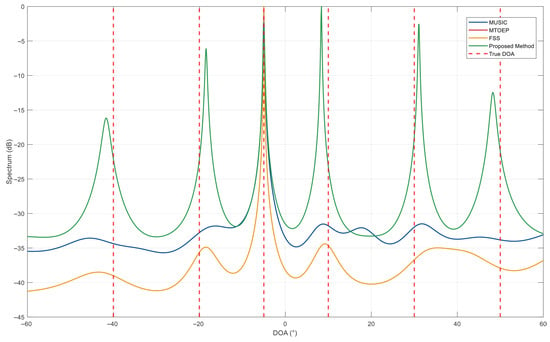
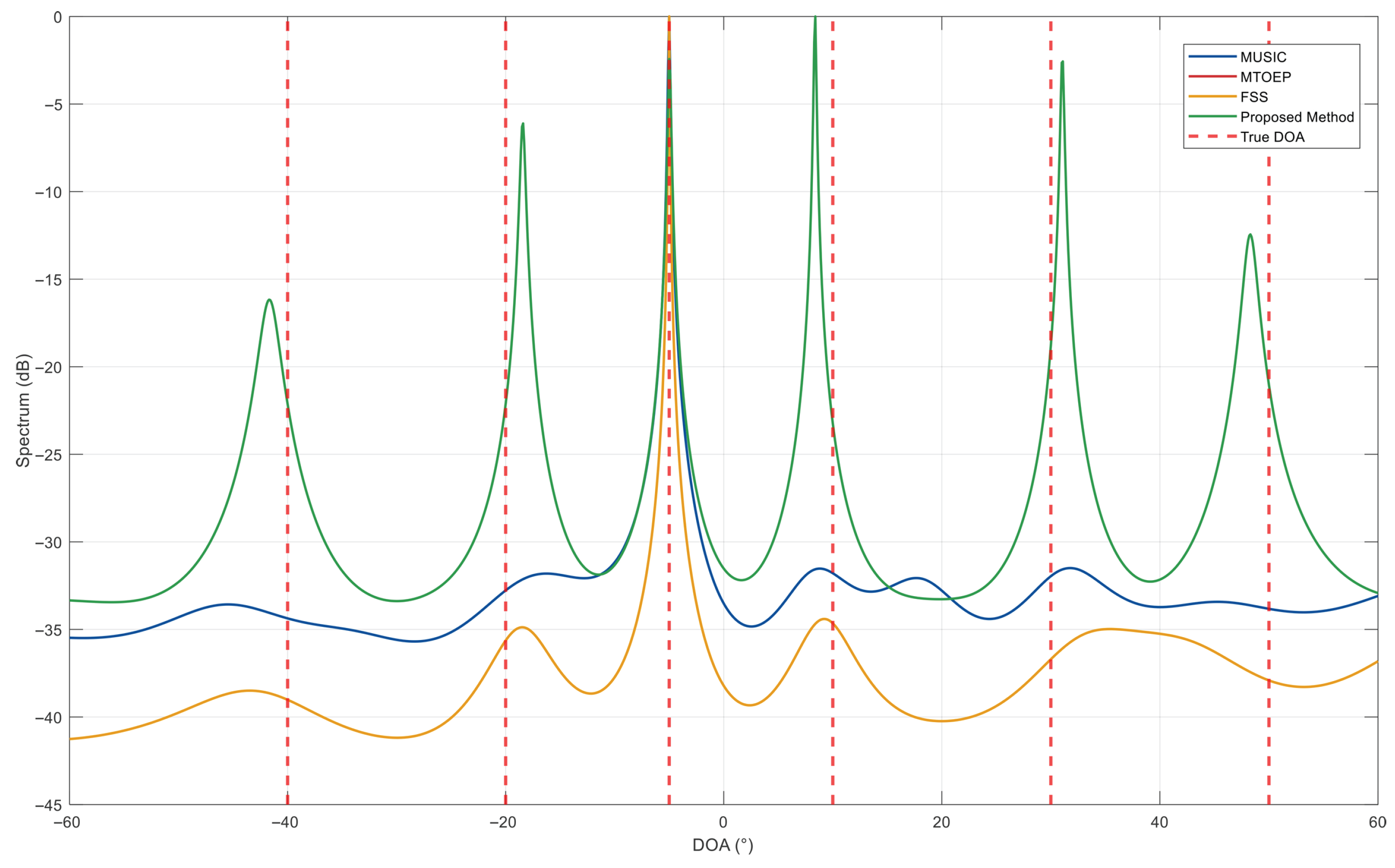
The simulation experiments verified the multi-source resolution capability and aperture utilization rate by gradually increasing the number of signal sources. Figure 8, Figure 9 and Figure 10 show that for an array with nine elements, when the number of signal sources increased to six, the proposed method was still able to accurately distinguish them, while the MTOEP method was limited by its inherent aperture loss and had a theoretical upper limit to its resolution ability. This advantage directly stems from the core design of the proposed method: It adopted a Toeplitz reconstruction strategy without dimensionality reduction. As a result, all array element information was fully utilized, effectively avoiding array aperture loss at the physical level and providing a solid hardware foundation for high-resolution multi-source estimation.
Figure 8.
Spatial spectrum of different algorithms (4 sources).
Figure 9.
Spatial spectrum of different algorithms (5 sources).
Figure 10.
Spatial spectrum of different algorithms (6 sources).
We analyzed the computational complexity of four methods and compare them in Table 4. Let the number of array elements be M and the number of snapshots be L. In spatial smoothing, the array is divided into P overlapping subarrays, each of length N, and the number of PARAFAC-ALS iterations in the proposed method is denoted by . The complexity of MUSIC is ; FSS requires subarray correlation statistics, smoothing averaging, and an EVD, with complexity ; MTOEP, in addition to Toeplitz reconstruction, also requires eigendecomposition, with complexity ; the proposed method introduces a PARAFAC-ALS iterative decomposition on top of the structured construction, yielding a complexity of . Although the proposed method incurs a higher computational cost than conventional approaches, it achieves superior performance over all compared methods.
Table 4.
Computational complexity comparison.
In conclusion, the simulation experiments comprehensively confirmed the superiority of the proposed method over conventional methods. This method not only effectively resolved the signal coherence problem in strong multipath environments but also achieved high-precision and high-resolution DOA estimation under practical constraints such as low SNR and few snapshots and provided a feasible solution for the situation awareness of unmanned aerial vehicles (UAVs) in complex urban scenes.
5. Conclusions
This paper proposed a high-precision DOA estimation method tailored for UAV platforms in strong multipath environments. By introducing a conjugate cross-correlation Toeplitz reconstruction technique, the proposed method restored the rank of the signal covariance matrix while effectively avoiding the 50% array aperture loss common in traditional MTOEP methods. The integration of cross-snapshot correlation further suppressed noise accumulation, significantly enhancing the SNR of intercepted signals. Finally, the PARAFAC tensor model and ALS decomposition were employed to achieve robust signal subspace extraction, even under non-scalar noise covariance conditions. Simulation results demonstrated that, compared with the MUSIC and FSS methods, the proposed approach achieved a lower RMSE and faster convergence under limited snapshot conditions. However, technical limitations remain: the Toeplitz reconstruction used is primarily suitable for ULA and requires adaptive modifications for circular or other array geometries. Furthermore, the iterative nature of the tensor factorization leads to higher computational overhead and hardware resource requirements. Consequently, investigating virtual array mapping for diverse array structures and optimization methods to reduce iterative latency are identified as key directions for future research.
Author Contributions
Conceptualization, J.L. and Y.Y.; methodology, J.L. and Y.Y.; software, J.L. ; formal analysis, Q.C. and D.Y.; investigation, Q.C. and D.Y. All authors have read and agreed to the published version of the manuscript.
Funding
This research received no external funding.
Data Availability Statement
The data used to support the findings of this study are included within the article.
Conflicts of Interest
The authors declare no conflict of interest.
References
- Bakhuraisa, Y.; Lim, H.S.; Chan, Y.K.; Hilman, M. UAV-Assisted Localization of Ground Nodes in Urban Environments Using Path Loss Measurements. Drones 2025, 9, 450. [Google Scholar] [CrossRef] [Scilit]
- Kramarić, L.; Jelušić, N.; Radišić, T.; Muštra, M. A Comprehensive Survey on Short-Distance Localization of UAVs. Drones 2025, 9, 188. [Google Scholar] [CrossRef] [Scilit]
- Li, J.; Deng, W.; Zhou, F.; Zhang, X.; Wu, Q. DOA Estimation and Separation of Multipath Wideband Signal Based on Parallel Factor Model. IEEE Trans. Veh. Technol. 2025, 74, 4461–4472. [Google Scholar] [CrossRef] [Scilit]
- Liu, Y.; Liu, H.; Wang, L.; Bi, G. Target Localization in High-Coherence Multipath Environment Based on Low-Rank Decomposition and Sparse Representation. IEEE Trans. Geosci. Remote Sens. 2020, 58, 6197–6209. [Google Scholar] [CrossRef] [Scilit]
- Zheng, Z.; Liu, H.; Ye, Z.; Wang, M.; Li, H.; Lu, X.; Li, Q. Target Localization of a Quadrotor UAV with Multi-Level Coordinate System Transformation Based on Monocular Camera Position Compensation. Electronics 2025, 14, 4371. [Google Scholar] [CrossRef] [Scilit]
- Cui, K.; Zhao, J.; He, F.; Wang, Y.; Li, X. Research on Low-Altitude UAV Target Tracking Method Based on ISAC. Electronics 2025, 14, 3902. [Google Scholar] [CrossRef] [Scilit]
- He, Y.; Li, J.; Zhang, X. Adaptive cascaded high-resolution source localization based on collaboration of multi-UAVs. China Commun. 2020, 17, 165–179. [Google Scholar] [CrossRef] [Scilit]
- Gu, B.; Liu, X.; Wang, F.; Gao, X.; Zhou, F. Joint Sparse Estimation Method for Array Calibration Based on Fast Iterative Shrinkage-Thresholding Algorithm. Electronics 2025, 14, 2165. [Google Scholar] [CrossRef] [Scilit]
- Liu, Y.; Yin, Y.; Lu, H.; Tong, K. A Novel Weighted Block Sparse DOA Estimation Based on Signal Subspace under Unknown Mutual Coupling. Electronics 2024, 13, 1790. [Google Scholar] [CrossRef] [Scilit]
- Wang, X.; Yang, L.T.; Meng, D.; Dong, M.; Ota, K.; Wang, H. Multi-UAV cooperative localization for marine targets based on weighted subspace fitting in SAGIN environment. IEEE Internet Things J. 2022, 9, 5708–5718. [Google Scholar] [CrossRef] [Scilit]
- Wang, H.; Wan, L.; Dong, M.; Ota, K.; Wang, X. Assistant vehicle localization based on three collaborative base stations via SBL-based robust DOA estimation. IEEE Internet Things J. 2019, 6, 5766–5777. [Google Scholar] [CrossRef] [Scilit]
- Zhang, J.; Li, M.; Bai, L.; Qiao, L. DOA Estimation by Jointly Exploiting L1-SVD and Enhanced Spatial Smoothing in Coherent Environment. IEEE Trans. Instrum. Meas. 2025, 74, 8508012. [Google Scholar] [CrossRef] [Scilit]
- Huang, F.; Li, J.; Gu, X. DOA Estimation of Mixed Coherent and Uncorrelated Signals Under Unknown Number of Sources. IEEE Sens. J. 2025, 25, 31266–31277. [Google Scholar] [CrossRef] [Scilit]
- Vasylyshyn, V. Combined Application of Structured and Standard Covariance Matrices for DOA Estimation. In Proceedings of the 2020 IEEE Ukrainian Microwave Week (UkrMW), Kharkiv, Ukraine, 21–25 September 2020; pp. 469–472. [Google Scholar]
- Zhou, L.; Ye, K.; Qi, J.; Sun, H. DOA Estimation Based on Pseudo-Noise Subspace for Relocating Enhanced Nested Array. IEEE Signal Process. Lett. 2022, 29, 1858–1862. [Google Scholar] [CrossRef] [Scilit]
- Li, P.; Li, J.; Zhang, Q.; Tang, Y. A DOA Estimation Method for UCA Based on Orthogonal Subspace Compensation. IEEE Commun. Lett. 2021, 25, 3561–3564. [Google Scholar] [CrossRef] [Scilit]
- Esfandiari, M.; Vorobyov, S.A. Generalized Framework to Subspace-based DOA Estimation. IEEE Trans. Signal Process. 2025, 73, 3872–3885. [Google Scholar] [CrossRef] [Scilit]
- Zhang, X.; Feng, D.; Zheng, W. Fast Subspace and DOA Estimation Method for the Case of High-Dimensional and Small Samples. IEEE Trans. Veh. Technol. 2025, 74, 3958–3975. [Google Scholar] [CrossRef] [Scilit]
- Pillai, S.U.; Kwon, B.H. Forward and backward spatial smoothing techniques for coherent signal identification. IEEE Trans. Acoust. Speech Signal Process. 1989, 37, 8–15. [Google Scholar] [CrossRef] [Scilit]
- Zhang, W.; Han, Y.; Jin, M.; Qiao, X. Multiple-Toeplitz Matrices Reconstruction Algorithm for DOA Estimation of Coherent Signals. IEEE Access 2019, 7, 49504–49512. [Google Scholar] [CrossRef] [Scilit]
- Zheng, H.; Zhou, C.; Shi, Z.; Gu, Y. Structured Tensor Reconstruction for Coherent DOA Estimation. IEEE Signal Process. Lett. 2022, 29, 1634–1638. [Google Scholar] [CrossRef] [Scilit]
- Wang, X.; Wang, W.; Liu, J.; Liu, Q.; Wang, B. Tensor-Based Real-Valued Subspace Approach for Angle Estimation in Bistatic MIMO Radar with Unknown Mutual Coupling. Signal Process. 2015, 116, 152–158. [Google Scholar] [CrossRef] [Scilit]
- Liu, Y.; Jin, S.; Matthaiou, M.; You, X. Tensor-Based Channel Estimation for Millimeter Wave MIMO-OFDM with Dual-Wideband Effects. IEEE Trans. Commun. 2020, 68, 4218–4232. [Google Scholar]
- Jing, X.; Liu, F.; Masouros, C.; Zeng, Y. ISAC from the Sky: UAV Trajectory Design for Joint Communication and Target Localization. IEEE Trans. Wirel. Commun. 2024, 23, 12857–12872. [Google Scholar] [CrossRef] [Scilit]
- Lyu, Z.; Zhu, G.; Xu, J. Joint Maneuver and Beamforming Design for UAV-Enabled Integrated Sensing and Communication. IEEE Trans. Wirel. Commun. 2023, 22, 2424–2440. [Google Scholar] [CrossRef] [Scilit]
- Zhou, S.; Xiang, L.; Yang, K.; Wong, K.K.; Wu, D.O.; Chae, C.-B. Beamforming-based Achievable Rate Maximization in ISAC System for Multi-UAV Networking. arXiv 2025, arXiv:2507.21895. [Google Scholar]
- Tomasi, G.; Bro, R. A comparison of algorithms for fitting the PARAFAC model. Comput. Stat. Data Anal. 2006, 50, 1700–1734. [Google Scholar] [CrossRef] [Scilit]

Disclaimer/Publisher’s Note: The statements, opinions and data contained in all publications are solely those of the individual author(s) and contributor(s) and not of MDPI and/or the editor(s). MDPI and/or the editor(s) disclaim responsibility for any injury to people or property resulting from any ideas, methods, instructions or products referred to in the content. |
© 2025 by the authors. Licensee MDPI, Basel, Switzerland. This article is an open access article distributed under the terms and conditions of the Creative Commons Attribution (CC BY) license.