1. Introduction
Magnetized liner inertial fusion (MagLIF) is a magneto-inertial fusion (MIF) concept that combines aspects of inertial confinement fusion (ICF) with applied magnetic fields to enhance energy coupling, and confinement [
1,
2,
3]. In MagLIF, the fuel is preheated and magnetized prior to cylindrical compression, enabling implosions at lower velocities [
4] (∼100 km/s) than are required in unmagnetized ICF (∼300 km/s), while also reducing convergence ratio demands [
5]. Lowering the implosion velocity has minimal impact on the fuel’s areal density, enhances energy gain, and reduces sensitivity to instabilities, but necessitates higher temperatures [
6]. The applied axial magnetic field suppresses electron thermal conduction [
7] and allows nearly adiabatic compression. Consequently, compared with traditional ICF, MagLIF offers a more energy-efficient path toward ignition. As a result, magnetized plasmas require lower areal densities (
) for self-heating compared to unmagnetized fuel [
8,
9].
MagLIF has shown considerable promise in both simulations and experiments [
10]. High-gain designs with cryogenic deuterium-tritium (DT) layers predict gains exceeding 100 [
11]. Integrated experiments at Sandia’s Z facility have achieved average ion temperatures as high as
[
12,
13], while the neutron yield increased by over an order of magnitude, reaching
neutrons [
14]. Scaled laser-driven MagLIF studies at OMEGA [
15,
16] employ parylene-N (CH) liners that are about ten times smaller, improving diagnostic access and providing insight into performance scaling with drive energy [
17,
18]. To compensate diagnostic capabilities, the areal density (
) in cylindrical implosions can be inferred from the ratio of secondary DT neutrons to primary DD neutrons [
19]. Moreover, the beneficial effect of magnetization arises only if the magnetic pressure is negligible relative to the fuel pressure [
20]. Magnetized targets driven by heavy-ion accelerator facility (HIAF [
21]) are also under exploration [
22], leveraging volumetric heating and longer implosion timescales [
23,
24]. These experiments highlight the progress of MagLIF and inform performance scaling and diagnostics.
A central challenge for scaling MagLIF is magnetic flux loss during compression, arising from resistive diffusion and the Nernst effect [
25,
26]. The Nernst effect, driven by perpendicular temperature gradients, convects magnetic flux outward and weakens confinement [
4,
5]. These processes can substantially reduce confinement and limit yield enhancement through energy coupling. A deeper understanding of this process is not only critical for interpreting current scaled experiments, but also essential for extending MagLIF to larger targets and for exploring heavy-ion–driven MagLIF concepts.
In this work, scaled laser-driven MagLIF with a CH liner is investigated, focusing on the interplay between magnetic field transport and thermal conduction under MagLIF-relevant conditions. A radiation magnetohydrodynamic model is employed to assess the impact of magnetic fields on neutron yield and to identify scaling trends with applied field strength. Before conducting the simulations, the contributions of both the Nernst and diffusion terms are quantitatively evaluated. Based on the theoretical formulations, an initial analytical assessment was conducted to evaluate the relative significance of the Nernst and diffusion terms. The analysis considered two representative plasma densities: one corresponding to the initial phase prior to preheating, and the other at stagnation. Evaluation of the corresponding Hall parameters and the ratio of the Nernst to diffusion term revealed that the Nernst effect becomes progressively more dominant as compression proceeds. Further investigation into the role of Ohmic heating feedback was carried out through scale analysis of characteristic time and length scales. The results indicate that in the scaled laser-Driven MagLIF configuration, Ohmic heating exerts only a minor influence, suggesting that the conversion of magnetic energy into internal energy via this mechanism is negligible under the present conditions. Full-scale simulations of the implosion process were subsequently performed, with optimization of the initial magnetic field. An initial field of 6 T was found to maximize the neutron yield, producing an enhancement of approximately 2.5 times compared to other configurations. These findings refine the understanding of the implosion dynamics and provide quantitative insight into the roles of transport and heating mechanisms in laser-driven magnetized implosions.
2. Physical Model
Magnetic transport in scaled laser-driven MagLIF has been incorporated into the one-dimensional, Lagrangian radiation magnetohydrodynamics code MULTI-IFE [
27,
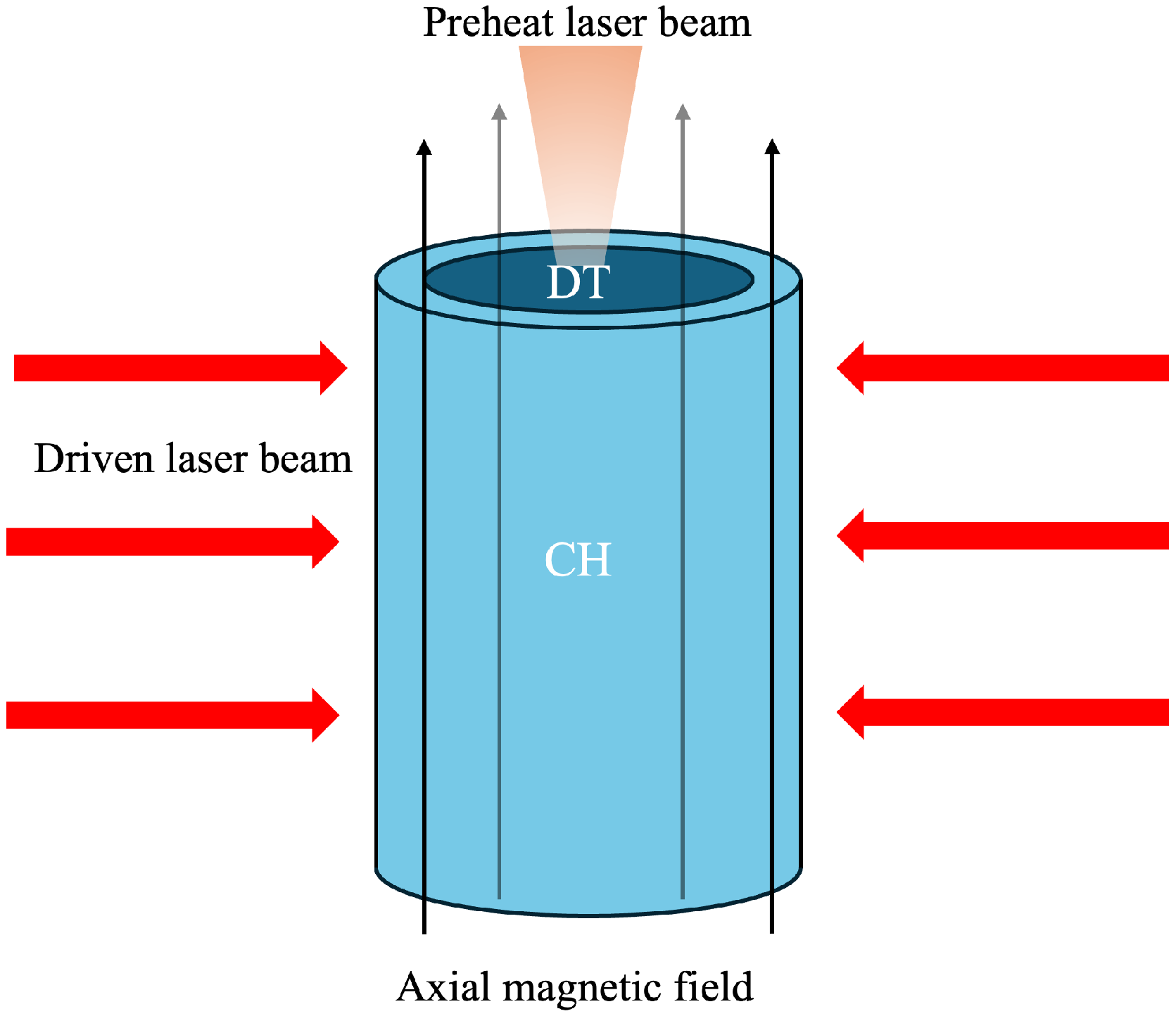
28]. The target is composed of two layers, a parylene-N (CH) pusher layer (liner) and a DT fuel layer, as schematically shown in
Figure 1.
In our radiation magnetohydrodynamics (MHD) model, several key physics relevant to magnetized target are available: two-component plasma hydrodynamics (ions and electrons), laser deposition, multigroup radiation transport, thermonuclear burn, -particle transport, thermal diffusion, and magnetic field evolution. These equations are solved in one-dimensional Lagrangian coordinates.
2.1. Governing Equations
The following integral equations describe the evolution of mass density
, fluid velocity
, specific internal energy
e, and magnetic field
:
where
V is the control volume moving with the fluid,
is its boundary surface, and
is the boundary of surface
S. These integrals forms are suitable for Lagrangian discretization in MULTI-IFE code. Here,
is the magnetic stress tensor,
is the matter pressure tensor,
is the electric field in the frame moving with the fluid,
is the current density,
and
are the heat flux and radiation transport, respectively, and
is the permeability.
c is the speed of light,
is the Planck mean opacity,
is the normalized emissivity, and
is the Planckian energy density. In radiation transfer Equations (
6) and (
7), these radiation parameters can be obtained from atomic physics models and computed using the SNOP code [
29,
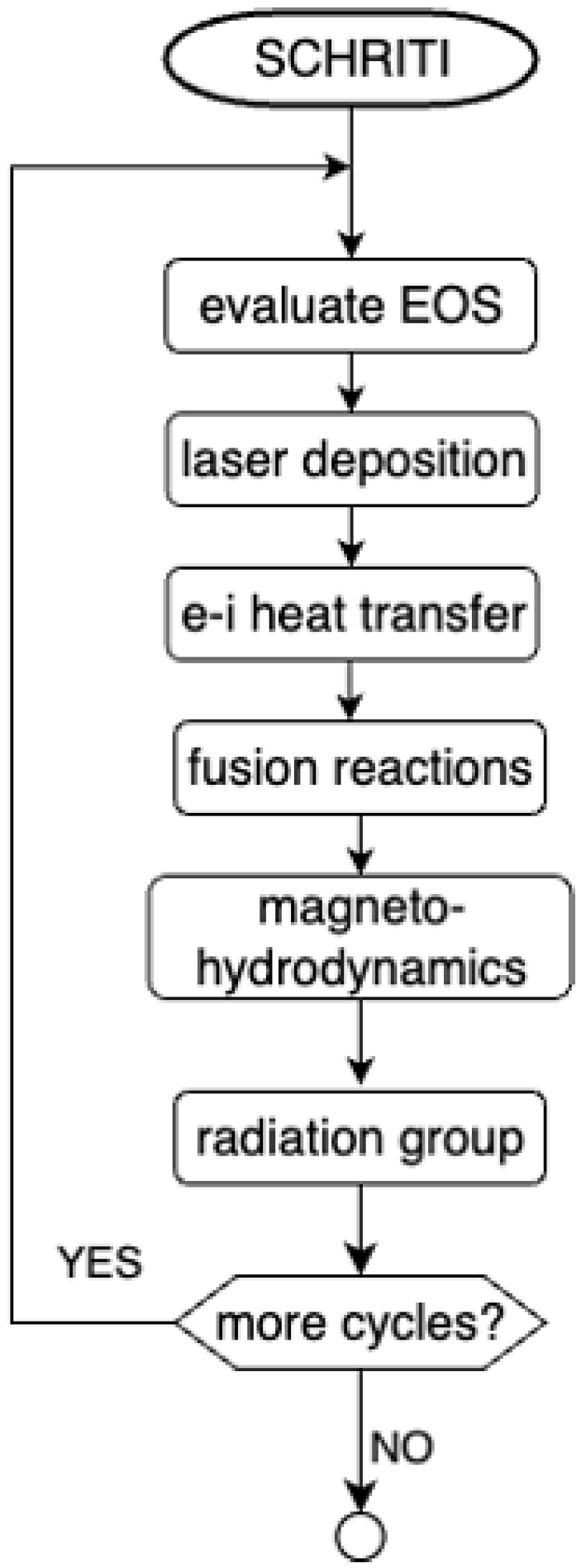
30]. The diagram of the MULTI code is shown in
Figure 2.
The driven laser beam is defined as a normal incidence laser, in the Wentzel–Kramers–Brillouin (WKB) approximation. The pulse time shape is defined as a constant profile. With normal incidence, the laser light propagates until the critical surface. This work is based on a one-dimensional (1D) simulation, which represents a relatively idealized scenario. As such, it does not account for the effects of instabilities such as Rayleigh–Taylor. These instabilities would degrade implosion performance, leading to results that fall short of those predicted by 1D simulations.
2.2. Relevant Parameter Space for MagLIF
The expressions of magnetic field and electric field are further derived. The momentum interchange of electrons with ions
is made up, in the linear approximation, of a frictional force (
) and a thermal force (
) [
31]. The coefficients
and
are tensorial quantities that depend on the magnitude and direction of the magnetic field. Neglecting electron inertia (
), the conservation of the electric momentum equation, which is based on Equation (
2) in integral form, is expressed as
Expressing the density of current as
, and as the Hall term
is neglected in comparison to the frictional force, the generalized Ohm’s law is obtained:
The derivation details of resistive diffusion and the Nernst effect can be found in reference [
5]. The axial magnetic field is decomposed into frozen-in, diffusive, and Nernst components:
where
is the resistivity coefficient appearing in the diffusion term, and
is the Nernst coefficient:
with
.
The evolution of the magnetic field is governed by both advection with the bulk plasma flow (frozen-in flow) and transport processes. The first term in Equation (
10) represents magnetic flux advection with the ideal fluid motion. The second term corresponds to magnetic diffusion, arising from electron collisions. The third term describes the Nernst effect, where perpendicular heat flux drives additional magnetic flux transport. These mechanisms also appear in the energy equation through the divergence of the heat flux, highlighting the intrinsic coupling between thermal transport and magnetic field evolution. In cylindrical geometry, magnetic diffusion and Nernst advection dominate flux loss, thereby reducing charged-particle confinement and degrading implosion performance.
Thermal energy and magnetic flux losses are studied in dense, collisional DT plasmas compressed by a laser-driven liner. In such plasmas, the thermal pressure (
) far exceeds the magnetic pressure, i.e.,
with typical values
n∼
∼
∼
at stagnation.
The electron Hall parameter
is correspondingly large:
where
is the Coulomb logarithm.
Thus, the magnetic field evolution in laser-driven MagLIF can be understood in terms of three key processes: frozen-in advection with the bulk plasma, resistive diffusion due to collisions, and Nernst advection driven by electron heat flow. Together, these determine the coupling between magnetic fields and electron thermal transport.
2.3. Numerical Discretization in Axial Magnetic Field
During the magnetic-flux-transport step, the axial field
B is firstly updated based on resistive diffusion and the Nernst term. Symbolically, the flux across each interface can be written as
where
is Lagrangian cell length. The following space-discretized equation for the magnetic field is derived:
Magnetic-flux conservation is then enforced by ensuring that flux leaving one cell enters the adjacent cell:
Hence, the magnetic field is updated via these two steps. More derivation details and benchmark tests of magnetic field can be found in our previous manuscript [
32].
2.4. Magnetic Flux Transport
In laser-driven MagLIF, the fuel is bounded by a colder liner of effectively infinite heat capacity, where the magnetic field is much weaker at stagnation. The liner, therefore, acts as a sink for both thermal energy and magnetic flux escaping from the fuel. Parametric studies based on Equations (
11) and (
12) capture the evolution of the diffusion and Nernst coefficients.
During compression, magnetic field, density and temperature can be estimated from flux and mass conservation, scaling with the convergence ratio , (, ), where , , and are the initial values. The parametric analysis focuses on the regime and .
Two representative stages are considered: (a) the early compression phase, with
, and (b) stagnation, where DT fuel reaches
.
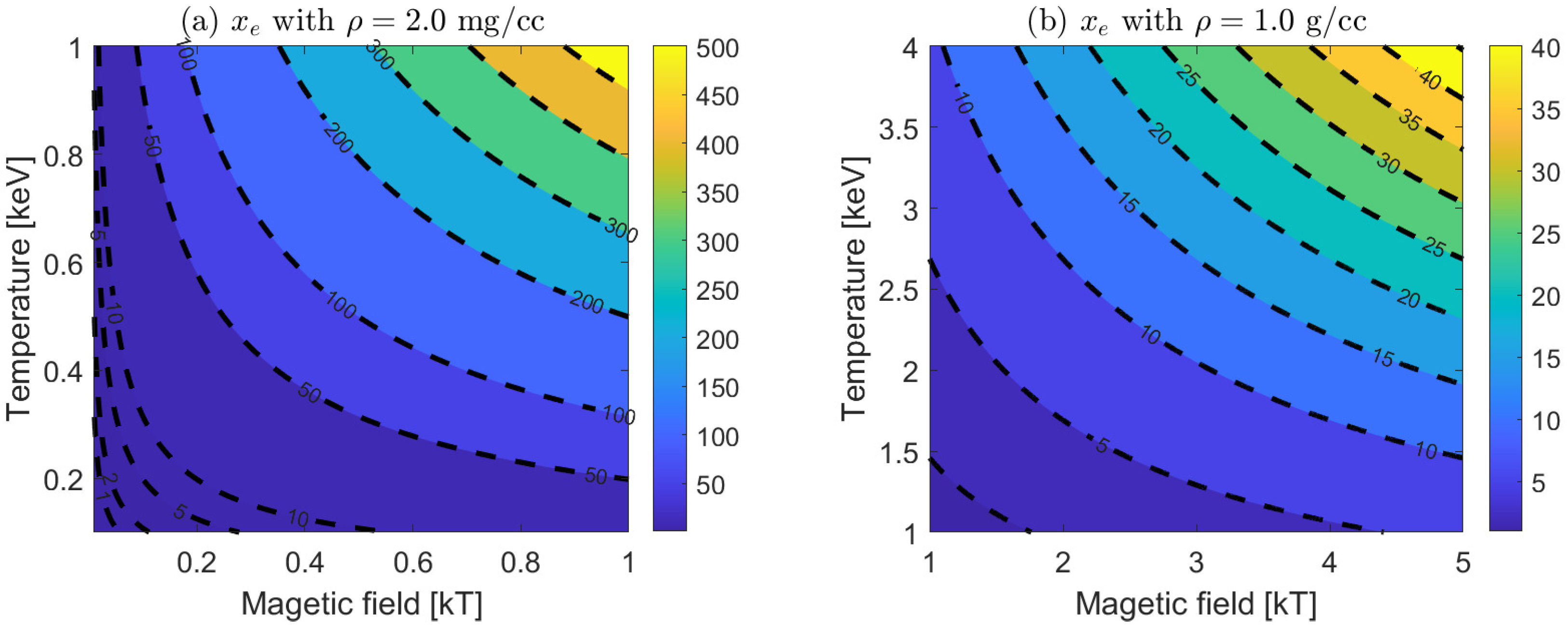
Figure 3 shows the evolution of the dimensionless Hall parameter
over the calculated
B–
T parameter space.
To assess the relative importance of diffusion versus Nernst effect, a non-dimensional expression is defined as
, and is shown in Equation (
18),
The non-dimensional number
demonstrates that the thermal force has less effect on an extreme magnetization regime (
). As illustrated in
Figure 4, the number
is not linearly related to the magnetic field
B and temperature
T, since the resistivity and thermoelectric coefficients depend on both
B and
T.
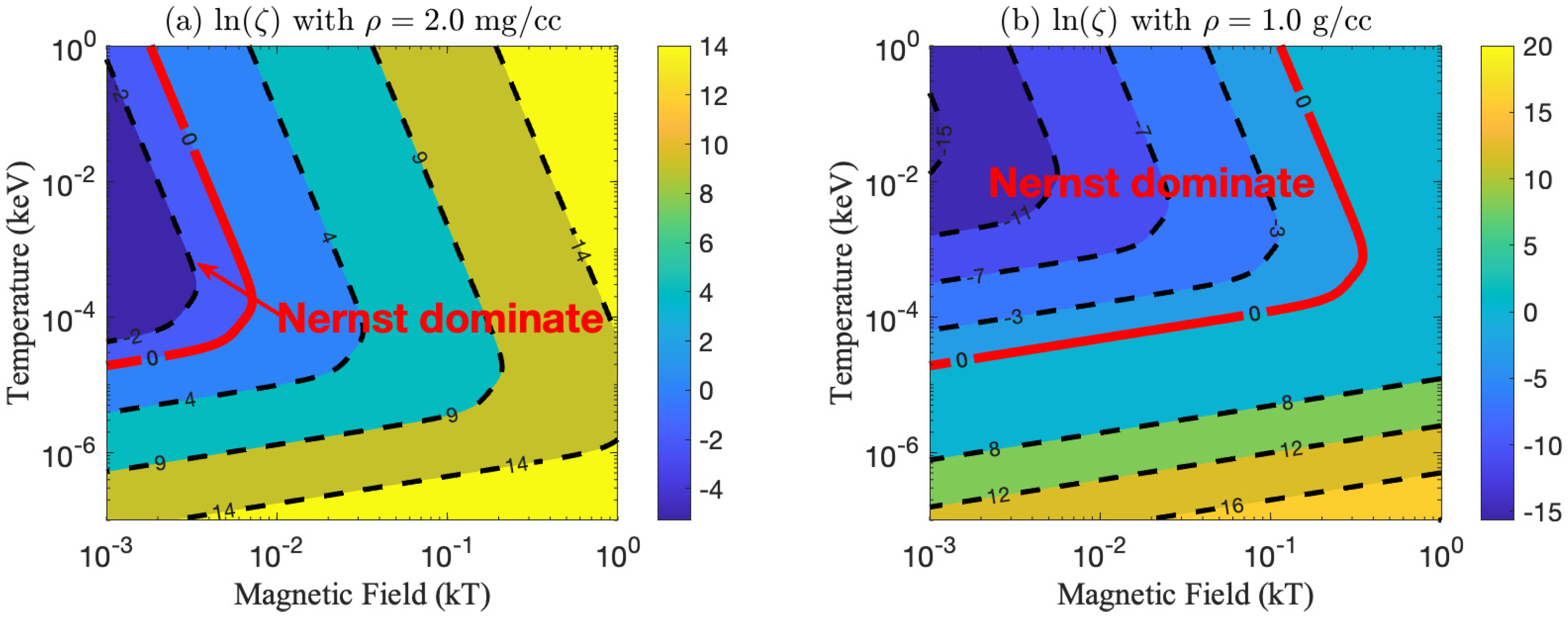
Figure 4a shows the case for a typical initial fuel density of
, while
Figure 4b shows the case for a compressed fuel density. The magnitude for the non-dimensional number
can be estimated within the scaled laser-driven MagLIF plasma parameter space. The dark blue region in
Figure 4 corresponds to the Nernst-effect-dominated region. Whether in the initial or compressed state, the Nernst effect is important in a weakly magnetized regime. By estimating the dimensionless number
, the Nernst effect influences the entire compression process of MagLIF, particularly in the relatively weakly magnetized region, such as the whole fuel in the early stages of compression and the fuel edge in the stagnation time.
2.5. Energy Coupling
In a magnetized target, the applied magnetic field serves several purposes, most notably suppressing electron thermal conduction. The field-dependent conductivity [
33] is
with
,
.
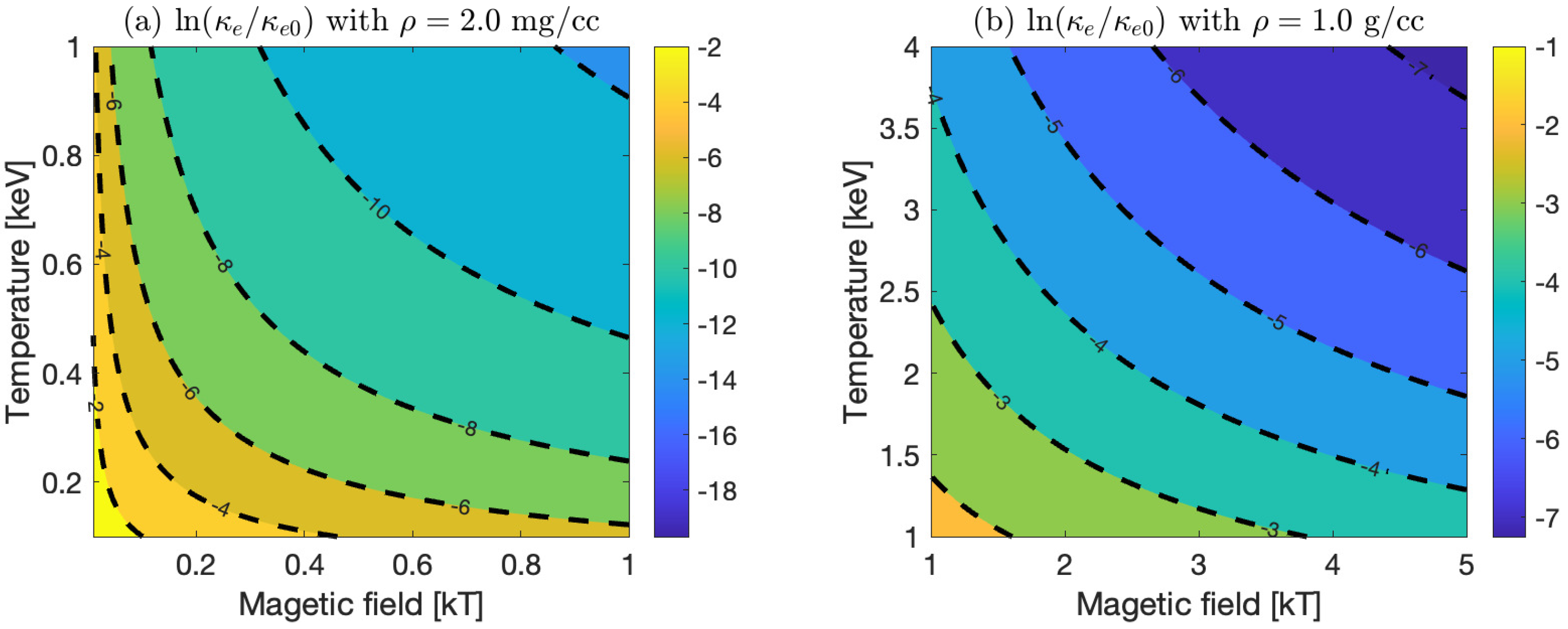
Figure 5 shows the normalized conductivity
over the same
B–
T range considered previously. Here,
is the unmagnetized conductivity at the same varing
T with
. In both early compression and stagnation, electron conductivity is significantly reduced by the applied field. Suppression is more pronounced at stagnation due to the higher density and stronger magnetization.
The potential role of Ohmic dissipation is estimated through the characteristic timescale for magnetic energy conversion into thermal energy:
where
is plasma resistivity,
is the permeability of free space, and
is the current scale length. This timescale is independent of
B for uniform fields and currents.
For laser-driven MagLIF, with compression times of ∼ ns, Ohmic heating is negligible: Spitzer resistivity gives ns≫ compression time. Thus, Joule heating contributes little to energy coupling at current scales. However, in larger targets with longer compression times, Ohmic dissipation could become significant, representing a direction for future investigation.
3. Simulation
Laser-driven MagLIF involves multiple coupled physical processes. A cylindrical parylene-N (CH) ablator filled with DT fuel is accelerated by laser drive. Fuel premagnetization and preheating reduce the required radial convergence, while the liner implodes and converts stored energy into radial kinetic energy, creating extreme plasma conditions at stagnation. The applied magnetic field reduces electron thermal conductivity and enhances
-particle deposition, thereby facilitating ignition and burn. Integrated implosions are simulated here using the one-dimensional cylindrical radiation–magnetohydrodynamic code MULTI-IFE. Thermodynamic properties (e.g., pressures, energies) are modeled with the QEOS equation of state [
31], and opacities are obtained from an atomic-physics-based opacity model [
29].
The target consists of a parylene-N liner (
, thickness
mm, outer radius
mm, length 10 mm), surrounding a DT fuel column of radius
mm at an initial density of
. The drive pulse, taken from Refs. [
15,
34], has a duration of
ns. Three main steps in implosion are modeled:
1. Fuel magnetization: an initial axial field of 10 T is applied.
2. Preheating: the fuel is preheated to ∼200 eV prior to compression.
3. Compression: laser-driven ablation generates a radial implosion, coupling magnetic insulation with heat transport and -particle dynamics.
The reference parameters are summarized in
Table 1. Laser drive refers to the laser energy delivered to the target by the beam. The laser is modeled using the WKB approximation at normal incidence. The target configuration was chosen with reference to the design employed in experiments conducted on the OMEGA facility. With ∼
lower energy, OMEGA requires a MagLIF target ∼
smaller than that on Z. The laser pulse shape, we will use a square-shaped pulse. The laser parameters employed correspond to a 440 nm wavelength. The initial magnetic field is 10 T. The radius of the inner fuel layer is 0.27 mm, while the thickness of the outer CH shell is 30
m.
Ignition occurs when
-heating exceeds radiative cooling, conductive losses, and
work. With fuel premagnetization and preheating, thermal conductivity is reduced and the required convergence lowered.
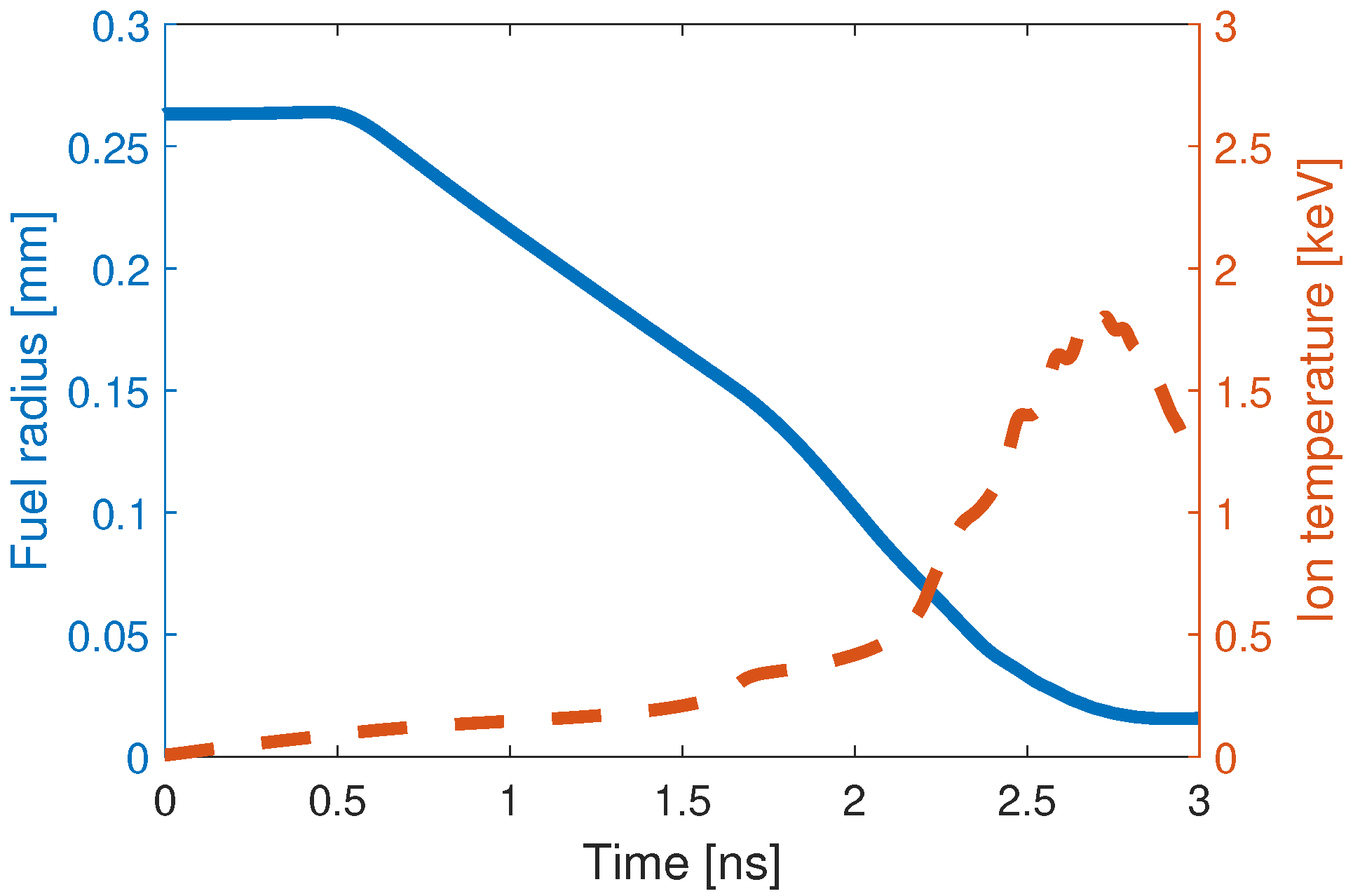
Figure 6 shows the evolution of fuel radius and mean ion temperature in the ideal magnetized case (only frozen-in-flow included). As shown in
Figure 6, the first 0.5 ns corresponds to the preheating stage, during which the fuel is heated to a temperature of approximately 200 eV. This is followed by the implosion compression stage, which lasts for 1.5 ns. Compression proceeds until stagnation at
ns, when the DT density reaches
with a convergence ratio of 17. The corresponding neutron yield is ∼
. Key performance metrics are summarized in
Table 2.
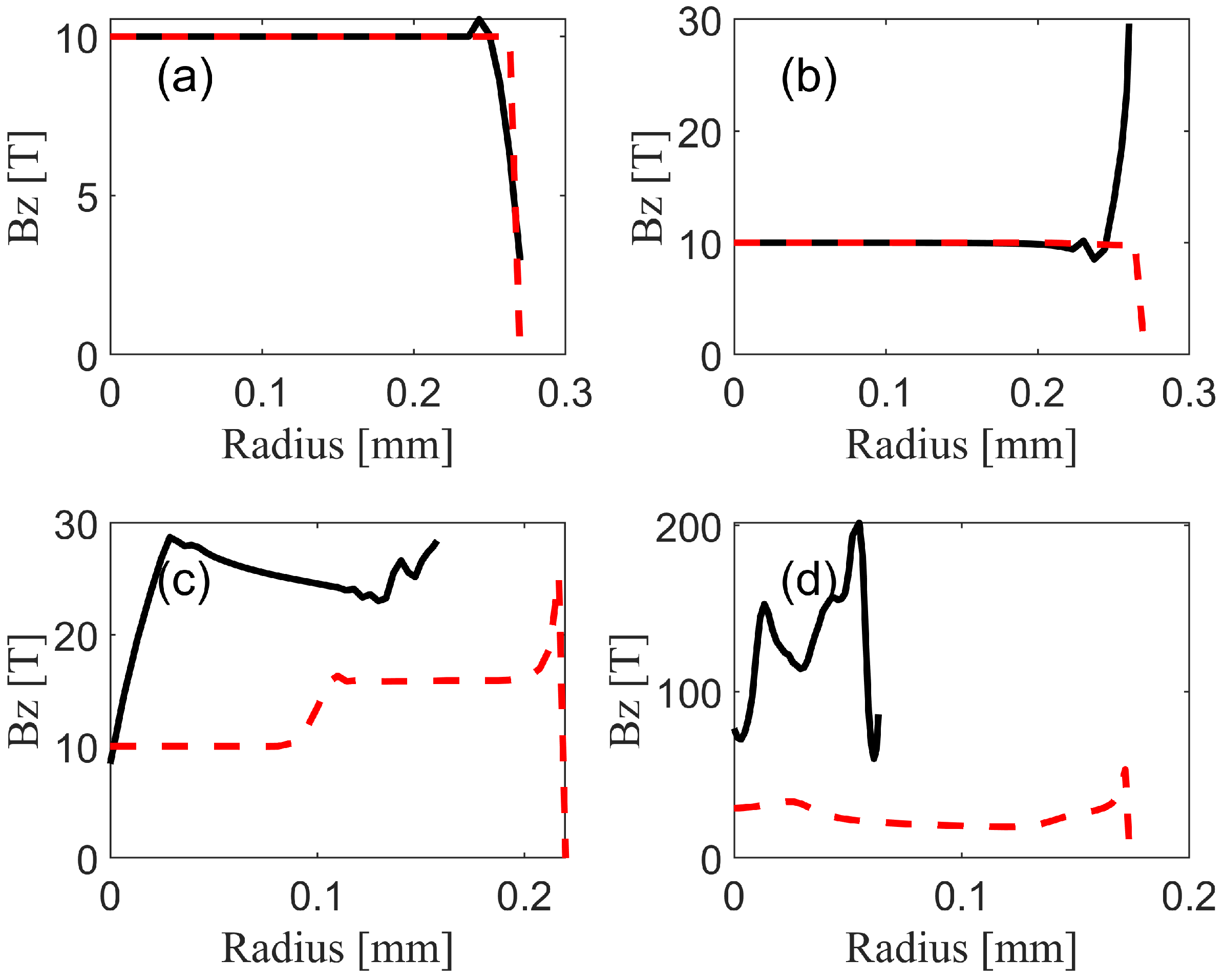
Figure 7 shows the evolution of the magnetic field in the fuel. The black curves represent cases that include the frozen-in, diffusion, and Nernst terms, while the red curves show, for comparison, the cases considering only the frozen-in term. The following describes the data corresponding to the black curve. At the early stage of the implosion (0.001 ns), as shown in
Figure 7a, the Nernst and diffusion terms have already transported a portion of the magnetic field toward the boundary, resulting in a small peak. At 0.5 ns, the Nernst and diffusion terms transport the magnetic field toward the boundary, producing a cavitation near
. At 1.0 ns, two magnetic peaks form at
and
: the outer peak results from accumulation near the CH shell due to the Nernst and diffusion terms, while the inner one is caused by shock-induced compression of the fuel, which amplifies the magnetic field through the frozen-in effect. As the shock moves inward, the inner peak shifts to
at 1.5 ns.
Figure 7 further demonstrates that magnetic flux diffusion reduces the magnetic field pressure and increases the convergence ratio. As shown in
Figure 7b–d, the shock in the black curve is positioned closer to the central region than that in the red curve.
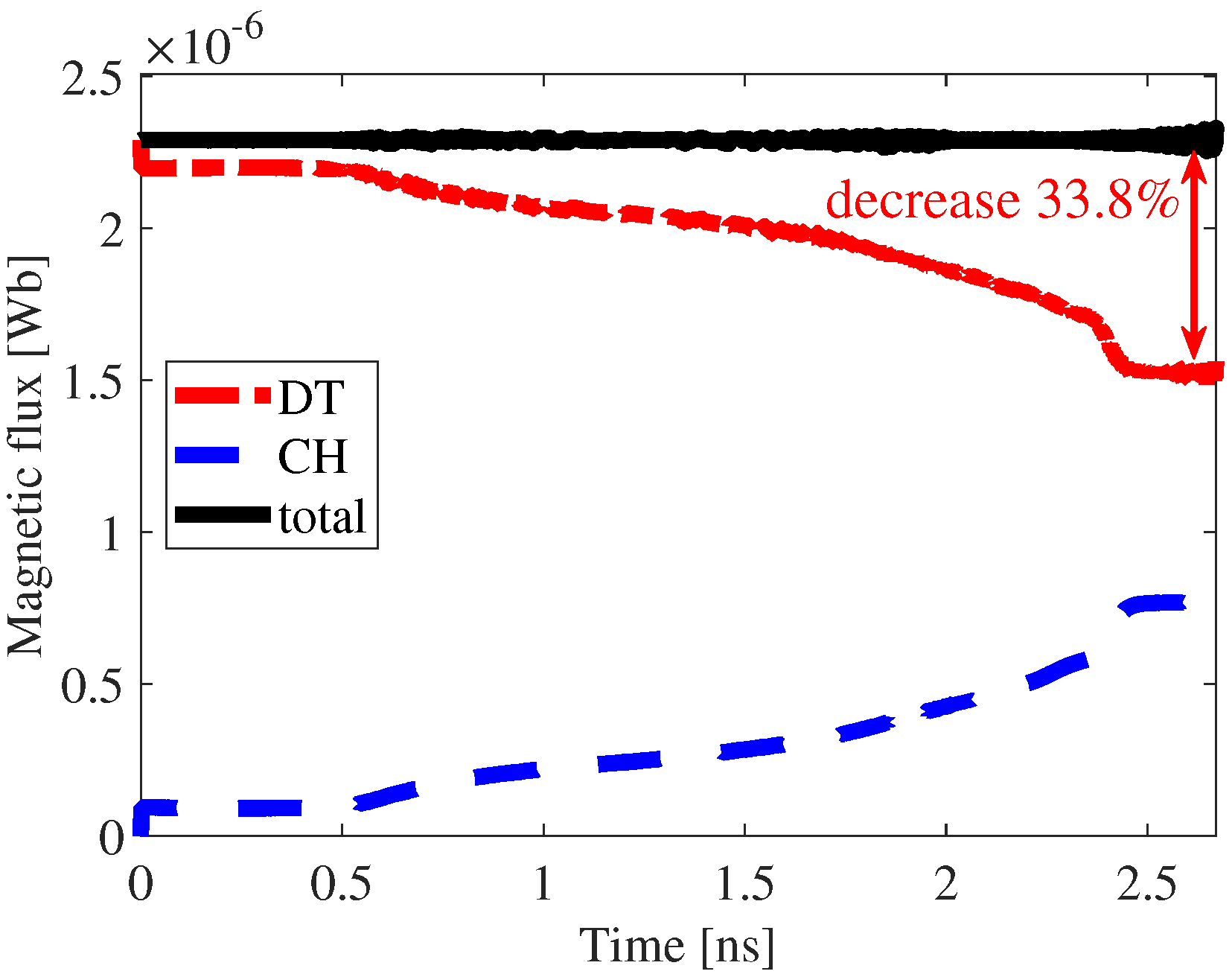
Figure 8 shows the evolution of the magnetic flux in target. The magnetic flux evolves from an initial value of
Wb to
Wb by the time of stagnation (2.72 ns). The magnetic flux in the fuel near the metal layer (red curve) is reduced by approximately 33.8% compared to the frozen-in case (black curve in
Figure 8), while magnetic flux loss occurs within the fuel, the consequent decrease in magnetic pressure and temperature enhances the overall compression, thereby reshaping the radial magnetic field distribution. The field becomes more tightly compressed, leading to a localized enhancement near the liner.
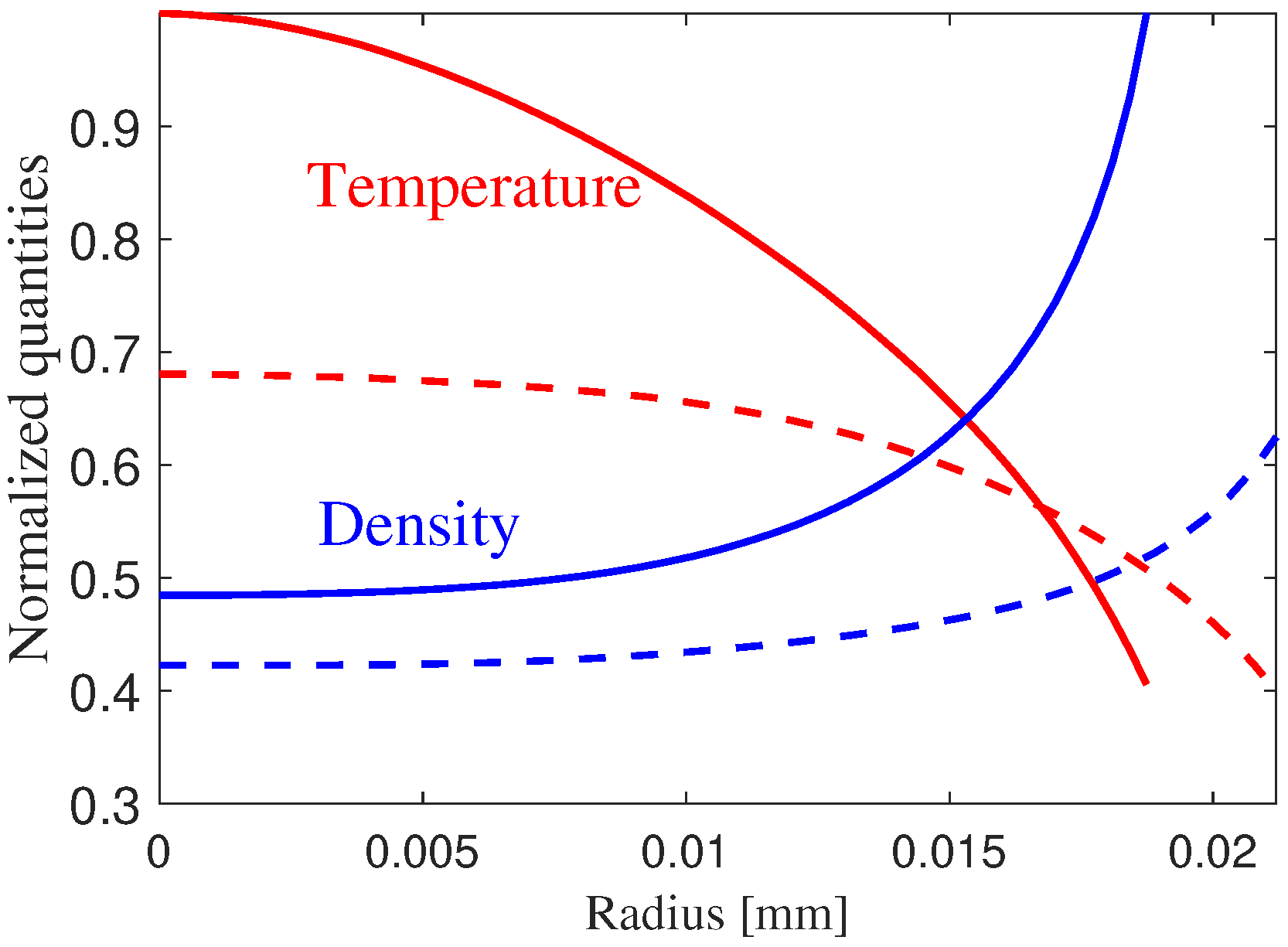
Figure 9 compares fuel profiles at stagnation for the magnetized (
T) and unmagnetized cases. Both exhibit density peaking near the stagnation radius and temperature peaking at the core. In the magnetized case, the core temperature is higher and the density distribution broader, reflecting reduced conduction and improved confinement, as well as a steeper gradient between core and edge. By contrast, the unmagnetized case suffers from stronger thermal losses, yielding a cooler core and flatter density spike. These differences highlight the role of magnetization in sustaining high core temperatures while moderating density gradients.
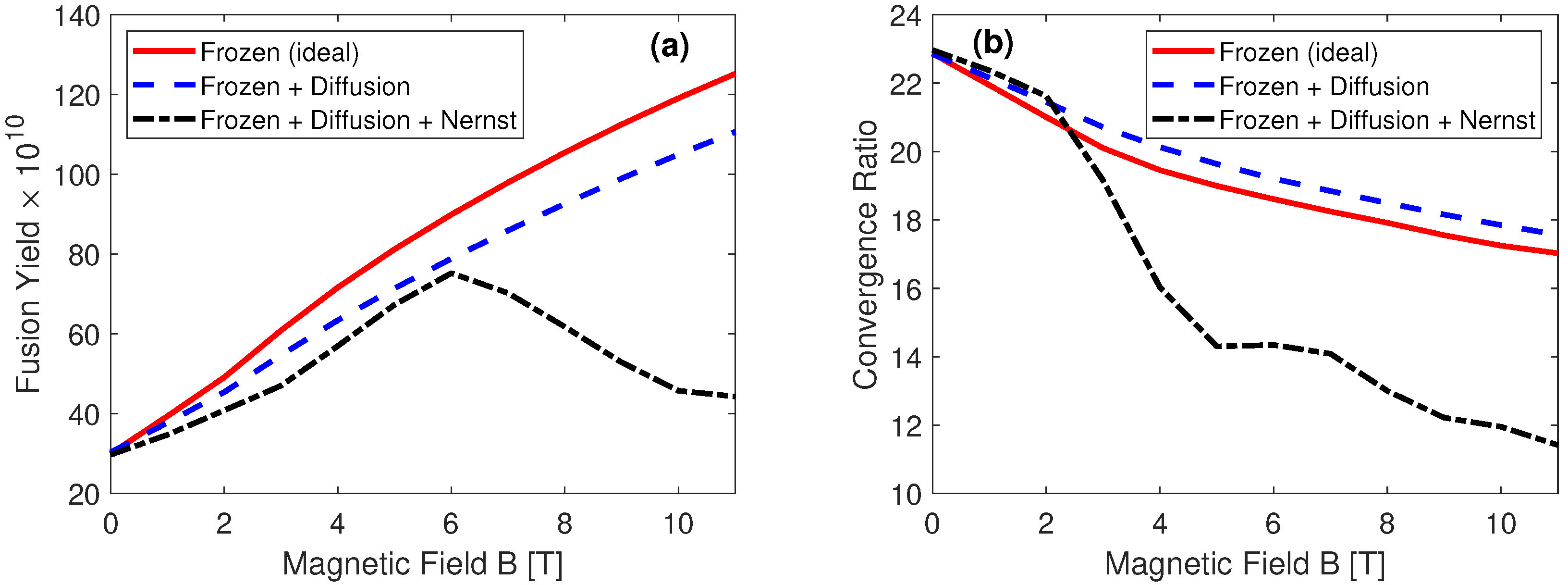
As shown in
Figure 10a, in the ideal magnetization case (red curve) the yield increases steadily with field strength, reaching ∼
at
T. Including diffusion (blue curve) slightly reduces the maximum yield to ∼
. When the Nernst effect is added (green curve), the yield peaks at ∼
near
T, roughly 2.5 times higher than the unmagnetized case, and then decreases at higher fields. This reduction stems from stronger Nernst advection at elevated temperatures and yields, which transports magnetic flux outward and diminishes central confinement.
Figure 10b further shows that while convergence ratio rises monotonically with
B in the ideal and diffusion cases, the yield in the Nernst case no longer follows this trend. This clearly demonstrates that magnetic flux transport by the Nernst effect undermines confinement and suppresses neutron production despite continued geometric compression.
In the absence of the Nernst term (frozen and frozen + diffusion models), both neutron yield and convergence ratio increase monotonically with the applied field, reflecting the beneficial role of magnetic insulation in suppressing conduction losses and enhancing confinement. When the Nernst effect is included (frozen + diffusion + Nernst model), the trend changes, while the convergence ratio deviates from the other models. This degradation arises from Nernst-driven flux transport away from the hot core, which weakens confinement and offsets the benefits of magnetization. These findings suggest that, although stronger fields (B∼11 T) would continue to benefit confinement in the absence of Nernst transport, the practical optimum shifts to T once Nernst losses are included. In practice, excessively high fields are further constrained by engineering considerations, since solenoids generating such fields obstruct diagnostic access in laser-driven experiments.
To distinguish the role of
-particle heating, eight representative cases were simulated, varying the inclusion of magnetic terms,
-particle feedback, and associated transport processes (
Table 3). For clarity, in the “no
” cases the fusion reaction module is disabled in the numerical model, such that no fusion yield is produced. These cases therefore isolate the effects of transport physics alone.
With -heating included, the frozen-in-flow model gives the highest yield ( cm−1) with keV, a convergence ratio of 17, and stagnation time of 2.72 ns. Adding diffusion reduces the yield slightly ( cm−1), while including both diffusion and the Nernst effect causes a sharp reduction to cm−1, despite a modest increase in peak temperature (2.25 keV). This illustrates that Nernst-driven magnetic flux loss out of the core is the dominant factor limiting confinement at high fields.
In the absence of -heating, all magnetized cases produce zero neutron yield, but still show elevated peak temperatures compared with the unmagnetized cases, underscoring the role of the applied magnetic field in suppressing conductive losses even without burn. Notably, when the Nernst effect is included without -heating, the peak temperature rises further (to 2.28 keV). This reflects the Nernst-driven redistribution of magnetic flux, which causes central magnetic field cavitation while depositing flux toward the outer regions, thereby steepening radial temperature gradients and enhancing edge heating. Across all magnetized cases, the stagnation time remains nearly constant at ∼ ns, whereas unmagnetized cases stagnate earlier (∼ ns). This indicates that stagnation duration is primarily governed by the applied magnetic field, while convergence ratio variations reflect changes in confinement quality.
4. Conclusions
The magnetic field influences on energy coupling in scaled, laser-driven magnetized liner inertial fusion are investigated. Magnetic field transport caused by the Nernst and diffusion effects modifies the energy coupling, prompting a parametric analysis to determine their role during the implosion phase. A one-dimensional magnetohydrodynamic model has also been used to investigate the role of applied magnetic fields in laser-driven MagLIF, with parameters scaled to conditions achievable on the laser facility.
The results show that as the temperature increases, the Nernst effect becomes progressively more dominant, at early compression stage ( mg/cc), than magnetic diffusion because of its strong dependence on the temperature gradient, and this dominance is further amplified at stagnation ( g/cc). The impact of Ohmic heating is minimal, as its characteristic timescale for converting magnetic energy into thermal energy is significantly longer than the approximately 2.5 ns implosion duration.
After establishing the importance of the Nernst effect, its influence during the implosion is further examined via numerical simulations. When the Nernst effect is included, the neutron yield decreases by 57.3% as magnetic flux is transported out of the hot core. With an initial field strength of 10 T, stagnation is achieved at 2.72 ns with a peak temperature of 2.17 keV and a neutron yield of . The final on-axis fuel density reaches 1.19 g/cc, corresponding to a convergence ratio of = 17. During the implosion, the magnetic field in the fuel region gradually diffuses outward into the outer liner, leading to a total magnetic flux loss of 33.8% at stagnation. A parametric sweep of the initial magnetic field strength identifies an optimized field of approximately 6 T, yielding about 2.5 times higher neutron output than the unmagnetized case.
For scaled MagLIF, energy loss processes in the fuel plasma are of central importance to fusion performance. The evolution of the magnetic field can be understood in terms of three key mechanisms: frozen-in convection with the bulk plasma flow, resistive diffusion due to electron collisions, and Nernst advection driven by electron heat flux. Together, these processes determine the coupling between magnetic fields and electron thermal transport, and thereby affect both Joule heating and the spatial distribution of -particle energy deposition. The redistribution of magnetic flux, particularly by the Nernst effect, alters radial confinement profiles and modifies the neutron yield. These results provide guidance for the design of scaled laser-driven MagLIF targets, emphasizing that field optimization is critical to maximizing neutron output.
The present work is limited to one-dimensional simulations, which do not account for instabilities and other effects that may influence the implosion performance. In future work, we plan to extend the simulations to two dimensions to provide a more comprehensive analysis.




 ,
,