


Abstract
This paper presents an Optimal Power Management System (OPMS) for smart homes in 6G environments, which are designed to enhance the sustainability of Green Internet of Everything (GIoT) applications. The system employs a brute-force search using an exact solution to identify the optimal decision for adapting power consumption to renewable power availability. Key techniques, including priority-based allocation, time-shifting, quality degradation, battery utilization and service rejection, will be adopted. Given the NP-hard nature of this problem, the brute-force approach is feasible for smaller scenarios but sets the stage for future heuristic methods in large-scale applications like smart cities. The OPMS, deployed on Multi-Access Edge Computing (MEC) nodes, integrates a novel demand response (DR) strategy to manage real-time power use effectively. Synthetic data tests achieved a 100% acceptance rate with zero reliance on non-renewable power, while real-world tests reduced non-renewable power consumption by over 90%, demonstrating the system’s flexibility. These results provide a foundation for further AI-based heuristics optimization techniques to improve scalability and power efficiency in broader smart city deployments.
1. Introduction
Information and Communications Technology (ICT) has interconnected devices like home appliances, vehicles, and wearables, forming a rapidly expanding Internet of Things (IoT) ecosystem [1]. As IoT grows, addressing the increasing power demands of connected devices requires innovative energy-harvesting technologies and efficient energy management strategies. Green IoT (GIoT) focuses on optimizing hardware, software, and communication systems to meet increasing energy demands. By integrating Energy Management Systems (EMS) with Distributed Energy Resources (DERs) such as renewable energy sources, GIoT systems are designed to create more sustainable and resilient smart environments. Key hardware components, such as photovoltaic (PV) systems, wind turbines, sensors, and energy storage systems, work in tandem with advanced software technologies to enhance system efficiency and reliability [2,3].
For example, PV systems, particularly agrivoltaics, combine agricultural production with solar energy generation, optimizing both land use and power output [4]. However, concerns about the long-term reliability of PV systems in harsh environmental conditions underscore the need for durable modules capable of withstanding extreme weather, temperature fluctuations, and UV exposure while remaining cost-effective [5]. Similarly, wind turbines play a critical role in renewable power generation, with advancements like flow-control devices reducing turbulence, increasing power output, and lowering maintenance costs in large-scale systems [6].
Despite the benefits of renewable energy, its availability remains inconsistent due to environmental and geographic factors. Battery Energy Storage Systems (BESS) help address this challenge by storing excess power generated during peak periods and releasing it when renewable output is low. However, BESS faces limitations, such as reduced storage capacity and gradual performance degradation over time, creating challenges in balancing supply and demand [7,8]. Technologies like hydro-pumped storage and supercapacitors also play an important role in integrating renewable energy, particularly in isolated systems, such as islands, where they help manage fluctuations in solar and wind power [9].
While hardware solutions play a crucial role in smart home energy management, software-driven optimization is equally essential for addressing the complexities of modern power systems. The integration of smart sensors, Advanced Metering Infrastructure (AMI), bidirectional communication, and smart home appliances with Home Area Networks (HAN) and Home Energy Storage Systems (HESS) creates a comprehensive framework for real-time monitoring and optimization of power usage. This synergy between hardware and software components enables greater grid efficiency and allows for more adaptive responses to fluctuating power demands [10].
In addition, the emergence of smart grids further empowers residential consumers to take control of their energy usage. With direct access to smart controllers through Home Energy Management Systems (HEMS), consumers can adjust power consumption based on personal preferences and comfort levels [11]. This advancement has moved energy systems beyond static hardware-focused approaches to dynamic, demand-responsive frameworks, allowing consumers to optimize energy use in real time.
One notable strategy is the Hybrid Power Systems Selection (HPSS), which intelligently distributes electrical power demands between the utility smart grid and local generators, using Wireless Sensor Networks (WSNs), thus ensuring both energy efficiency and sustainability [12]. These systems effectively manage bidirectional end-user parameters, comfort levels, and thresholds in residential community microgrids [13], representing a significant shift from centralized to decentralized energy models. By leveraging this combination of hardware and software-driven solutions, energy management in smart homes becomes more flexible, efficient, and sustainable.
As a result, demand response (DR) and Automated Demand Response (ADR) mechanisms have become critical for dynamically balancing energy supply and demand [14,15,16]. DR effectively addresses environmental, social, and economic challenges while promoting cost-effectiveness [17]. By enabling real-time communication between energy providers and consumers, DR enhances grid stability and increases consumer engagement, which are key components for ensuring long-term sustainability and resilience [18].
Despite these advancements, microgrids face inherent challenges due to the volatility of renewable energy sources. Balancing power supply and demand requires the use of steerable resources, such as diesel generators and energy storage systems. Intelligent energy management systems utilizing advanced scheduling and optimization techniques are essential for maintaining microgrid stability. Several approaches, such as meta-heuristic algorithms, mathematical programming, and reinforcement learning, have been proposed to address the complexities of managing renewable energy output and load consumption [19].
To further enhance system efficiency, Multi-access Edge Computing (MEC) offers a superior solution over traditional data centers, especially in managing DR in smart homes and IoT ecosystems. MEC extends cloud computing capabilities to the network edge, reducing latency, optimizing resource utilization, and alleviating network congestion. Offloading power optimization and scheduling tasks to MEC enhances system responsiveness and meets next-generation demands, such as ultra-reliable low-latency communications (URLLC) and enhanced mobile broadband (eMBB) [20,21,22]. This system not only improves power distribution but also guarantees uninterrupted internet and cloud services, reinforcing MEC’s role in modern energy system stability.
As these energy management systems become increasingly autonomous and data-driven, it is crucial to safeguard energy infrastructures from cyberattacks [15,23]. The increased data exchange within IoT-enabled smart grids exposes them to cybersecurity risks, such as False Data Injection (FDI) attacks, which can corrupt sensor data, destabilize operations, and potentially cause blackouts. To mitigate these risks, a comprehensive multi-layered security strategy is required. This strategy includes encryption for data privacy, secure communication protocols to ensure information authenticity, and real-time monitoring systems to detect and neutralize threats [24].
In addition, evolving energy markets see industrial users transitioning from consumers to suppliers, necessitating robust EMS to manage diverse energy sources and adapt to fluctuations in availability [25]. Despite advancements, challenges remain in balancing energy production and consumption due to fluctuating demand, storage limitations, and the integration of multiple energy sources. In smart energy applications, synchronized control and precise scheduling enhance customer comfort and reduce operational costs through demand-side management technologies [26,27]. Key strategies, such as time-shifting, quality degradation, and service rejection during peak demand, ensure that energy consumption aligns with supply availability, promoting efficiency and adaptability in real-time conditions [15].
1.1. Research Gap and Contribution
Despite significant advancements in renewable energy, energy management, and software-driven systems, existing solutions often address these aspects in isolation, lacking a unified framework for optimal power management. This research bridges that gap by proposing an innovative, integrated approach that combines advanced software mechanisms, battery storage optimization, and distributed renewable power sources. The system dynamically balances power supply and demand in smart homes, offering a more adaptable and efficient power management solution.
1.2. Hypothesis
We hypothesize that incorporating advanced power optimization strategies, such as service prioritization, load shifting, performance scaling, lifespan-aware battery control, and selective load shedding, will maximize the use of renewable power sources, reduce reliance on non-renewable power, and substantially enhance overall power efficiency in smart homes. Additionally, by deploying these optimization strategies before engaging the battery, the system will reduce excessive charge-discharge cycles, mitigate capacity degradation, and enhance the long-term operational efficiency of the battery, leading to improved overall power management.
1.3. Research Questions
- What is the impact of advanced power management techniques (e.g., service prioritization, time-shifting, quality degradation, battery utilization, and service rejection) on optimizing the efficiency of renewable power supply in real-time smart home environments?
- Can the integration of these advanced power management techniques create a more resilient and adaptable power management system for smart homes?
- How does the prioritization of management mechanisms, such as service prioritization, time-shifting, and quality degradation, contribute to minimizing battery degradation and enhancing long-term power efficiency in smart homes before adopting battery utilization?
- What are the limitations of the proposed algorithm in optimizing power management, and how do these limitations affect the scalability and overall performance of smart home power management systems?
1.4. Proposed Approach
This study proposes a unified power management framework that integrates advanced software-driven mechanisms, battery storage optimization, and distributed renewable power sources. By leveraging advanced management techniques, such as prioritizing critical services, time-shifting consumption to off-peak hours, and applying service degradation when necessary, the system dynamically balances renewable power availability with real-time consumption and minimizes or eliminates reliance on non-renewable power sources. While this approach introduces new challenges in managing the interdependencies of various power flows, it offers significant potential for achieving optimal power efficiency.
After evaluating priority allocation, time-shifting, and quality degradation, if power optimization is still insufficient, battery utilization is applied as another step to address unresolved power deficits. This ensures maximum use of renewable power while minimizing unnecessary battery discharges. The system employs lifespan-aware optimization to strategically schedule battery usage, activating it only when renewable power is inadequate. This reduces the frequency of charge-discharge cycles, extending battery lifespan and enhancing overall efficiency. By prioritizing other management strategies, the system preserves battery health and ensures long-term optimal performance.
A brute-force search algorithm also identifies the optimal configuration that minimizes the gap between power supply and demand. This comprehensive approach enhances system flexibility, reduces reliance on non-renewable power, and optimizes renewable power usage, making smart homes more resilient and sustainable in managing power fluctuations.
2. Related Work
The shift from fossil fuels to renewable energy requires a thorough reengineering of the energy system, encompassing both production and consumption processes. Different algorithms have been employed to implement these techniques, with numerous simulations conducted to assess their effectiveness. Earlier efforts by Lotfi et al. [28] presented a smart (HEMS) architecture that addresses both energy consumption and generation in parallel. The system integrates ZigBee-based energy measurement modules to monitor home appliance and lighting usage, while a power line communication (PLC)-based gateway tracks renewable energy production, providing real-time visibility into both energy usage and generation. A home server consolidates and analyzes these data, optimizing energy consumption to reduce costs. Furthermore, a remote energy management server aggregates data from multiple home servers, delivering statistical insights that enhance overall energy efficiency and promote greater cost savings. Zhao et al. [29] focused on addressing the challenges brought about by large-scale renewable energy integration, particularly the issue of surplus electricity production due to the fluctuating nature of sustainable energy sources. This work proposed a smart home electricity management approach designed to predict and schedule electricity demand and supply by considering the state of the smart grid, local power generation capacity, and the electrical consumption of household appliances. The system emphasized the importance of predicting weather conditions and incorporating residential home occupants’ immediate and longer-term plans into the decision-making process, effectively acting on their behalf. A comprehensive systematic review of recent literature on optimization techniques for (HEMS) is presented. For instance, Makhadmeh et al. [30] and Gomes et al. [31] have focused their review and survey papers on smart grid concepts, smart homes, and, in particular, the scheduling of smart home appliances. In these studies, the techniques are categorized into four broad groups: traditional methods, model predictive control, approximate method, and other approaches. Also includes a discussion of various DR programs and pricing schemes.
Smart Supply Switching System with Battery Monitoring has been presented by Kumar et al. [32]. The system optimizes energy usage by intelligently switching between various power sources, including renewable energy and backup generators, based on real-time conditions and user preferences. It also features advanced battery monitoring for proactive maintenance and seamless integration with IoT platforms, enhancing energy management for both residential and industrial applications).
In terms of exact solutions, different methods have been formulated for addressing the power scheduling problem in smart homes, such as integer linear programming (ILP) and mixed integer linear programming (MILP) methods, for instance, İzmitligil and Apaydın [33] present an offline (HEMS) designed to optimize energy bills, peak-to-average ratio, and user comfort using (MILP). The system, comprising a central controller, smart appliances, and power resources, achieved reductions in energy bills of 68.6% and 54.4% in two scenarios, highlighting the effectiveness of the MILP-based approach. Concerning demand response (DR) strategies, Tipantuña and Hesselbach [14] proposed a power management strategy that leverages service execution time-shifting combined with a combinatorial algorithm to optimize power demand allocation. This versatile approach is compatible with both renewable and non-renewable energy sources. It can manage up to 20 services, making it suitable for applications in smart grids, data centers, and various industrial environments. To support these optimization strategies, Hussain et al. [34] developed standardized communication models for Solar Home Systems and smart meters based on the IEC 61850 standard [35]. These models facilitate advanced functionalities such as power flow control and demand response, achieved through standardized message exchanges and bi-directional power flow management. Together, these contributions enhance power management by integrating sophisticated optimization techniques with robust communication standards [34].
Predictability of energy supply and demand is essential for effective grid management. Carli et al. [36] proposed a model predictive control - based energy scheduling approach for smart microgrids, optimizing the operation of controllable loads, photovoltaic panels, and battery energy storage systems to maximize solar self-sufficiency and minimize energy costs. Integrating real-time adjustment mechanisms with predictive and DR strategies represents a significant advancement in managing renewable and non-renewable energy resources. In this context, the author in [37] addresses the challenges of integrating small-scale renewable energy sources and emerging loads by proposing a real-time management schema using IoT solutions. This schema includes two algorithms: one for power balance based on a modified optimal power flow and another for voltage regulation using a sensitivity matrix. The effectiveness of these algorithms was validated through a real-time simulation with residential network data.
A large number of meta-heuristic and heuristic algorithms have been adopted for optimizing energy. For instance, the research [38] proposed algorithmic solutions for optimizing energy consumption in a demand response environment, leveraging Network Functions Virtualization (NFV) and IoT. The problem is modeled as ILP, which is solved optimally with OptTs, a brute-force strategy. Due to the problem’s NP-hard nature, a heuristic approach, FastTs, is also implemented. Both exact and heuristic methods improve energy management, with FastTs achieving near-optimal results 230× to 5000× faster.
To improve energy utilization in smart homes managing hundreds or thousands of energy demands, Tipantuña and Hesselbach [15,39] propose energy management strategies that account for factors such as dynamic renewable energy production, priority settings, and time-shifting capabilities. Tipantuña and Hesselbach (2021a) [15] proposed three heuristic strategies—GreedyTs, GATs, and DPTs—for efficient scheduling in the NFV domain. Simulations demonstrate that these approaches provide high-quality solutions, achieving near-optimal results two to seven orders of magnitude faster, and are scalable to handle thousands or even hundreds of thousands of energy demands. Tipantuña and Hesselbach (2021b) [39] provide a detailed analysis of a self-powered adaptive home energy control system using IoT technologies. The paper describes the system’s architecture, a negotiation scheme for IoT device consumption, and management mechanisms like time-shifting and quality degradation to optimize power utilization. Additionally, it includes the mathematical formulation of the adaptive consumption model and introduces a heuristic, PHRASE, which employs a divide-and-conquer approach to efficiently solve the energy model. In addition, Zhang, V. E., and Jackson Samuel [40] introduce a heuristic approach using a fuzzy expert system for efficient energy management in smart homes with a focus on demand management, renewable energy integration, and microgrid optimization. The system simplifies the design of smart microgrids with storage systems and controllable loads, enhancing energy utilization and maximizing financial gains. This approach aligns with the proposed Smart HEMS methodology by Abu Gunmi et al. [41], which employs heuristic techniques, including fuzzy logic, to manage energy resources effectively. Both strategies aim to optimize energy consumption by balancing cost-effectiveness, technical feasibility, and user comfort in smart home environments.
While previous models have made progress in reducing electricity costs, improving user satisfaction, and promoting renewable power, they often overlook key issues such as distributed power efficiency, battery sustainability, and power interaction costs within a unified management mechanism. These gaps can lead to power wastage and increased expenses. The proposed DR-based OPMS addresses these challenges by optimizing renewable power usage and adapting it to IoE consumption patterns, eliminating or reducing reliance on non-renewable sources. Although battery utilization is employed as a supplementary strategy to support renewable power usage, the battery is only discharged when necessary, following the implementation of priority-based allocation, time-shifting, and quality degradation. This approach minimizes battery usage, extends lifespan, and ensures effective power management. When both renewable and battery power are insufficient, non-renewable sources are used as a last resort, with the system seeking solutions that minimize dependence on non-renewable power. By integrating these strategies, the system maintains a balanced and sustainable power consumption model, adapting to supply and demand fluctuations, while effectively lowering costs by reducing or eliminating reliance on non-renewable energy sources.
3. Methodology
3.1. Overview of the Proposed System
This study introduces an advanced, software-driven (OPMS) aimed at optimizing power usage in (IoE)-connected devices for residential settings. The system implements a (DR) strategy to dynamically adjust power consumption in response to fluctuations in renewable power supply. The core objective is to minimize the gap between renewable power generation and total power consumption, enhancing the efficiency of power usage in real-time smart home environments.
The system integrates a combination of management mechanisms—including priority, time-shifting, quality degradation, battery utilization, and service rejection—to enable a full transition to renewable power sources. By minimizing or even eliminating reliance on non-renewable power, the system ensures sustainability. Priority-based allocation, battery utilization, and service rejection are relatively straightforward mechanisms. However, introducing time-shifting and quality degradation creates a combinatorial complexity due to the numerous potential configurations of power management options.
To resolve this complexity, the system employs a brute-force search approach. This search algorithm evaluates each possible configuration of time-shifting and quality degradation, determining the optimal combination that maximizes renewable power usage while minimizing reliance on non-renewable sources. The brute-force approach guarantees that the system can identify the most efficient solution, but its effectiveness diminishes with large and complex datasets due to high computational costs and time constraints.
Additionally, Multi-access Edge Computing (MEC) is integrated to process workloads closer to IoE devices, improving Quality of Experience (QoE) by enhancing system responsiveness and reducing latency. MEC minimizes the need for multi-hop connections to central cloud servers, which decreases computational burdens on centralized systems. Although MEC is proposed for future large-scale implementation, it will play a key role in addressing NP-hard challenges in IoE ecosystems, especially in smart cities. Figure 1 shows an overview of the proposed scenario, demonstrating how the system integrates renewable and non-renewable power sources and leverages MEC to optimize power allocation.
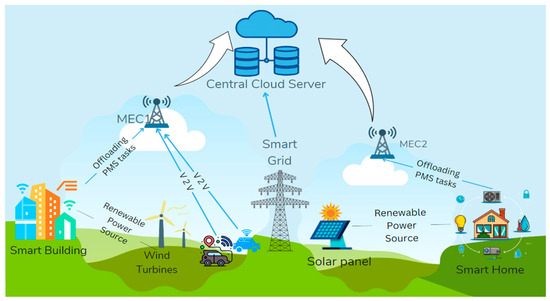
Figure 1.
Proposed scenario: offloading computing tasks to the nearest MEC agent.
Before exploring the power management process, Table 1 below presents the key parameters used in the OPMS model. These parameters define the system’s decision-making framework and will be critical in determining how power is allocated across different services:

Table 1.
Key Parameters affecting system performance in the OPMS for smart home.
The flowchart in Figure 2 presents the step-by-step process of the proposed system, starting from monitoring power consumption to making optimal power management decisions based on the parameters defined above.
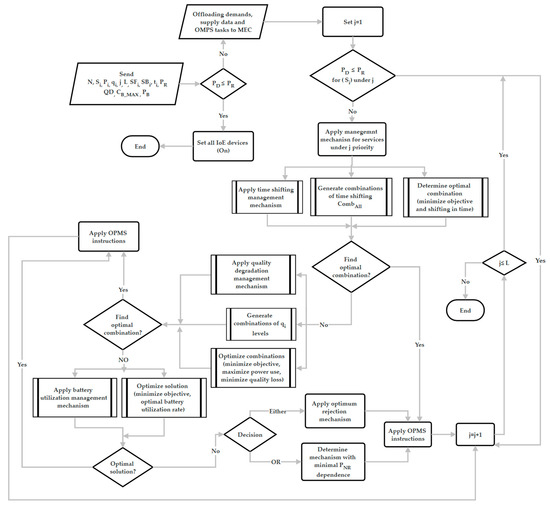
Figure 2.
Operational workflow of the advanced OPMS for IoE-enabled smart home.
3.2. System Architecture
This section presents an overview of the architecture that enables the OPMS to achieve efficient power usage in IoE-connected devices. The architecture integrates various components to manage power supply, consumption, and storage, relying on software-driven optimization techniques.
Figure 3 depicts the system’s core functionality. It illustrates the process by which the system identifies key service, smart meter, and grid parameters, formulates power management problems, optimizes power allocation, and validates results to ensure efficient distribution with minimal reliance on non-renewable power sources.
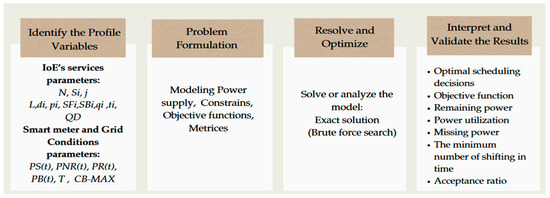
Figure 3.
Adaptive power consumption management model.
The OPMS comprises four main components, each contributing to optimized power management in a smart home environment, Figure 4 illustrates these participants:
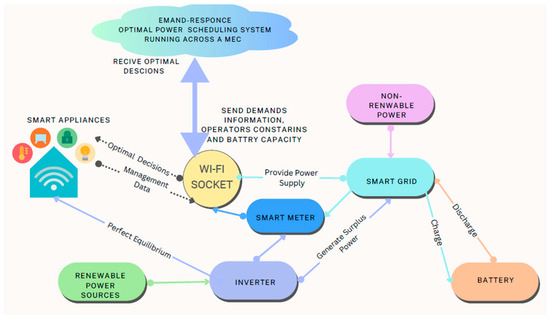
Figure 4.
Participants of the proposed OSPM.
- Power supply (): integrates renewable and non-renewable power sources to ensure a reliable power flow. On-site renewable power sources (), such as solar and wind energy, form the primary supply (), while non-renewable sources () act as secondary backups, only used when renewable power is insufficient. The total available power at any given time is represented by Equation (1). The total power supply prioritizes green power, with a weight factor wR in the range [0, 1], to manage non-renewable contributions, as shown in Equation (2). Given sustainability goals, the long-term aim is to set to zero and making fully renewable, as outlined in Equation (3).
- Power Consumers (): IoE devices act as power consumers and are categorized into two groups: Critical Services (), where j = 1 and j ranges from 1 to L, represent high-priority services like emergency systems or essential household appliances. Non-Critical Services (), where 2 ≤ j ≤ L, refer to lower-priority services such as entertainment devices or non-essential smart appliances. Each service demand is characterized by priority level, activation time, and duration. Services may also have temporal flexibility, allowing for delay tolerance in their activation. Additionally, quality degradation, which involves reducing service performance to conserve power, is a key strategy for optimizing power management.
- The Battery (B) Integrated battery systems manage load fluctuations, provide backup during outages or high demand, and support sustainable power use. To prevent premature degradation, the system incorporates lifespan-aware strategies that manage charge/discharge cycles, ensuring optimal battery performance. When battery power is included in the total power supply, as shown in Equation (4) where (t) is power provided by the battery at time (t):
- Supervisor of Power (): In the 6G IoE network, the MEC is the central hub for power management, processing offloaded tasks, and optimizing power distribution. It analyzes real-time data to ensure optimal power allocation and minimize network latency.
Figure 4 illustrates the architecture of the proposed OPMS, showcasing how smart appliances, renewable power sources, non-renewable power, and the battery system interact with each other alongside the smart grid. The Wi-Fi socket plays a central role in facilitating the communication between the smart meter, smart appliances, and the MEC-powered demand response system. The figure demonstrates the continuous feedback loop, where optimal power management decisions are executed to balance supply and demand while minimizing reliance on non-renewable power.
3.3. Wi-Fi Socket Smart Integration
To optimize power management in IoE-enabled households, we implemented a fundamental Machine-to-Machine (M2M) protocol for efficient transmission of power usage data to the OPMS computational node. We utilized three Raspberry Pi clients to simulate IoE devices, leveraging the MQTT (Message Queuing Telemetry Transport) protocol—a lightweight application-layer messaging protocol optimized for IoT communications [42]. These clients transmitted predefined power consumption data to a computational node, which was represented by a local PC equipped with a 2.60 GHz Intel Core i7-10750H processor, 16 GB of RAM, and dual storage (1 TB HDD and 256 GB SSD). The computational node processed the incoming data and generated optimized power management commands, which were then transmitted back to the Raspberry Pi clients for execution. We propose deploying this setup to upgrade traditional Wi-Fi sockets into smarter sockets, thus establishing seamless communication between IoE devices and MEC nodes. These smart Wi-Fi sockets will be instrumental in optimizing (DR) operations and enabling more efficient power management in IoE-enabled homes. This will improve power efficiency and allow for remote control of IoE devices, ensuring responsive power distribution.
Future improvements will expand this system with a four-way communication handshaking technique to manage demand-side power usage, coordinating IoE devices, power managers, the smart grid, and battery systems, as illustrated in Figure 5. Key variables include the following:
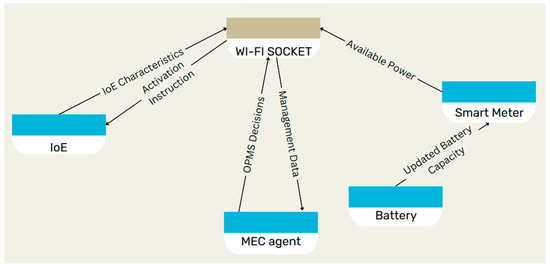
Figure 5.
An overview of the proposed M2M protocol negotiation.
- Client-Side: to send service priorities, power demands, start times with shifting possibilities, in addition to quality degradation tolerance.
- Grid Variables: to provide time slot durations, renewable/non-renewable power capacity, and operational constraints.
- PMS Decisions: receive the service accommodations, power allocation, and timing from the power manager.
- Battery Dynamics: for enabling adaptability to real-time changes in demand and providing current battery capacity availability.
These smart Wi-Fi sockets will drive smart home systems toward sustainable and responsive power management.
3.4. OPMS Mode
The OPMS framework is designed for a Single Autonomous System (SAS) or an intelligent building, optimizing power allocation for multiple IoE devices with varying consumption needs. The system operates in two modes:
- Offline Mode: In this mode, power demand is forecasted using predictive algorithms based on historical data (e.g., weather patterns and past consumption). This allows for efficient power scheduling in advance, accounting for known fluctuations in renewable power supply.
- Online Mode: The system dynamically adjusts in real-time to fluctuating power sources and immediate consumption needs. This mode is crucial for real-time IoE environments where power availability and demand are unpredictable.
While this framework primarily addresses offline SAS, its scalability for smart cities will require advanced AI-based heuristics to manage real-time power demands efficiently.
3.5. Management Mechanisms and Metrics
The OPMS aims to maximize the use of renewable power while minimizing reliance on non-renewable power by dynamically managing power distribution across various IoE-connected devices. To achieve this, the system employs a combination of advanced management mechanisms, each contributing to the reduction in the gap between power supply and consumption—the core focus of the objective function.
The system’s objective function minimizes residual power, defined as the difference between total power supply and consumption at each slot of time. The goal is to ensure that the power supply meets or exceeds demand, prioritizing scenarios with zero or positive residual power, thereby optimizing overall power efficiency.
Residual power (represented by Equation (9)) is the difference between the total power supply and the total power demand at the time slot (t). The system aims to minimize the residual power deficit across all time slots. The average residual power ( across the operating time () is expressed as the objective function in Equation (11)
where
The incorporation of management mechanisms, along with their evaluation metrics, helps to fine-tune the objective, ensuring that renewable power is maximized while minimizing or eliminating the dependence on non-renewable sources. The OPMS integrates a range of advanced power management mechanisms, which include the following:
- Full-Service Processing: When renewable power fully meets demand, it is used to minimize storage costs.
- Priority-Based Management Mechanism: Power is allocated based on predefined priority levels. Higher-priority services are served first, ensuring critical services are maintained in conditions of limited power availability.
- Time-Shifting Management Mechanism: To optimize power usage, service start times are shifted forward or backward. The system evaluates various time-shifting combinations and selects the one that minimizes the average residual power as specified in Equation (12).
Suppose multiple time-shifting combinations yield the same objective function values. In that case, the system selects the one with the least shifting time (, as explained in Equation (13). Minimizing the number of shifts is prioritized to maintain system stability.
If no optimal solution is identified, the search proceeds to find the combination that minimizes reliance on () as a candidate solution, in cases where no management mechanism yields an optimal decision, the focus shifts to selecting the solution that best reduces dependence on ()
For illustration, consider three services (, , and ) with varying start times and power demands, as detailed in Table 2. The OPMS generates possible time-shifting combinations for these services. The total number of combinations is determined by multiplying the number of time-shifting options available for each service (Equation (15)). These configurations are systematically evaluated to identify the optimal solution that minimizes the objective function () that ensures efficient power allocation across all time slots. Figure 6 illustrates the power demand distribution for eight combinations of start time-shifting.
Table 2.
Demands pattern.
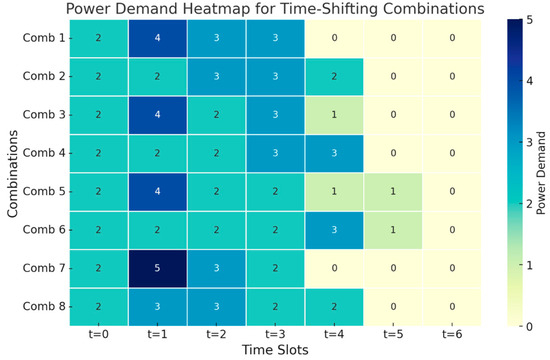
Figure 6.
Power demand distribution across time slots for different start time-shifting combinations.
In this example, has only the original start time option, () has four possible start times, while () has two possible start times. As a result, the system will evaluate 8 combinations based on Equation (15).
- 4.
- Quality Degradation Management Mechanism: services can be degraded to varying levels (e.g., values ranging from 0.1 to 1). The system generates combinations of these degradation levels to minimize total power consumption while maintaining stability. The algorithm selects the optimal combination that minimizes the average residual power (objective function). If no optimal solution is found, it prioritizes reducing reliance on non-renewable power () by maximizing the use of renewable power (). Power demand at any time slot (t) and the total power demand are calculated using Equations (16) and (17) respectively.To select the optimal combination among those have the same optimal objective function, the system prioritizes the one with the least quality degradation. Power utilization (Equations (18) and (19)) is also assessed to measure how effectively power consumption aligns with the available supply. A value near 1 indicates optimal utilization, minimizing both surplus and deficits for efficient power management.
- 5.
- Efficient Battery Utilization Management Mechanism: in the OPMS, battery utilization is the fourth mechanism employed, activated only after the system has examined and applied time-shifting and quality degradation options in addition to the priority based allocation. This approach reduces reliance on the battery and helps preserve its lifespan, ensuring that it is used optimally and only when necessary. The OPMS optimizes charging and discharging cycles across time slots by determining the best times to use battery reserves, based on predicted power supply deficits or surpluses. This ensures efficient battery usage while adapting to fluctuations in both power availability and demand, maintaining overall system stability. The total available power, combining renewable sources and battery reserves (Equation (4)), is managed through the Battery Utilization Rate () (Equation (20)). This metric ensures that battery reserves are used efficiently without over-reliance:The serves as a critical performance indicator, with an optimal range between 70 and 80%. Utilization rates exceeding this threshold indicate over-reliance on the battery, leading to potential degradation and reduced lifespan. To avoid this, the OPMS maintains within the predefined threshold, ensuring effective battery management and long-term system reliability.The OPMS optimizes power usage by employing dynamic battery management algorithms that prioritize power storage during surplus power generation and strategically discharge reserves when demand exceeds supply. In cases where battery reserves are insufficient, the system seamlessly integrates non-renewable power based on real-time load forecasting and advanced load-balancing techniques. This multi-tiered approach uses predictive models to anticipate power deficits, ensuring non-renewable energy is employed only as a last resort. The study further examines the efficiency of battery cycling protocols, the impact of power prioritization algorithms on overall power stability, and the role of adaptive scheduling techniques in reducing reliance on non-renewable power sources, all while maintaining system resilience and long-term sustainability.
- 6.
- Alternative Management Mechanism: When renewable power remains insufficient after applying all management strategies, the system evaluates two options:
- Supplement the shortfall with non-renewable power: this approach is designed to optimize renewable power usage while maintaining service reliability, especially for critical services where rejection is not an option. The primary goal is to minimize reliance on non-renewable power while maximizing renewable power utilization. The system aims to find the optimal configuration that minimizes non-renewable power consumption for combinatorial mechanisms such as time-shifting and quality degradation. The average power shortfall is calculated using Equation (21), which helps identify the optimal solution by reducing reliance on non-renewable power while maximizing power utilization.For non-combinatorial scenarios, Equation (22) directly evaluates the power shortfall by comparing power supply and demand, ensuring stability even without complex combinations. This method guarantees that power shortfalls are minimized while maintaining the focus on renewable power use.
- Selectively reject services through the rejection mechanism: in cases where service rejection is considered, the system evaluates various rejection combinations, aiming to minimize service rejections while optimizing power demand and utilization. The combination of the highest acceptance ratio (AR) and power utilization () is selected. The acceptance ratio, as defined in Equations (23) and (24), measures the proportion of active services after applying the rejection mechanism. Power utilization (Equations (25) and (26)) evaluates how effectively available power is used to meet demand. By prioritizing combinations that maximize both acceptance ratio and power utilization, the system ensures service continuity and efficient use of renewable power resources.For services with priority level (j), the acceptance ratio is expressed as follows:For demands under priority level (j), power utilization is computed as follows:
3.6. Constraints
To ensure optimal performance of the OPMS, several constraints must be adhered to. These constraints are classified into scope, time, and battery-related categories, ensuring that power allocation, time scheduling, and battery management operate within predefined limits. These boundaries are critical for maintaining system efficiency and ensuring the reliability of power distribution while maximizing the use of renewable power sources.
- Scope Constraints: The system must guarantee that the power supply is non-negative and strives to meet the total power demand at each time slot. These conditions are enforced by the C1 and C2. While C1 ensures that the power supply is always non-negative, C2 ensures that, ideally, the power supply meets or exceeds the power demand at each time slot. In cases where the demand exceeds supply, corrective mechanisms or non-renewable power utilization will be applied to prevent power shortages.
- Time Constraints: Each service operates within defined time limits governed by the start time , duration , and any forward or backward shifting. The following constraints ensure that all services adhere to the predefined time horizon, where C3 guarantees that all services start after time zero, while C4 ensures that the total operational time, including any forward shifts, fits within the maximum time horizon W. C5 prevents backward shifting from pushing service start times before zero, and C6 ensures that the initial time for power supply availability is non-negative. The forward and backward shifting allowances, denoted as and , respectively, ensure that services shifted in time still operate within the defined limits. These constraints maintain proper scheduling and timing of all services within the system’s operational framework.
- Battery Constraints: the battery system must operate within the defined constraints that ensure efficient utilization without exceeding its capacity. C7 keeps the battery charge within its manufactured capacity at all times. C8 allows battery charging when residual power is positive.C9 discharges the battery completely if the deficit exceeds battery reserves. C10 Partially discharges the battery to meet the power deficit when possible.
- Maximum Battery Utilization Rate () to preserve battery lifespan and ensure efficient power management, the system imposes constraint C11, which ensures that the battery utilization rate remains below a predefined maximum threshold. , which is set between 70% and 80%. This constraint is critical for preventing excessive battery degradation and maintaining long-term system reliability, as higher utilization rates can accelerate wear and reduce the overall lifespan of the battery.
4. Case Study
The primary objective of this proposal is to minimize the gap between available renewable power and consumption by adjusting demand based on the availability of renewable power. The case study serves as a foundational example to showcase the core functionalities of the proposed system. It lays the groundwork for more complex evaluations using synthetic, real-world, and profile-based datasets in subsequent sections. The results from these more comprehensive scenarios will further validate the flexibility and scalability of the OPMS.
To demonstrate the core concepts of our approach, we selected a simplified case study involving nine devices categorized into three priority levels: Priority 1 (e.g., TV, oven), Priority 2 (air conditioner), and Priority 3 (washing machine, dishwasher). These priorities are derived from a case study in Turkey [43], where the air conditioner is considered less essential compared to other appliances.
As summarized in Table 3, priority 1 device is classified as non-shiftable and requires immediate power. Priority 2 and 3 devices, however, have more flexible demand patterns and can be deferred based on availability. Initially, the peak baseline power demand for all devices reached 5500 W, creating a significant mismatch with the available renewable power supply of 4000 W (see Figure 7). This mismatch could lead to increased grid strain and dependency on non-renewable power sources.
Table 3.
Example power consumption profiles referenced from [43].
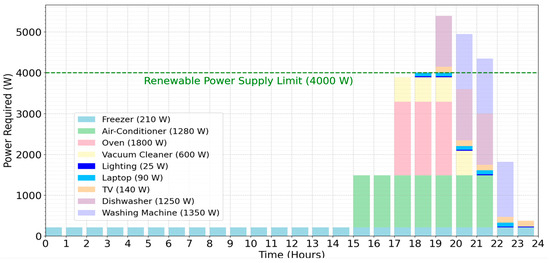
Figure 7.
Daily power consumption of household appliances without power optimization.
After applying the proposed OPMS with a combination of time-shifting and prioritization, the peak demand was significantly reduced by 33.63%, from 5500 W to 3650 W, aligning power consumption with available renewable power (Figure 8). This reduction underscores the effectiveness of OPMS in balancing renewable power usage, reducing grid impact, and minimizing non-renewable power reliance.
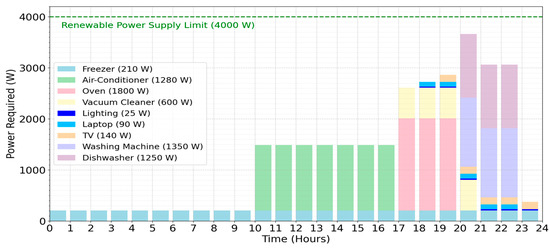
Figure 8.
Daily power consumption of household appliances after power optimization.
This case study provides a proof-of-concept for the proposed OPMS, demonstrating its effectiveness in optimizing power consumption within a simplified smart home scenario. The reduction in peak demand directly addresses Research Question 1, illustrating how advanced power management techniques, such as time-shifting and service prioritization, enhance the efficiency of renewable power use. Additionally, by aligning demand with renewable supply and reducing reliance on non-renewable sources, the system supports the hypothesis that integrating advanced management strategies improves overall power efficiency in smart homes. This also answers Research Question 2, confirming that the OPMS offers a more resilient and adaptable framework for power management.
5. Results and Discussion
This section presents the evaluation of the proposed OPMS using various approaches, including synthetic data, real data, and profile-based data. Each method assesses the system’s ability to optimize renewable power consumption and minimize or eliminate non-renewable power reliance while effectively managing power demand.
The primary goal of this proposal is to optimize power allocation for IoE devices in standalone smart homes. The proposed algorithm identifies the most effective management mechanism that minimizes the gap between renewable power availability and consumption, whether it be priority allocation, time-shifting, quality degradation, or battery utilization. If no optimal solution is found, the algorithm combines these mechanisms to further eliminate or reduce reliance on non-renewable sources.
This approach prioritizes renewable power usage first, turning to non-renewable sources only when necessary. Synthetic data are used to validate the system’s functionality by evaluating each mechanism independently. Real data testing directly determines the best management strategy for practical application. For comparison with relevant studies, profile-based simulations were adopted to validate the system’s robustness across various user scenarios, highlighting its adaptability and performance in different conditions.
5.1. Testing with Synthetic Data
In the synthetic data testing, we evaluated each power management mechanism—priority-based allocation, rejection, time-shifting, quality degradation, and battery utilization—independently to assess its impact on power system performance. This approach allowed for an isolated analysis of how each mechanism influenced power utilization, acceptance ratios, and the overall objective function, without interference from other mechanisms. By examining each mechanism separately, we highlighted its ability to optimize power consumption, balance service demand, and efficiently manage available renewable power. Furthermore, this method underscored the unique strengths and limitations of each mechanism for this scenario in addressing power shortages and improving overall power system efficiency.
In this regard, we generated synthetic data (Table 4) with five distinct service demands, categorized into three priority levels: two services at priority 1, one at priority 2, and two at priority 3. These data provide a comprehensive evaluation of the system’s ability to manage varying service requirements.
Table 4.
Synthetic service demands.
Each service was evaluated for its potential to shift start times forward or backward, offering flexibility in aligning with renewable power availability. Also, each service was assigned a specific level of allowed quality degradation, which provided flexibility in the system’s ability to manage power consumption. We also incorporated a manufactured battery capacity of = 10 Ah, allowing the system to manage power under fluctuating renewable supply. Figure 9 illustrates the renewable power supply over 24 h, providing a dynamic view of how the system adjusts to varying power availability.
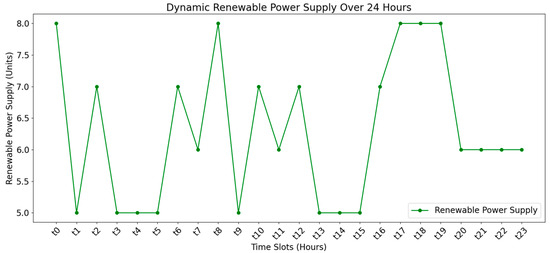
Figure 9.
Dynamic renewable power supply for testing in synthetic data over 24 h.
This baseline power demand vs. power supply (Figure 10) highlights a critical power deficit between hour 1 and hour 4, where demand exceeds renewable supply, leading to shortages (as shown by the red shaded area). The renewable supply fluctuates throughout the 24 h, while baseline demand peaks early and then drops to zero after hour 5, exposing inefficiencies in power usage. This illustrates the importance of employing advanced management mechanisms to better align demand with renewable availability and prevent power shortages. The following presents the results of evaluating each management mechanism independently:
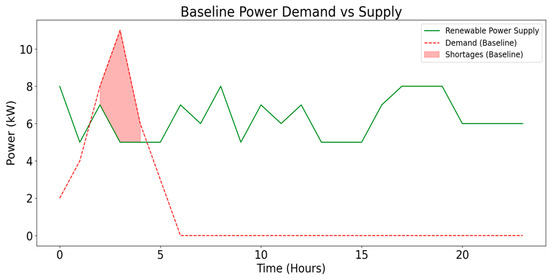
Figure 10.
Renewable power supply vs. baseline demand.
- The priority-based allocation approach: the priority-based approach focuses on meeting priority 1 demands first. As seen in Figure 11, subplot (a), shortages occurred in time slots 3 and 4, showing that renewable power alone was insufficient for critical services. While Priority 2 and 3 services adapted (Figure 11, subplots (b,c)), Priority 1 services remained underserved without supplementary mechanisms.
- The rejection mechanism: applying dual strategy targets rejecting high-consumption services that do not adequately meet demand (such as S3 and S4), while simultaneously increasing the number of accepted services to optimize the availability of power. Figure 12, subplot (a), shows that this strategy significantly reduced shortages and improved power allocation compared to the baseline scenario. By rejecting high consumption, the system balanced power more effectively with noticeable improvement compared to the baseline (Figure 10), where shortages were substantial.
- The time-shifting mechanism delivers the best performance, aligning consumption with supply through optimal service rescheduling. As depicted in Figure 12, subplot (b), this approach reduced average residual power to 2, with a 100% acceptance ratio. It fully utilized available renewable power by optimally shifting the start times of services while eliminating supply-demand mismatches.
- The quality degradation mechanism: this mechanism maintained service performance by slightly reducing quality levels to balance demand with supply. Figure 12, subplot (c) illustrates how the optimal degradation configuration allowed all services to be met without non-renewable power. The mechanism demonstrates flexibility in managing consumption while maintaining continuity for all services.
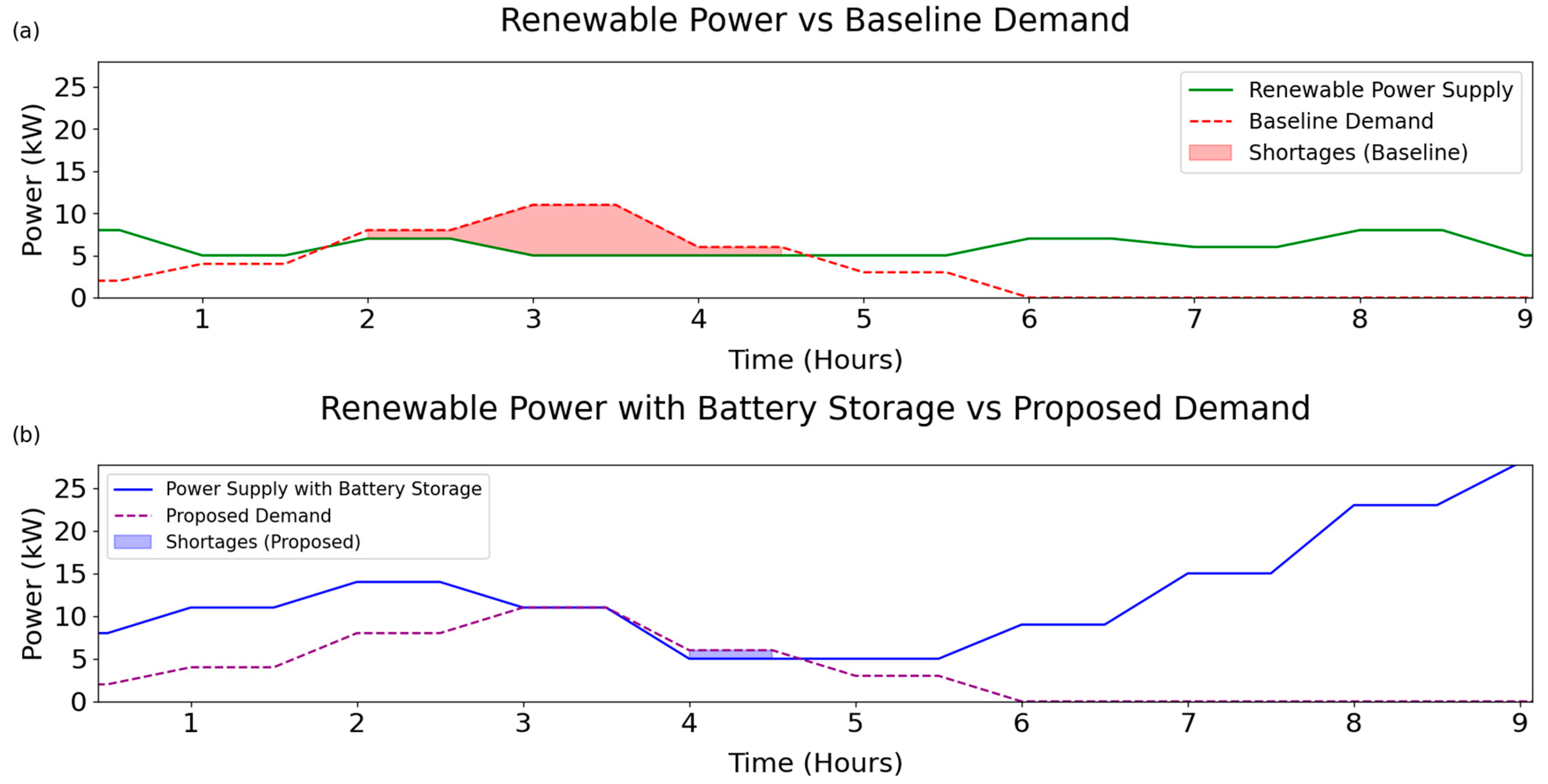
- Battery utilization mechanism: as seen in Figure 13, we observe how the battery utilization mechanism effectively manages power demands. In Figure 13, subplot b, the solid blue line represents the combined power supply from renewable sources and battery reserves. During certain periods, the demand exceeds the available power from renewable sources and battery reserves (shaded purple), leading to an average power deficit that must be supplied by non-renewable sources to meet all service demands. The mechanism efficiently discharges only 3 units of stored power, achieving a Battery Utilization Rate of 12%, this reflects low strain on the battery and demonstrates optimal power flow management. The strategy minimizes reliance on non-renewable power while ensuring services are adequately supplied, preserving both battery health and system efficiency.
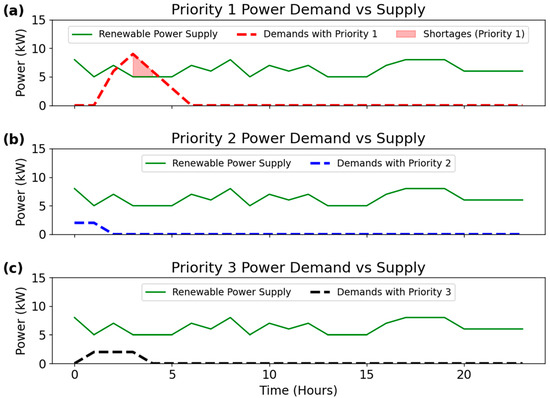
Figure 11.
Priority mechanism performance for synthetic data test. (a) Priority 1: renewable power vs. demand and shortages. (b) Priority 2: renewable power vs. demand and shortages. (c) Priority 3: renewable power vs. demand and shortages.
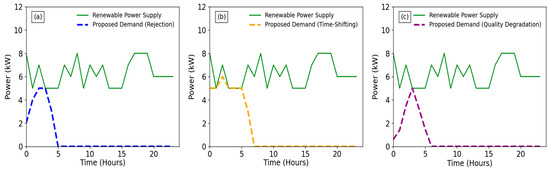
Figure 12.
Comparison of performance across various management mechanisms for with synthetic data testing. (a) Renewable power supply and proposed demand after rejection. (b) Renewable power supply and proposed demand after time shifting. (c) Renewable power supply and proposed demand after quality degradation.
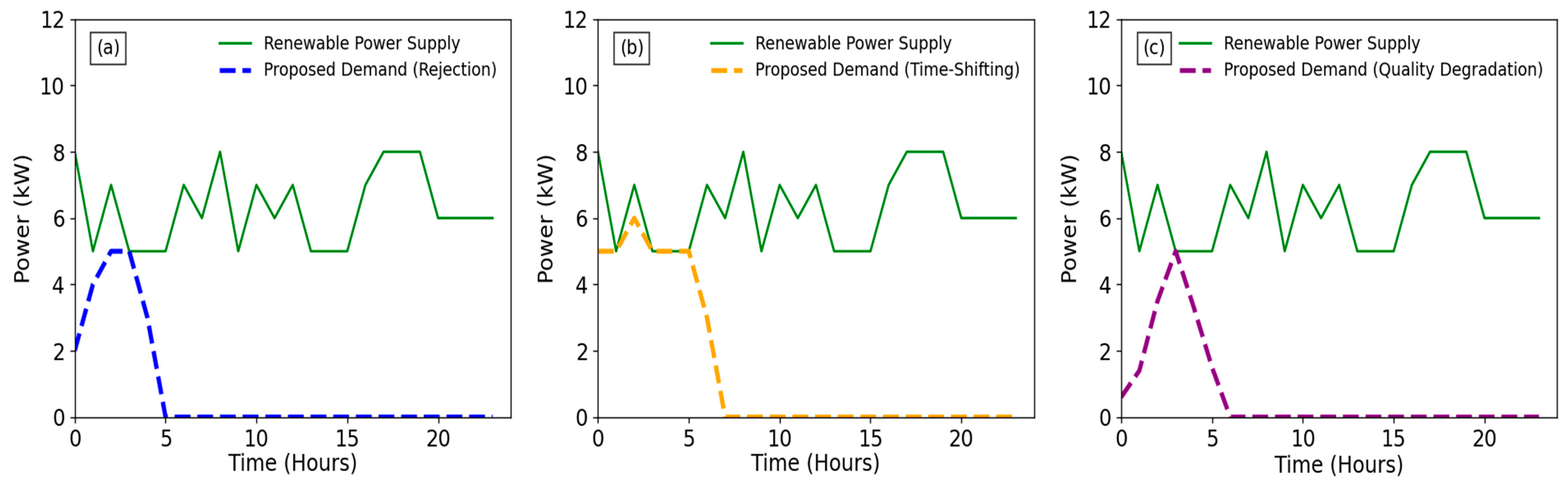
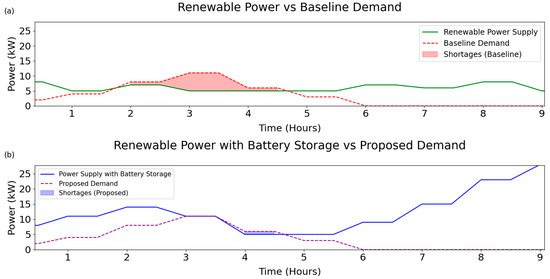
Figure 13.
Comparison of renewable power supply versus demand with and without battery storage. (a) Renewable power supply and baseline demand, with shortages highlighted when demand exceeds available renewable power. (b) Renewable power supply with battery storage and proposed demand, showing the impact of battery storage in partially mitigating shortages.
Comparative Analysis: Testing with Synthesis Data
Figure 14 provides a comparative analysis of four key power management mechanisms—Rejection, Time Shifting, Battery Utilization, and Quality Degradation. Each of these mechanisms offers a distinct approach to managing power, with varying effects on power efficiency, service acceptance, and objective function. Below is a more detailed description of each mechanism:
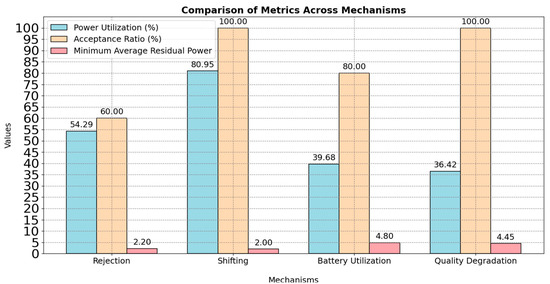
Figure 14.
Comparison of power utilization rate, acceptance ratio, and minimum residual power across various management mechanisms for synthetic data.
- The Time Shifting mechanism outperformed the others, achieving 100% acceptance, the highest power utilization (80.95%), and minimal average residual power = 2. This demonstrates its efficiency in identifying the optimal combination of services start times– = (:4)—to fully utilize available renewable power and meet all service demands.
- In contrast, the rejection mechanism, while effective in reducing power shortages by rejecting services (e.g., S3 and S4) that consumed significant portions of renewable power without fully meeting demand, resulted in lower power utilization (54.29%) and acceptance (60%). It left behind 2.20 of average residual power, highlighting the trade-offs of this approach.
- The battery utilization mechanism, despite effectively compensating for power shortages with a reasonably high acceptance rate of 80%, faced challenges due to high power demand. At time slot 4, a 1 kW shortfall occurred, leading to an average residual power of 4.80 and power utilization of 39.68%. The average power deficit over four-time slots was 0.166, showing that this mechanism may not be ideal for handling high-demand services in this scenario.
- The quality degradation mechanism: by slightly reducing service quality, the mechanism found the optimal quality degradation configuration- = (:0.3, :0.3, :0.3, :0.7,: 0.8)), achieved 100% acceptance, and maintained relatively good power utilization (36.42%). However, its average residual power (4.45) indicates that this mechanism, while flexible, may still leave some power unutilized in compression with shifting in time results.
- Lastly, the priority allocation mechanism focused on allocating power to higher-priority services but revealed limitations in fully meeting high-priority demands under constrained conditions. This led to a moderate acceptance rate and suboptimal power utilization.
After completing the synthetic data testing, the advanced power management techniques independently demonstrated their ability to optimize power usage effectively for this scenario. Time-shifting, in particular, proved to be the most powerful, aligning service consumption with renewable supply and maximizing power utilization. The integration of these mechanisms not only eliminates reliance on non-renewable power but also reduces the strain on battery reserves. By prioritizing these methods before resorting to battery utilization, the system preserved battery life and maintained overall power efficiency in smart homes.
5.2. Testing with Real Data
During this evaluation, the OPMS algorithm was applied in a smart home environment, utilizing real IoE demand data referenced from [28]. The algorithm was tested across multiple management mechanisms, selecting the most efficient based on system performance. Additional parameters, such as forward and backward time-shifting, quality degradation, and service prioritization, were incorporated to evaluate the flexibility and adaptability of each mechanism. Due to complexity constraints, the evaluation focused on 13 services (Figure 15).
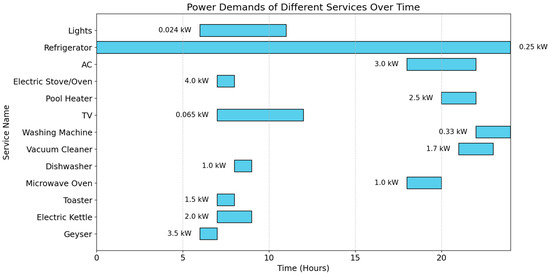
Figure 15.
Typical power ratings for common household appliances [28].
The renewable power supply was modeled using a predictive SVM-PSO approach, as described in [41], incorporating data from photovoltaic (PV) panels and wind turbines (WT). Day-ahead forecasts for hourly power generation were utilized to simulate real-world conditions, ensuring an accurate representation of anticipated renewable power outputs (Figure 16).
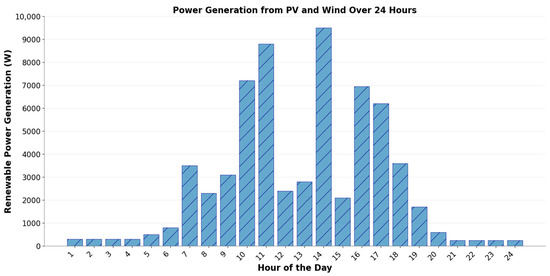
Figure 16.
Predictive power supply from PV Panels and Wind Turbines (WT) [41].
Comparative Performance Analysis: Testing with Real Data
In this assessment, all IoE devices were assigned Priority 1, indicating their high importance in the system. Given this prioritization, the priority-based power allocation mechanism aimed to satisfy the power demands of these services first. However, since the power supply faced shortages, it was not possible to fully accommodate all service demands solely through renewable power. As a result, even with service prioritization, some of the services under priority (1) still faced unmet power demands (as shown in Figure 17, subplot (a)), necessitating the use of additional mechanisms, such as shifting in time, quality degradation and battery utilization, to manage these shortages. In this evaluation, none of the power management mechanisms—time-shifting, quality degradation, or battery utilization—were able to fully meet service demands using 100% renewable power.
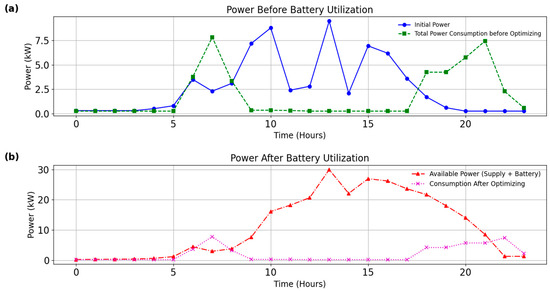
Figure 17.
Optimization effect on power with battery utilization management mechanism for real data. (a) Shows the initial power and total power consumption before optimizing. (b) Displays available power (including supply and battery) and the consumption after optimization.
- First, time-shifting was applied, generating 559,872 combinations. While this mechanism optimized service start times to align with renewable power availability, it could not fully prevent power shortages in certain time slots, indicating its limitations in scenario with high demand and insufficient renewable supply.
- Next, quality degradation was tested, which produced 1,594,323 combinations. This mechanism allowed services to operate at reduced power by slightly lowering service quality. While this approach helped decrease overall power consumption, it still could not eliminate the need for non-renewable power. The reduction in demand, although beneficial, was insufficient to bridge the gap between renewable supply and service demands.
- Finally, battery utilization proved to be the most effective strategy. Although it did not achieve complete reliance on renewable power, it significantly reduced the need for non-renewable power. As shown in Figure 17, subplot (b), battery reserves were insufficient to fully accommodate the power demands during time slot 7. The system discharged battery power only when necessary, ensuring that most demands were met using stored power.
This analysis underscores the importance of battery utilization in balancing power demand with renewable power supply, especially under battery capacity constraints ( = 30 Ah). The complete results are shown in Figure 18. Subplot (a) compares non-renewable power usage before and after optimization for each mechanism, highlighting the reduction in reliance on non-renewable power. When using the battery utilization management mechanism, the average need for non-renewable power dropped to just 0.062, compared to 1.09 for time-shifting and 0.268 for quality degradation. Before optimization, the average power deficit requiring non-renewable power was 1.187. This demonstrates the superior performance of battery utilization in significantly minimizing reliance on non-renewable power. Figure 18, subplot (b) shows the average residual power for each mechanism, reflecting how well each aligns consumption with renewable supply.
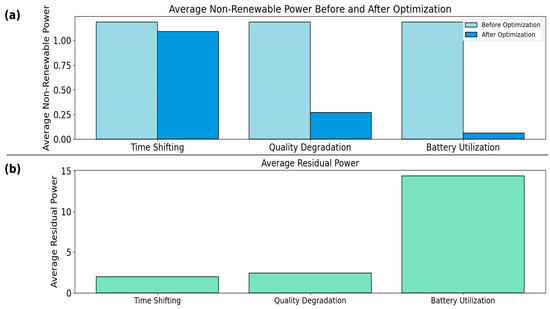
Figure 18.
Comparison of power management strategies in real data testing. (a) Average non-renewable power before and after optimization. (b) Average residual power for time-shifting, quality degradation, and battery utilization, showing battery utilization as the most effective strategy.
5.3. Evaluation Against Relevant Research Using Real Power Supply and Adopted Profile-Based Testing
The main contribution of the following section is to compare our study with the relevant research [15], which incorporates both heuristic and optimal power management approaches. Specifically, we compare their optimal power management results for small-scale systems (particularly profiles II and III) with our findings. We have adopted the same profile-based testing scenario as [15] and utilized the same real power supply data for consistency in comparison referenced from [44].
Our proposal, represented by Profiles I and II, focuses on service demands classified as priority 1, yet the renewable power supply was insufficient to meet these demands fully. To address this, we implemented supplementary management strategies such as time-shifting, battery utilization, and quality degradation, which were evaluated across key metrics like acceptance ratio (AR), runtime, and power utilization. By customizing the original profiles with three levels of quality degradation, we gained a comprehensive view of how these mechanisms optimize power usage. Unlike the approach in reference [15], which relies solely on time-shifting, our method incorporates additional strategies to address challenges like power shortages and battery efficiency, offering a more flexible and robust solution for power optimization. These profiles are as follows:
- Profile I: peak demand with variable power and time duration—simulates peak demand periods with varying power levels and durations to assess system performance under dynamic conditions.
- Profile II: 100% green power supply—evaluates how effectively the system synchronizes power consumption with renewable power generation, modeled using Gaussian distribution to reflect realistic renewable patterns.
Both profiles (outlined in Table 5 and illustrated in Figure 19) were analyzed using algorithmic scheduling for small-scale scenarios (N ≤ 8), incorporating up to four forward and backward time shifts. The results, summarized in Table 6, Table 7, Table 8 and Table 9, show that our approach achieved consistent and efficient performance in small-scale settings with = 10. This allows for a meaningful comparison with the optimal power management results [15].
Table 5.
Profile-based scenarios.
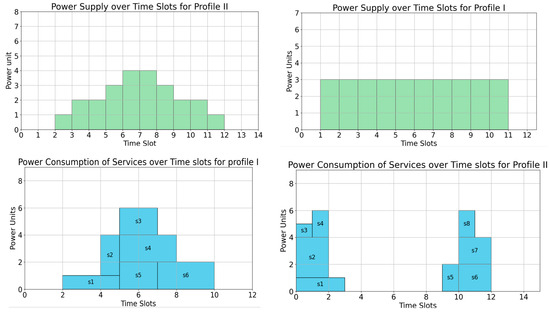
Figure 19.
Simulation profiles for power supply and demand consumption [15].
Table 6.
Summary of power optimization results after adopting the time-shifting mechanism across all scenarios for profile I.
Table 7.
Performance evaluation of optimal OPMS decision in Profile I.
Table 8.
Power optimization results when adopting the time-shifting management mechanism across all scenarios for Profile II..
Table 9.
Impact of quality degradation and battery utilization on power optimization for Profile II.
Based on the scenario proposed by [15], the OPMS initially allows a time-shifting range of 1 slot forward and 1 slot backward for each demand, with predefined quality degradation ( levels set at [1, 0.5, 0.75]. The system is subsequently re-evaluated with time-shifting ranges extended to 2 slots forward and backward while maintaining the same quality degradation levels. This process is iterated up to a 4-slot time-shifting range, progressively increasing the complexity of the analysis.
As shown in Table 5, both Profile I and Profile II employ the OPMS to evaluate varying demand sets across these shifting ranges, with performance assessed in terms of time-shifting, quality degradation, and battery utilization. The proposed algorithm stops once a mechanism completely relies on renewable power, ensuring both efficiency and sustainability. Otherwise, it continues searching for a solution that minimizes residual power, ensuring optimal allocation of resources while balancing supply and demand. This staged approach provides a comprehensive examination of the OPMS’s capability to optimize power consumption while adapting to fluctuating supply and demand profiles.
Comparative Performance Analysis: Testing with Profile-Based Data
As outlined, the OPMS prioritizes services by criticality, but since all services are classified as Priority 1, it evaluates total power demand directly. Given the initial power shortfall, the system continues exploring remaining mechanisms to identify the optimal solution.
- In Profile I, the OPMS starts with a time-shifting management mechanism but encounters a persistent power shortfall across all ranges (in all scenarios). As shown in Table 6, the required non-renewable power and residual renewable power increase with the time-shifting range. This highlights the computational trade-off as more combinations are evaluated, significantly increasing the system’s burden. However, when the quality degradation mechanism is applied, the OPMS optimizes power consumption, achieving 100% service adoption with complete reliance on renewable power, thus eliminating the need for non-renewable sources. Further evaluation of battery utilization becomes unnecessary once the optimal solution is identified because the system has already achieved power optimization without over-reliance on stored power. This approach reduces the frequency of charging and discharging cycles, which helps extend the battery’s overall life while ensuring that renewable power is used efficiently.In contrast, ref. [15] reports an acceptance ratio of 95.33% for the same profile, while our proposal achieves a 100% acceptance ratio. This improvement highlights the effectiveness of our approach in fully accommodating service demands by integrating additional management mechanisms like quality degradation, rather than just time-shifting.The results of the quality degradation mechanism are detailed in Table 7. Processing times increase with each time-shifting scenario, starting from 0.0197 s and reaching up to 3.42 s as the shifting range expands. Despite this, the consistent application of quality degradation ensures that the OPMS achieves full-service adoption, minimal residual power, and efficient processing. Ref. [15], which only applies time-shifting, reports an execution time of 2.89 × 10⁴ s for 50 iterations, whereas our approach reaches the optimal solution within 4 s, clearly showing that our method is faster and more effective in optimizing power management.
- Regarding the scenarios for Profile II, the proposed OPMS exhibited a significant increase in running time with time-shifting, progressing from 0.068 to 42.4 s as the shifting range expanded (Table 8). Despite this, none of the management mechanisms achieved an optimal solution with zero power deficit. As a result, the algorithm focuses on identifying the best decision that minimizes the objective function and reduces reliance on non-renewable power.All three mechanisms—time-shifting, quality degradation, and battery utilization—achieved a 100% acceptance ratio, ensuring that all services were fulfilled. However, the efficiency of these mechanisms varied. The time-shifting mechanism, while effective, demonstrated diminishing returns with larger shifting ranges. For instance, the average power deficit () decreased from 1.5 with no shifting to 1.11 at a shift range of ±3. However, beyond this, efficiency declined, with a deficit of 1.37 at a shift range of ±4. This shows that the computational burden increases as more combinations are evaluated, but the benefits taper off at higher shift ranges.The quality degradation mechanism proves to be the most efficient strategy for minimizing power shortages, reducing the average power deficit to 0.625 (Table 9). This method optimizes the use of renewable power while significantly lowering the dependency on non-renewable sources. On the other hand, battery utilization, while effective in maintaining service continuity, results in a larger power shortfall (0.916) and a heavier reliance on battery reserves. By leveraging quality degradation, the system effectively prevents unnecessary battery discharges, preserving battery lifespan and easing strain on reserves. As a result, quality degradation not only enhances power optimization and reduces reliance on non-renewable power, but also extends battery life by prioritizing the use of renewable power over battery usage.Notably, ref. [15] reports an acceptance ratio of 71.5% for Profile II and a significantly longer execution time of 1.41 × s for 50 iterations, further highlighting the efficiency of our proposed OPMS, which consistently achieved a 100% acceptance ratio across all mechanisms within much shorter processing times.
For both profiles, it clearly demonstrates the superior performance of quality degradation in optimizing power by adjusting service quality and reducing reliance on additional power sources.
6. Complexity Analysis
The complexity of the system’s approach is driven by two key factors:
- Linear Complexity () The power demand of each service must be checked against available power, growing linearly with the number of services N. The complexity of evaluating time-shifting variations for all services also grows linearly, given by . Each service can shift forward and backward, which are denoted by and , by a fixed number of time slots. This leads to +1) possible variations per service, and when multiplied by the total number of services, the overall complexity remains .
- Exponential Terms: the exponential growth is driven by two key mechanisms:
- Time-Shifting Combinations: The exponential growth is dominated by the number of time-shifting combinations for N services. The number of possible combinations for time-shifting is , contributing to .
- Quality Degradation: Similarly, the complexity arising from quality degradation levels QD is exponential, given by . Each service has multiple degradation levels, and the total number of combinations grows exponentially with N.
The overall complexity is determined by the larger of the two exponential terms, as expressed by the following:As the number of services N, the time-shifting range ( and ), or quality degradation levels QD increases, the computational requirements grow significantly, posing challenges for large-scale systems.
Mitigating Complexity with Optimization
Given the rapid growth of complexity driven by exponential terms, practical implementation requires efficient optimization strategies:
- Heuristic Methods: heuristics are used to approximate solutions, helping to reduce the solution space and improve scalability.
- AI-based Optimization: future implementations may include AI methods to accelerate scheduling and power management, improving system performance in large-scale applications.
While the complexity is primarily driven by the exponential terms, careful management of critical parameters and the use of optimization techniques, such as heuristic algorithms and AI, can mitigate these effects, making the approach feasible for larger-scale applications.
7. Future Work
To address the challenges and advance power optimization, future research will focus on the following areas:
- Enhanced Communication Protocols: develop an advanced four-way communication protocol involving IoE-connected devices, a scheduling manager, the smart grid, and the battery system. This will enhance coordination and improve overall efficiency in power management.
- AI Integration: integrate cutting-edge AI-based meta-heuristic optimization techniques to handle the NP-hard nature of power scheduling problems. These techniques will tackle stochastic decision-making scenarios and optimize large-scale power management systems in real-time mode, improving the handling of complex scheduling issues and enhancing overall efficiency.
- Power Efficiency and AI-Enhanced G-IoT Goals: incorporate AI-driven power-aware constraints to align with the G-IoT paradigm’s goal of reducing carbon footprints. This approach will leverage AI to balance power supply and demand for high-performance computing (HPC) resources, which are essential for managing numerous IoE devices while promoting sustainability.
- Integration of Cybersecurity Measures: developing algorithms that not only optimize power consumption but also ensure robustness against cyberattacks is a key area of focus. This involves incorporating real-time detection and mitigation strategies to safeguard smart homes and microgrids from threats, such as False Data Injection (FDI) attacks, which compromise sensor data and cause system instability or blackouts.
By pursuing these advancements, we aim to develop sophisticated and efficient methods for power optimization in IoE environments, enhancing sustainability and effective power management for the future.
8. Conclusions
This research introduces an advanced power management system (OPMS) designed to optimize the use of renewable power in smart homes within 6G environments. The hypothesis suggested that incorporating advanced power management techniques, such as priority-based allocation, time-shifting, quality degradation, and battery utilization, would maximize renewable power usage, reduce reliance on non-renewable power, and improve overall system efficiency. Our findings support this hypothesis.
By aligning IoE device consumption with available renewable power, the OPMS efficiently manages power distribution, reducing the dependency on non-renewable power. The system prioritizes critical services under power constraints using a priority-based allocation mechanism. In conjunction with time-shifting, battery utilization, and quality degradation, this approach ensures service continuity while optimizing power usage.
The research questions posed were addressed as follows:
- Impact of Power Management Techniques: Advanced management strategies were shown to be effective. In synthetic data testing, time-shifting achieved a 100% acceptance ratio (AR) and reduced residual power, demonstrating optimal alignment between consumption and available renewable power. Quality degradation proved to minimize power deficits, particularly in Profile II scenarios.
- Resilience of Power Management Systems: The system’s adaptability was demonstrated in real data testing, where battery utilization significantly reduced the required non-renewable power from 1.187 kW to 0.062 kW. This showcases the system’s resilience in maintaining power supply even when renewable resources are limited.
- Prioritization of Management Mechanisms: By prioritizing time-shifting and quality degradation before battery utilization, the system minimized battery strain and extended its lifespan. Quality degradation emerged as the most effective mechanism in Profile II, which reduced power shortages without excessive reliance on battery reserves.
Overall, the system’s demand-shifting and quality degradation strategies enhanced grid efficiency and optimized battery performance by managing charging cycles and preventing unnecessary discharges. The use of brute-force combinatorial methods ensured highly accurate solutions, though scalability remains a challenge. This opens the door for future work incorporating AI-driven heuristics for real-time decision-making, thus enabling the system to adapt to larger datasets and more complex power management scenarios.
In summary, this research confirms that a combination of advanced power management techniques can significantly reduce reliance on non-renewable power, improve power efficiency, and ensure the sustainable operation of smart homes in 6G environments. Future work will focus on scaling these approaches with AI-driven heuristics and establishing new benchmarks for sustainable power management in smart cities.
Author Contributions
Conceptualization, R.R.A.-T. and X.H.; methodology, R.R.A.-T. and X.H.; software, R.R.A.-T.; validation, R.R.A.-T. and Hesselbach; formal analysis, R.R.A.-T. and Hesselbach; investigation, R.R.A.-T. and X.H.; resources, X.H.; data curation, R.R.A.-T.; writing—original draft preparation, R.R.A.-T. and X.H.; writing—review and editing, R.R.A.-T. and X.H.; visualization, R.R.A.-T. and X.H.; supervision, X.H.; project administration, X.H.; funding acquisition, X.H., All authors have read and agreed to the published version of the manuscript.
Funding
This work has been supported by the Agencia Estatal de Investigación of Ministerio de Ciencia e Innovación of Spain under project PID2022-137329OB-C41/MCIN/AEI/10.13039/501100011033.
Data Availability Statement
The original contributions presented in the study are included in the article, further inquiries can be directed to the corresponding authors.
Conflicts of Interest
The authors declare no conflict of interest.
References
- Arshad, R.; Zahoor, S.; Shah, M.A.; Wahid, A.; Yu, H. Green IoT: An Investigation on Energy Saving Practices for 2020 and Beyond. IEEE Access 2017, 5, 15667–15681. [Google Scholar] [CrossRef]
- Shaikh, F.K.; Zeadally, S.; Exposito, E. Enabling Technologies for Green Internet of Things. IEEE Syst. J. 2017, 11, 983–994. [Google Scholar] [CrossRef]
- Lin, L.; Khan, H.U.; Abdallah, A.; Hashim, F.; Rabie, K.; Khan, I.; Ishak, M.K.; El-Sehiemy, R.A.; Mahmoud, K.; Darwish, M.; et al. Hierarchical Optimization and Grid Scheduling Model for Energy Internet: A GA-Based Layered Approach. Energy Rep. 2021. [Google Scholar] [CrossRef]
- Poulek, V.; Aleš, Z.; Finsterle, T.; Libra, M.; Beránek, V.; Severová, L.; Belza, R.; Mrázek, J.; Kozelka, M.; Svoboda, R. Reliability characteristics of first-tier photovoltaic panels for agrivoltaic systems–practical consequences. Int. Agrophysics 2024, 38, 383–391. [Google Scholar] [CrossRef] [PubMed]
- Kim, J.; Rabelo, M.; Padi, S.P.; Yousuf, H.; Cho, E.-C.; Yi, J. A review of the degradation of photovoltaic modules for life expectancy. Energies 2021, 14, 4278. [Google Scholar] [CrossRef]
- Akhter, Z.; Omar, F.K. Review of flow-control devices for wind-turbine performance enhancement. Energies 2021, 14, 1268. [Google Scholar] [CrossRef]
- Hesse, H.C.; Schimpe, M.; Kucevic, D.; Jossen, A. Lithium-ion battery storage for the grid—A review of stationary battery storage system design tailored for applications in modern power grids. Energies 2017, 10, 2107. [Google Scholar] [CrossRef]
- Carrasco, J.M.; Franquelo, L.G.; Bialasiewicz, J.T.; Galvan, E.; PortilloGuisado, R.; Prats, M.A.M.; Leon, J.I.; Moreno-Alfonso, N. Power-Electronic Systems for the Grid Integration of Renewable Energy Sources: A Survey. IEEE Trans. Ind. Electron. 2006, 53, 1002–1016. [Google Scholar] [CrossRef]
- Fotopoulou, M.; Pediaditis, P.; Skopetou, N.; Rakopoulos, D.; Christopoulos, S.; Kartalidis, A. A Review of the Energy Storage Systems of Non-Interconnected European Islands. Sustainability 2024, 16, 1572. [Google Scholar] [CrossRef]
- Zhou, B.; Li, W.; Chan, K.W.; Cao, Y.; Kuang, Y.; Liu, X.; Wang, X. Smart home energy management systems: Concept, configurations, and scheduling strategies. Renew. Sustain. Energy Rev. 2016, 61, 30–40. [Google Scholar] [CrossRef]
- Gorle, A.R.; Farhan, A. Optimization of Smart Home Appliances with Energy Management System. In Proceedings of the 2024 International Conference on Signal Processing, Computation, Electronics, Power and Telecommunication (IConSCEPT), Karaikal, India, 4–5 July 2024; pp. 1–6. [Google Scholar] [CrossRef]
- Hamouda, Y.E.M. Optimal Decision Making for Hybrid Power Systems Selection with Smart Grid and Local Generator Using Wireless Sensor Networks. In Proceedings of the 2023 IEEE International Conference on Advanced Systems and Emergent Technologies (IC_ASET), Hammamet, Tunisia, 29 April–1 May 2023; pp. 1–6. [Google Scholar] [CrossRef]
- Harikrishnan, G.R.; Sreedharan, S.; Badharudheen, P.; Joseph, T.; Chandran, C.V.; Joseph, S. Demand Response Supported Energy Management Framework for Residential Users. In Proceedings of the 2023 IEEE International Conference on Power Electronics, Smart Grid, and Renewable Energy (PESGRE), Trivandrum, India, 17–20 December 2023; pp. 1–6. [Google Scholar] [CrossRef]
- Tipantuña, C.; Hesselbach, X. Demand-Response power management strategy using time shifting capabilities. In Proceedings of the Ninth International Conference on Future Energy Systems, Karlsruhe, Germany, 12–15 June 2018. [Google Scholar] [CrossRef]
- Tipantuña, C.; Hesselbach, X.; Unger, W. Heuristic Strategies for NFV-Enabled Renewable and Non-Renewable Energy Management in the Future IoT World. IEEE Access 2021, 9, 125000–125031. [Google Scholar] [CrossRef]
- Allience, O. OpenADR 2.0 Profile Specification B Profile; Technical Report; OpenADR Alliance: Morgan Hill, CA, USA, 2013. [Google Scholar]
- Lotfi, M.; Monteiro, C.; Shafie-khah, M.; Catalão, J.P.S. Evolution of Demand Response: A Historical Analysis of Legislation and Research Trends. In Proceedings of the 2018 Twentieth International Middle East Power Systems Conference (MEPCON), Cairo, Egypt, 18–20 December 2018; pp. 968–973. [Google Scholar] [CrossRef]
- Hui, H.; Ding, Y.; Shi, Q.; Li, F.; Song, Y.; Yan, J. 5G network-based Internet of Things for demand response in smart grid: A survey on application potential. Appl. Energy 2020, 257, 113972. [Google Scholar] [CrossRef]
- Zhang, W.; Chen, Z.; Zuo, Y.; Long, Y.; Qiao, H.; Xu, X. Microgrid Energy Management Based on Sample-Efficient Reinforcement Learning. In Proceedings of the 2023 13th International Conference on Power and Energy Systems (ICPES), Chengdu, China, 8–10 December 2023; pp. 379–384. [Google Scholar] [CrossRef]
- Filali, A.; Abouaomar, A.; Cherkaoui, S.; Kobbane, A.; Guizani, M. Multi-Access Edge Computing: A Survey. IEEE Access 2020, 8, 197017–197046. [Google Scholar] [CrossRef]
- Yu, B.; Zhang, X.; You, I.; Khan, U.S. Efficient Computation Offloading in Edge Computing Enabled Smart Home. IEEE Access 2021, 9, 48631–48639. [Google Scholar] [CrossRef]
- Wang, J.; Pan, J.; Esposito, F.; Calyam, P.; Yang, Z.; Mohapatra, P. Edge cloud offloading algorithms: Issues, methods, and perspectives. ACM Comput. Surv. 2019, 52, 1–23. [Google Scholar] [CrossRef]
- Priya, B.; Malhotra, J. Intelligent Multi-connectivity Based Energy-Efficient Framework for Smart City. J. Netw. Syst. Manag. 2023, 31, 48. [Google Scholar] [CrossRef]
- Naderi, E.; Asrari, A. Detection of False Data Injection Cyberattacks: Experimental Validation on a Lab-scale Microgrid. In Proceedings of the 2022 IEEE Green Energy and Smart System Systems (IGESSC), Long Beach, CA, USA, 7–8 November 2022; pp. 1–6. [Google Scholar] [CrossRef]
- Xu, Z.; Han, G.; Liu, L.; Martínez-García, M.; Wang, Z. Multi-Energy Scheduling of an Industrial Integrated Energy System by Reinforcement Learning-Based Differential Evolution. IEEE Trans. Green Commun. Netw. 2021, 5, 1077–1090. [Google Scholar] [CrossRef]
- Shakerighadi, B.; Anvari-Moghaddam, A.; Vasquez, J.C.; Guerrero, J.M. Internet of Things for Modern Energy Systems: State-of-the-Art, Challenges, and Open Issues. Energies 2018, 11, 1252. [Google Scholar] [CrossRef]
- Essiet, I.O.; Sun, Y.; Wang, Z. Optimized energy consumption model for smart home using improved differential evolution algorithm. Energy 2019, 172, 354–365. [Google Scholar] [CrossRef]
- Han, J.; Choi, C.-S.; Park, W.-K.; Lee, I.; Kim, S.-H. Smart home energy management system including renewable energy based on ZigBee and PLC. IEEE Trans. Consum. Electron. 2014, 60, 198–202. [Google Scholar] [CrossRef]
- Zhao, W.; Ding, L.; Cooper, P.; Perez, P. Smart home electricity management in the context of local power resources and smart grid. J. Clean Energy Technol. 2014, 2, 73–79. [Google Scholar] [CrossRef]
- Makhadmeh, S.N.; Khader, A.T.; Al-Betar, M.A.; Naim, S.; Abasi, A.K.; Alyasseri, Z.A.A. Optimization methods for power scheduling problems in smart home: Survey. Renew. Sustain. Energy Rev. 2019, 115, 109362. [Google Scholar] [CrossRef]
- Gomes, I.; Bot, K.; Ruano, M.G.; Ruano, A. Recent Techniques Used in Home Energy Management Systems: A Review. Energies 2022, 15, 2866. [Google Scholar] [CrossRef]
- Kumar, R.J.; Nithishkumar, T.; Kumar, D.P.; Aravindhan, N. Smart Supply Switching System with Battery Monitoring. In Proceedings of the 2024 3rd International Conference on Applied Artificial Intelligence and Computing (ICAAIC), Salem, India, 5–7 June 2024; pp. 1769–1774. [Google Scholar] [CrossRef]
- İzmitligil, H.; Apaydn Özkan, H. A home energy management system. Trans. Inst. Meas. Control 2018, 40, 2498–2508. [Google Scholar] [CrossRef]
- Hussain, S.M.S.; Tak, A.; Ustun, T.S.; Ali, I. Communication Modeling of Solar Home System and Smart Meter in Smart Grids. EEE Access 2018, 6, 16985–16996. [Google Scholar] [CrossRef]
- Ustun, T.S.; Ozansoy, C.; Zayegh, A. Modeling of a Centralized Microgrid Protection System and Distributed Energy Resources According to IEC 61850-7-420. IEEE Trans. Power Syst. 2012, 27, 1560–1567. [Google Scholar] [CrossRef]
- Carli, R.; Dotoli, M.; Jantzen, J.; Kristensen, M.; Ben Othman, S. Energy scheduling of a smart microgrid with shared photovoltaic panels and storage: The case of the Ballen marina in Samsø. Energy 2020, 198, 117188. [Google Scholar] [CrossRef]
- Estebsari, A.; Mazzarino, P.R.; Bottaccioli, L.; Patti, E. IoT-Enabled Real-Time Management of Smart Grids With Demand Response Aggregators. IEEE Trans. Ind. Appl. 2022, 58, 102–112. [Google Scholar] [CrossRef]
- Tipantuña, C.; Hesselbach, X. NFV-Enabled Efficient Renewable and Non-Renewable Energy Management: Requirements and Algorithms. Future Internet 2020, 12, 171. [Google Scholar] [CrossRef]
- Tipantuña, C.; Hesselbach, X. IoT-Enabled Proposal for Adaptive Self-Powered Renewable Energy Management in Home Systems. IEEE Access 2021, 9, 64808–64827. [Google Scholar] [CrossRef]
- Zhang, R.; E, S.V.; Samuel, R.D.J. Fuzzy Efficient Energy Smart Home Management System for Renewable Energy Resources. Sustainability 2020, 12, 3115. [Google Scholar] [CrossRef]
- Abu Gunmi, M.; Hu, F.; Abu-Ghunmi, D.; Abu-Ghunmi, L. A smart home energy management system methodology for techno-economic optimal sizing of standalone renewable-storage power systems under uncertainties. J. Energy Storage 2024, 85, 111072. [Google Scholar] [CrossRef]
- Arbab-Zavar, B.; Palacios-Garcia, E.J.; Vasquez, J.C.; Guerrero, J.M. Message Queuing Telemetry Transport Communication Infrastructure for Grid-Connected AC Microgrids Management. Energies 2021, 14, 5610. [Google Scholar] [CrossRef]
- Ayan, O.; Turkay, B. Energy Management Algorithm for Peak Demand Reduction. In Proceedings of the 2018 20th International Symposium on Electrical Apparatus and Technologies (SIELA), Bourgas, Bulgaria, 3–6 June 2018; pp. 1–4. [Google Scholar] [CrossRef]
- Ding, Y.M.; Hong, S.H.; Li, X.H. A Demand Response Energy Management Scheme for Industrial Facilities in Smart Grid. IEEE Trans. Ind. Inform. 2014, 10, 2257–2269. [Google Scholar] [CrossRef]
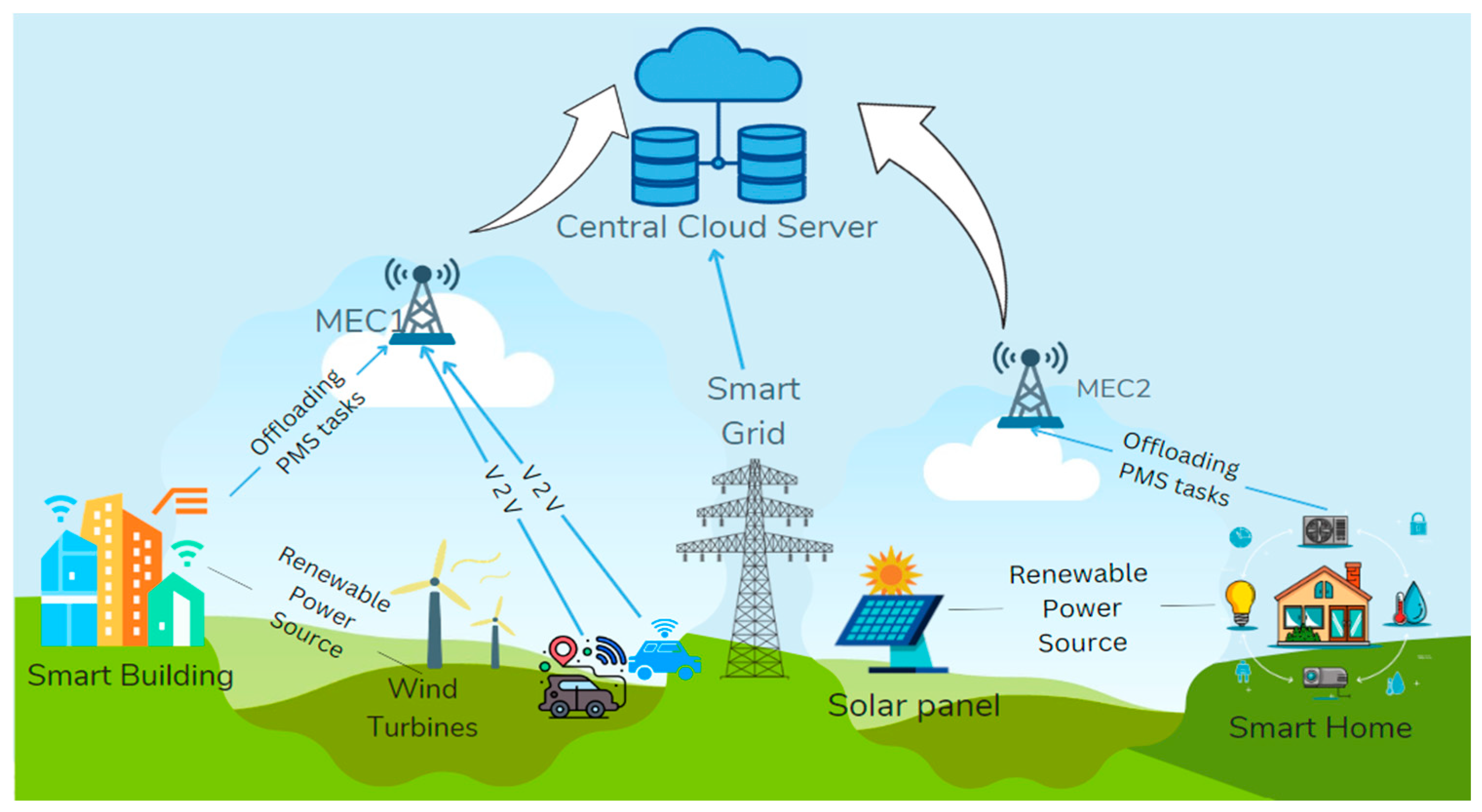
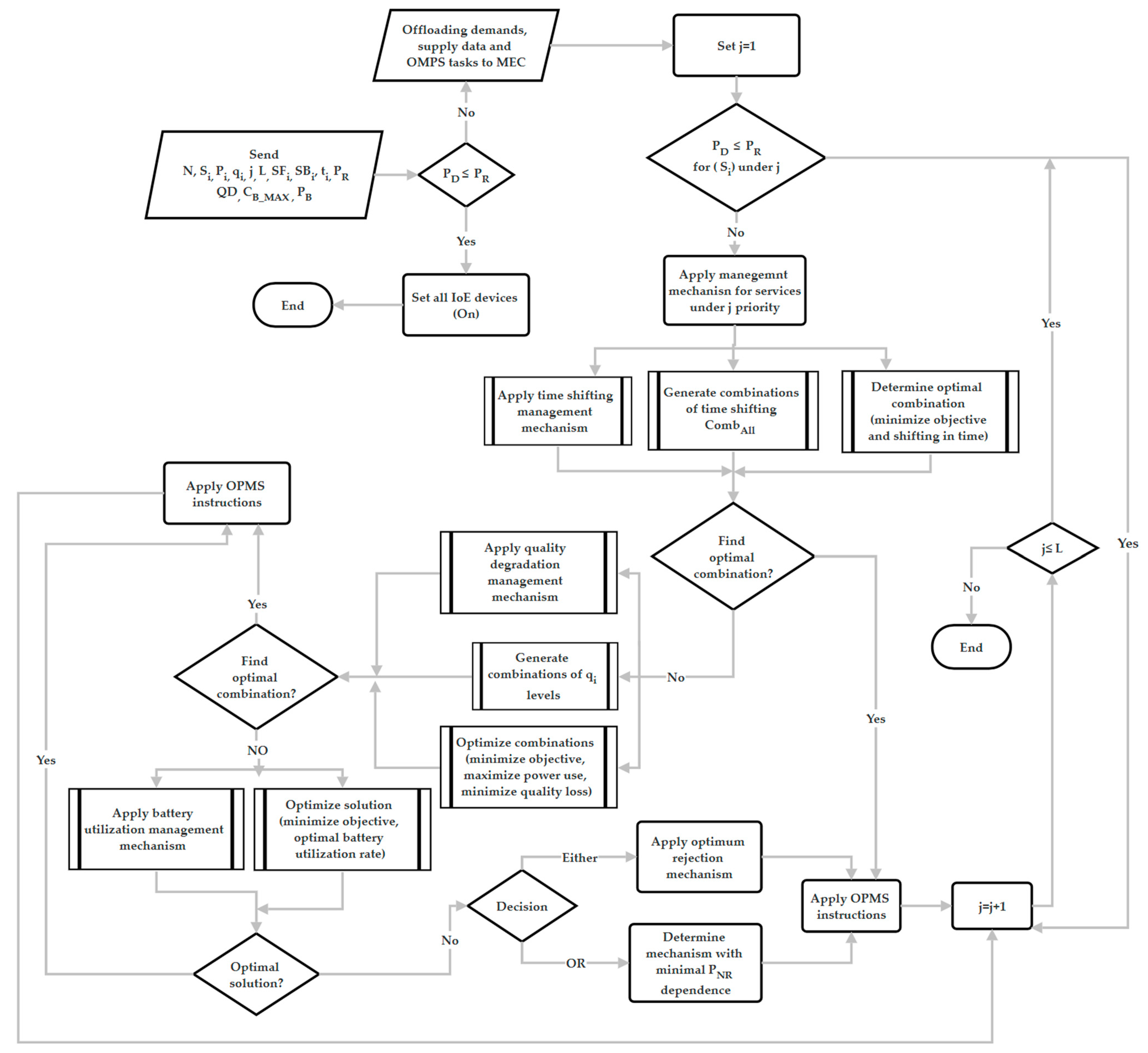
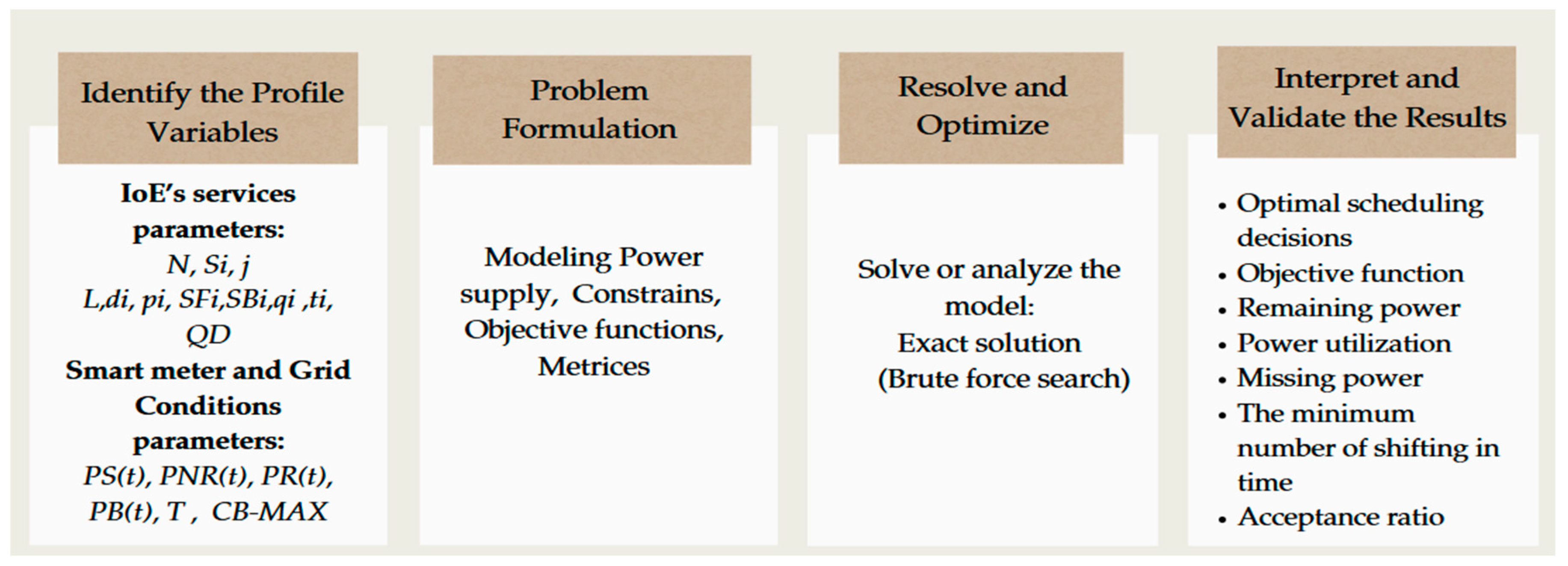
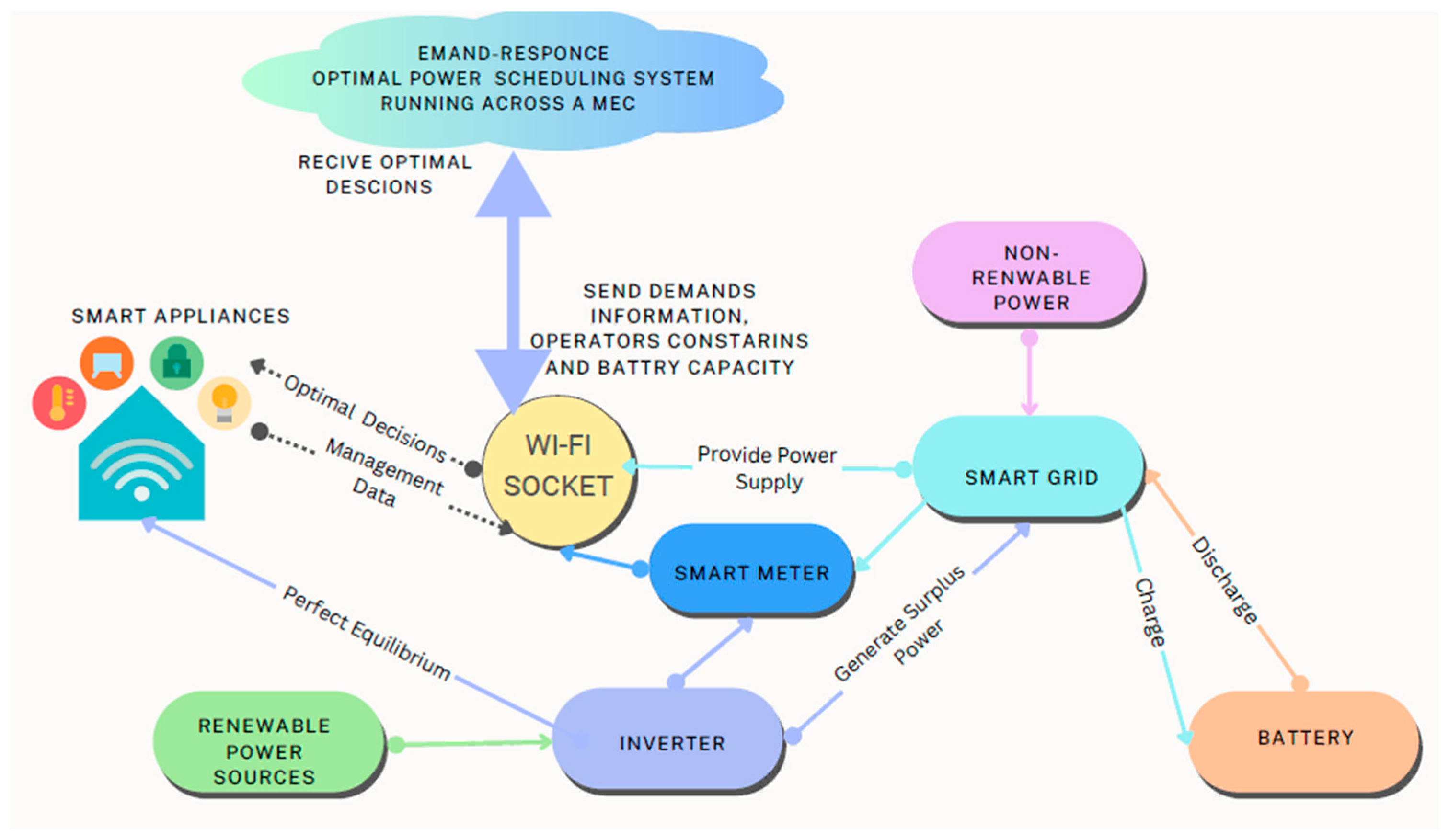
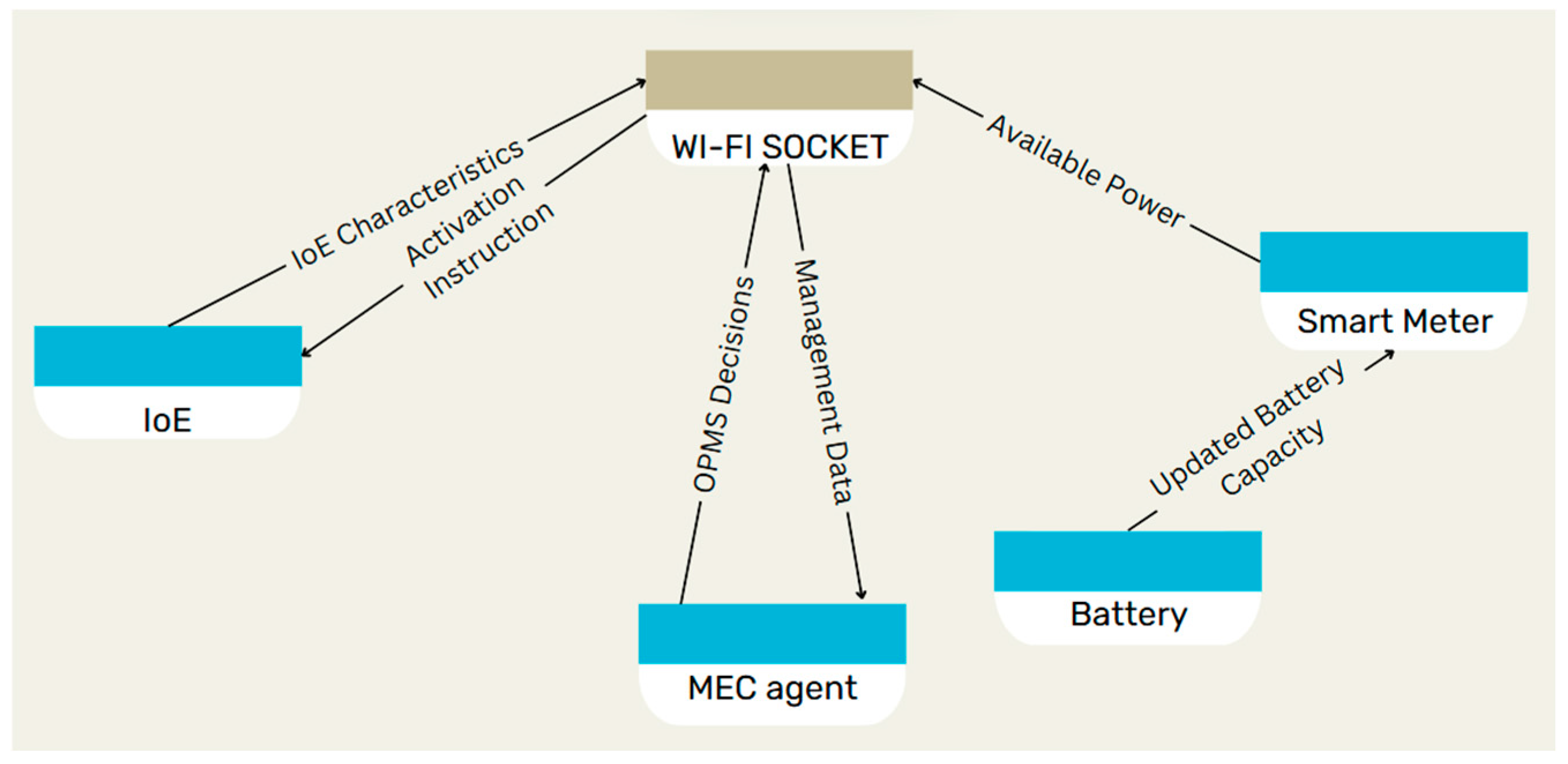
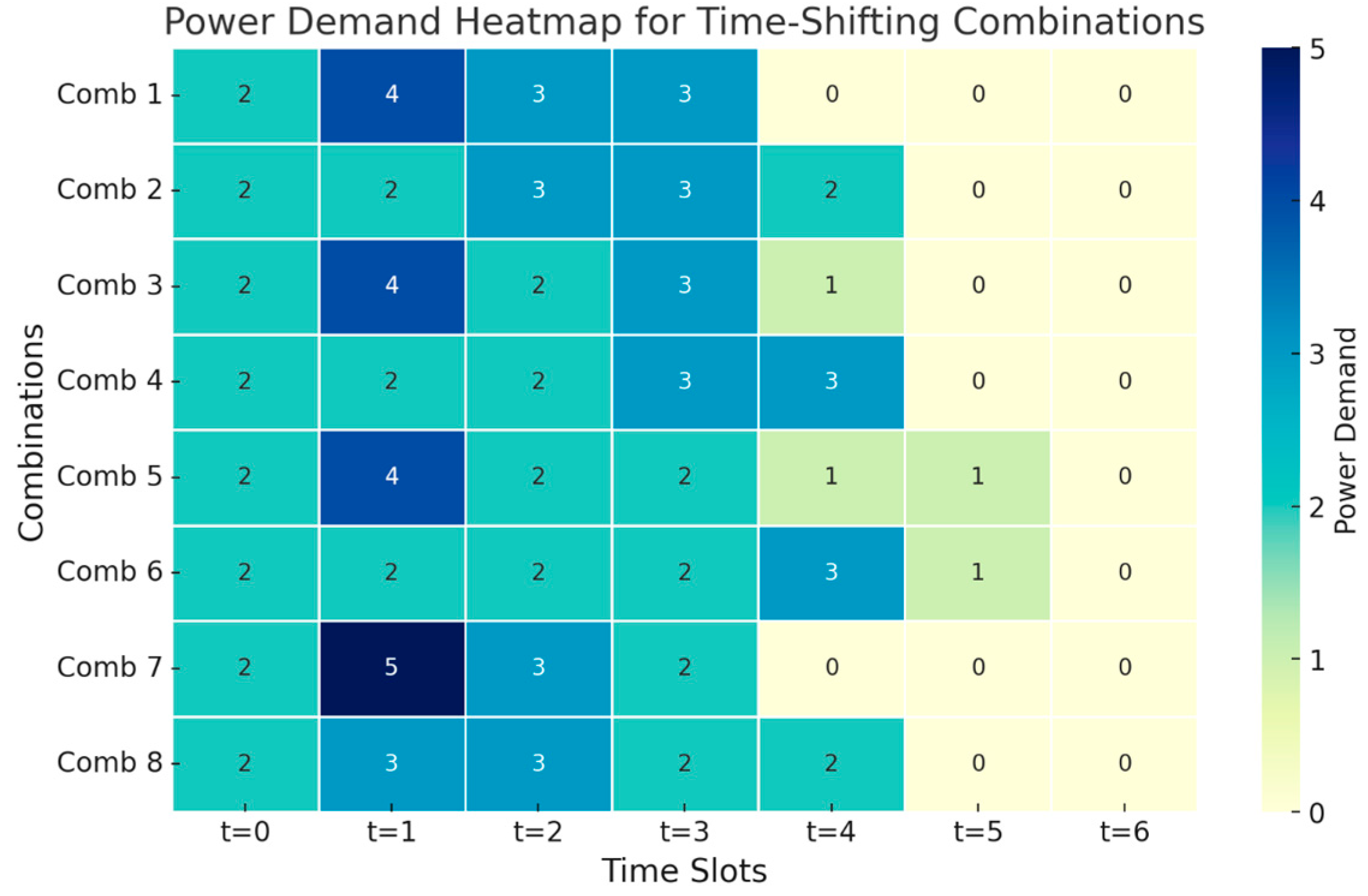
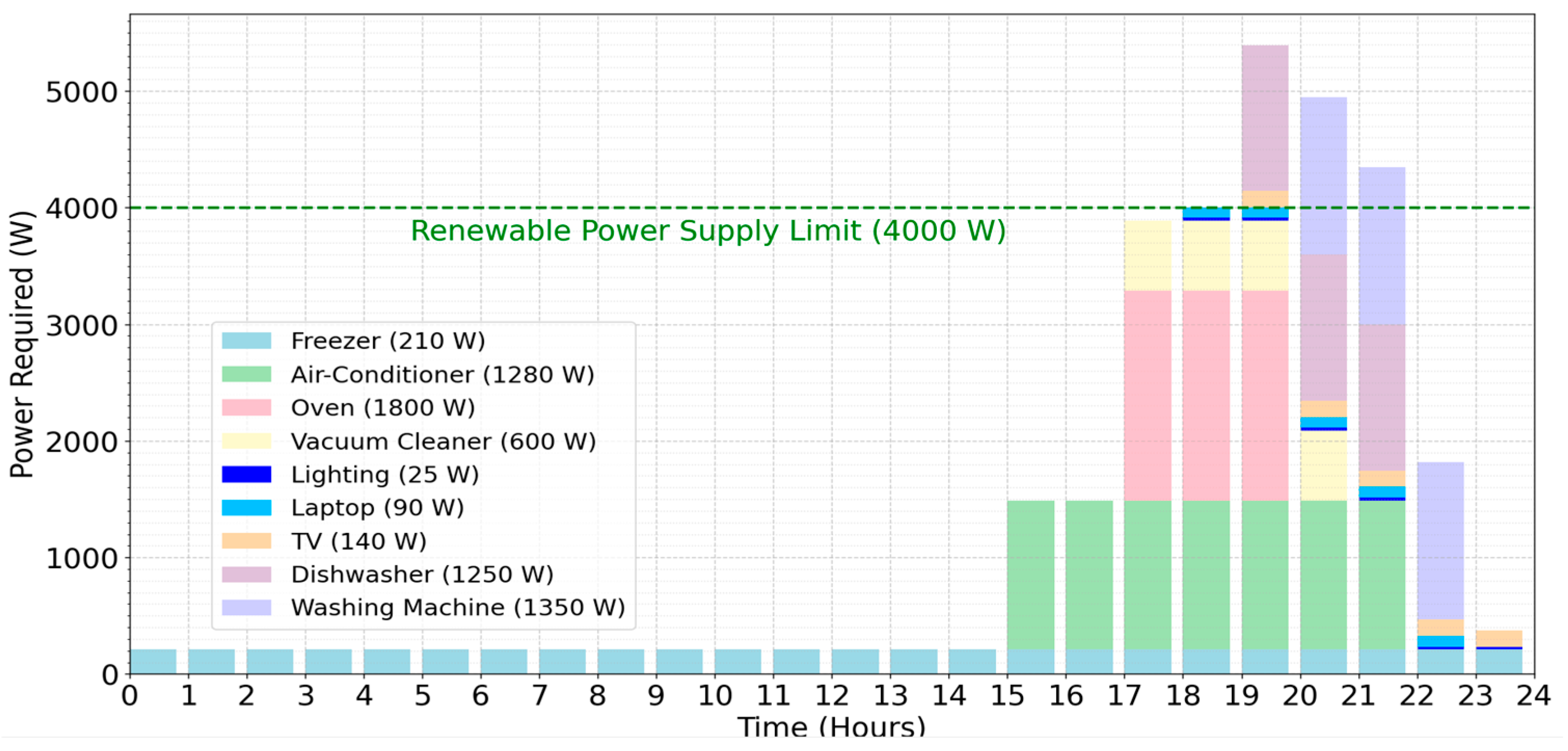
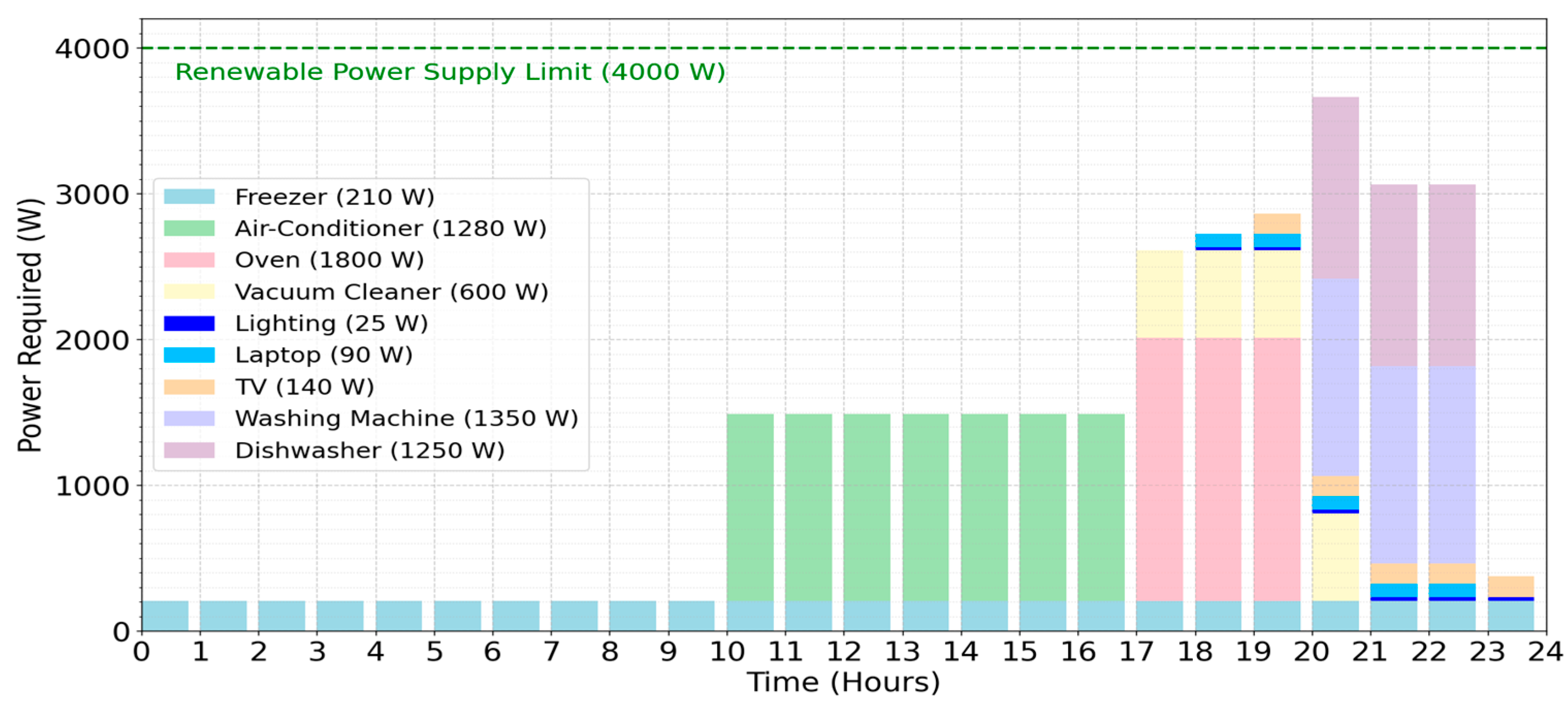
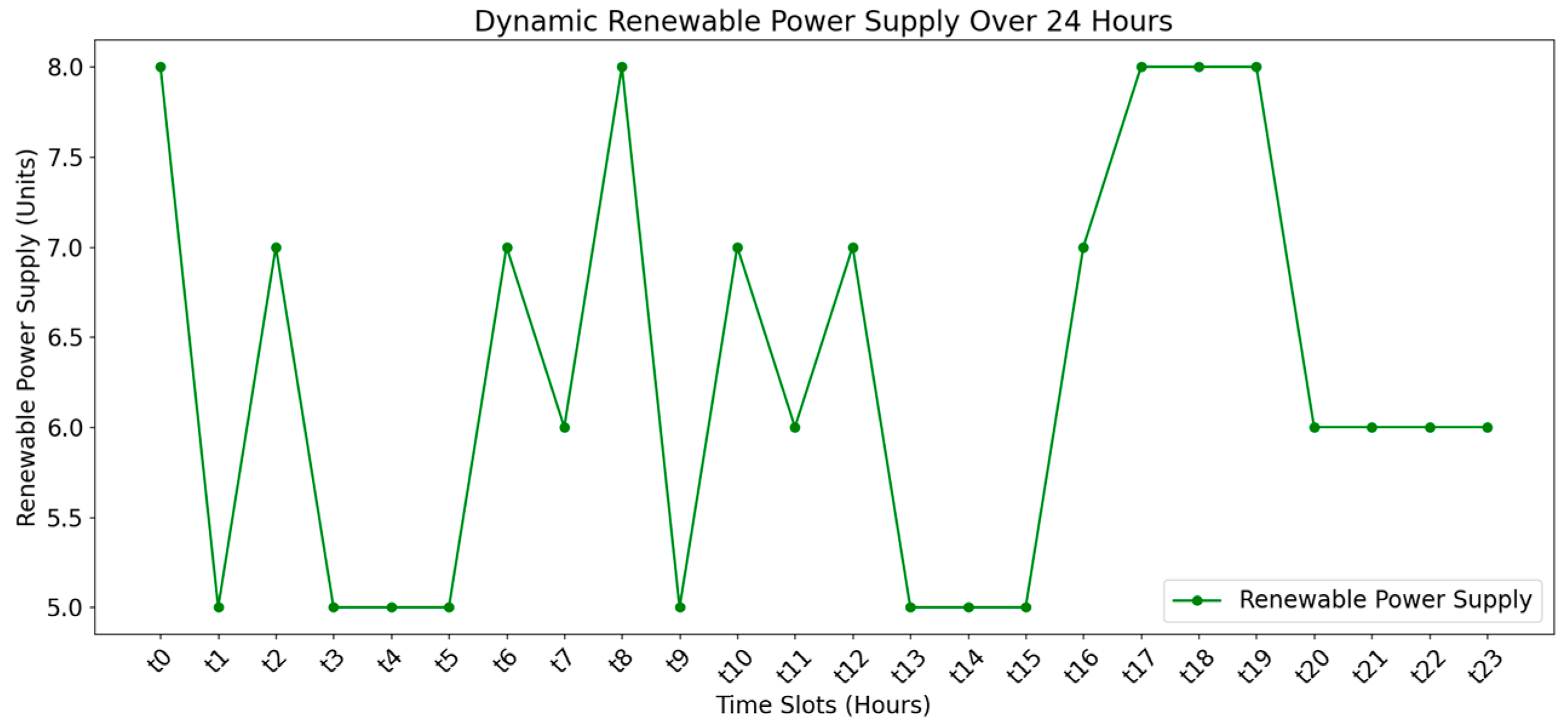
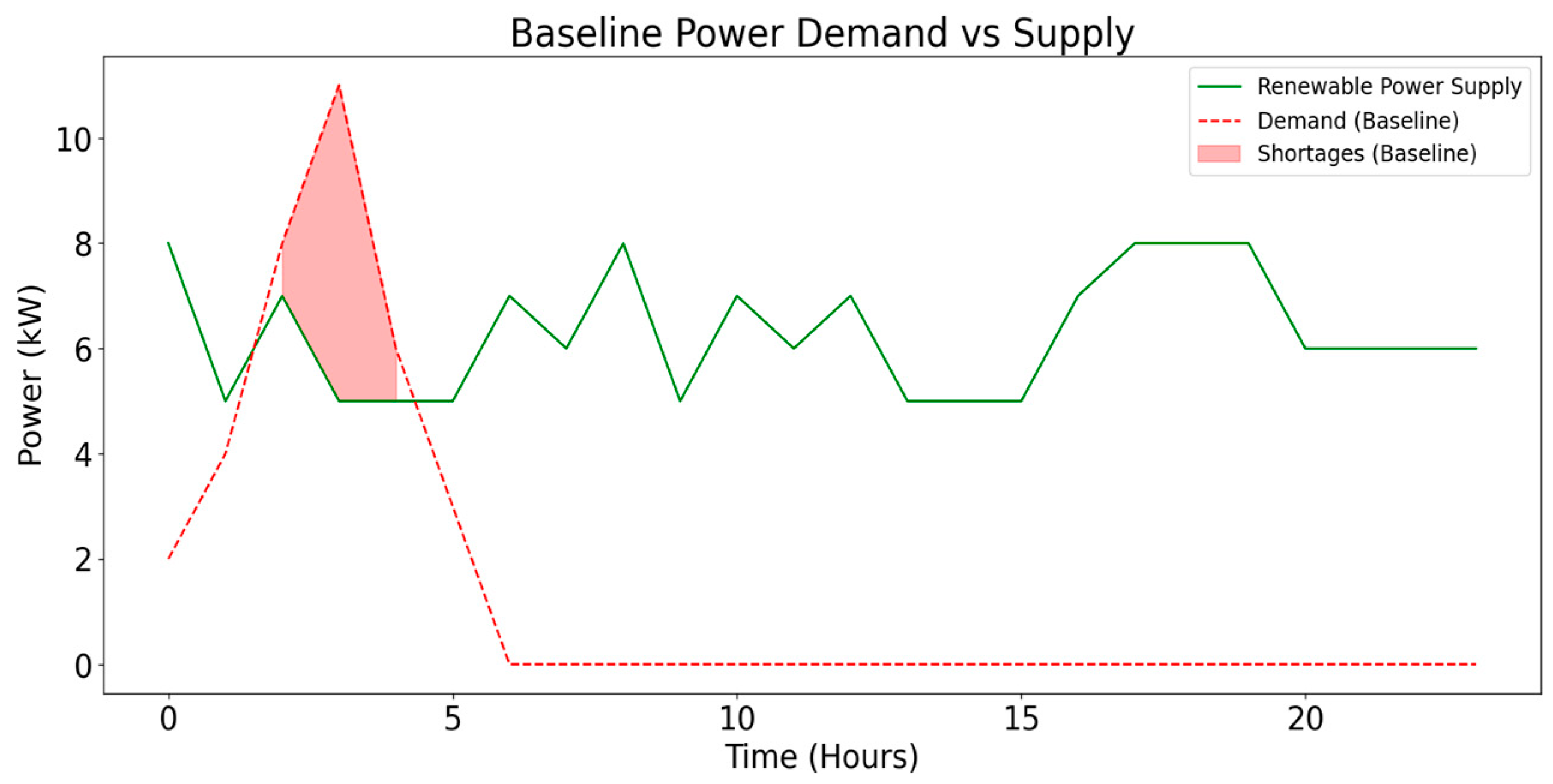
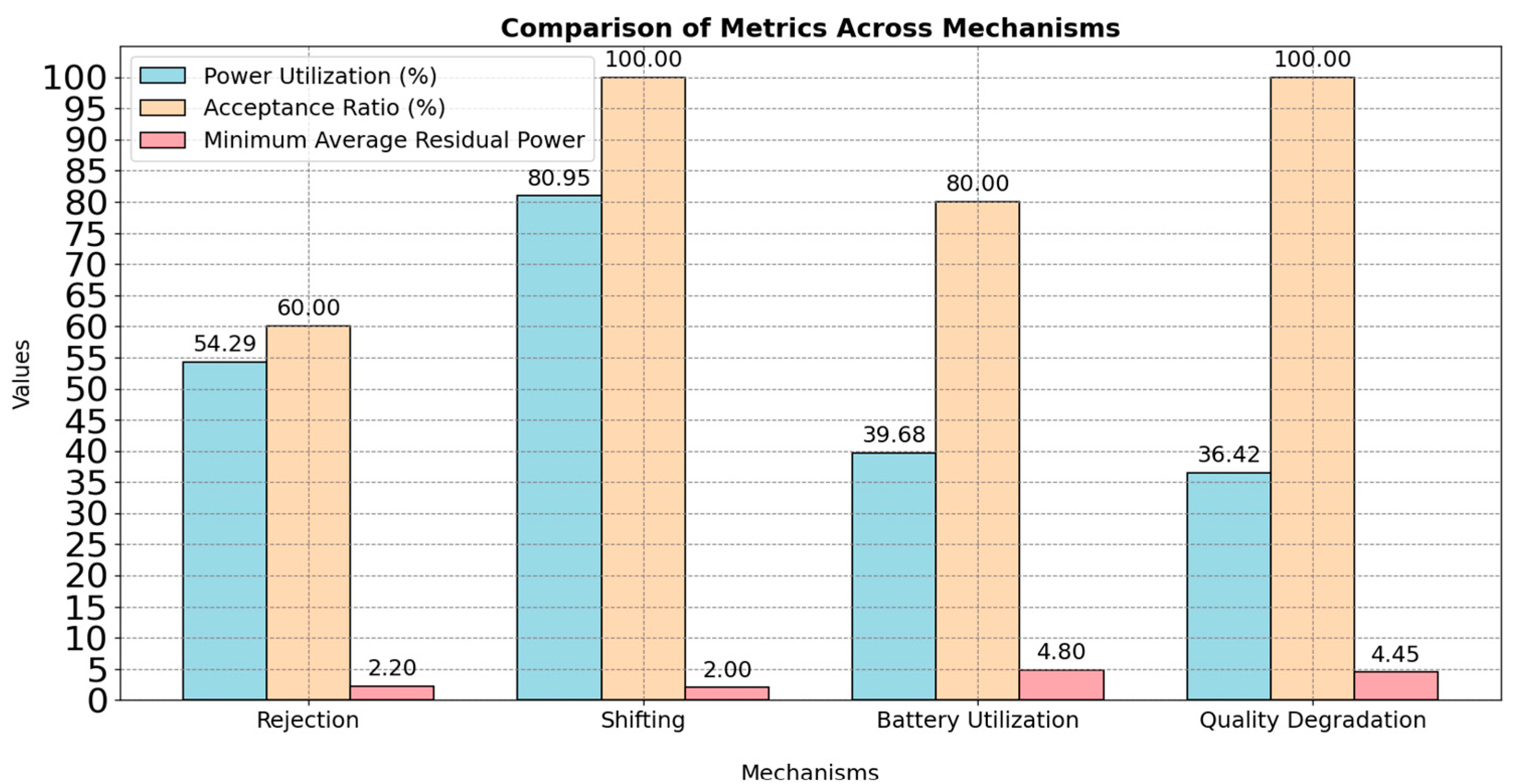
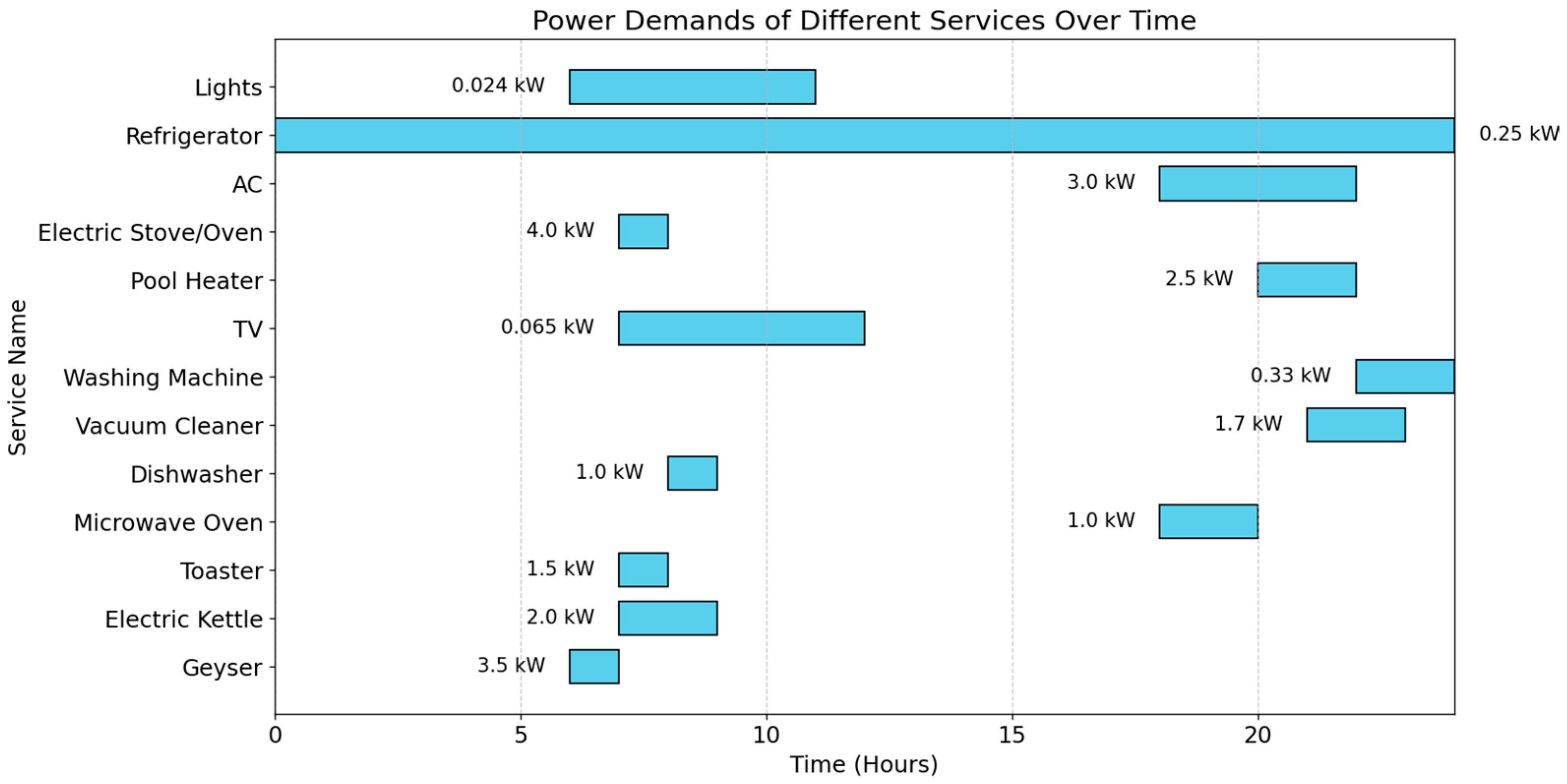
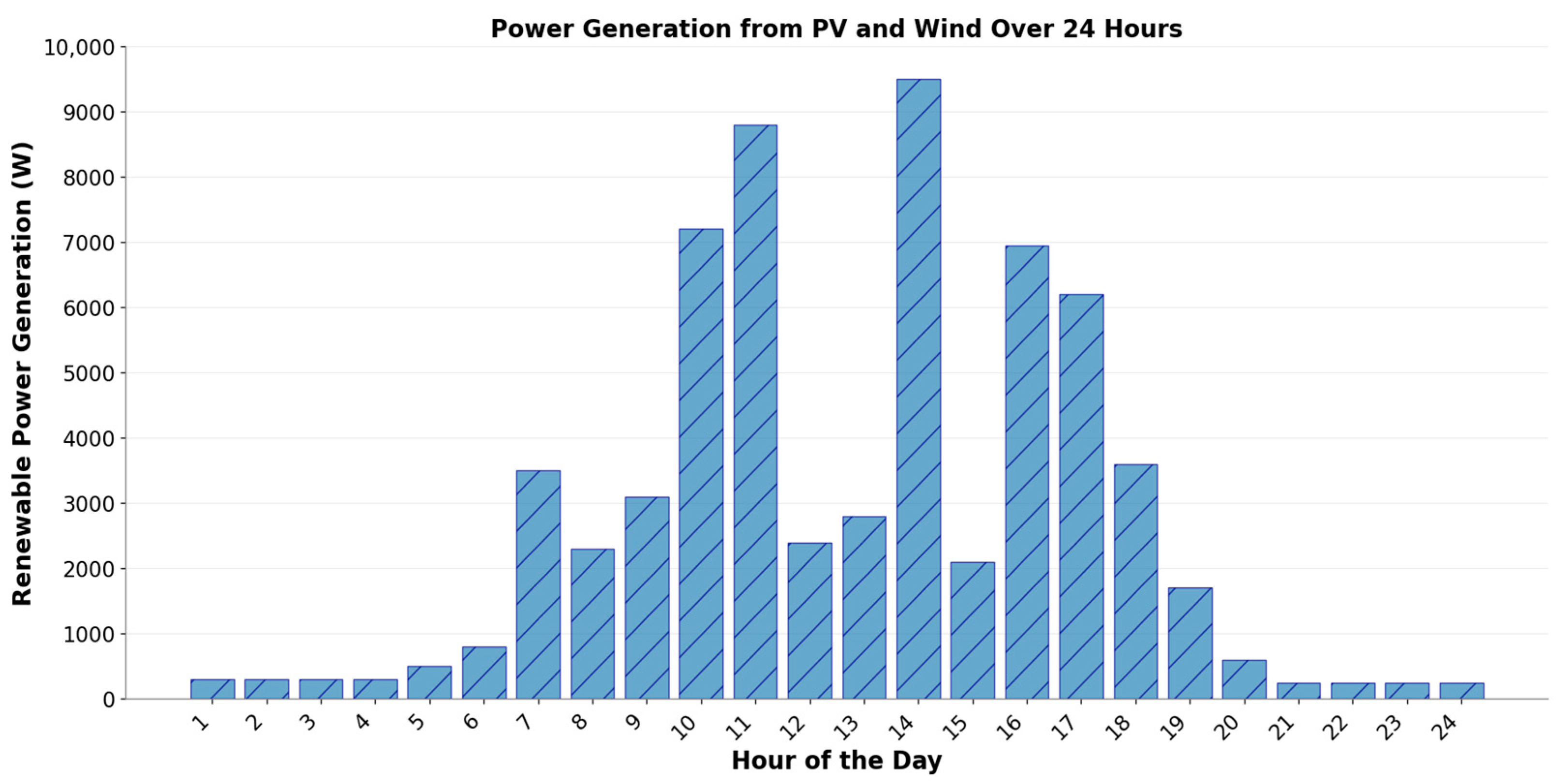
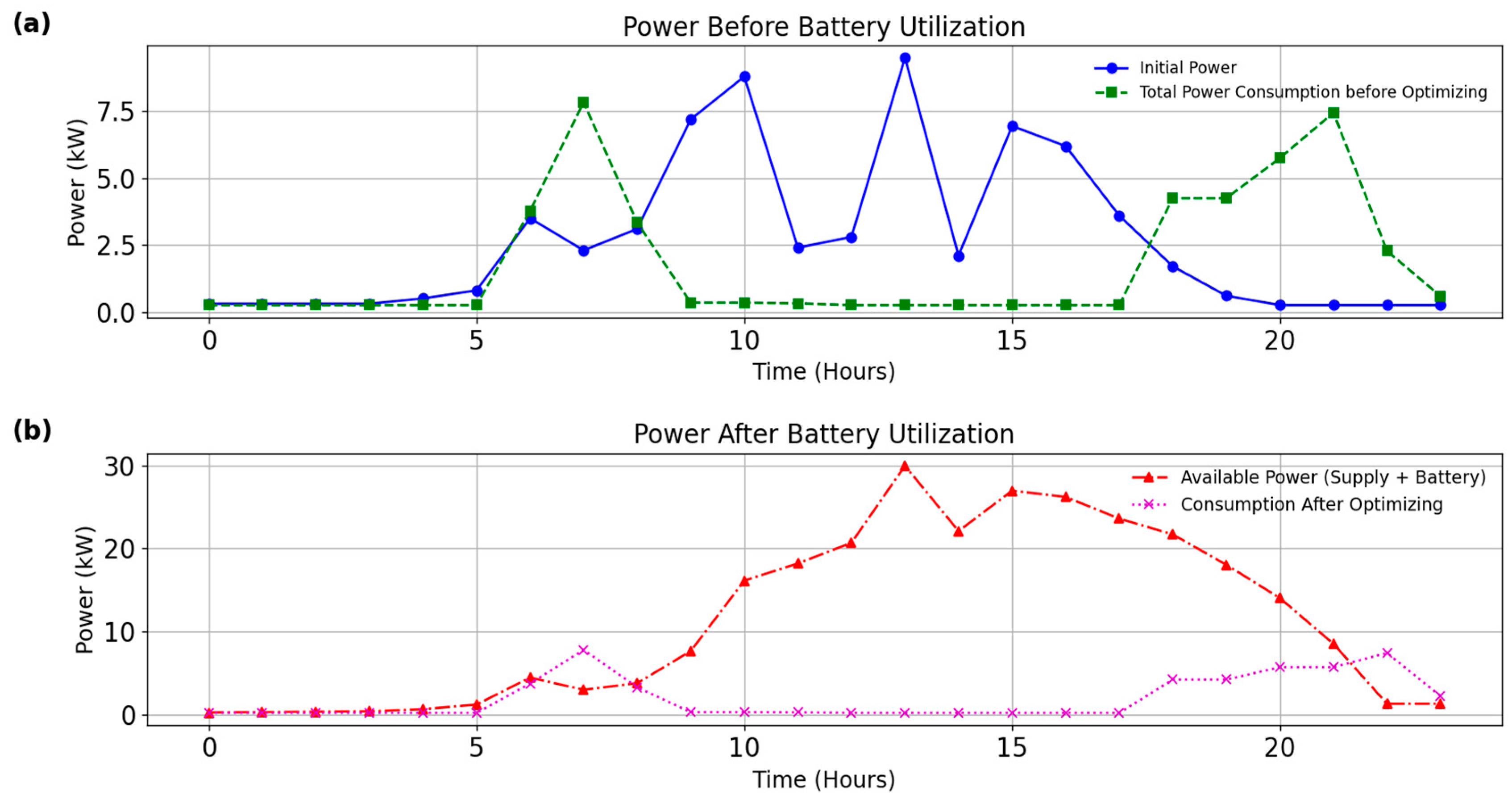
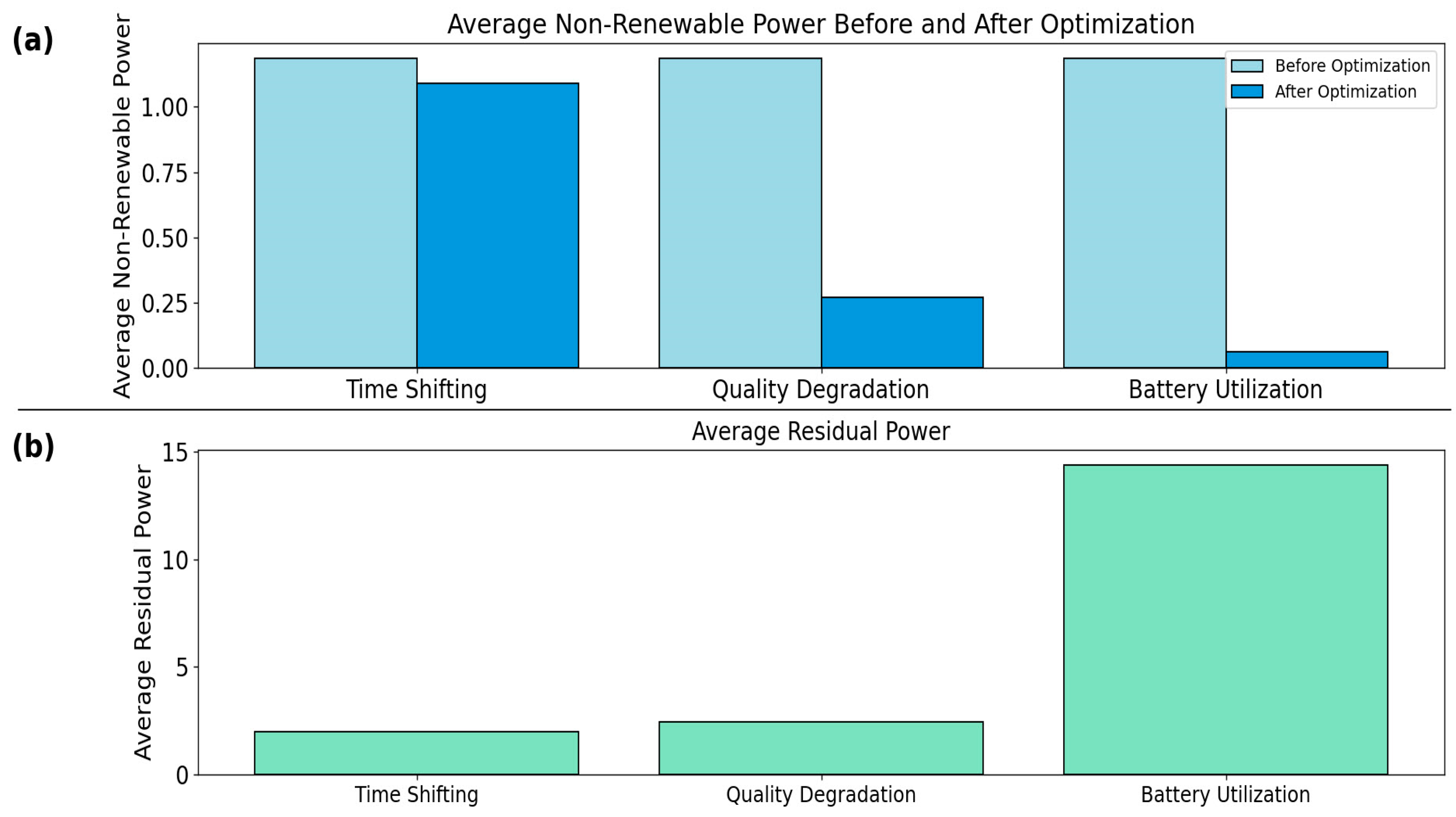
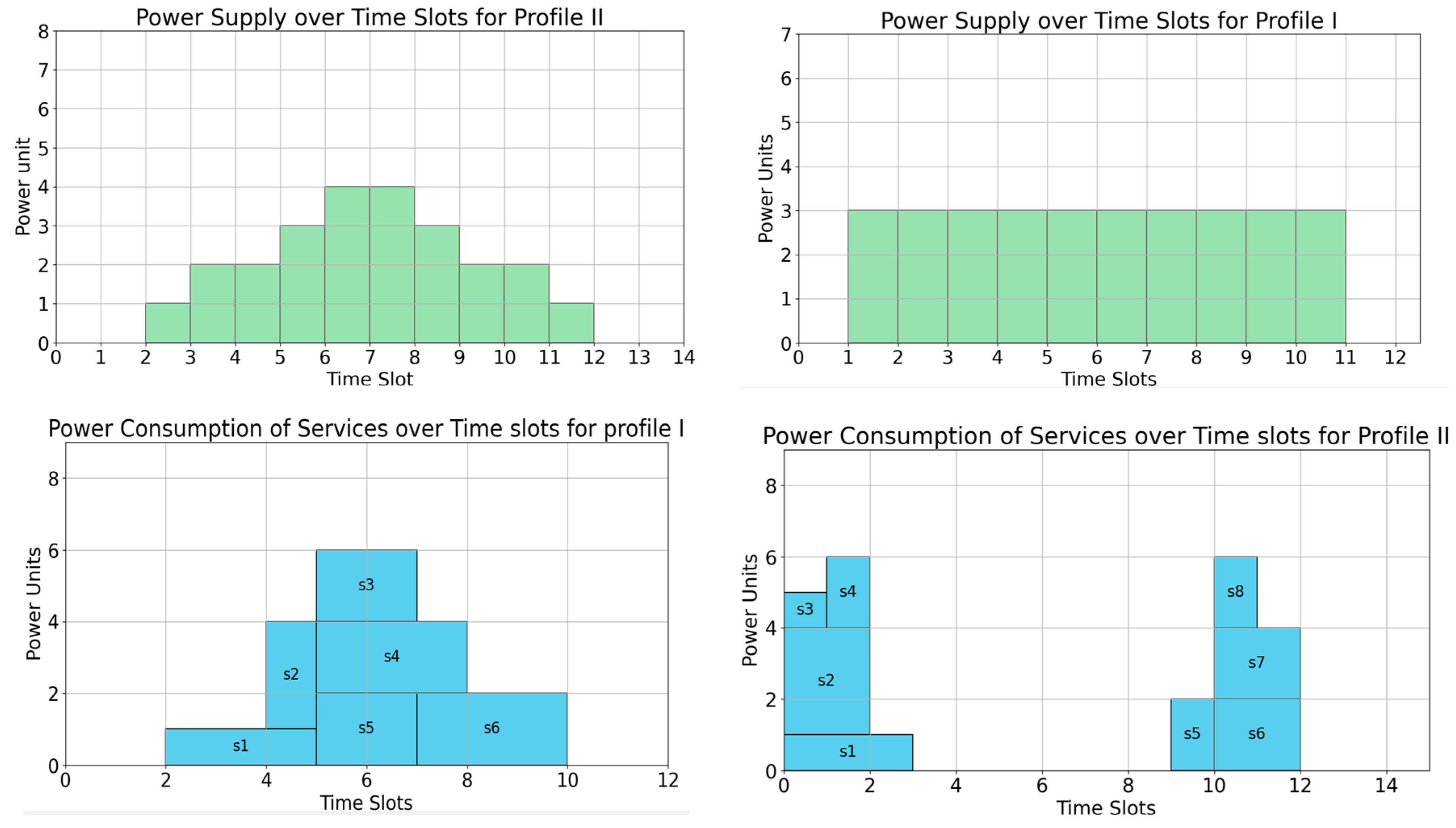
Disclaimer/Publisher’s Note: The statements, opinions and data contained in all publications are solely those of the individual author(s) and contributor(s) and not of MDPI and/or the editor(s). MDPI and/or the editor(s) disclaim responsibility for any injury to people or property resulting from any ideas, methods, instructions or products referred to in the content. |
© 2024 by the authors. Licensee MDPI, Basel, Switzerland. This article is an open access article distributed under the terms and conditions of the Creative Commons Attribution (CC BY) license (https://creativecommons.org/licenses/by/4.0/).