


Regenerative Strategies for Androgenetic Alopecia: Evidence, Mechanisms, and Translational Pathways


Abstract
1. Introduction
2. Machine Learning in Hair Disorders
2.1. Background and Rationale
2.2. Computer Vision and Deep Phenomics
2.3. Diagnostic, Prognostic, and Therapeutic Applications
2.4. Diagnosis and Severity Scoring
2.5. Prognostic Tools
2.6. Therapeutic Discovery
2.7. Limitations and Challenges
2.8. Conclusions
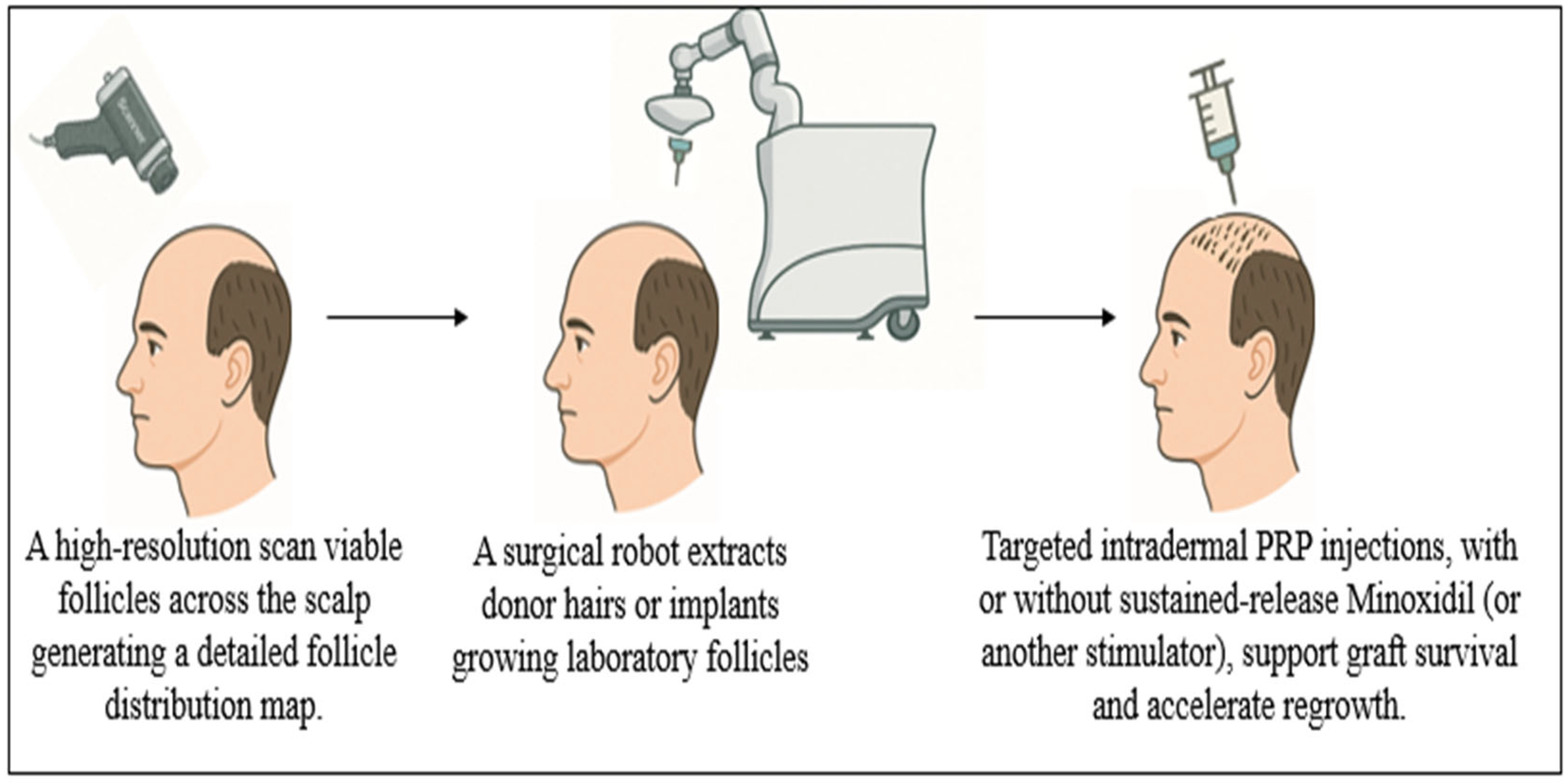
3. Robotic Hair Restoration—ARTAS
3.1. Advantages Engineered
3.2. Limitations
3.3. Training and Outcomes
3.4. Future Directions
4. Cellular and Regenerative Therapies
4.1. Moving Beyond Symptom Control
4.2. Wnt/β-Catenin Pathway Modulation
4.3. Cellular Sources: Autologous vs. Allogeneic
4.4. Regulatory and Compliance Considerations
4.5. Adipose-Derived Stem Cells and Secretome
4.6. PRP in Alopecia: Promise, Limits, and Evidence Gaps
4.6.1. Mechanistic Rationale
4.6.2. Clinical Signals: Meta-Analyses and Cohort Studies
4.6.3. Randomized, Placebo-Controlled Trials and Procedural Bias
4.6.4. Durability and Maintenance Requirements
4.6.5. Variability in Preparation and Reporting
4.6.6. Safety, Limitations, and Patient Selection
4.6.7. Role in Multimodal Care
4.6.8. Standardization Priorities and Future Directions
4.6.9. Conclusions
4.7. Microneedling: A Regenerative Adjunct with Promising but Temporary Effects
4.8. Broader Stem Cell Strategies
4.9. Evidence Gaps and Regulatory Status
4.10. Future Outlook
5. Biotechnologies: 3D Bioprinting
6. Cloning for Alopecia
6.1. Experimental Approaches
6.2. Clinical Translation
6.3. Challenges
6.4. Current Status and Outlook
7. Discussion
Supplementary Materials
Author Contributions
Funding
Data Availability Statement
Conflicts of Interest
References
- Cash, T.F. The Psychosocial Consequences of Androgenetic Alopecia: A Review of the Research Literature. Br. J. Dermatol. 1999, 141, 398–405. [Google Scholar] [CrossRef] [Scilit] [PubMed]
- Hwang, H.W.; Ryou, S.; Jeong, J.H.; Lee, J.W.; Lee, K.J.; Lee, S.B.; Shin, H.T.; Byun, J.W.; Shin, J.; Choi, G.S. The Quality of Life and Psychosocial Impact on Female Pattern Hair Loss. Ann. Dermatol. 2024, 36, 44–52. [Google Scholar] [CrossRef] [Scilit] [PubMed]
- Tsuboi, R.; Itami, S.; Inui, S.; Ueki, R.; Katsuoka, K.; Kurata, S.; Kono, T.; Saito, N.; Manabe, M.; Yamazaki, M.; et al. Guidelines for the Management of Androgenetic Alopecia (2010). J. Dermatol. 2012, 39, 113–120. [Google Scholar] [CrossRef] [Scilit]
- Devjani, S.; Ezemma, O.; Kelley, K.J.; Stratton, E.; Senna, M. Androgenetic Alopecia: Therapy Update. Drugs 2023, 83, 701–715. [Google Scholar] [CrossRef] [Scilit] [PubMed]
- Kaiser, M.; Abdin, R.; Gaumond, S.I.; Issa, N.T.; Jimenez, J.J. Treatment of Androgenetic Alopecia: Current Guidance and Unmet Needs. Clin. Cosmet. Investig. Dermatol. 2023, 16, 1387–1406. [Google Scholar] [CrossRef] [Scilit]
- Gonul, M.; Cemil, B.C.; Ayvaz, H.H.; Cankurtaran, E.; Ergin, C.; Gurel, M.S. Comparison of Quality of Life in Patients with Androgenetic Alopecia and Alopecia Areata. An. Bras. Dermatol. 2018, 93, 651–658. [Google Scholar] [CrossRef] [Scilit]
- Aukerman, E.L.; Jafferany, M. The Psychological Consequences of Androgenetic Alopecia: A Systematic Review. J. Cosmet. Dermatol. 2023, 22, 89–95. [Google Scholar] [CrossRef] [Scilit]
- Mehta, A.; Motavaf, M.; Raza, D.; McLure, A.J.; Osei-Opare, K.D.; Bordone, L.A.; Gru, A.A. Revolutionary Approaches to Hair Regrowth: Follicle Neogenesis, Wnt/β-Catenin Signaling, and Emerging Therapies. Cells 2025, 14, 779. [Google Scholar] [CrossRef] [Scilit]
- Chu, X.; Zhou, Z.; Qian, X.; Shen, H.; Cheng, H.; Zhang, J. Functional Regeneration Strategies of Hair Follicles: Advances and Challenges. Stem Cell Res. Ther. 2025, 16, 77. [Google Scholar] [CrossRef] [Scilit]
- Al Ameer, M.A.; Alnajim, A.T.; Al Ameer, A.; Alsalman, Z.; Al Ameer, G.A.; Alnajim, S.T.; Alghamdi, A.A.; Moideen, R.; Al Hadi, E.M. Exosomes and Hair Regeneration: A Systematic Review of Clinical Evidence Across Alopecia Types and Exosome Sources. Clin. Cosmet. Investig. Dermatol. 2025, 18, 2215. [Google Scholar] [CrossRef] [Scilit]
- Gupta, A.K.; Wang, T.; Rapaport, J.A. Systematic Review of Exosome Treatment in Hair Restoration: Preliminary Evidence, Safety, and Future Directions. J. Cosmet. Dermatol. 2023, 22, 2424–2433. [Google Scholar] [CrossRef] [Scilit] [PubMed]
- Fu, Y.; Han, Y.T.; Xie, J.L.; Liu, R.Q.; Zhao, B.; Zhang, X.L.; Zhang, J.; Zhang, J. Mesenchymal Stem Cell Exosomes Enhance the Development of Hair Follicle to Ameliorate Androgenetic Alopecia. World J. Stem Cells 2025, 17, 102088. [Google Scholar] [CrossRef] [Scilit]
- Poddar, N.; Aratikatla, A.; Gupta, A. Therapeutic Potential of Stem Cell-Derived Exosomes in Hair Regeneration: A Systematic Review. World J. Stem Cells 2025, 17, 108519. [Google Scholar] [CrossRef] [Scilit]
- Wan, J.; Kim, S.B.; Cartier, H.; Garson, S.; Frank, K.; Haykal, D.; Yi, K.H. A Prospective Study of Exosome Therapy for Androgenetic Alopecia. Aesthet. Plast. Surg. 2025, 49, 3151–3156. [Google Scholar] [CrossRef] [Scilit]
- Ersan, M.; Ozer, E.; Akin, O.; Tasli, P.N.; Sahin, F. Effectiveness of Exosome Treatment in Androgenetic Alopecia: Outcomes of a Prospective Study. Aesthet. Plast. Surg. 2024, 48, 4262–4271. [Google Scholar] [CrossRef] [Scilit]
- Koumprentziotis, I.A.; Kroumpouzos, E.; Delavar, S.; Kroumpouzos, G. Microneedling Radiofrequency Followed by Topical Exosome Application Therapy for Pattern Hair Loss: A Scoping Review and Prospective Study. Clin. Dermatol. 2025, 43, 742–751. [Google Scholar] [CrossRef] [Scilit]
- Xiao, L.; Zhang, F.; Chen, Y.; Tang, Y.; Usman, M.; Zhang, J. Microneedle-Mediated Therapies in Hair Loss: Applications, Mechanisms, and Future Directions. Plast. Aesthet. Res. 2025, 12, 25. [Google Scholar] [CrossRef] [Scilit]
- Nam, S.Y.; Jain, S.K.; Kurian, A.G.; Jeong, I.; Park, B.C.; Ban, K.; Knowles, J.C.; Kim, H.W. Hair Regeneration: Mechano-Activation and Related Therapeutic Approaches. J. Tissue Eng. 2025, 16, 20417314251362398. [Google Scholar] [CrossRef] [Scilit] [PubMed]
- Liu, Y.; Liu, Y.; Zhao, J.; Deng, T.; Ben, Y.; Lu, R.; Zhou, X.; Yan, R.; Chen, X.; Zhang, J.V.; et al. Subcutaneous Injection of Genetically Engineered Exosomes for Androgenic Alopecia Treatment. Front. Bioeng. Biotechnol. 2025, 13, 1614090. [Google Scholar] [CrossRef] [Scilit]
- Zhang, J.; Peng, J.; Fan, Z.; Wang, H.; Wen, L.; Miao, Y.; Chai, Y.; Hu, Z.; Chen, R. Therapeutic Potential of Isoproterenol in Androgenetic Alopecia: Activation of Hair Follicle Stem Cells via the PI3K/AKT/β-Catenin Signaling Pathway. Stem Cell Res. Ther. 2025, 16, 306. [Google Scholar] [CrossRef] [Scilit]
- Jin, H.; Zou, Z.; Chang, H.; Shen, Q.; Liu, L.; Xing, D. Photobiomodulation Therapy for Hair Regeneration: A Synergetic Activation of β-Catenin in Hair Follicle Stem Cells by ROS and Paracrine WNTs. Stem Cell Rep. 2021, 16, 1568–1583. [Google Scholar] [CrossRef] [Scilit]
- Ma, X.; Zhu, X.; Lv, S.; Yang, C.; Wang, Z.; Liao, M.; Zhou, B.; Zhang, Y.; Sun, S.; Chen, P.; et al. 3D Bioprinting of Prefabricated Artificial Skin with Multicomponent Hydrogel for Skin and Hair Follicle Regeneration. Theranostics 2025, 15, 2933–2950. [Google Scholar] [CrossRef] [Scilit]
- Makkar, J.; Flores, J.; Matich, M.; Duong, T.T.; Thompson, S.M.; Du, Y.; Busch, I.; Phan, Q.M.; Wang, Q.; Delevich, K.; et al. Deep Hair Phenomics: Implications in Endocrinology, Development, and Aging. J. Investig. Dermatol. 2025, 145, 800–811.e8. [Google Scholar] [CrossRef] [Scilit] [PubMed]
- Agramunt, J.; Parke, B.; Mena, S.; Ubels, V.; Jimenez, F.; Williams, G.; Rhodes, A.D.Y.; Limbu, S.; Hexter, M.; Knight, L.; et al. Mechanical Stimulation of Human Hair Follicle Outer Root Sheath Cultures Activates Adjacent Sensory Neurons. Sci. Adv. 2023, 9, eadh3273. [Google Scholar] [CrossRef] [Scilit] [PubMed]
- Hamann, W. Mammalian Cutaneous Mechanoreceptors. Prog. Biophys. Mol. Biol. 1995, 64, 81–104. [Google Scholar] [CrossRef] [Scilit]
- Lasisi, T.; Smallcombe, J.W.; Kenney, W.L.; Shriver, M.D.; Zydney, B.; Jablonski, N.G.; Havenith, G. Human Scalp Hair as a Thermoregulatory Adaptation. Proc. Natl. Acad. Sci. USA 2023, 120, e2301760120. [Google Scholar] [CrossRef] [Scilit]
- Li, W.Q.; Cho, E.; Han, J.; Weinstock, M.A.; Qureshi, A.A. Male Pattern Baldness and Risk of Incident Skin Cancer in a Cohort of Men. Int. J. Cancer 2016, 139, 2671. [Google Scholar] [CrossRef] [Scilit]
- Ho, C.H.; Sood, T.; Zito, P.M. Androgenetic Alopecia; StatPearls: Tampa, FL, USA, 2024. [Google Scholar]
- Schielein, M.C.; Tizek, L.; Ziehfreund, S.; Sommer, R.; Biedermann, T.; Zink, A. Stigmatization Caused by Hair Loss—A Systematic Literature Review. J. Dtsch. Dermatol. Ges. 2020, 18, 1357–1368. [Google Scholar] [CrossRef] [Scilit]
- Duverger, O.; Morasso, M.I. Epidermal Patterning and Induction of Different Hair Types during Mouse Embryonic Development. Birth Defects Res. C Embryo Today 2009, 87, 263–272. [Google Scholar] [CrossRef] [Scilit] [PubMed]
- Millar, S.E. Molecular Mechanisms Regulating Hair Follicle Development. J. Investig. Dermatol. 2002, 118, 216–225. [Google Scholar] [CrossRef] [Scilit]
- Schmidt-Ullrich, R.; Paus, R. Molecular Principles of Hair Follicle Induction and Morphogenesis. BioEssays 2005, 27, 247–261. [Google Scholar] [CrossRef] [Scilit]
- Grymowicz, M.; Rudnicka, E.; Podfigurna, A.; Napierala, P.; Smolarczyk, R.; Smolarczyk, K. Hormonal Effects on Hair Follicles. Int. J. Mol. Sci. 2020, 21, 5342. [Google Scholar] [CrossRef] [Scilit]
- Hasan, R.; Juma, H.; Eid, F.A.; Alaswad, H.A.; Ali, W.M.; Aladraj, F.J.; Hassan, R.; Mohsen, F.A.; Ali, W. Effects of Hormones and Endocrine Disorders on Hair Growth. Cureus 2022, 14, e32726. [Google Scholar] [CrossRef] [Scilit]
- Mendelsohn, A.R.; Larrick, J.W. The Danger of Being Too Sympathetic: Norepinephrine in Alzheimer’s Disease and Graying of Hair. Rejuvenation Res. 2020, 23, 68–72. [Google Scholar] [CrossRef] [Scilit] [PubMed]
- Neau, J.; Godeneche, G.; Mathis, S.; Godeneche-Mathis, G. Neurodermatology. In Handbook of Clinical Neurology; Elsevier: Amsterdam, The Netherlands, 2014; Volume 121, pp. 1561–1594. [Google Scholar] [CrossRef] [Scilit]
- Thom, E. Stress and the Hair Growth Cycle: Cortisol-Induced Hair Growth Disruption. J. Drugs Dermatol. 2016, 15, 1001–1004. [Google Scholar] [PubMed]
- Almashali, M.; Alekrish, K.; Shadid, A. The Use of 2D:4D Digit Ratio as a Predictor of Androgenetic Alopecia: A Review. Dermatol. Pract. Concept. 2023, 13, e2023043. [Google Scholar] [CrossRef] [Scilit]
- Liu, F.; Hamer, M.A.; Heilmann, S.; Herold, C.; Moebus, S.; Hofman, A.; Uitterlinden, A.G.; Nöthen, M.M.; Van Duijn, C.M.; Nijsten, T.E.C.; et al. Prediction of Male-Pattern Baldness from Genotypes. Eur. J. Hum. Genet. 2016, 24, 895–902. [Google Scholar] [CrossRef] [Scilit]
- Wolff, H.; Fischer, T.W.; Blume-Peytavi, U. The Diagnosis and Treatment of Hair and Scalp Diseases. Dtsch. Arztebl. Int. 2016, 113, 377–386. [Google Scholar] [CrossRef] [Scilit]
- Chi, W.; Wu, E.; Morgan, B.A. Dermal Papilla Cell Number Specifies Hair Size, Shape, and Cycling and Its Reduction Causes Follicular Decline. Development 2013, 140, 1676–1683. [Google Scholar] [CrossRef] [Scilit]
- Driskell, R.R.; Giangreco, A.; Jensen, K.B.; Mulder, K.W.; Watt, F.M. Sox2-Positive Dermal Papilla Cells Specify Hair Follicle Type in Mammalian Epidermis. Development 2009, 136, 2815–2823. [Google Scholar] [CrossRef] [Scilit] [PubMed]
- Schlake, T. FGF Signals Specifically Regulate the Structure of Hair Shaft Medulla via IGF-Binding Protein 5. Development 2005, 132, 2981–2990. [Google Scholar] [CrossRef] [Scilit]
- Takeo, M.; Toyoshima, K.-E.; Fujimoto, R.; Iga, T.; Takase, M.; Ogawa, M.; Tsuji, T. Cyclical Dermal Micro-Niche Switching Governs the Morphological Infradian Rhythm of Mouse Zigzag Hair. Nat. Commun. 2023, 14, 4371. [Google Scholar] [CrossRef] [Scilit] [PubMed]
- Weger, N.; Schlake, T. Igf-I Signalling Controls the Hair Growth Cycle and the Differentiation of Hair Shafts. J. Investig. Dermatol. 2005, 125, 873–882. [Google Scholar] [CrossRef] [Scilit]
- Jeong, H.; Park, C.; Henao, R.; Kim, M.K. Deep Learning in Dermatology: A Systematic Review of Current Approaches, Outcomes, and Limitations. J. Dermatol. Innov. 2023, 3, 100150. [Google Scholar] [CrossRef] [Scilit]
- Kim, J.; Oh, I.; Lee, Y.N.; Lee, J.H.; Lee, Y.I.; Kim, J.H.; Lee, J.H. Predicting the Severity of Postoperative Scars Using Artificial Intelligence Based on Images and Clinical Data. Sci. Rep. 2023, 13, 13448. [Google Scholar] [CrossRef] [Scilit]
- Tschandl, P.; Rinner, C.; Apalla, Z.; Argenziano, G.; Codella, N.; Halpern, A.; Janda, M.; Lallas, A.; Longo, C.; Malvehy, J.; et al. Human–Computer Collaboration for Skin Cancer Recognition. Nat. Med. 2020, 26, 1220–1226. [Google Scholar] [CrossRef] [Scilit]
- Wei, M.L.; Tada, M.; So, A.; Torres, R. Artificial Intelligence and Skin Cancer. Front. Med. 2024, 11, 1331895. [Google Scholar] [CrossRef] [Scilit]
- Di Fraia, M.; Tieghi, L.; Magri, F.; Caro, G.; Michelini, S.; Pellacani, G.; Rossi, A. A Machine Learning Algorithm Applied to Trichoscopy for Androgenic Alopecia Staging and Severity Assessment. Dermatol. Pract. Concept. 2023, 13, e2023150. [Google Scholar] [CrossRef] [Scilit] [PubMed]
- Gao, M.; Wang, Y.; Xu, H.; Xu, C.; Yang, X.; Nie, J.; Zhang, Z.; Li, Z.; Hou, W.; Jiang, Y. Deep Learning-Based Trichoscopic Image Analysis and Quantitative Model for Predicting Basic and Specific Classification in Male Androgenetic Alopecia. Acta Derm. Venereol. 2022, 102, 564. [Google Scholar] [CrossRef] [Scilit] [PubMed]
- Arteta, C.; Lempitsky, V.; Noble, J.A.; Zisserman, A. Learning to Detect Partially Overlapping Instances. In Proceedings of the IEEE Conference on Computer Vision and Pattern Recognition (CVPR), Portland, OR, USA, 23–28 June 2013. [Google Scholar] [CrossRef] [Scilit]
- Wang, S.; Yatagawa, T.; Suzuki, H.; Ohtake, Y. Image-Based Measurement of Individual Fiber Lengths for Randomly Oriented Short Fiber Composites. J. Nondestr. Eval. 2022, 41, 45. [Google Scholar] [CrossRef] [Scilit]
- Chai, J.; Zeng, H.; Li, A.; Ngai, E.W.T. Deep Learning in Computer Vision: A Critical Review of Emerging Techniques and Application Scenarios. Mach. Learn. Appl. 2021, 6, 100134. [Google Scholar] [CrossRef] [Scilit]
- Esteva, A.; Chou, K.; Yeung, S.; Naik, N.; Madani, A.; Mottaghi, A.; Liu, Y.; Topol, E.; Dean, J.; Socher, R. Deep Learning-Enabled Medical Computer Vision. NPJ Digit. Med. 2021, 4, 5. [Google Scholar] [CrossRef] [Scilit]
- Archila, J.; Manzanera, A.; Martínez, F. A Multimodal Parkinson Quantification by Fusing Eye and Gait Motion Patterns, Using Covariance Descriptors, from Non-Invasive Computer Vision. Comput. Methods Programs Biomed. 2022, 215, 106607. [Google Scholar] [CrossRef] [Scilit]
- Bae, H.; An, Y.K. Computer Vision-Based Statistical Crack Quantification for Concrete Structures. Measurement 2023, 211, 112628. [Google Scholar] [CrossRef] [Scilit]
- Mori, S.; Tachibana, Y.; Suzuki, M.; Harada, Y. Automatic Worm Detection to Solve Overlapping Problems Using a Convolutional Neural Network. Sci. Rep. 2022, 12, 8521. [Google Scholar] [CrossRef] [Scilit]
- Pun, T.B.; Neupane, A.; Koech, R.; Walsh, K. Detection and Counting of Root-Knot Nematodes Using YOLO Models with Mosaic Augmentation. Biosens. Bioelectron. X 2023, 13, 100283. [Google Scholar] [CrossRef] [Scilit]
- Toda, Y.; Okura, F.; Ito, J.; Okada, S.; Kinoshita, T.; Tsuji, H.; Saisho, D. Training Instance Segmentation Neural Network with Synthetic Datasets for Crop Seed Phenotyping. Commun. Biol. 2020, 3, 94. [Google Scholar] [CrossRef] [Scilit] [PubMed]
- Shakeel, C.S.; Khan, S.J.; Chaudhry, B.; Aijaz, S.F.; Hassan, U. Classification Framework for Healthy Hairs and Alopecia Areata: A Machine Learning (ML) Approach. Comput. Math. Methods Med. 2021, 2021, 1102083. [Google Scholar] [CrossRef] [Scilit]
- Shakeel, C.S.; Khan, S.J. Machine Learning (ML) Techniques as Effective Methods for Evaluating Hair and Skin Assessments: A Systematic Review. Proc. Inst. Mech. Eng. H 2024, 238, 132–148. [Google Scholar] [CrossRef] [Scilit] [PubMed]
- Chowdhury, M.S.; Sultan, T.; Jahan, N.; Mridha, M.F.; Safran, M.; Alfarhood, S.; Che, D. Leveraging Deep Neural Networks to Uncover Unprecedented Levels of Precision in the Diagnosis of Hair and Scalp Disorders. Skin Res. Technol. 2024, 30, e13660. [Google Scholar] [CrossRef] [Scilit] [PubMed]
- Gupta, A.K.; Ivanova, I.A.; Renaud, H.J. How Good Is Artificial Intelligence (AI) at Solving Hairy Problems? A Review of AI Applications in Hair Restoration and Hair Disorders. Dermatol. Ther. 2021, 34, e14811. [Google Scholar] [CrossRef] [Scilit] [PubMed]
- Gudobba, C.; Mane, T.; Bayramova, A.; Rodriguez, N.; Castelo-Soccio, L.; Ogunleye, T.A.; Taylor, S.C.; Cotsarelis, G.; Bernardis, E. Automating Hair Loss Labels for Universally Scoring Alopecia from Images: Rethinking Alopecia Scores. JAMA Dermatol. 2022, 159, 143. [Google Scholar] [CrossRef] [Scilit]
- Du, A.X.; Emam, S.; Gniadecki, R. Review of Machine Learning in Predicting Dermatological Outcomes. Front. Med. 2020, 7, 547105. [Google Scholar] [CrossRef] [Scilit]
- Jartarkar, S.R.; Patil, A.; Waskiel-Burnat, A.; Rudnicka, L.; Starace, M.; Grabbe, S.; Goldust, M. Artificial Intelligence in Hair and Nail Disorders. J. Drugs Dermatol. 2022, 21, 1049–1052. [Google Scholar] [CrossRef] [Scilit]
- Choy, S.P.; Kim, B.J.; Paolino, A.; Tan, W.R.; Lim, S.M.L.; Seo, J.; Tan, S.P.; Francis, L.; Tsakok, T.; Simpson, M.; et al. Systematic Review of Deep Learning Image Analyses for the Diagnosis and Monitoring of Skin Disease. NPJ Digit. Med. 2023, 6, 180. [Google Scholar] [CrossRef] [Scilit] [PubMed]
- Li, Z.; Koban, K.C.; Schenck, T.L.; Giunta, R.E.; Li, Q.; Sun, Y. Artificial Inelligence in Dermatology Image Analysis: Current Developments and Future Trends. J. Clin. Med. 2022, 11, 6826. [Google Scholar] [CrossRef] [Scilit]
- Wongvibulsin, S.; Yan, M.J.; Pahalyants, V.; Murphy, W.; Daneshjou, R.; Rotemberg, V. Current State of Dermatology Mobile Applications with Artificial Intelligence Features. JAMA Dermatol. 2024, 160, 646–650. [Google Scholar] [CrossRef] [Scilit]
- Nahm, W.J.; Sohail, N.; Burshtein, J.; Goldust, M.; Tsoukas, M. Artificial Intelligence in Dermatology: A Comprehensive Review of Approved Applications, Clinical Implementation, and Future Directions. Int. J. Dermatol. 2025, 64, 1568–1583. [Google Scholar] [CrossRef] [Scilit] [PubMed]
- Rundle, C.W.; Hollingsworth, P.; Dellavalle, R.P. Artificial Intelligence in Dermatology. Clin. Dermatol. 2021, 39, 657–666. [Google Scholar] [CrossRef] [Scilit]
- Chen, M.; Zhou, A.E.; Jain, N.; Gronbeck, C.; Feng, H.; Grant-Kels, J.M. Ethics of Artificial Intelligence in Dermatology. Clin. Dermatol. 2024, 42, 313–316. [Google Scholar] [CrossRef] [Scilit]
- MacKenzie, J.; Coric, C.; Kim, Y.W.; Lee, C.; Grant-Kels, J.M. Current Applications of Artificial Intelligence in Dermatology Offices and Potential Ethical Landmines. Clin. Dermatol. 2025, 43, 732–737. [Google Scholar] [CrossRef] [Scilit]
- Gomolin, A.; Netchiporouk, E.; Gniadecki, R.; Litvinov, I.V. Artificial Intelligence Applications in Dermatology: Where Do We Stand? Front. Med. 2020, 7, 100. [Google Scholar] [CrossRef] [Scilit] [PubMed]
- Young, A.T.; Xiong, M.; Pfau, J.; Keiser, M.J.; Wei, M.L. Artificial Intelligence in Dermatology: A Primer. J. Investig. Dermatol. 2020, 140, 1504–1512. [Google Scholar] [CrossRef] [Scilit]
- Daneshjou, R.; Smith, M.P.; Sun, M.D.; Rotemberg, V.; Zou, J. Lack of Transparency and Potential Bias in Artificial Intelligence Data Sets and Algorithms: A Scoping Review. JAMA Dermatol. 2021, 157, 1362–1369. [Google Scholar] [CrossRef] [Scilit]
- Pereira, J.C.; Pereira Filho, J.C.; Pereira, J.P.C. Megasessions for Robotic Hair Restoration. J. Drugs Dermatol. 2016, 15, 1407–1412. [Google Scholar]
- Kanayama, K.; Kato, H.; Mori, M.; Sakae, Y.; Okazaki, M. Robotically Assisted Recipient Site Preparation in Hair Restoration Surgery: Surgical Safety and Clinical Outcomes in 31 Consecutive Patients. Dermatol. Surg. 2021, 47, 1365–1370. [Google Scholar] [CrossRef] [Scilit]
- Zhu, Y.; Yang, K.; Lin, J.M.; Ni, C.; Zhang, Y.; Li, Z.; Liu, Q.; Zhou, Y.; Lin, J.; Wu, W. A Comparative Study on the Application of Robotic Hair Restoration Technology Versus Traditional Follicular Unit Excision in Male Androgenetic Alopecia. J. Cosmet. Dermatol. 2024, 23, 4213–4222. [Google Scholar] [CrossRef] [Scilit]
- Thuangtong, R.; Suthakorn, J. Design, Proof-of-Concept of Single Robotic Hair Transplant Mechanisms for Both Harvest and Implant of Hair Grafts. Comput. Struct. Biotechnol. J. 2024, 24, 31–45. [Google Scholar] [CrossRef] [Scilit] [PubMed]
- Thuangtong, R.; Anantawilailekha, O.; Prasertsin, P.; Suthakorn, J. Development and Evaluation of an Integrated Image-Guided Robotic System for Hair Transplant Surgery. Comput. Struct. Biotechnol. J. 2025, 28, 80–93. [Google Scholar] [CrossRef] [Scilit]
- Chauhan, K.; Tandon, M.; Kumar, A.; Taneja, N.; Hamid, S.A.T. A Comprehensive Review of Evolution of Advanced Follicular Unit Excision Systems. J. Cutan. Aesthet. Surg. 2025, 18, 69–77. [Google Scholar] [CrossRef] [Scilit] [PubMed]
- Bernstein, R.M.; Wolfeld, M.B. Robotic Follicular Unit Graft Selection. Dermatol. Surg. 2016, 42, 710–714. [Google Scholar] [CrossRef] [Scilit]
- Queen, D.; Avram, M.R. Hair Transplantation: State of the Art. Dermatol. Surg. 2025, 51, 874–881. [Google Scholar] [CrossRef] [Scilit]
- Moeckel, C.; Chacharidakis, G.; Balasis, S.; Queen, D.; Avram, M.R.; Panagiotopoulou, G. From Scalp Flaps to Follicular Units: A Historical Perspective on Hair Transplantation Techniques. Dermatol. Surg. 2025, 51, 1011–1016. [Google Scholar] [CrossRef] [Scilit]
- Rose, P.T.; Nusbaum, B. Robotic Hair Restoration. Dermatol. Clin. 2014, 32, 97–107. [Google Scholar] [CrossRef] [Scilit]
- Shin, J.W.; Kwon, S.H.; Kim, S.A.; Kim, J.Y.; Na, J.I.; Park, K.C.; Huh, C.H. Characteristics of Robotically Harvested Hair Follicles in Koreans. J. Am. Acad. Dermatol. 2015, 72, 146–150. [Google Scholar] [CrossRef] [Scilit]
- Rogers, N.E.; Callender, V.D. Advances and Challenges in Hair Restoration of Curly Afrocentric Hair. Dermatol. Clin. 2014, 32, 163–171. [Google Scholar] [CrossRef] [Scilit]
- Pinto, A.; Terskikh, A.V. The Rise of Induced Pluripotent Stem Cell Approach to Hair Restoration. Plast. Reconstr. Surg. 2021, 148, 39S–46S. [Google Scholar] [CrossRef] [Scilit]
- Cao, X.; Lu, M.; Li, N.; Cai, L.; Wang, Y.; Zhao, Y. Emerging Biomedical Engineering Strategies for Hair Follicle Regeneration. Bioact. Mater. 2025, 53, 84. [Google Scholar] [CrossRef] [Scilit] [PubMed]
- Kim, J.; Song, S.Y.; Sung, J.H. Recent Advances in Drug Development for Hair Loss. Int. J. Mol. Sci. 2025, 26, 3461. [Google Scholar] [CrossRef] [Scilit] [PubMed]
- Tao, N.; Sun, Q.; Ying, Y.; Wang, Y.; Gao, J. Dermal T Cell Immunity and Key Regulatory Signaling Pathways: Implications in Immune-Mediated Alopecia and Hair Regeneration. Genes Dis. 2025, 12, 101518. [Google Scholar] [CrossRef] [Scilit] [PubMed]
- Lim, C.; Lim, J.; Choi, S. Wound-Induced Hair Follicle Neogenesis as a Promising Approach for Hair Regeneration. Mol. Cells 2023, 46, 573–582. [Google Scholar] [CrossRef] [Scilit]
- Lee, S.H. Molecular Signaling Pathways in Wound-Induced Hair-Follicle Neogenesis. Cells 2025, 14, 440. [Google Scholar] [CrossRef] [Scilit]
- Oak, A.S.W.; Cotsarelis, G. Wound-Induced Hair Neogenesis: A Portal to the Development of New Therapies for Hair Loss and Wound Regeneration. Cold Spring Harb. Perspect. Med. 2023, 15, a041239. [Google Scholar] [CrossRef] [Scilit]
- Bellani, D.; Patil, R.; Prabhughate, A.; Shahare, R.; Gold, M.; Kapoor, R.; Shome, D. Pathophysiological Mechanisms of Hair Follicle Regeneration and Potential Therapeutic Strategies. Stem Cell Res. Ther. 2025, 16, 302. [Google Scholar] [CrossRef] [Scilit] [PubMed]
- Ryu, Y.C.; Park, J.; Kim, Y.R.; Choi, S.; Kim, G.U.; Kim, E.; Hwang, Y.; Kim, H.; Han, G.; Lee, S.H.; et al. CXXC5 Mediates DHT-Induced Androgenetic Alopecia via PGD2. Cells 2023, 12, 555. [Google Scholar] [CrossRef] [Scilit] [PubMed]
- Lee, S.H.; Seo, S.H.; Lee, D.H.; Pi, L.Q.; Lee, W.S.; Choi, K.Y. Targeting of CXXC5 by a Competing Peptide Stimulates Hair Regrowth and Wound-Induced Hair Neogenesis. J. Investig. Dermatol. 2017, 137, 2260–2269. [Google Scholar] [CrossRef] [Scilit]
- Ryu, Y.C.; Lee, D.H.; Shim, J.; Park, J.; Kim, Y.R.; Choi, S.; Bak, S.S.; Sung, Y.K.; Lee, S.H.; Choi, K.Y. KY19382, a Novel Activator of Wnt/β-Catenin Signalling, Promotes Hair Regrowth and Hair Follicle Neogenesis. Br. J. Pharmacol. 2021, 178, 2533–2546. [Google Scholar] [CrossRef] [Scilit]
- Anudeep, T.C.; Jeyaraman, M.; Muthu, S.; Rajendran, R.L.; Gangadaran, P.; Mishra, P.C.; Sharma, S.; Jha, S.K.; Ahn, B.C. Advancing Regenerative Cellular Therapies in Non-Scarring Alopecia. Pharmaceutics 2022, 14, 612. [Google Scholar] [CrossRef] [Scilit]
- Krefft-Trzciniecka, K.; Piętowska, Z.; Nowicka, D.; Szepietowski, J.C. Human Stem Cell Use in Androgenetic Alopecia: A Systematic Review. Cells 2023, 12, 951. [Google Scholar] [CrossRef] [Scilit] [PubMed]
- Gentile, P.; Garcovich, S. Advances in Regenerative Stem Cell Therapy in Androgenic Alopecia and Hair Loss: Wnt Pathway, Growth-Factor, and Mesenchymal Stem Cell Signaling Impact Analysis on Cell Growth and Hair Follicle Development. Cells 2019, 8, 466. [Google Scholar] [CrossRef] [Scilit]
- Zhang, J.; Chen, F.; Hu, Y.; Cong, X. Mechanisms and Clinical Progress of Adipose-Derived Stem Cells and Their Derivatives in the Treatment of Hair Loss. Stem Cell Res. Ther. 2025, 16, 439. [Google Scholar] [CrossRef] [Scilit]
- Legiawati, L.; Suseno, L.S.; Sitohang, I.B.S.; Yusharyahya, S.N.; Pawitan, J.A.; Liem, I.K.; Kurniawati, T.; Ardelia, A.; Paramastri, K. Combination of Adipose-Derived Stem Cell Conditioned Media and Minoxidil for Hair Regrowth in Male Androgenetic Alopecia: A Randomized, Double-Blind Clinical Trial. Stem Cell Res. Ther. 2023, 14, 210. [Google Scholar] [CrossRef] [Scilit]
- Tak, Y.J.; Lee, S.Y.; Cho, A.R.; Kim, Y.S. A Randomized, Double-Blind, Vehicle-Controlled Clinical Study of Hair Regeneration Using Adipose-Derived Stem Cell Constituent Extract in Androgenetic Alopecia. Stem Cells Transl. Med. 2020, 9, 839–849. [Google Scholar] [CrossRef] [Scilit]
- Zari, S. Efficacy of Adipocyte-Derived Stem Cells-Conditioned Media in Telogen Effluvium. Stem Cells Cloning 2023, 16, 77–89. [Google Scholar] [CrossRef] [Scilit] [PubMed]
- Chien, W.Y.; Huang, H.M.; Kang, Y.N.; Chen, K.H.; Chen, C. Stem Cell–Derived Conditioned Medium for Alopecia: A Systematic Review and Meta-Analysis. J. Plast. Reconstr. Aesthet. Surg. 2024, 88, 182–192. [Google Scholar] [CrossRef] [Scilit]
- Legiawati, L.; Suseno, L.S.; Sitohang, I.B.S.; Yusharyahya, S.N.; Fahira, A.; Ramadan, E.T.; Paramastri, K. Adipose-Derived Stem Cell Conditioned Medium for Hair Regeneration Therapy in Alopecia: A Review of Literature. Arch. Dermatol. Res. 2024, 316, 525. [Google Scholar] [CrossRef] [Scilit] [PubMed]
- Gan, Y.; Du, L.; Wang, H.; Li, K.; Fan, Z.; Sun, P.; Zhang, J.; Hu, Z.; Miao, Y. A Clinical Trial of Treating Androgenic Alopecia with Mesenchymal Stem Cell Suspension Derived from Autologous Hair Follicle. Plast. Reconstr. Surg. 2024, 154, 444e–450e. [Google Scholar] [CrossRef] [Scilit]
- Dhurat, R.; Sukesh, M.; Avhad, G.; Dandale, A.; Pal, A.; Pund, P. A Randomized Evaluator Blinded Study of Effect of Microneedling in Androgenetic Alopecia: A Pilot Study. Int. J. Trichol. 2013, 5, 6–11. [Google Scholar] [CrossRef] [Scilit] [PubMed]
- Zhang, Y.; Sheng, Y.; Zeng, Y.; Hu, R.; Zhao, J.; Wang, W.; Yang, Q. Randomized Trial of Microneedling Combined with 2% Minoxidil Topical Solution for the Treatment of Female Pattern Hair Loss in a Chinese Population. J. Cosmet. Dermatol. 2022, 21, 6985–6991. [Google Scholar] [CrossRef] [Scilit]
- Ablon, G. An Exosome Regenerative Complex Plus Microneedling Promotes Hair Growth in Subjects with Self-Perceived Thinning Hair. J. Drugs Dermatol. 2025, 24, 988–994. [Google Scholar] [CrossRef] [Scilit]
- English, R.S.; Ruiz, S.; DoAmaral, P. Microneedling and Its Use in Hair Loss Disorders: A Systematic Review. Dermatol. Ther. 2022, 12, 41–60. [Google Scholar] [CrossRef] [Scilit]
- Ahmed, K.M.A.; Kozaa, Y.A.; Abuawwad, M.T.; Al-Najdawi, A.I.; Mahmoud, Y.W.; Ahmed, A.M.; Taha, M.J.J.; Fadhli, T.; Giannopoulou, A. Evaluating the Efficacy and Safety of Combined Microneedling Therapy versus Topical Minoxidil in Androgenetic Alopecia: A Systematic Review and Meta-Analysis. Arch. Dermatol. Res. 2025, 317, 528. [Google Scholar] [CrossRef] [Scilit]
- Mao, Y.; Liu, P.; Wei, J.; Xie, Y.; Zheng, Q.; Li, R.; Yao, J. Cell Therapy for Androgenetic Alopecia: Elixir or Trick? Stem Cell Rev. Rep. 2023, 19, 1785–1803. [Google Scholar] [CrossRef] [Scilit] [PubMed]
- Pozo-Pérez, L.; Tornero-Esteban, P.; López-Bran, E. Clinical and Preclinical Approach in AGA Treatment: A Review of Current and New Therapies in the Regenerative Field. Stem Cell Res. Ther. 2024, 15, 260. [Google Scholar] [CrossRef] [Scilit]
- Kang, B.Y.; Li, A.W.; Lee, M.H.; Wong, C.C.; Naseer, N.; Ibrahim, S.A.; Miller, C.H.; Keimig, E.L.; Poon, E.; Alam, M. The Safety and Efficacy of Autologous Adipose-Derived Stromal Vascular Fraction for Nonscarring Alopecia: A Systematic Review. Arch. Dermatol. Res. 2022, 314, 349–356. [Google Scholar] [CrossRef] [Scilit]
- Gentile, P.; Garcovich, S. Systematic Review of Platelet-Rich Plasma Use in Androgenetic Alopecia Compared with Minoxidil®, Finasteride®, and Adult Stem Cell-Based Therapy. Int. J. Mol. Sci. 2020, 21, 2702. [Google Scholar] [CrossRef] [Scilit]
- Abaci, H.E.; Coffman, A.; Doucet, Y.; Chen, J.; Jacków, J.; Wang, E.; Guo, Z.; Shin, J.U.; Jahoda, C.A.; Christiano, A.M. Tissue Engineering of Human Hair Follicles Using a Biomimetic Developmental Approach. Nat. Commun. 2018, 9, 5301. [Google Scholar] [CrossRef] [Scilit]
- Nanmo, A.; Yan, L.; Asaba, T.; Wan, L.; Kageyama, T.; Fukuda, J. Bioprinting of Hair Follicle Germs for Hair Regenerative Medicine. Acta Biomater. 2023, 165, 50–59. [Google Scholar] [CrossRef] [Scilit]
- Kang, D.; Liu, Z.; Qian, C.; Huang, J.; Zhou, Y.; Mao, X.; Qu, Q.; Liu, B.; Wang, J.; Hu, Z.; et al. 3D Bioprinting of a Gelatin-Alginate Hydrogel for Tissue-Engineered Hair Follicle Regeneration. Acta Biomater. 2023, 165, 19–30. [Google Scholar] [CrossRef] [Scilit] [PubMed]
- Motter Catarino, C.; Cigaran Schuck, D.; Dechiario, L.; Karande, P. Incorporation of Hair Follicles in 3D Bioprinted Models of Human Skin. Sci. Adv. 2023, 9, eadg0297. [Google Scholar] [CrossRef] [Scilit] [PubMed]
- Ma, J.; Qin, C.; Wu, J.; Zhuang, H.; Du, L.; Xu, J.; Wu, C. 3D Multicellular Micropatterning Biomaterials for Hair Regeneration and Vascularization. Mater. Horiz. 2023, 10, 3773–3784. [Google Scholar] [CrossRef] [Scilit]
- Kageyama, T.; Shimizu, A.; Anakama, R.; Nakajima, R.; Suzuki, K.; Okubo, Y.; Fukuda, J. Reprogramming of Three-Dimensional Microenvironments for In Vitro Hair Follicle Induction. Sci. Adv. 2022, 8, eadd4603. [Google Scholar] [CrossRef] [Scilit]
- Liu, Z.; Huang, J.; Kang, D.; Zhou, Y.; Du, L.; Qu, Q.; Wang, J.; Wen, L.; Fu, D.; Hu, Z.; et al. Microenvironmental Reprogramming of Human Dermal Papilla Cells for Hair Follicle Tissue Engineering. Acta Biomater. 2023, 165, 31–49. [Google Scholar] [CrossRef] [Scilit] [PubMed]
- Zheng, W.; Xu, C.H. Innovative Approaches and Advances for Hair Follicle Regeneration. ACS Biomater. Sci. Eng. 2023, 9, 2251–2276. [Google Scholar] [CrossRef] [Scilit]
- Kageyama, T.; Miyata, H.; Seo, J.; Nanmo, A.; Fukuda, J. In Vitro Hair Follicle Growth Model for Drug Testing. Sci. Rep. 2023, 13, 4847. [Google Scholar] [CrossRef] [Scilit]
- Gupta, A.C.; Chawla, S.; Hegde, A.; Singh, D.; Bandyopadhyay, B.; Lakshmanan, C.C.; Kalsi, G.; Ghosh, S. Establishment of an in Vitro Organoid Model of Dermal Papilla of Human Hair Follicle. J. Cell. Physiol. 2018, 233, 9015–9030. [Google Scholar] [CrossRef] [Scilit]
- Marinho, P.A.; Jeong, G.; Shin, S.H.; Kim, S.N.; Choi, H.; Lee, S.H.; Park, B.C.; Hong, Y.D.; Kim, H.J.; Park, W.S. The Development of an in Vitro Human Hair Follicle Organoid with a Complexity Similar to That In Vivo. Biomed. Mater. 2024, 19, 025041. [Google Scholar] [CrossRef] [Scilit]
- Kalabusheva, E.P.; Vorotelyak, E.A. Generation of Hair Follicle Germs In Vitro Using Human Postnatal Skin Cells. In Methods in Molecular Biology; Springer: New York, NY, USA, 2020; Volume 2154, pp. 153–163. [Google Scholar] [CrossRef] [Scilit]
- Andl, T.; Zhou, L.; Zhang, Y. The Dermal Papilla Dilemma and Potential Breakthroughs in Bioengineering Hair Follicles. Cell Tissue Res. 2022, 391, 221. [Google Scholar] [CrossRef] [Scilit]
- Castro, A.R.; Logarinho, E. Tissue Engineering Strategies for Human Hair Follicle Regeneration: How Far from a Hairy Goal? Stem Cells Transl. Med. 2020, 9, 342–350. [Google Scholar] [CrossRef] [Scilit] [PubMed]
- Jain, P.; Kathuria, H.; Dubey, N. Advances in 3D Bioprinting of Tissues/Organs for Regenerative Medicine and In-Vitro Models. Biomaterials 2022, 287, 121639. [Google Scholar] [CrossRef] [Scilit] [PubMed]
- Kageyama, T.; Chun, Y.S.; Fukuda, J. Hair Follicle Germs Containing Vascular Endothelial Cells for Hair Regenerative Medicine. Sci. Rep. 2021, 11, 624. [Google Scholar] [CrossRef] [Scilit] [PubMed]
- Vatanashevanopakorn, C.; Sartyoungkul, T. IPSC-Based Approach for Human Hair Follicle Regeneration. Front. Cell Dev. Biol. 2023, 11, 1149050. [Google Scholar] [CrossRef] [Scilit]
- Zeng, Q.; Ma, Y.; Cai, R.; Li, X.; Luo, Y.; Zheng, B.; Wang, G.; Xu, X.; Wang, X.; Liu, Z. Direct Reprogramming of Human Fibroblasts into Hair-Inducing Dermal Papilla Cell-Like Cells by a Single Small Molecule. Biochem. Pharmacol. 2025, 233, 116744. [Google Scholar] [CrossRef] [Scilit] [PubMed]
- Intercytex Phase II Cell Therapy Research Trial Completion Data. Available online: https://www.farjo.com/news/intercytex-phase-ii-cell-therapy-research-trial-completion-data/ (accessed on 18 October 2025).
- Egger, A.; Tomic-Canic, M.; Tosti, A.; Frost, P. Advances in Stem Cell-Based Therapy for Hair Loss. CellR4 Repair Replace Regen. Reprogram. 2020, 8, e2894. [Google Scholar]
- Balañá, M.E.; Charreau, H.E.; Leirós, G.J. Epidermal Stem Cells and Skin Tissue Engineering in Hair Follicle Regeneration. World J. Stem Cells 2015, 7, 711–722. [Google Scholar] [CrossRef] [Scilit]
- Ji, S.; Zhu, Z.; Sun, X.; Fu, X. Functional Hair Follicle Regeneration: An Updated Review. Signal Transduct. Target. Ther. 2021, 6, 66. [Google Scholar] [CrossRef] [Scilit]
- A Study to Evaluate and Compare Injections of Autologous Dermal and Epidermal Cells into the Balding Scalp of Subjects with Hair Loss (CA-0002012) (NCT01451047). Available online: https://clinicaltrials.gov/study/NCT01451047 (accessed on 29 February 2012).
- A Study to Evaluate and Compare Injections of Autologous Mixed Population of Dermal Cells into the Balding Scalp of Subjects with Hair Loss (CA-0004542) (NCT01451151). Available online: https://clinicaltrials.gov/study/NCT01451151 (accessed on 11 July 2013).
- A Study to Evaluate and Compare Injections of Autologous Dermal and Epidermal Cells into the Balding Scalp of Subjects with Hair Loss (NCT01451021). Available online: https://clinicaltrials.gov/study/NCT01451021 (accessed on 29 February 2012).
- McElwee, K.J.; Kissling, S.; Wenzel, E.; Huth, A.; Hoffmann, R. Cultured Peribulbar Dermal Sheath Cells Can Induce Hair Follicle Development and Contribute to the Dermal Sheath and Dermal Papilla. J. Investig. Dermatol. 2003, 121, 1267–1275. [Google Scholar] [CrossRef] [Scilit]
- Tsuboi, R.; Niiyama, S.; Irisawa, R.; Harada, K.; Nakazawa, Y.; Kishimoto, J. Autologous Cell-Based Therapy for Male and Female Pattern Hair Loss Using Dermal Sheath Cup Cells: A Randomized Placebo-Controlled Double-Blinded Dose-Finding Clinical Study. J. Am. Acad. Dermatol. 2020, 83, 109–116. [Google Scholar] [CrossRef] [Scilit]
- Harada, K.; Ohyama, M.; Niiyama, S.; Irisawa, R.; Mae, K.; Mori, M.; Wakimoto, H.; Kinoshita-Ise, M.; Fukuyama, M.; Hayakawa, R.; et al. Efficacy of Autologous Dermal Sheath Cup Cell Transplantation in Male and Female Pattern Hair Loss: A Single-Arm, Multi-Center, Phase III Equivalent Clinical Study. J. Dermatol. 2023, 50, 1539–1549. [Google Scholar] [CrossRef] [Scilit]
- Yoshida, Y.; Tsuboi, R.; Kishimoto, J. Dermal Sheath Cells and Hair Follicle Regeneration. In Hair Follicle Regeneration; Springer International Publishing: Cham, Switzerland, 2022; Volume 72, pp. 91–106. [Google Scholar] [CrossRef] [Scilit]
- Liu, D.; Xu, Q.; Meng, X.; Liu, X.; Liu, J. Status of Research on the Development and Regeneration of Hair Follicles. Int. J. Med. Sci. 2024, 21, 80–94. [Google Scholar] [CrossRef] [Scilit]
- Hair Follicle Banking—HairClone. Available online: https://hairclone.me/about-us/hair-follicle-banking/ (accessed on 4 August 2024).
- Correia, M.; Lopes, J.; Lopes, D.; Melero, A.; Makvandi, P.; Veiga, F.; Coelho, J.F.J.; Fonseca, A.C.; Paiva-Santos, A.C. Nanotechnology-Based Techniques for Hair Follicle Regeneration. Biomaterials 2023, 302, 122348. [Google Scholar] [CrossRef] [Scilit]
- ISHRS. Tissue Engineering (Hair Follicle Cloning)—ISHRS. Available online: https://ishrs.org/ (accessed on 3 June 2014).
- Gupta, A.K.; Talukder, M.; Venkataraman, M.; Bamimore, M.A. Minoxidil: A Comprehensive Review. J. Dermatol. Treat. 2022, 33, 1896–1906. [Google Scholar] [CrossRef] [Scilit] [PubMed]
- Gupta, A.K.; Talukder, M.; Shemar, A.; Piraccini, B.M.; Tosti, A. Low-Dose Oral Minoxidil for Alopecia: A Comprehensive Review. Skin Appendage Disord. 2023, 9, 423–437. [Google Scholar] [CrossRef] [Scilit]
- Mella, J.M.; Perret, M.C.; Manzotti, M.; Catalano, H.N.; Guyatt, G. Efficacy and Safety of Finasteride Therapy for Androgenetic Alopecia: A Systematic Review. Arch. Dermatol. 2010, 146, 1141–1150. [Google Scholar] [CrossRef] [Scilit]
- Sharma, A.; Chouhan, K.; Bhatia, S.; Dashore, S. Platelet-Rich Plasma in Androgenetic Alopecia. Indian Dermatol. Online J. 2021, 12, S31. [Google Scholar] [CrossRef] [Scilit] [PubMed]
- Li, M.; Qu, K.; Lei, Q.; Chen, M.; Bian, D. Effectiveness of Platelet-Rich Plasma in the Treatment of Androgenic Alopecia: A Meta-Analysis. Aesthet. Plast. Surg. 2024, 48, 977–984. [Google Scholar] [CrossRef] [Scilit]
- Yan, W.; Liu, J.; Xie, X.; Jin, Q.; Yang, Y.; Pan, Y.; Zhang, Y.; Zhang, F.; Wang, Y.; Liu, J.; et al. Restoration of Follicular β-Catenin Signaling by Mesenchymal Stem Cells Promotes Hair Growth in Mice with Androgenetic Alopecia. Stem Cell Res. Ther. 2024, 15, 439. [Google Scholar] [CrossRef] [Scilit] [PubMed]
- Kim, Y.S.; Jeong, K.H.; Kim, J.E.; Woo, Y.J.; Kim, B.J.; Kang, H. Repeated Microneedle Stimulation Induces Enhanced Hair Growth in a Murine Model. Ann. Dermatol. 2016, 28, 586–592. [Google Scholar] [CrossRef] [Scilit]
- Plikus, M.V.; Mayer, J.A.; De La Cruz, D.; Baker, R.E.; Maini, P.K.; Maxson, R.; Chuong, C.M. Cyclic Dermal BMP Signalling Regulates Stem Cell Activation during Hair Regeneration. Nature 2008, 451, 340–344. [Google Scholar] [CrossRef] [Scilit]
- Chu, S.Y.; Chou, C.H.; Huang, H.D.; Yen, M.H.; Hong, H.C.; Chao, P.H.; Wang, Y.H.; Chen, P.Y.; Nian, S.X.; Chen, Y.R.; et al. Mechanical Stretch Induces Hair Regeneration through the Alternative Activation of Macrophages. Nat. Commun. 2019, 10, 1524. [Google Scholar] [CrossRef] [Scilit]
- Wu, X.; Tang, S. Advances in the Extracellular Vesicles Treatment of Alopecia. Ann. Med. 2025, 57, 2543517. [Google Scholar] [CrossRef] [Scilit] [PubMed]
- Liu, X.; Faes, L.; Kale, A.U.; Wagner, S.K.; Fu, D.J.; Bruynseels, A.; Mahendiran, T.; Moraes, G.; Shamdas, M.; Kern, C.; et al. A Comparison of Deep Learning Performance against Health-Care Professionals in Detecting Diseases from Medical Imaging: A Systematic Review and Meta-Analysis. Lancet Digit. Health 2019, 1, e271–e297. [Google Scholar] [CrossRef] [Scilit] [PubMed]
- Adamson, A.S.; Smith, A. Machine Learning and Health Care Disparities in Dermatology. JAMA Dermatol. 2018, 154, 1247–1248. [Google Scholar] [CrossRef] [Scilit]
- Takwale, A.; Arthur, E.; Pearce, J.; Farrant, P.; Holmes, S.; Harries, M. A Practical Guide to the Standardization of Hair Loss Photography for Clinicians. Clin. Exp. Dermatol. 2025, 50, 564–572. [Google Scholar] [CrossRef] [Scilit] [PubMed]
- Lee, S.; Lee, H.; Lee, C.H.; Lee, W.S. Photographic Assessment Improves Adherence to Recommended Follow-Up in Patients with Androgenetic Alopecia and Alopecia Areata: A Retrospective Cohort Study. Indian J. Dermatol. Venereol. Leprol. 2019, 85, 431–434. [Google Scholar] [CrossRef] [Scilit] [PubMed]
- Ankawa, R.; Fuchs, Y. May the Best Wound WIHN: The Hallmarks of Wound-Induced Hair Neogenesis. Curr. Opin. Genet. Dev. 2022, 72, 53–60. [Google Scholar] [CrossRef] [Scilit]
- Vañó-Galván, S.; Fernández-Crehuet, P.; Garnacho, G.; Gómez-Zubiaur, A.; Hermosa-Gelbard, A.; Moreno-Arrones, O.M.; Saceda-Corralo, D.; Serrano-Falcón, C. Recommendations on the Clinical Management of Androgenetic Alopecia: A Consensus Statement from the Spanish Hair Disorders Group of the Spanish Academy of Dermatology and Venereology (AEDV). Actas Dermosifiliogr. 2024, 115, T347–T355. [Google Scholar] [CrossRef] [Scilit]
- Zeltzer, A.A.; Keren, A.; Paus, R.; Gilhar, A. Topical Minoxidil Rejuvenates Hair Follicles from Men with Androgenetic Alopecia in Vivo. Acta Derm. Venereol. 2024, 104, adv24213. [Google Scholar] [CrossRef] [Scilit]
- Hawkshaw, N.J.; Hardman, J.A.; Haslam, I.S.; Shahmalak, A.; Gilhar, A.; Lim, X.; Paus, R. Identifying Novel Strategies for Treating Human Hair Loss Disorders: Cyclosporine A Suppresses the Wnt Inhibitor, SFRP1, in the Dermal Papilla of Human Scalp Hair Follicles. PLoS Biol. 2018, 16, e2003705. [Google Scholar] [CrossRef] [Scilit]
- Kalil, L.; King, B. Innovation in Alopecia Areata. Dermatol. Clin. 2025, 43, 27–33. [Google Scholar] [CrossRef] [Scilit]




| Therapies | Mechanistic Levers | → Outcomes |
|---|---|---|
| Minoxidil; Finasteride/Dutasteride; Wnt activators; JAKi (AA context) | Angiogenesis ↑; Wnt/β-catenin ↑; BMP restraint ↓; Immune-niche normalization; DP support | Telogen → Anagen; Sustain Anagen; Prevent Catagen |
| PRP; Exosomes/MSC secretome; ADSC preparations; DP/DSC cell therapies | Wnt cross-talk ↑; Angiogenesis ↑; Immunomodulation; DP signaling ↑ | Telogen → Anagen; Sustain Anagen |
| Microneedling; LLLT; Mechanobiology; Hair transplantation | Mechanotransduction; Wnt cross-talk; Angiogenesis ↑; DP integrity preserved | Telogen → Anagen; Sustain Anagen; Prevent Catagen |
| Organoids/iPSC/3D bioprinting | DP signaling ↑; developmental programs (Wnt) | Neogenesis (preclinical); full cycling (models) |
| Therapy | Typical Clinical Effect | Evidence Quality | Durability | Limitations/Safety |
|---|---|---|---|---|
| Topical Minoxidil | Small–moderate density/ thickening gains | High-quality RCTs + long-term data | Requires continuous use, regression after stopping | Dermatitis, shedding; adherence issues |
| Low-dose Oral Minoxidil | Moderate global improvement; useful in diffuse AGA | Prospective cohorts; limited long-term data | Continuous systemic therapy required | Hypertrichosis, edema; BP monitoring |
| Finasteride/ Dutasteride | Stabilizes loss; moderate density gain | Extensive RCTs; high-quality long-term evidence | Durable while on therapy | Sexual/mood adverse events; teratogenicity (women) |
| Preparation variability | Composition (patient-specific) | Dominant drivers |
|
|
|
| Mechanism A: Angiogenesis and metabolism ↑ Perfusion; DP survival | Mechanism B: Neurotrophic support (GDNF) Rescue of miniaturized follicles | Mechanism C: Dermal papilla activation Paracrine to matrix/HFSC |
| Confounder 1: Procedural/placebo effects Needle micro-injury; split-scalp diffusion | Confounder 2: Study heterogeneity and bias Protocols, dosing, endpoints; publication bias | |
| Clinical signal (3–6 months) ↑ Hair density (consistent). Hair thickness: variable | Durability/maintenance Peak by ~3–12 months; Booster sessions commonly needed | |
| Description | Clinical Use/Regulatory Status | Advantages | Challenges | Representative Evidence/Sample Details | |
|---|---|---|---|---|---|
| Minoxidil [3,4,5,153,154]/ Finasteride [3,4,5,155] | Pharmacologic agents slowing AGA progression by vasodilation and DHT inhibition; no follicle creation. | Routine clinical use (first line) Long-term benefit only with continuous use | Well-established, low-cost, accessible | Limited regrowth; no regenerative capacity; requires continuous use | Multiple large RCTs and post-marketing cohorts in thousands of adult men and women with AGA; topical and low-dose oral minoxidil assessed in long-term human scalp studies, with biomarkers of follicular aging measured in human AGA scalp biopsies. |
| Platelet-Rich Plasma (PRP) [119,156,157] | Autologous platelets concentrate releasing growth factors to stimulate follicular activity and angiogenesis [104,105] Glial cell line derived neurotrophic factor (GDNF) as the most correlated factor with density improvement [106]. | Adjunctive therapy (multiple small RCTs) | Safe, minimally invasive, enhances density mostly 3–6 months benefit, Humanized mouse model of AGA supports biological activity closer to human scalp [103] | Protocol variability; short-lived effects; inconsistent results, maintenance required Can cause pain, erythema, inconvenience costly, Effect on shaft thickness are less consistent | Evidence derived from multiple small RCTs and cohorts in adult AGA, typically n ≈ 20–60 per trial, using autologous peripheral blood–derived PRP; includes a randomized, double-blind, split-scalp RCT (n = 35) showing no significant superiority over placebo [97,98,99,100]; meta-analyses pool dozens of small studies with heterogeneous protocols [107]. |
| Microneedling [17] (±PRP/Exosomes) | Controlled micro-injury activates Wnt/BMP pathways and improves biologic delivery to follicles [111] | Increasing use; prospective trials positive | Synergistic, simple, inexpensive Microneedling alone: RCTs with greater hair-count gains vs. minoxidil alone, 12–24 weeks [111,112,115] Exosome + microneedling: ~30–35 hairs/cm2 at 12 months [16,113] | Temporary effect; protocol heterogeneity, Temporary effect (weeks–months) Exosomes: cell-free but unregulated; unknown long-term safety | Clinical data from randomized/evaluator-blinded trials (~12–24 weeks) and prospective cohorts in adult men and women with AGA [112], with typical sample sizes n ≈ 20–100; one systematic review covers >22 studies and >1000 patients; interventions include microneedling alone and in combination with topical minoxidil, PRP, or exosomes [114]. |
| Adipose-Derived Stem Cells [104,105,106,107] (ADSCs) and Conditioned Media | Autologous stromal cells or secretome delivering regenerative cytokines, anti-inflammatory effect and growth factors. | Early clinical trials and meta-analyses no Phase III data. | Paracrine repair, anti- inflammatory, safe, +9–15 hairs/cm2, diameter +2.8–34.6 µm, early-phase, n < 100 | Small studies, short follow-up, lack of standardization. Theoretical tumorigenicity and immune issues; so far not seen in small autologous trials but still experimental, Unknown long-term durability | Human evidence from early-phase prospective cohorts and small RCTs (typically n < 100, ≤12-month follow-up) in adult AGA patients. Samples include autologous lipoaspirate-derived ADSCs, stromal vascular fraction, and ADSC-conditioned media (topical or injectable). Systematic reviews/meta-analyses pool multiple small trials; |
| Mesenchymal Stem Cell-Derived Exosomes [12,103,110,158] | Cell-free vesicles transmitting regenerative signals; activate Wnt/β-catenin and dermal papilla proliferation [12,13] | Early human data: systematic reviews show density gain and thickness [102,116] | Scalable, standardized, safe | Costly, unregulated, no long-term data | Based on preclinical models (murine AGA and human DP cell cultures) plus early human pilot cohorts. A systematic review of MSC-derived exosomes reports density gains of ~9.5–35 hairs/cm2 and shaft-thickness increases up to ~13 µm in small human AGA trials (each typically n < 50); products derive from adipose tissue, bone marrow, or perinatal sources [10,11]. Long-term human data is lacking. |
| Mechanobiology/ Follicle Activation [9,18,24,159,160,161] | Mechanical cues → macrophage polarization → Wnt/β-catenin, BMP modulation → HFSC activation [97] | Early translational research stage | Non-pharmacologic, complements biologics | No standardized human protocols. Not a Therapy per se | Primarily pre-clinical animal models (e.g., murine wounding and mechanical stretch) and ex vivo human scalp explants. Representative work includes controlled mechanical stretch in mice showing telogen-to-anagen transition via M2-like macrophages and Wnt/β-catenin activation; human data are limited to small mechanistic studies, not powered clinical trials. |
| Small Molecule EX104 [19,162] | Novel compound remodeling follicular microenvironment and promoting angiogenesis; superior to minoxidil in mice. | Preclinical | Targeted molecular approach | No human data; unknown toxicity | Evaluated in murine AGA models only; sample types include C57BL/6 or similar mouse strains with androgen-induced alopecia. Outcomes include hair-density and shaft-thickness measurements; notrials reported to date. |
| AI and Machine Learning Applications [50,62,66] | Deep-learning models for trichoscopy, dermoscopy, and OCT image analysis (>92% accuracy). | Prototype/validation phase Performance influenced by dataset size, skin-type representation, and regulatory constraints | Objective diagnostics, predictive potential | Dataset bias, privacy and regulatory issues [163,164] | Algorithms trained and validated on retrospective trichoscopy, dermoscopy, and OCT image datasets, usually hundreds to several thousand images from adult patients with AGA, AA, and other alopecies. HairComb, for example, was validated in >400 patients [165,166], comparing automated severity scores with manual clinical scales; most datasets are single- or few-center and skewed toward lighter skin types. |
| ARTAS® Robotic FUE System [78,84,87] | Image-guided robotic harvesting with algorithm-based follicle targeting | FDA-cleared (male AGA, brown/black hair) | High precision, reproducibility, reduced fatigue [81,82], low complication rate, shorter learning curve for surgeons, Selection of the best follicles for harvesting [83]. | High cost [78,87], less efficient in curly hair [87,88,89], scars, etc. Permanent relocation of follicles | Data from prospective multicenter human trials and real-world cohorts in adult men with AGA, typically brown or black hair, undergoing robotic FUE. Reports describe harvesting rates of 500–1000 grafts/hour, ~1593 recipient sites/hour [79], and transection rates around 6.6% comparable to experienced surgeons [80]. Sample origin: occipital donor scalp follicles; no animal data. |
| Three-dimensional Bioprinting and Organoid Engineering [122,123,134] | Lab-grown follicle-like units using epithelial–mesenchymal co-culture and hydrogel scaffolds [124]. | Preclinical/tissue engineering | Mimics follicle architecture, potential de novo growth [127,128,129,130,131]. | Scalability, vascularization, and cost limitations [121,126]. Mismatch between in vitro morphology and in vivo functionality [120]. | Evidence from in vitro human cell constructs and animal wound-healing models. Sample types include human dermal papilla cells [125,126], keratinocytes, melanocytes, fibroblasts, endothelial cells, assembled in collagen/gelatin/alginate hydrogels. Typical experiments use dozens to hundreds of bioprinted constructs and murine full-thickness wounds; no human clinical trials yet. |
| Hair Follicle Cloning (DP/DSC Cell Therapy) [133] | Expansion and reinjection of inductive dermal papilla/sheath cells to regenerate miniaturized follicles [133]. | Early clinical (Phase II trials) | Proof-of-concept regenerative restoration | Loss of trichogenicity; transient benefit; regulatory hurdles | Includes historical DP-cell programs (Intercytex, Aderans) [138,139,140,141,142,143,144] and newer dermal sheath cup (DSC) cell trials [145]. A key randomized, placebo-controlled, double-blind Phase II trial (n = 65) used autologous DSC cells from small scalp biopsies injected into AGA scalp significant density/diameter gain at 6–9 months, waning by 12 months [146]. A subsequent multi-center open-label study (n = 36) reported global photographic improvement in ~30% of patients [147]. All samples are autologous human follicular cells; no approved products. |
| Wound-Induced Hair Neogenesis (WIHN) [94,95,96,167] | De Novo follicle formation through immune-mediated regeneration after large wounds. | Experimental/translational | Demonstrates adult regenerative potential | Uncontrolled, non-reproducible in humans | Data are largely from mouse and other mammalian models with full-thickness skin wounds of sufficient size to trigger WIHN, plus limited human case observations in surgical scars. Sample types include animal dorsal skin and human scalp/skin wounds; no controlled human interventional trials. |
| Multimodal Integration (Combined Therapies) [168] | Combination of pharmacologic, PRP/exosome, microneedling, and AI-guided approaches. | Conceptual translational framework | Personalized, synergistic, precision-driven | Needs multicenter validation, GMP standards, regulation | Data are largely from mouse and other mammalian models with full-thickness skin wounds of sufficient size to trigger WIHN, plus limited human case observations in surgical scars. Sample types include animal dorsal skin and human scalp/skin wounds; no controlled human interventional trials. |
| Therapy | Typical Clinical Effect | Evidence Quality | Durability | Limitation/Safety |
|---|---|---|---|---|
| PRP | Moderate density/thickness gains | Multiple trials; heterogeneity in methods | Maintenance every 3–6 months | Technique-dependent; cost |
| Microneedling (±topicals) | Strong additive effect with Minoxidil | Controlled studies; moderate evidence | Requires repeated sessions | Irritation, PIH, risk with overuse |
| LLLT/Photobiomodulation | Small–moderate improvement | Sham-controlled trials; variable quality | Requires frequent ongoing use | Cost, adherence burden |
| Therapy | Typical Clinical Effect | Evidence Quality | Durability | Limitations/Safety |
|---|---|---|---|---|
| ADSC-based preparations | Meaningful density + thickness gains | Small RCTs/cohorts; protocol variability | Durability beyond 12–18 months unclear | Regulatory complexity; cost |
| Exosomes/MSC secretome | Visible cosmetic improvement | Early-phase clinical data | Durability unknown; series-based | Investigational; product variability |
| DP/DSC cell therapies | Partial reversal of miniaturization | Small human studies; strong preclinical basis | Durability unclear; repeat dosing likely | Technical challenges; high cost |
| Therapy | Typical Clinical Effect | Evidence Quality | Durability | Limitations/Safety |
|---|---|---|---|---|
| Hair Transplantation (FUE/FUT) | Immediate density restoration | Decades of observational data | Permanent donor-zone follicles | Surgical risks; limited donor supply |
| JAK inhibitors (AA; exploratory AGA) | Strong effect in AA; minor AGA data | High-quality RCTs in AA; rare in AGA | High relapse on stopping | Systemic safety concerns; costly |
| Wnt-modulators (e.g., KY19382) | Strong preclinical activation/neogenesis | Robust mechanistic/animal data | Human durability unknown | Experimental; long-term safety unknown |
| Organoids/iPSC/Bioprinting | De novo follicle formation (animal models) | Advanced preclinical evidence | Human durability unknown | Experimental and cost challenges |
Disclaimer/Publisher’s Note: The statements, opinions and data contained in all publications are solely those of the individual author(s) and contributor(s) and not of MDPI and/or the editor(s). MDPI and/or the editor(s) disclaim responsibility for any injury to people or property resulting from any ideas, methods, instructions or products referred to in the content. |
© 2026 by the authors. Licensee MDPI, Basel, Switzerland. This article is an open access article distributed under the terms and conditions of the Creative Commons Attribution (CC BY) license.
Share and Cite
Laufer Britva, R.; Gilhar, A. Regenerative Strategies for Androgenetic Alopecia: Evidence, Mechanisms, and Translational Pathways. Cosmetics 2026, 13, 19. https://doi.org/10.3390/cosmetics13010019
Laufer Britva R, Gilhar A. Regenerative Strategies for Androgenetic Alopecia: Evidence, Mechanisms, and Translational Pathways. Cosmetics. 2026; 13(1):19. https://doi.org/10.3390/cosmetics13010019
Chicago/Turabian StyleLaufer Britva, Rimma, and Amos Gilhar. 2026. "Regenerative Strategies for Androgenetic Alopecia: Evidence, Mechanisms, and Translational Pathways" Cosmetics 13, no. 1: 19. https://doi.org/10.3390/cosmetics13010019
APA StyleLaufer Britva, R., & Gilhar, A. (2026). Regenerative Strategies for Androgenetic Alopecia: Evidence, Mechanisms, and Translational Pathways. Cosmetics, 13(1), 19. https://doi.org/10.3390/cosmetics13010019



