


Resources, Volume 14, Issue 12 (December 2025) – 16 articles
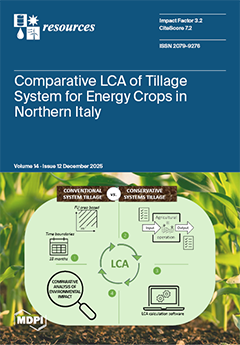
Cover Story (view full-size image):
Sustainable agriculture is central to future global challenges, as it provides essential food and energy resources. Life cycle assessment (LCA) is a valuable tool for evaluating environmental impacts, yet its application to agriculture remains complex. This study aimed to compare the environmental impacts of different soil management systems for energy crop production using LCA. Specifically, we examined a conventional tillage system alongside two conservation tillage systems: minimum tillage and no tillage. The objective was to identify the environmental hotspots of these systems, with particular emphasis on the contributions of organic and inorganic fertilisation processes. A key strength of the study is the extensive use of primary and context-specific data to quantify the input and output flows associated with the systems under analysis. View this paper
- Issues are regarded as officially published after their release is announced to the table of contents alert mailing list.
- You may sign up for e-mail alerts to receive table of contents of newly released issues.
- PDF is the official format for papers published in both, html and pdf forms. To view the papers in pdf format, click on the "PDF Full-text" link, and use the free Adobe Reader to open them.
Previous Issue
Next Issue
