
An Integrated Optimization for Resilient Wildfire Evacuation System Design: A Case Study of a Rural County in Korea

Abstract
1. Introduction
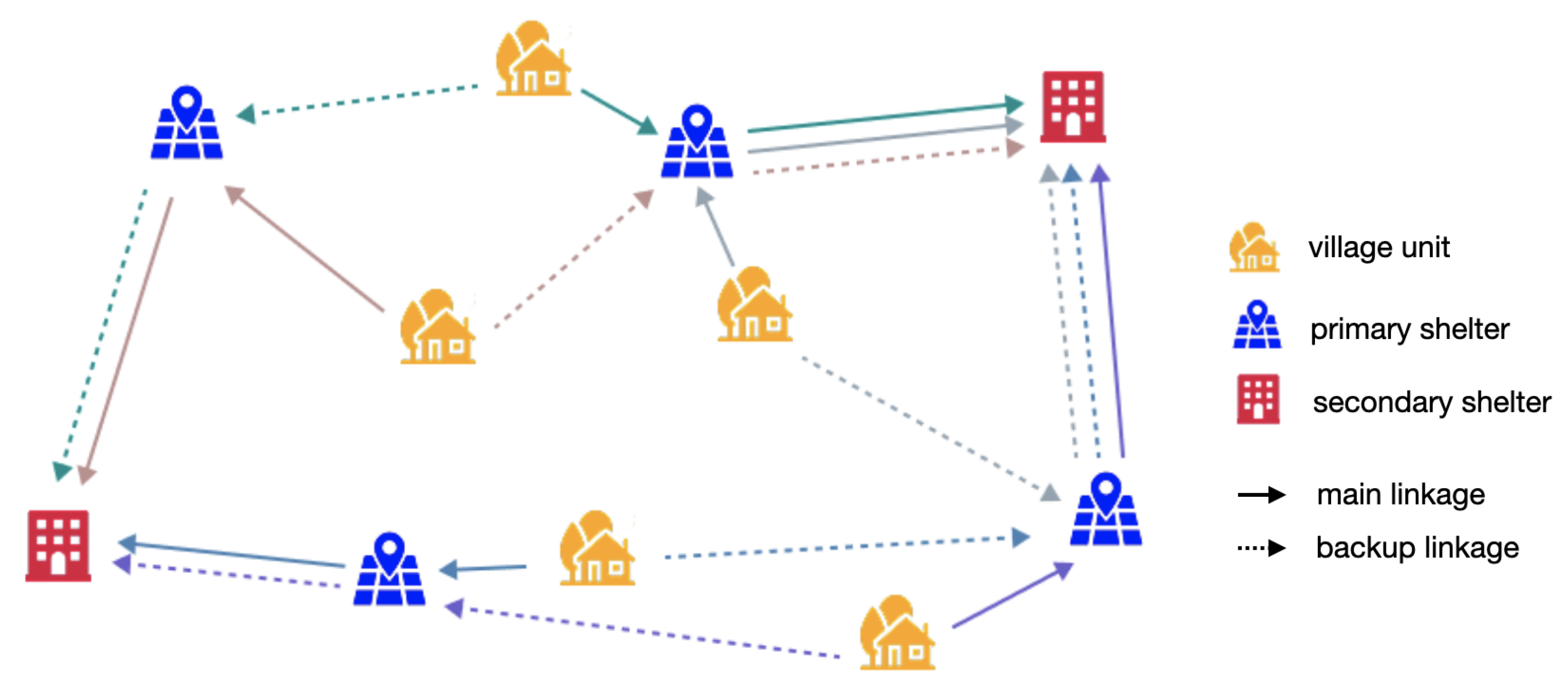
- Simultaneous determination of primary and secondary shelters: The model optimizes both short-term (primary) and long-term (secondary) shelter locations within a single integrated framework. Primary shelters serve as immediate, short distance refuges that residents can reach quickly during the initial spread of the wildfire. Secondary shelters are larger and safer facilities designed for long-term accommodation and resource support once the immediate danger subsides. By jointly determining both types of shelters, the model enables a structured and continuous evacuation process that enhances safety and continuity during the transition from primary to secondary shelters.
- Resilient evacuation with main and backup linkages: The model simultaneously optimizes main linkages, representing standard evacuation flows from each residence to the designated primary and secondary shelters, and backup linkages, which serve as alternatives in the event of road blockages or fire spread. This dual linkage structure enhances the resilience and continuity of evacuation operations under uncertain wildfire conditions.
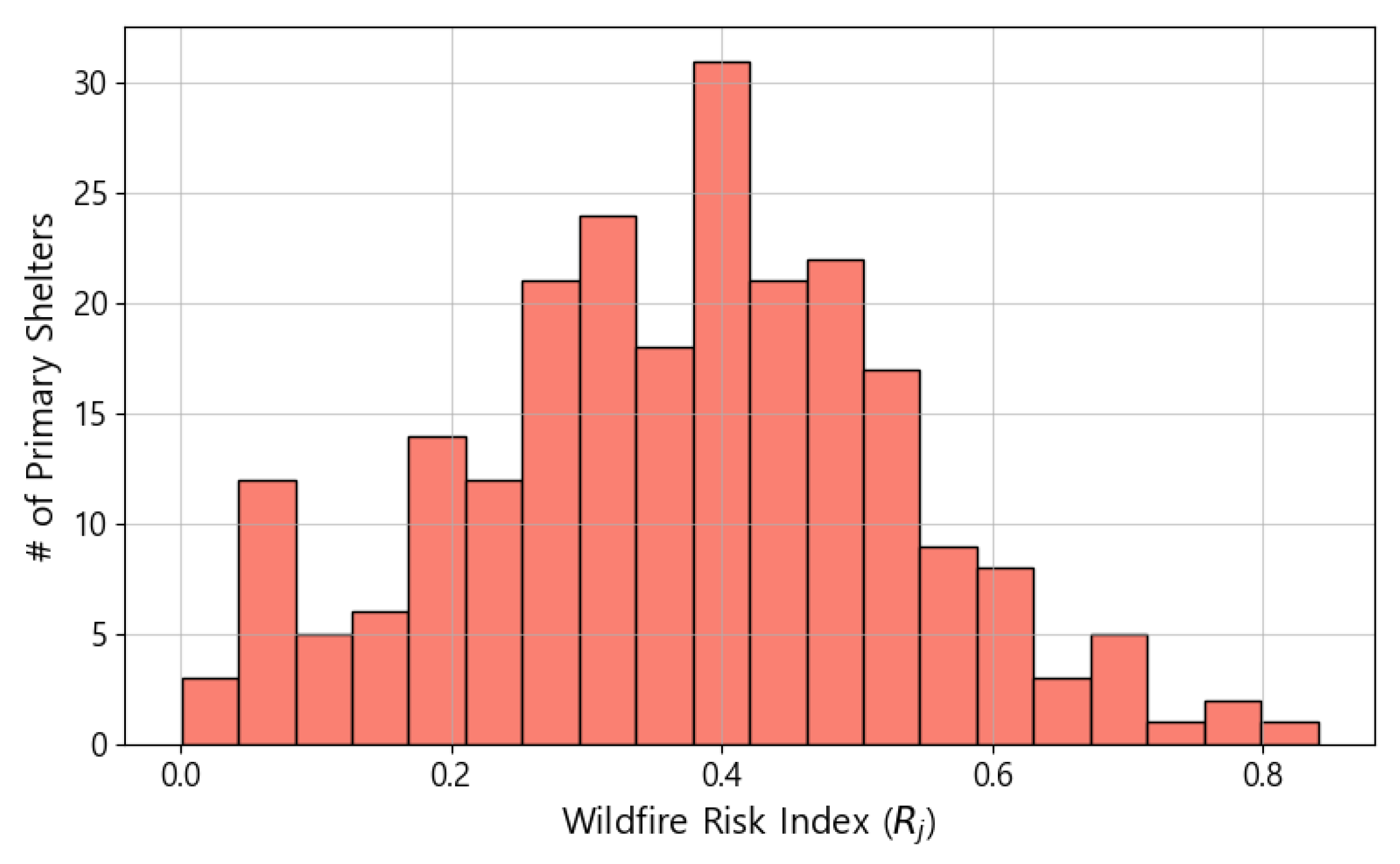
- Risk-aware allocation: Wildfire risk indices, quantified from topographic and environmental factors such as slope, forest density, and proximity to forests, are incorporated into the shelter allocation model. This ensures that shelters in high risk zones are deprioritized, leading to safer and more reliable evacuation planning.
2. Literature Review
2.1. Evacuation Planning: Context and Core Research Themes
2.2. Optimization Approaches in Evacuation Planning
2.3. Wildfire Evacuation Planning and Optimization Approaches
2.4. Research Gap and Contributions
3. Integrated Optimization Model of Wildfire Evacuation Planning
3.1. Problem Description
3.2. Optimization Model
3.3. Model Simplification
4. Case Study
4.1. Study Area Description
4.2. Data Collection and Preprocessing
4.3. Results and Analysis
4.3.1. Analysis of Solution Behavior
4.3.2. Effectiveness of Backup Linkages Under Disruption Scenarios
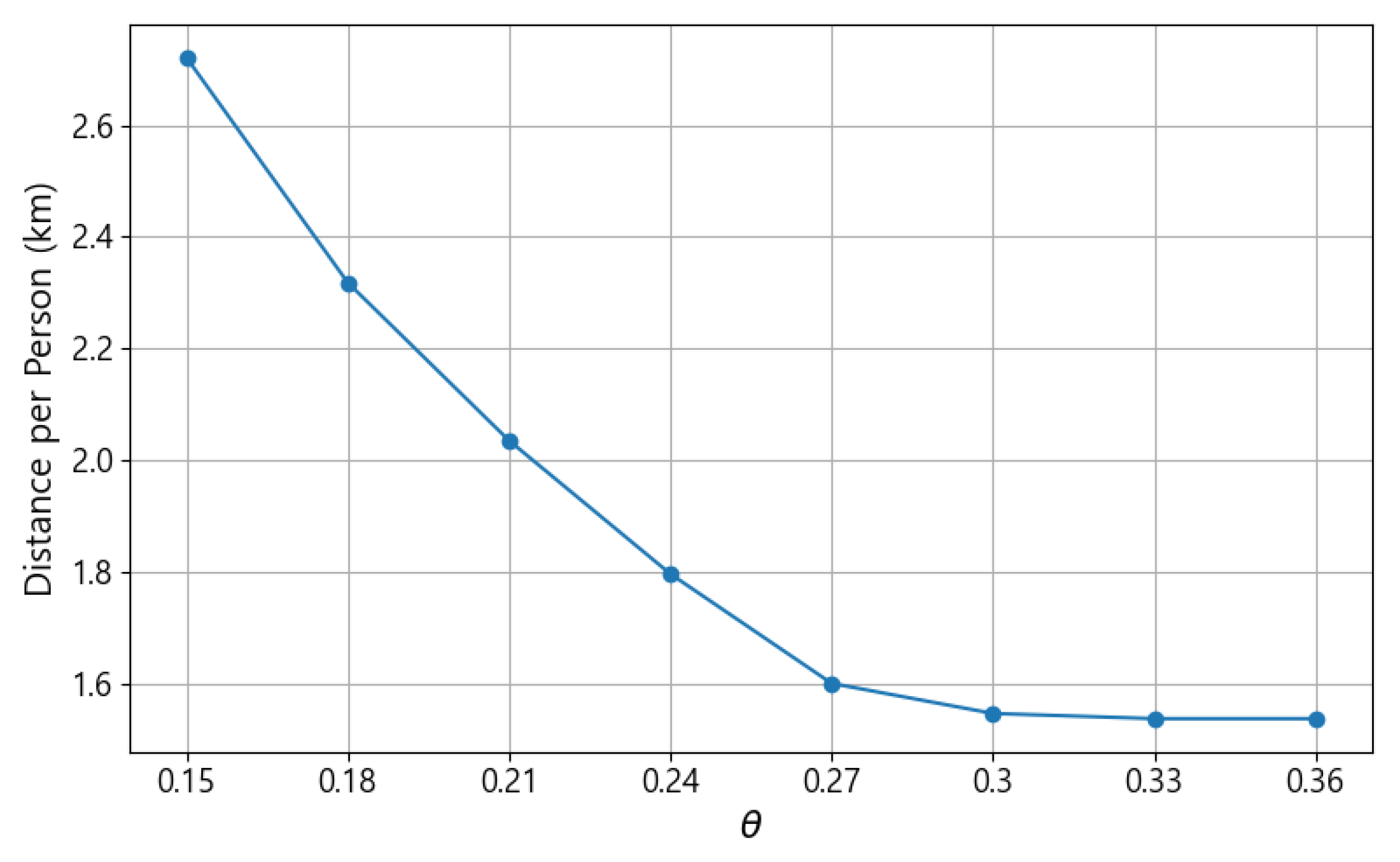
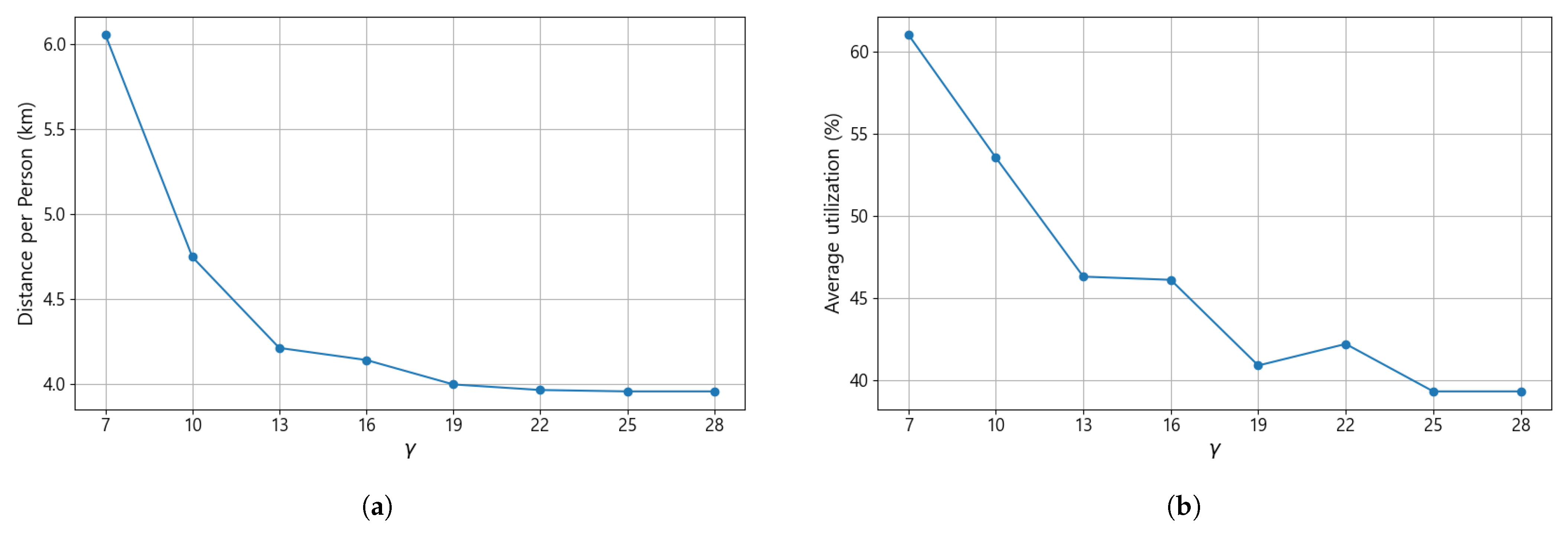
4.3.3. Sensitivity Analysis
5. Conclusions
Author Contributions
Funding
Data Availability Statement
Conflicts of Interest
References
- Bowman, D.M.; Kolden, C.A.; Abatzoglou, J.T.; Johnston, F.H.; van der Werf, G.R.; Flannigan, M. Vegetation fires in the Anthropocene. Nat. Rev. Earth Environ. 2020, 1, 500–515. [Google Scholar] [CrossRef]
- Lindenmayer, D.B.; Kooyman, R.M.; Taylor, C.; Ward, M.; Watson, J.E. Recent Australian wildfires made worse by logging and associated forest management. Nat. Ecol. Evol. 2020, 4, 898–900. [Google Scholar] [CrossRef] [PubMed]
- Wong, S.D.; Broader, J.C.; Shaheen, S.A. Review of California Wildfire Evacuations from 2017 to 2019; Technical Report; UC Institute of Transportation Studies: California, CA, USA, 2020. [Google Scholar]
- Tymstra, C.; Stocks, B.J.; Cai, X.; Flannigan, M.D. Wildfire management in Canada: Review, challenges and opportunities. Prog. Disaster Sci. 2020, 5, 100045. [Google Scholar] [CrossRef]
- Synolakis, C.E.; Karagiannis, G.M. Wildfire risk management in the era of climate change. Proc. Natl. Acad. Sci. USA Nexus 2024, 3, 151. [Google Scholar] [CrossRef]
- Wahlqvist, J.; Ronchi, E.; Gwynne, S.M.; Kinateder, M.; Rein, G.; Mitchell, H.; Bénichou, N.; Ma, C.; Kimball, A.; Kuligowski, E. The simulation of wildland-urban interface fire evacuation: The WUI-NITY platform. Saf. Sci. 2021, 136, 105145. [Google Scholar] [CrossRef]
- Taccaliti, F.; Marzano, R.; Bell, T.L.; Lingua, E. Wildland–urban interface: Definition and physical fire risk mitigation measures, a systematic review. Fire 2023, 6, 343. [Google Scholar] [CrossRef]
- Kang, Y.; Jang, E.; Im, J.; Kwon, C.; Kim, S. Developing a new hourly forest fire risk index based on catboost in South Korea. Appl. Sci. 2020, 10, 8213. [Google Scholar] [CrossRef]
- Park, H.; Nam, K.; Lim, H. Is critical infrastructure safe from wildfires? A case study of wildland-industrial and-urban interface areas in South Korea. Int. J. Disaster Risk Reduct. 2023, 95, 103849. [Google Scholar] [CrossRef]
- Park, J.; Suh, J.; Baek, M. Climatic and Forest Drivers of Wildfires in South Korea (1980–2024): Trends, Predictions, and the Role of the Wildland–Urban Interface. Forests 2025, 16, 1476. [Google Scholar] [CrossRef]
- Bouguettaya, A.; Zarzour, H.; Taberkit, A.M.; Kechida, A. A review on early wildfire detection from unmanned aerial vehicles using deep learning-based computer vision algorithms. Signal Process. 2022, 190, 108309. [Google Scholar] [CrossRef]
- Ghali, R.; Akhloufi, M.A. Deep learning approaches for wildland fires using satellite remote sensing data: Detection, mapping, and prediction. Fire 2023, 6, 192. [Google Scholar] [CrossRef]
- Kumar, A.; Perrusquía, A.; Al-Rubaye, S.; Guo, W. Wildfire and smoke early detection for drone applications: A light-weight deep learning approach. Eng. Appl. Artif. Intell. 2024, 136, 108977. [Google Scholar] [CrossRef]
- Amideo, A.E.; Scaparra, M.P.; Kotiadis, K. Optimising shelter location and evacuation routing operations: The critical issues. Eur. J. Oper. Res. 2019, 279, 279–295. [Google Scholar] [CrossRef]
- Zehra, S.N.; Wong, S.D. Systematic review and research gaps on wildfire evacuations: Infrastructure, transportation modes, networks, and planning. Transp. Plan. Technol. 2024, 47, 1364–1398. [Google Scholar] [CrossRef]
- National Assembly Research Service. National Response Strategies for Large-Scale Wildfires: Lessons from the 2025 Yeongnam Wildfire Crisis; Technical Report; National Assembly Research Service: Seoul, Republic of Korea, 2025. [Google Scholar]
- BBC News. Why Have the Wildfires in S Korea Been So Devastating? 2025. Available online: https://www.bbc.com/news/articles/cp8l60l8ppzo (accessed on 18 October 2025).
- Demange, M.; Gabrel, V.; Haddad, M.; Murat, C. A robust p-Center problem under pressure to locate shelters in wildfire context. EURO J. Comput. Optim. 2020, 8, 103–139. [Google Scholar]
- Flores, I.; Ortuño, M.T.; Tirado, G. A goal programming model for early evacuation of vulnerable people and relief distribution during a wildfire. Saf. Sci. 2023, 164, 106117. [Google Scholar] [CrossRef]
- Ohi, S.J.; Kim, A.M. Identifying a network of wildfire evacuation host communities. Saf. Sci. 2024, 179, 106622. [Google Scholar] [CrossRef]
- Saadatseresht, M.; Mansourian, A.; Taleai, M. Evacuation planning using multiobjective evolutionary optimization approach. Eur. J. Oper. Res. 2009, 198, 305–314. [Google Scholar] [CrossRef]
- Thompson, R.R.; Garfin, D.R.; Silver, R.C. Evacuation from natural disasters: A systematic review of the literature. Risk Anal. 2017, 37, 812–839. [Google Scholar]
- Huang, S.K.; Lindell, M.K.; Prater, C.S. Who leaves and who stays? A review and statistical meta-analysis of hurricane evacuation studies. Environ. Behav. 2016, 48, 991–1029. [Google Scholar] [CrossRef]
- Cimellaro, G.P.; Ozzello, F.; Vallero, A.; Mahin, S.; Shao, B. Simulating earthquake evacuation using human behavior models. Earthq. Eng. Struct. Dyn. 2017, 46, 985–1002. [Google Scholar] [CrossRef]
- Lim, H., Jr.; Lim, M.B.; Piantanakulchai, M. A review of recent studies on flood evacuation planning. J. East. Asia Soc. Transp. Stud. 2013, 10, 147–162. [Google Scholar]
- Cohn, P.J.; Carroll, M.S.; Kumagai, Y. Evacuation behavior during wildfires: Results of three case studies. West. J. Appl. For. 2006, 21, 39–48. [Google Scholar] [CrossRef]
- Toledo, T.; Marom, I.; Grimberg, E.; Bekhor, S. Analysis of evacuation behavior in a wildfire event. Int. J. Disaster Risk Reduct. 2018, 31, 1366–1373. [Google Scholar] [CrossRef]
- Aldahlawi, R.Y.; Akbari, V.; Lawson, G. A systematic review of methodologies for human behavior modelling and routing optimization in large-scale evacuation planning. Int. J. Disaster Risk Reduct. 2024, 110, 104638. [Google Scholar] [CrossRef]
- Abdelgawad, H.; Abdulhai, B. Emergency evacuation planning as a network design problem: A critical review. Transp. Lett. 2009, 1, 41–58. [Google Scholar] [CrossRef]
- Bayram, V. Optimization models for large scale network evacuation planning and management: A literature review. Surv. Oper. Res. Manag. Sci. 2016, 21, 63–84. [Google Scholar] [CrossRef]
- Beloglazov, A.; Almashor, M.; Abebe, E.; Richter, J.; Steer, K.C.B. Simulation of wildfire evacuation with dynamic factors and model composition. Simul. Model. Pract. Theory 2016, 60, 144–159. [Google Scholar] [CrossRef]
- McCaffrey, S.; Wilson, R.; Konar, A. Should I stay or should I go now? Or should I wait and see? Influences on wildfire evacuation decisions. Risk Anal. 2018, 38, 1390–1404. [Google Scholar] [CrossRef]
- Dash, N.; Gladwin, H. Evacuation decision making and behavioral responses: Individual and household. Nat. Hazards Rev. 2007, 8, 69–77. [Google Scholar] [CrossRef]
- Kuligowski, E. Evacuation decision-making and behavior in wildfires: Past research, current challenges and a future research agenda. Fire Saf. J. 2021, 120, 103129. [Google Scholar] [CrossRef]
- Guanquan, C.; Jinhua, S. The effect of pre-movement time and occupant density on evacuation time. J. Fire Sci. 2006, 24, 237–259. [Google Scholar] [CrossRef]
- Chang, H.S.; Liao, C.H. Planning emergency shelter locations based on evacuation behavior. Nat. Hazards 2015, 76, 1551–1571. [Google Scholar] [CrossRef]
- Sadri, A.M.; Ukkusuri, S.V.; Gladwin, H. The role of social networks and information sources on hurricane evacuation decision making. Nat. Hazards Rev. 2017, 18, 04017005. [Google Scholar] [CrossRef]
- Na, H.S.; Grace, R. Influence of social networks and opportunities for social support on evacuation destination decision-making. Saf. Sci. 2022, 147, 105564. [Google Scholar] [CrossRef]
- Liu, L.; Jin, H.; Liu, Y.; Zhang, X. Intelligent Evacuation route planning algorithm based on maximum flow. Int. J. Environ. Res. Public Health 2022, 19, 7865. [Google Scholar] [CrossRef]
- Deng, K.; Zhang, Q.; Zhang, H.; Xiao, P.; Chen, J. Optimal emergency evacuation route planning model based on fire prediction data. Mathematics 2022, 10, 3146. [Google Scholar] [CrossRef]
- Bian, R.; Murray-Tuite, P.; Edara, P.; Triantis, K. Modeling the impact of traffic management strategies on households’ stated evacuation decisions. Prog. Disaster Sci. 2022, 15, 100246. [Google Scholar] [CrossRef]
- Idoudi, H.; Ameli, M.; Van Phu, C.N.; Zargayouna, M.; Rachedi, A. An agent-based dynamic framework for population evacuation management. IEEE Access 2022, 10, 88606–88620. [Google Scholar] [CrossRef]
- Idoudi, H.; Li, W.; Ameli, M.; González, M.C.; Zargayouna, M. Population evacuation in motion: Harnessing disaster evolution for effective dynamic emergency response. IEEE Trans. Intell. Veh. 2024, 10, 4804–4816. [Google Scholar] [CrossRef]
- Boonmee, C.; Arimura, M.; Asada, T. Facility location optimization model for emergency humanitarian logistics. Int. J. Disaster Risk Reduct. 2017, 24, 485–498. [Google Scholar] [CrossRef]
- Ma, Y.; Xu, W.; Qin, L.; Zhao, X. Site selection models in natural disaster shelters: A review. Sustainability 2019, 11, 399. [Google Scholar] [CrossRef]
- Marín, A.; Pelegrín, M. p-Median problems. In Location Science; Springer: Cham, Switzerland, 2020; pp. 25–50. [Google Scholar]
- Kongsomsaksakul, S.; Yang, C.; Chen, A. Shelter location-allocation model for flood evacuation planning. J. East. Asia Soc. Transp. Stud. 2005, 6, 4237–4252. [Google Scholar]
- Zhao, L.; Li, H.; Sun, Y.; Huang, R.; Hu, Q.; Wang, J.; Gao, F. Planning emergency shelters for urban disaster resilience: An integrated location-allocation modeling approach. Sustainability 2017, 9, 2098. [Google Scholar] [CrossRef]
- Chang, K.H.; Pan, Y.J.; Chen, H. Shelter location–allocation problem for disaster evacuation planning: A simulation optimization approach. Comput. Oper. Res. 2024, 171, 106784. [Google Scholar] [CrossRef]
- Stepanov, A.; Smith, J.M. Multi-objective evacuation routing in transportation networks. Eur. J. Oper. Res. 2009, 198, 435–446. [Google Scholar] [CrossRef]
- Ikeda, Y.; Inoue, M. An evacuation route planning for safety route guidance system after natural disaster using multi-objective genetic algorithm. Procedia Comput. Sci. 2016, 96, 1323–1331. [Google Scholar] [CrossRef]
- Campos, V.; Bandeira, R.; Bandeira, A. A method for evacuation route planning in disaster situations. Procedia Soc. Behav. Sci. 2012, 54, 503–512. [Google Scholar] [CrossRef]
- Yamada, T. A network flow approach to a city emergency evacuation planning. Int. J. Syst. Sci. 1996, 27, 931–936. [Google Scholar] [CrossRef]
- Hamacher, H.W.; Heller, S.; Rupp, B. Flow location (FlowLoc) problems: Dynamic network flows and location models for evacuation planning. Ann. Oper. Res. 2013, 207, 161–180. [Google Scholar] [CrossRef]
- Wang, L.; Yang, L.; Gao, Z.; Li, S.; Zhou, X. Evacuation planning for disaster responses: A stochastic programming framework. Transp. Res. Part C Emerg. Technol. 2016, 69, 150–172. [Google Scholar] [CrossRef]
- Bayram, V.; Yaman, H. A stochastic programming approach for shelter location and evacuation planning. RAIRO Oper. Res. Rech. Opér. 2018, 52, 779–805. [Google Scholar] [CrossRef]
- Wang, L. A two-stage stochastic programming framework for evacuation planning in disaster responses. Comput. Ind. Eng. 2020, 145, 106458. [Google Scholar] [CrossRef]
- Fereiduni, M.; Shahanaghi, K. A robust optimization model for distribution and evacuation in the disaster response phase. J. Ind. Eng. Int. 2017, 13, 117–141. [Google Scholar] [CrossRef]
- Yao, T.; Mandala, S.R.; Chung, B.D. Evacuation transportation planning under uncertainty: A robust optimization approach. Netw. Spat. Econ. 2009, 9, 171–189. [Google Scholar] [CrossRef]
- Pourrahmani, E.; Delavar, M.R.; Pahlavani, P.; Mostafavi, M.A. Dynamic evacuation routing plan after an earthquake. Nat. Hazards Rev. 2015, 16, 04015006. [Google Scholar] [CrossRef]
- Mohamed, R.E.; Kosba, E.; Mahar, K.; Mesbah, S. A framework for emergency-evacuation planning using GIS and DSS. In Information Fusion and Intelligent Geographic Information Systems (IF&IGIS’17) New Frontiers in Information Fusion and Intelligent GIS: From Maritime to Land-Based Research; Springer: Cham, Switzerland, 2017; pp. 213–226. [Google Scholar]
- Shahabi, K.; Wilson, J.P. Scalable evacuation routing in a dynamic environment. Comput. Environ. Urban Syst. 2018, 67, 29–40. [Google Scholar] [CrossRef]
- Borgwardt, S.; Crawford, N.; Horton, D.; Morrison, A.; Speakman, E. Evacuation Planning on Time-Expanded Networks with Integrated Wildfire Information. arXiv 2024, arXiv:2410.14500. [Google Scholar] [CrossRef]
- Darvishan, A.; Lim, G.J. Dynamic network flow optimization for real-time evacuation reroute planning under multiple road disruptions. Reliab. Eng. Syst. Saf. 2021, 214, 107644. [Google Scholar] [CrossRef]
- Beyki, S.M.; Santiago, A.; Laím, L.; Craveiro, H.D. Evacuation simulation under threat of wildfire—an overview of research, development, and knowledge gaps. Appl. Sci. 2023, 13, 9587. [Google Scholar] [CrossRef]
- Maranghides, A.; Link, E. WUI Fire Evacuation and Sheltering Considerations: Assessment, Planning, and Execution (ESCAPE); Technical Note; National Institute of Standards and Technology: Gaithersburg, MD, USA, 2023. [Google Scholar]
- Ahmad, S.; Ali, A.; Ahmed, H.U.; Huang, Y.; Lu, P. Evaluating traffic operation conditions during wildfire evacuation using connected vehicles data. Fire 2023, 6, 184. [Google Scholar] [CrossRef]
- Wang, H.; Sheng, J.; Li, X.; Zhao, H.; Li, D. A Self-Adaptive Escape Route Planning Model Based on Dynamic Wildfire Information. Fire 2024, 7, 459. [Google Scholar] [CrossRef]
- Shahparvari, S.; Chhetri, P.; Abbasi, B.; Abareshi, A. Enhancing emergency evacuation response of late evacuees: Revisiting the case of Australian Black Saturday bushfire. Transp. Res. Part Logist. Transp. Rev. 2016, 93, 148–176. [Google Scholar] [CrossRef]
- Shahparvari, S.; Abbasi, B.; Chhetri, P.; Abareshi, A. Fleet routing and scheduling in bushfire emergency evacuation: A regional case study of the Black Saturday bushfires in Australia. Transp. Res. Part D Transp. Environ. 2019, 67, 703–722. [Google Scholar] [CrossRef]
- Zhou, S.; Erdogan, A. A spatial optimization model for resource allocation for wildfire suppression and resident evacuation. Comput. Ind. Eng. 2019, 138, 106101. [Google Scholar] [CrossRef]
- Krasko, V.; Rebennack, S. Two-stage stochastic mixed-integer nonlinear programming model for post-wildfire debris flow hazard management: Mitigation and emergency evacuation. Eur. J. Oper. Res. 2017, 263, 265–282. [Google Scholar] [CrossRef]
- Zhang, Z.; Tan, L.; Tiong, R.L. Evacuation path optimization algorithm for grassland fires based on SAR imagery and intelligent optimization. Front. Environ. Sci. 2025, 13, 1522933. [Google Scholar] [CrossRef]
- Zhang, Y.; Chen, W.; Zhong, G.; Zhai, G.; Zhai, W. A Two-Phase and Bi-Level Spatial Configuration Methodology of Shelters Based on a Circular Assignment Model and Evacuation Traffic Flow Allocation. ISPRS Int. J. Geo Inf. 2024, 13, 455. [Google Scholar] [CrossRef]
- Yin, Y.; Xu, X.; Wang, D.; Yu, Y.; Cheng, T. Two-stage recoverable robust optimization for an integrated location–allocation and evacuation planning problem. Transp. Res. Part B Methodol. 2024, 182, 102906. [Google Scholar] [CrossRef]
- Ermagun, A.; Janatabadi, F. Compound risk of wildfire and inaccessible shelters is disproportionately impacting disadvantaged communities. Prog. Disaster Sci. 2024, 23, 100358. [Google Scholar] [CrossRef]
- Bera, S.; Gnyawali, K.; Dahal, K.; Melo, R.; Li-Juan, M.; Guru, B.; Ramana, G. Assessment of shelter location-allocation for multi-hazard emergency evacuation. Int. J. Disaster Risk Reduct. 2023, 84, 103435. [Google Scholar] [CrossRef]
- Liang, B.; Yang, D.; Qin, X.; Tinta, T. A risk-averse shelter location and evacuation routing assignment problem in an uncertain environment. Int. J. Environ. Res. Public Health 2019, 16, 4007. [Google Scholar] [CrossRef]
- Statistics Korea (KOSTAT). Population and Housing Census of Uiryeong County, Gyeongsangnam-do. 2025. Available online: https://kostat.go.kr/ (accessed on 20 October 2025).
- Google Earth. Satellite Imagery of Uiryeong County, Gyeongsangnam-do, Republic of Korea. 2025. Available online: https://earth.google.com/ (accessed on 20 October 2025).
- Naver Map. Satellite Imagery of Uiryeong County, Gyeongsangnam-do, Republic of Korea. 2025. Available online: https://map.naver.com/ (accessed on 20 October 2025).
- Ministry of the Interior and Safety (MOIS). Guidelines for the Designation and Management of Earthquake Outdoor Evacuation Areas; MOIS: Sejong, Republic of Korea, 2024. (In Korean) [Google Scholar]
- Lee, S.H.; Goo, S.H.; Chun, Y.W.; Park, Y.J. The spatial location analysis of disaster evacuation shelter for considering resistance of road slope and difference of walking speed by age-case study of Seoul, Korea. J. Korean Soc. Geospat. Inf. Sci. 2015, 23, 69–77. [Google Scholar]
- Korea Forest Service. Large-Scale Forest Type Map. 2024. Available online: https://www.forest.go.kr/newkfsweb/html/HtmlPage.do?pg=/fgis/UI_KFS_5002_020100.html&mn=KFS_02_04_03_04_01&orgId=fgis (accessed on 12 December 2025).
- National Geographic Information Institute. National Base Map (River Boundaries). 2025. Available online: https://www.vworld.kr/dtmk/dtmk_ntads_s002.do?svcCde=MK&dsId=20250122DS00006 (accessed on 12 December 2025).
- National Institute of Agricultural Sciences. Soil Map. 2024. Available online: https://www.vworld.kr/dtmk/dtmk_ntads_s002.do?svcCde=MK&dsId=30495 (accessed on 12 December 2025).
- Jaiswal, R.K.; Mukherjee, S.; Raju, K.D.; Saxena, R. Forest fire risk zone mapping from satellite imagery and GIS. Int. J. Appl. Earth Obs. Geoinf. 2002, 4, 1–10. [Google Scholar] [CrossRef]
- Mahdavi, A. Forests and rangelands? wildfire risk zoning using GIS and AHP techniques. Casp. J. Environ. Sci. 2012, 10, 43–52. [Google Scholar]
- Ministry of the Interior and Safety (MOIS). 2025 Disaster Relief Plan Guideline. 2025. Available online: https://www.mois.go.kr/frt/bbs/type001/commonSelectBoardArticle.do?bbsId=BBSMSTR_000000000015&nttId=118124 (accessed on 12 December 2025). (In Korean).



| Sets | |
| I | Set of village units i |
| J | Set of primary shelters j |
| K | Set of secondary shelters k |
| Parameters | |
| Population of village unit i | |
| Wildfire risk index of primary shelter j | |
| Capacity of primary shelter j | |
| Capacity of secondary shelter k | |
| Distance between village unit i and primary shelter j | |
| Distance between primary shelter j and secondary shelter k | |
| Scaling factor representing the proportion of backup evacuees counted toward shelter capacity | |
| Distance ratio limit defining the maximum allowable length of backup linkages relative to main linkages | |
| Weighting coefficient controlling the relative importance of secondary evacuation distance in the objective function | |
| Upper limit on the population-weighted wildfire risk of selected primary shelters | |
| Upper bound on the number of secondary shelters that can be established | |
| Decision Variables | |
| Binary variable that equals 1 if village unit i is assigned to primary shelter j and subsequently to secondary shelter k through the main evacuation linkage, and 0 otherwise. | |
| Binary variable that equals 1 if village unit i is assigned to primary shelter j and subsequently to secondary shelter k through the backup evacuation linkage, and 0 otherwise. | |
| Binary variable that equals 1 if primary shelter j is selected, and 0 otherwise. | |
| Binary variable that equals 1 if secondary shelter k is selected, and 0 otherwise. |
Disclaimer/Publisher’s Note: The statements, opinions and data contained in all publications are solely those of the individual author(s) and contributor(s) and not of MDPI and/or the editor(s). MDPI and/or the editor(s) disclaim responsibility for any injury to people or property resulting from any ideas, methods, instructions or products referred to in the content. |
© 2025 by the authors. Licensee MDPI, Basel, Switzerland. This article is an open access article distributed under the terms and conditions of the Creative Commons Attribution (CC BY) license (https://creativecommons.org/licenses/by/4.0/).
Share and Cite
Kwon, K.; Kim, Y.; Han, J. An Integrated Optimization for Resilient Wildfire Evacuation System Design: A Case Study of a Rural County in Korea. Systems 2025, 13, 1125. https://doi.org/10.3390/systems13121125
Kwon K, Kim Y, Han J. An Integrated Optimization for Resilient Wildfire Evacuation System Design: A Case Study of a Rural County in Korea. Systems. 2025; 13(12):1125. https://doi.org/10.3390/systems13121125
Chicago/Turabian StyleKwon, Kyubin, Yejin Kim, and Jinil Han. 2025. "An Integrated Optimization for Resilient Wildfire Evacuation System Design: A Case Study of a Rural County in Korea" Systems 13, no. 12: 1125. https://doi.org/10.3390/systems13121125
APA StyleKwon, K., Kim, Y., & Han, J. (2025). An Integrated Optimization for Resilient Wildfire Evacuation System Design: A Case Study of a Rural County in Korea. Systems, 13(12), 1125. https://doi.org/10.3390/systems13121125