1. Introduction
A prominent feature of contemporary globalization is the rapid rise and continuous deepening of global value chains [
1,
2]. As production activities have been fragmented into a series of tradable tasks across borders, the global division of labour has gradually shifted from an inter-industry pattern to a functional pattern in which economies specialize in distinct stages such as research and development, design, manufacturing, and marketing [
3]. At the same time, the embeddedness of foreign-invested enterprises (FIEs) in host-country industrial chains introduces capital, knowledge, and advanced technologies and combines these with local labour, natural resources, and infrastructure [
4]. Together, these forces constitute a major driver of the organization and participation of host countries in the functional allocation of value chain activities [
5]. Therefore, a key question that follows is whether the embeddedness of FIEs can facilitate the functional upgrading of host-country manufacturing—namely, the shift from low value-added processing and assembly activities towards high value-added functions such as research and development (R&D), management, and marketing.
Existing research addressing this question reveals a marked divergence of views. On the one hand, a substantial body of empirical evidence shows that foreign direct investment can enhance the productivity and innovation capacity of host-country industries through mechanisms such as technological spillovers, managerial know-how transfer, and expanded market access [
6]. The entry of multinational enterprises not only brings advanced production processes and organizational practices but also stimulates local firms’ technological learning and efficiency improvements through competition and demonstration effects [
7]. From this perspective, the embeddedness of FIEs should, in principle, provide momentum for functional upgrading. On the other hand, some scholars argue that under the unequal governance structure of global value chains, firms in developing economies often become trapped in ‘low-end lock-in’, remaining confined to low-technology, low-profit processing and assembly activities and thus struggling to achieve substantive upgrading [
8,
9]. This lock-in is largely attributable to the restrictions that multinational corporations impose on the transfer of critical technologies and knowledge in order to safeguard their core competencies. Such constraints cultivate a dependency relationship that entrenches local firms’ peripheral position in the global division of labour [
10]. Hence, the effects of the embeddedness of FIEs do not naturally translate into functional upgrading.
These contradictory empirical findings suggest that the effect of the embeddedness of FIEs on functional upgrading may not be linear; rather, it may constitute a conditional outcome shaped by multiple contextual factors. Although existing studies have identified several moderating mechanisms at the firm, industry, and institutional levels [
11], relatively few have examined the issue from a broader system-level perspective by considering the ‘structural position’ of industries within the global production system. As the networked evolution of GVCs deepens, the global production system has increasingly taken the form of a complex, multi-layered network in which industries occupy highly differentiated positions in terms of power and connectivity [
12]. Some industries are located at the core of the network, possessing high levels of connectedness and informational dominance, whereas others remain at the periphery and are subject to the control of core nodes. Such differences in structural position may fundamentally determine whether, and under what conditions, the embeddedness of FIEs can facilitate functional upgrading.
Building upon this intuition to develop a system-level perspective, this paper introduces the concept of industrial chain centrality as a key indicator for measuring the structural power and influence of industries within the global value chain network. We argue that industrial chain centrality reflects the structural advantages of industries in terms of information access, resource integration, and bargaining power, and that it systematically affects the mechanisms through which the embeddedness of FIEs influences functional upgrading [
13]. Specifically, this paper proposes a core hypothesis: that there is a non-linear relationship between the embeddedness of FIEs and functional upgrading in manufacturing, mediated by industrial chain centrality as a threshold. Once the centrality of an industry surpasses a certain threshold value, its dense industrial connections, mature ecosystem, and enhanced bargaining power will significantly amplify the potential spillover effects brought by foreign investment, thus activating its positive role in facilitating functional upgrading.
To test the above hypothesis, this paper constructs an indicator of industrial chain centrality based on cross-country panel data covering 14 manufacturing industries across 42 economies from 2003 to 2020. Using these data, the study employs a panel threshold regression model to empirically examine the non-linear impact of the embeddedness of FIEs on functional upgrading in manufacturing.
The contributions of this study are threefold. First, at the theoretical level, this paper incorporates complex network theory into GVC research and, from a systemic perspective, proposes industrial chain centrality as a key moderating variable shaping the spillover effects of foreign investment. This approach provides an integrative analytical framework for reconciling the contradictory findings in the existing literature and advances the paradigm shift in GVC studies from a ‘chain-based’ to a ‘network-oriented’ perspective. Second, at the empirical level, this study utilizes the latest cross-country input–output datasets and greenfield investment data to construct measures of functional upgrading and industrial chain centrality, applying a threshold regression model to conduct the first empirical test of the non-linear characteristics of foreign-invested enterprise embeddedness. The model generates new empirical evidence that sheds light on the complex interactions between foreign investment and industrial upgrading in host countries. Third, at the policy level, the findings offer important implications. They indicate that the focus of industrial policy in developing economies should shift from merely increasing the quantity of foreign investment towards strategically enhancing the industrial chain centrality of domestic industries. Only when industries occupy a favourable structural position within the global production network can foreign investment truly serve as an effective catalyst for functional upgrading, thereby helping countries avoid the trap of low-end lock-in.
5. Discussion
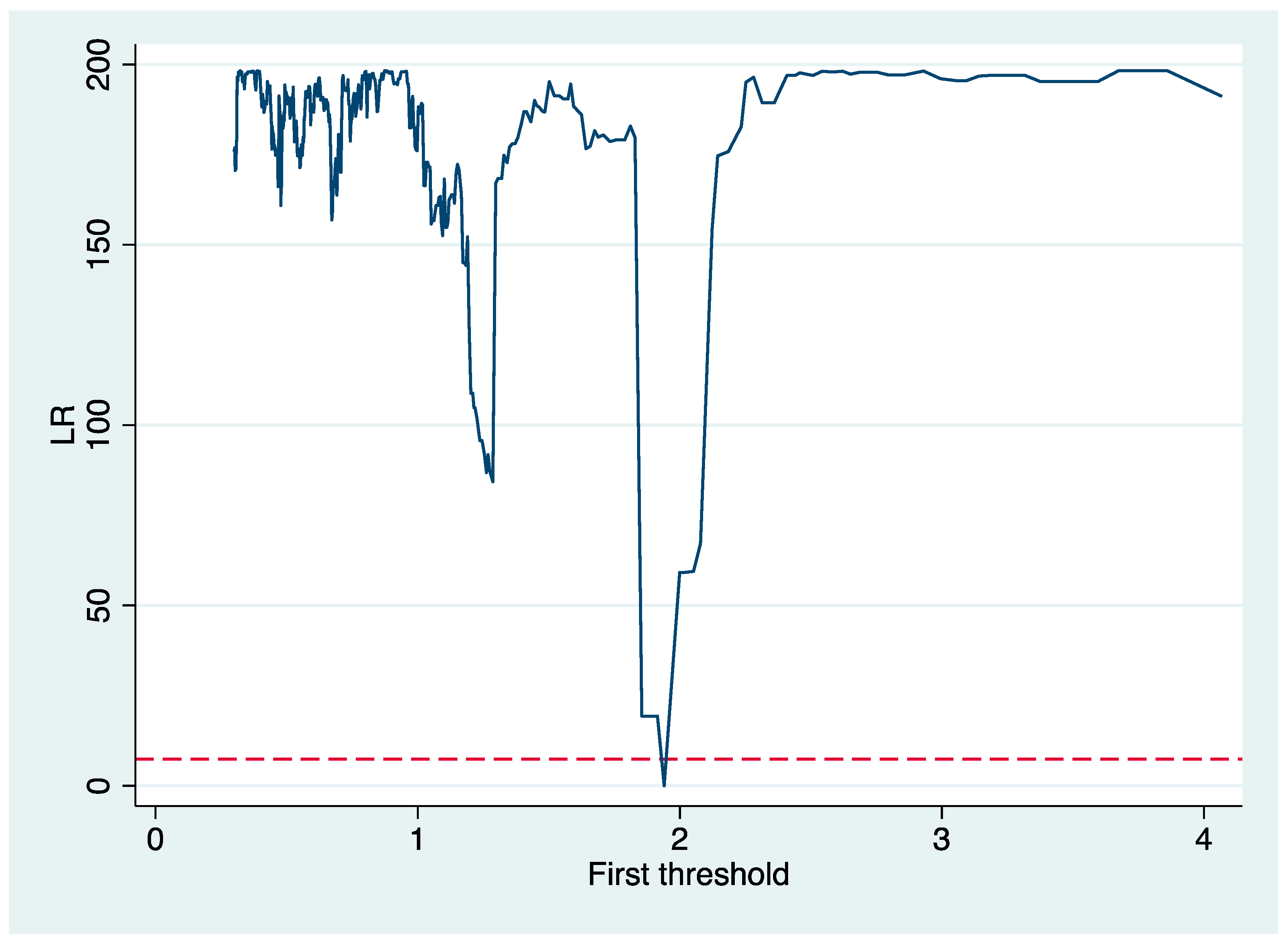
The core finding of this study is that the impact of the embeddedness of FIEs on the functional upgrading of the manufacturing sector is not linear, but instead exhibits a pronounced nonlinear pattern characterized by a threshold in industrial chain centrality. Only when an industry’s centrality within the production network surpasses a certain critical value can the embeddedness of FIEs effectively promote its transition into higher value-added functions. This result provides a new systems-level perspective for understanding the complex interaction between foreign capital and host-country upgrading, and it also carries important implications for understanding how developing countries can formulate effective industrial policies in the context of globalization.
The present analysis further shows that industrial chain centrality is the key factor for explaining the positive effects of the embeddedness of FIEs. This finding provides strong evidence for reconciling and interpreting the contradictory conclusions reported in the existing literature. For decades, scholars have debated whether FDI facilitates or inhibits industrial upgrading in host economies [
40]. Proponents argue that FDI can significantly enhance the productivity and innovation capacity of domestic firms through technology spillovers, managerial knowledge transfer, and expanded market access [
41,
42]. Critics, however, contend that under the unequal governance structures of global value chains, multinational corporations may leverage their dominant positions to lock host-country firms into low-value-added assembly tasks, thereby hindering functional upgrading [
1,
22]. The threshold-effect model developed in this study indicates that these seemingly contradictory views are in fact manifestations of the same underlying mechanism operating under different structural conditions. Whether the embeddedness of FIEs promotes or suppresses industrial upgrading largely depends on the structural position of the host-country industry within global production networks.
Industrial chain centrality, as an indicator of structural power within an industry, plays a critical role in distinguishing between the two contrasting outcomes observed in the embeddedness of FIEs. When an industry is positioned at the periphery of the global production network (low centrality), its channels for knowledge absorption are often limited, bargaining power is weak, and it is more susceptible to domination by multinational corporations, which makes it difficult for the positive effects of foreign capital to materialize [
43,
44]. In contrast, when an industry is located at the core of the network (high centrality), its dense industrial linkages, mature ecosystems, and stronger bargaining power allow it to maximize the potential spillover effects of foreign capital, thereby activating its positive role in promoting functional upgrading [
45]. Thus, by introducing ‘industrial chain centrality’ as a systemic variable, this study provides an integrated analytical framework to reconcile the debates in the existing literature.
Furthermore, this study contributes to the shift in GVC research from the traditional ‘chain-based’ paradigm to a more ‘networked’ perspective. Traditional GVC analysis often depicts the production process as a linear, value-adding chain extending from upstream to downstream. However, with the increasing fragmentation and complexity of global production, inter-industry links have evolved into intricate, interconnected networks [
46]. By introducing the concept of centrality from complex network theory, this study aims to capture these network structural characteristics. Industrial chain centrality not only reflects the number of direct connections within an industry but, more importantly, it embodies the transmission effects and influence within higher-order networks—where the importance of an industry depends on the significance of the industries to which it is connected. This indicator provides a powerful analytical tool for quantifying and understanding the power structure and uneven development within GVCs, where related analyses often require sophisticated methods to handle large-scale datasets [
47]. Through empirical testing of the threshold effect of centrality, this study reveals how an industry’s ‘structural position’ within the global production system fundamentally determines its upgrading path and its efficiency in utilizing foreign capital. This opens up new theoretical avenues for future GVC research, emphasizing the need for greater attention to systemic factors such as network topology, node positions, and power distribution in shaping industrial development.
The conclusions of this study have significant policy implications, especially for developing countries seeking to leverage foreign capital for industrial upgrading. First, the focus of industrial policy should shift from merely attracting FDI to enhancing the industrial chain centrality of domestic industries. Traditional policies often prioritize the total inflow of FDI, assuming that foreign capital will naturally bring about technology transfer and growth. However, the findings of this study caution that if domestic industries are positioned at the periphery of the global production network, simply attracting large amounts of foreign capital may not lead to the expected functional upgrading, and may even exacerbate dependency on multinational corporations. Therefore, policymakers need to adopt a more strategic perspective, placing the cultivation and enhancement of domestic industries’ central position within global networks as a prerequisite for effectively utilizing foreign capital. This approach entails substantial investments in infrastructure, reducing transaction costs, fostering mature supplier networks, and building dynamic industrial clusters [
48]. Only when the domestic industrial ecosystem is strong enough to play an indispensable role as a hub in the global network can foreign capital become a catalyst for industrial upgrading.
Furthermore, foreign capital policy should be differentiated and dynamic, with targeted strategies based on the level of industrial chain centrality in different industries. For industries with low industrial chain centrality, the focus of policy should not be on blindly attracting foreign capital, but rather on strengthening the foundational aspects of the domestic industry. This includes supporting domestic firms in technological innovation, strengthening domestic industry linkages, and cultivating specialized talent to gradually enhance the firms’ connectivity and influence within the global network. At this stage, the government can selectively attract ‘empowering’ foreign capital to fill domestic technological gaps and drive local supply chain development, rather than merely pursuing ‘efficiency-oriented’ foreign capital focused on cost advantages. For industries that have already surpassed the centrality threshold, policy should shift towards attracting higher-quality FDI and promoting its deep integration with the domestic innovation system. For example, encouraging multinational corporations to establish R&D centers locally, collaborate with local universities and research institutions, and jointly develop industry standards [
49]. This phased, differentiated policy framework can more effectively guide foreign capital to serve the strategic goals of long-term industrial development, avoiding the negative effects of a one-size-fits-all approach.
Despite the significant findings of this study, several limitations remain, which also point to fruitful directions for future research. First, functional upgrading and the embeddedness of FIEs are multidimensional ideas for variable measurement. The value-chain functional distribution index measures functional upgrading overall but cannot identify process, product, and chain upgrading [
50]. The embeddedness of FIEs statistic does not distinguish between FDI from various nations or motivated by different reasons (e.g., market-seeking or efficiency-seeking), yet such heterogeneity surely affects spillover effects. Future research could use micro-level, firm-based datasets to show upgrading types and FDI features more nuancedly, revealing deeper mechanisms. Second, while this study employs a fixed-effects model to account for time-invariant industry features, potential endogeneity—especially reverse causality—remains a methodological concern. Industries with stronger upgrading potential and greater structural centrality may attract higher-quality foreign capital, thereby biasing coefficient estimates. To more rigorously identify causal linkages, future studies may adopt instrumental variables or quasi-experimental approaches such as natural experiments or regression discontinuity designs. Third, industry-level analysis hides firm-level heterogeneity in this study. Absorptive capacity, ownership structure, and firm size vary widely within an industry, which may affect the embeddedness of FIEs. Thus, studying the relationships between business characteristics, foreign capital links, and network positions at the firm level is a promising research topic. Future research could examine whether state-owned versus private firms upgrade differently when faced with foreign capital shocks and how local industrial cluster embedding affects firms’ ability to benefit from foreign capital spillovers [
51].
6. Conclusions
In the context of deepening global economic integration, understanding how the embeddedness of FIEs can facilitate functional upgrading in the manufacturing sector has become an urgent and significant research question. The key to addressing this issue lies in identifying the structural conditions that shape the mechanisms through which the embeddedness of FIEs exerts its influence. Drawing on a complex network systems perspective, this paper challenges the traditional linear assumptions regarding the effects of FIE embedding and introduces industrial chain centrality as a critical threshold variable. In doing so, it systematically uncovers the nonlinear mechanism through which the embeddedness of FIEs affects the functional upgrading of manufacturing. Based on panel data for cross-economy manufacturing industries from 2003 to 2020, the empirical analysis yields several core conclusions. The most significant finding to emerge from this investigation is that the impact of the embeddedness of FIEs on manufacturing functional upgrading exhibits a clear threshold effect. Results from the threshold regression model demonstrate that only when industrial chain centrality—defined as an industry’s hub position and structural influence within the global production network—exceeds a specific critical value does the embeddedness of FIEs significantly promote functional upgrading. Conversely, when industrial chain centrality falls below this threshold, the positive effect of the embeddedness of FIEs becomes negligible and may even result in a ‘lock-in’ at the lower end of the value chain due to insufficient structural power. These findings remain robust when the explanatory variable is lagged by one period and under varying clustering of standard errors, thereby reinforcing the validity of the identified threshold effect.
In turn, this study yields several important theoretical and policy implications. On the theoretical side, the findings offer fresh insight into how the structural configuration of global production networks shapes the spillover effects of FIEs and influences upgrading trajectories within global value chains. This perspective advances the literature beyond a predominantly “chain-based” division of labour toward a more nuanced, “network-oriented’’ analytical framework. On the policy side, the results indicate that the effectiveness of industrial upgrading strategies hinges not only on the scale of inward FDI but also on the quality of the domestic industrial ecosystem and its centrality within global production networks. Policymakers should therefore incorporate industrial chain centrality into the design of FDI-related strategies. Only when domestic industries possess relatively high network density and structural advantages can the embeddedness of FIEs effectively promote functional upgrading rather than exacerbate lock-in risks.