


Abstract
Friction and wear significantly limit the performance and service life of mechanical components, yet metallic coatings remain essential for electrical and thermal conductivity in applications such as connectors. In this work, Co-Au coatings were fabricated on Ni-P-coated copper substrates via a chemical plating method, followed by thermal diffusion annealing at 350 °C for 1 h. The as-deposited coatings exhibit a continuous granular structure with an Au-rich top layer and a nanocrystalline Co-rich layer beneath, while annealing induces interdiffusion between Au and Co, forming a Co-Au solid solution. This microstructural evolution leads to enhanced hardness, optimized H/E ratio, and improved load-bearing capacity. Tribological tests reveal that annealed Co-Au coatings exhibit a reduced and stable coefficient of friction compared with Co and as-deposited Co-Au coatings under identical test conditions (~0.14), corresponding to a reduction of approximately 77% compared with the as-deposited Co-Au coatings (~0.60). Meanwhile, the wear track width decreases from ~138 μm to ~70 μm, indicating a reduction of about 49%. Corrosion resistance is improved after annealing, as evidenced by lower corrosion current density and a more positive open-circuit potential. The results demonstrate that the combination of chemical plating and thermal diffusion provides an effective strategy to produce structurally stable Co-Au coatings with excellent mechanical, tribological, and corrosion-resistant properties, suitable for complex-shaped conductive components.
1. Introduction
Friction and wear have long been recognized as critical factors limiting the performance, reliability, and service lifetime of mechanical components [1]. Consequently, reducing friction and wear of mechanical components remains a central objective in tribology research. Although various low-friction materials, such as diamond-like carbon (DLC) coatings and lubricating oils, have been extensively developed, metallic coatings continue to play an indispensable role in specific applications, particularly in plug-in connectors and conductive slip rings, owing to their superior electrical and thermal conductivity [2,3,4,5,6]. Among metallic coatings, gold coatings are widely applied in electrical connectors and contact components because of their excellent corrosion resistance, high electrical conductivity, and favorable intrinsic lubricity [7,8,9]. However, gold is inherently a soft metal with low hardness, resulting in poor resistance to mechanical wear and atomic diffusion under sliding or contact conditions [10,11,12,13]. Previous studies have demonstrated that pure gold coatings are susceptible to severe adhesive and abrasive wear, often accompanied by micro-motion-induced damage, brittle fracture, and interfacial delamination [14,15]. The preliminary simulations and experimental investigations further confirm that pure gold coatings exhibit pronounced adhesive wear, particularly under low-speed sliding conditions, where strong interfacial adhesion and sufficient atomic interpenetration lead to extensive material transfer and rapid coating degradation [16]. These limitations significantly hinder the direct application of pure gold coatings on copper-based conductive components.
Grain refinement is a well-established strengthening strategy for metals and alloys, typically described by the Hall–Petch relationship, whereby yield strength increases with decreasing grain size without altering chemical composition. When the grain size is refined to the nanoscale, the mechanical strength of metals can be substantially enhanced. However, once the grain size decreases below approximately 10 nm, grain-boundary-mediated deformation mechanisms may dominate, leading to a softening effect [17,18,19]. The introduction of suitable alloying elements can stabilize grain boundaries and extend the strengthening effect to smaller grain sizes, thereby improving the mechanical and tribological performance of the coating [20,21].
Alloying gold with cobalt has proven to be an effective approach for enhancing the wear resistance and overall tribological performance of gold-based coatings. Nevertheless, it has been reported that the mutual diffusion between copper substrates and gold-cobalt coatings during service can still lead to progressive deterioration of both tribological behavior and electrical contact performance [22,23,24]. In practical electrical connectors and relay contacts, noble-metal coatings such as Au or Au-alloy layers are typically deposited on Cu-based substrates with an intermediate Ni or Ni-P diffusion barrier layer to suppress interdiffusion and enhance mechanical support. During service, these coated contacts usually slide or experience micro-motion against mating components made of steel, Cu-based alloys, or Ni-based materials under relatively low normal loads and short reciprocating or fretting-like displacements. Such contact configurations and counterface materials are widely adopted in both industrial applications and laboratory-scale tribological evaluations of electrical contact materials. Ma et al. summarized standardized test methodologies for electrical contact materials, in which steel counterparts are commonly employed as mating materials, and low normal load conditions are used to simulate contact pressures encountered in connector interfaces [25]. Consequently, simplified ball-on-flat or ball-on-disk test geometries using steel counterparts under low-load conditions are commonly employed to provide a conservative and reproducible assessment of the friction, wear, and electrical contact stability of noble-metal-based conductive coatings. Moreover, owing to its higher hardness relative to copper, the nickel interlayer provides improved mechanical support, further alleviating wear of the overlying gold-cobalt coating [26].
In terms of fabrication methods, magnetron sputtering and electrochemical deposition are widely employed for alloy coating preparation. However, magnetron sputtering typically requires substrates with high geometric regularity and is less suitable for complex-shaped components, whereas electrochemical deposition often demands stringent control of process parameters to ensure coating stability and compositional uniformity [27,28]. In conventional gold-cobalt electroplating, cobalt is typically introduced in trace amounts through electrochemical codeposition, where its incorporation is highly sensitive to current density, mass transport, and local polarization conditions [29]. As a result, the cobalt distribution and microstructure of gold-cobalt coatings are often non-uniform, especially on geometrically complex components, and the incorporated cobalt tends to exist in a metastable state. Under thermal or tribological loading, such non-equilibrium cobalt distributions are prone to redistribution or depletion, leading to performance degradation.
In contrast, the chemical plating coupled with subsequent thermal diffusion employed in this work represents a different alloy formation pathway. Instead of relying on instantaneous electrochemical codeposition, cobalt and gold coatings were sequentially deposited through a modified electroless chemical plating method using a cobalt plating solution with potassium sodium tartrate as a complexing agent and a cyanide-free gold plating solution, followed by thermally driven interdiffusion between cobalt and gold. In contrast to conventional Au-Co electroplating, where trace Co is introduced through electrochemical codeposition and often results in non-uniform Co distribution and metastable microstructures, particularly on components with complex geometries, the present study adopts a sequential electroless plating combined with a thermal diffusion strategy. This approach enables Co and Au to be incorporated through a diffusion-controlled alloying process, leading to a more homogeneous and structurally stable Co-Au coating. Importantly, the absence of an external electric field during deposition significantly improves coating uniformity and process adaptability for complex-shaped conductive components. Meanwhile, a systematic study was conducted on the microstructure, mechanical properties, corrosion resistance, and tribological properties of the coating. The absence of an external electric field during deposition significantly enhances the applicability of this approach to complex-shaped conductive components. Therefore, the proposed chemical plating–thermal diffusion strategy not only overcomes the process sensitivity and compositional instability associated with conventional electroplating but also provides a scalable and industrially compatible route to fabricate Co-Au coatings with improved structural stability and tribological performance.
2. Materials and Methods
The Co-Au coatings were fabricated on copper substrates with a nickel-phosphorus (Ni-P) coating using a chemical plating method. The copper substrate was first polished and ultrasonically cleaned, then immersed in a palladium-containing solution (4 g/L PdCl2) for 1 min to form a palladium activation layer, followed by electroless plating in a Ni-P plating bath (5.3 v/v% Nichem HP1151MU + 10.6 v/v% Nichem HP1151B) for 1 h to deposit a Ni-P coating as the intermediate layer. Subsequently, the Ni-P plated copper substrates were connected to aluminum wires and successively immersed in a cobalt plating bath (50 g/L KNaC4H4O6, 20 g/L CoCl2, 10 g/L NaOH) for 15 min and a cyanide-free gold plating bath (15 g/L NH4Cl, 15 g/L Na2SO3, 10 g/L AuCl3, pH = 13.5) for 20 min to achieve sequential deposition of cobalt and gold coatings on the Ni-P surface. Finally, the as-deposited Co-Au coatings were annealed at 350 °C for 1 h in a tube furnace with nitrogen as a protective gas. This annealing condition was selected based on preliminary optimization trials conducted over a temperature range of 200–400 °C and different holding times (1–3 h).
The morphology, structure, and composition of the Co-Au coatings before and after annealing were characterized by a field emission scanning electron microscope (FE-SEM, JSM-6701F, JEOL, Akishima, Japan), X-ray diffractometer (XRD, X’Pert PRO, PANalytical, Almelo, The Netherlands), and X-ray Photoelectron Spectroscopy (XPS, ESCALAB 250, Thermo Fisher Scientific, Waltham, MA, USA). The nano-hardness of the coatings was measured with a nanoindentation tester (NHT3, Anton Paar, Graz, Austria), and at least 20 indentation tests were performed on each sample, with the average values reported for analysis. Electrochemical measurements were conducted in a 3.5 wt.% NaCl solution using an electrochemical workstation (μ Autolab III, Metrohm, Utrecht, The Netherlands) with a three-electrode system to evaluate the corrosion resistance of the coatings. The sample, Ag/AgCl electrode, and platinum sheet served as the working electrode, reference electrode, and counter electrode, respectively. Potentiodynamic polarization tests were carried out at a scan rate of 2 mV/s. Tribological tests of the coatings were performed on a linear reciprocating friction tester (TRB3, Anton Paar, Graz, Austria) under ambient conditions. The test parameters were set as follows: sliding frequency of 1 Hz, applied load of 0.5 N, 6 mm-diameter steel balls as friction counterparts, and a reciprocating sliding distance of 5 mm. The applied normal load of 0.5 N was selected to represent typical contact forces in electrical connectors and sliding conductive components. According to Hertzian contact analysis, the contact stress under the applied load corresponds to a mixed elastic-plastic deformation regime for the metallic coatings studied. The selected counterface material and test parameters were chosen to provide a simplified yet representative laboratory model of low-load sliding or fretting-like contact conditions commonly encountered in electrical connectors and relay contact applications. The steady-state coefficient of friction was calculated by averaging the friction coefficient over the stable sliding region after the running-in stage. The wear morphology of the coatings after friction tests was further examined by SEM (Apreo S, Thermo Fisher Scientific, Waltham, MA, USA) and EDS (Bruker Nano, Berlin, Germany).The cross-sectional microstructures of the Co-Au coatings before and after annealing were examined using a transmission electron microscope and a scanning transmission electron microscope (Titan Themis G3, Thermo Fisher Scientific, Waltham, MA, USA) operated at 200 kV, combined with HAADF-STEM imaging and energy-dispersive X-ray spectroscopy for elemental mapping. Contact resistance during friction was measured using a high-precision DC resistance tester, with a constant DC current of 1 mA applied through the contact interface during the entire sliding process to simulate the actual electrical load of conductive components in service.
3. Results
3.1. Preparation and Characterization of Co-Au Coatings
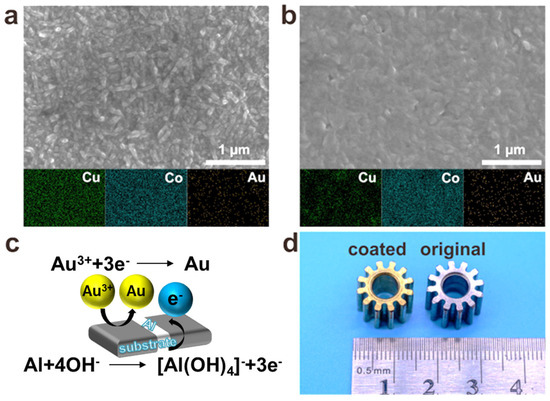
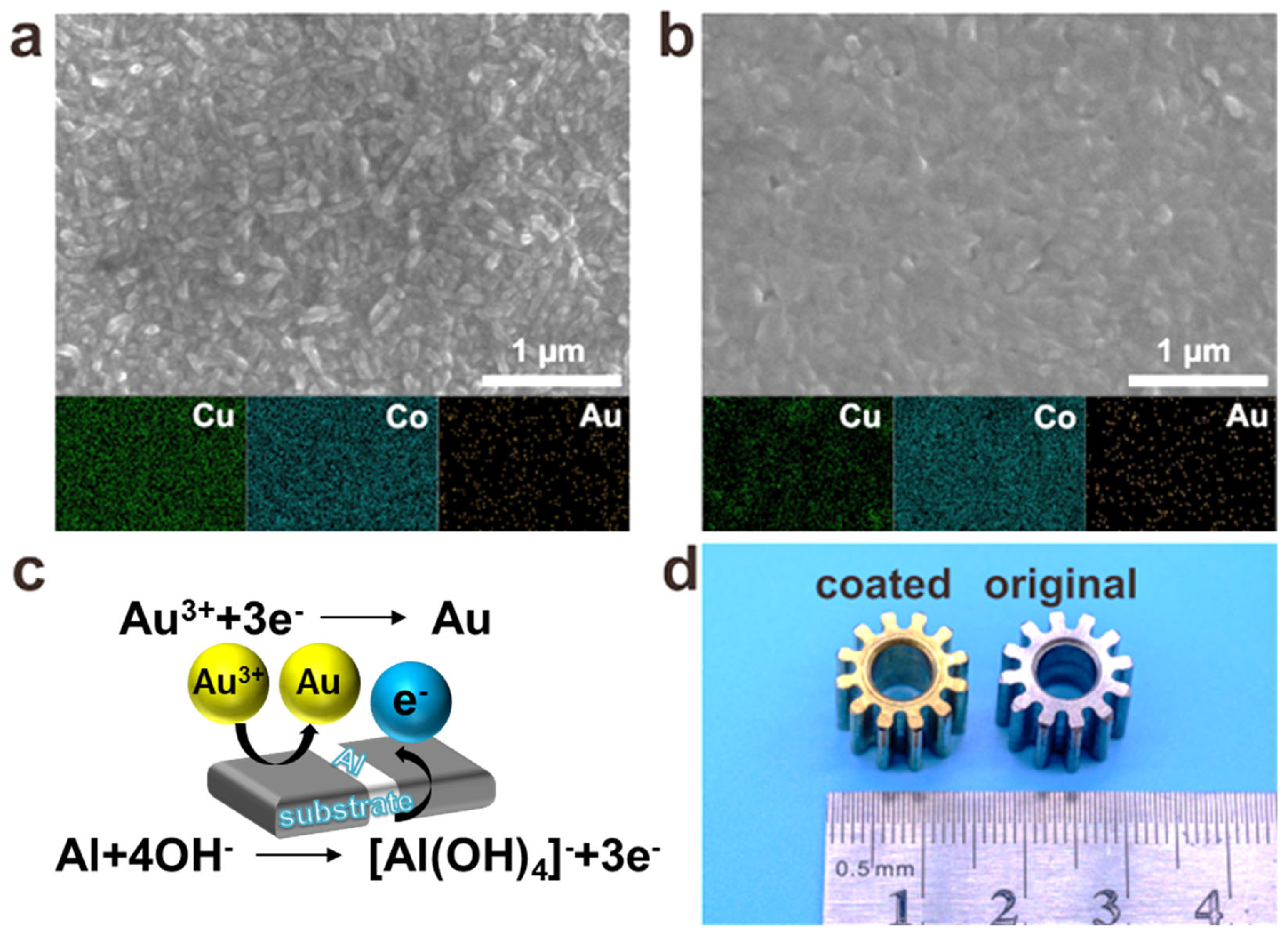
The Co-Au coatings were fabricated through a sequential chemical plating process, in which a cobalt coating was first deposited onto Ni-P coated copper substrates, followed by the deposition of a gold layer to obtain the Co-Au coating. After the deposition, the substrates were completely covered by uniform coatings exhibiting a characteristic gold-yellow appearance, indicating successful formation of the Co-Au coatings. Figure 1a presents the SEM images and corresponding EDS elemental mappings of the as-deposited Co-Au coating. A continuous and crack-free coating can be observed over the entire substrate surface. The coating is composed of densely packed granular features with irregular morphology, and the grain size ranges from approximately 100 to 200 nm. Although the grains are closely stacked to form a compact structure, distinct grain boundaries remain visible. The EDS analysis confirms that the coating mainly consists of cobalt and gold.
Figure 1.
(a,b) SEM and EDS elemental mappings of the Co-Au coatings and the annealed Co-Au coatings. (c) The principle of the chemical plating process for preparing Co and Au coatings. (d) The chemical plating method was employed to prepare Co-Au coatings on nuts.
The SEM images and EDS mappings of the annealed Co-Au coating are shown in Figure 1b. Compared with the as-deposited state, the annealed Co-Au coating exhibits partial grain coalescence and slight sintering, leading to a more compact and denser microstructure. The grain boundaries become less pronounced, indicating enhanced atomic diffusion during heat treatment. Elemental distribution maps reveal a homogeneous distribution of Co and Au throughout the coating at the microscale, without obvious elemental segregation. This suggests that annealing promotes interdiffusion between cobalt and gold, contributing to improved coating densification and structural stability.
The principle of the chemical plating process used to prepare the Co-Au coating is schematically illustrated in Figure 1c. Both cobalt and gold coatings were deposited using an aluminum-induced chemical solution deposition method. In this process, the aluminum wire attached to the substrate reacts with the alkaline plating solution to generate Al(OH)4− species while releasing electrons. Due to the galvanic coupling between aluminum and the substrate, these electrons are transferred to the substrate surface, where they reduce cobalt or gold ions in the solution, resulting in the deposition of metallic cobalt or gold coatings. This aluminum-induced approach effectively suppresses the direct displacement reaction between gold ions and the underlying cobalt layer, enabling the formation of a relatively dense gold coating without damaging the cobalt coating. An additional advantage of this chemical plating method is its excellent adaptability to complex-shaped substrates. As demonstrated in Figure 1d, a uniform annealed Co-Au coating was successfully prepared on a nut, verifying the capability of this method to achieve conformal coatings on intricate geometries. In actual service, these complex-shaped components are frequently subjected to sliding friction and contact wear at their mating interfaces, and the successful preparation of Co-Au coatings on nuts ensures that the tribological performance advantages confirmed by the laboratory friction tests can be effectively translated to practical engineering parts, rather than being limited to ideal flat substrates. This feature highlights the potential of the aluminum-induced chemical plating strategy for the fabrication of Co-Au coatings on practical components such as screws, nuts, and other mechanically complex parts.
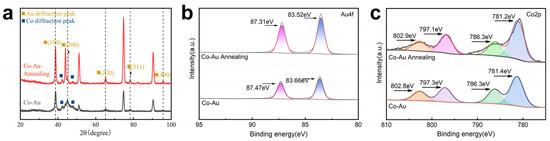
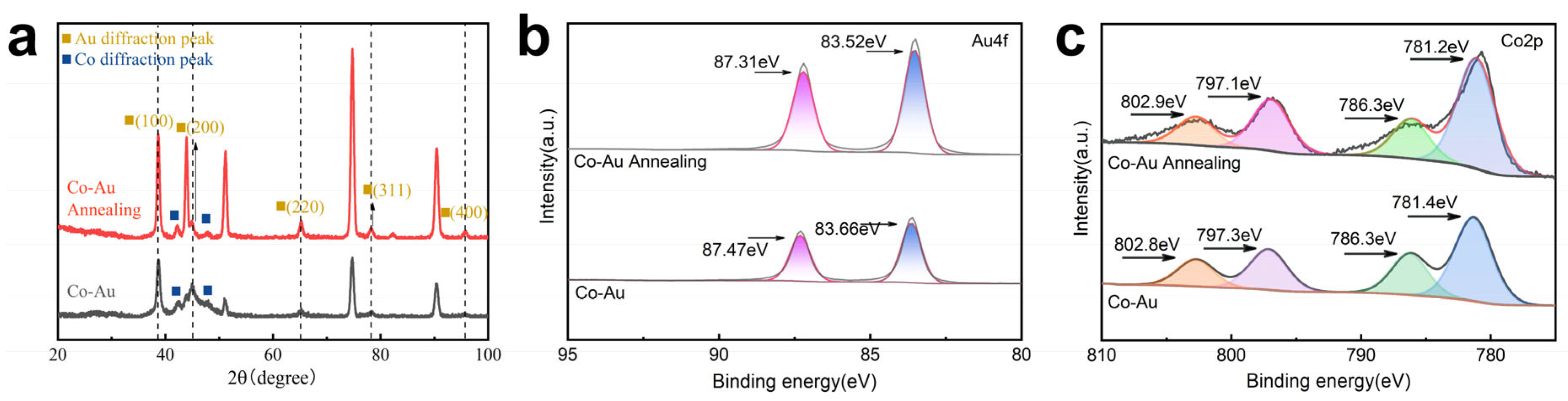
The phase structures of the Co-Au and annealed Co-Au coatings were characterized by XRD, as shown in Figure 2a. Distinct diffraction peaks corresponding to metallic Au and Co can be clearly identified in both coatings, confirming the successful co-deposition of cobalt and gold. Compared with the as-deposited Co-Au coating, the annealed Co-Au coating exhibits enhanced diffraction peak intensity and improved peak sharpness, particularly for the Au-related reflections. This behavior suggests an increase in crystallinity and grain growth induced by thermal treatment. Meanwhile, the cobalt diffraction peaks remain relatively weak and broadened, implying that cobalt exists in a nanocrystalline state or is partially incorporated into the gold lattice, forming a Co-Au solid-solution structure after annealing.
Figure 2.
(a) XRD patterns of the Co-Au and annealed Co-Au coatings; XPS fine spectrum of (b) gold and (c) cobalt element in the Co-Au and annealed Co-Au coatings.
To further elucidate the chemical states and electronic environments of Au and Co, high-resolution XPS analyses were conducted, as presented in Figure 2b,c. The Au 4f spectra of the Co-Au coating display two characteristic peaks located at approximately 83.66 eV (Au4f7⁄2) and 87.47 eV (Au4f5⁄2), corresponding to metallic gold. After annealing, these peaks shift slightly toward lower binding energies (~83.52 eV and 87.31 eV), indicating an increase in electron density around Au atoms. This negative binding energy shift can be attributed to interdiffusion and electronic interaction between Co and Au during annealing, which modifies the local electronic structure of Au and supports the formation of a Co-Au solid solution rather than a simple bilayer structure. The Co 2p spectra shown in Figure 2c further confirms this interaction. For the as-deposited Co-Au coating, the Co 2p3/2 peak is located at approximately 781.4 eV, accompanied by satellite features associated with Co2+ species. After annealing, the main Co 2p3/2 peak shifts slightly to lower binding energy (~781.2 eV), while the relative intensity of satellite peaks decreases. This evolution suggests partial reduction of cobalt species and enhanced metallic bonding character, which can be attributed to atomic rearrangement and solid-solution formation during heat treatment.
The mechanical properties of Co, Au, Co-Au, and annealed Co-Au coatings were systematically evaluated by nanoindentation, and the corresponding hardness, elastic modulus, and H/E ratio are summarized in Figure 3a. As shown in Figure 3a, the annealed Co-Au coating achieves the highest hardness value and an increased H/E ratio, while maintaining a nearly constant elastic modulus. This combination of high hardness and elevated H/E ratio reflects an optimized balance between strength and toughness, which is particularly advantageous for wear-resistant applications. Representative load–displacement curves are presented in Figure 3b. At the same indentation depth of 100 nm, the annealed Co-Au coating requires a significantly higher applied load compared with the other coatings, demonstrating superior resistance to deformation. The enhanced mechanical performance of the annealed Co-Au coating can be attributed to multiple synergistic mechanisms. First, annealing promotes atomic diffusion and microstructural homogenization, reducing lattice defects introduced during chemical plating [30,31,32]. Second, the formation of a Co-Au solid solution contributes to solid-solution strengthening. Third, controlled grain growth and densification during annealing improve load-bearing capability while preserving sufficient plastic deformation capacity [33,34,35].
Figure 3.
(a) Comparison of microhardness, elastic modulus, and H/E of Co, Au, Co-Au, and annealed Co-Au coatings. (b) Loading–unloading curves of Co, Au, Co-Au, and annealed Co-Au coatings. (hmax is the maximum indentation depth).
3.2. Wear Performance of Co-Au Coatings
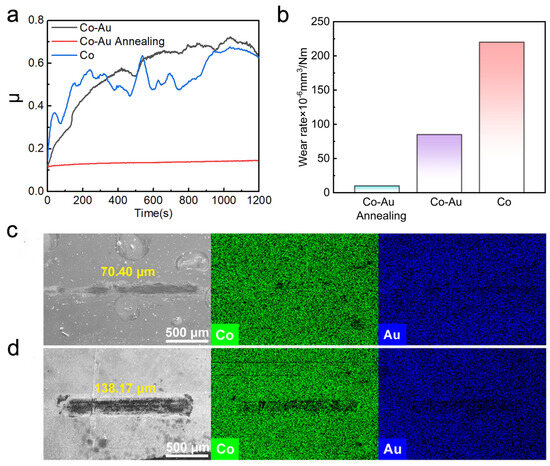
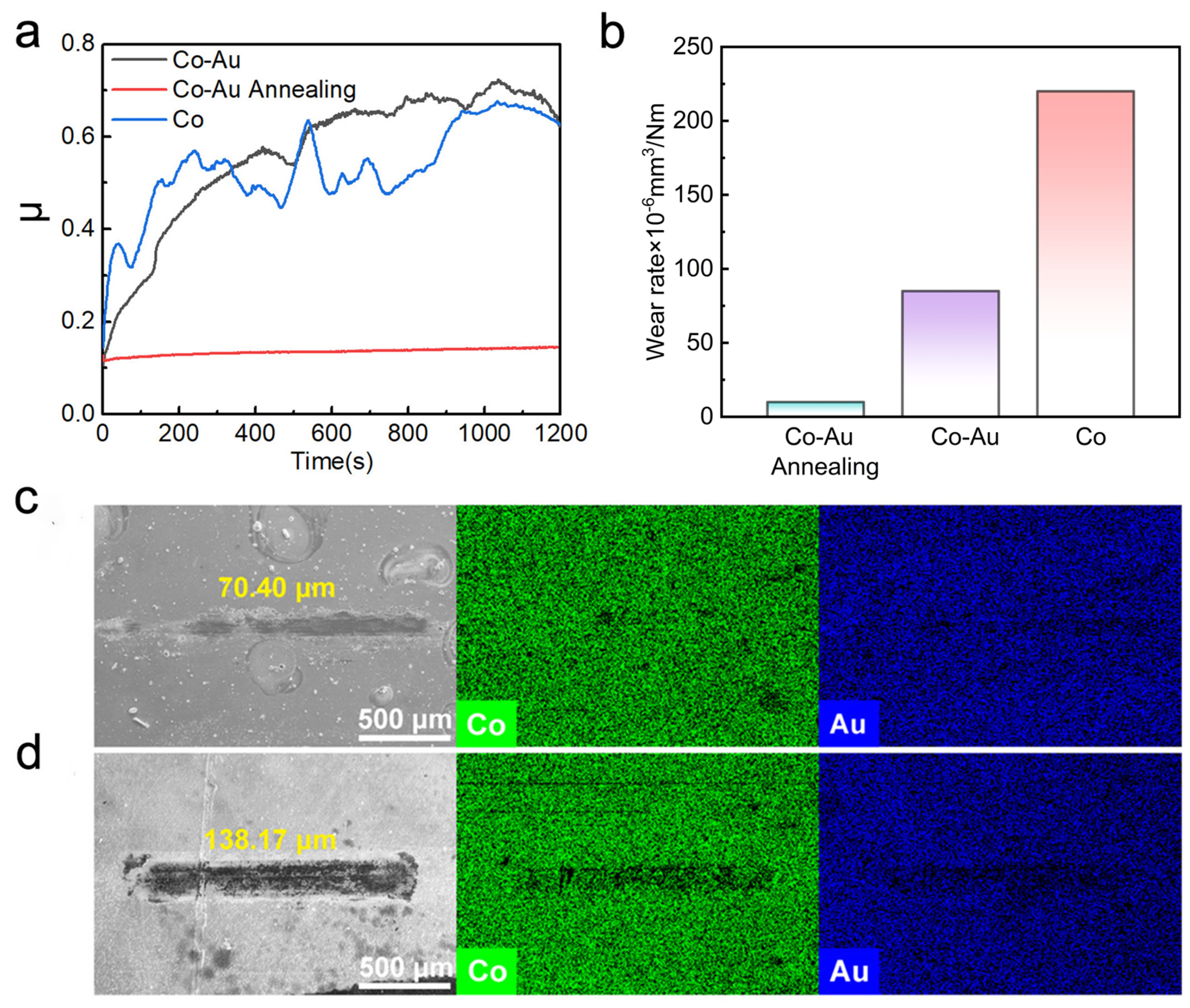
The tribological behaviors of Co, Co-Au, and annealed Co-Au coatings were evaluated, and the real-time coefficient of friction (COF) curves are presented in Figure 4a. For both the Co and Co-Au coatings, the friction process starts with a relatively low COF of approximately 0.2; however, this low-friction state is short-lived. With continued sliding, the COF rapidly increases and exhibits large-amplitude fluctuations before eventually stabilizing at around 0.60. Such unstable friction behavior indicates insufficient interfacial adaptability and limited load-bearing capacity of the coatings under repeated sliding contact. The pronounced oscillations suggest frequent disruption and reformation of the contact interface, likely caused by severe adhesive and abrasive wear processes. In sharp contrast, the annealed Co-Au coatings exhibit significantly improved and stable friction behavior. After a brief running-in stage, the COF rapidly stabilizes at approximately 0.14 and remains nearly constant throughout the entire test duration. Moreover, the friction curve of the annealed Co-Au coatings is smooth and free of pronounced fluctuations, reflecting a stable sliding interface and effective load accommodation. As shown in Figure 4b, the calculated wear rates clearly demonstrate that the annealed Co-Au coating exhibits the lowest specific wear rate, which is significantly lower than those of the as-deposited Co-Au and pure Co coatings. This quantitative analysis is fully consistent with the observed narrower wear tracks and smoother wear morphologies, and it further confirms the superior wear resistance of the annealed Co-Au coating.
Figure 4.
(a) Real-time friction coefficient curves of the coatings, (b) wear rates of the coatings, (c) SEM and EDS mapping images of wear track on the annealed Co-Au coating. (d) SEM and EDS mapping of the wear track on the as-deposited Co-Au coating.
The wear morphology of the annealed and the as-deposited Co-Au coatings after friction tests was further examined by SEM and EDS, as shown in Figure 4c,d. The annealed Co-Au coating displays a narrow and uniform wear track with an average width of approximately 70 μm. The wear surface is characterized by mild and shallow abrasive grooves, with wear debris evenly distributed along the edges of the sliding track. Importantly, the coating remains continuous and intact, and no penetrating cracks or coating delamination are observed, indicating a mild wear mechanism dominated by micro-abrasion. In comparison, the Co-Au coating exhibits a significantly wider wear scar of approximately 138 μm, nearly twice that of the annealed Co-Au coating. The wear track is dominated by deep, particle-like parallel grooves, accompanied by debris accumulation near the entrance and exit regions of the sliding path. These observations further confirm that annealing markedly enhances the wear resistance and structural integrity of the Co-Au coating.
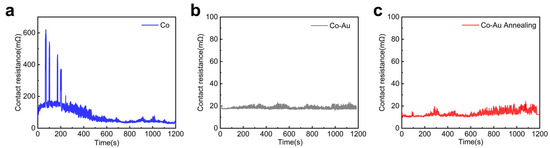
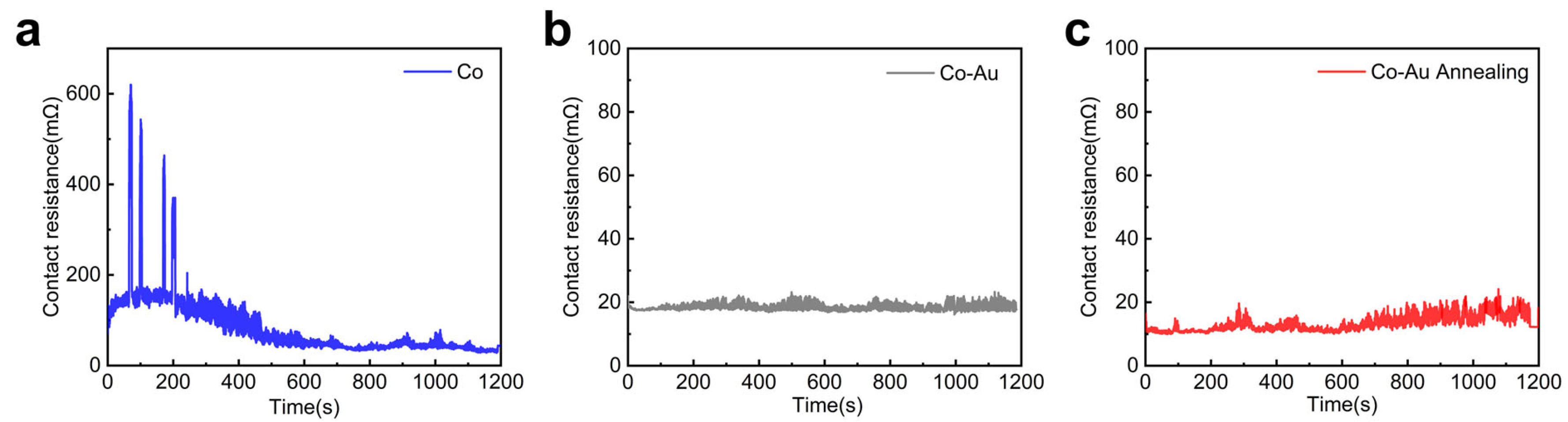
To simulate the electrical contact behavior of the coatings under mechanical sliding, the contact resistance was monitored in situ during the friction process, and the results are shown in Figure 5. As depicted in Figure 5a, the Co coating exhibits a pronounced resistance jump at the initial stage of sliding, followed by continuous fluctuations in the range of 50–60 mΩ. These abrupt variations indicate unstable electrical contact caused by rapid surface damage and debris generation during wear. Figure 5b,c present the resistance evolution of the Co-Au and annealed Co-Au coatings, respectively. Both coatings maintain relatively low contact resistance at the initial stage of friction, and the resistance remains stable within a narrow range throughout the sliding process. Notably, the annealed Co-Au coating exhibits the most outstanding performance, with the contact resistance consistently maintained below 20 mΩ and minimal fluctuation. This behavior indicates the formation of a stable and conductive contact interface during sliding. The combined friction and contact-resistance results demonstrate that the introduction of a gold layer onto the cobalt coating, together with subsequent annealing treatment, effectively enhances both wear resistance and electrical conductivity.
Figure 5.
The contact resistance of (a) Co coating, (b) Co-Au coating, and (c) annealed Co-Au coating during the friction process.
3.3. Corrosion Resistance of the Annealed Co-Au Coating
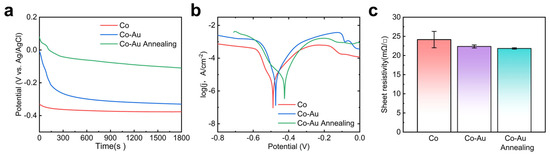
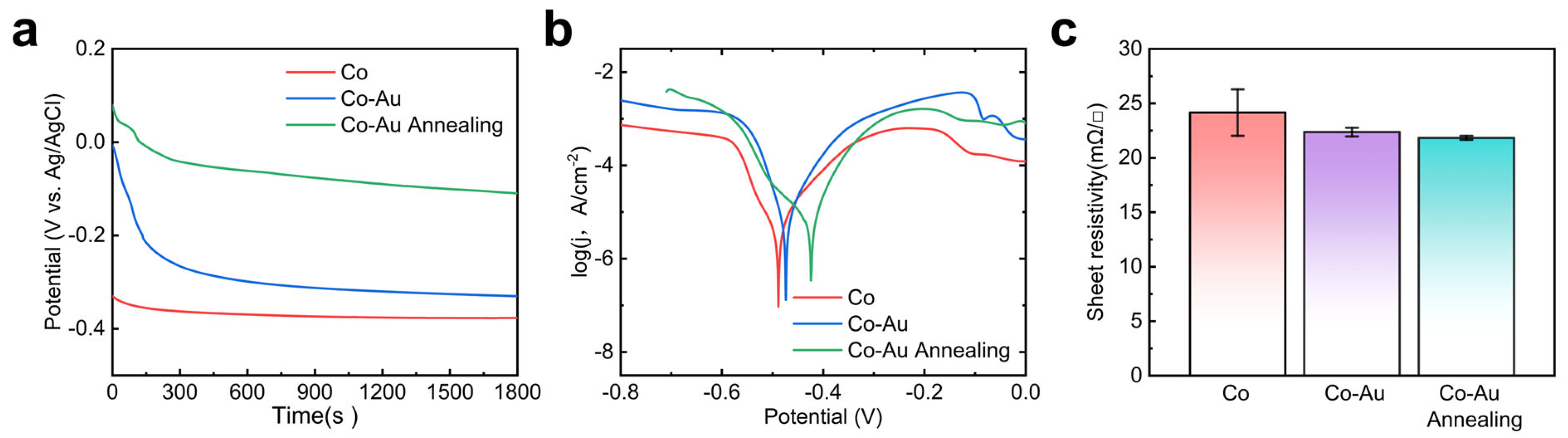
The corrosion resistance of the Co, Co-Au, and annealed Co-Au coatings was compared. The corrosion potential Ecorr and corrosion current density icorr of each coating were obtained by calculation based on the Tafel curve extrapolation method (Figure 6a). Among them, the corrosion current density of the annealed Co-Au coating was the lowest, only 95.54 μA/cm2. In contrast, the corrosion current density of the Co coating was the highest, reaching 279.47 μA/cm2, while the corrosion current density of the Co-Au coating ranks second, only after the Co coating at 146.96 μA/cm2. The corrosion current is lower for the annealed Co-Au coating as it has a completely crack-free surface before corrosion tests. In addition, at the microscopic level, the annealed alloy coating is denser than the unannealed one, with lower current corrosion density and corrosion potential. The surface of the annealed coating is denser, and there is a certain degree of fusion at the interface between the gold layer and the cobalt layer, which enhances the adhesion between the coatings and thus improves the corrosion resistance.
Figure 6.
(a) Potentiodynamic polarization curve, (b) OCP, and (c) sheet resistance of the Co, Co-Au, and annealed Co-Au coatings.
Figure 6b displays that the annealed Co-Au coating has the most positive open circuit potential, further indicating that this coating has good conductivity and improved corrosion resistance. In order to further determine the conductivity of the coating, the four-probe method is used to measure the square resistance of the coating surface (Figure 6c). The square resistance of the cobalt coating is the highest, which is 24.16 mΩ/□. The square resistance of the Co-Au coating and annealed Co-Au coating are close, which are 22.36 mΩ/□ and 21.84 mΩ/□, respectively. This shows that the addition of gold helps to improve the conductivity of the coating.
3.4. Microscopic Cross-Sectional Morphology of the Coating
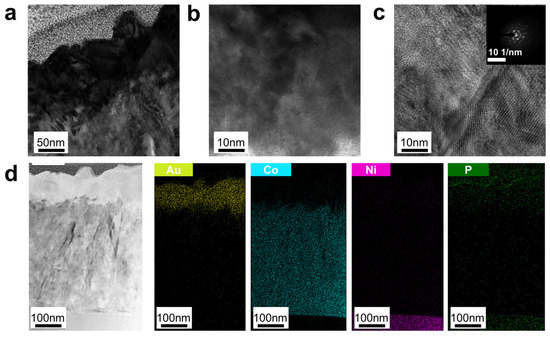
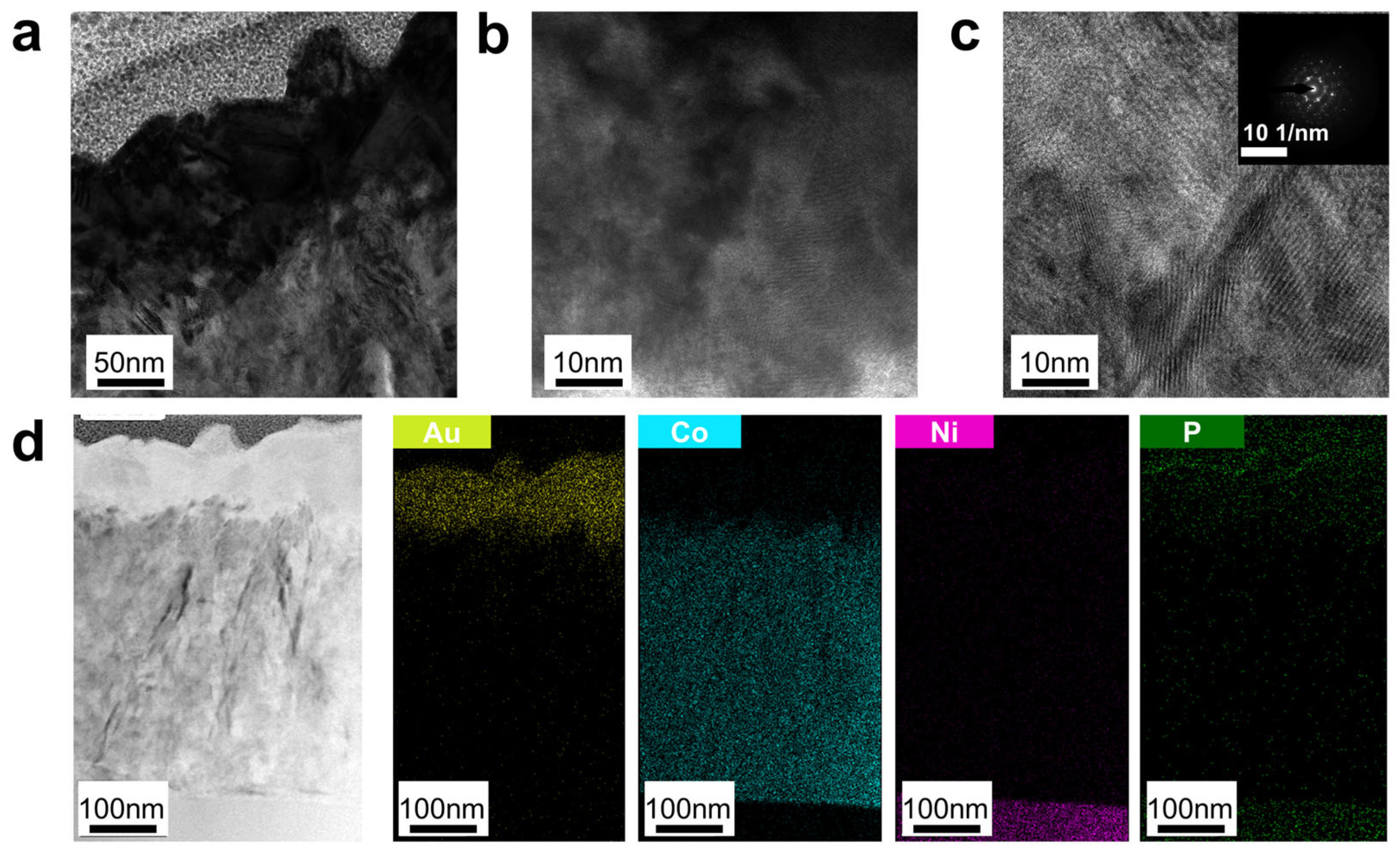
Figure 7 presents the high-resolution TEM characterization of the as-deposited Co-Au coatings. The cross-sectional HAADF-STEM image shown in Figure 7a clearly reveals a layered architecture composed of an Au-rich top layer and an underlying Co layer. As shown in Figure 7b, the Au-rich layer exhibits noticeable contrast fluctuations at higher magnification, indicating local variations in thickness or density. This microstructural nonuniformity suggests that, in the as-deposited state, the chemically plated Au layer does not form a perfectly continuous dense coating but instead contains nanoscale heterogeneities. Such features are consistent with the granular surface morphology observed by SEM and reflect the kinetic nature of the chemical deposition process. The underlying Co layer displays a markedly different microstructural characteristic. The lattice-resolved TEM image in Figure 7c reveals the presence of short-range ordered lattice fringes with varying orientations, indicating the coexistence of multiple cobalt crystallographic domains at the nanoscale. The corresponding FFT pattern (inset of Figure 7c) shows diffuse and discontinuous diffraction rings rather than sharp spots, which is characteristic of a nanocrystalline or partially disordered structure. This structural disorder is commonly observed in chemically deposited Co coatings and is associated with a high density of lattice defects and grain boundaries.
Figure 7.
Cross-sectional TEM characterization of the Co-Au coatings. (a) HAADF-STEM cross-sectional image showing the overall interface between the Au layer and the underlying Co layer; (b) High-magnification TEM image of the Au-rich region; (c) Lattice-resolved TEM micrograph of the Co layer, with the inset presenting the corresponding FFT pattern; (d) EDS elemental mapping images of Au, Co, Ni, and P elements across the coating cross-section.
The elemental distribution across the coating thickness is further confirmed by EDS mapping, as shown in Figure 7d. Au is predominantly concentrated in the top region of the coating, while Co is uniformly distributed throughout the bulk layer beneath. Signals from Ni and P, originating from the Ni-P interlayer, are confined to the bottom region and do not extend into the Co or Au layers. Importantly, the elemental maps indicate a sharp compositional boundary between Au and Co in the as-deposited coating, with no obvious interdiffusion detected at the interface, confirming the preservation of a bilayer structure prior to thermal treatment. Based on multiple cross-sectional measurements, the average thickness of the Au layer is estimated to be approximately 120 nm, whereas the Co layer reaches a thickness of about 400 nm. Upon annealing, atomic diffusion across the Au/Co interface is expected to be activated, leading to partial downward diffusion of Au into the Co matrix and a concomitant modification of the interfacial region.
Thermal annealing induces pronounced microstructural reconstruction within the Co-Au multilayer system, as revealed by the cross-sectional TEM analyses in Figure 8. In the HAADF image shown in Figure 8a, the originally sharp and well-defined Au/Co interface observed in the as-deposited coating becomes significantly blurred after annealing. This gradual contrast transition indicates substantial atomic interdiffusion across the interface, reflecting enhanced atomic mobility during thermal treatment. High-resolution TEM observations (Figure 8b) further reveal intermixed contrast features extending from the Au-rich region into the upper portion of the Co layer. These nanoscale features are characteristic of solid-state diffusion and partial alloying, suggesting that Au atoms diffuse downward into the Co matrix and locally participate in the formation of a Co-Au mixed phase. This interfacial reconstruction marks a transition from a discrete bilayer structure to a more integrated and chemically bonded architecture.
Figure 8.
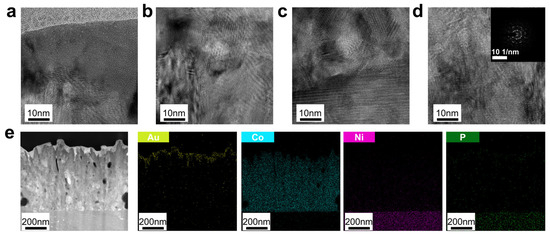
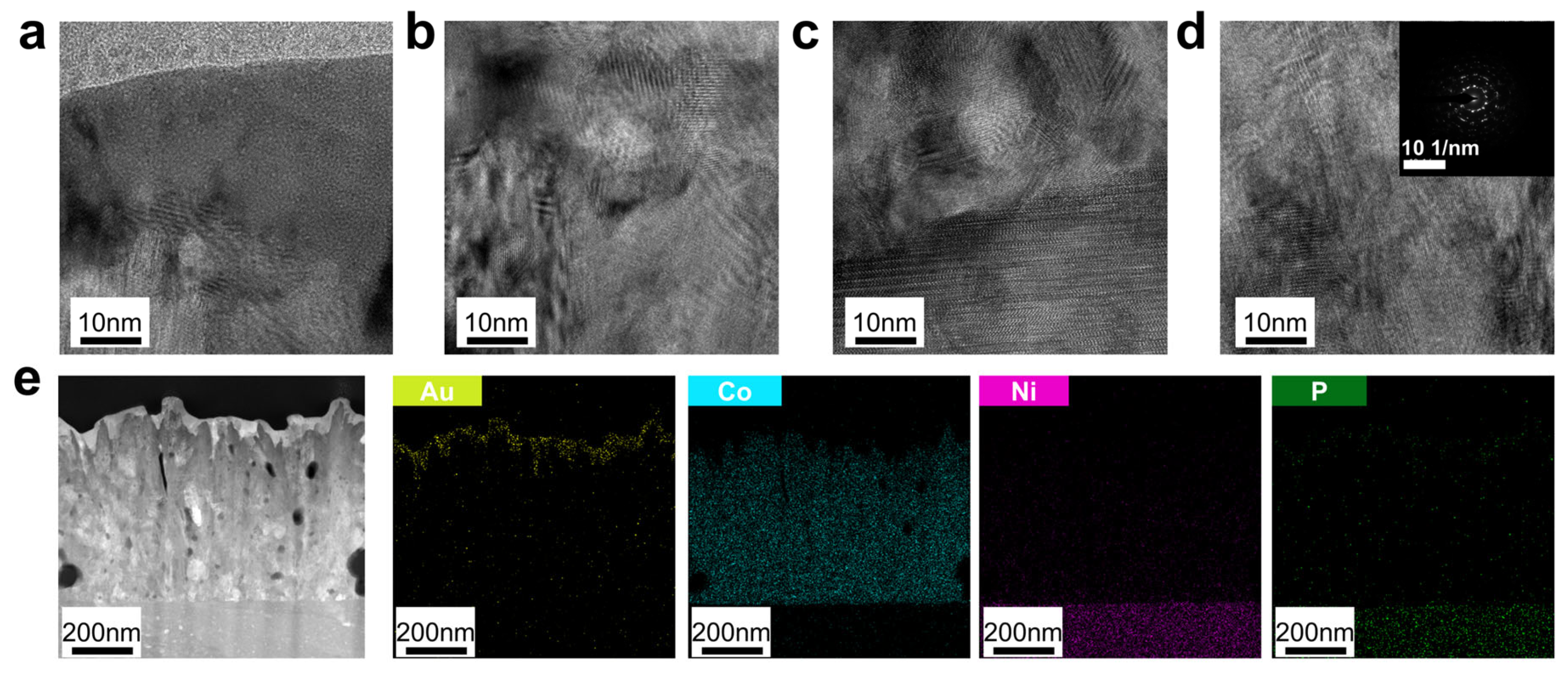
Cross-sectional TEM characterization of the annealed Co-Au coatings. (a) HAADF-STEM cross-sectional image showing the overall interface between the Au layer and the underlying Co layer; (b) High-magnification TEM image of the Au-rich region; (c) High-magnification TEM image of the Co and Ni-P region; (d) Lattice-resolved TEM micrograph of the Co layer, with the inset presenting the corresponding FFT pattern; (e) EDS elemental mapping images of Au, Co, Ni, and P elements across the coating cross-section.
In contrast, the interface between the Co layer and the underlying amorphous Ni-P interlayer remains abrupt and well preserved after annealing, as shown in Figure 8c. This observation demonstrates that the annealing process selectively activates interdiffusion between Au and Co, while the deeper Ni-P interface remains structurally stable and chemically isolated. Such selective diffusion behavior ensures that the integrity of the adhesion-promoting Ni-P layer is maintained. The lattice-resolved TEM image of the Co-dominant region (Figure 8d) shows well-developed lattice fringes with improved continuity compared with the as-deposited state. The corresponding FFT pattern exhibits clearer diffraction rings, indicative of enhanced crystallinity. These features suggest the formation of a Co-Au solid-solution dominated mixed crystalline phase rather than a simple phase-separated structure.
The elemental mapping across the annealed multilayer stack (Figure 8e) provides direct chemical evidence of this diffusion-driven mixing. Au exhibits a clear concentration gradient extending into the Co layer, while Co simultaneously diffuses upward into the Au-rich region. The mutual interpenetration of Au and Co confirms the formation of a compositionally graded Co-Au mixed phase rather than a sharp bilayer interface. The Au layer thickness decreases from approximately 120 nm in the as-deposited coating to about 60 nm, while the effective thickness of the Co-rich region increases to roughly 500 nm. This change directly reflects the downward diffusion of Au and its incorporation into the Co matrix, rather than simple layer thinning due to material loss.
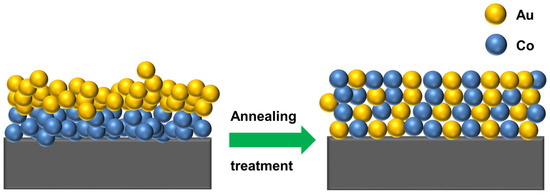
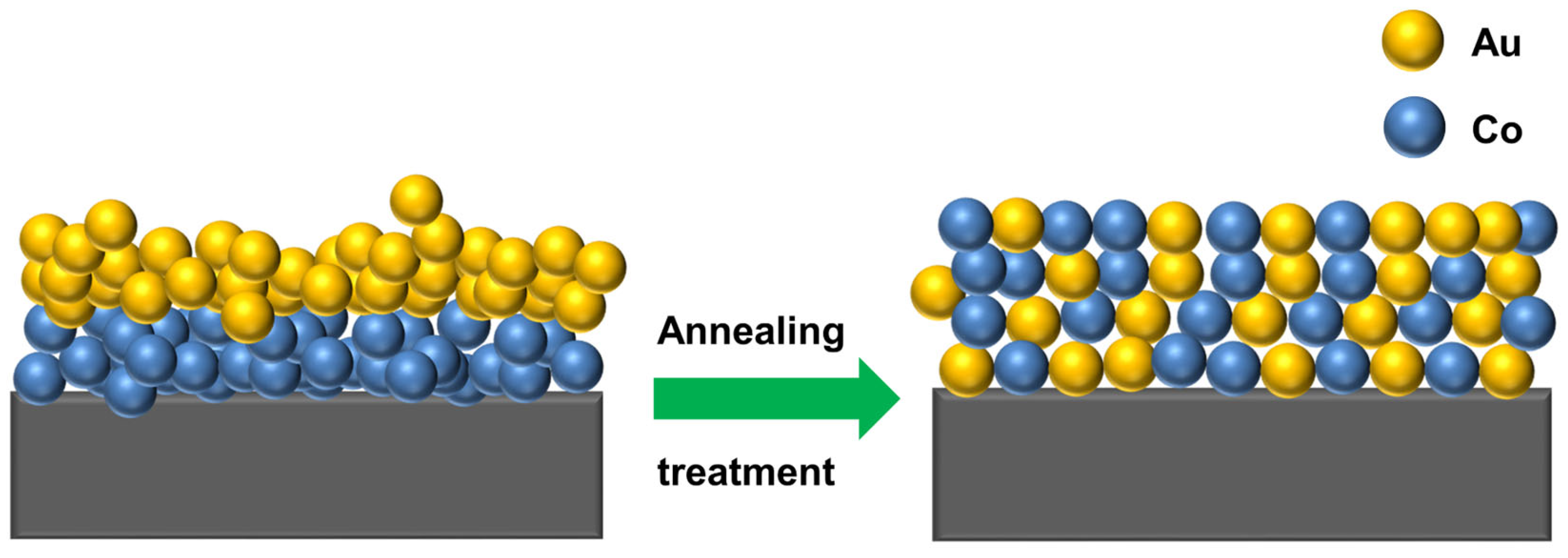
Collectively, these microstructural features demonstrate that annealing transforms the initially discrete Au/Co bilayer into a partially alloyed Co-Au mixed structure, as illustrated in Figure 9. This structural evolution provides a direct mechanistic explanation for the enhanced mechanical and tribological performance observed in the annealed films. The incorporation of Au, an intrinsically ductile and low-shear metal, into the Co matrix reduces interfacial shear resistance during sliding, while the formation of a mixed crystalline solid solution improves hardness, load-bearing capacity, and structural integrity.
Figure 9.
Schematic diagram illustrating the Co-Au coating after thermal diffusion treatment.
4. Discussion
The Co-Au coatings subjected to thermal diffusion treatment exhibit markedly reduced friction coefficients and enhanced wear resistance, which can be attributed to the synergistic effects of microstructural densification and diffusion-induced alloying. For the as-deposited electroless Co-Au coatings, the chemical plating process typically produces a granular and relatively loose microstructure containing a high density of surface asperities, grain boundaries, and interfacial defects. Similar microstructural characteristics have been reported for electroless or electroplated noble-metal coatings and are known to limit load-bearing capacity and wear resistance under sliding conditions [36]. During friction, these weakly bonded features are prone to fragmentation and pull-out, leading to debris generation, unstable third-body abrasion, and pronounced fluctuations in the friction coefficient.
Thermal diffusion treatment effectively mitigates these deficiencies by eliminating intrinsic defects and micropores and promoting atomic rearrangement and grain boundary relaxation. As reported in previous studies on thermally treated metallic and alloy coatings, such densification and defect annihilation can significantly enhance hardness and H/E ratio, thereby improving resistance to plastic deformation and subsurface damage during sliding [37]. In the present study, the increased hardness and optimized H/E ratio of the annealed Co-Au coating directly contribute to its improved load-bearing capacity and reduced wear width.
In addition to microstructural densification, diffusion-induced Co-Au alloying plays a critical role in friction reduction. Au, as a typical soft and ductile noble metal, possesses intrinsically low shear strength and favorable solid-lubrication characteristics, while Co provides high hardness and mechanical support. Previous investigations on Au-based alloy coatings have demonstrated that incorporating a harder alloying element can effectively suppress severe adhesive wear while maintaining low friction when a suitable solid-solution or gradient structure is formed [38]. In the present system, thermal diffusion enables interpenetration of Co and Au atoms at the atomic scale, transforming the initial bilayer architecture into a partially alloyed Co-Au solid-solution with a compositionally graded interface.
The incorporation of Au into the Co-rich matrix lowers interfacial shear strength during sliding due to the ductility and low shear resistance of Au, thereby reducing friction. At the same time, the Co-dominant framework preserves sufficient hardness to resist plastic deformation and material removal. This balanced combination of soft lubricating phases and hard load-bearing phases is widely recognized as an effective strategy for achieving low friction and high wear resistance in metallic tribological coatings [39].
As a result of these combined effects, the dominant wear mechanism of the Co-Au coating after thermal diffusion treatment shifts from severe adhesive-abrasive mixed wear to mild micro-abrasive wear. This transition is evidenced by the narrow and smooth wear tracks, shallow grooves, and minimal debris accumulation observed by SEM. The stable friction coefficient and significantly reduced wear rate are therefore a direct consequence of enhanced structural integrity, reduced interfacial shear resistance, and improved load-bearing capacity induced by diffusion-controlled Co-Au alloying.
5. Conclusions
Co-Au coatings were successfully prepared on Ni-P-coated copper substrates via sequential chemical plating and thermal diffusion, forming an Au-rich top layer and a Co-rich underlying layer. Thermal annealing induces significant atomic interdiffusion, resulting in a compositionally graded Co-Au solid solution with improved structural stability. Annealed Co-Au coatings exhibit enhanced mechanical performance, including increased hardness and H/E ratio, while maintaining elastic properties comparable to pure Au coatings. This synergistic balance of hardness and toughness contributes to improved wear resistance. Tribological testing shows that annealed Co-Au coatings achieve a reduced coefficient of friction relative to the as-deposited coatings, narrow and uniform wear tracks, and maintain low contact resistance, indicating the formation of a stable and conductive sliding interface. The introduction of cobalt and thermal diffusion treatment enhances the corrosion resistance of the coatings without significantly compromising electrical conductivity, making them suitable for electrically and mechanically demanding applications. The combination of chemical plating and thermal diffusion offers a scalable and industrially compatible approach to fabricating Co-Au coatings with superior mechanical, tribological, and corrosion-resistant properties, particularly for complex-shaped conductive components.
Author Contributions
Conceptualization, X.Z.; investigation, H.Y., R.L., G.X. and D.Z.; writing—original draft preparation, H.Y. and D.Z.; writing—review and editing, X.Z.; supervision, X.Z.; funding acquisition, X.Z. All authors have read and agreed to the published version of the manuscript.
Funding
This research was funded by the Key Research and Development Program of Gansu Province, grant number 25YFGA011.
Institutional Review Board Statement
Not applicable.
Informed Consent Statement
Not applicable.
Data Availability Statement
The data presented in this study are available on request from the corresponding author.
Conflicts of Interest
The authors declare no conflict of interest.
References
- Sawyer, W.G.; Argibay, N.; Burris, D.L.; Krick, B.A. Mechanistic studies in friction and wear of bulk materials. Annu. Rev. Mater. Res. 2014, 44, 395–427. [Google Scholar] [CrossRef] [Scilit]
- Kalita, P.; Malshe, A.P.; Kumar, S.A.; Yoganath, V.G.; Gurumurthy, T. Study of specific energy and friction coefficient in minimum quantity lubrication grinding using oil-based nanolubricants. J. Manuf. Process. 2012, 14, 160–166. [Google Scholar] [CrossRef] [Scilit]
- Yang, Y.; Fan, X.; Yue, Z.; Zhu, M. Mechanism on heterogeneous transfer film formed by diamond-like carbon film under molybdenum disulfide hybrid polyethylene glycol lubrication. Carbon 2023, 210, 118030. [Google Scholar] [CrossRef] [Scilit]
- Feng, S.; Lu, W.; Guo, F.; Wang, C.; Zou, L. Effects of Pulse Ion Source Arc Voltage on the Structure and Friction Properties of Ta-C Thin Films on NBR Surface. Coatings 2025, 15, 809. [Google Scholar] [CrossRef] [Scilit]
- Zhai, W.; Bai, L.; Zhou, R.; Fan, X.; Kang, G.; Liu, Y.; Zhou, K. Recent progress on wear-resistant materials: Designs, properties, and applications. Adv. Sci. 2021, 8, 2003739. [Google Scholar] [CrossRef] [Scilit] [PubMed]
- Zhang, X.; Chen, Y.; Hu, J. Recent advances in the development of aerospace materials. Aerosp. Sci. 2018, 97, 22–34. [Google Scholar] [CrossRef] [Scilit]
- Okinaka, Y.; Hoshino, M. Some recent topics in gold plating for electronics applications. Gold Bull. 1998, 31, 3–13. [Google Scholar] [CrossRef] [Scilit]
- Mohamed, A.; Teresa, A.; Maria, S. Pulsed Current Electrodeposition of Gold–Copper Alloys Using a Low-Cyanide Electrolyte. Coatings 2025, 15, 778. [Google Scholar]
- Kato, M.; Okinaka, Y. Some recent developments in noncyanide gold plating for electronics applications. Gold Bull. 2004, 37, 37–44. [Google Scholar] [CrossRef] [Scilit]
- Chen, X.; Han, Z.; Li, X.; Lu, K. Lowering coefficient of friction in Cu alloys with stable gradient nanostructures. Sci. Adv. 2016, 2, e1601942. [Google Scholar] [CrossRef] [Scilit]
- Tian, H.; Saka, N.; Rabinowicz, E. Fretting failure of electroplated gold contacts. Wear 1991, 142, 265–289. [Google Scholar] [CrossRef] [Scilit]
- Bayer, R.G.; Hsue, E.; Turner, J. A motion-induced sub-surface deformation wear mechanism. Wear 1992, 154, 193–204. [Google Scholar] [CrossRef] [Scilit]
- Heymans, G.; Muñoz, A.I.; Mischler, S. Tribological behaviour of galvanic gold coatings reinforced with silica nanoparticles. Wear 2020, 462, 203512. [Google Scholar] [CrossRef] [Scilit]
- Antler, M. Electrical effects of fretting connector contact materials: A review. Wear 1985, 106, 5–33. [Google Scholar] [CrossRef] [Scilit]
- Antler, M. Survey of contact fretting in electrical connectors: A review. Wear 2003, 8, 87–104. [Google Scholar] [CrossRef] [Scilit]
- Zhang, H.; Wu, X.; Wang, W. Modeling contact of Au-coated sphere with rigid flat: Electrical contact resistance, adhesive wear and friction. Int. J. Mech. Sci. 2023, 246, 108152. [Google Scholar] [CrossRef] [Scilit]
- Farhat, Z.N.; Ding, Y.; Northwood, D.O.; Alpas, A.T. Effect of grain size on friction and wear of nanocrystalline aluminum. Mater. Sci. Eng. A 1996, 206, 302–313. [Google Scholar] [CrossRef] [Scilit]
- Jeong, D.H.; Gonzalez, F.; Palumbo, G.; Aust, K.T.; Erb, U. The effect of grain size on the wear properties of electrodeposited nanocrystalline nickel coatings. Scr. Mater. 2001, 44, 493–499. [Google Scholar] [CrossRef] [Scilit]
- Rupert, T.J.; Schuh, C.A. Sliding wear of nanocrystalline Ni-W: Structural evolution and the apparent breakdown of Archard scaling. Acta Mater. 2010, 58, 4137–4148. [Google Scholar] [CrossRef] [Scilit]
- Li, J.X.; Jin, Z.H.; Li, X.Y.; Lu, K. Strengthening Ni alloys with nanoscale interfaces of negative excess energy. Science 2025, 390, 617–621. [Google Scholar] [CrossRef] [Scilit]
- Li, D.; Li, C.; Feng, T.; Zhang, Y.; Sha, G.; Lewandowski, J.J.; Zhang, Y. High-entropy Al0.3CoCrFeNi alloy fibers with high tensile strength and ductility at ambient and cryogenic temperatures. Acta Mater. 2017, 123, 285–294. [Google Scholar] [CrossRef] [Scilit]
- Pradhan, J.; Sankarakumar, A.; Srivastava, S.K.; Balakrishnan, S. Study of inter-diffusion of gold in copper in the presence of single layer graphene. Surf. Interfaces 2022, 30, 101923. [Google Scholar] [CrossRef] [Scilit]
- Tu, K.N.; Berry, B.S. X-ray study of interdiffusion in bimetallic Cu-Au films. Appl. Phys. 1972, 43, 3283–3290. [Google Scholar] [CrossRef] [Scilit]
- Fedorov, P.P.; Volkov, S.N. Au-Cu phase diagram. Russ. J. Inorg. Chem. 2016, 61, 772–775. [Google Scholar] [CrossRef] [Scilit]
- Ma, L.; Eom, K.; Geringer, J.; Jun, T.S.; Kim, K. Literature review on fretting wear and contact mechanics of tribological coatings. Coatings 2019, 9, 501. [Google Scholar] [CrossRef] [Scilit]
- Hu, J.; Zhang, Y.; Yang, G.; Gao, C.; Song, N.; Zhang, S.; Zhang, P. In-situ formed carbon based composite tribo-film with ultra-high load bearing capacity. Tribol. Int. 2020, 152, 106577. [Google Scholar] [CrossRef] [Scilit]
- Wang, D.; Hu, B. Study of the mechanism of magnetron sputtering of hybrid bonded diamond as carbon film coating for the surface of cavity structures. Bulg. Chem. Commun. 2017, 49, 29–32. [Google Scholar]
- Molaei, B.; Kolahdoozan, M. Investigation of Adhesion Force of Silver and Gold-Coated Surfaces with Different Thicknesses on Silicon Substrate. J. Mater. Eng. Perform. 2024, 33, 10003–10010. [Google Scholar] [CrossRef] [Scilit]
- Monev, M.; Bretzler, R.; Tatchev, D.; Zielonka, A. Nanosized structural features of electrodeposited Au–Co and Au–Ni alloy coatings. Trans. IMF 2017, 95, 255–260. [Google Scholar] [CrossRef] [Scilit]
- Lavakumar, B.; Prasad, M.; Phani, P.S.; Wasekar, N.P. Influence of compositional and microstructural gradient on the wear performance of nanocrystalline Ni–W coatings. Wear 2023, 530, 205039. [Google Scholar] [CrossRef] [Scilit]
- Kamikawa, N.; Huang, X.; Tsuji, N.; Hansen, N. Strengthening mechanisms in nanostructured high-purity aluminium deformed to high strain and annealed. Acta Mater. 2009, 57, 4198–4208. [Google Scholar] [CrossRef] [Scilit]
- Sathiyamoorthi, P.; Bae, J.W.; Asghari-Rad, P.; Park, J.M.; Kim, J.G.; Kim, H.S. Effect of annealing on microstructure and tensile behavior of CoCrNi medium entropy alloy processed by high-pressure torsion. Entropy 2018, 20, 849. [Google Scholar] [CrossRef] [Scilit] [PubMed]
- Salvadori, M.C.; Melo, L.L.; Vaz, A.R.; Wiederkehr, R.S.; Teixeira, F.S.; Cattani, M. Platinum and gold thin films deposited by filtered vacuum arc: Morphological and crystallographic grain sizes. Surf. Coat. Technol. 2006, 200, 2965–2969. [Google Scholar] [CrossRef] [Scilit]
- Fang, Z.Z.; Wang, H.; Kumar, V. Coarsening, densification, and grain growth during sintering of nano-sized powders—A perspective. Int. J. Refract. Met. Hard Mater. 2017, 62, 110–117. [Google Scholar] [CrossRef] [Scilit]
- Hansen, N. Hall-Petch relation and boundary strengthening. Scr. Mater. 2004, 51, 801–806. [Google Scholar] [CrossRef] [Scilit]
- Zhu, Z.; Ren, P.; Meng, H. Electrodeposition of nanocrystalline Au-Cu alloy coatings with high hardness and corrosion resistance for electronic contact application. Mater. Lett. 2023, 330, 133320. [Google Scholar] [CrossRef] [Scilit]
- Leyland, A.; Matthews, A. On the significance of the H/E ratio in wear control: A nanocomposite coating approach to optimised tribological behaviour. Wear 2000, 246, 1–11. [Google Scholar] [CrossRef] [Scilit]
- Wu, D.Y.; Zhou, X.; Li, L.P.; Zhai, G.F. Microstructure, mechanical properties and tribological behaviors of gold coating determined by surface quality. Surf. Coat. Technol. 2023, 462, 129463. [Google Scholar] [CrossRef] [Scilit]
- Chen, Z.; Wagner, J.; Turq, V.; Hillairet, J.; Taberna, P.L.; Laloo, R.; Duluard, S.; Bernard, J.M.; Song, Y.; Yang, Q.; et al. Surfactant-assisted electrodeposition of Au–Co/WS2 self-lubricating coating from WS2 suspended cyanide electrolyte. J. Alloys Compd. 2020, 829, 154585. [Google Scholar] [CrossRef] [Scilit]


Disclaimer/Publisher’s Note: The statements, opinions and data contained in all publications are solely those of the individual author(s) and contributor(s) and not of MDPI and/or the editor(s). MDPI and/or the editor(s) disclaim responsibility for any injury to people or property resulting from any ideas, methods, instructions or products referred to in the content. |
© 2026 by the authors. Licensee MDPI, Basel, Switzerland. This article is an open access article distributed under the terms and conditions of the Creative Commons Attribution (CC BY) license.