Beyond Content Delivery: A Systematic Review of Video-Based SRL Interventions and Gaps in Explicit Motivational and Resource-Management Instruction


Abstract
1. Introduction
2. Current Literature Reviews and Meta-Analyses of SRL Intervention Programs
The Role of Video in SRL Intervention Programs
3. The Study
- Q1
- Which SRL strategies do the interventions aim to promote?
- Q2
- Which instructional methods and learning tools do the interventions implement to promote SRL?
- Q3
- What are the roles of video within the SRL interventions?
- Q4
- What are the pedagogical settings that lead to a successful SRL intervention program?
4. Methodology
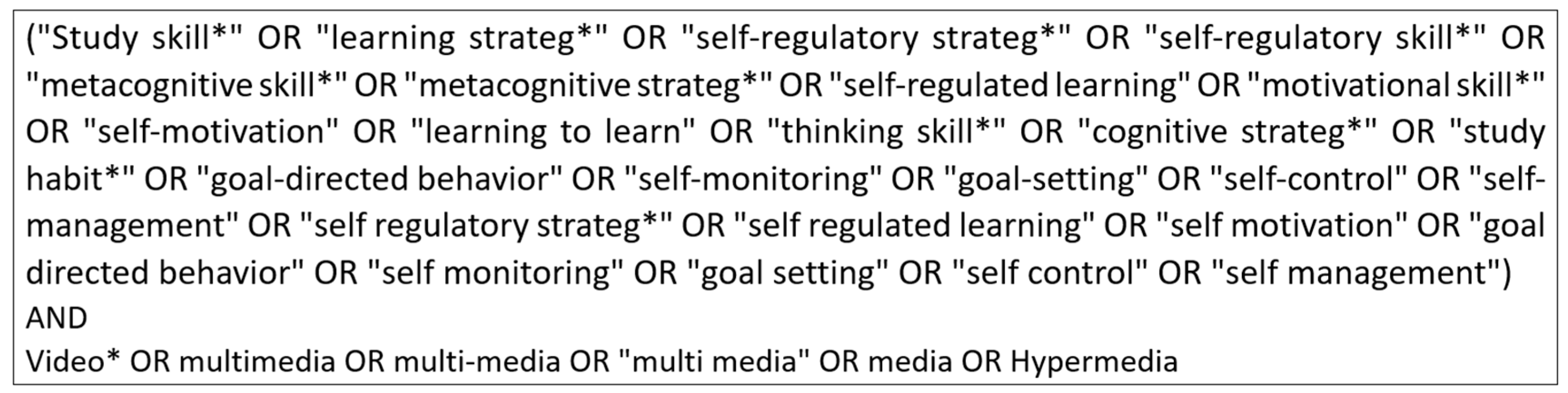
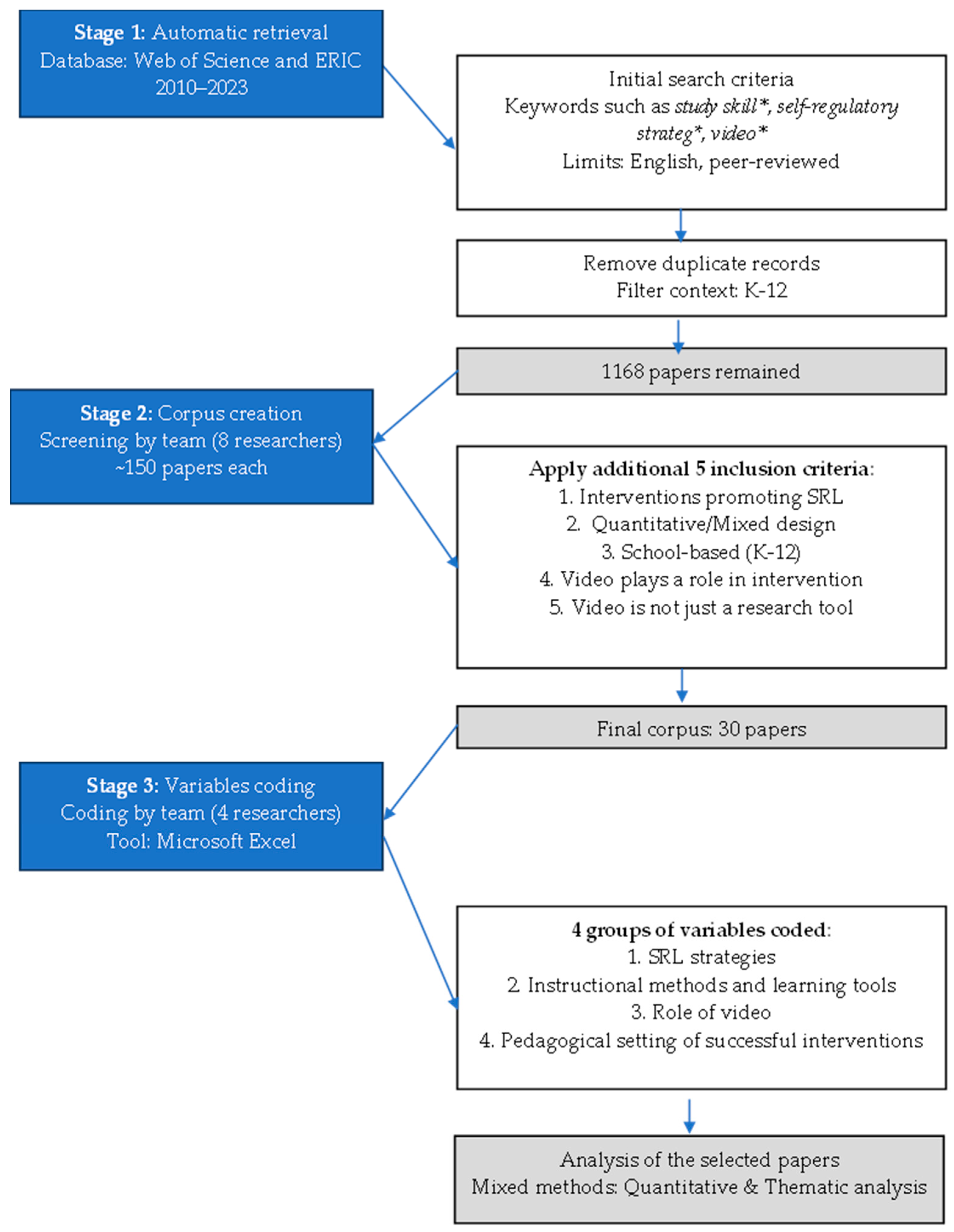
4.1. Stage 1—Automatic Retrieval of Recent Papers (Published from 2010–2023) Based on Initial Criteria
4.2. Stage 2—Construction of the Papers Corpus by the Research Team Based on Five Additional Criteria
4.3. Stage 3—Variable Coding
5. Findings
5.1. Q1 Which SRL Strategies Do the Interventions Aim to Promote?
5.2. Q2 Which Instructional Methods and Learning Tools Do the Interventions Implement to Promote SRL?
- Cognitive strategies were found in this review to appear both as specific and as generic. For example, papers 1, 2, 9, and 10 address cognitive strategies with a discipline-specific orientation, such as problem-solving in mathematics and biology, language-learning and reading comprehension strategies, and the promotion of abstract thinking skills in physics. In contrast, papers such as 6, 8, and 11 address generic cognitive strategies. Examples include promoting general critical thinking and problem-solving skills (e.g., classification, analysis, inference, consideration of multiple perspectives); fostering generic dimensions of critical thinking such as (1) identifying assumptions, (2) inductive reasoning, (3) deductive reasoning, (4) interpretation, and (5) argument evaluation; teaching generic reading strategies (annotations) ranging from basic comprehension of text and factual information to higher-level commenting on the text and inviting discussion; spaced practice, note preparation; and developing general problem-solving and persistence skills, for instance, “try solving it another way,” or “take a break and try again from a different starting point.”
- Metacognitive strategies are often associated with a generic orientation. For example, paper 6 deals with strategies such as planning (the preparatory phase), time management, structuring the learning environment, help-seeking, comprehension monitoring (the performance phase), and reflection.
- Many researchers refer to feedback in a generic orientation. However, feedback can also appear in a discipline-specific orientation. For example, in paper 7, the focus was on developing the ability to work with feedback in physical education, specifically concerning the correct technique for the Shot put.
5.3. Q3 What Are the Roles of Video Within the SRL Interventions?
5.4. Q4 What Are the Pedagogical Settings That Lead to a Successful SRL Intervention Program?
6. Discussion
6.1. SRL Strategies the Interventions Aim to Promote (Q1)
6.2. Instructional Methods and Learning Tools Implemented in the Interventions to Promote SRL (Q2)
6.3. Roles of Video Within the SRL Interventions (Q3)
6.4. Pedagogical Settings That Lead to Successful SRL Intervention Programs (Q4)
6.5. Conclusions
Supplementary Materials
Author Contributions
Funding
Institutional Review Board Statement
Informed Consent Statement
Data Availability Statement
Acknowledgments
Conflicts of Interest
Appendix A. Video-Based SRL Intervention Papers Included in the Current Literature Review
| # | Authors, Publication Year | Paper Name |
| 1 | Raaijmakers et al. (2018) | Training self-regulated learning skills with video modeling examples: Do task-selection skills transfer? |
| 2 | Kostons et al. (2012) | Training self-assessment and task-selection skills: A cognitive approach to improving self-regulated learning |
| 3 | Lau (2020) | The effectiveness of self-regulated learning instruction on students’ classical Chinese reading comprehension and motivation |
| 4 | Jena et al. (2018) | Exploring the Effects of Web 2.0 Technology on Individual and Collaborative Learning Performance in Relation to Self-Regulation of Learners |
| 5 | T. L. Lai et al. (2020) | The Effectiveness of Team-Based Flipped Learning on a Vocational High School Economics Classroom |
| 6 | Van Alten et al. (2020b) | Self-regulated learning support in flipped learning videos enhances learning outcomes |
| 7 | Kok et al. (2020) | The effects of self-controlled video feedback on motor learning and self-efficacy in a Physical Education setting: an exploratory study on the shot-put |
| 8 | Chen et al. (2020) | A web-based collaborative reading annotation system with gamification mechanisms to improve reading performance |
| 9 | Nandyansah et al. (2020) | Picsar (Physics Augmented Reality) as a Learning Media to Practice Abstract Thinking Skills in Atomic Model |
| 10 | Yakubova et al. (2020) | Teaching students with ASD to solve fraction computations using a video modeling instructional package |
| 11 | Mena Araya (2020) | Critical.inking for Civic Life in Elementary Education: Combining Storytelling and Thinking Tools |
| 12 | Hwang et al. (2021) | Effects of a social regulation-based online learning framework on students’ learning achievements and behaviors in mathematics |
| 13 | Wang et al. (2022) | A Curation Activity-Based Self-Regulated Learning Promotion Approach as Scaffolding to Improving Learners’ Performance in STEM Courses |
| 14 | Kong and Liu (2023) | Supporting the Self-Regulated Learning of Primary School Students With a Performance-Based Assessment Platform for Programming Education |
| 15 | Ramdani et al. (2022) | Analysis of students’ self-regulated learning in terms of gender using blended learning-based laboratory inquiry teaching materials |
| 16 | Hidajat (2022) | The effects of E-learning based on a creatively cooperative method on student’s self-regulation ability in mathematics |
| 17 | Zhao et al. (2023) | Effects of a self-regulated-based gamified virtual reality system on students’ English learning performance and affection |
| 18 | Fitriyana et al. (2021) | The Influences of Hybrid Learning with Video Conference and “Chemondro-Game” on Students’ Self-Efficacy, Self-Regulated Learning, and Achievement toward Chemistry |
| 19 | Alserhan et al. (2023) | Personal Learning Environments: Modeling Students’ Self-Regulation Enhancement Through a Learning Management System Platform |
| 20 | Nacaroğlu and Bektaş (2023) | The effect of the flipped classroom model on gifted students’ self-regulation skills and academic achievement |
| 21 | Alhalafawy and Zaki (2022) | How Has Gamification Within Digital Platforms Affected Self-Regulated Learning Skills During the COVID-19 Pandemic? Mixed-Methods Research |
| 22 | Heaysman and Kramarski (2022) | Enhancing students’ metacognition, achievement and transfer between domains: Effects of the simulative “SRL-AIDE” parallel teacher–student program |
| 23 | Ikhsan et al. (2019) | The Effects of “Science-on-Web” Learning Media on Junior High School Students’ Learning Independency Levels and Learning Outcomes |
| 24 | Fößl et al. (2016) | A field study of a video supported seamless-learning-setting with elementary learners |
| 25 | T. L. Wong et al. (2018) | Promoting Self-Regulated Learning by Online Educational Resources |
| 26 | Huertas et al. (2015) | Effect of a computational scaffolding in the development of secondary students’ metacognitive skills |
| 27 | Mazzotti et al. (2013) | Effects of Multimedia Goal-Setting Instruction on Students’ Knowledge of the Self-Determined Learning Model of Instruction and Disruptive Behavior |
| 28 | Molenaar et al. (2012) | Dynamic scaffolding of socially regulated learning in a computer-based learning environment |
| 29 | Winters and Alexander (2011) | Peer collaboration: The relation of regulatory behaviors to learning with hypermedia |
| 30 | Meyer et al. (2010) | Improving literacy and metacognition with electronic portfolios: Teaching and learning with ePEARL |
Appendix B. Strategies the Interventions Aimed to Promote, by Type of Strategy
| Paper No. | Cognitive | Metacognitive | Motivational & Affective | Resource Management |
| 1 | Problem-solving | Task selection, Self-assessment | Engagement | |
| 2 | Problem-solving | Task selection, Self-assessment | Engagement | |
| 3 | Reading comprehension | Goal setting, Learning monitoring, Self-assessment, Peer assessment | Self-efficacy, Intrinsic motivation | |
| 4 | Self-assessment | Learning pace management | ||
| 5 | Note-taking | |||
| 6 | Note-taking | Planning, Monitoring, Self-assessment | Time management, Learning environment design, Help-seeking | |
| 7 | Self-assessment, Strategy selection | Self-efficacy | ||
| 8 | Note-taking | |||
| 9 | Abstract scientific thinking | |||
| 10 | Problem-solving, Mathematical thinking | |||
| 11 | Problem-solving | Critical thinking | ||
| 12 | Note-taking | Goal setting, Strategy selection | Self-confidence, Self-efficacy | Learning environment design |
| 13 | Information retrieval, Information organization | |||
| 14 | Problem-solving | |||
| 15 | Information organization, Information retrieval, Rehearsal | Planning, Goal setting | Self-confidence | Learning environment design, Help-seeking |
| 16 | Creative thinking, Mathematical thinking | Goal setting, Strategy selection, Self-assessment | Self-efficacy | Learning environment design, Help-seeking, Time management |
| 17 | Vocabulary acquisition | Goal setting, Monitoring, Strategy selection, Self-assessment | Engagement | Help-seeking, Time management |
| 18 | Elaboration | Reflection, Monitoring, Task evaluation | Self-efficacy | |
| 19 | Planning, Goal setting, Monitoring, Reflection, Evaluation | Self-efficacy, Effort | ||
| 20 | Rehearsal, Elaboration, Information organization | Critical thinking, Self-assessment, Planning, Goal setting | Effort | Time management, Help-seeking |
| 21 | Rehearsal | Planning, Goal setting, Monitoring | Effort, Engagement | Help-seeking |
| 22 | Reading comprehension, Elaboration, Information organization | Monitoring, Strategy selection | ||
| 23 | Intrinsic motivation, Self-confidence, Effort, Engagement | |||
| 24 | Strategy selection, Planning, Goal setting | Engagement, Intrinsic motivation | Time management, Help-seeking | |
| 25 | Planning, Goal setting, Monitoring, Task evaluation | Engagement, Intrinsic motivation | ||
| 26 | Planning, Goal setting, Monitoring, Strategy selection, Self-assessment | |||
| 27 | Planning, Goal setting, Monitoring, Self-assessment | |||
| 28 | Writing, Elaboration | Planning, Goal setting, Monitoring | ||
| 29 | Strategy selection, Monitoring, Engagement, Planning, Goal setting | |||
| 30 | Planning, Goal setting, Self-assessment, Reflection, Strategy selection | Self-efficacy, Intrinsic motivation, Affect |
References
- Alhalafawy, W. S., & Zaki, M. Z. T. (2022). How has gamification within digital platforms affected self-regulated learning skills during the COVID-19 pandemic? Mixed-methods research. International Journal of Emerging Technologies in Learning, 17(6), 123–151. [Google Scholar] [CrossRef]
- Alserhan, S., Alqahtani, T. M., Yahaya, N., Al-Rahmi, W. M., & Abuhassna, H. (2023). Personal learning environments: Modeling students’ self-regulation enhancement through a learning management system platform. IEEE Access, 11, 5464–5482. [Google Scholar] [CrossRef]
- Amineh, R. J., & Asl, H. D. (2015). Review of constructivism and social constructivism. Journal of Social Sciences, 1(1), 9–16. [Google Scholar]
- Azevedo, R., Johnson, A., & Burkett, C. (2015, July 22–25). Does training of cognitive and metacognitive regulatory processes enhance learning and deployment of processes with hypermedia? Annual Meeting of the Cognitive Science Society (Vol. 37), Pasadena, CA, USA. [Google Scholar]
- Azevedo, R., Moos, D. C., Johnson, A. M., & Chauncey, A. D. (2004). Using cognitive tools to scaffold self-regulated learning in hypermedia environments. Educational Psychologist, 39(4), 257–267. [Google Scholar]
- Boekaerts, M. (2011). Emotions, emotion regulation, and self-regulation of learning. In B. J. Zimmerman, & D. H. Schunk (Eds.), Handbook of self-regulation of learning and performance (pp. 408–425). Routledge. [Google Scholar]
- Broadbent, J., & Poon, W. L. (2015). Self-regulated learning strategies & academic achievement in online higher education learning environments: A systematic review. The Internet and Higher Education, 27, 1–13. [Google Scholar] [CrossRef]
- Callan, G., Longhurst, D., Shim, S., & Ariotti, A. (2022). Identifying and predicting teachers’ use of practices that support SRL. Psychology in the Schools, 59(11), 2327–2344. [Google Scholar] [CrossRef]
- Carter, R. A., Jr., Rice, M., & Yang, S. (2020). Self-regulated learning in online learning environments: Strategies for success. Distance Education, 41(3), 401–422. [Google Scholar]
- Chen, C. M., Li, M. C., & Chen, T. C. (2020). A web-based collaborative reading annotation system with gamification mechanisms to improve reading performance. Computers & Education, 144, 103697. [Google Scholar] [CrossRef]
- Chiu, T. K. F. (2022). Student engagement in learning management systems: A self-determination theory perspective. British Journal of Educational Technology, 53(2), 319–334. [Google Scholar]
- Cohen, G., & Cohen, A. (2024). Mapping educators’ insights of student problem-solving difficulties while implementing video-assisted self-regulated learning training in classrooms. European Journal of Open, Distance and E-Learning, 26(s1), 20–34. [Google Scholar] [CrossRef]
- Cousins, S. B., Bol, L., & Luo, R. (2022). Examining self-regulated learning interventions in K-12: A systematic review. Educational Psychology Review, 34(2), 1019–1045. [Google Scholar]
- De Boer, H., Donker, A. S., Kostons, D., & van der Werf, M. P. C. (2018). Effectiveness of self-regulated learning interventions on achievement and self-regulation: A meta-analysis. Educational Research Review, 24, 1–17. [Google Scholar]
- Delen, E., Liew, J., & Willson, V. (2014). Effects of interactivity and instructional video type on learning: An eye-tracking study. Computers & Education, 78, 150–163. [Google Scholar]
- Dignath, C., Buettner, G., & Langfeld, H. P. (2008). How can promary school students learn selg regulated learning strategies most effectively? A meta-analysis on self-regulation training programmes. Educational Research Review, 3(2), 101–129. [Google Scholar] [CrossRef]
- Dignath, C., & Büttner, G. (2008). Components of fostering self-regulated learning among students: A meta-analysis on intervention studies at primary and secondary school level. Metacognition and Learning, 3(3), 231–264. [Google Scholar] [CrossRef]
- Dignath, C., van Ewijk, C. C., Perels, F., & Fabriz, S. (2023). Effective self-regulated learning interventions: A systematic review. Educational Psychology Review, 35(1), 117–142. [Google Scholar]
- Donker, A. S., De Boer, H., Kostons, D., Dignath, C., & van der Werf, M. P. C. (2014). Effectiveness of learning strategy instruction on academic performance: A meta-analysis. Educational Research Review, 11, 1–26. [Google Scholar] [CrossRef]
- Ergen, B., & Kanadli, S. (2017). The effect of self-regulated learning strategies on academic achievement: A meta-analysis study. Eurasian Journal of Educational Research, 17(69), 55–74. [Google Scholar] [CrossRef]
- Fitriyana, N., Wiyarsi, A., Sugiyarto, K. H., & Ikhsan, J. (2021). The influences of hybrid learning with video conference and “chemondro-game” on students’ self-efficacy, self-regulated learning, and achievement toward chemistry. Journal of Turkish Science Education, 18(2), 233–248. [Google Scholar] [CrossRef]
- Fößl, T., Ebner, M., Schön, S., & Holzinger, A. (2016). A field study of a video supported seamless-learning-setting with elementary learners. Educational Technology and Society, 19(1), 321–336. [Google Scholar]
- Galatsopoulou, F., Kenterelidou, C., Kotsakis, R., & Matsiola, M. (2022). Examining students’ perceptions towards video-based and video-assisted active learning scenarios in journalism and communication courses. Education Sciences, 12(2), 74. [Google Scholar] [CrossRef]
- Girón-García, C., & Fortanet-Gómez, I. (2023). Science dissemination videos as multimodal supporting resources for ESP teaching in higher education. English for Specific Purposes, 70, 164–176. [Google Scholar] [CrossRef]
- He, W., Holton, A., Farkas, G., & Warschauer, M. (2016). The effects of flipped instruction on out-of-class study time, exam performance, and student perceptions. Learning and Instruction, 45, 61–71. [Google Scholar] [CrossRef]
- Heaysman, O., & Kramarski, B. (2022). Enhancing students’ metacognition, achievement and transfer between domains: Effects of the simulative “SRL-AIDE” parallel teacher–student program. International Journal of Educational Research, 116, 102074. [Google Scholar] [CrossRef]
- Hidajat, F. A. (2022). The effects of E-learning based on a creatively cooperative method on student’s self-regulation ability in mathematics. Cypriot Journal of Educational Sciences, 17(9), 3466–3477. [Google Scholar] [CrossRef]
- Huertas, A., Vesga, G., Vergara, A., & Romero, M. (2015). Effect of a computational scaffolding in the development of secondary students’ metacognitive skills. International Journal of Technology Enhanced Learning, 7(2), 143–159. [Google Scholar] [CrossRef]
- Hwang, G. J., Wang, S. Y., & Lai, C. L. (2021). Effects of a social regulation-based online learning framework on students’ learning achievements and behaviors in mathematics. Computers & Education, 160, 104031. [Google Scholar] [CrossRef]
- Ikhsan, J., Akhyar, M., & Nais, M. K. (2019). The effects of science-on-web learning media on junior high school students’ learning independency levels and learning outcomes. Journal of Turkish Science Education, 16(2), 231–239. [Google Scholar]
- Jansen, R. S., van Leeuwen, A., Janssen, H., Conijn, R., & Kester, L. (2020). Supporting learners’ self-regulated learning in massive open online courses. Computers & Education, 146, 103771. [Google Scholar] [CrossRef]
- Jansen, R. S., van Leeuwen, A., Janssen, J., & Kester, L. (2018). Validation of the revised self-regulated online learning questionnaire. In V. Pammer-Schindler, M. Pérez-Sanagustín, H. Drachsler, R. Elferink, & M. Scheffel (Eds.), Lifelong technology-enhanced learning (pp. 116–121). Springer International Publishing. [Google Scholar] [CrossRef]
- Jena, A. K., Bhattacharjee, S., Gupta, S., Das, J., & Debnath, R. (2018). Exploring the effects of Web 2.0 technology on individual and collaborative learning performance in relation to self-regulation of learners. Journal on School Educational Technology, 13(4), 20–35. [Google Scholar]
- Kok, M., Komen, A., van Capelleveen, L., & van der Kamp, J. (2020). The effects of self-controlled video feedback on motor learning and self-efficacy in a Physical Education setting: An exploratory study on the shot-put. Physical Education and Sport Pedagogy, 25(1), 49–66. [Google Scholar] [CrossRef]
- Kong, S. C., & Liu, B. (2023). Supporting the self-regulated learning of primary school students with a performance-based assessment platform for programming education. Journal of Educational Computing Research, 61(5), 977–1007. [Google Scholar] [CrossRef]
- Kostons, D., van Gog, T., & Paas, F. (2012). Training self-assessment and task-selection skills: A cognitive approach to improving self-regulated learning. Learning and Instruction, 22(2), 121–132. [Google Scholar] [CrossRef]
- Lai, C. L., & Hwang, G. J. (2016). A self-regulated flipped classroom approach to improving students’ learning performance in a mathematics course. Computers & Education, 100, 126–140. [Google Scholar] [CrossRef]
- Lai, C. L., & Hwang, G. J. (2023). Strategies for enhancing self-regulation in e-learning: A review of selected journal publications from 2010 to 2020. Interactive Learning Environments, 31(6), 3757–3779. [Google Scholar] [CrossRef]
- Lai, T. L., Lin, F. T., & Yueh, H. P. (2020). The effectiveness of team-based flipped learning on a vocational high school economics classroom. Interactive Learning Environments, 28(1), 130–141. [Google Scholar] [CrossRef]
- Lau, K. L. (2020). The effectiveness of self-regulated learning instruction on students’ classical Chinese reading comprehension and motivation. Reading and Writing, 33(8), 2001–2027. [Google Scholar] [CrossRef]
- Maulana, M. I. (2023). Leveraging Zoom video-conferencing features in interview data generation during the Covid-19 pandemic. In Research and teaching in a pandemic world: The challenges of establishing academic identities during times of crisis (pp. 391–407). Springer Nature Singapore. [Google Scholar]
- Mazzotti, V. L., Test, D. W., & Wood, C. L. (2013). Effects of multimedia goal-setting instruction on students’ knowledge of the self-determined learning model of instruction and disruptive behavior. Journal of Positive Behavior Interventions, 15(2), 90–102. [Google Scholar] [CrossRef]
- Mejeh, M., & Grieder, C. (2025). Educational interventions to promote self-regulated learning in vocational schools—A systematic review. International Journal for Research in Vocational Education and Training, 12(2), 192–235. [Google Scholar] [CrossRef]
- Mena Araya, A. E. (2020). Critical thinking for Cvic life in elementary education: Combining storytelling and thinking tools. Revista Educación, 44, 23–43. [Google Scholar] [CrossRef]
- Meyer, E., Abrami, P. C., Wade, C. A., Aslan, O., & Deault, L. (2010). Improving literacy and metacognition with electronic portfolios: Teaching and learning with ePEARL. Computers and Education, 55(1), 84–91. [Google Scholar] [CrossRef]
- Molenaar, I., Roda, C., Van Boxtel, C., & Sleegers, P. (2012). Dynamic scaffolding of socially regulated learning in a computer-based learning environment. Computers & Education, 59(2), 515–523. [Google Scholar] [CrossRef]
- Moos, D. C., & Bonde, C. (2016). Flipped classrooms and self-regulated learning: Impacts on engagement and performance. Learning, Media and Technology, 41(2), 219–235. [Google Scholar]
- Nacaroğlu, O., & Bektaş, O. (2023). The effect of the flipped classroom model on gifted students’ self-regulation skills and academic achievement. Thinking Skills and Creativity, 47, 101244. [Google Scholar] [CrossRef]
- Nandyansah, W., Suprapto, N., & Mubarok, H. (2020). Picsar (physics augmented reality) as a learning media to practice abstract thinking skills in atomic model. Journal of Physics: Conference Series, 1491(1), 012049. [Google Scholar] [CrossRef]
- Navarrete, E., Nehring, A., Schanze, S., Ewerth, R., & Hoppe, A. (2025). A closer look into recent video-based learning research: A comprehensive review of video characteristics, tools, technologies, and learning effectiveness. International Journal of Artificial Intelligence in Education, 35, 1631–1694. [Google Scholar] [CrossRef]
- Nilson, L. B., & Zimmerman, B. J. (2023). Creating self-regulated learners: Strategies to strengthen students’ self-awareness and learning skills. Routledge. [Google Scholar]
- Ortube, A. F., Panadero, E., & Dignath, C. (2024). Self-regulated learning interventions for pre-service teachers: A systematic review. Educational Psychology Review, 36(4), 113. [Google Scholar] [CrossRef]
- Paas, F. (2014). Cognitive load theory: A theoretical basis for designing effective learning environments. Instructional Science, 42(2), 107–123. [Google Scholar]
- Page, M. J., McKenzie, J. E., Bossuyt, P. M., Boutron, I., Hoffmann, T. C., Mulrow, C. D., Shamseer, L., Tetzlaff, J., Akl, E., Brennan, S. E., Chou, R., Glanville, J., Grimshaw, J., Hróbjartsson, A., Lalu, M., Li, T., Loder, E., Mayo-Wilson, E., McDonald, S., … Moher, D. (2021). The PRISMA 2020 statement: An updated guideline for reporting systematic reviews. The BMJ, 372, n71. [Google Scholar] [CrossRef] [PubMed]
- Panadero, E. (2017). A review of self-regulated learning: Six models and four directions for research. Frontiers in Psychology, 8, 422. [Google Scholar] [CrossRef]
- Pintrich, P. R. (1999). The role of motivation in promoting and sustaining self-regulated learning. International Journal of Educational Research, 31(6), 459–470. [Google Scholar] [CrossRef]
- Prasse, D., Webb, M., Deschênes, M., Parent, S., Aeschlimann, F., Goda, Y., Yamada, M., & Raynault, A. (2024). Challenges in promoting self-regulated learning in technology supported learning environments: An umbrella review of systematic reviews and meta-analyses. Technology, Knowledge and Learning, 29(4), 1809–1830. [Google Scholar] [CrossRef]
- Raaijmakers, S. F., Baars, M., Schaap, L., Paas, F., van Merriënboer, J., & van Gog, T. (2018). Training self-regulated learning skills with video modeling examples: Do task-selection skills transfer? Instructional Science, 46(2), 273–290. [Google Scholar] [CrossRef]
- Ramdani, A., Artayasa, P., Sulawanti, E. V., & Yustiqvar, M. (2022). Analysis of students’ self-regulated learning in terms of gender using blended learning-based laboratory inquiry teaching materials. AIP Conference Proceedings, 2600, 070008. [Google Scholar] [CrossRef]
- Sablić, M., Mirosavljević, A., & Škugor, A. (2021). Video-based learning (VBL)—Past, present and future: An overview of the research published from 2008 to 2019. Technology, Knowledge and Learning, 26(4), 1061–1077. [Google Scholar] [CrossRef]
- Schunk, D. H., & Zimmerman, B. J. (Eds.). (2023). Self-regulation of learning and performance: Issues and educational applications. Taylor & Francis. [Google Scholar]
- Shih, W. C., & Huang, M. T. (2020). The impact of video-based learning on self-regulated learning in higher education. Journal of Educational Multimedia and Hypermedia, 29(1), 73–92. [Google Scholar]
- Sijmkens, E., De Cock, M., & De Laet, T. (2023). Scaffolding students’ use of metacognitive activities using discipline-and topic-specific reflective prompts. Metacognition and Learning, 18(3), 811–843. [Google Scholar] [CrossRef]
- Simón-Grábalos, D., Fonseca, D., Aláez, M., Romero-Yesa, S., & Fresneda-Portillo, C. (2025). Systematic review of the literature on interventions to improve self-regulation of learning in first-year university students. Education Sciences, 15(3), 372. [Google Scholar] [CrossRef]
- Tsai, C. C., Shen, P. D., & Fan, Y. T. (2013). Research trends in self-regulated learning and e-learning. British Journal of Educational Technology, 44(3), 464–477. [Google Scholar]
- Van Alten, D. C. D., Phielix, C., Janssen, J., & Kester, L. (2020a). Effects of flipping the classroom on learning outcomes and self-regulated learning: A meta-analysis. Educational Research Review, 28, 100281. [Google Scholar] [CrossRef]
- Van Alten, D. C. D., Phielix, C., Janssen, J., & Kester, L. (2020b). Self-regulated learning support in flipped learning videos enhances learning outcomes. Computers & Education, 158, 104000. [Google Scholar] [CrossRef]
- Van Laer, S., & Elen, J. (2017). The effect of self-regulated learning on technology-enhanced learning environments: A systematic review. Educational Research Review, 22, 1–9. [Google Scholar]
- Vilkova, K. (2022). Self-regulated learning in MOOCs: A review and future directions. Computers & Education, 182, 104438. [Google Scholar]
- Wang, Q., Peng, Y., & Wang, H. (2022). A curation activity-based self-regulated learning promotion approach as scaffolding to improving learners’ performance in STEM courses. Journal of Educational Computing Research, 60(4), 843–876. [Google Scholar] [CrossRef]
- Watters, A. (2023). The state of education technology in 2023: Global trends and challenges. EdTech Review, 11(2), 56–72. [Google Scholar]
- Winters, F. I., & Alexander, P. A. (2011). Peer collaboration: The relation of regulatory behaviors to learning with hypermedia. Instructional Science, 39(4), 407–427. [Google Scholar] [CrossRef]
- Wong, K. T., Khalil, M., Baars, M., de Koning, B. B., & Paas, F. (2019). Exploring sequences of learner activities in relation to self-regulated learning in a massive open online Cours. Computers & Education, 140, 103595. [Google Scholar] [CrossRef]
- Wong, T. L., Xie, H., Wang, F. L., Tang, K. T., Kong, A., & Kwan, R. (2018, August 13–15). Promoting self-regulated learning by online educational resources. 2018 International Symposium on Educational Technology, ISET 2018 (pp. 204–208), Osaka, Japan. [Google Scholar] [CrossRef]
- Yakubova, G., Hughes, E. M., & Chen, B. B. (2020). Teaching students with ASD to solve fraction computations using a video modeling instructional package. Research in Developmental Disabilities, 101, 103637. [Google Scholar] [CrossRef]
- Yang, Y., Wen, Y., & Song, Y. (2023). A systematic review of technology-enhanced self-regulated language learning. Educational Technology & Society, 26(1), 31–44. [Google Scholar]
- Zhao, J. H., Panjaburee, P., Hwang, G. J., & Wongkia, W. (2023). Effects of a self-regulated-based gamified virtual reality system on students’ English learning performance and affection. Interactive Learning Environments, 32, 5509–5536. [Google Scholar] [CrossRef]
- Zheng, H. (2025). Leveraging GenAI to transform a traditional instructional video into engaging short video lectures. Educause Review. Online. Available online: https://www.proquest.com/openview/b6d2da7a4a9f70332fdc8a58ee001e7f/1?pq-origsite=gscholar&cbl=7213897 (accessed on 7 February 2026).
- Zimmerman, B. J. (2000). Attaining self-regulation: A social cognitive perspective. In M. Boekaerts, P. R. Pintrich, & M. Zeidner (Eds.), Handbook of self-regulation (pp. 13–39). Academic Press. [Google Scholar]
- Zimmerman, B. J., & Moylan, A. R. (2009). Self-regulation: Where metacognition and motivation intersect. In D. J. Hacker, J. Dunlosky, & A. C. Graesser (Eds.), Handbook of metacognition in education (pp. 299–315). Routledge. [Google Scholar]


| Explicit instruction | Frontal | Explicit strategy explanation involves demonstrating the steps, the facilitator’s implementation, questions, and class discussion. This is followed by group/individual practice of the explicitly taught strategy. For example, synchronous video instruction in paper 13 is classified as frontal due to its similarities with in-class learning, such as the inability to rewind the video and the option to get teacher feedback. |
| Guidance | Similar to frontal instruction, video guides explicitly explain a strategy, its use, and rationale. Video Modeling (VM) documents an “expert” using a strategy, demonstrates its implementation through a think-aloud, and serves as an example. Another video-guiding method is an augmented reality system used for teaching abstract scientific thinking (paper 9). | |
| Prompts | Prompts are textual aids that appear to learners during regular work/tasks within a learning environment or in informational videos. Some prompts are preset with fixed timing, while others adapt based on log-file analysis of learner data. In paper 22, for example, prompts were provided in the form of memory-supporting strategy sheets. | |
| SRL online platform | Some learning environments promote SRL without explicit strategy instruction, but clarify their purpose of helping students implement SRL strategies alongside disciplinary learning. Activities include goal setting, self-assessment, note-taking, and required cognitive strategies like information gathering/organization. In paper 13, for example, learners prepare mind maps from self-collected materials, receiving task instructions that implicitly guide strategy implementation. These environments may have collaborative peer assessment/commenting components. Some use digital strategy implementation guides instead of pop-up prompts. | |
| Gamification | One intervention developed a VR educational game for explicit vocabulary learning. | |
| Implicit instruction | Online learning environment | Some existing learning environments and learning management systems were not designed to explicitly promote SRL, but do implicitly facilitate the development of SRL strategies among learners. |
| Gamification | Gamification implicitly facilitates strategy acquisition by embedding learning within educational games. In studies that incorporated gamification elements for learning, the aim was to increase learners’ motivation and engagement. | |
| Inquiry | Inquiry learning, often in groups, promotes learner freedom and autonomy. It involves searching for questions or problems, exploring topics, and generating solutions, as outlined in paper 15. This approach implicitly fosters SRL strategies for effective learning. | |
| Group work | Group work was widely used. Some used it solely, assuming SRL strategies could develop through social learning. Other interventions combined individual and group learning to deepen understanding or facilitate peer assessment. However, in 17 interventions, group work was not the main method used to teach the strategy; rather, it was used for SRL practice/application. | |
| Flipped classroom | The flipped classroom method, explored in three papers, involves students encountering material before class, often through pre-class videos. This allows for a deeper understanding in class through group work or by asking the teacher questions. With learners responsible for acquiring knowledge independently, SRL strategies become crucial. |
| Explicit Instruction | Implicit Instruction | |||||||||
|---|---|---|---|---|---|---|---|---|---|---|
| Activity\ Strategy Type | Frontal | Guidance | Prompts | SRL Online Platform | Gamification | Online Learning Environment | Gamification | Inquiry | Group Work | Flipped Classroom |
| Cognitive | 3, 5, 13, 16 | 1, 2, 9, 22, 24 | 6 | 8, 14 | 17 | 21, 24, 25 | 21 | 15 | 4, 12, 16, 29 | 20 |
| Meta-cognitive | 13, 3, 11 | 1, 2, 22 | 6, 22, 26 | 7, 12, 27, 30 | 19, 21 | 18, 21 | 15 | 4, 13, 29 | 6, 20 | |
| Motivational | 23, 19 | 18 | 15 | 3, 5, 8, 12, 29 | 20 | |||||
| Resource management | 6 | 12 | 21 | 21 | 15 | 4 | 5, 6, 20 | |||
| Role | Activity Type | Papers (%) | Definition and Use |
| Provide content for promoting SRL | Instruction | 3 (10%) | The videos contain an explicit explanation of the strategy, how to use it, the reason for using it, and examples of its implementation. |
| Video Modeling (VM) | 3 (10%) | Instruction through a demonstration by an expert showing how to implement a specific strategy—not talking about it, but applying it. A recorded board is used, sometimes with think-aloud. | |
| Synchronized meeting | 3 (10%) | In a synchronous meeting, video conferencing technologies were used, and learners met with the teacher in a ‘live broadcast’. | |
| Provide disciplinary content | Instruction | 10 (33.3%) | Videos for teaching the subject area were used to increase learners’ interest, reinforce prior knowledge, and introduce new material. Some videos were recorded by the teachers themselves, while others were found online and utilized by the teachers. |
| Active search online | 3 (10%) | The interventions combined the learners’ creation of a digital product, requiring them to search the internet for videos related to the activity topic. | |
| Video making | 1 (3.3%) | Learners were asked to learn and research the subject area and integrate it with the use of SRL strategies in order to produce a video addressing social issues. | |
| Synchronized meeting | 4 (13.3%) | The synchronous meeting was held to explain the domains. | |
| Combining disciplinary and SRL content | Applying SRL | 7 (23.3%) | Common approaches included SRL-promoting prompts during instructional videos, video-based games for subject/SRL learning, an AR environment for cognitive strategy acquisition alongside material exposure, and a 3D ‘digital expert’ guiding SRL based on learner performance. |
Disclaimer/Publisher’s Note: The statements, opinions and data contained in all publications are solely those of the individual author(s) and contributor(s) and not of MDPI and/or the editor(s). MDPI and/or the editor(s) disclaim responsibility for any injury to people or property resulting from any ideas, methods, instructions or products referred to in the content. |
© 2026 by the authors. Licensee MDPI, Basel, Switzerland. This article is an open access article distributed under the terms and conditions of the Creative Commons Attribution (CC BY) license.
Share and Cite
Cohen, A.; Ezra, O.; Michaeli, E.; Cohen, G.; Gabbay, H.; Bronshtein, A. Beyond Content Delivery: A Systematic Review of Video-Based SRL Interventions and Gaps in Explicit Motivational and Resource-Management Instruction. J. Intell. 2026, 14, 33. https://doi.org/10.3390/jintelligence14020033
Cohen A, Ezra O, Michaeli E, Cohen G, Gabbay H, Bronshtein A. Beyond Content Delivery: A Systematic Review of Video-Based SRL Interventions and Gaps in Explicit Motivational and Resource-Management Instruction. Journal of Intelligence. 2026; 14(2):33. https://doi.org/10.3390/jintelligence14020033
Chicago/Turabian StyleCohen, Anat, Orit Ezra, Efrat Michaeli, Guy Cohen, Hagit Gabbay, and Alla Bronshtein. 2026. "Beyond Content Delivery: A Systematic Review of Video-Based SRL Interventions and Gaps in Explicit Motivational and Resource-Management Instruction" Journal of Intelligence 14, no. 2: 33. https://doi.org/10.3390/jintelligence14020033
APA StyleCohen, A., Ezra, O., Michaeli, E., Cohen, G., Gabbay, H., & Bronshtein, A. (2026). Beyond Content Delivery: A Systematic Review of Video-Based SRL Interventions and Gaps in Explicit Motivational and Resource-Management Instruction. Journal of Intelligence, 14(2), 33. https://doi.org/10.3390/jintelligence14020033