


Abstract
In recent years, young people have often been portrayed as increasingly detached from traditional forms of religious belonging. Nevertheless, religious affiliation continues to shape how individuals interpret the world—that is, the cultural frameworks and value systems through which, in Weberian terms, they ascribe meaning to an otherwise indeterminate reality. Drawing on a survey conducted among a sample of young Italians in Rome, this study examines the relationship between youth and values by comparing believers and non-believers. The data are weighted to reflect the demographic structure of a comparable population in the European Social Survey. The article explores the intersections between religiosity, spirituality, value orientations, and forms of social participation among young Romans. It relies on a wide range of indicators capturing attitudes toward religion and society, religious and spiritual practices, and the perceived importance of various social issues. The analysis focuses on differences between spiritual and non-spiritual believers, practicing and non-practicing believers, and non-believers. The central questions guiding the study are: What distinguishes young believers from their non-believing peers in these domains? And how do these groups differ in their orientations when classified in this way?
1. Introduction
The process of secularization, rather than relegating religion to the margins of society, appears to have transformed the ways in which it is expressed (Berger 2014). Individuals identify less with institutionalized religious paths (Hervieu-Léger 1999), while the ways in which spirituality intertwines with everyday life have become increasingly significant (Ammerman 2014, 2020). The subjective dimension (Heelas and Woodhead 2005) that characterizes the choice to adhere—or not—to faith-based proposals strongly differentiates young people’s trajectories, particularly in Europe, in North America (Woods and Fernández 2023; Wilkins-Laflamme 2023) and also in Italy (Garelli 2007; Bichi and Bignardi 2015; Casavecchia et al. 2024; Sbalchiero and Giordan 2024). In this sense, in the Western world the reconfiguration of belief and practice shapes people’s religious sentiment. Authenticity and everyday life have found a new valorization in a secular age (Taylor 2007).
Within this context, the article examines the place occupied by the religious dimension in shaping young people’s scapes (Appadurai 2013); the extent to which religious orientation guides their actions; and whether, and in what ways, young people construct a narrative landscape that connects their value-based choices with the religious sphere. To this end, the analysis draws on the results of a study conducted on a non-probabilistic sample of young people living in Rome. This study adopted a quota-based, typological–factorial sampling strategy (Vehovar et al. 2016) to ensure a balanced distribution of men and women within each of the two age groups used in subsequent analyses (16–22 and 23–34), to enable comparisons that are contextually grounded yet indicative of the social reality of the Roman context during the period. The city presents distinctive features: it is the capital of Italy and the seat of the Vatican City. Consequently, it constitutes a privileged context for observation and inquiry, as it hosts the residence of the Pope, particularly in an exceptional year in which Catholics celebrated a Jubilee. The participants in the study were thus situated in a context conducive to deeper reflection on their values and religious beliefs.
After identifying different types of orientations toward religion, a Principal Component Analysis shows how positions regarding practice, beliefs, and spirituality can be understood as a structuring principle of social and value configurations.
The findings highlight the emergence of distinct profiles that appear to be situated along a continuum between belief and non-belief, rather than reflecting a bipolar division between the secular and the religious. Their positioning shapes the ways in which they orient themselves toward social and political action in complex ways. The study confirms that the religious phenomenon remains present among young people in a secularized society—one that challenges, problematizes, and renders less taken-for-granted the decision to belong to a faith community.
2. New Configurations of Spirituality and Religiosity Among Young People
Young people’s positioning toward religion cannot be interpreted through a binary logic of acceptance or rejection. Various studies, both internationally and in Italy, highlight diversified and nuanced attitudes that reveal the complexity of this relationship. This appears to be the main outcome of the subjective turn toward a spirituality of life, which emphasizes the search for authenticity in religious experience and the personalization of pathways, at the expense of a life as religion model that situates biographies within institutionalized, congregational logics (Heelas and Woodhead 2005).
A shift is thus observed from traditional socialization, where family and religious institutions played a decisive role in transmitting faith (Smith 2021), to the involvement of young people through their own agency. Individuals engage in choices that activate, or do not activate, religious resources, drawing on multiple sources of the sacred: media content, music, and fiction intertwine with local and transnational traditional religions (Cusack 2011). This confirms that the secularization process has not led to the disappearance of religion but rather to its reconfiguration within society (Casanova 1994, 2019). A decisive moment for young people’s faith options emerges when individuals attempt to make coherent meaning in life situations (McNamara Barry et al. 2010).
Among the younger generations, the pluralization of forms of belief and belonging is driven by biographical choices oriented towards the search for relational self-expression. Spirituality is distinguished by heightened subjectivity within a process of deinstitutionalization: when it aligns with a religious tradition, experience and critical selectivity become central. This gives rise to fervent few groups characterized by personal commitment within expressive communalism (Collins-Mayo 2012). By contrast, most young people tend to adopt an attitude of Moralistic Therapeutic Deism, in which religious resources are activated intermittently and primarily in critical moments, while everyday life is marked by a benevolent indifference. Another form of indifference emerges from behavioral drift, whereby attention shifts toward other commitments (such as study, leisure, or professional growth).
In the European context, additional nuances emerge in the relationship with religion as a distinctive effect of secularization. Davie (2023, 2021) argues that, on the one hand, it is increasingly common to encounter individuals who first abandon religious practice and only later relinquish membership in a faith community, without converting to another religion. On the other hand, historically rooted religious communities are perceived as collective institutions that perform sociocultural functions for the common good; thus, even non-practicing or non-believing individuals may regard these churches as part of collective identity.
Within a scenario of uncertainty, individualization activates two different dynamics. The first is a process of reconstruction, in which convergent elements from different traditions are adopted to create an idiosyncratic spirituality. This may lead to significant transitions—from a critical spirituality within traditional belief systems to atheism or vice versa—or may integrate diverse elements into a coherent personal faith system. The second dynamic is a form of resistance in which contradictions that challenge institutionalized belief systems are rejected and traditional practices are reaffirmed. This attitude may lead to two different outcomes: either a rigidification of the positions one has acquired or a neutralization of tensions in order to preserve the sense of well-being derived from religion (Woods and Fernández 2023).
In Italy as well, although a Catholic cultural substratum persists (Cipriani 2011), young people have long displayed a variability in attitudes toward religion that reflects the growing weight of personal autonomy. Their range of choices spans from adherence to the majority religion to the pursuit of a critical spirituality that opens space for pathways outside traditional proposals, all the way to atheism (Garelli 2007). Alongside the religious who remain within a recognizable institutional pattern of religiosity, we find the spiritual but not religious (Palmisano and Pannofino 2017) and those who appear spiritual but not entirely religious (Sbalchiero and Giordan 2024), a group that also differs from those who express an autonomous spirituality still connected to institutional religion. These individuals display a light form of belonging to the ecclesial institution: they acknowledge a value-based bond without full adherence, and their participation in religious practices tends to favor those that privilege the personal dimension over the communal one, as their attention is directed primarily toward interiority and personal well-being.
In the literature, similar four-fold typologies have been empirically tested, distinguishing between Religious and Spiritual (RS), Spiritual but not Religious (SnR), Religious but not Spiritual (RnS), and neither Religious nor Spiritual (nRnS) individuals, and showing that these constitute psychologically distinct profiles rather than mere points along a continuum. Notably, the RnS category—those who maintain institutional religious affiliation without a subjective spiritual dimension—consistently emerges as the least numerous and the most difficult to characterize, suggesting that institutional adherence without spiritual experience represents a minority yet theoretically significant trajectory (Ugolini et al. 2025). These findings motivate typologies that go beyond the religious/spiritual dichotomy and include intermediate or apparently contradictory positions.
Even among the more committed individuals, involvement in ecclesial groups often extends beyond strictly religious boundaries: motivations are not exclusively or primarily spiritual but include the search for sociality, civic and cultural engagement, or the promotion of sustainable lifestyles (Genova 2022). Belonging thus appears situated and decentered, as young people seem to identify more with the groups or faith communities they attend than with the ecclesial institution itself (Casavecchia et al. 2024).
Compared with previous research, which had already documented the plurality of religious orientations within the Italian population (Garelli 2011), the new generation appears less characterized by sharply delineated or oppositional stances. Rather, it tends to display less polarization in its positions, more oriented toward a search for personal meaning, and less constrained by institutional forms of religion. Other studies show that, as in Italy, a generational pattern of religious socialization emerges: older people maintain a traditional and practicing religiosity, adults tend to embrace a mainly cultural Catholicism grounded in civic values, while young people display a weak connection to the Church and a more individualized form of religiosity (Ricucci et al. 2024).
In sum, young people’s engagement with the religious sphere reveals them to be autonomous actors rather than passive recipients. They interpret their relationship with religion through the cultural contexts in which they are embedded and orient their agency accordingly, to the point of constructing mythscapes—dynamic and situated narrative maps (Mercier et al. 2023). Scholars introduce this concept in the context of migration to explore the coherence between religious belonging and the choice of a destination country.
The analysis that follows seeks to outline these value-based “scapes” in relation to young people’s religious positioning. The central questions guiding the study are: what distinguishes young believers from their non-believing peers across the domains of values, participation, and social practices? And how do these groups differ in their orientations when classified according to religious practice and spirituality?
Drawing on the theoretical framework outlined above, two hypotheses guide the analysis. First, we expect that practicing and spiritual believers will display more integrated and normatively coherent value configurations and inner search, alongside greater involvement in solidaristic and religious forms of participation and more restrictive moral orientations. Second, we expect that non-believers will exhibit a distinctly secular profile, centered on well-being, civic rights, and political participation, with greater openness toward socially controversial practices.
These two classificatory dimensions—religious practice and spirituality—were chosen because they capture complementary yet analytically distinct aspects of young people’s relationship with religion. Religious practice reflects the institutional and behavioral dimension of religiosity, while spirituality captures its subjective and experiential dimension. Considering both dimensions allows us to move beyond a simple believer/non-believer binary and to account for heterogeneity within the believing population, in line with the literature on the subjective turn and the pluralization of religious experience among younger generations.
3. Data and Methods
The current article stems from the need to understand what it means, in contemporary terms, to be a young practicing believer, a non-practicing believer, a spiritual or non-spiritual individual, or a non-believer within the broader and widely debated phenomenon of secularization. The data used derive from an anonymous questionnaire administered in the city of Rome (Italy) in the period immediately preceding the Jubilee year, between May 2024 and July 2025, and promoted by the Diocese of Rome as part of the project “Educare a credere” (“Educating to Believe”).
The survey was conducted through CAPI and web-based questionnaires, adopting a non-probabilistic sampling strategy of a factorial–typological nature, with quotas defined by gender and age (16–34 years). The final sample was balanced through a specifically constructed weighting procedure and, after weighting, consists of 738 cases. The composition is balanced both by gender—50.5% female (n = 373) and 49.5% male (n = 366)—and by age, with 50.2% of respondents aged 16–22 (n = 366) and 49.8% aged 23–34 (n = 368).
The data from our survey (see Section 4) are consistent with those of the European Social Survey Round 11 (2023/24) for Italy. Overall, 76.5% of the population declares a religious affiliation, confirming the country’s persistent religious connotation. Among young people (16–34 years), however, this share drops to 62.8%, while the proportion of the unaffiliated rises significantly (37.2% compared to the general 23.5%). The generational gap of 13.7 percentage points indicates a decline in religious adherence among younger cohorts, which can be interpreted as an expression of secularization processes, greater pluralism, and distancing from traditional institutions. A trend thus emerges toward more de-institutionalized and individualized forms of relationship with religion.
Although the sample was constructed to ensure a good internal balance by gender and age, the non-probabilistic nature of the survey does not allow the results to be generalized to the entire Italian youth population (Løøv 2016). The evidence presented therefore offers a precise and contextualized description of young people residing in Rome in the period immediately preceding the Jubilee year, providing an in-depth look at a specific urban and cultural context characterized by distinctive religious and social dynamics. The aim is thus not statistical generalization, but rather the understanding of the value configurations and practices that emerge within this specific territorial and temporal scenario (Voas 2007).
For the purposes of the analysis, three sections of the questionnaire were used. The first concerns the respondents’ current situation and includes a question on the importance attributed to specific personal aspects of life. The second explores social practice through items related to the acceptability of certain behaviors connected to issues of sexuality, ethics, and bioethics, as well as a battery dedicated to social issues. The third area investigates religious practices, with particular attention to participation in third-sector activities, religious movements, and other forms of social engagement. All analyses were conducted using SPSS 18 software.
To address the research aims, two typologies were constructed, both of which are central to the analysis. These derive from the conditional section of the questionnaire that first distinguishes between believers and non-believers through self-declaration. Within the group of believers, the first classification separates practicing from non-practicing believers, derived empirically from respondents’ self-reported frequency of participation in religious rites and services.
Specifically, those who declared participating regularly ‘very much’ or ‘extremely’ were classified as practicing believers, accounting for 44.7% of respondents (n = 330), while those who reported participating ‘not at all’, ‘very little’, or ‘quite a lot’ were classified as non-practicing believers, representing 18.3% of the sample (n = 135). Alongside these groups is the category of non-believers, representing 36.9% of the total (n = 273).
In parallel, a second typology distinguishes spiritual believers from non-spiritual believers, derived empirically from the level of importance respondents attributed to the spiritual dimension in their everyday life. Those who rated spirituality as ‘important’ or ‘fundamental’ were classified as spiritual believers (46.2%, n = 341), while those who rated it as ‘completely irrelevant’, ‘not very important’, or ‘fairly important’ were classified as non-spiritual believers (16.8%, n = 124). This threshold reflects a meaningful empirical discontinuity in the distribution of responses, clearly separating those for whom spirituality constitutes a central life dimension from those for whom it does not.
As can be observed, categories including non-believers are missing; these were not considered because they represent a very small percentage of the sample, which does not allow for analysis, or are even absent. Moreover, including them would have gone beyond the questions and objectives set.
These two typologies—constructed from different yet complementary dimensions, namely religious practice on the one hand and the centrality attributed to spirituality on the other—constitute the analytical basis through which the behaviors, representations, and value orientations of young Romans are interpreted within the context of contemporary secularization.
The analysis will first describe the typologies identified based on religious practice and spiritual orientation, examining their behavior with respect to the main questions presented. This preliminary phase involves a bivariate exploration, useful for capturing initial differences between groups and outlining the most evident trends. Subsequently, Principal Component Analyses (PCA) will be conducted (including the relevant preliminary tests on the reliability of the item batteries, the Kaiser–Meyer–Olkin (KMO) measure of sampling adequacy, Bartlett’s test of sphericity, explained variance and component eigenvalues, as well as the corresponding component loadings for each item included in the data reduction procedure), as detailed in the methodological sections, with the aim of synthesizing the value-based and attitudinal dimensions underlying the responses. This data reduction procedure is carried out on categorical variables, in line with the methodological literature. All the PCAs conducted are summarized in Table 1. The use of PCA with Likert-type items (5 categories) is widespread, as treating them as continuous generally yields results similar to ordinal methods (Norman 2010; Rhemtulla et al. 2012). PCA is used here for exploratory and data-reduction purposes and serves as a descriptive tool to summarize the covariance structure of the items, rather than as a latent variable model requiring strong assumptions. Previous studies also confirm its stability and interpretability in this context (Carifio and Perla 2008).
Table 1.
List of the individual variables used, and the dimensions extracted from PCA.
Finally, the constructed typologies will be related to the extracted components by analyzing group means on each latent dimension, thereby highlighting distinctive configurations and profiles within the youth population under study.
4. Young People’s Relationship with Religious Practice and Spirituality
To address our hypotheses, we first examined the individual characteristics—both ascribed and acquired—of the groups that the literature identifies as differentiated by levels of spirituality and religious practice (Garelli 2007; Palmisano and Pannofino 2017; Sbalchiero and Giordan 2024). The contingency tables clearly show that the dimensions of belief, practice, and spirituality are not uniformly distributed across the population; rather, they follow distinct patterns that confirm the presence of heterogeneous religious and spiritual profiles.
The first contingency table (see Table 2) allows for a detailed observation of how belief, religious practice, and spiritual orientation combine with one another, outlining three distinct profiles that recent literature considers central to the transformation of the contemporary religious field. The percentage distribution across the total sample reveals highly marked patterns, suggesting the presence of non-random identity configurations.
Table 2.
Relationship between Young People’s Religious Practice, Spirituality, and Belief/Non-Belief *.
The group of practicing believers is overwhelmingly concentrated among spiritual believers (39.3%), while only a residual share (5.4%) falls within the category of non-spiritual believers. This imbalance indicates that regular religious practice today tends to be supported by an explicit spiritual orientation rather than by purely institutional or traditional adherence. In other words, practice appears increasingly less as routine behavior and more as an expression of an internalized belief, consistent with possible trends toward the spiritualization of religion.
Non-practicing believers, by contrast, display a more articulated distribution: 11.4% fall among non-spiritual believers, while 6.9% are classified as spiritual believers. This dual positioning suggests that non-practice does not necessarily coincide with a weakening of belief; rather, it can assume different meanings. On the one hand, it may reflect a distancing from both practice and spirituality; on the other, it may indicate a more individualized form of belief, less tied to institutional rituals. This group therefore appears internally heterogeneous, highlighting the possible existence of a “do-it-yourself religion”.
Finally, examining the overall distribution of spirituality categories, spiritual believers constitute the largest group (46.2%), followed by non-believers (37%) and non-spiritual believers (16.8%). This structure confirms that spirituality today represents a fundamental interpretive axis for understanding forms of belief and practice—more relevant than the simple believer/non-believer distinction.
In a second step, the identified groups were examined by age, gender, educational attainment, and main activity. Only gender and age demarcate significant differences.
Among the youngest respondents (16–22 years), the distribution of practicing believers, non-practicing believers, and non-believers appears relatively balanced. In the 23–34 age group, however, a clearer polarization emerges: the share of practicing believers increases (49.9%), as does that of spiritual believers (55.6%), while the proportion of non-believers decreases (34.6%). Both associations are statistically significant—the relationship between religious identification and age group reaches significance for the practicing/non-practicing dimension (χ2 = 8.37, p < 0.05, Cramér’s V = 0.107) and is even stronger for the spiritual dimension (χ2 = 36.15, p < 0.001, Cramér’s V = 0.221), suggesting that the latter captures a more pronounced generational cleavage.
This pattern suggests that the transition to adulthood may foster a more deliberate re-elaboration of religious and spiritual affiliations, with a greater tendency to integrate spiritual dimensions even in the absence of regular practice (see Table 3).
Table 3.
Relationship between Age, Spirituality/Practice and Belief *.
Finally, gender distribution confirms trends widely documented in sociological literature. Regarding the spiritual dimension, men show a slightly higher presence among spiritual believers (48.9% vs. 43.7% of women), while women are somewhat more concentrated among non-spiritual believers (18.2% vs. 15.3%); however, this association does not reach statistical significance, so these differences, though not negligible, should be interpreted with caution. The share of non-believers is broadly comparable across genders (38.1% vs. 35.8%). As for religious practice, women are more represented among non-practicing believers (22.5% vs. 14.2% of men), whereas men show a higher incidence of practicing believers (50.0% vs. 39.4% of women); this association is statistically significant (χ2 = 11.84, p < 0.01, Cramér’s V = 0.127), with the share of non-believers again remaining broadly comparable (38.1% vs. 35.8%). Overall, these patterns suggest that gender differences emerge primarily in the forms of belief and modes of adherence rather than in religious affiliation or non-affiliation per se (see Table 4).
Table 4.
Relationship between Gender, Spirituality/Practice and Belief *.
Overall, these analyses confirm that spirituality and religious practice not only distinguish different social groups but also intersect with key sociodemographic variables, contributing to the delineation of a complex and multifaceted religious landscape, consistent with the transformations observed in the contemporary Italian context.
5. What Truly Matters? Young People’s Value Orientations
Analyzing, at the bivariate level, what young spiritual believers — both practicing and non-practicing — consider important in their lives, the data reveal clear differences in value systems that anticipate the subsequent principal component analysis (see Table 5).
Table 5.
Importance of Values among Respondents *.
The responses immediately suggest the emergence of three distinct value profiles among those who rate the proposed items as “very” or “extremely” important. Practicing believers attribute great importance to family (92%), faith (93%), and inner exploration (84%), while assigning little weight to sex (24%) and physical appearance (26%). Non-practicing believers display a more balanced profile, with high importance attributed to family (93%), friendship (93%), and well-being (70%), but a lower centrality of faith (47%).
Focusing on the spiritual dimension, spiritual believers show very high levels of importance attributed to friendship (98%), family (93%), faith (92%), and especially inner exploration (87%), outlining a strongly introspective profile. Non-spiritual believers, by contrast, appear more detached from these aspects: they assign lower importance to inner exploration (32%) and faith (44%), and more frequently emphasize pragmatic dimensions such as work (61%) and rights (80%).
Non-believers, instead, prioritize secular aspects such as well-being (78%), health (88%), rights (81%), and education (73%), while the importance of faith drops to 5%.
The sixteen life dimensions included in the questionnaire show a moderate degree of internal consistency (Cronbach’s α = 0.726; α = 0.752 on standardized items), with significant variance between items (F = 191.445, p < 0.001). This heterogeneity suggests that respondents do not evaluate the various life dimensions as a single undifferentiated block but rather attribute importance to them in a structured and differentiated way. For this reason, we performed a PCA to identify the underlying groupings among the dimensions. From this PCA, only the items referring to sex and study were excluded for reasons related to the scarce variability among the sample.
Then we run the first announced PCA that identifies four components that together account for 57.4% of the total variance (KMO = 0.731; Bartlett’s test of sphericity: χ2 (d.f. 120) = 3479.664, p < 0.001), confirming adequate sampling adequacy and the factorability of the correlation matrix. The first component, which we label individual self-realization (λ = 2.43; σ2 = 15.2%), captures aspects related to fun (0.771), free time (0.676), physical appearance (.651), economic wellbeing (0.549), friendship (0.516), and health (0.498). The second, labeled civic engagement (λ = 2.28; σ2 = 14.3%), includes culture (0.704), politics (0.714), social commitment (0.711), and human rights (0.684). The third, self-realization and independence (λ = 2.25; σ2 = 14.0%), brings together work (0.608), love (0.624), family itself (0.523), and especially the creation of one’s own family (0.794). Finally, the fourth component synthesizes the value attributed to faith and spirituality (λ = 2.22; σ2 = 13.9%), clearly isolating religious faith (0.867) and spiritual exploration (0.867).
What is particularly interesting to observe for the groups under consideration are the mean scores on the PCA components.
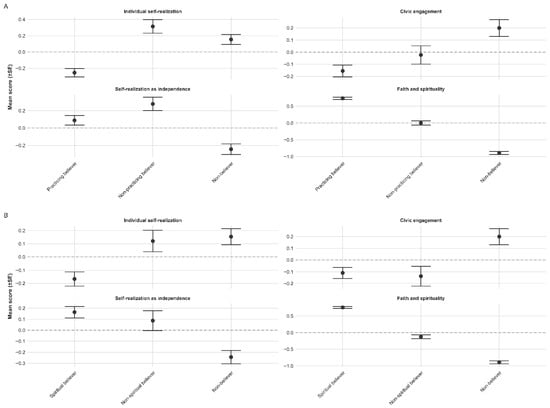
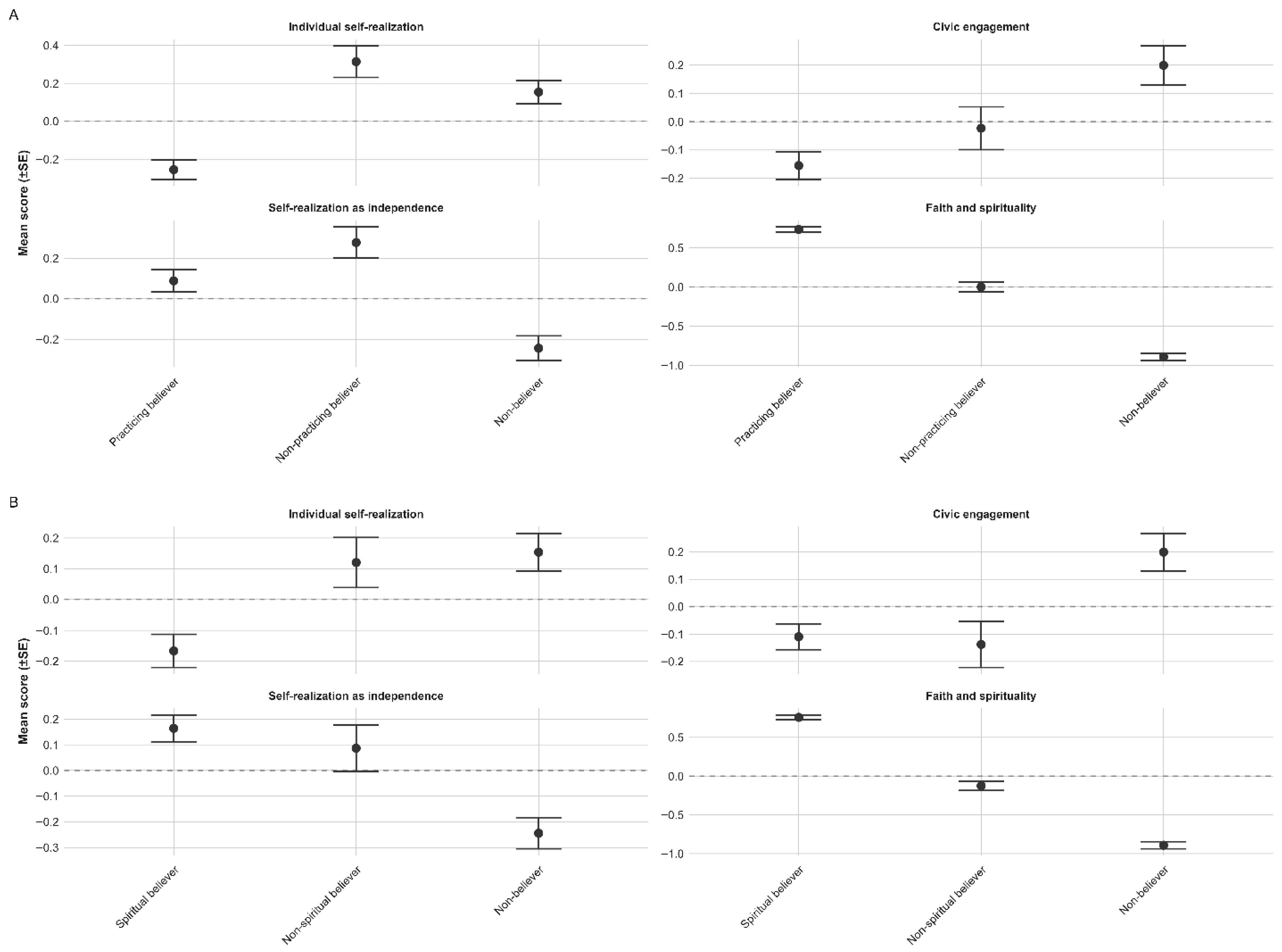
Looking at the first component—individual self-realization—the highest mean is found among non-practicing believers (0.31), followed by non-believers (0.15) and non-spiritual believers (0.12). Practicing believers (−0.26) and spiritual believers (−0.17) display high but negative values, indicating that this value orientation is more prominent among those who potentially prioritize other dimensions than religious ones, or among those who, despite identifying as believers, do not define themselves as practicing and do not experience their faith in a spiritual way. Both associations are statistically significant (p < 0.001), though the effect sizes remain modest (η2 = 0.056 for the practicing/non-practicing dimension; η2 = 0.024 for the spiritual dimension).
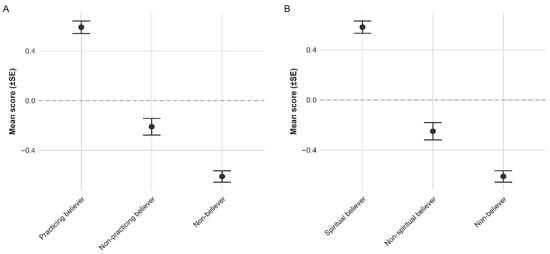
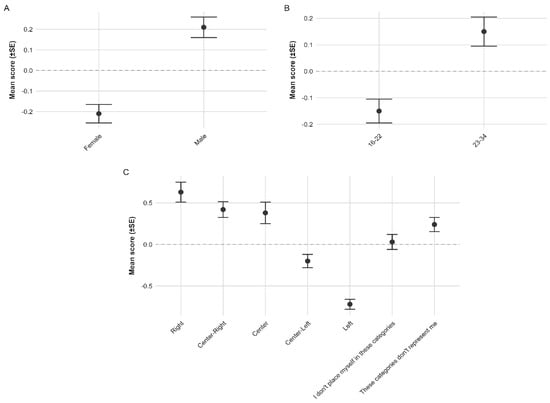
About civic engagement—comprising politics, social involvement, culture, and human rights—non-believers show the highest values (0.20), suggesting a possible closer affinity with secular and political forms of civic participation. Non-practicing believers are positioned around zero, while practicing believers, non-spiritual believers, and spiritual believers fall well below this threshold, as illustrated in Figure 1A, B. Here too both associations are significant (p < 0.001), with small effect sizes (η2 = 0.026 and η2 = 0.023, respectively).
Figure 1.
Analysis of variance of the groups “belief and practice” (A) and “belief and spirituality” (B) across the dimensions of subjective self-realization, civic engagement, self-realization as independence and faith and spirituality.
In the dimension of self-realization and independence, the highest values are again found among non-practicing believers, who reach a mean of 0.28, indicating a stronger tendency toward forms of self-realization pursued autonomously. Practicing believers and non-spiritual believers show more moderate values (both 0.09), suggesting a weaker association with this dimension. Spiritual believers score slightly higher (0.16), while non-believers present a negative value (−0.24), pointing to a lower association between the absence of religious belief and this form of personal independence. Here again both associations are significant (p < 0.001), with modest effect sizes (η2 = 0.040 and η2 = 0.036). Considering the elements that compose this dimension—starting one’s own family, romantic relationships, work, and family life—it emerges that those who maintain some form of belief, particularly non-practicing believers, attribute greater importance to forms of self-realization that combine personal independence with the construction of meaningful relationships. This group appears to value both affective and family-related aspects and those linked to work, integrating them into a trajectory of individual growth less bound to traditional religious practice.
The final component—faith and spirituality—shows a very clear distinction between groups. Practicing believers and spiritual believers display the highest values (0.74 and 0.76), indicating a strong centrality of the religious and spiritual dimension in their lives. Non-practicing believers are positioned at a neutral value (0.00), reflecting an identity-based form of belief that does not translate into practice or deep spiritual involvement. Non-spiritual believers show a slightly negative value (−0.12), suggesting distance from the spiritual dimension despite maintaining a religious reference. Finally, non-believers score strongly negative values (−0.89 on both scales), confirming a clear estrangement from value orientations linked to faith and spirituality. This is by far the dimension most strongly structured by religious identification: both relations are highly significant (p < 0.001), and the effect sizes are markedly large (η2 = 0.537 and η2 = 0.563), indicating that faith and spirituality represent the value axis most sharply differentiating the groups under study.
Overall, the analysis shows that the different ways of relating to faith structure clearly distinct value systems. Practicing believers and spiritual believers consistently position themselves on the components linked to the religious and inner dimension, while appearing less oriented toward individualistic and civic values. Non-practicing believers emerge as the most balanced and autonomous group, with strong attention to affective ties and the construction of their personal life, and with the highest scores in independent self-realization. Non-believers, finally, stand out for a secular orientation centered on well-being, rights, and civic participation, and for a marked distance from anything related to faith and spirituality. Taken together, these profiles outline coherent and differentiated value trajectories that reflect the role of religiosity—lived, attenuated, or absent—in shaping young people’s life priorities.
6. Civic, Social, and Political Participation
The second dimension used to examine what distinguishes young practicing believers, spiritual believers, and non-believers is that of participation. A PCA was also conducted for this dimension. However, looking first at the bivariate level (see Table 6), focusing on the response category related to regular participation, we observe non-negligible patterns across the groups.
Table 6.
Participation Practices by Belief and Religious Practice, and by Belief and Spirituality *.
At first glance, a marked polarization emerges in participation in faith-based groups and volunteering, which is significantly more intense among practicing and spiritual believers. In religious groups, for example, 82.4% of practicing believers and 76.8% of spiritual believers participate regularly, while the share among non-believers is minimal (4.0%). In volunteering, regular participation is more moderate: 27.6% among practicing believers and 26.1% among spiritual believers, while it remains very low among non-believers (5.5%). Conversely, non-believers show more substantial participation in political and student groups (11.7% and 13.2%), confirming the greater centrality of these domains for those not embedded in forms of faith.
Cultural and sports associations, by contrast, display a more transversal and inclusive profile: regular participation is distributed relatively evenly across believers and non-believers, with comparable values among practicing believers (10.9% in cultural associations, 32.3% in sports associations), spiritual believers (12.6% and 28.9%), and non-believers (13.2% and 27.4%). Non-practicing and non-spiritual believers show slightly lower, yet still meaningful, percentages, indicating that in these contexts the link with religious affiliation is less decisive.
Overall, the data suggest that while confessional or political forms of participation tend to be strongly polarized according to religiosity, cultural and sports associations constitute more inclusive settings in which value-based belonging plays a less significant role in shaping regular participation. Together, these dimensions show a Cronbach’s α = 0.444 (std. α = 0.497 on standardized items; F = 134.147, p < 0.001). The low internal consistency confirms that these items do not converge on a single underlying dimension, which is theoretically expected. For this reason, rather than treating them as a unidimensional scale, we performed a PCA to identify the latent structure of the data and to allow for the possibility of multiple distinct components emerging from the analysis.
The PCA identifies two synthetic dimensions that together account for 55.5% of the total variance (KMO = 0.603; Bartlett’s test of sphericity: χ2 (d.f. 15) = 522.883, p < 0.001), confirming the factorability of the correlation matrix, albeit with a marginal sampling adequacy. The first, labeled civic and associative participation, captures modes of involvement in student associations (0.770), political groups, trade unions and collectives (0.725), as well as cultural and artistic associations (0.671) and sports associations (0.556), accounting for 31.7% of the variance (λ = 1.9). The second extracted component, which explains 23.8% of the variance (λ = 1.43), reflects participation in religious associations and/or faith-based pathways, social and welfare volunteering groups of either secular or religious inspiration, and sports associations. This latter component has been labeled solidaristic and religious engagement.
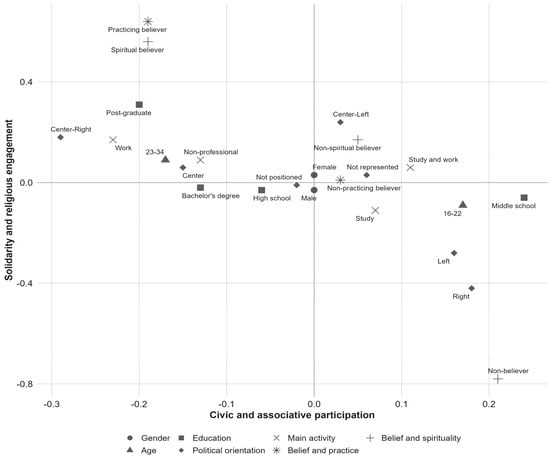
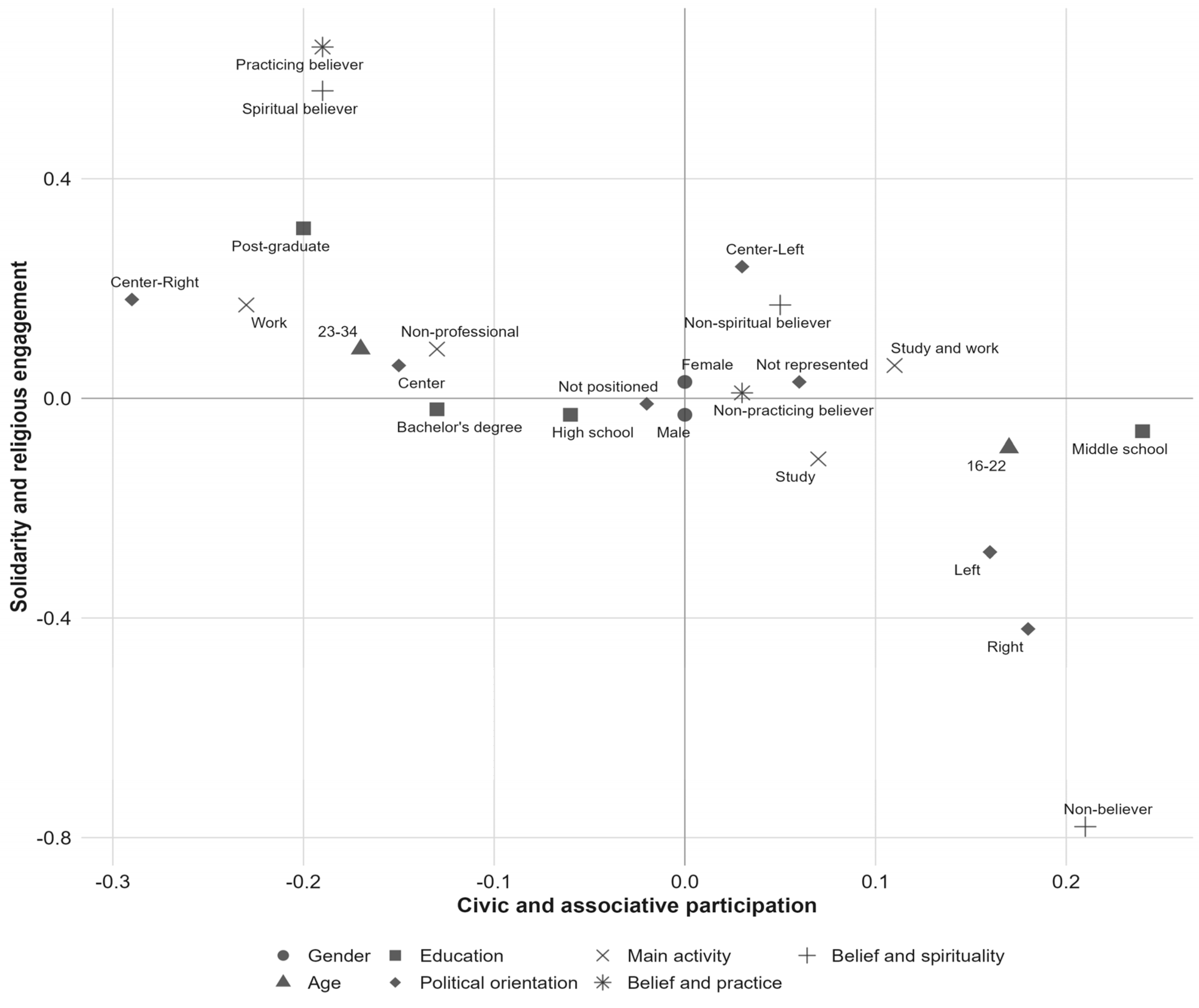
Following a configurational approach (Di Franco and Marradi 2013), we placed the first component on the x-axis and the second on the y-axis. This allowed us to project the mean scores on both dimensions and obtain profiles that, in addition to religious practice and spirituality, synthetically incorporate other ascriptive and achieved characteristics.
The factorial plane highlights a clear structuring of profiles. In the upper-left quadrant we find practicing believers and spiritual believers (p < 0.001 for both components), associated with higher levels of solidaristic and religious engagement, alongside profiles marked by greater biographical and institutional stability—such as holding a postgraduate degree (p < 0.001 on civic participation; p < 0.05 on solidaristic engagement), being employed (p < 0.01 and p < 0.05), and centrist or center-right political orientations (p < 0.05 on civic participation; p < 0.001 on solidaristic engagement).
Conversely, in the lower-right quadrant non-believers emerge (p < 0.001), clearly separated along the second component and associated with forms of participation that are less religiously connoted but more closely aligned with defined political orientations, both left- and right-leaning (p < 0.05 on the first component; p < 0.001 on the second), as well as with younger age profiles (16–22 years) (p < 0.001 on civic participation; p < 0.05 on solidaristic engagement).
In an intermediate position, close to the origin of the axes, we find non-practicing believers and non-spiritual believers (p < 0.001), together with modalities that point to transitional or less structured conditions, such as being a student (p < 0.01; p < 0.05), lacking a political orientation (p < 0.05; p < 0.001), and holding a high-school diploma (p < 0.001; p < 0.05). These patterns suggest less polarized and more ambivalent profiles. Among all variables, gender differences are not significant.
Overall, the plot depicts a social space in which the dimensions of participation and engagement combine according to statistically grounded configurations, showing that religious affiliations do not operate in isolation but systematically intertwine with life trajectories, educational resources, and political-value orientations (see Figure 2).
Figure 2.
Projection of illustrative categories onto the two participatory dimensions.
7. Practice, Spirituality, and Contemporary Social Practices
To further distinguish what characterizes the young people in the sample on the basis of religious practice and spirituality, respondents were asked what they considered acceptable or unacceptable among a set of practices known to be sensitive topics in debates on sexuality and sexual relations, such as end-of-life issues (Gysels et al. 2012) or those on medically assisted procreation (Viviani 2021) or the legitimacy of homosexual relationships (Synod.va 2025).
As before, examining the bivariate percentages of total rejection of the various practices across the groups of interest reveals clearly distinctive patterns along the lines of religious practice and spirituality (see Table 7).
Table 7.
Social Practices by Belief and Religious Practice, and by Belief and Spirituality *.
First, practicing believers show the highest levels of rejection for practices that are ethically and socially controversial from a religious standpoint, particularly cloning (60.2%), surrogacy (44.7%), abortion (32.8%), and euthanasia/end-of-life decisions (35.2%), while displaying relatively greater acceptance of more widespread or socially normalized practices such as contraception (5.4%).
Non-practicing believers tend to show generally lower levels of rejection, with only moderate peaks for cloning (25.9%) and surrogacy (12.2%), suggesting greater flexibility with respect to traditional religious norms.
Among spiritual believers, the patterns partly mirror those of practicing believers, with marked rejection of surrogacy (44.9%), abortion (31%), and euthanasia (34.1%), but they show more moderate values for other ethically sensitive practices, indicating a selectivity grounded more in spiritual considerations than in ritual practice.
Non-believers, finally, consistently display the lowest levels of total rejection across nearly all practices, confirming a more secular and tolerant outlook. Their highest rejection rates concern only a few practices that remain strongly contested socially (gender transition, 15.4%) or are still less culturally integrated.
A clear transversal pattern emerges in the distinction between biotechnology and bodily intervention practices (cloning, surrogacy, assisted reproduction), for which rejection levels are highest among practicing and spiritual believers, and practices related to sexuality and interpersonal relationships (sex before marriage, casual sex, same-sex marriage), where group polarization is more pronounced but non-believers show markedly greater acceptance.
These findings suggest that religious affiliation and ritual practice significantly shape the moral acceptance of bioethical and sexual practices, while spirituality—though influential—tends to operate through a more nuanced selectivity, and non-belief is generally associated with a more inclusive and permissive stance.
In this case the Cronbach’s α of the battery of items is very high (Cronbach’s α = 0.935; std. α = 0.938; F = 181.74; p < 0.001) and, on this set of items (excluding only the cloning item due to number of answers refused), we run a PCA from which a single component emerged, explaining 63% of the total variance (λ = 5.7; KMO = 0.911; Bartlett’s test of sphericity: χ2 (d.f. 36) = 4693.564, p < 0.001), indicating excellent sampling adequacy and strong intercorrelations among the items. This component shows high loadings on all items, indicating that evaluations of the acceptability of sexual, bioethical, and gender-related practices align along a single latent dimension, interpretable as a continuum of openness versus moral rejection. Component loadings are as follows: abortion (0.878), euthanasia and end-of-life decisions (0.821), assisted reproduction (0.803), gender transition (0.796), same-sex marriage/civil unions (0.791), casual sexual relations (0.772), surrogacy (0.772), sex before marriage (0.766), and contraception (0.760).
The result suggests that, despite the heterogeneity of the topics considered, respondents’ perceptions follow a coherent pattern that can be traced back to a general indicator of ethical attitudes toward socially relevant practices. On this index, higher negative values correspond to greater acceptability, whereas positive and increasing values indicate higher levels of unacceptability.
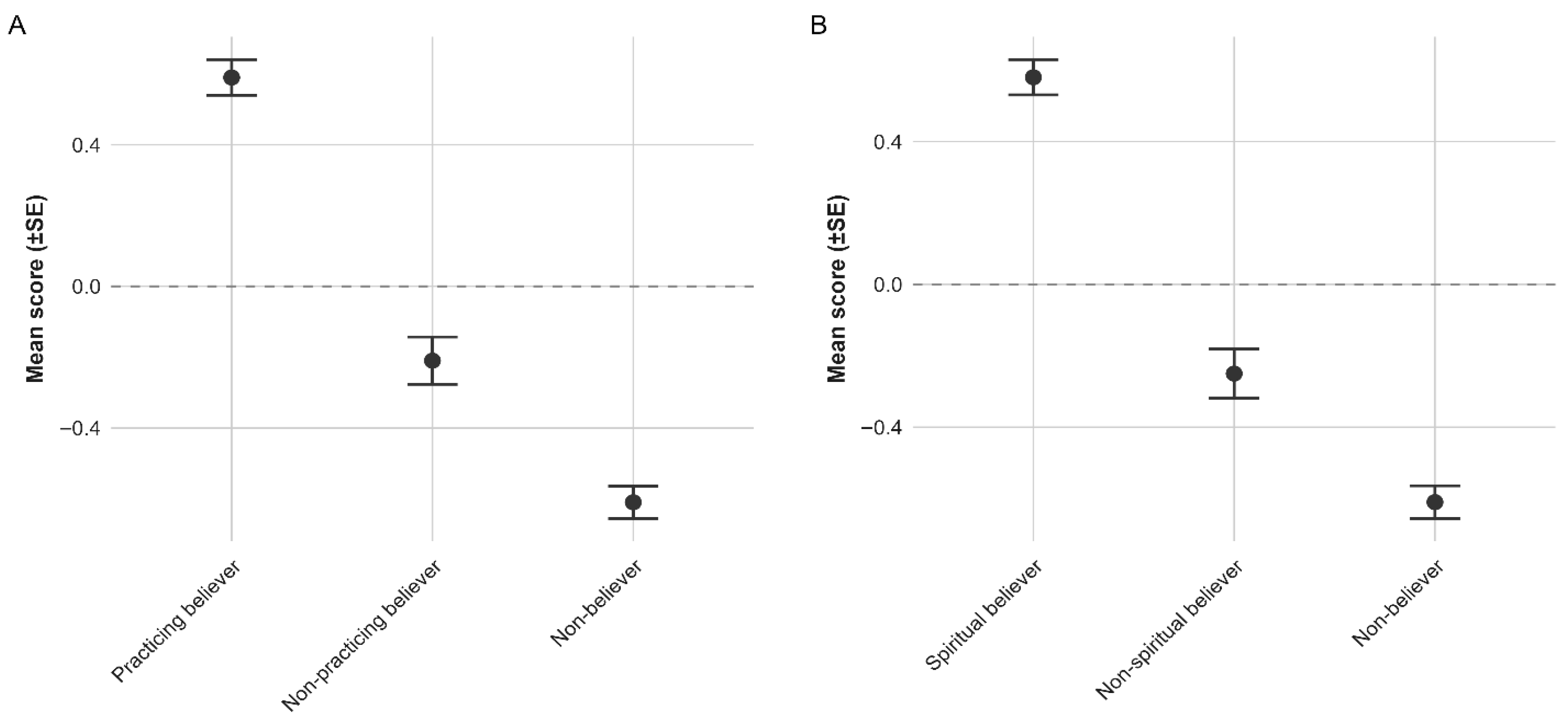
The analysis of mean component scores shows that practicing believers and spiritual believers register positive and relatively high values (0.59 and 0.58, respectively), expressing an overall more restrictive orientation and a stronger tendency to consider the practices examined as unacceptable. This suggests that adherence to active or interiorized forms of religiosity is associated with more rigid moral judgments on the issues addressed in the battery. Conversely, non-believers display clearly negative mean values (−0.61), indicating greater openness and acceptability of these practices. This position reflects a value orientation less bound to religious or traditional references, consistent with a more liberal and individualized reading of the behaviors under examination.
Intermediate groups—non-practicing believers and non-spiritual believers—show moderately negative values (−0.21 and −0.25), outlining a moderate stance: while distancing themselves from more structured religious or spiritual practices, they maintain a certain evaluative caution, without reaching either the rigidity of more involved believers or the high openness of non-believers. Both associations are highly significant (p < 0.001) and yield the largest effect sizes observed across all dimensions analyzed, with η2 = 0.305 for the practicing/non-practicing dimension and η2 = 0.307 for the spiritual one, indicating that moral evaluations represent the value axis most sharply and consistently structured by religious identification (see Figure 3).
Figure 3.
Mean Scores of the “Belief and Practice” (A) and “Belief and Spirituality” (B) Groups on the Index of Practice Unacceptability.
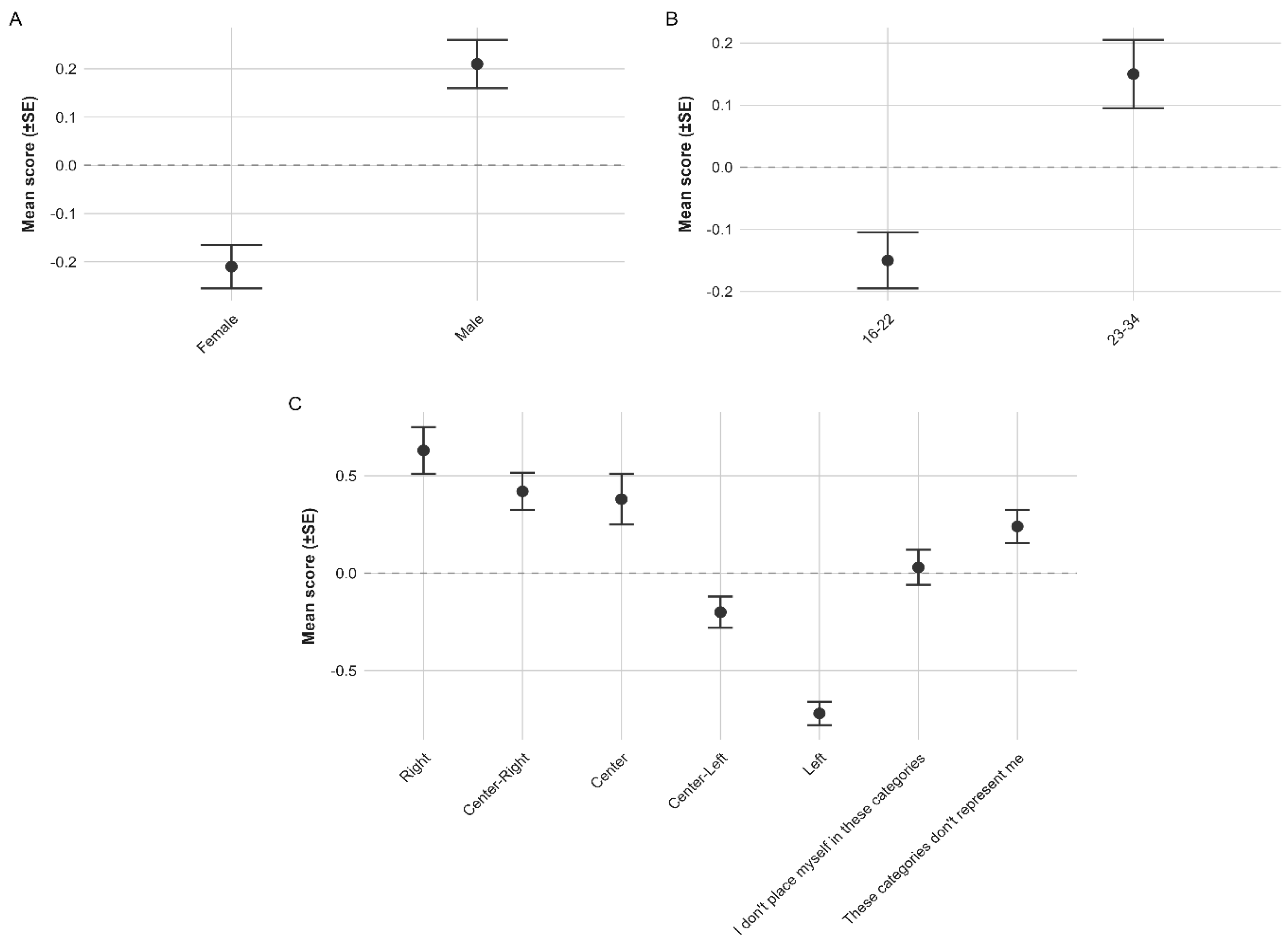
Alongside the religious and spiritual dimension, significant differences also emerge in relation to respondents’ demographic and social characteristics. Men display, on average, higher levels of unacceptability than women (p < 0.001, η2 = 0.043), as do individuals aged 23–34, who appear overall more “resistant” than younger respondents (p < 0.001, η2 = 0.022). In terms of political orientation (p < 0.001, η2 = 0.186), greater resistance is concentrated among those who position themselves on the right and center of the political spectrum, whereas more open attitudes are observed among center-left and left-leaning respondents. Individuals who do not place themselves politically show values close to zero, situating them in an intermediate position consistent with a less polarized evaluative profile.
This component highlights a clear polarization along the axis of religiosity and spirituality, which emerges as a central factor in shaping moral judgments regarding sexual, reproductive, and bioethical practices. It interacts with socio-demographic and political variables in defining distinct profiles of social acceptability (see Figure 4).
Figure 4.
Mean Scores by Gender (A), Age (B), and Political Orientation (C) on the Index of Social Practice Unacceptability.
8. Discussion
Starting from the analytical aims of the paper (examining the value systems and practices of young people in the Roman context), the findings clearly suggest that religious practice, belief, and spirituality should not be treated as purely individual attributes. Rather, they operate as structuring principles of broader social and value configurations. They cut across value systems, forms of participation, and moral judgments, contributing to the organization of the space of positions and belongings. In this sense, religiosity does not function merely as a residual or declining cultural trait. Instead, it emerges as a generative dimension capable of organizing meaning and action within differentiated social contexts. Through such spaces, young people can actively construct their own narrative maps (Mercier et al. 2023).
Far from mapping a straightforward linear continuum between belief and non-belief (or believers from non-believers), the data reveal a differentiated field in which the various ways of relating religious experience to different value spheres are reconfigured. This configuration aligns with a growing body of international research showing that contemporary religiosity is better understood as a multidimensional and internally differentiated domain, rather than as a binary opposition between the religious and the secular. Similar patterns have been observed across European and North American contexts, where the decline of institutional affiliation coexists with the persistence, or even expansion, of subjective and individualized forms of spirituality (Madge et al. 2014; Petrović et al. 2024; Ugolini et al. 2025).
Within this framework, practicing believers and spiritual believers emerge as groups characterized by strong symbolic and, albeit in different forms, institutional integration (Madge et al. 2014). On the one hand, they attribute high salience to values centred on faith, inner searching, and family; on the other, they are more engaged in solidaristic and religious forms of participation and express more restrictive moral orientations regarding sexual, bioethical, and gender related issues. In these profiles, religiosity—whether expressed through practice or varying degrees of spirituality—appears as an ordering principle capable of connecting value, participatory, and normative dimensions within a relatively stable and integrated framework.
More broadly, this pattern resonates with comparative evidence showing that religiosity tends to function as a source of normative coherence, particularly in domains where moral regulation is culturally and politically contested. In this sense, religious and spiritual orientations can be seen as interpretive frameworks that help stabilize moral judgments in contexts characterized by pluralism and uncertainty. This is particularly evident in the domain of bioethical and sexual practices, where the data show a clear polarization between more religiously integrated profiles and more secular ones. Indeed, the international literature suggests that in more religious contexts, especially where politics and religion are grounded in the same values, there tends to be greater reticence toward more contemporary issues, even when individual-level variables are considered, as demonstrated by the comparative study by Verbakel and Jaspers (2010) on euthanasia. This pattern holds across different Christian denominations: among Orthodox Christian female students in Serbia, for instance, higher religiosity consistently predicted greater rejection of abortion, same-sex marriage, and euthanasia, with the spirituality dimension proving a stronger predictor of moral attitudes than the behavioral one, suggesting that it is the internalized, experiential dimension of faith, rather than mere ritual observance, that most decisively shapes moral orientations (Petrović et al. 2024). A study on religiosity and value orientations in Portugal, a catholic country, (Carneiro et al. 2021) arrives at similar conclusions, though the impact of religiosity appears to be more attenuated. The findings that resonate closely with our own results. Practicing and spiritual believers—more specifically, those for whom faith is primarily lived as an inner experience rather than as an institutional habit—display the most restrictive stances across the full range of bioethical and sexual practices examined. However, our data reveal a gender-based difference in orientation among young believers. This divergence warrants further investigation in order to better understand gender positioning, which previous studies have identified as a particularly fruitful line of research (Crespi and Ruspini 2014).
Extending the lens to cross-national comparisons across Mediterranean systems, research consistently shows that the relationship between religiosity and attitudes toward morally sensitive issues is far from uniform. Rather, it varies with the degree of religion’s institutional embeddedness and with how it intersects with national political cultures.
This complexity is particularly evident even within Catholic Southern Europe. A comparative study of university students in Italy, Croatia, and Greece (Tutić Grokša et al. 2025) shows that, despite a shared Mediterranean context and a partially common Catholic heritage, significant differences persist in attitudes toward abortion and euthanasia. Notably, Italian students exhibit comparatively greater openness than their Croatian and Greek counterparts—a divergence that can be partly explained by cross-national variation in the extent to which religious identity remains intertwined with political institutions and public discourse in each country.
These variations indicate that religiosity operates within specific national and cultural configurations, interacting with political traditions, welfare regimes, and public discourses. In this respect, the Roman case adds an important contribution, as it highlights how these dynamics unfold in a context where religious symbolism is particularly dense and institutionally visible.
Non-practicing believers, by contrast, occupy a more intermediate and less polarized position. They combine a lower centrality of the religious dimension with a strong investment in affective ties, personal self-realization, and the construction of their own life trajectory, positioning themselves as the group most oriented toward forms of individual autonomy. This configuration is also reflected in their moral judgments and participation patterns, which appear more flexible and selective, pointing to an attenuated and renegotiated relationship with the religious sphere—one that is better described as pluralized than as simply weakened or residual.
From a broader theoretical perspective, these intermediate profiles can be interpreted as expressions of a “liminal” religiosity, situated between institutional belonging and individual autonomy. Rather than representing transitional or unstable positions, they appear as relatively coherent configurations, characterized by selective appropriation of religious meanings and practices. This finding aligns with research on individualized religion, which emphasizes the role of agency, reflexivity, and biographical choice in shaping contemporary forms of belief. In this sense, non-practicing believers do not simply reflect disengagement from religion, but rather a rearticulation of religious resources within personalized frameworks of meaning.
This interpretation is consistent with recent psychological research showing that religiosity and spirituality constitute distinct yet intersecting identity configurations, each associated with specific experiential, motivational, and value profiles. In Italian research, Ugolini et al. (2025), demonstrate that “religious and spiritual,” “spiritual but not religious,” “religious but not spiritual,” and “neither religious nor spiritual” individuals differ markedly in the centrality of religion, spiritual orientations, and life motives. Notably, spirituality (whether combined with religiosity or expressed outside institutional frameworks) emerges as a strong source of meaning, self-realization, and experiential engagement. These findings reinforce the idea, also evident in our data, that spirituality functions as an autonomous dimension of value construction, capable of shaping moral orientations and participatory styles even when institutional religiosity is weak or absent.
At the opposite end, non-believers stand out for a distinctly secular profile, marked by a strong distance from the values of faith and spirituality and by greater openness toward socially controversial practices. Their value orientation centres on wellbeing, rights, health, and civic participation, while their forms of engagement tend to shift toward non-confessional political and associative domains (Tatala et al. 2024). In this group, religion loses its symbolic and normative reference function, leaving room for more individualized and secularized evaluative criteria.
However, rather than interpreting this profile simply in terms of absence or decline, it can be more productively understood as the emergence of alternative moral and civic frameworks. In line with findings from other European contexts, non-belief is often associated not with disengagement from collective life, but with different modes of participation and different normative foundations, frequently centred on rights, equality, and individual autonomy (Berkers and Sieben 2020; Moniz 2023). In this sense, secular orientations do not imply a vacuum of meaning, but the presence of distinct and coherent value systems.
These configurations do not distribute randomly within the youth population but intersect systematically with biographical and social variables (Mercier et al. 2023). Age, gender, and political orientation contribute to reinforcing or attenuating the observed polarizations (in a bidirectional relationship): the greater moral rigidity found among men and young adults, as well as the association between center-right political positions and more restrictive judgments, indicate that religious affiliations operate in interaction with other dimensions of social identity rather than in isolation. This intersectional pattern is consistent with international research highlighting how religiosity is embedded within broader configurations of social stratification, political culture, and life course trajectories.
The resulting picture is that of a structured social space in which religiosity, spirituality, and non-belief define different modes of integration, participation, and moral orientation. Rather than drawing a simple boundary between believers and non-believers, these dimensions delineate differentiated value trajectories that reflect contemporary transformations in the relationship between religion, individualization, and social practices among young people.
This interpretation is further reinforced by evidence from other Southern European contexts. Research on university students in Greece shows that religiosity—together with interpersonal trust and political ideology—significantly increases the likelihood of civic engagement, particularly in activities such as volunteering, associationism, and community participation. At the same time, the study highlights that students who are less religious and politically left-oriented also display higher levels of civic involvement, especially in forms of political voice such as protesting and petition signing, which are more strongly endorsed within left-wing political cultures. These findings align with our results, confirming that religiosity functions as a multidimensional principle structuring values, participation, and orientations toward the public sphere, while non-belief and left-oriented political identities constitute alternative configurations of engagement grounded in secular, rights-based, and participatory value systems. In both cases, the effects of these orientations are embedded within broader configurations of social identity, contributing to differentiated trajectories of civic and moral participation among young people (Arvanitidis 2017).
Another research (Aksoy and Wiertz 2024) shows that religiosity operates as a multidimensional structuring principle that extends beyond moral orientations to encompass cooperative dispositions and civic behaviours. Longitudinal evidence from the UK demonstrates that religious service attendance positively predicts generalized trust, volunteering, and perceived cooperativeness, even after accounting for time-invariant confounders and reverse causality. These findings reinforce the idea, also emerging from our data, that religiosity and spirituality do not function as isolated individual traits, but as components of wider configurations of social integration, shaping not only moral judgments but also orientations toward others and the public sphere. Notably, the heterogeneity observed across religious traditions in their study parallels the differentiated profiles identified here, further supporting the view that the effects of religiosity are embedded within specific cultural, institutional, and identity contexts.
Considering these results, the hypothesis of a society that is simply and linearly secularized appears only partially adequate: the results suggest not so much a progressive and uniform decline in the relevance of religion, but rather its differentiated recomposition within the social space (Ziebertz and Kay 2005). Secularization thus appears less like the dissolution of symbolic and normative references and more as the pluralization of forms of relating to the religious, within a segmented space in which belief, spirituality, and non-belief continue to play a significant role in structuring social and value positions. More broadly, this perspective suggests considering secularization as a context-dependent reconfiguration, shaped by institutional arrangements, cultural legacies, and individual trajectories across different societies.
9. Conclusions
Given the limitations associated with the sample used in this study, the findings nonetheless indicate that young people’s relationship with religion cannot be interpreted either in binary terms or as the simple outcome of a linear process of secularization. Religious practice, belief, and spirituality instead emerge as dimensions capable of structuring coherent values and moral configurations, translating into differentiated modes of participation and social integration. In line with the literature on the subjective turn (Heelas and Woodhead 2005), the personalization of religious experience does not coincide with its marginalization; rather, it takes on plural forms ranging from the selective reworking of traditions to markedly secular orientations.
The empirical profiles identified show that, alongside groups characterized by integrated and normatively oriented religiosity, there are intermediate positions and more individualized modes of relating to the sacred, as well as structured and value-consistent configurations of non-belief (Mercier et al. 2023). The two classificatory dimensions—practice and spirituality—are analytically productive precisely because they reveal this internal heterogeneity, bringing to light intermediate profiles whose value orientations, participatory patterns, and moral judgments would remain obscured within a simpler classificatory scheme. This finding carries important methodological implications: the choice of classificatory dimensions is not neutral, but actively shapes what becomes visible in the data and what remains concealed.
In this sense, secularization appears less as a uniform decline of religion and more as a differentiated reconfiguration of the symbolic space within which young people exercise their agency in constructing trajectories of meaning (McNamara Barry et al. 2010), belonging, and moral orientation.
The profiles identified are not randomly distributed within the youth population: they intersect systematically with biographical variables such as age, gender, and political orientation, suggesting that religious and secular trajectories are co-constructed alongside other dimensions of social identity. This finding resonates with key themes in Italian sociology of religion and points to several directions for further investigation. First, it would be useful to explore—through appropriate qualitative approaches—how the interplay between spirituality and religious practice operates as a principle structuring social action within each profile, and how individuals themselves narrate the relationship between institutional belonging and personal meaning-making. Second, extending the analysis to participants residing in other urban and non-urban contexts would make it possible to discern the specific effects of the Roman metropolitan environment and to understand how different spatial configurations shape religious subjectivities and modes of engagement. Finally, the fluid character of the profiles raises broader questions about interfaith dialogue among young people: does reduced institutional embeddedness foster more horizontal, dialogic forms of interaction, or does it weaken the identity awareness that facilitates meaningful exchange? Future research, ideally based on probabilistic and longitudinal designs, could further explore how these configurations evolve across biographical transitions and in comparative urban contexts, shedding light on the long-term dynamics through which religious and spiritual identities are formed, negotiated, and transformed.
Author Contributions
Conceptualization, M.B., A.C. and O.G.; methodology, M.B., A.C. and O.G.; software, M.B.; validation, M.B.; formal analysis, M.B. and A.C.; investigation, M.B., A.C. and O.G.; resources, M.B., A.C. and O.G.; data curation, M.B.; writing—original draft preparation, M.B., A.C. and O.G.; writing—review and editing, M.B., A.C. and O.G.; visualization, M.B.; supervision, A.C. and O.G.; project administration, A.C.; funding acquisition, M.B., A.C. and O.G. All authors have read and agreed to the published version of the manuscript.
Funding
This research received no external funding.
Institutional Review Board Statement
The study was conducted in accordance with the Declaration of Helsinki. The data were collected anonymously and used solely for research purposes in accordance with the General Data Protection Regulation (GDPR-2016/679) adopted by the European Union, and in compliance with Italian legislation (L. 675/96 and D.Lgs. 101/2018) governing the processing of personal data in these areas. Consequently, the data were collected and stored anonymously, voluntary participation in the survey was ensured, the survey was conducted in complete anonymity, and all data were protected.
Informed Consent Statement
Informed consent was obtained from all subjects involved in the study.
Data Availability Statement
The data supporting the findings of this study are not publicly available due to privacy restrictions. Data may be obtained from the corresponding authors upon reasonable request.
Conflicts of Interest
The authors declare no conflict of interest.
References
- Aksoy, Ozan, and David Wiertz. 2024. The impact of religious involvement on trust, volunteering, and perceived cooperativeness: Evidence from two British panels. European Sociological Review 40: 143–59. [Google Scholar] [CrossRef] [Scilit]
- Ammerman, Nancy. 2014. Sacred Stories, Spiritual Tribes. Finding Religion in Everyday Life. New York: Oxford University Press. [Google Scholar]
- Ammerman, Nancy. 2020. Rethinking religion: Toward a practice approach. American Journal of Sociology 126: 6–51. [Google Scholar] [CrossRef] [Scilit] [PubMed]
- Appadurai, Arjun. 2013. The Future as Cultural Fact: Essay on the Global Condition. London: Verso. [Google Scholar]
- Arvanitidis, Paschalis A. 2017. The concept and determinants of civic engagement. Human Affairs 27: 252–72. [Google Scholar] [CrossRef] [Scilit]
- Berger, Peter L. 2014. The Many Altars of Modernity: Toward a Paradigm for Religion in a Pluralist Age. Boston: De Gruyter Mouton. [Google Scholar]
- Berkers, Eline, and Inge Sieben. 2020. The atheistic factor? Explaining the link between atheistic beliefs and child-rearing values in 30 countries in Europe. European Societies 22: 4–25. [Google Scholar] [CrossRef] [Scilit]
- Bichi, Rita, and Paola Bignardi, eds. 2015. Dio a Modo Mio. Giovani e Fede in Italia. Milano: Vita e Pensiero. [Google Scholar]
- Carifio, James, and Rocco Perla. 2008. Resolving the 50-year debate around using and misusing Likert scales. Medical Education 42: 1150–52. [Google Scholar] [CrossRef] [Scilit]
- Carneiro, Ana, Hélder Fernando Pedrosa e Sousa, Maria Alzira Pimenta Dinis, and Ângela Leite. 2021. Human Values and Religion: Evidence from the European Social Survey. Social Sciences 10: 75. [Google Scholar] [CrossRef] [Scilit]
- Casanova, José. 1994. Public Religions in the Modern World. Chicago: University Press of Chicago. [Google Scholar]
- Casanova, José. 2019. Global Religious and Secular Dynamics. Leiden: Brill. [Google Scholar]
- Casavecchia, Andrea, Alba Francesca Canta, and Benedetta Turco. 2024. The Active and Critical Participation: A Study on Belonging and Believing Among Young Catholics in Rome. Religions 15: 1389. [Google Scholar] [CrossRef] [Scilit]
- Cipriani, Roberto. 2011. Diffused religion and civil society in Italy. Italian Sociological Review 1: 10. [Google Scholar] [CrossRef] [Scilit]
- Collins-Mayo, Silvia. 2012. Youth and religion. An international perspective. Zeitschrift für Religionspädagogik 11: 80–94. [Google Scholar]
- Crespi, Isabella, and Elisabetta Ruspini, eds. 2014. Genere e Religioni in Italia. Voci a Confronto. Milano: FrancoAngeli. [Google Scholar]
- Cusack, Carole. 2011. Some recent trends in the study of religion and youth. Journal of Religious History 35: 409–18. [Google Scholar] [CrossRef] [Scilit]
- Davie, Grace. 2021. Religion, secularity, and secularization in Europe. In The Oxford Handbook of Religion and Europe. Edited by Grace Davie and Lucian Leustean. Oxford: Oxford University Press, pp. 268–84. [Google Scholar]
- Davie, Grace. 2023. Revisiting secularization in light of growing diversity: The European case. Religions 14: 1119. [Google Scholar] [CrossRef] [Scilit]
- Di Franco, Giovanni, and Marradi Alberto. 2013. Factor Analysis and Principal Component Analysis. Milano: FrancoAngeli. [Google Scholar]
- Garelli, Franco. 2007. Research Note between Religion and Spirituality: New Perspectives in the Italian Religious Landscape. Review of Religious Research 48: 318–26. Available online: https://www.jstor.org/stable/20447447 (accessed on 14 April 2026).
- Garelli, Franco. 2011. Religione all’Italiana. L’Anima del Paese Messa a Nudo. Bologna: Il Mulino. [Google Scholar]
- Genova, Carlo. 2022. Young Activists in Catholic Groups. Meanings of Participation Across the Boundaries of the Religious Field. Italian Sociological Review 12: 501–21. [Google Scholar] [CrossRef]
- Gysels, Marjolein, Natalie Evans, Arantza Meñaca, Andrew Erin, Franco Toscani, Sylvia Finetti, H. Roeline Pasman, Irene Higginson, Richard Harding, and Robert Pool. 2012. Culture and End of Life Care: A Scoping Exercise in Seven European Countries. PLoS ONE 7: e34188. [Google Scholar] [CrossRef] [Scilit]
- Heelas, Paul, and Linda Woodhead. 2005. The Spiritual Revolution: Why Religion Is Giving Way to Spirituality. Hoboken: Blackwell Publishing. [Google Scholar]
- Hervieu-Léger, Danielle. 1999. Le pèlerin et le Converti. La Religion en Mouvement. Paris: Flammarion. [Google Scholar]
- Løøv, Margarethe. 2016. Quantitative Approaches to New Religions. In The Oxford Handbook of New Religious Movements. Oxford: Oxford University Press, vol. II, p. 72. [Google Scholar]
- Madge, Nicola, Hemming Peter, and Stenson Kevin. 2014. Youth on Religion: The Development, Negotiation and Impact of Faith and Non-Faith Identity. London: Routledge. [Google Scholar]
- McNamara Barry, Carolin, Larry Nelson, Sahar Davarya, and Shirene Urry. 2010. Religiosity and spirituality during the transition to adulthood. International Journal of Behavioral Development 34: 311–24. [Google Scholar] [CrossRef] [Scilit]
- Mercier, Charles, Warren Jean-Philippe, and Kaell Hillary. 2023. Mapping the Field of Religion, Globalization and Youth Agency: Introduction. Social Sciences and Missions 36: 1–15. [Google Scholar] [CrossRef] [Scilit]
- Moniz, Jorge Botelho. 2023. Secularization in Europe: Causes, consequences, and cultural diversity. Religions 14: 423. [Google Scholar] [CrossRef] [Scilit]
- Norman, Geoff. 2010. Likert scales, levels of measurement and the “laws” of statistics. Advances in Health Sciences Education 15: 625–32. [Google Scholar] [CrossRef] [Scilit]
- Palmisano, Stefania, and Nicola Pannofino. 2017. So far and yet so close: Emergent spirituality and the cultural influence of traditional religion among Italian Youth. Social Compass 64: 130–46. [Google Scholar] [CrossRef] [Scilit]
- Petrović, Jelena R., Uroš V. Šuvaković, and Ivko A. Nikolić. 2024. The relationship between the level of religiousness of the Christian Orthodox female students of teachers’ education faculties in Serbia and their attitudes towards orthodox-moral issues. Religions 15: 809. [Google Scholar] [CrossRef] [Scilit]
- Rhemtulla, Mijke, Brosseau-Liard Patricia É., and Savalei Victoria. 2012. When can categorical variables be treated as continuous? A comparison of robust continuous and categorical SEM estimation methods under suboptimal conditions. Psychological Methods 17: 354–73. [Google Scholar] [CrossRef] [Scilit] [PubMed]
- Ricucci, Roberta, Luca Bossi, Marcello Cabria, and Renzo Carriero. 2024. Investigating Italian Religious Socialization Paths: Findings and Lessons from a Mixed-Methods Exercise. In Religious Change and Continuity Across Generations: Passing on Faith in Families of Six European and North American Nations. Edited by Merril Silverstein, Christel Gärtner and Maria T. Brown. London: Rowman & Littlefield-Lexington. [Google Scholar]
- Sbalchiero, Stefano, and Giuseppe Giordan. 2024. Youth, Spirituality, Religion, and the Categories in Between. Religions 15: 923. [Google Scholar] [CrossRef] [Scilit]
- Smith, Jesse. 2021. Transmission of faith in families: The influence of religious ideology. Sociology of Religion 82: 332–56. [Google Scholar] [CrossRef] [Scilit] [PubMed]
- Synod.va. 2025. Criteri Teologici e Metodologici per il Discernimento Condiviso di Questioni Dottrinali, Pastorali ed Etiche. Sinodo 2021–2025. Available online: https://www.synod.va/it/il-processo-sinodale/fase-3-l-implementazione/i-gruppi-di-studio/rapporti-intermedi/gruppo-9.html (accessed on 14 April 2026).
- Tatala, Malgorzata, Klamut Ryszard, and Timoszyk-Tomczak Celina. 2024. Personal Aspects of Religiosity and Civic Engagement: The Mediating Role of Prayer. Religions 15: 192. [Google Scholar] [CrossRef] [Scilit]
- Taylor, Charles. 2007. A Secular Age. Cambridge, MA: The Belknap Press of Harvard University Press. [Google Scholar]
- Tutić Grokša, Ivana, Ana Depope, Tijana Trako Poljak, Igor Eterović, Toni Buterin, Robert Doričić, Mariana Gensabella, Maria Laura Giacobello, Josip Guć, Eleni Kalokairinou, and et al. 2025. Students’ attitudes toward euthanasia and abortion: A cross-cultural study in three Mediterranean countries. BMC Medical Ethics 26: 9. [Google Scholar] [CrossRef] [Scilit]
- Ugolini, Caterina, Elisa Paluan, and Alberto Voci. 2025. Self-Categorizations in Terms of Religiosity and Spirituality: Associations with Religious Experiences, Spiritual Dimensions, and Motives in Life. Religions 16: 1513. [Google Scholar] [CrossRef] [Scilit]
- Vehovar, Vasja, Vera Toepoel, and Stephanie Steinmetz. 2016. Non-probability sampling. In The SAGE Handbook of Survey Methodology. Edited by Christof Wolf, Dominique Joye, Tom W. Smith and Yang-chih Fu. London: SAGE, pp. 329–45. [Google Scholar]
- Verbakel, Ellen, and Eva Jaspers. 2010. A comparative study on permissiveness toward euthanasia: Religiosity, slippery slope, autonomy, and death with dignity. Public Opinion Quarterly 74: 109–39. [Google Scholar] [CrossRef] [Scilit]
- Viviani, Debora. 2021. Nature Is No Longer a Horizon: Towards Limitless Gestational Performance? Italian Sociological Review 11: 551. [Google Scholar] [CrossRef]
- Voas, David. 2007. Surveys of Behaviour, Beliefs and Affiliation: Micro-Quantitative. In The SAGE Handbook of the Sociology of Religion. Thousand Oaks: Sage Publications Ltd., pp. 144–66. [Google Scholar]
- Wilkins-Laflamme, Sarah. 2023. Religion, Spirituality and Secularity Among Millennials: The Generation Shaping American and Canadian Trends. Abingdon: Routledge. [Google Scholar] [CrossRef] [Scilit]
- Woods, Ruth, and Ana Fernández. 2023. Uncertainty, reconstruction and resistance: Young adults’ responses to religious diversity in Spain and the UK. Religion 53: 224–45. [Google Scholar] [CrossRef] [Scilit]
- Ziebertz, Hans-Georg, and William K. Kay, eds. 2005. Youth in Europe: An International Empirical Study about the Impact of Religion on Life Orientation. Münster: LIT Verlag, vol. 3. [Google Scholar]

Disclaimer/Publisher’s Note: The statements, opinions and data contained in all publications are solely those of the individual author(s) and contributor(s) and not of MDPI and/or the editor(s). MDPI and/or the editor(s) disclaim responsibility for any injury to people or property resulting from any ideas, methods, instructions or products referred to in the content. |
© 2026 by the authors. Licensee MDPI, Basel, Switzerland. This article is an open access article distributed under the terms and conditions of the Creative Commons Attribution (CC BY) license.