


Abstract
A deep learning-based cyclic shift keying spread spectrum (CSK-SS) underwater acoustic (UWA) communication system is proposed for improving the performance of the conventional system in low signal-to-noise ratio and multipath effects. The proposed deep learning-based system involves the long- and short-term memory (LSTM) architecture-based neural network model as the receiving module of the system. The neural network is fed with the communication signals passing through known channel impulse responses in the offline stage, and then directly used to demodulate the received signal in the online stage to reduce the influence of the above factors. Numerical simulation and actual data results suggest that the deep learning-based CSK-SS UWA communication system is more reliable communication than a conventional system. In particular, the collected experimental data show that after preprocessing, when the communication rate is less than 180 bps, a bit error rate of less than 10−3 can be obtained at a signal-to-noise ratio of −8 dB.
1. Introduction
The underwater acoustic (UWA) channel is a dual-selective fading channel and has time-varying and space-varying characteristics, which brings difficulties to underwater information interaction based on the acoustic wave [1]. Direct-sequence spread spectrum (DSSS) communication technology has low spectrum density and strong resistance to multipath fading and the Doppler effect. Thus, it is widely used in UWA communication scenarios [2,3]. Compared with the conventional DSSS system, the cyclic shift keying spread spectrum (CSK-SS) modulation can provide a higher data rate. He et al. proposed a passive time reversal with CSK-SS using hyperbolic frequency-modulated (HFM) waveform for a reliable point-to-point UWA communication system [4]. Jing et al. proposed a novel interleave-division multiple access system based on CSK-SS modulation for multiuser UWA communications [5]. The communication rate of the above two systems is higher than that of the conventional DSSS communication system.
Recently, deep learning (DL) has received more and more attention as it can transform the original data features through multi-step feature conversion to obtain a higher and more slightly abstract feature representation, and further input to the prediction function to obtain the final result [6,7]. Due to the neural network models being able to easily solve credit assignment problems [8], the neural network model has become the main model used in DL. Many neural network models such as long- and short-term memory (LSTM) have been widely used in natural language processing [9,10,11]. In addition, DL is also good at discovering intricate structures in high-dimensional data, so it has gradually become widely used in acoustic signal processing and other fields [12,13,14,15].
At present, DL has been successfully applied in the field of communication, such as in orthogonal frequency division multiplexing (OFDM) communication systems. Ye et al. proposed a channel estimation and symbol detection method using a deep neural network in the OFDM communication system [16]. They pointed out that in OFDM wireless communication with complex channel distortion and interference, the DL-based method can solve the problem of channel distortion and detect transmission symbols. Gao et al. proposed a model-driven DL method, which combines DL with expert knowledge to replace the existing wireless OFDM communication receiver [17]. They explained that a bidirectional LSTM (BiLSTM) recurrent neural network could utilize the internal relationship of intersymbol interference (ISI) between sequence data. Zhang et al. proposed a DL-based OFDM UWA communication system, which replaces the receiving module in the conventional OFDM UWA communication system with the deep neural network (DNN) [18]. They pointed out that after the neural network has been sufficiently trained, the transmitted symbols can be recovered directly through the neural network. There is no need to use explicit channel estimation and equalization as in conventional UWA communication. However, there are few applications of DL in spread spectrum UWA communication. Qasem et al. proposed an autonomous underwater vehicles communication scheme based on DL coding index modulation spread spectrum (CIM-SS) [19]. In this system, the DNN model is used as the de-mapper to demodulate the baseband signal, avoids the deterioration in the performance of CIM-SS over long tap delay UWA channel, and improves the system data rate as well as the energy efficiency and the bit error rate (BER) performance.
For the spread spectrum communication system, the spreading gain will severely affect the communication rate of the DSSS UWA communication system. However, the CSK-SS UWA communication system uses a circular cyclic shift of the spreading sequence to carry the information, which breaks the limitation of spreading gain on data rate [4]. In the process of demodulation, the conventional CSK-SS system performs correlation processing on the received baseband signal and the local cyclic shifted spreading sequence during the demodulation process and selects the maximum correlation value for decision. The position of the peak value is the information modulated on the code phase to realize the recovery of the source information. However, it needs to be pointed out that the improvement of data rate comes at the expense of destroying the partial autocorrelation function (PACF) characteristics of the sequence in the DSSS system [20]. Due to the influence of the noise and UWA multipath fading channel, the size of the correlation peak in the demodulation process of the CSK-SS UWA communication system changes, resulting in inaccurate decision results, making demodulation results wrong and affecting the performance of the CSK-SS system.
Inspired by the application of DL-based methods in the field of acoustic signal processing [16,17], in this paper, a DL-based CSK-SS UWA communication system is proposed, which innovatively applies DL to complete the demodulation of CSK-SS UWA communication signals and obtain several times higher communication rates than DSSS. More importantly, it avoids the performance limitations of conventional CSK-SS systems due to UWA multipath channels and noise environments. Furthermore, compared with the conventional system, this system can directly demodulate the received signal at the receiving end without completing the de-carrier and despreading operation of the received signal, which simplifies the processing flow of the received signal to a certain extent. By sufficiently training the LSTM architecture-based neural network model in the offline stage, a large number of random data samples modulated by CSK-SS and a large number of channel impulse responses (CIRs) generated under the ray acoustics model are used as the training datasets of the network, which gives the trained model the ability to remember and analyze CSK-SS time domain signals affected by noise and multipath fading. This paper is aimed at the application scenario of signal transmission and command control between fixed nodes of the underwater communication network [21]. It is based on the actual measured sound speed profile (SSP), adjusts the horizontal distance and vertical depth of transceiver position for a specific sea area, and uses BELLHOP [22] to generate multiple groups CIRs through spatial position change. It provides a prerequisite guarantee for the sufficient training of LSTM architecture-based neural network models. Therefore, when the trained model is deployed online in a specific sea area practical application scenario, by inputting the time domain waveform of the unknown random CSK-SS signal affected by multipath fading into the neural network model, the LSTM architecture-based neural network completes the information processing through the internal LSTM cell according to the input received signal time sequence data. Lastly, the classifier completes the output of its category to realize the demodulation of the signal.
The main contribution of this paper is to propose a new DL-based CSK-SS UWA communication system for the application scenario of underwater fixed node acoustic communication. Taking the LSTM architecture-based neural network model as the receiving module of the system, the CSK-SS communication system can overcome the influence of low signal-to-noise ratio (SNR) and complex shallow water acoustic channels. Meanwhile, the system uses a shorter spreading sequence and allowing each spreading sequence to carry multiple bits. While increasing the communication rate of the system, it avoids the degradation of the CSK-SS system performance under the influence of complex multipath fading. In addition, the robustness of the DL-based system is evaluated to analyze the impact on the system performance when the change of marine environment causes the sample mismatch in the training and test stages. Moreover, a water tank experiment was carried out, and some suggestions for future experiments are provided according to the analysis of experimental data.
The rest of this paper is organized as follows. In Section 2, the structure of the conventional CSK-SS UWA communication system, the structure of LSTM cell in LSTM neural network, and the structure of DL-based CSK-SS UWA communication system are introduced. In Section 3, a detailed description of the environment configuration and parameter settings in the simulation and the simulation results are given. In Section 4, we provide a water tank experiment and data analysis, and share some suggestions for future sea trials. Section 5 summarizes this paper and gives prospects for the future.
2. System Structure
2.1. Conventional CSK-SS UWA Communication System Structure
The CSK-SS UWA communication system uses the cyclic shift characteristic of pseudo-random sequence to encode and map the information bits. The spreading sequence with -th order, code length of can be cyclic shifted times. In addition, each spreading sequence can carry up to bits of information after cyclic shift coding mapping. Compared with the conventional DSSS system, each spreading sequence carries 1 bit information, the communication rate of CSK-SS system is times higher than that of DSSS system with the same code length under the same conditions.
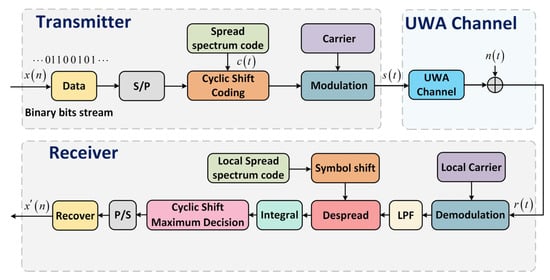
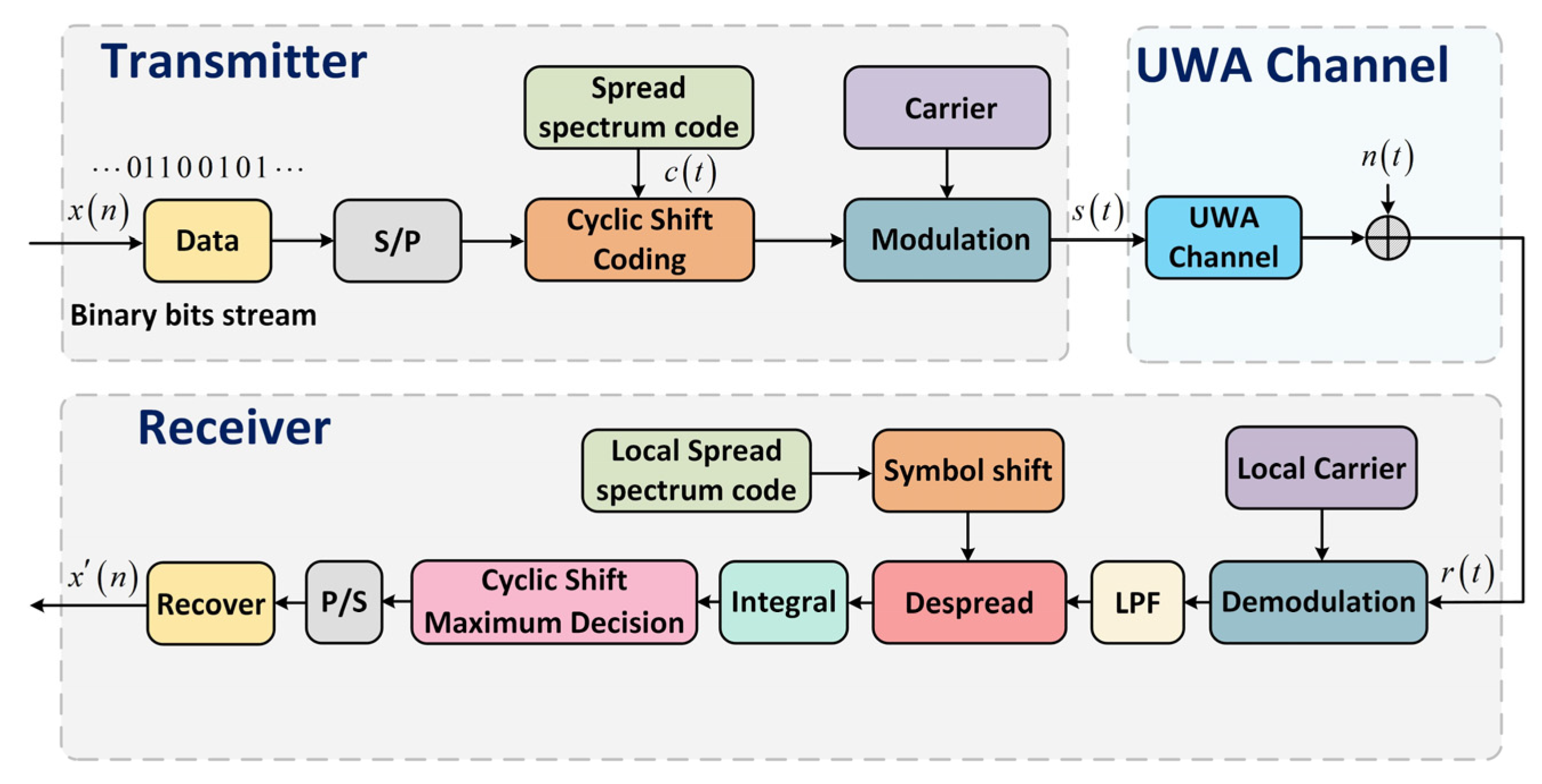
The structure of a conventional CSK-SS UWA communication system is shown in Figure 1. First, a cyclic shift matrix can be defined as
Figure 1.
Conventional CSK-SS UWA communication system structure.
Each cyclic shift of the spreading sequence can be obtained by multiplying the matrix by the spreading sequence once.
At the transmitter of the system, the spreading sequence is generated by the code sequence generator. Carry out the serial-parallel conversion on the transmission sequence , convert the binary bitstream information into a decimal data stream with bits, and shift the symbols of the spreading sequence by using the decimal data stream information.
where represents the vector form of the spreading sequence, represents the spreading sequence obtained after cyclic shifts of the spreading sequence , .
After carrier modulation, the transmitted signal can be expressed as
where is the amplitude of the transmitted signal and is the spreading code with a code length of and chip duration of . Assuming that the duration of each symbol is , , and are the carrier frequency and initial phase, respectively.
The transmitted signal reaches the receiving end of the system after passing through the underwater acoustic channel. In the propagation process, this paper focuses on the impact of multipath fading and noise on the received signal. The received signal can be represented as
where is the propagation delay of the main path signal and is the amplitude after attenuation. is the propagation delay of multipath signal, , is the number of multipath signals, is the amplitude of multipath signal reaching the receiving end, is the phase of the multipath signal, , is the shift spreading sequence generating delay, and the local carrier is . When the system carrier is synchronized, , , and are additive Gaussian white noise.
can be obtained from the locally generated spreading sequence through the sequence selector and cyclic shifter. is the symbol shift information, . After the system completes symbol synchronization, can be obtained.
After passing through the low-pass filter, only the integral output within the duration of one symbol is considered. Within the duration , the output of the integrator can be expressed as
The correlation functions and in Equation (5) can be expressed in the form of spread spectrum code
changes with the change of , and the position of its maximum value is the information modulated on the code phase.
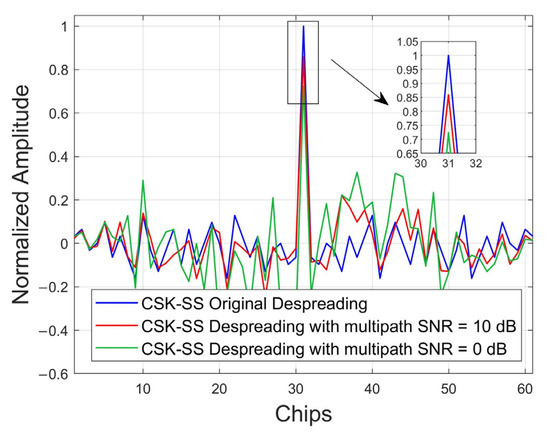
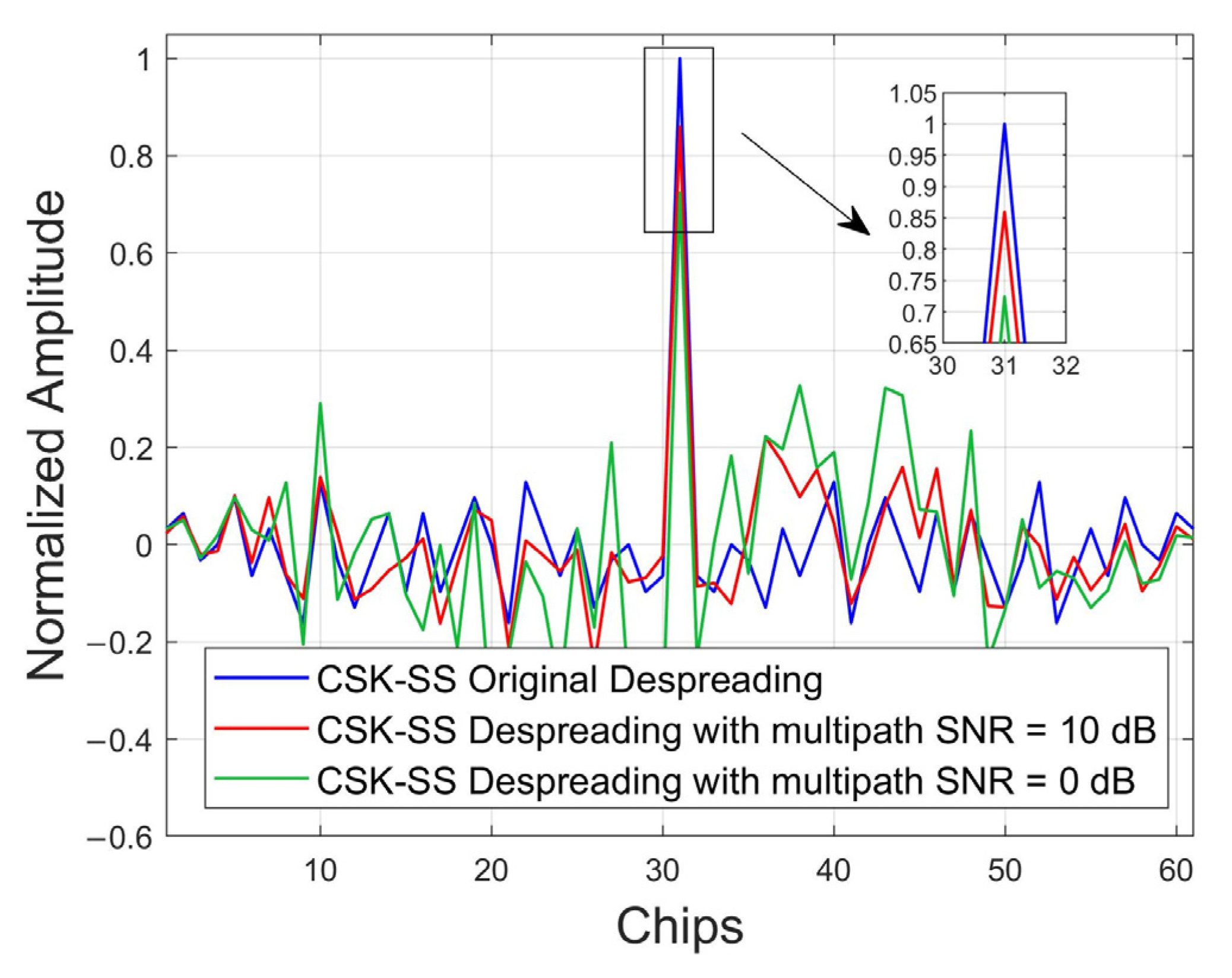
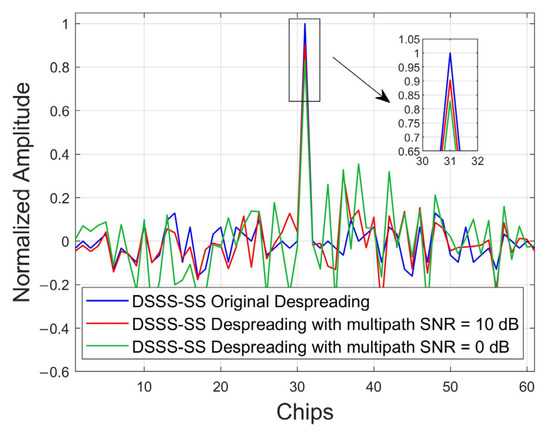
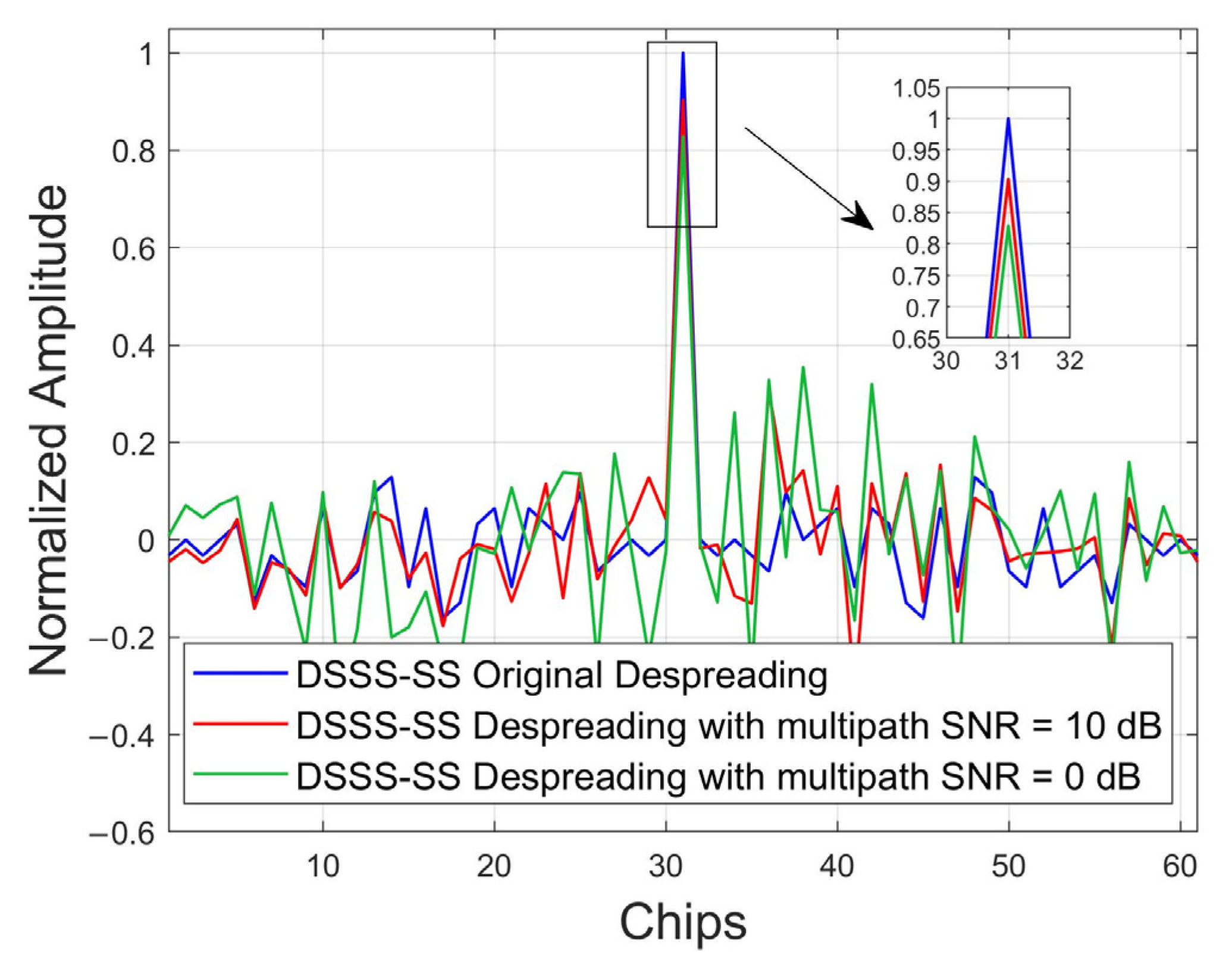
In the multipath fading channel, the influence of multipath fading on the performance of the CSK-SS system can be explored through the correlation function of the spread spectrum code. As shown in Figure 2, When SNR = 10 dB, the correlation peak of the spreading sequence decreases by nearly 15% after the CSK-SS signal passes through the multipath fading channel and decreases by nearly 28% when SNR = 0 dB. Figure 3 shows the correlation peak of the spreading sequence under the influence of multipath fading of the DSSS signal. When SNR = 10 dB, its peak value decreases by about 10% and decreases by nearly 18% when SNR = 0 dB. The above comparison shows that compared with the DSSS system, the CSK-SS system breaks the limitation of spreading gain on communication rate, and the improvement of communication rate is at the cost of destroying the excellent PACF characteristics of sequences in the DSSS system. In order to reduce the impact of multipath fading and noise on the technology of the CSK-SS system, this paper proposes a DL-based CSK-SS communication system. At the receiving end of the system, the CSK-SS signal is demodulated through the neural network model, which replaces the de-carrier, despreading, and related decision operations in the conventional system. The trained neural network establishes the mapping relationship between the CSK-SS signal and its carrying bits and solves inaccurate decision results caused by multipath fading in a conventional CSK-SS system.
Figure 2.
Correlation results of original despreading and despreading with multipath in CSK-SS.
Figure 3.
Correlation results of original despreading and despreading with multipath in DSSS.
2.2. LSTM Neural Network Model
The hidden layer of the LSTM neural network is composed of LSTM cells. A unique gating mechanism is introduced to control the accumulation speed of information. The standard unidirectional LSTM network transmits information in the positive order of time. In addition, to enhance the performance of the network, the BiLSTM network is proposed [23]. Compared with the standard unidirectional LSTM network, it adds a network layer that transmits information in the reverse order of time and connects the two hidden layers to the same output layer. In phoneme classification [24] and speech recognition [11], the performance of the bidirectional network is better than that of the unidirectional network. In order to explore the DL-based CSK-SS UWA communication system, this paper analyzes the application effects of the unidirectional LSTM and BiLSTM network models in the system, respectively.
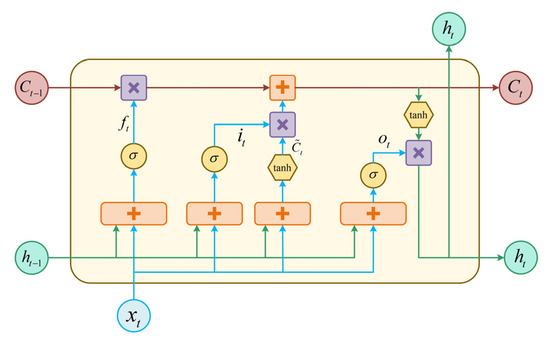
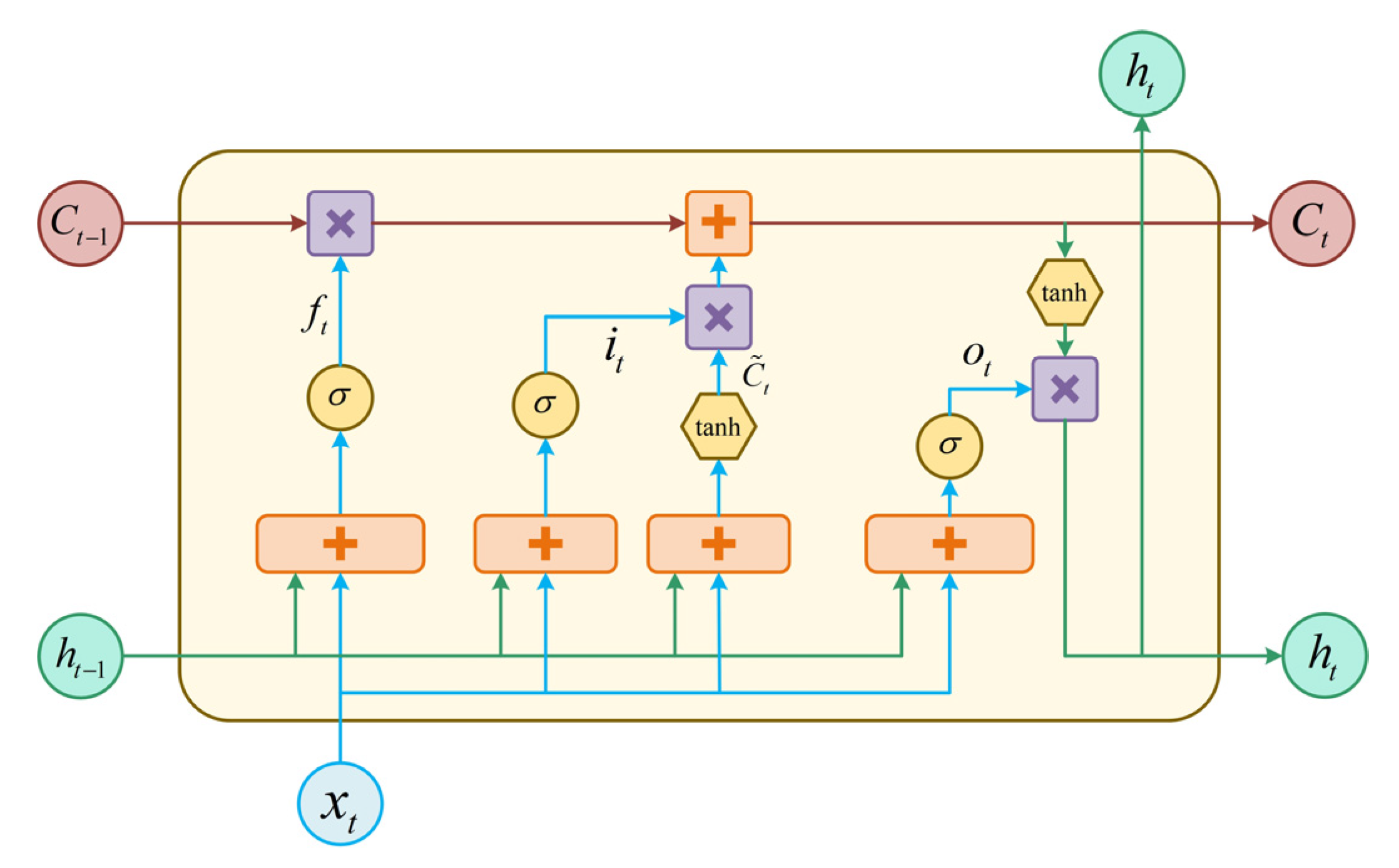
As a fundamental component of the one-way LSTM and BiLSTM network hidden layer, the LSTM cell is introduced below. The structure of the LSTM cell [25] is shown in Figure 4.
Figure 4.
LSTM cell structure.
For a given input sequence , in each time step, , is used as the input vector feed to the LSTM cell. The LSTM cell outputs a cell state vector for the transmission of cyclic information, and a hidden state is an output as the output vector of the LSTM cell, which can be expressed as
where , , and are forget gate, input gate, and output gate, respectively. They are used to control the path of information transmission, is the cell state at the previous moment, and is the activation state vector of the cell. They can be expressed as
where is the Logistic function, , , and are the weight matrix and bias vector parameters that the network needs to learn during the training process, , is the hidden state of the LSTM cell at the last moment.
2.3. DL-Based CSK-SS UWA Communication System Structure
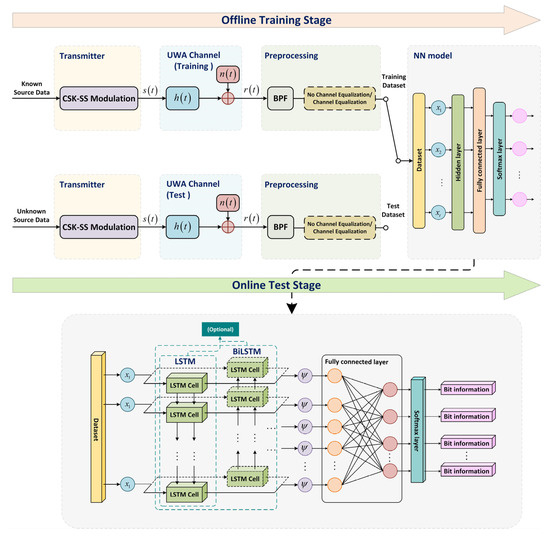
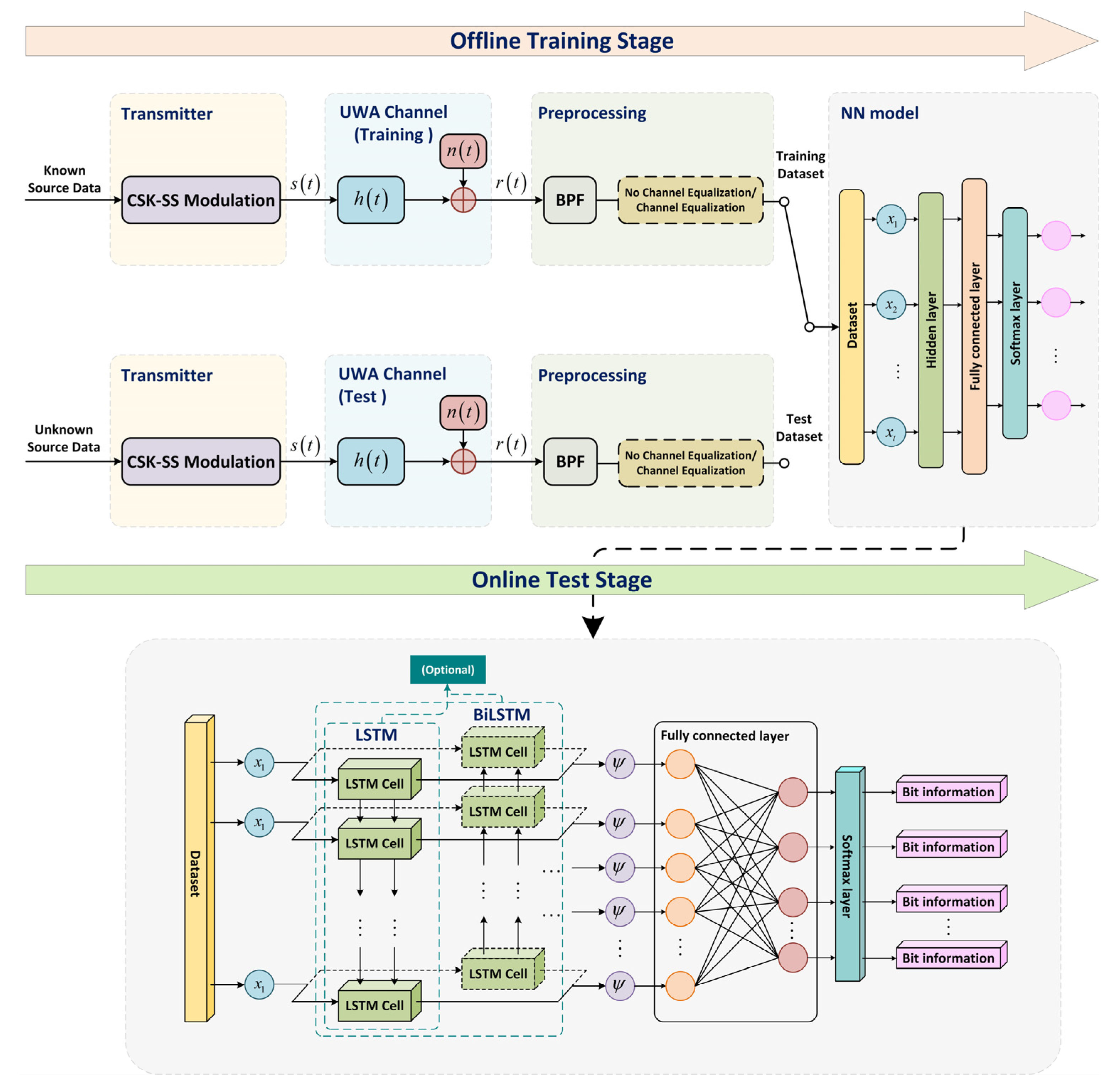
The structure of the DL-based CSK-SS UWA communication system is shown in Figure 5. Compared with the conventional system, in the receiving part of the DL-based system, the neural network model is used to replace the receiver module of the conventional system. The DL-based signal demodulation will be divided into the offline training stage and the online test stage. In the offline stage, the transmitter completes the modulation of the known source information, reaches the receiver of the system through the UWA channel, and completes the training of the neural network model by receiving the signal data samples. In the test stage, the synchronized unknown received signal is input to the trained neural network model to complete the signal demodulation.
Figure 5.
Structure of DL-based CSK-SS UWA communication system.
This paper selects unidirectional standard LSTM and BiLSTM as the neural network model in the system. In addition, two different schemes will be proposed for whether there is channel equalization preprocessing. In scheme A, the CSK-SS signal through the UWA channel is directly input to the DL-based system after signal synchronization. The neural network model training and the demodulation of the received signal are completed in two stages. In scheme B, the preprocessing operation of the received signal is added. Firstly, the channel estimation is completed by the orthogonal matching pursuit (OMP) algorithm [26], then the channel equalization is realized by the virtual time-reversal mirror (VTRM) technology [27], and finally, the preprocessed received signal is processed. In the two stages, the training of the neural network model and the demodulation of the received signal are completed.
In the offline training stage of scheme A, the known information sequence generates signal samples after CSK-SS modulation. Multiple UWA channel samples for training are generated by using BELLHOP. The training dataset consists of the CSK-SS signal passing through the UWA channel, which can be expressed as
where is the CSK-SS signal transmitted by the transducer, is the CIR of the UWA channel, is the noise interference, and is the convolution operation.
In the offline training stage of scheme B, in order to suppress the ISI caused by multipath expansion of the UWA channel and reduce the impact of channel fading, channel equalization preprocessing can be carried out before the received signal is fed to the neural network model. Based on the reciprocity theorem [28], the time-reversal mirror technology matches the UWA channel of acoustic transmission and guides spatial focusing and time compression [29,30]. VTRM technology can make the multipath signals generated by the acoustic channel superimpose in phase simultaneously, compress the signal in the time domain, suppress the ISI caused by multipath spread, obtain the focusing gain, and improve the SNR. Especially in constructing a UWA communication network, when the nodes are fixedly arranged under the complex shallow water acoustic channel conditions, a better communication performance will be obtained by using VTRM technology. In addition, since the focusing effect of VTRM is related to the accuracy of UWA channel estimation, the OMP algorithm is used to estimate the channel. The received signal processed by VTRM will be used as the training dataset of the neural network, which can be expressed as
where is the CIR estimation result after inversion, is the cross-correlation function between the CIR and its estimated value , also known as the virtual time-reversal channel.
In the training process, quantifying the difference between the expected probability distribution of the output result and the predicted probability distribution, iterate continuously on the weight parameters and bias parameters in the model to gradually reduce the difference. Through the softmax activation function that maps the eigenvector to the effective real space of to represent the probability of the category, the cross-entropy loss function is selected to calculate the loss value to quantify the difference. The cross-entropy loss function [31] is as
where is the true probability distribution of the -th sample and is the predicted probability distribution of the -th sample.
In the online test stage of scheme A and scheme B, the unknown source data is modulated into the CSK-SS signal, and then the UWA channel sample space for the test is established. It should be noted that the above test channel samples are different from the training channel samples. In scheme A, the modulated CSK-SS test signal is directly received by the receiving end after testing the channel. In scheme B, it is received by the receiving end after preprocessing. The sufficiently trained neural network models will realize the direct demodulation of the received signal according to the mapping relationship between the waveform in the time domain and the information bits carried by each symbol.
3. Analysis of Simulation Results
3.1. Environment Configuration and Parameter Settings
In the simulation, two neural network models are discussed. Similarly, both models comprise an input layer, hidden layer, fully connected layer, softmax layer, and output layer. Different from each other, the hidden layer is LSTM and BiLSTM, which respectively complete unidirectional propagation and bidirectional propagation of information according to the input time series. The size of the input layer of the two neural network models is 744, the number of hidden units in the LSTM cells is 30, and the output size of the fully connected layer and the number of neural units in the output layer are determined by the number of types of tags. The training dataset is generated by using the m-sequence with a spreading gain of 31 as a spreading sequence and generated under SNR = 5 dB. The training dataset and the test dataset are divided according to a ratio of 3:1.
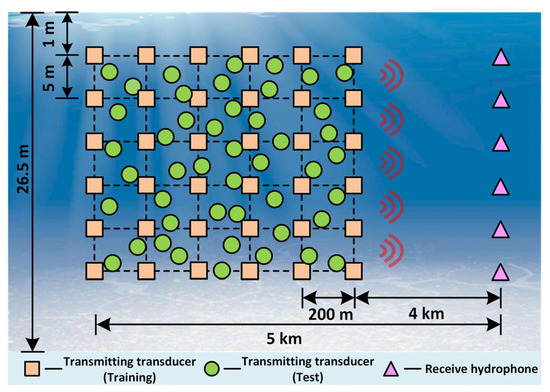
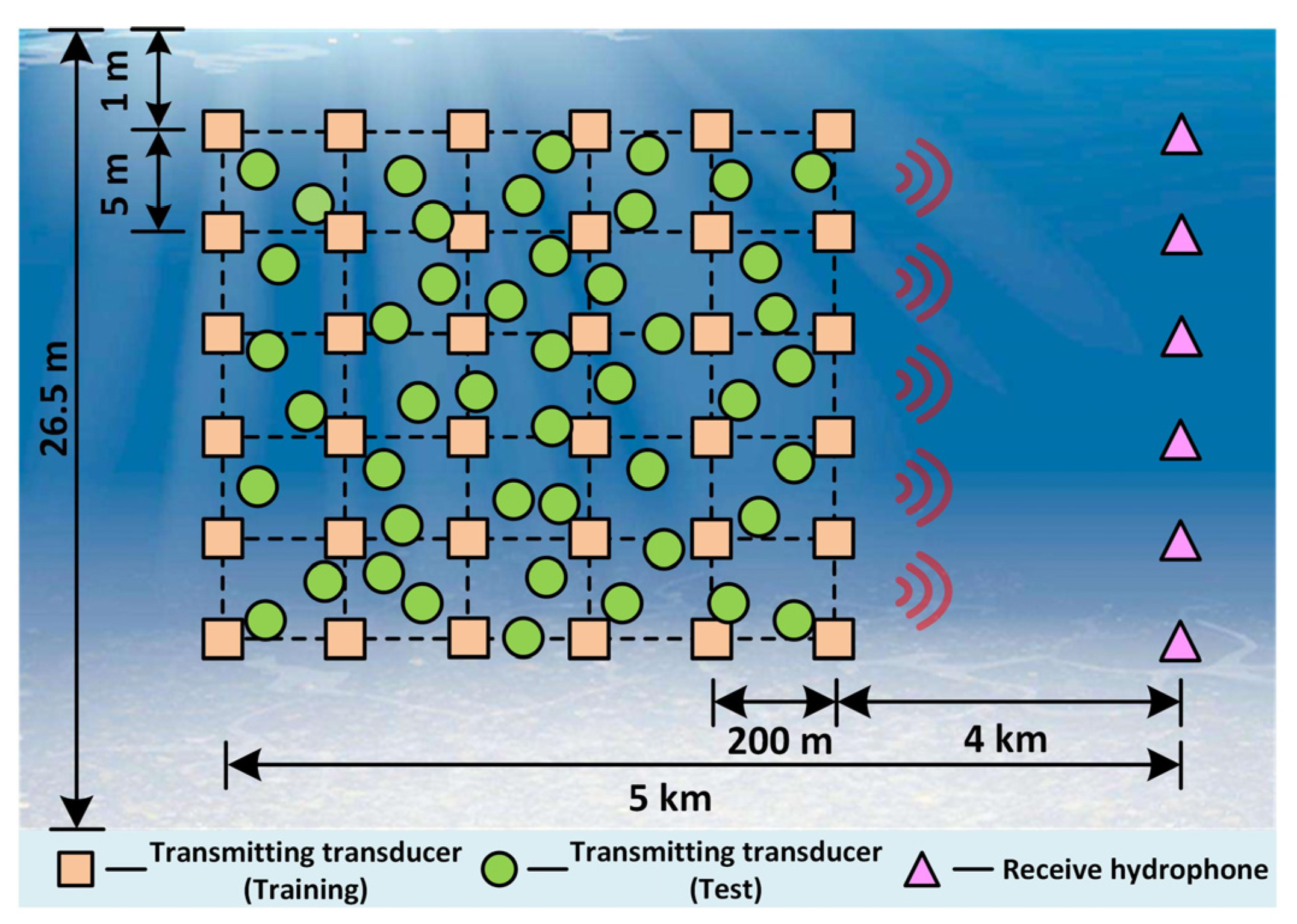
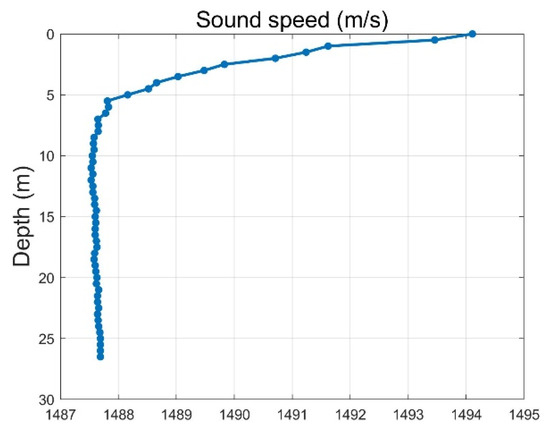
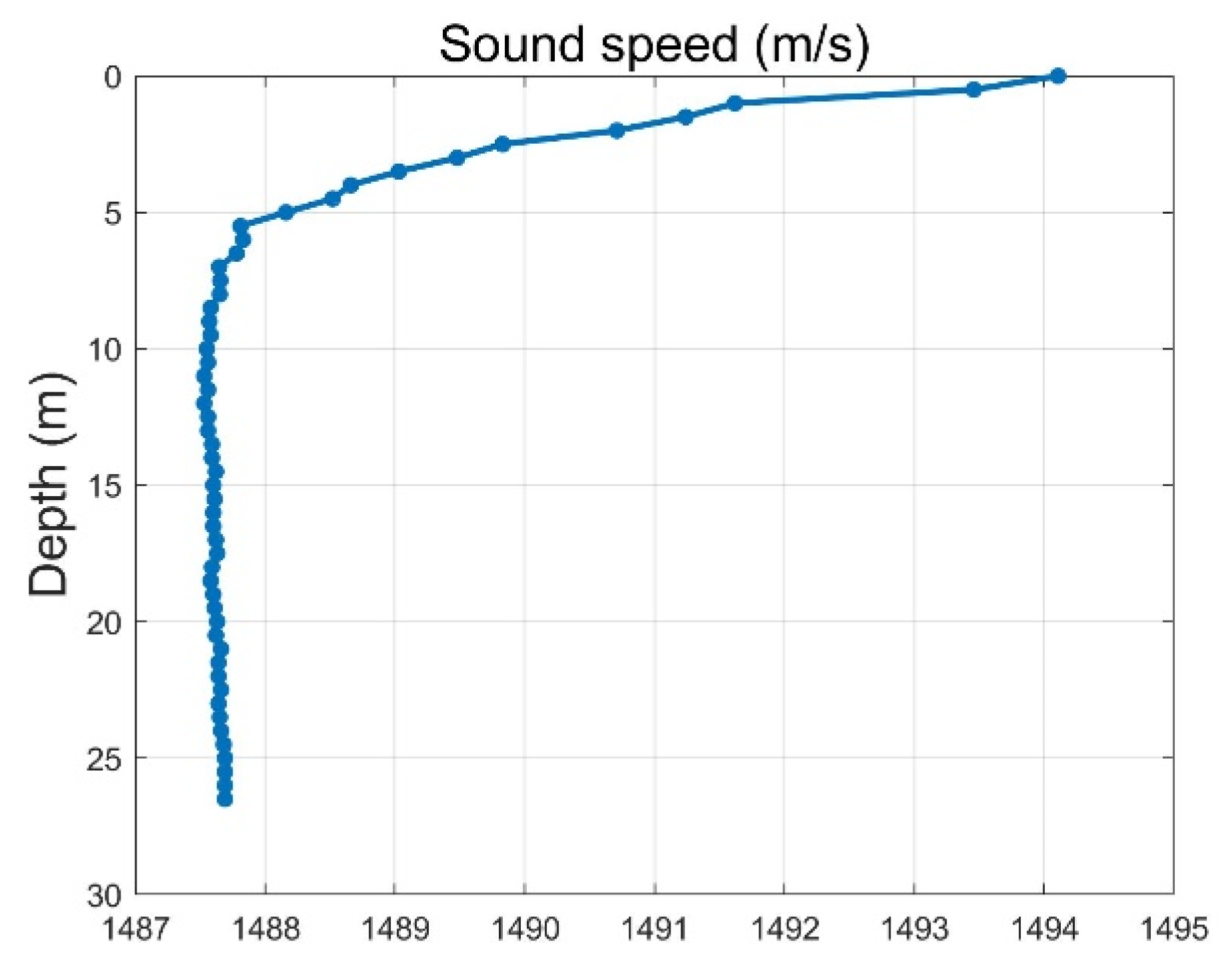
In the offline training stage, in order to sufficiently train the neural network models and make them have the ability to remember and analyze complex UWA channels, based on the SSP actually collected in a specific sea area, the spatial positions of the transmitting transducer and the receiving hydrophone are continuously adjusted according to a specific step. In addition, the BELLHOP model is used to obtain multiple groups of CIRs according to the combination of different positions of the transmitting transducer and the receiving hydrophone. In addition, in the online test stage, the spatial positions of the transmitting transducer and the receiving hydrophone will be further adjusted to obtain a variety of position combinations to generate multiple groups of CIRs used in the test stage. Figure 6 shows an environmental configuration for generating CIRs. Figure 7 shows the SSP obtained through the actual collection in the Yellow Sea of China in May 2020.
Figure 6.
Position layout of transmitter and receiver in training stage and test stage.
Figure 7.
SSP obtained through actual measurement.
The depth of seawater is 26.5 m. In Figure 6, the orange square represents the position of the transmitting transducer in the offline training stage. At this time, the depth range of the transmitting transducer is 1–26 m and the depth step between transmitting transducers is set to 5 m. The pink triangle represents the position of the receiving hydrophone, the depth range is 1–26 m, and the depth step between them is set to 5 m. The horizontal distance between the transmitting transducer and the receiving hydrophone varies in the range of 4–5 km and the distance step is set to 200 m. The green circle represents the position of the transmitting transducer in the online test stage. Their positions are randomly arranged within the depth range of 1–26 m and the horizontal distance from the receiving hydrophone range of 4–5 km.
The parameter settings of the UWA channel simulation are given in Table 1.
Table 1.
UWA channel simulation parameters.
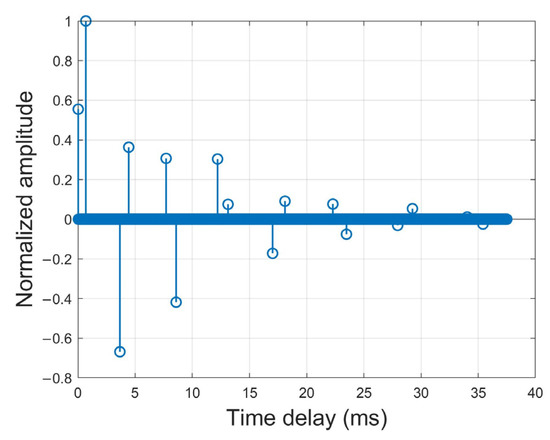
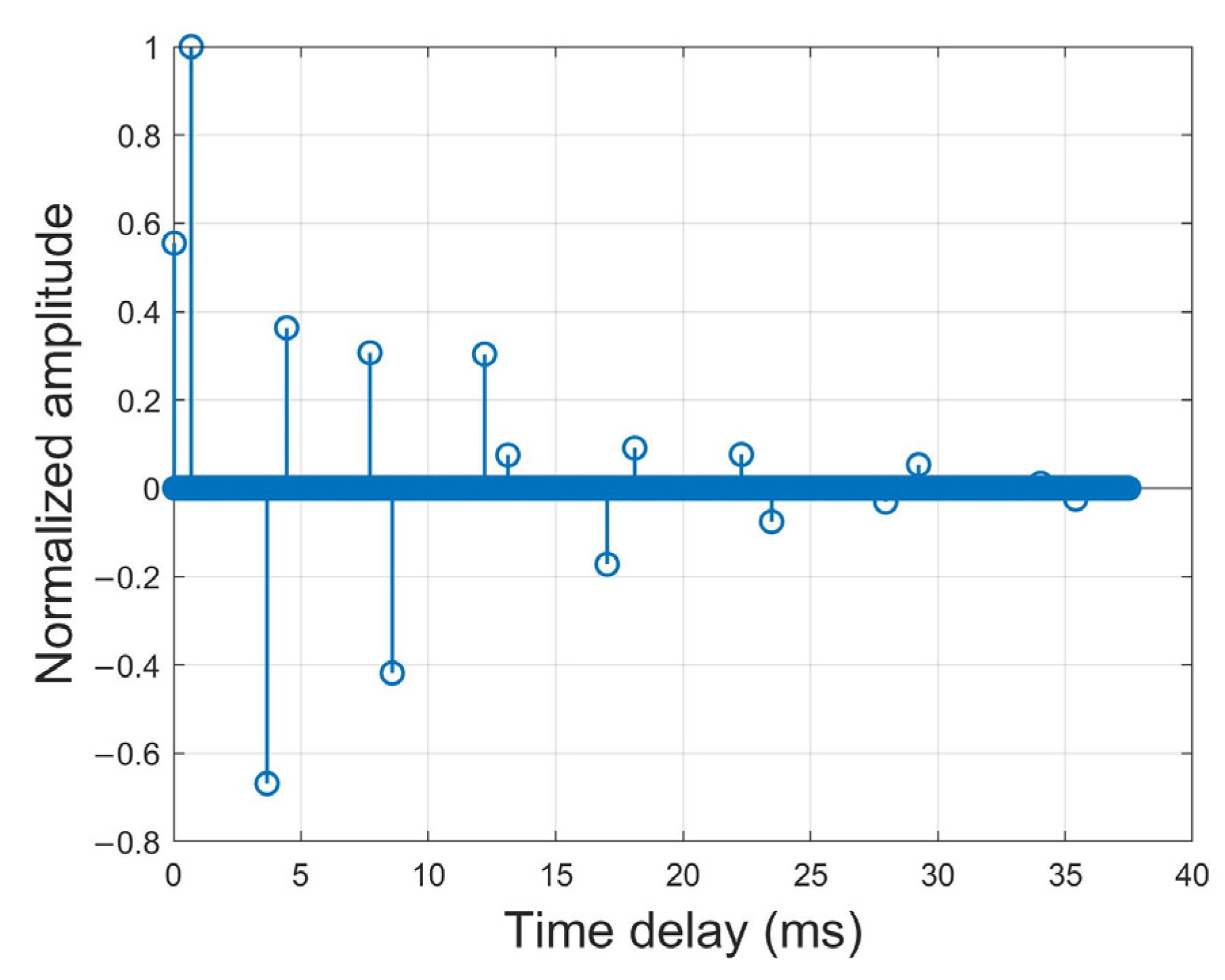
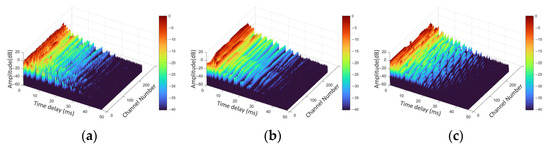
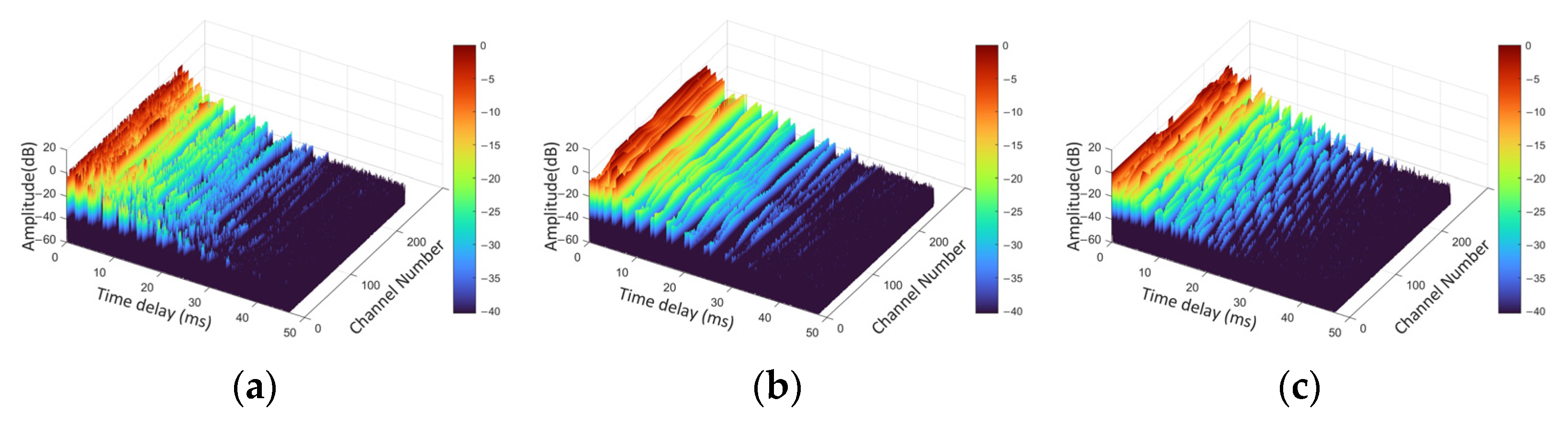
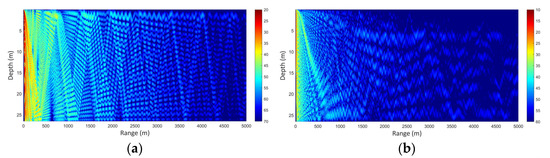
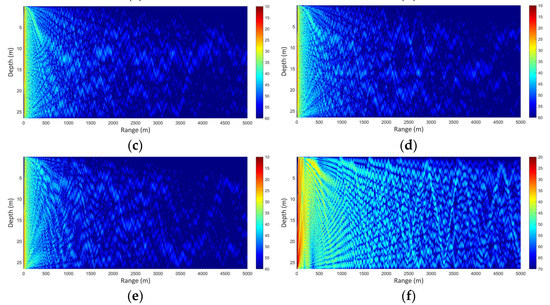
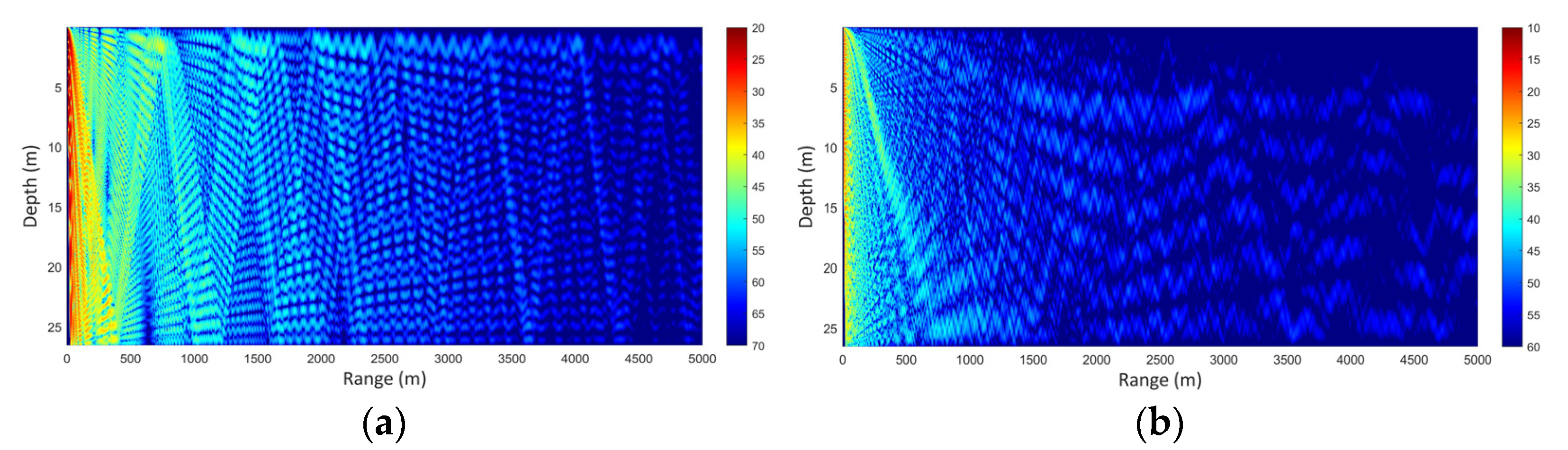
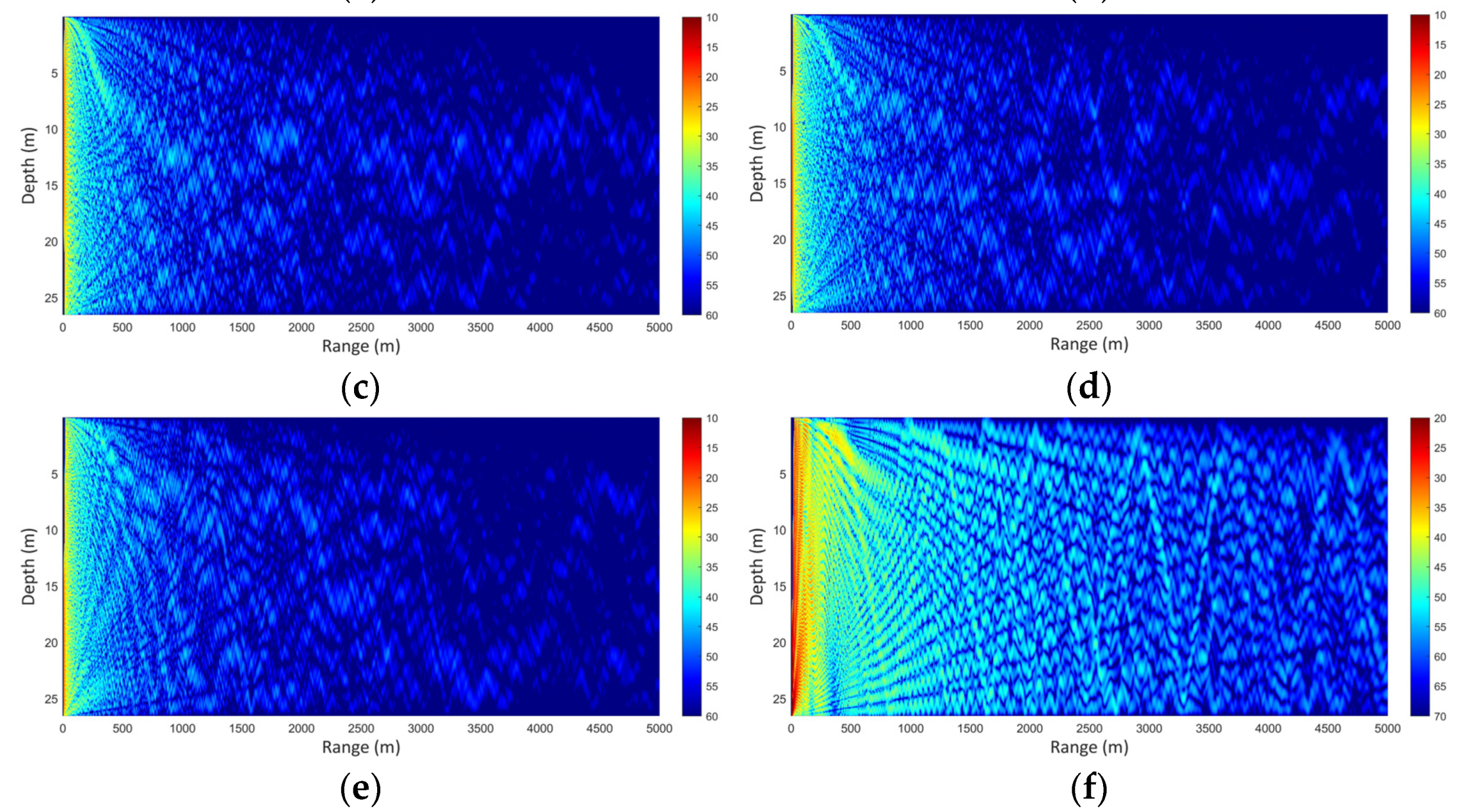
In the simulation, the ocean bottom parameters [32] are set. In this paper, the flat seabed with very fine sand is considered, in which the density ratio is 1.268, the sound velocity ratio is 1.0568, and the attention coefficient is 0.01875. Figure 8 shows the shallow water CIR obtained through SSP through BELLHOP software. Figure 9a–c shows CIRs obtained by controlling the change of the position of the transmitting transducer and the change of the horizontal distance between the transmitting transducer and the receiving hydrophone. The shallow water environment generally has the characteristics of high temporal and spatial variability. The propagation of acoustics in shallow water is mainly the repeated interaction with the sea surface and seabed. Figure 10a–f shows the difference in acoustic transmission loss in shallow water when the transmitting transducer is located at different depths.
Figure 8.
One of the multiple CIRs used in communication system simulation.
Figure 9.
In the environment configuration, CIRs change with the changing the spatial position of the transmitting end and the receiving end. (a) Multiple CIRs are generated by changing the depth of the transmitting transducer. (b) Multiple CIRs are generated by changing the depth of the receiving hydrophone. (c) Multiple CIRs are generated by changing the horizontal distance.
Figure 10.
The predicted transmission loss of transmitter at different depths. (a) Transmitter depth is 1 m. (b) Transmitter depth is 6 m. (c) Transmitter depth is 11 m. (d) Transmitter depth is 16 m. (e) Transmitter depth is 21 m. (f) Transmitter depth is 26 m.
3.2. Performance Analysis of the System without Preprocessing in Shallow Water Channels
In the test stage, the input size of the information sequence in each time step of the neural network model is determined by the symbol length of the signal. By comparing the output of the neural network model with the source information, the BER curve is obtained and the performance of the DL-based CSK-SS UWA communication system is evaluated.
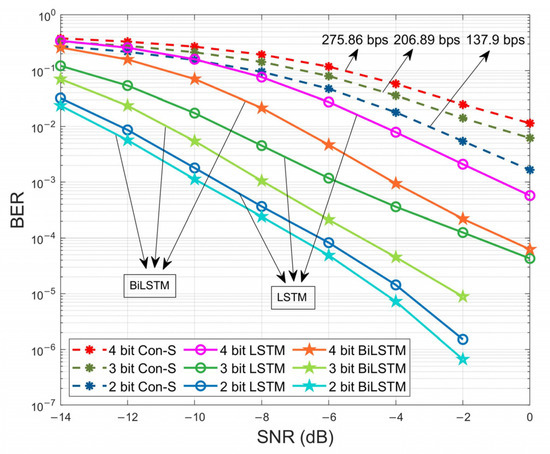
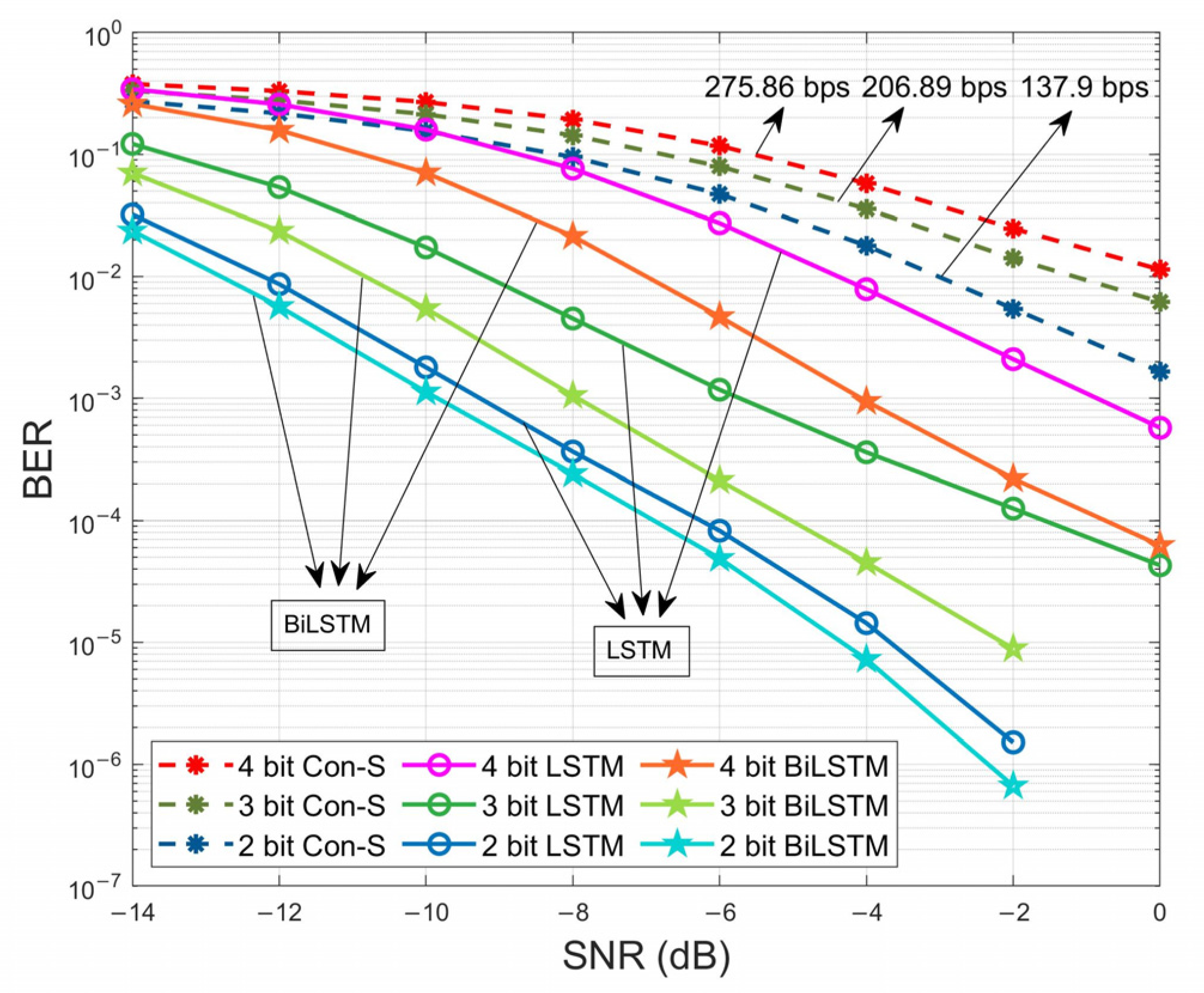
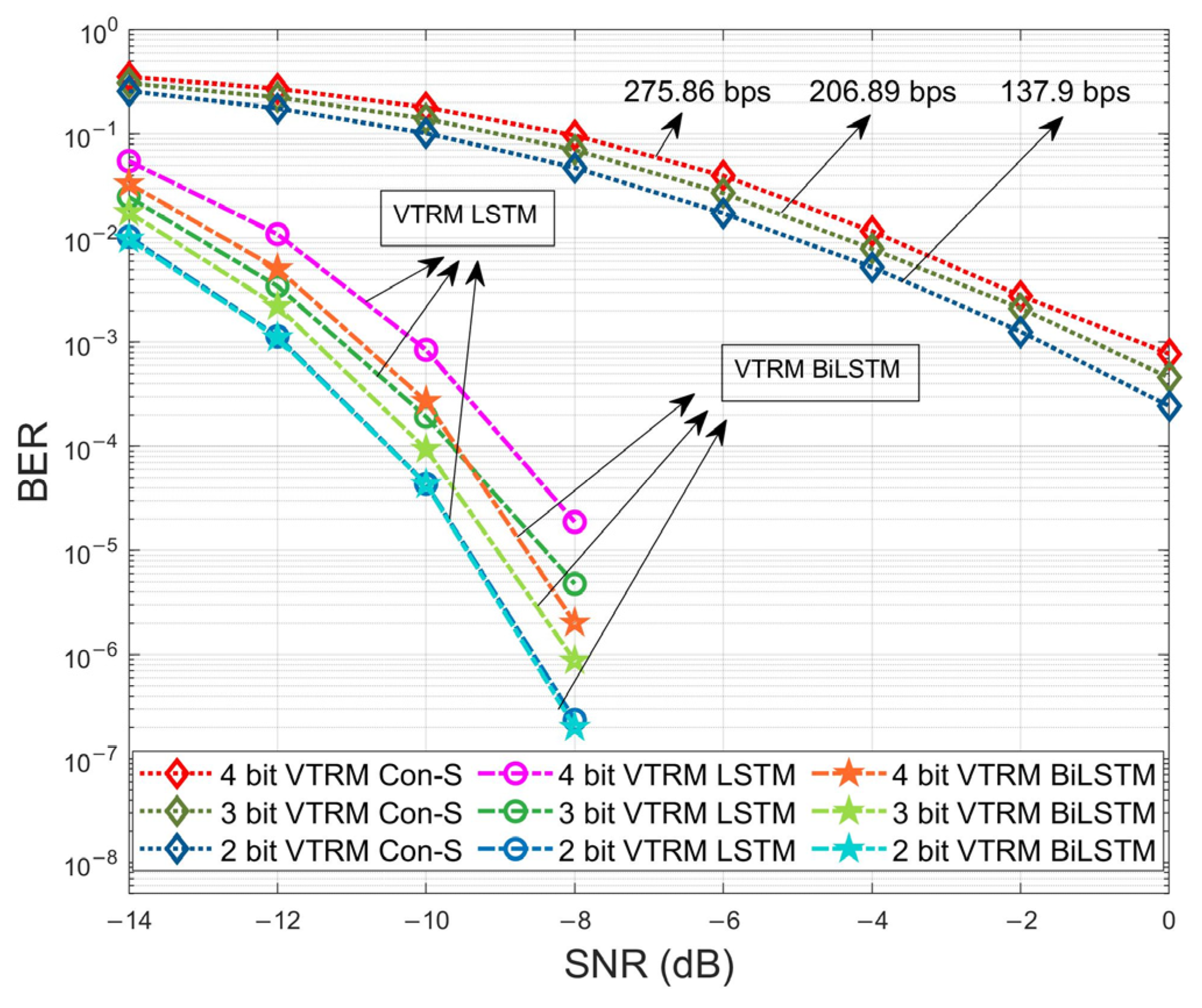
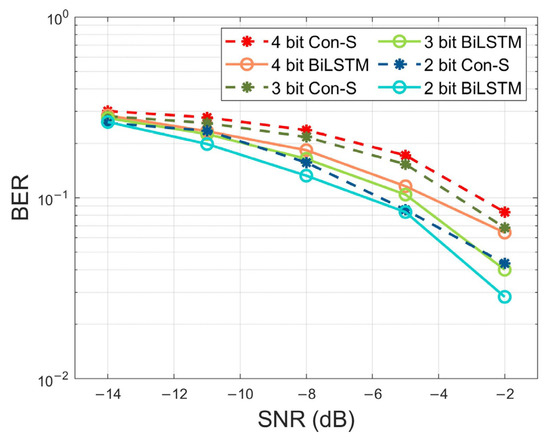
In CSK-SS modulation, the number of bits carried by each symbol determines the symbol rate of the system. When each symbol carries 4 bit, 3 bit, and 2 bit information, the symbol rates are 275.86 bps, 206.89 bps, and 137.9 bps, respectively. The simulation results of the DL-based CSK-SS communication system in shallow water acoustic channels are shown in Figure 11. Due to the random selection of several UWA channels which are not in the range of training samples in the test stage (like the green circle in Figure 6), the BER curves of the conventional system and the DL-based system represent the mean BER of various channels under different SNR.
Figure 11.
BER curve of DL-based system and conventional system (Con-S) without preprocessing.
Without channel equalization preprocessing, the performance of DL-based systems on two different neural network models is better than that of the conventional system in the SNR range of −14 dB to 0 dB. Meanwhile, the anti-noise ability of the LSTM neural network model is improved by 4.5 dB, 8 dB, and 9 dB when the symbol rate is 275.86 bps, 206.89 bps, and 137.9 bps, and the magnitude of the BER is 10−2. Compared with the conventional system, the anti-noise ability of the BiLSTM neural network model is improved by 7 dB, 10 dB, and 10 dB. It can be seen that the BiLSTM neural network model has better performance than the LSTM neural network model.
From one perspective, the BiLSTM network increases the vertical depth of the network compared with the unidirectional LSTM network by adding a network layer that transmits information in reverse time to enhance the capability of the network. From another perspective, under the condition of a complex shallow water channel with a serious multipath effect, the BiLSTM network can use the internal relationship of ISI in sequential data to reduce the impact of ISI on performance.
3.3. Performance Analysis of the System after Preprocessing in Shallow Water Channels
In the preprocessing stage, firstly, the CIR is reconstructed by the OMP algorithm, then the channel equalization is realized by VTRM technology, and finally, the processed signal data are input into the neural network model to complete the signal demodulation. Through simulation analysis, it was found that the performance of the preprocessed DL-based system is better than that of the preprocessed conventional system.
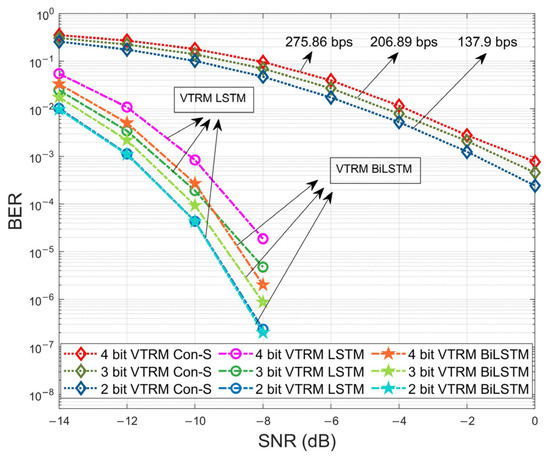
The simulation results of the preprocessed DL-based CSK-SS communication system in shallow water channels are shown in Figure 12. When each symbol carries 4 bit, 3 bit, and 2 bit information, and the magnitude of the BER is 10−3, the SNR of the LSTM neural network model is about 9.5 dB, 10 dB, and 10.5 dB lower than that of the conventional system, respectively. In addition, when each symbol carries 4 bit and 3 bit information, the SNR required by the BiLSTM neural network model to achieve the same system performance is reduced by about 1 dB and 0.5 dB, respectively, compared with the LSTM neural network model.
Figure 12.
BER curve of DL-based system and conventional system after preprocessing.
When each symbol carries 2 bit information, the performance of the two models is similar, but the BiLSTM neural network model still has a slight advantage at −8 dB. The whys and wherefores are that after preprocessing, the performance of the DL-based system is better than that of the conventional system and the BiLSTM neural network model has more advantages in performance.
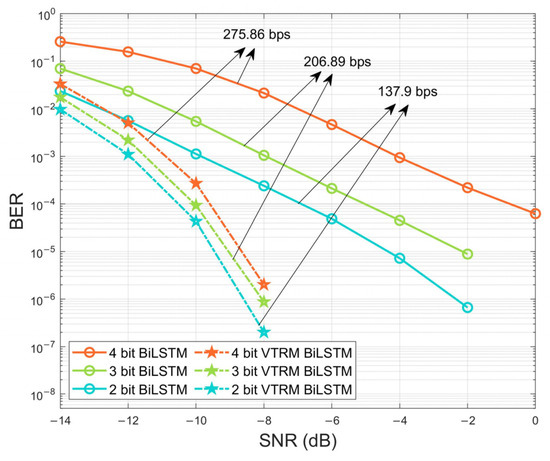
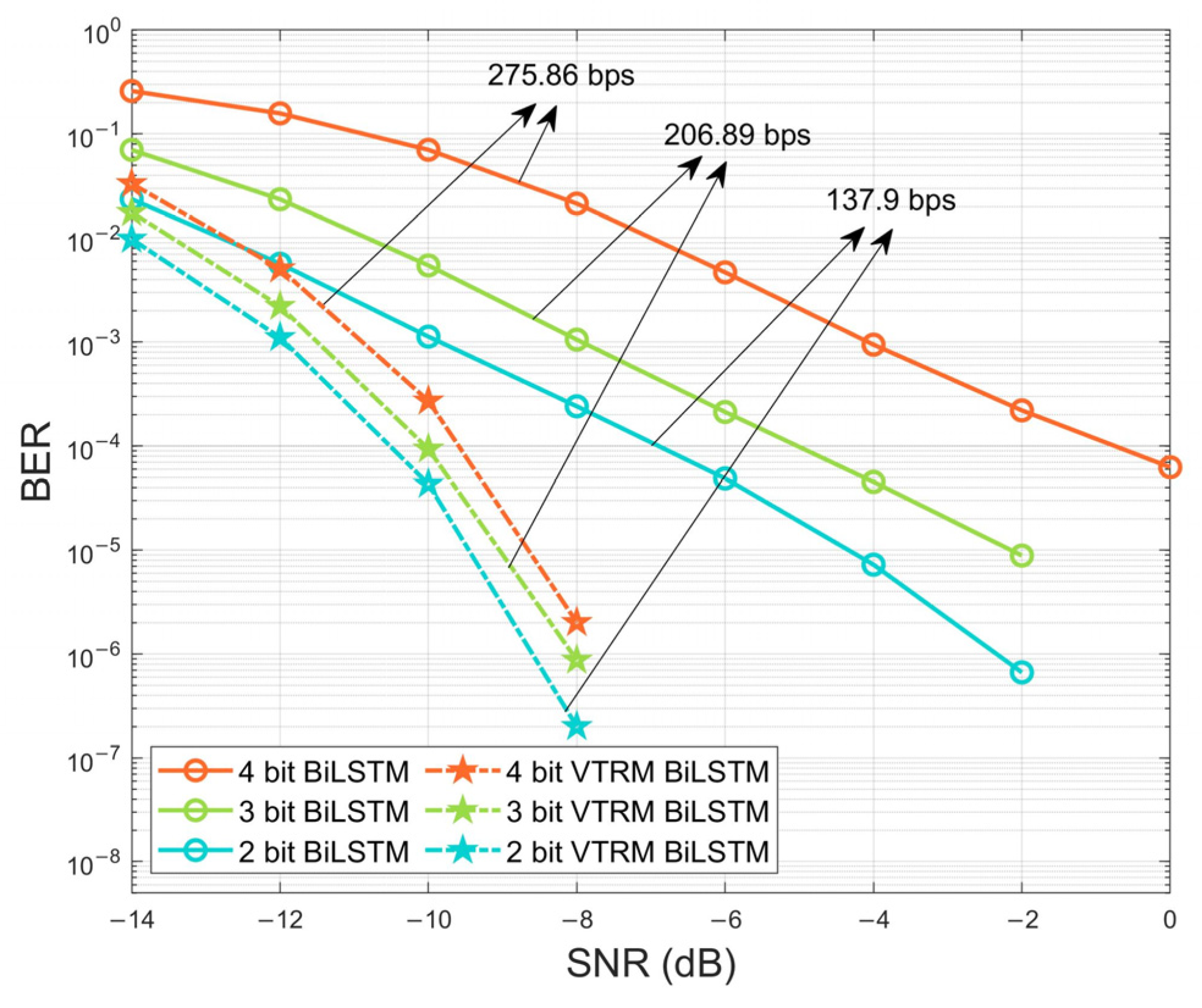
As shown in Figure 13, compared with the DL-based CSK-SS UWA communication system without VTRM technology, for the BiLSTM neural network model, the required SNR is reduced by about 7 dB, 3.5 dB, and 2 dB, respectively. VTRM technology suppresses the ISI caused by multipath expansion of the UWA channel so that the multipath signal energy is superimposed to obtain the focusing gain. In addition, VTRM can make the signal components coherently superimposed and the noise components incoherently superimposed to increase the SNR of the signal. Therefore, after the preprocessing of the communication signal is completed by using this technology, the performance of the system will be further improved when demodulated by the neural network model.
Figure 13.
BER curve of DL-based system with or without preprocessing.
3.4. System Robustness Analysis in Specific Application Scenarios
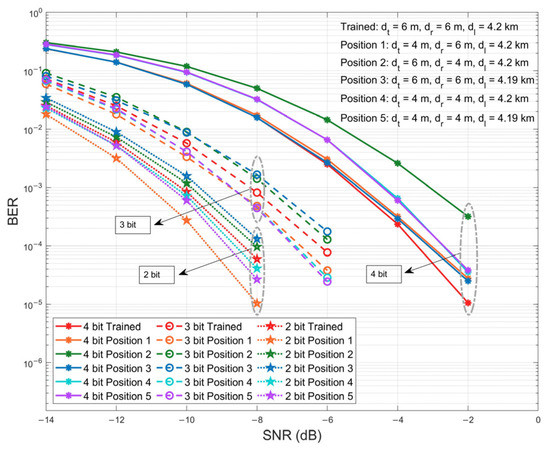
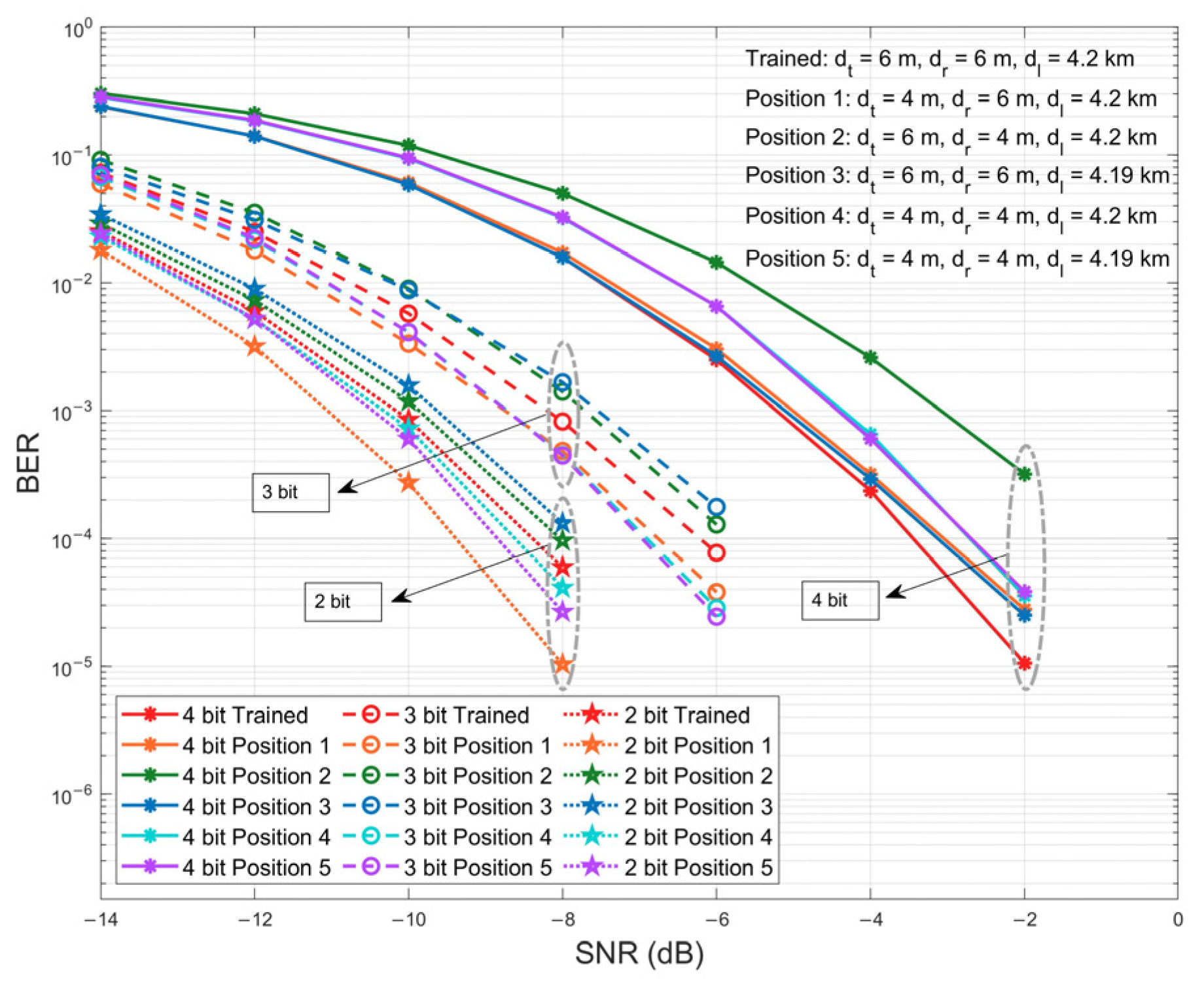
For the specific application scenarios of fixed UWA communication nodes, the robustness of the system needs to be analyzed. In the previous section, the test channel samples were taken outside the range of the training samples. This is because the underwater nodes will be affected by ocean currents and tides, which will lead to the change of node position. In order to analyze the impact of the sample mismatch between the offline training stage and the online test stage on the system performance, this section will first select the training channel sample space and use it as the test channel to obtain the system performance when the two-stage samples match each other. Secondly, by changing the transmitting transducer depth (), receiving hydrophone depth (), and the distance (), the CIR outside the training sample space is obtained to analyze the system performance when the two-stage samples mismatch. Only the robustness of the BiLSTM model is analyzed in this section. The simulation results are shown in Figure 14. By comparing the BER curves, it can be seen that based on the simulation results in this application scenario, due to the change of underwater node position, the UWA channel sample mismatch between the training stage and the test stage does not have significant damage to the performance of the DL-based CSK-SS UWA communication system.
Figure 14.
BER curve with mismatches between training and test stages.
4. Analysis of Experimental Results
4.1. Experimental Scene Construction and Parameter Setting
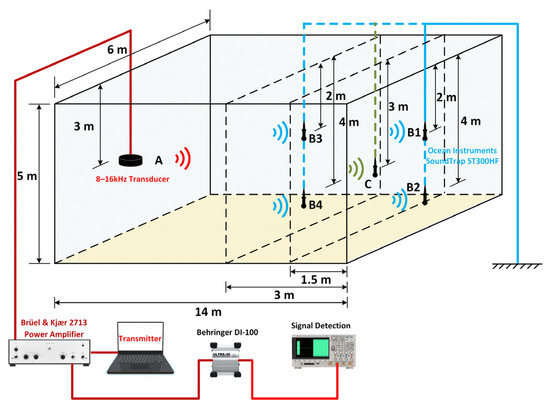
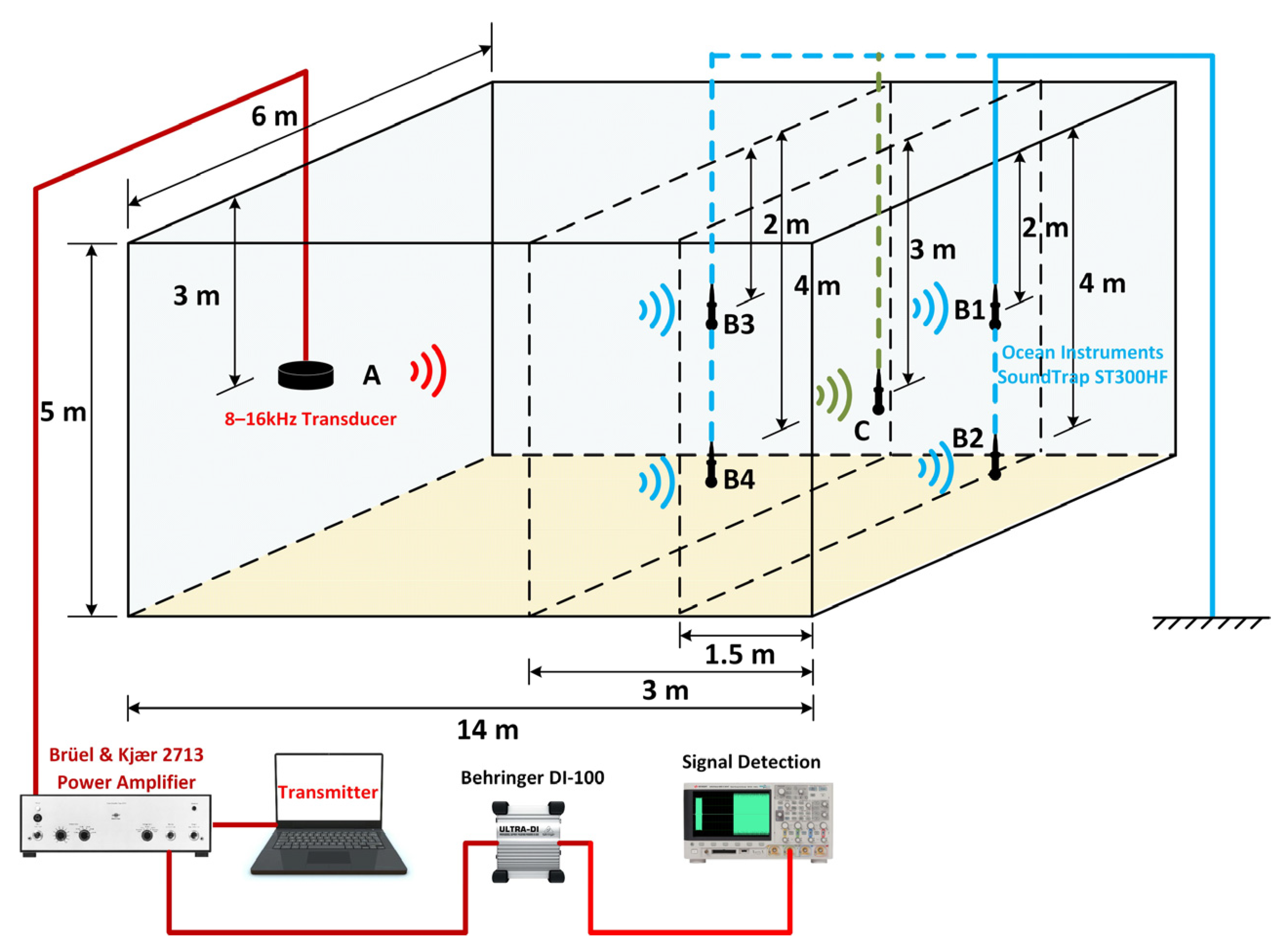
In this section, to verify the performance of the DL-based CSK-SS communication system, the demodulation of the actual signal is tested in the water tank experiment. The experiment also consists of two stages: offline training and online test. The size of the water tank is 45 m (length) ∗ 6 m (width) ∗ 5 m (depth). There are anechoic tiles installed on the walls on both sides of the water tank, and the bottom of the water tank is covered with smooth tiles, which will make the sound waves reach the receiving end of the system after multiple reflections from the bottom and the water surface, thereby simulating the propagation process of the signal in the shallow water channel. Figure 15 shows the scene construction of the experiment, in which A represents the position of the transmitting transducer, B1, B2, B3, and B4 represent the position of the receiving hydrophone in the offline training stage, and C represents the position of the receiving hydrophone in the online test stage. In the experimental equipment, the power amplifier (PA) is B&K2713 [33], the operating frequency band of the transmitting transducer is 8–16 kHz, the attenuator is BEHRINGER DI-100 [34], and the receiving hydrophone is ST300HF [35].
Figure 15.
Layout of the water tank experiment scene.
The transmitted signal used in the offline training stage is composed of several data packets. The signal in each data packet is composed of an HFM signal and communication signal, in which the communication signal is the known source information modulated by CSK-SS. After being transmitted by the transducer, the hydrophone receives the signal after passing through the water tank acoustic channel. Finally, the received signal is processed as the training dataset of the neural network model to complete the training of the neural network model.
In the online test stage, the hydrophone receives the transmitted signal and is directly input into the trained neural network model after resampling to complete the signal demodulation.
The analysis of the simulation results shows that in the DL-based CSK-SS UWA communication system, the BiLSTM network has better performance than the LSTM network. Therefore, the neural network model used in the water tank experiment is BiLSTM and the parameter settings in the neural network are consistent with those in the simulation.
The primary parameter setting and data structure of the transmitted signal are shown in Table 2 and Table 3.
Table 2.
Parameter setting of the transmitted signal.
Table 3.
Parameter setting of the transmission signal frame structure.
4.2. Analysis of Experimental Results
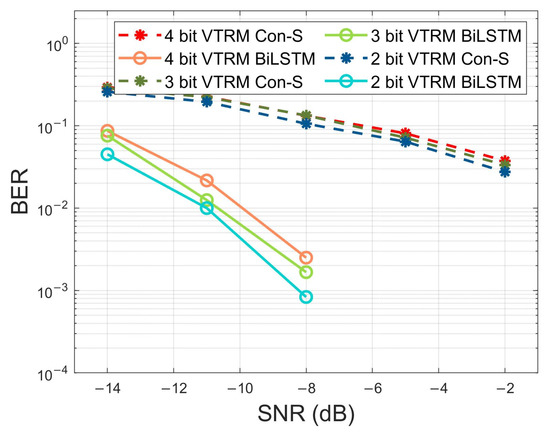
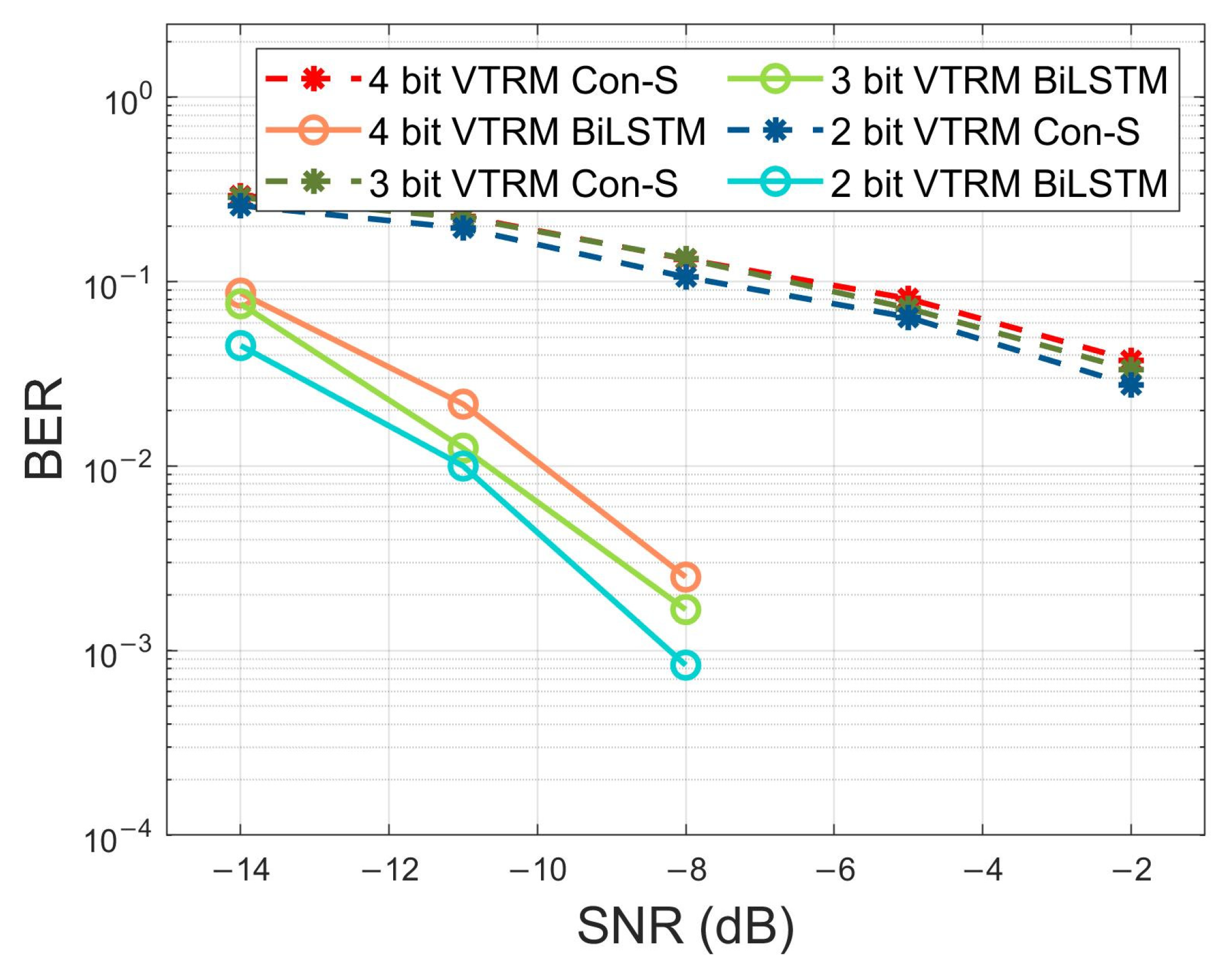
In the water tank experiment, the performance of the conventional system and the DL-based system are compared. Moreover, in CSK-SS modulation, three schemes with communication rates of 180.45 bps (each symbol carries 4-bit), 146.34 bps (each symbol carries 3-bit), and 106.19 bps (each symbol carries 2-bit) are analyzed. In addition, in experimental data processing, noise interference is added artificially to obtain the condition of a low SNR.
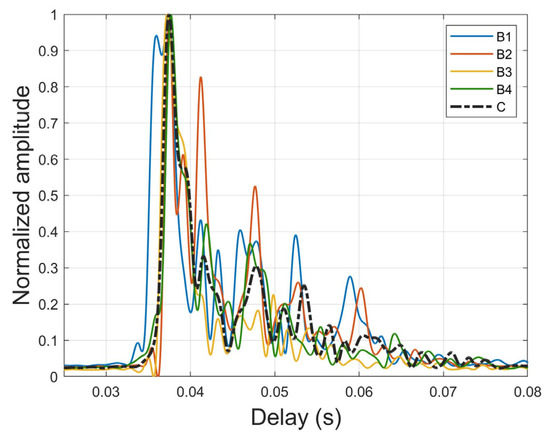
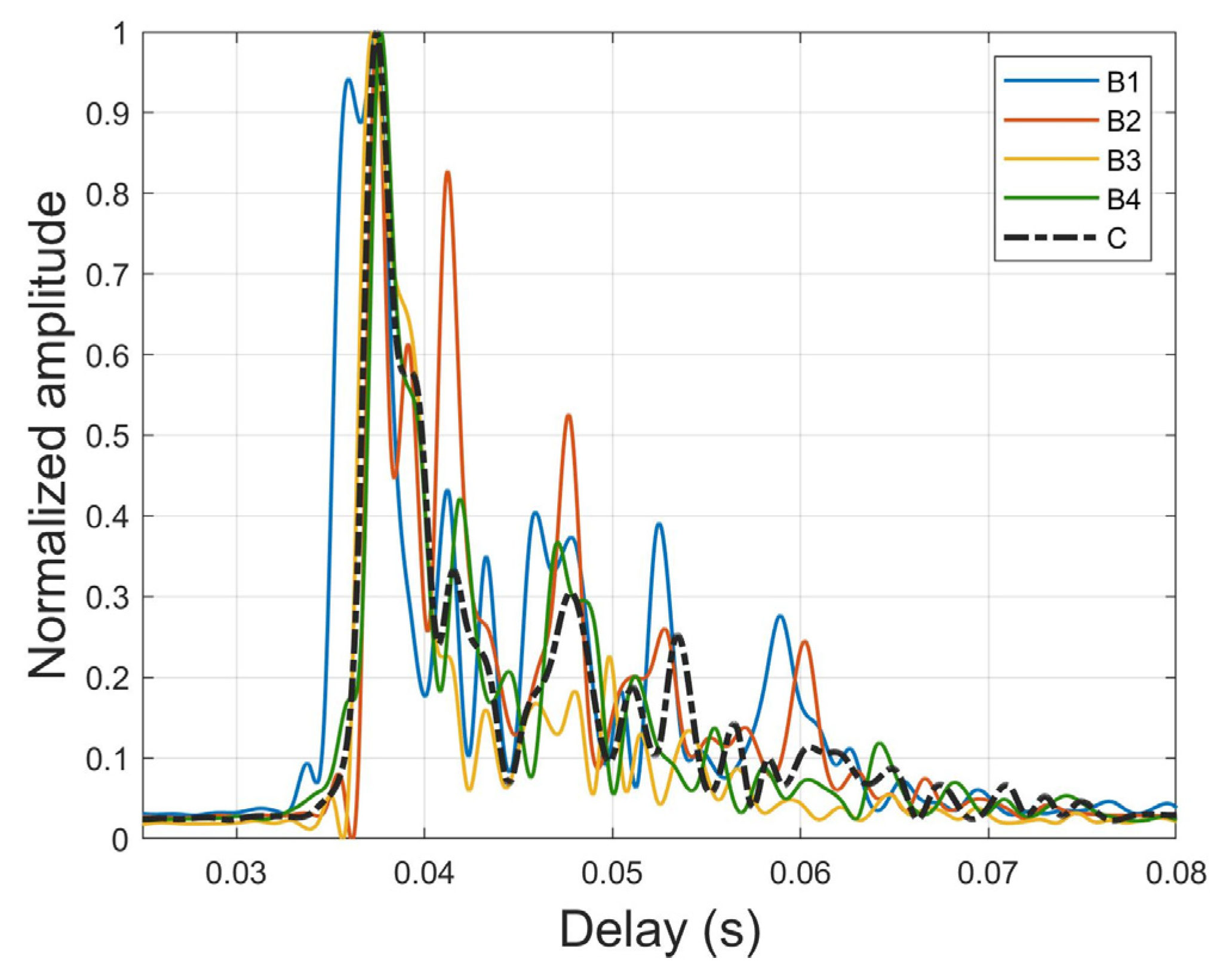
In the experiment, the training data samples of the neural network are received by hydrophones at positions B1, B2, B3, and B4, respectively. The data used to test the performance of the DL-based system are received by the hydrophone at position C. Due to the different locations of the hydrophone, the UWA channel structures in the training and test stage are also different. Due to the change of the position of the receiving hydrophone, the different CIRs is shown in Figure 16.
Figure 16.
Training stage and test stage: CIRs at different positions of hydrophone.
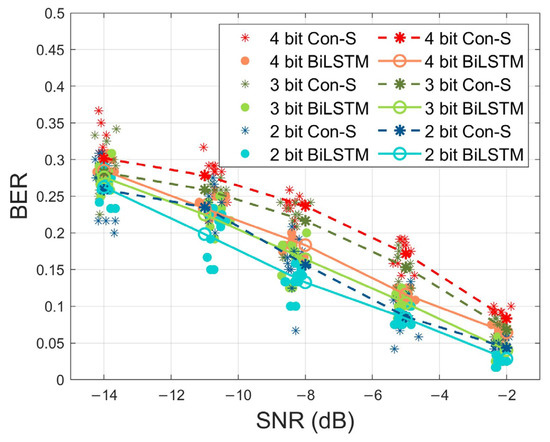
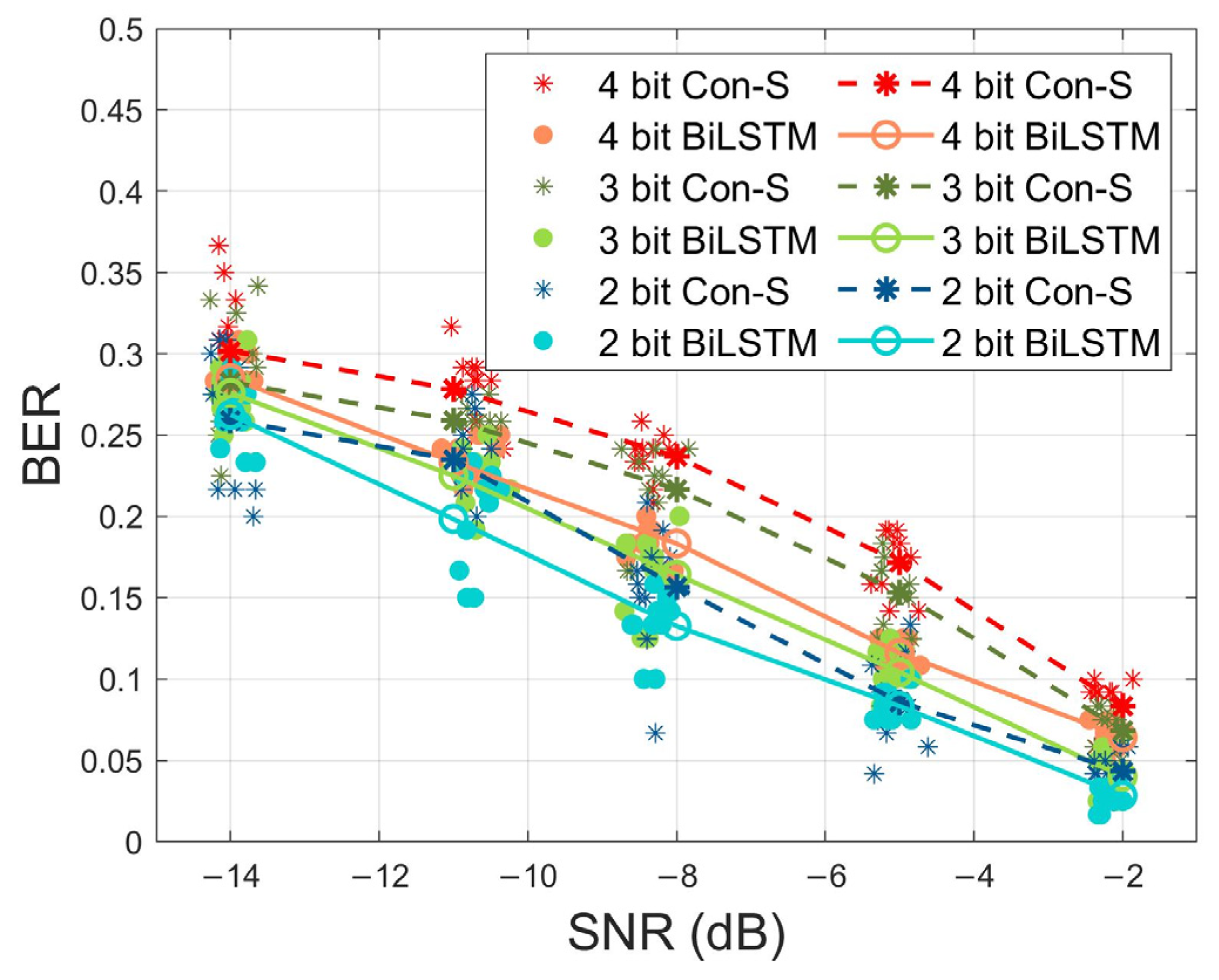
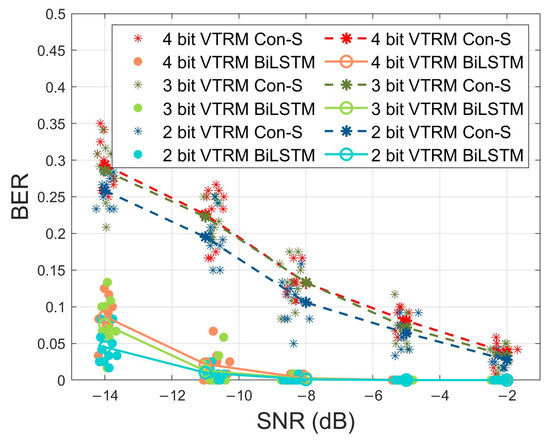
The performance of the conventional and the DL-based systems without preprocessing are compared experimentally. The scatter diagram of BER under three CSK-SS modulation schemes under different SNRs is given in Figure 17. The BER curve is given by calculating the mean of scatter points under each SNR. A more intuitive representation is given in Figure 18. Through the analysis of the data, it can be found that under the three CSK-SS modulation schemes, the performance of the DL-based system is better than that of the conventional system, and the anti-noise performance is improved by 1 dB to 3 dB.
Figure 17.
The scatter diagram of the conventional and DL-based systems without preprocessing.
Figure 18.
The BER curve of the conventional and DL-based systems without preprocessing.
The experiment also compares the performance of the conventional and the DL-based systems after preprocessing. Figure 19 shows the scatter diagram of BER under three CSK-SS modulation schemes under different SNRs. Similarly, the BER curve is given through Figure 20. The data analysis shows that the preprocessing improves the performance of the DL-based CSK-SS UWA communication system. Under the three CSK-SS modulation schemes, compared with the preprocessed conventional system, the preprocessed DL-based system improves the anti-noise ability by 9 dB to 10 dB. When the SNR is greater than −8 dB, each symbol in CSK-SS modulation carries 4 bits, 3 bits, and 2 bits, the BER of the DL-based system is less than 2.5 × 10⁻³, 1.7 × 10⁻³, and 0.8 × 10⁻³, respectively. Under the condition of SNR = −14 dB, when each symbol in CSK-SS modulation carries 4 bit, 3 bit, and 2 bit information, the BER is 8.6 × 10⁻², 7.6 × 10⁻², and 4.5 × 10⁻², respectively.
Figure 19.
The scatter diagram of the conventional and DL-based systems after preprocessing.
Figure 20.
The BER curve of the conventional and DL-based systems after preprocessing.
Table 4 and Table 5 respectively shows the BER of the conventional and DL-based systems with or without preprocessing operations under different SNRs.
Table 4.
BER of the conventional and DL-based systems without preprocessing under different SNRs.
Table 5.
BER of the conventional and DL-based systems after preprocessing under different SNRs.
The experimental results show that the performance of the DL-based CSK-SS UWA communication system is better than that of the conventional CSK-SS UWA communication system. In addition, for the DL-based system, when the UWA channel structure in the offline training stage is inconsistent with that in the online test stage, the BiLSTM network still has a certain generalization ability. It is worth noting that under the condition of a low SNR, the channel equalization preprocessing method can significantly improve the performance of the DL-based system. Therefore, the DL-based CSK-SS UWA communication system can realize reliable signal transmission in complex shallow water acoustic channels under the condition of a low SNR. The memory and analysis of the received signal are completed through the BiLSTM network model, which solves the problems in the signal demodulation process of the conventional CSK-SS UWA communication system affected by multipath fading and noise.
4.3. Suggestions for Future Experiments
By processing and analyzing the actual data in the water tank experiment, we have thought about the problems that may be encountered in future experiments. In order to deal with these problems, we will provide suggestions and references for all scholars to pay attention to the process of experimental verification in the future.
- −
- Influence of experimental equipment
It is necessary to consider the negative impact of the PA on the transmitted signal in the experiment. When the PA amplifies the signal, it usually introduces the corresponding nonlinear distortion [36]. The additional high-order components obtained after the PA will cause certain distortion to the amplitude and phase of the signal. This influence will produce phase modulation components and cause clutter interference. Digital pre-distortion technology [37] can be used to compensate for the nonlinear distortion caused by the PA by distorting the signal before passing through the PA in the digital domain to reduce the impact on the performance of the neural network. In addition, the frequency response of the preamplifier, filter, and transducer will also affect the signal waveform. It is necessary to adopt more strict standards to screen the instruments and equipment that may be used in the test process.
- −
- Variation of UWA channel and coping strategies
The environment of the water tank is relatively stable and the channel conditions will not change much. However, the marine environment is more complex and changeable, and the channel will change due to marine dynamic factors such as sea surface floating. It is necessary to “saturation train” the network model. For the specific application scenario of underwater fixed communication nodes, it can be considered to wake up the underwater nodes regularly in non-working hours, send training signals to the receiver to obtain more diverse UWA channel information, and periodically strengthen the neural network model to improve the performance of the system.
5. Conclusions and Prospect
In this paper, the neural network model is used as the receiver structure of the DL-based CSK-SS UWA communication system to demodulate the signal. The neural network model is trained based on the training samples with distortion caused by the influence of UWA channels and noise in the offline stage.
The simulation results show that the DL-based CSK-SS UWA communication system has better reliability than the conventional system in the complex shallow water acoustic channels with low SNR. The neural network model-based receiver module will reduce the impact of the multipath effect on the performance of the conventional CSK-SS system in fading channel. Furthermore, the neural network model has good generalization ability. When the online deployment conditions do not precisely agree with the offline training conditions, the neural network model can still work effectively to a certain extent. In other words, the model can analyze and memorize the complex characteristics of the UWA channel. In addition, the focusing gain brought by VTRM will introduce new beneficial features to the neural network, which will bring more reliable performance to this system.
The performance of the DL-based CSK-SS UWA communication system is verified by a water tank experiment. The experimental results show that the performance of the DL-based system is improved compared with the conventional system. Especially for the DL-based system after channel equalization preprocessing, when SNR is greater than −8 dB, the BER is less than 2.5 × 10⁻³. It should be pointed out that the BER of the communication system can be further reduced with appropriate coding under the condition of low BER. In addition, some suggestions are put forward for the problems that scholars may encounter in future experiments.
In the future, we can also consider using convolutional neural network, combined with transfer learning, few-shot learning, and other technologies to expand the application scope of the system further and reduce the cost and complexity of network training. Moreover, further exploration of the application of the system in practical engineering will be considered.
Author Contributions
Conceptualization, Y.L. (Yufei Liu) and F.Z.; methodology, Y.L. (Yufei Liu) and Y.Z.; software, Y.L. (Yufei Liu); validation, Y.L. (Yufei Liu), Y.Z., G.Y., X.L. and Y.L. (Yinheng Lu); formal analysis, Y.L. (Yufei Liu) and F.Z.; investigation, G.Q.; resources, G.Q. and F.Z.; data curation, G.Y., X.L. and Y.L. (Yinheng Lu); writing—original draft preparation, Y.L. (Yufei Liu); writing—review and editing, G.Q., Y.L. (Yufei Liu), F.Z. and Y.Z.; visualization, Y.L. (Yufei Liu); supervision, F.Z.; project administration, F.Z.; funding acquisition, F.Z. All authors have read and agreed to the published version of the manuscript.
Funding
This research was funded by the National Key R&D Program of China (Grant Nos. 2018YFC0308500), National Natural Science Foundation of China (Grant Nos. U1806201), the Science and Technology on Underwater Information and Control Laboratory (Grant No. 6142218200410).
Institutional Review Board Statement
Not applicable.
Informed Consent Statement
Not applicable.
Data Availability Statement
Not applicable.
Acknowledgments
The authors would like to thank the editors and the anonymous reviewers.
Conflicts of Interest
The authors declare no conflict of interest.
References
- Stojanovic, M.; Preisig, J. Underwater acoustic communication channels: Propagation models and statistical characterization. IEEE Commun. Mag. 2009, 47, 84–89. [Google Scholar] [CrossRef] [Scilit]
- Yang, T.C.; Yang, W.B. Performance analysis of direct-sequence spread-spectrum underwater acoustic communications with low signal-to-noise-ratio input signals. J. Acoust. Soc. Am. 2008, 123, 842–855. [Google Scholar] [CrossRef] [Scilit]
- Yang, T.C.; Yang, W.B. Low probability of detection underwater acoustic communications using direct-sequence spread spectrum. J. Acoust. Soc. Am. 2008, 124, 3632–3647. [Google Scholar] [CrossRef] [Scilit]
- He, C.; Zhang, Q.; Huang, J. Passive time reversal communication with cyclic shift keying over underwater acoustic channels. Appl. Acoust. 2015, 96, 132–138. [Google Scholar] [CrossRef] [Scilit]
- Jing, L.; He, C.; Wang, H.; Zhang, Q.; Yin, H. A New IDMA System Based on CSK Modulation for Multiuser Underwater Acoustic Communications. IEEE Trans. Veh. Technol. 2020, 69, 3080–3092. [Google Scholar] [CrossRef] [Scilit]
- LeCun, Y.; Bengio, Y.; Hinton, G. Deep learning. Nature 2015, 521, 436–444. [Google Scholar] [CrossRef] [Scilit] [PubMed]
- Schmidhuber, J. Deep learning in neural networks: An overview. Neural Netw. 2015, 61, 85–117. [Google Scholar] [CrossRef] [Scilit]
- Minsky, M. Steps toward artificial intelligence. Proc. IRE 1961, 49, 8–30. [Google Scholar] [CrossRef] [Scilit]
- Gers, F.A.; Schmidhuber, J. LSTM recurrent networks learn simple context-free and context-sensitive languages. IEEE Trans. Neural Netw. 2001, 12, 1333–1340. [Google Scholar] [CrossRef] [Scilit]
- Graves, A.; Schmidhuber, J. Framewise phoneme classification with bidirectional LSTM and other neural network architectures. Neural Netw. 2005, 18, 602–610. [Google Scholar] [CrossRef] [Scilit]
- Graves, A.; Jaitly, N.; Mohamed, A. Hybrid speech recognition with deep bidirectional LSTM. In Proceedings of the 2013 IEEE Workshop on Automatic Speech Recognition and Understanding, Conference and Exhibition, Olomouc, Czech Republic, 8–12 December 2013. [Google Scholar]
- Yu, D.; Deng, L. Deep learning and its applications to signal and information processing [exploratory dsp]. IEEE Signal Process. Mag. 2010, 28, 145–154. [Google Scholar] [CrossRef] [Scilit]
- Xie, H.; Qin, Z.; Li, G.Y.; Juang, B.H. Deep learning enabled semantic communication systems. IEEE Trans. Signal Process. 2021, 69, 2663–2675. [Google Scholar] [CrossRef] [Scilit]
- Cao, H.; Wang, W.; Su, L.; Ni, H.; Gerstoft, P.; Ren, Q.; Ma, L. Deep transfer learning for underwater direction of arrival using one vector sensor. J. Acoust. Soc. Am. 2021, 149, 1699–1711. [Google Scholar] [CrossRef] [Scilit] [PubMed]
- Hinton, G.; Deng, L.; Yu, D.; Dahl, G.E.; Mohamed, A.; Jaitly, N.; Senior, A.; Vanhoucke, V.; Nguyen, P.; Sainath, T.N.; et al. Deep neural networks for acoustic modeling in speech recognition: The shared views of four research groups. IEEE Signal Process. Mag. 2012, 29, 82–97. [Google Scholar] [CrossRef] [Scilit]
- Ye, H.; Li, G.Y.; Juang, B.H. Power of deep learning for channel estimation and signal detection in OFDM systems. IEEE Wirel. Commun. Lett. 2017, 7, 114–117. [Google Scholar] [CrossRef] [Scilit]
- Gao, X.; Jin, S.; Wen, C.K.; Li, G.Y. ComNet: Combination of deep learning and expert knowledge in OFDM receivers. IEEE Commun. Lett. 2018, 22, 2627–2630. [Google Scholar] [CrossRef] [Scilit]
- Zhang, Y.; Li, J.; Zakharov, Y.; Li, X.; Li, J. Deep learning based underwater acoustic OFDM communications. Appl. Acoust. 2019, 154, 53–58. [Google Scholar] [CrossRef] [Scilit]
- Qasem, Z.A.H.; Leftah, H.A.; Sun, H.; Qi, J.; Wang, J.; Esmaiel, H. Deep learning-based code indexed modulation for autonomous underwater vehicles systems. Veh. Commun. 2021, 28, 100314. [Google Scholar] [CrossRef] [Scilit]
- Torrieri, D. Principles of Spread-Spectrum Communication Systems; Springer: Berlin/Heidelberg, Germany, 2005. [Google Scholar]
- Tu, X.; Xu, X.; Song, A. Frequency-Domain Decision Feedback Equalization for Single-Carrier Transmissions in Fast Time-Varying Underwater Acoustic Channels. IEEE J. Ocean. Eng. 2020, 46, 704–716. [Google Scholar] [CrossRef] [Scilit]
- Porter, M.B. The Bellhop Manual and User’s Guide: Preliminary Draft; Heat, Light, and Sound Research, Inc.: La Jolla, CA, USA, 2011; Rep; Volume 260. [Google Scholar]
- Schuster, M.; Paliwal, K.K. Bidirectional recurrent neural networks. IEEE Trans. Signal Process. 1997, 45, 2673–2681. [Google Scholar] [CrossRef] [Scilit]
- Graves, A.; Fernández, S.; Schmidhuber, J. Bidirectional LSTM networks for improved phoneme classification and recognition. In Proceedings of the Artificial Neural Networks: Formal Models and Their Applications—ICANN 2005, ICANN 2005, Lecture Notes in Computer Science, Conference and Exhibition, Berlin/Heidelberg, Germany, 11–15 September 2005; Springer: Berlin/Heidelberg, Germany, 2005. [Google Scholar]
- Greff, K.; Srivastava, R.K.; Koutník, J.; Steunebrink, B.; Schmidhuber, J. LSTM: A search space odyssey. IEEE Trans. neural Netw. Learn. Syst. 2016, 28, 2222–2232. [Google Scholar] [CrossRef] [Scilit] [PubMed]
- Tropp, J.A.; Gilbert, A.C. Signal recovery from random measurements via orthogonal matching pursuit. IEEE Trans. Inf. Theory 2007, 53, 4655–4666. [Google Scholar] [CrossRef] [Scilit]
- Yin, J.; Wang, Y.; Wang, L.; Hui, J. Multiuser underwater acoustic communication using single-element virtual time reversal mirror. Chin. Sci. Bull. 2009, 54, 1302–1310. [Google Scholar] [CrossRef] [Scilit]
- Samarasinghe, P.; Abhayapala, T.D.; Kellermann, W. Acoustic reciprocity: An extension to spherical harmonics domain. The J. Acoust. Soc. Am. 2017, 142, EL337–EL343. [Google Scholar] [CrossRef] [Scilit] [PubMed]
- Kim, S.; Edelmann, G.F.; Kuperman, W.A.; Hodgkiss, W.S.; Song, H. Spatial resolution of time-reversal arrays in shallow water. J. Acoust. Soc. Am. 2001, 110, 820–829. [Google Scholar] [CrossRef] [Scilit]
- Kim, S.; Kuperman, W.A.; Hodgkiss, W.S.; Song, H.; Edelmann, G.F.; Akal, T. Robust time reversal focusing in the ocean. J. Acoust. Soc. Am. 2003, 114, 145–157. [Google Scholar] [CrossRef] [Scilit]
- Murphy, K.P. Machine Learning: A Probabilistic Perspective; MIT press: Cambridge, MD, USA, 2012. [Google Scholar]
- Hodges, R.P. Underwater Acoustics: Analysis, Design and Performance of Sonar; John Wiley & Sons: Hoboken, NJ, USA, 2011. [Google Scholar]
- Available online: https://testequipment.center/Product_Documents/Bruel-Kjaer-2713-Specifications-7A786.pdf (accessed on 20 August 2021).
- Available online: https://www.behringer.com/product.html?modelCode=P0062 (accessed on 20 August 2021).
- Available online: http://www.oceaninstruments.co.nz/product/soundtrap-300-hf-high-frequency/ (accessed on 20 August 2021).
- Ku, H.; Kenney, J.S. Behavioral modeling of nonlinear RF power amplifiers considering memory effects. IEEE Trans. Microw. Theory Tech. 2003, 51, 2495–2504. [Google Scholar]
- Morgan, D.R.; Ma, Z.; Kim, J.; Zierdt, M.G.; Pastalan, J. A generalized memory polynomial model for digital predistortion of RF power amplifiers. IEEE Trans. Signal Process. 2006, 54, 3852–3860. [Google Scholar] [CrossRef] [Scilit]

Publisher’s Note: MDPI stays neutral with regard to jurisdictional claims in published maps and institutional affiliations. |
© 2021 by the authors. Licensee MDPI, Basel, Switzerland. This article is an open access article distributed under the terms and conditions of the Creative Commons Attribution (CC BY) license (https://creativecommons.org/licenses/by/4.0/).