Skip to Content
JMSEJournal of Marine Science and Engineering
  • Article
  • Open Access

28 January 2026

Seismo-Stratigraphic Architecture of the Campania–Latium Tyrrhenian Margin: New Insights from High-Resolution Sparker Profiles


,
,
and
1
Istituto di Scienze Marine (ISMAR), Consiglio Nazionale delle Ricerche (CNR), Sezione Secondaria di Napoli, Calata Porta di Massa, Porto di Napoli, 80133 Napoli, Italy
2
Dipartimento di Scienze e Tecnologie, Università degli Studi del Sannio, 82100 Benevento, Italy
*
Author to whom correspondence should be addressed.

Abstract

High-resolution single-channel Sparker (1 kJ) profiles have been carried out to reconstruct the seismo-stratigraphic architecture of a sector of the Campania–Latium Tyrrhenian margin (Southern Tyrrhenian Sea, Italy). Seven seismic lines between the Volturno river mouth and the southern Latium margin were processed in IHS Kingdom® software (4.0) at the University of Sannio (Benevento, Italy) and interpreted at the CNR-ISMAR (Naples, Italy) using seismic- and sequence-stratigraphic criteria. The Sparker dataset refines correlations with previously interpreted Chirp profiles and improves the imaging of fault patterns and key stratigraphic markers. Several seismo-stratigraphic units displaced by normal faults were recognized. Unit 1 represents the acoustic substratum of the high-resolution record, whereas Unit 2 corresponds to a thick relict prograding wedge that thickens toward the Volturno river mouth. A mounded lowstand unit is interpreted as deposits related to the Volturno river delta/fan system. Volcanic units, including the Villa Literno volcanic complex and local volcanic edifices, are locally identified. Overall, the results show that Sparker processing and interpretation provide robust constraints on the stratigraphic architecture and Late Quaternary tectono-sedimentary evolution of deltaic continental shelves. In particular, while previous Chirp studies have effectively constrained the stratigraphic architecture of the Late Quaternary depositional sequence and the geometry of the NYT reflector, this study provides new insights about deeper progradational seismo-stratigraphic units and related volcanic deposits and their tectono-stratigraphic setting.

1. Introduction

The Campania–Latium sector of the Tyrrhenian margin belongs to the western Tyrrhenian back-arc domain, which underwent lithospheric thinning and intense Plio–Quaternary volcanism during opening of the Tyrrhenian basin [1]. Along this margin, Plio–Quaternary extensional basins are separated by structural highs that commonly represent the offshore continuation of onshore morpho-structural domains. In many sectors, peri-Tyrrhenian basins also form the seaward continuation of coastal plains, whose development and stratigraphic architecture were strongly influenced by Plio–Quaternary extension [2,3,4,5,6,7,8,9,10,11,12] within the broader Neogene evolution of the Apennine chain [13,14,15].
Previous studies indicate that the tectonic history of peri-Tyrrhenian basins reflects alternating extensional and compressional/transpressional phases during the Plio–Quaternary, locally accompanied by tectonic inversion [12,16,17]. Extension was associated with rifting and seafloor spreading in the back-arc, including the Pliocene Vavilov Basin and the Quaternary Marsili Basin [18,19,20,21,22,23,24,25,26], whereas inversion involved the reactivation of earlier normal faults under changing stress fields [27,28,29,30]. At the basin scale, extension is frequently accommodated by listric master faults and associated antithetic faults, producing half-graben architectures and a regional NE–SW structural grain [2,31] that contributed to the alternation of coastal ridges and plains [12,32,33,34].
In the Campania offshore, high-resolution seismic studies based on Chirp data have provided key constraints on Late Pleistocene–Holocene stratigraphy and on the regional correlation of volcaniclastic markers, including the NYT [35,36,37]. Additional contributions include geological and stratigraphic reconstructions based on integrated onshore/offshore data [11,12,38] and analyses of recent landscape evolution and ground deformation in the Volturno Plain [39]. Building on this background, this paper provides the geological and seismo-stratigraphic interpretation of seven single-channel Sparker profiles acquired on the northern Campania continental margin and compares the resulting framework with previous Chirp-based reconstructions [35,36,37]. More specifically, this study offers new information about deeper progradational seismo-stratigraphic units and related volcanic deposits and their tectono-stratigraphic setting, whereas earlier Chirp studies have effectively constrained the seismo-stratigraphic setting of the Late Quaternary depositional sequence and the contours of the NYT reflector. As a general rule, Sparker systems provide high-resolution data but have lower signal penetration and data quality, while the Chirp sub-bottom profiler provides very-high-resolution seismic data but gives information about the first 30 m below the seafloor. In marine studies, the combined interpretation of Chirp and Sparker data with variable penetration and resolution contributes to achieving an accurate geological interpretation, as demonstrated in our study.

2. Geological Setting

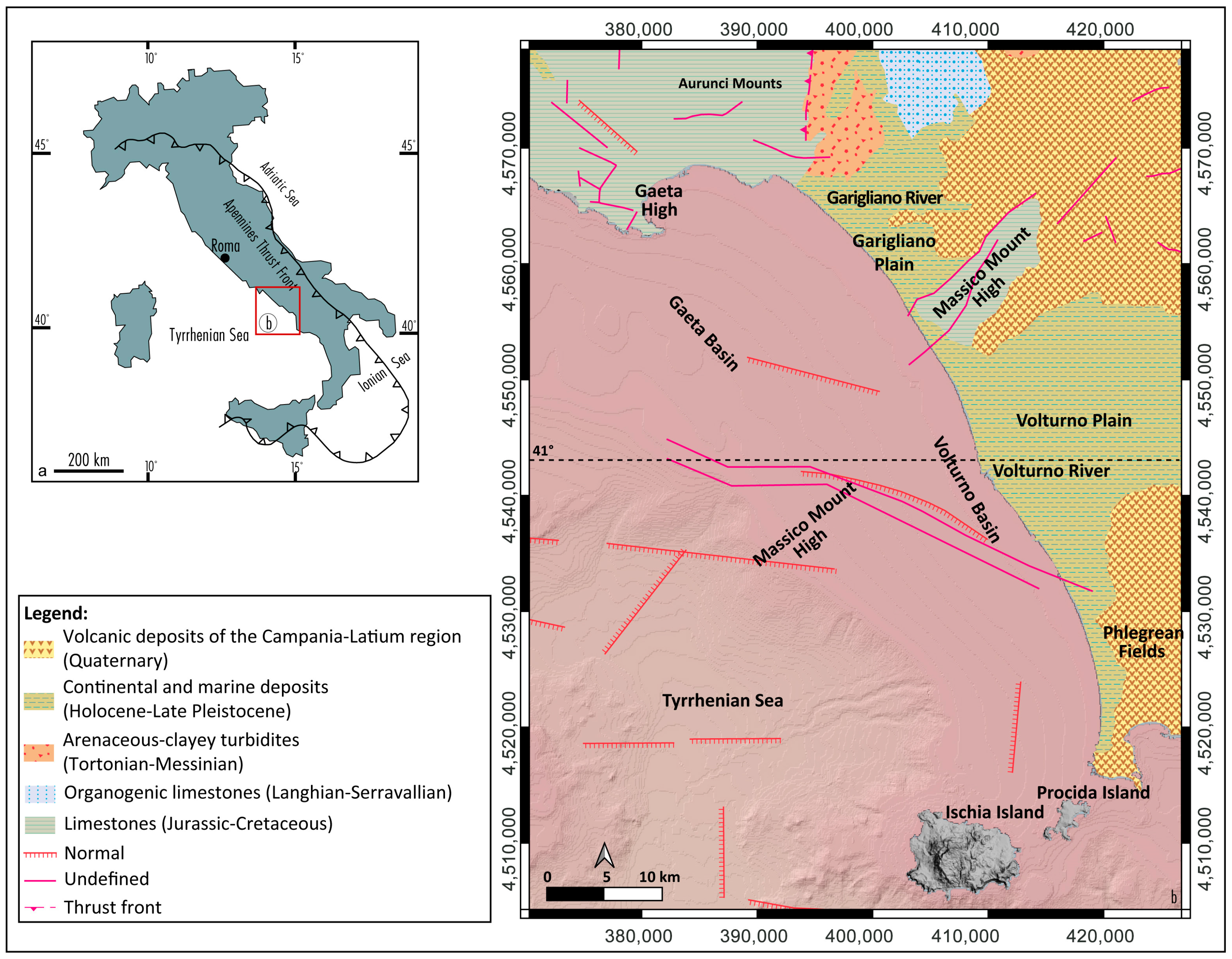
The Campania–Latium Tyrrhenian margin is characterized by a set of Plio–Quaternary extensional basins separated by structural highs that represent the offshore continuation of onshore morpho-structural domains. According to the regional synthesis of [16], the main lineaments between the Gulf of Gaeta and Ischia Island include (Figure 1) (i) the Circeo structural high (NW–SE-trending, seaward continuation of the Circeo Promontory), (ii) the Terracina Basin (N–S-trending half-graben widening seaward and laterally linked to the Gaeta Basin), (iii) the Terracina–Gaeta structural high (a belt of highs offshore Gaeta separating the Terracina and Gaeta basins), (iv) the Massico structural high (offshore continuation of Mt. Massico) [11,12], and (v) the Volturno Basin, whose depocenter is located close to the Volturno river mouth and whose basin fill reaches ~2.5 s two-way travel time (TWT) [2,34,35] (Figure 1).
The regional structural pattern also includes major fault systems with different orientations and kinematics. South of the 41° N lineament, the margin is associated with a well-developed magnetic anomaly field with a complex trend [11,40]. Normal faults with WNW–ESE, E–W, and NE–SW strikes are reported, and ENE–WSW to E–W structures aligned with the 41° N fault system display geometries consistent with a strike-slip component [41]. In the Mt. Massico sector, NE–SW-trending faults have been related to the Ortona–Roccamonfina Line (ORL) [41,42,43,44,45,46]. Seismo-stratigraphic constraints indicate that the ORL is older than the 41° N fault system [41,47], although their relationship with Tyrrhenian extension remains debated.
Figure 1. (a) Location of the study area along the Campania–Latium Tyrrhenian margin (southern Italy). (b) Morpho-structural framework between the Gulf of Gaeta and Ischia Island, showing the main basins and structural highs (e.g., Gaeta Basin/High, Massico structural high, Volturno Basin), the 41° N lineament, and the principal fault traces and thrust-front segments. Modified after [29,41,42].
Jmse 14 00269 g001
The Campania Plain is the widest and least dissected coastal plain of the region and forms an elongated NW–SE-trending lowland (~150 km long, up to ~50 km wide). Its inland margins are bounded by normal faults uplifting Meso–Cenozoic carbonate massifs (Mt. Massico to the NW; the Caserta–Avella–Sarno mountains to the NE; and the Lattari mountains to the SE). The seaward margin is influenced by the Volturno delta system [39,48,49,50,51] and by coastal volcanic edifices (Campi Flegrei and Somma-Vesuvius) [52,53]. The timing of graben development remains debated, with a Late Pliocene onset proposed by [54] and an Early Pleistocene onset suggested by [55] based on reinterpretations of the same lithostratigraphic dataset.
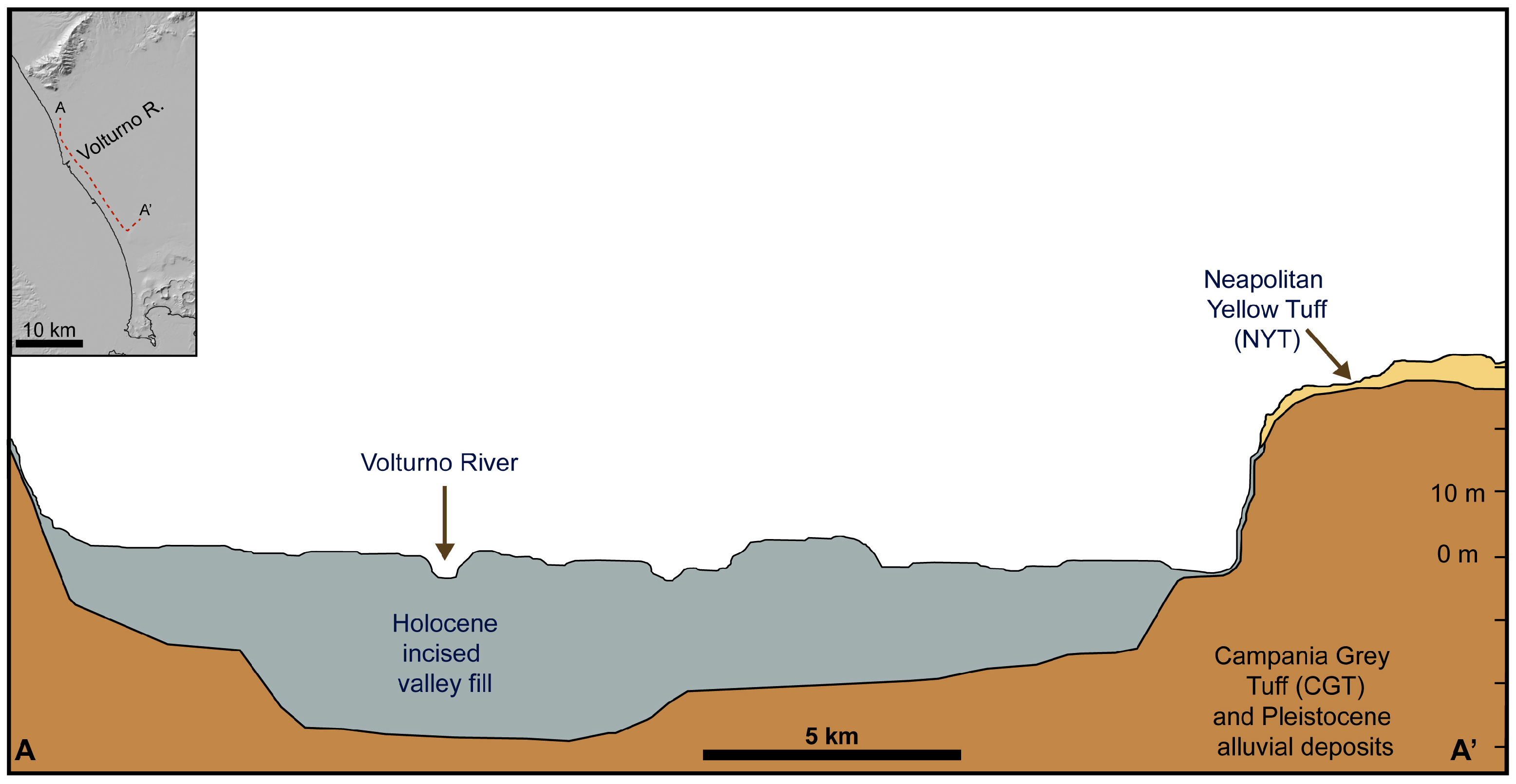
A key stratigraphic marker in the Volturno sector is the Campanian Ignimbrite/Campanian Grey Tuff (CGT), which forms a laterally continuous ignimbritic unit readily recognizable in cores due to its distinctive thickness and lithological characteristics [34]. Stratigraphic correlations allow the outline of a palaeovalley incised into the ignimbritic unit to be mapped; its depocenter broadly aligns with the modern Volturno river and reaches ~15–20 km in width and up to ~30 m depth [34] (Figure 2).
Figure 2. Sketch stratigraphic diagram of the Volturno valley fill (modified after [34]). Key: NYT: Neapolitan Yellow Tuff. CGT: Campania Grey Tuff. AA’: trace of the geological section (see the inset for location).
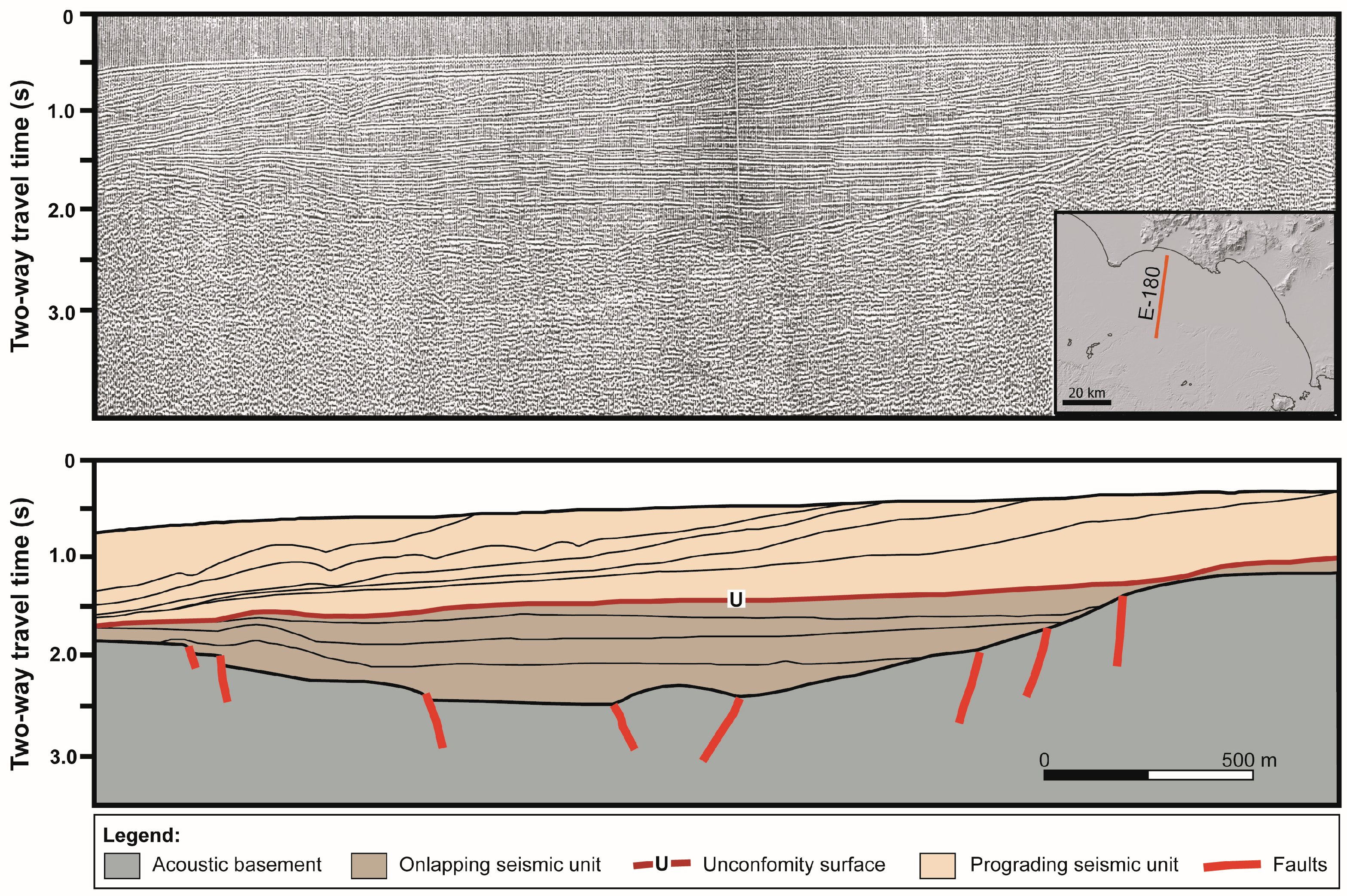
Regional-scale seismic data provide key constraints on the deeper tectono-stratigraphic framework underlying the shallow shelf succession investigated using Sparker profiles. Offshore, the regional seismic profile E-180 (Figure 3) illustrates the stratigraphic architecture of the Volturno delta and the organization of multiple depositional sequences bounded by major discontinuities and affected by normal faulting [16]. The interpreted horizons and fault pattern highlight the structural control of accommodation and progradation within the basin fill, providing a basin-scale context for the shallow seismo-stratigraphic units described in this study.
Figure 3. Seismic profile E180 and corresponding geological interpretation, displaying the stratigraphic architecture of the Volturno delta (modified after [16]). Key. U: regional unconformity, separating the syn-rift basin sequences from the post-rift basin sequences.
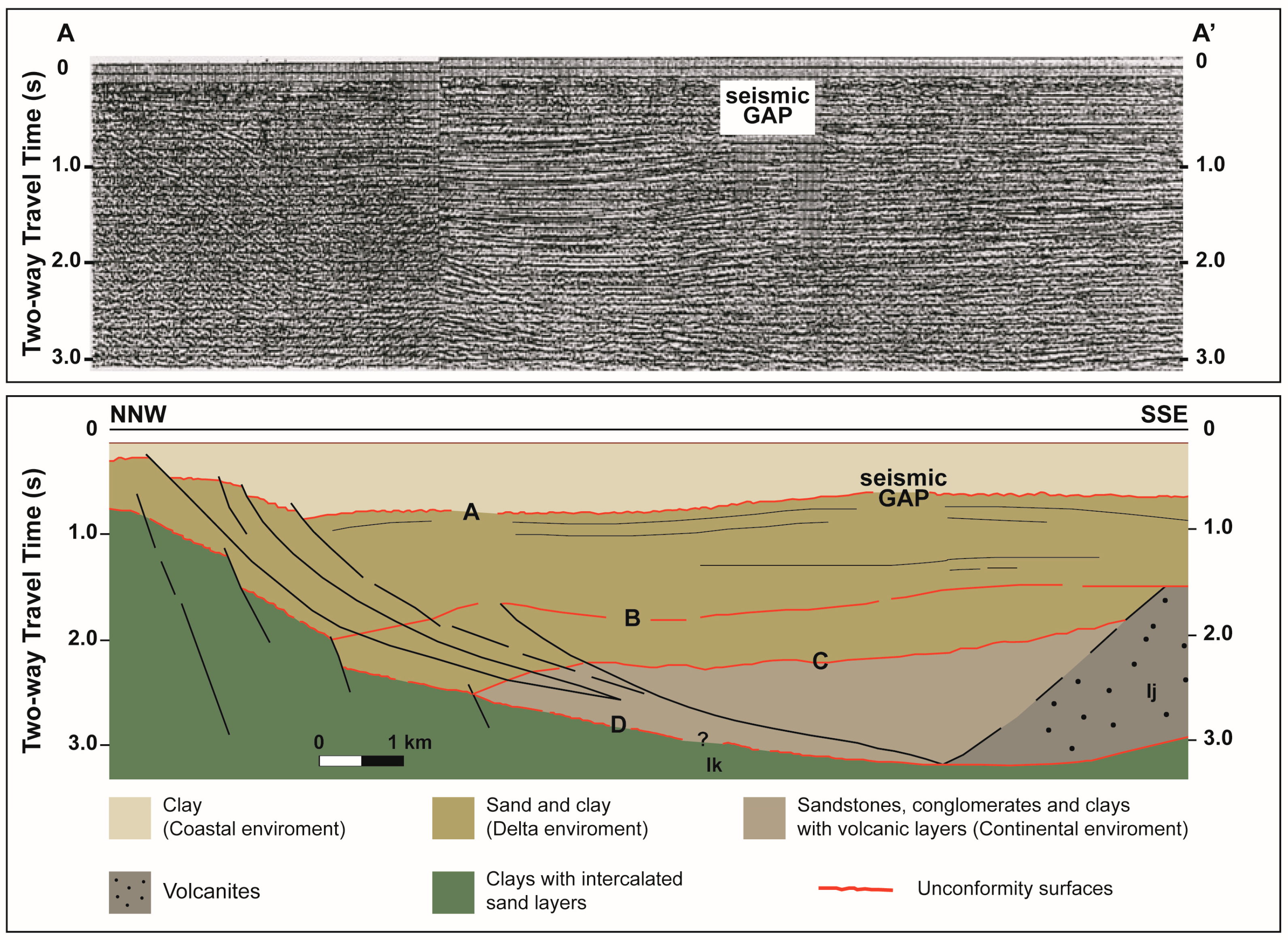
Onshore, seismic and well data acquired during petroleum exploration indicate that the subsurface of the Campania Plain contains thick Pleistocene successions of marine, alluvial, and deltaic deposits interlayered with pyroclastic sequences and lavas [2]. The onshore seismic example in Figure 4 shows a fault-bounded basin architecture consistent with half-graben development and supports the large thickness of basin infill close to the Volturno river mouth, where values of ~2.5 s TWT correspond to approximately 4 km [2].
Figure 4. Onshore seismic profile across the Volturno Basin and corresponding geological interpretation (modified after [2]). Key. A, B, C, D: regional unconformities, occurring at the basin scale. Ij: Meso-Cenozoic carbonate acoustic basement. Ik: Miocene flysch deposits.
High-resolution offshore studies based on Chirp data provided key constraints on Late Pleistocene–Holocene stratigraphy and on the regional correlation of volcaniclastic markers in the northern Phlegraean–Gaeta offshore [35,36,37]. A multi-proxy approach integrating Chirp profiles with sedimentological and physical property data was used to characterize Late Holocene deposits and interpret recent sedimentary processes on the outer shelf [36]. Tephrostratigraphic constraints were refined through the geochemical characterization of tephra layers identified in gravity cores from the northern Phlegraean offshore [37]. The corresponding major element dataset supports the classification and correlation of key tephra horizons and provides a geochemical framework for the recognition of marker deposits, including the NYT used in regional stratigraphic correlations [35,36,37].
Additional contributions include the stratigraphic scheme proposed by [38] and integrated geophysical interpretations of basin structure based on reprocessed seismic, gravity, and magnetic data [11], as well as regional seismo-stratigraphic syntheses and well correlations focused on the Volturno Basin and adjacent structural highs [12]. Regional volcanism and its stratigraphic significance have also been discussed in the context of the Northern Campania Volcanic Zone [56,57], and indicators of basin inversion have been related to broader inversion processes recognized in the Tyrrhenian region [28,29,58].

3. Materials and Methods

A grid of single-channel Sparker (1 kJ) seismic profiles was acquired on the continental shelf offshore of the Campania region during the GMS03_01 oceanographic cruise (R/V Urania, National Research Council of Italy) within the framework of marine geological mapping activities. Data acquisition was performed using a 1 kJ Sparker source deployed from the vessel. The generated signal of the Sparker systems is typically in the 50–2000 Hz frequency band and is usually detected and recorded using single-channel short streamers. The power of Sparker sources varies between 100 J and 16 kJ, and as the system’s power increases, the resolution decreases. In the studied seismic sections, the shot spacing recording interval was 10 m, while the sampling interval was one meter.
For time-to-depth conversion, a mean acoustic velocity of 1550 m s−1 was adopted, yielding an estimated penetration of approximately 25–50 m below the seafloor. This velocity represents a standard assumption for seawater and shallow marine sediments in the absence of site-specific velocity calibration; therefore, depth values should be regarded as approximate and are primarily used to provide an order-of-magnitude conversion from two-way travel time to depth. Navigation and positioning were provided by a Starfix differential GPS (DGPS) system. Seismic processing and interpretation were performed in IHS Kingdom® (University of Sannio, Benevento, Italy), whereas final figure drafting and layout were completed in CorelDRAW Suite (version 21.0; CNR-ISMAR, Naples, Italy). Within Kingdom®, SEG-Y files were imported and quality-checked (navigation consistency and signal integrity), and processing was applied to improve the reflector continuity and signal-to-noise ratio through a standard workflow, including (i) trace editing and removal of noisy segments where required; (ii) band-pass filtering tailored to the Sparker bandwidth; (iii) time-variant gain (e.g., AGC) to compensate for attenuation with time; and (iv) amplitude scaling and display optimization for interpretation. Laterally continuous reflectors were then interactively picked on each profile and correlated across adjacent lines to build a consistent seismo-stratigraphic framework [35].
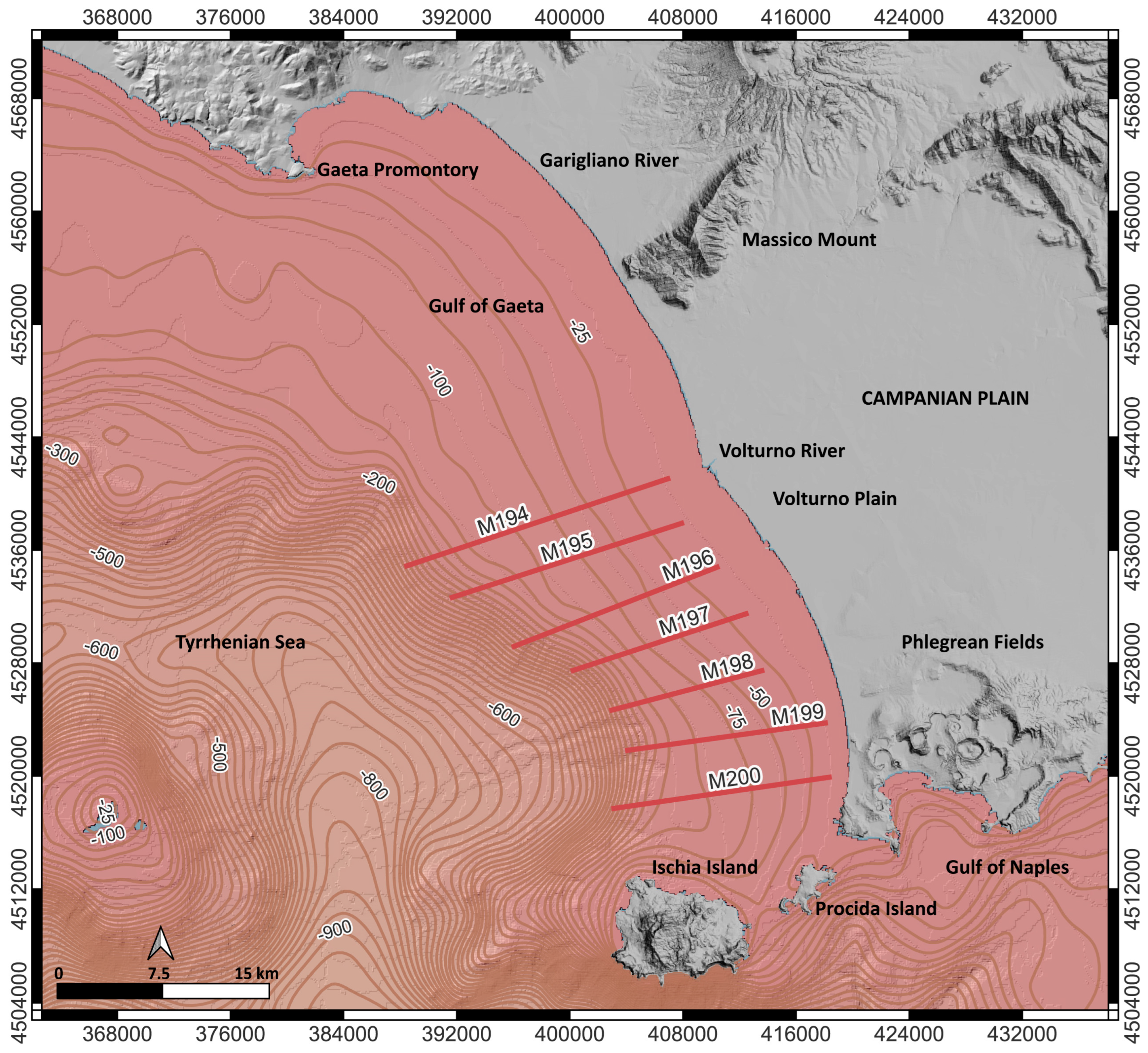
The spatial distribution of the acquired profiles and the survey layout are shown in Figure 5. The bathymetric shaded relief background and bathymetric contours were derived from the EMODnet Bathymetry digital terrain model [59], whereas the onshore topographic shaded relief was obtained from the TINITALY DEM [60]. The main metadata of each line (orientation and geographic setting) are summarized in Table 1. Seismo-stratigraphic interpretation was based on the identification of key seismic discontinuities and depositional sequences, enabling the reconstruction of sediment body geometries, inference of depositional environments, and chronostratigraphic correlations. High-resolution seismic and sequence stratigraphy are widely applied to the interpretation of shallow seismic datasets [61,62,63,64,65,66,67], and the same methodology was adopted here.
Figure 5. Location map of the single-channel Sparker profiles (1 kJ) analyzed in this study (M200–M194), shown on EMODnet Bathymetry (offshore) and TINITALY (onshore) shaded relief backgrounds with bathymetric contours of 25 m.
Table 1. Single-channel Sparker profiles analyzed in this study and their orientation.
Seismo-stratigraphic interpretation was based on the identification of key seismic discontinuities and the definition of depositional sequences, enabling a reconstruction of sediment body geometries, inference of depositional environments, and chronostratigraphic correlations. High-resolution seismic and sequence stratigraphy are widely applied to the interpretation of shallow seismic datasets [61,62,63,64,65,66,67], and the same methodology was adopted here.
IHS Kingdom® was used as the main platform for loading, visualizing, and interpreting the Sparker seismic profiles. SEG-Y files were quality-checked and displayed along navigation tracks; laterally continuous reflectors were then interactively picked on each profile and correlated across adjacent lines to build a consistent seismo-stratigraphic framework [35].

4. Results

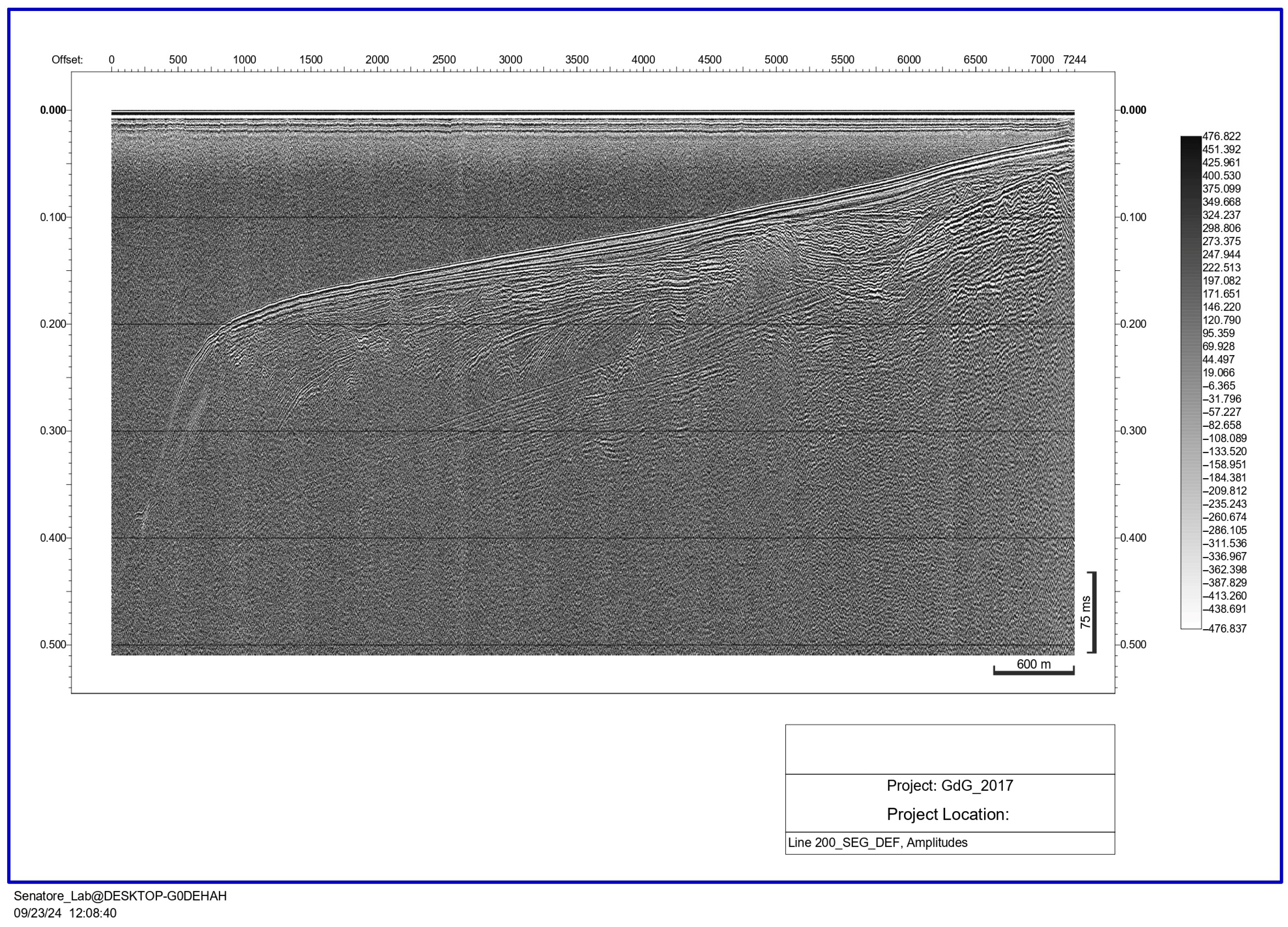
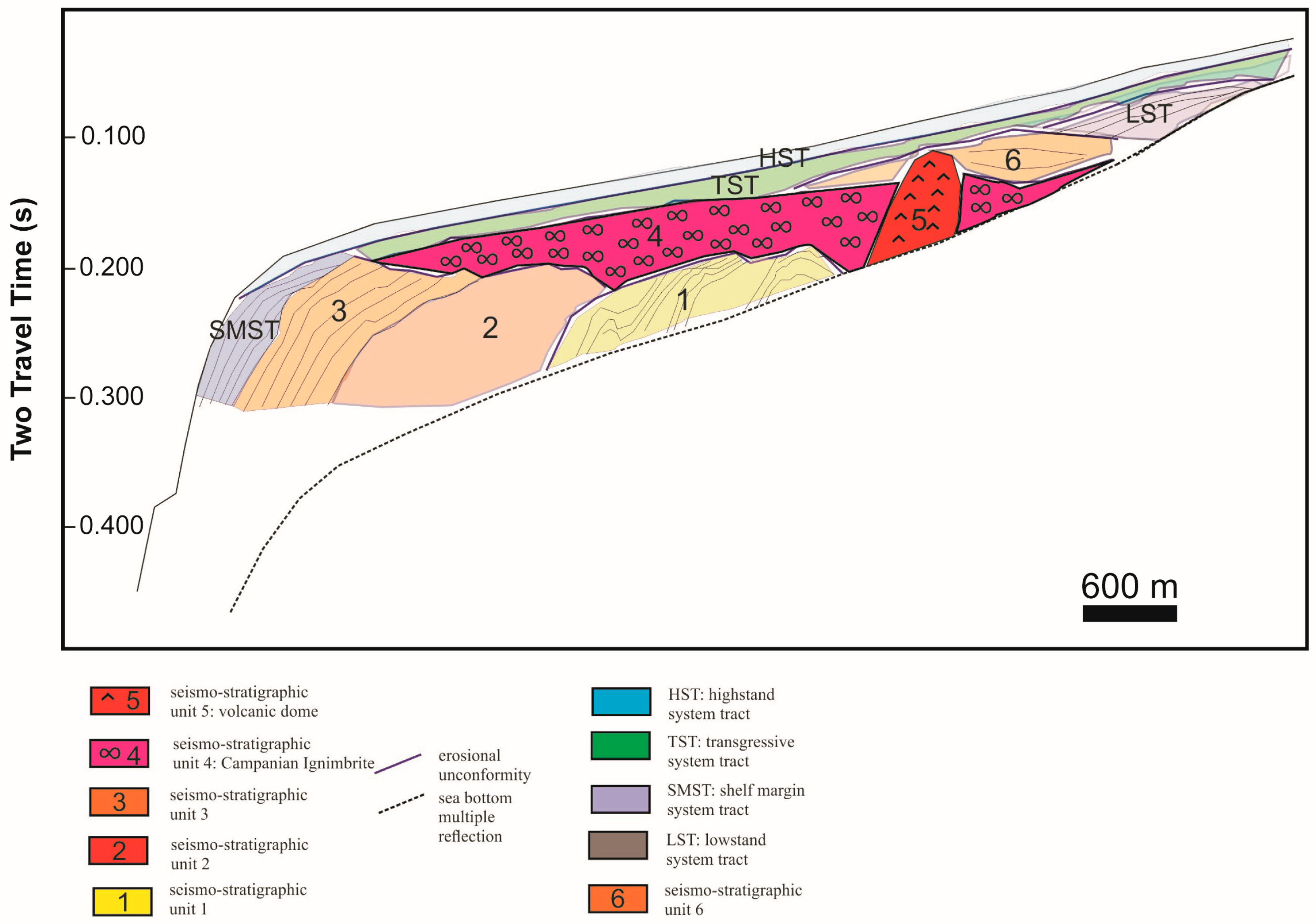
Key seismic facies, discontinuities, and geometries observed along the Sparker profiles are summarized below. Profile M200 images multiple seismo-stratigraphic units of sedimentary and volcanic character (Figure 6 and Figure 7). Unit 1 is characterized by oblique, laterally continuous reflectors alternating with acoustically transparent intervals. Unit 2 is dominated by an acoustically transparent seismic facies. Unit 3 consists of prograding clinoforms truncated at the top by an erosional unconformity. Units 1–3 are overlain, across an erosional surface, by a wide wedge-shaped body (Unit 4). Unit 5 cross-cuts Unit 4 and has a geometry consistent with a localized intrusive body (Figure 7).
Figure 6. Processed Sparker profile M200 (see Figure 7 for the geological interpretation).
Figure 7. Geological interpretation of the Sparker profile M200.
Unit 6 overlies Units 4 and 5 and is characterized by discontinuous to sub-parallel reflectors. The upper part of the succession includes depositional packages attributed to the Late Quaternary sequence (LST, SMST, TST, and HST in Figure 7). The LST occurs mainly in the shelf, whereas the SMST is observed at the shelf margin (Figure 7).
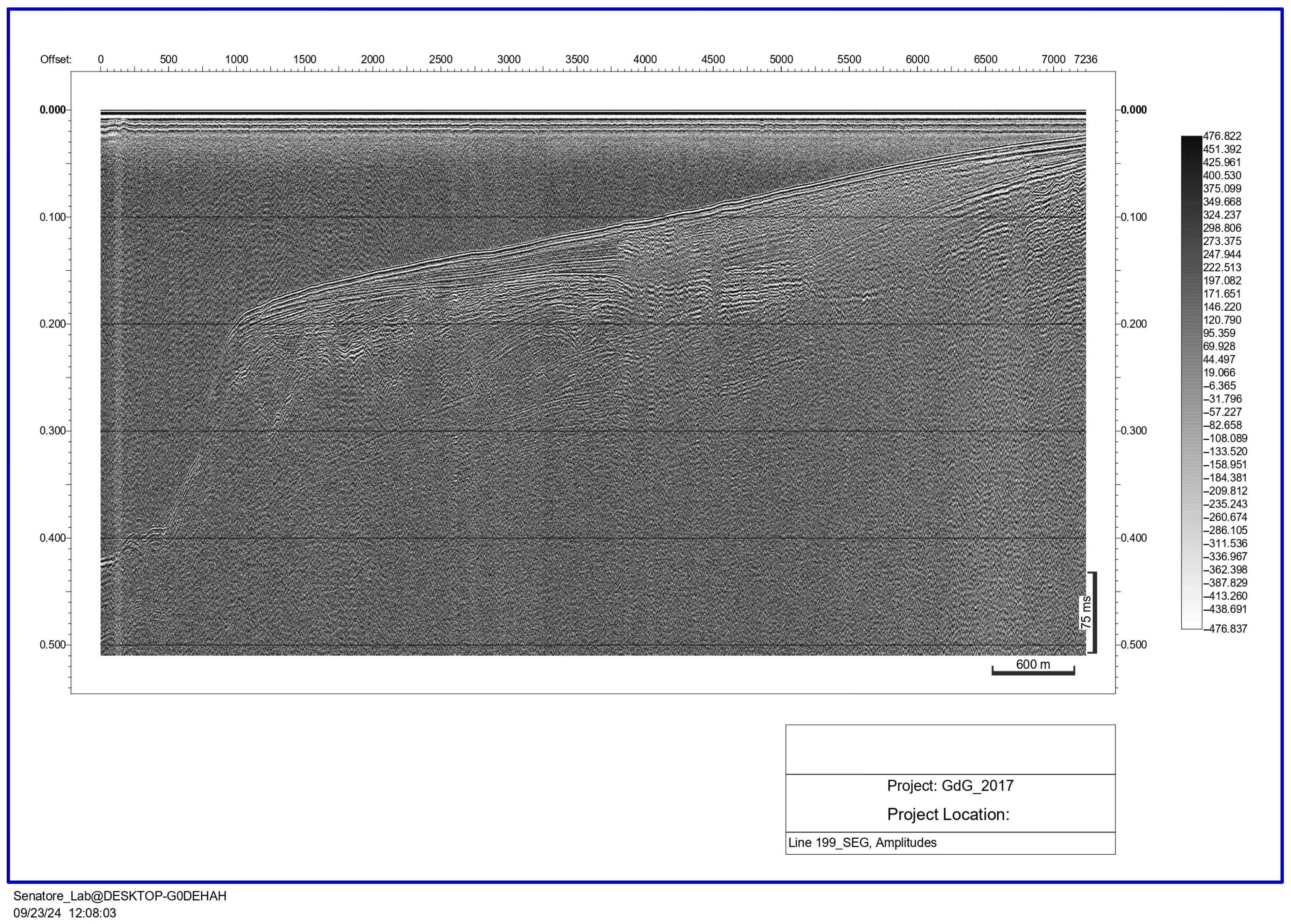
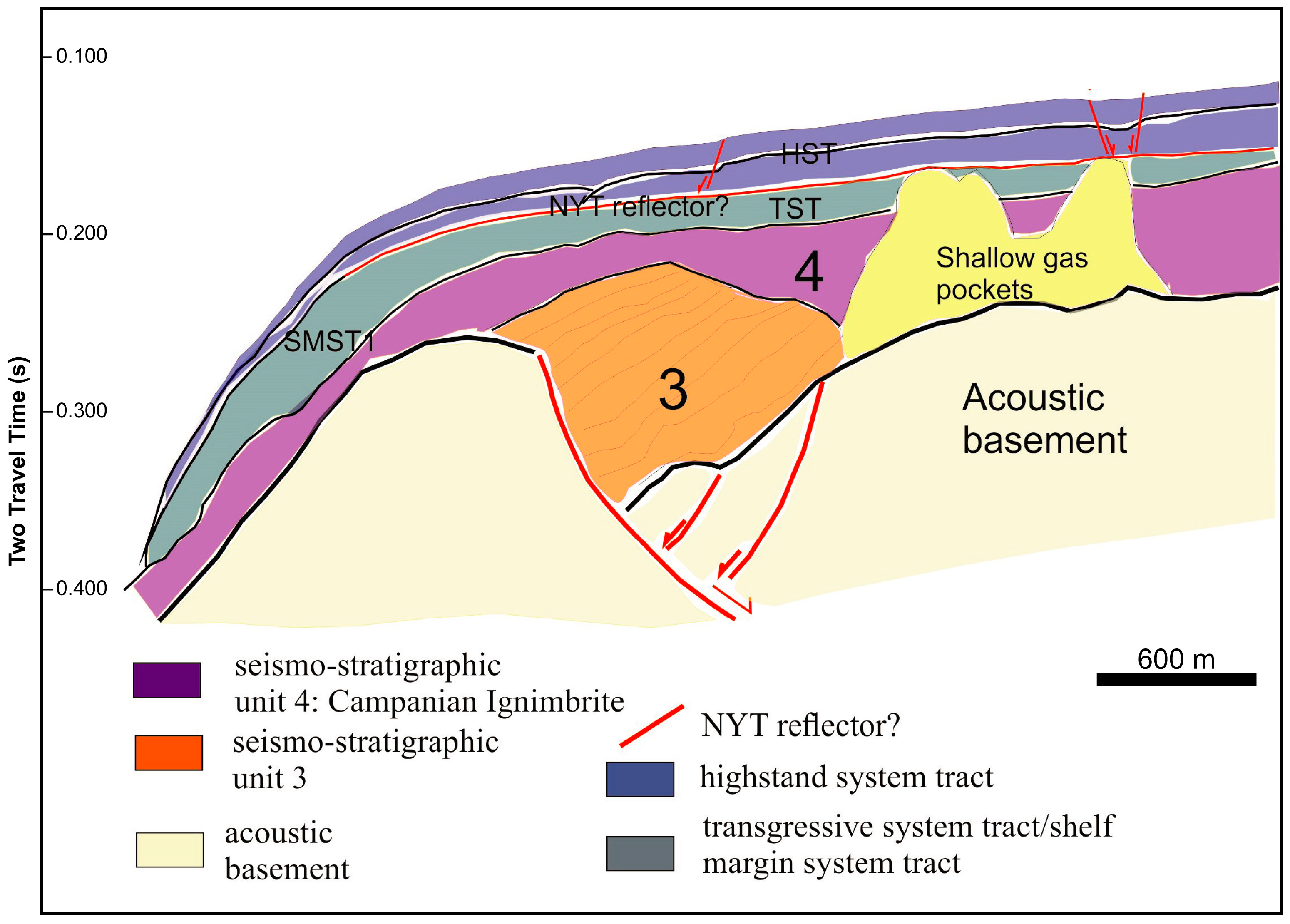
Within profile M199, the basal acoustic substratum is displaced by two conjugate normal faults, producing a typical half-graben geometry (Figure 8 and Figure 9). Unit 3 is characterized by oblique prograding clinoforms that are erosionally truncated at the top. An erosional surface incises Unit 3, generating broad palaeo-depressions filled by Unit 4, which shows an acoustically transparent facies. In Unit 4, shallow gas features are recognized by disrupted reflectors and local acoustic blanking/transparent zones. In the overlying unit, retrogradational geometries are observed and attributed to a transgressive system tract (TST), while a shelf margin system tract occurs seaward (SMST1). A laterally continuous reflector occurs at the top of the transgressive unit and is tentatively correlated with the NYT marker [37]. In the uppermost part of the sequence, highstand deposits occur and thicken northwards; local internal deformation has been observed based on seismo-stratigraphic analysis.
Figure 8. Processed Sparker profile M199 (see Figure 9 for the geological interpretation).
Figure 9. Geological interpretation of the Sparker profile M199. Note the occurrence of different seismo-stratigraphic units.
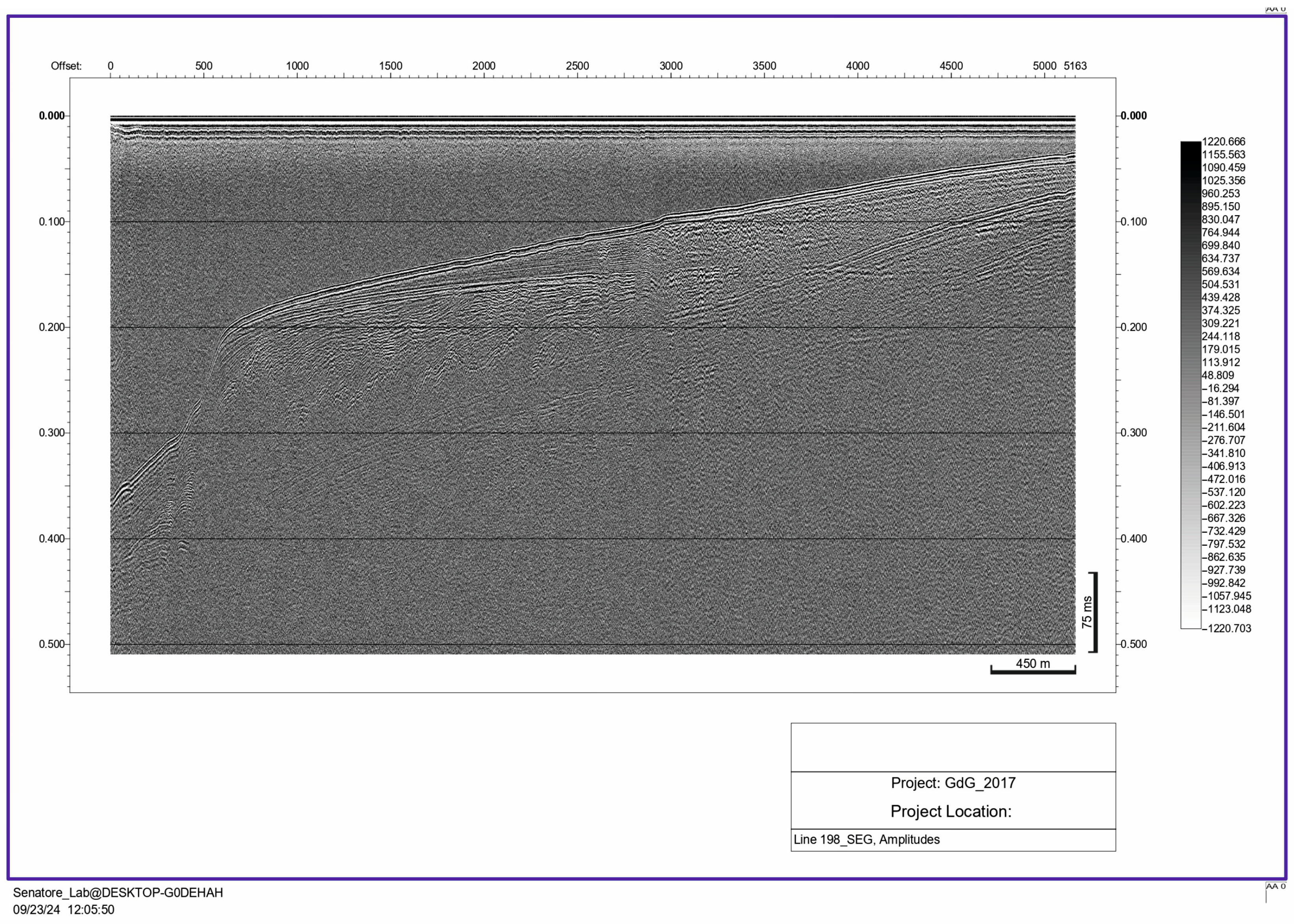
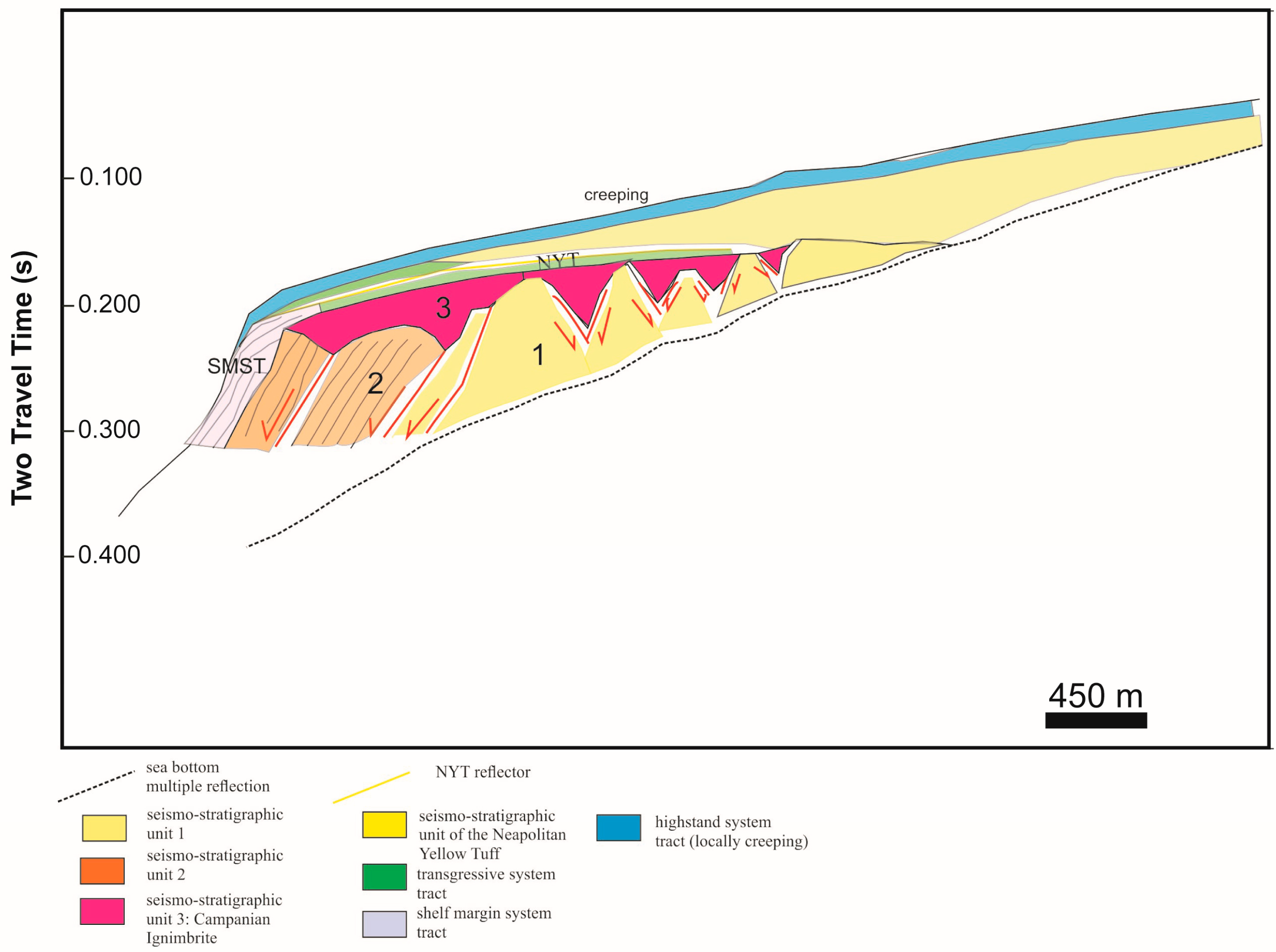
Profile M198 shows several seismo-stratigraphic units displaced by a set of normal faults, consistent with half-graben geometries [31]. Unit 1 is characterized by an acoustically transparent facies. Unit 2 displays oblique reflectors and prograding clinoforms, with an upper part truncated by erosion. Unit 3 is wedge-shaped and fills erosional depressions in the upper part of the succession. A laterally continuous set of parallel reflectors is also observed [37]. In addition, a wedge-shaped body that thins seaward is detected (Figure 10 and Figure 11) and is described here as a distinct volcaniclastic unit, whose significance is discussed in Section 5.
Figure 10. Processed Sparker profile M198 (see Figure 11 for the geological interpretation).
Figure 11. Geological interpretation of the Sparker profile M198. Volcanic and sedimentary seismo-stratigraphic units are present. Red lines indicate normal faults.
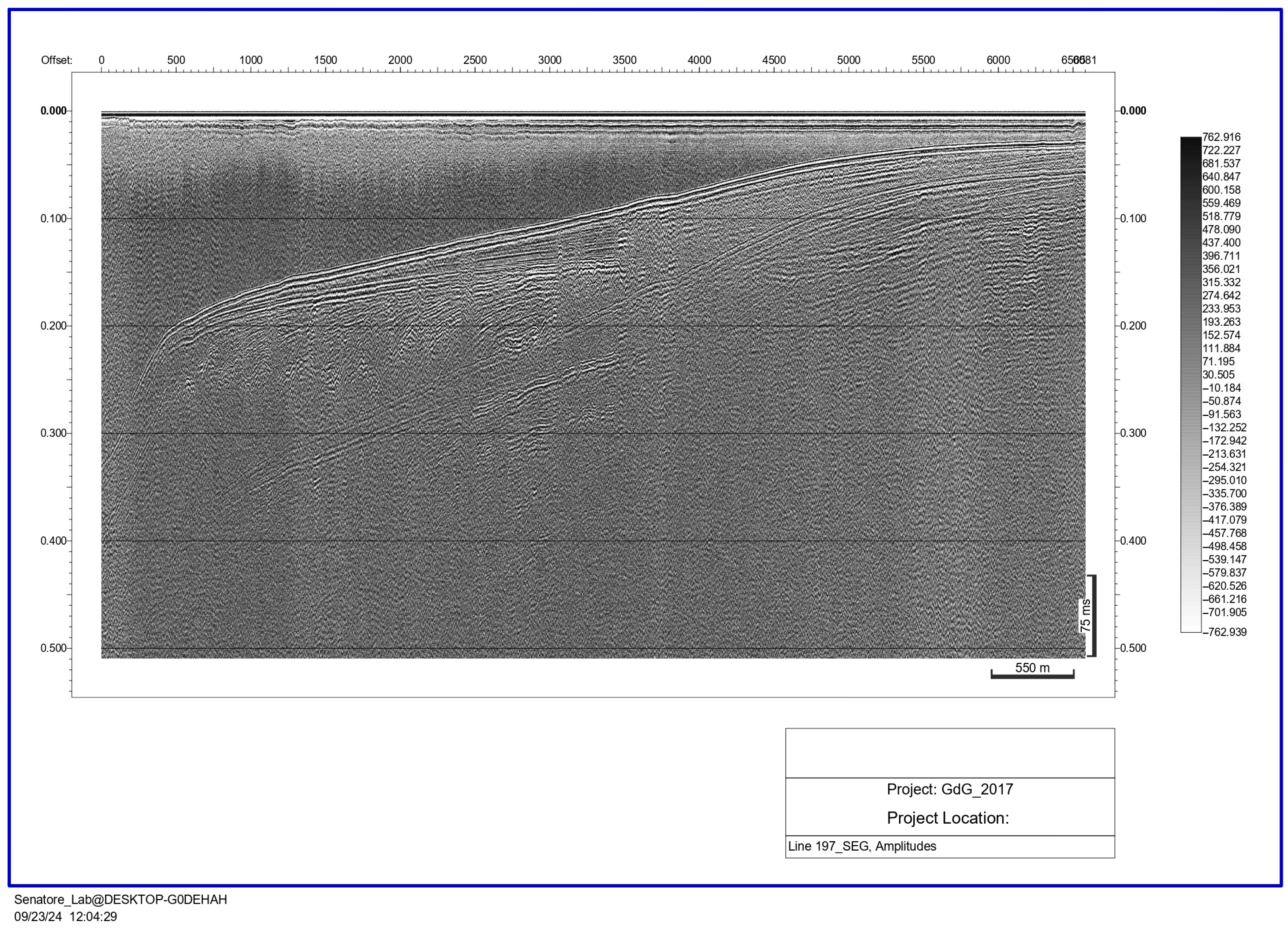
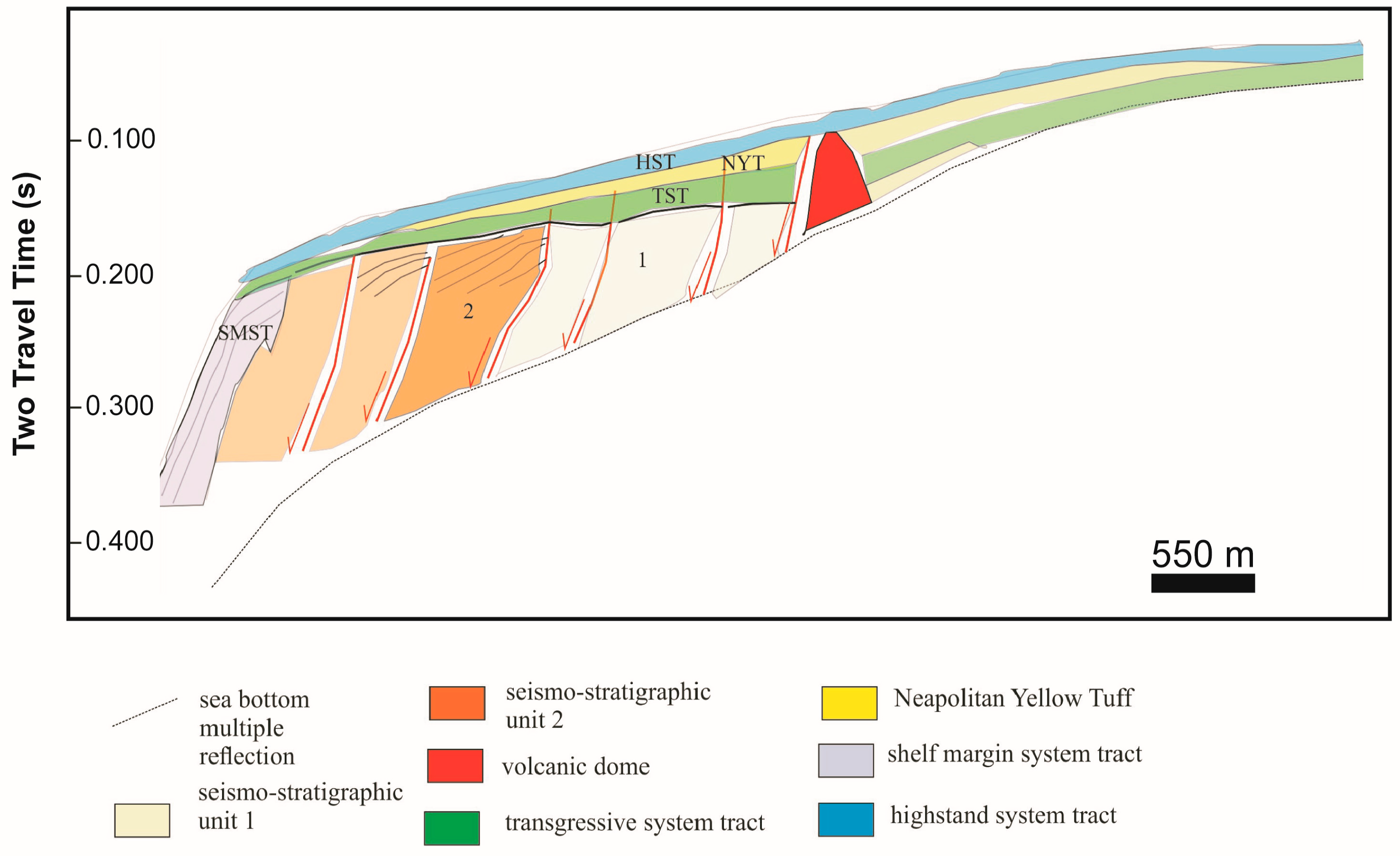
Profile M197 shows the same overall stratigraphic architecture recognized in adjacent lines, but lacks the wedge-shaped unit observed in other profiles in the same stratigraphic position (Figure 12 and Figure 13). In this line, Unit 1 locally exhibits acoustic basement characteristics and is strongly displaced by normal faults. Unit 2 is characterized by oblique prograding clinoforms and also downthrown by normal faults. A volcanic dome is clearly imaged (Figure 12 and Figure 13). A laterally continuous reflector occurs between the upper part of the transgressive package (TST) and the lower part of the highstand (HST) deposits, consistent with a regional, marker horizon. Stratigraphic architecture changes along the line M 197, indicating along-strike variability within the study area (Figure 12 and Figure 13).
Figure 12. Processed Sparker profile M197 (see Figure 13 for the geological interpretation).
Figure 13. Geological interpretation of the Sparker profile M197. Red lines indicate normal faults.
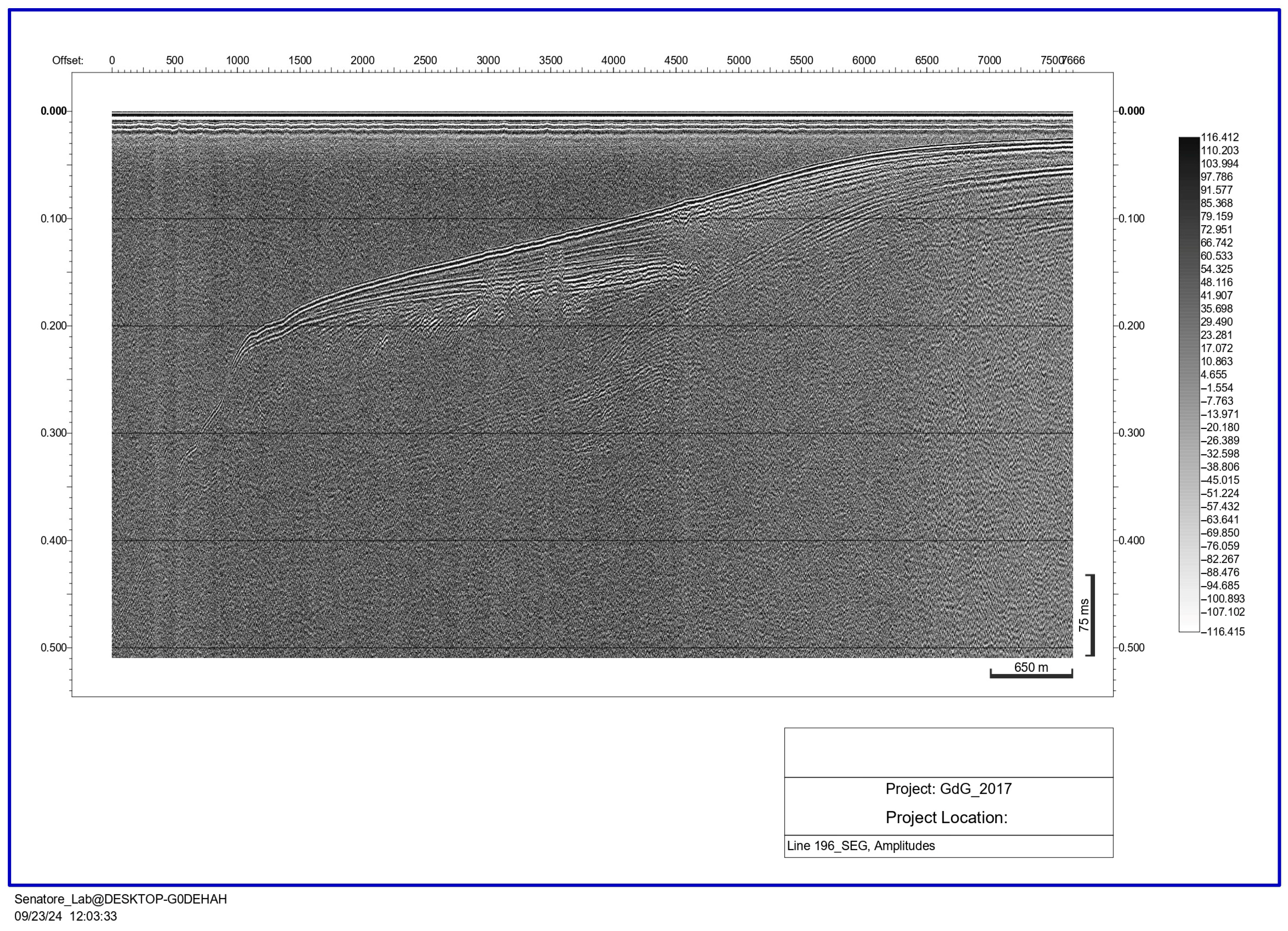
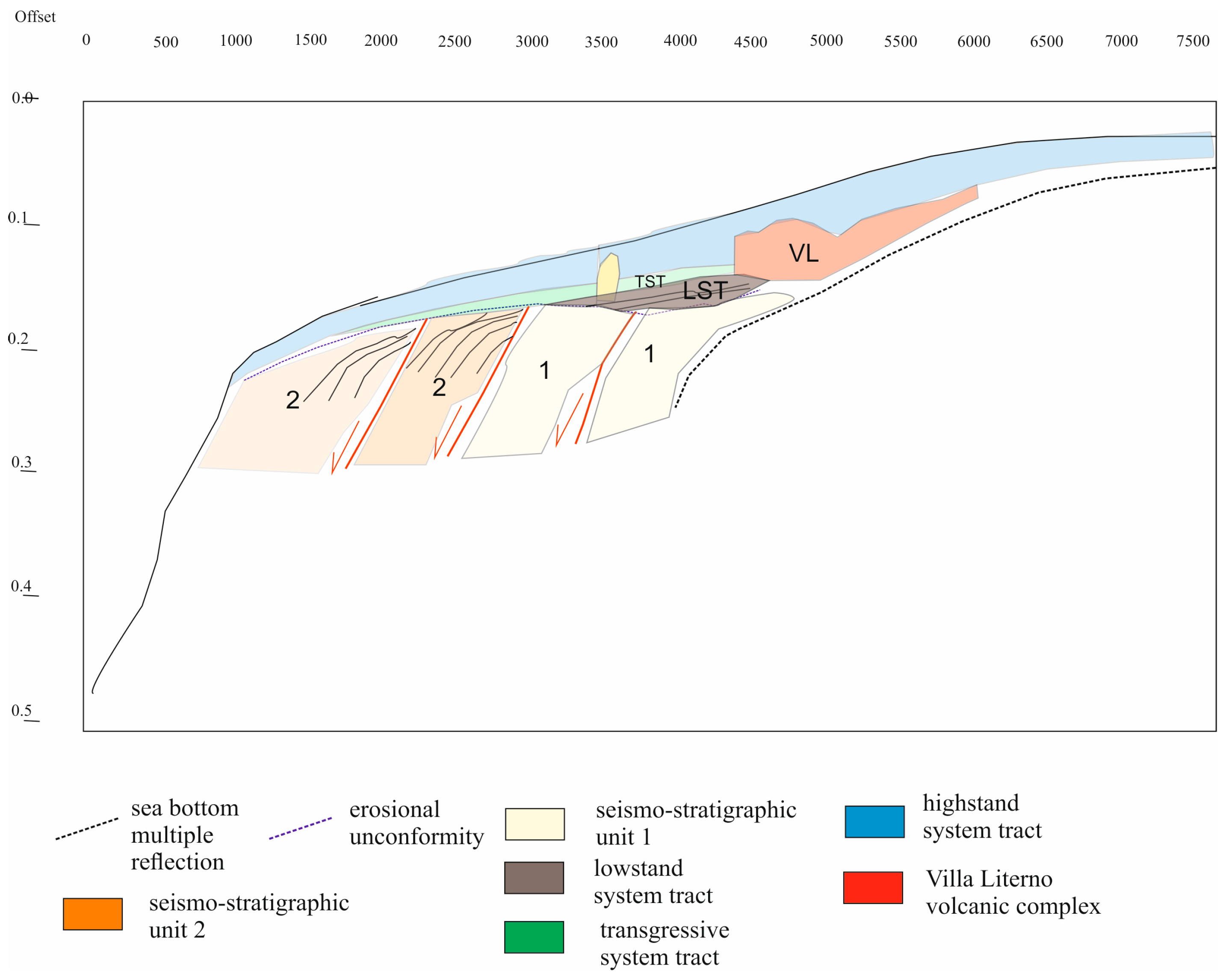
Profile M196, displays multiple seismo-stratigraphic units (Figure 15). Units 1 and 2 form the basal faulted interval and are characterized by discontinuous reflectors (Unit 1) and oblique prograding clinoforms (Unit 2), both displaced by normal faults. Unit 1 is overlain by an erosional surface and by lowstand deposits that downlap onto the underlying unit. On the left side of the profile, a thick acoustically transparent volcanic unit is identified (Figure 14 and Figure 15).
Figure 14. Processed Sparker profile M196 (see Figure 15 for the geological interpretation).
Figure 15. Geological interpretation of the Sparker profile M196, offshore the Campania Plain. Red lines indicate normal faults.
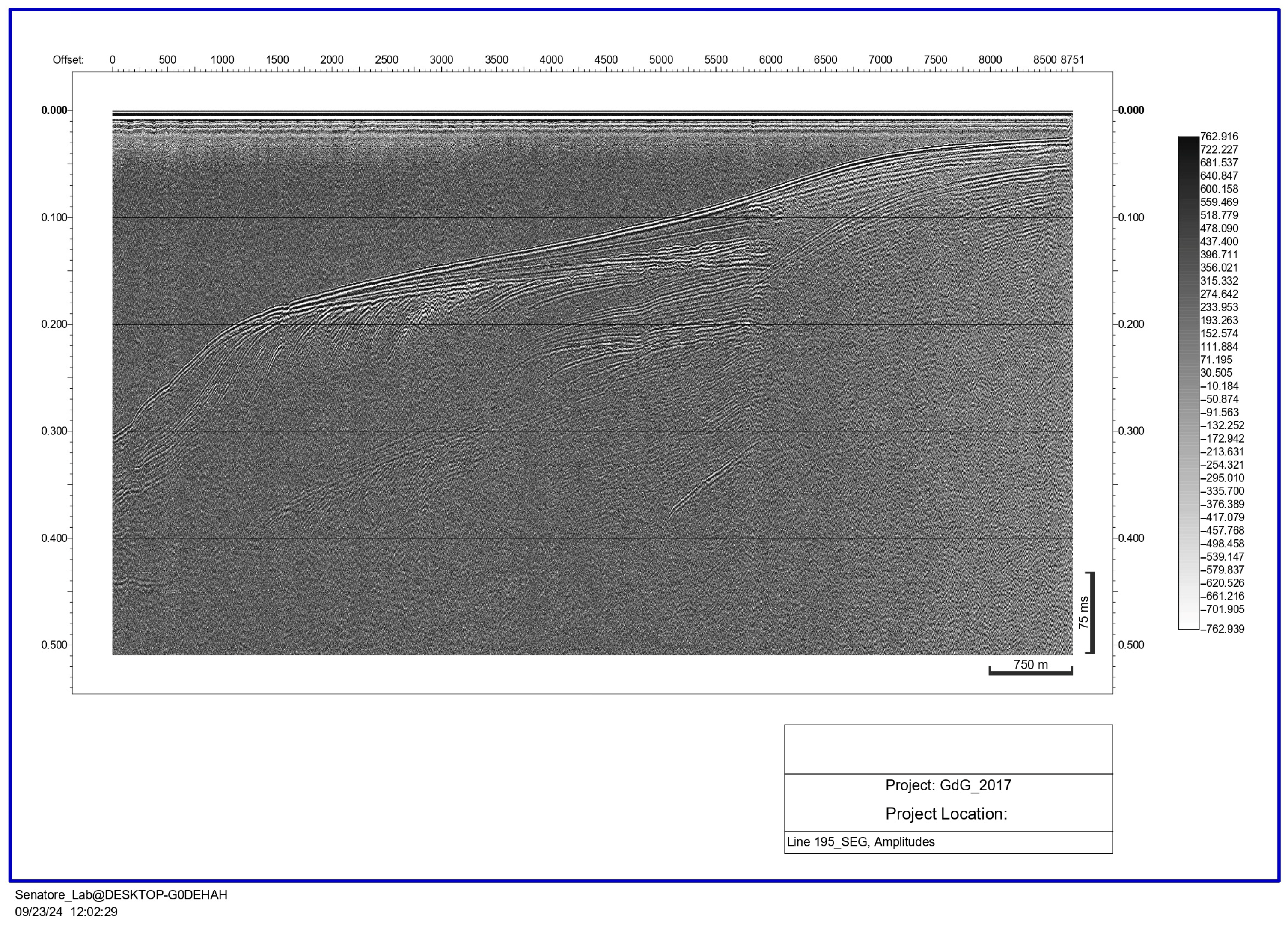
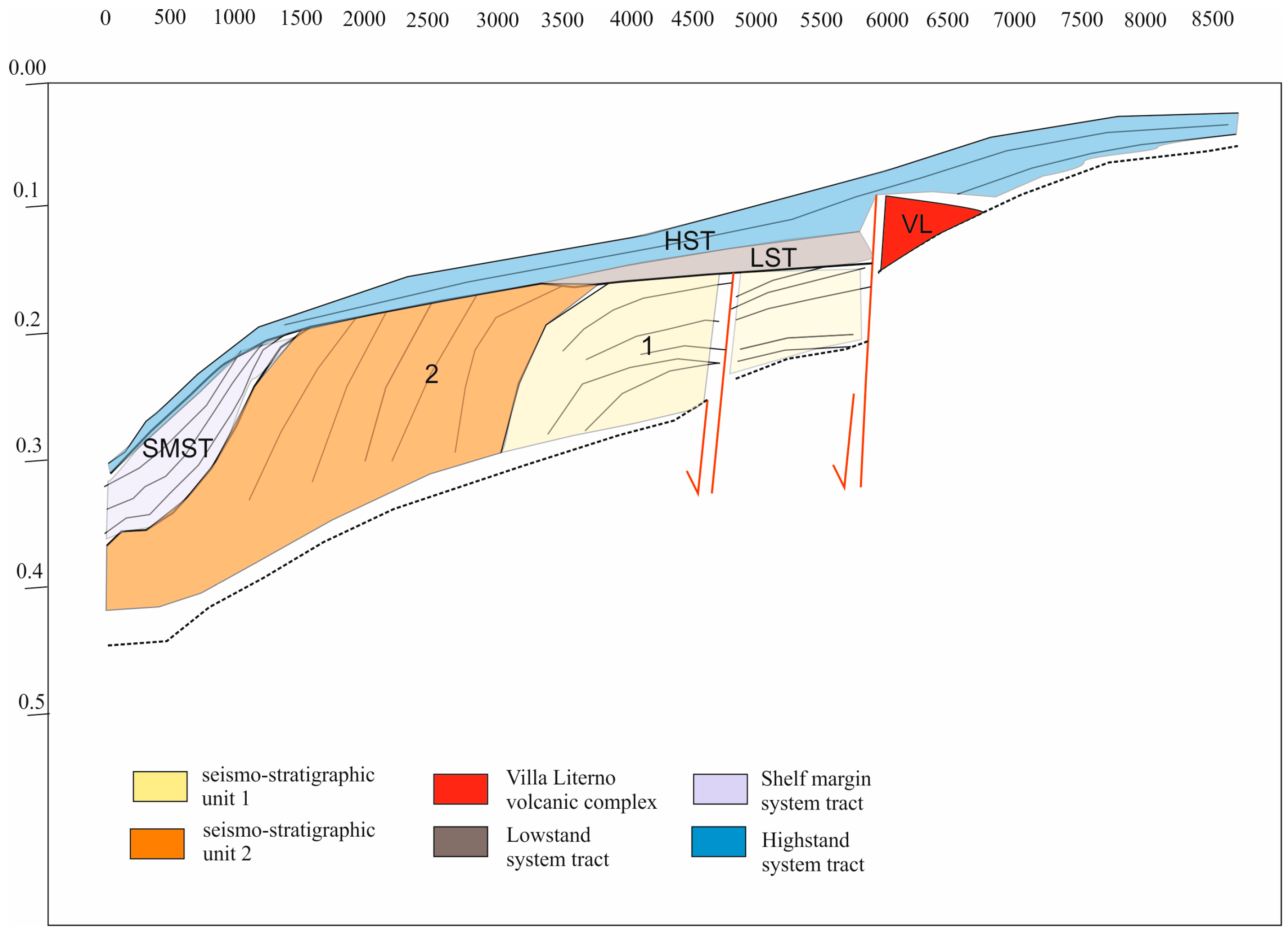
Profile M195 shows several seismo-stratigraphic units (Figure 16 and Figure 17). Unit 1 is characterized by sub-parallel to discontinuous seismic reflectors and is displaced by normal faults; Unit 2 displays oblique prograding reflectors. Both units are truncated at the top by a prominent erosional unconformity. In the hanging wall of the first major normal fault, a thick acoustically transparent unit is observed and is described as a volcanic body (VL in Figure 16 and Figure 17). Above the erosional unconformity, a thick wedge-shaped unit is observed on the shelf and is assigned to the lowstand system tract (LST), whereas a progradational unit develops at the shelf margin (SMST in Figure 16 and Figure 17). The uppermost part of the succession consists of thick highstand deposits, locally cropping out at the seafloor (Figure 18).
Figure 16. Processed Sparker profile M195, offshore of the Campania Plain (see Figure 17 for the geological interpretation).
Figure 17. Geological interpretation of the Sparker profile M195, offshore of the Campania Plain. Red lines indicate normal faults.
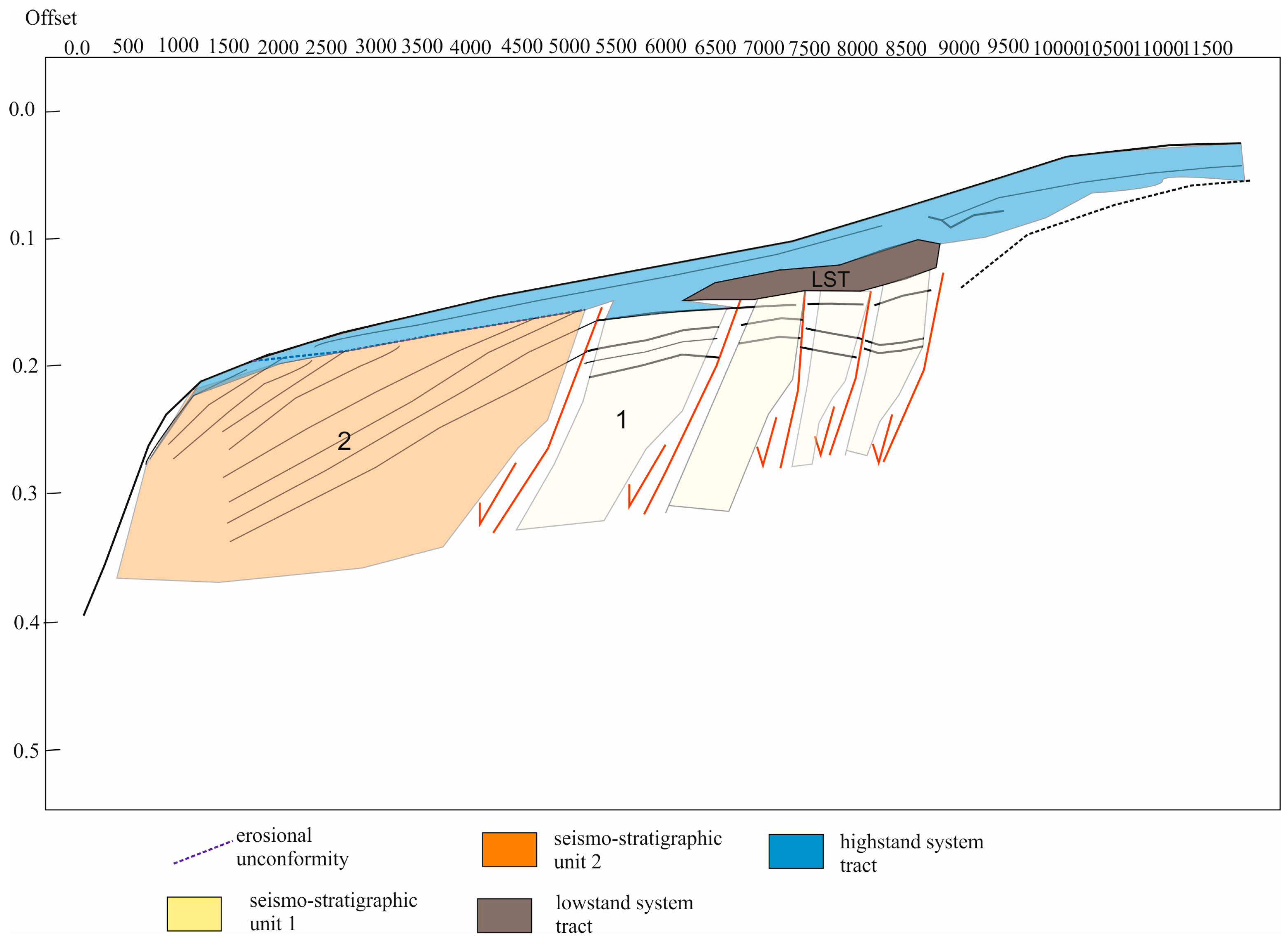
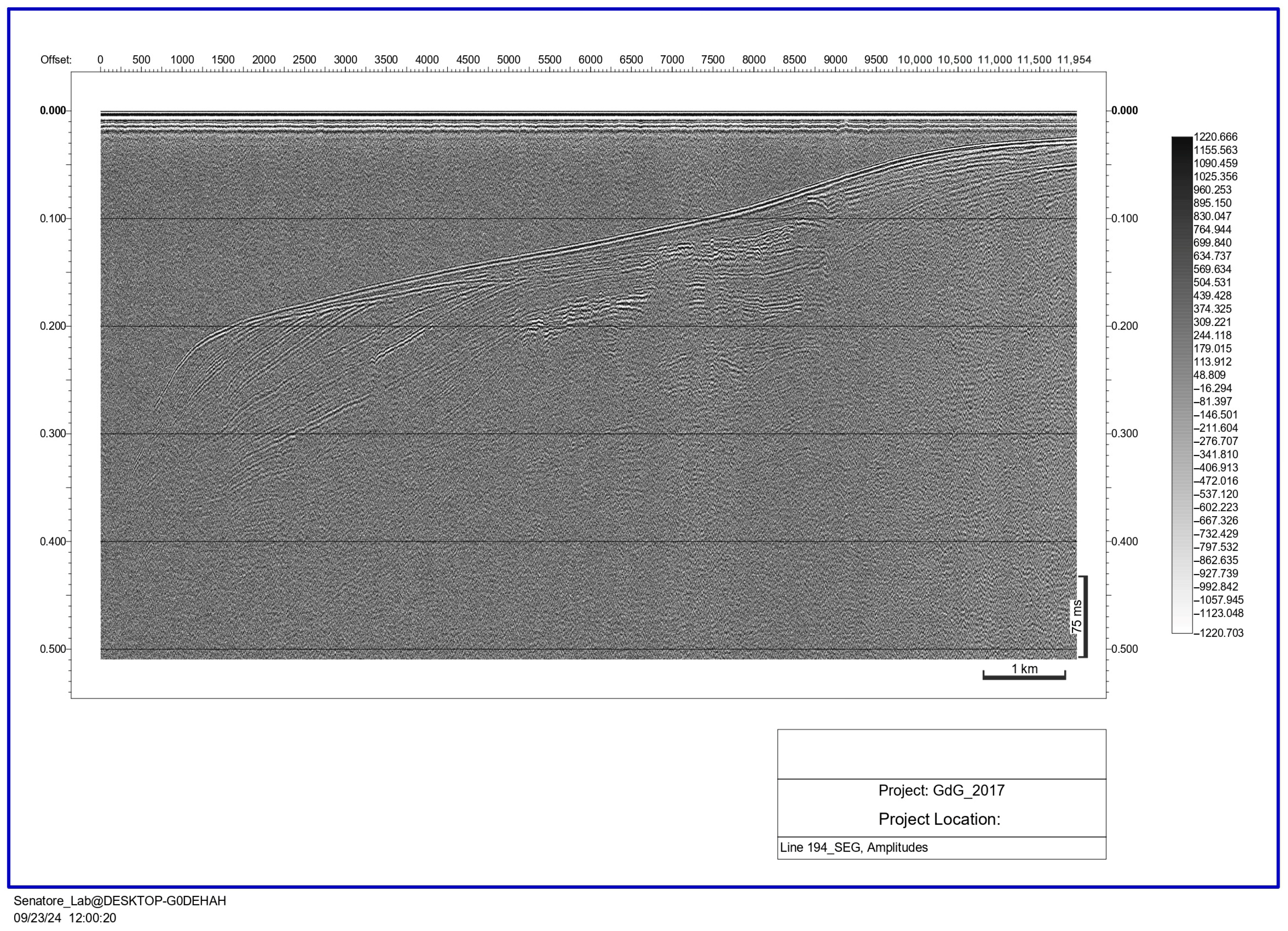
Profile M194 highlights the structural pattern controlling the basal succession (Figure 19). Normal faults in Unit 1 define the local accommodation. Unit 2 corresponds to a prograding wedge that thickens markedly toward the Volturno river mouth, where it reaches its maximum thickness (Figure 20).
Figure 18. Processed Sparker profile M194, offshore of the Volturno river mouth (see Figure 20 for the geological interpretation).
Jmse 14 00269 g018
Figure 19. Geological interpretation of the Sparker profile M194, offshore of the Volturno river mouth. Red lines indicate normal faults.
Jmse 14 00269 g019
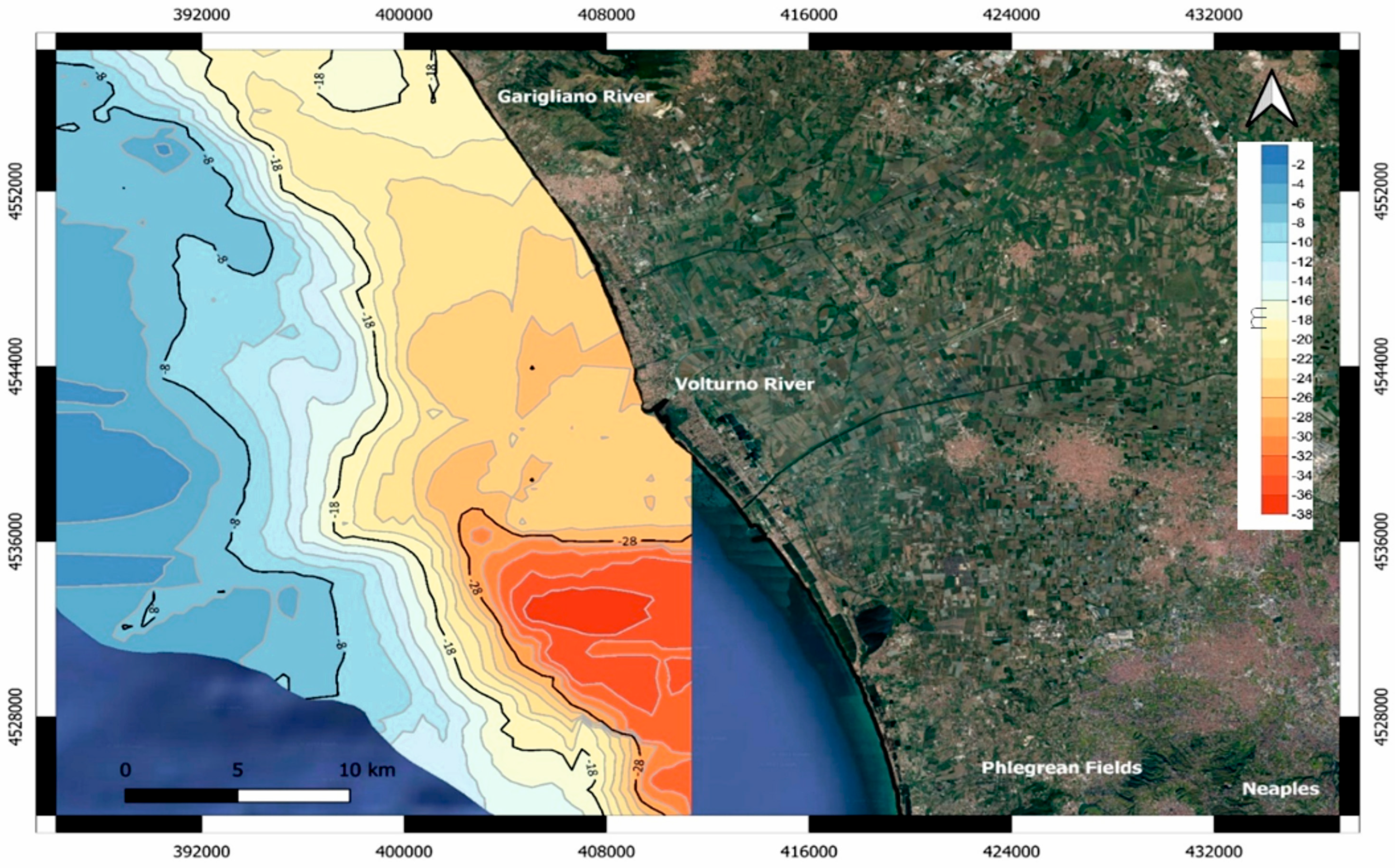
Figure 20. Isopach map of the sediment thickness overlying the NYT (V) reflector (i.e., burial depth below the seafloor), expressed in meters, in the Volturno–Gaeta offshore (modified after [35]). Colorimetric scale corresponding to water depths is shown on the right side of the figure.
Jmse 14 00269 g020
A brief summary table outlining the reflection characteristics, geometry, boundary relationships, and possible interpretation of each unit has been constructed (Table 2). The acoustic basement (Figure 9) has not been reported in this table, since it does not directly represent a seismo-stratigraphic unit. This table describes the general seismo-stratigraphic framework of the area, as described by seismic profiles (Figure 6, Figure 7, Figure 8, Figure 9, Figure 10, Figure 11, Figure 12, Figure 13, Figure 14, Figure 15, Figure 16, Figure 17, Figure 18 and Figure 19).
Table 2. General seismo-stratigraphic setting of the area, as described by the seismo-stratigraphic units recognized on seismic profiles based on the geological interpretation.

5. Discussion

The results confirm the value of processing single-channel Sparker (1 kJ) data and applying seismic- and sequence-stratigraphic criteria to resolve the shallow stratigraphic architecture of the Campania offshore (Figure 6, Figure 7, Figure 8, Figure 9, Figure 10, Figure 11, Figure 12, Figure 13, Figure 14, Figure 15, Figure 16, Figure 17, Figure 18 and Figure 19).
Sparker processing has been discussed in detail in previous studies [68,69,70,71]. Ref. [68] tested spiking deconvolution, match filtering, and vertical seismic profile deconvolution, and reported a comparable performance for the latter two approaches. Processed Sparker datasets from Naples Bay were presented by [8], who imaged the Mesozoic carbonate acoustic basement and overlying stratigraphic sequences, including pre-/syn-rift and post-rift prograding wedges of Early–Middle and Middle Pleistocene age, respectively.
In this study, processing and interpretation performed in IHS Kingdom® provide a coherent seismo-stratigraphic framework for a shelf succession shaped by progradation, erosional surfaces, volcaniclastic inputs, and fault-controlled accommodation (Figure 7, Figure 8, Figure 9, Figure 10, Figure 11, Figure 12, Figure 13, Figure 14, Figure 15, Figure 16, Figure 17, Figure 18, Figure 19 and Figure 20). Unit 1 is interpreted as the acoustic substratum of the high-resolution record. Because the expected depth to the top of the Meso–Cenozoic carbonates exceeds the Sparker penetration/resolution in the study area [4,8], Unit 1 is not directly correlated with the carbonate domain. Instead, based on the correlation with onshore constraints [2] and previous interpretations [4], Unit 1 is more consistently related to the upper part of the Volturno Basin infill, where well data document a thick (~1000 m) Pleistocene succession of deltaic sands and shales interlayered with pyroclastites and lavas (Castelvolturno 2 well) [2]. The systematic fault displacement affecting Unit 1 is consistent with the half-graben geometries typical of the southern Tyrrhenian margin (Figure 6, Figure 7, Figure 8, Figure 9, Figure 10, Figure 11, Figure 12, Figure 13, Figure 14, Figure 15, Figure 16, Figure 17, Figure 18 and Figure 19).
Unit 2 is a key element of the shelf stratigraphic architecture (Figure 6, Figure 7, Figure 8, Figure 9, Figure 10, Figure 11, Figure 12, Figure 13, Figure 14, Figure 15, Figure 16, Figure 17, Figure 18 and Figure 19). Its oblique prograding clinoforms and regionally truncated top indicate a major progradational phase followed by an erosional event. Based on its geometry and stratigraphic position, Unit 2 is interpreted as a relict prograding wedge, probably Late Pleistocene in age. The pronounced thickening toward the Volturno river mouth (Figure 19) supports a strong linkage with the main sediment-routing system feeding the shelf. In the M200 seismic profile (Figure 7), the wedge-shaped volcaniclastic body overlying Unit 2 is interpreted as the Campanian Ignimbrite [72,73,74,75,76]. Accordingly, Unit 2 formed prior to the CI deposits (~39 ka BP). The Campanian Ignimbrite is a large pyroclastic flow, which covered the whole Campania Plain about 39 ka B.P. and represents an important stratigraphic marker [72,73,74,75,76] (Figure 2).
Three profiles (Figure 10, Figure 11, Figure 12 and Figure 13) show a laterally continuous, high-amplitude reflector and associated volcaniclastic bodies interpreted as the Neapolitan Yellow Tuff (NYT) marker and deposits [72,73,77,78]. To frame the spatial variability observed in the Sparker profiles, we compared our stratigraphic interpretation with the NYT burial depth/isopach map published by [35] (Figure 20). This map represents the thickness of sediments overlying the NYT reflector (i.e., burial depth below the seafloor), ranging from a few meters to several tens of meters (up to ~38 m) across the shelf, with maximum values in the Volturno sector. The observed distribution supports the placement of the NYT horizon within the transgressive system tract (TST) interval and highlights the role of accommodation and sediment supply in controlling NYT preservation and subsequent burial.
In the present dataset, the NYT horizon is consistently placed within the interval attributed to the TST, in agreement with previous seismo-stratigraphic reconstructions [35,36,37]. Among the highly explosive eruptions of the Phlegraean Fields caldera, the event dated at ~15 ka cal BP produced the NYT ignimbrite. The outcrop distribution was outlined by [79], whereas the caldera extension was investigated by [80] on seismic profiles from the Gulf of Pozzuoli. NYT deposits were recognized offshore from the southern Gulf of Gaeta by [36] and later reconstructed using Chirp profiles by [37]. The Sparker profiles presented here further constrain the occurrence and geometry of the NYT seismo-stratigraphic unit, supporting the regional correlations proposed in previous works [35,36,37]. Its absence in profiles M200 and M199 indicates that the NYT-related volcaniclastic package becomes more prominent (and/or better preserved) toward the northern Volturno offshore.
In addition, the Sparker dataset documents a thick, mounded seismo-stratigraphic body attributed to the Lowstand System Tract (LST) in the northern sector of the study area. This unit is interpreted as deposits related to the Volturno fan–delta system, consistent with reconstructions of the onshore Volturno valley fill [34]. The uppermost part of the succession also shows filled channel forms within highstand deposits (Figure 19), indicating repeated phases of channel abandonment and subsequent infilling during the most recent depositional stages, consistent with the Late Holocene evolution proposed by [34].
The dataset also images a thick volcanic unit in the intermediate portion of the Late Quaternary sequence (Figure 14, Figure 15, Figure 16 and Figure 17), interpreted as the Villa Literno volcanic complex (VL in Figure 16 and Figure 18). In profile M195, this volcanic body occurs in the hanging wall of a normal fault (Figure 18), suggesting structural control on its emplacement and/or preservation. Previous data indicate that the Villa Literno volcanic complex occurs in the subsurface of the Volturno Plain [81,82], and its lithostratigraphic attribution is supported by the Villa Literno 2 well, which drilled andesitic tuffs (~150 m thick) overlying marine and transitional clastic deposits (~650 m), with deeper alternations of basalts, andesites, and tuffs [81,82]. On this basis, the VL seismic unit is interpreted as the upper part of the volcanic complex (Figure 14, Figure 15, Figure 16 and Figure 17).
Inner deformation has been observed in the uppermost part of the highstand deposits, suggesting the occurrence of creeping (Figure 9).
Finally, the upper part of the succession records the latest depositional cycle related to post-LGM sea level rise and subsequent Late Holocene progradation. From ~15 to 6 ka BP, the rising sea level favored a widespread transgression and shelf flooding, whereas since ~6.5 ka cal BP a shift toward highstand conditions promoted the onset of the modern Volturno delta and the Late Holocene progradation (3–6 km) of the adjacent coastal plain [39]. Within this framework, the Late Pleistocene shelf–margin progradational unit (SMST) and the older progradational units (Units 1–2) represent distinct stages in the development of the shelf architecture, with CI (~39 ka) and NYT (~15 ka) providing key volcanic markers for stratigraphic correlation in the investigated area.

6. Conclusions

The Campania Plain forms part of a peri-Tyrrhenian extensional basin system developed mainly during the Quaternary along the western flank of the southern Apennines and the eastern Tyrrhenian margin, within a post-orogenic extensional regime interacting with strike-slip tectonics.
The geological interpretation of the single-channel Sparker profiles indicates that the offshore stratigraphic architecture is dominated by fault-controlled progradational successions and erosional discontinuities. Late Pleistocene shelf-margin progradation (SMST) is mainly developed at the shelf edge, whereas older progradational wedges (Units 1 and 2) form the bulk of the shelf succession. Key volcanic and sedimentary units are also imaged, including the Villa Literno volcanic complex (VL) and lowstand-related Volturno fan–delta deposits (LST). The general seismo-stratigraphic setting of the area is resumed in Table 2.
The structural setting is dominated by arrays of normal faults producing half-graben geometries, consistent with regional models for the southern Tyrrhenian margin [83,84]. The observed geometries are compatible with the half-graben/tilt-block framework described by [85], in which hanging-wall down-tilting and footwall uplift generate tectonically controlled slopes that influence sediment dispersal and progradational architectures.
Future work will focus on acquiring and interpreting a denser grid of high-resolution seismic profiles to further refine the seismo-stratigraphic framework and improve the spatial constraints on fault activity and depositional architectures.

Author Contributions

Writing, original draft preparation, G.A.; seismic data processing, A.M. and M.R.S.; data acquisition and investigation, G.A. and M.I.; writing, revised draft preparation: G.A. and A.M.; supervision: M.I. and M.R.S. All authors have read and agreed to the published version of the manuscript.

Funding

This research received no external funding.

Data Availability Statement

The original contributions presented in this study are included in the article. Further inquiries can be directed to the corresponding author.

Conflicts of Interest

The authors declare no conflicts of interest.

References

  1. Trincardi, F.; Zitellini, N. The rifting of the Tyrrhenian Basin. Geo-Mar. Lett. 1987, 7, 1–6. [Google Scholar] [CrossRef]
  2. Mariani, M.; Prato, R. I bacini neogenici costieri del margine tirrenico: Approccio sismico-stratigrafico. Mem. Soc. Geol. Ital. 1988, 41, 519–531. [Google Scholar]
  3. Brancaccio, L.; Cinque, A.; Romano, P.; Rosskopf, C.; Russo, F.; Santangelo, N. L’evoluzione delle pianure costiere della Campania: Geomorfologia e neotettonica. Estratto da: Assetto fisico e problemi ambientali delle pianure italiane. Mem. Soc. Geogr. Ital. 1991, 53, 313–336. [Google Scholar]
  4. Aiello, G.; Marsella, E.; Cicchella, A.G.; Di Fiore, V. New insights on morpho-structures and seismic stratigraphy along the Campania continental margin (Southern Italy) based on deep multichannel seismic profiles. Rend. Lincei 2011, 22, 349–373. [Google Scholar] [CrossRef]
  5. Budillon, F.; Aiello, G.; Conforti, A.; D’Argenio, B.; Ferraro, L.; Marsella, E.; Monti, L.; Pelosi, N.; Tonielli, R. The Coastal Depositional Systems along the Campania Continental Margin (Italy, Southern Tyrrhenian Sea) since the Late Pleistocene: New Information Gathered in the frame of the CARG Project. DTA Dip. Terra Ambiente 2011, 6, 1–12. [Google Scholar]
  6. Aiello, G.; Cicchella, A.G. Dati sismostratigrafici sul margine continentale della Campania tra Ischia, Capri ed il bacino del Volturno (Tirreno meridionale, Italia) in base al processing sismico ed all’interpretazione geologica di profili sismici a riflessione multicanale. Quad. Geofis. 2019, 149, 1905–1910. [Google Scholar]
  7. Conti, A.; Bigi, S.; Cuffaro, M.; Doglioni, C.; Scrocca, D.; Muccini, F.; Cocchi, L.; Ligi, M.; Bortoluzzi, G. Transfer zones in an oblique back-arc basin setting: Insights from the Latium-Campania segmented margin (Tyrrhenian Sea). Tectonics 2017, 36, 78–107. [Google Scholar] [CrossRef]
  8. Aiello, G.; Iorio, M.; Molisso, F.; Sacchi, M. Integrated Morpho-Bathymetric, Seismic-Stratigraphic, and Sedimentological Data on the Dohrn Canyon (Naples Bay, Southern Tyrrhenian Sea): Relationships with Volcanism and Tectonics. Geosciences 2020, 10, 319. [Google Scholar] [CrossRef]
  9. Aiello, G.; Caccavale, M. The Coastal Areas of the Bay of Naples: The Sedimentary Dynamics and Geological Evolution of the Naples Canyons. Geosciences 2023, 13, 226. [Google Scholar] [CrossRef]
  10. Budillon, F.; Martorelli, E.; Conforti, A.; De Falco, G.; Bosman, A.; Di Martino, G.; Firetto Carlino, M.; Misuraca, M.; Innangi, S.; Pierdomenico, M.; et al. Geohazard features of the Gulf of Naples and Pontine Islands (Eastern Tyrrhenian Sea). J. Maps 2024, 20, 2378935. [Google Scholar] [CrossRef]
  11. Bruno, P.P.G.; Putignano, M.L.; Cella, F.; Florio, G. Investigating tectonic links between the deep Volturno Plain and Campanian volcanism using vintage seismic and potential field data. Sci. Rep. 2025, 15, 21602. [Google Scholar] [CrossRef]
  12. Aiello, G. Regional Geological Data on the Volturno Basin Filling and Its Relationship to the Massico Structure (Southern Tyrrhenian Sea, Italy). J. Mar. Sci. Eng. 2025, 13, 241. [Google Scholar] [CrossRef]
  13. Royden, L.; Patacca, E.; Scandone, P. Segmentation and configuration of subducted lithosphere in Italy: An important control on thrust-belt and foredeep basin evolution. Geology 1987, 15, 714–717. [Google Scholar] [CrossRef]
  14. Patacca, E.; Scandone, P. Post-Tortonian mountain building in the Apennines: The role of passive sinking of a relic lithospheric slab. In The Lithosphere in Italy, 1st ed.; Boriani, A., Bonafede, M., Piccardo, G.B., Vai, G.B., Eds.; Accademia Nazionale dei Lincei: Roma, Italy, 1989; pp. 157–176. [Google Scholar]
  15. Vitale, S.; Ciarcia, S. Tectono-stratigraphic setting of the Campania region (southern Italy). J. Maps 2018, 14, 9–21. [Google Scholar] [CrossRef]
  16. Aiello, G.; Marsella, E.; Sacchi, M. Quaternary structural evolution of Terracina and Gaeta basins (Eastern Tyrrhenian margin, Italy). Rend. Lincei 2000, 11, 41–58. [Google Scholar] [CrossRef]
  17. Mantovani, E.; Viti, M.; Babbucci, D.; Tamburelli, C. Plio–Quaternary Tectonic Activity in the Northern Nubian Belts: The Main Driving Forces. Appl. Sci. 2025, 15, 587. [Google Scholar] [CrossRef]
  18. Kastens, K.A.; Mascle, J.; Auroux, C.; Bonatti, E.; Broglia, C.; Channell, J.; Curzi, P.; Emeis, K.C.; Glaçon, G.; Hasegawa, S.; et al. ODP Leg 107 in the Tyrrhenian Sea: Insights into passive margin and back-arc basin evolution. Geol. Soc. Am. Bull. 1988, 100, 1140–1156. [Google Scholar] [CrossRef]
  19. Argnani, A.; Savelli, C. Cenozoic volcanism and tectonics in the southern Tyrrhenian sea: Space-time distribution and geodynamic significance. J. Geodyn. 1999, 27, 409–432. [Google Scholar] [CrossRef]
  20. Marani, M.; Trua, T. Thermal constriction and slab tearing at the origin of a superinflated spreading ridge: Marsili volcano (Tyrrhenian Sea). J. Geophys. Res. 2002, 107, 2188. [Google Scholar] [CrossRef]
  21. Sartori, R. The Tyrrhenian back-arc basin and subduction of the Ionian lithosphere. Epis. J. Int. Geosci. 2003, 26, 217–221. [Google Scholar] [CrossRef]
  22. Gamberi, F.; Marani, M. Control of Regional Geology on the Style of Basin-Plain Depositional Systems in the Tyrrhenian Sea. In External Controls on Deep-Water Depositional Systems; SEPM Special Publication; SEPM Society for Sedimentary Geology: Claremore, OK, USA, 2009; Volume 92. [Google Scholar] [CrossRef]
  23. Milia, A.; Torrente, M.M.; Massa, B.; Iannace, P. Progressive changes in rifting directions in the Campania margin (Italy): New constrains for the Tyrrhenian Sea opening. Glob. Plan. Change 2013, 109, 3–17. [Google Scholar] [CrossRef]
  24. Savelli, C.; Ligi, M. An updated reconstruction of basaltic crust emplacement in Tyrrhenian Sea, Italy. Sci. Rep. 2017, 7, 18024. [Google Scholar] [CrossRef]
  25. Milia, A.; Iannace, P.; Tesauro, M.; Torrente, M.M. Marsili and Cefalù basins: The evolution of a rift system in the southern Tyrrhenian Sea (Central Mediterranean). Glob. Plan. Change 2018, 171, 225–237. [Google Scholar] [CrossRef]
  26. Sawyer, D.E.; Urgeles, R.; Lo Iacono, C. 50,000 yr of recurrent volcaniclastic megabed deposition in the Marsili Basin, Tyrrhenian Sea. Geology 2023, 51, 1001–1006. [Google Scholar] [CrossRef]
  27. Cavallaro, D.; Monaco, C.; Polonia, A.; Sulli, A.; Di Stefano, A. Evidence of positive tectonic inversion in the north-central sector of the Sicily Channel (Central Mediterranean). Nat. Hazards 2017, 86, 233–251. [Google Scholar] [CrossRef]
  28. Zitellini, N.; Ranero, C.R.; Loreto, M.F.; Ligi, M.; Pastore, M.; D’Oriano, F.; Sallares, V.; Grevemeyer, I.; Moeller, S.; Prada, M. Recent inversion of the Tyrrhenian Basin. Geology 2020, 48, 123–127. [Google Scholar] [CrossRef]
  29. Loreto, M.F.; Zitellini, N.; Ranero, C.R.; Palmiotto, C.; Prada, M. Extensional tectonics during the Tyrrhenian back-arc basin formation and a new morpho-tectonic map. Basin Res. 2021, 33, 138–158. [Google Scholar] [CrossRef]
  30. Lo Mauro, G.; Gasperini, L.; Sgroi, T.; Barberi, G.; Polonia, A. Morphotectonics of the Gulf of Patti (Southern Tyrrhenian Sea) through pseudo-3D geophysical techniques. Mar. Geophys. Res. 2025, 46, 35. [Google Scholar] [CrossRef]
  31. Aiello, G.; Marsella, E.; Di Fiore, V.; D’Isanto, C. Stratigraphic and structural styles of half-graben offshore basins in Southern Italy: Multichannel seismic and Multibeam morpho-bathymetric evidences on the Salerno Valley (Southern Campania continental margin, Italy). Quad. Geofis. 2009, 77, 4–31. [Google Scholar]
  32. Cinque, A.; Patacca, E.; Scandone, P.; Tozzi, M. Quaternary kinematic evolution of the Southern Apennines. Relationships between surface geological features and deep lithospheric structures. Ann. Geofis. 1993, 36, 249–260. [Google Scholar]
  33. Milia, A.; Torrente, M.M. Tectonics and stratigraphic architecture of a peri-Tyrrhenian half-graben (Bay of Naples, Italy). Tectonophysics 1993, 315, 301–318. [Google Scholar] [CrossRef]
  34. Amorosi, A.; Pacifico, A.; Rossi, V.; Ruberti, D. Late Quaternary incision and deposition in an active volcanic setting: The Volturno valley fill, southern Italy. Sediment. Geol. 2012, 282, 307–320. [Google Scholar] [CrossRef]
  35. Iorio, M.; Meo, A.; Aiello, G.; Senatore, M.R. The Neapolitan Yellow Tuff record in the Gaeta Gulf (Eastern Tyrrhenian margin, Southern Italy). Adv. Geosci. 2024, 63, 15–27. [Google Scholar] [CrossRef]
  36. Iorio, M.; Capretto, G.; Petruccione, E.; Marsella, E.; Aiello, G.; Senatore, M.R. Multi-proxy analysis in defining sedimentary processes in very recent prodelta deposits: The Northern Phlegraean offshore example (Eastern Tyrrhenian Margin). Rend. Lincei 2014, 25, 237–254. [Google Scholar] [CrossRef]
  37. Aiello, G.; Insinga, D.D.; Iorio, M.; Meo, A.; Senatore, M.R. On the occurrence of the Neapolitan Yellow Tuff tephra in the Northern Phlegraean Fields offshore (Eastern Tyrrhenian margin; Italy). Ital. J. Geosci. 2017, 136, 263–274. [Google Scholar] [CrossRef]
  38. Corrado, G.; Amodio, S.; Aucelli, P.P.C.; Gioia, D.; Pappone, G.; Schiattarella, M. Reconstructing active tectonics from land–sea correlations based on cross-interpretation of core and seismic data for the Tyrrhenian coastal segment in southern Italy. Earth Surf. Process. Landf. 2024, 50, e6049. [Google Scholar] [CrossRef]
  39. Alberico, I.; Matano, F. Subsidence and recent landscape evolution at Volturno Coastal Plain (Italy). Quat. Int. 2024, 712, 109584. [Google Scholar] [CrossRef]
  40. Fedi, M.; Rapolla, A. I Metodi Gravimetrico e Magnetico nella Geofisica Applicata; Liguori Editore: Napoli, Italy, 1987. [Google Scholar]
  41. Bruno, P.P.G.; Di Fiore, V.; Ventura, G. Seismic study of the ‘41st Parallel’ Fault System offshore the Campanian—Latial continental margin, Italy. Tectonophysics 2000, 324, 37–55. [Google Scholar] [CrossRef]
  42. Di Bucci, D.; Tozzi, M. La linea ‘‘Ortona-Roccamonfina’’: Revisione dei dati esistenti e nuovi contributi per il settore settentrionale (media valle del Sangro). Studi Geol. Camerti 1991, 1991, 397–406. [Google Scholar]
  43. Milano, G.; Di Giovambattista, R.; Ventura, G. Seismic activity in the transition zone between Southern and Central Apennines (Italy): Evidences of longitudinal extension inside the Ortona–Roccamonfina tectonic line. Tectonophysics 2008, 457, 102–110. [Google Scholar] [CrossRef]
  44. Bonardi, G.; Ciarcia, S.; Di Nocera, S.; Matano, F.; Sgrosso, I.; Torre, M. Carta delle principali unità cinematiche dell’Appennino meridionale. Nota illustrativa. Ital. J. Geosci. 2009, 128, 47–60. [Google Scholar] [CrossRef]
  45. Cuoco, E.; Minissale, A.; Di Leo, A.; Tamburrino, S.; Iorio, M.; Tedesco, M. Fluid geochemistry of the Mondragone hydrothermal systems (southern Italy): Water and gas compositions vs. geostructural setting. Int. J. Earth Sci. 2017, 106, 2429–2444. [Google Scholar] [CrossRef]
  46. Pierantoni, P.P.; Penza, G.; Macchiavelli, G.; Schettino, A.; Turco, E. 3—Kinematics of the Tyrrhenian-Apennine system and implications for the origin of the Campanian magmatism. In Vesuvius, Campi Flegrei and Campania Volcanism, 1st ed.; De Vivo, B., Belkin, H.E., Rolandi, G., Eds.; Elsevier: Amsterdam, The Netherlands, 2020; pp. 33–56. [Google Scholar] [CrossRef]
  47. Sartori, R.; Torelli, L.; Zitellini, N.; Carrara, G.; Magaldi, M.; Mussoni, P. Crustal features along a W–E Tyrrhenian transect from Sardinia to Campania margins (Central Mediterranean). Tectonophysics 2004, 383, 171–192. [Google Scholar] [CrossRef]
  48. Bartole, R.; Savelli, C.; Tramontana, M.; Wezel, F.C. Structural and sedimentary features in the Tyrrhenian margin off Campania, southern Italy. Mar. Geol. 1983, 55, 163–180. [Google Scholar] [CrossRef]
  49. Ruberti, D.; Vigliotti, M. Land use and landscape pattern changes driven by land reclamation in a coastal area: The case of Volturno delta plain, Campania Region, southern Italy. Environ. Earth Sci. 2017, 76, 694. [Google Scholar] [CrossRef]
  50. Ruberti, D.; Buffardi, C.; Sacchi, M.; Vigliotti, M. The late Pleistocene-Holocene changing morphology of the Volturno delta and coast (northern Campania, Italy): Geological architecture and human influence. Quat. Int. 2022, 625, 14–28. [Google Scholar] [CrossRef]
  51. Barra, D.; Romano, P.; Santo, A.; Campajola, L.; Roca, V.; Tuniz, C. The Versilian transgression in the Volturno river plain (Campania, southern Italy): Palaeoenvironmental history and chronological data. Il Quat. 1996, 9, 445–458. [Google Scholar]
  52. Santacroce, R. Somma-Vesuvius. In Quaderni de La Ricerca Scientifica; CNR: Roma, Italy, 1987. [Google Scholar]
  53. Rosi, M.; Sbrana, A. Phlegrean Fields. In Quaderni de La Ricerca Scientifica; CNR: Roma, Italy, 1987. [Google Scholar]
  54. Ippolito, F.; Ortolani, F.; Russo, M. Struttura marginale tirrenica dell’Appennino campano: Reinterpretazione di dati di antiche ricerche di idrocarburi. Mem. Soc. Geol. Ital. 1973, 12, 227–251. [Google Scholar]
  55. Cinque, A.; Hossein, H.; Laureti, L.; Russo, F. Osservazioni preliminari sull’evoluzione geomorfologica della Piana del Sarno (Campania, Appennino meridionale). Geogr. Fis. Dinam. Quat. 1987, 10, 161–174. [Google Scholar]
  56. Rolandi, G.; Bellucci, F.; Heizler, M.T.; Belkin, H.E.; De Vivo, B. Tectonic controls on the genesis of ignimbrites from the Campanian Volcanic Zone, southern Italy. Mineral. Petrol. 2003, 79, 3–31. [Google Scholar] [CrossRef]
  57. Rolandi, G.; De Natale, G.; Kilburn, C.R.J.; Troise, C.; Somma, R.; Di Lascio, M.; Fedele, A.; Rolandi, R. 8—The 39 ka Campanian Ignimbrite eruption: New data on source area in the Campanian Plain. In Vesuvius, Campi Flegrei, and Campanian Volcanism, 1st ed.; De Vivo, B., Belkin, H.E., Rolandi, G., Eds.; Elsevier: Amsterdam, The Netherlands, 2020; pp. 175–205. [Google Scholar] [CrossRef]
  58. Mauffret, A.; Contrucci, I.I.; Brunet, C. Structural evolution of the Northern Tyrrhenian Sea from new seismic data. Mar. Pet. Geol. 1999, 16, 381–407. [Google Scholar] [CrossRef]
  59. EMODnet Bathymetry Consortium. EMODnet Digital Bathymetry (DTM). EMODnet Bathymetry. Available online: https://emodnet.ec.europa.eu/en/bathymetry (accessed on 25 January 2026).
  60. Tarquini, S.; Isola, I.; Favalli, M.; Mazzarini, F.; Bisson, M.; Pareschi, M.T.; Boschi, E. TINITALY/01: A new triangular irregular network of Italy. Ann. Geophys. 2007, 50, 407–425. [Google Scholar] [CrossRef]
  61. Mitchum, R.M.J.; Vail, P.R.; Sangree, J.B. Stratigraphic Interpretation of Seismic Reflection Patterns in Depositional Sequences. In Seismic Stratigraphy: Applications to Hydrocarbon Exploration; Payton, C.E., Ed.; American Association of Petroleum Geologist: Tulsa, OK, USA, 1977; Volume 26, pp. 117–133. [Google Scholar]
  62. Vail, P.R.; Mitchum, R.M.; Thompson, S. III Seismic stratigraphy and global changes of sea level, Part 4, Global cycles of relative changes of sea level. In Seismic Stratigraphy: Applications to Hydrocarbon Exploration; Payton, C.E., Ed.; American Association of Petroleum Geologist: Tulsa, OK, USA, 1977; Volume 26, pp. 83–97. [Google Scholar]
  63. Van Wagoner, C.; Posamentier, H.W.; Mitchum, R.M.; Vail, P.R.; Sarg, J.F.; Loutit, T.S.; Hardenbol, J. An Overview of the Fundamentals of Sequence Stratigraphy and Key Definitions. In Sea-Level Changes: An Integrated Approach; Wilgus, C.K., Hastings, B.S., Posamentier, H., Van Wagoner, J., Ross, C.A., Kendall, C.G.S., Eds.; SEPM Special Publication: Tulsa, OK, USA, 1988; Volume 42. [Google Scholar] [CrossRef]
  64. Catuneanu, O.; Abreu, V.; Bhattacharya, J.P.; Blum, M.D.; Darlymple, R.W.; Eriksson, P.G.; Fielding, C.R.; Fisher, W.L.; Galloway, W.E.; Gibling, M.R.; et al. Towards the standardization of sequence stratigraphy. Earth Sci. Rev. 2009, 92, 1–33. [Google Scholar] [CrossRef]
  65. Zecchin, M.; Catuneanu, O. High-resolution sequence stratigraphy of clastic shelves I: Units and bounding surfaces. Mar. Pet. Geol. 2013, 39, 1–25. [Google Scholar] [CrossRef]
  66. Catuneanu, O. Model-independent sequence stratigraphy. Earth Sci. Rev. 2019, 188, 312–388. [Google Scholar] [CrossRef]
  67. Zecchin, M.; Catuneanu, O.; Caffau, M. Wave-ravinement surfaces: Classification and key characteristics. Earth Sci. Rev. 2019, 188, 210–239. [Google Scholar] [CrossRef]
  68. Duchesne, M.J.; Bellefleur, G.; Galbraith, M.; Kolesar, R.; Kuzminski, R. Strategies for waveform processing in sparker data. Mar. Geophys. Res. 2007, 28, 153–164. [Google Scholar] [CrossRef]
  69. Nasıf, A. Optimal processing of single-channel sparker marine seismic data. Acta Geophys. 2025, 73, 421–437. [Google Scholar] [CrossRef]
  70. Kluesner, J.; Brothers, D.; Hart, P.; Miller, N.; Hatcher, G. Practical approaches to maximizing the resolution of sparker seismic reflection data. Mar. Geophys. Res. 2019, 40, 279–301. [Google Scholar] [CrossRef]
  71. Pepe, F.; Sulli, A.; Agate, M.; Di Maio, D.; Kok, A.; Lo Iacono, C.; Catalano, R. Plio-Pleistocene geological evolution of the northern Sicily continental margin (southern Tyrrhenian Sea): New insights from high-resolution, multi-electrode sparker profiles. Geo-Mar. Lett. 2003, 23, 53–63. [Google Scholar] [CrossRef]
  72. Sbrana, A.; Marianelli, P.; Pasquini, G. The Phlegrean Fields volcanological evolution. J. Maps 2021, 17, 557–570. [Google Scholar] [CrossRef]
  73. Orsi, G.; De Vita, S.; Di Vito, M. The restless, resurgent Campi Flegrei nested caldera (Italy): Constraints on its evolution and its configuration. J. Volcanol. Geotherm. Res. 1996, 74, 179–214. [Google Scholar] [CrossRef]
  74. De Vivo, B.; Rolandi, G.; Gans, P.B.; Calvert, A.; Bohrson, W.A.; Spera, F.J.; Belkin, H.E. New constraints on the pyroclastic eruptive history of the Campanian volcanic Plain (Italy). Mineral. Petrol. 2001, 73, 47–65. [Google Scholar] [CrossRef]
  75. Aiello, G. A review of submarine landslides in the Naples Bay: The Ischia offshore example (Southern Tyrrhenian Sea, Italy). Landslides, 2026; in press. [Google Scholar]
  76. Ascione, A.; Aucelli, P.P.C.; Cinque, A.; Di Paola, G.; Mattei, G.; Ruello, M.; Russo Ermolli, E.; Santangelo, N.; Valente, E. Geomorphology of Naples and the Campi Flegrei: Human and natural landscapes in a restless land. J. Maps 2021, 17, 18–28. [Google Scholar] [CrossRef]
  77. Di Vito, M.A.; Isaia, R.; Orsi, G.; Southon, J.; De Vita, S.; D’Antonio, M.; Pappalardo, L.; Piochi, M. Volcanism and deformation since 12,000 years at the Campi Flegrei caldera (Italy). J. Volcanol. Geotherm. Res. 1999, 91, 221–246. [Google Scholar] [CrossRef]
  78. Pabst, S.; Worner, G.; Civetta, L.; Tesoro, R. Magma chamber evolution prior to the Campanian Ignimbrite and Neapolitan Yellow Tuff eruptions (Campi Flegrei, Italy). Bull. Volcanol. 2008, 70, 961–976. [Google Scholar] [CrossRef]
  79. Deino, A.L.; Orsi, G.; de Vita, S.; Monica Piochi, M. The age of the Neapolitan Yellow Tuff caldera-forming eruption (Campi Flegrei caldera—Italy) assessed by 40Ar/39Ar dating method. J. Volcanol. Geotherm. Res. 2004, 133, 157–170. [Google Scholar] [CrossRef]
  80. Sacchi, M.; Pepe, F.; Corradino, M.; Insinga, D.D.; Molisso, F.; Lubritto, C. The Neapolitan Yellow Tuff caldera offshore the Campi Flegrei: Stratal architecture and kinematic reconstruction during the last 15ky. Mar. Geol. 2014, 354, 15–33. [Google Scholar] [CrossRef]
  81. Aiello, G.; Cicchella, A.G.; Di Fiore, V.; Marsella, E. New seismo-stratigraphic data of the Volturno Basin (northern Campania, Tyrrhenian margin, southern Italy): Implications for tectono-stratigraphy of the Campania and Latium sedimentary basins. Ann. Geophys. 2011, 54, 265–283. [Google Scholar] [CrossRef]
  82. Baldi, P.; Cameli, G.M.; D’Argenio, B.; Oliveri Del Castillo, A.; Pescatore, T.S.; Puxeddu, L.; Rossi, A.; Toro, B. Geothermal research in Western Campania (Southern Italy): A revised interpretation of the Qualiano-Parete structure. In Proceedings of the International Conference Thermal Waters, Geothermal Energy and Volcanism of the Mediterranean Area, Athens, Greece, 5–10 October 1976. [Google Scholar]
  83. Milia, A.; Torrente, M.M.; Russo, M.; Zuppetta, A. Tectonics and crustal structure of the Campania continental margin: Relationships with volcanism. Mineral. Petrol. 1993, 79, 33–47. [Google Scholar] [CrossRef]
  84. Aiello, G. Techniques and methods of seismic data processing in active volcanic areas: Some applications to multichannel seismic profiles (Gulf of Naples, Southern Tyrrhenian sea, Italy). J. Geogr. Cartogr. 2019; submitted. [Google Scholar] [CrossRef]
  85. Leeder, M.R.; Gawthorpe, R.L. Sedimentary models for extensional tilt-block/half-graben basins. In Continental Extensional Tectonics; Coward, M.P., Dewey, M.P., Hancock, P.L., Eds.; Geological Society Special Publication: London, UK, 1987; Volume 28, pp. 139–152. [Google Scholar]
Disclaimer/Publisher’s Note: The statements, opinions and data contained in all publications are solely those of the individual author(s) and contributor(s) and not of MDPI and/or the editor(s). MDPI and/or the editor(s) disclaim responsibility for any injury to people or property resulting from any ideas, methods, instructions or products referred to in the content.

Article Metrics

Citations

Article Access Statistics

Multiple requests from the same IP address are counted as one view.