


Abstract
This article analyses budgetary expenditures on agriculture and rural development in Poland in 2004–2025, i.e., after Poland’s accession to the European Union (EU). The study examines the size, real dynamics, and structure of total agricultural budget expenditures, including both national budgetary funds and EU funds allocated through the instruments of the Common Agricultural Policy (CAP). The analysis assesses the importance of EU budget funds for the level and structure of public expenditures on agriculture and rural development in Poland and attempts to determine the relationship between national and EU funds. The study employed time series analysis, structural analysis, and an analysis of the interdependence of variables (i.e., correlation and multiple regression). It was found that during the 22 years of EU membership, budgetary expenditures on agriculture, agricultural markets, and rural development in Poland were strongly determined by the volume of European funds, which accounted for the sharp increase in Poland’s agricultural budget compared with the pre-accession period. Compared with 2003 levels, expenditure rose by an average of 162% in nominal terms and 129% in real terms. EU funds also acted as a stabilising factor for the size of this budget throughout the analysed period. The proportion of European funds in Poland’s agricultural budget (PAB) rose sharply in the early years of Poland’s EU membership (2004–2011), increasing from 20.1% to 48.7%. However, it remained relatively stable in subsequent years, averaging 47.8%. Nevertheless, the appreciation of the Polish zloty against the euro caused the real value of these expenditures to decline, a trend that became apparent from 2017 onwards. This resulted in the need to increase expenditures from the national budget and led to national funds assuming a greater share of the financial burden of supporting agriculture. Between 2017 and 2025, the share of EU funds in the PAB fell from 43% to 33.1% (averaging 40.3%). The structure of expenditures within the CAP evolved over time as a result of changes in CAP priorities, although farmers’ income support as well as assistance for the modernization and improvement of the competitiveness of Polish agriculture remained key objectives.
1. Introduction
Agriculture in Poland immediately prior to the country’s accession to the European Union (EU), which took place on 1 May 2004, faced numerous structural problems that determined the low economic efficiency of the sector and its weak competitiveness compared with agriculture in many EU countries, particularly those belonging to the so-called “old” European Union (EU-15). In the year preceding Poland’s accession to the EU (2003), Polish agriculture was characterised by the following problems and challenges [1,2,3,4]:
- A large and persistent income disparity between farmers and other socio-occupational groups—the average disposable income per capita in farmers’ households in 2003 amounted to 69.2% of the income recorded in employees’ households; thus, the income gap reached 30.8% (the average gap in the five years preceding EU accession was 28.9%);
- Agrarian fragmentation—84% of agricultural holdings did not exceed 10 hectares of utilised agricultural area (UAA), while in the “old” EU-15 Member States this share amounted to 68.5%;
- Excess employment and low labour productivity—the number of full-time workers in agriculture amounted to 2.28 million AWU (Annual Work Units), representing approximately 11% of the economically active population in the country, while gross value added per AWU was six times lower than in the EU-15;
- Low investment expenditures (PLN 2 billion in 2003) and a very high level of depreciation of fixed assets (70.2%), indicating that agriculture required a substantial increase in capital outlays, and that farms—especially their machinery stock and production technologies—needed modernization;
- Low competitiveness of the food sector on the international market, as evidenced by the fact that in the years 1992–2002 Poland recorded a deficit in trade in agri-food products, and only in 2003 achieved a small surplus of EUR 0.2 billion, while in 2004 the surplus amounted to EUR 0.56 billion.
The economic and social issues facing rural areas of Poland prior to its accession to the EU were also highly significant. The most important of these were:
- Underdeveloped technical infrastructure (80.9% of rural households were connected to the water supply network, while the shares connected to the sewage and gas networks amounted to 14.1% and 27.3%, respectively) [5];
- Very high unemployment among the rural population (in 2003, the registered unemployment rate was 20% nationwide and 19.1% in rural areas. However, when hidden unemployment among the agricultural population was taken into account—estimated at 0.8–1.2 million people—the actual unemployment rate in rural areas was found to be 28% [6].
The significance of these problems is confirmed by the World Bank’s recognition of the level of technical infrastructure in rural areas as a primary factor in the development of rural areas and agriculture, due to its direct impact on the level of agricultural production, the overall development prospects of these areas, and their ability to attract capital and investment [7]. At the same time, high unemployment in rural areas constituted a fundamental barrier to reducing employment in agriculture and to the multifunctional development of rural areas.
Resolving or at least partially alleviating the above-mentioned problems and addressing structural challenges required significant public expenditures, particularly in view of the limited capital resources available in the private sector. Meanwhile, the scale of budgetary expenditures on agriculture, agricultural markets, and rural development in Poland in the years preceding the country’s membership in the European Union was very modest. Average agricultural budget expenditures in Poland in the years 2000–2003 amounted nominally to PLN 20.4 billion (which in 2025 prices would correspond to less than PLN 43 billion). Converted into euros according to the average exchange rate for the years 2000–2003 (PLN 3.97 per euro), this corresponded to approximately EUR 5.1 billion. Notably, three-quarters (75.5%) of this amount consisted of annual subsidies to the Agricultural Social Insurance Fund (ASIF), i.e., expenditures supporting the farmers’ pension and disability insurance system, serving strictly social and welfare objectives [8]. Only 24.5% of the agricultural budget was allocated to other agricultural policy objectives, with expenditures mainly devoted to maintaining institutions operating in the agricultural environment (agricultural advisory services, agencies and agricultural inspection bodies, etc.) and to intervention support for specific agricultural markets. Development-oriented support was provided only in the form of interest rate subsidies for preferential investment loans for farmers and agri-food processing sector (in 2003, the expenditures of the Agency for Restructuring and Modernisation of Agriculture (ARMA) for this purpose slightly exceeded PLN 1 billion). The Producer Support Estimate (PSE) in Poland in the years 2001–2003 averaged 12.5%, while the average level of this indicator for the EU-15 was 35% in the same period, and 31.5% for OECD countries [9]. In 2003, the share of agricultural expenditures in total state budget expenditures amounted to 2.22%, and 10.29% when expenditures on ASIF were included. The share of agricultural expenditures (including ASIF) in GDP was 0.47 percentage points lower than the share of agriculture (2.6%) in GDP creation, which indicated the scale of the relative depreciation of agriculture in the distribution of national income redistributed through the budgetary mechanism.
Poland’s accession to the European Union and the inclusion of Polish agriculture within the instruments of the Common Agricultural Policy (CAP), which also support rural development, created an opportunity not only for a substantial increase in the financing of agriculture and rural areas but also for the introduction of a coherent and complementary set of agricultural policy instruments. When Poland joined the EU, the Common Agricultural Policy—following the Fischler reform—placed increasing emphasis on supporting the non-production functions of agriculture. In Poland, however, reducing the income disparity of farmers as well as the modernization and improvement of agricultural productivity remained priority objectives [10,11]. In the post-accession period, agricultural policy in Poland—shaped by budgetary expenditures on agriculture and rural development—therefore became a combination of financial resources from the EU budget and from the national budget, some of which were also co-financed under CAP instruments. Examining the structure and mutual relationships between these components makes it possible to assess the importance of EU funds for the scale of public financial support directed to agriculture and rural development. It also enables an evaluation of the influence of these funds on the hierarchy of objectives pursued by agricultural policy in Poland.
The main scientific issue that remains unresolved regarding the relationship between domestic and EU agricultural budget expenditure in Poland is determining the optimal model of complementarity between these funds in order to achieve the objectives of agricultural policy. In EU countries, these objectives are set by the Common Agricultural Policy but are also influenced by national factors, such as the current parliamentary majority. These national factors are, on the one hand, a response to long-term structural challenges specific to a given country in agriculture and rural areas. On the other hand, they result from the current need for state intervention in agriculture and agricultural markets. Research into the relationship and interdependence between national expenditure and EU funding within the total public expenditure framework on agriculture and rural development in EU countries is rare. Most often, researchers focus on expenditure and consequently the objectives financed from the CAP budget, whereas the national component is equally important. To some extent, national funds supplement expenditure aimed at specific Common Agricultural Policy (CAP) objectives, but they also serve separate objectives. There may be a substitution relationship between national budget expenditure and EU funds, meaning certain national expenditure is replaced by EU funds. There is a lack of clear evidence as to whether EU funds actually increase the total amount spent on agriculture or merely enable the state to redirect its own funds to other areas, which, in the long term, could undermine the national strategy for developing agriculture and rural areas. Furthermore, there is often a conflict between the EU’s focus on environmental and climate objectives, and national priorities concerning income support for farmers and market stability. Another challenge in researching the aforementioned relationships is obtaining year-on-year data that would allow the actual proportions of public expenditure on agriculture financed from the national budget and EU funds to be determined. This article addresses this research gap and, as will be discussed below, the associated literature gap.
The aim of this study is to analyse and assess the level and structure of budgetary expenditures on agriculture and rural development in Poland in 2004–2025, encompassing both national and European Union (EU) funds. Determining the interrelationships and interdependencies between these two sources of financing the overall Polish agricultural budget allows for an evaluation of the significance of EU funds, allocated under the Common Agricultural Policy (CAP), for the level, structure, and stability of public expenditures on agriculture and rural development. It also enables an assessment of the influence of CAP objectives and priorities on the composition of Poland’s agricultural budget during 2004–2025.
2. Literature Review
Budgetary expenditures constitute the principal instrument for implementing the priorities and objectives of agricultural policy. In the literature, the issue of public expenditures on agriculture is most often examined in the context of the rationale for and the scale of state interventionism in agriculture, as well as the evaluation of the effects of such intervention. The justification for intervention lies in the failures of the market mechanism, which particularly affect agriculture due to its specific characteristics, creating a complex conglomerate of problems and challenges referred to in the literature as the agrarian question [3,12,13,14,15].
These include the low price and income elasticity of demand for food, the rigidity of the supply of agricultural products, the often small scale of agricultural production, as well as its spatial dispersion and dependence on natural and climatic conditions. At the same time, the concentration of the input supply and marketing spheres of agriculture, operating through the system of prices and margins, leads to the capture of part of farmers’ incomes by entities operating in the agricultural environment [3,8,16]. The immobility and specific nature of the land factor, the seasonality and length of production cycles, as well as the perishability of agricultural products are also of considerable importance [17]. According to Stiglitz [18], a consequence of the agrarian question is the persistence of income disparities between agriculture and other sectors of the economy. Reducing these disparities, as well as limiting the instability of farm incomes caused by fluctuations in agro-environmental and market conditions, is commonly identified as the primary objective of state intervention in agriculture [8,15,19,20,21].
The results of studies on the impact of budgetary expenditures on farmers’ incomes are, however, inconclusive. Some research conducted in developing countries demonstrates that agricultural subsidies, particularly in the form of input support, can increase the use of production resources and enhance both agricultural productivity and farmers’ incomes [22,23]. Conversely, other studies indicate that both production-linked subsidies and decoupled direct payments can lead to a decrease in agricultural product prices, an increase in the cost of production inputs, and a rise in land prices and lease rents [24,25,26,27,28].
One of the key objectives of public spending in agriculture is to stimulate farm development through investment and innovation grants. Numerous studies indicate that investment support increases the productivity of production factors, consequently improving the profitability of agricultural production [29,30,31,32]. Research conducted in Poland suggests that such support is much more effective in areas characterised by significant agricultural fragmentation and a predominance of small farms [33]. As small farms often face credit constraints, access to non-repayable investment grants or preferential loans involving public support is their only chance to modernise and increase their production potential [33]. However, research in Poland indicates that the beneficiaries of investment funds are often larger farms in terms of both economic size and agricultural land area [32,34]. This creates a risk of public funds going to producers who would have invested anyway, as well as a risk of misguided investments due to the reduced cost of capital. This can lead to a tendency to opt for capital-intensive options and ‘over-investment’ [35,36]. According to the literature, all forms of investment support in agriculture should aim to strengthen the process of equity capital creation on farms [35,37].
An important justification for public support of the agricultural sector is the provision of public goods by agriculture, including ecosystem resource protection, biodiversity preservation, maintenance of rural landscapes, water retention, and the safeguarding of rural traditions and culture. These goods are not priced or compensated to farmers by the market [38,39,40,41,42,43]. Supporting agricultural initiatives that generate positive externalities or reduce external costs is advisable, as these may arise from agriculture’s negative impact on the social and natural environments [35,44].
Support for agriculture—through subsidies, co-financing of insurance, and grants for investments and innovations that increase agricultural resilience to risk factors—is of fundamental importance for ensuring food security, understood as the constant availability of food that is safe, healthy and affordable [45,46]. Today, climate change, geopolitical tensions, and an ageing farming population mean that ensuring food security is once again a key justification for state intervention in agriculture. However, policies supporting food security should consider not only stable access to adequate-quality food, but also the sustainability of the food system [47]. In other words, ensuring food security ‘today’ should not compromise its future [46].
The issue of the agricultural budget has been analysed in various countries in the context of social changes in rural areas or within the framework of political cycles [48,49,50]. Attention has also been drawn to the significant role of public support in facilitating technological progress and innovation in agriculture [51]. Numerous publications address the share of agriculture in the overall EU budget and the changes resulting from successive reforms of the Common Agricultural Policy (CAP) [52,53,54]. Research has also examined changes in the structure of EU agricultural budget expenditures, the evolution of CAP priorities and objectives, and their impact on the level of funds allocated from the EU agricultural budget to individual Member States [55,56,57,58]. Numerous studies further analyse the effects of CAP reforms on the transformation of rural areas and agriculture toward sustainable development [50,59].
A high degree of heterogeneity in agricultural sectors across the European Union has been noted, resulting from several rounds of EU enlargement. Consequently, this has led to increasing divergence in national preferences, significantly influencing the design of proposed CAP reforms at the EU level. Other important factors affecting changes in the CAP included the introduction of the co-decision procedure in the agricultural domain and the growing influence of Member States on the decision-making process following the economic crisis of 2008–2009. As a result, in negotiations concerning the size of the EU agricultural budget, its allocation among Member States, and the structure of expenditures, Member States seek to advance their sectoral and national interests [57,60,61]. On the other hand, it is emphasised that the decision-making rules and institutional structures of the CAP, as well as the balance of power among Member States, continue to constitute a barrier to radical changes in this policy [56,58,62,63].
The formulation of agricultural policy is the responsibility of both Member States and the institutions of the European Union through the development of the Common Agricultural Policy (CAP). The significance of the CAP is associated with the high level of integration of agricultural policy within the EU, which encompasses an extensive regulatory framework and a substantial agricultural budget—approximately one third of all EU expenditures [64]. The final shape of a Member State’s agricultural policy represents a compromise between the objectives of the CAP and the priorities of national policies concerning agriculture and rural areas.
The complexity and diversity of financial support mechanisms employed by individual countries necessitate their quantification, measurement, and analysis of the structure of public expenditures [65]. Equally important is the identification of the interrelationships among the different components of the agricultural budget. Such an analysis is essential for subsequent evaluations of the rationale and effectiveness of public spending in relation to the objectives of agricultural policy.
There is a gap in the literature regarding studies analysing primary data on public expenditure in the agricultural sector in Poland (and other European Union countries), taking into account the interdependencies between expenditure from the European Union budget and expenditure recorded in national agricultural budgets. This gap arises, among other reasons, from the fact that primary data from individual budget years, as analysed by experts, are not aggregated over longer periods. Difficulties in aggregation stem from maintaining long-term comparability in the structure of how these data are recorded. Using only operational (primary) data concerning state expenditure and budgets under the responsibility of individual ministries enables research in this area to be conducted. Secondly, it should be noted that the level of expenditure adopted in research is always the result of the subjective decision of a given parliamentary majority, which changes under democratic conditions along with the political option that determines what constitutes acceptable expenditure. Researchers therefore primarily have comparative analyses of data structures and their significant interdependencies within and between budgets at their disposal, e.g., national and EU budgets. This necessitates the application of dynamic, regression, correlation and trend analyses. These are all used in the present article to verify the formulated hypotheses, while consciously forgoing more advanced statistical analyses, tools and modelling due to the origin and nature of operational data. However, we are aware that decisions on budget expenditure made subjectively do not necessarily correspond to the objective needs of the economy. These differences only become apparent in long-term comparative analyses of the structure and dynamics of state budget expenditure and national and EU agricultural budgets. Long-term analysis may indicate the increasing scope of renationalization of agricultural policy, or vice versa, and, on the other hand, the importance of EU funds in stabilising public spending on agriculture and shaping its structure. The arguments presented lead us to believe that this article will fill the gap in the literature indicated above.
3. Materials and Methods
Budgetary expenditures on agriculture in Poland, referred to in this study as the Polish agricultural budget (PAB) or the total agricultural budget, are financed from two sources:
- National budget—funds allocated to agriculture, rural development, and agricultural markets (including regional budgets of voivodeships, earmarked reserves, and expenditures planned in other budget sections) as well as subsidies to the Agricultural Social Insurance Fund (ASIF);
- European funds—resources directed to agriculture and rural areas under the instruments of the first and second pillars of the CAP.
This article focuses on budgetary expenditures on agriculture and rural development. These expenditures provide direct support to agricultural producers, such as subsidies for ongoing operations, investment grants, payments for specific actions aimed at protecting the natural environment and climate, and financial assistance for mitigating the effects of natural disasters. Other budgetary expenditures support agriculture and rural development indirectly, for example, by financing services of various institutions operating for agriculture, stabilising agricultural markets, supporting agricultural insurance, and financing farmers’ pension and disability schemes.
Excluded from this analysis are other agricultural policy instruments, such as tax preferences for farmers (commonly referred to as tax expenditures in the literature), measures supporting demand for agricultural products (e.g., consumer subsidies, biofuel incentives), and other non-budgetary support instruments, such as trade regulations (tariffs, import quotas, etc.) [66,67].
The temporal scope of the study covers 2004–2025. The starting point is Poland’s accession to the European Union and the inclusion of Polish agriculture within the CAP instruments, which complemented the range of fiscal tools previously applied in Poland for agriculture and rural development. EU funds have also largely determined the level and direction of public support for agriculture in the post-accession period [3].
The focus of the study, in the context of the structure of Poland’s agricultural budget expenditures, is as follows:
- (a)
- National budget expenditures versus EU-funded expenditures, which from 2010 onward are included in the European Funds Budget (EFB);
- (b)
- Expenditures financed through CAP instruments, analysed according to their allocation within the first and second pillars of the CAP, as well as by their purpose, taking into account: support for farmers’ incomes, expenditures on market interventions, and objectives related to the development of agriculture and rural areas (within the second pillar of the CAP).
Understanding the structure of the agricultural budget and the relationships among its components will indicate the priorities of agricultural policy in Poland and their evolution over the long term, encompassing 22 years of Poland’s EU membership. The study also examines the stability of expenditures financed from EU funds and the national budget.
The following research hypotheses were adopted:
H1:
The dominance of EU funds in the structure of expenditure of the Polish agricultural budget (excluding subsidies for ASIF) decreased in the post-accession period due to the long-term trend of a real decline in the transfer of European funds.
H2:
EU funds acted as a stabilising component of Poland’s overall agricultural budget expenditures during 2004–2025.
H3:
Expenditures from the national budget and EU funds simultaneously exhibited complementary and substitutive relationships in terms of their role in financing agricultural policy objectives in Poland.
To determine the level and changes in budgetary expenditures on agriculture and rural development, time series analysis methods were employed, including dynamics analysis (chain indices, average growth rates) and fitting a linear trend function, with goodness-of-fit evaluated using the coefficient of determination (R2). Both nominal and real levels, as well as the dynamics of agricultural budget expenditures, were analysed, with the Consumer Price Index (CPI) used as the deflator. The relationship of these expenditures to total state budget expenditures and Poland’s GDP was also established.
To test hypothesis H1, the structure of expenditure under the Polish Agricultural Budget (PAB) was analysed, as was the real growth in expenditure from EU funds between 2004 and 2025.
To test hypothesis H2, a comparative analysis was conducted of the real growth in total agricultural budget expenditure (%), alongside national budget expenditure (excluding ASIF) and expenditure from EU funds. Furthermore, multiple regression analysis was employed to identify the factors influencing the rate of change in total agricultural budget expenditure (PAB). The following equation was estimated:
where:
Yit = α0 + βiXit + εit
Yi: a variable representing the rate of change (relative increase) in PAB (year-on-year);
Xi: a set of explanatory variables;
εi: the random component;
α0, β_i: the intercept and slopes of the regression function;
t: time.
The relative increase (Δt/t(–1) × 100%) indicates the percentage change in the value of the feature under study during period t compared to the previous period.
Based on a review of the literature on the subject [8,68], the explanatory variables (Xi) were selected as features internal to the total agricultural budget, as well as features external to the budget that may influence its size and thus its dynamics. Prior to selecting the explanatory variables for the regression model estimation, an analysis of Pearson’s linear correlation was conducted, alongside an analysis of their variance using the coefficient of variation (V). This procedure was designed to eliminate independent variables that were strongly correlated with one another (r(xy) > 0.7) and characteristics with a low range of variation (V < 10%).
The following were adopted as explanatory variables (Xi):
X1: Share of EU funds in the state budget (%).
X2: Real growth rate of national budget expenditure (excluding ASIF) (%).
X3: GDP growth rate at constant prices (%).
X4: Growth rate of state budget expenditure at constant prices (%).
X5: Real growth rate of expenditure from EU funds (%).
Descriptive statistics for the variables are presented in Table 1.
Table 1.
Descriptive statistics of explanatory variables (2004–2025).
The ADF test was used to verify the stationarity of the variables, while the OLS (Ordinary Least Squares) method was employed to estimate the regression parameters. The following assessments were carried out to verify the quality of the estimates: normality of the residual distribution (Jarque–Bera test); homogeneity of variance of the residuals (White’s heteroscedasticity test); autocorrelation of the random component (Breusch–Godfrey test); linearity of the analytical form of the model (White’s test for nonlinearity); and multicollinearity of the explanatory variables (VIF). The ADF test was used to verify the stationarity of the variables, while the OLS (Ordinary Least Squares) method was employed to estimate the regression parameters. The following assessments were carried out to verify the quality of the estimates: normality of the residual distribution (Jarque–Bera test); homogeneity of variance of the residuals (White’s heteroscedasticity test); autocorrelation of the random component (Breusch–Godfrey test); linearity of the analytical form of the model (White’s test for nonlinearity); and multicollinearity of the explanatory variables (VIF).
To test hypothesis H3, an analysis of the structure of Poland’s agricultural budget expenditure and expenditure under CAP instruments will be carried out, as well as a comparative analysis of the real growth of expenditure financed from EU funds and the national budget.
The hypotheses formulated in the article are justified by a literature review, which indicates that there is a research gap in the analysis and assessment of the relationship between national expenditure and expenditure from EU funds within the framework of overall public expenditure on agriculture and rural development in EU countries, including Poland. In this article, we seek to answer the question of the importance of EU funding in shaping the level and dynamics of budgetary expenditure on agriculture and rural development in Poland over a long period spanning 22 years. We also seek answers to the question about the role of EU funds in stabilising public spending on agriculture. Finally, given that national funds complement expenditures financing specific CAP objectives, but also pursue separate goals, we seek answers to the question about the mutual, complementary and substitutive relationships between EU funds and national expenditures within Poland’s overall agricultural budget. Answering the above questions is crucial for understanding the structure of financing sources for agriculture and rural development in Poland, as well as for assessing the effectiveness of public spending in the context of achieving agricultural policy goals. It also indicates the extent to which agricultural policy in Poland is integrated with the objectives of the Common Agricultural Policy and the extent to which it pursues autonomous (national) goals. The hypotheses directly relate to the research questions presented above, and their verification was carried out using methods that, taking into account the nature of the empirical data, are adequate for their verification.
Empirical data on Polish agricultural budget expenditure came from the Ministry of Agriculture and Rural Development (MARD) in the form of annual reports on the draft state budget and the budget for European funds in the areas of agriculture, rural development, and agricultural markets. As previously mentioned, the data obtained from the MARD were primary in nature. Appropriate expert aggregation was required to distinguish expenditure financed from the national budget and the budget for European funds, as well as expenditure financed under the individual pillars of the CAP. Information from the Ministry of Agriculture and Rural Development formed the basis of the Opinion on the budget act concerning agriculture, rural development, and agricultural markets, which was prepared by A. Czyżewski for the period from 1998 to 2025. Data on the implementation of the state budget from the Ministry of Finance (MF) was also used, as well as reports entitled ‘Information on the results of audits of the implementation of the state budget in sections 32—Agriculture, 33—Rural Development, and 35—Agricultural Markets’, published by the Supreme Audit Office between 2005 and 2025. The data presented in the article on Poland’s agricultural budget expenditure takes into account amendments to the state budget that occurred during the years covered by the study.
The analysis also utilised data from the Agency for Restructuring and Modernisation of Agriculture (ARMA) on the implementation of EU co-financed CAP measures in 2004–2024, as well as macroeconomic data from the Central Statistical Office of Poland (CSO) regarding GDP and inflation.
4. Research Results
4.1. Level and Structure of Poland’s Agricultural Budget Expenditures in 2004–2025
Compared with the pre-accession period, funds directed to agriculture from the instruments of the Common Agricultural Policy (CAP) radically increased the scale of public expenditures supporting the agricultural sector and rural areas. In 2003, immediately before Poland’s accession to the EU, budgetary expenditures on agriculture amounted nominally to PLN 21.8 billion. By 2004, this figure had risen to PLN 26.7 billion, and by 2008 it reached PLN 57.2 billion (Table 2). Nominally, this represented an increase of 162%, and in real terms 129% compared with 2003. This sharp increase in expenditures for agriculture and rural development was made possible not only by the inflow of EU funds through CAP instruments. The requirement to provide the national contribution to direct payments in the first years of EU membership (under the so-called transitional national support) and the national co-financing of programmes funded under the second pillar of the CAP also drove an increase in national budget expenditures (excluding ASIF), from slightly over PLN 5 billion in 2003 to PLN 26.5 billion in 2008 (Table 2). Between 2009 and 2021, the agricultural budget expenditures averaged approximately PLN 50.5 billion, albeit with significant annual fluctuations downward (2011, 2017–2019) or upward (2013–2016). A marked increase in these expenditures occurred only in 2022, reaching PLN 60.6 billion (Table 2). Similarly high nominal growth was observed in agricultural budget expenditures in 2023–2025 (Table 2).
Table 2.
The level and dynamics (in current prices) of Polish agricultural budget (PAB) expenditure, including domestic expenditure and European Union funds, in 2004–2025.
Expenditures financed from the EU budget grew steadily and rapidly year by year during 2004–2009. In subsequent years, the amount of expenditures from this source fluctuated, but their variability was lower compared with that of national budget expenditures (excluding ASIF subsidies). In 2011–2025, EU-funded expenditures ranged between PLN 20.5–28.5 billion, with an average of PLN 23.9 billion. The most stable component of Poland’s agricultural budget was expenditures on subsidies to the Agricultural Social Insurance Fund (ASIF), which in 2004–2023 ranged from PLN 14.5–20.1 billion, with an average of PLN 17 billion. In 2024–2025, these expenditures recorded a stronger increase (PLN 27.4 billion and PLN 30.2 billion, respectively), driven by a substantial indexation of farmers’ pension and disability benefits due to high inflation.
Overall, Poland’s agricultural budget expenditures exhibited a real downward trend during 2009–2021, averaging a decline of 2.9% per year. Undoubtedly, this decrease would have been deeper if not for the inflow of EU funds, which grew in real terms at an average annual rate of 14% during 2004–2015. However, from 2016 onward, with the exception of slight increases in 2022 and 2024–2025, EU-funded expenditures experienced year-on-year real declines. The real growth of total agricultural budget expenditures in 2022–2025 was therefore attributable to a substantial increase in national budget expenditures, which since 2017 have compensated for the gradual real decline in EU funds (Figure 1).
Figure 1.
Real dynamics of total agricultural budget expenditure (in %), including national budget expenditure (without ASIF) and expenditure from EU funds in 2005–2025 (previous year = 100%, at 2025 prices). Source: own study based on MARD and Central Statistical Office (CSO) data.
During the period under study, an inverse pattern of expenditures dynamics between national budget expenditures (excluding ASIF) and EU-funded expenditures was frequently observed (Figure 1). In years when national budget expenditures fell in real terms compared with the previous year (e.g., 2009, 2011, 2013–2016, 2024), EU-funded expenditures recorded positive growth (index above 100%). Conversely, in years when the real growth of EU-funded expenditures declined, national budget expenditures increased. Therefore, there was a degree of substitutability between these two sources of agricultural expenditure, as evidenced by the negative (although low at −0.17) yet statistically significant (p < 0.05) Pearson’s linear correlation coefficient between the real growth indices of these variables. Out of the 22 years covered by the analysis, there were 12 in which the real growth rates of domestic expenditure and EU funding moved in opposite directions. On six occasions, a real decline in EU funds was accompanied by an increase in domestic expenditure, and the opposite occurred an equal number of times.
The charts (Figure 1) illustrate the actual trends in Poland’s agricultural budget expenditure and its two components: expenditure financed from EU funds, and expenditure from the national budget (excluding ASIF). They show that, during the period under review, expenditure from EU funds exhibited significantly less volatility (an average of 6.1% year-on-year) than expenditure from the national budget (excluding ASIF) (12.9% year-on-year). This is also confirmed by the lower values of the linear trend function parameters (i.e., the trend slope and R2) for EU funds compared to national budget expenditure.
Table 3 shows the regression parameters for the rate of change in total agricultural budget expenditure (Yt). The results show that three explanatory variables have a statistically significant impact on the variability of Poland’s agricultural budget expenditure (PAB). A negative relationship was found between the dependent variable Y and the independent variable X1 (i.e., the share of EU funds in total agricultural expenditure). This suggests that an increase in the proportion of EU funds allocated to agriculture and rural development reduces the volatility of PAB expenditure. Conversely, a decrease in the proportion of EU funds leads to an increase in the volatility of total agricultural expenditure. As EU funds exhibited lower volatility than expenditure from the national budget (excluding ASIF), hypothesis H2 is confirmed. Between 2004 and 2025, European funds acted as a stabilising factor for Poland’s agricultural budget expenditure.
Table 3.
Parameters of the regression function determining the rate of change in agricultural budget expenditure at constant prices (Y) for the years 2004–2025.
The second explanatory variable found to have a statistically significant, albeit positive, relationship with variable Y was the real growth rate of national budget expenditure (excluding ASIF)—X2. An increase in national budget expenditure led to greater volatility in the agricultural budget as a whole. This correlation confirms that EU funds acted as a stabilising component for expenditure on agriculture and rural development in Poland during the post-accession period, while expenditure from the national budget (excluding ASIF) exhibited very high volatility. This was because these were largely discretionary, active fiscal policy instruments designed to respond to current challenges such as natural disasters or agricultural market instability.
A positive relationship was also demonstrated between variable Y and variable X4, i.e., the real growth rate of central government expenditure. This is not a surprising finding, as expenditure on agriculture and rural development is largely fixed (as demonstrated by the ASIF subsidy), and is therefore subject to the same macroeconomic conditions as the budget as a whole.
Over the period under analysis, the structure of Poland’s agricultural budget changed (Figure 2). In the first years of Poland’s EU membership, the share of EU funds increased steadily, from 20.1% in 2004 to 48.7% in 2011 (Figure 2). Between 2011 and 2016, this share remained high and relatively stable, ranging from 42.7% to 51.7%, with an average of 48%. Excluding subsidies to the Agricultural Social Insurance Fund (ASIF), national budget expenditures on agriculture during 2011–2016 were 2–3 times lower, and in 2016 even more than three times lower, than expenditures financed from the EU budget (on average, national budget funds excluding ASIF accounted for 19.6% of Poland’s agricultural budget). During this period, EU funds played a dominant role in financing agriculture and rural development in Poland. They formed the core of funding for economic objectives (supporting farmers’ incomes, investments in agriculture and agro-processing, rural development, etc.) as well as environmental and climate-related objectives.
Figure 2.
Structure of Poland’s total agricultural budget in 2004–2025 (in %). Source: own study based on MARD data.
This situation gradually began to change in the following years, 2017–2025. Signs of renationalization of the agricultural budget emerged, reflected in the decline of the EU funds’ share in the European Funds Budget (EFB) from 45.2% in 2018 to around 33% in 2024–2025 (Figure 2). In real terms, EU funds declined on average by 4.5% per year during 2017–2025. EU support allocated through the National Recovery Plan in 2024–2025 did not reverse this trend but only mitigated it. Meanwhile, total national budget expenditures grew real 3.4% per year during 2017–2025, while national expenditures excluding ASIF subsidies increased on average 7.9% per year. Consequently, the financial burden of public support for agriculture and rural development in Poland shifted, increasingly relying on national budget expenditures.
In the first years of EU membership (2004–2008), the ratio of Poland’s agricultural budget to the total state budget increased from 13.5% to 20.6%, while the ratio relative to GDP rose from 2.86% to 4.45%. In subsequent years, a generally opposite trend was observed (Figure 3), indicating a gradual decline in the relative importance of agriculture within the sectoral allocation of public funds and a lack of “alignment” of the agricultural budget with GDP growth dynamics. This supports the argument that the agricultural sector in Poland did not benefit proportionally from GDP growth through budgetary expenditures. This process can be partially explained by the decline in the number of agricultural holdings (by 31.6% between 2004 and 2022), the reduction in the area of agricultural land (by 7.8%), and the decrease in full-time employment in agriculture (AWU) by 41.8% [3]. These facts indicate a certain “contraction” of the agricultural sector, but at the same time, capital requirements in agriculture are increasing, as labour inputs, and to some extent land inputs, are being replaced by capital investments.
Figure 3.
Expenditures of the Polish agricultural budget in relation to state budget expenditures and to GDP at current prices (in %). Source: own study based on MARD and CSO data.
4.2. Expenditures Under the Common Agricultural Policy by Sources of Financing and Objectives
Polish rural areas and agriculture received substantial support from the EU budget. Financial transfers from the European Union to Poland for financing the Common Agricultural Policy (CAP) amounted to EUR 85.8 billion between May 2004 and September 2025. Of this amount, EUR 55 billion (64.1%) was allocated to direct payments, EUR 27.3 billion (31.8%) to rural development (CAP Pillar II), and EUR 1.8 billion (2.1%) to market interventions. Other CAP transfers during this period amounted to EUR 0.72 billion.
Since 2007, the CAP has been financed through two funds: the European Agricultural Guarantee Fund (EAGF) and the European Agricultural Fund for Rural Development (EAFRD). Within Pillar I (funded by the EAGF), direct payments to farmers and expenditures related to agricultural markets are financed, including measures aimed at preventing market disruptions and crisis situations, as well as intervention support for specific agricultural producers. The primary objective of these instruments is the direct support of farmers’ incomes and the protection of agricultural producers’ revenues against various market shocks. These are therefore strictly economic objectives. Funds under Pillar II of the CAP (financed by the EAFRD) support rural development, with significant involvement of national budget resources through co-financing of measures. In Poland, Pillar II funds have been implemented through individual axes and measures included in successive Rural Development Programmes (RDPs) for the periods 2004–2006, 2007–2013, and 2014–2020. In the period 2023–2027, measures classified under Pillar II were incorporated into the CAP Strategic Plan for 2023–2027, which integrates all CAP-funded measures implemented in Poland.
In Poland during 2004–2025, expenditures under Pillar I clearly dominated, accounting on average for 62.5% of all expenditures implemented through CAP instruments. A higher-than-average share of Pillar I expenditures occurred in the first years following EU accession (64.5% in 2004–2008). This reflected the agricultural policy approach adopted in Poland at that time, which prioritised income support for farmers. Moreover, expenditures under Pillar I were easier to implement compared with those under Pillar II, which required the paying agency—the Agency for Restructuring and Modernisation of Agriculture (ARMA)—to develop and launch specific application rules and procedures for individual measures. Beneficiaries also had to become familiar with these rules and procedures and adequately prepare to access the funds. All of this required time, which meant that measures supporting rural development were implemented gradually and often with some delay relative to initial plans. A similar situation occurred with Pillar II expenditures during transition periods (taking into account the n + 2 and n + 3 rules for the 2014–2020 programming period), i.e., when EU funds from the previous programming period were being phased out while the allocation of funds under the subsequent Rural Development Programme was delayed. Such delays occurred, for example, in 2016–2017. During these periods, CAP expenditures were generally lower compared with previous years, while Pillar I expenditures gained a significant predominance within the overall structure (Figure 4).
Figure 4.
Structure of expenditure under the Common Agricultural Policy in Poland (total EU funds and contribution from the national budget) across the I and II pillars of the CAP (in %)*. * for 2025, expenditure determined on the basis of the state budget plan and the European Funds Budget (EFB), while for 2004–2024, the expenditure was determined on the basis of reports on the implementation of the state budget and the EFB. Source: own study based on MARD data and Information on the results of the state budget execution audit in parts 32—Agriculture, 33—Rural development and 35—Agricultural markets from 2004–2024, Supreme Audit Office, Warsaw 2005–2025.
Expenditures under Pillar II accounted on average for slightly more than one-third (37.5%) of total CAP expenditures throughout the analysed period. However, there were periods when their share in the CAP expenditures structure was higher. This occurred in 2009–2015, when their share averaged 44.9%, and again in 2020–2025, when they accounted on average for 38.5% of CAP expenditures (Figure 4). It should be emphasised, however, that within Pillar II expenditures a very significant component consisted of payments for areas with natural or other specific constraints (ANC)—formerly known as Less Favoured Area (LFA) payments—granted to farmers cultivating land subject to natural or other specific limitations on agricultural production. When these payments are added to direct payments, the share of expenditures aimed at supporting farmers’ incomes averaged 69.3% over the entire post-accession period, and in some years exceeded 80% (2004; 2016–2017). After excluding ANC payments, the share of expenditures devoted specifically to rural development objectives within CAP expenditures in Poland ranged in the post-accession period from 12% (2016) to 44% (2012), demonstrating considerable variability.
The dominance of objectives related to direct income support for farmers and agricultural market support, relative to objectives related to rural development, is also characteristic of CAP expenditures across the European Union as a whole. Between 2004 and 2024, the share of rural development expenditures within the total CAP budget ranged from 21% (2004) to 28.3% (2023), although it exhibited a gradual upward trend [69]. It should be noted, however, that the classification of CAP expenditures according to specific agricultural policy objectives is not straightforward, as individual instruments typically pursue more than one objective simultaneously. Even in an instrument seemingly clearly targeted—such as direct payments, whose primary purpose is to support farmers’ incomes—there are mechanisms that contribute to the achievement of other objectives, for example environmental and climate-related goals, as illustrated by the so-called eco-schemes [70].
It is worth emphasising that the share of EU funds in expenditures implemented under CAP instruments averaged 78.1% during the analysed period. In the first years of membership, this share was slightly lower due to the significant national contribution to direct payments. Between 2004 and 2016, the contribution of EU funds to CAP expenditures in Poland increased systematically, from 55.8% in 2004 to 91.8% in 2016, indicating the increasingly dominant role of EU funds not only in financing CAP instruments but also in the overall public support for agriculture in Poland (Figure 5). In 2017–2025, the share of EU funds in CAP expenditures averaged 80.6%, although it exhibited relatively high variability. Between 2017 and 2022, expenditures under CAP instruments reached lower nominal—and consequently also real—levels than in the peak years 2011–2016. The real appreciation of the Polish zloty against the euro, which occurred during the post-accession period, caused expenditures directed from the EU budget to support agriculture and rural development to decline in real terms. In order to maintain the nominal—and particularly the real—level of CAP expenditures, the shrinking EU funds had to be supplemented with resources from the national budget. As shown, in 2016–2022 this was achieved only partially. The amount of national funds used as co-financing for CAP expenditures increased markedly in 2023–2024, while the share of EU funds declined to slightly below 65%. In 2022–2025, CAP expenditures also increased nominally to the highest levels recorded in the post-accession period (Figure 5).
Figure 5.
Level of expenditure on agriculture and rural development in Poland under the CAP (in PLN billion) and the share of EU funds in CAP expenditure (in %) in 2004–2025. Source: As in Figure 4.
An analysis of the allocation of Pillar II CAP funds indicates a gradual evolution in the structure of agricultural policy objectives. In Poland, these expenditures were implemented through successive Rural Development Programmes (RDPs), and in 2004–2006 also through selected measures of the Sectoral Operational Programme “Restructuring and Modernisation of the Food Sector and Rural Development 2004–2006.” By classifying Pillar II CAP measures implemented in the respective programming periods according to the six priorities of the 2014–2020 RDP, it is possible to observe how the structure of these expenditures has changed over time (Figure 6).
Figure 6.
Structure of expenditure supporting the development of agriculture and rural areas in Poland (CAP Pillar II) in 2004–2024 according to the priorities of the Rural Development Programme 2014–2020. Source: own study based on ARMA data.
Measures under Priority 1—Knowledge transfer and innovation accounted for only a small share of the expenditures structure of Pillar II CAP, averaging around 1%. The dominant position was occupied by expenditures under Priority 2, which broadly supported the competitiveness of agriculture through investments aimed at the modernisation of agricultural holdings and the improvement of infrastructure serving agriculture. Within this objective, support was also provided for investments facilitating the entry of young farmers, the adaptation of farms to EU standards, and land consolidation. Support was also directed towards the development of semi-subsistence farms, increasing the value added of agricultural and forestry production, and promoting generational change in agriculture through structural pensions. In the first years following EU accession, the share of these expenditures amounted to nearly 53% of total Pillar II CAP expenditures. In subsequent years, the dominance of these expenditures declined somewhat in favour of environmental and climate-related objectives as well as rural development goals (Figure 6). Nevertheless, they continued to constitute the largest component of expenditures under successive RDPs, reaching an average share of 45.3% in 2004–2024.
Given the significant fragmentation of agricultural holdings in Poland, an important issue has been the improvement of food chain organisation (Priority 3). The participation of small farms in marketing channels is limited due to their small production scale and restricted capacity to meet buyers’ quality requirements. To reduce these constraints, the processing sector was strengthened and farmer integration into producer groups as well as their participation in quality systems was supported. Expenditures targeting this objective were particularly high in the early years of EU membership (10.3%). Within the 2007–2013 RDP, spending for this purpose was significantly reduced, while in the subsequent 2014–2020 RDP, nominal expenditures increased, but their share in the Pillar II CAP expenditures structure remained relatively low (Figure 6). On average, over the entire study period, these expenditures accounted for 2.6% of total rural development and agricultural expenditures in Poland.
The growing importance of environmental objectives in agricultural policy—such as protection of natural ecosystems, biodiversity, rural landscapes, climate change mitigation, and energy transition—is reflected in the increasing share of such expenditures within the Pillar II CAP in Poland (Figure 6).
Objectives relating to the protection of the natural environment, biodiversity, the rural landscape and climate change mitigation have been gradually incorporated into the CAP since the 1990s, but in recent years they have gained in importance as they form a key element of the broader European Green Deal strategy [71,72]. This is also evident in the increase in the share of such expenditure within the structure of CAP Pillar II in Poland (Figure 6). Furthermore, throughout the post-accession period in Poland, successive RDPs have also supported the organic farming development, afforestation of agricultural lands, and the restoration of agricultural and forestry production potential damaged by natural disasters [73].
Beyond ecological and climate-related objectives, the importance of rural development goals—generally referred to as engagement or social inclusion—also increased. Under this priority, funding supported activities aimed at diversifying agricultural and agri-related activities, developing non-agricultural economic activity in rural areas, and implementing local development strategies and initiatives under the LEADER programme. Overall, these objectives were focused on the multifunctional development of agriculture and rural areas, improving the quality of life of rural residents, building social capital, and preserving rural cultural heritage. A total of 15.8% of Pillar II CAP funds was allocated to these purposes, with the largest share in the 2007–2013 RDP (18%).
5. Discussion
After more than two decades (2004–2025), it can be concluded that EU funds allocated through the CAP instruments have transformed the face of agricultural policy in Poland. European funds significantly increased the scale of public expenditures supporting the agricultural sector and rural areas. They also contributed to stabilising the level and structure of expenditures directed toward agriculture, rural development, and agricultural markets. However, this does not mean that budgetary expenditures on agriculture (both domestic and EU) and their structure remained unchanged in the post-accession period. Changes were driven by successive CAP reforms and domestic factors and conditions.
The amount of EU-financed expenditures influenced domestic budget expenditures through the co-financing mechanism of programmes implemented under CAP Pillar II. Moreover, the annual allocation of EU funds is programmed in seven-year periods in accordance with CAP guidelines. This suggests that domestic budgetary allocations were largely “adjusted” to the level of EU funds planned for agriculture and rural development. When planned EU funds were high in a given budget year, a larger share of the overall agricultural budget relied on these EU resources.
Studies [3,8] indicate that since 2015, there has been a clear real and relative decline in agricultural budget expenditures in Poland (relative to state budget spending and GDP). Considering not only economic but also social and environmental-climate functions of agriculture, this trend should be viewed as unfavourable for the sustainable development of agriculture and rural areas. Without EU financial support, sectoral disparities in the allocation of domestic income would have grown even more sharply.
From 2017 onward, the share of EU funds in the Polish agricultural budget gradually declined from about one-half to one-third, reflecting a steady decrease in the real value of EU transfers. This was due not only to reductions in nominal transfers but also to the long-term appreciation of the Polish zloty against the euro. The decline in real EU contributions compelled successive Polish governments to increase domestic budget expenditures, excluding ASIF subsidies, to maintain real levels of support for agriculture and rural development comparable to previous years. In recent years (2023–2025), the greater share of financing taken on by the domestic budget was also driven by rising expenditures on interventions related to multiple crises in the agricultural market (e.g., COVID-19 pandemic, adverse effects of the war in Ukraine) and the need to mitigate the impact of natural disasters. Nevertheless, data for 2024–2025 and plans for the allocation of CAP funds for the following years (2026–2027 within the framework of the SP CAP 2023–2027) [74,75] indicate that the decline in the importance of European funds in financing agriculture and rural development in Poland appears to be a lasting trend that is difficult to reverse.
Approximately two-thirds of total EU transfers to Polish agriculture in 2004–2025 were direct income support under CAP Pillar I. The nature of this EU funding means that member states do not generally need to co-finance these transfers from national budgets, unlike rural development funds. However, in Poland, in the first years after accession, domestic budget resources were allocated to direct payments to reduce disparities between payments received by Polish farmers and those in the “old” EU-15. These expenditures were intended not only to increase farmers’ incomes but also to partially smooth their volatility [21,76]. Furthermore, as successive CAP reforms were implemented, direct payments also began playing an important role in achieving environmental and climate-related objectives [59,72,77].
From the beginning of Poland’s EU membership, farm modernization, structural transformation in agriculture—including generational changes—and adaptation to EU single market competition were priority goals [78,79]. These measures were essential for increasing agricultural competitiveness, improving the entire agri-food sector, and enhancing farm profitability. The structure of expenditures under CAP Pillar II indicates that throughout the study period, the above objectives were treated as priority goals. The CAP is based on EU-wide objectives and indicators, but its implementation mechanism has been designed to take account of the specific characteristics of agriculture in individual Member States [71,80,81]. Environmental-climate objectives and rural development goals gained importance over time but were always considered secondary. Undoubtedly, the achievement of these agricultural policy goals, relative to the entire Polish agricultural budget, was more heavily dependent on EU-funded expenditures than other objectives.
6. Conclusions
The conducted research allowed for the verification of the hypotheses and yielded several key observations.
During Poland’s EU membership, there was a significant shift in the financial burden of agriculture from the domestic budget to EU funds. EU expenditures, especially direct payments and rural development programmes, became the dominant source of support for farmers’ incomes as well as the modernization of farms and rural areas. Meanwhile, the domestic budget primarily financed the social insurance system for farmers (ASIF subsidies) and provided the required national co-financing for programmes under CAP Pillar II. In addition, domestic funds maintained institutions supporting agriculture and financed targeted payments for farmers and other actors in the agri-food sector, including market intervention measures.
The study confirmed Hypothesis H1. The sharp increase in budgetary expenditures on agriculture and rural development in Poland during the post-accession period was largely due to EU transfers. Between 2011 and 2016, EU funds accounted for nearly half of the Polish agricultural budget, including the ASIF subsidies. Since 2017, there has been a slow but steady renationalisation of Poland’s agricultural budget, mainly due to a long-term trend of a real decline in European funding (partly as a result of the zloty’s appreciation against the euro) and an increase in real expenditure from the national budget.
EU-funded expenditures under CAP instruments stabilised the overall agricultural budget, as domestic budget spending (excluding ASIF subsidies) was highly volatile. Their amount depended on changing priorities in current economic policy, the need to mitigate the effects of natural disasters, and price and supply shocks in the agricultural market. This confirms Hypothesis H2.
The results also provided positive verification of Hypothesis H3. There was a substitution relationship between expenditure from the national budget (excluding ASIF) and expenditure from EU funds. When real expenditure from EU funds fell, real expenditure from the national budget rose. Conversely, when expenditure from the EU budget rose in real terms, public authorities were able to redirect budgetary funds to purposes unrelated to agriculture. Evidence of this can be seen in the decline in the real growth rate of national expenditure on agriculture and rural development. At the same time, the structure of expenditure under CAP instruments indicates a complementary relationship between EU funds and the national budget. This was particularly evident in the second pillar of the CAP. However, national funds also significantly supplemented EU funds in the area of CAP Pillar I expenditure, which was particularly evident in the first post-accession years due to the significant national contribution to direct payments.
The Common Agricultural Policy, through the level and structure of expenditures financed from EU funds, plays a significant role in overall public support for agriculture and rural development in Poland. The evolution of CAP influenced the structure of these expenditures, although changes over more than two decades have been relatively slow. As in other EU countries, direct income support for farmers predominated in Poland. Within rural development funds (CAP Pillar II), the dominant objective was increasing the competitiveness of the agricultural sector, including support for structural transformations in agriculture, which is crucial for ensuring food security. It should also be emphasised that EU-funded expenditures in Poland increasingly address environmental and climate objectives as well as social goals associated with the multifunctional development of rural areas.
The analysis leads to the following conclusions regarding agricultural policy:
- The introduction of budgetary stability mechanisms, such as a medium-term expenditure framework for key agricultural policy objectives, would allow for greater stability in the agricultural budget and support long-term planning, for example in the area of agricultural investment.
- An unresolved question is whether, after more than 20 years in the EU, Polish agriculture is capable of maintaining its competitiveness should the trend of a decline in the real value of EU fund transfers, which has been ongoing since 2017, continue? In this context, public funds (both national and EU) should primarily support increased agricultural productivity and the implementation of technological innovations. This would, in the future, reduce farms’ dependence on subsidies and enhance their capacity to allocate their own funds towards development.
- The key to the effective use of combined national and EU funds for agricultural development will lie in skilfully reconciling the CAP’s priorities—which increasingly focus on environmental and climate-related aspects—with the national priority of supporting farmers’ incomes, production stability and investment in agriculture. In negotiations on the future shape of the CAP, efforts should be made to take greater account of specific national circumstances. At the same time, when planning budgetary expenditure on agriculture, it is worth promoting initiatives that integrate environmental and climate objectives with strictly economic ones.
Our research contributes to current debates on the complementarity of agricultural budgetary expenditure, funded from EU and national sources, in the context of its impact on the achievement of agricultural policy objectives.
A limitation of the research was the difficulty in accurately isolating, from the original budget data, the amounts of expenditure from individual sources (national and EU) and the pillars of the CAP. The relatively long time frame of the analysis, albeit limited to data ending in the financial year, also prevented the use of more advanced statistical methods. Future research may focus on isolating the allocative, redistributive and stabilising effects of budgetary expenditure and analysing the contribution of national and EU funds to achieving these effects.
Author Contributions
Conceptualization, A.C., R.K. and A.M.; methodology, A.C., R.K. and A.M.; formal analysis, A.C., R.K. and A.M.; editing, R.K. and A.M. All authors have read and agreed to the published version of the manuscript.
Funding
This work has been supported by the funds of the Ministry of Science and Higher Education granted to the University of Rzeszow, Poland.
Institutional Review Board Statement
Not applicable.
Data Availability Statement
The original contributions presented in this study are included in the article. Further inquiries can be directed to the corresponding author.
Conflicts of Interest
The authors declare no conflicts of interest. The funders had no role in the design of the study, in the collection, analyses, or interpretation of data, in the writing of the manuscript, or in the decision to publish the results.
References
- CSO. Statistical Yearbook of Agriculture and Rural Areas 2007; Central Statistical Office: Warsaw, Poland, 2007.
- Urban, R. (Ed.) Stan Polskiej Gospodarki Żywnościowej po Przystąpieniu do Unii Europejskiej. Raport 3 (The State of the Polish Food Economy after Accession to the European Union. Report 3); IERiGŻ-PIB: Warsaw, Poland, 2006. [Google Scholar]
- Czyżewski, A.; Kata, R.; Matuszczak, A. Evolution of Budget Expenditures on Agriculture in Poland Over Two Decades of Membership in the European Union. Pol. Political Sci. Yearb. 2025, 54, 107–126. [Google Scholar] [CrossRef] [Scilit]
- Zegar, J.S. Kwestia Agrarna w Polsce (The Agrarian Question in Poland); IERiGŻ-PIB: Warsaw, Poland, 2018. [Google Scholar]
- Chudy, W. Rozwój infrastruktury obszarów wiejskich (Development of Rural Infrastructure). Infrastruct. Ecol. Rural. Areas 2011, 10, 97–106. [Google Scholar]
- Mossakowska, E. Ludność wiejska na rynku pracy (Rural Population in the Labor Market). Pr. Nauk. Akad. Ekon. We Wrocławiu 2006, 1118, 143–148. [Google Scholar]
- Wierzbicki, K.; Krajewski, K. Kierunki rozwoju infrastruktury technicznej obszarów wiejskich w Polsce (Directions of Development of Technical Infrastructure in Rural Areas in Poland). Water-Environ.-Rural. Areas 2004, 4, 9–20. [Google Scholar]
- Czyżewski, A.; Kata, R.; Matuszczak, A. Expenditure of Poland’s Agricultural Budgets in the Context of Selected Macroeconomic Relations. Ekonomista 2022, 1, 41–66. [Google Scholar] [CrossRef] [Scilit]
- MARD. Rolnictwo i Gospodarka Żywnościowa w Polsce (Agriculture and the Food Economy in Poland); Ministry of Agriculture and Rural Development: Warsaw, Poland, 2004.
- Poczta, W. Wspólna polityka rolna UE po 2013 roku—Uzasadnienie, funkcje, kierunki rozwoju w kontekście interesu polskiego rolnictwa (The Common Agricultural Policy After 2013—Justification, Functions, Directions of Development in the Context of the Interests of Polish Agriculture). Wieś I Rol. 2010, 3, 38–55. [Google Scholar]
- Beba, P.; Poczta, W.; Kiryluk-Drjska, E. Ewolucja kierunków wsparcia wsi i rolnictwa w Polsce środkami Wspólnej Polityki Rolnej o charakterze strukturalnym (Evolution of the Directions of Support for Rural Areas and Agriculture in Poland by CAP’S Structural Funds). Rocz. Nauk. Ser. 2016, XVIII, 9–16. [Google Scholar]
- Wilkin, J. Interwencjonizm państwowy w rolnictwie-dlaczego był, jest i będzie (State Interventionism in Agriculture—Why it Was, Is and Will be). In Dostosowania Polskiego Rynku Rolnego do Wymogów UE (Adaptation of the Polish Agricultural Market to EU Requirements); IERiGŻ-PIB: Warsaw, Poland, 2003. [Google Scholar]
- Czyżewski, B. Kierat Rynkowy w Europejskim Rolnictwie (The Market Treadmill in European Agriculture); PWN: Warsaw, Poland, 2017. [Google Scholar]
- Matuszczak, A. Ewolucja Kwestii Agrarnej a Środowiskowe Dobra Publiczne (The Evolution of the Agrarian Question and Environmental Public Goods); Wyd. IERiGŻ-PIB: Warsaw, Poland, 2020. [Google Scholar]
- Kułyk, P. Różne Oblicza Interwencjonizmu w Rolnictwie na Drodze do Zrównoważonego Rozwoju. Studium Teoretyczno-Empiryczne (The Different Faces of Agricultural Intervention on the Path to Sustainable Development: A Theoretical and Empirical Study); Oficyna Wyd. Uniwersytetu Zielonogórskiego: Zielona Góra, Poland, 2023. [Google Scholar]
- Brodeur, C.; Clerson, F. Is Government Intervebtion in Agriculture Still Relevant in the 21st Century, Final Report; Grupe AGECO: Montreal, QC, Canada, 2015. [Google Scholar]
- Czyżewski, A.; Kułyk, P. Kształtowanie rozwoju trwale równoważonego w ekonomii rolnej w optyce historycznej i współczesnej (Shaping Sustainable Development in Agricultural Economics in a Historical and Contemporary Perspective). Pr. Nauk. UE We Wrocławiu Ekon. I Sr. 2016, 452, 32–45. [Google Scholar]
- Stiglitz, J. Some Theoretical Aspects of Agricultural Policies. World Bank Res. Obs. 1987, 2, 43–60. [Google Scholar] [CrossRef] [Scilit]
- Mishra, A.K.; Sandretto, C.L. Stability of Farm Income and the Role of Nonfarm Income in U.S. Agriculture. Rev. Agric. Econ. 2002, 24, 208–221. [Google Scholar] [CrossRef] [Scilit]
- Severini, S.; Di Tommaso, G.; Finger, R. Effects of the Income Stabilization Tool on Farm Income Level, Variability and Concentration in Italian Agriculture. Agric. Food Econ. 2019, 7, 23. [Google Scholar] [CrossRef] [Scilit]
- Kata, R.; Wosiek, M. Income Variability of Agricultural Households in Poland: A Descriptive Study. Agriculture 2024, 14, 357. [Google Scholar] [CrossRef] [Scilit]
- Hemming, D.J.; Chirwa, E.W.; Dorward, A.; Ruffhead, H.J.; Hill, R.; Osborn, J.; Langer, L.; Harman, L.; Asaoka, H.; Coffey, C. Agricultural Input Subsidies for Improving Productivity, Farm Income, Consumer Welfare and Wider Growth in Low- and Lower-Middle-Income Countries: A Systematic Review. Campbell Syst. Rev. 2018, 14, 1–153. [Google Scholar] [CrossRef] [Scilit]
- Nguyen, L.; Russ, J.; Triyana, M. The Effect of Agricultural Input Subsidies on Productivity; World Bank: Washington, DC, USA, 2023. [Google Scholar]
- Schmitz, A.; Schmitz, T.G.; Rossi, F. Agricultural Subsidies in Developed Countries: Impact on Global Welfare. Rev. Agric. Econ. 2006, 28, 416–425. [Google Scholar] [CrossRef] [Scilit]
- Qian, J.; Ito, S.; Zhao, Z.; Mu, Y.; Hou, L. Impact of Agricultural Subsidy Policies on Grain Prices in China. J. Fac. Agric. Kyushu Univ. 2015, 60, 273–279. [Google Scholar] [CrossRef] [Scilit]
- Penson, J.B.; Capps, O.; Rosson, P.C.; Woodward, R.T. Introduction to Agricultural Economics, 7th ed.; Pearson Education: Hudson Street, NY, USA, 2017. [Google Scholar]
- Ciaian, P.; Swinnen, J.F.M. Credit Market Imperfections and the Distribution of Policy Rents. Am. J. Agric. Econ. 2009, 91, 1124–1139. [Google Scholar] [CrossRef] [Scilit]
- Buchholz, M.; Danne, M.; Musshoff, O. An Experimental Analysis of German Farmers’ Decisions to Buy or Rent Farmland. Land Use Policy 2022, 120, 106218. [Google Scholar] [CrossRef] [Scilit]
- Kirchweger, S.; Kantelhardt, J. The dynamic effects of government-supported farm-investment activities on structural change in Austrian agriculture. Land Use Policy 2015, 48, 73–93. [Google Scholar] [CrossRef] [Scilit]
- Sauer, J.; Latacz-Lohmann, U. Investment, technical change and efficiency: Empirical evidence from German dairy production. Eur. Rev. Agric. Econ. 2015, 42, 151–175. [Google Scholar] [CrossRef] [Scilit]
- Nilsson, P. Productivity effects of CAP investment support: Evidence from Sweden using matched panel data. Land Use Policy 2017, 66, 172–182. [Google Scholar] [CrossRef] [Scilit]
- Klimkowski, C. The Effectiveness of Subsidizing Investments in Polish Agriculture: A Propensity Score Matching Approach. Agriculture 2025, 15, 1708. [Google Scholar] [CrossRef] [Scilit]
- Beba, P.H.; Kiryluk-Dryjska, E. Differences in Outcomes of the “Modernisation of Agricultural Holdings” Measure Across Polish Regions. Sustainability 2025, 17, 8202. [Google Scholar] [CrossRef] [Scilit]
- Czubak, W.; Sadowski, A. The Impact of EU Funds Supporting the Modernization of Farms on Changes in Farm Assets in Poland. J. Agribus. Rural. Dev. 2014, 2, 45–57. [Google Scholar] [CrossRef]
- Kulawik, J. Dilemmas of Budget Support to Agricultural Investments. Probl. Agric. Econ. 2016, 347, 52–72. [Google Scholar] [CrossRef]
- Nilsson, P.; Wixe, S. Assessing long-term effects of CAP investment support on indicators of farm performance. Eur. Rev. Agric. Econ. 2022, 49, 760–795. [Google Scholar] [CrossRef] [Scilit]
- Kata, R. The Importance of Public Funds and External Capital in Financing Investments in Polish Agriculture in 2004–2022. Ann. Pol. Assoc. Agric. Agribus. Econ. 2024, 26, 34–47. [Google Scholar] [CrossRef] [Scilit]
- Pretty, J.; Brett, C.; Gee, D.; Hine, R.; Mason, C.; Morison, J.; Rayment, M.; Van Der Bijl, G.; Dobbs, T. Challenges and Priorities for Internalizing the Externalities of Modern Agriculture. J. Environ. Plan. Manag. 2001, 44, 263–283. [Google Scholar] [CrossRef]
- Schmitz, A.; Moss, C.B. Multifunctionality in Agriculture: Externalities and Non-Traded Goods. Int. J. Agric. Resour. Gov. Ecol. 2005, 4, 327–343. [Google Scholar] [CrossRef] [Scilit]
- Czyżewski, B. Produktywność zasobów w rolnictwie w Polsce wobec paradygmatu zrównoważonego rozwoju (Resource productivity in agriculture in Poland and the sustainable development paradigm). Stud. Ekon. 2012, 2, 167–188. [Google Scholar]
- Góral, J. Wybrane środowiskowe aspekty ekonomii a teoria second-best (Selected environmental aspects of economics and the second-best theory). Rocz. Nauk. Ser. 2016, XVIII, 42–49. [Google Scholar]
- Branca, G.; Natali, F. On Positive Externalities From Irrigated Agriculture and Their Policy Implications: An Overview. Econ. Agro-Aliment. 2020, XXII, 1–25. [Google Scholar]
- Kiryluk-Drjska, E.; Bear-Nawrocka, A.; Okereke, O. The environmental and Climatic CAP Measures in Poland vs. Farmers’ Expectations—Regional Analysis. Energies 2022, 15, 4529. [Google Scholar] [CrossRef] [Scilit]
- Honcharuk, I.; Chikov, I.; Okhota, Y.; Biletska, N. Strategic Management and ESG Impact Assessment in Sustainable Agribusiness Development Model. Econ. Ecol. Socium 2025, 9, 109–128. [Google Scholar] [CrossRef] [Scilit]
- Kułyk, P. Finansowe Wsparcie Rolnictwa w Krajach o Różnym Poziomie Rozwoju Gospodarczego (Financial Support for Agriculture in Countries with Different Levels of Economic Development); Wyd. Uniwersytetu Ekonomicznego w Poznaniu: Poznań, Poland, 2013. [Google Scholar]
- Kowalczyk, S.; Sobiecki, R. Bezpieczeństwo Żywnościowe Polski i Świata (Food Security in Poland and the World); Oficyna Wydawnicza SGH: Warsaw, Poland, 2024. [Google Scholar]
- Clapp, J.; Moseley, W.G.; Burlingame, B.; Termine, P. Viewpoint: The case for a six-dimensional food security framework. Food Policy 2022, 106, 102164. [Google Scholar] [CrossRef] [Scilit]
- Fan, S.; Rao, N. Public Spending in Developing Coutries: Trends, Determination, and Impact. EPTD Discuss. Pap. 2003, 99. [Google Scholar] [CrossRef]
- Poulton, C. Democratisation and the Political Economy of Agricultural Policy in Africa; Working Paper; Future Agricultures Consortium: Brighton, UK, 2012; Volume 43. [Google Scholar]
- De Haan, J.; Klomp, J. Conditional Political Budget Cycles: A Review of Recent Evidence. Public Choice 2013, 157, 387–410. [Google Scholar] [CrossRef] [Scilit]
- Akkaya, D.; Bimpikis, K.; Lee, H. Government Interventions to Promote Agricultural Innovation. Manuf. Serv. Oper. Manag. 2021, 23, 437–452. [Google Scholar] [CrossRef] [Scilit]
- Ackrill, R. The European Union Budget, the Balanced Budget Rule and the Development of Common European Policies. J. Public Policy 2000, 20, 1–19. [Google Scholar] [CrossRef] [Scilit]
- Swinnen, J.F. The EU budget, enlargement and reform of the Common Agricultural Policy and the structural funds. In Land Use Policy Group (LUPG) Conference on Future Policies for Rural Europe; Land Use Policy Group (LUPG): London, UK, 2003; pp. 12–14. [Google Scholar]
- Lovec, M. Towards New CAP Objectives. In The European Union’s Common Agricultural Policy Reforms. Central and Eastern European Perspectives on International Relations; Palgrave Macmillan: London, UK, 2016. [Google Scholar] [CrossRef] [Scilit]
- De Filippis, F.; Henke, R.; Salvatici, L.; Sardone, R. Agricultural Expenditure in the European Union Budget: A Graphical Analysis. Eur. Rev. Agric. Econ. 2013, 40, 659–683. [Google Scholar] [CrossRef] [Scilit]
- Greer, A. The Common Agricultural Policy and the EU Budget: Stasis or Change? Eur. J. Gov. Econ. 2013, 2, 119–136. [Google Scholar] [CrossRef] [Scilit]
- Henke, R.; Benos, T.; De Filipps, F.; Giua, M.; Pierangeli, F.; D’Andrea, M.R. The New Common Agricultural Policy: How do Member States Respond to Flexibility? J. Common Mark. Stud. 2018, 56, 403–419. [Google Scholar] [CrossRef] [Scilit]
- Feindt, P.H.; Grohmann, P.; Häger, A. The CAP Post-2020 Reform and the EU Budget Process. In EU Policymaking at a Crossroads; Edward Elgar Publishing: Gloucestershire, UK, 2022; pp. 95–121. [Google Scholar]
- Wąs, A.; Malak-Rawlikowska, A.; Majewski, E. The New Delivery Model of the Common Agricultural Policy After 2020-Challenges for Poland. Probl. Agric. Econ. 2018, 4, 33–59. [Google Scholar] [CrossRef] [Scilit]
- Doukas, E.; Salvati, L.; Vardopoulos, I. Unraveling the European Agricultural Policy Sustainable Development Trajectory. Land 2023, 12, 1749. [Google Scholar] [CrossRef] [Scilit]
- Grochowska, R. From a Centralised to a Diversified Common Agricultural Policy in the Light of Liberal Intergovernmentalism Theory. Stud. Eur. Aff. 2023, 2, 121–134. [Google Scholar] [CrossRef] [Scilit]
- Burrell, A. The CAP: Looking Back, Looking Ahead. J. Eur. Integr. 2009, 31, 271–289. [Google Scholar] [CrossRef] [Scilit]
- Bourget, B. The Common Agricultural Policy 2023–2027: Change and Continuity. Fond. Robert Schuman Policy Pap. 2021, 607, 2023–2027. [Google Scholar]
- Włodarczyk, B. Prawne instrumenty ochrony środowiska i przeciwdziałania zmianom klimatu we Wspólnej Polityce Rolnej na lata 2023–2027 (Legal Instruments for Environmental Protection and Combating Climate Change in the Common Agricultural Policy for 2023–2027). Przegląd Prawa Rolnego 2022, 2, 11–26. [Google Scholar] [CrossRef] [Scilit]
- Kułyk, P. Dysproporcje w wielkości finansowego wsparcia rolnictwa w wybranych krajach UE (Disproportions in the amount of financial support for agriculture in selected EU countries). Probl. World Agric. 2016, XXXI, 232–242. [Google Scholar]
- Butault, J.-P.; Bureau, J.-C.; Witzke, H.P.; Heckelei, T. Comparative Analysis of Agricultural Support within the Major Agricultural Trading Nations; European Parliament: Brussels, Belgium, 2012. [Google Scholar]
- Konat, G. Pomiar, ocena i optymalizacja pomocy publicznej udzielanej gospodarstwom rolniczym—Wybrane zagadnienia (Measurement, Evaluation and Optimization of Public Aid Granted to Farms—Selected Issues). In Subsidies and the Economics, Finances and Income of Farms; Soliwoda, M., Ed.; IERiGŻ-PIB: Warsaw, Poland, 2018. [Google Scholar]
- Stevanovic, M.; Brankov, T. When More Support Delivers Less: Agricultural Budget Recoupling and Technical Efficiency in Serbia (2015–2025). Agriculture 2026, 16, 685. [Google Scholar] [CrossRef] [Scilit]
- European Commission. CAP Expenditure. Available online: https://agriculture.ec.europa.eu/data-and-analysis/financing/cap-expenditure_en (accessed on 5 January 2026).
- Wigier, M.; Wrzaszcz, W. Polityka klimatyczna i środowiskowa Unii Europejskiej a rolnictwo (European Union Climate and Environmental Policy and Agriculture). In Environmental and Climatic Conditions for the Development of Agriculture and Rural Areas in Poland in 2004–2030 Studia i Monografie; Wigier, M., Wrzaszcz, W., Eds.; IERGŻ-PIB: Warsaw, Poland, 2024; Volume 201, pp. 61–86. [Google Scholar]
- Dinculescu, C.G. Environmental Objectives from CAP_POST 2020 Reflected in Biodiversity. Agric. Econ. Rural Dev. 2024, 21, 245–252. [Google Scholar] [CrossRef] [Scilit]
- Zieliński, M.; Gołębiewska, B.; Jadczyszyn, J.; Adamski, M.; Tyburski, J. Importance of Environmental Measures Under the CAP 2023–2027 on High Nature Value Farmlands: Evidence from Poland. Sustainability 2025, 17, 7763. [Google Scholar] [CrossRef] [Scilit]
- Zegar, J.S. Agriculture in the Economic and Ecological Rural Space After Poland’s Accession to the European Union. Stud. Obsz. Wiej. 2019, 53, 19–34. [Google Scholar] [CrossRef] [Scilit]
- Nurzyńska, I.; Drygas, M. The Desired Support Structure Within the European Union’s Common Agricultural Policy After 2020 and National Policy Objectives in the Light of Global Modernisation Challenges Facing Polish Agriculture; Fundacja Europejski Fundusz Rozwoju Wsi Polskiej; IRWiR-PAN: Warszawa, Poland, 2021. [Google Scholar]
- MARD, Strategic Plan for the Common Agricultural Policy for 2023–2027 (SP CAP 2023–2027). Available online: https://www.gov.pl/web/rolnictwo/plan-strategiczny-dla-wspolnej-polityki-rolnej-na-lata-2023-27 (accessed on 25 February 2026).
- Nurzyńska, I. Polska jako beneficjent Wspólnej Polityki Rolnej (Poland as a Beneficiary of the Common Agricultural Policy). In Polska Wieś 2018. Raport o Stanie Wsi (Polish Countryside 2018. Report on the State of the Countryside); Wilkin, J., Nurzyńska, I., Eds.; Wydawnictwo Naukowe Scholar; FDPA: Warsaw, Poland, 2018; pp. 135–156. [Google Scholar]
- Wrzaszcz, W. Zielona transformacja polityki rolnej w Unii Europejskiej (Green Transformation of Agricultural Policy in the European Union). In Zielone Finanse (Green Finance); Burchard-Dziubińska, M., Prandecki, K., Eds.; Polska Akademia Nauk: Warsaw, Poland, 2023; pp. 80–112. [Google Scholar]
- Zawalińska, K. Instrumenty i Efekty Wsparcia Unii Europejskiej Dla Regionalnego Rozwoju Obszarów Wiejskich w Polsce (Instruments and Effects of European Union Support for Regional Development of Rural Areas in Poland); IRWiR PAN: Warsaw, Poland, 2009. [Google Scholar]
- Rowiński, J. Wpływ Funduszy Współfinansowanych ze Środków Unii Europejskiej na Rozwój Rolnictwa i Regionów Wiejskich (Studium Porównawcze) (The Impact of Funds Co-Financed by the European Union on the Development of Agriculture and Rural Regions (Comparative Study); IERiGŻ-PIB: Warsaw, Poland, 2010. [Google Scholar]
- Wilkin, J. Political Economics of Common Agricultural Policy Reform. Gospod. Nar. 2009, 1, 1–25. [Google Scholar] [CrossRef] [Scilit]
- Calegari, E.; Fabrizi, E.; Guastella, G.; Timpano, F. EU Regional Convergence in the Agricultural Sector: Are there Synergies Between Agricultural and Regional Policies? Pap. Reg. Sci. 2021, 100, 23–50. [Google Scholar] [CrossRef] [Scilit]
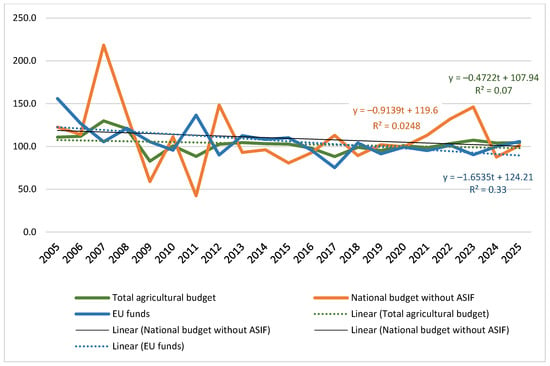
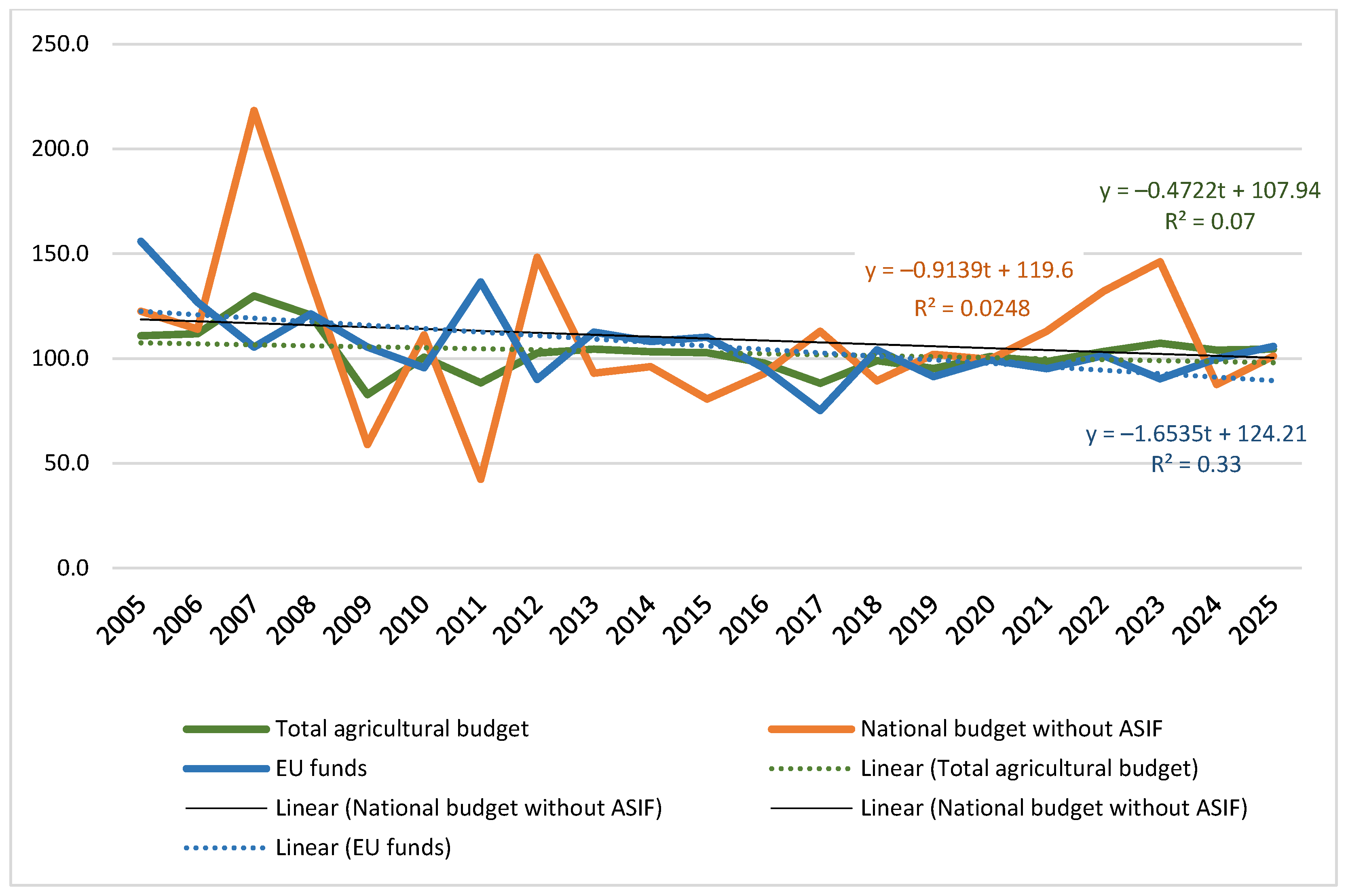
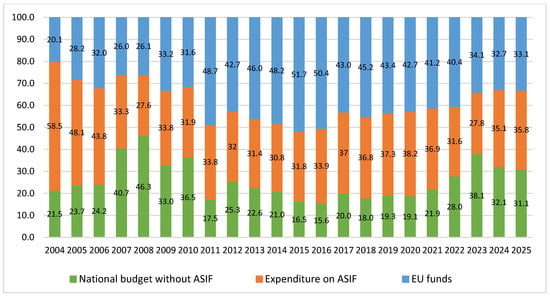
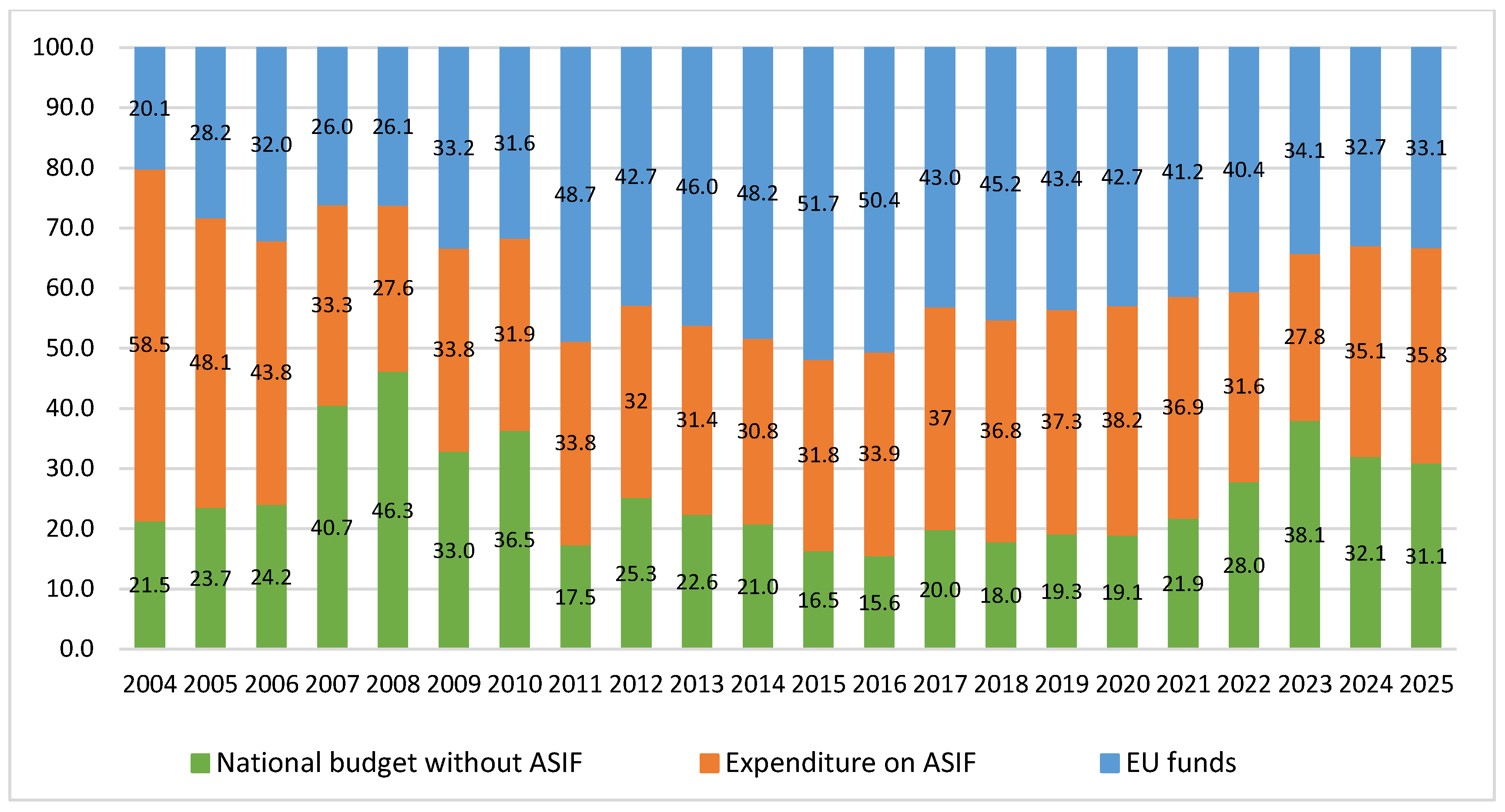
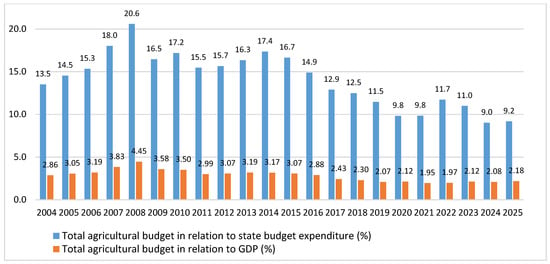
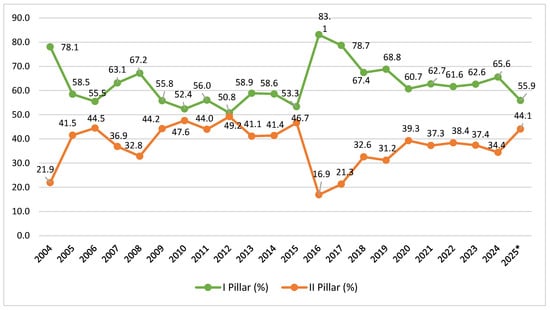
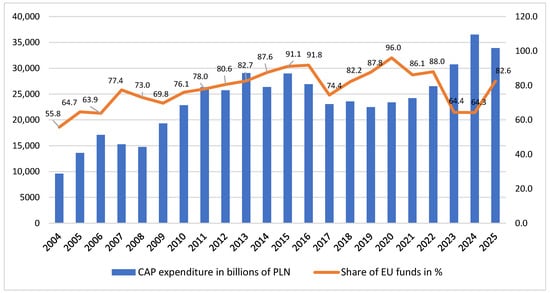
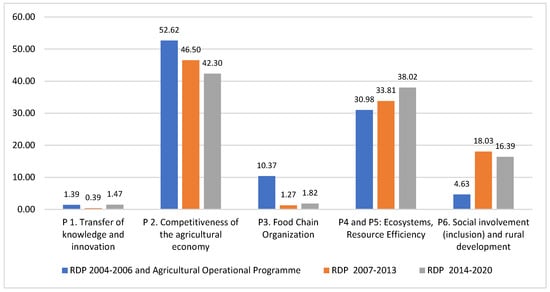

Disclaimer/Publisher’s Note: The statements, opinions and data contained in all publications are solely those of the individual author(s) and contributor(s) and not of MDPI and/or the editor(s). MDPI and/or the editor(s) disclaim responsibility for any injury to people or property resulting from any ideas, methods, instructions or products referred to in the content. |
© 2026 by the authors. Licensee MDPI, Basel, Switzerland. This article is an open access article distributed under the terms and conditions of the Creative Commons Attribution (CC BY) license.