You are currently viewing a new version of our website. To view the old version click .
Agriculture
  • Feature Paper
  • Article
  • Open Access

31 December 2025

Research on the Coupling and Coordinated Evolution of Cultivated Land Use Efficiency and Ecological Safety: A Case Study of Jilin Province (2000–2023)

,
,
,
,
and
College of Geographical and Tourism Science, Jilin Normal University, Siping 136000, China
*
Author to whom correspondence should be addressed.
Agriculture2026, 16(1), 94;https://doi.org/10.3390/agriculture16010094 
(registering DOI)
This article belongs to the Section Agricultural Systems and Management

Abstract

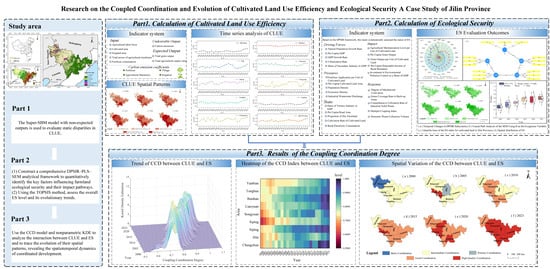
With increasing emphasis on ecological conservation and food security, cultivated land issues have become more prominent. This study focuses on Jilin Province and uses nine prefecture-level administrative units and prefectures as the basic analytical units. Using continuous data for 2000–2023, this study analyzes the spatiotemporal evolution of cultivated land use efficiency (CLUE). By 2023, most regions had achieved ecological safety (ES), examined through their coupling and coordination. The Super-Efficiency SBM-DEA model and the Malmquist–Luenberger (ML) index were used to evaluate the static and dynamic changes in CLUE. A DPSIR–PLS-SEM integrated framework was applied to identify causal mechanisms influencing ES, while the TOPSIS method was employed to assess overall evolutionary trends. In addition, the coupling coordination degree (CCD) model combined with kernel density estimation (KDE) was used to characterize the interaction between CLUE and ES and their spatial evolution. Results indicated the following: (1) From 2000 to 2023, overall CLUE in Jilin Province showed an upward trend with fluctuations, while regional disparities narrowed and spatial distribution became more balanced. (2) The composite ES index increased from 0.3009 to 0.7900, accompanied by a marked expansion of areas classified as secure. (3) The CCD improved from a basic level to a high-quality coordination level, indicating enhanced synergistic development. Higher coordination was observed in central and eastern regions, whereas western and peripheral areas lagged. This study integrates multi-dimensional modeling approaches to systematically assess the coupled dynamics on cultivated land use efficiency and ecological safety, providing insights for land management and policy formulation.

1. Introduction

Food security is regarded as a matter of paramount national importance [1]. Since the 18th National Congress, the Central Committee has prioritized agriculture, rural development, and farmers, consistently emphasizing food security in national governance. It calls for firmly maintaining the cultivated land “red line,” adopting a comprehensive concept of food security, and ensuring the safety and long-term stability of staple grain production [2]. Cultivated land resources form the foundation of national food security [3]. The synergistic evolution of cultivated land use efficiency (CLUE) and ecological safety (ES) is a critical issue for safeguarding regional food security and sustainable development. During long-term agricultural development aimed at increasing grain production and economic returns, reliance on high-input, high-consumption production models degraded cultivated-land ecosystems, intensifying the conflict between resource use and ecological conservation [4]. This led to reduced cultivated area, declining soil quality, accelerated erosion, and increased agricultural nonpoint-source pollution, which severely hinder coordinated improvement of CLUE and ES [5]. In the black soil region, continued deterioration of cultivated land quality has further aggravated the conflict between improving CLUE and maintaining ES [6]. Despite these concerns, research on the coupled coordination of CLUE and ES remains limited, particularly in major agricultural provinces such as Jilin. Against this backdrop, studying the coupling relationship between CLUE and ES and clarifying their interaction mechanisms have become essential scientific tasks for addressing regional cultivated land conservation and sustainable use [7].
Recently, scholarly attention to linkages between CLUE and ES increased at both domestic and international levels. Regarding CLUE, foreign research started earlier, initially emphasizing the optimization of land resource allocation [8] and intensive land use [9]. More recently, the research focus shifted toward the quantitative assessment of CLUE and the analysis of its key factors. Domestic scholars mainly focused on CLUE measurement methods [10], regional variation characteristics [11], and spatiotemporal evolution patterns [12]. The research scale has progressively evolved from macro to micro levels, shifting from national-scale [13] and major grain-producing region studies [14] to provincial-level analyses [15]. In terms of methodology, scholars generally agree that evaluating CLUE requires a comprehensive analysis of the relationships among multiple inputs and economic as well as social outputs [16]. Commonly used methods include variable returns-to-scale DEA models, Super-Efficiency SBM-DEA, and SBM-Undesirable models. Since the concept of ecological security was introduced, Liu Yong [17] developed an early theoretical assessment framework for regional land resource ES, laying a foundation for subsequent studies. As a key aspect of land ES studies, ES describes the resilience of cultivated land ecosystems in preserving structural integrity and functional stability when subjected to external disturbances and risks. Existing research primarily focused on comprehensive assessments of ES [18], driving mechanism analyses [19], spatiotemporal evolution simulations [20], and cultivated land ecological conservation and regulation [21]. These studies span national, provincial, and regional levels, employing diverse methodologies such as state-space models, the DPSIR framework, barrier diagnosis models, and ecological footprint models. These approaches provide methodological support for the quantitative analysis and scientific management of ES. At the theoretical level, this study develops a three-dimensional framework. The analysis proceeds in three steps: first, constructing indicators and analyzing static and dynamic variations in CLUE using the Super-Efficiency SBM-DEA model and the Malmquist–Luenberger (ML) index; second, integrating the DPSIR framework with PLS-SEM to identify key factors and causal pathways affecting ES, and applying TOPSIS to examine overall evolution trends; finally, using a coupling coordination degree (CCD) model combined with kernel density estimation (KDE) to assess interactions between CLUE and ES and their spatial patterns. This approach overcomes limitations of single-criterion models, clarifies methodological logic, and provides guidance for optimizing cultivated land use in Jilin Province while supporting food security and ecological sustainability. In summary, existing research provides essential theoretical foundations and methodological insights for improving CLUE and ES. However, there remains considerable room for further refinement and expansion in this field. First, regarding the evaluation framework, most studies emphasize economic and social outputs, whereas the systematic integration of environmental negative effects and unintended outputs during CLUE assessment remains limited. Second, with respect to research scale, scholarly efforts have primarily targeted national and watershed levels, leaving municipal-level examinations in major agricultural areas comparatively underexplored. Jilin Province contributes about 7% of the national grain output. The sustainable use of its cultivated land resources is vital not only for regional agricultural development but also for ensuring national food security. Nevertheless, current understanding of internal regional disparities and spatiotemporal evolution patterns within the province remains insufficient. Third, regarding research content, previous studies have mainly explored the spatiotemporal patterns of CLUE and their influencing factors. Despite growing scholarly interest in CLUE and ES, the coupled coordination and evolution between them have not been thoroughly investigated, and comprehensive analyses of the mechanisms and spatiotemporal dynamics of their driving factors remain limited. Therefore, this study aims to address key issues related to CLUE and ES in Jilin Province by examining how these two systems interact and influence each other, identifying the spatial and temporal patterns of mismatches or synergies at the municipal level, and providing evidence-based guidance for balancing agricultural productivity and ecological sustainability to support regional food security.

2. Materials and Methods

2.1. Study Area

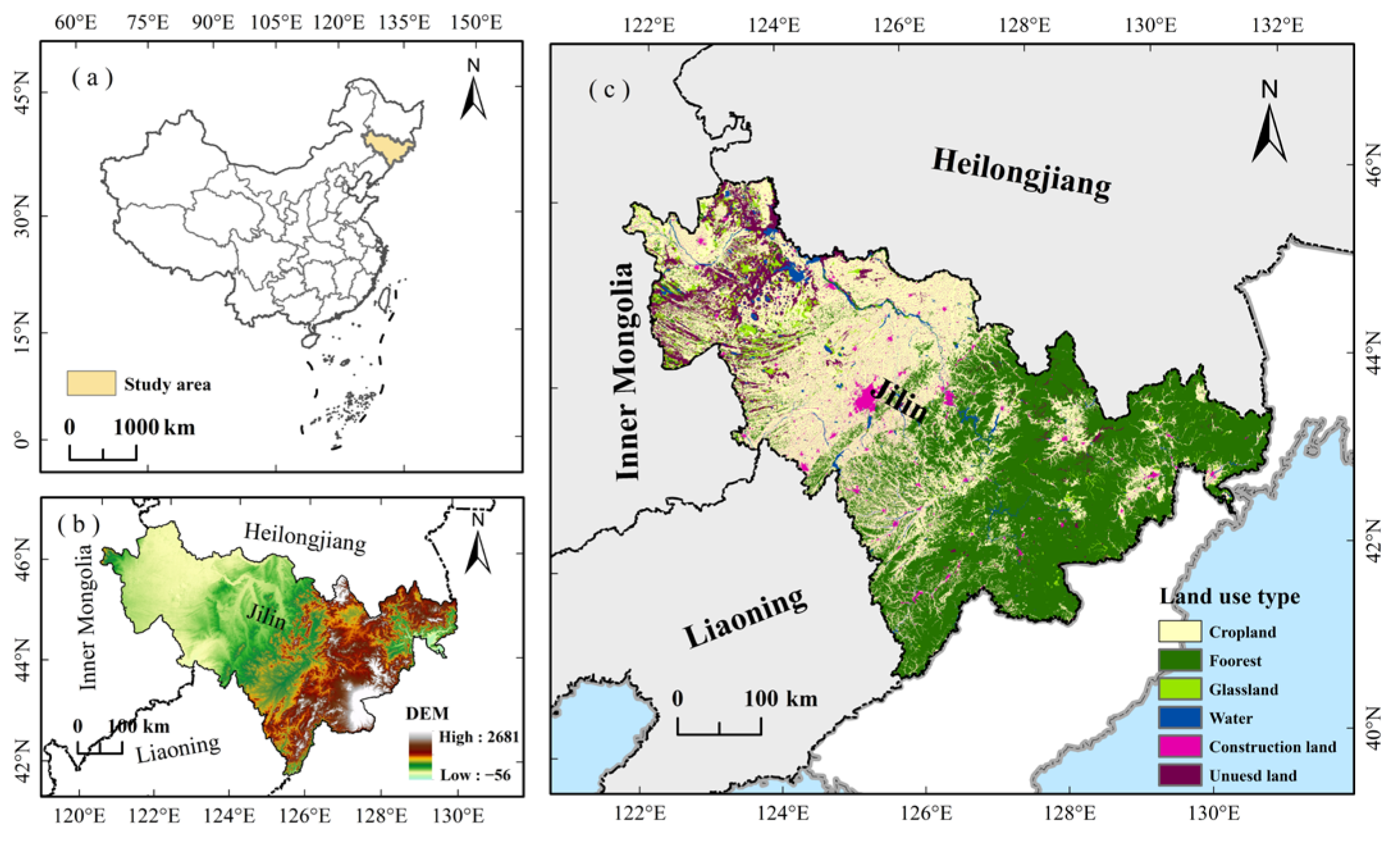
Jilin Province (Figure 1) located in central Northeast China, covers approximately 187,400 km2 (40°52′–46°18′ N, 121°38′–131°19′ E). Situated at the core of the global black soil belt, Jilin is both a major grain-producing region and an important ecological barrier in China [22]. The province features a topography that slopes from east to west, characterized by diverse landforms and a temperate continental monsoon climate, which provides favorable conditions for agricultural development [23]. As of 2023, the cultivated land area is approximately 74,500 km2 (approximately 40% of the province), mainly distributed across the central plains regions of Changchun, Siping, Songyuan, and other cities [24]. According to the latest statistics, the permanent population of Jilin Province decreased from 27.28 million in 2000 to 23.39 million in 2023, representing a decline of about 14.2%. Despite this decrease, overall agricultural productivity remained relatively stable, indicating that technological progress in the agricultural sector helped maintain production levels. Grain production has exceeded 40 billion kg for several consecutive years, securing a strategic position in national food security and earning the title of “ballast stone”. As a typical black soil region and major grain-producing area [25], its coordinated development model holds significant exemplary value for regional agricultural ES governance.
Figure 1. (a) Location of Jilin Province in China. (b) Digital Elevation Model (DEM). (c) Land use types of the study area.

2.2. Data Sources

This study encompasses all prefecture-level administrative units in Jilin Province, covering the period from 2000 to 2023. Statistical data were obtained from the Jilin Statistical Yearbook, China Rural Statistical Yearbook, China Environmental Statistical Yearbook, and prefecture-level statistical yearbooks, supplemented by datasets from the China Rural Statistical Database. Data gaps identified in some regions were addressed using linear interpolation to ensure temporal continuity. To eliminate inconsistencies in the measurement units of the selected indicators, all data were normalized prior to analysis. Elevation (DEM) and administrative boundary data were acquired from the Geospatial Data Cloud and the National Basic Geographic Information Center, respectively.

2.3. Methods

2.3.1. Construction of CLUE Evaluation Indicator System

Considering the regional features of Jilin Province, an evaluation index system was developed encompassing both input and output aspects [26] (Table 1), with carbon emissions identified as the undesirable output. Following previous studies, the carbon emission calculation formula and the corresponding emission coefficients for major carbon sources [27] (Table 2) are defined as follows:
E = E h = ( G h × δ h   )
where E denotes the total carbon emissions, Eh represents the emissions from the h-th carbon source, Gh indicates the activity level of the h-th source, and δh denotes the corresponding carbon emission coefficient.
Table 1. Construction of the cultivated land use efficiency (CLUE) indicator system. All indicator data were standardized to ensure comparability.
Table 2. Carbon emission coefficients of major carbon source factors used in this study.

2.3.2. Super-Efficiency SBM-DEA

We employ the Super-Efficiency SBM-DEA model—an extension of Data Envelopment Analysis (DEA) that accommodates undesirable outputs—to assess decision-making unit efficiency [32]. The model extends the traditional CCR/BCC frameworks by explicitly incorporating undesirable outputs, enabling a more comprehensive CLUE evaluation [33]. The specific calculation formula is as follows:
min ρ = 1 + 1 m i = 1 m s i / x i k 1 1 q 1 + q 2 r = 1 q 1 s r + / y r k + t = 1 q 2 s t b / b t k
s . t . j = 1 , j k n x i j λ j s i x i k j = 1 , j k n y r j λ j + s r + y r k j = 1 , j k n b t j λ j s t b b t k 1 1 q 1 + q 2 r = 1 q 1 s r + y r k + t = 1 q 2 s t b b t k > 0 λ , s , s + 0 i = 1,2 , m ; r = 1,2 , , q ; j = 1,2 , n ( j k )
The additional constraint 1 1 q 1 + q 2 r = 1 q 1 s r + y r k + t = 1 q 2 s t b b t k > 0 can be removed during linear transformation.
Where n denotes the number of decision units, m, q1, and q2 represent the quantities of inputs, expected outputs, and unexpected outputs, s, s+, and sb are the slack variables for each, xi, yr, and bt denote the vectors of inputs, expected outputs, and unexpected outputs, and λ is the weight vector.
The efficiency values obtained above were categorized into grades, resulting in Table 3.
Table 3. Classifying the levels of CLUE.

2.3.3. Malmquist-Luenberger Index

The ML index offers a dynamic evaluation of CLUE in Jilin Province, effectively capturing variations in the operational efficiency of agricultural systems that account for both positive and negative environmental outputs [34]. The calculation formula is as follows:
M L t t + 1 = 1 + D 0 t x t , y t , b t ; y t , b t 1 + D 0 t + 1 x t + 1 , y t + 1 , b t + 1 ; y t + 1 , b t + 1 × 1 + D 0 t + 1 x t , y t , b t ; y t , b t 1 + D 0 t + 1 x t + 1 , y t + 1 , b t + 1 ; y t + 1 , b t + 1 1 2
The ML index is further divided into two components: the Technical Efficiency Change (EC) and Technical Progress Change [35], which can be expressed, respectively, as:
E C t t + 1 = 1 + D 0 t x t , y t , b t ; y t , b t 1 + D 0 t + 1 ( x t + 1 , y t + 1 , b t + 1 ; y t + 1 , b t + 1 )
T C t t + 1 = 1 + D 0 t + 1 x t , y t , b t ; y t , b t 1 + D 0 t ( x t , y t , b t ; y t , b t × 1 + D 0 t + 1 x t + 1 , y t + 1 , b t + 1 ; y t + 1 , b t + 1 1 + D 0 t ( x t + 1 , y t + 1 , b t + 1 ; y t + 1 , b t + 1 1 2  
where M L t t + 1 > 1 indicates an increase in CLUE from period t to t + 1, E C t t + 1 > 1 indicates improved efficiency, and T C t t + 1 > 1 indicates technological advancement; values ≤ 1 indicate the opposite.

2.3.4. Construction of ES Evaluation Indicator System

Based on the DPSIR framework [36], we assess ES [37]. Indicator weights were obtained by combining the entropy-weight method and the analytic hierarchy process (AHP) [38], as presented in Table 4.
Table 4. Construction of the ecological safety (ES) indicator system. All indicators were standardized prior to analysis.

2.3.5. DPSIR-PLS-SEM Framework

The DPSIR-PLS-SEM framework provides a causal chain to identify variable–structure relationships while addressing complex paths, mediators, and latent variables [39]. The PLS-SEM formula is:
X = Λ x ξ + σ
Y = Λ y η + ε  
where X and Y denote exogenous and endogenous observable variables, ΛX and ΛY represent factor loading matrices linking observed variables to corresponding latent variables, and σ and ε indicate the error terms.
η = B η + r ξ + ζ
where η denotes endogenous latent variables, ξ the exogenous latent variables, B the path coefficients among endogenous variables, r the coefficients linking exogenous and endogenous variables, and ζ the residuals capturing unexplained variance within the structural model.

2.3.6. TOPSIS Method

The TOPSIS method ranks alternatives by measuring their relative closeness to the positive (ideal) and negative (anti-ideal) solutions, enabling performance comparison across multiple attributes [40]. The formula is as follows:
D i + = j = 1 m ( z i j z j + ) 2
D i = j = 1 m z i j z j 2
where D i + and D i represent the distances of the i -th evaluation unit from the positive and negative ideal solutions, respectively; z j + and z j denote the corresponding ideal solution values; and z i j refers to the normalized indicator value.
The relative proximity of each evaluation object is calculated as:
S = D i D i + D i +
where S   represents the relative closeness of the i -th evaluation unit, with higher values indicating greater proximity to the ideal solution and thus better overall performance.
The results were categorized into grades, as shown in Table 5.
Table 5. Classifying the levels of ES.

2.3.7. Coupling Coordination Degree Model

The concept of coupling, originally derived from physics, is widely applied to characterize interactions among multiple subsystems [41]. The corresponding calculation formula is given as follows:
C = 2 E × S E + S
where C [ 0 ,   1 ] represents the coupling degree between the two systems. A higher C value indicates stronger interaction, whereas a lower value indicates weaker coupling. E and S represent the levels of CLUE and ES, respectively.
As the coupling degree model cannot capture the synergistic interactions between the two variables, a coordination degree model was subsequently adopted for deeper evaluation [42]. The calculation formula is given as follows:
T = α U 1 + β U 2
D = C × T
where T represents the comprehensive coordination degree, reflecting the overall development status, and D indicates the CCD ranging between 0 and 1, with higher values signifying stronger coordination between the two systems; and α and β are undetermined parameters satisfying α + β = 1, both set to 0.5 in this study.
The results were classified into levels, as shown in Table 6.
Table 6. Classifying the levels of coupling coordination.

2.3.8. Kernel Density Estimation

KDE is a nonparametric method used to analyze the distribution characteristics of the coupling between CLUE and ES through continuous density curves [43]. The estimation function is given as follows:
f x = 1 N g i = 1 N H x i x ¯ g
where f x represents the CCD function; x i denotes the CCD of each prefecture-level city; x - is the mean CCD; N stands for the number of regions; g indicates the bandwidth; and H(·) denotes the kernel function. This study applies the CCD of Jilin Province for kernel density estimation.

3. Results

3.1. Spatiotemporal Evolution of CLUE

3.1.1. Temporal Evolution of CLUE

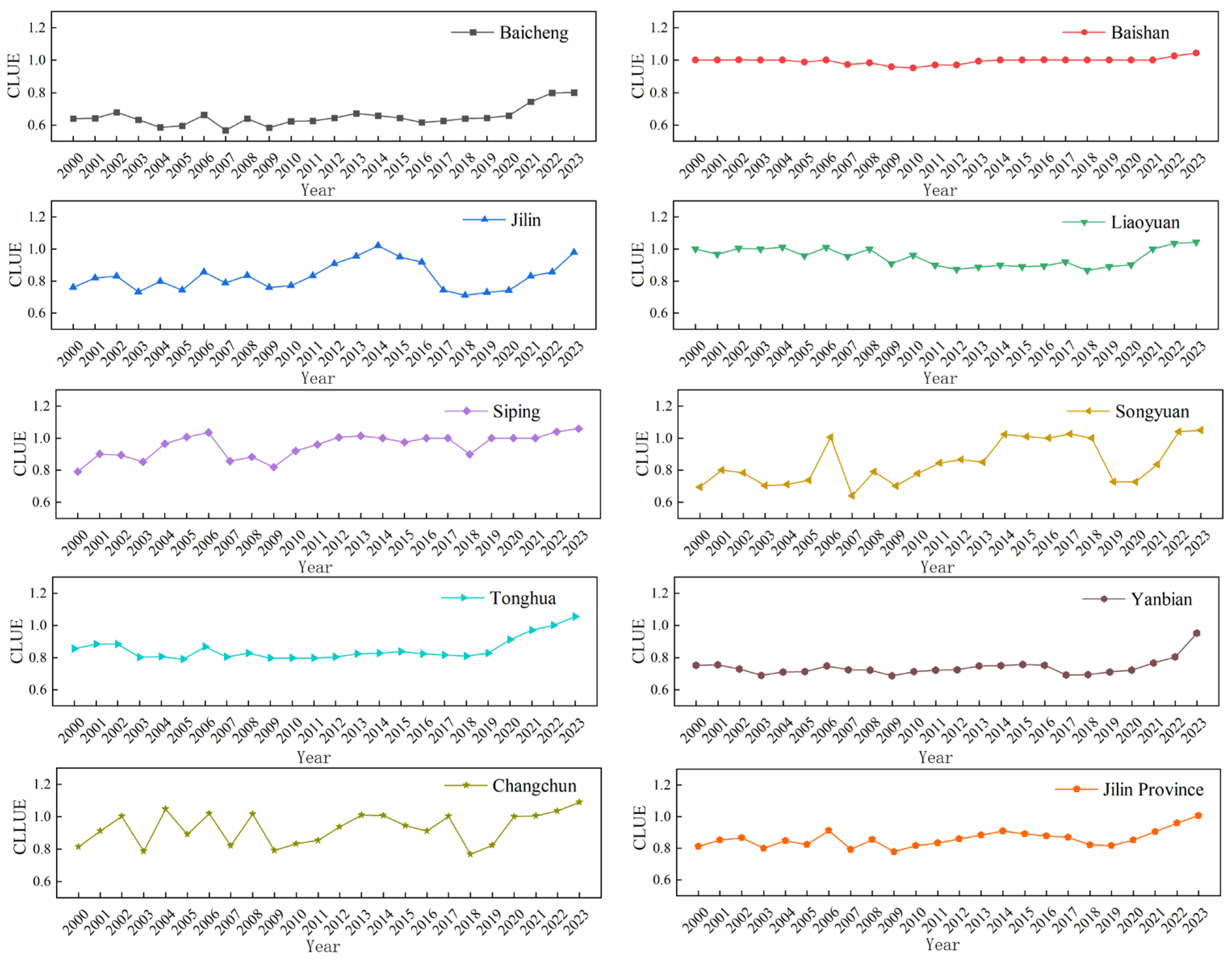
To assess regional differences in CLUE, we analyze its patterns across Jilin Province and its prefecture-level cities over the period 2000–2023. As shown in Figure 2, CLUE generally increased during this period.
Figure 2. Trends in CLUE Values Across Jilin Province and Its Prefecture-Level Cities (2000–2023).
Overall, CLUE increased over the study period with fluctuations and pronounced regional disparities. Driven by agricultural modernization, supportive policies for major grain-producing regions, and intensified land use, Jilin Province has achieved steady improvements in CLUE. Particularly since 2015, the development of high-standard Cultivated land and the advancement of agricultural technologies have further boosted overall progress. Regionally, Baicheng, Tonghua, and the Yanbian Prefecture initially exhibited lower CLUE levels; however, improvements in infrastructure and large-scale agricultural operations have substantially enhanced them. Jilin and Changchun experienced pronounced fluctuations due to industrial restructuring and urbanization, yet both have shown signs of recovery in recent years. Songyuan exhibited pronounced fluctuations due to soil salinization and ecological fragility, while Liaoyuan and Siping remained relatively stable with modest gains.
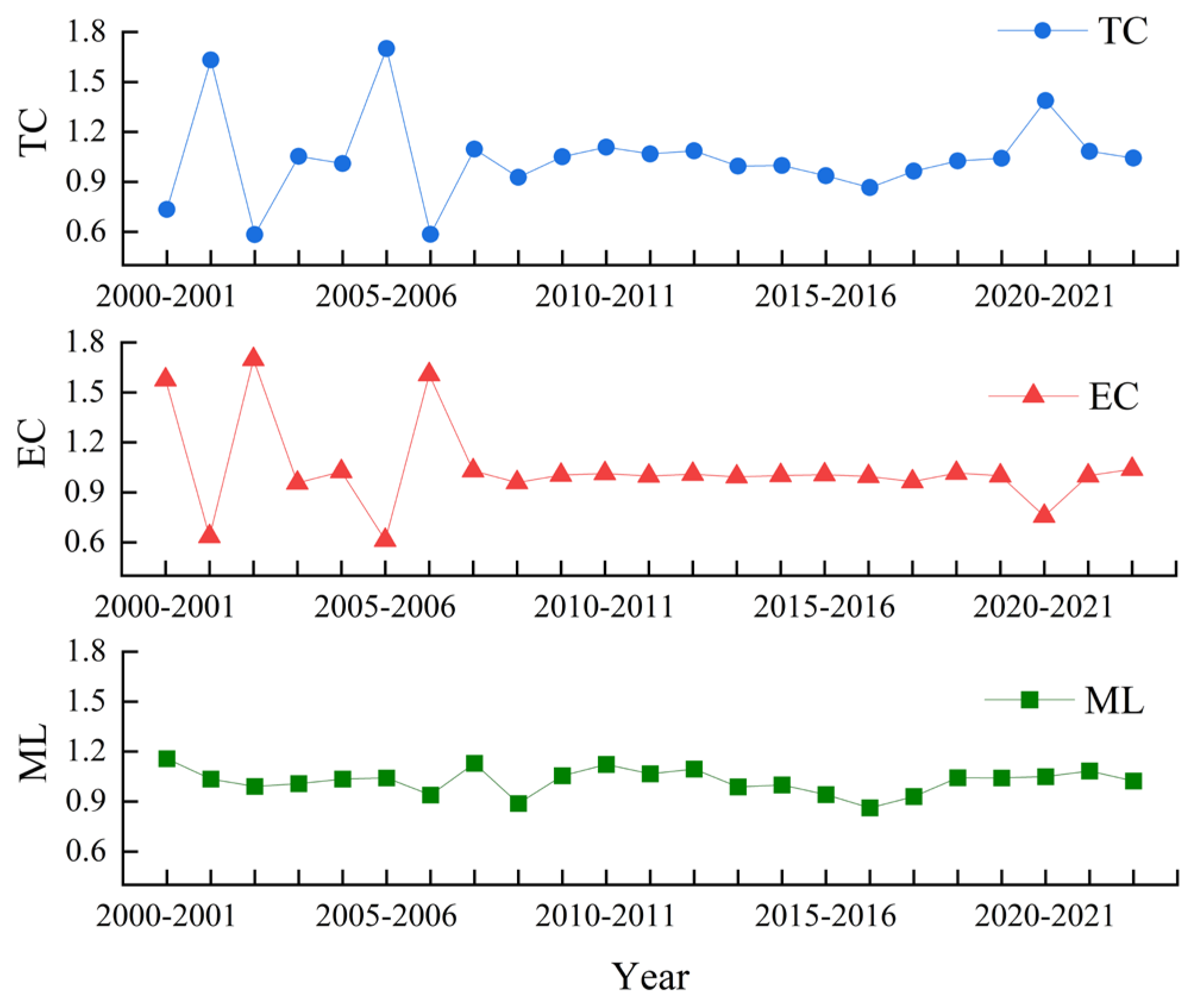
To further examine the dynamic evolution of CLUE in Jilin Province, the ML index was applied. This analysis produced the ML index of CLUE and its decomposition into TC and EC (Figure 3).
Figure 3. Trends in Total Factor Productivity across Jilin Province.
Overall, the ML index of cultivated land use in Jilin Province remained approximately 1 throughout the study period, showing only minor fluctuations, which indicates that total factor productivity remained generally stable. The TC index averaged 1.0388, suggesting that technological progress contributed to efficiency improvement but displayed cyclical fluctuations. The EC index averaged 1.0423, with improvements in technical efficiency making a relatively greater contribution to total factor productivity growth. The enhancement of CLUE in Jilin Province primarily stemmed from improvements in technical efficiency, although considerable potential for further technological progress remains.

3.1.2. Spatial Distribution Patterns of CLUE

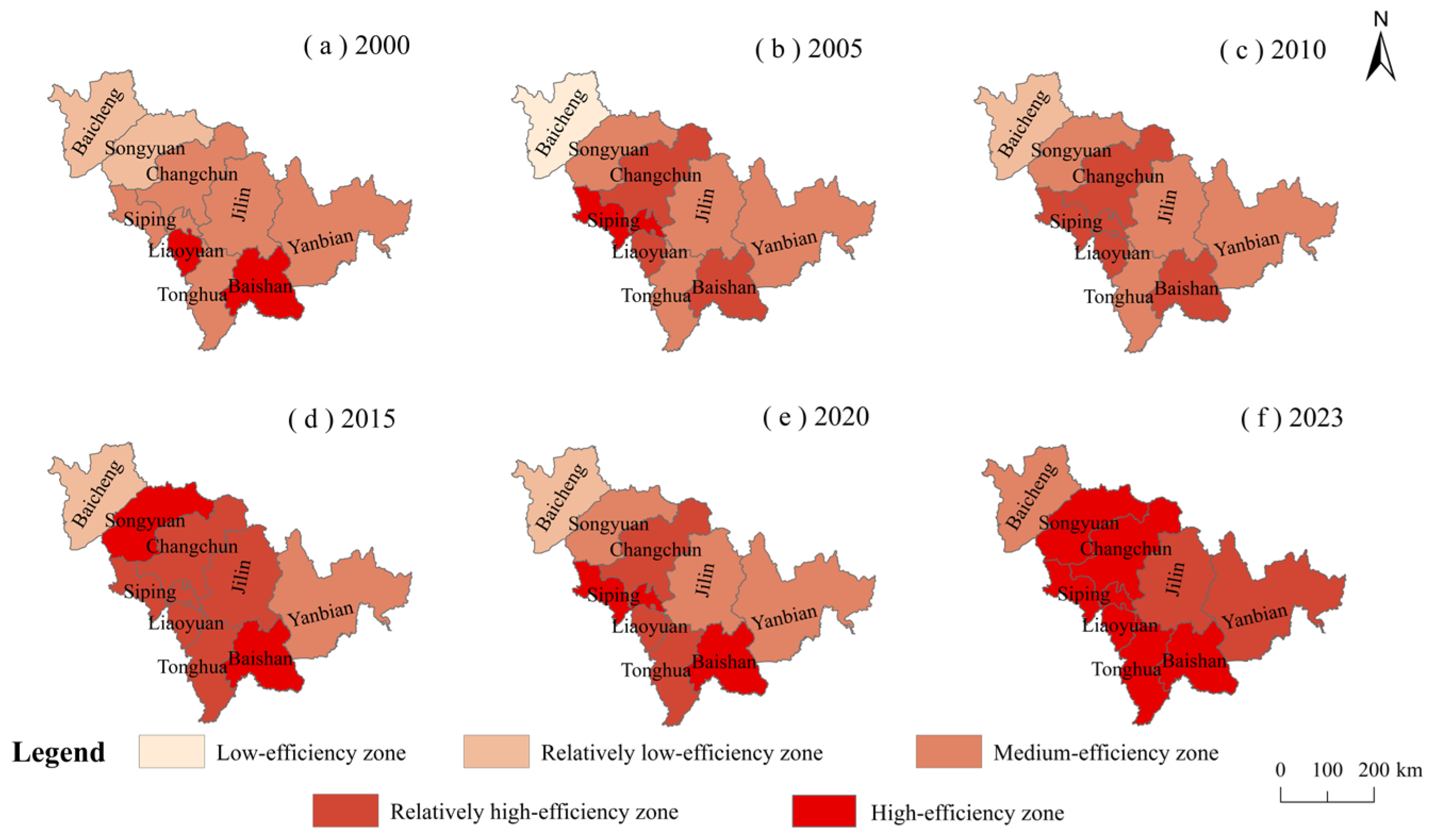
The Characteristics of CLUE across the cities and prefectures of Jilin Province for 2000, 2005, 2010, 2015, 2020, and 2023 illustrates its spatial distribution patterns (Figure 4).
Figure 4. Spatial Distribution of CLUE Values across Jilin Province in 2000, 2005, 2010, 2015, 2020 and 2023.
From 2000 to 2023, CLUE patterns across Jilin Province underwent marked changes. Overall, the low-efficiency zones gradually improved, while the high-efficiency zones expanded in extent and exhibited increasing spatial agglomeration. Changchun and Jilin cities consistently maintained high-efficiency zones, constituting the province’s core high-efficiency cluster. Songyuan and Siping transitioned from low-efficiency zones to high-efficiency zones, exhibiting the most notable improvement. Baicheng and Liaoyuan improved from low-efficiency zones or relatively low-efficiency zones to medium-efficiency zones, indicating favorable development potential. Tonghua, Baishan, and Yanbian Prefecture showed moderate improvement, although the overall gains remained limited. By 2023, most regions had entered the relatively high and high-efficiency zones, suggesting that, under the combined influence of policy support [44], agricultural modernization, and land intensification [45], the province’s overall CLUE had reached a relatively high-zone. This formed a spatial pattern characterized by overall improvement and narrowing regional disparities.

3.2. ES Calculation Results and Analysis

3.2.1. Dynamic Analysis of the ES Indicator

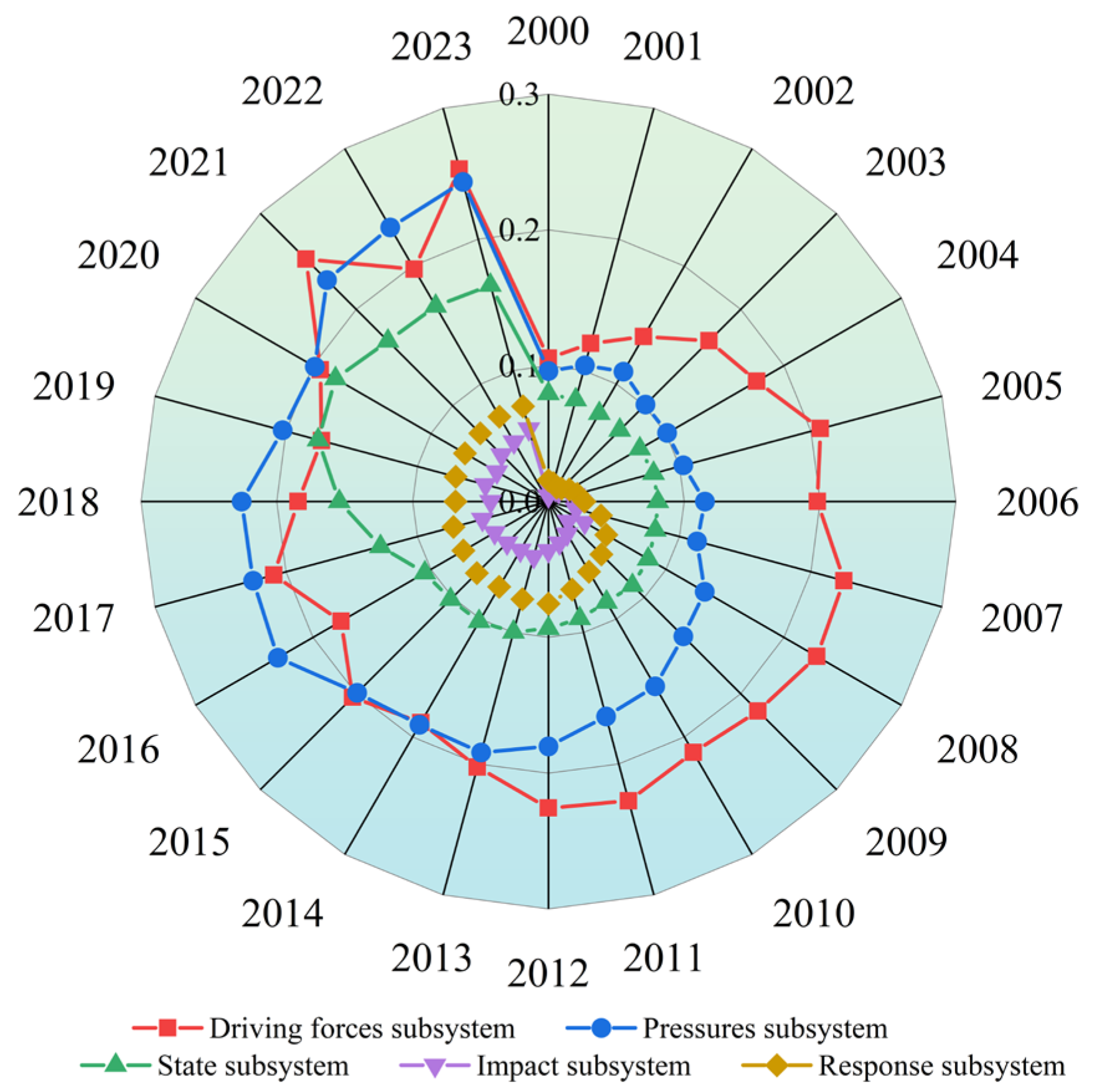
Changes in cultivated land ES across Jilin province can be comprehensively examined through five subsystems (Figure 5). Distinct differences are observed among the characteristics of these subsystems. The key forces subsystem presents an “upward–downward–rebound” trajectory, reflecting the pronounced influence of staged economic and social development on cultivated ecological conditions. The pressures subsystem shows a “decline–brief rebound” pattern, indicating that the intensity of resource exploitation and ecological pressures has generally eased, although both have increased slightly in recent years due to food security initiatives. The state subsystem has shown continuous improvement, particularly since 2015, with marked gains driven by the Black Soil Conservation Project and the promotion of green agricultural technologies. However, from 2021 to 2023, minor fluctuations occurred due to natural disasters. The overall upward trajectory of the impact subsystem suggests that improvements in cultivated ecology generate positive feedback effects on agricultural productivity and socioeconomic development. The response subsystem has been continuously strengthened since 2000, as evidenced by a progressively refined policy framework that reflects steady advances in cultivated ecological governance capacity. The synergistic interactions among the DPSIR subsystems are both evident and significant. The reinforcement of key forces and response mechanisms effectively mitigates ecological pressures, fostering the evolution of cultivated land ecosystems toward greater efficiency, coordination, and sustainability.
Figure 5. Temporal Changes in DPSIR Subsystems Indicators.

3.2.2. Evaluation Results of the DPSIR–PLS–SEM Framework

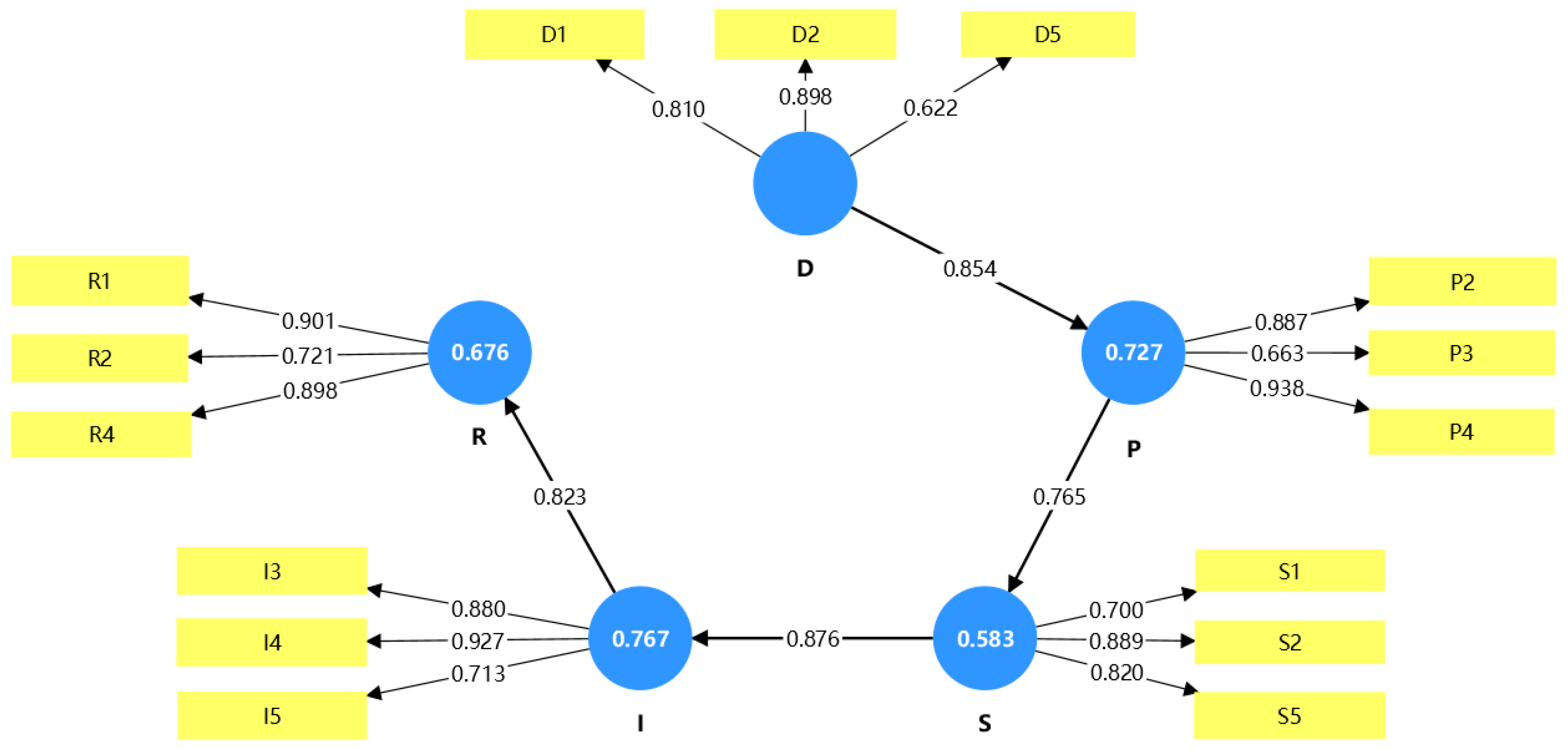
By comparing the DPSIR subsystems, an initial understanding of the system’s evolutionary trends is obtained. Integrating the DPSIR-PLS-SEM evaluation results facilitates a deeper understanding of the interactive relationships and overall effects among the subsystems. Analysis and validation were conducted using SEM within the DPSIR framework. To ensure model validity, model fitting and refinement of SEM were performed: First, indicators that failed the factor loading and multicollinearity tests were excluded. In accordance with the requirement that each second-order construct contains an equal number of observed variables, three indicators with the highest factor loadings were selected from each subsystem. Ultimately, the variables D (D1, D2, D5), P (P2, P3, P4), S (S1, S2, S3), I (I3, I4, I5), and R (R1, R2, R4) were incorporated into the final SEM model. The measurement model demonstrated high composite reliability, as shown in Table 7.
Table 7. Reliability Test Results for PLS-SEM Model.
The model’s explanatory power was assessed using R2 values, which were 0.727, 0.583, 0.767, and 0.676, respectively. These results demonstrate substantial explanatory power and accurately capture the causal relationships within the DPSIR framework. Bootstrapping with 5000 resamples at a 95% confidence level was used to test path significance using the t-statistic. A hypothesis is deemed statistically significant at the 5% level when the t-value exceeds 1.96. The path coefficients and t-values indicate that all hypotheses are supported at this threshold. The structural equation model with D as the exogenous variable clearly illustrates the causal relationships within the system (Figure 6), confirming that the constructed indicator system is applicable to this evaluation.
Figure 6. Causal path analysis of the PLS-SEM model with driving forces (D) as the exogenous construct. Values shown on the paths are standardized path coefficients.
The results (Table 8) indicate that all pathways are statistically significant, indicating robust interactions among the subsystems within Jilin Province’s ES system. The key force exerts the strongest influence on subsystem pressure, with a path coefficient of 0.854. While economic growth and industrialization promote regional development, they also result in greater exploitation of cultivated land resources and heightened environmental pressures. The path coefficient for pressure on the state is 0.765, indicating that human activities adversely affect the ecological environment of cultivated land. Areas with dense populations and economically concentrated zones are prone to land fragmentation, loss of soil fertility, and the spread of nonpoint source pollutants, which compromise ecosystem stability. The path coefficient indicating the impact of ecological status on subsystems is 0.876, indicating that favorable ecological conditions of cultivated land can enhance agricultural mechanization levels, grain yields, and farmers’ incomes, thereby promoting improvements in ES. The influence on subsystem responses is also relatively strong, with a path coefficient of 0.823, indicating that changes in the ES status of cultivated land can trigger positive feedback at the policy and societal levels.
Table 8. Parameter Estimates of the PLS-SEM with D as the Exogenous Variable.

3.2.3. Temporal Evolution of ES

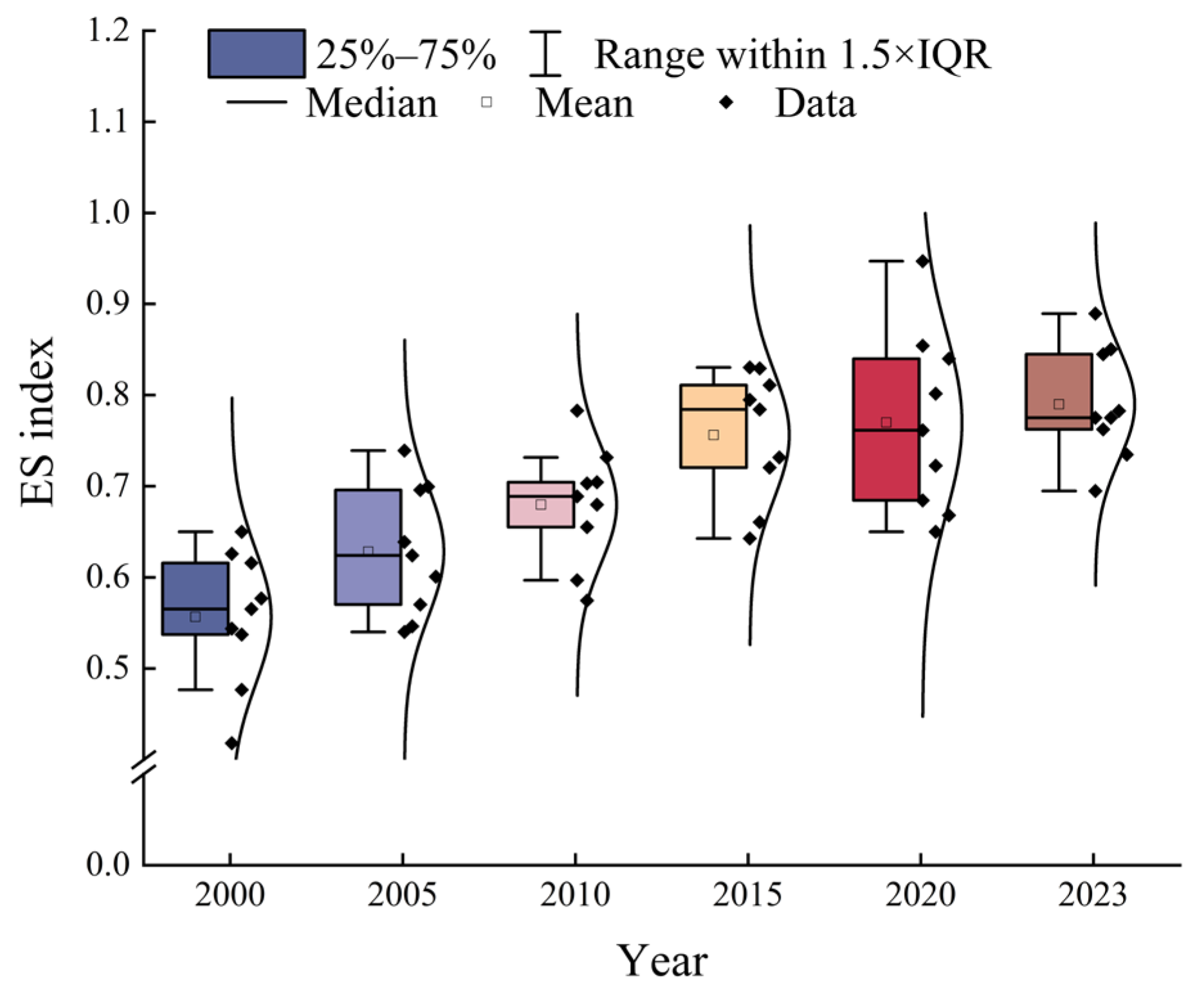
According to Figure 7, the comprehensive ES index in Jilin Province exhibited a continuous upward trend from 2000 to 2023. In 2000, ES levels were mainly at the risk level or sensitive level, with significant regional disparities, primarily influenced by the overexploitation of agricultural resources, delayed cultivated land protection policies, and traditional agricultural practices [46]. By 2010, the median value had increased significantly, and the distribution became more concentrated, marking the beginning of a phase of steady improvement in the ES of cultivated land. Since 2015, the composite index has continued to grow steadily, with marked progress in related initiatives [47]. In 2020, both the median and upper quartile values increased markedly, reaching the relatively safe level and safe level, indicating phased achievements in cultivated land conservation and ecological restoration efforts. The central black soil plains experienced notable improvements, while the western regions, affected by salinization and wind erosion, experienced comparatively slower progress [48]. By 2023, the composite index reached a new high, reflecting the enduring impacts and wide-ranging benefits of policy implementation [49].
Figure 7. Quartile lines of the ES index for cultivated land in Jilin Province.

3.2.4. Spatial Distribution Patterns of ES

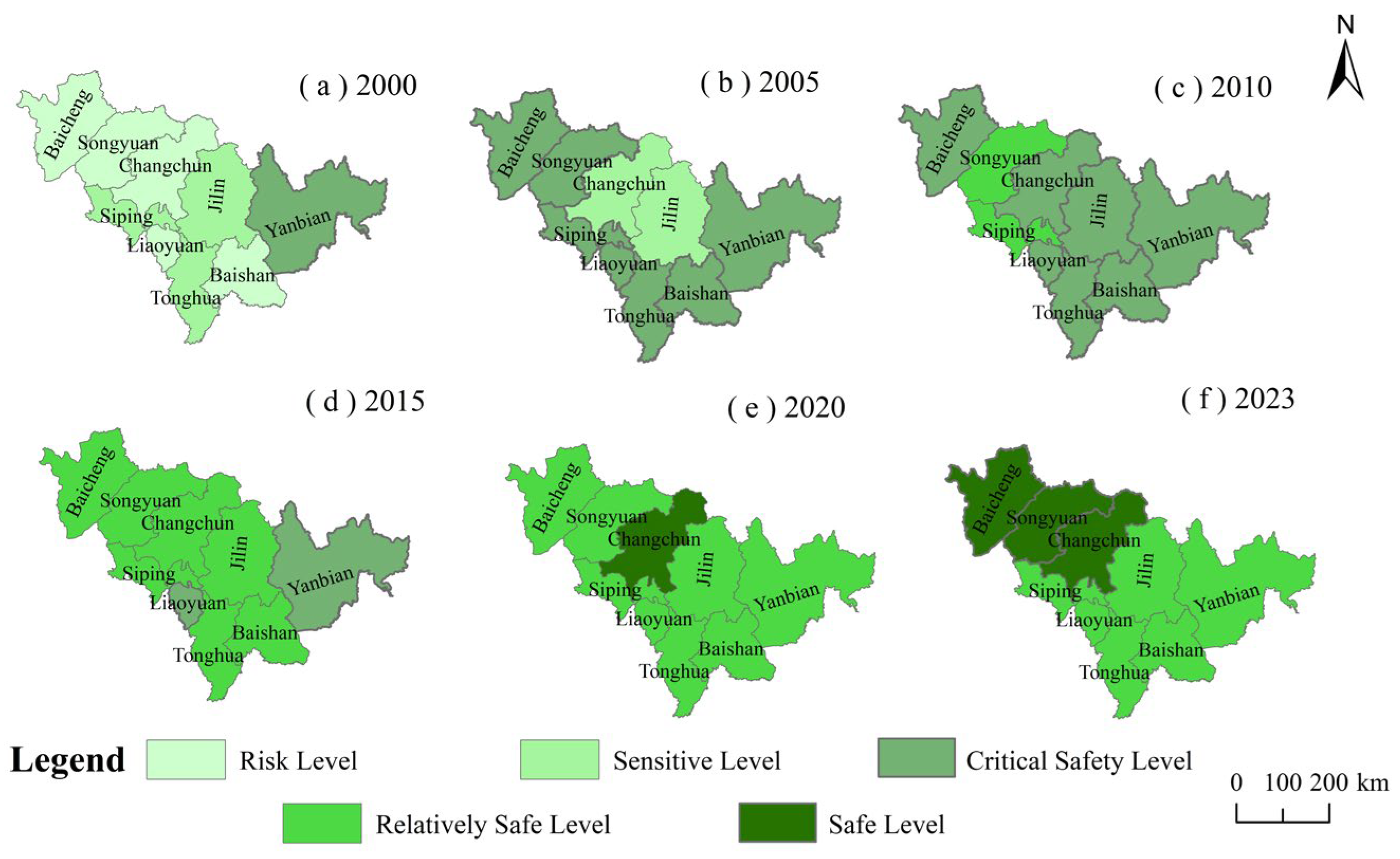
From a spatial perspective, this study examines regional variations in ES (Figure 8) by analyzing the ES status across cities and prefectures in Jilin Province. The ES in eastern and central Jilin Province, including Changchun City, Jilin City, and Yanbian Prefecture, has improved relatively quickly. These regions have experienced rapid economic development, a high degree of agricultural modernization, and strong policy support, leading to an early improvement in ES that has since stabilized at a high level [50]. Progress in improving ES in western and northern areas, including Songyuan City and Baicheng City, has been relatively slow. This is primarily due to natural conditions like drought and soil salinization, coupled with more traditional agricultural production models and relatively delayed implementation of ecological restoration policies [51]. Consequently, the pace of ES enhancement in these areas has been slow, with gradual improvements only emerging by 2020. Overall, Jilin Province has progressively enhanced its ES through policy initiatives and the transition to green agriculture.
Figure 8. Spatial Distribution of ES Index across Jilin Province in 2000, 2005, 2010, 2015, 2020 and 2023.

3.3. Results and Analysis of the CCD

3.3.1. Temporal Evolution Results

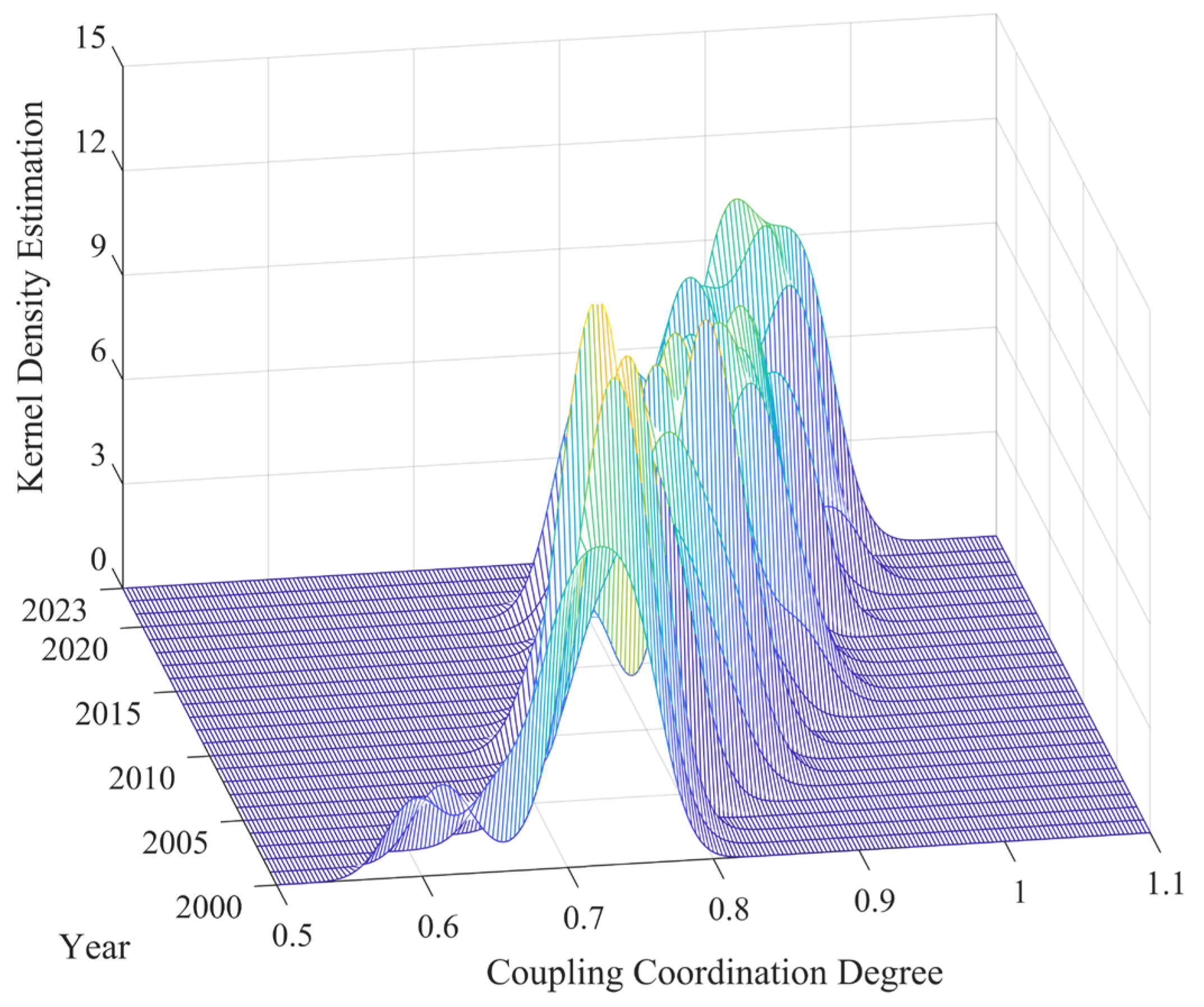
The results of the KDE reveal that over the course of the study, the CCD between CLUE and ES in Jilin Province increased steadily, indicating a trend toward higher-quality coordination (Figure 9). Specifically, the kernel density curve’s center gradually shifting to the right reflects a steady improvement in system coordination. The decline in peak height and broadening of the curve suggest reduced clustering, indicating that the evaluated regions have become more spatially dispersed. The progressive decline and flattening of the kernel density peak indicate that regions with comparable coordination levels are increasing, while interregional disparities are narrowing. Moreover, the kernel density curve consistently exhibits a single peak, suggesting that the coupling coordination between CLUE and ES in Jilin Province has not yet shown polarization.
Figure 9. Kernel density estimation (KDE) Distribution of the coupling coordination degree (CCD) between CLUE and ES.
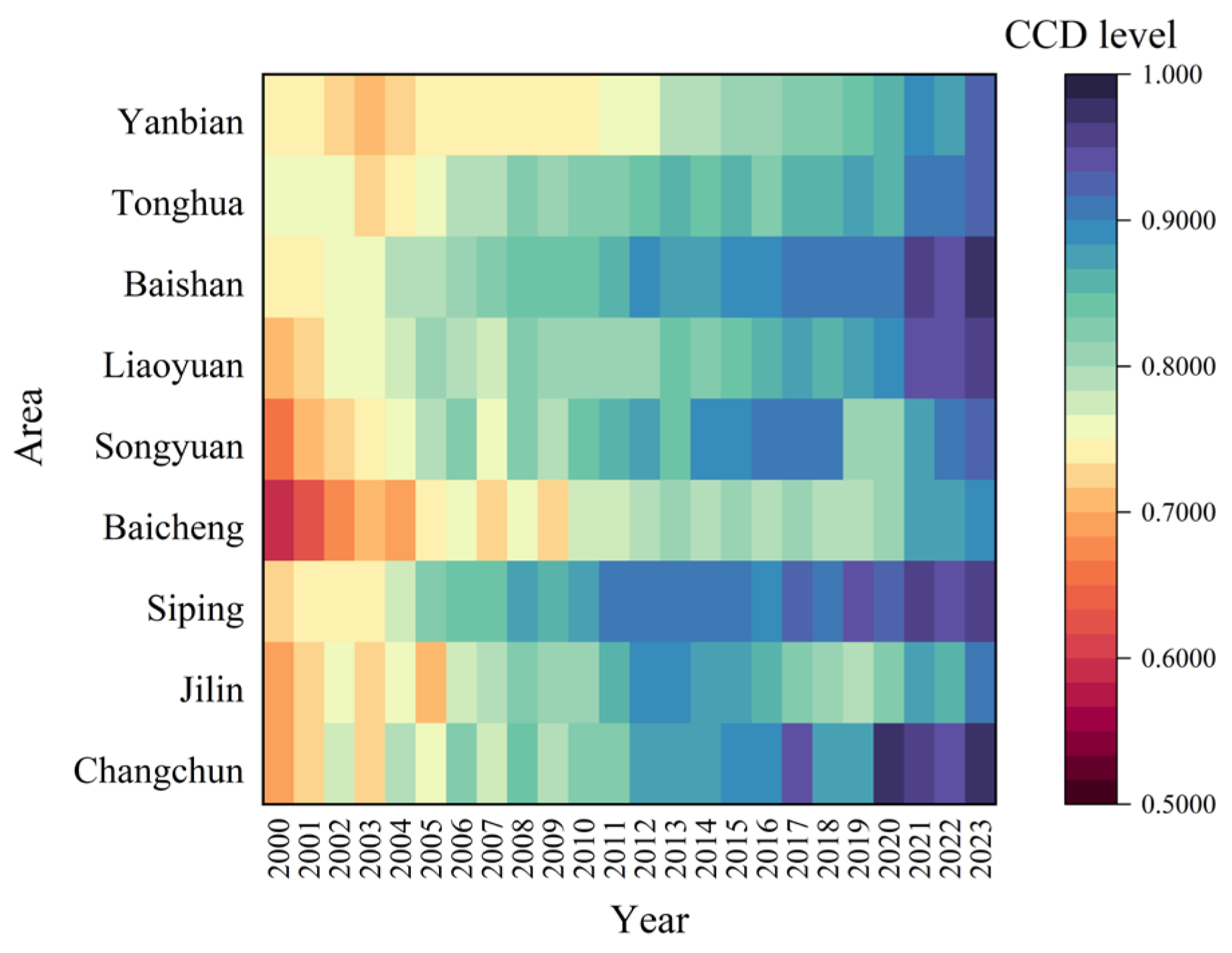
Using the heat map of the CLUE–ES coupling coordination index for Jilin Province’s nine prefecture-level cities between 2000 and 2023 (Figure 10), the index exhibited a stepwise increase during the study period, gradually increasing from a low-to-medium level (0.6–0.7) to a medium-to-high level (0.8–0.9). Key turning points occurred in 2010 and 2020. In the early phase, conflicts between traditional agricultural development and ecological conservation were prominent. During the mid-phase, initiatives such as the Black Soil Conservation Project enabled core areas like Changchun City to exceed 0.8. In the later phase, the “ecology + agriculture” model allowed regions such as Yanbian Prefecture to approach 0.9. The spatial pattern shows an “east high–west low and central polarization” distribution. The eastern ecological advantage zone has shown significant improvement in coordination levels, supported by a strong ecological foundation. The central industrial core zone leads through mechanization and technological advancement; however, it requires careful control to prevent overexploitation. Despite improvements achieved through engineering initiatives, the fragile ecosystems in western regions remain vulnerable.
Figure 10. Heatmap of the CCD between CLUE and ES.

3.3.2. Spatial Characteristics and Temporal Evolution of the CCD

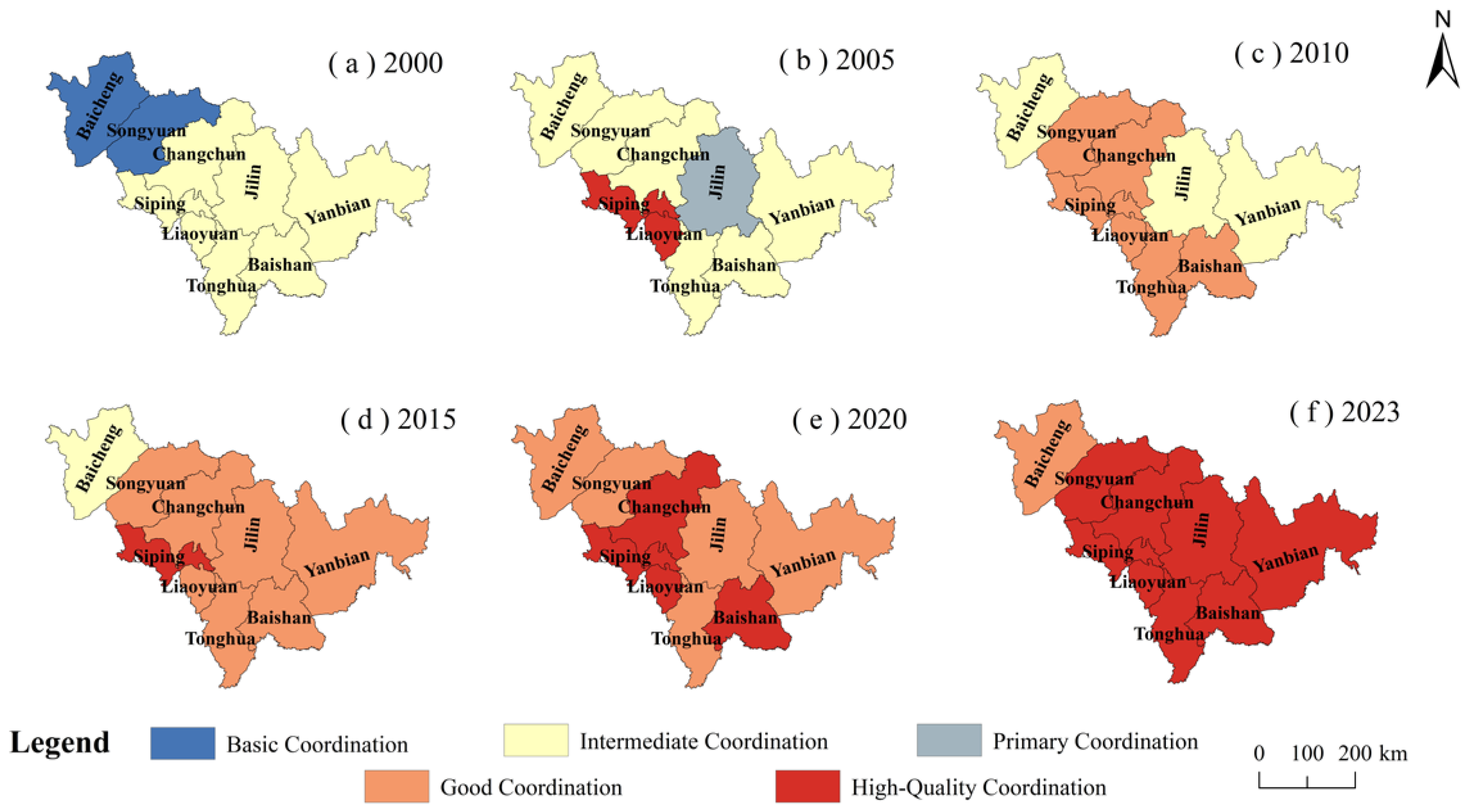
Throughout the study period, the coupling coordination between the ecological efficiency of CLUE and ES in Jilin Province exhibited a continuous upward trend, although notable stage-based regional differences were observed (Figure 11). A distinct spatial pattern emerged, with the central and southeastern regions performing relatively well, whereas the western and peripheral areas lagged behind. The central region—including Changchun, Siping, Jilin, and Liaoyuan—demonstrates a high overall level of coordination, constituting the province’s core advantage zone. This region features extensive black soil distribution and serves as a major grain-producing area, supported by a strong agricultural base and convenient transportation infrastructure. Urbanization and industrial growth have further advanced agricultural modernization. Despite intensive cultivation, the combination of substantial investment and advanced technologies has fostered a positive synergy between CLUE and ES. In the southeastern regions—including Tonghua, Baishan, and Yanbian Prefecture—coordination levels have steadily improved, maintaining a generally good-to-excellent performance. This area is predominantly mountainous and hilly, with scarce cultivated land resources. However, through ecological conservation initiatives, specialty agriculture, and the development of green industries, it has achieved notable ES benefits, thereby enhancing overall coordination. Western regions—such as Songyuan and Baicheng—show comparatively low coordination levels, constituting the province’s weak links. Constrained by ecological problems such as water scarcity, soil salinization, and wind erosion—and further challenged by agricultural overexploitation and grassland degradation—both CLUE and ES have been negatively affected.
Figure 11. Spatial Distribution of the CCD between CLUE and ES across Jilin Province in 2000, 2005, 2010, 2015, 2020 and 2023.

4. Discussion

4.1. Policy Recommendations

Region-specific policy measures should be implemented according to local characteristics. For the central and southeastern regions, which exhibit higher levels of efficiency and ecological coordination, it is recommended to further enhance agricultural technology, optimize production practices, and increase total agricultural output while maintaining ecological benefits [52].
Slower improvements in CLUE and ES in western Jilin Province can be attributed to natural and ecological constraints. Western Jilin is characterized by lower precipitation, arid conditions, and significant soil salinization, which reduce ecosystem service supply and soil conservation capacity compared with central and southeastern areas [53]. In addition, limited irrigation infrastructure and climate influences have historically constrained agricultural productivity, contributing to slower gains in CLUE. Analyses of ecosystem service supply and demand further indicate that ecological service provision is lower in western regions, reinforcing spatial heterogeneity in ES outcomes. For the western regions with low coupling coordination levels, it is recommended to integrate ecological agriculture into the evaluation system, establish farmer incentive mechanisms, promote sustainable farming practices, reduce pollutant-intensive inputs, and achieve coordinated economic and ecological development [54].
Regional disparities exist in population distribution and economic development across Jilin Province. During urbanization, it is recommended to implement policies that facilitate regional cultivated land transfer, encourage large-scale and centralized farming, and promote agricultural mechanization and modern management practices [55]. Nature-based solutions (NbSs) can be applied to optimize surface and groundwater utilization, improve resource efficiency, and achieve sustainable, intensive use of cultivated land. Climate factors, including temperature and precipitation, critically influence ES and crop production. It is recommended to select appropriate crop varieties and management practices according to regional climatic conditions, optimize crop layout, implement scientific cultivation, and enhance both crop yield and ecological resilience, while ensuring food security [56].

4.2. Limitations and Way Forward

Regarding the research scope, this paper primarily uses the city as the basic unit for empirical analysis, which limits the ability to fully capture internal variations and local dynamic processes at the county level. Future research should consider using higher-resolution multi-source remote sensing data and analyzing administrative units at finer scales than the city level to more accurately characterize the spatiotemporal evolution of CLUE and ES.
Regarding the driving mechanisms [57], this study primarily examines the interaction linking CLUE with ES from a conceptual and comprehensive perspective. However, it does not provide an in-depth identification or quantitative analysis of the key driving factors affecting variations in coupling coordination levels. Future research could integrate multiple factors, including natural endowments, socioeconomic conditions, policy interventions, and climate change, to develop a driving mechanism model that links CLUE with ES.
Regarding methodological assumptions, several aspects warrant further consideration. First, the Super-Efficiency SBM-DEA model assumes comparable production conditions across decision-making units, which is widely adopted in efficiency analysis. While this facilitates interregional comparison, it may not fully capture subtle differences in resource endowments or institutional contexts among cities. Second, the ML index is based on distance function estimation and may be influenced by data quality and extreme observations, potentially affecting the measurement of dynamic efficiency changes. In addition, the DPSIR–PLS–SEM framework relies on a predefined conceptual structure to examine causal relationships among latent variables. Although effective for clarifying interaction mechanisms, it does not explicitly account for nonlinear relationships or feedback effects related to ecological safety. Moreover, indicator selection and model specification inevitably involve expert judgment, which may introduce a degree of uncertainty. Future studies could further enhance methodological robustness by incorporating alternative efficiency models, conducting robustness analyses, and exploring nonlinear or spatial analytical approaches.
To address these limitations, future research should examine the underlying interactions between CLUE and ES within a comprehensive framework integrating multiple spatial scales, diverse influencing factors, and varied modeling approaches. Additionally, future studies should expand dynamic simulations and scenario projections of coupled coordination. These efforts would provide strong theoretical basis and practical guidance for optimizing cultivated land allocation, managing ES, and formulating high-quality development strategies in Jilin Province and other black soil regions of China.

5. Conclusions

Jilin Province features diverse cultivated land types, primarily black soil and black calcareous soil, providing a solid foundation for agricultural production. This study analyzed the spatiotemporal evolution and coupling coordination of cultivated land use efficiency CLUE and ES across nine municipal-level cities from 2000 to 2023. Based on this analysis, the main conclusions are as follows:
(1) Over the period 2000–2023, cultivated land use efficiency in Jilin Province showed a fluctuating but overall upward trend, with low-efficiency zones gradually contracting and high-efficiency zones expanding. Spatial disparities narrowed over time, and the provincial CLUE reached a relatively high level under the combined effects of policy support, agricultural modernization, and land intensification. This trend is consistent with findings from previous studies on cultivated land eco-efficiency in China’s major grain-producing regions, which also report a long-term improvement trajectory despite short-term fluctuations, reflecting sustained enhancements in land use performance [58].
(2) Over the study period, ES index in Jilin Province exhibited a steady upward trend, accompanied by notable spatial enhancements in ecological conditions. The results derived from the DPSIR–PLS–SEM framework demonstrate that the model possesses satisfactory goodness of fit and robust explanatory power. All path coefficients were statistically significant, elucidating the causal mechanisms influencing the ES in Jilin Province. Our results on ecological safety in Jilin Province are consistent with previous studies [59], showing overall upward trends and spatial disparities, with central and southeastern areas performing better than western regions. While prior research analyzed multiple cities at a broader scale, our study highlights finer spatial patterns and ES gradations within Jilin Province.
(3) Over the study period, the CCD between CLUE and ES in Jilin Province exhibited a continuous upward trend, reflecting a transition toward high-quality coordinated development. Spatially, good coordination and high-quality coordination were observed throughout the central and southeastern regions, whereas the western region remained relatively lagging. The central region, characterized by a solid agricultural foundation and a high degree of modernization, served as the province’s core advantage area. The southeastern region achieved steady progress through ecological conservation and the development of green industries, whereas the western region, constrained by fragile ecosystems and limited resources, maintained comparatively low coordination levels.
The findings were consistent with previous empirical studies [60], indicating that between 2000 and 2023, both CLUE and ES in Jilin Province steadily increased, with the CCD between them continuously improving. From the dual perspectives of efficiency and ecology, this study systematically elucidates the coupling relationship and evolutionary characteristics between CLUE and ES, offering analytical insights that refine the theoretical framework of coordinated development in cultivated systems. The research findings provided practical guidance for Jilin Province and the broader Northeast region by supporting improvements in land use planning, strengthening policies for cultivated land safeguarding, and promoting eco-friendly agricultural practices. These conclusions serve as valuable references for achieving sustainable agricultural development and ensuring regional ES.

Author Contributions

S.W.: originated the study design, established the methodological framework, carried out data handling and analytical work, and prepared the first draft of the paper, including the creation of figures and graphics. H.J.: oversaw the project as a whole, coordinated data management and funding support, and offered critical revisions and final editorial oversight. R.L.: assisted in shaping the research concept and took part in validating the analytical procedures. H.Y.: helped check the results and contributed to ensuring their robustness. X.S. and X.F.: undertook the core statistical analyses and interpreted the primary findings. All authors have read and agreed to the published version of the manuscript.

Funding

This research was funded by National Natural Science Foundation of China (Grant No. 41701424), and the Science and Technology Development Plan Project of Jilin Province—Strategic Research on Innovation and Development (Grant No. 20240701167FG).

Institutional Review Board Statement

Not applicable.

Data Availability Statement

Statistical data were obtained from the Jilin Statistical Yearbook, China Rural Statistical Yearbook, China Environmental Statistical Yearbook, and prefecture-level statistical yearbooks, supplemented by datasets from the China Rural Statistical Database. Elevation (DEM) and administrative boundary data were acquired from the Geospatial Data Cloud (https://www.gscloud.cn/) and the National Basic Geographic Information Center (http://www.ngcc.cn/), respectively.

Acknowledgments

We sincerely appreciate the anonymous reviewers for their valuable comments and insightful suggestions, which have significantly contributed to the enhancement of this manuscript. We remain committed to further improving the quality of our research and truly value your guidance and support.

Conflicts of Interest

The authors declare no conflicts of interest.

References

  1. Jun, F.; Rui, D.; YuQi, Z.; LinYu, D.; SiWei, S.; LiNa, P.; Jian, Z.; YuXuan, H.; Juan, L.; KeXin, W.; et al. Analysis of the spatial-temporal evolution of Green and low carbon utilization efficiency of agricultural land in China and its influencing factors under the goal of carbon neutralization. Environ. Res. 2023, 237, 116881. [Google Scholar] [CrossRef] [PubMed]
  2. Li, X.; Xu, X.; Yin, R.M. Spatial optimization of agricultural production from the perspective of “Greater Food Concept” in Yangzhou, China. Ecol. Indic. 2024, 169, 112805. [Google Scholar] [CrossRef]
  3. Valenti, F.; Bustamante, M.; Mancuso, G.; Toscano, A.; Zhuang, J.; Zilberman, D.; Liao, W. Exploring a food-energy-water nexus solution towards a sustainable and resilient Europe. Resour. Conserv. Recycl. 2026, 225, 108618. [Google Scholar] [CrossRef]
  4. Wang, L.; Zhao, R.; Dong, C.; He, C.; Kang, X.; Zhang, L.; Wei, D.; Zhou, J.; He, L.; Liu, X.; et al. Research on Delineation and Assessment Methods for Cultivated Land Concentration and Contiguity in Southeastern China. Agriculture 2025, 15, 1803. [Google Scholar] [CrossRef]
  5. Yao, R.; Ma, Z.; Wu, H.; Xie, Y. Mechanism and Measurement of the Effects of Industrial Agglomeration on Agricultural Economic Resilience. Agriculture 2024, 14, 337. [Google Scholar] [CrossRef]
  6. Shao, T.; Qian, F.; Liu, H.; Wang, S.; Pang, R.; Xu, H. Multi-scale cultivated land quality assessment and its scale effect based on multi-source data fusion. CATENA 2025, 259, 109350. [Google Scholar] [CrossRef]
  7. Yang, S.; Jiang, G.; Yu, H. Has rural depopulation reduced agricultural land use efficiency? Mediating roles of cropland abandonment, scale operation, and cultivation structure. Land Use Policy 2025, 159, 107821. [Google Scholar] [CrossRef]
  8. Zhang, Z.; Zhang, J.; Guan, Q.; Luo, H.; Sun, Y.; Liu, H.; Li, X. Multi-objective optimal allocation and spatial distribution of water and land resources in Yellow River Basin irrigated farmland: A government-farmer duality perspective. J. Hydrol. 2025, 662, 134070. [Google Scholar] [CrossRef]
  9. Bahram, M.; Morley, L.L.; Mikryukov, V.; Sveen, T.R.; Grant, A.; Pent, M.; Hildebrand, F.; Labouyrie, M.; Köninger, J.; Tedersoo, L.; et al. Intensive land use enhances soil ammonia-oxidising archaea at a continental scale. Soil Biol. Biochem. 2026, 213, 110024. [Google Scholar] [CrossRef]
  10. Ren, S.; Ye, S.; Zhang, L.; Gao, P.; Tittonell, P.; Song, C. Reducing cropland fragmentation may not be universally beneficial at increasing land use efficiency: Evidence from multiscale spatial analysis of Huang-Huai-Hai region, China. Land Use Policy 2025, 159, 107806. [Google Scholar] [CrossRef]
  11. Lee, C.C.; Qian, A. Regional differences, dynamic evolution, and obstacle factors of cultivated land ecological security in China. Socioecon. Plann. Sci. 2024, 94, 101970. [Google Scholar] [CrossRef]
  12. Pan, L.; Chen, Y.; Shi, D.; Gao, J.; Jiang, Y.; Liu, F. Spatio-temporal evolution of sloping farmland and identification of its erosion risk management and control zones in the Three Gorges Reservoir Area, China. Resour. Environ. Sustain. 2025, 21, 100255. [Google Scholar] [CrossRef]
  13. Han, H.; Zhang, X. Static and dynamic cultivated land use efficiency in China: A minimum distance to strong efficient frontier approach. J. Clean. Prod. 2020, 246, 119002. [Google Scholar] [CrossRef]
  14. Cui, N.; Wang, X.; Yu, Z. Analysis ecological efficiency evaluation and influencing factors of cultivated land of grain production in Northeast main production area. Ecol. Econ. 2021, 37, 104–110. [Google Scholar]
  15. Kuang, B.; Lu, X.; Zhou, M.; Chen, D. Provincial cultivated land use efficiency in China: Empirical analysis based on the SBM-DEA model with carbon emissions considered. Technol. Forecast. Soc. Change 2020, 151, 119874. [Google Scholar] [CrossRef]
  16. Duro, J.A.; Lauk, C.; Kastner, T.; Erb, K.-H.; Haberl, H. Global inequalities in food consumption, cropland demand and land-use efficiency: A decomposition analysis. Global Environ. Change 2020, 64, 102124. [Google Scholar] [CrossRef]
  17. Liu, Y.; Liu, Y.; Xu, P. Evaluation on ecological security of regional land resources: A case study of Jiaxing City, Zhejiang Province. Resour. Sci. 2004, 26, 69–75. [Google Scholar]
  18. Qing, Z.; Yongli, C. Integrating ecological risk, ecosystem health, and ecosystem services for assessing regional ecological security and its driving factors: Insights from a large river basin in China. Ecol. Indic. 2023, 155, 110954. [Google Scholar] [CrossRef]
  19. Lingdong, T.; Gaodou, L.; Guanhai, G.; Jun, X.; Lian, D.; Xinying, Z.; Xiaoxiong, Y.; Rucheng, L. Study on the spatial-temporal evolution characteristics, patterns, and driving mechanisms of ecological environment of the Ecological Security Barriers on China’s Land Borders. Environ. Impact Assess. Rev. 2023, 103, 107267. [Google Scholar] [CrossRef]
  20. Hailong, L.; Zhenglei, W.; Liping, Z.; Fei, T.; Gaiyan, W.; Man, L. Construction of an ecological security network in the Fenhe River Basin and its temporal and spatial evolution characteristics. J. Clean. Prod. 2023, 417, 137961. [Google Scholar] [CrossRef]
  21. Zha, H.; Zeng, L.; Fu, H.; Qiu, X.; Zhuo, P. A beneficial exploration and recommendations for the use of hydrophobic materials in ecological protection of strongly weathered carbonaceous mudstone slopes. J. Clean. Prod. 2025, 532, 146966. [Google Scholar] [CrossRef]
  22. Kong, D.; Chu, N.; Luo, C. Climatic and Topographic Controls on Soil Organic Matter Heterogeneity in Northeast China’s Black Soil Region: Implications for Sustainable Management. Agriculture 2025, 15, 1983. [Google Scholar] [CrossRef]
  23. Song, C.; Xu, Y.; Fang, C.; Zhang, C.; Xin, Z.; Liu, Z. SVR model and OLCI images reveal a declining trend in phycocyanin levels in typical lakes across Northeast China. Ecol. Inform. 2025, 85, 102965. [Google Scholar] [CrossRef]
  24. Gao, M.; Yang, Z.; Li, X.; Sun, H.; Hang, Y.; Yang, B.; Zhou, Y. Research on Cultivated Land Quality Assessment at the Farm Scale for Black Soil Region in Northeast China Based on Typical Period Remote Sensing Images from Landsat 9. Remote Sens. 2025, 17, 2199. [Google Scholar] [CrossRef]
  25. Yuhao, G.; Yifan, Z.; Junxi, C.; Xue, Y.; Yiting, H.; Fenghao, S.; Yangbo, H.; Zhengchao, T.; Lirong, L.; Chongfa, C.; et al. Temporal and spatial distribution and development of permanent gully in cropland in the rolling hill region (phaeozems area) of northeast China. CATENA 2024, 235, 107625. [Google Scholar] [CrossRef]
  26. Zhang, N.; Sun, F.; Hu, Y. Carbon emission efficiency of land use in urban agglomerations of Yangtze River Economic Belt, China: Based on three-stage SBM-DEA model. Ecol. Indic. 2024, 160, 111922. [Google Scholar] [CrossRef]
  27. Fu, S.; Lv, T.; Wu, G.; Li, H.; Zhu, L.; Zhang, X. Discerning changes in carbon emission intensity of cultivated land utilization since agricultural green transformation: Based on the motivation-opportunity-ability (MOA) framework. Environ. Impact Assess. Rev. 2025, 114, 107946. [Google Scholar] [CrossRef]
  28. West, T.O.; Marland, G. A synthesis of carbon sequestration, carbon emissions, and net carbon flux in agriculture: Comparing tillage practices in the United States. Agric. Ecosyst. Environ. 2002, 91, 217–232. [Google Scholar] [CrossRef]
  29. Wang, L.; Liu, Y.; Zhang, Y.; Dong, S. Spatial and temporal distribution of carbon source/sink and decomposition of influencing factors in farmland ecosystem in Henan Province. Acta Sci. Circumstantiae 2022, 42, 410–422. [Google Scholar]
  30. Li, B.; Zhang, J.; Li, H. Research on spatial-temporal characteristics and affecting factors decomposition of agricultural carbon emission in China. China Popul. Resour. Environ. 2011, 21, 80–86. [Google Scholar]
  31. Wu, F.L.; Li, L.; Zhang, H.L.; Chen, F. Effects of conservation tillage on net carbon flux from farmland ecosystems. Chin. J. Ecol. 2007, 26, 2035–2039. [Google Scholar]
  32. Liu, Q.; Qiao, J.; Han, D.; Li, M.; Shi, L. Spatiotemporal Evolution of Cultivated Land Use Eco-Efficiency and Its Dynamic Relationship with Landscape Pattern Change from the Perspective of Carbon Effect: A Case Study of Henan, China. Agriculture 2023, 13, 1350. [Google Scholar] [CrossRef]
  33. Dong, S.; Hou, R.; Li, T.; Fu, Q.; Xue, P.; Gao, Y.; Zhou, Z.; Li, Q. Simulation study of the production efficiency of family-type agricultural management entities under regulation measures on farmland: Three-stage super-SBM model considering greenhouse gas emissions. Agric. Syst. 2025, 224, 104265. [Google Scholar] [CrossRef]
  34. Huang, L.; Zhou, X.; Chi, L.; Meng, H.; Chen, G.; Shen, C.; Wu, J. Stimulating innovation or enhancing productivity? The impact of environmental regulations on agricultural green growth. J. Environ. Manag. 2024, 370, 122706. [Google Scholar] [CrossRef] [PubMed]
  35. Shengling, Z.; Yao, W.; Yu, H.; Zhiwei, L. Shooting two hawks with one arrow: Could China’s emission trading scheme promote green development efficiency and regional carbon equality? Energy Econ. 2021, 101, 105412. [Google Scholar] [CrossRef]
  36. Abdul, M.M.; Jingzheng, R. Promoting sustainable management of hazardous waste-to-wealth practices: An innovative integrated DPSIR and decision-making framework. J. Environ. Manag. 2023, 344, 118470. [Google Scholar] [CrossRef]
  37. Nan, H.; Yong, Z.; Li, W.; Qing, L.; Qian, Z.; Jingyi, L.; Mengyao, L. Spatiotemporal evaluation and analysis of cultivated land ecological security based on the DPSIR model in Enshi autonomous prefecture, China. Ecol. Indic. 2022, 145, 109619. [Google Scholar] [CrossRef]
  38. Ren, Q.; Sun, M. Using AHP-Entropy method to explore the influencing factors of spatial demand of EVs public charging stations: A case study of Jinan, China. J. Clean. Prod. 2025, 491, 144779. [Google Scholar] [CrossRef]
  39. Chao, W.; Le, M.; Yan, Z.; Nengcheng, C.; Wei, W. Spatiotemporal dynamics of wetlands and their driving factors based on PLS-SEM: A case study in Wuhan. Sci. Total Environ. 2021, 806, 151310. [Google Scholar] [CrossRef]
  40. Jing, X.; Tao, S.; Hu, H.; Sun, M.; Wang, M. Spatio-temporal evaluation of ecological security of cultivated land in China based on DPSIR-entropy weight TOPSIS model and analysis of obstacle factors. Ecol. Indic. 2024, 166, 112579. [Google Scholar] [CrossRef]
  41. Qi, Z.; Xi, L.; Zou, J.; Cao, X.; Feng, Y. Evaluation of coupling coordination degree and identification of key drivers in arid inland river basins: A case study of the Aksu River Basin. J. Environ. Manag. 2025, 394, 127664. [Google Scholar] [CrossRef]
  42. Jianchun, L.; Wenhua, Y.; Xiaonan, Q.; Xiaoxing, Q.; Li, M. Coupling coordination degree for urban green growth between public demand and government supply in urban agglomeration: A case study from China. J. Environ. Manag. 2022, 304, 114209. [Google Scholar] [CrossRef]
  43. Lin, X.; Zhang, L.; Wang, M.; Li, J.; Qin, J.; Lin, J. The ecological utility study on carbon metabolism of cultivated land: A case study of Hubei Province, China. J. Environ. Manag. 2024, 365, 121531. [Google Scholar] [CrossRef]
  44. Ma, J.; Chen, S. Does land transfer have an impact on land use efficiency? A case study on rural China. Natl. Account. Rev. 2022, 4, 112–134. [Google Scholar] [CrossRef]
  45. Jiang, M.; Hu, X.; Chunga, J.; Lin, Z.; Fei, R. Does the popularization of agricultural mechanization improve energy-environment performance in China’s agricultural sector? J. Clean. Prod. 2020, 276, 124210. [Google Scholar] [CrossRef]
  46. Zhang, M.; Bao, Y.; Xu, J.; Han, A.; Liu, X.; Zhang, J.; Tong, Z. Ecological security evaluation and ecological regulation approach of East-Liao River basin based on ecological function area. Ecol. Indic. 2021, 132, 108255. [Google Scholar] [CrossRef]
  47. Wang, Y.; Jiang, Y.; Zhu, G. Spatio-temporal evaluation of multi-scale cultivated land system resilience in black soil region from 2000 to 2019: A case study of Liaoning Province, Northeast China. Chin. Geogr. Sci. 2024, 34, 168–180. [Google Scholar] [CrossRef]
  48. Du, W.; Liao, X.; Tong, Z.; Rina, S.; Rong, G.; Zhang, J.; Liu, X.; Guo, E. Early warning and scenario simulation of ecological security based on DPSIRM model and Bayesian network: A case study of east Liaohe river in Jilin Province, China. J. Clean. Prod. 2023, 398, 136649. [Google Scholar] [CrossRef]
  49. Zhang, L.; Liu, Q.; Wang, J.; Wu, T.; Li, M. Constructing ecological security patterns using remote sensing ecological index and circuit theory: A case study of the Changchun-Jilin-Tumen region. J. Environ. Manag. 2025, 373, 123693. [Google Scholar] [CrossRef]
  50. Peng, B.; Yang, J.; Li, Y.; Zhang, S. Land-use optimization based on ecological security pattern—A case study of Baicheng, Northeast China. Remote Sens. 2023, 15, 5671. [Google Scholar] [CrossRef]
  51. Sui, L.; Yan, Z.; Li, K.; Wang, C.; Shi, Y.; Du, Y. Prediction of ecological security network in Northeast China based on landscape ecological risk. Ecol. Indic. 2024, 160, 111783. [Google Scholar] [CrossRef]
  52. Li, W.; Guo, J.; Xie, T. Impact of Non-Agricultural Labor Transfer on the Ecological Efficiency of Cultivated Land: Evidence from China. Agriculture 2025, 15, 1083. [Google Scholar] [CrossRef]
  53. Zhang, B.; Liu, J.; Zhang, Z.; Zhu, Y. Research on ecological management zoning in Jilin Province based on a human well-being framework. Sci. Rep. 2025, 15, 16730. [Google Scholar] [CrossRef]
  54. Zhang, J.; Zhang, P.; Lu, S.; Wu, G. Exploring the Impact of Rural Labor Mobility on Cultivated Land Green Utilization Efficiency: Case Study of the Karst Region of Southwest China. Agriculture 2025, 15, 226. [Google Scholar] [CrossRef]
  55. Elbared, P.; Nassif, N.; Hassoun, G.; Mulas, M. GIS-Based Land Suitability Analysis for Sustainable Almond Cultivation in Lebanon. Agriculture 2025, 15, 1974. [Google Scholar] [CrossRef]
  56. Ma, L.; Wang, Q.; Tan, X.; Chen, Y.; Jiang, W. Identifying the coupling coordination relationship between new-type urbanization and cultivated land use transition and its impact mechanism—A case study of the middle and lower reaches of the Yellow River in China. Agric. Syst. 2026, 232, 104568. [Google Scholar] [CrossRef]
  57. Chen, X.; An, Y.; Pan, W.; Wang, Y.; Chen, L.; Gu, Y.; Liu, H.; Yang, F. Dynamic transfer and driving mechanisms of the coupling and coordination of agricultural resilience and rural land use efficiency in China. J. Geogr. Sci. 2024, 34, 1589–1614. [Google Scholar] [CrossRef]
  58. Fan, S.; Lin, H.; Luo, N.; Sima, H.; Liu, Y. Spatial temporal trends and inequality in agricultural eco-efficiency under carbon constraints in China. Sci. Rep. 2025, 15, 21557. [Google Scholar] [CrossRef] [PubMed]
  59. Lee, C.-C.; He, Z.-W.; Luo, H.-P. Spatio-temporal characteristics of land ecological security and analysis of influencing factors in cities of major grain-producing regions of China. Environ. Impact Assess. Rev. 2024, 104, 107344. [Google Scholar] [CrossRef]
  60. Hu, X.; Liu, M.; Wen, G. Spatial-temporal variability of coupling coordination between intensive use of cultivated land and ecological efficiency in China. Resour. Environ. Yangtze Basin 2022, 31, 2282–2294. [Google Scholar]
Disclaimer/Publisher’s Note: The statements, opinions and data contained in all publications are solely those of the individual author(s) and contributor(s) and not of MDPI and/or the editor(s). MDPI and/or the editor(s) disclaim responsibility for any injury to people or property resulting from any ideas, methods, instructions or products referred to in the content.

Article Metrics

Citations

Article Access Statistics

Article metric data becomes available approximately 24 hours after publication online.