Abstract
The socioecological system (SES) of the Qilian Mountains community—mountains, water, forests, fields, lakes, grasslands, and sands—faces considerable challenges from climate change and anthropogenic pressures. Here, we aimed to examine the coupled coordination relationships within the Qilian Mountains community. Using a comprehensive evaluation index system for the socioeconomic components of the life community, we analyzed the spatiotemporal evolution of the coupled coordination degree (CCD) from 2000 to 2023, identified key hindering factors, and forecasted future trends based on a grey prediction model. The overall CCD achieved a historic leap from near-disharmony to sound coordination. The findings reveal the following: (1) The overall CCD achieved a historic leap from near-disharmony to sound coordination from 0.340 to 0.523, indicating a transition into a synergistic development phase, though with persistent spatial disparities. (2) System coordination is primarily constrained by water, farmland, and grassland subsystems, with water supply–demand imbalance being the foremost regional obstacle. In the Hexi Oasis area, this manifests as a sharp contradiction between farmland expansion and agricultural water demand. In the Qinghai region, it is deeply intertwined with topography, water yield modulus, and the distribution of forested and aquatic areas. (3) GM(1,1) projections suggest a continued upward trajectory for CCD, yet also underscore the complexity and long-term nature of coordinated development. This study established a framework for socioecological system research in arid and vulnerable regions, with the conclusions providing a reference for optimizing national ecological security barrier construction and regional high-quality coordinated development.
1. Introduction
Human-influenced ecosystems are regarded as coupled socioecological systems (SESs). These coupled systems exhibit complexity, nonlinearity, and uncertainty posing considerable challenges for sustainable management and governance [1,2]. The vulnerability of ecological environments and human societies is particularly pronounced within the SES. Faced with increasingly frequent extreme global weather events and accelerated economic and urbanization processes, human societies face a profound contradiction between ecosystem degradation and sustainable development [3,4]. The core challenge lies in reconciling the economic development of the human subsystem with the ecological integrity of the natural subsystem [5]. Traditional, fragmented environmental management approaches often fail to address the nonlinear interactions within such complex systems [6]. In response, the United Nations Sustainable Development Goals (SDGs) emphasize coordinated advancement of human well-being and ecological resilience. Similarly, China’s concept of the “Community of Life for Mountains, Waters, Forests, Fields, Lakes, Grasslands, and Deserts” advocates holistic protection and integrated management, viewing humanity and nature as a dynamically coupled, synergistic whole [6]. As a localized application and extension of the SES framework, the life community integrates natural geographic elements such as mountains, waters, forests, farmlands, lakes, and grasslands into an organically unified natural subsystem that interacts with social, economic, and governance subsystems [7]. This conceptualization aligns with the SES core subsystems—resource systems (RSs), resource units (RUs), governance systems (GSs), and actors (As) [8]. This integration provides a powerful lens for analyzing complex human–environment interactions in regions like the Qilian Mountains.
The Qilian Mountains represent a quintessential example of such a “life community,” featuring interdependent landscapes of mountains, oases, and deserts [9,10]. As a vital ecological functional zone, it underpins ecological, food, and energy security in Northwest China [11]. However, global warming-induced glacial retreat, overgrazing, and historical resource exploitation have led to grassland degradation and biodiversity loss, threatening ecosystem stability [12,13]. While initiatives like the Qilian Mountain National Park have curbed some deterioration, profound conservation-development conflicts persist [12], necessitating an integrated SES approach. The integrated management of natural elements provides practical pathways for ecological conservation [14]. In ecologically fragile regions, social-ecological systems often exhibit a state of imbalance. In particular, disparities in land use patterns lead to an imbalance between economic development and the carrying capacity of resources and the environment, further intensifying tensions within the system [15,16]. Research on SES and land system coordination has advanced significantly, with studies employing frameworks such as the DPSIR model and CCD analysis across various contexts [17]. Most of these indicator systems are designed for urban or purely natural ecosystems and lack explicit frameworks for analyzing coupled interactions with socioeconomic systems. The CCD model has been widely applied to quantify interactions between subsystems, such as economy–environment and urbanization–ecology [18,19,20]. Previous research on the Qilian Mountains has primarily focused on specific aspects such as core ecological processes and change monitoring [21], human activity disturbances and ecological responses [22], and the assessment of ecosystem services [23]. However, there remains a critical gap: the lack of a long-term, comprehensive analysis that explicitly treats the “living community” as an ecological subsystem within a standardized SES-CCD framework. This analysis is needed to examine cross-administrative collaborative governance mechanisms between Gansu and Qinghai provinces and to diagnose obstacles to sustainable development models systematically.
To address these gaps, this study is guided by the following research questions (RQs) and hypotheses (Hs):
RQ1.
How has the spatiotemporal pattern of coupled coordination between the social subsystem and the ecological subsystem evolved in the Qilian Mountains from 2000 to 2023?
H1.
The CCD has significantly increased over time, but substantial spatial heterogeneity exists.
RQ2.
What are the key subsystems and indicators that impede the improvement of CCD, and how do these obstacles vary spatially?
H2.
Water scarcity is the primary system-wide obstacle, while constraining factors in agricultural and high-altitude regions are dominated by farmland pressure and natural geographic limitations, respectively.
RQ3.
What are the potential short-term future trajectories of the subsystem indices and the overall SES-CCD under a business-as-usual scenario?
H3.
The CCD will continue to improve slowly, but key ecological subsystems under stress (e.g., water) may show stagnating or declining trends, highlighting persistent sustainability challenges.
This study focused on the life community of the Qilian Mountains within an SES framework. The objectives are as follows: (1) To incorporate the “life community” as a natural subsystem into a CCD model, revealing spatiotemporal evolution patterns from 2000 to 2023. (2) To employ an obstacle degree model to identify and analyze dynamic changes in key limiting factors. (3) To use the GM(1,1) model to forecast future CCD trends. This study aims to deepen the empirical understanding of the “life community” concept and provide a scientific basis for regional sustainable development.
2. Materials and Methods
2.1. Study Area
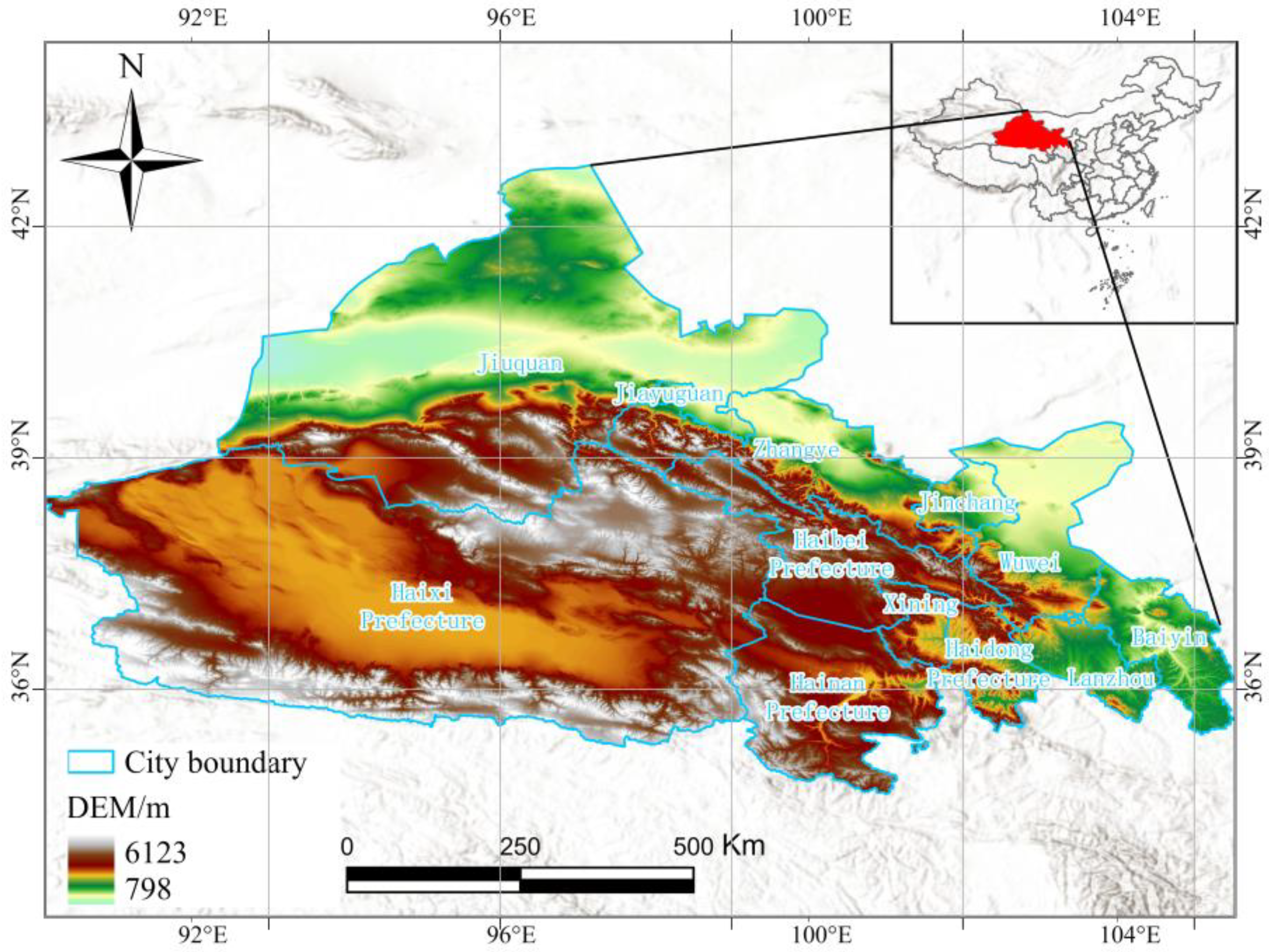
The Qilian Mountains (36–40° N, 93–104° E) are located in the central part of northwest China, deep inland, and distant from the ocean. They lie at the junction of the Qinghai–Tibet Plateau, Inner Mongolia Plateau, and Loess Plateau [24]. The Qilian Mountains have a west-high and east-low topography with a northwest–southeast orientation. They are crucial water sources for the Hexi inland rivers, Qinghai inland water systems, and the upper reaches of the Yellow River [25]. The climate is a typical continental, alpine semi-humid mountain climate, with an annual average temperature below 4 °C, annual sunshine duration of 1744 h, and annual precipitation ranging between 300 and 900 mm, distributed unevenly across the region. Precipitation was primarily concentrated from June to September [24], with a distinct westward decrease. The eastern part receives more precipitation and higher temperatures. Meanwhile, the western part receives less precipitation and lower temperatures [13]. The study area encompasses most administrative regions within the Qilian Mountains, spanning Gansu and Qinghai provinces. This includes Haixi Mongol and Tibetan Autonomous Prefecture, hereafter Haixi Prefecture, Haibei Tibetan Autonomous Prefecture, hereafter Haibei Prefecture, Hainan Tibetan Autonomous Prefecture, hereafter Hainan Prefecture, Xining City, Haidong City, Lanzhou City, Baiyin City, Wuwei City, Jinchang City, Zhangye City, Jia Yuguan City, and Jiu Quan City (Figure 1), with elevations ranging from approximately 1100 to 5800 m [9]. The study area features complex topography and diverse vegetation types, including grasslands, forests, deserts, and cultivated land [25].
Figure 1.
Location map of study area. Produced from the StandardMap (Approval No.: GS(2024)0650) issued by the Standard Map Service website of the Ministry of Natural Resources. No modification has been made to the base map boundaries.
2.2. Methods and Data Sources
2.2.1. Conceptual Framework and Research Workflow
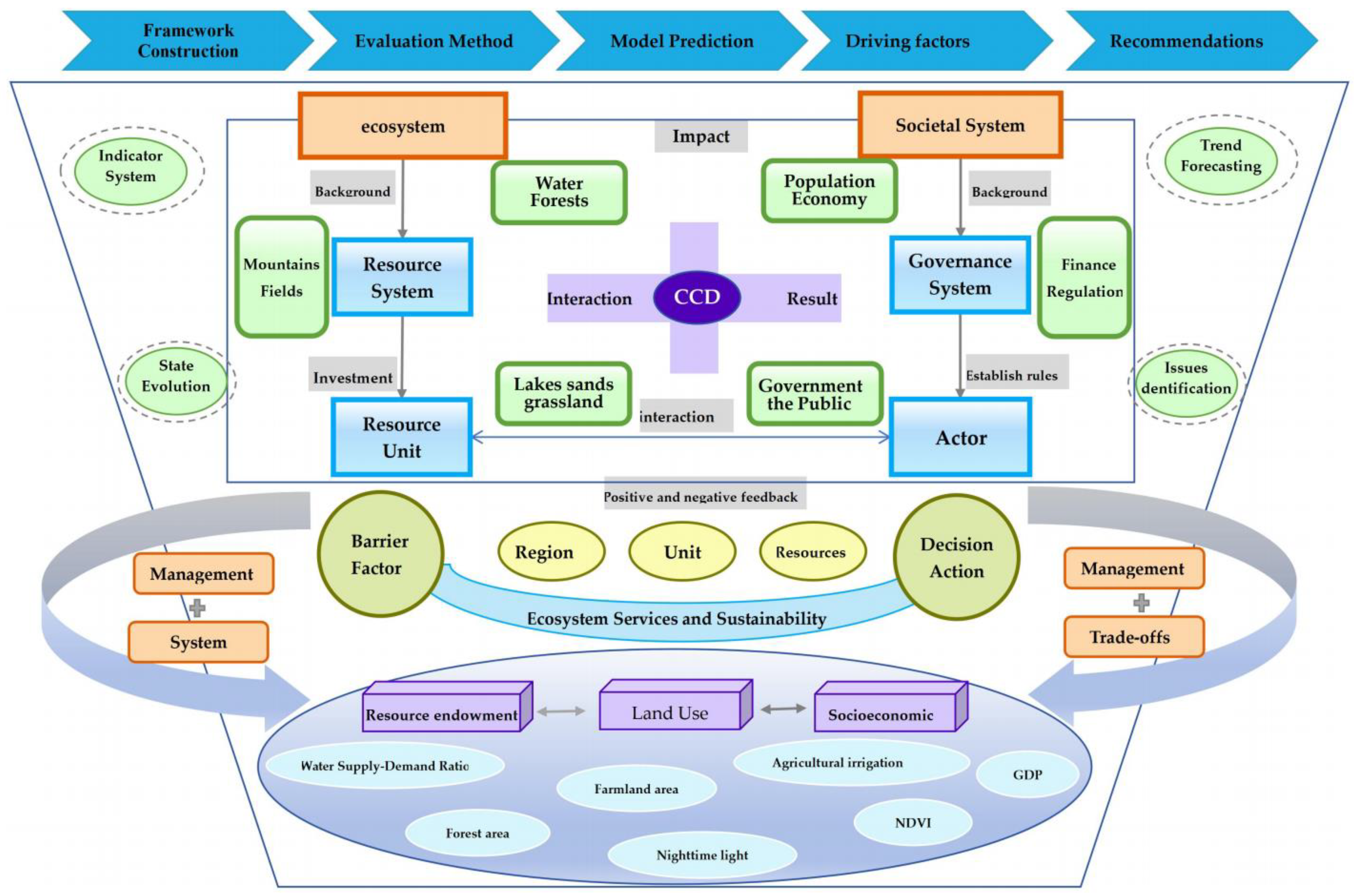
This study is grounded in SES theory [20,26], which posits that social and ecological systems are interdependent, co-evolving complexes. Integrating the life community into the socioecological systems analysis framework (Figure 2), water and forests constitute the critical ecosystems that underpin the survival of resource units. As resource systems, mountains and fields generate and support resource units such as lakes, grasslands, and sands [26]. These units are influenced by the system state and, in turn, constrain the provisioning of services and the sustainability of the system. The core dynamics of this coupled system involve feedback loops: ecological conditions support or constrain social development (e.g., water availability limits agriculture), while social actions (e.g., policies, economic activities) drive ecological change (e.g., land use change, pollution).
Figure 2.
Conceptual framework and research workflow of study.
2.2.2. Socio-Ecosystem Assessment Indicator System
Building on the SES framework, we selected 12 cities in the Qilian Mountains and adjacent areas as decision units. Using panel data from 2000 to 2023, 26 indicators were chosen to characterize the “life community” subsystems (mountains, waters, forests, farmlands, lakes, grasslands, deserts) and the social subsystems (social, governance, actors), as detailed in Table 1. Justification of Indicator Selection: Indicators were selected to capture key structures, processes, and services of each subsystem within the SES framework [26]. Within the ecological subsystem, “water” was represented by availability (X1), efficiency (X2), and pressure (X3); “forests” by coverage (X4), economic value (X5), and resource demand (X6). Within the recourse subsystem, “mountains” were characterized by terrain complexity (X7), water yield coefficient (X8), and tertiary industry economic output (X9); “farmland” by area (X10), resource demand (X11), and economic output value (X12). Within the resource unite subsystem, “lakes” were characterized by surface water resources (X13), wetland ecosystem area (X14), and economic output value of aquatic resources (X15); “grasslands” by area (X16), vegetation coverage (X17), and economic output value (X18); “sands” by land degradation or inefficient use (X19) and climatic aridity (X20). At the system level, social system characteristics were reflected by regional economic development level (X21) and population pressure per unit land area (X22); Governance systems were reflected through government investment intensity (X23) and regional economic development potential (X24); Actors were represented by human activity intensity, indirect energy consumption, and carbon emission levels (X25), as well as the priority of ecological demands in water resource allocation (X26). This selection aimed to provide a multidimensional representation of the complex SES.
Table 1.
Socio-Ecosystem Assessment Indicator System.
2.2.3. Calculation of Integrated Assessment Index for Socio-Ecosystem and Subsystems
The comprehensive assessment index was calculated using the entropy-weighted method, which objectively assigns weights based on the information content of each indicator. The complete computational procedure is as follows:
- (1)
- Standardization: Raw data matrix for years (24) and indicators (26) was normalized to eliminate dimensional differences.where is the standardized value, xij is the original value, and a and b denote the lower (fixed at 0) and upper (fixed at 1) bounds of the normalization spectrum, respectively. Furthermore, min () and max () are the minimum and maximum values of factor quantification, respectively. For negative indicators, the normalized value should be deducted from the set normalized upper limit during computation.
- (2)
- Entropy Calculation: The information entropy for each indicator was calculated.
- (3)
- Weight Determination: The weight for each indicator was derived from its entropy.
- (4)
- Comprehensive Index Calculation: The comprehensive assessment index for each year was calculated.
2.2.4. Multi-System Coupling Coordination Model
Based on the assessment indices for the subsystem and system layers, the coupling coordination degree model calculates the coupling coordination degree between the systems. This describes the degree of harmony between the subsystem and system layers [27]. Integrating prior research findings and regional particularities, we classified the socioecological system coupling coordination in the Qilian Mountains into four tiers: extremely uncoordinated (0–0.3), low coordination (0.3–0.4), moderate coordination (0.4–0.5), high coordination (0.5–0.8), and extremely coordinated (0.8–1). The coupling coordination degree model was calculated as follows:
2.2.5. Obstruction Degree Model
In this study, we used the barrier model to analyze the key factors influencing the degree of coupling coordination of biocommunities. The formula for this calculation is as follows:
- (1)
- Factor contribution:
Here, indicates the impact of a single factor, represents the stratification weight.
- (2)
- Index deviation:
Here, represents the gap between a single factor and the goal.
- (3)
- Barrier degree:
Here, indicates the impact of a single factor.
2.2.6. GM(1,1) Grey Prediction Model
Grey system theory defines grey derivatives and grey differential equations based on concepts such as correlation space and smooth discrete functions positioned between black. The GM(1,1) model is effective for short-term forecasting with limited data. It is suitable for systems with uncertain or incomplete information (“grey” systems) [28,29], The modelling steps are as follows.
- (1)
- Establish the original system sequence:where n is the number of data points (11 years, 2013–2023).X(0) = [x(0)(1), x(0)(2), …, x(0)n],
- (2)
- Accumulated Generating Operation (AGO):where x(1)(k) = ;X(1) = [x(1)(1), x(1)(2), …, x(1)n],
- (3)
- Mean Sequence: The mean sequence Z(1) of X(1) is generated:where Z(1)(k) = ;Z(1) = [z(1)(2), z(1)(3), …, z(1)n],
- (4)
- Grey Differential Equation: The basic form of the GM(1,1) model is x0(k) + az1(k) = a, +
- (5)
- Parameter Estimation: The parameters aa and bb are estimated using the least squares method: â = [a,b]T = (BT × B)−1 × BTY, where
- (6)
- Establish the first-order cumulative time–response sequence prediction, as follows:
x(1)(t) = (x(1) − b/a) exp(−a(t − 1)) + b/a
- (7)
- Calculate the predicted value, as follows:
- (8)
- Model Validation: The prediction accuracy was rigorously checked using three common metrics in grey system theory [28,29]:
Posterior Variance Ratio (C) , where S1 is the standard deviation of the original sequence X(0), and S2 is the standard deviation of the residual errors ϵ(k) = x(0)(k) − (0)(k). Model accuracy is considered excellent if C < 0.35, eligible if C < 0.65, and unqualified if C > 0.65.
Small Error Probability (P): . Model accuracy is considered excellent if p > 0.95, eligible if p > 0.70, and unqualified if C < 0.70.
2.2.7. Data Sources and Processing
The data sources required for this study include: (1) X1, X2, X3, X5, X6, X8, X9, X11, X12, X13, X15, X18, X20 (precipitation), X21, X22, X23, X24, and X26, which were sourced from the Statistical Yearbooks of Gansu Province, Qinghai Province, and their respective cities, as well as the Gansu Provincial Water Resources Bulletin and Qinghai Provincial Water Resources Bulletin. Partially missing data were imputed using a time-series trend extrapolation method. (2) Land use data for forestland, grassland, farmland, water bodies, wetlands, and bare land were sourced from the Resource and Environment Science Data Center of the Chinese Academy of Sciences (http://www.resdc.cn (accessed on 28 July 2024)). Potential evapotranspiration data were obtained from the National Qinghai–Tibet Plateau Science Data Centre (https://data.tpdc.ac.cn (accessed on 18 April 2024)), with a spatial resolution of 1 km. (3) The NDVI was derived from NASA’s regularly released MOD13A3 dataset (https://www.earthdata.nasa.gov/ (accessed on 10 August 2024)). Based on monthly NDVI grid data for each of the 12 months in a year, the maximum value from each of the 12 months is selected to obtain annual NDVI data for the years 2000–2023. (4) Average terrain elevation was based on the processing of the 2022 Copernicus 30 m resolution Digital Elevation Model (DEM). Using the 2024 municipal administrative division Shp data (approval No.: GS(2024)0650) released by the National Geographic Information Public Service Platform (Tianditu), the grid values within each municipality were averaged to obtain the average undulation data. (5) The nighttime light index uses corrected China-wide DMSP-OLS-like data from 1992 to 2023, with a spatial resolution of 1 km, derived from integrating DMSP-OLS and SNPP-VIIRS data. The calibration method employs the “pseudo-invariant pixel” approach for DMSP-OLS data. Given the temporal resolution consistency between DMSP-OLS and SNPP-VIIRS data, missing values in the raw monthly SNPP-VIIRS data were imputed prior to synthesizing the annual SNPP-VIIRS data. To ensure data consistency and comparability, all spatial data have been resampled to a 1 km resolution using the nearest neighbour algorithm.
3. Results and Analysis
3.1. Spatiotemporal Variations in Life Community and Subsystem Assessment Indices
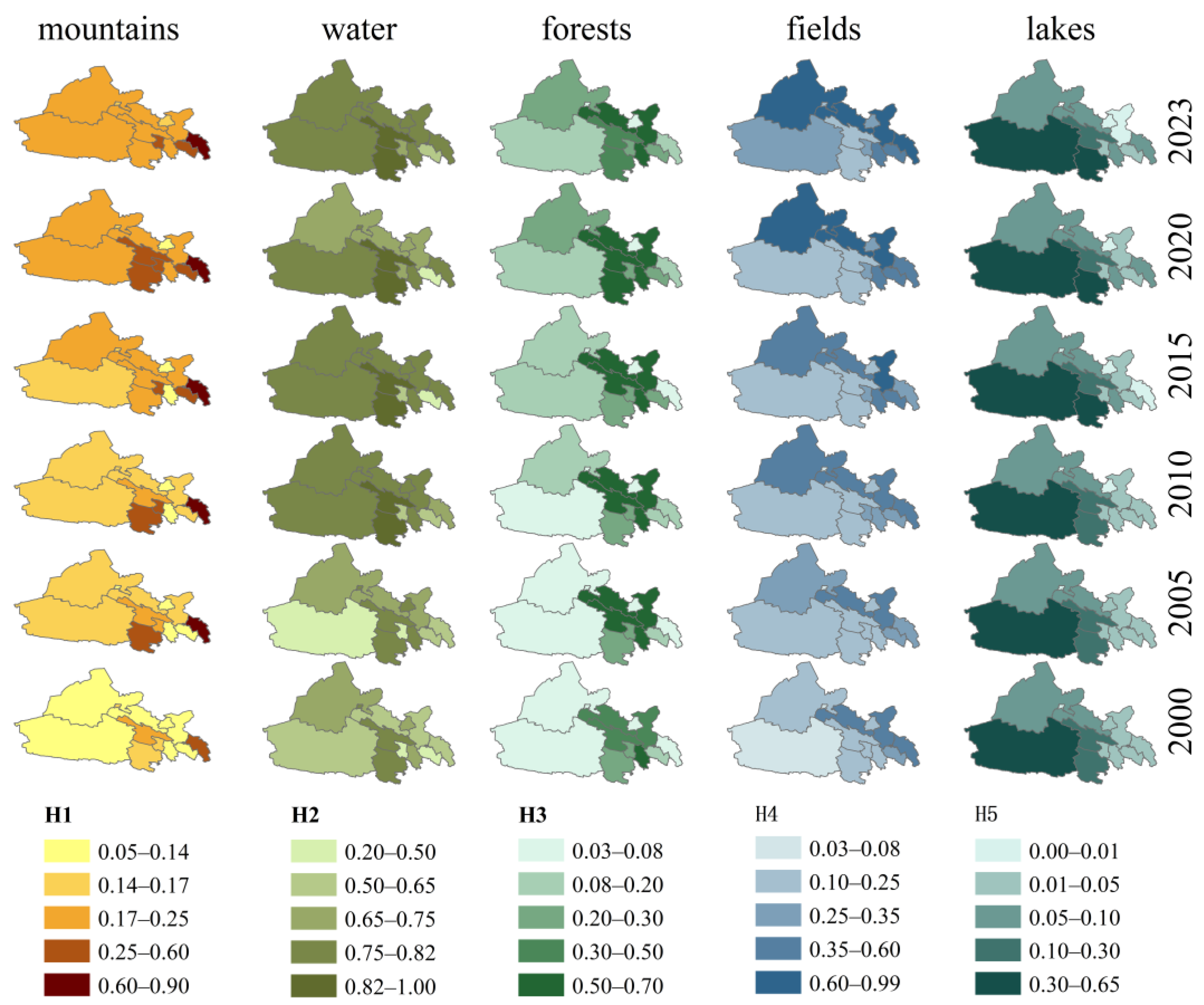
Based on the SES framework and a comprehensive evaluation model, the changes in the composite indices for the socioecological system and its subsystem assessment indicators in the Qilian Mountains and adjacent areas are shown in Figure 3. From 2000 to 2023, the assessment indices for the mountain, forest, farmland, and grassland subsystems, as well as the social system, showed steady increases. Meanwhile, the water, lake, and sand subsystems, along with the governance and actor systems, exhibited slight fluctuations with minor upward trends. Spatially, significant regional variations emerged across subsystems: the mountain subsystem remained highest in Baiyin, with gradual improvements in Lanzhou and Xining, while Jinchang and Haidong recorded lower values. The water subsystem index has consistently improved in eastern regions such as Baiyin, Xining, and Haidong, while in Haibei and Hainan it initially rose before declining, with Haibei maintaining a persistently high level. The area from Jiuquan to Lanzhou experienced a “rise–fall–rise” fluctuation, with Lanzhou maintaining an overall high index. The forest subsystem has consistently led in Haidong, remained low in Jiayuguan and Jinchang, and shown annual increases in Jiuquan, Zhangye, and Lanzhou. The field subsystem consistently registered the lowest values in Jiayuguan, while northern regions such as Jiuquan, Zhangye, and Wuwei showed higher values. Eastern areas including Lanzhou, Baiyin, and Haidong demonstrated significant growth. The lake subsystem exhibited high-value zones in southern foothill regions such as Hainan, Haixi, and Haibei, while low-value clusters were concentrated in the central-western foothills stretching from Jiuquan to Wuwei.
Figure 3.
Spatial distribution of the mountains, water, forests, fields, and lakes subsystem in 2000, 2005, 2010, 2015, 2020, and 2023.
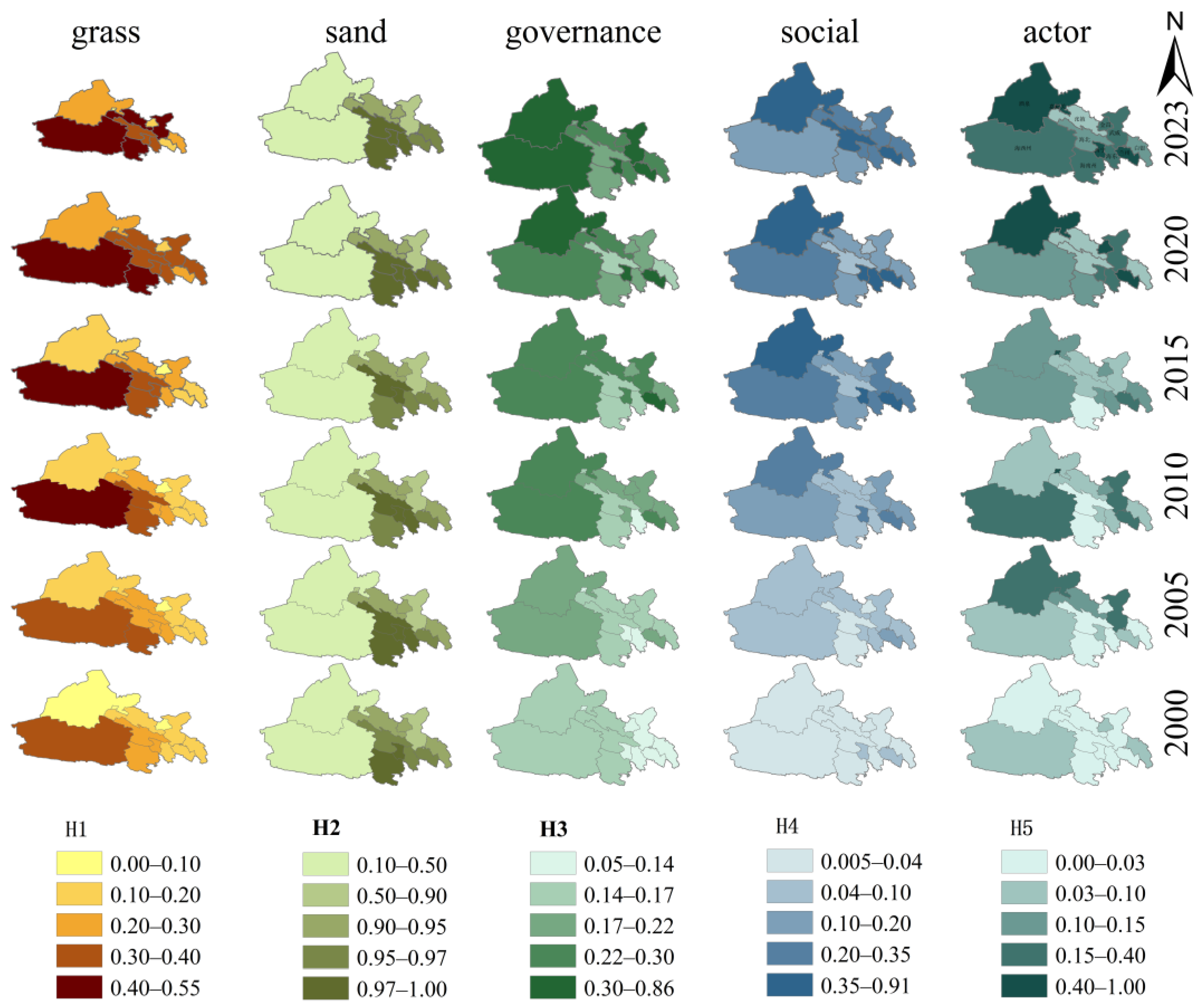
Changes in the assessment indices for the grassland and sand subsystems, and the social, governance, and action subsystems in the study area are shown in Figure 4. The grassland ecosystem showed annual increases across all regions except Lanzhou and Baiyin, which initially rose before slightly declining. High-value areas were concentrated in the southern Qilian Mountains. In the sandy ecosystem, indices fluctuated across cities and prefectures, with lower values in the west and higher values in the southeast. The Social System index improved across all regions, with significant increases in Lanzhou and Xining, pushing them into the high-value range. The Governance System continued to rise in Jiuquan, Jiayuguan, Zhangye, Lanzhou, Haibei, and Hainan, with Lanzhou consistently maintaining the highest level. Xining and Haidong experienced initial increases followed by declines, while Jinchang, Wuwei, Baiyin, and Haixi exhibited fluctuating patterns of “increase-decrease-increase”. The Actor System showed annual growth in Jiayuguan, Haixi, Haibei, and Hainan; Jinchang, Lanzhou, and Haidong experienced initial increases followed by declines; while Jiuquan, Zhangye, and Haixi exhibited a “rise–fall–rise” trend.
Figure 4.
Spatial distribution of grass and sand subsystems and governance, social, actor systems, 2000–2023.
3.2. Analysis of Coupling Coordination Between Society and Ecosystem
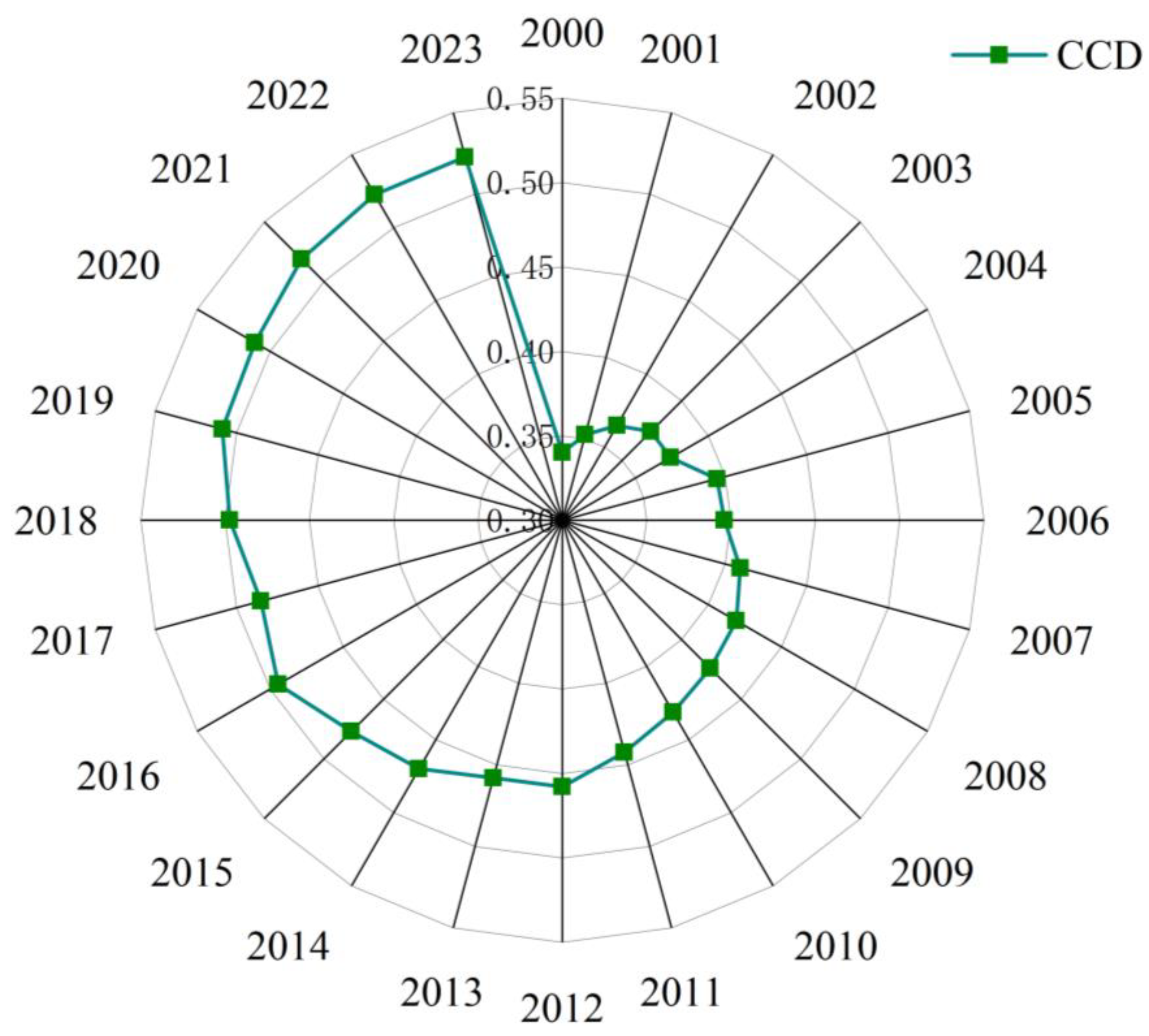
A coupling coordination index model was used to calculate the coupling coordination levels among systems in the Qilian Mountains and adjacent cities. The annual average coupling coordination index for each of the 12 cities reflects each city’s agricultural coupling coordination level. Figure 5 shows the coupling coordination results for the Qilian Mountain Life Community from 2000 to 2023. From a temporal perspective, the degree of coupling coordination between the mountain, water, forest, farmland, lake, grassland, and sand subsystems, and the social, governance, and actor systems in the Qilian Mountains and adjacent areas showed a general increasing trend. It rose from 0.340 in 2000 to 0.523 in 2023, corresponding to a 53.7% increase and suggesting a transition from the low-coordination stage to the high-coordination stage. This trend suggests a potential shift from mutual constraints toward mutual promotion between the social and ecological subsystems over the study period.
Figure 5.
CCD in the Qilian Mountain Life Community, 2000–2023.
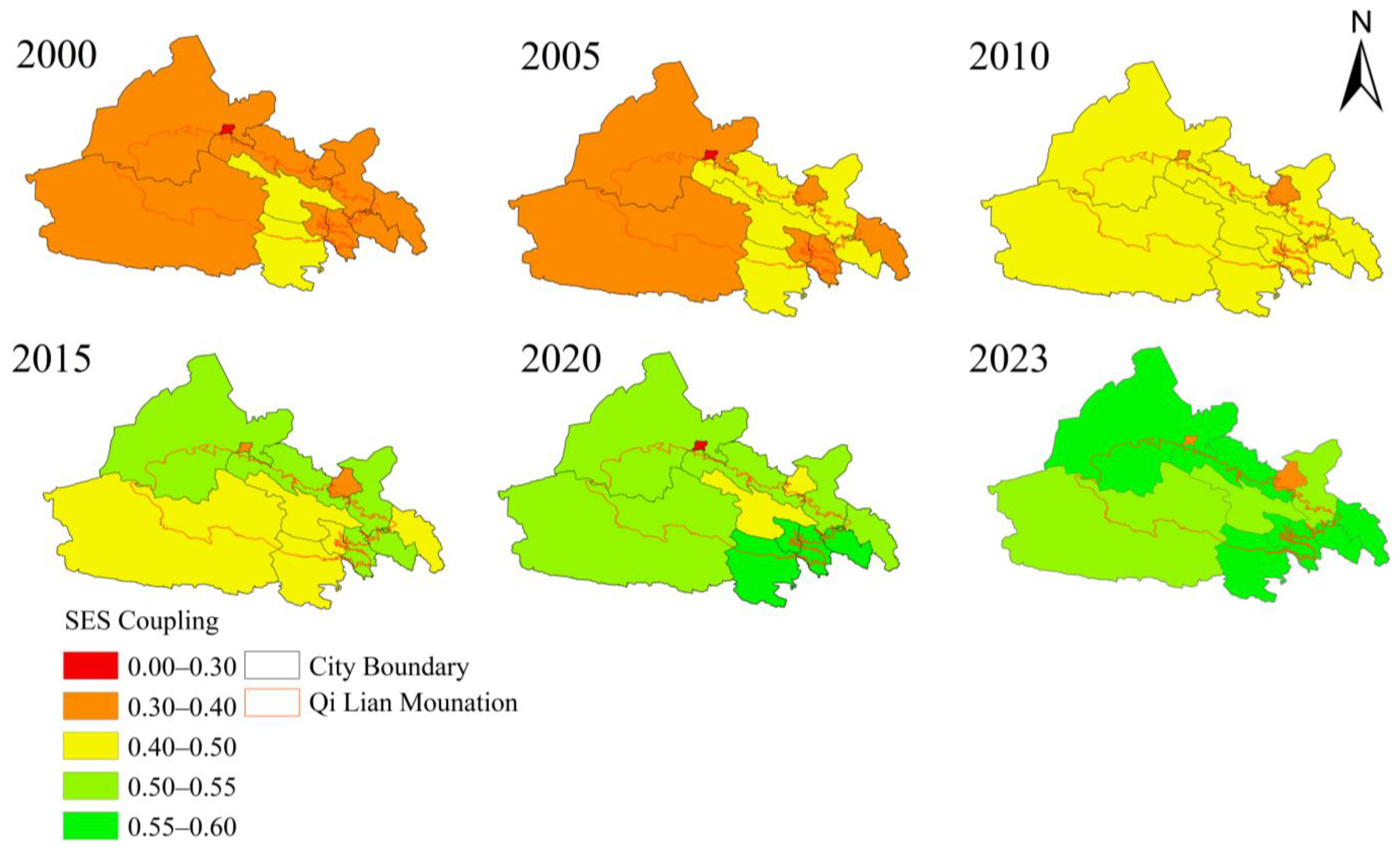
From a regional perspective (Figure 6), by 2023, all cities (prefectures) except Jiayuguan (0.303) and Jinchang (0.392) had achieved coupling coordination levels exceeding 0.500, reaching a high coordination stage. This reflects the overall effectiveness of collaborative governance within the Qilian Mountain Life Community, while Jiayuguan and Jinchang still exhibit internal constraints between systems. From a temporal evolutionary perspective, most regions underwent a gradual transition from low to high coordination, though the timing of reaching the high coordination stage varied. Zhangye, Wuwei, and Lanzhou were the earliest to achieve high coordination in 2012, followed by Haidong and Haixi in 2014. Jiuquan, Xining, and Baiyin achieved high coordination in 2015, 2016, and 2019. Hainan and Haibei Prefectures progressed steadily from moderate to high coordination. Hainan Prefecture reached the high-coordination stage in 2016, whereas Haibei Prefecture only entered it in 2022.
Figure 6.
Spatial distribution of SES coupling, 2000–2023.
3.3. Barrier Factor Analysis
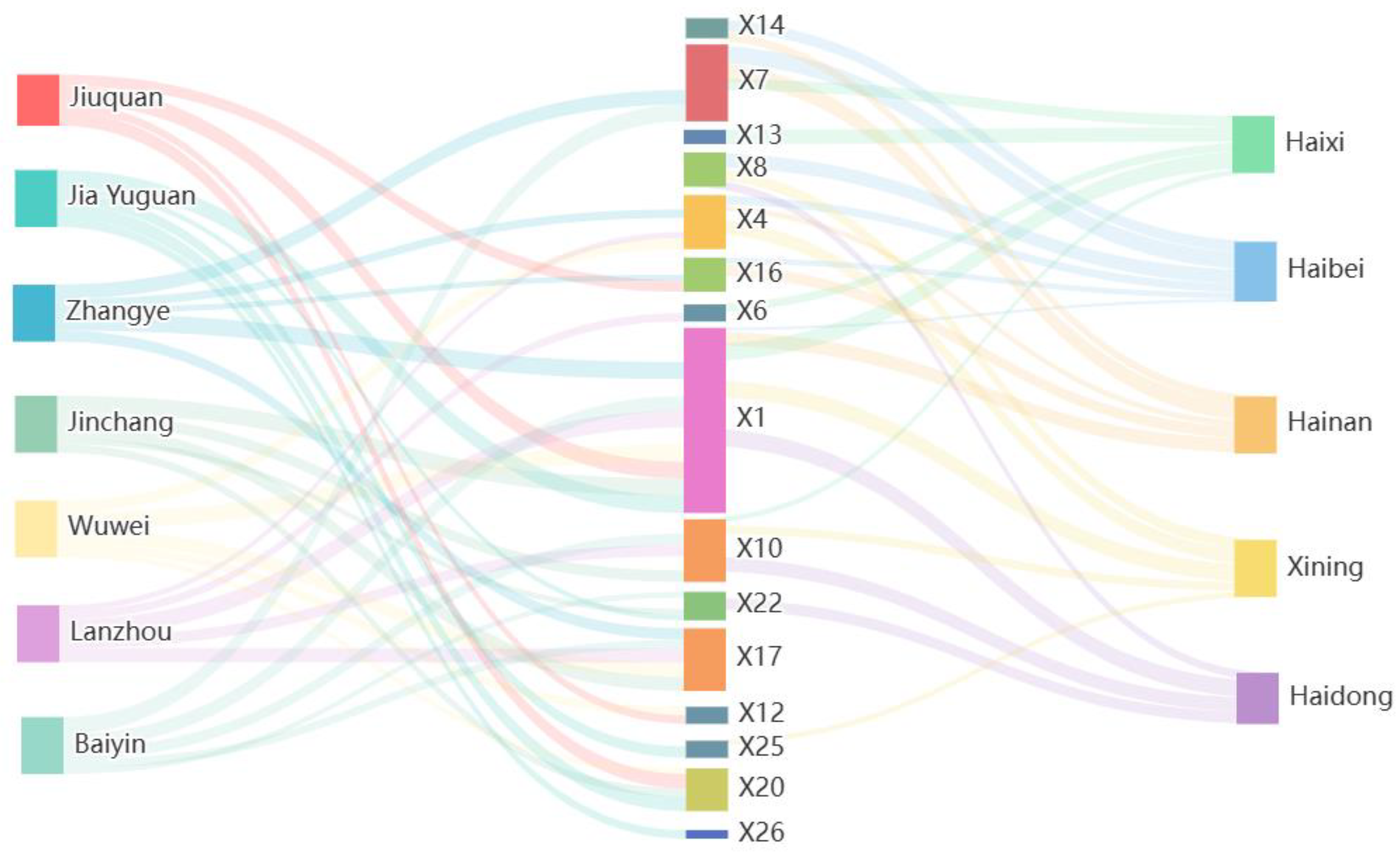
To identify the CCD’s key factors influencing the CCD of the Qilian Mountain life community, we used a barrier degree model to diagnose the primary variables. At the system level, the subsystems primarily influencing the CCD were water (16.51%), farmland (14.16%), grassland (14.03%), mountains (12.10%), and forests (11.16%) (Table 2). At the indicator level, key limiting factors included water supply–demand ratio (9.68%), NDVI (6.34%), farmland area (5.81%), and average terrain relief (5.61%) (Table 2). Regarding city-specific obstacle degrees (Figure 7), the key constraints differed by region. The Gansu region is primarily characterized by water scarcity (X1) and agricultural pressure (X10, X11). Jiuquan City’s primary obstacles are the X1 (8.89%), X10 (7.60%), X20 (6.63%), and X16 (6.54%). Jiayuguan City are X1 (17.34%), X20 (15.09%), X25 (14.58%), and X26 (11.7%). The barrier factors for CCD in Zhangye City were the X1 (7.39%), X7 (7.35%), X17 (7.25%), and X11 (6.74%). The limiting factors affecting Jinchang City were the X1 (11.30%), X17 (10.67%), X10 (9.81%), and X20 (7.85%). The limiting factors in Wuwei City were the (8.27%), X17 (7.76%), X11 (8.19%), and X4 (7.47%). The limiting factors for Lanzhou City were the X1 (7.62%), X17 (7.38%), X10 (7.32%), and X6 (6.64%). The barrier factors for Baiyin City’s CCD include X7 (8.78%), X1 (8.82%), X10 (7.82%), and X17 (7.73%). The Qinghai region is primarily constrained by the combined effects of water scarcity (X1), rugged terrain (X7), and the condition of its soil and water conservation ecosystems (X8, X4, X14). The factors affecting Xining City were the X1 (8.74%), X4 (8.28%), water yield modulus (8.25%), and X10 (7.80%). Haidong City’s barrier factors were the X1 (9.46%), X10 (9.43%), X22 (9.38%), and X8 (8.66%). The constraint factors for Haibei Prefecture’s CCD were the X7 (10.57%), X8 (10.31%), X14 (10.03%), and X4 (9.48%). The constraint factors for Hainan Prefecture were the X7 (9.56%), X1 (9.54%), X14 (9.33%), and X4 (9.17%). The constraint factors for CCD in Haixi Prefecture were the X1 (9.97%), X13 (9.28%), X7 (7.60%). Analysis of constraint factors indicated that the coupling coordination degree of the Qilian Mountains and municipal ecosystems was primarily influenced by natural resource distribution and agricultural–forestry water allocation.
Table 2.
Barrier Levels and Ranking of Evaluation Indicators.
Figure 7.
Degree of Constraint Factors by City.
3.4. GM Model Prediction
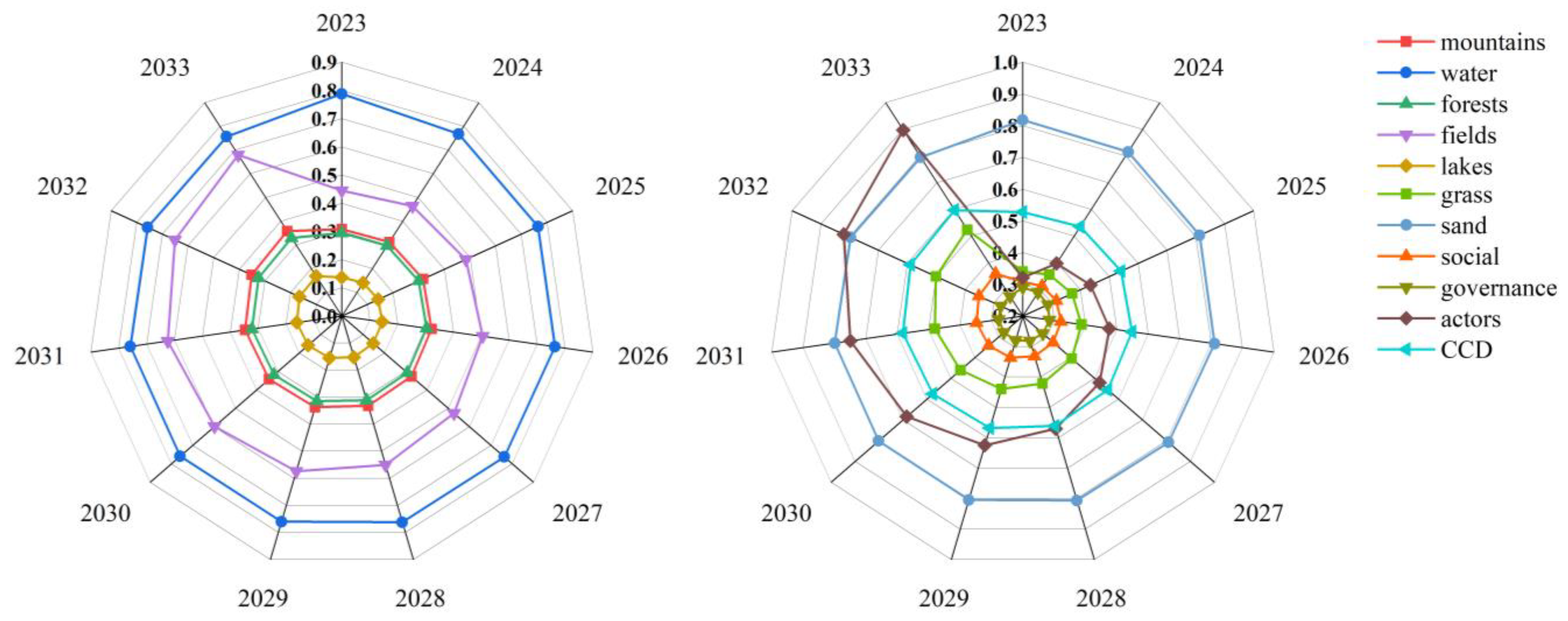
To better understand the future development trends of socioecological systems and their subsystem assessment indices, we assumed that the comprehensive assessment trends for the mountains, waters, forests, fields, lakes, grasslands, and sand subsystems, as well as the social, governance, and actor systems in the Qilian Mountains and adjacent areas, will follow the same trajectory as that observed from 2013 to 2023. Therefore, the average values of the mountain, water, forest, farmland, lake, grassland, and sand subsystems, along with the social, governance, and actor systems across the 12 cities from 2013 to 2023, were selected as the original data. The GM(1,1) grey prediction model was used to simulate and forecast composite standards for the next decade. The results are presented in Figure 8. The prediction models for all indices passed the accuracy checks (Table 3). The average relative error ranged from 0.69% to 7.35%. The coefficient of variance (C) ranged from 0.03 to 0.19, and the probability of small error (P) ranged from 0.73 to 1.00. This confirms the model’s applicability for short-term trend projection under stable development conditions. Based on the grey correlation model prediction (Figure 8), the evaluation indices of the mountain, forest, lake subsystems, and social system are projected to exhibit a slight upward trend from 2024 to 2033. Their respective index ranges are 0.312–0.358, 0.297–0.329, 0.140–0.168, and 0.312–0.358. The assessment indices for the farmland and grassland subsystems and the action system are predicted to display a more pronounced upward trend, with index ranges of 0.464–0.679, 0.355–0.523, and 0.397–0.897, respectively. Meanwhile, the water, sand, and governance subsystems showed slight downward trends, with index ranges projected at 0.767–0.756, 0.815–0.795, and 0.288–0.274, respectively. The CCD index of the SES is predicted to increase slightly, rising from 0.535 to 0.597, suggesting a potential state of high coordination, though it appears to remain considerably distant from reaching a level of extreme coordination.
Figure 8.
Simulation of Coupling Coordination Degree in Social-Ecological Systems and Evaluation Indices of Their Subsystems, 2023–2033.
Table 3.
System GM(1,1) Model Test Values table.
4. Discussion
4.1. Systems Spatiotemporal Patterns
Subsystems within the Qilian Mountain biogeographic community exhibited significant spatial differentiation. Their distribution was strongly coupled with natural geography and human activities. The warm and humid southeast-cold and dry northwest distribution of hydrological resources represents the two most critical controlling factors driving the evolution of the mountain–oasis–desert coupled system [30,31]. Precipitation and glacial meltwater determine water resources and wetland distribution, influencing suitable zones for vegetation and agriculture [22]. As a key manifestation of material and energy exchange between humans and Earth, land use change dictates the overall status and spatial variation of ecosystem service functions [32]. Forested areas in the Qilian Mountains are primarily distributed in the southeastern Qilian Mountains, the Lenglong Ridge, the Wushiao Ridge, and along the Tole and Desert rivers. Grasslands were concentrated in patches on the southern slopes. Meanwhile, deserts and alpine deserts were found in the west. Cultivated land is mainly located in the central Hexi Corridor and the plains north of Lenglong Ridge [10,33]. Based on the irrigation agricultural infrastructure in the Heihe and Shiyanghe River basins, intensive human development has formed contiguous high-yield farmlands in the Hexi Corridor.
High concentrations of population, economic activity (high GDP), fiscal capacity (annual fiscal expenditure), and infrastructure (high nighttime light index) have led to the clustering of high-value social and governance systems in the provincial capital metropolitan areas at both ends of the Qilian Mountains. High-value actor systems were concentrated in Jiayuguan City in the northwest. Urbanization and industrialization have driven high-value regional economic centres such as Lanzhou and Xining. Urbanization and industrialization invigorate urban socioeconomic development [34], establish well-organized community structures, and enhance governance efficiency through technology [35] but also provide sustained momentum for rural revitalisation. This facilitates the transfer of core development factors, such as talent, capital, and technology to rural areas, promoting the organic integration of new urbanization and rural revitalisation strategies [36]. However, accelerated industrialization has triggered soaring energy consumption and various environmental challenges, including sharp increases in carbon emissions [37], water stress, and pollution [38,39].
4.2. SES Coordination Trends
From 2000 to 2023, the CCD of SES in the Qilian Mountains and adjacent areas showed a steady upward trend, reaching a highly coordinated stage by 2023. This reflects continuously enhanced synergistic development between the two systems and an increasingly close coupling relationship. The upward trend in the Qilian Mountains CCD aligns with findings from the Qinghai–Tibet Plateau [40] and the Yellow River Basin [41]. These studies indicate that environmental and economic coordination improves following the implementation of robust conservation policies and sustainable development initiatives [42]. With the introduction of the “community of life” concept and the establishment of the Qilian Mountain National Park, policy drivers have systematically strengthened ecological conservation and restoration efforts [43,44]. Second, continuous improvement in governance capabilities. Large-scale ecological projects such as the Three-North Shelterbelt Program and the Grain-for-Green Program have effectively enhanced regional ecological environment quality, further strengthening ecosystem stability and service functions [44,45]. Third, economic restructuring and the advancement of new-type urbanization have promoted resource utilization efficiency [34,35], enhancing the socio-economic system’s adaptability to ecological and environmental changes [46]. The continuous increase in CCD values indicates that the developmental gap between the social and ecological subsystems is narrowing, with their interactive relationship showing improvement. However, owing the mathematical characteristics of the model and the standardization process, the rise in CCD values does not necessarily imply that either subsystem has independently reached an optimal state.
By 2023, collaborative governance of the Qilian Mountain Life Community appeared to have achieved notable results. The CCD values of all eight involved cities (Jiuquan, Zhangye, Wuwei, Lanzhou, Baiyin, Xining, Haidong, and Haixi) were recorded above 0.500, suggesting that integrated management of biological communities may have yielded positive outcomes in most areas. It is possible that a positive feedback effect had been established between socioeconomic development and ecological conservation [36]. Jiuquan, Zhangye, Wuwei, Lanzhou, Baiyin, Xining, Haidong, and Haixi underwent complete progression from low-to moderate to high coordination, reflecting a gradually deepening and advancing process of synergistic governance. Hainan Prefecture and Haibei Prefecture advanced directly from moderate to high coordination (Hainan in 2016; Haibei in 2022), indicating relatively high starting points and smoother development trajectories. The lagging performance of Jiayuguan (0.303) and Jinchang (0.392) cities (0.303) highlights regional development disparities. Jiayuguan, a rapidly urbanizing area, has driven growth in its socioeconomic subsystem through its core steel production industry, accompanied by substantial water demand and environmental pressures [47]. As a proxy indicator of the urbanization and industrialization intensity, the nighttime light index has a close linear relationship with carbon emissions [48,49]. The high barrier level of Jiayuguan City in the nighttime light index (Figure 7) indicates that carbon emissions resulting from intense urban or industrial activities exert considerable pressure on resources and environmental systems. The nonferrous metals industry plays a vital role in Jinchang’s economic development. Its production processes, particularly smelting and processing operations, require substantial amounts of cooling water, washing water, and process water. The resulting wastewater contains pollutants such as heavy metals and acidic/alkaline substances, posing significant challenges to local water supply and wastewater treatment and reuse systems [50].
The GM(1,1) grey prediction model indicated that over the next decade, the assessment indices for the cropland and grassland subsystems and the action system will increase rapidly. Meanwhile, the socioecological system CCD and the mountain, forest, lake, and social indices will increase slightly. The synergistic enhancement of vegetation restoration and action management further strengthened the coupled relationships among the subsystems. The obstacle model (Table 2) indicated that water, farmland, and grassland were the primary subsystems constraining the CCD. The land use in the Qilian Mountains is dominated by grasslands, forests, farmland, and water bodies [10,33]. The NDVI exhibits an overall positive correlation with water yield, with stronger correlations in the low-vegetation-cover areas of Northwest China. This suggests that vegetation changes have a greater impact on the hydrological cycle in ecologically fragile regions [45]. The implementation of modern water-saving ecological irrigation districts coupled with scientific planning and management measures, including efficient water conservation, irrigation area reduction, crop structure adjustment, and water source substitution, has promoted precise agricultural water allocation and enhanced water and soil resource use efficiency [51,52].
It should be noted that while the GM(1,1) model is methodologically suitable for historical data patterns, it should be regarded as an extension of current trends rather than a deterministic future. Social ecosystems remain vulnerable to nonlinear shifts, climate shocks, and policy adjustments—factors not captured by the model. While projections indicate an improved CCD value of 0.597, significant optimization potential persists, underscoring the long-term and complex nature of achieving highly coordinated development. The unpredictability and complexity of policy and climate factors impose significant constraints on GM(1,1) projections. To more realistically assess uncertainty, we introduce two qualitative scenarios alongside quantitative model projections: Pessimistic Scenario: Climate change leads to more frequent and intense droughts and heatwaves, potentially drastically reducing water yield (X8) and river runoff (X13) while exacerbating water scarcity (X1). This could halt or even reverse CCD growth (particularly in the Hexi Corridor), overturning the optimistic projection of gradual improvement. Optimistic Scenario: Implementing robust policy interventions—such as large-scale investments in water-saving infrastructure, strict enforcement of industrial water quotas, and the establishment of water conservation-focused ecological compensation mechanisms—could overcome the bottleneck path illustrated in Figure 8. This would likely enable the projected improvement in CCD.
4.3. Analysis of Barriers to Socio-Ecosystem Development
Barrier analysis indicates key bottlenecks constraining CCD enhancement across cities, whose causes are closely tied to core socio-ecosystem elements. Water supply–demand conflicts rank among the primary barriers hindering CCD improvement in 14 cities. The Qilian Mountains lie within arid and semi-arid zones and are characterized by limited water resources and uneven spatiotemporal distribution. Rapid socioeconomic development has driven a surge in water demand, and climate change may exacerbate water resource uncertainty [39]. Water scarcity directly constrains ecological water use, agricultural production, and vegetation restoration, making it the greatest bottleneck for coordinated system development [53]. In other studies of the Qinghai–Tibet Plateau, water resource indicators—such as freshwater reserves and water conservation measures—are intrinsically linked to functional services like soil and water conservation and carbon sequestration. The interactions among these elements collectively drive synergies and trade-offs among regional ecosystem services [54]. This is the fundamental reason that Jiayuguan and Jinchang have long remained poorly coordinated. Agricultural land area was the primary constraint in Jiuquan (7.60%), Jinchang (9.81%), Lanzhou (7.32%), Baiyin (7.82%), Xining (7.80%), and Haidong (9.43%). This reflects the pressure on ecosystems from agricultural expansion or the inefficient use of existing farmland. The growing demand for water-intensive crops and the expansion of irrigated farmlands in arid regions will directly lead to negative ecological impacts due to water depletion [55]. Agricultural irrigation water consumption was also an obstacle for Wuwei (8.19%) and Zhangye (6.74%). The Hexi Oasis is dominated by irrigated farmland. Here, irrigation water accounts for over 95% of the agricultural water use [51], exacerbating the supply–demand imbalance. Changes in forest and water areas were the primary drivers of the CCD increase in Haibei and Hainan. Meanwhile, the water production modulus also influenced CCD growth in Xining (8.25%), Haidong (8.66%), and Haibei (10.31%). The conservation, restoration, and sustainable use of forests, grasslands, lakes, and wetlands are important for water conservation and biodiversity preservation in the plateau regions [56,57]. Factors such as fluctuations in total water resources under climate change and the impact of permafrost degradation on runoff [58,59] are crucial for sustaining ecosystem services and for coordinating efforts on the Qinghai–Tibet Plateau.
Comparing the limiting factors for CCD development between the Gansu and Qinghai sections of the Qilian Mountains, the most critical constraints in the core area of the Hexi Corridor are the water supply–demand ratio and aridity, compounded by the extent of farmland and the pressure on agricultural irrigation water pressure. Zhangye, Wuwei, and Lanzhou achieved high coordination earlier by implementing more effective measures in water resource management, such as Heihe River Basin governance, adjusting agricultural cropping patterns, and prioritizing efficient water-saving technologies such as drip irrigation, sprinkler irrigation, and micro-irrigation, and advancing ecological conservation [51]. The Qinghai Region has several limitations. While the water supply–demand ratio remains a common constraint, the impacts of terrain undulation, water yield modulus, and water/forest area have substantially increased. This reflects Qinghai’s role as the core water conservation area of the Qilian Mountains and as a region with fragile plateau ecosystems. Here, coordinated development is more constrained by terrain limitations on resource-carrying capacity and the need to protect and restore water-conservation ecosystems [57]. Haibei and Hainan achieved relatively high coordination relatively late, particularly in 2022 for Haibei, which was strongly correlated with their complex topography and high ecological conservation importance.
4.4. Policy Implications and Future Research Directions
CCD and vulnerability assessment results provide a prioritization reference for regional actions, driving policy shifts from broad sustainable development goals toward concrete, evidence-based interventions. For sustainable water management, implement integrated water resource allocation policies and promote efficient agricultural water-saving technologies (such as drip irrigation) to ensure ecological water demands are met. To optimize land use structures, control the scale of high-water-use crop cultivation in arid regions, promote sustainable grazing on grasslands, and strengthen protection of ecologically sensitive areas. Regional strategies must be tailored to local conditions: the Hexi Corridor should focus on improving water use efficiency and advancing agricultural modernization, while the Qinghai Plateau should prioritize ecosystem conservation and restoration projects. The low CCD values in Jiayuguan and Jinchang alert policymakers that these cities’ current development models are ecologically unsustainable. Policies should focus on industrial transformation, promoting the shift from high-water-consumption and high-pollution industries to high-value-added, water-efficient industries.
Although we selected a relatively comprehensive indicator system, it ultimately represents a simplification of a highly complex reality. Regarding GM(1,1) projections, while the GM(1,1) model is methodologically suitable for historical data patterns, it should be viewed as an extension of current trends rather than a deterministic forecast of the future. Social-ecological systems remain vulnerable to nonlinear shifts, climate shocks, and policy adjustments—factors that the model does not capture. In future research, we will attempt to develop integrated models (e.g., system dynamics) that synthesize climate projections with policy scenarios. These models will incorporate more dynamic process-based indicators, combining quantitative socioecological analysis with qualitative research to yield more detailed and accurate findings. This approach aims to reveal underlying governance and behavioural mechanisms, providing a foundation for the sustainable development of mountain–oasis–desert socioecological systems supported by glacial meltwater.
5. Conclusions
This study systematically evaluated the coupled coordination relationship between the SES of the Qilian Mountains and adjacent areas from 2000 to 2023. The core conclusions are as follows: (1) The “life community” pattern exhibits spatially differentiated natural and human-driven dynamics, with most subsystem functions showing steady improvement. Natural endowments established the baseline pattern of “water in the south, farmland in the north, forests in the central–eastern mountains, and sand in the west”. At the same time, human activities further reinforced this differentiation, driving socioeconomic elements toward urban clusters and the northwestern Qilian Mountains. (2) Regional collaborative governance has yielded significant results, with overall coupling coordination levels rising and exhibiting diverse pathways. The regional SES’s CCD had improved across the board. By 2023, most prefecture-level cities and regions—except Jiayuguan and Jinchang—had achieved high coordination levels. The GM(1,1) forecast suggests a continued slow improvement in CCD under current trends but highlights the considerable distance to optimal coordination and the need for sustained efforts. (3) Water resource supply–demand conflicts constitute the primary obstacle to coordinated development across the region. In the Hexi Oasis area, this manifests as a sharp contradiction between farmland expansion and agricultural water demand. In the Qinghai region, it is deeply intertwined with topography, water yield modulus, and the distribution of forested and aquatic areas. Collectively, these factors reflect water scarcity and its interactions with land use and natural geography, highlighting the critical need for optimized governance in the future. Future research should integrate climate scenarios to better simulate complex SES dynamics and policy impacts.
Author Contributions
Conceptualization, H.X. and H.R.; Methodology, H.X.; Investigation, H.X., T.Z. and F.Y.; Data curation, S.J. and E.X.; Writing—original draft, H.X.; Writing—review & editing, H.X. and H.R.; Visualization, T.Z.; Project administration, H.R.; Funding acquisition, H.R. All authors have read and agreed to the published version of the manuscript.
Funding
This work was supported by the Joint Funds of the National Social Science Foundation of China (Project No.: 23XGL035), Gansu Province Philosophy and Social Sciences Planning Project (Project No.: 2022YB138), and National Center of Pratacultural Technology Innovation (under preparation), Special fund for innovation platform construction (Project No.: CCPTZX2024WT01).
Data Availability Statement
The original contributions presented in this study are included in the article. Further inquiries can be directed to the corresponding author.
Acknowledgments
We appreciate the anonymous reviewers and the editor for their comments, which have been very helpful in improving an earlier version of this paper.
Conflicts of Interest
Author Feng Yuan was employed by the company Inner Mongolia Pratacultural Technology Innovation Center Co., Ltd. The remaining authors declare that the research was conducted in the absence of any commercial or financial relationships that could be construed as a potential conflict of interest.
References
- Wang, L.C.; Liu, Y.Y.; Guo, R.Q.; Zhang, L.; Liu, L.J.; Hua, S.J. Cooperation and resource sustainability in coupling social-ecological systems with dynamic growth rates. Chaos Solit. Fractals 2024, 182, 7. [Google Scholar] [CrossRef]
- Wang, Y.D.; Li, J.; Wang, Y.D.; Bai, J.Z. Regional social-ecological system coupling process from a water flow perspective. Sci. Total Environ. 2022, 853, 11. [Google Scholar] [CrossRef]
- Qu, S.D.; Zhang, Y.B.; Huang, F.X.; Gao, J.B. Assessing regional sustainability from the perspective of reconciling social-ecological resilience and human well-being: Empirical evidence from China. Appl. Geogr. 2025, 182, 13. [Google Scholar] [CrossRef]
- Chang, H.Y.; Zhao, Y.; Cao, Y.Q.; He, G.H.; Wang, Q.M.; Liu, R.; Ren, H.; Yao, J.Q.; Li, W. Evaluating Sustainability of Water-Energy-Food-Ecosystems Nexus in Water-Scarce Regions via Coupled Simulation Model. Agriculture 2025, 15, 1271. [Google Scholar] [CrossRef]
- Schweitzer, F.; Andres, G.; Casiraghi, G.; Gote, C.; Roller, R.; Scholtes, I.; Vaccario, G.; Zingg, C. Modeling Social Resilience: Questions, Answers, Open Problems. Adv. Complex Syst. 2022, 25, 50. [Google Scholar] [CrossRef]
- Sa, N.; Zhao, J.Y.; Kou, X.Y.; Zheng, S.N.; Lu, Z.H.; Fu, X.; He, X.J.; Wu, G.; Sang, W.G. Coupling mountains-waters-forests-farmlands-lakes-grasslandssandlands life community: Framework, models and prospect. Acta Ecol. Sin. 2023, 43, 4333–4343. [Google Scholar]
- Ye, Y.M.; Lin, Y.B.; Liu, S.C.; Luo, M. Social-ecological system (SES) analysis framework for application inecological restoration engineering of mountains-rivers-forests-farmlands-lakes-grasslands: Utilizing the source area of Qiantang Riverin Zhejiang Province as an example. Acta Ecol. Sin. 2019, 39, 8846–8856. [Google Scholar]
- Chen, Y.C.; Zhang, X.C.; Zhang, Y. The institutional construction of territorial spatial governance for’integrated mountains, rivers, forests, fields, lakes, grasses and desertsin China. J. Nat. Resour. 2025, 40, 1174–1193. [Google Scholar]
- Ren, H.; Zhao, W.Z.; Wang, X.P.; Luo, W.C.; Zhou, T. System Cognition and Key Challenges for the Future of Qilian Mountains Community of Life: A Case Study of Gansu Province. Adv. Earth Sci. 2024, 39, 957–967. [Google Scholar]
- Guo, R.; Liu, W.; Li, Z.X.; Wang, Y.; Chen, Y.; Zhou, L.H. An analysis on the land use change characteristics and driving forces in Gansu part of the Qilian Mountain. J. Desert Res. 2023, 43, 188–198. [Google Scholar]
- Yang, L.S.; Feng, Q.; Adamowski, J.F.; Deo, R.C.; Yin, Z.L.; Wen, X.H.; Tang, X.; Wu, M. Causality of climate, food production and conflict over the last two millennia in the Hexi Corridor, China. Sci. Total Environ. 2020, 713, 11. [Google Scholar] [CrossRef]
- Zhou, J.J.; Zhao, Y.R.; Huang, P.; Zhao, X.; Feng, W.; Li, Q.Q.; Xue, D.X.; Dou, J.; Shi, W.; Wei, W.; et al. Impacts of ecological restoration projects on the ecosystem carbon storage of inland river basin in arid area, China. Ecol. Indic. 2020, 118, 13. [Google Scholar] [CrossRef]
- Ma, R.R.; Huang, Y.H.; Zhou, W.; Zhou, J.; Bai, Z.K.; Guan, Y.J.; Zheng, L.F.; Zhan, P.Y.; Yang, Z.; Zhang, Y. Exploration and practice of ecological protection and restoration about mountains-rivers-forests-farmlands-lakes-grasslands in the Qilian Mountains. Acta Ecol. Sin. 2019, 39, 8990–8997. [Google Scholar]
- Cheng, J.H.; You, Z. Scientific connotation and practical paths about the principle of ‘taking mountains, rivers, forests, farmlands, lakes, and grasslands as a life community’. China Popul. Resour. Environ. 2019, 29, 1–6. [Google Scholar]
- Xin, S.J.; Chen, N.; Li, Z.G. Enhancing ecosystem services and socio-ecological system coupling coordination through LULC optimization. Ecol. Indic. 2025, 179, 15. [Google Scholar] [CrossRef]
- Chen, L.T.; Zhang, A.L. Identification of land use conflicts and dynamic response analysis of Natural-Social factors in rapidly urbanizing areas- a case study of urban agglomeration in the middle reaches of Yangtze River. Ecol. Indic. 2024, 161, 13. [Google Scholar] [CrossRef]
- Nie, J.L.; Guan, D.J.; Xie, T.T.; Zhou, L.L.; He, X.J. Identification of health diagnosis types and restoration pathway optimization for the mountains-rivers-forests-fields-lakes-grasslandssands life community in China. Res. Soil Water Conserv. 2025, 32, 418–429. [Google Scholar]
- Croese, S.; Green, C.; Morgan, G. Localizing the Sustainable Development Goals Through the Lens of Urban Resilience: Lessons and Learnings from 100 Resilient Cities and Cape Town. Sustainability 2020, 12, 550. [Google Scholar] [CrossRef]
- Sun, L.; Yu, Y.; He, J.; Li, C.; Yu, X.; Zhang, L.; Lu, Y.; Malik, I.; Wistuba, M. Vulnerability assessment of Social-Ecological systems in arid Regions: A Cross-Efficiency modified DEA model with entropy weight aggregation. Ecol. Indic. 2025, 179, 114149. [Google Scholar] [CrossRef]
- Zhu, S.; Feng, H.; Arashpour, M.; Zhang, F. Enhancing urban flood resilience: A coupling coordinated evaluation and geographical factor analysis under SES-PSR framework. Int. J. Disaster Risk Reduct. 2024, 101, 104243. [Google Scholar] [CrossRef]
- Cai, L.G.; Zhao, J.H.; Chen, J. Coevolutionary dynamics in the grass-livestock social-ecological system of China’s alpine pastoral areas: A case study of the Qilian Mountains region in China. PLoS ONE 2025, 20, 26. [Google Scholar] [CrossRef]
- Liu, G.H.; Chen, R.S.; Li, K.L. Glacial Change and Its Hydrological Response in Three Inland River Basins in the Qilian Mountains, Western China. Water 2021, 13, 2213. [Google Scholar] [CrossRef]
- Yang, H.J.; Gou, X.H.; Xue, B.; Ma, W.J.; Kuang, W.N.; Tu, Z.Y.; Gao, L.L.; Yin, D.C.; Zhang, J.Z. Research on the change of alpine ecosystem service value and its sustainable development path. Ecol. Indic. 2023, 146, 14. [Google Scholar] [CrossRef]
- Zhang, B.T.; Li, Z.X.; Feng, Q.; Lu, Z.X.; Zhang, B.J.; Cheng, W.J. Evolution of ecosystem service values in Qilian Mountains based on land-use change from 1990 to 2020. Acta Ecol. Sin. 2024, 44, 4187–4202. [Google Scholar]
- Wu, J.J.; Jiao, L.; Zhang, H.; Du, D.S.; Zhu, X.L.; Che, X.C. Vegetation coverage variation in the Qilian Mountains before and after ecological restoration. Acta Ecol. Sin. 2023, 43, 408–418. [Google Scholar] [CrossRef]
- You, C.; Qu, H.J.; Guo, L. Spatio-temporal coupling and prediction of social-ecological systems under the “concept of life community of mountains, water, forests, fields, lakes, grasses, and sands”. Acta Ecol. Sin. 2024, 44, 2745–2760. [Google Scholar]
- Chen, P.; Shi, X.Q. Dynamic evaluation of China’s ecological civilization construction based on target correlation degree and coupling coordination degree. Environ. Impact Assess. Rev. 2022, 93, 12. [Google Scholar] [CrossRef]
- Cetin, M. The effect of urban planning on urban formations determining bioclimatic comfort area’s effect using satellitia imagines on air quality: A case study of Bursa city. Air Qual. Atmos. Health 2019, 12, 1237–1249. [Google Scholar] [CrossRef]
- Daniel, D.; Satriani, S.; Zudi, S.L.; Ekka, A. To What Extent Does Indigenous Local Knowledge Support the Social-Ecological System? A Case Study of the Ammatoa Community, Indonesia. Resources 2022, 11, 106. [Google Scholar] [CrossRef]
- Tian, C.; Wang, R.H.; Peng, Q.; Liu, C.W.; Zhou, L.M. Analysis of Hydrothermal Characteristics based on Different Drought Indices in Qilian Mountain National Park. Remote Sens. Technol. Appl. 2023, 38, 200–213. [Google Scholar]
- Lan, Y.F.; Li, C.H. Spatiotemporal Pattern of Vegetation Net Primary Productivity (NPP) and Its Response to Climate Change in Qilian Mountains during the past 16 Years. Acta Agrestia Sin. 2022, 30, 188–195. [Google Scholar]
- Zhang, Y.M.; Wu, X.T.; Wang, S.; Zhou, Y.; Fu, F.Y.; Lu, N.; Kou, L.B. Land use optimization for future ecosystem service demands: A case study in the Yanhe watershed. J. Clean Prod. 2025, 520, 12. [Google Scholar] [CrossRef]
- Sun, Z.T.; Yuan, J.; Li, X.Y.; Tang, J.T. Research on land use change and spatiotemporal distribution of carbon storage on the southern slope of Qilian Mountains based on the InVEST model. Res. Soil Water Conserv. 2025, 32, 332–342. [Google Scholar]
- Ma, Q.; Shi, F.F. New urbanization and high-quality urban and rural development: Based on the interactive coupling analysis of industrial green transformation. Ecol. Indic. 2023, 156, 14. [Google Scholar] [CrossRef]
- Wu, Y.Q.; Tang, Y.Y.; Sun, X.S. Rural Industrial Integration and New Urbanization in China: Coupling Coordination, Spatial-Temporal Differentiation, and Driving Factors. Sustainability 2024, 16, 3235. [Google Scholar] [CrossRef]
- Li, G.F.; Zhang, X.E. The Spatial-Temporal Characteristics and Driving Forces of the Coupled and Coordinated Development between New Urbanization and Rural Revitalization. Sustainability 2023, 15, 16487. [Google Scholar] [CrossRef]
- Huo, T.F.; Li, X.H.; Cai, W.G.; Zuo, J.; Jia, F.Y.; Wei, H.F. Exploring the impact of urbanization on urban building carbon emissions in China: Evidence from a provincial panel data model. Sust. Cities Soc. 2020, 56, 11. [Google Scholar] [CrossRef]
- Wang, Y.; Zhang, Y.H.; Sun, W.X.; Zhu, L. The impact of new urbanization and industrial structural changes on regional water stress based on water footprints. Sust. Cities Soc. 2022, 79, 11. [Google Scholar] [CrossRef]
- Saxena, V. Water Quality, Air Pollution, and Climate Change: Investigating the Environmental Impacts of Industrialization and Urbanization. Water Air Soil Pollut. 2025, 236, 40. [Google Scholar] [CrossRef]
- Wang, X.F.; Huang, X.; Zhang, X.R.; Yan, Y.; Zhou, C.W.; Zhou, J.T.; Feng, X.M. Analysis of the spatio-temporal change of social-ecological system coupling: A case study in the Qinghai-Tibet Plateau. Glob. Ecol. Conserv. 2022, 33, 19. [Google Scholar] [CrossRef]
- Zhang, K.R.; Jin, Y.Z.; Li, D.Y.; Wang, S.Y.; Liu, W.Y. Spatiotemporal variation and evolutionary analysis of the coupling coordination between urban social-economic development and ecological environments in the Yangtze River Delta cities. Sust. Cities Soc. 2024, 111, 18. [Google Scholar] [CrossRef]
- Ren, J.; Li, Y.; Zhang, J.Y.; Zhao, L.; Guo, J.M.; Du, M.H.; Hao, C.X.; Hu, R. Analysis of coordinated development of ?society-ecology-policy? and spatio-temporal variation of people?s livelihoods and well-being in the Yellow River basin, China. Ecol. Indic. 2023, 148, 12. [Google Scholar] [CrossRef]
- Zhang, Y.; Yang, Y.; Jiang, P.; Deng, H.D.; Qi, F.; Li, Q.; Chang, X.W.; Cheng, P. Scientific cognition, path and governance system guarantee of the Life Community of Mountains, Rivers, Forests, Fields, Lakes and Grasses. J. Nat. Resour. 2022, 37, 3005–3018. [Google Scholar] [CrossRef]
- Wang, J.; Bai, W.C.; Du, B. Coupling Coordination and Spatial Correlation Network Structure of Economic Resilience and Ecological Resilience. Environ. Sci. 2025, 1, 1–17. [Google Scholar]
- Qin, D.X.; Li, Z.H.; Xu, M.; Wang, D.; Hou, X.S. Spatiotemporal Evolution and Interactions of Vegetation and Water Balance Elements. Strateg. Study CAE 2024, 26, 140–156. [Google Scholar]
- Li, X.F.; Yang, H.; Jia, J.; Shen, Y.; Liu, J.Q. Index system of sustainable rural development based on the concept of ecological livability. Environ. Impact Assess. Rev. 2021, 86, 12. [Google Scholar] [CrossRef]
- Li, Y.X.; Xue, D.Q.; Song, Y.Y. Spatio-temporal Characteristics and Trend Warnings of Water Resources Carrying Capacity in China. Resour. Environ. Yangtze Basin 2021, 30, 1574–1584. [Google Scholar]
- Lv, Q.; Liu, H.B.; Wang, J.T.; Liu, H.; Shang, Y. Multiscale analysis on spatiotemporal dynamics of energy consumption CO2 emissions in China: Utilizing the integrated of DMSP-OLS and NPP-VIIRS nighttime light datasets. Sci. Total Environ. 2020, 703, 12. [Google Scholar] [CrossRef] [PubMed]
- Shi, K.F.; Chen, Y.; Yu, B.L.; Xu, T.B.; Chen, Z.Q.; Liu, R.; Li, L.Y.; Wu, J.P. Modeling spatiotemporal CO2 (carbon dioxide) emission dynamics in China from DMSP-OLS nighttime stable light data using panel data analysis. Appl. Energy 2016, 168, 523–533. [Google Scholar] [CrossRef]
- Meng, S.B.; Wen, S.M.; Han, G.; Wang, X.; Feng, Q.C. Wastewater Treatment in Mineral Processing of Non-Ferrous Metal Resources: A Review. Water 2022, 14, 726. [Google Scholar] [CrossRef]
- Zhang, X.M.; Hou, J.Z.; Jiang, Y.N. Multi-objective optimization of water and land resources in typical oasis irrigation areas of the Hexi Corridor: A case study of the Fengle River Irrigation Area. J. Drain. Irrig. Mach. Eng. 2025, 43, 414–426. [Google Scholar]
- Dai, X.W.; Li, Y.; Qi, Y.; Chen, Y.; Yan, D.T.; Xia, K.Y.; He, S.Y.; He, Y.Q. Coupling Agricultural Green Development and Park City Development: An Empirical Analysis from Chengdu, China. Agriculture 2025, 15, 248. [Google Scholar] [CrossRef]
- Wu, H.; Guo, S.S.; Guo, P.; Shan, B.Y.; Zhang, Y. Agricultural water and land resources allocation considering carbon sink/source and water scarcity/degradation footprint. Sci. Total Environ. 2022, 819, 16. [Google Scholar] [CrossRef]
- Zhang, Y.S.; Lu, X.; Liu, B.Y.; Wu, D.T.; Fu, G.; Zhao, Y.T.; Sun, P.L. Spatial relationships between ecosystem services and socioecological drivers across a large-scale region: A case study in the Yellow River Basin. Sci. Total Environ. 2021, 766, 16. [Google Scholar] [CrossRef]
- Chen, B.; Han, M.Y.; Peng, K.; Zhou, S.L.; Shao, L.; Wu, X.F.; Wei, W.D.; Liu, S.Y.; Li, Z.; Li, J.S.; et al. Global land-water nexus: Agricultural land and freshwater use embodied in worldwide supply chains. Sci. Total Environ. 2018, 613, 931–943. [Google Scholar] [CrossRef] [PubMed]
- Zhang, L.; Guo, L.X.; Zhang, M.Y.; Li, X.J.; Zhao, L.; Yang, Y.S. Response of plant community structure and soil water conservation function to forbidden grazing and enclosure in alpine steppe of thed Qinghai Lake. Acta Bot. Boreali-Occident. Sin. 2024, 44, 1488–1498. [Google Scholar]
- Fan, X.M.; Jing, X.; Xiao, B.W.; Ma, X.L.; He, J.S. Climate and land-use change jointly determine the spatial-temporal changes of ecosystem services in Hainan and Haibei Tibetan Autonomous Prefectures, Qinghai Province. Acta Pratacult. Sin. 2022, 31, 17–30. [Google Scholar]
- Cao, X.H.; Zhao, Z.; Zheng, Y.J.; Su, C.; Lei, Q.L.; Li, W.P.; Li, C.Y. Climate change threatens water resources over the Qinghai-Tibetan plateau. Sci. Rep. 2025, 15, 13. [Google Scholar] [CrossRef]
- Wang, X.; Lian, W.H.; Wei, J.F.; Zhang, Y.; Yin, Y.S.; Wang, Q.; Zhang, F.G. Status and problems of water resources on the Qinghai-Tibet Plateau. Adv. Water Sci. 2023, 34, 812–826. [Google Scholar]
Disclaimer/Publisher’s Note: The statements, opinions and data contained in all publications are solely those of the individual author(s) and contributor(s) and not of MDPI and/or the editor(s). MDPI and/or the editor(s) disclaim responsibility for any injury to people or property resulting from any ideas, methods, instructions or products referred to in the content. |
© 2025 by the authors. Licensee MDPI, Basel, Switzerland. This article is an open access article distributed under the terms and conditions of the Creative Commons Attribution (CC BY) license (https://creativecommons.org/licenses/by/4.0/).