Dynamically Updated Irrigation Canal Scheduling Rules Based on Risk Hedging



Abstract
1. Introduction
2. Materials and Methods
2.1. The “Bi-Level, Two-Stage” Dynamically Updated Canal Scheduling Model
2.1.1. Canal Scheduling Rule Optimization Model
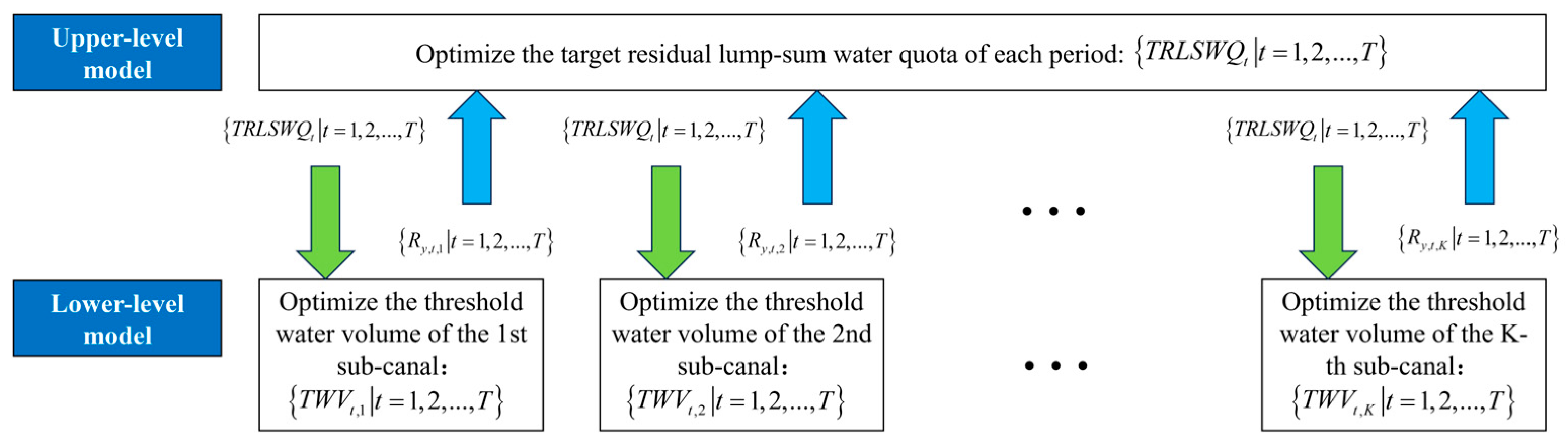
- Upper-level model:
- Objective function:
- Lower-level model:
- Objective function:
- (1)
- If the MWS is not lower than the MRGD, and the RLSWQ is not lower than the TWV, then allocate the water of each sub-canal on demand.
- (2)
- If the MWS is not lower than the MRGD, and the RLSWQ is higher than the inlet water volume of the main canal after being restricted in accordance with the rules () and lower than the TWV, then restrict the water volume based on the hedging factors under this scenario, which are equal to the ratios of RLSWQ to each TWV.
- (3)
- If the MWS is lower than the MRGD or the RLSWQ is lower than the inlet water volume of the main canal after being restricted in accordance with the rules (), then restrict the water volume based on the hedging factors under this scenario: calculate the ratio of the remaining water volume (after deducting losses (WL) from the smaller value of RLSWQ and MWS) to the sum of the water demands of all sub-canals in this period (); these ratios are the hedging factors in this scenario.
2.1.2. Water Demand Calculation Model
2.2. Comparison Models
2.2.1. The Conventional Dynamically Updated Canal Scheduling Model
- Decision variable:
- Objective function:
2.2.2. The Optimal Static Canal Scheduling Model
- Decision variable:
- Objective function:
2.3. Study Area
2.4. Data Preparation
2.5. Performance Evaluation Indicators
3. Results
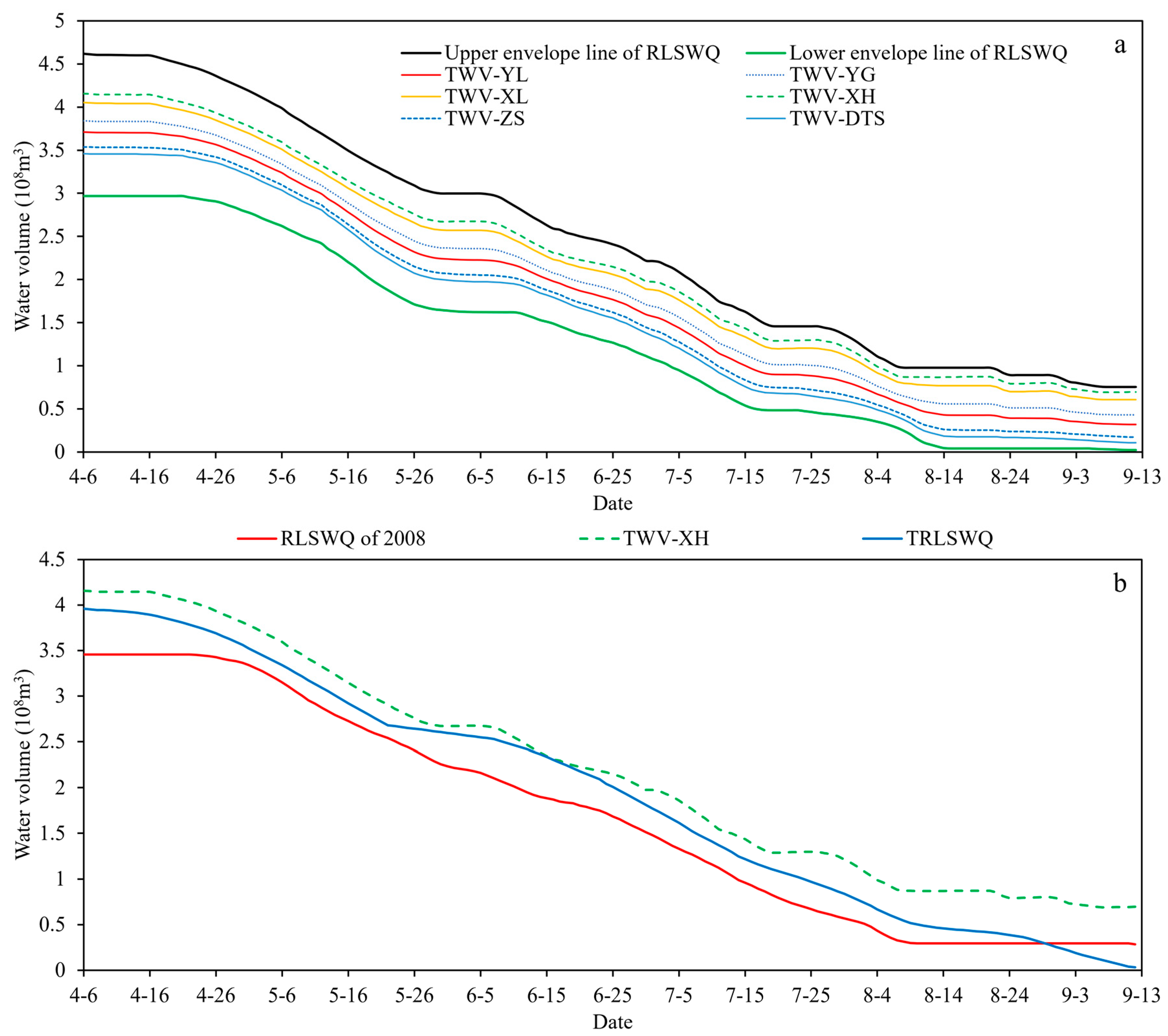
3.1. The Canal Scheduling Rules of the BT Model
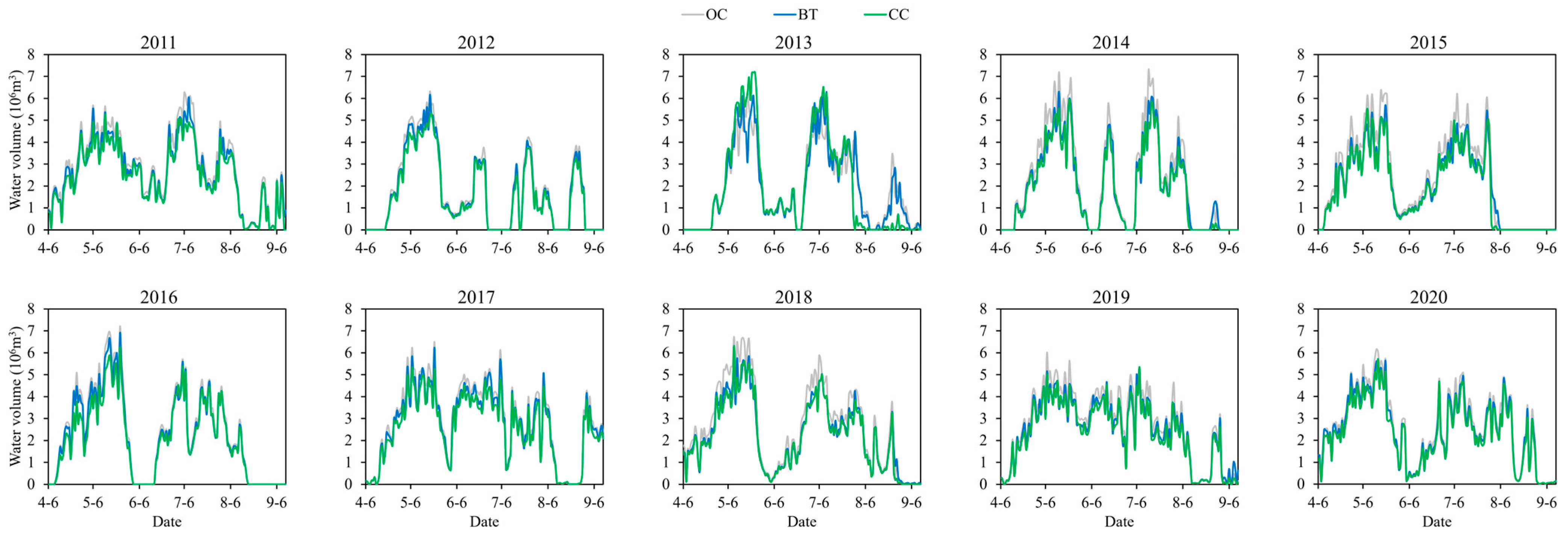
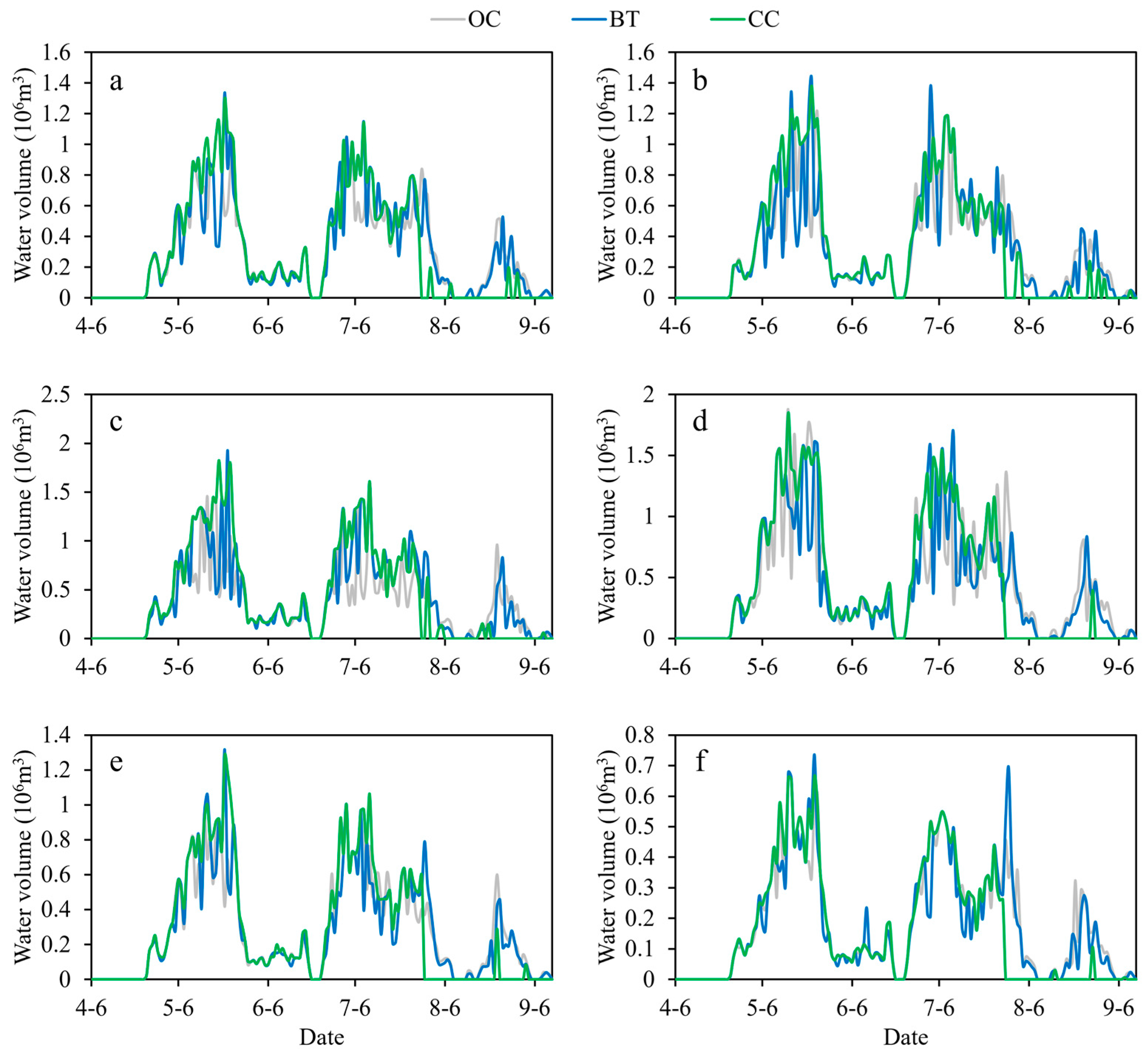
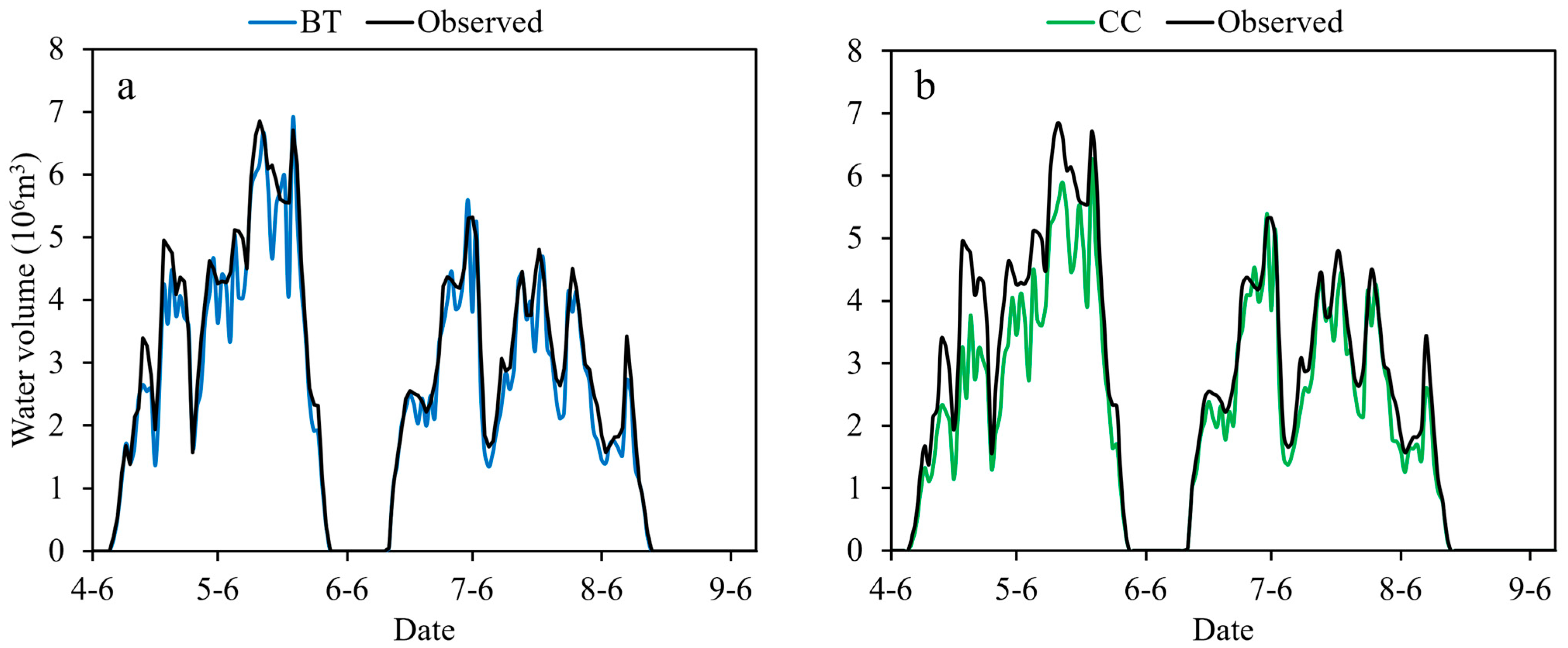
3.2. Representative Canal Schedule Process and Overall Canal Scheduling Performance
3.3. Analysis of the Canal Scheduling Strategy of the BT Model
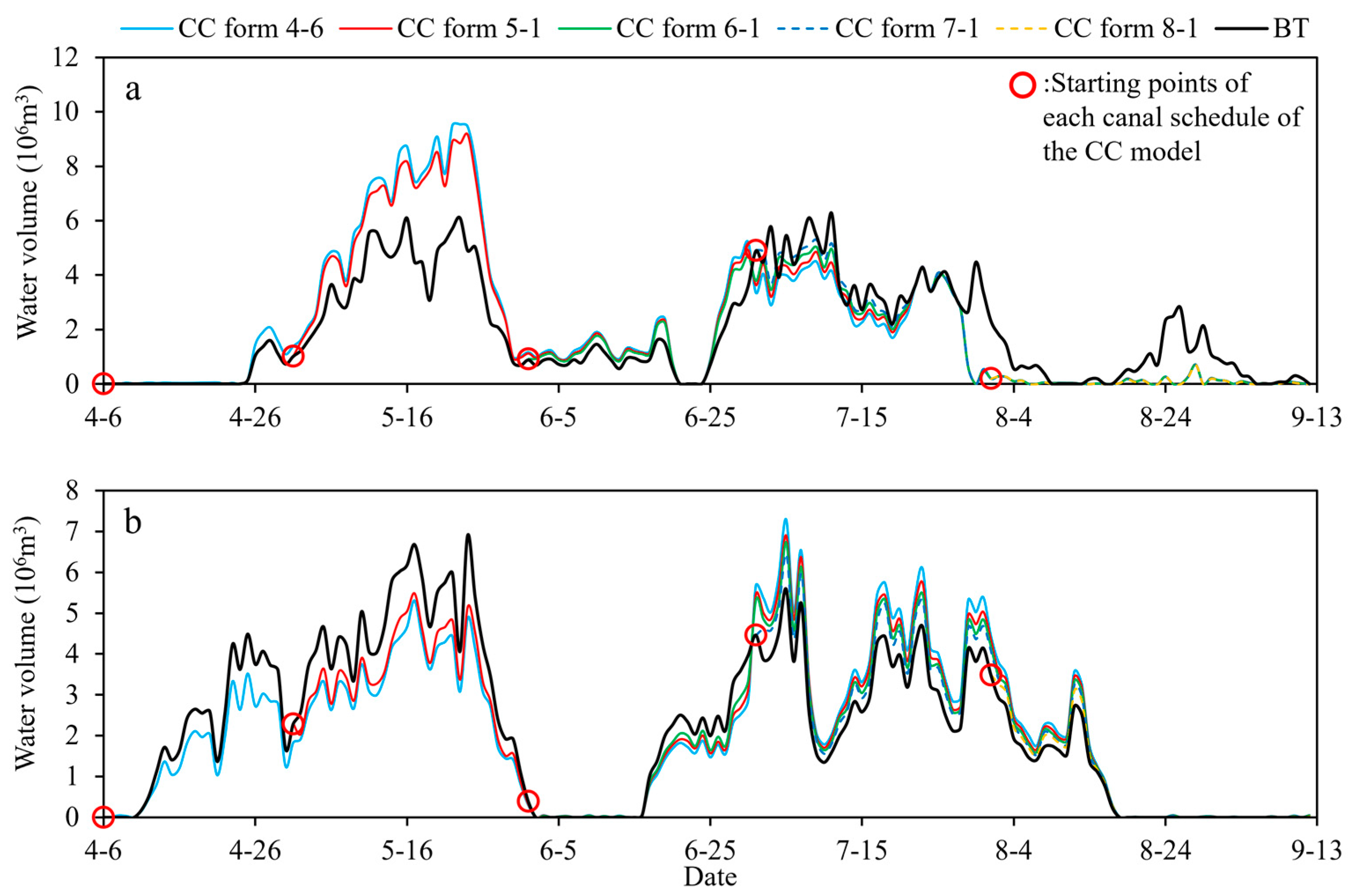
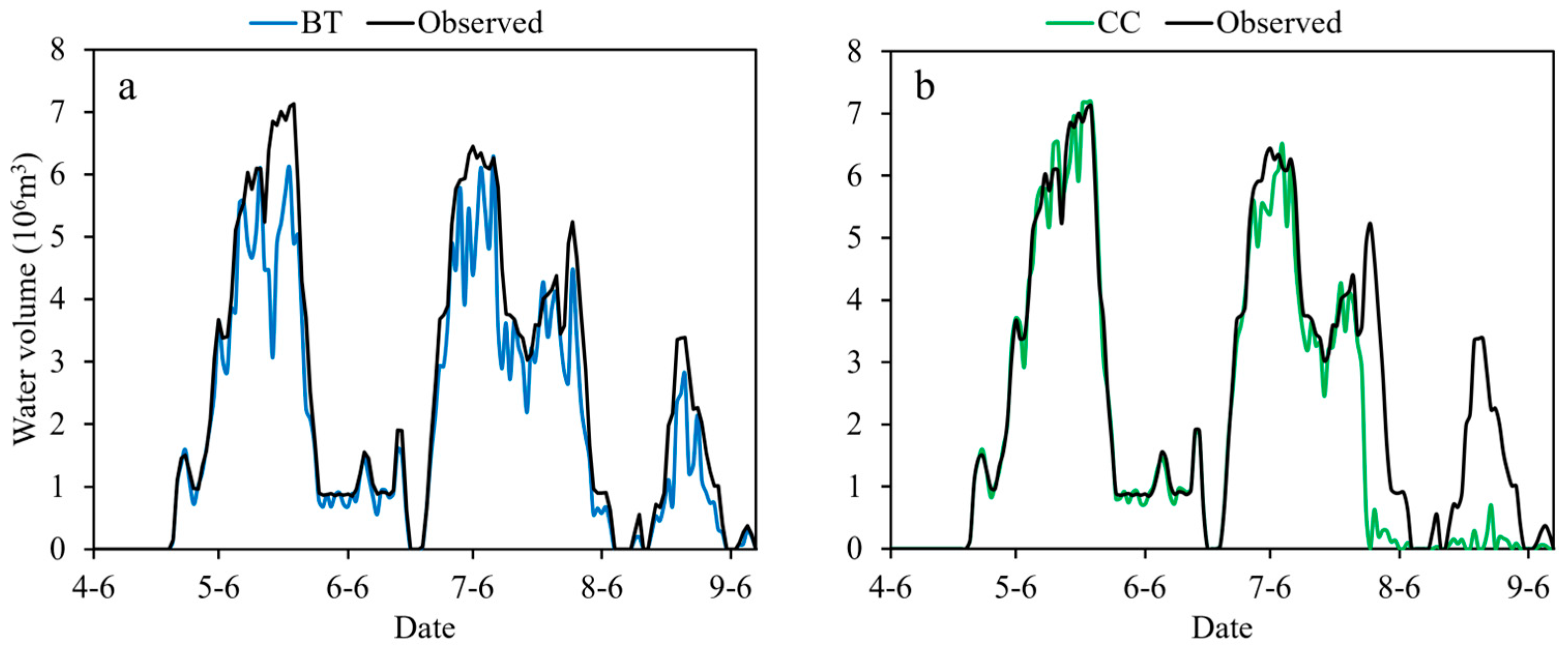
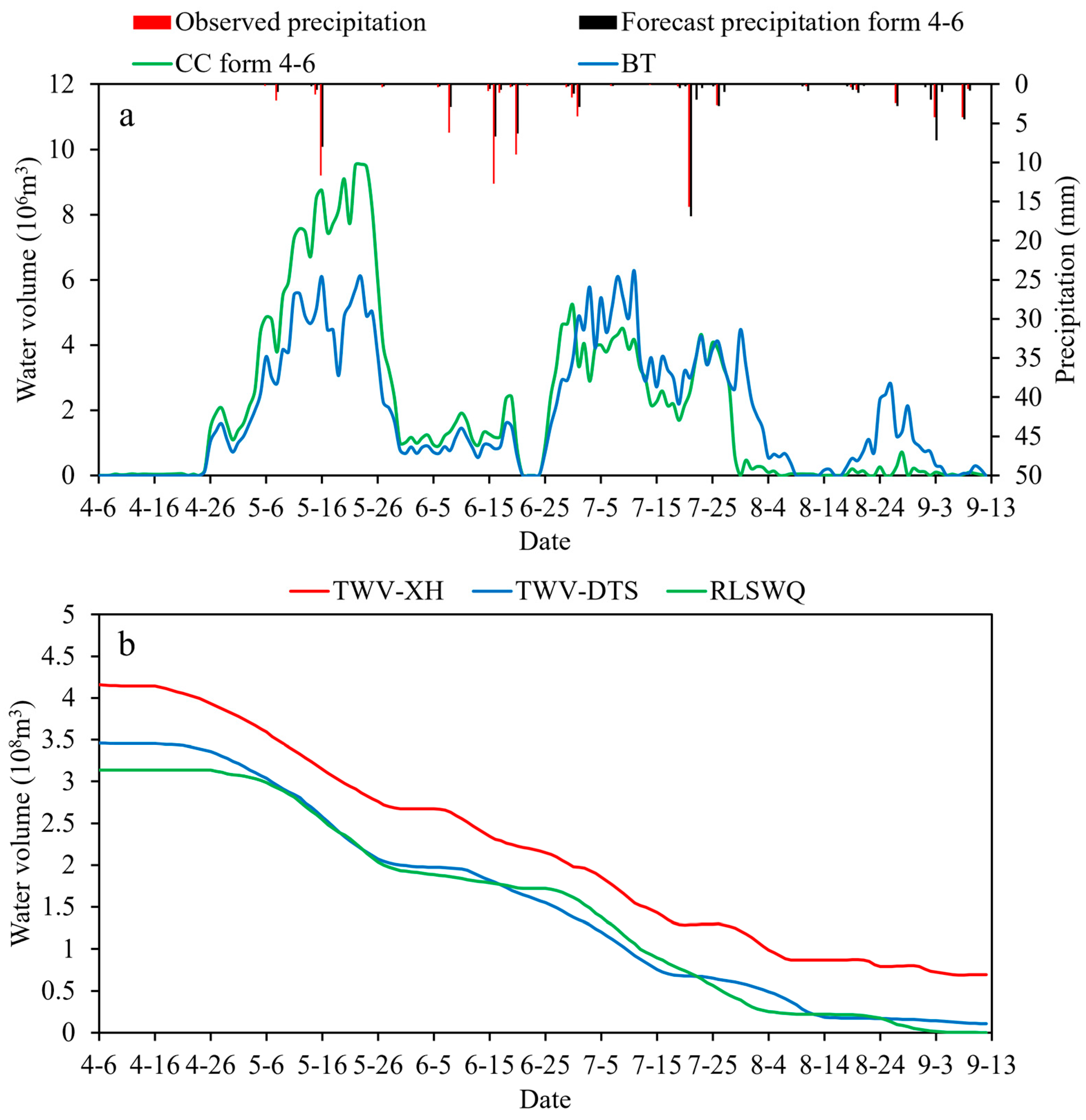
3.3.1. Scenario with Underestimated Forecast Precipitation in Earlier Periods
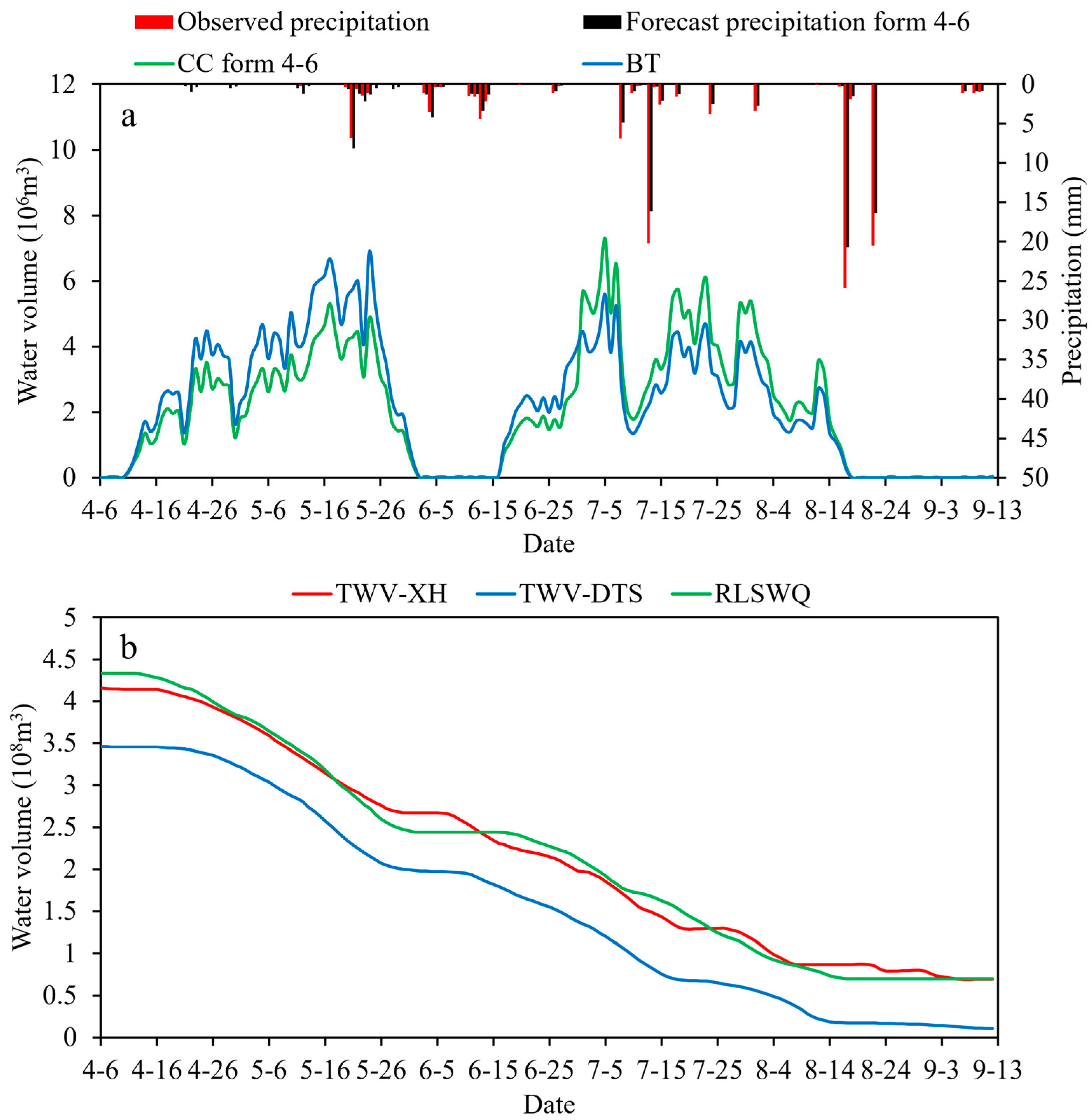
3.3.2. Scenario with Overestimated Forecast Precipitation in Earlier Periods
4. Discussion
5. Conclusions
- (1)
- A dynamically updated canal system scheduling strategy is proposed, which incorporates both the target residual lump-sum water quota at the beginning of each period and hydrometeorological forecast information. This strategy addresses the limitations of current strategies, which rely solely on water availability and crop water demand forecasts. Specifically, it mitigates issues such as excessive water allocation in earlier periods caused by underestimated precipitation forecasts, which can lead to water shortages in later periods, or excessive restriction in earlier periods caused by overestimated precipitation forecasts, which can lead to water wastage in later periods. This strategy encourages irrigation district managers to thoroughly examine historical canal system scheduling data and plan the canal schedule based on established rules, enabling them to implement water allocation restriction measures in a timely and appropriate manner.
- (2)
- Canal scheduling rules for the canal system in the Yongji Irrigation District are provided, including the target and threshold water volume at the beginning of each period, and the degree of restriction applied when hedging is triggered. Compared to the conventional model, the rules reduced the sum of the water shortage index of sub-canals by 22.9% and increased the utilization rate of the residual lump-sum water quota by 3.9%.
- (3)
- The proposed dynamically updated canal scheduling model offers several advantages, including the effective use of diverse information sources, minimal lead time requirements for forecast information, clear canal scheduling rules, and achieving good performance in optimizing canal scheduling.
Author Contributions
Funding
Institutional Review Board Statement
Data Availability Statement
Conflicts of Interest
Appendix A

| Growth Period | Crop | |||
|---|---|---|---|---|
| Start Date | End Date | Wheat | Corn | Sunflower |
| 6 April | 10 April | 0.40 | / | / |
| 11 April | 20 April | 0.50 | 0.40 | / |
| 21 April | 30 April | 0.55 | 0.40 | / |
| 1 May | 10 May | 0.60 | 0.45 | 0.30 |
| 11 May | 20 May | 0.70 | 0.50 | 0.30 |
| 21 May | 31 May | 0.85 | 0.50 | 0.30 |
| 1 June | 10 June | 0.90 | 0.60 | 0.30 |
| 11 June | 20 June | 1.00 | 0.70 | 0.40 |
| 21 June | 30 June | 1.00 | 0.80 | 0.50 |
| 1 July | 10 July | 0.90 | 1.00 | 0.70 |
| 11 July | 20 July | 0.70 | 1.00 | 0.90 |
| 21 July | 31 July | 0.50 | 1.00 | 1.00 |
| 1 August | 10 August | / | 0.90 | 1.10 |
| 11 August | 20 August | / | 0.90 | 1.10 |
| 21 August | 31 August | / | 0.75 | 0.90 |
| 1 September | 12 September | / | 0.50 | 0.80 |
| Month | Wheat | Corn | Sunflower | |||
|---|---|---|---|---|---|---|
| SWU | SWL | SWU | SWL | SWU | SWL | |
| 4 | 125 | 86 | 121 | 83 | / | / |
| 5 | 187 | 86 | 182 | 83 | 161 | 74 |
| 6 | 218 | 129 | 195 | 125 | 173 | 110 |
| 7 | 218 | 150 | 212 | 137 | 187 | 121 |
| 8 | / | / | 212 | 146 | 187 | 129 |
| 9 | / | / | 212 | 146 | 187 | 129 |
References
- Food and Agriculture Organization of the United Nations (FAO). The State of the World’s Land and Water Resources for Food and Agriculture—Systems at Breaking Point; FAO: Rome, Italy, 2021; p. 11. [Google Scholar]
- Kamrani, K.; Roozbahani, A.; Shahdany, S.M.H. Using Bayesian networks to evaluate how agricultural water distribution systems handle the water-food-energy nexus. Agric. Water Manag. 2020, 239, 12. [Google Scholar] [CrossRef]
- Lakhiar, I.A.; Yan, H.; Zhang, C.; Wang, G.; He, B.; Hao, B.; Han, Y.; Wang, B.; Bao, R.; Syed, T.N.; et al. A Review of Precision Irrigation Water-Saving Technology under Changing Climate for Enhancing Water Use Efficiency, Crop Yield, and Environmental Footprints. Agriculture 2024, 14, 1141. [Google Scholar] [CrossRef]
- Mancosu, N.; Snyder, R.L.; Kyriakakis, G.; Spano, D. Water Scarcity and Future Challenges for Food Production. Water 2015, 7, 975–992. [Google Scholar] [CrossRef]
- Liao, X.; Mahmoud, A.; Hu, T.; Wang, J. A novel irrigation canal scheduling model adaptable to the spatial-temporal variability of water conveyance loss. Agric. Water Manag. 2022, 274, 107961. [Google Scholar] [CrossRef]
- Zhou, S.; Hu, T.; Zhu, R.; Wu, F.; Wang, X. A bilevel modeling approach for optimizing irrigation canal scheduling under a hierarchical institutional arrangement. Agric. Water Manag. 2023, 284, 108322. [Google Scholar] [CrossRef]
- Haque, M.A.; Najim, M.M.M.; Lee, T.S. Modeling irrigation water delivery schedule for rice cultivation in East Coast Malaysia. Trop. Agric. Res. 2004, 16, 204–213. [Google Scholar]
- Mishra, A.; Singh, R.; Raghuwanshi, N.S. Alternative delivery scheduling for improved canal system performance. J. Irrig. Drain. Eng. 2002, 128, 244–248. [Google Scholar] [CrossRef]
- Suryavanshi, A.R.; Reddy, J.M. Optimal operation schedule of irrigation distribution-systems. Agric. Water Manag. 1986, 11, 23–30. [Google Scholar] [CrossRef]
- Zhou, K.; Fan, Y.; Gao, Z.; Chen, H.; Kang, Y. Research progress on operation control and optimal scheduling of irrigation canal systems. Irrig. Drain. 2025, 74, 861–879. [Google Scholar] [CrossRef]
- Anwar, A.A.; Bhatti, M.T.; de Vries, T.T. Canal Operations Planner. I: Maximizing Delivery Performance Ratio. J. Irrig. Drain. Eng. 2016, 142, 12. [Google Scholar] [CrossRef]
- Fan, Y.; Yang, M.; Zhou, K.; Gao, Z.; Zhang, W.; Guo, B.; Zhang, X. Irrigation Scheduling and Water Distribution Evaluation Model Based on Water Supply Flow Rate. J. Irrig. Drain. Eng. 2025, 151, 9. [Google Scholar] [CrossRef]
- Fan, Y.; Chen, H.; Gao, Z.; Fang, B.; Liu, X. A Model Coupling Water Resource Allocation and Canal Optimization for Water Distribution. Water Resour. Manag. 2023, 37, 1341–1365. [Google Scholar] [CrossRef]
- Anwar, A.A.; de Vries, T.T.; Bhatti, M.T. Canal Operations Planner. II: Minimizing Inequity. J. Irrig. Drain. Eng. 2016, 142, 7. [Google Scholar] [CrossRef]
- Santhi, C.; Pundarikanthan, N.V. A new planning model for canal scheduling of rotational irrigation. Agric. Water Manag. 2000, 43, 327–343. [Google Scholar] [CrossRef]
- Zhou, S.; Hu, T.; Zhu, R.; Huang, J.; Shen, L. A novel irrigation canal scheduling approach without relying on a prespecified canal water demand process. J. Clean. Prod. 2021, 282, 124253. [Google Scholar] [CrossRef]
- Monem, M.J.; Namdarian, R. Application of simulated annealing (SA) techniques for optimal water distribution in irrigation canals. Irrig. Drain. 2005, 54, 365–373. [Google Scholar] [CrossRef]
- Delgoda, D.; Malano, H.; Saleem, S.K.; Halgamuge, M.N. A novel generic optimization method for irrigation scheduling under multiple objectives and multiple hierarchical layers in a canal network. Adv. Water Resour. 2017, 105, 188–204. [Google Scholar] [CrossRef]
- Fan, Y.; Chen, H.; Gao, Z.; Wang, Y.; Xu, J. Optimal water distribution model of canals considering the workload of managers. Irrig. Drain. 2023, 72, 182–195. [Google Scholar] [CrossRef]
- Nguyen, D.C.H.; Ascough, J.C.; Maier, H.R.; Dandy, G.C.; Andales, A.A. Optimization of irrigation scheduling using ant colony algorithms and an advanced cropping system model. Environ. Modell. Softw. 2017, 97, 32–45. [Google Scholar] [CrossRef]
- Sun, Z.; Chen, J.; Han, Y.; Huang, R.; Zhang, Q.; Guo, S. An Optimized Water Distribution Model of Irrigation District Based on the Genetic Backtracking Search Algorithm. IEEE Access 2019, 7, 145692–145704. [Google Scholar] [CrossRef]
- Wu, J.J.; Huang, R.; Fang, T.Y.; Han, Y. Multi-objective model of irrigation water distribution based on particle swarm optimization. 5Th International Conference on Water Resource and Environment. IOP Conf. Ser. Earth Environ. Sci. 2019, 344, 8. [Google Scholar] [CrossRef]
- Du, Y.; Zhang, C.; Wei, R.; Cao, L.; Zhao, T.; Wang, W.; Hu, X. Multi-Objective Optimal Scheduling of Water Transmission and Distribution Channel Gate Groups Based on Machine Learning. Agriculture 2025, 15, 1344. [Google Scholar] [CrossRef]
- Tian, G.; Lv, M.; Wang, M.; Qin, J.; Wang, Y.; Yu, J.; Yang, B. A novel water distribution model considering the dynamic coupling of canals and gates. Comput. Electron. Agric. 2025, 236, 20. [Google Scholar] [CrossRef]
- Kang, S.; Hao, X.; Du, T.; Tong, L.; Su, X.; Lu, H.; Li, X.; Huo, Z.; Li, S.; Ding, R. Improving agricultural water productivity to ensure food security in China under changing environment: From research to practice. Agric. Water Manag. 2017, 179, 5–17. [Google Scholar] [CrossRef]
- Zheng, H.; Hou, H.; Wu, J.; Tian, D.; Miao, P. Irrigation Schedule Optimization for Wheat and Sunflower Intercropping under Water Supply Restrictions in Inner Mongolia, China. Atmosphere 2024, 15, 566. [Google Scholar] [CrossRef]
- Cai, X.; Hejazi, M.I.; Wang, D. Value of Probabilistic Weather Forecasts: Assessment by Real-Time Optimization of Irrigation Scheduling. J. Water Resour. Plan. Manag. 2011, 137, 391–403. [Google Scholar] [CrossRef]
- Hejazi, M.I.; Cai, X.; Yuan, X.; Liang, X.; Kumar, P. Incorporating Reanalysis-Based Short-Term Forecasts from a Regional Climate Model in an Irrigation Scheduling Optimization Problem. J. Water Resour. Plan. Manag. 2014, 140, 699–713. [Google Scholar] [CrossRef]
- Puig, F.; Garcia-Vila, M.; Soriano, M.A.; Rodriguez-Diaz, J.A. AquaCrop-IoT: A smart irrigation platform integrating real-time images and weather forecasting. Comput. Electron. Agric. 2025, 235, 13. [Google Scholar] [CrossRef]
- Wang, D.; Cai, X. Irrigation Scheduling-Role of Weather Forecasting and Farmers’ Behavior. J. Water Resour. Plan. Manag. 2009, 135, 364–372. [Google Scholar] [CrossRef]
- Li, H.; Liu, P.; Guo, S.; Cheng, L.; Huang, K.; Feng, M.; He, S.; Ming, B. Deriving adaptive long-term complementary operating rules for a large-scale hydro-photovoltaic hybrid power plant using ensemble Kalman filter. Appl. Energy 2021, 301, 15. [Google Scholar] [CrossRef]
- Zhang, L.; Feng, Z.; Yao, X.; Niu, W.; Wang, Y.; Mo, L. A multi-objective operation optimization method for dynamic control of reservoir water level in evolving flood season environments. J. Hydrol. 2024, 643, 17. [Google Scholar] [CrossRef]
- Maass, A.; Hufschmidt, M.M.; Dorfman, R.; Thomas, H.A., Jr.; Marglin, S.A.; Fair, G.M. Design of Water-Resources Systems: New Techniques for Relating Economic Objectives, Engineering Analysis, and Government Planning; Harvard University Press: Cambridge, UK, 1962; p. 638. [Google Scholar]
- Draper, A.J.; Lund, J.R. Optimal Hedging and Carryover Storage Value. J. Water Resour. Plan. Manag. 2004, 130, 83–87. [Google Scholar] [CrossRef]
- You, J.Y.; Cai, X. Hedging rule for reservoir operations: 1. A theoretical analysis. Water Resour Res. 2008, 44, W01415. [Google Scholar] [CrossRef]
- Zeng, X.; Hu, T.; Xiong, L.; Cao, Z.; Xu, C. Derivation of operation rules for reservoirs in parallel with joint water demand. Water Resour. Res. 2015, 51, 9539–9563. [Google Scholar] [CrossRef]
- Allen, R.G.; Pereira, L.S.; Raes, D.; Smith, M. Crop Evapotranspiration, Guidelines for Computing Crop Water Requirements; FAO: Rome, Italy, 1998. [Google Scholar]
- Fan, Y.; Chen, H.; Gao, Z.; Chang, X. Canal water distribution optimization model based on water supply conditions. Comput. Electron. Agric. 2023, 205, 10. [Google Scholar] [CrossRef]
- Bayazit, M.; Unal, N.E. Effects of hedging on reservoir performance. Water Resour. Res. 1990, 26, 713–719. [Google Scholar] [CrossRef]
- Lund, J.R.; Reed, R.U. Drought water rationing and transferable rations. J. Water Resour. Plan. Manag. 1995, 121, 429–437. [Google Scholar] [CrossRef]
- Shiau, J.T. Analytical optimal hedging with explicit incorporation of reservoir release and carryover storage targets. Water Resour. Res. 2011, 47, W01515. [Google Scholar] [CrossRef]
- Shih, J.S.; Revelle, C. Water-supply operations during drought—Continuous hedging rule. J. Water Resour. Plan. Manag. 1994, 120, 613–629. [Google Scholar] [CrossRef]
- Taghian, M.; Rosbjerg, D.; Haghighi, A.; Madsen, H. Optimization of Conventional Rule Curves Coupled with Hedging Rules for Reservoir Operation. J. Water Resour. Plan. Manag. 2014, 140, 693–698. [Google Scholar] [CrossRef]
- Canon, J.; Gonzalez, J.; Valdes, J. Reservoir Operation and Water Allocation to Mitigate Drought Effects in Crops: A Multi-level Optimization Using the Drought Frequency Index. J. Water Resour. Plan. Manag. 2009, 135, 458–465. [Google Scholar] [CrossRef]
- Chang, J.; Guo, A.; Wang, Y.; Ha, Y.; Zhang, R.; Xue, L.; Tu, Z. Reservoir Operations to Mitigate Drought Effects with a Hedging Policy Triggered by the Drought Prevention Limiting Water Level. Water Resour. Res. 2019, 55, 904–922. [Google Scholar] [CrossRef]
- Li, Y.; Ding, W.; Chen, X.; Cai, X.; Zhang, C. An Analytical Framework for Reservoir Operation with Combined Natural Inflow and Controlled Inflow. Water Resour. Res. 2020, 56, 20. [Google Scholar] [CrossRef]
- Liu, X.; Guo, S.; Liu, P.; Chen, L.; Li, X. Deriving Optimal Refill Rules for Multi-Purpose Reservoir Operation. Water Resour. Manag. 2011, 25, 431–448. [Google Scholar] [CrossRef]


| Variables/Parameters | Definition | Unit | |
|---|---|---|---|
| Parameters and variables required for model optimization | the outlet water volume of the k-th sub-canal in the t-th period of the y-th year | m3 | |
| the water demand of the k-th sub-canal in the t-th period of the y-th year | m3 | ||
| the forecast value of the water demand of the k-th sub-canal in tb-th period of y-th year from the beginning of the ta-th period of y-th year | m3 | ||
| the target residual lump-sum water quota at the beginning of the t-th period | m3 | ||
| the initial lump-sum water quota of the y-th year’s crop growth stage | m3 | ||
| the threshold water volume of the t-th period of the k-th sub-canal | m3 | ||
| the objective function value of the upper-level model of the BT model | |||
| the objective function value of the k-th sub-canal of the lower-level model of the BT model, the canal schedule efficiency loss of the BT model at the t-th period of the y-th year of the k-th sub-canal | |||
| the deviation between water allocation and demand of the current period, the deviation between the residual lump-sum water quota and the target residual lump-sum water quota at the end of the current period | |||
| the residual lump-sum water quota of the t-th period in the y-th year | m3 | ||
| the maximum water supply of the t-th period in the y-th year | m3 | ||
| the inlet water volume of the main canal in the t-th period of the y-th year | m3 | ||
| the on-demand inlet water volume of the main canal in the t-th period of the y-th year | m3 | ||
| the limited outlet water volume of the k-th sub-canal in the t-th period of the y-th year, while the maximum water supply can meet the water demand | m3 | ||
| the limited outlet water volume of the k-th sub-canal in the t-th period of the y-th year, while the maximum water supply or residual lump-sum water quota cannot meet the water demand | m3 | ||
| the total water loss of the canal system in the t-th period of the y-th year | m3 | ||
| empirical parameters for water loss calculation | |||
| length of the k-th sub-canal | km | ||
| length of the j-th part of the main canal (where j = 1 denotes the initial section of the main canal, and j = J denotes the terminal section of the main canal) | km | ||
| outlet water volume of the j-th section of the main canal in the t-th period of the y-th year | m3 | ||
| the starting and ending numbers of the sub-canals directly connected to the j-th section of the main canal | |||
| the duration of a period | d | ||
| the designed discharge of the main canal | m3/s | ||
| the designed discharge of the k-th sub-canal | m3/s | ||
| the objective function value of the CC model at the beginning of the ta-th period of the y-th year | |||
| the objective function value of the OC model | |||
| Parameters required for water demand calculation | the evapotranspiration of the m-th crop in the t-th period of the y-th year | mm | |
| the crop coefficient of the m-th crop | |||
| soil moisture correction coefficient, its value is set to 1 | |||
| reference evapotranspiration in the t-th period of the y-th year | mm | ||
| the soil moisture content of the tillage layer of the m-th crop in the t-th period of the y-th year in the field irrigated by the k-th sub-canal | mm | ||
| the change in soil moisture content caused by the variation in the depth of the tillage layer of the m-th crop in the t-th period of the y-th year in the field irrigated by the k-th sub-canal | mm | ||
| the soil moisture content of the tillage layer of the m-th crop in t-th period of y-th year in the field irrigated by the k-th sub-canal, assuming no irrigation is conducted during the (t − 1)-th period | mm | ||
| the forecast effective precipitation in the t-th period of the y-th year | mm | ||
| the observed effective precipitation in the t-th period of the y-th year | mm | ||
| the forecast error of effective precipitation in the t-th period of the y-th year | mm | ||
| the ratio of the standard deviation of the normal distribution of the forecast error of effective precipitation that the error follows to the observed value | |||
| groundwater recharge to the tillage layer of the m-th crop in t-th period of y-th year in the field irrigated by the k-th sub-canal | mm | ||
| irrigation water volume per unit area of the m-th crop in the t-th period of the y-th year in the field irrigated by the k-th sub-canal | mm | ||
| the upper and lower limits of the suitable soil moisture content of the tillage layer of the m-th crop in the t-th period | mm | ||
| planting area of the m-th crop in the field irrigated by the k-th sub-canal | m2 | ||
| Subscripts and their maximum value | annual number, total number of years in the calculation series | ||
| period number within a year, total number of periods in a year | |||
| crop number, total number of crops | |||
| sub-canal number, total number of sub-canals | |||
| section number of the main canal, total section number of the main canal | |||
| Performance evaluation indicators | sum of water shortage index of all sub-canals in the y-th year | ||
| canal system water loss rate in the y-th year | % | ||
| utilization rate of the initial lump-sum water quota in the y-th year | % | ||
| Indicator | The OC Model | The BT Model | The CC Model |
|---|---|---|---|
| The sum of the water shortage index (SWSI) | 22.92 ± 14.15 | 31.44 ± 17.07 | 40.81 ± 30.64 |
| The canal system’s water loss rate (TWLR) | 2.80 ± 0.21% | 2.99 ± 0.14% | 3.10 ± 0.18% |
| The utilization rate of the initial lump-sum water quota (URILSWQ) | 93.66 ± 2.93% | 92.82 ± 2.91% | 89.32 ± 2.80% |
Disclaimer/Publisher’s Note: The statements, opinions and data contained in all publications are solely those of the individual author(s) and contributor(s) and not of MDPI and/or the editor(s). MDPI and/or the editor(s) disclaim responsibility for any injury to people or property resulting from any ideas, methods, instructions or products referred to in the content. |
© 2025 by the authors. Licensee MDPI, Basel, Switzerland. This article is an open access article distributed under the terms and conditions of the Creative Commons Attribution (CC BY) license (https://creativecommons.org/licenses/by/4.0/).
Share and Cite
Yan, M.; Wu, F.; Chen, L.; Liu, Y.; Zeng, X.; Hu, T. Dynamically Updated Irrigation Canal Scheduling Rules Based on Risk Hedging. Agriculture 2025, 15, 2527. https://doi.org/10.3390/agriculture15242527
Yan M, Wu F, Chen L, Liu Y, Zeng X, Hu T. Dynamically Updated Irrigation Canal Scheduling Rules Based on Risk Hedging. Agriculture. 2025; 15(24):2527. https://doi.org/10.3390/agriculture15242527
Chicago/Turabian StyleYan, Ming, Fengyan Wu, Luli Chen, Yong Liu, Xiang Zeng, and Tiesong Hu. 2025. "Dynamically Updated Irrigation Canal Scheduling Rules Based on Risk Hedging" Agriculture 15, no. 24: 2527. https://doi.org/10.3390/agriculture15242527
APA StyleYan, M., Wu, F., Chen, L., Liu, Y., Zeng, X., & Hu, T. (2025). Dynamically Updated Irrigation Canal Scheduling Rules Based on Risk Hedging. Agriculture, 15(24), 2527. https://doi.org/10.3390/agriculture15242527