


Abstract
Objective: To map and characterize artificial intelligence (AI) applications in post-liver transplantation (LT) care, summarize comparative performance where available, and identify methodological and translational gaps. Methods: We conducted a scoping review in accordance with PRISMA-ScR. A comprehensive search of electronic databases was performed from inception through 1 April 2025. We included primary studies evaluating AI applications in the post-LT period (model development, validation, or implementation). Comparative studies were defined as those reporting head-to-head evaluation of at least two algorithmic models for the same task with quantitative performance metrics. Single-model studies were retained for evidence mapping but analyzed separately. Reviews and the other non-primary literature were included for contextual mapping. Results: The search yielded 3088 records. After deduplication, 2408 were screened, 191 full texts were assessed, and 65 studies were included. Of these, 52 reported primary outcome data. Clinical prediction studies (n = 43) focused on graft survival, rejection, fibrosis, oncologic recurrence, mortality, and composite outcomes. Operational studies (n = 3) evaluated early warning or bedside decision-support systems, and system-level studies (n = 6) examined benchmarking, donor–recipient matching, explainability, fairness, and cross-domain modeling. Most studies were retrospective and single-center, with internal validation commonly reported and external validation uncommon. Conclusions: AI research in post-LT care is expanding, with a predominant focus on clinical prediction. However, limited external validation, heterogeneous methods, and scarce real-world implementation constrain clinical readiness. Standardized evaluation and prospective integration are needed to determine whether AI tools can support decision-making and improve post-transplant outcomes.
1. Introduction
End-stage liver disease (ESLD) causes approximately two million deaths globally each year and remains a major contributor to premature mortality from cirrhosis and liver cancer [1]. Liver transplantation (LT) is the definitive treatment for ESLD and acute liver failure [2]. Advances in perioperative management, surgical techniques, immunosuppressive therapy, and antiviral treatment have improved early post-transplant outcomes, with one-year and five-year survival rates now exceeding 90% and 75%, respectively [3]. Despite these gains, LT is still associated with substantial morbidity and mortality. Post-transplant complications, particularly biliary and vascular events, remain common and contribute to graft dysfunction, reduced survival, and increased healthcare utilization [4]. Accurate risk stratification and early detection are therefore essential to preserve graft function and optimize long-term outcomes [5].
Post-transplant care is inherently data-intensive and requires continuous longitudinal monitoring of graft function, immunosuppressive exposure, laboratory trends, imaging findings, and evolving complications [6]. Although electronic health records and transplant registries provide structured documentation and enable benchmarking, post-LT data are often heterogeneous, incomplete, and inconsistently defined across centers. In addition, conventional statistical models and established prognostic scores may fail to capture complex non-linear interactions and time-dependent patterns that shape post-transplant trajectories. These limitations contribute to persistent gaps in individualized risk stratification and highlight the need for analytical approaches capable of integrating multimodal clinical data into clinically actionable predictions.
Artificial intelligence (AI) applications are increasingly explored across clinical medicine, including solid organ transplantation [7]. In LT recipients, AI has been evaluated to support risk prediction, complication detection, and outcome forecasting [8,9]. However, the evidence landscape is fragmented, with few studies providing head-to-head comparisons of AI model performance, optimization strategies, or clinical utility [10,11,12]. Moreover, many models lack external validation and are developed under heterogeneous methodological conditions, limiting their interpretability and clinical readiness. The expanding availability of digital health data highlights the need to map existing AI applications and clarify their methodological and translational maturity.
To date, no synthesis has specifically examined the comparative performance of AI applications in the post-LT setting. This scoping review aims to identify and characterize studies that directly compare AI models in post-transplant care for LT recipients, with a focus on methodological rigor, reported performance metrics, and clinical applicability.
2. Methods
2.1. Eligibility Criteria
This scoping review followed the Preferred Reporting Items for Systematic Reviews and Meta-Analyses extension for Scoping Reviews (PRISMA-ScR) guidelines [13]. We included primary studies evaluating AI applications developed for use in the post-LT phase, including model development, validation, or implementation. Comparative studies were defined as those reporting head-to-head evaluation of at least two distinct algorithmic models for the same post-LT task using the same dataset and outcome definition, with quantitative performance metrics. Comparators could include other AI/machine learning (ML) models, conventional statistical approaches (e.g., logistic regression or Cox regression), and/or established clinical scoring systems. Single-model development studies without a formal comparator were retained for evidence mapping but were analyzed separately from the comparative performance synthesis. The target population comprised adult or pediatric LT recipients receiving post-transplant care supported by AI applications.
Outcomes of interest were grouped into three domains: (1) clinical outcomes (e.g., graft survival, rejection, infection, readmission, and mortality), (2) operational outcomes (e.g., accuracy or timeliness of decision support, improvements in triage, or risk stratification), and (3) system-level outcomes (e.g., usability, explainability, fairness, benchmarking, donor–recipient matching, and other model performance measures).
Studies were eligible from database inception to 1 April 2025 in any language with an English abstract. We included randomized and non-randomized studies, prospective and retrospective cohort studies, technical validation studies, systematic and narrative reviews, methodological papers, and editorials. We excluded conference abstracts, protocols, unpublished or non-peer-reviewed materials, studies focused exclusively on preoperative or intraoperative phases of LT, animal or non-human studies, and studies comparing AI solely to clinical judgment without comparison to another algorithmic model (AI/ML, conventional statistical regression, or an established clinical scoring system).
2.2. Data Sources and Literature Search Approach
A comprehensive literature search was conducted in PubMed, Web of Science, and the Cochrane Central Register of Controlled Trials, covering studies published from database inception through 1 April 2025. Grey literature was not searched. The reference lists of all the included studies were screened manually to identify additional relevant publications. The search strategy was developed to identify studies evaluating AI applications in the post-transplantation phase of LT. Medical Subject Headings (MeSH) and free-text terms related to AI, ML, deep learning (DL), natural language processing (NLP), and LT were combined using Boolean operators. The complete search syntax is provided in the Supplementary Materials (Data S1).
2.3. Study Selection and Characteristics
Titles and abstracts were screened independently by two reviewers (I.L. and D.L.) after duplicate removal, followed by full-text assessment of potentially relevant articles. Discrepancies were resolved through discussion, and a third reviewer (D.R.) was consulted when consensus could not be reached. Reference management was performed using EndNote X9.
2.4. Data Extraction and Synthesis Procedures
Following the final selection of eligible studies, one reviewer (I.L.) developed a structured extraction spreadsheet tailored for this scoping review. Data were independently extracted and subsequently verified by a second reviewer (D.L.) for accuracy. Findings were synthesized through iterative team discussions to consolidate key points and guide thematic analysis. Discrepancies in interpretation were resolved through consensus.
3. Results
3.1. Study Selection and Overview of Included Evidence
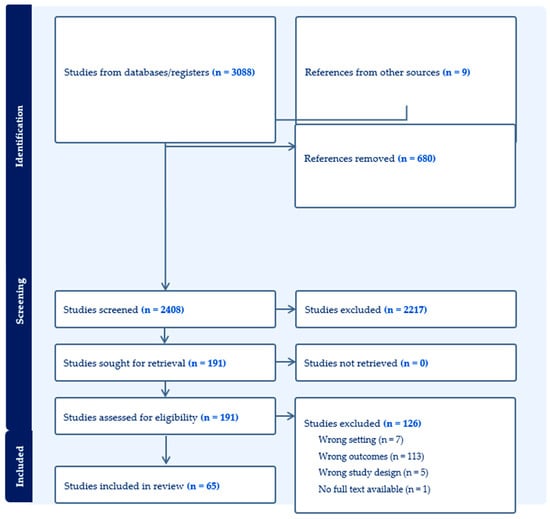
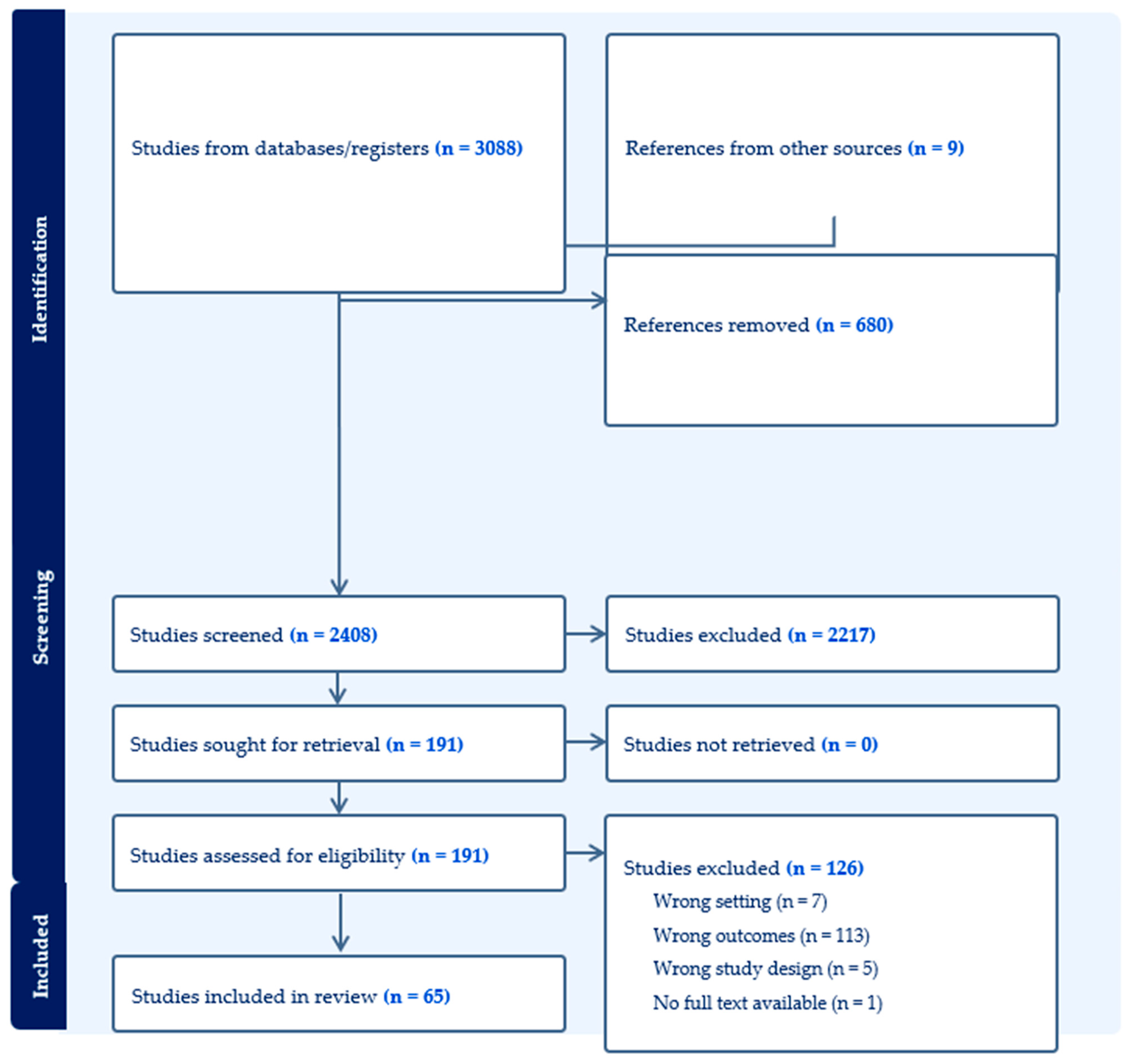
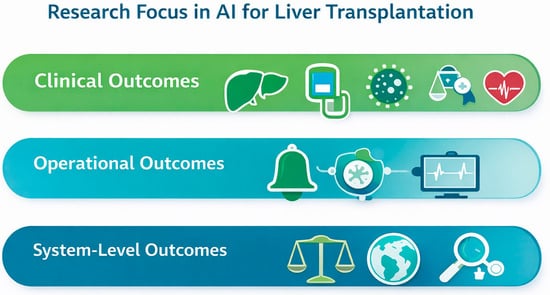
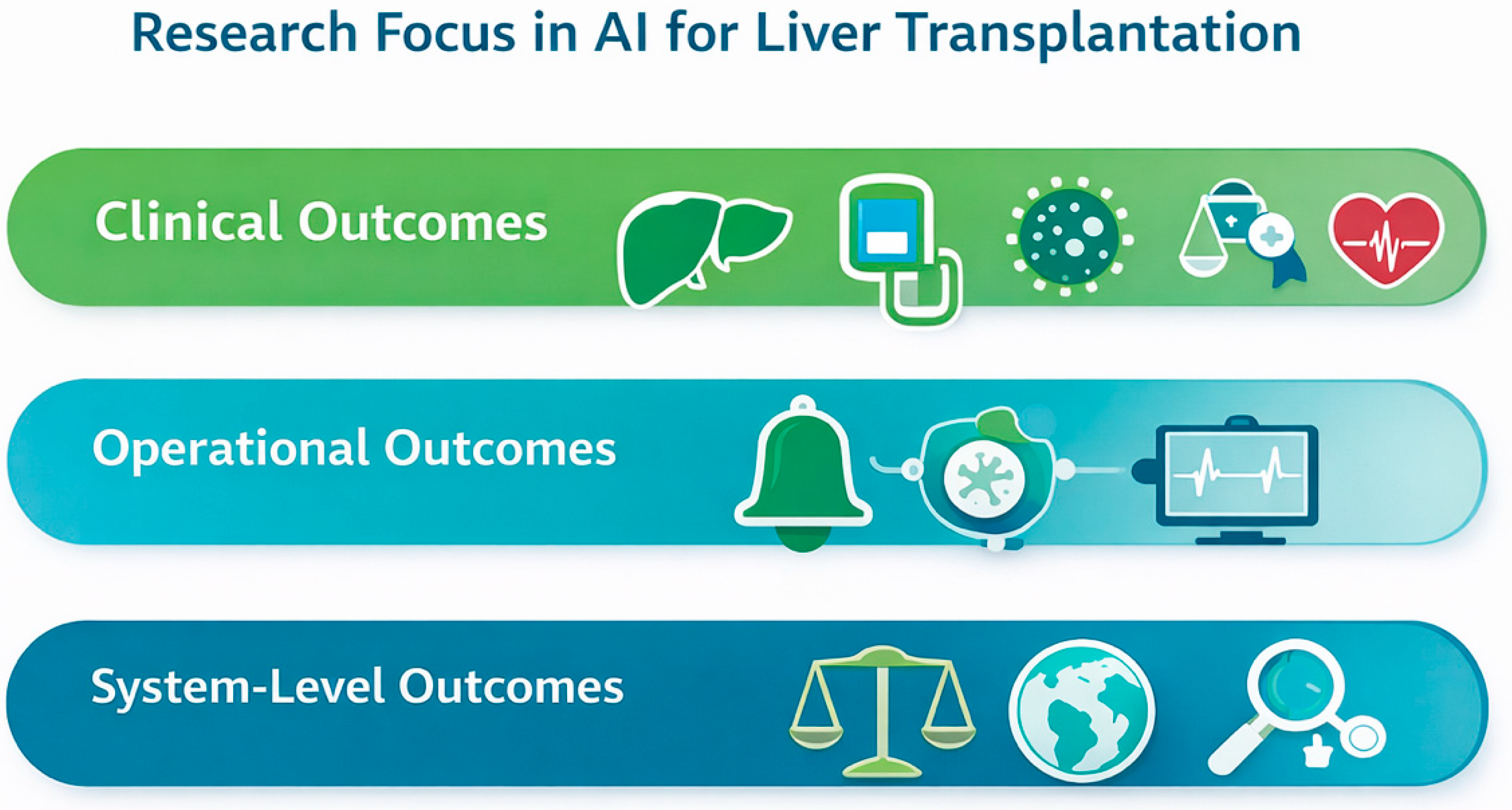
The search identified 3088 records. After removing 680 duplicates, 2408 unique citations underwent title and abstract screening. Of these, 191 full-text articles were assessed for eligibility, and 65 studies were included in this scoping review [11,14,15,16,17,18,19,20,21,22,23,24,25,26,27,28,29,30,31,32,33,34,35,36,37,38,39,40,41,42,43,44,45,46,47,48,49,50,51,52,53,54,55,56,57,58,59,60,61,62,63,64,65,66,67,68,69,70,71,72,73,74,75,76,77]. The selection process is summarized in the PRISMA flow diagram (Figure 1). To contextualize the evidence landscape, AI applications identified in this scoping review were categorized into three conceptual domains based on their intended targets within post-transplant care: clinical outcomes, operational outcomes, and system-level outcomes (Figure 2). Of the 65 included studies, 52 reported primary outcome data and were included in thematic synthesis [14,15,16,17,18,19,20,21,22,23,24,25,26,27,28,29,30,31,32,33,34,35,36,37,38,39,40,41,42,43,44,45,46,47,48,49,50,51,52,53,54,55,56,57,58,59,60,61,62,63,64,65]. These comprised 43 studies categorized under Theme 1 (clinical outcomes) [14,15,16,17,18,19,20,21,22,23,24,25,26,27,28,29,30,31,32,33,34,35,36,37,38,39,40,41,42,43,44,45,46,47,48,49,50,51,52,53,54,55,56], consisting of one meta-analysis [14], 2 prospective studies [15,16], and 40 retrospective studies [17,18,19,20,21,22,23,24,25,26,27,28,29,30,31,32,33,34,35,36,37,38,39,40,41,42,43,44,45,46,47,48,49,50,51,52,53,54,55,56]; three retrospective studies addressing Theme 2 (operational outcomes) [57,58,59]; and six retrospective studies contributing to Theme 3 (system-level outcomes) [60,61,62,63,64,65]. The remaining 13 publications included four systematic reviews [66,67,68,69], seven narrative reviews [11,70,71,72,73,74,75], one methodological paper [76], and one commentary [77]. These were used to support contextual interpretation of methodological approaches and evidence gaps. Across the primary studies, internal validation approaches (e.g., split-sample testing or cross-validation) were common, whereas external validation using independent datasets was uncommon, and no studies reported prospective clinical validation or real-world implementation outcomes. Predicted endpoints varied in time horizon, spanning short-term (≤90 days), medium-term (3–12 months), and long-term (≥3 years) outcomes depending on the clinical target and available follow-up (Table 1, Table 2 and Table 3).
Figure 1.
PRISMA flow diagram.
Figure 2.
Conceptual domains of artificial intelligence applications in post-liver transplantation care. AI applications in post-liver transplantation care can be grouped into three domains: (1) clinical outcomes, representing models that predict graft or patient trajectories; (2) operational outcomes, referring to workflow-embedded tools such as early warning and decision-support systems; and (3) system-level outcomes, addressing population-level modeling, allocation, fairness, benchmarking, and deployment considerations.
Table 1.
Studies reporting clinical outcomes predicted by artificial intelligence models in post-liver transplantation care.
Table 2.
Studies reporting operational outcomes of artificial intelligence models in post-liver transplantation care.
Table 3.
Studies reporting system-level outcomes of artificial intelligence models in post-liver transplantation care.
3.2. Theme 1: Clinical Outcomes
A summary of included studies evaluating AI-based prediction of clinical outcomes in post-LT care is provided in Table 1.
3.2.1. Graft Survival and Rejection
Graft-related endpoints remain among the most clinically consequential challenges after LT. Accurately predicting graft survival, graft failure, rejection, fibrosis, and oncologic recurrence is essential for individualizing immunosuppression, allocating monitoring resources, and improving long-term outcomes. Of the 43 studies in Theme 1, fifteen specifically evaluated AI-driven models for graft-related endpoints, including graft survival, graft failure, rejection, fibrosis, or oncologic recurrence [14,18,20,23,24,27,28,33,35,43,44,46,48,50,55]. These investigations primarily applied ML approaches, including DL architectures, such as long short-term memory (LSTM) networks [18], multilayer perceptrons (MLPs) [46], and artificial neural networks (ANNs) [20,23,24,27,28,43,55]. Classical ML models were also widely utilized, including random survival forests (RSF) [33,44,50], gradient boosting techniques [44,48], and support vector machines (SVM) [35,44]. Several studies incorporated modern survival analysis frameworks, such as CoxNet and DeepSurv [33,50], while others leveraged transfer learning strategies [14] or integrated omics data [44] to enhance predictive performance. Most included studies directly compared multiple AI-driven models for post-LT outcome prediction, and many benchmarked them against traditional statistical methods and established clinical scoring systems, emphasizing their potential clinical utility [23,27,33,48,50]. Collectively, these studies address four major graft-related prediction tasks that are central to post-transplant care: (1) graft survival and failure prediction, (2) prediction of graft-compromising complications, (3) prediction of acute rejection, and (4) prediction of oncologic recurrence.
Graft Survival and Failure Prediction
Efforts to predict graft survival and failure after LT have progressed considerably over the past two decades. Early ANN-based models demonstrated limited discriminatory ability, achieving an area under the receiver operating characteristic curve (AUC-ROC) values of approximately 0.56 for short-term graft survival prediction [28]. Subsequent approaches incorporating perioperative and recipient-specific variables substantially improved performance. One such model reported an AUC-ROC of 0.8060, significantly outperforming established prognostic scores, including the model for end-stage liver disease (MELD), donor risk index (DRI), and balance of risk (BAR), which demonstrated respective AUC-ROC values of 0.50, 0.42, and 0.67 when compared against the ANN model (all p = 0.001) [23]. More recent investigations have leveraged DL architectures capable of modeling temporal patterns in clinical data. Weighted LSTM networks achieved an AUC-ROC of 0.798 (95%CI: 0.790–0.810), outperforming unweighted LSTM (AUC-ROC 0.761, 95%CI: 0.750–0.769, p = 0.031), recurrent neural network (RNN) (AUC-ROC 0.736, 95%CI: 0.721–0.744, p = 0.023), temporal convolutional network (TCN) (AUC-ROC 0.700, 95%CI: 0.662–0.747, p = 0.025), and random forest (RF) models (AUC-ROC 0.679, 95%CI: 0.652–0.707, p = 0.0081) [20]. Other ML-based approaches have targeted specific clinical contexts, including controlled donation after circulatory death using normothermic regional perfusion, where graft survival prediction at 3 and 12 months yielded AUC-ROC values of 0.82 and 0.83, respectively [24]. Models stratifying recipients by donor type (living versus deceased) also reported exceptional long-term graft survival prediction, with sensitivity, specificity, and accuracy exceeding 99% [48]. Finally, ANN models incorporating recipient comorbidities demonstrated improved discrimination of early graft loss, reporting a C-index of 0.745 (95%CI: 0.692–0.798, p < 0.001) [55].
Prediction of Graft-Compromising Complications
Multiple studies investigated AI-based strategies to anticipate post-transplant complications that jeopardize graft health, including fibrosis progression, biliary complications, and graft-versus-host disease (GVHD) [18,20,27,46]. In the context of fibrosis, ANN models trained on routine laboratory parameters achieved high accuracy, yielding an AUC-ROC of 0.93 (95%CI: 0.86–0.97), whereas logistic regression achieved an AUC-ROC of 0.84 (p = 0.045) [46]. DL methods that incorporated longitudinal clinical data further advanced this task. For example, LSTM networks attained an AUC-ROC of 0.798 (95%CI: 0.790–0.810) and surpassed both conventional ML algorithms and commonly used non-invasive fibrosis scores, such as the aspartate aminotransferase-to-platelet ratio index and the fibrosis-4 index (p < 0.05) [20]. Biliary injury was addressed by models integrating perioperative and recipient-specific variables, which demonstrated concordance index (C-index) values of 0.699 for biliary events and 0.784 for related mortality, indicating their capacity for risk-based stratification after LT [18]. GVHD, although uncommon, was similarly examined, with ML approaches achieving AUC-ROC values between 0.83 and 0.96, and thereby enabling earlier identification of this severe complication [27].
Prediction of Acute Rejection
Early neurocomputing models for predicting acute rejection following LT achieved moderate performance, with reported sensitivity between 65% and 75%, specificity ranging from 70% to 80%, and an overall accuracy of approximately 70–75%, consistently outperforming traditional linear models [43]. Subsequent efforts integrated immunogenetic markers with clinical variables, yielding substantial gains in predictive discrimination. In pediatric LT recipients, one such ML network achieved an AUC-ROC of 0.975 (95%CI: 0.96–0.99), with a sensitivity of 79.6%, specificity of 99.1%, and a correct classification rate of 97.1% [44]. More recently, a pan-organ ML framework incorporating transcriptomic data from liver, kidney, heart, and lung transplant cohorts demonstrated improved rejection prediction from peripheral blood samples. In LT recipients, this multi-organ model achieved an AUC-ROC of 0.71 compared to 0.55 for a liver-specific model, indicating enhanced generalizability when leveraging cross-organ molecular signatures [14].
Prediction of Oncologic Recurrence
AI models aimed at estimating post-LT oncologic risk have primarily focused on hepatocellular carcinoma (HCC) recurrence, integrating clinical, radiologic, and pathologic variables to support individualized risk assessment [33,50]. In a multicenter analysis, one ML approach reported a C-index of 0.75 (95%CI: 0.64–0.84) for predicting post-LT HCC recurrence, exceeding the performance of established clinical scoring systems [33]. Similar findings were observed for the Recurrent Liver Cancer Prediction Score (RELAPSE), developed using RSF and classification and regression tree methods. The RELAPSE showed a C-index of 0.81 in the development cohort and maintained comparable performance during external validation in a European population, with AUC-ROC values of 0.77 and 0.75 at 2 and 5 years, respectively [50].
3.2.2. Mortality Prediction
Estimating post-transplant mortality risk is central to optimizing clinical pathways, guiding early interventions, and supporting individualized follow-up strategies. Eleven studies evaluated AI-based approaches for mortality prediction across diverse time horizons, recipient cohorts, and methodological frameworks [18,19,22,30,31,34,36,39,45,52,53]. For short-term postoperative outcomes, RF models demonstrated moderate discrimination, reporting an AUC-ROC of 0.771 for 30-day survival prediction [39]. Extending beyond the immediate postoperative period, RF models also performed favorably in predicting 1-, 3-, and 12-month mortality following deceased donor LT, achieving AUC-ROC values of 0.80, 0.85, and 0.81, respectively. These values exceeded those of commonly used prognostic tools such as MELD, donor MELD, and BAR, each of which consistently remained below an AUC-ROC of 0.70 [52]. More advanced DL architectures incorporating longitudinal and multimodal clinical data further improved predictive performance, with one model reporting an AUC-ROC of 0.92 for 1-year post-transplant survival [53]. Recent work has also explored expert-augmented ML frameworks. In this context, transformer-based models achieved robust long-term mortality prediction, with AUC-ROC values of 0.804 (95%CI: 0.773–0.835; p < 0.0001) for 1-year mortality and 0.733 (95%CI: 0.703–0.762; p < 0.0001) for 5-year mortality across heterogeneous causes of death, outperforming traditional logistic regression approaches [45].
3.2.3. Infection Risk
Post-transplant infections remain a major source of morbidity in LT recipients; however, AI-based predictive models targeting infection-related outcomes are relatively sparse. Among the included studies, one investigation developed and validated multiple ML models to predict pressure injury in pediatric living donor LT recipients, an adverse event with infectious and wound-related implications [22]. Across the tested algorithms, the decision tree model showed the highest discriminative performance, reporting an AUC-ROC of 0.84 in the testing dataset [22]. Univariate analyses further identified prolonged operative duration (p = 0.001), intraoperative corticosteroid administration (p = 0.001), and absence of preoperative skin protection measures (p = 0.002) as significant risk factors for pressure injury development [22].
3.2.4. Multimodal or Composite Outcome Prediction
AI models capable of integrating multimodal data streams and predicting composite clinical outcomes represent an emerging methodological direction in post-LT research. Sixteen studies evaluated such approaches, incorporating combinations of clinical, imaging, laboratory, and administrative data to address multiple outcome domains concurrently [16,17,21,25,29,32,37,38,40,41,42,47,49,51,54,56]. Owing to methodological heterogeneity, five studies were prioritized for detailed synthesis based on data integration strategies, direct model comparisons, and clinical relevance [16,17,25,38,54]. In the oncologic setting, a deep survival model integrating demographic, clinical, and imaging variables was developed to predict recurrence-free survival in LT recipients with HCC, reporting a C-index of 0.812 (±0.082) in testing and 0.839 (±0.001) in external validation, with significantly better recurrence stratification than the Milan criteria (p < 0.001) [25]. Beyond oncologic endpoints, multimodal approaches were also applied to major adverse cardiovascular events, with a DL model trained on large-scale claims data predicting events up to five years post-LT with an AUC-ROC of 0.763 (95%CI: 0.748–0.777) and an AUC-PR of 0.682 (95%CI: 0.661–0.711), outperforming conventional risk scores [17]. In pediatric LT, an RF classifier trained on the Studies of Pediatric Liver Transplantation (SPLIT) registry data predicted attainment of an “ideal composite outcome”, defined by sustained allograft function without immune or non-immune complications, with an accuracy of 0.71 (95%CI: 0.68–0.74), positive predictive value (PPV) of 0.83 (95%CI: 0.76–0.89), and negative predictive value (NPV) of 0.70 (95%CI: 0.68–0.71) [16]. A single-model DL study using pre-transplant clinical and laboratory variables reported excellent discrimination for early post-LT complications in hepatitis C-infected recipients (accuracy 100%, AUC-ROC 1.0, F2 score 1.0 in the validation cohort), although no head-to-head comparator was reported [54]. Multimodal models have also been applied to acute kidney injury, where gradient boosting techniques reported the highest performance among several ML comparators, with an AUC-ROC of 0.90 (95%CI: 0.86–0.93) and an accuracy of 84%, significantly exceeding logistic regression (AUC-ROC 0.61, 95%CI: 0.56–0.66, p < 0.001), RF (AUC-ROC 0.85, 95%CI: 0.81–0.89, p = 0.001), and decision tree models (AUC-ROC 0.86, 95%CI: 0.81–0.89, p = 0.033) [38].
3.3. Theme 2: Operational Outcomes
AI applications targeting operational aspects of post-LT care, such as real-time risk stratification, automated alerting, and clinical decision support, remain comparatively underrepresented in the literature, with three studies evaluating models designed to augment bedside workflows and facilitate earlier recognition of postoperative complications [57,58,59]. Table 2 summarizes the operational domains addressed, corresponding data modalities, and reported performance metrics.
One investigation developed an RF model integrating eight routinely collected clinical and laboratory variables to predict post-LT sepsis [58]. The RF model reported an AUC-ROC of 0.731 (95%CI: 0.649–0.802), outperforming the Sequential Organ Failure Assessment (SOFA) score, which achieved an AUC-ROC of 0.637 (95%CI: 0.551–0.692) [58]. To support clinical adoption, the model was deployed as an online calculator for bedside use [58]. In a related operational context, an AI-enabled early warning system leveraging electronic health records (EHRs), vital signs, and laboratory measurements was developed to predict postoperative pneumonia, achieving an AUC-ROC of 0.778 (95%CI: 0.720–0.836) compared with 0.647 (95%CI: 0.586–0.708) for the SOFA score (p < 0.001) [57]. Finally, an ensemble learning framework combining natural language processing of clinical notes with physiologic time-series and structured EHR data was applied to predict multiple adverse events, including rejection and infection [59]. This model reported an AUC-ROC of 0.79, supporting its potential role as an integrated decision-support component within post-LT workflows [59].
3.4. Theme 3: System-Level Outcomes
Unlike clinical and operational applications, system-level investigations explore how AI tools interact with the broader digital and organizational infrastructure surrounding post-LT care. These include considerations of interoperability, fairness, scalability, and deployment feasibility. Six studies examined such system-level dimensions [60,61,62,63,64,65]. Table 3 summarizes investigations focused on technical performance, cross-domain modeling, and integration challenges within post-transplant workflows.
Several studies emphasized multi-task modeling and equity considerations. One transformer-based framework simultaneously predicted five post-LT complications, malignancy, diabetes mellitus, rejection, infection, and cardiovascular events, while incorporating fairness constraints to reduce demographic performance disparities [65]. This model reported an AUC-ROC of 0.660 (95%CI: 0.650–0.670) for cardiovascular prediction, reflecting task-balanced rather than single-outcome optimization [65]. Another study developed a hybrid modeling approach integrating tree-based algorithms with deep neural networks (DNNs) to predict cause-specific mortality, reporting AUC-ROC values of 0.640 for rejection-related death and 0.646 for infection-related death [61]. In contrast to these model-centric architectures, one evaluation compared classical statistical methods with ML algorithms for donor–recipient matching, a system-level task with implications for organ allocation and resource use [60]. Logistic regression demonstrated superior performance for 5-year graft survival prediction, achieving an AUC-ROC of 0.654 and outperforming more complex ML techniques, emphasizing how limitations in data completeness and granularity may constrain the added value of advanced AI approaches in certain system-level contexts [60].
3.5. Additional Evidence Mapping
In addition to outcome-focused studies, several included publications synthesized AI applications across multiple transplant phases and clinical domains [11,66,67,68,69,70,71,72,73,74,75,76,77]. As shown in Table 4, these sources predominantly described supervised ML techniques (including RF, gradient boosting, ANN, and DNN), frequently discussed benchmarking against clinical scoring systems (such as MELD, BAR, and SOFT), and highlighted applications spanning outcomes including mortality, oncologic recurrence, sepsis, acute kidney injury, and rejection. Commonly reported methodological patterns included reliance on retrospective data, heterogeneous input features, and variable model performance reporting, with limited external or prospective validation across sources.
Table 4.
Contextual publications informing methodological approaches and evidence gaps in artificial intelligence applications for liver transplantation.
4. Discussion
This scoping review identifies a maturing yet uneven landscape of AI research in post-LT care. Most studies concentrated on supervised ML and DL approaches for clinical prediction tasks, where structured postoperative data and established prognostic benchmarks provide favorable conditions for algorithmic development. By contrast, relatively few studies extended AI applications toward bedside operational support or system-level integration, and even fewer addressed the steps required for real-world deployment. Taken together, these findings suggest that while technical capability for clinical risk modelling is advancing, the infrastructural, methodological, and implementation scaffolds necessary for clinical uptake remain comparatively underdeveloped.
Clinical prediction represents the most technically developed application domain for post-LT AI. Across graft survival, graft failure, rejection, fibrosis progression, oncologic recurrence, mortality, and composite adverse outcomes, supervised ML and DL models frequently demonstrated discrimination gains over traditional statistical tools, such as MELD, donor–MELD, BAR, and HCC recurrence indices [23,27,33,48,50,52]. These performance gains likely reflect the capacity of non-linear modelling to capture multidimensional postoperative trajectories shaped by perioperative factors, immune responses, and oncologic risk. Importantly, the predictive targets prioritized in this literature map directly onto high-stakes clinical decisions, including immunosuppression adjustment, surveillance intensity, and prognostic counselling, which likely explains why this segment has matured more rapidly than others.
By comparison, AI applications aimed at operational augmentation remain nascent. Only a small subset of studies developed early warning systems, automated triage algorithms, or risk-alerting models designed to function within bedside workflows [57,58,59]. These approaches demonstrated that integrating structured EHR data, physiologic time-series, or unstructured clinical notes is feasible and can outperform generic acuity scores, such as SOFA, for detecting postoperative pneumonia or sepsis risk. Such findings illustrate a logical extension of AI from static prediction toward workflow-embedded decision support. However, no studies assessed prospective use, clinician–algorithm interaction, usability, or alert burden, nor did any link algorithmic output to time-to-intervention or downstream clinical outcomes. Operational AI, therefore, provides technical signals of promise, but lacks evidence of compatibility with real-world transplant care processes.
System-level investigations were even more limited but offer insight into how AI could interface with the broader informational and organizational architecture of transplantation. Only six studies engaged with system-level questions [60,61,62,63,64,65], including multi-task learning frameworks modelling interdependent post-LT complications and hybrid architectures predicting cause-specific mortality. These designs move beyond single-endpoint prediction and reflect a more holistic representation of post-LT trajectories. Across these three domains, clinical, operational, and system-level, patterns emerged that shape the methodological and translational profile of current post-LT AI research.
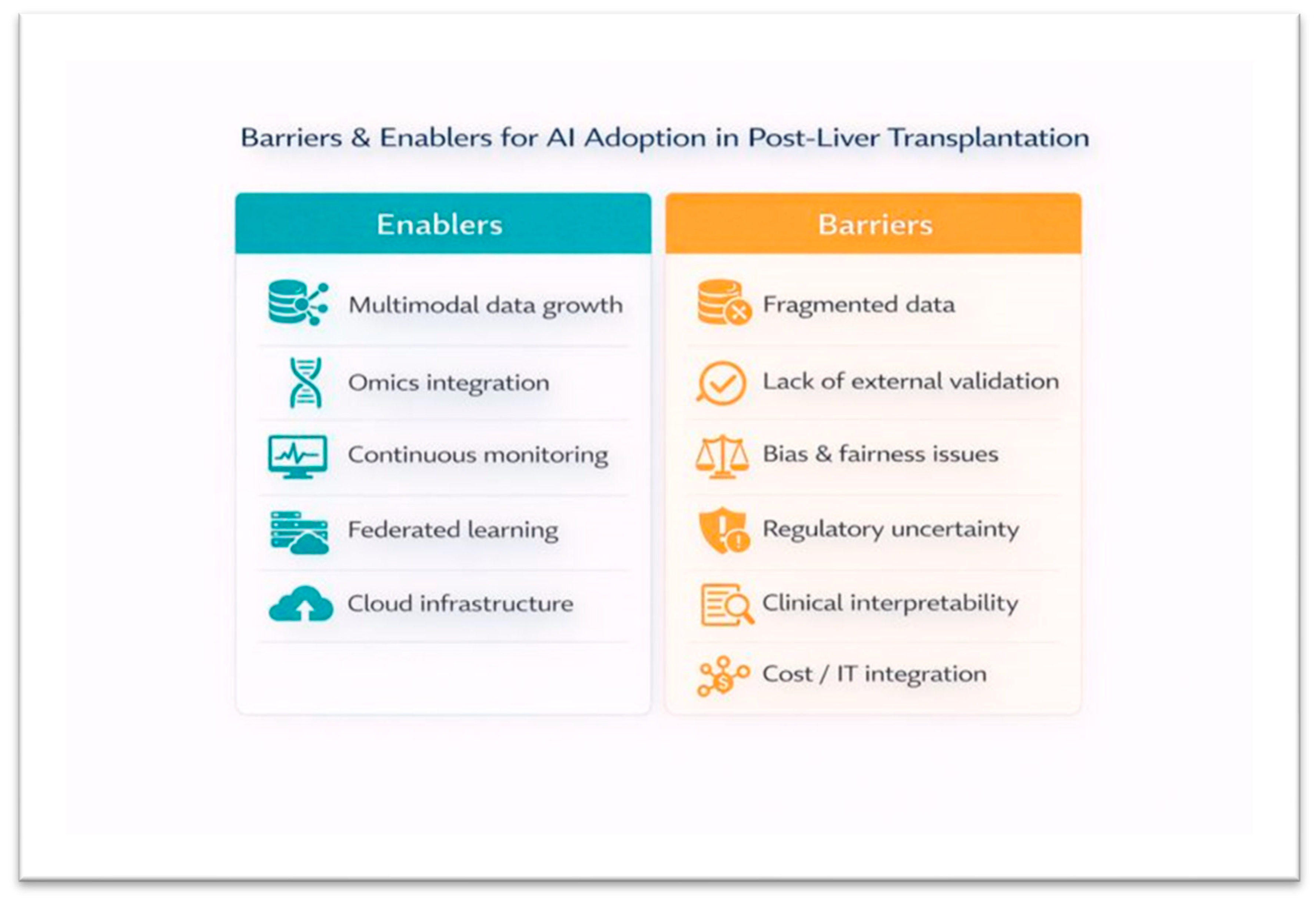
Across application domains, several methodological characteristics constrain interpretability, comparability, and translational potential. These methodological constraints parallel broader translational barriers and enablers for clinical implementation of AI in post-LT care, summarized in Figure 3. Most studies were retrospective and single-center, with heterogeneous variable sets and non-standardized outcome definitions [14,15,16,17,18,19,20,21,22,23,24,25,26,27,28,29,30,31,32,33,34,35,36,37,38,39,40,41,42,43,44,45,46,47,48,49,50,51,52,53,54,55,56,57,58,59,60,61,62,63,64,65]. Internal validation was common, external validation was uncommon, and prospective validation or real-world implementation was absent. While many included studies demonstrated promising discrimination, the majority represent proof-of-concept model development rather than clinically applicable AI. Most models were trained retrospectively and evaluated using internal cross-validation or split-sample testing, without evidence of prospective use, workflow integration, or impact on clinical decision-making. Only a limited subset of studies approached translational readiness through external validation in independent cohorts (e.g., multicenter validation of HCC recurrence and mortality prediction frameworks) [25,45,50,52]. A small number of operational studies also moved toward clinical usability by providing implementation-oriented interfaces such as online calculators or early warning systems [57,58]. However, even these deployment-adjacent investigations did not report clinician-in-the-loop evaluation, usability testing, alert burden, or downstream patient outcomes [57,58]. This distinction highlights a critical evidence gap: the current post-LT AI literature is rich in retrospective performance benchmarking, but remains sparse in clinically implemented, prospectively evaluated decision-support systems.
Figure 3.
Barriers and enablers for AI adoption in post-liver transplantation care. A conceptual illustration of the principal enablers (left) and barriers (right) influencing clinical translation and deployment of AI systems in post-liver transplantation care. Enablers include multimodal data availability, omics integration, continuous monitoring, federated learning, and cloud-based infrastructure. Barriers include fragmented data ecosystems, limited external validation, bias and fairness considerations, regulatory uncertainty, lack of interpretability, and resource-intensive IT integration.
In parallel, reporting quality and performance characterization were frequently incomplete. Performance reporting overwhelmingly emphasized discrimination metrics (AUC-ROC or C-index), whereas calibration, net benefit, decision-curve analysis, and impact metrics were rarely reported. Yet calibration is essential for risk communication and thresholding, and decision-analytic measures are necessary to determine whether improved accuracy translates into meaningful clinical benefit. Deep architectures introduced additional challenges related to explainability, uncertainty, and missing-data handling, but few studies described feature attribution or other interpretability techniques. Collectively, these methodological patterns indicate that while technical performance in controlled settings is increasingly well characterized, the evidentiary foundation required for safe and effective deployment remains incomplete.
These observations have several implications for the trajectory of AI in post-LT care. Translational impact will require movement beyond model-centric development toward ecosystem-centric design. For clinical prediction models, priorities include harmonized outcome definitions, multicenter data linkage, and prospective evaluation capable of assessing real-world performance and clinical impact. For operational AI, progress will depend on EHR integration, clinician-in-the-loop interfaces, usability testing, and deployment studies measuring alert burden, time-to-intervention, and acceptance among transplant teams. For system-level AI, advancement will require collaborative data infrastructures, federated and privacy-preserving learning strategies, and governance frameworks enabling the secure use of transplant registries and claims data. Finally, alignment with emerging reporting and evaluation standards (TRIPOD-AI, PROBAST-AI, and DECIDE-AI) will be essential to support transparent and clinically meaningful translation.
Overall, the current evidence depicts a field transitioning from proof-of-concept model development toward questions of implementation, safety, and utility. The methodological foundations for accurate clinical prediction are increasingly established, yet the translational infrastructures necessary for real-world deployment remain limited. Future progress will require harmonizing methodological rigor with implementation science, human-factors engineering, and system-level integration. Only through such alignment can AI systems evolve from retrospective accuracy benchmarks into clinically integrated tools with the capacity to alter postoperative trajectories and improve outcomes for LT recipients.
5. Conclusions
AI research in post-LT care appears to be approaching an inflection point. Technical capacity to model clinically meaningful graft and patient trajectories is now well established, yet the translational pathways required to convert predictive performance into clinical utility remain underdeveloped. Progress will depend on the alignment of methodological rigor, data infrastructure, human-factors engineering, and implementation science. Whether AI becomes an analytical adjunct or an integrated component of LT care will depend not on incremental gains in discrimination, but on the development of the institutional, infrastructural, and regulatory scaffolds needed to support safe, equitable, and clinically meaningful deployment.
Supplementary Materials
The following supporting information can be downloaded at: https://www.mdpi.com/article/10.3390/jcm15041491/s1/. Data S1: Complete search syntax for PubMed, Web of Science, and Cochrane.
Author Contributions
I.L., I.G., J.P.S., D.R. and D.L. participated in the conceptualization of this manuscript; I.L., I.G., J.P.S., D.R., A.G., L.K.B., N.P. and D.L. performed the literature review and data analysis; I.L., I.G., J.P.S., D.R., A.G. and D.L. designed the manuscript’s original draft; L.K.B., N.P., I.B.K., G.E., J.P., I.M., D.V.S., L.E., L.T., S.J., D.M., F.J. and L.M. reviewed and edited the manuscript original draft; and I.L., I.G., J.P.S., D.R. and D.L. performed manuscript supervision and project administration. All authors have read and agreed to the published version of the manuscript.
Funding
The authors have no sources of funding to declare for this manuscript.
Data Availability Statement
The data supporting the findings of this study are available from the corresponding author upon request.
Conflicts of Interest
The authors declare no conflicts of interest.
Abbreviations
The following abbreviations are used in this manuscript:
| ABIC | Age–bilirubin–INR–creatinine |
| ACLF | Acute-on-chronic liver failure |
| AdaBoost | Adaptive boosting |
| AFP | Alpha-fetoprotein |
| AI | Artificial intelligence |
| AJCC | American Joint Committee on Cancer |
| AKI | Acute kidney injury |
| ALP | Alkaline phosphatase |
| ALT | Alanine aminotransferase |
| AMAE | Average mean absolute error |
| ANN | Artificial neural network |
| APRI | Aspartate aminotransferase to platelet ratio index |
| APTT | Activated partial thromboplastin time |
| AST | Aspartate aminotransferase |
| AUC-PR | Area under the precision–recall curve |
| AUC-ROC | Area under the receiver operating characteristic curve |
| AUSCAD | Australian chronic allograft dysfunction study |
| BAR | Balance of risk |
| BCLC | Barcelona clinic liver cancer staging system |
| BiGRU | Bidirectional gated recurrent unit |
| BMI | Body mass index |
| C5.0 | Decision tree algorithm based on the C4.5 model, used for classification tasks |
| CART | Classification and regression tree |
| cDCD-NRP | Controlled donation after circulatory death under normothermic regional perfusion |
| cfDNA | Cell-free deoxyribonucleic acid |
| C-GBS | Component-wise gradient boosted survival |
| CI | Confidence interval |
| C-index | Concordance index |
| CIT | Cold ischemia time |
| CNN | Convolutional neural network |
| CoD-MTL | Cause-of-death multi-task learning |
| Cox-P | Cox model-based feature selection using p-values |
| CoxPH | Cox proportional hazards model |
| Coxnet | Cox proportional hazards model with elastic net regularization |
| CPH | Cox proportional hazards |
| CT | Computed tomography |
| DECIDE-AI | Developmental and exploratory clinical investigation of decision support systems driven by artificial intelligence |
| DeepSurv | Deep survival neural network |
| DL | Deep learning |
| DM | Diabetes mellitus |
| D-MELD | Donor age multiplied by recipient MELD score |
| DNN | Deep neural network |
| DPD | Demographic parity difference |
| DRI | Donor risk index |
| E-NET | Elastic net regression |
| EHCLT | European hepatocellular cancer liver transplant |
| EHRs | Electronic health records |
| EOD | Equalized odds difference |
| ERASL-post | European association for the study of the liver post-transplant model |
| ESLD | End-stage liver disease |
| Fair-ML | Fairness-aware machine learning |
| FERI | Fairness-enhanced risk index |
| FIB-4 | Fibrosis-4 index |
| FS-SVM | Fast survival support vector machine |
| GBDTs | Gradient boosted decision trees |
| GBS | Gradient boosted survival |
| GMS | Geometric mean of sensitivities |
| GRWR | Graft-to-recipient weight ratio |
| GST | Glutathione s-transferase |
| GVHD | Graft-versus-host disease |
| HALT-HCC | Hazard associated with liver transplantation for hepatocellular carcinoma |
| HCC | Hepatocellular carcinoma |
| INR | International normalized ratio |
| i-RAPIT | Integrated radiology and pathology for immunotherapy-based transplantation |
| KCH | King’s College Hospital |
| KNNs | K-nearest neighbors |
| LASSO | Least absolute shrinkage and selection operator |
| LDA | Linear discriminant analysis |
| LDAL | Latent Dirichlet Allocation |
| LDLT | Living donor liver transplantation |
| LightGBM | Light gradient boosting machine |
| LR | Logistic regression |
| LSTM | Long short-term memory |
| LT | Liver transplantation |
| MACEs | Major adverse cardiovascular events |
| MADRE | Model for allocation of donor and recipient using artificial intelligence |
| MAPLE | Molecular assessment of predictive liver expression |
| MELD | Model for end-stage liver disease |
| MELD-Na | Model for end-stage liver disease with serum sodium |
| MELD 3.0 | Updated model for end-stage liver disease, version 3.0 |
| MeSHs | Medical subject headings |
| MIMIC-IV | Medical information mart for intensive care, version IV |
| miRNA | Micro ribonucleic acid |
| ML | Machine learning |
| MLP | Multilayer perceptron |
| MORAL | Model of recurrence after liver transplantation |
| mRNA | Messenger ribonucleic acid |
| MPENSGA2 | Multi-objective evolutionary algorithm |
| NASH | Nonalcoholic steatohepatitis |
| NLP | Natural language processing |
| NODAT | New-onset diabetes after transplant |
| NPV | Negative predictive value |
| NRI | Net reclassification index |
| OPTN | Organ procurement and transplantation network |
| PCA | Principal component analysis |
| PND | Perioperative neurocognitive disorder |
| Post-LT | Post-liver transplantation |
| PPV | Positive predictive value |
| PRISMA-ScR | Preferred reporting items for systematic reviews and meta-analyses extension for scoping reviews |
| PROBAST-AI | Prediction model risk of bias assessment tool–artificial intelligence |
| PSC | Primary sclerosing cholangitis |
| PSSP | Patient-specific survival prediction |
| RBC | Red blood cell |
| RELAPSE | Recurrent liver cancer prediction score |
| ResNet-50 | 50-layer residual network |
| RETREAT | Risk estimation of tumor recurrence after transplant |
| RF | Random forest |
| RFE | Recursive feature elimination |
| Ridge | Regularized linear regression |
| RNA | Ribonucleic acid |
| RNN | Recurrent neural network |
| RSF | Random survival forest |
| SFM | Select from model |
| SHAPs | Shapley additive explanations |
| SOFA | Sequential organ failure assessment |
| SOFT | Survival outcomes following liver transplantation |
| SPLIT | Studies of pediatric liver transplantation |
| SpO2 | Peripheral capillary oxygen saturation |
| SRTR | Scientific registry of transplant recipients |
| STAR | Standard transplant analysis and research |
| SVM | Support vector machine |
| TabNet | Tabular neural network |
| TCGA | The cancer genome atlas |
| TCNs | Temporal convolutional networks |
| TM-GTP | Tissue microdissection–genotype tissue profiling |
| TNM | Tumor–node–metastasis staging system |
| TOP | Transferable omics prediction |
| TRIPOD-AI | Transparent reporting of a multivariable prediction model for individual prognosis or diagnosis–artificial intelligence |
| U-net | U-shaped convolutional neural network |
| UCSF | University of California San Francisco |
| UHN | University health network |
| UMHTC | US Multicenter HCC Transplant Consortium |
| UNOS | United Network for Organ Sharing |
| WBC | White blood cell |
| WIT | Warm ischemia time |
| XGBoost | Extreme gradient boosting |
References
- Devarbhavi, H.; Asrani, S.K.; Arab, J.P.; Nartey, Y.A.; Pose, E.; Kamath, P.S. Global burden of liver disease: 2023 update. J. Hepatol. 2023, 79, 516–537. [Google Scholar] [CrossRef] [Scilit] [PubMed]
- Ozturk, N.B.; Bartosek, N.; Toruner, M.D.; Mumtaz, A.; Simsek, C.; Dao, D.; Saberi, B.; Gurakar, A. Approach to Liver Transplantation: Is There a Difference between East and West? J. Clin. Med. 2024, 13, 1890. [Google Scholar] [CrossRef] [Scilit]
- Agostini, C.; Buccianti, S.; Risaliti, M.; Fortuna, L.; Tirloni, L.; Tucci, R.; Bartolini, I.; Grazi, G.L. Complications in Post-Liver Transplant Patients. J. Clin. Med. 2023, 12, 6173. [Google Scholar] [CrossRef] [Scilit]
- Gheorghe, G.; Diaconu, C.C.; Bungau, S.; Bacalbasa, N.; Motas, N.; Ionescu, V.A. Biliary and Vascular Complications after Liver Transplantation-From Diagnosis to Treatment. Medicina 2023, 59, 850. [Google Scholar] [CrossRef] [Scilit] [PubMed]
- Schenk, A.D.; Han, J.L.; Logan, A.J.; Sneddon, J.M.; Brock, G.N.; Pawlik, T.M.; Washburn, W.K. Textbook Outcome as a Quality Metric in Liver Transplantation. Transplant. Direct 2022, 8, e1322. [Google Scholar] [CrossRef] [Scilit] [PubMed]
- Herzer, K.; Sterneck, M.; Welker, M.W.; Nadalin, S.; Kirchner, G.; Braun, F.; Malessa, C.; Herber, A.; Pratschke, J.; Weiss, K.H.; et al. Current Challenges in the Post-Transplant Care of Liver Transplant Recipients in Germany. J. Clin. Med. 2020, 9, 3570. [Google Scholar] [CrossRef] [Scilit]
- Khosravi, M.; Zare, Z.; Mojtabaeian, S.M.; Izadi, R. Artificial Intelligence and Decision-Making in Healthcare: A Thematic Analysis of a Systematic Review of Reviews. Health Serv. Res. Manag. Epidemiol. 2024, 11, 23333928241234863. [Google Scholar] [CrossRef] [Scilit] [PubMed]
- Avramidou, E.; Todorov, D.; Katsanos, G.; Antoniadis, N.; Kofinas, A.; Vasileiadou, S.; Karakasi, K.E.; Tsoulfas, G. AI Innovations in Liver Transplantation: From Big Data to Better Outcomes. Livers 2025, 5, 14. [Google Scholar] [CrossRef] [Scilit]
- Andishgar, A.; Rismani, M.; Bazmi, S.; Mohammadi, Z.; Hooshmandi, S.; Kian, B.; Niakan, A.; Taheri, R.; Khalili, H.; Alizadehsani, R. Developing practical machine learning survival models to identify high-risk patients for in-hospital mortality following traumatic brain injury. Sci. Rep. 2025, 15, 5913. [Google Scholar] [CrossRef] [Scilit] [PubMed]
- Montgomery, A.E.; Rana, A. Current state of artificial intelligence in liver transplantation. Transplant. Rep. 2025, 10, 100173. [Google Scholar] [CrossRef] [Scilit]
- Bhat, M.; Rabindranath, M.; Chara, B.S.; Simonetto, D.A. Artificial intelligence, machine learning, and deep learning in liver transplantation. J. Hepatol. 2023, 78, 1216–1233. [Google Scholar] [CrossRef] [Scilit] [PubMed]
- Al Moussawy, M.; Lakkis, Z.S.; Ansari, Z.A.; Cherukuri, A.R.; Abou-Daya, K.I. The transformative potential of artificial intelligence in solid organ transplantation. Front. Transplant. 2024, 3, 1361491. [Google Scholar] [CrossRef] [Scilit]
- Tricco, A.C.; Lillie, E.; Zarin, W.; O’Brien, K.K.; Colquhoun, H.; Levac, D.; Moher, D.; Peters, M.D.J.; Horsley, T.; Weeks, L.; et al. PRISMA Extension for Scoping Reviews (PRISMA-ScR): Checklist and Explanation. Ann. Intern. Med. 2018, 169, 467–473. [Google Scholar] [CrossRef] [Scilit] [PubMed]
- Robertson, H.; Kim, H.J.; Li, J.; Robertson, N.; Robertson, P.; Jimenez-Vera, E.; Ameen, F.; Tran, A.; Trinh, K.; O’Connell, P.J.; et al. Decoding the hallmarks of allograft dysfunction with a comprehensive pan-organ transcriptomic atlas. Nat. Med. 2024, 30, 3748–3757. [Google Scholar] [CrossRef] [Scilit]
- Tusch, G. An optimization model for sequential decision-making applied to risk prediction after liver resection and transplantation. Proc. AMIA Symp. 1999, 425–429. [Google Scholar] [PubMed]
- Wadhwani, S.I.; Hsu, E.K.; Shaffer, M.L.; Anand, R.; Ng, V.L.; Bucuvalas, J.C. Predicting ideal outcome after pediatric liver transplantation: An exploratory study using machine learning analyses to leverage Studies of Pediatric Liver Transplantation Data. Pediatr. Transplant. 2019, 23, e13554. [Google Scholar] [CrossRef] [Scilit]
- Abdelhameed, A.; Bhangu, H.; Feng, J.; Li, F.; Hu, X.; Patel, P.; Yang, L.; Tao, C. Deep Learning-Based Prediction Modeling of Major Adverse Cardiovascular Events After Liver Transplantation. Mayo Clin. Proc. Digit. Health 2024, 2, 221–230. [Google Scholar] [CrossRef] [Scilit] [PubMed]
- Andishgar, A.; Bazmi, S.; Lankarani, K.B.; Taghavi, S.A.; Imanieh, M.H.; Sivandzadeh, G.; Saeian, S.; Dadashpour, N.; Shamsaeefar, A.; Ravankhah, M.; et al. Comparison of time-to-event machine learning models in predicting biliary complication and mortality rate in liver transplant patients. Sci. Rep. 2025, 15, 4768. [Google Scholar] [CrossRef] [Scilit] [PubMed]
- Andres, A.; Montano-Loza, A.; Greiner, R.; Uhlich, M.; Jin, P.; Hoehn, B.; Bigam, D.; Shapiro, J.A.M.; Kneteman, N.-M. A novel learning algorithm to predict individual survival after liver transplantation for primary sclerosing cholangitis. PLoS ONE 2018, 13, e0193523. [Google Scholar] [CrossRef] [Scilit] [PubMed]
- Azhie, A.; Sharma, D.; Sheth, P.; Qazi-Arisar, F.A.; Zaya, R.; Naghibzadeh, M.; Duan, K.; Fischer, S.; Patel, K.; Tsien, C.; et al. A deep learning framework for personalised dynamic diagnosis of graft fibrosis after liver transplantation: A retrospective, single Canadian centre, longitudinal study. Lancet Digit. Health. 2023, 5, e458–e466. [Google Scholar] [CrossRef] [Scilit] [PubMed]
- Bezjak, M.; Kocman, B.; Jadrijevic, S.; Filipec Kanizaj, T.; Antonijevic, M.; Dalbelo Basic, B.; Mikulic, D. Use of machine learning models for identification of predictors of survival and tumour recurrence in liver transplant recipients with hepatocellular carcinoma. Ann. Transl. Med. 2023, 11, 345. [Google Scholar] [CrossRef] [Scilit] [PubMed]
- Bhat, V.; Tazari, M.; Watt, K.D.; Bhat, M. New-Onset Diabetes and Preexisting Diabetes Are Associated with Comparable Reduction in Long-Term Survival After Liver Transplant: A Machine Learning Approach. Mayo Clin. Proc. 2018, 93, 1794–1802. [Google Scholar] [CrossRef] [Scilit] [PubMed]
- Briceño, J.; Cruz-Ramírez, M.; Prieto, M.; Navasa, M.; Ortiz de Urbina, J.; Orti, R.; Gómez-Bravo, M.Á.; Otero, A.; Varo, E.; Tomé, S.; et al. Use of artificial intelligence as an innovative donor-recipient matching model for liver transplantation: Results from a multicenter Spanish study. J. Hepatol. 2014, 61, 1020–1028. [Google Scholar] [CrossRef] [Scilit] [PubMed]
- Calleja, R.; Rivera, M.; Guijo-Rubio, D.; Hessheimer, A.J.; de la Rosa, G.; Gastaca, M.; Otero, A.; Ramírez, P.; Boscà-Robledo, A.; Santoyo, J.; et al. Machine Learning Algorithms in Controlled Donation After Circulatory Death Under Normothermic Regional Perfusion: A Graft Survival Prediction Model. Transplantation 2025, 109, e362–e370. [Google Scholar] [CrossRef] [Scilit] [PubMed]
- Cao, S.; Yu, S.; Huang, L.; Seery, S.; Xia, Y.; Zhao, Y.; Si, Z.; Zhang, X.; Zhu, J.; Lang, R.; et al. Deep learning for hepatocellular carcinoma recurrence before and after liver transplantation: A multicenter cohort study. Sci. Rep. 2025, 15, 7730. [Google Scholar] [CrossRef] [Scilit] [PubMed]
- Chen, X.; Tang, S.; Qin, Y.; Zhou, S.; Zhang, L.; Huang, Y.; Chen, Z. A Predictive Model of Pressure Injury in Children Undergoing Living Donor Liver Transplantation Based on Machine Learning Algorithm. J. Adv. Nurs. 2024, 81, 3003–3012. [Google Scholar] [CrossRef] [Scilit] [PubMed]
- Cooper, J.P.; Perkins, J.D.; Warner, P.R.; Shingina, A.; Biggins, S.W.; Abkowitz, J.L.; Reyes, J.D. Acute Graft-Versus-Host Disease After Orthotopic Liver Transplantation: Predicting This Rare Complication Using Machine Learning. Liver Transpl. 2022, 28, 407–421. [Google Scholar] [CrossRef] [Scilit] [PubMed]
- Cruz-Ramírez, M.; Hervás-Martínez, C.; Fernández, J.C.; Briceño, J.; de la Mata, M. Predicting patient survival after liver transplantation using evolutionary multi-objective artificial neural networks. Artif. Intell. Med. 2013, 58, 37–49. [Google Scholar] [CrossRef] [Scilit] [PubMed]
- Ding, Z.; Zhang, L.; Zhang, Y.; Yang, J.; Luo, Y.; Ge, M.; Yao, W.; Hei, Z.; Chen, C. A Supervised Explainable Machine Learning Model for Perioperative Neurocognitive Disorder in Liver-Transplantation Patients and External Validation on the Medical Information Mart for Intensive Care IV Database: Retrospective Study. J. Med. Internet. Res. 2025, 27, e55046. [Google Scholar] [CrossRef] [Scilit] [PubMed]
- Fatemi, Y.; Nikfar, M.; Oladazimi, A.; Zheng, J.; Hoy, H.; Ali, H. Machine Learning Approach for Cardiovascular Death Prediction among Nonalcoholic Steatohepatitis (NASH) Liver Transplant Recipients. Healthcare 2024, 12, 1165. [Google Scholar] [CrossRef] [Scilit] [PubMed]
- Ge, J.; Digitale, J.C.; Fenton, C.; McCulloch, C.E.; Lai, J.C.; Pletcher, M.J.; Gennatas, E.D. Predicting post-liver transplant outcomes in patients with acute-on-chronic liver failure using Expert-Augmented Machine Learning. Am. J. Transplant. 2023, 23, 1908–1921. [Google Scholar] [CrossRef] [Scilit] [PubMed]
- He, T.; Fong, J.N.; Moore, L.W.; Ezeana, C.F.; Victor, D.; Divatia, M.; Vasquez, M.; Ghobrial, R.M.; Wong, S.T.C. An imageomics and multi-network based deep learning model for risk assessment of liver transplantation for hepatocellular cancer. Comput. Med. Imaging. Graph. 2021, 89, 101894. [Google Scholar] [CrossRef] [Scilit] [PubMed]
- Ivanics, T.; Nelson, W.; Patel, M.S.; Claasen, M.P.A.W.; Lau, L.; Gorgen, A.; Abreu, P.; Goldenberg, A.; Erdman, L.; Sapisochin, G. The Toronto Post Liver Transplantation Hepatocellular Carcinoma Recurrence Calculator: A Machine Learning Approach. Liver Transpl. 2022, 28, 593–602. [Google Scholar] [CrossRef] [Scilit] [PubMed]
- Jain, V.; Bansal, A.; Radakovich, N.; Sharma, V.; Khan, M.Z.; Harris, K.; Bachour, S.; Kleb, C.; Cywinski, J.; Argalious, M.; et al. Machine Learning Models to Predict Major Adverse Cardiovascular Events After Orthotopic Liver Transplantation: A Cohort Study. J. Cardiothorac. Vasc. Anesth. 2021, 35, 2063–2069. [Google Scholar] [CrossRef] [Scilit] [PubMed]
- Kantidakis, G.; Putter, H.; Lancia, C.; Boer, J.; Braat, A.E.; Fiocco, M. Survival prediction models since liver transplantation—Comparisons between Cox models and machine learning techniques. BMC Med. Res. Methodol. 2020, 20, 277. [Google Scholar] [CrossRef] [Scilit] [PubMed]
- Kazemi, A.; Kazemi, K.; Sami, A.; Sharifian, R. Identifying Factors That Affect Patient Survival After Orthotopic Liver Transplant Using Machine-Learning Techniques. Exp. Clin. Transplant. 2019, 17, 775–783. [Google Scholar] [CrossRef] [Scilit] [PubMed]
- Ko, S.H.; Cao, J.; Yang, Y.K.; Xi, Z.F.; Han, H.W.; Sha, M.; Xia, Q. Development of a deep learning model for predicting recurrence of hepatocellular carcinoma after liver transplantation. Front. Med. 2024, 11, 1373005. [Google Scholar] [CrossRef] [Scilit]
- Lee, H.C.; Yoon, S.B.; Yang, S.M.; Kim, W.H.; Ryu, H.G.; Jung, C.W.; Suh, K.S.; Lee, K.H. Prediction of Acute Kidney Injury after Liver Transplantation: Machine Learning Approaches vs. Logistic Regression Model. J. Clin. Med. 2018, 7, 428. [Google Scholar] [CrossRef] [Scilit]
- Liu, C.L.; Soong, R.S.; Lee, W.C.; Jiang, G.W.; Lin, Y.C. Predicting Short-term Survival after Liver Transplantation using Machine Learning. Sci. Rep. 2020, 10, 565. [Google Scholar] [CrossRef] [Scilit] [PubMed]
- Liu, L.P.; Zhao, Q.Y.; Wu, J.; Luo, Y.W.; Dong, H.; Chen, Z.W.; Gui, R.; Wang, Y.J. Machine Learning for the Prediction of Red Blood Cell Transfusion in Patients During or After Liver Transplantation Surgery. Front. Med. 2021, 8, 632210. [Google Scholar] [CrossRef] [Scilit] [PubMed]
- Liu, Z.; Liu, Y.; Zhang, W.; Hong, Y.; Meng, J.; Wang, J.; Zheng, S.; Xu, X. Deep learning for prediction of hepatocellular carcinoma recurrence after resection or liver transplantation: A discovery and validation study. Hepatol. Int. 2022, 16, 577–589. [Google Scholar] [CrossRef] [Scilit]
- Loosen, S.H.; Krieg, S.; Chaudhari, S.; Upadhyaya, S.; Krieg, A.; Luedde, T.; Kostev, K.; Roderburg, C. Prediction of New-Onset Diabetes Mellitus within 12 Months after Liver Transplantation—A Machine Learning Approach. J. Clin. Med. 2023, 12, 4877. [Google Scholar] [CrossRef] [Scilit] [PubMed]
- Melvin, D.G.; Niranjan, M.; Prager, R.W.; Trull, A.K.; Hughes, V.F. Neuro-computing versus linear statistical techniques applied to liver transplant monitoring: A comparative study. IEEE Trans. Biomed. Eng. 2000, 47, 1036–1043. [Google Scholar] [CrossRef] [PubMed]
- Ningappa, M.; Rahman, S.A.; Higgs, B.W.; Ashokkumar, C.S.; Sahni, N.; Sindhi, R.; Das, J. A network-based approach to identify expression modules underlying rejection in pediatric liver transplantation. Cell Rep. Med. 2022, 3, 100605. [Google Scholar] [CrossRef] [Scilit] [PubMed]
- Nitski, O.; Azhie, A.; Qazi-Arisar, F.A.; Wang, X.; Ma, S.; Lilly, L.; Watt, K.D.; Levitsky, J.; Asrani, S.K.; Lee, D.S.; et al. Long-term mortality risk stratification of liver transplant recipients: Real-time application of deep learning algorithms on longitudinal dana. Lancet Digit. Health 2021, 3, e295–e305. [Google Scholar] [CrossRef] [Scilit] [PubMed]
- Piscaglia, F.; Cucchetti, A.; Benlloch, S.; Vivarelli, M.; Berenguer, J.; Bolondi, L.; Pinna, A.D.; Berenguer, M. Prediction of significant fibrosis in hepatitis C virus infected liver transplant recipients by artificial neural network analysis of clinical factors. Eur. J. Gastroenterol. Hepatol. 2006, 18, 1255–1261. [Google Scholar] [CrossRef] [Scilit]
- Qu, W.F.; Tian, M.X.; Lu, H.W.; Zhou, Y.F.; Liu, W.R.; Tang, Z.; Yao, Z.; Huang, R.; Zhu, G.Q.; Jiang, X.F.; et al. Development of a deep pathomics score for predicting hepatocellular carcinoma recurrence after liver transplantation. Hepatol. Int. 2023, 17, 927–941. [Google Scholar] [CrossRef] [Scilit]
- Raji, C.G.; Chandra, S.S.V.; Gracious, N.; Pillai, Y.R.; Sasidharan, A. Advanced prognostic modeling with deep learning: Assessing long-term outcomes in liver transplant recipients from deceased and living donors. J. Transl. Med. 2025, 23, 188. [Google Scholar] [CrossRef] [Scilit] [PubMed]
- Rodriguez-Luna, H.; Vargas, H.E.; Byrne, T.; Rakela, J. Artificial neural network and tissue genotyping of hepatocellular carcinoma in liver-transplant recipients: Prediction of recurrence. Transplantation 2005, 79, 1737–1740. [Google Scholar] [CrossRef] [Scilit]
- Tran, B.V.; Moris, D.; Markovic, D.; Zaribafzadeh, H.; Henao, R.; Lai, Q.; Florman, S.S.; Tabrizian, P.; Haydel, B.; Ruiz, R.M.; et al. Development and validation of a REcurrent Liver cAncer Prediction ScorE (RELAPSE) following liver transplantation in patients with hepatocellular carcinoma: Analysis of the US Multicenter HCC Transplant Consortium. Liver Transpl. 2023, 29, 683–697. [Google Scholar] [CrossRef] [Scilit] [PubMed]
- Xie, H.; Shi, B.; Fan, J.; Liu, S.; Ma, Q.; Dai, J.; Dong, S.; Liu, Y.; Meng, H.; Liu, H.; et al. A predictive model based on radiomics, clinical features, and pathologic indicators for disease-free survival after liver transplantation for hepatocellular carcinoma: A 7-year retrospective study. J. Gastrointest. Oncol. 2024, 15, 2187–2200. [Google Scholar] [CrossRef] [Scilit] [PubMed]
- Yasodhara, A.; Dong, V.; Azhie, A.; Goldenberg, A.; Bhat, M. Identifying Modifiable Predictors of Long-Term Survival in Liver Transplant Recipients with Diabetes Mellitus Using Machine Learning. Liver Transpl. 2021, 27, 536–547. [Google Scholar] [CrossRef] [Scilit] [PubMed]
- Yu, Y.D.; Lee, K.S.; Man Kim, J.; Ryu, J.H.; Lee, J.G.; Lee, K.W.; Kim, B.W.; Kim, D.S. Korean Organ Transplantation Registry Study Group. Artificial intelligence for predicting survival following deceased donor liver transplantation: Retrospective multi-center study. Int. J. Surg. 2022, 105, 106838. [Google Scholar] [CrossRef] [Scilit] [PubMed]
- Zabara, M.L.; Popescu, I.; Burlacu, A.; Geman, O.; Dabija, R.A.C.; Popa, I.V.; Lupascu, C. Machine Learning Model Validated to Predict Outcomes of Liver Transplantation Recipients with Hepatitis C: The Romanian National Transplant Agency Cohort Experience. Sensors 2023, 23, 2149. [Google Scholar] [CrossRef] [Scilit]
- Zalba Etayo, B.; Marín Araiz, L.; Montes Aranguren, M.; Lorente Pérez, S.; Palacios Gasos, P.; Pascual Bielsa, A.; Sánchez Donoso, N.; Serrano Aullo, T.; Araiz Burdio, J.J. Graft Survival in Liver Transplantation: An Artificial Neuronal Network Assisted Analysis of the Importance of Comorbidities. Exp. Clin. Transplant. 2023, 21, 338–344. [Google Scholar] [CrossRef] [PubMed]
- Zhang, Y.; Yang, D.; Liu, Z.; Chen, C.; Ge, M.; Li, X.; Luo, T.; Wu, Z.; Shi, C.; Wang, B.; et al. An explainable supervised machine learning predictor of acute kidney injury after adult deceased donor liver transplantation. J. Transl. Med. 2021, 19, 321. [Google Scholar] [CrossRef] [Scilit] [PubMed]
- Chen, C.; Yang, D.; Gao, S.; Zhang, Y.; Chen, L.; Wang, B.; Mo, Z.; Yang, Y.; Hei, Z.; Zhou, S. Development and performance assessment of novel machine learning models to predict pneumonia after liver transplantation. Respir. Res. 2021, 22, 94. [Google Scholar] [CrossRef] [Scilit]
- Chen, C.; Chen, B.; Yang, J.; Li, X.; Peng, X.; Feng, Y.; Guo, R.; Zou, F.; Zhou, S.; Hei, Z. Development and validation of a practical machine learning model to predict sepsis after liver transplantation. Ann. Med. 2023, 55, 624–633. [Google Scholar] [CrossRef] [Scilit] [PubMed]
- Kamaleswaran, R.; Sataphaty, S.K.; Mas, V.R.; Eason, J.D.; Maluf, D.G. Artificial Intelligence May Predict Early Sepsis After Liver Transplantation. Front. Physiol. 2021, 12, 692667. [Google Scholar] [CrossRef] [Scilit]
- Ding, S.; Tang, R.; Zha, D.; Zou, N.; Zhang, K.; Jiang, X.; Hu, X. Fairly Predicting Graft Failure in Liver Transplant for Organ Assigning. AMIA Annu. Symp. Proc. 2023, 2022, 415–424. [Google Scholar] [PubMed]
- Ding, S.; Tan, Q.; Chang, C.Y.; Zou, N.; Zhang, K.; Hoot, N.R.; Jiang, X.; Hu, X. Multi-Task Learning for Post-transplant Cause of Death Analysis: A Case Study on Liver Transplant. AMIA Annu. Symp. Proc. 2024, 2023, 913–922. [Google Scholar] [PubMed]
- Dorado-Moreno, M.; Pérez-Ortiz, M.; Gutiérrez, P.A.; Ciria, R.; Briceño, J.; Hervás-Martínez, C. Dynamically weighted evolutionary ordinal neural network for solving an imbalanced liver transplantation problem. Artif. Intell. Med. 2017, 77, 1–11. [Google Scholar] [CrossRef] [Scilit]
- Guijo-Rubio, D.; Briceño, J.; Gutiérrez, P.A.; Ayllón, M.D.; Ciria, R.; Hervás-Martínez, C. Statistical methods versus machine learning techniques for donor-recipient matching in liver transplantation. PLoS ONE 2021, 16, e0252068. [Google Scholar] [CrossRef] [Scilit] [PubMed]
- Li, C.; Lai, D.; Jiang, X.; Zhang, K. FERI: A Multitask-based Fairness Achieving Algorithm with Applications to Fair Organ Transplantation. AMIA Jt. Summits. Transl. Sci. Proc. 2024, 2024, 593–602. [Google Scholar] [PubMed]
- Li, C.; Jiang, X.; Zhang, K. A transformer-based deep learning approach for fairly predicting post-liver transplant risk factors. J. Biomed. Inform. 2024, 149, 104545. [Google Scholar] [CrossRef] [Scilit] [PubMed]
- Chongo, G.; Soldera, J. Use of machine learning models for the prognostication of liver transplantation: A systematic review. World J. Transplant. 2024, 14, 88891. [Google Scholar] [CrossRef] [Scilit] [PubMed]
- Pruinelli, L.; Balakrishnan, K.; Ma, S.; Li, Z.; Wall, A.; Lai, J.C.; Schold, J.D.; Pruett, T.; Simon, G. Transforming liver transplant allocation with artificial intelligence and machine learning: A systematic review. BMC Med. Inform. Decis. Mak. 2025, 25, 98. [Google Scholar] [CrossRef] [Scilit] [PubMed]
- Rahman, M.A.; Yilmaz, I.; Albadri, S.T.; Salem, F.E.; Dangott, B.J.; Taner, C.B.; Nassar, A.; Akkus, Z. Artificial Intelligence Advances in Transplant Pathology. Bioengineering 2023, 10, 1041. [Google Scholar] [CrossRef] [Scilit] [PubMed]
- Wingfield, L.R.; Ceresa, C.; Thorogood, S.; Fleuriot, J.; Knight, S. Using Artificial Intelligence for Predicting Survival of Individual Grafts in Liver Transplantation: A Systematic Review. Liver Transpl. 2020, 26, 922–934. [Google Scholar] [CrossRef] [Scilit] [PubMed]
- Calleja Lozano, R.; Hervás Martínez, C.; Briceño Delgado, F.J. Crossroads in Liver Transplantation: Is Artificial Intelligence the Key to Donor-Recipient Matching? Medicina 2022, 58, 1743. [Google Scholar] [CrossRef] [Scilit] [PubMed]
- Ferrarese, A.; Sartori, G.; Orrù, G.; Frigo, A.C.; Pelizzaro, F.; Burra, P.; Senzolo, M. Machine learning in liver transplantation: A tool for some unsolved questions? Transpl. Int. 2021, 34, 398–411. [Google Scholar] [CrossRef] [Scilit] [PubMed]
- Fuchs, J.; Rabaux-Eygasier, L.; Guerin, F. Artificial Intelligence in Pediatric Liver Transplantation: Opportunities and Challenges of a New Era. Children 2024, 11, 996. [Google Scholar] [CrossRef] [Scilit] [PubMed]
- Gulla, A.; Jakiunaite, I.; Juchneviciute, I.; Dzemyda, G. A narrative review: Predicting liver transplant graft survival using artificial intelligence modeling. Front. Transplant. 2024, 3, 1378378. [Google Scholar] [CrossRef] [Scilit] [PubMed]
- Ivanics, T.; Patel, M.S.; Erdman, L.; Sapisochin, G. Artificial intelligence in transplantation (machine-learning classifiers and transplant oncology). Curr. Opin. Organ. Transplant. 2020, 25, 426–434. [Google Scholar] [CrossRef] [Scilit] [PubMed]
- Taner, T.; Bruner, J.; Emamaullee, J.; Bonaccorsi-Riani, E.; Zarrinpar, A. New Approaches to the Diagnosis of Rejection and Prediction of Tolerance in Liver Transplantation. Transplantation 2022, 106, 1952–1962. [Google Scholar] [CrossRef] [Scilit] [PubMed]
- Jiang, L.; Wang, J.; Wang, Y.; Yang, H.; Kong, L.; Wu, Z.; Shen, A.; Huang, Z.; Jiang, Y. Bibliometric and LDA analysis of acute rejection in liver transplantation: Emerging trends, immunotherapy challenges, and the role of artificial intelligence. Cell Transplant. 2025, 34, 9636897251325628. [Google Scholar] [CrossRef] [Scilit] [PubMed]
- Khorsandi, S.E. Will deep learning change outcomes in liver transplant? Lancet Digit. Health 2023, 5, e398–e399. [Google Scholar] [CrossRef] [Scilit] [PubMed]

Disclaimer/Publisher’s Note: The statements, opinions and data contained in all publications are solely those of the individual author(s) and contributor(s) and not of MDPI and/or the editor(s). MDPI and/or the editor(s) disclaim responsibility for any injury to people or property resulting from any ideas, methods, instructions or products referred to in the content. |
© 2026 by the authors. Licensee MDPI, Basel, Switzerland. This article is an open access article distributed under the terms and conditions of the Creative Commons Attribution (CC BY) license.