


Abstract
Background: We aimed to analyse the performance of minimal invasive extracorporeal circulation (MiECC) concomitantly with Microplegia, in patients with recent myocardial infarction (MI) undergoing urgent coronary artery bypass grafting (CABG) surgery. Methods: We included patients with a recent MI (≤7 days) undergoing isolated CABG surgery using MiECC. The primary endpoint was a major cardiovascular or cerebrovascular event (MACCE). In a secondary analysis, we compared our institutional Microplegia concept with the use of a crystalloid single-shot cardioplegic solution. Results: In total, 139 patients (mean ± standard deviation (SD) age 66 ± 10 years) underwent urgent CABG surgery using Microplegia; 55% (n = 77) of the patients had an acute MI within 1–7 days preoperatively; 20% (n = 28) had an acute MI within 6–24 h; and 24% (n = 34) had an acute MI within <6 h preoperatively. The number of distal anastomoses was a geometric mean of 4 (95% confidence interval 3–4). The MACCE and in-hospital mortality were 7% (n = 10) and 1% (n = 2), respectively. The results were confirmed in a secondary analysis comparing Microplegia with crystalloid cardioplegic solution (n = 271). Conclusion: The use of MiECC with Microplegia in urgent CABG surgery is feasible and safe and provides a straight-forward intraoperative setting. Therefore, it can also be considered to retain the benefits of MiECC in urgent CABG surgery.
1. Introduction
Coronary artery bypass grafting (CABG) represents the therapy of choice for patients with complex coronary artery disease [1,2,3]. Despite recommendations for off-pump surgery for patients with significant atherosclerotic aortic disease and high-risk patients, the majority of CABG operations are performed using extracorporeal circulation (ECC), especially in the case of urgent CABG surgeries [3,4,5].
To further improve outcomes after CABG, various efforts have been made within recent decades to implement new strategies and technologies. Among them, a minimized and closed form of ECC, the minimal extracorporeal circulation system (MiECC) was introduced to maintain the advantages of the ECC but to reduce artificial surfaces and avoid blood–air contact [6].
Based on excellent short-, mid-, and long-term outcomes, the use of MiECC in CABG surgery should be considered over the standard ECC, to decrease blood loss and the need for transfusion as well as to increase the biocompatibility of ECC [6,7,8,9,10,11,12,13,14,15,16,17]. In addition to MiECC, at our institution we use the Myocardial Protection System (second-generation, MPS®) to deliver a refined Microplegia, which was shown to be superior regarding perioperative myocardial injury when compared to a single-shot crystalloid solution (Cardioplexol® Bichsel, Interlaken, Switzerland) [7,8].
However, data analysing the use of MiECC in the setting of an urgent operation in patients with recent acute myocardial infarction (MI) is limited, even though this represents a crucial and, so far in studies, underrepresented patient population.
To address this major gap in clinical knowledge, we aimed to analyse our experience using MiECC in patients with recent MI undergoing urgent CABG surgery and in a secondary analysis to compare the use of our institutionally developed Microplegia concept with the use of a crystalloid single-shot cardioplegia.
2. Materials and Methods
2.1. Study Design
In our centre, standard perfusion strategies for isolated CABG surgery comprise on-pump surgery using MiECC or off-pump coronary artery bypass grafting (OPCABG). ECC is mostly applied in emergency situations with potential need for concomitant procedures such as beating heart surgery, valve surgery, or other non-CABG surgeries. Consequently, since ECC is only used in special situations and a minority of isolated CABG surgeries (n = 124), these patients were excluded and also not considered for comparison with MiECC.
To investigate the quality of MiECC in consecutive patients over the age of 18 undergoing urgent CABG in patients with recent MI, we only included patients with an MI within the last 7 days prior to surgery based on our own observational data and excluded all patients without prior MI or MI ≥ 8 days.
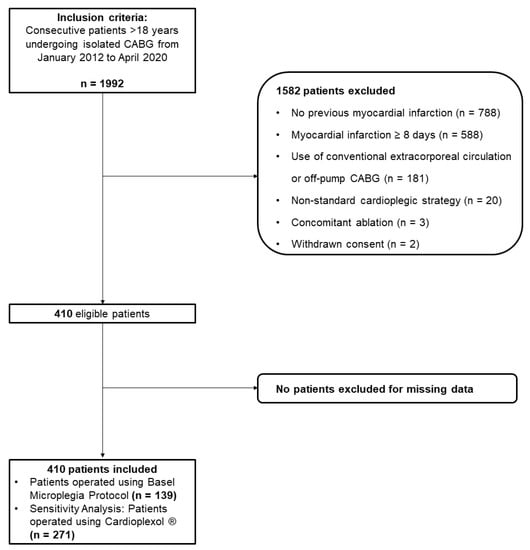
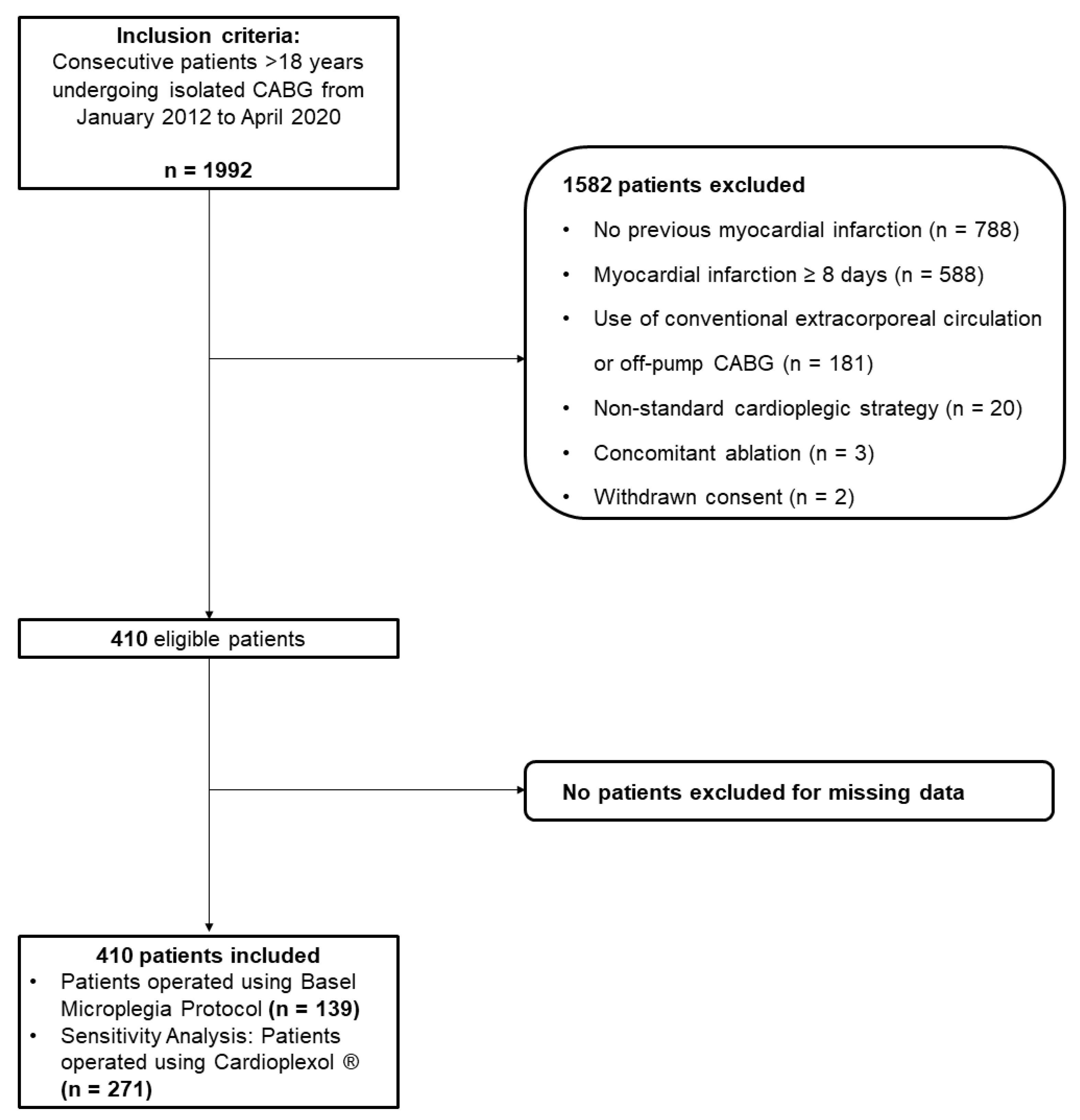
For this analysis, we further excluded patients with OPCAB surgery, non-standard cardioplegic strategy, or concomitant ablation (Figure 1). Patients with concomitant ablation were excluded, since we aimed for a homogenous study cohort with a minimum of additional confounders.
Figure 1.
Flowchart; CABG denotes coronary artery bypass grafting.
To further generalize our findings, we performed an additional analysis comparing patients operated on using MiECC and Microplegia (current standard approach) with a historical cohort operated on using MiECC and a single-shot cardioplegia (further details are provided in the section “Cardioplegia strategy and technical details”).
Using a prospectively maintained institutional registry (Intellect 1.7, Dendrite Clinical Systems, Henley-on-Thames, UK), we identified all suitable patients after January 2012. This registry, where data have been regularly controlled for completeness and accuracy, was used to export the clinical data [7,8,15].
Furthermore, we assessed, as the primary outcome, MACCE defined as postoperative stroke, MI, or all-cause death before discharge. Stroke was defined as episode of neurological dysfunction caused by a focal cerebral infarction and typically confirmed with imaging. MI was diagnosed according to current clinical guideline practice [18].
Blood results such as high-sensitivity cardiac troponin T (hs-cTnT), creatine kinase (CK), and CK-myoglobin-binding (CK-MB) were measured according to the standard algorithm in our hospital, starting on postoperative day (POD) 1 and continuing on a daily basis until a decreasing trend was observed. However, since the preoperative dynamic of these biomarkers, which per se are elevated in patients with recent MI, could not be precisely implemented in a statistical model, we chose MACCE as the primary endpoint.
2.2. Cardioplegia Strategy and Technical Details
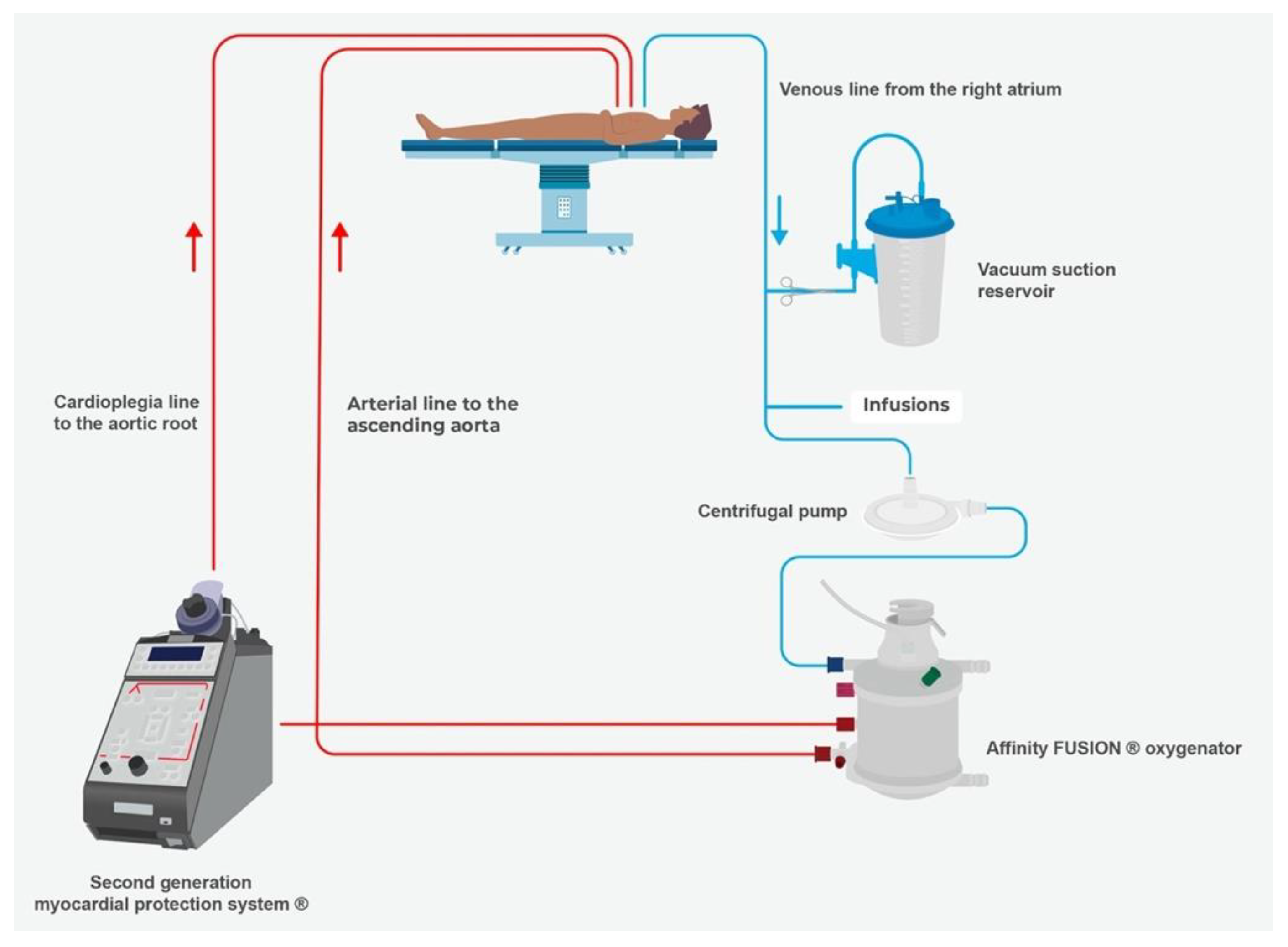
In our institution, we use a closed Mini-ECC-system type 1 with a priming volume of about 600 mL. The system is composed of a Bio-Console® 560 (Medtronic Inc., Minneapolis, MN, USA), a Medtronic centrifugal pump, and an Affinity FUSION® oxygenator (Medtronic Inc.). Targeted flow rates are 2 L/min/m2 [6].
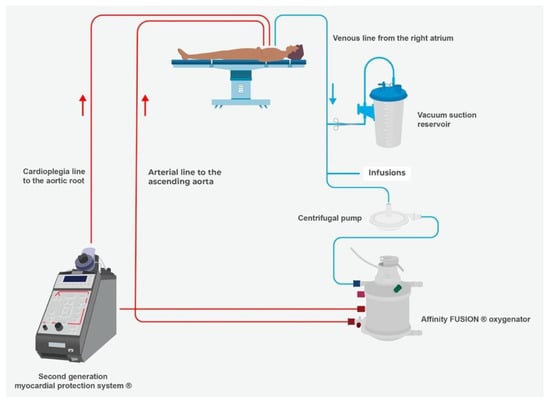
When using the MiECC system, only a few cardioplegic solutions are applicable. High-volume crystalloid cardioplegic solutions are not feasible due to the closed concept of MiECC leading to volume overload. In order to further improve our perfusion strategy when using MiECC, we added the second-generation MPS® to apply an institutional, refined Microplegia (Basel Microplegia Protocol, BMP) in 2017 (Figure 2).
Figure 2.
It shows the concept of the Myocardial Protection System (MPS®) as an additional tool to the minimal extracorporeal circulation (MIECC) system to apply Microplegia.
High volumes of patient blood, gained from the oxygenator, enriched with potassium (20 mmol/L for the first two minutes and 13 mmol/L for the next two minutes), magnesium (1.6 g/L), and lidocaine (40 mg/L) (therefore, high-volume but euvolemic Microplegia) are applied with a targeted flow of 300 mL/min for 4 min during induction and 2 min in a 20 min interval for repetition. Before declamping, a hot shot (warm patient blood) is given for 1 min (without potassium). This concept was shown to be feasible, reliable, and beneficial compared to a single-shot, low-volume crystalloid cardioplegic solution (Cardioplexol® Bichsel, Interlaken, Switzerland; composition: 10 mmol/100 mL potassium, 16.2 mmol/100 mL Magnesium; 1.1 mmol/100 mL procaine, 29.6 mmol/100 mL xylitol), regarding perioperative myocardial damage in patients without recent MI [7,8,15]. This single-shot cardioplegia, which is applied directly and manually via the aortic root, was used in our institution before introduction of the Microplegia. Since the Microplegia showed excellent results, the combination of MiECC and Microplegia became routine in isolated CABG in our institution [7,8,15]. Further details of our Microplegia solution, as well as the use of single-shot cardioplegia, were previously described in detail [7,8].
Surgical strategy remains similar when using Microplegia compared to the use of MiECC with single-shot cardioplegia, except for the induction phase of 4 min, repeated Microplegia administration at 20-min intervals as well as the “hot-shot” application prior to declamping [7,8]. In brief, after median sternotomy and heparinization, the ascending aorta and the right atrium were cannulated. While we aimed for 34 °C core temperature when introducing the Microplegia concept, we nowadays aim for a normothermic core temperature. Topical cooling of the heart was not performed as standard. Routine postoperative anticoagulation consisted of lifelong 100 mg aspirin daily and a second anti-platelet medication for 12 months after myocardial infarction.
2.3. Ethical Approval
The study was conducted according to the principles of the Declaration of Helsinki and was authorized by the ethical committee (EKNZ BASEC Req-2019-02383; ClinicalTrials.gov ID NCT04309994). Informed consent was waived by the ethical committee.
2.4. Statistical Analysis
We carried out two main analyses. We first described our Microplegia treatment group summarizing continuous variables as mean ± standard deviation (SD) if normally distributed or as geometric means with confidence intervals back-transformed from the logarithmic scale if skewed. Categorical data were reported as numbers with percentage.
For the comparison of MiECC in conjunction with Microplegia and single-shot cardioplegia, we conducted an inverse probability of treatment weighting (IPTW) analysis to derive the average treatment effect based on logistic regression. We included gender, body mass index (BMI), preoperative stroke, preoperative renal failure, time since myocardial infarction (MI), hypertension, NYHA class 3 or 4, current smoking status, main stem disease, and preoperative atrial fibrillation as covariates into the propensity model. Time since MI was categorized into <6 h, 6–24 h, and 1–7 days. We selected these variables because they might be associated with the risk of MACCE, which is the primary outcome.
We censored treatment weights exceeding the 1st and 99th percentile [19] or 10, respectively, and calculated standardized differences for each variable to assess residual imbalances between the groups, using the formulae proposed by Austin et al. [20]. Differences between the treatment groups (Microplegia and single-shot cardioplegia) before and after IPTW were expressed as standardized differences to assess comparability, independently of the number of observations; the standardized differences are displayed in Supplemental Figure S1. We also calculated p values using linear regression for normally distributed continuous variables, linear regression on the log scale for skewed variables, and logistic regression for binary and multinomial logistic regression for categorical variables. Confidence intervals and p-values are two-sided; a p-value below 0.05 is considered significant. All analyses were performed by a biostatistician (BG) using Stata 16.0 (Stata Corp, College Station, TX, USA).
3. Results
3.1. Preoperative Data
From January 2012 until April 2020, 1992 patients underwent isolated CABG surgery. In total, 1582 patients were excluded, and the study cohort consisted of 139 patients operated on using Microplegia, while 271 patients were operated on using single-shot cardioplegia and are analysed within the secondary analysis (Figure 1).
Mean ± SD age was 66 ± 10 years, and the majority of patients were men (n = 122, 88%). Overall, 55% (n = 77) of the patients had an acute MI within 1–7 days preoperatively, whereas 20% (n = 28) had an acute MI within 6–24 h, and 24% (n = 34) had an MI < 6 h preoperatively. In order to derive unconfounded effect estimates, we conducted propensity modelling and calculated IPT-weighted effect sizes intended to express the influence of the cardioplegic approach, rather than reflecting patient characteristics. Preoperative data are presented in Table 1.
Table 1.
Preoperative data.
3.2. Intraoperative Data
A left internal mammary artery (LIMA) was used as the graft in 97% of the operations (n = 135). Total arterial revascularization was performed in 17% (n = 23), and the number of distal anastomoses were a geometric mean of 4 (95% CI 3–4). Mean ± SD procedure time (from skin to skin) and aortic cross-clamp time were 234 ± 64 min and 67 ± 20 min, respectively. Intraoperative data are provided in Table 2.
Table 2.
Intraoperative data.
3.3. Postoperative Data
Inotropic support at the end of the operation was necessary in 67 patients (48%). Geometric mean time and CI on the intensive care unit (ICU) and length of hospital stay were 2 (2 to 2) and 9 (9 to 10) days, respectively. MACCE was seen in 10 patients (7%). In-hospital mortality was 1% (n = 2). After IPTW, Microplegia and MACCE did not show an association, OR was 0.69, and 95% CI was 0.31 to 1.55; p = 0.37. Postoperative results are provided in Table 3. Similar findings were seen for male and female patients (Supplemental Table S1).
Table 3.
Postoperative data.
3.4. Comparison of Microplegia and Single-Shot Cardioplegia
In total, 139 patients undergoing CABG surgery using Microplegia were compared with 271 patients in whom single-shot cardioplegia was used. After IPWT, there were no significant differences regarding the preoperative data such as age, gender, and the time since myocardial infarction. Kernel density distribution and preoperative data before and after IPTW are presented in Supplemental Figure S1 and Table 1.
While the use of LIMA as a bypass graft, total arterial revascularisation, and numbers of distal anastomoses were comparable between patients operated on using Microplegia and Cardioplexol®, the mean ± SD aortic cross-clamp time was significantly longer in patients operated on with Microplegia (67 ± 21 versus 57 ± 19 min, p < 0.001). Intraoperative data are provided in Table 2. No significant difference was seen in postoperative MACCE and in hospital mortality comparing Microplegia and single-shot cardioplegia (n = 10 (7%) versus n = 28 (10%); p = 0.37 and n = 1 (1%) versus n = 11 (4%), p = 0.072). Postoperative data are presented in Table 3.
4. Discussion
This single-centre study aimed to analyse and report the experience of using MiECC in patients with recent acute MI undergoing urgent CABG surgery. We report three major findings:
First, the use of MiECC with Microplegia in patients with recent acute MI allows for good intraoperative conditions, indicated by a high number of distal anastomoses in an appropriate aortic-cross clamp time. Second, MiECC in urgent CABG surgery is safe and feasible, with low in-hospital mortality and frequency of MACCE. Third, the comparison of MiECC in conjunction with Microplegia with a historical cohort using another cardioplegic strategy (single-shot cardioplegia instead of Microplegia) confirmed the promising intra- and postoperative results when using MiECC. The significantly longer aortic cross-clamp time in patients operated on using Microplegia compared to patients operated on with single-shot cardioplegia is due to the differences in the administration protocol between the two cardioplegic solutions. While the single-shot cardioplegia was mostly only applied once, the Microplegia is given for 4 min during induction and 2 min in a 20 min interval for repetition as well as 1 min before declamping, which explains the 10 min longer aortic cross-clamp time in the Microplegia group.
These findings broaden the evidence on the use of MiECC in CABG surgery [6,7,8,9,10,11,12,13,14,15,16]. Additionally, these results also support the use of MiECC in the vulnerable and, so far, in studies underrepresented cohort of urgent CABG surgeries in patients with recent acute MI.
However, analysing and interpreting the outcomes in patients with (recent) acute MI undergoing CABG surgery are difficult for several reasons: First, the patients with recent MI represent a heterogenous patient population comprising patients that are hemodynamically unstable or even in shock. This is shown by the wide range of EuroSCORE II data sets (0.58–45.21) in our study population. Obviously, this affects the outcome and is difficult to be encompassed within a study protocol. Second, established outcome parameters for perioperative myocardial damage reflecting the quality of cardiac protection (hs-cTn, CK, and CK-MB) are complicated to be interpreted, since they are by definition elevated in patients with MI. The dynamics of these biomarkers from preoperative MI until the early postoperative period are too heterogeneous to be used in a statistical model. We decided to include all patients with previous MI within 7 days, since these patients were excluded or are underrepresented in previous studies regarding the performance of MiECC in isolated CABG surgery [7,8,10,15]. Nevertheless, to overcome the above-mentioned issues, further randomized trials with high patient numbers are needed to extend the knowledge in this field and to analyse and compare various protection strategies.
There is still an ongoing discussion concerning the optimal perfusion strategy in urgent CABG surgeries. Gaudino et al. could show that, in patients with post-infarction cardiogenic shock, off-pump CABG and the use of cardiopulmonary bypass (CPB) did not differ regarding in-hospital outcome [21]. However, use of CPB and the LIMA at the time of the operation was beneficial regarding follow-up survival [21]. In total, 181 patients were excluded in our analysis due to the use of conventional ECC (n = 124) or OPCABG (n = 57) instead of MiECC. As conventional ECC is mostly applied in emergency operations with the potential need for concomitant procedures such as valve surgery, this might embed a certain selection bias [7,8,15]. Nevertheless, our data show that, in a centre with broad experience with MiECC, the use of MiECC in urgent CABG surgery is feasible and safe and, therefore, should be considered to retain the benefits of MiECC also in urgent CABG surgery.
Some limitations have to be considered when interpreting the above-mentioned findings. First, based on the novelty of the combined use of the MiECC and the MPS systems, this was an observational single-centre study, so, external validation of our findings is preferable. Second, due to the inclusion and exclusion criteria of this study, the study cohort is relatively small, so, the generalizability of our results may be challenged. Additional studies with larger patient cohorts are needed to further deepen the evidence of this topic. Third, due to the retrospective analysis and as mentioned above, the study design is susceptible to selection bias for the patients operated on using MiECC.
5. Conclusions
In a centre with broad experience with MiECC, the use of MiECC with Microplegia in urgent CABG surgery is feasible and safe and provides a straight-forward intraoperative setting. Therefore, it can be considered to also retain the benefits of MiECC in urgent CABG surgery.
Supplementary Materials
The following supporting information can be downloaded at: https://www.mdpi.com/article/10.3390/jcm11247488/s1. Figure S1: It shows performance of the propensity score (PS) modelling. As can be seen in (a), distribution of PS in both treatment groups overlap almost completely with centers of mass close together. Part (b) shows that standardized differences between treatment groups are markedly below 0.1 with respect to all variables in the model, indicating good balance; Table S1: Outcome by gender.
Author Contributions
Conceptualization, L.K. and O.R.; methodology, L.K., B.G. and O.R.; software, B.G.; validation, L.K., B.G. and O.R.; formal analysis, B.G.; investigation, L.K., B.G. and O.R.; resources, O.R. and F.S.E.; data curation, L.K., B.G., J.M., U.Z. and B.R.; writing—original draft preparation, L.K., B.G. and O.R.; writing—review and editing, L.K., B.G., J.M., U.Z., B.R., I.V., D.S., D.B., F.S.E. and O.R.; visualization, L.K. and B.G.; supervision, O.R.; project administration, B.G., O.R., and F.S.E. All authors have read and agreed to the published version of the manuscript.
Funding
This research received no external funding.
Institutional Review Board Statement
The study was conducted according to the principles of the Declaration of Helsinki and was authorized by the ethical committee (EKNZ BASEC Req-2019-02383; ClinicalTrials.gov ID NCT04309994).
Informed Consent Statement
Informed consent was waived by the ethical committee.
Data Availability Statement
The data that support the findings of this study are available from the corresponding author, upon reasonable request.
Conflicts of Interest
The authors declare no conflict of interest.
References
- Cohen, D.J.; Osnabrugge, R.L.; Magnuson, E.A.; Wang, K.; Li, H.; Chinnakondepalli, K.; Pinto, D.; Abdallah, M.S.; Vilain, K.A.; Morice, M.-C.C.; et al. Cost-Effectiveness of Percutaneous Coronary Intervention with Drug-Eluting Stents versus Bypass Surgery for Patients with 3-Vessel or Left Main Coronary Artery Disease: Final Results from the Synergy between Percutaneous Coronary Intervention with TAXUS A. Circulation 2014, 130, 1146–1157. [Google Scholar] [CrossRef] [Scilit] [PubMed]
- Farkouh, M.E.; Domanski, M.; Dangas, G.D.; Godoy, L.C.; Mack, M.J.; Siami, F.S.; Hamza, T.H.; Shah, B.; Stefanini, G.G.; Sidhu, M.S.; et al. Long-Term Survival Following Multivessel Revascularization in Patients with Diabetes (FREEDOM Follow-On Study). J. Am. Coll. Cardiol. 2019, 73, 629–638. [Google Scholar] [CrossRef] [Scilit] [PubMed]
- Sousa-Uva, M.; Neumann, F.J.; Ahlsson, A.; Alfonso, F.; Banning, A.P.; Benedetto, U.; Byrne, R.A.; Collet, J.P.; Falk, V.; Head, S.J.; et al. 2018 ESC/EACTS Guidelines on Myocardial Revascularization. Eur. J. Cardiothorac. Surg. 2019, 55, 4–90. [Google Scholar] [CrossRef] [Scilit] [PubMed]
- Bakaeen, F.G.; Shroyer, A.L.W.; Gammie, J.S.; Sabik, J.F.; Cornwell, L.D.; Coselli, J.S.; Rosengart, T.K.; O’Brien, S.M.; Wallace, A.; Shahian, D.M.; et al. Trends in Use of Off-Pump Coronary Artery Bypass Grafting: Results from the Society of Thoracic Surgeons Adult Cardiac Surgery Database. J. Thorac. Cardiovasc. Surg. 2014, 148, 856–864.e1. [Google Scholar] [CrossRef] [Scilit] [PubMed]
- D’Agostino, R.S.; Jacobs, J.P.; Badhwar, V.; Fernandez, F.G.; Paone, G.; Wormuth, D.W.; Shahian, D.M. The Society of Thoracic Surgeons Adult Cardiac Surgery Database: 2019 Update on Outcomes and Quality. Ann. Thorac. Surg. 2019, 107, 24–32. [Google Scholar] [CrossRef] [Scilit] [PubMed]
- Anastasiadis, K.; Murkin, J.; Antonitsis, P.; Bauer, A.; Ranucci, M.; Gygax, E.; Schaarschmidt, J.; Fromes, Y.; Philipp, A.; Eberle, B.; et al. Use of Minimal Invasive Extracorporeal Circulation in Cardiac Surgery: Principles, Definitions and Potential Benefits. A Position Paper from the Minimal Invasive Extra-Corporeal Technologies International Society (MiECTiS). Interact. Cardiovasc. Thorac. Surg. 2016, 22, 647–662. [Google Scholar] [CrossRef] [Scilit]
- Koechlin, L.; Zenklusen, U.; Doebele, T.; Rrahmani, B.; Gahl, B.; Berdajs, D.; Grapow, M.T.R.; Eckstein, F.S.; Reuthebuch, O. Clinical Implementation of a Novel Myocardial Protection Pathway in Coronary Artery Bypass Surgery with Minimal Extracorporeal Circulation. Perfusion 2019, 34, 277–284. [Google Scholar] [CrossRef] [Scilit]
- Koechlin, L.; Rrahmani, B.; Gahl, B.; Berdajs, D.; Grapow, M.; Eckstein, F.; Reuthebuch, O. Microplegia versus Cardioplexol® in Coronary Artery Bypass Surgery with Minimal Extracorporeal Circulation: Comparison of Two Cardioplegia Concepts. Thorac. Cardiovasc. Surg. 2019, 68, 223–231. [Google Scholar] [CrossRef] [Scilit]
- Puehler, T.; Haneya, A.; Philipp, A.; Wiebe, K.; Keyser, A.; Rupprecht, L.; Hirt, S.; Kobuch, R.; Diez, C.; Hilker, M.; et al. Minimal Extracorporeal Circulation: An Alternative for On-Pump and Off-Pump Coronary Revascularization. Ann. Thorac. Surg. 2009, 87, 766–772. [Google Scholar] [CrossRef] [Scilit]
- Winkler, B.; Heinisch, P.P.; Zuk, G.; Zuk, K.; Gahl, B.; Jenni, H.J.; Kadner, A.; Huber, C.; Carrel, T. Minimally Invasive Extracorporeal Circulation: Excellent Outcome and Life Expectancy after Coronary Artery Bypass Grafting Surgery. Swiss Med. Wkly. 2017, 147, w14474. [Google Scholar] [CrossRef] [Scilit]
- Philipp, A.; Schmid, F.X.; Foltan, M.; Gietl, M.; Thrum, A.; Kobuch, R.; Rupprecht, L.; Arlt, M.; Birnbaum, D.E. Miniaturisierte Extrakorporale Kreislaufsysteme: Erfahrungsbericht Aus Über 1000 Anwendungen. Kardiotechnik 2006, 15, 3–8. [Google Scholar]
- van Boven, W.; Gerritsen, W.; Waanders, F.; Haas, F.; Aarts, L. Mini Extracorporeal Circuit for Coronary Artery Bypass Grafting: Initial Clinical and Biochemical Results. Perfusion 2004, 19, 239–246. [Google Scholar] [CrossRef] [Scilit] [PubMed]
- Panday, G.F.V.; Fischer, S.; Bauer, A.; Metz, D.; Schubel, J.; El Shouki, N.; Eberle, T.; Hausmann, H. Minimal Extracorporeal Circulation and Off-Pump Compared to Conventional Cardiopulmonary Bypass in Coronary Surgery☆. Interact. Cardiovasc. Thorac. Surg. 2009, 9, 832–836. [Google Scholar] [CrossRef] [Scilit] [PubMed]
- Wahba, A.; Milojevic, M.; Boer, C.; De Somer, F.M.J.J.; Gudbjartsson, T.; van den Goor, J.; Jones, T.J.; Lomivorotov, V.; Merkle, F.; Ranucci, M.; et al. 2019 EACTS/EACTA/EBCP Guidelines on Cardiopulmonary Bypass in Adult Cardiac Surgery. Eur. J. Cardio-Thorac. Surg. 2020, 57, 210–251. [Google Scholar] [CrossRef] [Scilit] [PubMed]
- Koechlin, L.; Zenklusen, U.; Doebele, T.; Rrahmani, B.; Gahl, B.; Schaeffer, T.; Berdajs, D.; Eckstein, F.S.; Reuthebuch, O. Analysis of Myocardial Ischemia Parameters after Coronary Artery Bypass Grafting with Minimal Extracorporeal Circulation and a Novel Microplegia versus Off-Pump Coronary Artery Bypass Grafting. Mediat. Inflamm. 2020, 2020, 5141503. [Google Scholar] [CrossRef] [Scilit] [PubMed]
- Stahel, H.T.; Barandun, S.; Kaufmann, E.; Gahl, B.; Englberger, L.; Jenni, H.; Weber, A.; Aymard, T.; Gygax, E.; Carrel, T. Single-Center Experience with the Combination of CardioplexolTM Cardioplegia and MiECC for Isolated Coronary Artery Bypass Graft Procedures. J. Thorac. Dis. 2019, 11 (Suppl. S10), S1471. [Google Scholar]
- Heinisch, P.P.; Mihalj, M.; Haliguer, E.; Gahl, B.; Winkler, B.; Venetz, P.; Jenni, H.; Schober, P.; Erdoes, G.; Luedi, M.M.; et al. Initial Experience with Minimally Invasive Extracorporeal Circulation in Coronary Artery Bypass Graft Reoperations. Swiss Med. Wkly. 2022, 152, w30101. [Google Scholar] [CrossRef] [Scilit]
- Thygesen, K.; Alpert, J.S.; Jaffe, A.S.; Chaitman, B.R.; Bax, J.J.; Morrow, D.A.; White, H.D. ESC Scientific Document Group Fourth Universal Definition of Myocardial Infarction (2018). Eur. Heart J. 2019, 40, 237–269. [Google Scholar] [CrossRef] [Scilit]
- Austin, P.C. The Performance of Different Propensity Score Methods for Estimating Marginal Hazard Ratios. Stat. Med. 2013, 32, 2837–2849. [Google Scholar] [CrossRef] [Scilit]
- Austin, P.C. An Introduction to Propensity Score Methods for Reducing the Effects of Confounding in Observational Studies. Multivar. Behav. Res. 2011, 46, 399–424. [Google Scholar] [CrossRef] [Scilit]
- Gaudino, M.; Glineur, D.; Mazza, A.; Papadatos, S.; Farina, P.; Etienne, P.Y.; Fracassi, F.; Cammertoni, F.; Crea, F.; Massetti, M. Long-Term Survival and Quality of Life of Patients Undergoing Emergency Coronary Artery Bypass Grafting for Postinfarction Cardiogenic Shock. Ann. Thorac. Surg. 2016, 101, 960–966. [Google Scholar] [CrossRef] [Scilit] [PubMed]

Disclaimer/Publisher’s Note: The statements, opinions and data contained in all publications are solely those of the individual author(s) and contributor(s) and not of MDPI and/or the editor(s). MDPI and/or the editor(s) disclaim responsibility for any injury to people or property resulting from any ideas, methods, instructions or products referred to in the content. |
© 2022 by the authors. Licensee MDPI, Basel, Switzerland. This article is an open access article distributed under the terms and conditions of the Creative Commons Attribution (CC BY) license (https://creativecommons.org/licenses/by/4.0/).