


Abstract
Background: Maintaining optimal oral hygiene during fixed orthodontic treatment is critical yet challenging. This study assessed oral hygiene knowledge, practices, and challenges among fixed orthodontic patients and developed a patient-centered guidance form. Methods: A sequential explanatory mixed-methods design was employed. A cross-sectional survey was conducted among 300 fixed orthodontic patients (150 males, 150 females) age range 13–31+ years followed by in-depth interviews with 15 purposively selected patients. Quantitative data were analyzed using non-parametric tests and multiple regression; qualitative data were analyzed thematically. Results: Scale reliability was acceptable to excellent (α = 0.681–0.941). Females demonstrated higher knowledge (p < 0.001); males showed better recall (p = 0.005). Knowledge increased with age and education (p < 0.001). A substantial knowledge–behavior gap was evident: 85% recognized interdental brushes as essential, but only 23% used them daily. Discomfort was the main barrier (77%), and 71% preferred mobile app reminders. Knowledge of auxiliary aids predicted recall (β = 1.912, p < 0.001), explaining 81.9% of variance. Notably, 100% reported current instructions are physically difficult to execute; 86% prioritized technique guidance. Conclusions: Fixed orthodontic patients demonstrate adequate knowledge but poor translation into practice. The patient-centered guidance form provides a practical resource to support oral hygiene self-management.
1. Introduction
Malocclusion is a prevalent oral health problem affecting 10–35% of adolescents in developed countries and 67.8% of children in China [1,2]. Fixed orthodontic treatment with brackets and archwires is the standard correction approach [3], but these appliances create significant challenges for oral hygiene maintenance. Brackets and wires act as plaque retention sites, increasing the risk of white spot lesions, enamel demineralization, gingival inflammation, periodontal disease, and treatment prolongation [4,5,6]. White spot lesions affect 50–70% of orthodontic patients and can develop within four weeks of inadequate plaque control [7,8]. Poor oral hygiene may also extend treatment time, increasing patient burden and healthcare costs [9]. Oral hygiene self-management during orthodontic treatment encompasses knowledge of proper techniques, awareness of associated risks, appropriate use of auxiliary cleaning aids (interdental brushes, floss threaders), recall of instructions and maintenance of consistent behaviors [10]. Previous research has identified gender [11], age [12], and educational level [13] as influencing factors. However, most studies have employed purely quantitative methodologies that, while valuable for identifying associations fail to capture patients’ lived experiences and explanatory narratives [14].
The Knowledge, Attitude and Practice framework provides a useful theoretical foundation, proposing that knowledge and attitudes are prerequisite for behavior change, though translation into practice is facilitated by situational and motivational factors [15,16]. Recent studies have explored oral health self-management using mixed-methods designs [17,18], yet few have translated findings into practical, patient-centered educational tools [19]. Therefore, this study aimed to (1) comprehensively assess oral hygiene knowledge, awareness, practices, and challenges among fixed orthodontic patients, (2) examine relationships among these dimensions and their association with demographic characteristics, (3) identify patient-reported barriers and preferred solutions and (4) translate integrated findings into a patient-centered oral hygiene guidance form. By combining statistical precision with patient narratives, this study aims to provide evidence-based recommendations for improving orthodontic patient education.
2. Materials and Methods
2.1. Study Design
The current study utilized a sequential explanatory mixed-methods design consisting of three phases from Cyprus Health and Social Sciences University, Cyprus: (1) a quantitative cross-sectional survey of fixed orthodontic patients, (2) a qualitative phase involving in-depth semi-structured interviews with purposively selected participants (selected based on quantitative findings, specifically poor self-management scores < 60), and (3) development of a patient-centered oral hygiene guidance form based on integrated findings. The integration between phases occurred at two key points: first, quantitative results guided purposive sampling for interviews; second, qualitative themes were used to explain and contextualize quantitative patterns, with joint display analysis informing guidance form development.
2.2. Setting and Participants
The study was conducted at the orthodontic clinic of Cyprus Health and Social Sciences University. Participants were recruited using convenience sampling.
- Inclusion criteria:
- Patients undergoing fixed orthodontic treatment.
- Age range 13–31+ years.
- Ability to understand and respond to the questionnaire.
- Willingness to participate and provide informed consent (parental consent obtained for adolescents).
- Exclusion criteria:
- Patients with removable orthodontic appliances only.
- Patients with severe gingival or periodontal diseases.
- Patients with congenital craniofacial anomalies (e.g., cleft lip and palate).
- Patients undergoing combined orthodontic–orthognathic surgical treatment.
2.3. Sample Size
A sample size calculation was performed based on the rule of thumb for multiple regression analysis, which recommends 10–15 participants per predictor variable [20]. With three predictor variables in our regression model, a minimum of 45 participants was required. Our sample of 300 participants exceeds this minimum and provides adequate statistical power. This study validated a (65-item) questionnaire assessing knowledge, awareness, auxiliary aid use, recall of instructions, behaviors, barriers, and preferred solutions. The 65 items are distributed across six sections as described in Section 2.5 below. Based on survey responses, 15 patients with poor self-management scores were purposively selected for in-depth semi-structured interviews. Qualitative data were analyzed using thematic analysis following Braun and Clarke’s six-phase approach. A total of 300 patients experienced face and content validity checks by a panel of two orthodontic experts. A pilot study on 20 fixed orthodontic patients was conducted to check reliability and clarity.
2.4. Ethical Considerations
Ethical approval was obtained from the Institutional Review Board of Cyprus Health and Social Sciences University (Reference No: KSTU//2026//023). All procedures followed the ethical standards of the institutional research committee and the 1964 Helsinki declaration.
2.5. Questionnaire Development
A structured 65-item questionnaire (total items across all six sections) was developed based on a comprehensive literature review [10,11,17,18] and input from an expert panel of two orthodontic specialists. The questionnaire consisted of six sections:
- Section 1: Demographic and Clinical Characteristics (9 items): gender, age, education, treatment duration, phase, appliance type, previous experience, instruction source and format.
- Section 2: Knowledge, Awareness and Recall Scales (24 items): Four subscales assessed: Subscale 1: Knowledge of Oral Hygiene Requirements (9 items), Subscale 2: Awareness of Risks and Complications (5 items), Subscale 3: Knowledge of Auxiliary Cleaning Aids (5 items), Subscale 4: Recall of Instructions Received (5 items). Each subscale used a 5-point Likert scale (1 = Strongly Disagree to 5 = Strongly Agree), with higher scores indicating greater knowledge, awareness, or recall.
- Section 3: True/False Knowledge Assessment (12 items): Factual statements about oral hygiene during orthodontic treatment.
- Section 4: Oral Hygiene Behaviors (9 items): Self-reported behaviors including toothbrush change frequency, brushing technique, mouthwash use, brushing frequency and duration, and use of interdental aids.
- Section 5: Self-Rated Behaviors and Perceptions (5 items): Three behavior ratings and two items on barriers and preferred solutions.
- Section 6: Open-Ended Questions (6 items): Exploring patients’ challenges, experiences, and suggestions.
2.6. Validity and Reliability
Content validity was verified by a panel of two orthodontic experts, who reviewed all items for relevance, clarity and comprehensiveness. Minor wording revisions were made based on their feedback. A pilot study was conducted with 20 fixed orthodontic patients to assess questionnaire clarity, comprehensibility and completion time. Based on pilot feedback, minor modifications were made to improve clarity. Pilot data were not included in the main analysis. Internal consistency reliability was assessed using Cronbach’s alpha for each subscale. Acceptable reliability was defined as α ≥ 0.70 [20].
2.7. Quantitative Data Collection
Data were collected by two trained research assistants. Questionnaires were self-administered in a quiet clinic area with researchers available to answer questions. Completed questionnaires were checked on-site for completeness to minimize missing data. Each questionnaire took approximately 20–25 min to complete.
2.8. Qualitative Interviews
Based on quantitative results identifying patients with poor self-management scores (total score < 60 on knowledge and behavior scales), 15 participants with poor self-management scores (total score < 60 on knowledge and behavior scales) were purposively selected for in-depth interviews. Selection aimed to maximize variation in demographic characteristics (gender, age, education). A semi-structured interview guide was developed based on the qualitative literature [14,15,18,21] and explored: (1) knowledge and information sources, (2) problems encountered, (3) impacts of treatment, (4) self-management practices, (5) barriers and challenges and (6) suggested improvements. Interviews were conducted by the principal investigator in a private clinic room, lasting 20–30 min. Data collection continued until thematic saturation was reached (no new themes emerged), which occurred after 15 interviews. The quantitative findings directly informed the purposive sampling strategy, ensuring that qualitative data captured the perspectives of patients struggling most with oral hygiene self-management.
2.9. Guidance Form Development
Based on the integrated quantitative and qualitative findings, a patient-centered oral hygiene guidance form was developed. The development process followed patient-generated priorities (e.g., 86% wanted technique guidance) guided content emphasis. The guidance form was designed as a one-page visual guide incorporating icons, simple illustrations and minimal text to enhance accessibility and recall [22]. The draft tool was reviewed by two orthodontic experts for accuracy and completeness. It was reviewed by a subset of participants (n = 5) for clarity and usefulness, with minor revisions made based on feedback.
2.10. Data Analysis
Quantitative analysis: Data were entered into the IBM SPSS Statistics version 23.0 and checked for accuracy. Descriptive statistics (frequencies, percentages, means, standard deviations) were calculated for all variables. Normality of scale scores was assessed using Shapiro–Wilk tests, skewness and kurtosis. As data were non-normally distributed (Shapiro–Wilk p < 0.05), non-parametric tests were employed for inferential analyses. The Mann–Whitney U test [23] (a non-parametric alternative to the independent t-test) was used to compare scale scores between two genders. The Kruskal–Wallis test [24] (a non-parametric alternative to one-way ANOVA) was used to compare scores among three or more groups such as age groups and educational levels. For scale reliability a Cronbach’s alpha was calculated for each subscale to assess internal consistency. Concerning correlations, Spearman’s rank correlation coefficient [25] (a non-parametric measure of rank correlation) was calculated to examine relationships among the four scales. Multiple linear regressions were performed to identify predictors of recall of instructions received. The regression model included knowledge, awareness and auxiliary aid knowledge as predictors. Collinearity diagnostics were performed using Variance Inflation Factor (VIF) and tolerance statistics, with VIF > 10 indicating problematic collinearity [26]. Assumptions of linear regression were checked and satisfied. In relation to statistical significance a p-value < 0.05 was considered statistically significant for all tests.
Qualitative analysis: Data were analyzed using thematic analysis following Braun and Clarke’s six-phase approach [27]: familiarization, initial coding, theme generation, theme review, theme definition and report writing. Analysis was conducted by two researchers independently with discrepancies resolved through discussion.
Integration: Quantitative findings informed purposive sampling for interviews. Qualitative themes were used to explain quantitative patterns. A joint display matrix was constructed to directly compare quantitative results with qualitative themes, enabling meta-inferences. Integrated findings directly informed guidance tool development.
3. Results
3.1. Participant Characteristics
A total of 300 fixed orthodontic patients participated in this study, with the sample evenly balanced by gender: 150 (50.0%) males and 150 (50.0%) females. The largest age group was 13–18 years (40.0%), followed by equal proportions aged 19–24 years (29.7%) and 25–30 years (29.7%). Only 2 participants (0.7%) were aged 31+ years; therefore, findings for this age group should be interpreted with caution due to the very small sample size. Most participants had a university-level education (69.7%) and previous orthodontic experience (88.0%). Concerning patient education, 17.0% received no oral hygiene instructions, and 20.0% relied on internet sources. Only 30.0% received instruction with demonstration. Table 1 presents demographic and clinical characteristics.
Table 1.
Demographic and clinical characteristics (N = 300).
3.2. Scale Reliability
Internal consistency reliability was assessed using Cronbach’s alpha coefficient for each of the four scales (Table 2). The Knowledge of Oral Hygiene Requirements Scale demonstrated acceptable reliability (α = 0.723). The Awareness of Risks and Complications Scale (α = 0.941) and Recall of Instructions Received Scale (α = 0.917) demonstrated excellent reliability. The Knowledge of Auxiliary Cleaning Aids Scale showed acceptable reliability for a newly developed scale (α = 0.681).
Table 2.
Internal Consistency Reliability Coefficient for Scales.
3.3. Normality Assessment of Scale Scores
Shapiro–Wilk tests revealed significant non-normality for all four scales (p < 0.001). First, it justified our use of non-parametric statistical tests (Mann–Whitney U, Kruskal–Wallis, Spearman’s correlations) rather than parametric tests, ensuring the validity of our findings. Second, the extreme kurtosis (42.993) for the Knowledge Scale reveals that responses were highly concentrated, indicating strong agreement on certain items. Third, the skewness patterns provide valuable insights; the negative skew for Awareness (−0.744) shows generally high awareness among participants, while the positive skew for Auxiliary Aids (1.342) and Recall (1.562) reveals that many participants scored poorly on these measures detecting key areas for educational intervention. These findings justified the use of non-parametric statistical tests for all subsequent analyses.
3.4. Gender Differences in Knowledge, Awareness, and Recall
Mann–Whitney U tests revealed significant gender differences across all scales (Table 3). Females demonstrated significantly higher scores on the “Knowledge of Oral Hygiene Requirements Scale”, “Awareness of Risks and Complications Scale” and “Knowledge of Auxiliary Cleaning Aids Scale” (p < 0.001). However, males demonstrated significantly higher scores on the “Recall of Instructions Received Scale” (p = 0.005), indicating better recall of professional instructions.
Table 3.
Mann–Whitney U test results for variables according to gender.
3.5. Age and Educational Level Differences in Knowledge, Awareness and Recall
Age-related differences: Kruskal–Wallis tests revealed significant age-related differences across all four scales (p < 0.001), as shown in Table 4. However, the +31 age group included only 2 participants, so the high mean ranks observed for this group should be interpreted with extreme caution and may not be representative of older orthodontic patients generally. Mean ranks increased progressively from adolescence through young adulthood.
Table 4.
Results of the Kruskal–Wallis test for variables according to age.
Educational level differences: Kruskal–Wallis tests revealed significant differences across all scales (p < 0.01 to p = 0.001). University-educated and postgraduate participants consistently demonstrated higher mean ranks than those with secondary education (Table 5).
Table 5.
Kruskal–Wallis test results for variables according to educational level.
3.6. Correlations Among Scales
Spearman’s rank correlations demonstrated significant relationships among most scales as shown in Table 6. The “Knowledge of Oral Hygiene Requirements Scale” correlated positively with the “Awareness of Risks and Complications Scale” and with the “Knowledge of Auxiliary Cleaning Aids Scale” (p < 0.001), but it did not correlate significantly with the “Recall of Instructions Received Scale”. A particularly strong correlation was observed between the “Awareness of Risks and Complications Scale” and “Knowledge of Auxiliary Cleaning Aids Scale” (r = 0.965, p < 0.001). The “Recall of Instructions Received Scale” demonstrated significant positive correlations with both the Awareness Scale (r = 0.479, p < 0.001) and the Auxiliary Aids Scale (r = 0.646, p < 0.001). Notably, no significant correlation was found between the “Knowledge of Oral Hygiene Requirements Scale” and the “Recall of Instructions Received Scale” (r = −0.057, p = 0.328).
Table 6.
Spearman’s rank correlations.
3.7. Predictors of Recall of Instructions: Multiple Regression Analysis
Multiple regression analysis was conducted to identify predictors of recall of instructions received, with the three scales entered as predictor variables. Collinearity diagnostics revealed acceptable VIF values (VIF range = 1.234 to 2.891) and tolerance values (range = 0.346 to 0.810), indicating no problematic multicollinearity. The model was statistically significant (F (3,296) = 447.325, p < 0.001) and explained 81.9% of the variance in recall scores (R2 = 0.819, adjusted R2 = 0.817), as represented in Table 7. This R2 value indicates that the three predictor variables together account for 81.9% of the variance in recall scores. The model demonstrated excellent predictive power with a strong multiple correlation coefficient (R = 0.905).
Table 7.
Multiple regression model summary.
3.8. Regression Coefficients: Unique Contributions of Predictors
Examination of the standardized coefficients (beta) revealed that the three predictor variables made significant unique contributions to the model (p < 0.001), as shown in Table 8. The “Knowledge of Auxiliary Cleaning Aids Scale” emerged as the strongest positive predictor of recall (β = 1.912, t = 33.428, p < 0.001), with a large unique contribution (part correlation = 0.826). However, both the “Knowledge of Oral Hygiene Requirements Scale” (β = −0.521, t = −13.362, p < 0.001) and “Awareness of Risks and Complications Scale” (β = −0.945, t = −19.102, p < 0.001) were negative predictors of recall, indicating suppressor effects due to high intercorrelations among predictors.
Table 8.
Coefficients a regression coefficients with collinearity diagnostics.
3.9. True/False Factual Knowledge Assessment
Kruskal–Wallis tests were conducted to examine differences in factual knowledge (True/False/Don’t Know responses) according to educational level, revealing a mixed pattern of significant and non-significant findings across the 12 items. These findings suggest that while fundamental oral hygiene concepts are widely understood regardless of education, deeper mechanistic understanding varies with educational attainment, highlighting the need for tailored education for patients with lower educational levels.
3.10. Self-Reported Oral Hygiene Behaviors
Self-reported behaviors revealed considerable variation and identified critical gaps in oral hygiene practice shown in Table 9. While 59% changed toothbrushes at recommended intervals (every 3 months) and 48% used the Modified Bass technique, other behaviors were suboptimal. Only 49% brushed twice daily, and just 2% brushed for the recommended 2–3 min. Mouthwash was never used by 42% of participants. Most concerning was the low utilization of auxiliary cleaning aids as 75% never used interdental water flossers, 36% never used interdental brushes, and 63% never used dental floss.
Table 9.
Behavior frequencies.
3.11. Gender Differences in Self-Rated Behaviors
Mann–Whitney U tests were conducted to examine gender differences in three self-rated oral hygiene behaviors revealed no significant gender differences in self-reported frequency of inspecting teeth after brushing (p = 1.000) or avoiding hard/sticky foods (p = 1.000), with identical mean ranks (150.50) for both genders on these measures. However, a significant gender difference was observed for attending scheduled dental hygiene appointments (p < 0.001), with males demonstrating a higher mean rank (165.00) than females (136.00), indicating better self-reported appointment adherence among male patients.
3.12. Barriers and Preferred Solutions
Table 10 presents participants’ perceptions of barriers to oral hygiene maintenance and their preferred solutions for improving their oral care routines. Analysis of patient-reported barriers revealed that discomfort when cleaning was the predominant difficulty, cited by 77% of participants, followed by complexity of cleaning aids (22%), with only 1% reporting lack of time. Regarding preferred solutions, a clear majority (71%) indicated that a mobile app with reminders would help improve their oral hygiene routine, followed by more frequent reminders from orthodontists (14%), rewards/incentives (12%) and social support (3%).
Table 10.
Barriers and solutions.
3.13. Qualitative Findings: Patient Perspectives on Oral Hygiene Challenges
Thematic analysis of in-depth interviews with 15 purposively selected participants revealed five major themes that explain and contextualize the quantitative findings as demonstrated in Table 11.
Table 11.
Summary of qualitative themes with illustrative quotes and quantitative links.
Theme 1: Insufficient Awareness and Limited Knowledge Sources:
Patients described relying on habit rather than evidence-based knowledge, and when they sought information, they turned to informal sources rather than healthcare providers. One participant stated: “I know that orthodontic treatment requires me to pay attention to cleaning my teeth, but I do not know how to brush my teeth. I just brush my teeth according to my own habits” (P1, male, 17 years). Another explained: “I checked the problems I encountered online. If I do not encounter them, I do not want to know too much, and I do not take the initiative to ask the medical staff” (P3, female, 15 years). These narratives explain the quantitative finding that 20% of patients rely on internet/social media and 17% receive no instructions.
Theme 2: Low Compliance Despite Awareness:
Patients acknowledged knowing the recommendations but struggled to implement them consistently. One participant reflected: “I know there are some foods I cannot eat during treatment, but I cannot help it. I tried my best to eat some nuts that I like to eat” (P2, male, 16 years). Another cited environmental barriers: “Brushing my teeth at home is done according to the doctor’s instructions, and my family usually pays attention to my diet, but I cannot control what I eat and brush my teeth at school” (P15, male, 16 years). These quotes explain the knowledge–behavior gap where 85% know of interdental brushes but only 23% use them.
Theme 3: Inability to Recognize or Solve Oral Problems:
Patients encountered oral problems but lacked the knowledge or initiative to address them. One participant stated: “I was told by the doctor several times that my teeth were not clean, and I had to brush them again before I could continue the treatment, but I did not know how I could be considered clean” (P9, male, 14 years). Another normalized symptoms, stated that “It is inconvenient to brush and eat after wearing braces. I think it is normal to have oral problems” (P12, male, 15 years). These narratives explain why general knowledge does not correlate with recall (r = −0.057).
Theme 4: Difficulty Sustaining Self-Management:
Patients described initial motivation that waned over time. One participant explained: “I have to brush my teeth every time I eat food. It is fine for a week or two. But to persist for a few months, I cannot do it, and my heart will be irritable” (P5, male, 15 years). Another expressed futility: “I have been orthodontic for so long and still cannot take off my braces. It has been too long, and the treatment time will not be shortened with or without oral health management” (P10, female, 17 years). These quotes explain why 56% cite lack of visible results as their biggest challenge.
Theme 5: Insufficient Motivation for Treatment:
Many participants were undergoing treatment due to parental insistence rather than personal motivation. One adolescent stated: “The permanent teeth that grew out of the deciduous teeth were crooked. I did not care much, but my mother discovered my teeth were ugly and brought me to the hospital” (P3, female, 15 years). Another explained: “I do not think it affects me when my teeth are not orthodontic, but my mother said that my teeth are too ugly and must be straightened” (P15, male, 16 years). These narratives explain the age gradient showing lowest scores among adolescents.
3.14. Integration of Quantitative and Qualitative Findings
The sequential explanatory design enabled explicit integration of quantitative and qualitative data. Table 12 presents a joint display of key quantitative findings alongside corresponding qualitative themes and integrated meta-inferences. This integration reveals that while quantitative data established the prevalence of the knowledge–behavior gap (e.g., 85% knowledge vs. 23% daily use), qualitative narratives explained the mechanisms driving this gap—specifically, discomfort (77%), lack of visible results (56%), and instructions perceived as physically impossible to follow (100%). The integration also clarified the non-significant correlation between general knowledge and recall (r = −0.057), with qualitative data revealing that patients do not proactively seek information and rely on habit rather than professional instruction. These integrated insights directly informed the guidance form’s emphasis on technique demonstration, tool-specific instruction, and strategies to address discomfort.
Table 12.
Joint display of integrated quantitative–qualitative findings.
3.15. Patient-Generated Priorities for Guidance Form
When patients were asked what they would include in a one-page guide for new patients, 86% confirmed that “Master the Correct Technique” was the most common between both genders (130 males, 129 females). This patient-generated priority directly informed the content and emphasis of the oral hygiene maintenance guidance form.
3.16. The Developed Oral Hygiene Guidance Form
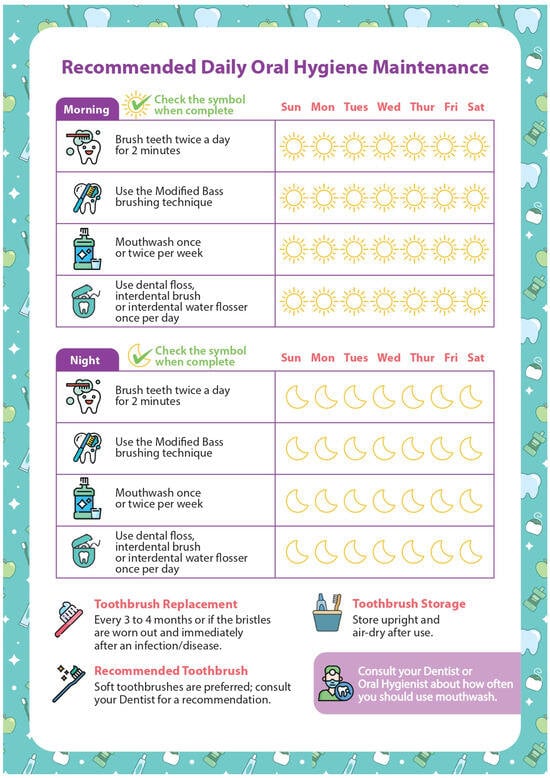
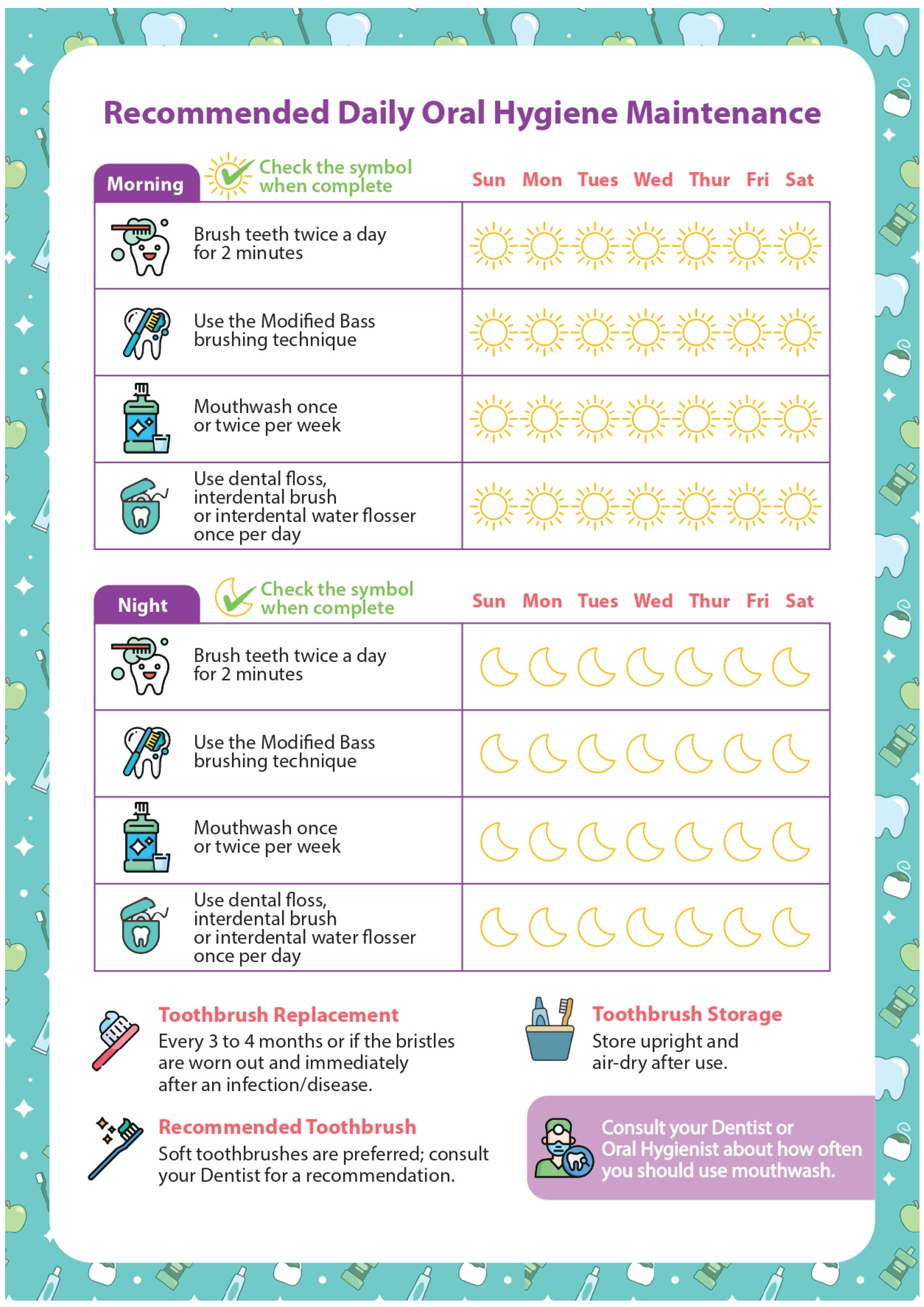
Based on integrated quantitative and qualitative findings, a one-page visual guidance form was developed (Figure 1). The form incorporates evidence-based, patient-centered elements including the ideal brushing technique, toothbrush replacement guidance which is “Every 3 to 4 months or if the bristles are worn out and immediately after an infection/disease” addressing the finding that only 59% change brushes at recommended intervals. And it clearly illustrates the use of interdental brushes and floss threaders, directly addressing the knowledge of auxiliary aids as the strongest predictor of recall (β = 1.912). It also shows that a soft toothbrush is recommended, but with dentist or oral hygienist consultation approval, addressing discomfort as the primary barrier 77%. Concerning toothbrush storage, placing it in an upright position and air-drying after use is recommended as mentioned in previous study [28]. The positive finding that 96% store aids in the bathroom is reinforced. A mouthwash guidance is presented due to its importance, addressing that 42% do not use mouthwash and the confusion about proper use; therefore, a dentist or oral hygienist consultation about how often a person should use mouthwash is highly recommended. The form uses simple icons, minimal text and a clear visual hierarchy to enhance accessibility and recall. It is designed to be distributed as a printed one-page guide and as a digital file for mobile devices.
Figure 1.
Recommended daily oral hygiene maintenance—guidance form.
4. Discussion
This mixed-methods study provides a comprehensive understanding of oral hygiene knowledge, practices, and challenges among 300 fixed orthodontic patients, integrating quantitative survey data with in-depth qualitative insights from 15 purposively selected participants. The findings reveal a complex picture of adequate knowledge coexisting with poor implementation, significant demographic differences, critical deficiencies in current patient education and clear patient-generated priorities for improving clinical care. These results align with previous research emphasizing the need for enhanced patient motivation and structured educational interventions during orthodontic treatment [29].
4.1. Participant Characteristics and Current Education Practices
The study sample was evenly balanced by gender, 50% male and 50% female, and included a broad age range from adolescence through adulthood (13 to 31+ years), enhancing the generalizability of findings across demographic groups. Most participants were in the 6–24 month treatment duration range (98.7%) and in the intermediate or finishing phases of treatment, suggesting that the findings reflect experiences across the treatment processes rather than only the initial adaptation period. A concerning finding was that 17% of participants reported receiving no specific oral hygiene instructions, and 20% relied on internet/social media as their primary information source. This gap in professional education leaves patients exposed to misinformation and inadequate self-management. Previous research has similarly reported that 78% of orthodontic patients did not follow oral hygiene instructions despite receiving them, indicating that knowledge alone is insufficient to ensure compliance [30]. Regarding the format of instructions received, it was realized that only 30% received verbal instruction combined with a demonstration, while 39% received verbal-only instruction, despite evidence that different method education enhances learning and retention [31]. Educational psychology research establishes that procedural skills require demonstration and practice for effective learning [32].
4.2. Gender Differences: A Complex Picture
Females demonstrated significantly higher knowledge and awareness across all scales except in the Recall of Instructions Received Scale which was consistent with previous research [11,33,34]. This differential pattern suggests that while females possess greater foundational knowledge, males may more effectively retain specific instructions provided during clinical encounters. This gender difference may reflect greater health literacy, stronger aesthetic concern, and stronger frequent healthcare engagement among females [35]. However, males demonstrated significantly better recall of instructions received from healthcare providers (mean rank: 161.91 vs. 139.09, p = 0.005). One possible explanation is that clinicians may provide more repeated or emphasized instructions to male patients, perhaps due to perceptions that males require more reinforcement or are less likely to seek out information independently. Alternatively, males may over-report their recall due to confidence bias [36]. This gender-specific pattern has important clinical implications. Educational approaches may need to be tailored differently for males and females, with males requiring more foundational knowledge building and females needing reinforcement of recall and implementation.
4.3. Age and Education Gradients: Targeting Vulnerable Groups
Kruskal–Wallis tests revealed significant age-related differences across all scales (p < 0.001), with clear age progression in knowledge, awareness and recall scales constant with health literacy research [37,38]. Adolescents (13–18 years) consistently demonstrated the lowest scores, reflecting developmental cognitive characteristics and reliance on parental supervision [39]. This finding identifies adolescents as a priority group for intensified educational support, including parental involvement, developmentally appropriate materials, and more frequent reinforcement. Young adults (19–24 years) represent a vulnerable group needing targeted support during the transition to independent healthcare management, with emphasis on rebuilding routines and maintaining engagement [40]. Adults (25+ years) may benefit from more detailed technical information and can serve as peer mentors for younger patients.
The education gradient has important implications for health communication. Higher educational attainment was associated with superior oral health knowledge and self-management capabilities, identifying patients with lower educational levels as a priority group for enhanced educational support, consistent with previous research [41]. The guidance form developed in this study addresses this need through visual design and minimal text, making it accessible across literacy levels.
4.4. Interrelationships Among Knowledge, Awareness and Recall Scales
Spearman’s correlations revealed significant positive relationships among most scales, with coefficients ranging from 0.479 to 0.965 (p < 0.01). Critically, knowledge of oral hygiene requirements did not correlate significantly with recall of instructions received (r = −0.057, p = 0.328). This dissociation indicates that general knowledge about oral hygiene may derive from sources other than professional instruction, such as personal reading, internet searches, or previous experiences, and does not guarantee recall of personalized clinical guidance. In contrast, knowledge of auxiliary cleaning aids showed strong positive correlations with recall of instructions (r = 0.646, p < 0.001). This suggests that when clinicians specifically teach patients about concrete tools like interdental brushes and dental floss, this information is more effectively remembered. Multiple regression analysis revealed that knowledge of auxiliary aids was the strongest positive predictor of recall (β = 1.912), explaining 81.9% of the variance. This finding underscores the paramount importance of teaching patients about specific tools and techniques. When patients understand what tools exist, how to use them, and why they are important, they are substantially more likely to remember the instructions provided.
4.5. The Knowledge–Behavior Gap: A Critical Challenge
The most clinically significant finding of this study is the significant disconnection between knowledge and actual behavior. While 85% recognized interdental brushes as essential, only 23% used them daily; 63% never used dental floss and only 2% brushed for the recommended 2–3 min. This knowledge–behavior gap is well-documented in health psychology [42,43,44] and reflects the difference between declarative knowledge “knowing that” and procedural knowledge “knowing how” as well as the influence of motivational, environmental and habitual factors [45]. The qualitative findings provide clear explanation for this gap. When patients were asked about their single biggest challenge, 56% of patients cited “Lack of Visible Results/Motivation” and 71% reported “Lack of Motivation” as their primary challenge in cleaning. These responses highlight that patients struggle to maintain effort when they cannot immediately see the benefits of their actions.
4.6. Barriers: The Primacy of Physical Discomfort
Quantitative data revealed that discomfort when cleaning was the predominant barrier (77%), followed by complexity of cleaning aids (22%). These findings align with previous research identifying physical discomfort and technical difficulty as major obstacles to orthodontic oral hygiene [30,46].
The qualitative findings powerfully reinforced this quantitative result, with 100% of patients reporting that advice received was “physically difficult to execute.” This unanimous finding represents a powerful indictment of current educational approaches. Patients described pain from interdental brushes, difficulty manipulating floss threaders, and frustration with time-consuming routines. Even among the 96% who stored cleaning aids properly in the bathroom, many reported skipping cleaning due to discomfort or lack of motivation, indicating that environmental cues alone are insufficient when the behavior itself is aversive.
4.7. Patient-Reported Solutions: The Role of Mobile Technology
A remarkably clear patient preference emerged; 71% of participants indicated that a mobile app with reminders would help improve their oral hygiene routine. This strong preference for technology-based interventions aligns with the increasing integration of digital health tools in dental practice [47,48]. Zotti et al. [49] demonstrated that using WhatsApp as a social tool allowed patients to share experiences and recent oral hygiene behaviors, improving understanding and reducing anxiety. Scheerman et al. [50] developed the “WhiteTeeth” application based on the Health Action Process Approach (HAPA) theory, incorporating health goals, action plans, reminders, and self-monitoring with promising results. These studies support the potential effectiveness of the mobile app-based approach preferred by our participants.
4.8. Gender Differences
Mann–Whitney U tests revealed no significant gender differences in self-reported frequency of inspecting teeth after brushing or avoiding hard/sticky foods (both p = 1.000), with identical mean ranks (150.50) for both genders. However, a significant gender difference emerged for attending scheduled dental hygiene appointments (p < 0.001), with males demonstrating a higher mean rank (165.00) than females (136.00), indicating better self-reported appointment adherence among male patients. This finding contrasts with the general pattern of females demonstrating superior knowledge and awareness suggesting that knowledge does not necessarily translate into adherence to professional care schedules.
4.9. Behavioral Mechanisms Underlying the Knowledge–Behavior Gap
The substantial gap between knowledge and behavior observed in this study (e.g., 85% knowledge of vs. 23% daily use of interdental brushes) requires explanation through established behavioral science frameworks.
Intention–Behavior Gap: Sheeran and Webb [42] demonstrated that even strong intentions predict behavior only modestly (r = 0.46), with the gap widening when behaviors require sustained effort, as with orthodontic oral hygiene. Our finding that 96% of patients cite “lack of visible results” as a primary challenge reflects the intention–behavior gap in action—patients intend to clean but lack implementation intentions (specific plans for when, where, and how to perform behaviors).
Health Action Process Approach (HAPA): Schwarzer [43] distinguishes between pre-intentional motivation phase (risk perception, outcome expectancies) and post-intentional volition phase (action planning, coping planning, self-efficacy). Our qualitative data reveal that patients struggle primarily in the volitional phase—they know the risks (pre-intentional) but lack action plans (“I do not know how I could be considered clean,” P9) and coping plans for when discomfort arises (“I cannot control what I eat and brush my teeth at school,” P15).
Habit Formation: Lally et al. [51] found that health behaviors become automatic only after 66 days of consistent repetition. Our patients report irregular cleaning patterns (“Irregular/occasionally” for floss, 16%; for interdental water flosser, 9%), suggesting that for most patients, effective cleaning never reaches the automaticity threshold. The finding that 96% store cleaning aids in the bathroom (environmental cue) but still skip cleaning confirms that cues alone are insufficient without established behavioral routines.
Perceived Behavioral Control (Ajzen’s TPB): Physical discomfort (77%) and complexity (22%) directly reduce patients’ perceived ability to perform recommended behaviors. When patients believe a behavior is difficult or painful, perceived behavioral control diminishes, reducing both intention and action [52]. This explains why 100% of interviewees described current instructions as “physically difficult to execute.”
Motivational Phase Issues: Among adolescents (40% of sample), treatment motivation is often externally driven by parents (Theme 5). Prochaska and DiClemente’s Transtheoretical Model [45] would classify these patients in the precontemplation or contemplation stages rather than action or maintenance stages, explaining why adolescents scored lowest across all knowledge and awareness scales.
These behavioral mechanisms collectively explain why our guidance form emphasizes: (1) specific technique demonstration (procedural knowledge), (2) strategies to manage discomfort (coping planning), (3) visible self-monitoring (addressing lack of visible results), and (4) mobile app reminders (implementation intentions).
4.10. Synergistic Opportunities: Behavioral Guidance and Biomaterial Innovations
While this study focuses on behavioral guidance for oral hygiene self-management, recent advances in biomaterials offer complementary approaches to oral tissue protection during orthodontic treatment. Wang, Gu, and Sui [53] developed a Janus hydrogel dressing with robust wet-tissue adhesion and anti-adhesion properties for wound protection. Although originally designed for surgical wound care, such biomaterials have potential applications in orthodontic settings. For example, protective hydrogel coatings could be applied to bracket-adjacent enamel surfaces to prevent white spot lesions, or to gingival tissues to reduce mechanical irritation from archwires and cleaning aids.
The integration of behavioral guidance (as provided in our patient-centered form) with biomaterial innovations could produce synergistic effects: biomaterials providing passive protection while patients develop sustainable cleaning habits. Future research should explore (1) the adaptation of wet-adhesive hydrogels for orthodontic plaque prevention, (2) patient preferences for such protective interventions, and (3) combined effectiveness of behavioral guidance plus biomaterial protection in randomized controlled trials. This dual approach—addressing both patient behavior and material science—may ultimately provide the most comprehensive strategy for oral tissue protection during fixed orthodontic treatment.
4.11. Strengths and Limitations
This study has several strengths, including a robust sample size (N = 300) with balanced gender distribution, a mixed-methods design integrating quantitative and qualitative data, validated scales with good reliability (α = 0.681–0.941), and translation of findings into a practical patient-centered guidance form.
However, several limitations must be acknowledged. First, this was a single-center study, which may limit generalizability to other populations and settings. Second, the cross-sectional design precludes causal inferences about the relationships between knowledge, awareness, and behavior. Third, all data on knowledge, behaviors, and barriers were self-reported, which is subject to social desirability bias and recall bias. No clinical indices (such as plaque index, gingival index, or white spot lesion count) were collected, limiting our ability to correlate self-reported behaviors with objective clinical outcomes. Fourth, the very small subgroup sizes (e.g., only two participants aged 31+ years and two postgraduate participants) mean that findings for these groups should be interpreted with caution. Fifth, the cross-sectional design captures a single time point and cannot assess changes in behavior over the course of treatment. Future multi-center studies should incorporate objective clinical outcome measures and longitudinal follow-up to address these limitations.
5. Conclusions
This mixed-methods study demonstrates that fixed orthodontic patients possess adequate knowledge but struggle to translate knowledge into practice due to physical discomfort (77%), lack of visible results (56%) and instructions unanimously reported as “physically difficult to execute” (100%). Significant demographic differences identify priority groups; females have higher knowledge, males better recall, and knowledge increases with age and education with adolescents as vulnerable targets.
Crucially, knowledge of auxiliary aids was the strongest predictor of recall (β = 1.912), explaining 81.9% of variance, indicating that education should prioritize tool-focused instruction. Patients strongly prefer mobile app support (71%) and technique guidance (86%). The developed one-page visual guidance form addresses these needs through step-by-step demonstrations and evidence-based recommendations. Transforming orthodontic education from verbal instruction to practical, technology-enhanced support that addresses discomfort and leverages mobile technology is urgently needed. Future research should evaluate the guidance form’s effectiveness in improving clinical outcomes.
Author Contributions
Conceptualization, M.K.Y.; Methodology, M.K.Y.; Software, M.K.Y.; Validation, M.K.Y.; Formal analysis, M.K.Y.; Investigation, M.K.Y.; Resources, M.K.Y.; Data curation, M.K.Y.; Writing—original draft, M.K.Y.; Writing—review and editing, M.K.Y.; Visualization, M.K.Y.; Supervision, M.D.; Project administration, M.K.Y.; Funding acquisition, M.K.Y. All authors have read and agreed to the published version of the manuscript.
Funding
This research received no external funding.
Institutional Review Board Statement
Ethical approval was obtained from the Institutional Review Board of Cyprus Health and Social Sciences University (Reference No: KSTU//2026//023).
Informed Consent Statement
Written informed consent has been obtained from the patient(s) to publish this paper.
Data Availability Statement
The original contributions presented in this study are included in the article. Further inquiries can be directed to the corresponding author.
Acknowledgments
The authors are deeply grateful to Huda Ahmed Ali Al-Rajabi for her invaluable assistance with the scientific statistical analysis, without which this work would not have been possible. We sincerely thank our graphic designer Marwa Ahmad Jamal Yassine for her invaluable guidance in the paper’s design and for the creativity, dedication and hard work that turned this project into reality with clarity and excellence.
Conflicts of Interest
The authors declare no conflict of interest.
References
- Petersen, P.E. The World Oral Health Report 2003: Continuous improvement of oral health in the 21st century—The approach of the WHO Global Oral Health Programme. Community Dent. Oral Epidemiol. 2003, 31, 3–23. [Google Scholar] [CrossRef] [Scilit] [PubMed]
- Fu, M.; Zhang, D.; Wang, B.; Deng, Y.; Wang, F.; Ye, X. The prevalence of malocclusion in China—An investigation of 25,392 children. Zhonghua Kou Qiang Yi Xue Za Zhi 2002, 37, 371–373. [Google Scholar] [PubMed]
- Shokeen, B.; Viloria, E.; Duong, E.; Rizvi, M.; Murillo, G.; Mullen, J.; Shi, B.; Dinis, M.; Li, H.; Tran, N.C.; et al. The impact of fixed orthodontic appliances and clear aligners on the oral microbiome and the association with clinical parameters: A longitudinal comparative study. Am. J. Orthod. Dentofac. Orthop. 2022, 161, e475–e485. [Google Scholar] [CrossRef] [Scilit]
- Rajendran, R.; Sudhakar, V.; Rangarajan, R.S.; Chinnasamy, A.; Vasupradha, G.; Jeeva, J.S. Evaluation of change in surface enamel microhardness in patients undergoing fixed orthodontic appliance therapy: A randomized control trial. J. Pharm. Bioallied Sci. 2021, 13, S1106–S1110. [Google Scholar] [CrossRef] [Scilit] [PubMed]
- Cosma, L.L.; Suhani, R.D.; Mesaros, A.; Badea, M.E. Current treatment modalities of orthodontically induced white spot lesions and their outcome—A literature review. Med. Pharm. Rep. 2019, 92, 25–30. [Google Scholar] [CrossRef] [Scilit]
- Vidigal, M.T.C.; Mesquita, C.M.; de Oliveira, M.N.; de Andrade Vieira, W.; Blumenberg, C.; Nascimento, G.G.; Pithon, M.M.; Paranhos, L.R. Impacts of using orthodontic appliances on the quality of life of children and adolescents: Systematic review and meta-analysis. Eur. J. Orthod. 2022, 44, 359–368. [Google Scholar] [CrossRef] [Scilit]
- Sundararaj, D.; Venkatachalapathy, S.; Tandon, A.; Pereira, A. Critical evaluation of incidence and prevalence of white spot lesions during fixed orthodontic appliance treatment: A meta-analysis. J. Int. Soc. Prev. Community Dent. 2015, 5, 433–439. [Google Scholar] [CrossRef] [Scilit]
- Ogaard, B. Prevalence of white spot lesions in 19-year-olds: A study on untreated and orthodontically treated persons 5 years after treatment. Am. J. Orthod. Dentofac. Orthop. 1989, 96, 423–427. [Google Scholar] [CrossRef] [Scilit]
- Khan, H.; Mheissen, S.; Iqbal, A.; Jafri, A.R.; Alam, M.K. Bracket failure in orthodontic patients: The incidence and the influence of different factors. BioMed Res. Int. 2022, 2022, 5128870. [Google Scholar] [CrossRef] [Scilit]
- Guo, J.; Li, L.; Guan, G.; Bennani, F.; Mei, L. Oral health knowledge and practice among orthodontic clients in China and New Zealand. Can. J. Dent. Hyg. 2020, 54, 124–132. [Google Scholar]
- Rajeh, M.T. Gender differences in oral health knowledge and practices among adults in Jeddah, Saudi Arabia. Clin. Cosmet. Investig. Dent. 2022, 14, 235–244. [Google Scholar] [CrossRef] [Scilit] [PubMed]
- Crerand, C.E.; Kapa, H.M.; Litteral, J.; Da Silveira, A.C.; Markey, M.K. Adherence to orthodontic treatment in youth with craniofacial conditions: A survey of US orthodontists. Cleft Palate Craniofacial J. 2019, 56, 1322–1332. [Google Scholar] [CrossRef] [Scilit] [PubMed]
- Benson, P.; O’Brien, C.; Marshman, Z. Agreement between mothers and children with malocclusion in rating children’s oral health-related quality of life. Am. J. Orthod. Dentofac. Orthop. 2010, 137, 631–638. [Google Scholar] [CrossRef] [Scilit] [PubMed]
- Prado, L.H.; Previato, K.; Delgado, R.Z.R.; Filho, P.N.; Segato, R.A.B.; Matsumoto, M.A.N.; Feres, M.F.N. Adolescents’ perception of malocclusion, their motivations, and expectations concerning orthodontic treatment: Is it all about attractiveness? A qualitative study. Am. J. Orthod. Dentofac. Orthop. 2022, 161, e345–e352. [Google Scholar] [CrossRef] [Scilit]
- Kaliyaperumal, K. Guideline for conducting a knowledge, attitude and practice (KAP) study. AECS Illum. 2004, 4, 7–9. [Google Scholar]
- Ritchie, K.C.; Snelgrove-Clarke, E.; Murphy, A. The 23-item Evidence Based Practice knowledge attitudes and practices (23-item EBP-KAP) survey: Initial validation among health professional students. Health Prof. Educ. 2019, 5, 152–162. [Google Scholar] [CrossRef] [Scilit]
- Li, Y.; Liu, J.; Xu, Y.; Yin, J.; Li, L. Oral health self-management ability and its influencing factors among adolescents with fixed orthodontics in China: A mixed methods study. Dis. Markers 2022, 2022, 3657357. [Google Scholar] [CrossRef] [Scilit]
- Inquimbert, C.; Clement, C.; Couatarmanach, A.; Tramini, P.; Bourgeois, D.; Carrouel, F. Oral hygiene practices and knowledge among adolescents aged between 15 and 17 years old during fixed orthodontic treatment: Multicentre study conducted in France. Int. J. Environ. Res. Public Health 2022, 19, 2316. [Google Scholar] [CrossRef] [Scilit]
- Coulter, A.; Ellins, J. Effectiveness of strategies for informing, educating, and involving patients. BMJ 2007, 335, 24–27. [Google Scholar] [CrossRef] [Scilit]
- Thorndike, R.M. Book review: Psychometric theory (3rd ed.) by Jum Nunnally and Ira Bernstein New York: McGraw-Hill, 1994, xxiv + 752 pp. Appl. Psychol. Meas. 1995, 19, 303–305. [Google Scholar] [CrossRef] [Scilit]
- Longstaff, S.; Davies, K.; Benson, P. Exploring 10–15-year-old patients’ perspectives of fixed orthodontic treatment. J. Orthod. 2021, 48, 110–117. [Google Scholar] [CrossRef] [Scilit] [PubMed]
- Houts, P.S.; Doak, C.C.; Doak, L.G.; Loscalzo, M.J. The role of pictures in improving health communication: A review of research on attention, comprehension, recall, and adherence. Patient Educ. Couns. 2006, 61, 173–190. [Google Scholar] [CrossRef] [Scilit] [PubMed]
- Mann, H.B.; Whitney, D.R. On a test of whether one of two random variables is stochastically larger than the other. Ann. Math. Stat. 1947, 18, 50–60. [Google Scholar] [CrossRef] [Scilit]
- Kruskal, W.H.; Wallis, W.A. Use of ranks in one-criterion variance analysis. J. Am. Stat. Assoc. 1952, 47, 583–621. [Google Scholar] [CrossRef]
- Spearman, C. The proof and measurement of association between two things. Am. J. Psychol. 1904, 15, 72–101. [Google Scholar] [CrossRef] [Scilit]
- Hair, J.F.; Black, W.C.; Babin, B.J.; Anderson, R.E. Multivariate Data Analysis, 7th ed.; Pearson: London, UK, 2010. [Google Scholar]
- Braun, V.; Clarke, V. Using thematic analysis in psychology. Qual. Res. Psychol. 2006, 3, 77–101. [Google Scholar] [CrossRef] [Scilit]
- Glenny, A.M.; Walsh, T.; Iwasaki, M.; Kateeb, E.; Braga, M.M.; Riley, P.; Melo, P. Development of tooth brushing recommendations through professional consensus. Int. Dent. J. 2024, 74, 526–535. [Google Scholar] [CrossRef] [Scilit]
- Huang, J.; Yao, Y.; Jiang, J.; Li, C. Effects of motivational methods on oral hygiene of orthodontic patients: A systematic review and meta-analysis. Medicine 2018, 97, e13182. [Google Scholar] [CrossRef] [Scilit]
- Baheti, M.; Toshniwal, N. Survey on oral hygiene protocols among orthodontic correction-seeking individuals. J. Educ. Ethics Dent. 2015, 5, 8. [Google Scholar] [CrossRef] [Scilit]
- Mayer, R.E. Incorporating motivation into multimedia learning. Learn. Instr. 2014, 29, 171–173. [Google Scholar] [CrossRef] [Scilit]
- Anderson, J.R. Acquisition of cognitive skill. Psychol. Rev. 1982, 89, 369–406. [Google Scholar] [CrossRef]
- Tang, X.; Cai, J.; Lin, B.; Yao, L.; Lin, F. Motivation of adult female patients seeking orthodontic treatment: An application of Q-methodology. Patient Prefer. Adherence 2015, 9, 249–256. [Google Scholar] [CrossRef] [Scilit] [PubMed]
- Nadar, S.; Saravana Dinesh, S.P. A questionnaire study about oral hygiene awareness among orthodontic patients. Int. J. Orthod. Rehabil. 2016, 7, 97–100. [Google Scholar] [CrossRef] [Scilit]
- Varela-Centelles, P.; Diz-Iglesias, P.; Estany-Gestal, A.; Blanco-Hortas, A.; Bugarín-González, R.; Seoane-Romero, J.M. Regular dental attendance and periodontal health knowledge: A cross-sectional survey. Oral Dis. 2020, 26, 419–428. [Google Scholar] [CrossRef] [Scilit]
- Pallier, G. Gender differences in the self-assessment of accuracy on cognitive tasks. Sex Roles 2003, 48, 265–276. [Google Scholar] [CrossRef] [Scilit]
- Berkman, N.D.; Sheridan, S.L.; Donahue, K.E.; Halpern, D.J.; Crotty, K. Low health literacy and health outcomes: An updated systematic review. Ann. Intern. Med. 2011, 155, 97–107. [Google Scholar] [CrossRef] [Scilit]
- Sørensen, K.; Van den Broucke, S.; Fullam, J.; Doyle, G.; Pelikan, J.; Slonska, Z.; Brand, H.; (HLS-EU) Consortium Health Literacy Project European. Health literacy and public health: A systematic review and integration of definitions and models. BMC Public Health 2012, 12, 80. [Google Scholar] [CrossRef] [Scilit]
- Gazzaz, A.Z.; Carpiano, R.M.; Aleksejuniene, J. Socioeconomic status, social support, and oral health-risk behaviors in Canadian adolescents. J. Public Health Dent. 2021, 81, 316–326. [Google Scholar] [CrossRef] [Scilit]
- Arnett, J.J. Emerging adulthood: A theory of development from the late teens through the twenties. Am. Psychol. 2000, 55, 469–480. [Google Scholar] [CrossRef]
- Nutbeam, D. Health literacy as a public health goal: A challenge for contemporary health education and communication strategies into the 21st century. Health Promot. Int. 2000, 15, 259–267. [Google Scholar] [CrossRef] [Scilit]
- Sheeran, P.; Webb, T.L. The intention-behavior gap. Soc. Pers. Psychol. Compass 2016, 10, 503–518. [Google Scholar] [CrossRef] [Scilit]
- Schwarzer, R. Modeling health behavior change: How to predict and modify the adoption and maintenance of health behaviors. Appl. Psychol. 2008, 57, 1–29. [Google Scholar] [CrossRef] [Scilit]
- Atassi, F.; Awartani, F. Oral hygiene status among orthodontic patients. J. Contemp. Dent. Pract. 2010, 11, E025–E032. [Google Scholar] [PubMed]
- Prochaska, J.O.; DiClemente, C.C. Stages and processes of self-change of smoking: Toward an integrative model of change. J. Consult. Clin. Psychol. 1983, 51, 390–395. [Google Scholar] [CrossRef]
- Raevanisa, N.; Narmada, I.B.; Alida, A.; Nugraha, A.P.; Ramadayanti, S.L.; Pradnyaswari, I.D.A.A.; Deshmukh, S. Orthodontic pain is related to oral health-related quality of life in orthodontic patients. J. Orthod. Sci. 2024, 13, 18. [Google Scholar] [CrossRef] [Scilit]
- Underwood, B.; Birdsall, J.; Kay, E. The use of a mobile app to motivate evidence-based oral hygiene behaviour. Br. Dent. J. 2015, 219, E2. [Google Scholar] [CrossRef] [Scilit]
- Toniazzo, M.P.; Nodari, D.; Muniz, F.W.M.G.; Weidlich, P. Effect of mHealth in improving oral hygiene: A systematic review with meta-analysis. J. Clin. Periodontol. 2019, 46, 297–309. [Google Scholar] [CrossRef] [Scilit]
- Zotti, F.; Dalessandri, D.; Salgarello, S.; Piancino, M.; Bonetti, S.; Visconti, L.; Paganelli, C. Usefulness of an app in improving oral hygiene compliance in adolescent orthodontic patients. Angle Orthod. 2016, 86, 101–107. [Google Scholar] [CrossRef] [Scilit]
- Scheerman, J.F.M.; van Meijel, B.; van Empelen, P.; Verrips, G.H.W.; van Loveren, C.; Twisk, J.W.R.; Pakpour, A.H.; Braak, M.C.T.v.D.; Kramer, G.J.C. The effect of using a mobile application (“WhiteTeeth”) on improving oral hygiene: A randomized controlled trial. Int. J. Dent. Hyg. 2020, 18, 73–83. [Google Scholar] [CrossRef] [Scilit]
- Lally, P.; van Jaarsveld, C.H.M.; Potts, H.W.W.; Wardle, J. How are habits formed: Modelling habit formation in the real world. Eur. J. Soc. Psychol. 2010, 40, 998–1009. [Google Scholar] [CrossRef] [Scilit]
- Ajzen, I. The theory of planned behavior. Organ. Behav. Hum. Decis. Process 1991, 50, 179–211. [Google Scholar] [CrossRef] [Scilit]
- Wang, Y.; Gu, W.; Sui, K. Robust Janus Hydrogel with Wet-Tissue Adhesive Properties for Wound Dressing and Anti-Postoperative Adhesion. ACS Appl. Bio Mater. 2025, 8, 3932–3940. [Google Scholar] [CrossRef] [Scilit] [PubMed]

Disclaimer/Publisher’s Note: The statements, opinions and data contained in all publications are solely those of the individual author(s) and contributor(s) and not of MDPI and/or the editor(s). MDPI and/or the editor(s) disclaim responsibility for any injury to people or property resulting from any ideas, methods, instructions or products referred to in the content. |
© 2026 by the authors. Licensee MDPI, Basel, Switzerland. This article is an open access article distributed under the terms and conditions of the Creative Commons Attribution (CC BY) license.