


Abstract
Material and texture decisions in bionic machinery installation art often remain intuition-dependent, limiting the reusability of empirical evidence for experience design. Building on the biomimetic content logic in biomimetic design theory, this study proposes a targeted framework—Texture Bionics—and operationalizes texture into four quantifiable perceptual dimensions: transparency, hardness, roughness, and surface texture, forming a controllable sample space of 12 plastic texture conditions. A case database encompassing 56 representative works (2000–present) was constructed to justify material selection; plastics were chosen for their tunable properties and feasibility for parameterized modulation. In a standardized viewing setup (≈500 lx illumination; 60 cm viewing distance), participants viewed a dynamic biomimetic mechanical wing module with interchangeable textured plastic surfaces. Subjective affect responses were captured using PAD ratings, and objective attention was assessed via wearable eye-tracking technology. Repeated-measures analyses showed robust main effects of texture on total fixation duration across all four dimensions, and selective effects on time to first fixation (significant/marginal for transparency, roughness, and surface texture but not hardness); pupillary response metrics provided no stable discrimination. PAD mappings further revealed functional “role types” (e.g., Key driver, Explore guide, Stable base), and a strong association between Arousal and inter-participant variability in fixation distribution, suggesting that high-arousal textures act as strategy amplifiers rather than uniformly increasing attention. Finally, findings were translated into an actionable Texture Design Toolkit using a three-question workflow—function label → attention goal → differentiation risk—to support evidence-based orchestration of installation narratives.
1. Introduction
Against the backdrop of increasing convergence between interactive art and biomimetic design, research methodologies in art and design are shifting from purely subjective interpretation toward a coordinated framework that integrates self-reported experience with objective physiological data. Systematic reviews indicate that physiological signals such as EEG, electrodermal activity, and eye tracking can complement self-report measures by enhancing temporal immediacy, capturing implicit reactions, and strengthening mechanistic explanations—thereby enhancing interpretability and reproducibility [1]. At the same time, biologically inspired (biomimetic) design emphasizes interdisciplinary knowledge transfer and testable design logic, offering methodological grounding for quantitative modeling of the “material–perception–emotion” chain [2]. Recent large-sample evidence further suggests that psychological representations of materials can be summarized into a set of interpretable and replicable core material dimensions, facilitating cross-material comparison and variable-based modeling [3].
Building on our earlier research trajectory around a “four-dimensional affective model for bionic machinery installation art,” this study argues that, within installation experiences characterized by “mechanical vitality,” materiality is not only a carrier of visual and tactile information but may also function as a core interface for affective arousal. In material–emotion research, variable modeling can be simplified into two routes. The first route treats texture categories as design variables: texture classes (e.g., wood/paper/glass/ceramic/textiles) are used as independent variables to compare perceptual and evaluative structures. The visual system can rapidly and reliably distinguish texture categories in natural images [4], and texture categories are systematically linked to stable perceptual quality dimensions [5]. Texture–aesthetics research also supports a reproducible, category-level semantic structure [6]. Cross-material roughness research further shows that comparable perceptual relationships can be established across different texture categories [7]. The second route treats texture attributes as parametrized variables: properties such as transparency/translucency, roughness, and surface texture are operationalized as controllable parameters and manipulated via controlled stimuli to examine their effects on material perception and experience. Translucency is both an optical property and a stable perceptual phenomenon, making it suitable for variable-based modeling [8]. Texture cues can reliably elicit affective responses that are detectable not only through explicit ratings but also via implicit paradigms capturing automated emotional reactions [9]. Consumer-psychology findings further suggest that visual roughness systematically shapes inferences (e.g., durability/usability) and preference, indicating that low-level surface features can be “lifted” into higher-level meaning judgments [10].
Although these two routes are supported by substantial evidence, most prior work focuses on static materials or static surfaces. To address the problem that material/texture design in installation-art contexts can overly rely on intuition and lacks reusable empirical evidence chains, this study proposes a cross-disciplinary approach: using plastics as the base material, we will construct controllable samples around transparency, roughness, and surface texture; at the subjective level, we will adopt PAD (Pleasure–Arousal–Dominance) to structure affective responses [11]; and at the objective level, we will introduce eye-tracking indicators to characterize attentional allocation and information processing patterns [12]. The ultimate goal is to consolidate a “material/texture design toolkit” for biomimetic installation creation, enhancing the interpretability and transferability of material selection and texture modulation strategies.
2. Theoretical Foundations
2.1. Developing a Theoretical Model for Texture Research in Bionic Machinery Installation Art
Bionic machinery, installation art, and biomimetic design share a strong methodological isomorphism. Both typically follow a comparable pathway: biological prototype identification → mechanism abstraction → translation into form/structure/behavior → iterative prototyping and evaluation. Specifically, biomimetic design emphasizes extracting transferable structural and behavioral principles from biological systems and transforming them into implementable design strategies. Likewise, bionic machinery installation art draws on biological prototypes and realizes biomimetic expression through mechanical structures, kinetic behaviors, and material–surface properties. The key distinction lies in its primary objectives: rather than prioritizing utilitarian performance, bionic machinery installation art foregrounds viewer experience and affective elicitation (i.e., aesthetic–interactive–emotional functions) and often relies on audience responses and behavioral data as major evaluative evidence. On this basis, the present study adopts biomimetic design theory as a foundational model to develop a theoretical framework for bionic machinery installation art.
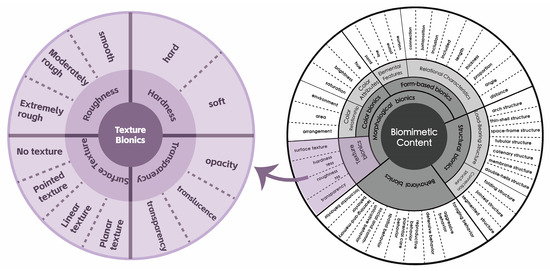
In operationalizing this framework, the study follows the classification logic of Biomimetic content presented in Generality of Bio-inspired Design [13] and translates texture-related factors into four measurable perceptual dimensions: Transparency (opacity, translucence, transparent), Hardness (hard, soft), Roughness (smooth, moderately rough, extremely rough), and Surface texture (no texture, pointed texture, linear texture, planar texture). Building on these dimensions, and to further foreground the role of texture in biomimetic expression, this paper proposes a more targeted framework termed “Texture Bionics” (Figure 1). The model not only provides a refined, structured account of texture-based biomimicry but also establishes clear dimensional boundaries and measurable constructs that support subsequent experimental design and effectiveness evaluation, thereby strengthening both interpretability and reproducibility.
Figure 1.
Texture Bionics model and operational perceptual dimensions.
2.2. The PAD Emotion Scale
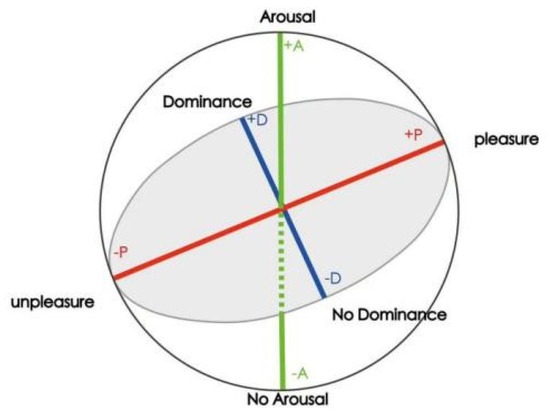
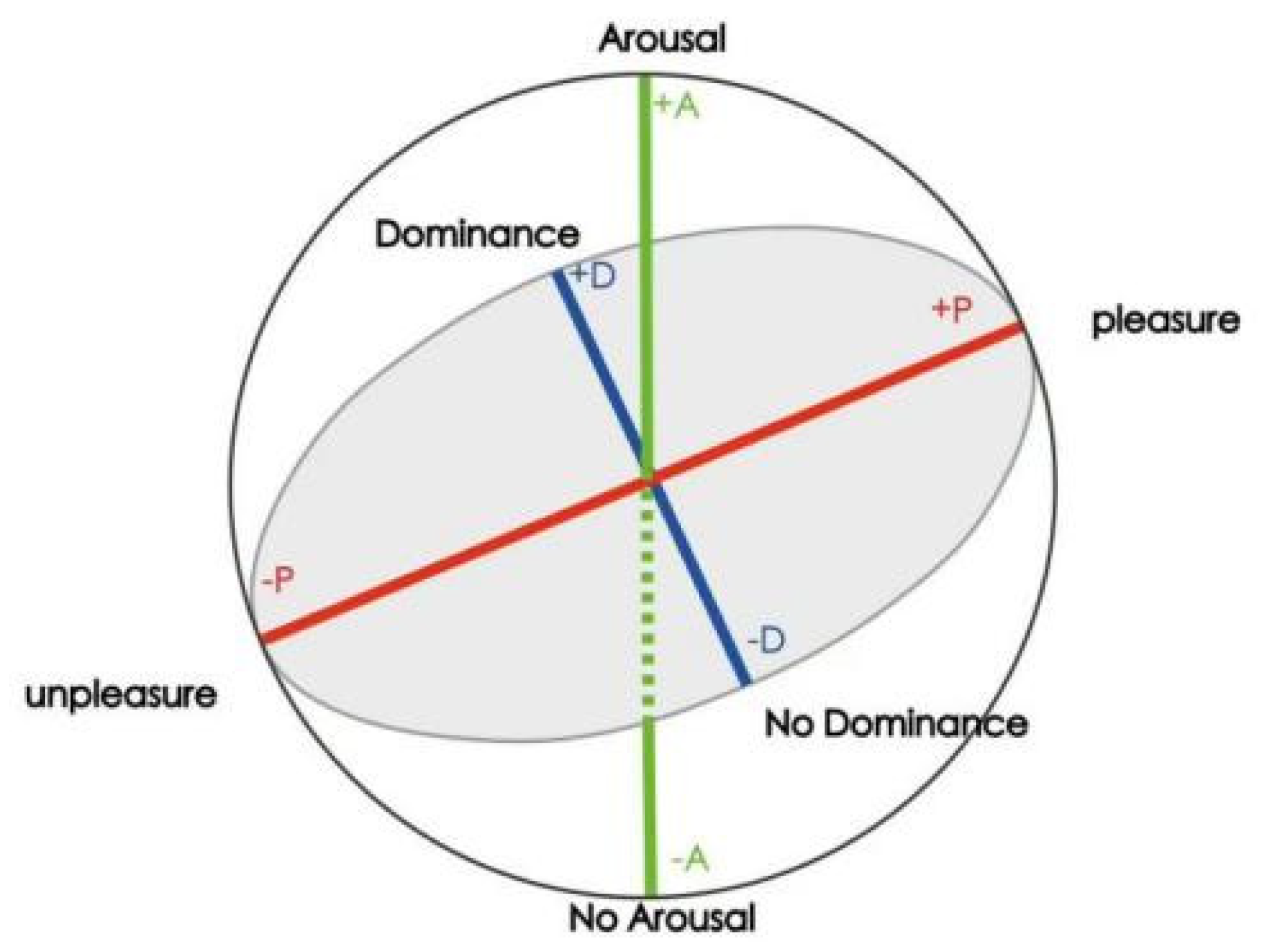
The Pleasure–Arousal–Dominance (PAD) model (Figure 2) is a self-report framework for affect assessment grounded in psychological responses, comprising three relatively independent dimensions: Pleasure, Arousal, and Dominance. This three-dimensional structure was initially introduced to represent the emotional impact of environmental stimuli and was later formalized into an operational measurement system with standardized scales [11,14]. In the Chinese context, the reliability and validity of an abbreviated Chinese PAD scale were examined and reported in an English-language international conference proceeding, providing psychometric evidence to support cross-cultural and cross-linguistic use [15]. This study uses the scale and semantic differential method to collect emotion data. It then combines subjective ratings with eye-tracking measures to improve the validity of the emotion analysis and the reliability of the results.
Figure 2.
The Pleasure–Arousal–Dominance (PAD) scale.
2.3. Eye-Tracking Technology and Tobii Pro Glasses 3
Most contemporary eye-tracking systems rely on the pupil center–corneal reflection (PCCR) principle, using near-infrared illumination to detect the pupil center and corneal “glints” and estimate gaze direction and point of regard [16]. Wearable eye trackers are particularly suitable for naturalistic research because they can capture gaze behavior during free walking, head turns, and object interaction. For example, Tobii Pro Glasses 3 (Tobii AB, Danderyd, Sweden) provide binocular tracking (50/100 Hz) with one-point evaluation or automatic calibration, record Full-HD scene video (1920 × 1080@25 fps) with a wide field of view (≈95° horizontal, 63° vertical; 106° diagonal), and support synchronization for multimodal recordings [17].
In analysis, eye-tracking studies commonly define areas of interest (AOIs) and compute metrics such as time to first fixation, total fixation duration, fixation count, and transition patterns between AOIs, complemented by visualizations (e.g., heatmaps and scanpaths). Empirical evidence shows that mobile eye tracking can reveal attentional organization in aesthetic processing [18] and, in gallery-like settings, can be integrated with movement trajectories and self-reports to demonstrate links between movement dynamics and art experience [19]. Eye-movement features have also been used to identify individual differences in learning styles and information-processing preferences [20]. However, eye tracking remains comparatively underutilized for mechanism-oriented questions in installation-art research, particularly for explaining visual texture–emotion relationships. Accordingly, this study integrates eye tracking as an objective measure of attention and information processing within a coordinated subjective–objective framework to enable more testable and reusable modeling of texture–emotion mappings.
3. Material Selection and Construction of a Texture Space for Bionic Machinery Installation Art
3.1. Defining the Case Sample and Selecting Plastic as the Target Material
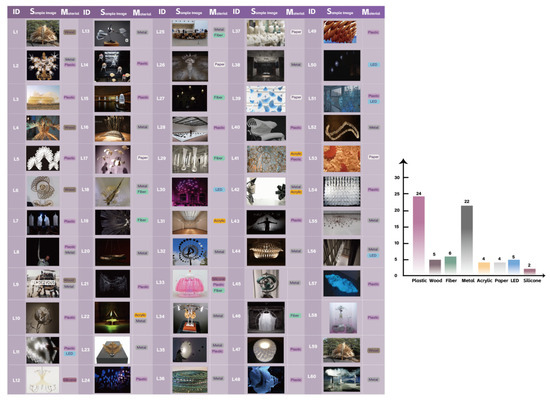
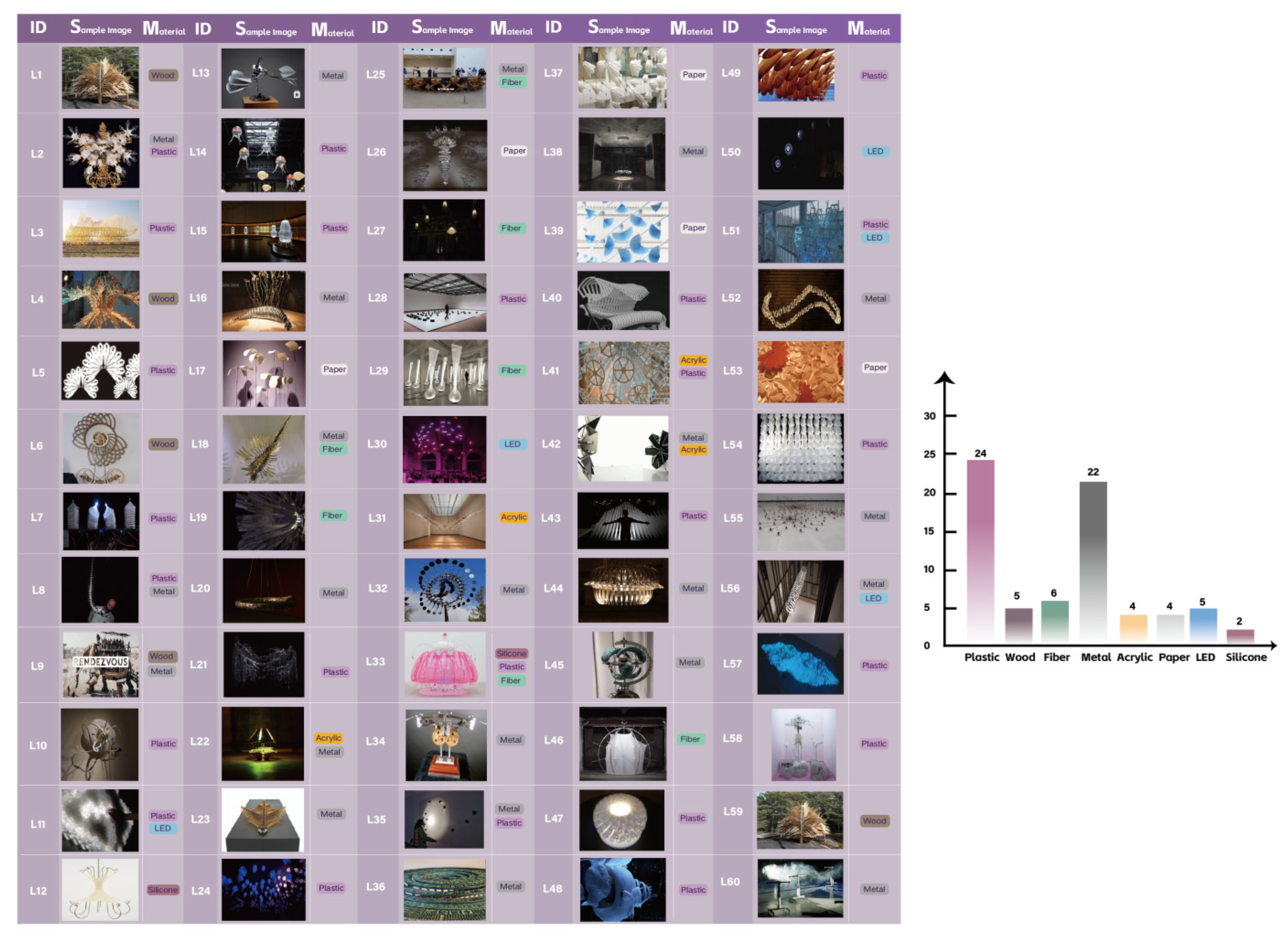
This study examines the texture-driven affective empowerment of bionic machinery installation art, asking how materiality can trigger emotional responses between viewers and artworks and evoke quasi-lifelike perception. To structure the inquiry, we built a case database covering works from 2000 to the present, drawing on major international art institutions and professional literature. Works were included only if they (a) were biomimetic at their core, (b) involved mechanical motion, (c) took an installation form, and (d) had complete and verifiable documentation. Highly anthropomorphic forms were excluded to reduce potential confounds from the uncanny valley. After removing highly similar serial works by the same artist, 56 representative cases were retained for analysis (Figure 3).
Figure 3.
Case Sample Construction and Texture–Material Selection for Bionic Machinery Installation Art.
Material statistics across the 56 cases show that plastics and metals dominate and are frequently used in combination. However, metal offers limited leverage for manipulating physical transparency as a texture variable, whereas plastics—covering resin, PLA, PVC, optical fiber, and fiberglass—provide broader tunability and formability in texture expression. Considering prevalence in the sample set, morphological malleability, and feasibility for parameter quantification, this study selects plastic as the core material for subsequent experiments; other materials are excluded from fine-grained modeling at this stage.
3.2. Fabrication of the Experimental Samples
This study focuses on texture expression in bionic machinery installation art and highlights that its aesthetic effects change dynamically during mechanical motion. To systematically test how different texture dimensions shape affective perception, we adopt a modular experimental design. First, we build a unified dynamic mechanical skeleton as the base platform and select a wing—commonly used in biomimetic creation—as the baseline biomimetic form. We then mount plastic surface samples with different textures onto the same skeleton, enabling a controlled comparison under the logic of “the same dynamic structure, different texture properties.”
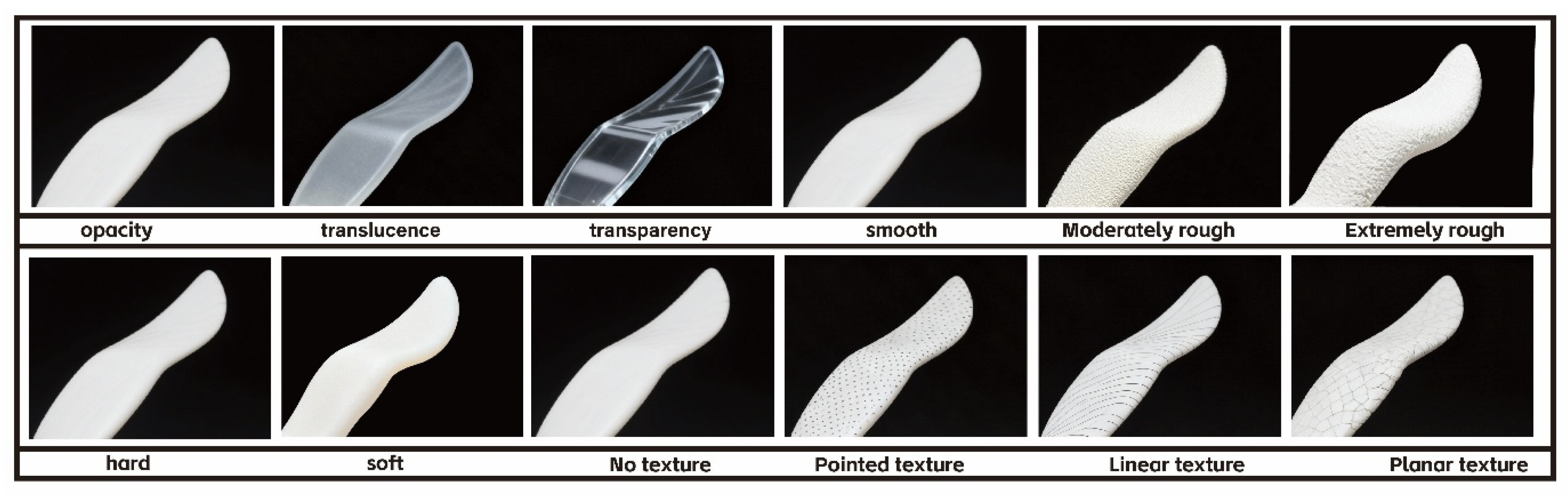
Because plastic is the core material of this study, all samples can be fabricated via 3D printing. This approach supports rapid iteration and accommodates multiple representative plastics (e.g., PLA, ABS, PETG), which differ markedly in physical properties and surface (tactile–visual) texture qualities. These differences facilitate the operationalization of the four dimensions specified in the Texture Bionics Model: transparency (opacity, translucence, transparency), roughness (smooth, moderately rough, extremely rough), hardness (hard, soft), and surface texture (no texture, pointed texture, linear texture, planar texture). Accordingly, we designed 12 representative plastic texture samples and organized them into four sets of control conditions. The figure below visualizes this “sample space,” (Figure 4) which will be used for data collection and analysis in the subsequent affective experiments. It should be noted that these 12 samples were not intended to constitute a fully crossed factorial design across the four texture dimensions; rather, they were organized as within-subject comparison conditions around each of the four dimensions. This dimension-wise decomposition strategy was adopted to enable clearer comparisons between different levels within each dimension and their relationships with affective and attentional responses, while maintaining a unified dynamic mechanical structure, standardized viewing conditions, and a consistent material family. It also provides a more interpretable empirical basis for subsequent typological abstraction and toolkit-based design translation.
Figure 4.
Sample space of the 12 representative plastic texture samples used in the Texture Bionics experiment.
In addition, the construction of the four sample sets was not independently or arbitrarily defined but followed a shared baseline logic: a regularized surface corresponding to “opaque, hard, smooth, and texture-free” was used as a low-stimulation reference condition, from which each texture dimension was varied in a single direction. The repeated inclusion of this baseline condition across different dimensional sets was not a simple duplication but was intended to ensure that ratings and eye-movement responses within each dimension were anchored to the same reference point. This made it possible to compare differences between levels relative to the baseline condition more robustly, while also improving the comparability and interpretive consistency of results across dimensions.
To ensure participants’ attention and immersion in texture perception while minimizing external interference, we further developed a compact observation setup: the Affective Material Interaction Chamber. Built as a light-box structure with controllable illumination, the chamber standardizes viewing distance and angle so that participants observe the stimuli from the same vantage point. This enables more precise capture of affective responses under single-variable conditions. The setup offers the combined advantages of immersion, standardization, and cost control, making it suitable for repeated deployment and future extension.
3.3. An Experimental Study of Affective Responses to Plastic Material Qualities
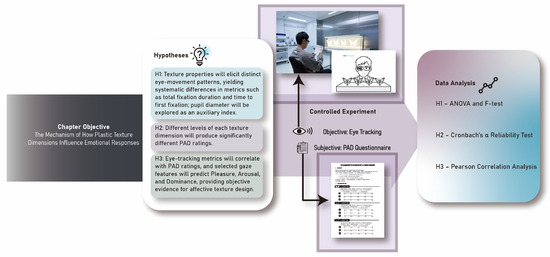
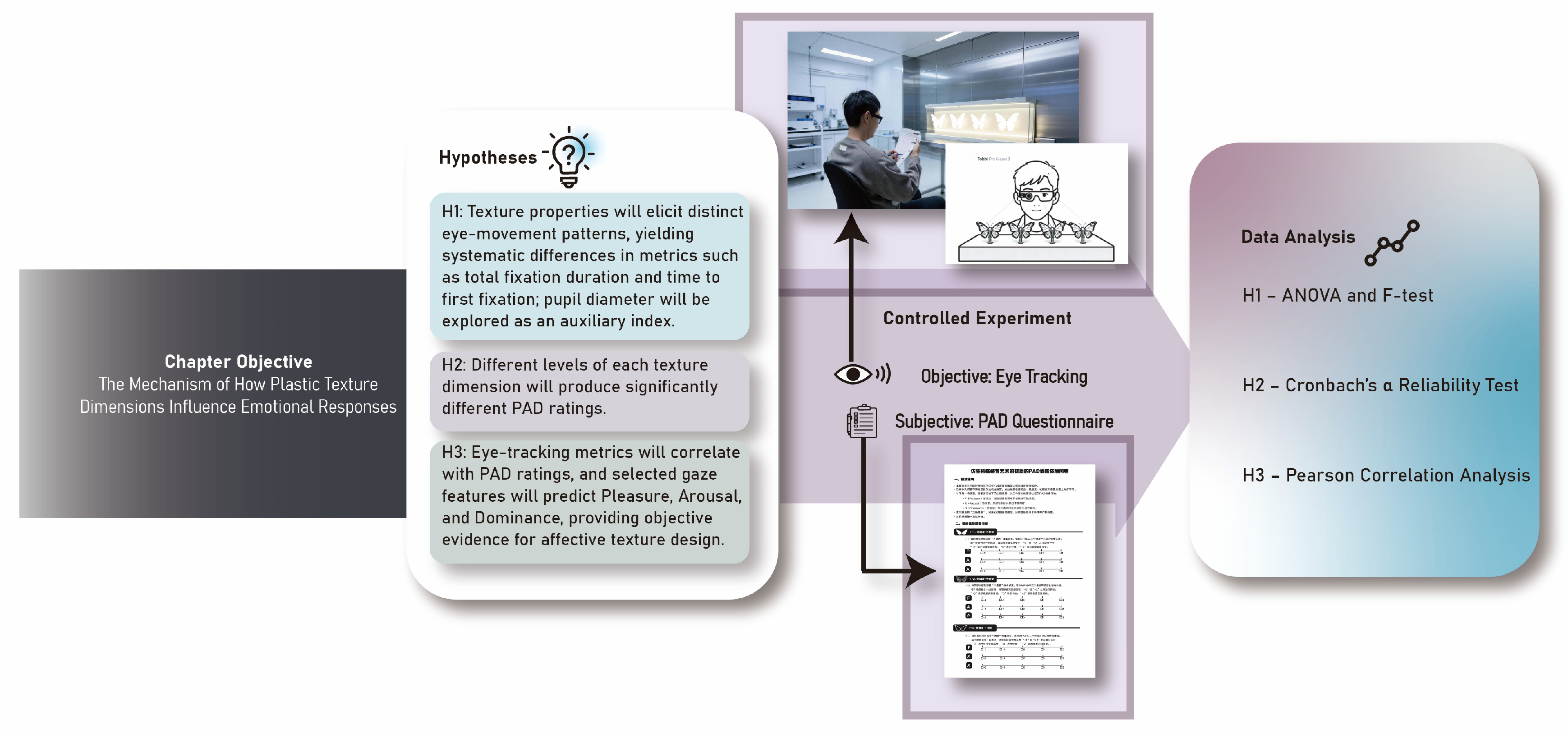
This chapter reports a controlled experiment designed to examine how different plastic material/texture dimensions shape viewers’ affective responses. Based on the “Texture Bionics” model established in Chapter 2 and a set of 12 representative plastic samples, we collected eye-tracking measures and PAD self-reports in a standardized viewing environment (the Affective Material Interaction Chamber). A coordinated subjective–objective analysis was then conducted to test the proposed texture–emotion mapping (Figure 5).
Figure 5.
Empirical Research Pathway for Affective Responses to Plastic Texture Qualities.
3.3.1. Hypotheses
Focusing on four dimensions—transparency (opacity, translucence, transparency), roughness (smooth, moderately rough, extremely rough), hardness (hard, soft), and surface texture (no texture, pointed texture, linear texture, planar texture)—we propose:
H1:
Texture properties will elicit distinct eye-movement patterns, yielding systematic differences in metrics such as total fixation duration and time to first fixation; pupil diameter will be explored as an auxiliary index.
H2:
Different levels of each texture dimension will produce significantly different PAD ratings.
H3:
Eye-tracking metrics will correlate with PAD ratings, and selected gaze features will predict Pleasure, Arousal, and Dominance, providing objective evidence for affective texture design.
To test these hypotheses, the experiment followed the pipeline of texture samples → dynamic presentation → eye tracking → PAD ratings → statistical analysis, enabling within-subject comparisons across conditions and correlation-based analyses between subjective and objective measures.
3.3.2. Experimental Design and Procedure
(1) Participants
Thirty participants completed the PAD ratings (N = 30). After eye-tracking quality control (e.g., unsuccessful calibration/validation or substantial data loss), 26 valid eye-tracking recordings were retained (N = 26). Participants were 20–32 years old (M = 24.3, SD = 2.8), had normal or corrected-to-normal vision, and reported no severe visual impairment or neurological disease. To consider potential expertise effects, 18 participants had an art/design-related background, and 12 participants came from engineering/science and other disciplines. All participants provided informed consent and were free to withdraw at any time.
(2) Apparatus and Stimuli
The experiment was conducted in the Affective Material Interaction Chamber developed in the previous section. The chamber was equipped with a controllable constant–color–temperature light source, and illuminance was maintained at approximately 500 lx to minimize the influence of ambient-light fluctuations on texture perception. The viewing distance between the observation window and the stimulus was fixed at 60 cm. Participants viewed a biomimetic mechanical wing module mounted with plastic surfaces of different texture properties through the front observation window. The stimuli consisted of the 12 representative plastic texture samples established in Chapter 2. Eye movements were recorded using Tobii Pro Glasses 3.
(3) Task and Procedure
Participants performed a “watch-and-rate” task, viewing dynamic wing-texture presentations and providing affect ratings.
- Briefing and practice: One to two practice trials to familiarize participants with the task and the PAD scale.
- Calibration and validation: One-point calibration/validation per the device; recalibration if needed; recordings failing validation were excluded from eye-tracking analyses.
- Main experiment: A 1 s fixation cue preceded each set; each sample was viewed for 10 s (e.g., four samples = 40 s; two samples = 20 s), with continuous eye tracking; PAD ratings (five-point) were completed immediately after each set.
- Randomization and breaks: The four condition sets were presented in random order; within-set order was randomized; short breaks were provided between sets. Total duration was approximately 12 min.
3.3.3. Eye-Tracking Experiment
(1) Eye-Tracking Measures and Extraction
To characterize viewers’ visual attention and processing under different texture conditions, the following eye-tracking measures were extracted from Tobii Pro Lab using AOI-based and event-based exports:
- Total Fixation Duration in AOI (TFD): This metric reflects sustained attention to a given AOI. For each participant and condition, it was computed as the sum of all fixation durations falling within that AOI. AOI-level summaries were computed only when at least one valid fixation occurred within the AOI.
- Time to First Fixation in AOI (TTFF): TTFF captures the speed of initial orienting to an AOI. For each AOI, it was computed as the time interval, expressed in ms, from the onset of the current TOI (or stimulus presentation) to the first valid fixation within that AOI.
- Mean Pupil Diameter (event-based): Using Tobii Pro Lab’s event-level export, pupil-diameter samples associated with valid fixation events were aggregated under each texture condition, and the condition-level mean pupil diameter was calculated. The pupil metric reported in this study is the raw mean value, expressed in mm; the sample standard deviation (n−1) is also reported to describe variability at the inter-individual and/or event level under each condition. Given that pupil changes are easily influenced by individual baseline differences and momentary states, pupil diameter is treated here as a supplementary physiological indicator rather than a primary basis for interpretation.
- Heatmaps: Heatmaps were generated to visualize gaze distribution and attention concentration under each texture condition. Higher intensity indicates greater visual attention.
(2) Eye-Tracking Data Preprocessing
Eye-tracking preprocessing consisted of the following steps:
Removal of invalid data: Segments with signal loss due to blinking or head movements were excluded. Trials were marked as invalid if continuous data loss exceeded 200 ms. If, for any participant, the proportion of valid data in any stimulus condition was less than 70% of the total duration, the participant was excluded from eye-tracking analyses.
Definition of Areas of Interest (AOIs): AOIs were defined according to the tested variable set in each condition. For example, in the transparency condition, AOIs were delineated as opacity, translucence, and transparency regions to compare viewing behavior across transparency levels.
Time-window specification: The 10 s stimulus presentation for each trial was used as the analysis window, and all eye-tracking metrics were computed within this window.
(3) Statistical Analysis and Results
This study employed within-subject repeated-measures ANOVA (RM-ANOVA) to examine differences in eye-tracking measures across levels within each texture dimension [21]. In each analysis, the levels of a given texture dimension served as within-subject factors, and the dependent variables included total fixation duration (TFD), time to first fixation (TTFF), and pupil-related indices. These metrics are commonly used to characterize visual attention allocation and processing dynamics [22,23,24]. TTFF is often treated as an index of early attentional capture [25], whereas pupil-related measures are typically associated with cognitive load and autonomic arousal, although their interpretation requires caution [26,27,28].
The RM-ANOVA test statistic was calculated as:
where:
The significance level was set at α = 0.05. Where appropriate, sphericity was assessed with Mauchly’s test, and Greenhouse–Geisser or Huynh–Feldt corrections were applied when necessary [21].
Effect sizes were reported as partial eta squared () [29,30]:
Because partial η2 may be design-dependent in repeated-measures contexts, its interpretation was made with caution [31]. Significance levels were reported using standard notation: , , and , with non-significant results labeled as ns.
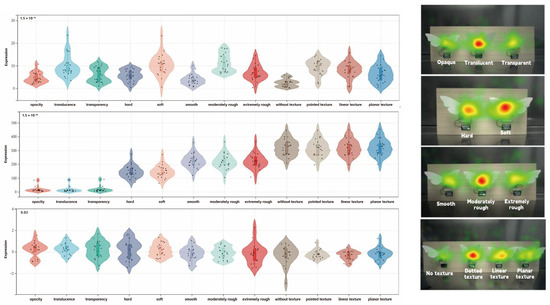
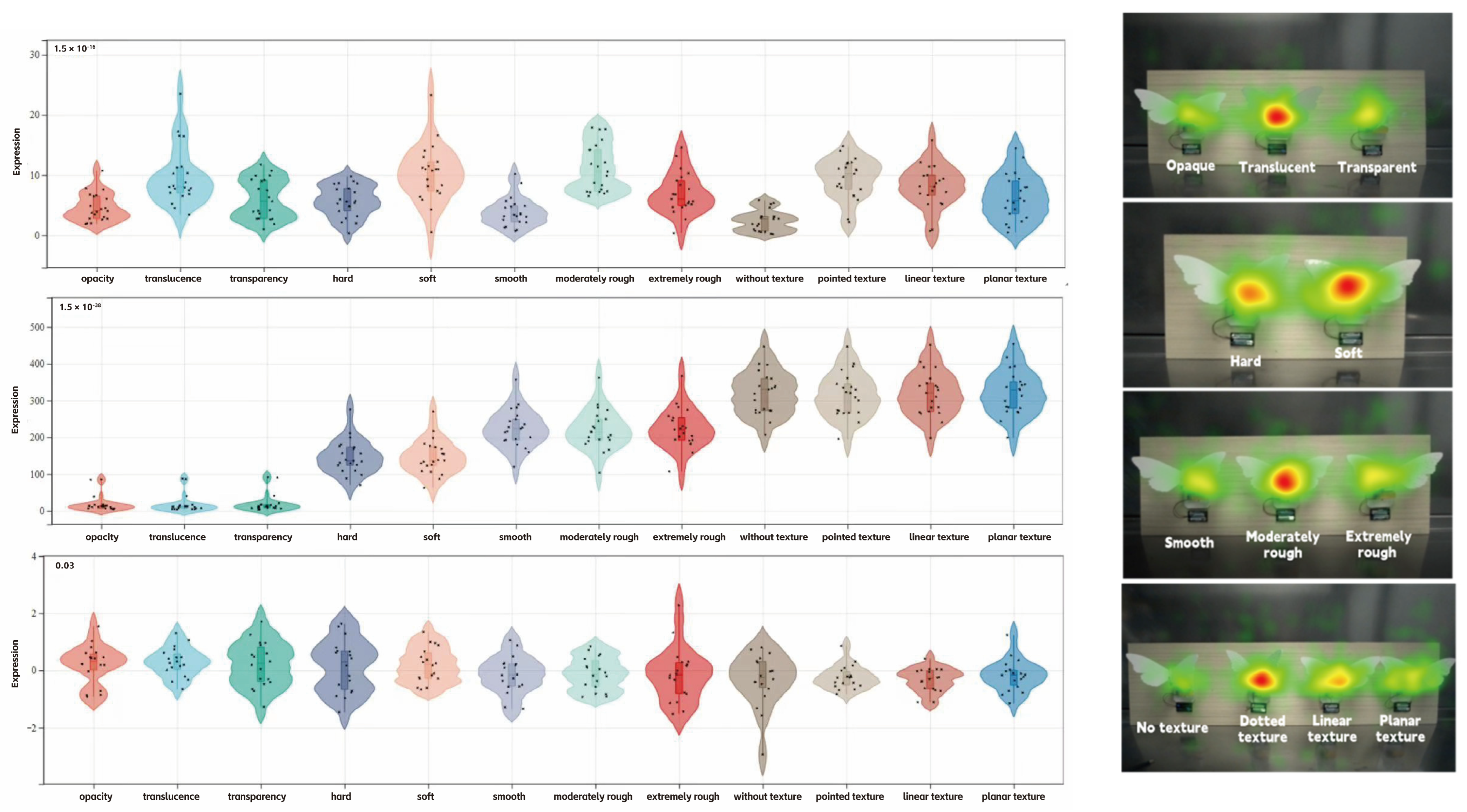
This study conducted separate within-subject repeated-measures ANOVAs (RM-ANOVAs) for each of the four texture dimensions (transparency, hardness, roughness, and surface texture) to examine differences in eye-tracking measures across levels within each dimension. Because the statistical inference in this study focuses on within-dimension comparisons rather than on a unified cross-dimensional model estimation, the corresponding results are reported primarily as dimension-specific comparative evidence. Given that multiple texture dimensions and multiple eye-tracking measures were examined simultaneously, marginally significant results are interpreted with caution in the following sections, and no overly strong inferences are made. Table 1 summarizes the RM-ANOVA results for Total Fixation Duration in AOI (TFD, s), Time to First Fixation in AOI (TTFF, ms), and Mean Pupil Diameter (event-based, mm) across the four texture dimensions, while Figure 6 provides a visual summary of the corresponding mean patterns and representative gaze heatmaps. In terms of significance patterns, total fixation duration showed stable and strong main effects for all four dimensions (all p < 0.05, with partial in the medium-to-large range), indicating that texture cues robustly modulate sustained visual engagement during viewing. TTFF was significant (or highly significant) for transparency, roughness, and surface texture, but not for hardness (p ≥ 0.05), suggesting that early attentional capture is more sensitive to visually discriminable structural cues (e.g., transparency and roughness) than to hardness differences—the latter rely more on tactile associations and are therefore less salient in purely visual viewing. In contrast, the pupil measure did not show significant main effects in any of the four dimensions (all ns), implying that under the current task and stimulus settings, pupil responses did not provide stable physiological evidence for differentiating texture conditions. Accordingly, subsequent discussion focuses primarily on indicators with clearer significance and effect sizes—especially total fixation duration and TTFF where significant—to interpret and compare viewing strategies across texture levels. The condition-level descriptive means for TFD, TTFF, and mean pupil diameter are presented in Table 2.
Table 1.
Within-Subject RM-ANOVA Results and F-Tests.
Figure 6.
The three panels on the left (from top to bottom) show Total Fixation Duration (TFD, s), Time to First Fixation (TTFF, ms), and Mean Pupil Diameter (event-based, mm). The four panels on the right (from top to bottom) present gaze heatmaps for Transparency, Hardness, Roughness, and Surface texture.
Table 2.
Comparison of within-condition means for each texture set.
3.4. Subjective Experiment Using the PAD Scale
3.4.1. Scale Design and Procedure
This study employed a bio-mechanical-device-art-contextualized version of the Pleasure–Arousal–Dominance (PAD) framework to measure participants’ immediate subjective emotional experience under each texture condition. PAD conceptualizes affective experience along three bipolar dimensions—Pleasure (P), Arousal (A), and Dominance (D)—and has been established in foundational emotion research and widely applied in studies of affective quality attributed to environments [11,32,33]. A five-point semantic differential scale (−2, −1, 0, +1, +2) was used, allowing raters to score each texture separately on P, A, and D. Semantic differential scaling is a classic approach for capturing bipolar connotative judgments, and methodological considerations in semantic differential research have been discussed in the psychometric literature [34]. After data collection, the mean scores of P, A, and D were computed for each item, determining its coordinate in the three-dimensional PAD space and providing a basis for subsequent analyses [11,33].
To evaluate inter-rater agreement of the aggregated (mean) PAD ratings across 30 participants for the 12 samples (subsequent analyses used participant-level means), the intraclass correlation coefficient ICC (A,k) (two-way random-effects model, absolute agreement, average measures) was computed separately for P, A, and D. This specification is consistent with classic ICC formulations and guidance emphasizing clear reporting of the ICC model, type (absolute agreement vs. consistency), and unit (single vs. average measures) [35,36]. Let n denote the number of rated objects (samples, n = 12) and k the number of raters (participants, k = 30). Based on a two-way ANOVA, let , , and represent the mean squares for rows (targets/samples), columns (raters), and residual error, respectively. Then:
Values of ICC (A,k) closer to 1 indicate higher agreement of the aggregated mean ratings [36]. The results in this study were:
- P dimension:
- A dimension:
- D dimension:
Using commonly cited interpretive guidelines, these coefficients indicate adequate reliability of the aggregated mean PAD ratings, supporting subsequent sample-wise comparisons and correlation analyses based on mean scores [37].
3.4.2. Emotional “Roles” of Different Textures in the PAD Space
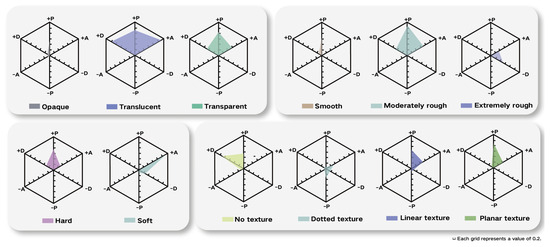
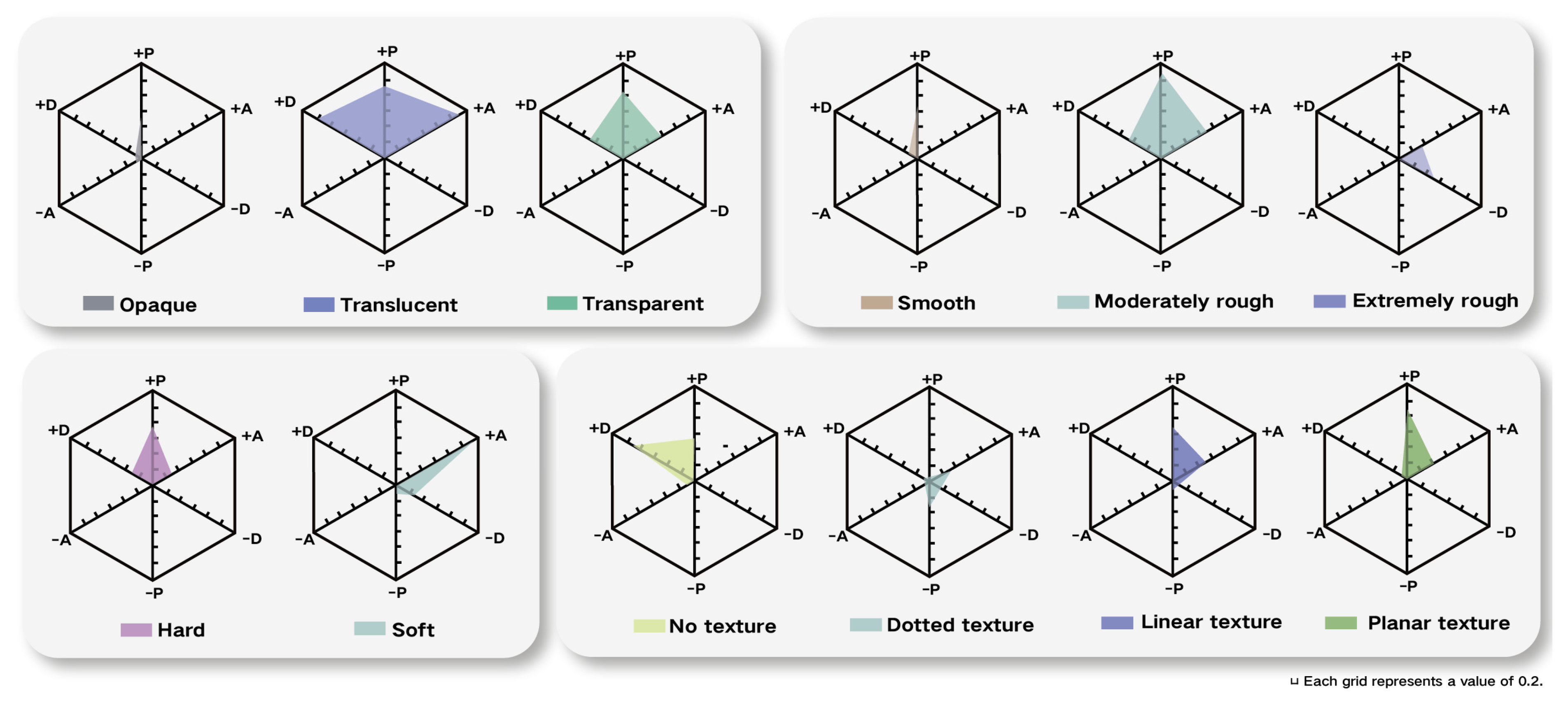
Based on the visualization (Figure 7), most texture conditions show positive Pleasure (P > 0), suggesting that viewers tend to adopt an affective baseline of approach/acceptance toward the material presentation of bionic machinery installation art. By contrast, Arousal (A) and Dominance (D) diverge substantially across conditions, resulting in distinct functional tiers of experience. First, translucence and moderately rough surfaces form a strong driver profile characterized by high pleasure–high arousal (both P and A are high) and are therefore more likely to support emotional momentum in the installation narrative. Second, no texture and translucence yield higher dominance (D 1.00), corresponding to a stronger sense of being understandable, graspable, and controllable. Third, soft and extremely rough conditions produce negative dominance (D < 0), indicating a greater tendency to evoke feelings of being driven/pulled, uncertainty, or oppression, which is suitable for generating tension or alienation.
Figure 7.
PAD-space distribution of 12 texture conditions in bionic machinery installation art . Each point represents the mean score of a texture condition on P (pleasure), A (arousal), and D (dominance) on a to scale.
(1) Transparency: A clear affective gradient, the transparency set exhibits a coherent emotional gradient. Opacity (P = 0.53, A, D) provides a stable, low-stimulation positive baseline and can be interpreted as a stable base layer in the installation experience, establishing a safe and accessible starting point for viewing. Transparency (P = 0.83, A = 0.57, D = 0.47) maintains high pleasure while increasing arousal and controllability, indicating stronger exploration induction; it can be treated as an exploration window, facilitating the transition from passive looking to active observation and meaning construction. Translucence (P = 0.87, A = 1.07, D = 1.00) reaches high values on all three dimensions and expresses a composite affective state of being positive, excited, and confident. It is therefore best positioned as an energy-core component of the installation: it captures attention while sustaining viewers’ sense of control over interaction outcomes, thereby advancing the experience emotionally.
(2) Hardness: Structural support vs. sensitive trigger; hard material (P = 0.73, A = 0.27, D = 0.30) shows moderately high pleasure, low-to-moderate arousal, and positive dominance, pointing to a more stable and predictable experience. This profile aligns with a structural support role in bionic-mechanical imagery—reinforcing perceived mechanical reliability and dampening emotional volatility. In contrast, soft material exhibits a distinctive high-arousal but low-control configuration (A = 1.10, D = −0.23), with pleasure near neutral and slightly negative (P = −0.07). This suggests that softness functions more like a mechanism that triggers excitability and sensitivity, accompanied by uncertainty and a sense of being pulled. It can therefore be framed as a sensitive trigger role within the installation experience, suited to areas intended to evoke tension, strangeness, or biological associations (e.g., tentacle-like forms, membrane structures, deformable components), producing an affective quality that feels alive yet not fully controllable.
(3) Roughness: Comfort, pleasurable interaction, and warning boundaries; a smooth surface (P = 0.63, A = 0.00, D = 0.13) conveys comfort with low stimulation and can serve as an affinitive skin, reducing perceptual friction and maintaining viewing continuity. Moderately rough achieves the highest pleasure in the dataset (P = 1.10) and is accompanied by higher arousal and positive dominance ((A = 0.70, D = 0.43)), indicating that it most strongly elicits an experience of wanting to approach and being willing to engage. It can thus be defined as a pleasurable interactive interface, appropriate for key interaction zones or visual focal areas in bionic machinery installations. By contrast, extremely rough forms a combination of moderate arousal but negative dominance (A = 0.37, D = −0.47) with pleasure near zero (P = 0.00), resembling a warning boundary/challenging shell: it increases alertness and tension while reducing control, and is well suited for narrative conflict, danger cues, or the construction of alienated exteriors.
(4) Surface texture: Strongest stratification in dominance; among all dimensions, surface texture produces the most pronounced stratification in dominance (D). No texture yields low arousal but high dominance (A = −0.10, D = 0.90), corresponding to strong orderliness and graspability; it can be treated as a control interface (e.g., dashboard-like, panel-like, or otherwise readable mechanical surfaces), whose affective function is not stimulation but the establishment of understanding and control. Pointed texture shows the lowest pleasure overall (P = −0.30), with mild arousal (A = 0.33) and dominance near zero (D). It therefore aligns more closely with a noise accent/discomfort-stimulation role: its value lies less in being pleasant and more in producing a sense of foreignness or instability, useful for localized physiological intensification or contrast in conflict. Linear texture (P = 0.63, A = 0.50, D = −0.10) reflects moderate excitement with slight loss of control and can be interpreted as a motion-trajectory/directional guide role, using directional cues to evoke movement and tension. Planar texture (P = 0.83, A = 0.40, D) leans toward a spatially expansive positive experience and can serve a field-laying role, supporting continuous atmosphere and spatial enveloping.
Taken together, these patterns support Hypothesis H2: different levels of texture properties—transparency, roughness, hardness, and surface texture—produce significantly different subjective PAD ratings.
3.5. Association Between Eye-Tracking Measures and PAD Affect: Analysis and Discussion
3.5.1. Pearson Correlation Between Subjective and Objective Measures
To test H3, we computed Pearson correlation coefficients () at the texture-condition level across 12 conditions—corresponding to the complete Texture Bionics sample space: Transparency: opacity, translucence, transparency; Hardenss: hard, soft; Roughness: smooth, moderately rough, extremely rough; Surface texture: no texture, pointed texture, linear texture, planar texture.
For each condition, the mean eye-tracking measures were related to the mean PAD ratings (Pleasure, Arousal, Dominance). Subsequently, multiple linear regression models were constructed to examine the joint predictive contribution of the PAD dimensions to the eye-tracking responses.
Pearson’s quantifies the linear association between two continuous variables, ranging from to . A value of indicates a positive association, indicates a negative association, and a larger indicates a stronger linear relationship [38]. The coefficient is calculated as:
The significance of was tested using a -test:
Consistent with the preceding within-subject RM-ANOVA results, the pupil measure did not show significant main effects across any of the four texture dimensions (). This suggests its limited discriminability and insufficient signal stability for distinguishing between texture conditions. Consequently, pupil diameter was retained as a supplementary descriptive variable but was excluded as a primary component in the H3 correlation-based explanatory chain to avoid over-interpreting unstable evidence [26].
Using the 12 texture conditions as observational units, Pearson correlations (, two-tailed, ) were computed between the condition-level mean PAD scores () and the dispersion (standard deviation, , ) of the two primary eye-tracking measures. The results of the Pearson correlation analysis between PAD scores and eye-tracking measures are presented in Table 3 and discussed in the following section.
Table 3.
Pearson correlation analysis between PAD scores and eye-tracking measures.
The correlation analysis revealed an extremely strong positive association between Arousal and Total Fixation Duration in AOI (TFD) . This indicates that, at the texture-condition level, conditions with higher are associated with larger between-participant differences in total fixation duration. From a visual-behavior perspective, increased dispersion typically implies two plausible mechanisms: (1) highly arousing textures may prompt divergent attentional strategies across individuals (e.g., rapid scanning vs. prolonged dwelling), and/or (2) highly arousing textures may elicit more frequent re-checking/return-looking, substantially extending fixation time for some participants and thereby widening within-condition variability. With respect to H3, this result provides clear evidence that Arousal is the affective dimension most consistently aligned with variation in fixation investment.
In contrast, Pleasure and Dominance showed no significant correlation with TFD , suggesting that—at the condition level— and do not reliably account for the amplification or reduction of between-participant differences in total fixation duration. Notably, the near-zero for indicates essentially no interpretable linear covariation with this measure.
For Time to First Fixation in AOI (TTFF) , none of the correlations with PAD reached significance ; however, the directions and magnitudes suggest trend-level patterns: showed a weak negative association , was near zero , and showed a moderate negative trend . Although not significant with the current sample size , this direction tentatively suggests that texture conditions associated with stronger perceived control/dominance may yield more consistent first-orienting latencies (i.e., smaller between-participant variability). This interpretation should be treated as trend-level rather than definitive; accordingly, H3 is partially supported.
3.5.2. Integrated Discussion of the “Texture–Visual Attention–Affect” Pathway
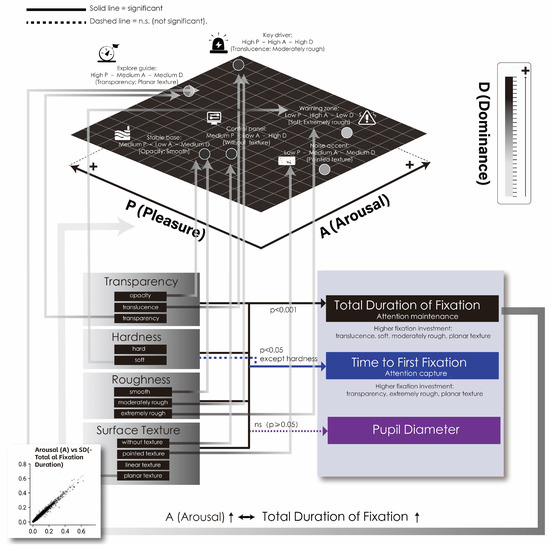
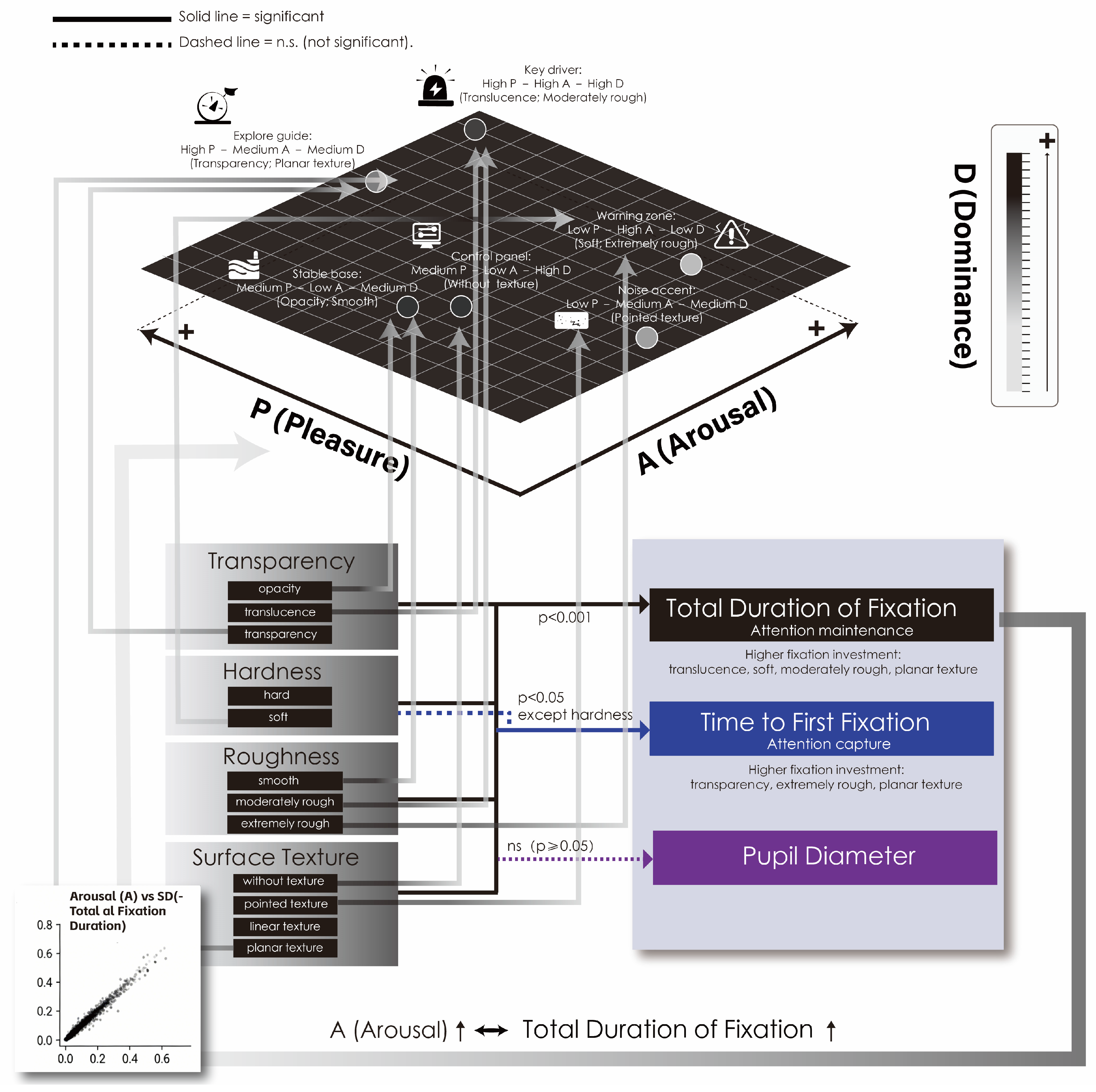
Synthesizing the results from Section 3.3, Section 3.4 and Section 3.5, the proposed “texture–visual attention–affect” pathway should not be understood as a single linear chain. Rather, it resembles a multi-layer mechanism in which texture cues initiate processing, attention allocation and appraisal/meaning construction jointly shape interpretation, and differentiated experiences ultimately emerge in the PAD space (Figure 8). In this study, eye-tracking indices were analyzed within an 8 s presentation window, and AOIs were defined according to each texture dimension, providing operational behavioral evidence for this pathway.
Figure 8.
Integrated pathway analysis of “texture–visual attention–affect”.
(1) Texture cues stably modulate sustained fixation investment: stronger structural contrast increases processing intensity
RM-ANOVA showed that Total Fixation Duration exhibited strong and robust main effects across all four texture dimensions—TRANSPARENCY, HARDNESS, ROUGHNESS, and SURFACE TEXTURE—with medium-to-large effect sizes (e.g., transparency , hardness , roughness , surface texture ; all ). This indicates that texture cues reliably shift the level of sustained processing during viewing—namely, whether viewers remain longer within an AOI and allocate more visual resources. Consistent with the mean patterns, translucence, softness, moderately rough surfaces, and pointed/linear textures tended to elicit higher fixation investment, whereas no texture, opacity, and smooth surfaces aligned more closely with a low-load/low-stimulation viewing strategy. Mechanistically, this pattern suggests that when surfaces present richer layers, boundaries, and structural differences, viewers engage in more intensive cycles of visual sampling → confirmation → integration, resulting in greater accumulated fixation time. Conversely, when surfaces are highly regular or low in information density, the visual system can complete recognition more quickly and shift to the next processing target.
(2) TTFF reflects selective sensitivity in early attentional capture: visually discriminable structure dominates, tactile-associative cues are weaker
Time to First Fixation showed significant (or stronger) effects for TRANSPARENCY, ROUGHNESS, and SURFACE TEXTURE, but not for HARDNESS. This pattern implies that early orienting is primarily driven by first-glance visual salience and structural separability—for example, directional organization in texture, granular roughness cues, and the depth/occlusion relations introduced by transparency. By contrast, hardness is more strongly tied to tactile experience or contextual inference and therefore exerts weaker influence on “where the first fixation lands” in purely visual viewing. In this sense, the attentional stage exhibits a two-phase structure: TTFF functions as an entry mechanism indicating which cues capture attention first, whereas total fixation duration reflects an investment mechanism indicating whether viewers continue processing. Together, they form a behavioral loop of attention capture → attention maintenance.
(3) Pupil diameter did not provide stable physiological differentiation: arousal signals may be masked by context and individual baselines.
Pupil diameter showed no significant main effects across the four texture dimensions (all ). Accordingly, in the explanatory chain for H3, pupil measures were treated as supplementary descriptors rather than primary evidence, avoiding core inferences based on signals with limited stability. Importantly, this does not imply the absence of arousal. Rather, under the current stimulus intensity, task demands, and experimental controls, pupil responses may have been more strongly influenced by individual baselines and moment-to-moment attentional fluctuations, making them insufficiently sensitive to discriminate texture conditions.
(4) Functional role differentiation in the affective layer: PAD patterns reflect hierarchical experience functions rather than simple “more vs. less”
The PAD results indicate that texture conditions can be organized into functional affective roles such as: translucence/moderately rough as Key driver, transparency/planar texture as Explore guide, opacity/smooth as Stable base, no texture as Control panel, extremely rough/soft as Warning zone, and pointed texture as Noise accent. This structure is crucial for integrating the pathway: it implies that affect is not merely a passive reaction to material cues but is naturally coupled with the functional “site roles” within an installation narrative. Consequently, the same attentional behavior (e.g., prolonged fixation) may carry different meanings under different affective roles—signaling either approach and exploration or uncertainty and repeated checking. Building on this, we further summarize PAD patterns across texture conditions into these functional roles within the PAD space (Table 4).
Table 4.
Classification of PAD role types across texture conditions.
(5) Key bridging evidence: Arousal is strongly correlated with TFD—high arousal does not cause everyone to look longer, but prompts viewing strategies to diverge.
The most critical bridging finding is that, at the condition level, Arousal shows an extremely strong positive correlation with TFD . Descriptive statistics further indicate that translucence, soft, and moderately rough conditions exhibit higher dispersion in TFD, whereas no texture and opacity show lower dispersion. Together, these patterns point to an important mechanism: high-arousal textures function more like an amplifier—they magnify individual differences rather than producing a uniform attention pattern. Some viewers may respond to high-arousal cues by scanning rapidly and switching information frequently, whereas others may dwell longer and engage in return-looking. As a result, overall dispersion increases substantially.
(6) The “weak correlations” of are also informative: Pleasure and Dominance behave more like evaluative outcomes than stable drivers of attention.
Pleasure is essentially unrelated to TFD , and Dominance is also non-significant. This suggests that, when the statistical unit is the texture condition, and do not reliably determine the degree to which viewing investment differentiates across individuals. A plausible interpretation is that and are closer to post-viewing integrative evaluations (e.g., “like/dislike” and “controllable/uncontrollable”). They may be shaped more strongly by appraisal and contextual interpretation of the installation and therefore do not necessarily translate into consistent differences in gaze strategies. Put differently, attention in this pathway behaves more like a process variable leading toward affect, whereas and are outcome variables after the process has unfolded—so linear synchrony is not required.
(7) A trend-level cue linking D and TTFF: Perceived control may relate to consistency in early orienting, but stronger power is needed.
Although TTFF did not show statistically significant correlations with any PAD dimension, exhibited a moderate negative trend with TTFF dispersion . This offers an extendable, testable hypothesis: when a material/surface affords stronger feelings of being understandable and graspable (e.g., the “Control panel” tendency associated with no texture), viewers’ early orienting may become more consistent across individuals (i.e., smaller between-participant variability). Conversely, when textures induce lower dominance or uncertainty (e.g., the “Warning zone” tendency associated with soft and extremely rough), early orienting may be more strongly shaped by individual strategies and thus becomes more dispersed. Since the present correlation analysis uses only 12 conditions as the sample size, statistical power is limited; therefore, this inference should be treated as a directional cue. Future work could test it more rigorously by increasing the number of conditions, adopting multilevel models (trial-/participant-level), or using mediation models.
Overall Implication
Taken together, this integrated discussion clarifies that the evidence chain supports the claim that texture can modulate visual attention investment and that affective responses can be organized into functional roles in PAD space. At the same time, it shows that the texture–affect relationship is not one-to-one; instead, it is characterized by an arousal-centered pattern of strategy differentiation. This provides a clear theoretical and methodological basis for future work using moderation models or testing the dynamic feedback mechanism between texture and affect in more ecologically valid installation-interaction contexts.
4. Construction and Workflow of the Texture Design Toolkit
4.1. Concept and Framework
To translate the mechanisms and role distinctions outlined above into actionable design methods, this study proposes the “Texture Design Toolkit.” The core concept of the toolkit is as follows: beginning with the narrative and interaction objectives of an installation, designers select texture combinations that align with these goals, while simultaneously anticipating the potential attention patterns and emotional functions that these textures may evoke. This enables a controlled orchestration of affective experience.
The toolkit is intended for practical use, allowing designers to make efficient design decisions without needing to review the entire research process. The decision-making workflow is simplified into a sequence of “purpose → strategy → attention effect → placement guidance.” The specific design rules, categorized according to the preceding analysis, are presented below (Table 5)
Table 5.
Classification scheme of the texture design toolkit.
4.2. Toolkit Contents and Application Workflow
The toolkit can be applied through a three-question workflow that progressively deepens the analysis. The process is outlined as follows.
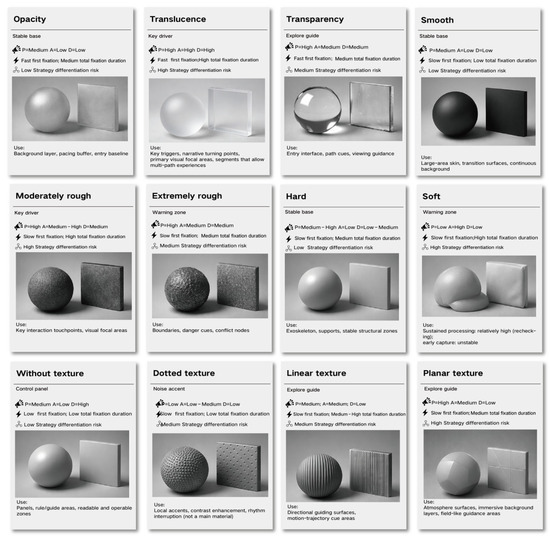
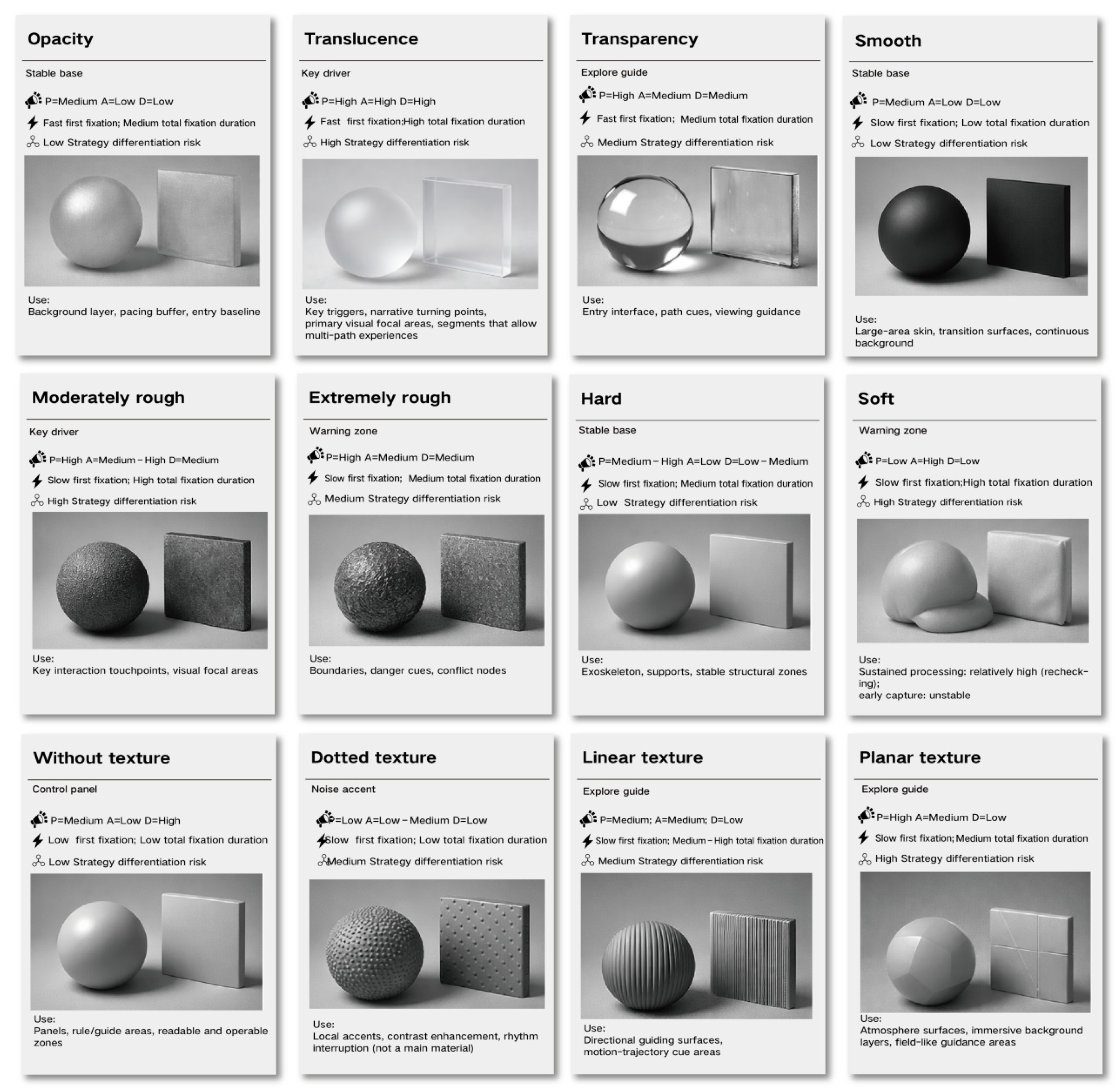
To enable designers to quickly access and apply evidence from the “texture–attention–affect” pathway during creation, the experimental findings were translated into an actionable Texture Design Toolkit. The toolkit consists of three core components: a Texture Sample Library, Six Functional Categories, and Design Guidance Cards (Figure 9).
Figure 9.
Design guidance cards of the Texture Design Toolkit.
The final output of the three-question workflow is a material recommendation for each installation part in the form of a combined package (Table 6):
Table 6.
Analysis of the usage workflow of the texture design toolkit.
The final output of the three-question workflow is a material recommendation for each installation part in the form of a combined package: “functional label + attention goal + differentiation risk.” This structure upgrades texture selection from an aesthetic preference to a controllable tool for emotional orchestration, supporting narrative progression, guiding viewing, and explicitly incorporating the risk trade-off between multiple interpretations and interaction consistency into design decision-making.
5. Conclusions
This study investigated the texture–visual attention–affect pathway by constructing a controllable sample space of 12 texture conditions and integrating eye-tracking with the PAD scale under standardized settings. The results confirm the critical role of texture cues in the experience of bionic-machinery installation art. Specifically, texture cues reliably modulated sustained attentional investment (significant differences in total fixation duration) and exerted selective effects on early attentional capture (TTFF depended more strongly on visually discriminable structural cues). At the affective level, different textures formed summarizable functional roles in PAD space, allowing material choice to shift from “aesthetic preference” toward a decision grounded in experience function.
More importantly, the study shows that attention and affect are not linked by a simple one-directional relation. Arousal operates more like a strategy amplifier: high-arousal textures do not necessarily cause everyone to look longer but are more likely to increase divergence in viewing strategies and invite multiple interpretations. This provides an operational design lever for narrative progression and rhythmic structuring in installation experiences. Building on this evidence chain, the paper further translates the findings into a Texture Design Toolkit, using the three-question workflow—functional label → attention goal → differentiation risk—to support rapid placement and communication of material decisions across key segments, entry segments, background segments, and interface-like zones.
Several limitations should be acknowledged. If the presentation order of conditions was not sufficiently randomized or counterbalanced, order effects such as habituation and fatigue may have influenced the robustness of some main effects. In addition, the present study focused primarily on plastic materials and emphasized visual cues, which still differs from real-world installation practice where multi-material and multi-sensory coupling is common. Future work can strengthen inference by adopting more rigorous randomization/counterbalancing designs, expanding materials to metal, textiles, and bio-materials, and incorporating touch, sound, and movement rhythm as additional variables. These extensions would help develop a more practice-oriented multimodal texture–emotion–function toolkit and enable iterative validation of the proposed design-translation framework in ecologically valid settings.
Author Contributions
Conceptualization, Y.C.; Methodology, Y.C.; Software, Y.C.; Validation, Y.C.; Formal analysis, Y.C.; Investigation, Y.C.; Resources, M.W.; Data curation, Y.C.; Writing—original draft, Y.C.; Writing—review & editing, M.W.; Visualization, Y.C.; Supervision, M.W.; Project administration, M.W.; Funding acquisition, M.W. All authors have read and agreed to the published version of the manuscript.
Funding
This research was funded by the National Natural Science Foundation of China, General Program, grant number 62276063.
Institutional Review Board Statement
The study was conducted in accordance with the Declaration of Helsinki and approved by the Institutional Review Board of Tongji University (protocol code tjdxsr2025181, 31 December 2025).
Informed Consent Statement
Informed consent was obtained from all subjects involved in the study.
Data Availability Statement
The original contributions presented in the study are included in the article, further inquiries can be directed to the corresponding author.
Conflicts of Interest
The authors declare no conflict of interest.
References
- Halbig, A.; Latoschik, M.E. A systematic review of physiological measurements, factors, methods, and applications in virtual reality. Front. Virtual Real. 2021, 2, 694567. [Google Scholar] [CrossRef] [Scilit]
- Vincent, J.F.V.; Bogatyreva, O.A.; Bogatyrev, N.R.; Bowyer, A.; Pahl, A.-K. Biomimetics: Its practice and theory. J. R. Soc. Interface 2006, 3, 471–482. [Google Scholar] [CrossRef] [Scilit] [PubMed]
- Schmidt, F.; Hebart, M.N.; Schmid, C.; Fleming, R.W. Core dimensions of human material perception. Proc. Natl. Acad. Sci. USA 2025, 122, e2417202122. [Google Scholar] [CrossRef] [Scilit] [PubMed]
- Sharan, L.; Rosenholtz, R.; Adelson, E.H. Accuracy and speed of material categorization in real-world images. J. Vis. 2014, 14, 12. [Google Scholar] [CrossRef] [Scilit] [PubMed]
- Fleming, R.W.; Wiebel, C.; Gegenfurtner, K.R. Perceptual qualities and material classes. J. Vis. 2013, 13, 9. [Google Scholar] [CrossRef] [Scilit]
- Marschallek, B.E.; Jacobsen, T. Materials aesthetics: A replication and extension study of the conceptual structure. PLoS ONE 2022, 17, e0277082. [Google Scholar] [CrossRef] [Scilit]
- Bergmann Tiest, W.M.; Kappers, A.M.L. Haptic and visual perception of roughness. Acta Psychol. 2007, 124, 177–189. [Google Scholar] [CrossRef] [Scilit]
- Gigilashvili, D.; Thomas, J.-B.; Hardeberg, J.Y.; Pedersen, M. Translucency perception: A review. J. Vis. 2021, 21, 4. [Google Scholar] [CrossRef] [Scilit]
- Dubbiosi, L.; Pierguidi, L.; Borgogno, M.; Dinnella, C.; Sanesi, S.; Monteleone, E.; Spinelli, S. Implicit measure of emotional responses to fabric textures: An original approach based on the Affect Misattribution Procedure. Food Qual. Prefer. 2025, 134, 105685. [Google Scholar] [CrossRef] [Scilit]
- Chen, J.; Wu, P.; Jiang, Y.; Lv, L. Rough is durable, smooth is user-friendly: Effects of surface visual roughness on consumers’ perception and product preference. J. Retail. Consum. Serv. 2025, 84, 104196. [Google Scholar] [CrossRef] [Scilit]
- Mehrabian, A. Pleasure-arousal-dominance: A general framework for describing and measuring individual differences in temperament. Curr. Psychol. 1996, 14, 261–292. [Google Scholar] [CrossRef] [Scilit]
- Asan, O.; Yang, Y. Using eye trackers for usability evaluation of health information technology: A systematic literature review. JMIR Hum. Factors 2015, 2, e5. [Google Scholar] [CrossRef] [Scilit]
- Xu, B.; Lu, J. Fangsheng Sheji Gailun [Generality of Bio-Inspired Design]; Southwest Jiaotong University Press: Chengdu, China, 2016. [Google Scholar]
- Mehrabian, A.; Russell, J.A. An Approach to Environmental Psychology; MIT Press: Cambridge, MA, USA, 1974; Available online: https://mitpress.mit.edu/9780262130905/an-approach-to-environmental-psychology/ (accessed on 30 December 2025).
- Li, X.; Zhou, H.; Song, S.; Ran, T.; Fu, X. The reliability and validity of the Chinese version of abbreviated PAD emotion scales. In Affective Computing and Intelligent Interaction; Lecture Notes in Computer Science; Tao, J., Tan, T., Picard, R.W., Eds.; Springer: Berlin/Heidelberg, Germany, 2005; Volume 3784, pp. 513–518. [Google Scholar] [CrossRef] [Scilit]
- Gneo, M.; Schmid, M.; Conforto, S.; D’Alessio, T. A free geometry model-independent neural eye-gaze tracking system. J. Neuroeng. Rehabil. 2012, 9, 82. [Google Scholar] [CrossRef] [Scilit]
- Tobii. Tobii Pro Glasses 3: Advanced Wearable Eye Tracker Built for Research. Available online: https://www.tobii.com/products/eye-trackers/wearables/tobii-pro-glasses-3 (accessed on 8 January 2026).
- Huang, Y.; Rong, W.; Li, X.; Wu, W.; Liu, Y.; Sun, S.; Gan, F. The aesthetic nature of Chinese-inscribed poetry and painting texts—Evidence from eye movements. Digit. Scholarsh. Humanit. 2025, 40, 779–801. [Google Scholar] [CrossRef] [Scilit]
- Kühnapfel, C.; Fingerhut, J.; Brinkmann, H.; Ganster, V.; Tanaka, T.; Specker, E.; Mikuni, J.; Güldenpfennig, F.; Gartus, A.; Rosenberg, R.; et al. How Do We Move in Front of Art? How Does This Relate to Art Experience? Linking Movement, Eye Tracking, Emotion, and Evaluations in a Gallery-Like Setting. Empir. Stud. Arts 2024, 42, 86–146. [Google Scholar] [CrossRef] [Scilit]
- Luo, Z. Using eye-tracking technology to identify learning styles: Behaviour patterns and identification accuracy. Educ. Inf. Technol. 2021, 26, 4457–4485. [Google Scholar] [CrossRef] [Scilit]
- Blanca, M.J.; Arnau, J.; García-Castro, F.J.; Alarcón, R.; Bono, R. Repeated measures ANOVA and adjusted F-tests when sphericity is violated: Which procedure is best? Front. Psychol. 2023, 14, 1192453. [Google Scholar] [CrossRef] [Scilit] [PubMed]
- Duchowski, A.T. A breadth-first survey of eye-tracking applications. Behav. Res. Methods Instrum. Comput. 2002, 34, 455–470. [Google Scholar] [CrossRef] [Scilit]
- King, A.J.; Bol, N.; Cummins, R.G.; John, K.K. Improving visual behavior research in communication science: An overview, review, and reporting recommendations for using eye-tracking methods. Commun. Methods Meas. 2019, 13, 149–177. [Google Scholar] [CrossRef] [Scilit]
- Rayner, K. Eye movements in reading and information processing: 20 years of research. Psychol. Bull. 1998, 124, 372–422. [Google Scholar] [CrossRef] [Scilit]
- Guo, F.; Ding, Y.; Liu, W.; Liu, C.; Zhang, X. Can eye-tracking data be measured to assess product design? Visual attention mechanism should be considered. Int. J. Ind. Ergon. 2016, 53, 229–235. [Google Scholar] [CrossRef] [Scilit]
- Beatty, J. Task-evoked pupillary responses, processing load, and the structure of processing resources. Psychol. Bull. 1982, 91, 276–292. [Google Scholar] [CrossRef] [PubMed]
- Bradley, M.M.; Miccoli, L.; Escrig, M.A.; Lang, P.J. The pupil as a measure of emotional arousal and autonomic activation. Psychophysiology 2008, 45, 602–607. [Google Scholar] [CrossRef] [Scilit] [PubMed]
- Sirois, S.; Brisson, J. Pupillometry. Wiley Interdiscip. Rev. Cogn. Sci. 2014, 5, 679–692. [Google Scholar] [CrossRef] [Scilit]
- Lakens, D. Calculating and reporting effect sizes to facilitate cumulative science: A practical primer for t-tests and ANOVAs. Front. Psychol. 2013, 4, 863. [Google Scholar] [CrossRef] [Scilit]
- Richardson, J.T.E. Eta squared and partial eta squared as measures of effect size in educational research. Educ. Res. Rev. 2011, 6, 135–147. [Google Scholar] [CrossRef] [Scilit]
- Bakeman, R. Recommended effect size statistics for repeated measures designs. Behav. Res. Methods 2005, 37, 379–384. [Google Scholar] [CrossRef] [Scilit] [PubMed]
- Russell, J.A.; Mehrabian, A. Evidence for a three-factor theory of emotions. J. Res. Personal. 1977, 11, 273–294. [Google Scholar] [CrossRef] [Scilit]
- Russell, J.A.; Pratt, G. A description of the affective quality attributed to environments. J. Personal. Soc. Psychol. 1980, 38, 311–322. [Google Scholar] [CrossRef]
- Heise, D.R. Some methodological issues in semantic differential research. Psychol. Bull. 1969, 72, 406–422. [Google Scholar] [CrossRef] [Scilit]
- McGraw, K.O.; Wong, S.P. Forming inferences about some intraclass correlation coefficients. Psychol. Methods 1996, 1, 30–46. [Google Scholar] [CrossRef]
- Shrout, P.E.; Fleiss, J.L. Intraclass correlations: Uses in assessing rater reliability. Psychol. Bull. 1979, 86, 420–428. [Google Scholar] [CrossRef] [PubMed]
- Cicchetti, D.V. Guidelines, criteria, and rules of thumb for evaluating normed and standardized assessment instruments in psychology. Psychol. Assess. 1994, 6, 284–290. [Google Scholar] [CrossRef]
- Schober, P.; Boer, C.; Schwarte, L.A. Correlation coefficients: Appropriate use and interpretation. Anesth. Analg. 2018, 126, 1763–1768. [Google Scholar] [CrossRef] [Scilit] [PubMed]

Disclaimer/Publisher’s Note: The statements, opinions and data contained in all publications are solely those of the individual author(s) and contributor(s) and not of MDPI and/or the editor(s). MDPI and/or the editor(s) disclaim responsibility for any injury to people or property resulting from any ideas, methods, instructions or products referred to in the content. |
© 2026 by the authors. Licensee MDPI, Basel, Switzerland. This article is an open access article distributed under the terms and conditions of the Creative Commons Attribution (CC BY) license.