


Abstract
Human–Machine Interfaces (HMIs) are increasingly important in vehicles and other safety-critical systems, yet approaches to their usability and User eXperience (UX) evaluation remain fragmented. This systematic literature review investigates how HMIs are empirically evaluated across domains, with a primary focus on automotive HMIs, complemented by evidence from related safety-critical domains. The review examines UX and usability evaluation methodologies, tools, standards, and technological trends reported in recent research. Peer-reviewed journal articles published between 2015 and 2025 were considered if they addressed empirical usability or UX evaluation of HMIs. Searches were conducted in Scopus and ScienceDirect databases following PRISMA guidelines. From n = 659 records initially identified, n = 82 papers were included in the final analysis. The literature was synthesized using a descriptive and narrative approach, focusing on evaluation contexts, testing methodologies, sensor-based tools, applied standards, and assessment metrics. Most papers investigated automotive HMIs, while fewer addressed aerospace, industrial, maritime, and other safety-critical applications. Simulation-based user testing emerged as the dominant evaluation approach, frequently supported by eye-tracking and physiological sensing technologies and subjective evaluation questionnaires. A more detailed analysis revealed that adherence to international standards (e.g., ISO 9241 and ISO 26262) was not always consistently evident. Overall, the evidence highlights substantial methodological heterogeneity, fragmented adoption of standards, and limited cross-domain comparability. While today UX and usability evaluation can benefit from continuous technological advances, the field lacks standardized and replicable assessment protocols. Future research should prioritize stronger integration of standards, multimodal evaluation approaches, and longitudinal study designs.
1. Introduction
Human–Machine Interfaces (HMIs) are quickly changing as critical components of contemporary vehicle systems [1]. In modern automotive contexts, HMIs are no longer limited to basic control panels but serve as comprehensive interaction hubs that connect drivers with more and more complicated in-vehicle technologies. As vehicles integrate advanced features such as automation, connectivity, and artificial intelligence, the HMI becomes essential not only for usability and comfort but also for ensuring driving safety and security [2].
The transition toward full-touch interfaces and multimodal interaction paradigms has introduced new challenges and risks. Large, multifunctional touchscreen displays offer increased flexibility and functionality, but often at the cost of higher cognitive and visual workload for drivers. These interfaces enable a wide range of secondary tasks, frequently without tactile feedback, which can increase visual–manual distraction and raise safety concerns [3]. Empirical studies have shown that distraction behavior in full-touch HMI configurations varies considerably across users and can negatively affect lateral vehicle control, eyes-off-road time, and response accuracy, particularly in real-world driving conditions.
As automotive HMIs evolve from primarily functional control systems into complex digital environments, the evaluation of UX has become increasingly important. Modern HMIs require users to interact with software-intensive systems that differ fundamentally from traditional mechanical controls in terms of interaction patterns, feedback mechanisms, and cognitive processing demands. The multimodal nature of contemporary HMIs, combining visual, auditory, haptic, and voice-based interaction, creates multi-sensory experiences that may either support or hinder safe and efficient system use. Moreover, the multifunctional capabilities of current interfaces allow users to perform multiple concurrent tasks, such as navigation, entertainment, and vehicle configuration, often through unified touchscreen-based systems that replace dedicated physical controls.
This growing digital complexity needs a holistic approach to UX evaluation that extends beyond traditional usability metrics. While usability primarily addresses task effectiveness and efficiency, UX encompasses broader cognitive, emotional, and behavioral responses experienced during interaction. In the automotive domain, this includes aspects such as perceived safety, trust in automated functions, aesthetic appeal, learnability over time, workload, and the ability to maintain situational awareness. Capturing these dimensions requires evaluation approaches that combine objective performance measures with subjective and experiential data, particularly given the diversity of users and usage contexts in modern vehicles.
Despite the growing functional and safety demands placed on HMIs, testing practices remain diverse and inconsistently applied across domains. Traditional evaluation methods, such as heuristic inspection, usability testing, and cognitive walkthroughs [4], coexist with more recent techniques involving biometric sensing, user behaviour logging, and simulation-based testing. However, there is no widely adopted protocol that systematically integrates these methods or conforms with international standards. Frameworks such as ISO 9241 (Ergonomics of human-system interaction) and ISO 26262 (Functional safety for road vehicles) are occasionally referenced in research, but their practical implementation in UX evaluation varies a lot [5,6].
This systematic literature review (SLR) investigates how HMIs are empirically tested with a focus on UX and usability evaluation practices. The review examines which methodologies and tools are employed, which standards and regulatory frameworks guide evaluation activities, and how these practices have evolved over the past decade. Specifically, the review addresses the following research questions (Table 1).
Table 1.
Research questions.
By addressing these questions, the review aims to synthesize current evaluation practices, identify methodological trends and inconsistencies, and support the development of more structured and replicable approaches to HMI testing. While the review adopts an automotive-centered perspective, studies from other safety-critical domains were also included when they addressed comparable UX and usability evaluation methodologies. This cross-domain perspective allows the identification of transferable approaches while maintaining automotive HMIs as the primary reference context for the analysis and discussion.
1.1. Terminology and Definitions
To ensure terminological consistency, this review adopts the following definitions based on international standards and established literature:
User Experience (UX)—as defined in ISO 9241-210, “a person’s perceptions and responses that result from the use or anticipated use of a product, system, or service” [5]. UX represents an overarching construct encompassing affective, cognitive, and behavioural aspects of human interaction with technology. Throughout this review, UX is used to denote this holistic, multidimensional perspective on human interaction with HMIs, integrating both objective performance data and subjective experiential measures.
Usability is defined according to ISO 9241-11 as “the extent to which a system can be used by specified users to achieve specified goals with effectiveness, efficiency, and satisfaction in a specified context of use” [7]. In empirical HMI studies, usability evaluation typically focuses on task-oriented performance indicators, such as task completion time, error rates, success rates, and efficiency measures. Within this review, usability refers specifically to these performance- and task-related aspects of interaction, commonly assessed through controlled user testing and standardized usability questionnaires.
User Testing—refers to a broad class of empirical evaluation methods that involve human participants interacting with a system or prototype under defined conditions. User testing may be conducted in laboratory environments, driving simulators, or real-world settings, and may include both formative and summative evaluations. In this review, the term user testing is used as an umbrella concept encompassing any empirical study in which users directly interact with an HMI for the purpose of assessing usability, UX, or related human factors.
HMI testing is used in this paper to describe domain-specific applications of user testing that explicitly focus on the evaluation of Human–Machine Interfaces. In the automotive domain, HMI testing often involves safety-critical considerations, such as driver distraction, situational awareness, trust calibration, and compliance with functional safety requirements. While HMI testing typically includes usability and UX evaluation, it may also incorporate additional domain-specific constraints and metrics that are not always present in general-purpose user testing.
The paper is structured as follows: Section 2 presents the research background and contextualizes the relevance of HMI testing across different domains. Section 3 describes the adopted methodology, including the systematic review protocol and selection criteria. Section 4 reports the main results of the literature analysis, organized by thematic dimensions. Section 5 offers a critical discussion of the findings in relation to the research goals. Finally, Section 6 concludes the paper by summarizing key insights and outlining potential directions for future research.
1.2. Summary of Main Findings
Anticipating the results presented in the following sections, this review identifies several consistent patterns in UX evaluation of HMIs. First, the majority of analyzed papers focuses on automotive applications, while aerospace, defence, medical, and industrial domains remain comparatively under-represented. Second, simulation-based testing dominates over real-world evaluations, mainly due to safety, cost, and reproducibility constraints. Third, eye-tracking and basic physiological sensors (e.g., heart rate and electrodermal activity) are the most frequently employed objective measurement tools and are typically combined with standardized questionnaires such as the System Usability Scale (SUS), NASA-TLX, and the User Experience Questionnaire (UEQ). Fourth, explicit use of international standards (e.g., ISO 9241, ISO 26262 and related norms) is inconsistent and often limited to high-level references rather than operational protocols. Finally, UX evaluation practices remain fragmented, with limited multimodal data integration and scarce longitudinal studies, which limits cross-study comparability and the development of standardised, replicable testing frameworks.
2. Research Background
Human–Machine Interfaces (HMIs) represent the critical interaction layer between users and complex technological systems, encompassing both the physical and digital components that enable human control and monitoring of machine operations [8]. Traditionally, HMIs consisted of discrete physical controls such as buttons, switches, and analogue displays that provided direct, tactile feedback and one-to-one mapping between control actions and system responses. However, the contemporary understanding of HMIs has evolved to encompass sophisticated digital ecosystems that integrate multiple interaction modalities, adaptive interfaces, and intelligent system behaviors that respond contextually to user needs and environmental conditions [1].
Modern HMIs are characterized by their software-driven nature, enabling dynamic reconfiguration of interface elements, personalization capabilities, and integration with broader networked systems [9]. These interfaces typically feature multi-touch displays, gesture recognition, voice control, and haptic feedback systems that work in concert to create seamless UX across diverse operational contexts. The shift from hardware-centric to software-centric design has fundamentally altered the interaction paradigm, moving from static, dedicated controls to flexible, context-aware interfaces that can adapt their presentation and functionality based on user preferences, task requirements, and environmental conditions.
While this research focuses primarily on automotive applications, HMIs serve as critical components across numerous high-stakes domains where human–machine interaction directly impacts safety, efficiency, and operational success. In the automotive sector, HMIs have evolved from basic radio and climate controls to comprehensive infotainment systems that integrate navigation, communication, entertainment, and vehicle diagnostics into unified touchscreen interfaces. These systems must balance rich functionality with driving safety requirements, necessitating careful consideration of visual-manual distraction and cognitive load management [10].
Beyond automotive applications, HMIs serve as critical components across numerous high-stakes domains where human–machine interaction directly impacts safety, efficiency, and operational success. Aerospace applications represent some of the most demanding HMI implementations, where pilots interact with complex flight management systems under high-stress conditions with minimal tolerance for error [11,12]. Defence systems employ HMIs in command and control environments where operators must process large volumes of information while making time-critical decisions. Industrial machinery applications encompass manufacturing control systems and process monitoring interfaces where operators must monitor complex processes and intervene when necessary to maintain operational efficiency and safety. These domains share common challenges with automotive HMIs, including the need to balance rich functionality with safety requirements, manage cognitive load under stress, and accommodate diverse user populations with varying expertise levels.
UX encompasses the holistic perception and response that users develop through their interaction with products, systems, and services, extending beyond mere functional usability to include emotional, cognitive, and behavioral dimensions of human-system interaction. The International Organization for Standardization defines UX in ISO 9241-210 as “a person’s perceptions and responses that result from the use or anticipated use of a product, system or service,” emphasizing that UX includes “all the users’ emotions, beliefs, preferences, perceptions, physical and psychological responses, behaviours and accomplishments that occur before, during and after use” [5]. This comprehensive definition highlights three fundamental characteristics that distinguish UX from traditional usability metrics. First, UX is contextual, meaning that UX are heavily influenced by the specific circumstances, environment, and situational factors surrounding the interaction [13]. The same interface may produce vastly different UX when used in different physical environments, under varying time pressures, or with different task objectives. In automotive contexts, this contextual dependency is particularly pronounced, as driving conditions, weather, traffic, and passenger presence all significantly influence how users perceive and interact with vehicle systems. Second, UX is dynamic, evolving continuously throughout the interaction lifecycle and changing based on user familiarity, expertise development, and evolving expectations. Initial UX with new interfaces often emphasize novelty and exploration, while extended use patterns focus more on efficiency and habit formation. This temporal dimension requires evaluation approaches that can capture both immediate impressions and long-term satisfaction patterns, particularly important for automotive systems that users interact with daily over extended periods. Third, UX is user-dependent, varying significantly across different user populations based on individual differences in cognitive capabilities, prior experience, cultural background, and personal preferences. What constitutes a positive UX for one individual may be frustrating or confusing for another, necessitating evaluation methodologies that can account for user diversity and identify design solutions that accommodate broad user populations while maintaining usability for specific user groups.
The relationship between UX and performance outcomes represents a critical consideration in HMI design, particularly in safety-critical domains where poor UX can directly contribute to operational errors, reduced efficiency, and increased risk of accidents. Research demonstrates that positive UX correlate with improved task performance through several mechanisms, including reduced cognitive load, enhanced user confidence, and increased system acceptance that promotes appropriate use patterns [14]. Poor UX can manifest in various performance degradations, including increased task completion times, higher error rates, and reduced situational awareness as users struggle with confusing or frustrating interfaces. In automotive contexts, negative UX can lead to increased visual-manual distraction as drivers spend more time and attention interacting with poorly designed interfaces, potentially compromising driving safety and performance [3]. Conversely, well-designed UX can enhance performance by reducing interaction complexity, providing clear feedback, and supporting users’ mental models of system operation.
The evaluation of UX requires methodological approaches that can capture both objective performance metrics and subjective user perceptions, typically categorized into expert evaluation and usability testing methodologies [4,15,16]. Each approach offers distinct advantages and limitations, often requiring integrated evaluation strategies that combine multiple methods to provide comprehensive insights into UX quality.
Expert evaluation involves trained evaluators systematically examining interfaces using established principles, guidelines, and heuristics to identify potential usability and UX issues without direct user involvement [4,15,16]. Heuristic evaluation represents the most widely used expert evaluation method, where evaluators assess interfaces against established usability principles such as visibility of system status, match between system and real world, and user control and freedom [16]. This approach enables rapid identification of common usability problems and can be particularly effective during early design phases when testing may be impractical or expensive.
User testing involves direct observation and measurement of actual users interacting with interfaces under controlled or naturalistic conditions, providing empirical data about both performance outcomes and subjective UX [17]. Controlled laboratory testing typically involves structured task scenarios where users perform predetermined activities while researchers collect quantitative metrics such as task completion times, error rates, and efficiency measures, alongside qualitative data through think-aloud protocols, interviews, and standardized questionnaires. Usability testing methodologies can incorporate various data collection techniques, including behavioural observation, physiological measurement (such as eye tracking, heart rate monitoring, and galvanic skin response), and subjective assessment through validated questionnaires and interview protocols. The integration of multiple data sources enables comprehensive evaluation of UX dimensions that cannot be captured through single-method approaches, supporting more nuanced understanding of user-system interaction quality and identifying specific areas for design improvement.
3. Materials and Methods
This study adopts a structured systematic literature review (SLR) methodology to identify, screen, and analyze empirical research on usability and UX evaluation of Human–Machine Interfaces (HMIs). The review process follows the PRISMA 2020 reporting guidelines and integrates the PSALSAR framework to structure the different stages of the review process, including protocol definition, literature search, study selection, synthesis, analysis, and reporting [18].
The review protocol was defined prior to the literature search and included the specification of research questions, eligibility criteria, data sources, and analysis procedures. Establishing the protocol in advance helped ensure consistency during the screening, selection, and synthesis stages. The main principles of a valid systematic review are: (i) clearly formulated research questions guiding the entire review process; (ii) explicitly stated objectives and reproducible methods; (iii) a comprehensive and documented search strategy aimed at identifying all relevant studies; (iv) pre-established eligibility criteria and structured study selection procedures; (v) systematic synthesis of extracted data; and (vi) transparent reporting that enables verification and reuse of the results in evidence-based research and practice.
In line with these principles, the present review was designed and reported in accordance with the Preferred Reporting Items for Systematic Reviews and Meta-Analyses (PRISMA 2020) guidelines [19]. PRISMA provides a standardized checklist and flow structure that supports transparent documentation of eligibility criteria, information sources, search strategies, study selection, data extraction, and synthesis procedures.
To further strengthen the methodological structure, the PRISMA framework was combined with the PSALSAR model proposed by Mengist et al. [20]. PSALSAR extends the classical SALSA approach (Search, Appraisal, Synthesis, Analysis) by explicitly introducing the phases of Protocol definition and Reporting (Table 2). This integration enables a more systematic and traceable review process, supporting both rigorous planning and transparent communication of results. By combining PRISMA 2020 with the PSALSAR framework, the present study ensures compliance with established reporting standards while providing a comprehensive and well-structured methodological workflow for the analysis of HMI usability and UX evaluation studies.
Table 2.
Review phases and expected outputs.
3.1. Protocol—SLR Methodology Step 1
The first phase of this review process corresponds to the Protocol stage of the PSALSAR framework, which emphasizes the importance of defining the research design prior to data collection. During this phase, the research scope and methodological strategy of the review were defined, including the research questions, inclusion criteria, and the overall review workflow.
The review protocol was developed in alignment with established guidelines for systematic reviews, particularly PRISMA 2020 [18,21,22]. It included the definition of the review objectives and the specification of a methodological strategy covering literature search, study selection, data synthesis, and reporting. Defining the protocol in advance reduces the risk of bias and supports methodological consistency across all stages of the review.
The primary objective of this review is to systematically examine how Human–Machine Interfaces (HMIs) are empirically evaluated in the scientific literature, with particular attention to evaluation methodologies, tools, standards, and testing practices. The review was designed to cover a ten-year period (2015–2025), focusing on peer-reviewed journal articles and emphasizing empirical grounding and methodological transparency. The research questions guiding this investigation, introduced in the first section of the paper, are summarized in Table 1 and form the analytical foundation of the subsequent stages.
3.2. Search—SLR Methodology Step 2
The Search phase is a critical component of the systematic review process, as it determines the scope and relevance of the evidence base. In accordance with methodological recommendations for evidence-informed research [18,21], the search strategy was designed to be comprehensive, replicable, and closely aligned with the review objectives.
The literature search was conducted using Scopus and ScienceDirect, selected for their broad coverage of engineering, ergonomics, computer science, and human–computer interaction research. Search queries combined three conceptual dimensions—Human–Machine Interfaces, usability and UX evaluation, and testing methods or standards—using Boolean operators (“AND”, “OR”) and database-specific syntax.
Searches were limited to peer-reviewed journal articles published in English between 2015 and 9 January 2026. As a quality-oriented filter, only articles published in Q1 or Q2 journals, according to the 2024 Scimago Journal Rank (SJR) classification, were considered. This criterion was applied to strengthen the scientific robustness of the corpus rather than to narrow the thematic scope.
The search process was iterative. Initial queries were refined to balance precision and recall while maintaining consistency with the predefined inclusion criteria. Some keyword combinations yielded no results in one database but relevant records in the other; these combinations were retained and reported to ensure transparency and reproducibility. Searches were conducted in sequential batches due to the large number of retrieved records, while consistently applying the same eligibility criteria throughout.
Overall, the combined search strategy resulted in n = 659 records, which were subsequently screened according to the appraisal criteria described in Section 3.3.
3.3. Appraisal—SLR Methodology Step 3
Following the completion of the search phase, the Appraisal stage focused on the systematic screening and selection of papers based on predefined eligibility criteria. This phase aimed to identify the subset of publications that were both relevant to the research questions and suitable for inclusion in the final synthesis.
The appraisal process was conducted in two sequential steps. First, titles and abstracts were screened to remove clearly irrelevant records, such as papers not addressing HMI evaluation, papers lacking an empirical testing component, or works focusing exclusively on technical system design without user involvement. Second, full-text screening was performed to assess the remaining articles in greater detail and to confirm their methodological relevance and alignment with the scope of the review.
Eligibility criteria were defined prior to screening to ensure consistency and to minimize selection bias. Papers were included only if they reported empirical usability or UX evaluations of HMIs involving human participants and provided sufficient methodological detail to allow interpretation and comparison. Papers were excluded if they fell outside the defined scope, lacked a clear evaluation methodology, or consisted of non-scientific material (e.g., editorials, opinion pieces, or informal reports).
The screening and eligibility assessment were performed by the authors through a systematic review of each article. Papers were excluded when they did not report empirical HMI evaluation involving human participants, lacked sufficient methodological detail, or were considered out of scope with respect to the research questions.
In line with the objectives of this review, the appraisal phase emphasized methodological relevance rather than formal quality scoring. No standardized risk-of-bias assessment tool was applied, as the included papers varied substantially in design, context, and evaluation approach. Instead, methodological transparency and reporting completeness were considered during data extraction and synthesis, particularly with respect to experimental setup, evaluation methods, and metrics used.
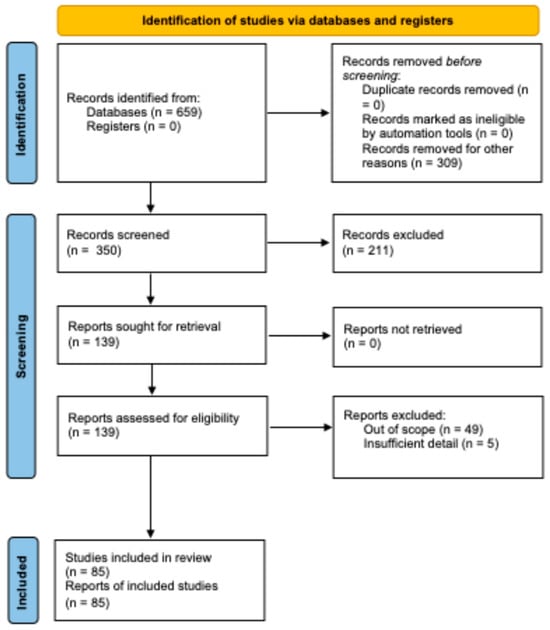
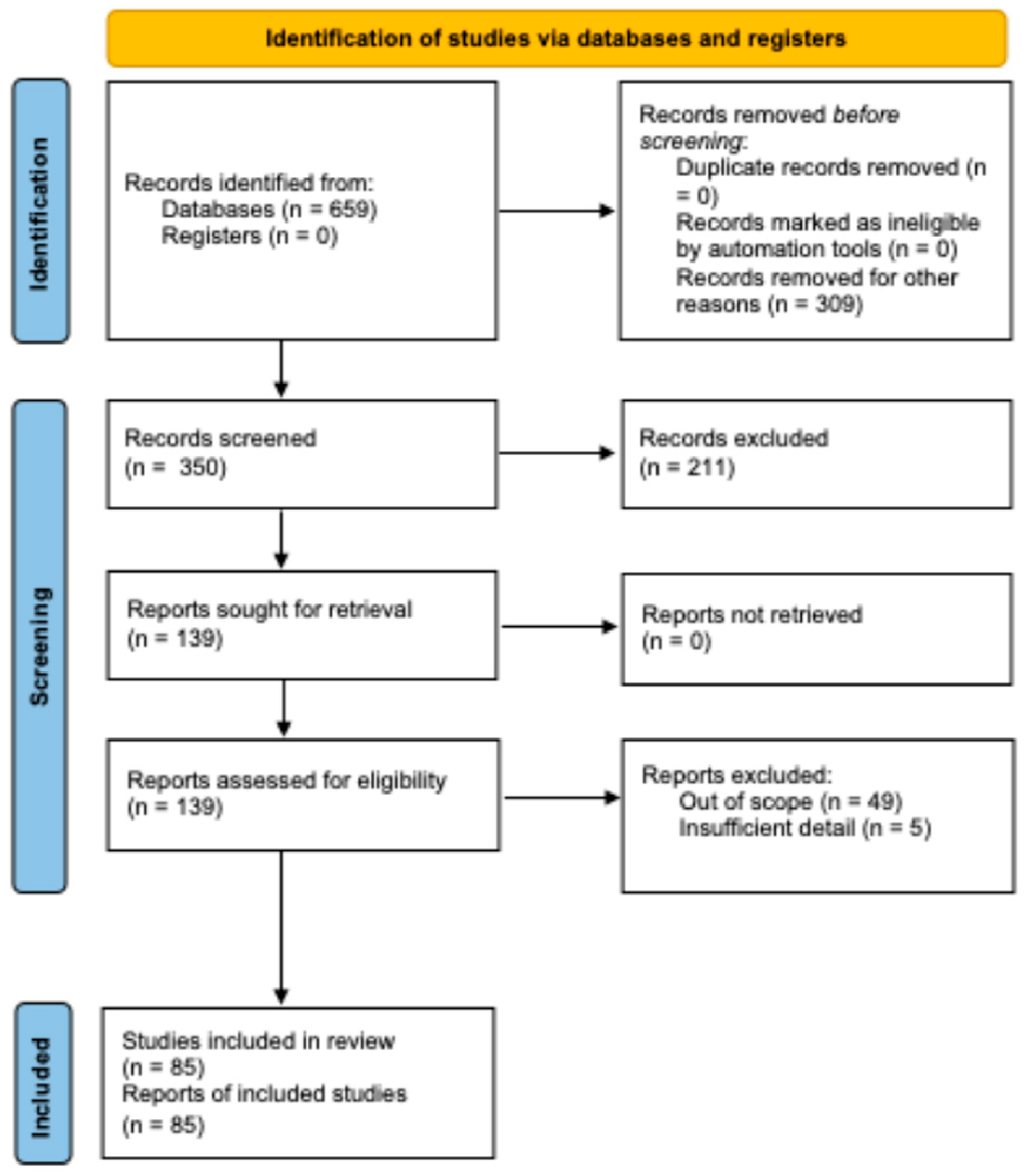
The inclusion and exclusion criteria reported in Table 3 were applied during the screening stages summarized in Table 4. Initial screening criteria (e.g., publication type, language, and time range) were applied during the first filtering phase, while relevance-based exclusion was performed during the final eligibility assessment. The outcome of the appraisal process is summarized in the PRISMA flow diagram (Figure 1).
Table 3.
SLR study selection of literature using inclusion and exclusion criteria.
Table 4.
Papers selected at each stage of the research.
Figure 1.
PRISMA 2020 flow diagram of study selection.
After applying the outlined screening process and selection criteria, a final set of n = 82 papers was identified for inclusion in the review. For transparency, the detailed counts at each stage are also reported in Table 4.
The selected articles were then organized into a structured dataset to facilitate thematic coding, comparison, and integration. The complete list of papers included in this review is provided in Appendix Table A1—List of Reviewed Papers. The following section describes the procedure adopted for data extraction and synthesis, as well as the categories and dimensions that guided the analysis of the selected literature.
3.4. Synthesis—SLR Methodology Step 4
After the identification of relevant papers through the appraisal phase [20], the review proceeded to the Synthesis stage. This phase focused on the systematic extraction, categorization, and organization of information from the selected articles to enable a structured and comparable representation of the evidence base.
Data extraction was conducted manually using a predefined coding framework to ensure consistency across studies. Each included article was reviewed in full, and relevant information was recorded across a common set of dimensions, including:
- authorship and year of publication;
- application domain (e.g., automotive, industrial, medical);
- publication source and journal classification;
- research objectives;
- technologies, tools, or interaction modalities investigated;
- testing methodology and experimental setup;
- main findings related to HMI usability or UX evaluation.
Although a formal risk-of-bias assessment tool was not applied, several measures were adopted to ensure the reliability and consistency of the synthesized findings. The review was limited to peer-reviewed journal articles published in Q1/Q2 journals, and each paper was analyzed using a structured data extraction framework covering methodologies, tools, evaluation approaches, and results. This approach enabled a consistent comparison across studies and reduced potential variability in interpretation.
3.5. Analysis—SLR Methodology Step 5
The analysis phase represents the transition from structured data organization to interpretative evaluation. In this stage, the analysis was conducted by examining the extracted information in relation to the five research questions defined in the protocol phase. Each paper was reviewed to identify the evaluation methods used, the technologies and tools involved, the reference standards, and the reported limitations or future research directions. The extracted data were then grouped into thematic categories corresponding to the research questions, enabling comparison of evaluation approaches, technologies, and methodological practices across the reviewed literature.
The analysis combined qualitative interpretation with basic quantitative descriptors. Frequencies and distributions were used to observe tendencies (such as the prevalence of specific evaluation methods, tools, or metrics) while the core of the analysis relied on narrative synthesis to interpret how usability and UX evaluation are conceptualized and applied across studies. This approach allowed the comparison of evaluation strategies across application domains and the identification of converging or divergent practices.
Through this analytical process, the review addresses the research questions and derives higher-level insights that extend beyond the individual contributions of the included papers, highlighting both established practices and underexplored areas in HMI evaluation research.
3.6. Reporting—SLR Methodology Step 6
The final phase of the methodology corresponds to Reporting, which ensures that the review process and findings are communicated in a transparent, traceable, and reproducible manner. In accordance with the PSALSAR framework [20] and PRISMA 2020 guidelines, this stage encompasses both the structured presentation of results and the explicit documentation of methodological decisions.
The reporting structure adopted in this review is directly aligned with the research questions and thematic categories identified during synthesis and analysis. Results are presented with attention to clarity and consistency, and where appropriate, supported by descriptive statistics, tables, and comparative summaries. This structured reporting approach facilitates critical appraisal of the review and supports future reuse of the findings in evidence-based research and practice.
4. Results
The following section presents the findings of the literature review across a total of n = 82 papers, structured along the four thematic dimensions identified during synthesis. Full-text articles excluded at the eligibility stage (n = 54) were removed mainly because they were out of scope (n = 49), or for insufficient details (n = 5). Data were further enriched and summarized through a structured mapping of publication contexts, journals, testing approaches, technologies, and evaluation metrics.
4.1. Application Contexts and Study Focus
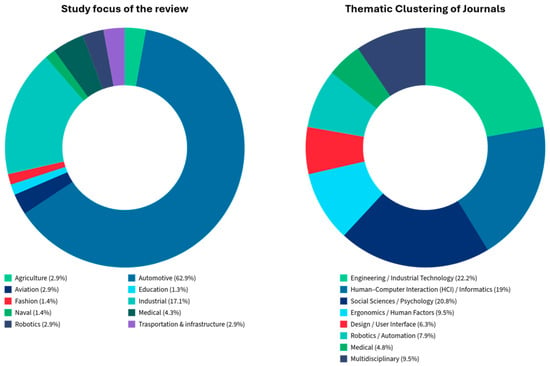
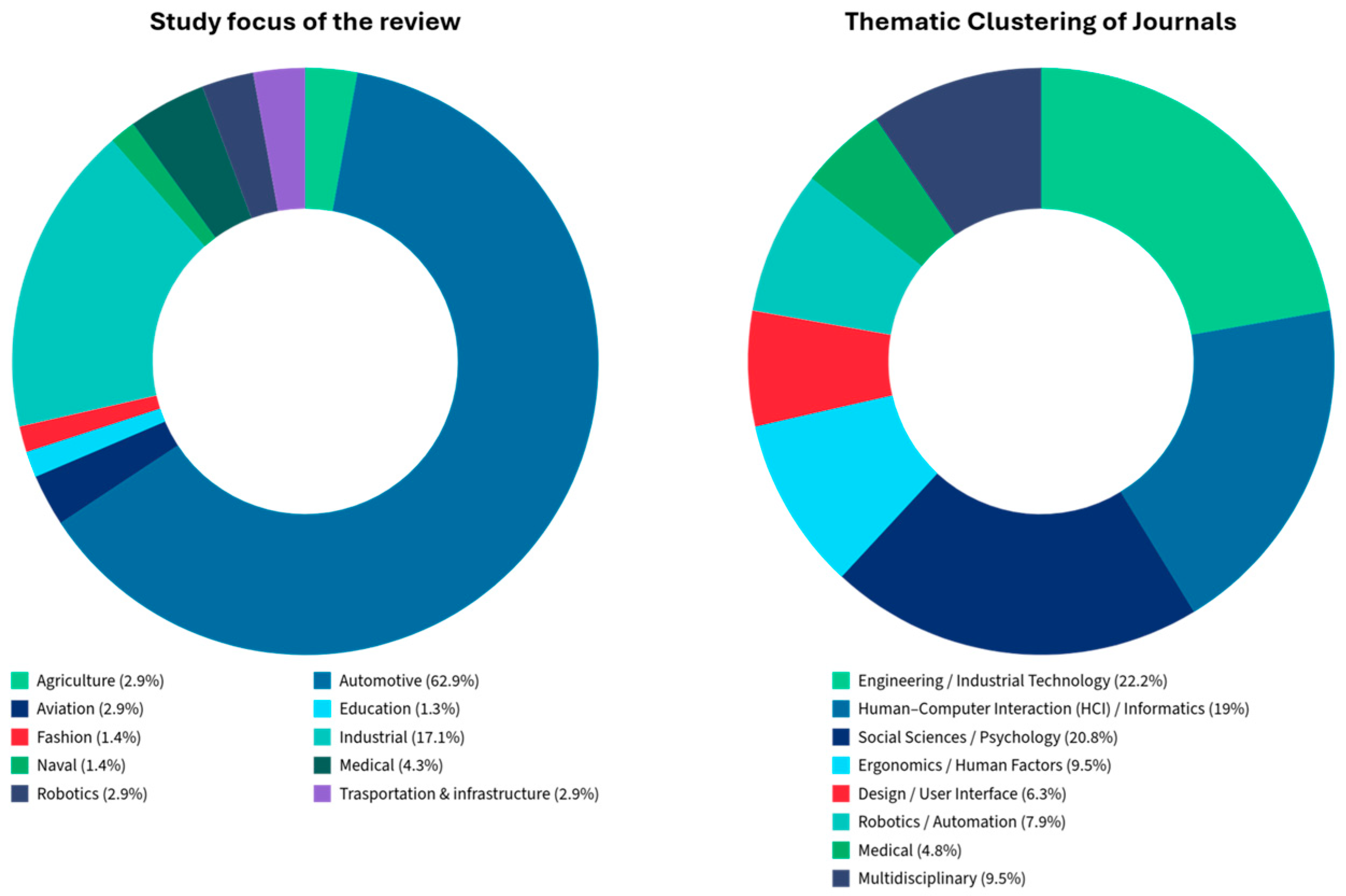
The reviewed papers span a range of application contexts, reflecting the interdisciplinary nature of HMI evaluation research. As shown in Figure 2, the automotive domain clearly dominates the literature, accounting for approximately 60% of the included papers (n = 51). In these works, HMI testing is closely associated with driving safety, user attention, workload management, and compliance with domain-specific regulations, underscoring the central role of in-vehicle interfaces in contemporary HMI research.
Figure 2.
Distribution of HMI Papers by Application Domain and Journal Classification.
Beyond automotive applications, industrial and manufacturing contexts represent the second most frequent domain (approximately 17% of papers, n = 14), often focusing on operator interfaces, human–robot interaction, and system monitoring. Smaller subsets of papers addressed aerospace and aviation, naval, healthcare, and other safety-critical environments. While these domains share comparable constraints in terms of safety, reliability, and human performance, their representation in the reviewed corpus remains limited and is frequently confined to exploratory or pilot studies rather than large-scale evaluations.
The dissemination of this body of research occurs primarily within journals and conferences situated in the fields of ergonomics, human–computer interaction, engineering and robotics, UX, and cognitive psychology. Figure 2 demonstrates this thematic clustering, with engineering and industrial technology journals representing 22.2% of publications, human–computer interaction venues accounting for 19%, and social sciences/psychology journals contributing 20.6%. Many articles are published in venues that emphasize applied science, user-centered design, or technological innovation. This diversity reflects the inherently cross-sectoral nature of HMI evaluation, where engineering approaches meet behavioral insights and human factors considerations. Interestingly, a few contributions emerged from journals focused on multimodal systems, augmented and virtual reality, or industrial design, underscoring the expanding technological landscape in which HMIs are being deployed and tested.
4.2. Typologies of Testing and Experimental Design
In terms of test environment, the most common setup involved simulated scenarios, including driving simulators and VR environments [23,24,25,26,27]. These simulation-based approaches enable controlled evaluation of complex interaction scenarios while maintaining safety and reproducibility across different test conditions. By contrast, real-world testing remains relatively uncommon and appears only in a limited subset of the reviewed papers (n = 15). No clear temporal shift toward increased real-world evaluation was observed over the reviewed period, suggesting that the dominance of simulation-based testing is driven primarily by practical considerations—such as cost, logistical complexity, and safety constraints—rather than by methodological trends. Wizard-of-Oz approaches were employed in a smaller number of papers [28,29] mainly in the evaluation of voice- or gesture-based HMIs, and were typically used during early design or prototyping phases [30,31,32].
Participant samples varied significantly, with study sizes ranging from 10 to over 120 participants. Most research involved 20–50 users, balanced across experts (e.g., engineers, factory workers) and lay participants. Some papers also examined cross-cultural effects, comparing user responses across different national contexts (e.g., Germany vs. China) [29,33]. Tasks assigned to participants ranged from simple control actions (button presses, menu navigation) to complex, scenario-based interactions that involved multimodal input/output. The most advanced studies replicated real-life operational conditions, including emergency events or multitasking while driving [34]. In some cases, particularly during initial evaluation phases, testing approaches may focus solely on questionnaire-based assessment rather than interactive task performance [35,36].
4.3. Technological Setup and Sensor-Based Evaluation
A substantial portion of the reviewed papers (n = 53) employed sensor-based technologies to capture objective indicators of user behavior, attention, workload, and physiological responses during interaction with HMIs [26,34,37,38,39,40]. These technologies were frequently integrated with driving simulators, virtual environments, or controlled laboratory setups to complement subjective and performance-based evaluation methods.
As summarized in Table 5, the most adopted objective measurement tools include eye-tracking systems and physiological monitoring devices, often used in combination to support multi-dimensional assessment of HMI. Among these, eye-tracking emerged as the most frequently reported sensor-based technique, particularly in automotive HMI studies, where visual attention management is directly linked to safety and usability.
Table 5.
Summary of objective monitoring technologies used in HMI testing and their measured parameters.
Eye-tracking systems, such as head-mounted or remote devices, were primarily used to measure gaze position, fixation duration, and saccadic movements. These metrics provide insight into how users visually explore an interface and how effectively an HMI guides attention toward relevant information. In addition, several papers monitored pupil diameter as an indirect indicator of cognitive workload, building on evidence that increased task difficulty and mental effort are associated with pupil dilation [41]. In automotive contexts, head pose and gaze direction data were particularly relevant for assessing forward attention and distraction.
Physiological sensing technologies were also widely applied to infer mental workload, stress, and emotional engagement. Wearable biosensors enabled the collection of parameters such as heart rate variability (HRV), electrodermal activity (EDA), respiration rate, and movement patterns. These measures are commonly interpreted as indicators of autonomic nervous system activity and have been associated with cognitive load, arousal, and user comfort during interaction [42,43]. For example, increases in EDA are often linked to heightened arousal, while changes in HRV are used to estimate mental workload and stress levels.
More complex physiological acquisition systems, capable of simultaneously recording signals such as EEG, EMG, ECG, and respiration, were reported in a smaller number of papers. Due to their setup complexity and intrusiveness, these systems were largely confined to laboratory-based experiments. Similarly, motion capture technologies were employed in a limited set of papers where body posture, gestures, or ergonomics were central to the interaction being evaluated.
These technologies support multi-dimensional evaluation frameworks, enabling researchers to correlate objective physiological signals with task performance, subjective experience, and environmental variables. However, their application remains uneven across domains, often constrained by cost, complexity, or the need for specialized expertise in data interpretation.
4.4. Evaluation Tools and Performance Metrics
Across the reviewed literature, HMI evaluation relied on a combination of standardized subjective questionnaires, cognitive workload assessments, and task performance metrics, as summarized in Table 6. Together, these tools provided complementary insights into usability, perceived quality of interaction, workload, and overall UX.
Table 6.
Summary of rating tools found in the reviews.
The System Usability Scale (SUS) is a technology-agnostic questionnaire designed to provide a rapid and reliable measure of a product’s perceived usability. Originally introduced by Brooke (1996) [44], the SUS consists of 10 items, each rated on a 5-point Likert scale ranging from “Strongly disagree” to “Strongly agree”. The items alternate between positively and negatively worded statements to reduce acquiescence bias, and responses are aggregated into a single usability score ranging from 0 to 100.
It remains the most widely used tool for measuring perceived usability. It is widely adopted due to its simplicity, non-proprietary nature, and applicability across diverse interface types. It is particularly valued for its high reliability and ease of administration, even in industrial or iterative testing environments [45]. Within the reviewed literature, SUS has been widely adopted for HMI evaluation (n = 56) [25,46,47].
Originally developed by Hart and Staveland (1988) [48], the NASA Task Load Index (NASA-TLX) is a subjective workload assessment tool composed of six dimensions: Mental Demand, Physical Demand, Temporal Demand, Performance, Effort, and Frustration. Each is rated on a 0–100 scale, and users optionally perform pairwise comparisons to assign individualized weights to each factor.
The final score represents a weighted average reflecting overall perceived workload. The tool is widely applied in HMI evaluation due to its sensitivity to task complexity and interface demands, particularly in simulation-based environments such as driving or aviation. Recent applications of NASA-TLX in HMI testing were found during the review [31,46,49], demonstrating its effectiveness across different interface types and complexity levels. NASA-TLX is often combined with physiological or performance metrics to strengthen workload analysis.
The User Experience Questionnaire (UEQ) is a standardized tool designed to measure both pragmatic and hedonic qualities of interactive systems. It consists of 26 items presented as semantic differentials (e.g., “complicated–easy”, “boring–exciting”), rated on a 7-point scale. The items are grouped into six dimensions: Attractiveness, Perspicuity, Efficiency, Dependability, Stimulation, and Novelty [50].
UEQ allows rapid benchmarking of UX and is sensitive to design iterations. It is particularly useful in comparing alternative UI versions and evaluating perceived usability, engagement, and emotional appeal. The scale structure supports both quantitative scoring and graphical feedback, and it has been validated in multiple languages and application domains [47,51].
In addition to the previously discussed tools which are among the most used in HMI evaluation studies, a few specialized instruments are also employed to assess more targeted aspects of UX [47,49,52,53]. These tools are particularly relevant when investigating presence, trust, emotional engagement, or situation awareness, especially in domains involving robotics, assistive technologies, and multimodal interaction.
The Godspeed Questionnaire Series (GQS) is used to evaluate perceptions of robots and artificial agents along five key dimensions: Anthropomorphism, Animacy, Likeability, Perceived Intelligence, and Perceived Safety. It is frequently used in human–robot interaction (HRI) studies to assess users’ affective and cognitive impressions of embodied systems.
The Spatial Presence Experience Scale (SPES) captures users’ subjective sense of immersion in a mediated environment, with items measuring self-location and perceived possible actions. It is especially suited for virtual reality, simulation-based interfaces, or augmented feedback systems [54].
The Quebec User Evaluation of Satisfaction with Assistive Technology (QUEST 2.0) was developed to assess user satisfaction with assistive devices. It evaluates both technical characteristics (e.g., safety, weight) and service-related factors (e.g., support, delivery), and is widely used in health-related and accessibility research [55].
The Situation Awareness Global Assessment Technique (SAGAT) is an objective technique for evaluating situational awareness. It temporarily pauses a task or simulation and queries users on the current system state, helping researchers assess perception, comprehension, and projection—the three levels of situational awareness defined by Endsley [56].
Finally, SUXES is a lightweight method tailored to evaluate spoken and multimodal interfaces, focusing on aspects like dialogue flow, naturalness, and emotional tone. It is particularly useful in evaluating UX with voice assistants, gesture-based systems, and multimodal conversational agents.
4.5. Temporal Analysis of Methods and Tools (2015–2025)
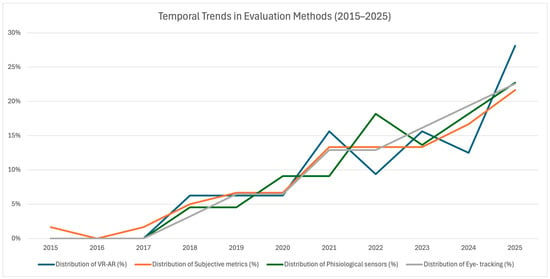
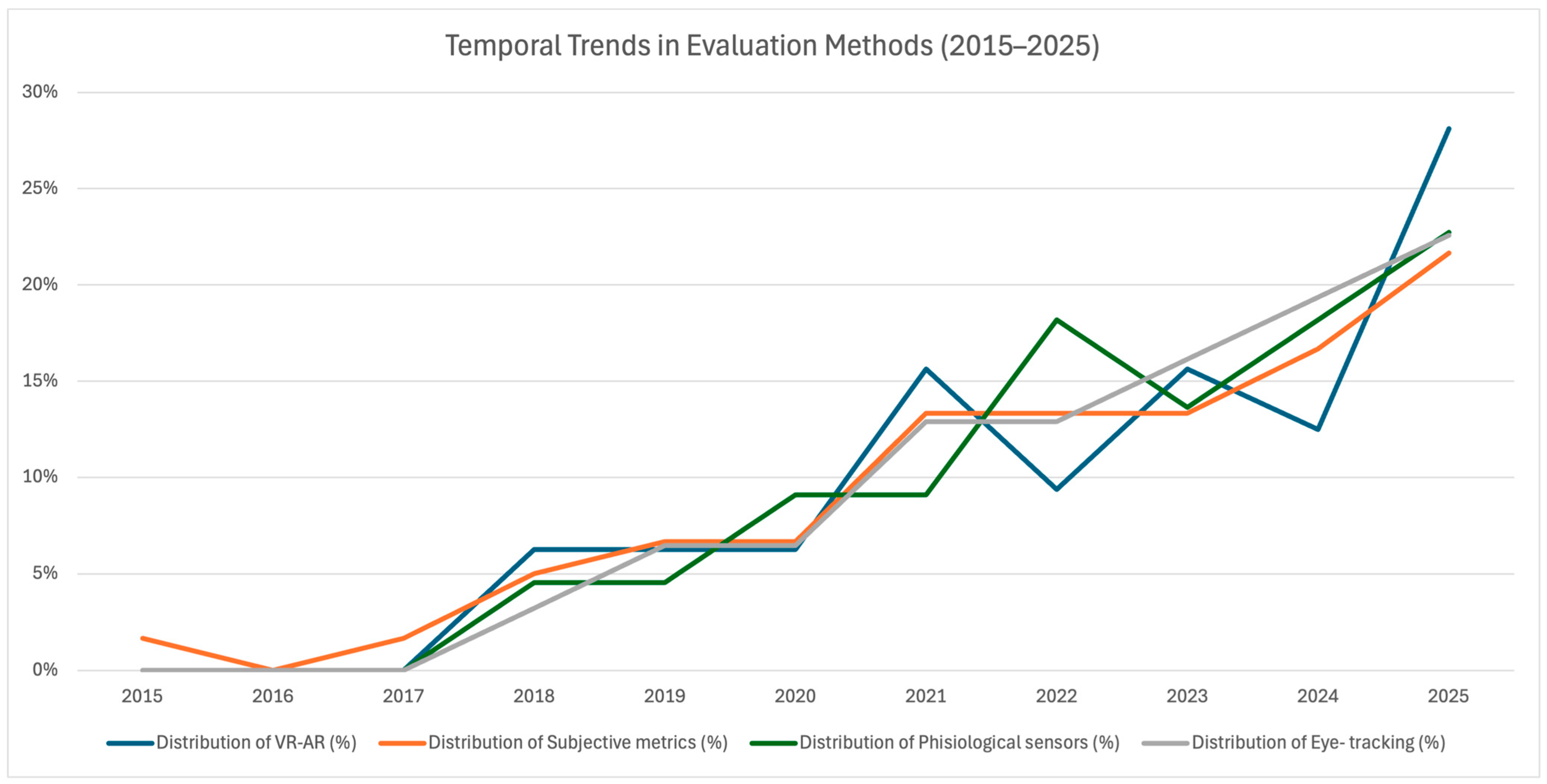
Figure 3 illustrates the temporal distribution of the main evaluation methods and technologies adopted in the 82 papers included in this review, covering the period from 2015 to 2025. Each trend line represents the proportion of papers published each year that employed a specific category of evaluation approach, including subjective questionnaires, eye-tracking, physiological sensing, and immersive simulation technologies (e.g., VR/AR).
Figure 3.
Temporal trends in evaluation methods.
Overall, the temporal analysis reveals a clear and sustained growth in the adoption of technology-supported and multimodal evaluation approaches over the observed decade. While subjective evaluation instruments remain consistently present throughout the entire period, their use is increasingly complemented by objective and sensor-based methods.
Eye-tracking technologies show an increasing presence in the reviewed papers starting from approximately 2018. Within the analyzed corpus, eye-tracking is among the most frequently reported objective measurement tools used to assess user attention and interaction behaviour. This trend reflects the growing importance of visual attention analysis in automotive HMI evaluation, as well as the increasing availability and maturity of eye-tracking hardware and analysis techniques.
Physiological sensing technologies, including measures such as heart rate variability and electrodermal activity, also appear with increasing frequency in the reviewed papers over time. These measures are commonly used to capture indicators of workload, stress, or emotional engagement during HMI.
The use of VR and AR-based simulation environments also demonstrates a consistent increase over time, with a notable acceleration in the later years of the review period. This pattern suggests a progressive shift toward immersive and controlled testing environments that support the evaluation of complex interaction scenarios while maintaining experimental safety and reproducibility.
Taken together, these trends indicate an evolution toward increasingly multimodal evaluation frameworks, in which traditional subjective assessments are systematically combined with objective behavioral and physiological measurements. Rather than replacing established methods, newer technologies appear to extend and enrich HMI evaluation practices, supporting more comprehensive and data-driven analyses of usability and UX.
5. Discussion
This section interprets the findings of the review in relation to the five research questions, with an emphasis on methodological and conceptual implications rather than descriptive repetition. The interpretation is conducted within the boundaries of the analyzed corpus and does not aim to generalize beyond the reviewed literature. Overall, the analysis indicates that while HMI evaluation practices have become increasingly sophisticated and technology-supported, the field remains fragmented in terms of methodological consistency, standard adoption, and cross-domain comparability.
5.1. RQ1: What Methods Are Currently Used to Conduct Usability Testing on Real or Simulated HMIs?
The predominance of simulation-based and laboratory testing shows that current practices prioritise experimental control over ecological validity. This confirms a trade-off common in HMI evaluation: methods that ensure reproducibility often reduce contextual realism. The widespread use of mixed-method approaches suggests that researchers are seeking to bridge this gap, yet the absence of unified testing protocols continues to hinder comparability across studies and domains.
5.2. RQ2: What Technologies and Tools Are Mostly Employed in UX Evaluation Procedures?
The increasing presence of sensor-based technologies in the reviewed papers, including eye-tracking and physiological monitoring, highlights the growing interest in objective indicators of user attention, workload, and physiological response during HMI. Nevertheless, the results show that technological adoption alone does not ensure methodological rigor. Many papers lack standardized data-fusion strategies capable of translating multimodal signals into interpretable and comparable UX indicators. This fragmentation limits cumulative knowledge building and highlights the need for shared analytical pipelines and benchmarking practices.
5.3. RQ3: What Standards, Norms, or Regulatory Frameworks Guide UX Evaluation?
Some of the reviewed papers refer to established standards such as ISO 9241 (Ergonomics of human-system interaction) and ISO 26262 (Functional safety for road vehicles). However, these standards are typically mentioned as conceptual or regulatory references rather than being operationalised as structured evaluation protocols within the reported studies.
5.4. RQ4: What Are the Current Limitations and Research Gaps in Existing UX Evaluation Protocols?
The review reveals a gradual evolution of HMI evaluation practices driven by the transition from hardware-based to software-centric and multimodal interfaces. This shift has necessitated more complex evaluation strategies capable of addressing adaptive behavior, multimodal interaction, and cognitive demands. At the same time, several structural limitations persist. Chief among these is the lack of standardized, replicable protocols that would support cumulative evidence generation. Cross-domain transferability remains limited, as evaluation frameworks are often tailored to specific contexts. In addition, technical challenges related to synchronizing and interpreting multimodal data persist, and longitudinal UX assessment over repeated or prolonged interaction remains underrepresented.
5.5. RQ5: How Can UX Assessment Protocols Evolve over the Coming Years?
Looking ahead, emerging technologies such as artificial intelligence and advanced data analytics may offer new opportunities for supporting the interpretation of multimodal user data. While these approaches are not yet widely represented in the reviewed corpus, they represent potential directions for future research in HMI evaluation. To fully realize this potential, future UX evaluation protocols should emphasize standardized reporting, multimodal data integration, and longitudinal study designs aligned with international standards. Such developments would support more robust, comparable, and ecologically valid evaluation practices across automotive and other safety-critical domains.
5.6. Visual Synthesis of HMI Evaluation Approaches
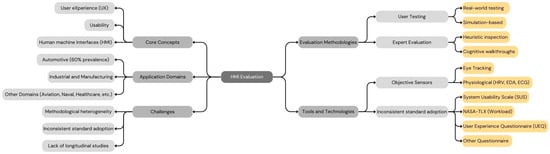
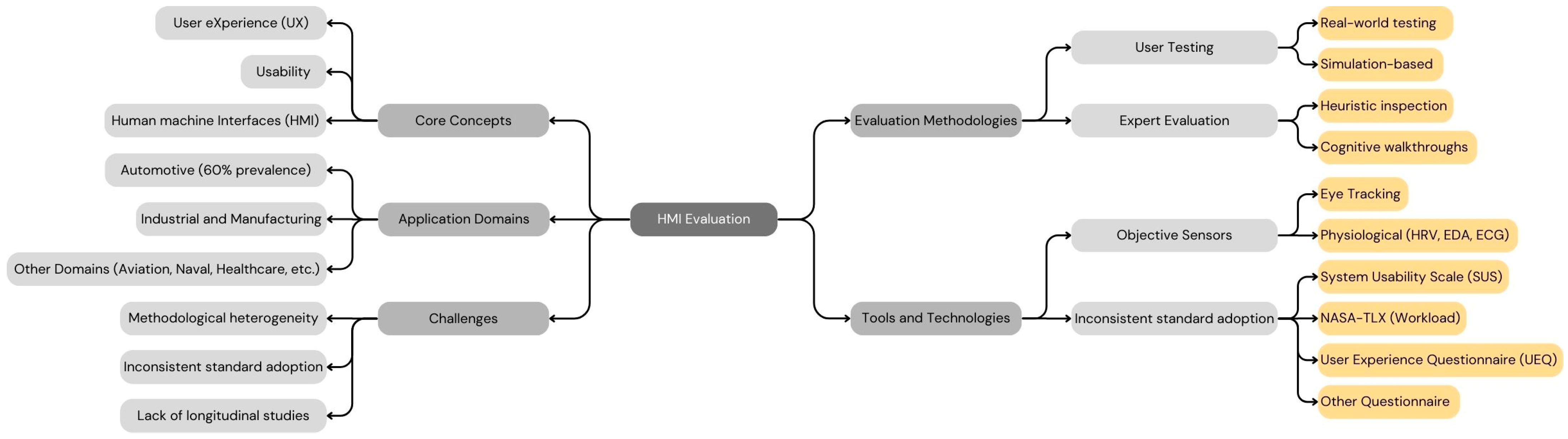
To complement the discussion of the reviewed studies, a conceptual map was developed to provide a visual synthesis of the main elements characterising HMI evaluation research (Figure 4). Rather than introducing additional findings, the map organises the key dimensions that emerged throughout the analysis, highlighting how concepts, methodological approaches, tools, and research challenges relate to each other within the broader HMI evaluation landscape.
Figure 4.
Conceptual framework of HMI evaluation methods, tools, application domains, and research challenges emerging from the literature review.
The visual framework illustrates how usability and user experience represent the central conceptual foundations of HMI assessment, while evaluation practices are typically structured around two main methodological perspectives: user-based testing and expert-based inspection. In parallel, the increasing integration of technological tools, such as eye-tracking systems and physiological sensors, reflects the growing interest in combining behavioural and objective measurements with established subjective assessment instruments.
Furthermore, the map contextualises these methodological approaches within their primary application domains, emphasising the strong prevalence of the automotive sector while acknowledging the broader applicability of HMI evaluation across other domains such as industrial systems, aviation, and healthcare.
Finally, the visual synthesis also highlights several cross-cutting challenges identified in the literature, including methodological heterogeneity, inconsistent adoption of evaluation standards, and the limited presence of longitudinal studies. By integrating these elements into a single framework, the conceptual map supports a more holistic understanding of the current research landscape and helps clarify how different evaluation strategies and research contexts interact in the assessment of usability and user experience in HMI systems.
5.7. Limitations and Implications
This review is subject to several limitations. The literature search was limited to Scopus and ScienceDirect, which were selected due to their broad and complementary coverage of peer-reviewed research in engineering, human–computer interaction, and ergonomics, as well as their accessibility through institutional subscriptions. While this ensured consistent access to full-text articles and methodological comparability, it may have excluded relevant conference proceedings, grey literature, or non-English publications. The ten-year time frame (2015–2025) focuses on contemporary practices but may omit earlier foundational work. In addition, this review did not apply a formal risk-of-bias assessment tool. While this may limit the ability to quantitatively assess the internal validity of individual studies, methodological consistency was ensured through strict inclusion criteria and a structured data extraction process. The findings should therefore be interpreted within the boundaries of the analyzed corpus.
Despite these limitations, the findings offer several implications. For researchers, the review highlights the need for standardized and replicable evaluation frameworks that integrate multimodal sensing with clear methodological reporting. For practitioners, incorporating longitudinal and context-sensitive testing approaches may improve usability and safety in real-world deployments. For policymakers and standardization bodies, promoting harmonized evaluation practices across sectors could enhance comparability and facilitate the translation of research outcomes into regulatory and industrial standards.
6. Conclusions
This systematic literature review examined how Human–Machine Interfaces (HMIs) are empirically evaluated with respect to usability and UX, with a primary focus on the automotive domain and complementary evidence drawn from other safety-critical sectors, including industrial, aerospace, maritime, and healthcare applications. By analyzing 82 peer-reviewed papers published between 2015 and 2025, the review provides a consolidated and structured overview of evaluation methods, technological tools, applied standards, and methodological trends in contemporary HMI testing.
The conclusions drawn in this review are based on the analyzed corpus and should be interpreted within the scope and limitations of the adopted methodology, without aiming to generalize beyond the reviewed literature.
The findings suggest that HMI evaluation practices have evolved toward increasingly multimodal and technology-supported approaches. Simulation-based testing environments dominate the literature, particularly in automotive research, reflecting the need to assess complex, safety-critical interaction scenarios under controlled and reproducible conditions. Subjective questionnaires such as SUS, NASA-TLX, and UEQ remain widely used tools for evaluating usability and UX. In several of the reviewed papers, these subjective instruments are used alongside objective measurements, such as eye-tracking or physiological sensing, enabling complementary perspectives on user interaction and workload.
Despite this methodological evolution, the review identifies several persistent structural limitations. Evaluation protocols remain highly heterogeneous, limiting comparability and cumulative evidence building across studies and domains. International standards such as ISO 9241 and ISO 26262 are frequently referenced but inconsistently operationalized, often serving as conceptual anchors rather than as concrete methodological guides. In addition, longitudinal UX evaluation and standardized multimodal data integration are still underrepresented, constraining the ability to assess adaptation, learning effects, and sustained interaction quality over time.
From a scientific perspective, this review contributes by providing a structured synthesis of usability and UX evaluation practices, clarifying their conceptual distinctions, consolidating fragmented approaches into a coherent analytical framework, and identifying critical gaps that hinder methodological maturity in HMI assessment. The results suggest that progress in the field is driven less by the introduction of individual technologies than by the need for integrated, standardized, and replicable evaluation protocols capable of combining subjective, behavioural, and physiological data.
Future research should therefore focus on translating international standards into actionable and operational UX evaluation procedures, fostering longitudinal and ecologically valid study designs, and supporting multimodal data integration through shared analytical frameworks. Addressing these challenges is essential to ensure that increasingly complex HMIs—particularly in automated and safety-critical systems—are evaluated rigorously, comparably, and in a genuinely user-centered manner.
Author Contributions
Conceptualization, M.C.; Methodology, M.C. and M.P.; Formal analysis, M.C.; Investigation, M.C.; Data curation, M.C.; Writing—original draft preparation, M.C.; Writing—review and editing, M.C. and M.P.; Supervision, M.P. All authors have read and agreed to the published version of the manuscript.
Funding
This research received no external funding.
Data Availability Statement
No new data were created in this study. The data supporting the findings of this study consist of published articles, which are cited within the manuscript. The list of reviewed papers is provided in Appendix A (Table A1).
Acknowledgments
During the preparation of this work, the author M. Cescon used a generative AI language model ChatGPT (OpenAI, GPT-5.3 version) to assist in improving the readability and flow of the English text. The content was thoroughly reviewed and edited by the author M. Cescon, who assume full responsibility for the final manuscript.
Conflicts of Interest
The authors declare no conflicts of interest.
Abbreviations
The following abbreviations are used in this manuscript:
| UX | User eXperience |
| VR | Virtual Reality |
| AI | Artificial Intelligence |
| AR | Augmented Reality |
| EDA | Electrodermal Activity |
| ECG | Electrocardiogram |
| EEG | Electroencephalogram |
| EMG | Electromyogram |
| HCI | Human–Computer Interaction |
| HMI | Human–Machine Interface |
| HR | Heart Rate |
| HRV | Heart Rate Variability |
| IMU | Inertial Measurement Unit |
| ISO | International Organization for Standardization |
| OEM | Original Equipment Manufacturer |
| PPG | Photoplethysmography |
| PSALSAR | Protocol, Search, Appraisal, Synthesis, Analysis, Reporting |
| PERCLOS | Percentage of Eyelid Closure |
| PRISMA | Preferred Reporting Items for Systematic Reviews and Meta-Analyses |
| Q1/Q2 | Quartile 1/Quartile 2 (journal ranking levels) |
| SAGAT | Situation Awareness Global Assessment Technique |
| SLR | Systematic Literature Review |
| SPES | Spatial Presence Experience Scale |
| SUS | System Usability Scale |
| SUXES | User Experience Evaluation Method for Spoken and Multimodal Interaction |
| UEQ | User Experience Questionnaire |
| WoZ | Wizard of Oz (technique) |
Appendix A
Table A1.
List of Reviewed Papers.
References
- Singh, H.P.; Kumar, P. Developments in the Human Machine Interface Technologies and Their Applications: A Review. J. Med. Eng. Technol. 2021, 45, 552–573. [Google Scholar] [CrossRef] [Scilit] [PubMed]
- Grobelna, I.; Mailland, D.; Horwat, M. Design of Automotive HMI: New Challenges in Enhancing User Experience, Safety, and Security. Appl. Sci. 2025, 15, 5572. [Google Scholar] [CrossRef] [Scilit]
- Zhao, X.; Li, Z.; Zhao, C.; Wang, C.; Fu, R. Distraction Pattern Classification and Comparisons under Different Conditions in the Full-Touch HMI Mode. Displays 2023, 78, 102413. [Google Scholar] [CrossRef] [Scilit]
- Nielsen, J.; Molich, R. Heuristic Evaluation of User Interfaces. In Proceedings of the SIGCHI Conference on Human Factors in Computing Systems, Seattle, WA, USA, 1–5 April 1990; pp. 249–256. [Google Scholar] [CrossRef] [Scilit]
- ISO 9241-210:2010—Ergonomics of Human-System Interaction—Part 210: Human-Centred Design for Interactive Systems. Available online: https://www.iso.org/standard/52075.html (accessed on 20 May 2025).
- ISO 26262-1:2018—Road Vehicles—Functional Safety—Part 1: Vocabulary. Available online: https://www.iso.org/standard/68383.html (accessed on 20 May 2025).
- ISO 9241-11:2018; Ergonomics of Human-System Interaction-Part 11: Usability: Definitions and Concepts. ISO: Geneva, Switzerland, 2018.
- Robert, J.; Lesage, A. Designing and Evaluating User Experience. In The Handbook of Human-Machine Interaction; CRC Press: Boca Raton, FL, USA, 2017; pp. 321–338. [Google Scholar] [CrossRef] [Scilit]
- Ardanza, A.; Moreno, A.; Segura, Á.; de la Cruz, M.; Aguinaga, D. Sustainable and Flexible Industrial Human Machine Interfaces to Support Adaptable Applications in the Industry 4.0 Paradigm. Int. J. Prod. Res. 2019, 57, 4045–4059. [Google Scholar] [CrossRef] [Scilit]
- Zhang, X.; Liao, X.-P.; Tu, J.-C.A.; Zhang, X.; Liao, X.-P.; Tu, J.-C. A Study of Bibliometric Trends in Automotive Human–Machine Interfaces. Sustainability 2022, 14, 9262. [Google Scholar] [CrossRef] [Scilit]
- Gauci, J.; Xuereb, M.; Muscat, A.; Zammit-Mangion, D. Multi-Modal Interaction between Pilots and Avionic Systems on-Board Large Commercial Aircraft. In International Conference on Engineering Psychology and Cognitive Ergonomics; Lecture Notes in Computer Science; Springer International Publishing: Cham, Switzerland, 2017; Volume 10276, pp. 200–210. [Google Scholar] [CrossRef] [Scilit]
- Gauci, J.; Cauchi, N.; Theuma, K.; Zammit-Mangion, D.; Muscat, A. Design and Evaluation of a Touch Screen Concept for Pilot Interaction with Avionic Systems. In Proceedings of the 2015 IEEE/AIAA 34th Digital Avionics Systems Conference (DASC), Prague, Czech Republic, 13–17 September 2015; pp. 3C21–3C219. [Google Scholar] [CrossRef] [Scilit]
- Roto, V.; Väätäjä, H.; Jumisko-Pyykkö, S.; Väänänen-Vainio-Mattila, K. Best Practices for Capturing Context in User Experience Studies in the Wild. In Proceedings of the 15th International Academic MindTrek Conference: Envisioning Future Media Environments, Tampere, Finland, 28–30 September 2011; pp. 91–98. [Google Scholar] [CrossRef] [Scilit]
- Hornbæk, K.; Law, E.L.C. Meta-Analysis of Correlations among Usability Measures. In Proceedings of the SIGCHI Conference on Human Factors in Computing Systems, San Jose, CA, USA, 28 April–3 May 2007; pp. 617–626. [Google Scholar] [CrossRef] [Scilit]
- Ntoa, S. Usability and User Experience Evaluation in Intelligent Environments: A Review and Reappraisal. Int. J. Hum. Comput. Interact. 2025, 41, 2829–2858. [Google Scholar] [CrossRef] [Scilit]
- Nielsen, J. Enhancing the Explanatory Power of Usability Heuristics. In Proceedings of the SIGCHI Conference on Human Factors in Computing Systems, Boston, MA, USA, 24–28 April 1994; pp. 152–158. [Google Scholar] [CrossRef] [Scilit]
- Dumas, J.S.; Redish, J.C. A Practical Guide to Usability Testing; Intellect Books: Exeter, UK, 1999. [Google Scholar]
- Hart, C. Doing a Literature Review: Releasing the Research Imagination; Sage: London, UK, 1998. [Google Scholar]
- Page, M.J.; McKenzie, J.E.; Bossuyt, P.M.; Boutron, I.; Hoffmann, T.C.; Mulrow, C.D.; Shamseer, L.; Tetzlaff, J.M.; Akl, E.A.; Brennan, S.E.; et al. The PRISMA 2020 Statement: An Updated Guideline for Reporting Systematic Reviews. BMJ 2021, 372, n71. [Google Scholar] [CrossRef] [Scilit]
- Mengist, W.; Soromessa, T.; Legese, G. Ecosystem Services Research in Mountainous Regions: A Systematic Literature Review on Current Knowledge and Research Gaps. Sci. Total Environ. 2020, 702, 134581. [Google Scholar] [CrossRef] [Scilit]
- Moher, D.; Shamseer, L.; Clarke, M.; Ghersi, D.; Liberati, A.; Petticrew, M.; Shekelle, P.; Stewart, L.A.; Estarli, M.; Barrera, E.S.A.; et al. Preferred Reporting Items for Systematic Review and Meta-Analysis Protocols (PRISMA-P) 2015 Statement. Syst. Rev. 2015, 4, 1. [Google Scholar] [CrossRef] [PubMed]
- Tranfield, D.; Denyer, D.; Smart, P. Towards a Methodology for Developing Evidence-Informed Management Knowledge by Means of Systematic Review. Br. J. Manag. 2003, 14, 207–222. [Google Scholar] [CrossRef] [Scilit]
- Ahn, D.K.; Bae, B.C.; Kim, Y. User Experience of a Digital Fashion Show: Exploring the Effectiveness of Interactivity in Virtual Reality. Appl. Sci. 2023, 13, 2558. [Google Scholar] [CrossRef] [Scilit]
- Métayer, N.; Coeugnet, S. Improving the Experience in the Pedestrian’s Interaction with an Autonomous Vehicle: An Ergonomic Comparison of External HMI. Appl. Ergon. 2021, 96, 103478. [Google Scholar] [CrossRef] [Scilit]
- Perrier, M.J.R.; Louw, T.L.; Carsten, O.M.J. Usability Testing of Three Visual HMIs for Assisted Driving: How Design Impacts Driver Distraction and Mental Models. Ergonomics 2023, 66, 1142–1163. [Google Scholar] [CrossRef] [Scilit]
- Zolotová, I.; Papcun, P.; Kajáti, E.; Miškuf, M.; Mocnej, J. Smart and Cognitive Solutions for Operator 4.0: Laboratory H-CPPS Case Studies. Comput. Ind. Eng. 2020, 139, 105471. [Google Scholar] [CrossRef] [Scilit]
- Lungershausen, N.; Lepa, S.; Helberger, J.; Schaar, H.; Virkus, T.; Zhao, Y. Creating Trust in Fully Autonomous Vehicles through Spatialized Predictive Sonification. Int. J. Hum. Comput. Stud. 2025, 199, 103481. [Google Scholar] [CrossRef] [Scilit]
- Graichen, L.; Graichen, M. Do Users Desire Gestures for In-Vehicle Interaction? Towards the Subjective Assessment of Gestures in a High-Fidelity Driving Simulator. Comput. Hum. Behav. 2024, 156, 108189. [Google Scholar] [CrossRef] [Scilit]
- Sogemeier, D.; Naujoks, F.; Forster, Y.; Krems, J.F.; Keinath, A. Performance and Visual Appearance of In-Vehicle Voice Assistants Impact User Experience: A Comparative Study between Chinese and German Users. Transp. Res. Part F Traffic Psychol. Behav. 2025, 111, 279–295. [Google Scholar] [CrossRef] [Scilit]
- Gerber, M.A.; Schroeter, R.; Ho, B. A Human Factors Perspective on How to Keep SAE Level 3 Conditional Automated Driving Safe. Transp. Res. Interdiscip. Perspect. 2023, 22, 100959. [Google Scholar] [CrossRef] [Scilit]
- Schwenk, R.; Smith, S. An Immersive Spatially Consistent Multi-Modal Augmented Virtuality Human-Machine Interface for Telerobotic Systems. Comput. Ind. 2025, 167, 104260. [Google Scholar] [CrossRef] [Scilit]
- Sebald, C.; Treiber, M.; Eryilmaz, E.; Bernhardt, H. Usability Testing of Novel IoT-Infused Digital Services on Farm Equipment Reveals Farmer’s Requirements towards Future Human–Machine Interface Design Guidelines. AgriEngineering 2024, 6, 1660–1673. [Google Scholar] [CrossRef] [Scilit]
- Large, D.R.; Burnett, G.; Crundall, E.; Lawson, G.; Skrypchuk, L.; Mouzakitis, A. Evaluating Secondary Input Devices to Support an Automotive Touchscreen HMI: A Cross-Cultural Simulator Study Conducted in the UK and China. Appl. Ergon. 2019, 78, 184–196. [Google Scholar] [CrossRef] [Scilit] [PubMed]
- Grandi, F.; Prati, E.; Peruzzini, M.; Pellicciari, M.; Campanella, C.E. Design of Ergonomic Dashboards for Tractors and Trucks: Innovative Method and Tools. J. Ind. Inf. Integr. 2022, 25, 100304. [Google Scholar] [CrossRef] [Scilit]
- Muhammad, A.P.; Knauss, E.; Bärgman, J. Human Factors in Developing Automated Vehicles: A Requirements Engineering Perspective. J. Syst. Softw. 2023, 205, 111810. [Google Scholar] [CrossRef] [Scilit]
- Schneider, O.; MacLean, K.; Swindells, C.; Booth, K. Haptic Experience Design: What Hapticians Do and Where They Need Help. Int. J. Hum. Comput. Stud. 2017, 107, 5–21. [Google Scholar] [CrossRef] [Scilit]
- Brunzini, A.; Peruzzini, M.; Barbadoro, P. Human-Centred Data-Driven Redesign of Simulation-Based Training: A Qualitative Study Applied on Two Use Cases of the Healthcare and Industrial Domains. J. Ind. Inf. Integr. 2023, 35, 100505. [Google Scholar] [CrossRef] [Scilit]
- Liang, C.; Liu, S.; Wanyan, X.; Liu, C.; Xiao, X.; Min, Y. Effects of Input Method and Display Mode of Situation Map on Early Warning Aircraft Reconnaissance Task Performance with Different Information Complexities. Chin. J. Aeronaut. 2023, 36, 105–114. [Google Scholar] [CrossRef] [Scilit]
- Liu, W.; Zhu, Y.; Huang, R.; Ohashi, T.; Auernhammer, J.; Zhang, X.; Shi, C.; Wang, L. Designing Interactive Glazing through an Engineering Psychology Approach: Six Augmented Reality Scenarios That Envision Future Car Human-Machine Interface. Virtual Real. Intell. Hardw. 2023, 5, 157–170. [Google Scholar] [CrossRef] [Scilit]
- Schrank, A.; Wilbrink, M.; Brandenburg, S.; Oehl, M. Improving Road User Perception in Adverse Weather: An Augmented Human–Machine Interface for Remote Assistants of Automated Vehicles. Transp. Res. Part F Traffic Psychol. Behav. 2025, 113, 500–516. [Google Scholar] [CrossRef] [Scilit]
- Gorin, H.; Patel, J.; Qiu, Q.; Merians, A.; Adamovich, S.; Fluet, G. A Review of the Use of Gaze and Pupil Metrics to Assess Mental Workload in Gamified and Simulated Sensorimotor Tasks. Sensors 2024, 24, 1759. [Google Scholar] [CrossRef] [Scilit]
- Iarlori, S.; Perpetuini, D.; Tritto, M.; Cardone, D.; Tiberio, A.; Chinthakindi, M.; Filippini, C.; Cavanini, L.; Freddi, A.; Ferracuti, F.; et al. An Overview of Approaches and Methods for the Cognitive Workload Estimation in Human–Machine Interaction Scenarios through Wearables Sensors. BioMedInformatics 2024, 4, 1155–1173. [Google Scholar] [CrossRef] [Scilit]
- Masi, G.; Amprimo, G.; Rechichi, I.; Ferraris, C.; Olmo, G. Does Baseline Stress Affect Electrodermal Activity? A Serious-Game-Based Pilot Study. In Proceedings of the 2024 46th Annual International Conference of the IEEE Engineering in Medicine and Biology Society (EMBC), Orlando, FL, USA, 15–19 July 2024. [Google Scholar] [CrossRef] [Scilit]
- Brooke, J. SUS-a Quick and Dirty Usability Scale. Usability Eval. Ind. 1996, 189, 4–7. [Google Scholar]
- Bangor, A.; Kortum, P.T.; Miller, J.T. An Empirical Evaluation of the System Usability Scale. Int. J. Hum. Comput. Interact. 2008, 24, 574–594. [Google Scholar] [CrossRef] [Scilit]
- Makarov, D.; Vahdatikhaki, F.; Miller, S.; Mowlaei, S.; Dorée, A. Usability Assessment of Compaction Operator Support Systems Using Virtual Prototyping. Autom. Constr. 2021, 129, 103784. [Google Scholar] [CrossRef] [Scilit]
- Sogemeier, D.; Forster, Y.; Naujoks, F.; Krems, J.F.; Keinath, A. Driving across Markets: An Analysis of a Human–Machine Interface in Different International Contexts. Information 2024, 15, 349. [Google Scholar] [CrossRef] [Scilit]
- Hart, S.G.; Staveland, L.E. Development of NASA-TLX (Task Load Index): Results of Empirical and Theoretical Research. Adv. Psychol. 1988, 52, 139–183. [Google Scholar] [CrossRef] [Scilit]
- Schrank, A.; Walocha, F.; Brandenburg, S.; Oehl, M. Human-Centered Design and Evaluation of a Workplace for the Remote Assistance of Highly Automated Vehicles. Cogn. Technol. Work 2024, 26, 183–206. [Google Scholar] [CrossRef] [Scilit]
- Schrepp, M.; Hinderks, A.; Thomaschewski, J. Applying the User Experience Questionnaire (UEQ) in Different Evaluation Scenarios. In International Conference of Design, User Experience, and Usability; Lecture Notes in Computer Science; Springer: Cham, Switzerland, 2014; Volume 8517, pp. 383–392. [Google Scholar] [CrossRef] [Scilit]
- Burkard, A.; Zimmermann, G.; Schwarzer, B. Monitoring Systems for Checking Websites on Accessibility. Front. Comput. Sci. 2021, 3, 628770. [Google Scholar] [CrossRef] [Scilit]
- Schwarze, A.; Bhattacharya, S.; Grundmann, R.; Mahadevan, H.S.; Hochgeschurz, S.; Motz, F. BEYOND—Building an Experience to Yield Optimal Nautical Displays—Measuring Nautical Situation Awareness. J. Phys. Conf. Ser. 2024, 2867, 012044. [Google Scholar] [CrossRef] [Scilit]
- You, F.; Deng, H.; Hansen, P.; Zhang, J. Research on Transparency Design Based on Shared Situation Awareness in Semi-Automatic Driving. Appl. Sci. 2022, 12, 7177. [Google Scholar] [CrossRef] [Scilit]
- Hartmann, T.; Wirth, W.; Schramm, H.; Klimmt, C.; Vorderer, P.; Gysbers, A.; Böcking, S.; Ravaja, N.; Laarni, J.; Saari, T.; et al. The Spatial Presence Experience Scale (SPES): A Short Self-Report Measure for Diverse Media Settings. J. Media Psychol. 2016, 28, 1–15. [Google Scholar] [CrossRef] [Scilit]
- Demers, L.; Weiss-Lambrou, R.; Demers, L.; Ska, B. Development of the Quebec User Evaluation of Satisfaction with Assistive Technology (QUEST). Assist. Technol. 1996, 8, 3–13. [Google Scholar] [CrossRef] [Scilit] [PubMed]
- Endsley, M.R.; Selcon, S.J.; Hardiman, T.D.; Croft, D.G. Comparative Analysis of SAGAT and SART for Evaluations of Situation Awareness. Proc. Hum. Factors Ergon. Soc. 1998, 42, 82–86. [Google Scholar] [CrossRef] [Scilit]

Disclaimer/Publisher’s Note: The statements, opinions and data contained in all publications are solely those of the individual author(s) and contributor(s) and not of MDPI and/or the editor(s). MDPI and/or the editor(s) disclaim responsibility for any injury to people or property resulting from any ideas, methods, instructions or products referred to in the content. |
© 2026 by the authors. Licensee MDPI, Basel, Switzerland. This article is an open access article distributed under the terms and conditions of the Creative Commons Attribution (CC BY) license.