


Abstract
Discretisation is a processing step often included in the preliminary data preparation. Typically, when the input features have continuous domains and their discrete forms are needed, all are translated into categorical type at the same time, before data mining takes place. However, proceeding this way is not always the most advantageous to performance. The paper presents results from the research where the discretisation transformations were carried out sequentially forward for variables, and their selection was based on their values and also importance of the attributes estimated by the constructed rankings. The experiments were executed on the datasets from the area of stylometric analysis of texts, the application domain focused on recognising authorship based on individual characteristics of writing styles. For the selected data mining techniques, the performance was studied in the context of transformed features. The observed trends indicate that along with enhanced understanding of the nature of the data, partial discretisation of feature sets could bring higher accuracy than transformation of entire input domain, showing the merits of the described research methodology.
MSC:
68T10; 68T30; 68T37; 68U35
1. Introduction
With easy access to modern equipment and computer systems, the efficiency of information systems is often taken for granted. It is just assumed that data can come from various sources, in various forms, and in huge volumes. Technical development certainly can handle operations with products, goods, materials, components, or phenomena being described in a myriad of ways [1]. However, managing typical working conditions is not the same as optimisation. Just because goals were achieved and solutions were found does not mean that the results obtained are the best or that the path that led to them was the most advantageous. Disregarding some nuances and simplification of data can reduce the processing costs of explorations [2]. It can also help with the interpretation of the knowledge learnt and generalisation [3]. These are some of the reasons for discretisation transformations to be applied to the data available in continuous form.
Discretisation transforms the input domain, replacing the real values of the attributes with categorical ones, corresponding to defined intervals that reflect the ranges of continuous values [4]. The standard aims of this operation are to simplify the data, remove unnecessary detailed information or noise, and obtain a representation that is accessible to all machine learning methods and techniques [5]. The change of input space properties also causes some changes in characteristics of variables and knowledge patterns present, yet this influence is often taken without any deeper study or analysis. Typically, all numerical variables are transformed at the same time, with the same procedure, before the application of knowledge discovery methods. The only decision is made with respect to the selection of a particular discretisation algorithm to be applied to the data, as due to the existence of many transformation algorithms, the choice is not trivial. This approach brings much desired simplification, but does not leave room for adaptation to the specifics of individual attributes and their importance [6].
The paper presents research that was focused on gradual expansion of a set of discretised attributes. Starting with the set of numerical features, the variables were transformed one by one sequentially and the processing was stopped when the entire set of attributes had a categorical representation. The selection of features to transform was controlled by the properties of attribute domains and their relevance estimated by the constructed rankings [7]. Because of gradual discretisation and following two orderings of features in ascending and descending order, the number of obtained data variants was substantial.
The investigations were carried out on two datasets dedicated to authorship attribution, considered the most important task in stylometry [8]. This application domain is devoted to the analysis of texts through writing styles and linguistic habits and preferences of writers, as opposed to studies concerning, for example, specific topics [9]. The knowledge discovered by training on text samples of known authorship can be used to recognise authors for unknown samples, leading to a classification type of problem and the opportunity to apply machine learning algorithms [10].
All variants of the input data, in the original continuous domain, partially discretised and fully discrete, resulting from the described processing, were explored with two well-known classifiers, implemented in the WEKA workbench [11]. The two inducers, namely Random Forest and k-Nearest Neighbours, can handle both numerical and discrete attributes [12]. The former is relatively complex due to relying on collaborative decision making by the component decision trees, while the latter is rather simple and often referred to as lazy because of a lack of actual training stage. The application of two such different approaches allowed for a wider scope of observations. Furthermore, the two classifiers display different sensitivities to the format of the input data. Their performance was studied in the context of discretised features, taking into account the number of transformed variables and the method used. The reported results show that partial discretisation of attribute sets can lead to higher accuracy than when operating in either continuous or entirely discrete space. These observations confirm the advantages of the presented research framework.
The research work described in the paper leads to the following main contributions:
- Examination of categorical representations resulting from multiple discretisation algorithms processing the input data, both from supervised and unsupervised categories;
- Description and illustration of a data processing approach aimed at the gradually performed transformations of attribute domains, governed by the observed orderings of variables;
- Verification of performance with test sets transformed by two distinctively different modes: independent and dependent;
- Study of performance trends for the considered classifiers operating on continuous, partially discrete, and entirely discrete data;
- Analysis of the influence of attribute relevance and characteristics on their representation and performance of the inducers studied;
- Comparison of directions in processing, starting transformations with the least important, then increasingly more and more important, and the opposite one.
The paper is organised in five sections as follows: Section 2 describes methods and typical approaches to the discretisation transformation of the data, as well as the fundamental notions of the application domain of stylometry. In addition, the procedure of gradual discretisation is explained. Section 3 provides details of the experiments performed and their results, with a deeper discussion given in Section 4. Section 5 concludes the paper and includes comments on future research paths.
2. Materials and Methods
The section is devoted to the presentation of the research background and context. This includes transformations involved in the input data preparation and the fundamental notions of the application domain of stylometry, as well as the research methodology adapted for sequential discretisation of attribute sets.
2.1. Standard Approaches to Discretisation
The most obvious categorisation of the wide selection of available discretisation methods is by the amount of consideration they give to class information [13]. Supervised methods aim to support class distinction; therefore, they take this information into account when intervals are being defined, while unsupervised algorithms focus on a domain of transformed attribute and the occurring values, disregarding how these values reflect classes or any other factors. The former are commonly considered superior, while the latter are often criticised even though the experiments show that a deeper analysis of the characteristics of the input domain is needed to find the most beneficial categorical representation, in particular when some irregularities can be detected in the data [6].
Supervised discretisation requires some type of measure to evaluate the quality of defined intervals. The value of the selected measure is then calculated before and after the modification of the domain to verify which representation is more advantageous to class distinction. Entropy, which can express or describe the purity of information, is often exploited to this end in transformations [14]. They can be performed either in the direction from the bottom to the top, or the other way round. In the former, the small intervals are merged to form larger intervals [15], while in the latter, the larger intervals are partitioned into smaller ones. The Fayyad and Irani method [16] is a representative of the last category.
At the starting point in a top-down discretisation procedure, the entire attribute domain is considered to be represented by a single interval, and candidate cut-points, which could divide it into smaller intervals, are tested with the help of entropy. For all candidates, their entropy is evaluated and compared. The cut-point is selected as optimal if its entropy is minimal. The subsets become newly formed intervals. The process of calculating and choosing optimal cut-points is executed recursively, as long as the stopping condition remains unsatisfied. The stopping condition relies on the Minimum Description Length principle [17] and the information gain, which is the difference in entropy before and after the split. When all candidate cut-points do not bring gain but loss of information (that is, only increased entropy resulting from splitting an interval), the processing stops. Because of the top-down operation mode applied to the input space, the transformation can be stopped right at the very beginning, without accepting any cut-points. Then some attributes are assigned single intervals, corresponding to their entire domains, for categorical representation. In effect, it means their rejection from any further considerations and processing and reduction of available features.
Equal width binning is the most basic and intuitive unsupervised method [18]. The input parameter provides the number of intervals of equal width to be constructed for all attributes, regardless of any specifics or distribution of existing datapoints. For the entire space, the uniform decrease in scale is adopted and the same level of detail in description is applied to all features. All variables retain some informative content, but the existence of some regions with densely packed points and other parts with just a few instances—outliers—can make a categorial representation reflect the original input data in a suboptimal way.
The standard way of performing discretisation of the data starts with selection of a particular algorithm and then applying it to all numerical features at the same time. Then the translated data are explored. Since processing involved in knowledge mining is typically computationally complex and time-consuming, it is not often that several discretisation methods are tested and results compared in search of the most advantageous representation. This aspect can be addressed by mining the data first and then discretising the learnt patterns [19]. However, such processing is possible only when the discovered patterns are easily accessible, as is the case of induced sets of decision rules [20]. Also, the approach of ’all or nothing’ is the most popular. Either all features are used with their original domains, or all numeric attributes are transformed into categorical ones, without studying the possibilities of partial discretisation of attribute sets. This closer observation of data representation was the motivation behind the conducted experiments that are presented in the paper.
2.2. Stylometric Domain and Its Specifics
A style, understood as a specific way of creating something, is more easily recognised subconsciously or intuitively than defined precisely [21]. It is more natural to express style characteristics in descriptive and qualitative terms than in quantitative terms. Still, this is what the stylometric domain is all about [22]: using selected markers to measure the linguistic properties of a text to arrive at an approximation of authorial profile for a writer. Such profile can be used to compare and recognise authors based on their writing styles. Authorship attribution is considered the most important of stylometric tasks [23].
2.2.1. Construction of Authorial Profiles
The construction of an authorial profile for a writer involves the preparation of a corpus of texts of known authorship [24]. Text samples should be sufficiently varied to allow observation of style variations and linguistic patterns present regardless of a particular topic. Individual samples should be neither too short nor too long, and their sets should be as numerous as possible. That is why in the case of longer texts, such as literary works, it is a widely used practice to partition them into text chunks of comparable size [25]. When the text samples are ready, the selected stylometric descriptors are calculated for them, which leads to the obtaining of the stylometric datasets. Since various language elements can be used as markers, several sets of stylometric characteristic features can also be employed for identification and verification of authorship [26].
The exploration of datasets causes the detection of patterns characteristic for analysed authors, their stylistic writerprints [27]. The knowledge discovered in the process of data mining can be used to recognise authorship for unknown text samples. With this way of proceeding, first training on samples labelled with authors and then testing by assigning labels to samples, the task of attributing authorship is approached as a supervised machine learning problem: classification [2]. Depending on the type of characteristic features used, various algorithms can be implemented and their performance can vary greatly [10]. Some learners require discrete or nominal data, while others can operate in the continuous domain [28]. Transformations of the input space are often included in the processing, not only to enable the application of some inducers, but also for the sake of simplification, reduction of computational complexity, improvement of generalisation, understanding and interpretability [29].
2.2.2. Characteristic Features and Relevance
Stylometric descriptors come from various categories, reflecting the linguistic characteristics of a text. Authorship should be recognised no matter the topic, so rather than specific vocabulary, other more common elements are sought. Subconscious or habitual choices lead to individual stylistic patterns that can be detected in many pieces of writing, and therefore, they can be used as specific writerprints. The categories of lexical and syntactic markers are often employed in stylometric tasks [30]. They provide averages, distributions, or frequency of usage for selected characters, common function words, phrases, and punctuation marks, returning datasets with numerical attributes.
Language is flexible, and a creation process that turns human thoughts into a text is deeply complex and multi-layered, therefore, for any authorship attribution task, typically many alternative sets of stylometric features can be used with comparable efficiency. Even when some set is selected, some elements could be more important, while others less important for some particular task. As for any other problem, feature selection can influence performance to a significant degree [31]. The choice of attributes can be made more informed with the support of some mechanism dedicated to the evaluation of relevance such as ranking [32,33]. Popular ranking algorithms lead to ordering of available features from the most relevant to the least relevant, either for the entire available set of elements, or its subset when some of the features are evaluated as completely irrelevant.
Relief belongs to these ranking methods that find all features relevant by always assigning a non-zero score to all available variables [34]. Relying on instance-based learning, it orders variables through the calculation of weights accumulated in the iterative procedure, resulting from the repeated detection of nearest hits and nearest misses. The first are the closest instances from the same class, and the last denote the closest instances from a different class. Differences in feature values result in scores that reflect the efficiency of individual attributes in distinction of recognised classes.
This form of importance estimation can be used for the selection and reduction of attribute sets, but also for other purposes, for example, pruning rules [35]. In the research reported in this paper, the orderings of features were employed to drive the procedure of gradual discretisation of datasets. The methodology is described in the next section.
2.3. Procedure for Sequential Discretisation Directed by Attribute Ordering
The procedure dedicated to the gradual discretisation of sets of features can be used with any discretisation algorithm that works on variables independently, without taking into account their possible interdependencies. The processing starts with a dataset containing numerical attributes used as input, along with the specific ordered list of features. This list can reflect the relevance of variables established by some mechanism, or it can be any other arbitrary ordering (with M attributes it is possible to define different orderings), yet it should include all features that are to be subjected to discretisation transformation.
Translation from continuous into the chosen discrete domain can be performed in two directions with respect to the defined ordering: descending or ascending. Descending direction is understood as beginning with the variable placed in the first position of the ordering, which, if the ordering is a ranking, corresponds typically to the attribute evaluated as the most important. Ascending direction means starting with the last position on the list, assigned to the least relevant features in their ranking. Step by step, one by one, the set of transformed variables is expanded until the entire set of features attain categorical representation. In consequence of the procedure, for one direction of a single ordering of M attributes, there are data variants: one being the original in the continuous domain, partially discrete, and one that is entirely discretised.
The pseudo-code for the procedure dedicated to the gradual discretisation of sets of features is shown as Algorithm 1. At the beginning, the original continuous data is explored to evaluate performance. Then, the set of attributes is processed iteratively, relaying in their selection on the ordering provided. For descending direction, the value of the index that points to the specific position in the ordering is increased, and for ascending direction, the value is decreased. In each step of iteration only the selected variable is transformed, while others keep their representation. Therefore, after the first iteration, a single attribute is discretised and the rest continuous. After the second iteration there are two transformed features, and so on, until the last iteration when the final variable is discretised and the entire set contains only discrete features.
| Algorithm 1 Pseudo-code for discretisation controlled by an ordering of attributes |
Input: number of attributes M, dataset in the continuous domain Data-R, ordering of attributes , search direction Direction to follow ordering of attributes ; begin Data-TMP←Data-R //take the original continuous data mine knowledge from Data-TMP //explore the original continuous data evaluate performance for Data-TMP //establish the reference point for to M do //process iteratively all M attributes if Direction = Descending then //increase the attribute index else // decrease the attribute index select attribute from the ordering attr //select the indicated variable discretise attr in Data-TMP //discretise the selected variable mine knowledge from Data-TMP //explore the transformed data evaluate performance for Data-TMP //verify the performance end for end {algorithm} |
For all data variants, the effectiveness of representation for the features is verified. At the beginning of the transformation path the reference point is established by checking the performance while working with real-valued attributes, to be compared next with partially discrete and entirely discrete representation. Mining knowledge from all versions of the data enables the observation of existing trends and the detection of conditions most beneficial to classification accuracy. Because of the required operation on various forms of the input space, the inducers employed in data exploration need to belong to such learners that can work with both numerical and discrete features, yet cannot relay on any inherent internal discretisation mechanism that could cloud or bias investigated results.
3. Experimental Results
The experiments performed within the research involved several stages. The processing started with the preparation of the input datasets. The orderings of attributes dependent on their importance and other characteristics were then calculated. The orderings were used as indicators of features to discretise, one element at a time. For the entire process of gradual discretisation, starting with the continuous datasets and ending with the completely discrete data, the data were explored with the two selected and distinctively different machine learning algorithms. Their performance was studied in the context of the discretisation method used, direction while following orderings, modes of processing adapted to sets, and the number of transformed attributes.
This section presents all steps of research and their parameters, and comments on the obtained direct results, while a discussion and summarising observations are part of the next section. To avoid constant repetitions by long phrases in descriptions of the research results, some acronyms and short names are introduced. They are commented on upon the first occurrence in the text, but they are also gathered together as a list at the end of the paper for quick reference.
3.1. Input Datasets
For the experiments, two datasets were prepared. To minimise the influence of other potential factors that could possibly cloud or bias observations, each dataset was dedicated to a binary authorship attribution problem. The female writer (F-Writers) dataset was based on selected literary works of Edith Wharton and Mary Johnston. The male writer (M-Writers) dataset was dedicated to the comparison of styles of Henry James and Thomas Hardy. These acclaimed writers are widely known for their relatively long works, which makes them well suited for the intended purpose. Each dataset included one training set and two test sets, balanced (that is, with the same number of samples per author) and containing the numerical characteristics calculated for the text samples [36]. As characteristic features, the frequency of usage for 12 two-letter function words was chosen [30]. The words were as follows: as, at, by, if, in, no, of, on, or, so, to, up.
The way of data preparation resulted in the continuous input domain for all features. To establish their importance, Relief ranking was obtained. It is presented in Table 1, the R: Attr column indicating positions and listing the corresponding attributes. The second ordering of features, based on the average values of variables, was also included in the table. This ordering cannot be called a ranking, since a value of an attribute does not necessarily directly reflect its importance. This ordering was used in the research for comparison. For each feature, characteristics such as standard deviation, minimum, and maximum values were also given. The minimal value that could be detected is equal to zero when a specific word is absent in some analysed text sample. Theoretically, the maximal value would be equal to one, if some sample was composed of only one and the same word (how many times used does not matter, the frequency would still be the same). Such a text sample would rather need to be prepared with premeditation, otherwise it is not likely to occur. That is why for the most part the detected maxima were small fractions.
Table 1.
Relief ranking and ordering based on characteristics of stylometric attributes discovered in the train sets, Attr giving attribute names and R and P reflecting positions in orderings, and columns Avg ± Std, Min and Max giving, respectively, averages and corresponding standard deviation, minimum and maximum values.
Comparisons of corresponding columns (R: Attr with respect to P: Attr) bring the conclusion of obtaining completely different orderings for each dataset and between datasets. The former observation confirmed intuitive expectations. The higher the average attribute value, the more often it was used in the training text samples. Commonly used words might be less useful in the recognition of a specific writing style. Less frequently employed words could be more telling, but, they were not perceived as more relevant by Relief ranking. Despite using the same set of attributes for both datasets, the placement of features in both orderings was different, which confirms not only the notion of individuality of writing styles, fundamental to stylometry, but also some shared characteristics of authors of the same gender that was one of the reasons for grouping them in these pairs [37].
3.2. Transformations of Input Domain
In the transformations of the input space, three main aspects were considered and studied: specific discretisation algorithms applied to features and their domains, modes of translation adapted to sets and subsets of variables, and processing types of sets included in a dataset. Of the available discretisation methods two were selected [38]: one supervised in the form of the Fayyad and Irani approach, and one unsupervised, equal width binning. The Fayyad and Irani (denoted dsF) algorithm is non-parametric and returned single data variants. Equal width binning (denoted duw) requires the definition of the number of constructed intervals (called also bins) of equal width. This number ranged from two to ten, resulting in nine variants of data. Therefore, all together, ten ways of obtaining discrete spaces were investigated.
For each of ten discretisation approaches, the processing started with the datasets including only numerical attributes. Then, based on an ordering of features, one variable was discretised, then the second, the third, and so on, all along going as indicated by listed positions, until the set of features to transform was exhausted and all variables in the datasets became discrete. Relief rankings and orderings by average attribute values were used to control gradual discretisation, and both types of orderings were processed ascending and descending. With M variables (), L directions (), R attribute orderings (), and D discretisation approaches (), this means that the total number of data variants to be explored equals to:
In the research, the total was equal to 451, with 1 continuous, 440 partially discrete, and 10 entirely discrete data variants per dataset. Keeping in mind that with M variables as many as different orderings of these variables can be possibly constructed, only a small subset was explored, but, combined with multiple discretisation approaches applied, it still led to extensive processing.
When a dataset includes several separate sets, such as in the case of training and test sets, their discretisation can be performed in various ways [39]. One approach relies on independent processing of all sets. Then each set is transformed with focus only on local characteristics of space, disregarding characteristics of other sets, which can result not only in defining different cut-points between intervals but even different numbers of bins for one and the same variable in various sets. In particular for supervised discretisation of features there can be a lot of differences. Another path leads to dependent mode of operation through imposing definitions learnt for one set (the training set) on another one (a test set). Then in all sets, the bins have the same definitions. Both modes have some points to their favour. Independent discretisation is simpler to implement and leads to constructing discrete data models, with their comparison becoming a part of pattern recognition. Dependent transformations allow one to see the test data through the perspective learnt in the discretisation of train sets; therefore, the same granularity is imposed on all considered and explored spaces.
To observe the influence of the transformation mode applied to sets on performance, both approaches were used in the research. For all discrete data variants studied (partially discretised as well as entirely discrete), there was one training set, two test sets obtained through independent transformations (denoted test independent, Tind), and two test sets resulting from dependent processing (denoted test on learn, ToL).
3.3. Data Mining
All variants of the input data, continuous, partially discrete, and completely discretised, were explored with two well-known machine learning algorithms, Random Forest (RF) and k-Nearest Neighbours (k-NN). Their implementations in the WEKA workbench [11] were used without any specific fine-tuning of the parameters. With the intended application to multiple variants of data, any deeper study of the settings was unfeasible, because it would further multiply the extent of processing. The two classifiers have different mathematical backgrounds and modes of operation, which reflects on their sensitivity to transformations of input domain. Both can handle numeric and discrete variables, but, depending on the domain, the discretisation process can be beneficial or disadvantageous to performance. The distinctively different approach to data exploration and knowledge discovery of the two classifiers was the leading motivation for their selection for the reported research, as they provided a sufficiently wide scope for observations.
Random Forest belongs with ensemble learning approaches [40] that rely on the ’wisdom of the crowd’ and try to overcome the weaknesses of simple learners by collective decision making. When inducers involved are of different types and work on the same data, they form a heterogeneous ensemble (or a classifier committee). If one type of base classifier is used to operate on different data, then the ensemble is called homogeneous. Random Forest is a representative of the latter category. It trains a group of decision trees with randomly selected data samples and aggregates the final decision by voting on the proposals submitted by the individual trees.
With such involved operation of Random Forest, k-Nearest Neighbours comes as a contrast. It is referred to as a ‘lazy classifier’, because it does not have a separate training stage followed by the testing stage. Instead, its training stage is combined with the labelling of samples [41]. k-NN samples the closest neighbourhood of an instance, and assigns to it the class that constitutes the majority in this considered neighbourhood.
3.4. Reference Points
The performance of the two inducers employed in the reported investigations was evaluated by the average classification accuracy obtained for the test sets included in each dataset. The choice of this measure was made because of the working conditions [42]: a binary classification task was performed, both classes were always represented to the same degree (data were balanced), and both classes were treated as of the same importance, causing the same costs of misclassification. Involving test sets in the evaluation instead of the popular cross-validation technique results from characteristic properties of the input stylometric space, where specific groupings of datapoints can be observed due to the construction of the data samples [43]. Typically cross-validation, even with a higher number of folds, returns falsely over-optimistic results, and averaging over performance observed for the test sets tends to be more reliable.
Due to independent and dependent processing adapted for the test sets, only in the original continuous domain was one result reported for each inducer per dataset, treated as one of the reference points. The other point for comparisons reflected a standard approach to discretisation, that is, the performance obtained at the end of the transformation process, when all numerical attributes were discretised with selected algorithms, supervised and unsupervised. For discrete data, the evaluation was given separately for the independently (Tind) and dependently (ToL) processed test sets. All these reference points are included in Table 2. In each column of the table, the best result was marked in bold font.
Table 2.
Performance [%] of inducers for datasets in the continuous and discrete domains, resulting from the supervised Fayyad and Irani (dsF) method and the unsupervised equal width (duw) binning, for independently (Tind) and dependently (ToL) transformed test sets.
For both inducers and both datasets studied, discretisation caused some improvement over performance recorded in the continuous input domain for at least one approach to transformations of features. It happened mainly for unsupervised transformations with a higher number of constructed bins. For independently processed test sets, supervised discretisation resulted in rather degraded performance, due to different local characteristics in sets leading to incompatible definitions of intervals for the same features. In addition, some variables were assigned single bins, which practically removed them from considerations. For the Random Forest classifier, the differences between the maximum classification accuracy listed for Tind and ToL sets were noticeably lower than the ones reported by k-NN for both datasets. Only k-Nearest Neighbours showed the best performance for independently processed test sets transformed by the supervised Fayyad and Irani method.
3.5. Performance Trends in Sequential Discretisation
For both classifiers, the performance was studied over the entire processing path of gradual discretisation of variables, which started with all attributes of numerical type and ended with all features discrete. Actually, four such sequential transformation paths were investigated because of two orderings of features considered (by average value and Relief ranking) and two possible directions. Ascending order meant starting at the bottom of ordering, with the least important variables from the Relief ranking, and the features with lowest average values. The descending direction led to taking as first to transform the most relevant features or those with the highest average values, as listed before in Table 1.
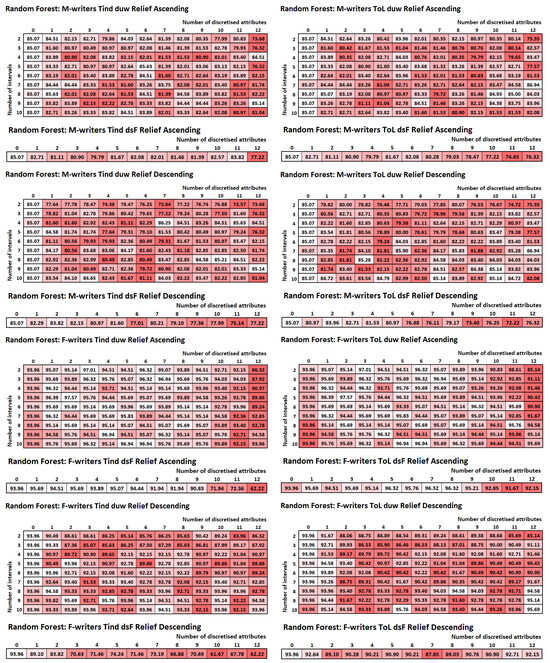
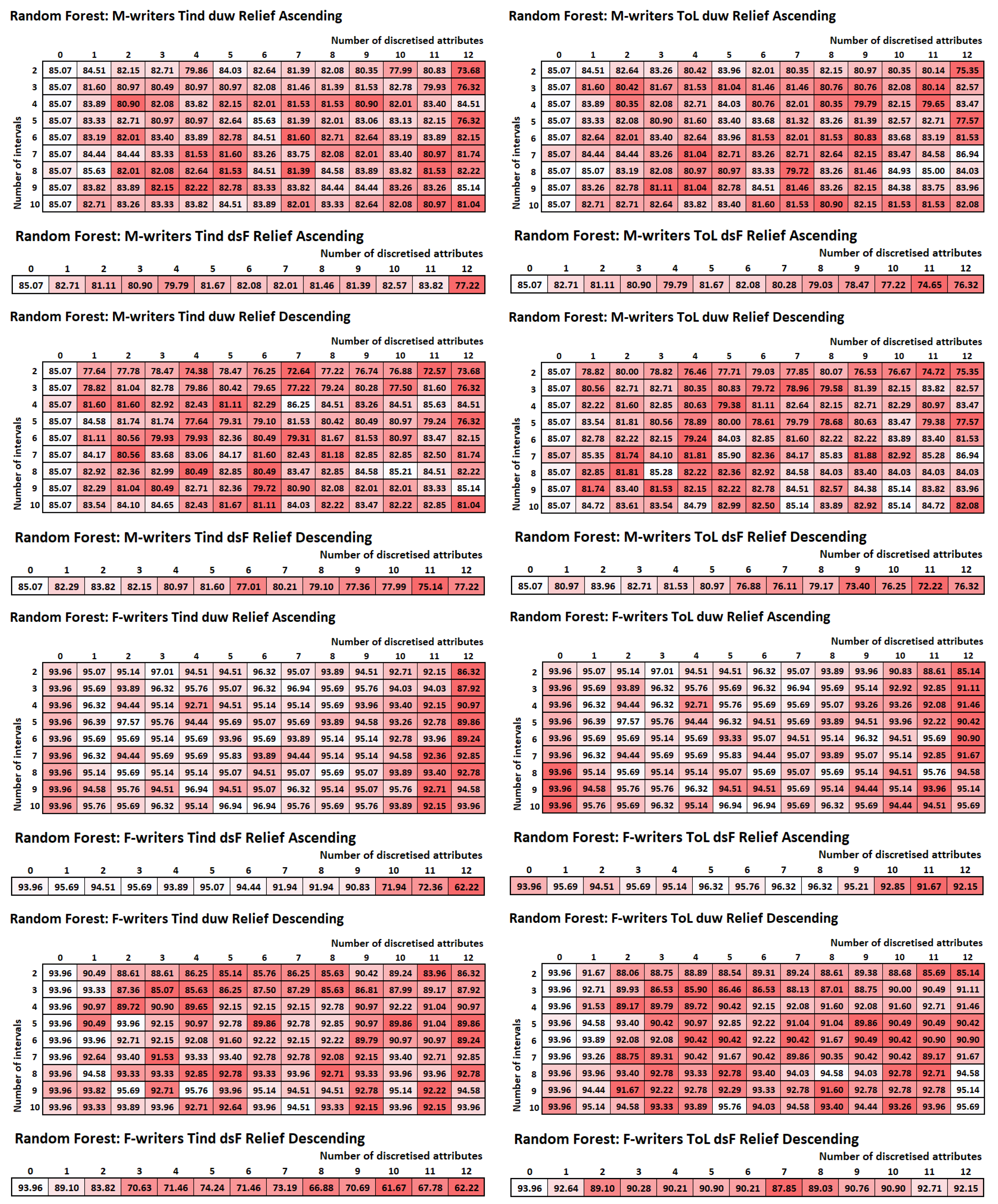
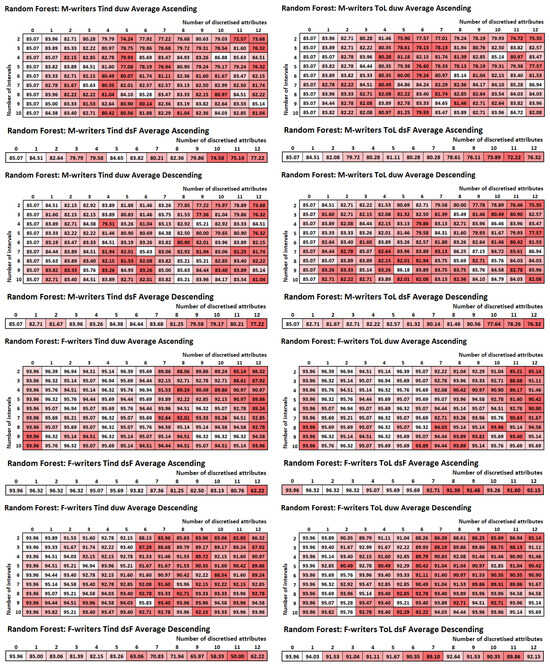
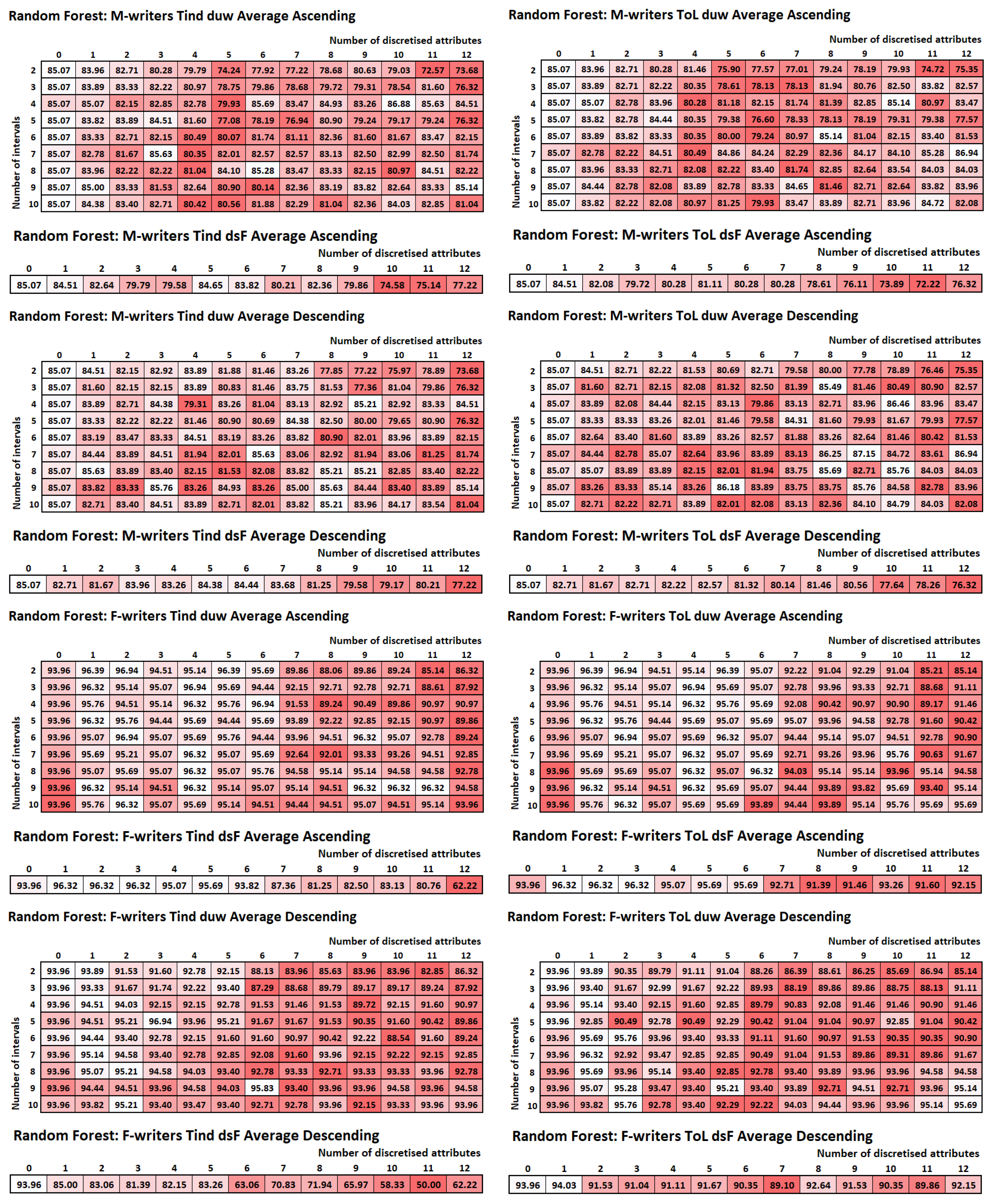
The performance of the classifiers is presented in Figure 1 and Figure 2 for Random Forest, and in Figure 3 and Figure 4 for k-Nearest Neighbours. Each figure is composed of sixteen parts, eight per each dataset (two directions × two main discretisation approaches × two modes of transformation applied to test sets). For each discretisation approach, the predictions are shown in one row, for the equal width binning together in one table, and for the Fayyad and Irani algorithm separately. The columns are described by the number of discretised attributes listed. The index 0 corresponds to the case of the original datasets in the continuous domain (included here for reference), and the index 12 denotes the completely discrete data. The tables on the left provide the results for the test sets that were transformed independently, and the ones on the right for dependent discretisation. The upper half of each figure is dedicated to one dataset, and the bottom half to the other. Within each figure the components refer to one ordering of variables controlling transformations, either Relief or based on the average attribute values, for the two processing directions.
Figure 1.
Performance of Random Forest classifiers in the process of gradual discretisation of attributes while following Relief ranking for equal width binning (duw) and for the Fayyad and Irani (dsF) algorithm, classification accuracy [%] evaluated by test sets prepared by independent (Tind) and dependent (ToL) processing.
Figure 2.
Performance of Random Forest classifiers in the process of gradual discretisation of attributes while following ordering of features based on their average values, for equal width binning (duw) and for the Fayyad and Irani (dsF) algorithm, classification accuracy [%] evaluated by test sets prepared by independent (Tind) and dependent (ToL) processing.
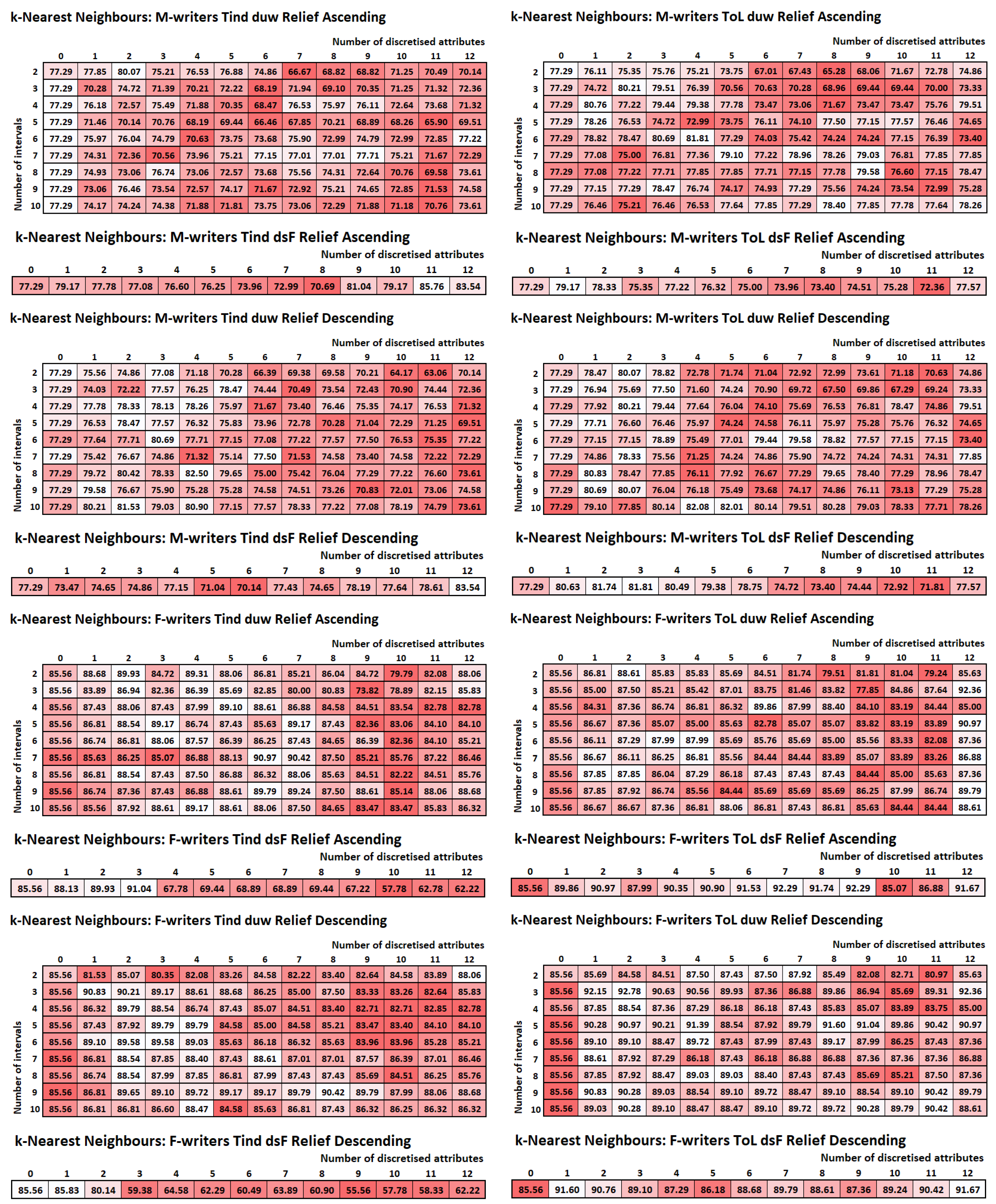
Figure 3.
Performance of k-Nearest Neighbours classifiers in the process of gradual discretisation of attributes while following Relief ranking for equal width binning (duw) and for the Fayyad and Irani (dsF) algorithm, classification accuracy [%] evaluated by test sets prepared by independent (Tind) and dependent (ToL) processing.
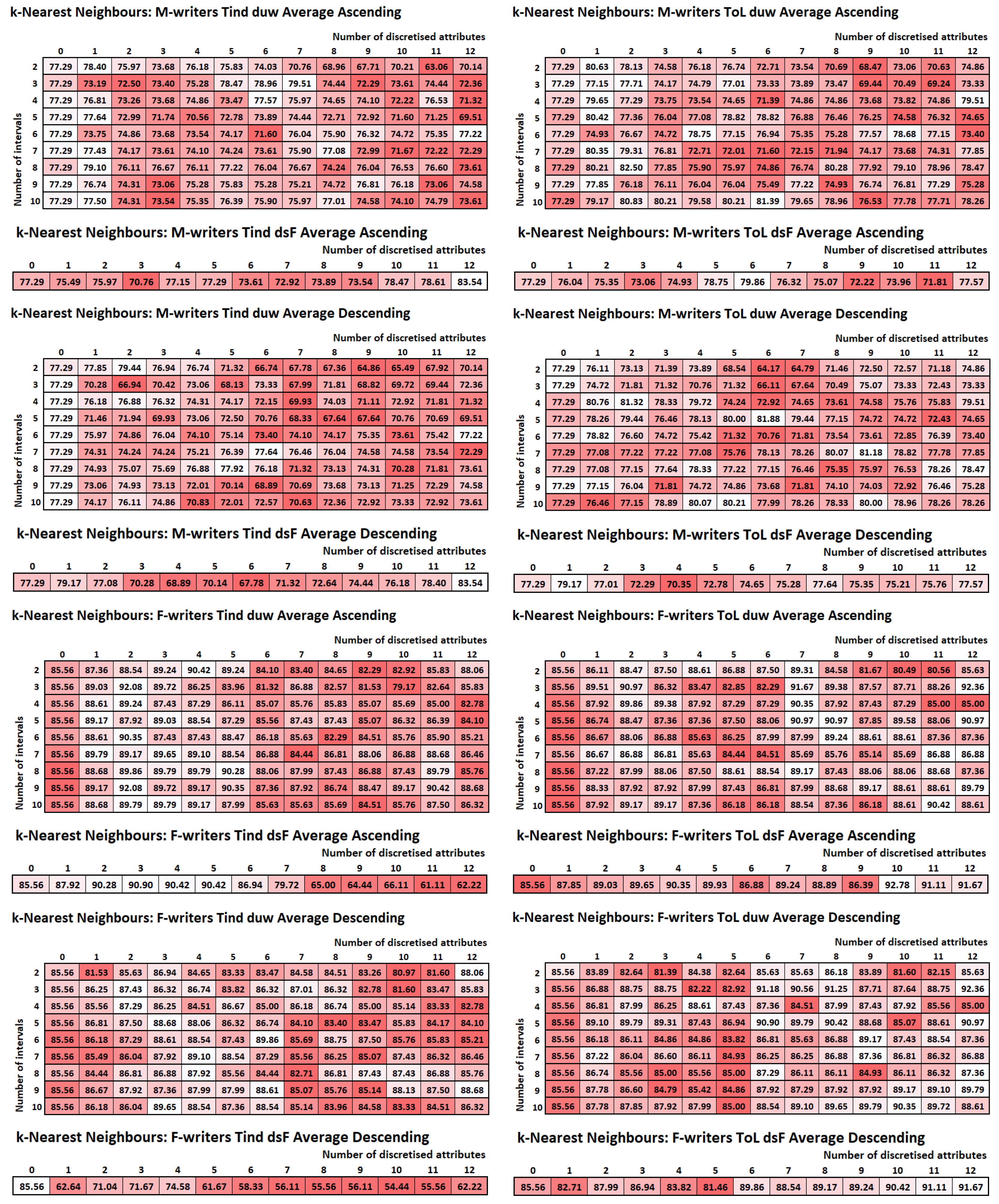
Figure 4.
Performance of k-Nearest Neighbours classifiers in the process of gradual discretisation of attributes while following ordering of features based on their average values, for equal width binning (duw) and for the Fayyad and Irani (dsF) algorithm, classification accuracy [%] evaluated by test sets prepared by independent (Tind) and dependent (ToL) processing.
The classification accuracy is given by directly listed values, but the adopted colour scale also shows quality of predictions. The highest values are displayed on the white background. Then, gradually the colour changes through shades to dark red, which corresponds to the lowest predictions detected in each specific transformation path, visualised by a row. Thanks to the conditional colouring of cells applied, one glance at the four figures immediately leads to the conclusion that although, in general, discretisation was advantageous to classifier performance in many cases, rarely the maximum was reported for the entire set of attributes transformed to a discrete domain, both for supervised and unsupervised discretisation algorithms. On the contrary, when categorical representation of features resulted in some improvement, the majority of conditions show only partial discretisation, and the complete change of the domain caused often degraded accuracy with respect to the reference point in the continuous domain. Therefore, the representation of attributes that was most advantageous to performance was found when some but not all features were transformed.
For the Random Forest classifier processing the Relief ranking in ascending order of unsupervised discretisation for the female writer dataset, the performance was enhanced for all data variants resulting from the input parameter giving the number of bins. For the same parameters, in the case of the male writer dataset, the reported predictions were more varied, and only in a limited number of cases discretisation brought improvement. Descending order (proceeding down the Relief ranking) was less advantageous than ascending. For the ordering of attributes by their average values, similar trends in the performance of Random Forest can be observed: starting discretisation at the bottom, with features with lowest values, led to data representation that worked better than when transformations began for the features with the highest average values.
For the k-Nearest Neighbours, again for the female writer dataset categorical representation for some features resulted in enhanced predictions more often than for the male writer dataset. Yet for the two datasets, the maxima also in this case were mainly detected for partial discretisation, although there were more conditions where complete transformation of the input space turned out to be most beneficial than observed for Random Forest. The comparison between the ascending and descending orders for the two orderings of features led to the conclusion that the latter brought more advantageous transformations than the former. For descending order, contrasting Relief versus ordering based on averages shows more improvement for the sequential discretisation based on the ranking that actually reflects relevance of attributes. However, for ascending order, the opposite statement was mainly true: taking into account the values of features worked better for their representation than considering their estimated importance.
For the Random Forest, the comparison of evaluation by independently processed test sets against their transformations based on the training data shows similar trends. For the supervised discretisation by the Fayyad and Irani method, the change of representation was rather disadvantageous, and often the higher the number of transformed features, the worse the performance. Yet for k-Nearest Neighbours, the two types of test sets led to kind of mirror images of performance changes. When discretisation was beneficial for the independently prepared test sets, then it was harmful for the dependent test sets, and vice versa. For equal width binning, the results depended not only on the number of translated variables, but also on the number of constructed bins, yet the patterns in performance resembled those for supervised discretisation. For Random Forest, evaluations through Tind and ToL test sets caused observation of similar behaviour, while for k-Nearest Neighbours and Tind sets the trends were mostly opposite to those visible for ToL sets.
When performance and its changes due to domain transformations are examined, obviously typically the one of the goals is to locate the maximum, the conditions leading to the representation that is most beneficial to accuracy of recognition. Based on the included figures, such study was also executed. Complete discretisation of the input space caused representations more favourable than partial transformation twice as many times for the k-Nearest Neighbours classifier exploring the data than for Random Forest. For k-NN, this happened for both datasets investigated, but more often when the performance was evaluated through the test sets processed with relaying on definitions for intervals learnt from the training sets than for independent mode of transformations. This was particularly visible for average-based ordering of variables and the female writer dataset, for both descending and ascending directions.
For the Random Forest and F-Writers, almost always the partial discretisation was more beneficial than complete transformation of the entire input domain, but for M-Writers more features were needed to have discretised domains to arrive at the highest predictions, even all of them. Such conditions were most numerous when attributes were processed relying on the Relief ranking, again in both directions, but more often when the dependently processed ToL test sets were used than for the independently transformed Tind test sets. On the other hand, the dominant majority of recorded evaluations of accuracy indicates that partial discretisation is clearly worth a deeper investigation. For all successive discretisation paths, dependent on a transformation method and search direction, the highest classification accuracy was reported more often when fewer than all attributes were discretised. There were many cases in which a single translated variable caused the most beneficial representation of the input data.
Contrary to widely popularised opinions, supervised discretisation was not always better than unsupervised transformations of the input space, even though with premeditation the most basic of unsupervised algorithms was used in the experiments. It was especially visible in the case of independently discretised test sets due to the presence of irregularities in the input data, which led to the construction of distinctively varied definitions of intervals for the same variables in different sets. Furthermore, there were some variables that were assigned single categorical representations, and the subsets of these features were not the same for all sets. For dependent transformations of test sets, the definitions of bins were imposed on these sets, so they were the same as for the train sets.
The detailed results given by the coloured tables enable to investigate trends in performance of the two considered classifiers and their reaction to the happening change of representation of the input space under various conditions. However, based on this form of presentation, the formulation of some overall summarising conclusions could be problematic. To study the characteristics of the transformation paths more closely in order to detect the conditions most advantageous to representation, some statistics were calculated, and they are presented and discussed in the next section of the paper.
4. Discussion
Over the entire path of sequential transformations that involved gradual discretisation of the available attribute sets, some selected general statistics were calculated for the two classifiers used in the research. They are listed in Table 3 and Table 4. The values given were calculated for partial discretisation, that is, when at least one, but not all attributes were discretised. The cases of zero and all discretised features were excluded from these calculations on purpose, in order to avoid bias of a standard way of processing (that is, when either none of the variables are discretised, or all of them are).
Table 3.
Statistics of performance for the Random Forest classifiers, calculated over the process of gradual discretisation of the set of attributes led by their ordering, with MetD discretisation algorithm, either the supervised Fayyad and Irani (dsF) or the unsupervised equal width binning (duwi, where i specifies the number of bins), obtained for evaluation with independently (Tind) or dependently (ToL) processed test sets. Statistics include average ± standard deviation (Avg ± Std), minimum (Min) and maximum (Max) classification accuracy detected.
Table 4.
Statistics of performance for k-Nearest Neighbours classifiers, calculated over the process of gradual discretisation of attributes led by their ordering, with MetD discretisation algorithm, either the supervised Fayyad and Irani (dsF) or the unsupervised equal width binning (duwi, where i specifies the number of bins), obtained for evaluation with independently (Tind) or dependently (ToL) processed test sets. Statistics include average ± standard deviation (Avg ± Std), minimum (Min) and maximum (Max) classification accuracy detected.
For all transformation paths, the statistics included the average, minimal, and maximal classification accuracy expressed as a percentage of the correctly classified samples averaged over test sets, and also standard deviation. With just 11 elements, the formula of standard deviation per sample (instead of per population) was employed. In each group of rows (corresponding to the particular order of proceeding), the best value was marked in bold font. In the case of classification accuracy, the preferred value was the maximum detected, while for standard deviation the minimum value was preferable.
Higher standard deviation values, often observed for the supervised Fayyad and Irani algorithm, show wider ranges of classification accuracy obtained depending on the transformed variables. Such undesirable conditions occurred mostly for evaluation with the independently processed Tind test sets due to irregularities in the data that caused divergent definitions of intervals found for the same features. In the case of the dependent mode of translation adapted for the test sets, Std was never in two digits, yet the value listed for the Fayyad and Irani discretisation method was often the highest. For unsupervised methods, standard deviation was expressed mostly in single digits, even just by fractions, in particular for the higher numbers of constructed intervals. This reflects lower variability in reported precision, and preferred coherence of the discretisation procedures.
Based on the detected values of standard deviation for the Random Forest classifiers and the female writer dataset, the most stable path of transformations led by Relief ranking of attributes, with close results for both processing directions for both types of test sets. For the male writer dataset, ascending Relief returned the smallest standard deviation. In the case of k-Nearest Neighbours classifiers and the F-Writer dataset, the descending direction worked better for stability of the results. The ordering by average attribute values brought a more advantageous evaluation by independent test sets, while for the dependent ones, Relief was more beneficial. For the M-Writer dataset, proceeding in ascending direction turned out to give close results for all discretisation approaches, which led to the smallest Std for both modes of transformations adapted for the test sets.
A closer study of the two tables with respect to the classification accuracy, its average, minimum, and maximum values, further confirms the conclusion that supervised discretisation of attributes rarely caused the most preferred highest values. For the Random Forest classifier, it never happened, and for k-Nearest Neighbours only a few entries in bold font in the rows corresponding to dsF indicate the marked maxima. This occurred while operating on the female writer dataset in ascending direction of both Relief and ordering by average and evaluating by dependently discretised ToL test sets, and for the male writer dataset and ascending Relief for independently translated Tind test sets.
In the case of k-Nearest Neighbours, for both datasets, similar conditions were most beneficial to performance for both modes of transformation applied to test sets. With some exceptions, the highest values were noted either for Relief and descending order, or average-based ordering and ascending order. The comparison between the directions tested for both orderings and both types of test sets led to the confirmation of these findings. For Relief, better results were noted mostly for the descending direction than for ascending, and for average-based order, the ascending direction was more advantageous than descending for both the female and male writer datasets.
For Random Forest and F-Writers, the ascending direction was noticeably more favourable, but both Relief and average-based orderings led to cases of most preferred predictions, with some slight advantage of attribute selection directed by Relief. In the case of the male writer dataset, the results were not so uniform and more varied. When Relief ordering was driving the sequential discretisation, the ascending order brought more desirable results, while for average-based ordering, the descending order led to better performance. For F-Writers, ascending direction caused more favourable conditions for both variable orderings, while for M-Writers and Relief, ascending direction was more advantageous, and for the ordering based on average, the ascending order worked better.
To take this analysis further and verify if partial transformations could be a better option, the performance of the classifiers observed in sequential forward discretisation of features was compared with the reference points in the continuous domain, that is, with precision while working with real-valued attributes, before any transformations of their domains were attempted. From this comparison, the cases with improvement caused by partial discretisation were selected and listed in Table 5. The entries of this table include the accuracy and the number of discretised features that resulted in a more favourable representation of the input domain. The empty cells reflect cases where for some transformation path for all evaluations the reported performance was only degraded, worse than in the continuous domain. In each column for ordering of attributes considered, the maximum is marked in bold font.
Table 5.
Conditions most advantageous to performance of the classifiers detected for partial discretisation of attribute sets, with MetD giving the discretisation approach, either the supervised Fayyad and Irani (dsF) or the unsupervised equal width binning (duwi, where i specifies the number of bins), obtained for evaluation with independently (Tind) or dependently (ToL) processed test sets. The columns represent: MCl the maximal classification accuracy for the path that improved over the reference point in the continuous domain, Nad the lowest number of discretised attributes that caused this improvement.
For Random Forest and the F-Writer dataset, partial discretisation turned out to result in improved predictions more often than for the M-Writer dataset, as evidenced by the top-right quarter of Table 5 being mostly empty, with only a few entries listed for the two orderings of variables considered. For F-Writers, the ascending direction of processing based on averages of features and their Relief ranking always caused better conditions for operation of the inducer than in the original continuous input space. However, for k-Nearest Neighbours the situation was markedly different: only with a few exceptions, the partial discretisation of attributes led to classification accuracy higher than the reference point. Furthermore, for both data exploration approaches employed, these most advantageous conditions frequently happened when just a few features, even as few as one or two (making it a distinctive minority), were subjected to domain transformations.
To study the overall best conditions for the work of the two tested inducers, operating on the original continuous data and the discrete variants prepared, all best cases were taken and contrasted with the reference points. This summary is given in Table 6. In the case of Random Forest, for the F-Writer dataset, the highest classification accuracy returned for evaluation with independently and dependently transformed test sets was at the same level of 97.57%. It was reported for the dataset processed based on Relief ranking while only two least relevant features were discretised with unsupervised equal width binning with five intervals constructed for categorical representation.
Table 6.
The best performance [%] of inducers and corresponding conditions for datasets in the continuous (denoted Contin.) and discrete domains, either the supervised Fayyad and Irani (dsF) or the unsupervised equal width binning (duwi, where i specifies the number of bins) with the number in brackets giving the lowest number of discretised attributes that caused this improvement, obtained for evaluation with independently (Tind) or dependently (ToL) processed test sets.
For the M-Writer dataset, the maximum precision of 86.88% was observed for independently discretised Tind test sets when ten variables with lowest averages were transformed, also with equal width binning but with four defined bins. Evaluation with dependently processed ToL test sets gave a slightly higher accuracy of 87.15% for nine variables discretised with the duw7 approach while following the ordering based on averages in descending order. The male writer dataset and attributes processed in ascending order of Relief ranking and evaluation with ToL test sets represents the only case from all conditions studied that the maximum precision obtained for partial discretisation was below the reference point with all features discretised, which is shown by the single empty cell in the table.
For the k-Nearest Neighbours, in general, discretisation caused a greater improvement over operation in continuous space than for Random Forest classifiers. When consequences of complete and partial transformations were contrasted it turned out that for independently processed Tind test sets the latter resulted in more noticeable positive difference than for the ToL test sets discretised based on discrete data models learnt for the training sets.
For evaluation with the Tind sets of the female writer dataset, the maximum was found at 92.08% when only two attributes with lowest averages were discretised with equal width binning method and either three or nine bins. For the male writer dataset, the best performance established based on independently processed test sets was 85.76% for 11 least relevant variables taken from the Relief ranking and discretised by the supervised Fayyad and Irani method. The supervised transformations also worked well in the case of evaluation with dependent ToL test sets for the F-Writer dataset, when the maximum classification accuracy at the level of 92.78% occurred for ten discretised features selected from the average-based ordering proceeding in ascending direction. In this case for M-Writers, the highest precision of 82.50% corresponds to conditions where two variables with the lowest averages were discretised with the duw8 method.
All presented detailed results, comments on trends observed for sequential forward discretisation process following some ordering of features, the calculated statistics, comparisons, and summaries clearly indicate that a closer look at the applied discretisation method provides more insight into the domain and attribute characteristics that can be advantageous. Even so, the reported research should not be treated as a convincing reason to perform transformations of the input domain or advocating superiority of one method over another. A discretisation process cannot guarantee an improvement, therefore, it should always be applied with a certain degree of caution.
However, improved understanding of the relations between changes in representation and performance, and enhancement of the latter can be worth the additional effort and time dedicated to analysis, in particular in the cases where machine learning algorithms employed in data exploration are capable of working both with continuous and discrete forms of variables yet show sensitivity to the type of the input domain. When a change in the representation of attributes is taken under consideration, transformations of subsets of features should be investigated closer. Even for small numbers of available attributes it would be unfeasible to analyse all subsets that could possibly be constructed and transformed, but testing some smaller selection could lead to interesting discoveries. As experiments show, this change of approach could lead to more positive results than discretisation of all attributes, executed without discerning their specificity. Furthermore, the popular opinion of superiority of supervised transformation methods should not always be accepted blindly, without verifying their effectiveness in leading to categorical representation, as characteristics of the input domain can result in unsupervised transformations bringing definitions of intervals more favourable to performance.
5. Conclusions
It is a widely accepted practice that when discretisation is applied to the input data space, all attributes are transformed at the same time at the preliminary data pre-processing stage, and all considerations are moved to the discrete domain, without investigating partial discretisation. The paper reports on a different research methodology, with closer examination of the discretisation process executed for sets of available features. Instead of translating entire sets of attributes from numeric to categorical representation, the range of transformed variables was gradually expanded one by one, going sequentially forward. The selection process of elements to be discretised was controlled by orderings of features. Two orderings were employed for the task, the Relief ranking reflecting relevance and the order based on the average values of the attributes, providing information on some domain characteristics. Both orderings were followed in ascending and descending order. For the resulting variants of datasets, which at the beginning of the processing were continuous, then partially discretised, and finally completely discrete, the performance of the two selected inducers was studied and evaluated with two types of test sets, prepared through independent and dependent modes of transformations.
Due to the high number of the input data variants resulting from the processing which further involved several selected supervised and unsupervised discretisation approaches used in all transformation paths, the experiments that were carried out were extensive. They were conducted on the task of binary authorship attribution treated as a classification problem, with authors working as labels for samples and characteristic features reflecting linguistic descriptors specific for individual writing styles. The investigations aimed at observation of relations between attribute characteristics and representations and classifier performance. The results obtained led to the conclusion that selective transformations of attributes are worth a deeper analysis because, for a noticeable number of conditions studied, partial discretisation was more advantageous to predictions, even for unsupervised discretisation algorithms, which are often criticised and considered inferior to supervised transformations.
Future research will involve application of the demonstrated methodology to other types of inducers, with a different background and operation mode. Furthermore, combinations of discretisation algorithms will be tested in search of closer adaptation to the input space characteristics that would be beneficial to performance.
Author Contributions
Conceptualization, U.S.; methodology, U.S.; software, G.B.; validation, U.S., G.B.; formal analysis, U.S.; investigation, U.S.; data curation, U.S., G.B.; writing—original draft preparation, U.S.; writing—review and editing, U.S.; visualization, U.S.; supervision, U.S. All authors have read and agreed to the published version of the manuscript.
Funding
This research received no external funding.
Institutional Review Board Statement
Not applicable.
Informed Consent Statement
Not applicable.
Data Availability Statement
The raw data supporting the conclusions of this article will be made available by the authors on request.
Acknowledgments
The research described in the paper was performed at the Silesian University of Technology, Gliwice, Poland, within the statutory project of the Department of Computer Graphics, Vision and Digital Systems (RAU-6, 2026).
Conflicts of Interest
The authors declare no conflicts of interest.
Abbreviations
The following abbreviations are used in this manuscript:
| F-Writers/M-Writers | Names of the two datasets used in the research, respectively, the female writer dataset or the male writer dataset |
| RF | Random Forest, one of the classifiers employed |
| k-NN | k-Nearest Neighbours, one of the classifiers employed |
| dsF | Discretised by the supervised method by Fayyad and Irani |
| duwi | Discretised by the unsupervised equal width binning, with i specifying the number of bins |
| Tind | Test set discretised independently |
| ToL | Test set discretised based on intervals defined for learning set |
| Avg | Average |
| Std | Standard deviation |
References
- Cios, K.J.; Pedrycz, W.; Świniarski, R.W.; Kurgan, L. Data Mining. A Knowledge Discovery Approach; Springer: New York, NY, USA, 2007. [Google Scholar]
- Han, J.; Kamber, M.; Pei, J. Data Mining: Concepts and Techniques; Morgan Kaufmann: Burlington, MA, USA, 2011. [Google Scholar]
- Sokol, K.; Flach, P. Interpretable representations in explainable AI: From theory to practice. Datamining Knowl. Discov. 2024, 38, 3102–3140. [Google Scholar] [CrossRef] [Scilit]
- Dash, R.; Paramguru, R.L.; Dash, R. Comparative analysis of supervised and unsupervised discretization techniques. Int. J. Adv. Sci. Technol. 2011, 2, 29–37. [Google Scholar]
- Huan, L.; Farhad, H.; Lim, T.; Manoranjan, D. Discretization: An Enabling Technique. Data Min. Knowl. Discov. 2002, 6, 393–423. [Google Scholar] [CrossRef] [Scilit]
- Stańczyk, U.; Zielosko, B. Data irregularities in discretisation of test sets used for evaluation of classification systems: A case study on authorship attribution. Bull. Pol. Acad. Sci. Tech. Sci. 2021, 69, e137629. [Google Scholar] [CrossRef] [Scilit]
- Mansoori, E. Using statistical measures for feature ranking. Int. J. Pattern Recognit. Artifficial Intell. 2013, 27, 1350003. [Google Scholar] [CrossRef] [Scilit]
- Rybicki, J.; Eder, M.; Hoover, D. Computational stylistics and text analysis. In Doing Digital Humanities: Practice, Training, Research, 1st ed.; Crompton, C., Lane, R., Siemens, R., Eds.; Routledge: Abingdon, UK, 2016; pp. 123–144. [Google Scholar]
- Sbalchiero, S.; Eder, M. Topic modeling, long texts and the best number of topics. Some Problems and solutions. Qual. Quant. 2020, 54, 1095–1108. [Google Scholar] [CrossRef] [Scilit]
- Koppel, M.; Schler, J.; Argamon, S. Computational Methods in Authorship Attribution. J. Am. Soc. Inf. Sci. Technol. 2009, 60, 9–26. [Google Scholar] [CrossRef] [Scilit]
- Hall, M.; Frank, E.; Holmes, G.; Pfahringer, B.; Reutemann, P.; Witten, I.H. The WEKA data mining software: An update. SIGKDD Explor. 2009, 11, 10–18. [Google Scholar] [CrossRef] [Scilit]
- Cutler, A.; Cutler, D.R.; Stevens, J.R. Random Forests. In Ensemble Machine Learning: Methods and Applications; Zhang, C., Ma, Y., Eds.; Springer: New York, NY, USA, 2012; pp. 157–175. [Google Scholar]
- Garcia, S.; Luengo, J.; Saez, J.; Lopez, V.; Herrera, F. A Survey of Discretization Techniques: Taxonomy and Empirical Analysis in Supervised Learning. IEEE Trans. Knowl. Data Eng. 2013, 25, 734–750. [Google Scholar] [CrossRef] [Scilit]
- Grzymala-Busse, J.W. Discretization Based on Entropy and Multiple Scanning. Entropy 2013, 15, 1486–1502. [Google Scholar] [CrossRef] [Scilit]
- Kerber, R. ChiMerge: Discretization of Numeric Attributes. In Proceedings of the AAAI Conference on Artificial Intelligence, San Jose, CA, USA, 12–16 July 1992; pp. 123–128. [Google Scholar]
- Fayyad, U.M.; Irani, K.B. Multi-interval discretization of continuousvalued attributes for classification learning. In Proceedings of the 13th International Joint Conference on Articial Intelligence; Morgan Kaufmann Publishers: San Francisco, CA, USA, 1993; Volume 2, pp. 1022–1027. [Google Scholar]
- Rissanen, J. Modeling by shortest data description. Automatica 1978, 14, 465–471. [Google Scholar] [CrossRef] [Scilit]
- Yang, Y.; Webb, G.I.; Wu, X. Discretization Methods. In Data Mining and Knowledge Discovery Handbook; Maimon, O., Rokach, L., Eds.; Springer: Boston, MA, USA, 2005; pp. 113–130. [Google Scholar]
- Stańczyk, U. Simplification Oriented Data and Pattern Transformations vs. Attribute Importance and Rule-Based Classifier Performance. In Emerging Challenges in Intelligent Management Information Systems. Proceedings of 28th European Conference on Artificial Intelligence ECAI 2025—IMIS Workshop. Volume 1; Hernes, M., Walaszczyk, E., Rot, A., Eds.; Lecture Notes in Networks and Systems; Springer Nature: Cham, Switzerland, 2026; Volume 1767, pp. 96–109. [Google Scholar]
- Jensen, R.; Shen, Q. Computational Intelligence and Feature Selection: Rough and Fuzzy Approaches; IEEE Press Series on Computational Intelligence; Wiley-IEEE Press: Hoboken, NJ, USA, 2008. [Google Scholar]
- Argamon, S.; Burns, K.; Dubnov, S. (Eds.) The Structure of Style: Algorithmic Approaches to Understanding Manner and Meaning; Springer: Berlin, Germany, 2010. [Google Scholar]
- Stamatatos, E. A Survey of Modern Authorship Attribution Methods. J. Am. Soc. Inf. Sci. Technol. 2009, 60, 538–556. [Google Scholar] [CrossRef] [Scilit]
- He, X.; Lashkari, A.H.; Vombatkere, N.; Sharma, D.P. Authorship Attribution Methods, Challenges, and Future Research Directions: A Comprehensive Survey. Information 2024, 15, 131. [Google Scholar] [CrossRef] [Scilit]
- Eder, M. Does size matter? Authorship attribution, small samples, big problem. Digit. Scholarsh. Humanit. 2015, 30, 167–182. [Google Scholar] [CrossRef] [Scilit]
- Zhao, Y.; Zobel, J. Searching with Style: Authorship Attribution in Classic Literature. In Proceedings of the Thirtieth Australasian Conference on Computer Science, ACSC ’07, Darlinghurst, Australia, 30 January 2007; Volume 62, pp. 59–68. [Google Scholar]
- Eder, M. Style-Markers in Authorship Attribution A Cross-Language Study of the Authorial Fingerprint. Stud. Pol. Linguist. 2011, 6, 99–114. [Google Scholar]
- Misini, A.; Kadriu, A.; Canhasi, E. A Survey on Authorship Analysis Tasks and Techniques. SEEU Rev. 2022, 17, 153–167. [Google Scholar] [CrossRef] [Scilit]
- Škorić, M.; Stanković, R.; Ikonić Nešić, M.; Byszuk, J.; Eder, M. Parallel Stylometric Document Embeddings with Deep Learning Based Language Models in Literary Authorship Attribution. Mathematics 2022, 10, 838. [Google Scholar] [CrossRef] [Scilit]
- Stańczyk, U.; Zielosko, B.; Baron, G. Significance of Single-Interval Discrete Attributes: Case Study on Two-Level Discretisation. Appl. Sci. 2024, 14, 4088. [Google Scholar] [CrossRef] [Scilit]
- Zhao, Y.; Zobel, J. Effective and Scalable Authorship Attribution Using Function Words. In Proceedings of the Information Retrieval Technology; Lee, G.G., Yamada, A., Meng, H., Myaeng, S.H., Eds.; Springer: Berlin, Heidelberg, 2005; pp. 174–189. [Google Scholar]
- Guyon, I.; Elisseeff, A. An Introduction to Variable and Feature Selection. J. Mach. Learn. Res. 2003, 3, 1157–1182. [Google Scholar]
- Blum, A.L.; Langley, P. Selection of relevant features and examples in machine learning. Artif. Intell. 1997, 97, 245–271. [Google Scholar] [CrossRef] [Scilit]
- Hall, M.A. Correlation-based Feature Subset Selection for Machine Learning. Ph.D. Thesis, Department of Computer Science, University of Waikato, Hamilton, New Zealand, 1998. [Google Scholar]
- Kononenko, I. Estimating attributes: Analysis and extensions of RELIEF. In Proceedings of the Machine Learning: ECML-94; Bergadano, F., De Raedt, L., Eds.; LNCS; Springer: Berlin/Heidelberg, Germany, 1994; Volume 784, pp. 171–182. [Google Scholar]
- Stańczyk, U. Pruning Decision Rules by Reduct-Based Weighting and Ranking of Features. Entropy 2022, 24, 1602. [Google Scholar] [CrossRef] [Scilit]
- Fernández, A.; García, S.; Galar, M.; Prati, R.C.; Krawczyk, B.; Herrera, F. Data Level Preprocessing Methods. In Learning from Imbalanced Data Sets; Springer International Publishing: Cham, Switzerland, 2018; pp. 79–121. [Google Scholar]
- Rybicki, J. Vive la différence: Tracing the (authorial) gender signal by multivariate analysis of word frequencies. Digit. Scholarsh. Humanit. 2016, 31, 746–761. [Google Scholar] [CrossRef] [Scilit]
- Kotsiantis, S.; Kanellopoulos, D. Discretization Techniques: A recent survey. Int. Trans. Comput. Sci. Eng. 2006, 1, 47–58. [Google Scholar]
- Baron, G.; Harężlak, K. On Approaches to Discretization of Datasets Used for Evaluation of Decision Systems. In Intelligent Decision Technologies 2016; Czarnowski, I., Caballero, A.M., Howlett, R.J., Jain, L.C., Eds.; Springer International Publishing: Cham, Switzerland, 2016; pp. 149–159. [Google Scholar]
- Breiman, L. Random Forests. Mach. Learn. 2001, 45, 5–32. [Google Scholar] [CrossRef] [Scilit]
- Zhang, X.; Xiao, H.; Gao, R.; Zhang, H.; Wang, Y. K-nearest neighbors rule combining prototype selection and local feature weighting for classification. Knowl.-Based Syst. 2022, 243, 108451. [Google Scholar] [CrossRef] [Scilit]
- Sta̧por, K.; Ksieniewicz, P.; García, S.; Woźniak, M. How to design the fair experimental classifier evaluation. Appl. Soft Comput. 2021, 104, 107219. [Google Scholar] [CrossRef] [Scilit]
- Baron, G.; Stańczyk, U. Standard vs. non-standard cross-validation: Evaluation of performance in a space with structured distribution of datapoints. In Knowledge-Based and Intelligent Information & Engineering Systems: Proceedings of the 25th International Conference KES-2021, Szczecin, Poland, 8–10 September 2021; Wa̧tróbski, J., Salabun, W., Toro, C., Zanni-Merk, C., Howlett, R.J., Jain, L.C., Eds.; Procedia Computer Science; Elsevier: Amsterdam, The Netherlands, 2021; Volume 192, pp. 1245–1254. [Google Scholar]

Disclaimer/Publisher’s Note: The statements, opinions and data contained in all publications are solely those of the individual author(s) and contributor(s) and not of MDPI and/or the editor(s). MDPI and/or the editor(s) disclaim responsibility for any injury to people or property resulting from any ideas, methods, instructions or products referred to in the content. |
© 2026 by the authors. Licensee MDPI, Basel, Switzerland. This article is an open access article distributed under the terms and conditions of the Creative Commons Attribution (CC BY) license.