


Abstract
The paw pad is an outstanding cushioning structure, which demonstrates nonlinear mechanical characteristics when subjected to pressure. Nonlinear mechanical characteristics are generally considered to be related to the viscoelastic properties of the material. However, the relationship between its nonlinear mechanical properties and the morphological characteristics of the paw pad remains unknown. In this study, morphological data, mechanical data, and finite element simulation methods were integrated to explore how the unique shape of the paw pads enables them to exhibit excellent cushioning performance. The research findings indicate that the paw pad exhibits an irregular morphology. Nevertheless, its cross-sectional area increases in proportion to the increase in the paw pad height, presenting a linear gradient relationship (R2 = 0.99). Two comparison models with the same volume and height but different morphologies as the paw pad model, were designed for finite element simulation. The finite element static analysis shows that the influence of morphology is mainly reflected in the early deformation process, while the influence of viscoelastic material properties is reflected in the later load-bearing capacity. The finite element dynamic analysis shows that compared with the comparison models, the paw pad model has a more stable force during the impact process, without an instantaneous impact force at the initial contact moment. Moreover, the peak normal ground reaction force (GRF) component under different impact speeds is lower than that of the comparison models, demonstrating better buffering effects. The research results can provide inspiration and a biomechanical basis for the morphological design of buffering units.
1. Introduction
When digitigrade animals such as domestic cats and canines run at high speeds, the normal ground reaction component acting on their feet can reach two to three times their body weight [1]. The paw pad, a soft tissue composed of multiple materials, is the only part in contact with the ground. It is generally acknowledged that the paw pad plays a crucial role in reducing normal GRF components and protecting both skeletal and muscular systems. It is an outstanding cushioning structure with excellent performance [2]. Paw pads also contribute to stable contact between the foot and the ground during the ground contact phase. Evidently, paw pads represent an efficient mechanical system capable of concurrently fulfilling the seemingly paradoxical functional requirements of flexible cushioning and rigid support. We hold the view that the excellent performance exhibited by paw pads is closely associated with their nonlinear mechanical characteristics. Nonlinear mechanical properties are prevalent in biological tissues. For instance, tissues such as muscles, ligaments, and blood vessels exhibit nonlinear mechanical properties when subjected to tensile forces [3,4,5]. The nonlinear mechanical properties of biological tissues typically follow a J-shaped curve [6,7]. In the initial stage, the tissues display remarkable softness and compliance. When significant deformations occur (the steeply ascending part of the curve), the tissues become extremely rigid, effectively preventing tearing or rupture. The nonlinear mechanical properties of biological tissues are not coincidental but rather represent a refined design that has evolved over hundreds of millions of years. These properties confer substantial and irreplaceable advantages to the survival and functionality of organisms. However, research on the nonlinear mechanical properties arising from compression remains relatively limited. Consequently, an in-depth investigation into the impact of the material and morphological characteristics of the paw pad on its nonlinear mechanical properties can provide a vital biomechanical foundation for the development of bionic cushioning technologies.
The mechanical properties of biological tissue structures are intricately linked to their material composition [8], internal architecture [9], and macroscopic morphology [10]. In recent years, researchers have predominantly engaged in valuable explorations concerning the material composition and internal structure of paw pads. Alexander conducted dynamic compression experiments on the paw pads of various animal species, revealing that metacarpal pads exhibit nonlinear mechanical characteristics. Through formulaic deduction, it was proposed that the viscoelasticity of the metacarpal pad material is a fundamental factor contributing to its mechanical nonlinearity. Furthermore, this viscoelastic property effectively aids in dissipating impact energy and mitigating tremors during the foot-ground contact phase [11]. Chi and Miao et al., respectively, tested the stiffness values of the forefoot pad and the hindfoot pad in both in vitro and in vivo conditions and found that the stiffness value of the forefoot pad was slightly greater than that of the hindfoot pad [12,13]. Miao and Mei et al. conducted a microscopic study on the paw pads of dogs and cats and found that the paw pads are multi-layered structures composed of various materials. From the outside to the inside, there are the stratum corneum, dermis, and adipose tissue, and the adipose tissue is wrapped by collagen fibers and elastic fibers to form small chambers [14,15]. Lu conducted bionic design research based on the multi-layer structure of cat pads, and the results verified its excellent buffering performance [16,17]. However, there are no reports on the influence of morphological structure on its nonlinear performance. Through research, we have noticed that the parts of the human body or animals that need to bear force in contact all show certain irregular shapes, such as the human heel pad [18], the front foot pad [19], the human buttocks [20], the paw pads of primates [21], the paw pads of canines, the paw pads of felines, the camel foot pad [22], the ostrich paw pads [23,24], etc. These structures all have certain arc-shaped structures, and this kind of morphological structure may be beneficial to the cushioning and supporting functions.
Accordingly, this study takes the paw pads of canines as the research subject, investigates the effects of the morphological characteristics of canine paw pads on their mechanical properties, and reveals the significant role of the morphological characteristics of biological tissues. Initially, this paper extracts the morphological characteristics of canine paw pads. Subsequently, the finite element static analysis method is employed to investigate how morphology and material properties influence the mechanical performance of these paw pads. Finally, the finite element dynamics approach is utilized to explore the contribution of such morphological structural characteristics to the cushioning function of paw pads. The findings of this research can enable a more comprehensive understanding of the structural and morphological characteristics of paw pads and the underlying mechanisms of their cushioning functions. Moreover, this study provides valuable insights and a biomechanical foundation for the development of related bionic products.
2. Materials and Methods
The experimental design and analytical procedures for investigating canine paw pad biomechanics are described herein, including specimen preparation, quasi-static compression testing, MRI-based anatomical reconstruction, finite element modeling and analysis, and data processing methods.
2.1. Subjects
Two canine cadavers were donated by the Changchun Police Dog Base following ethical review and approval. Both forepaws and hind paws were harvested within 24 h post-mortem. The extraction procedure involved surgical dissection to remove superficial soft tissues while preserving the structural integrity of joints and skeletal components. The dissected specimens were immediately fixed in 10% neutral buffered formalin for 48 h [25] and stored for subsequent magnetic resonance imaging (MRI) evaluation and quasi-static compression testing.
2.2. Mechanical Performance Test of Canine Paw Pads
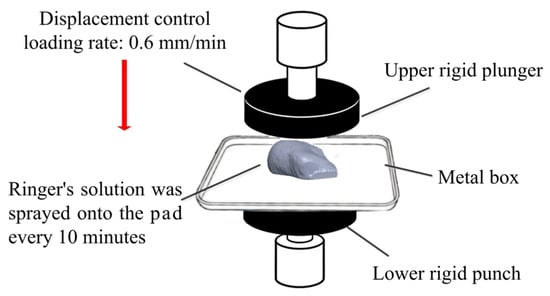
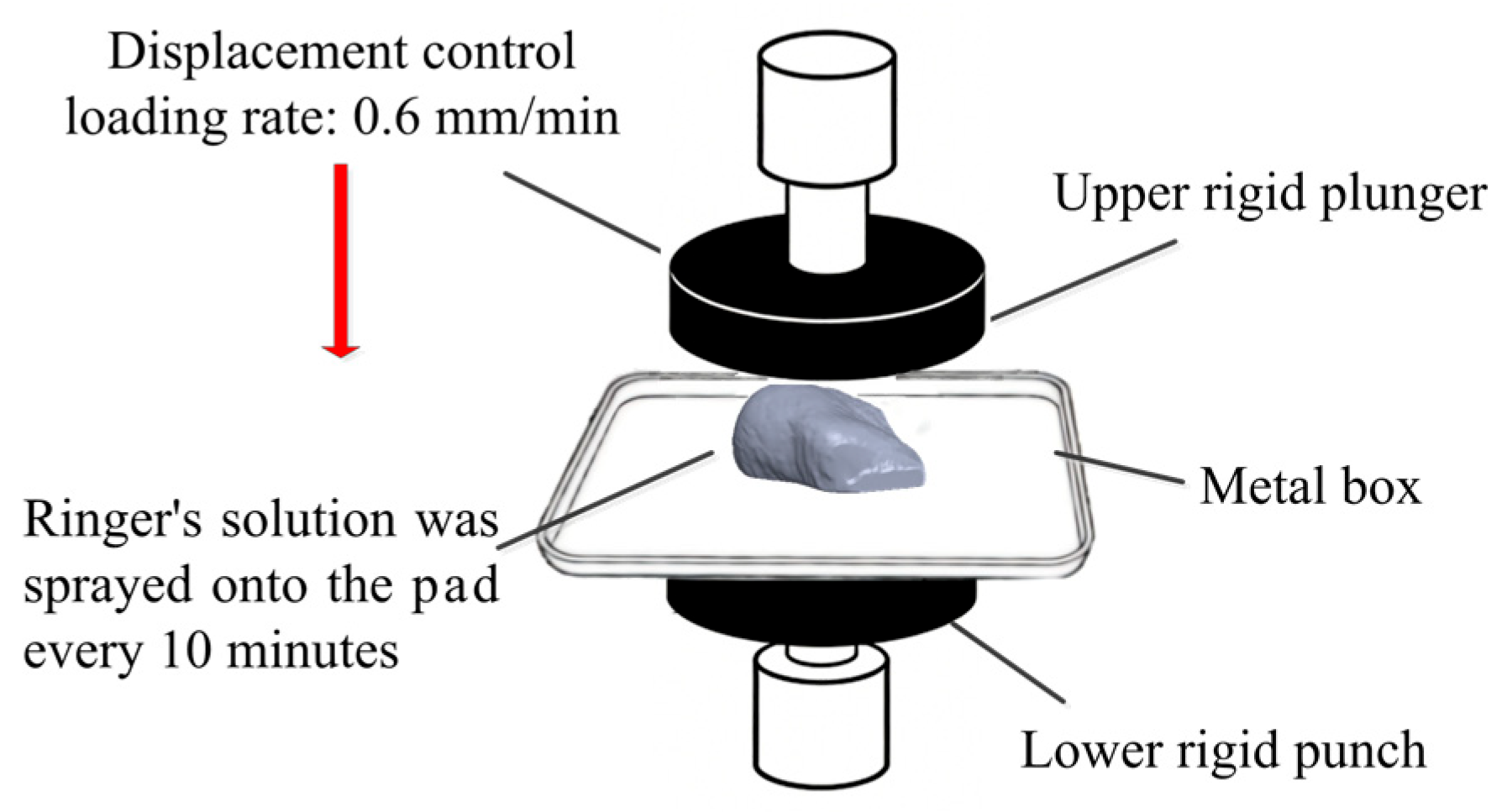
Quasi-static compression tests were conducted on the forefoot paw pads using an MTS Universal Testing Machine (MTS Systems Corporation, Eden Prairie, MN, USA). The experimental setup, including the specimen orientation, loading mechanism, and environmental chamber, is schematically illustrated in Figure 1.
Figure 1.
Schematic diagram of the quasi-static compression test of the canine’s paw pad. The red arrow indicates the downward movement of the upper rigid plunger.
Prior to testing, a preload of 0.1 N was applied to ensure full contact between the indenter and the specimen surface, and the displacement at this point was recorded to determine the original thickness of the paw pad. The compression test was performed at a constant displacement rate of 0.6 mm/min [12]. To prevent dehydration and maintain the physiological moisture content of the tissue throughout the experiment, Ringer’s solution was sprayed onto the specimen every 10 min during the compression process [12].
2.3. MRI Scans
Magnetic resonance imaging (MRI) was performed on the forelimbs and hindlimbs of the two canine cadavers at The First Hospital of Jilin University, Changchun, to acquire high-resolution anatomical data. The MRI datasets were imported into Mimics software (version 10.0, Materialise, Leuven, Belgium) for 3D reconstruction. Region-growing algorithms and manual editing tools were employed to refine the segmentation, ensuring that the boundaries of the paw pads were accurately delineated on every cross-sectional slice. Following segmentation, a 3D surface model was generated using the “Calculate 3D” module. To improve surface quality and eliminate digitization artifacts, the generated model underwent a smoothing process. Finally, the cross-sectional area of the paw pads was manually measured on sequential MRI slices using Digimizer image analysis software (Version 6.5.0, MedCalc Software Ltd., Ostend, Belgium) to ensure anatomical accuracy.
2.4. Finite Element Model Construction
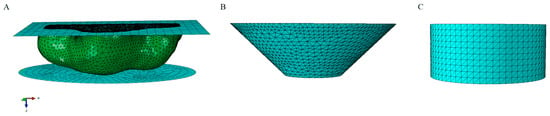
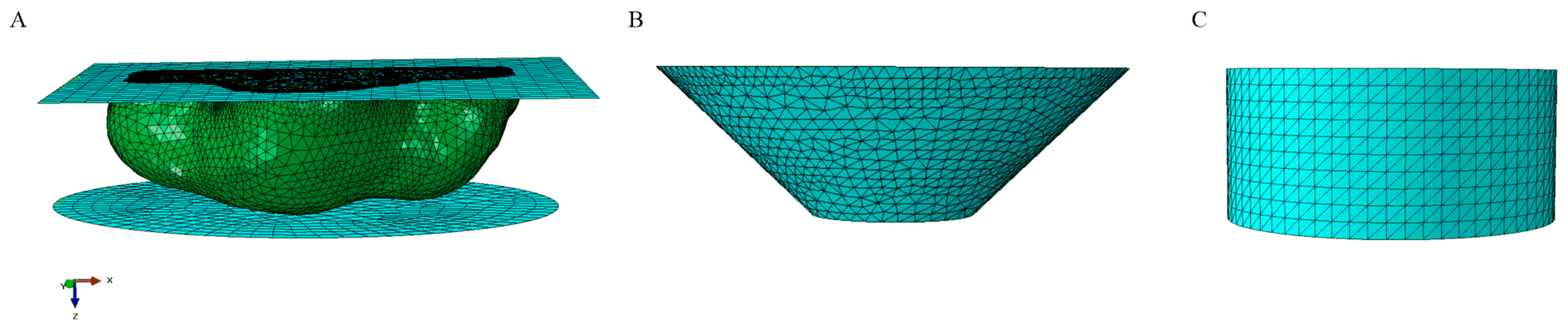
The MRI data were segmented in Mimics, and the 3D geometry was reconstructed using the marching cubes algorithm, which generates a triangular isosurface mesh (STL) from the voxel data. This process approximates the anatomical boundaries based on MRI intensity thresholds, with geometric errors primarily arising from the voxel resolution and linear interpolation. The STL file was refined in Geomagic Studio to create a solid model. Meshing was performed in Hypermesh. This element type was selected for its superior ability to discretize the complex, irregular geometry of biological tissue without significant geometric simplification. In ABAQUS, the FE model was assembled with two rigid planes (Figure 2A). A rectangular plane was tied to the top of the pad to distribute the load, while a circular plane beneath the pad simulated the ground [26]. A surface-to-surface contact interaction with a penalty formulation (friction coefficient = 0.6) was defined between the pad and the ground to model the high-friction boundary condition [27]. The top rectangular plane was fully fixed to simulate a static load application. The bottom circular plane was constrained against horizontal translation (U1 = U2 = 0) and rotational motion (UR1 = UR2 = UR3 = 0), allowing only vertical displacement (U3) to facilitate the application of body weight. A concentrated mass of 5 kg was assigned to the bottom plane, representing the body mass distributed over the paw pad area. This value was estimated based on the average mass of canine cadavers and the contact area of the paw [13,28].
Figure 2.
Three-dimensional finite element models. (A) Paw pad model; (B) Truncated cone model; (C) Cylindrical model.
To investigate the influence of morphological geometry on biomechanical function, two simplified comparative models were designed: a cylindrical model and a truncated cone model, as illustrated in Figure 2B,C. Both simplified models were constructed to possess the same volume and total height as the biological paw pad model, ensuring that any differences in mechanical response were primarily attributed to variations in geometry rather than size. The cylindrical model represents a control geometry with uniform dimensions. Its cross-sectional area remains constant along the vertical axis, resulting in a zero slope for the area-height relationship. The truncated cone model was designed to simulate tapered geometry. Its cross-sectional area increases linearly from the base to the apex. The slope of the cross-sectional area with respect to height was calculated to be 121 mm2/mm, derived from the specific radii required to maintain the target volume. A critical topological distinction between the models is the nature of the contact surface. The truncated cone model features a flat, circular base, whereas the lowermost part of the paw pad model is a single point contact region, which is one of the core morphological features of the natural canine paw pad.
The paw pad, cylindrical, and truncated cone models were discretized with 44,565, 22,122, and 16,365 elements, respectively. For the rigid interaction planes, a consistent meshing scheme was adopted with linear rigid quadrilateral elements (R3D4), with 529 elements for the top plane and 568 for the bottom plane.
2.5. Finite Element Static Analysis
To investigate the influence of morphology and material properties on the biomechanical response, a series of finite element static analyses was conducted. The analysis was structured into three distinct case studies to isolate variables. Paw pad model (linear elastic), to evaluate the effect of geometry alone. Paw pad model (viscoelastic), to evaluate the combined effect of geometry and realistic time-dependent material behavior. Cylindrical model (viscoelastic), to serve as a geometric control for the viscoelastic case.
The material behavior of the paw pad was characterized by using two distinct constitutive models. The linear elastic model was defined by a Young’s Modulus (E) of 1 MPa and a Poisson’s ratio (ν) of 0.49. This model assumes a linear stress–strain relationship and is nearly incompressible. The viscoelastic model was implemented as a hyperelastic (Neo-Hookean) base with a Prony series expansion to describe the relaxation behavior. The instantaneous elasticity was defined by the Neo-Hookean strain energy potential W = μ(I1 − 3)/2, where the shear modulus μ was set to 0.64 kPa and the bulk modulus parameter α was 6.82. The time-dependent relaxation was governed by the Prony series coefficients: g1 = 0.4621, τ1 = 0.07249 s and g2 = 0.4959, τ2 = 9.610 s [29].
All models were subjected to identical boundary conditions. A quasi-static vertical displacement of 7 mm was imposed on the bottom rigid plane (representing the ground). The top rectangular plane (representing the load-bearing surface) was fully fixed. The reaction force (vertical contact force) and displacement data were extracted as functions of time to analyze the load-deformation characteristics.
2.6. Finite Element Dynamic Analysis
To evaluate the energy absorption and buffering performance of different morphologies under impact loading, explicit dynamic analyses were performed on three models: the biological paw pad, the truncated cone, and the cylinder. All models utilized the identical linear elastic material properties defined in Section 2.5 to ensure that differences in dynamic response were purely attributed to geometric variations.
The dynamic simulations were conducted by prescribing an initial vertical velocity to the bottom rigid plane (ground), causing it to impact the stationary paw pad model. Three different impact velocities were simulated: 0.2 m/s, 0.4 m/s, and 0.6 m/s, which were estimated from the metacarpal motion measurement data of German shepherd dogs during normal walking [14]. The top surface of the model remained fixed. The dynamic response was evaluated by analyzing the normal ground reaction force component, vertical displacement of the contact surface.
2.7. Mesh Convergence Analysis
Quasi-static and explicit dynamic analyses were carried out using C3D4H and C3D10M elements, respectively. Both element formulations are appropriate for both the nearly incompressible linear elastic and hyperelastic materials of the canine paw pad. Independent three-level mesh convergence studies were performed on the representative paw pad model, with a uniform global element size refinement ratio of 1.5 between successive levels [29]. Peak GRF and peak displacement were adopted as convergence metrics. All responses showed monotonic convergence, with relative errors < 2.5% for global quantities (Table 1). The converged mesh resolution was uniformly applied to all geometries for consistent comparison, with no numerical artifacts present.
Table 1.
Mesh convergence analysis results for the unified C3D10M and C3D4H model. Relative deviation is normalized to the fine mesh (100%). Dynamic analysis using C3D10M elements was carried out with an impact velocity of 0.4 m/s, while static analysis using C3D4H elements was performed with a 7 mm displacement load.
2.8. Data Analysis
Microsoft Excel 2010 was utilized to collate and process the data collected from the experiments and simulations. The Origin software (Version 10.0, OriginLab Corporation, Northampton, MA, USA) was applied to perform a linear fitting analysis on the data. To ensure the consistency of fitting results, the intercept was constrained to zero in the linear fitting procedure. The goodness of fit was evaluated using the r2 value. The closer the r2 value is to 1, the better the linearity of the data. Secant stiffness was evaluated across five deformation intervals (0–20%, 20–40%, and 40–60%, 60–80%, and 80–100%). The incremental secant stiffness, calculated as the slope of the force–displacement curve within each interval (Ksec,interval = ΔF/Δδ). This dual representation captures both the overall stiffness evolution and the local stiffness variation at different deformation levels [30].
3. Results
Comprehensive results of experimental tests and finite element simulations on the paw pad’s mechanical behaviors, geometric characteristics, and cushioning performance are presented herein. Quasi-static compression tests analyzed its force–displacement relationship, MRI-based analysis explored cross-sectional area-thickness correlation, and static/dynamic simulations evaluated geometric and material effects on normal GRF component, deformation, and impact response, providing insights into its cushioning mechanisms.
3.1. Mechanical Property Testing and Analysis of the Paw Pad
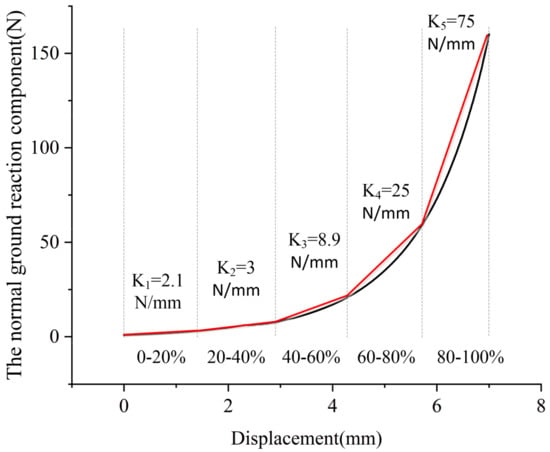
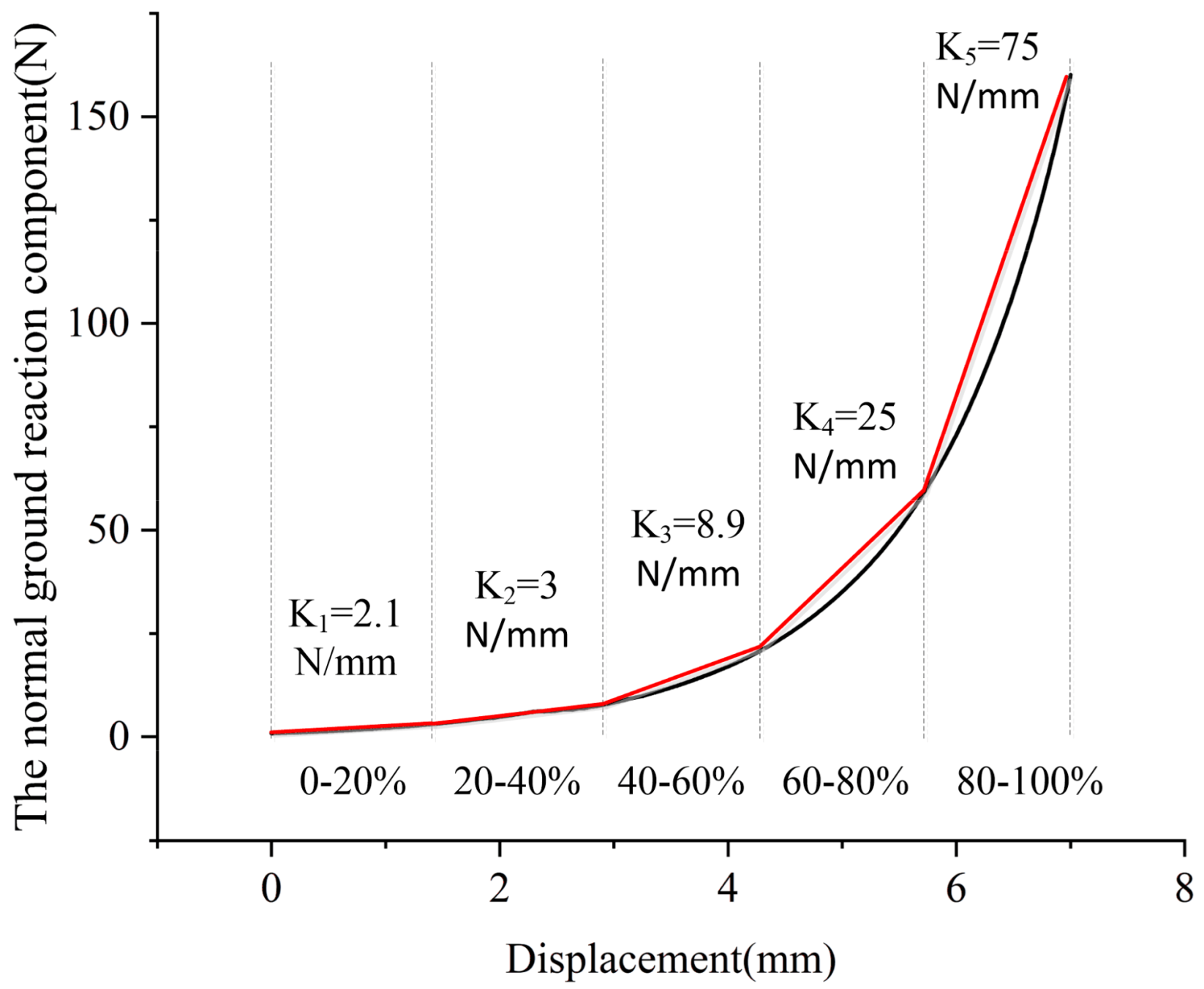
Figure 3 shows the force–displacement response curve of the canine paw pad model under continuous quasi-static compression loading conditions. This curve visually reflects the mechanical load-bearing characteristics of the paw pad soft tissue during the gradual deformation process. To quantitatively characterize the stiffness evolution law of the paw pad at different deformation stages, this study divided the entire compression deformation process into five consecutive deformation regions based on the nonlinear change characteristics of the force–displacement curve, each corresponding to different strain levels and structural response stages. For each divided region, tangent stiffness was calculated based on the local slope of the force–displacement curve, and the tangent stiffness values of the five regions were 2.1, 3, 8.9, 25, and 75 N/mm, respectively. From the changing characteristics of the stiffness values, it can be seen that as the compression deformation continues to develop, the tangent stiffness of the paw pad shows a significant and gradual increasing trend. This change law is highly consistent with the material nonlinearity and structural geometric nonlinearity characteristics of biological soft tissues under large deformations, reflecting the gradually enhanced resistance to deformation of the paw pad during the compression process.
Figure 3.
Results of the mechanical test of the paw pad. The black line represents experimental data. Secant stiffness was calculated over five deformation intervals: 0–20%, 20–40%, 40–60%, 60–80%, and 80–100%, where the red line indicates the secant stiffness for each interval.
3.2. Analysis of the Variation Trend of the Cross-Sectional Area of the Paw Pad
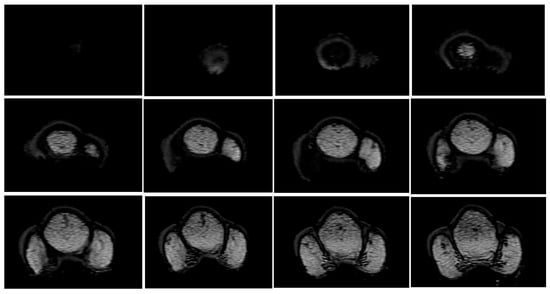
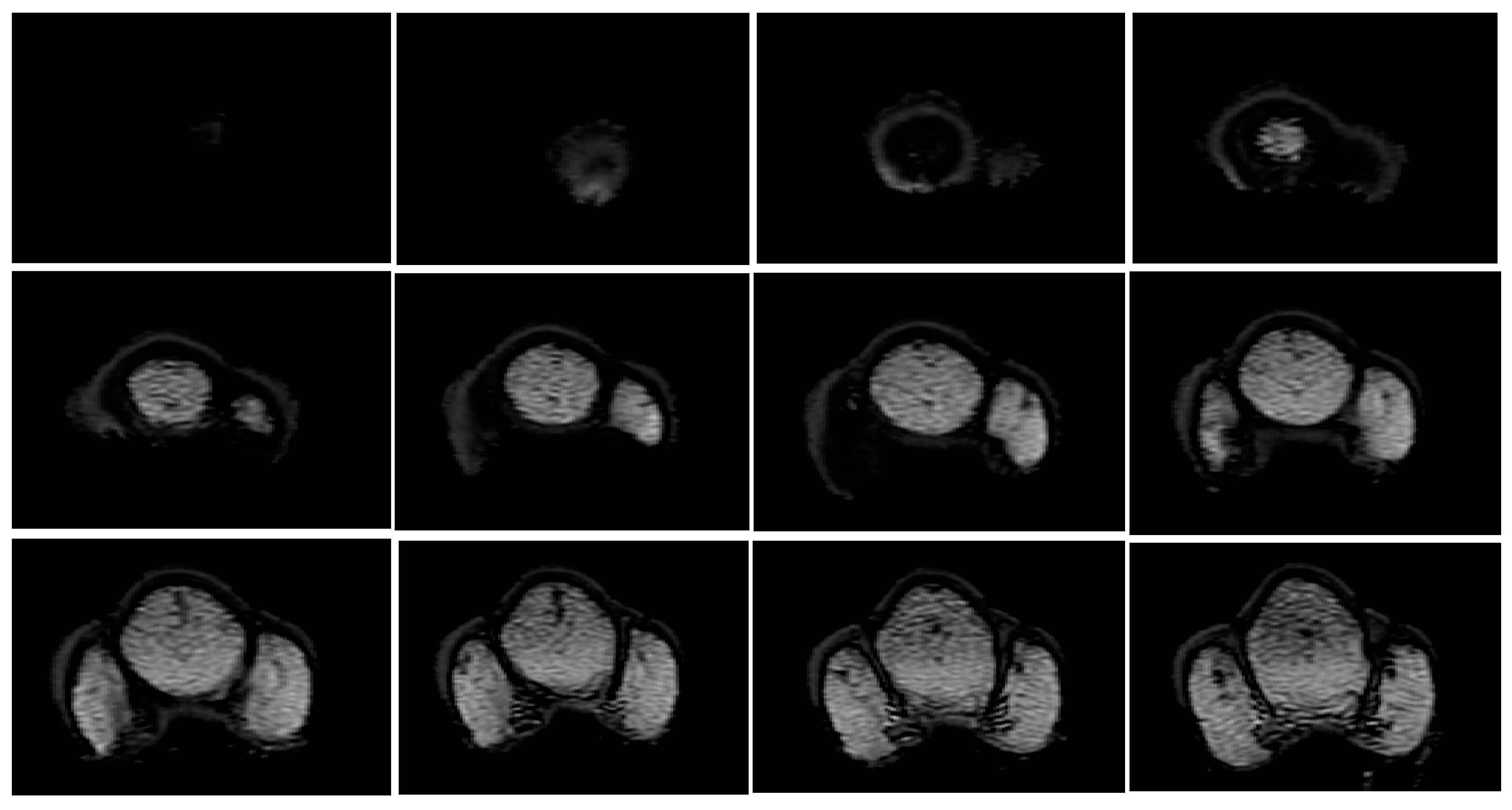
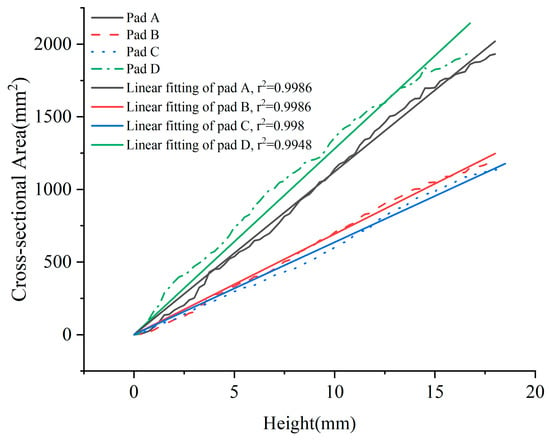
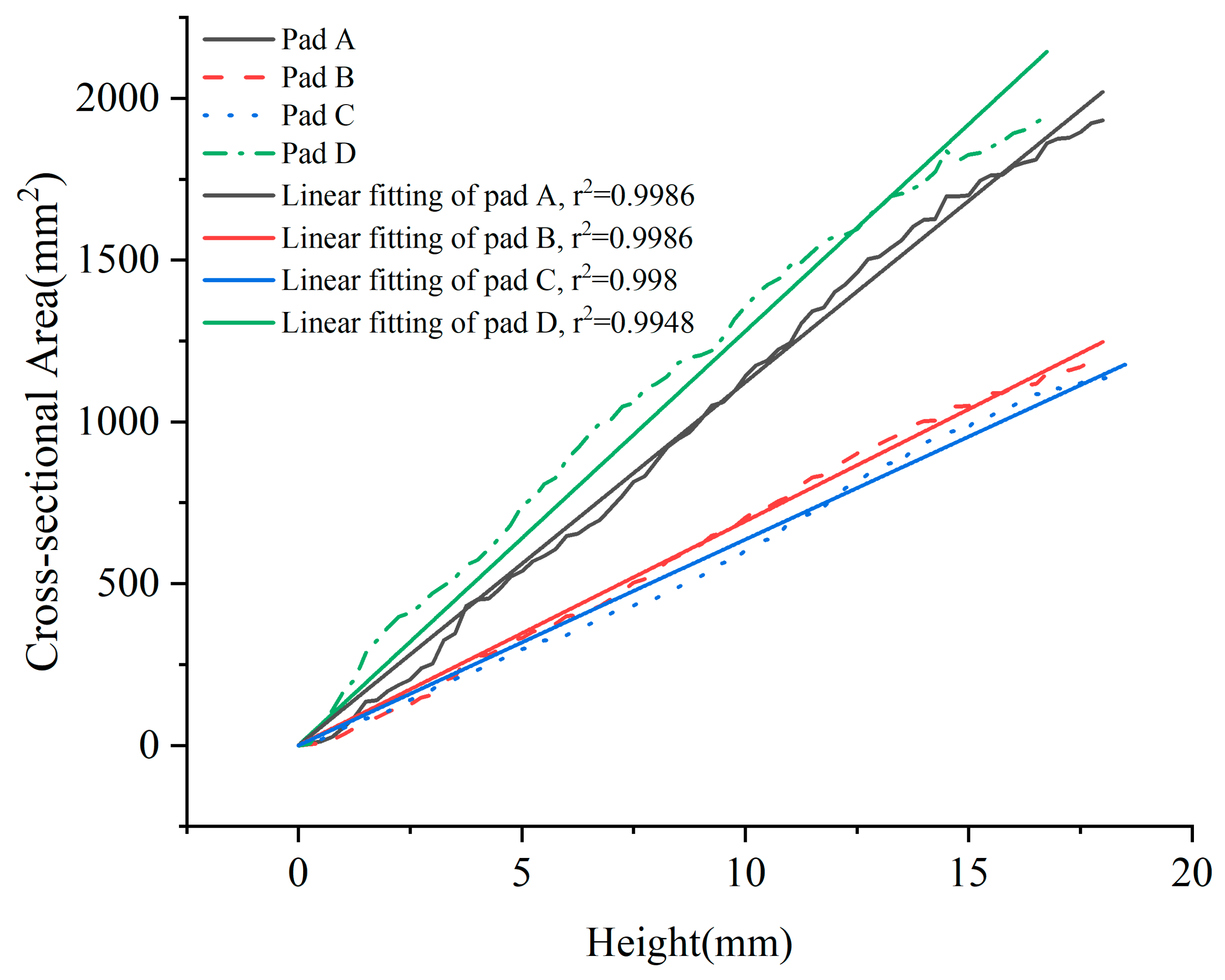
Through an in-depth analysis of the MRI of the paw pad, this study reveals that the cross-sectional area of the paw pad varies in accordance with its thickness (Figure 4). To comprehensively explore the intricate relationship between the cross-sectional area and thickness, this paper meticulously collated data regarding the curve of the paw pad’s cross-sectional area and thickness. A linear regression analysis was then conducted, and the coefficient of determination (R2) was calculated. As presented in Figure 5, it is evident that the cross-sectional area of the paw pad increases in direct proportion to its thickness. The two variables exhibit a strong linear correlation, with an R2 value of 0.9975 ± 0.0018, which indicates a high degree of linearity. Notably, although the paw pad presents an apparently irregular external form, the relationship between its cross-sectional area and thickness follows a linear pattern. This characteristic may be intricately linked to its cushioning capabilities.
Figure 4.
Sequential cross-sectional images of the canine paw pad, arranged in the order of original scanning. Every seventh image was selected from the full sequence for presentation to avoid redundancy while preserving the morphological variation along the longitudinal axis.
Figure 5.
Relationship between the cross-sectional area of the paw pad and its thickness. The dotted lines in the figure represent the experimental data, while the solid lines represent the fitted data.
3.3. Static Simulation Analysis
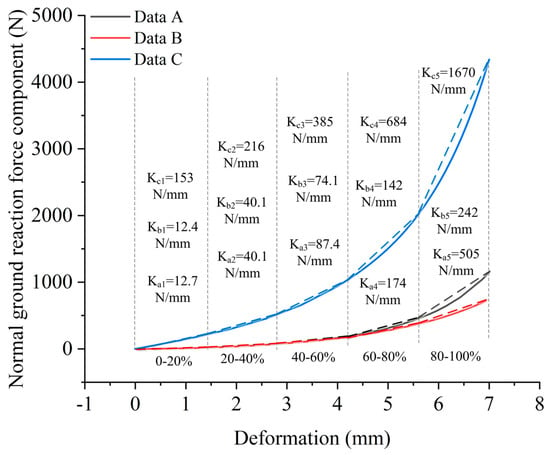
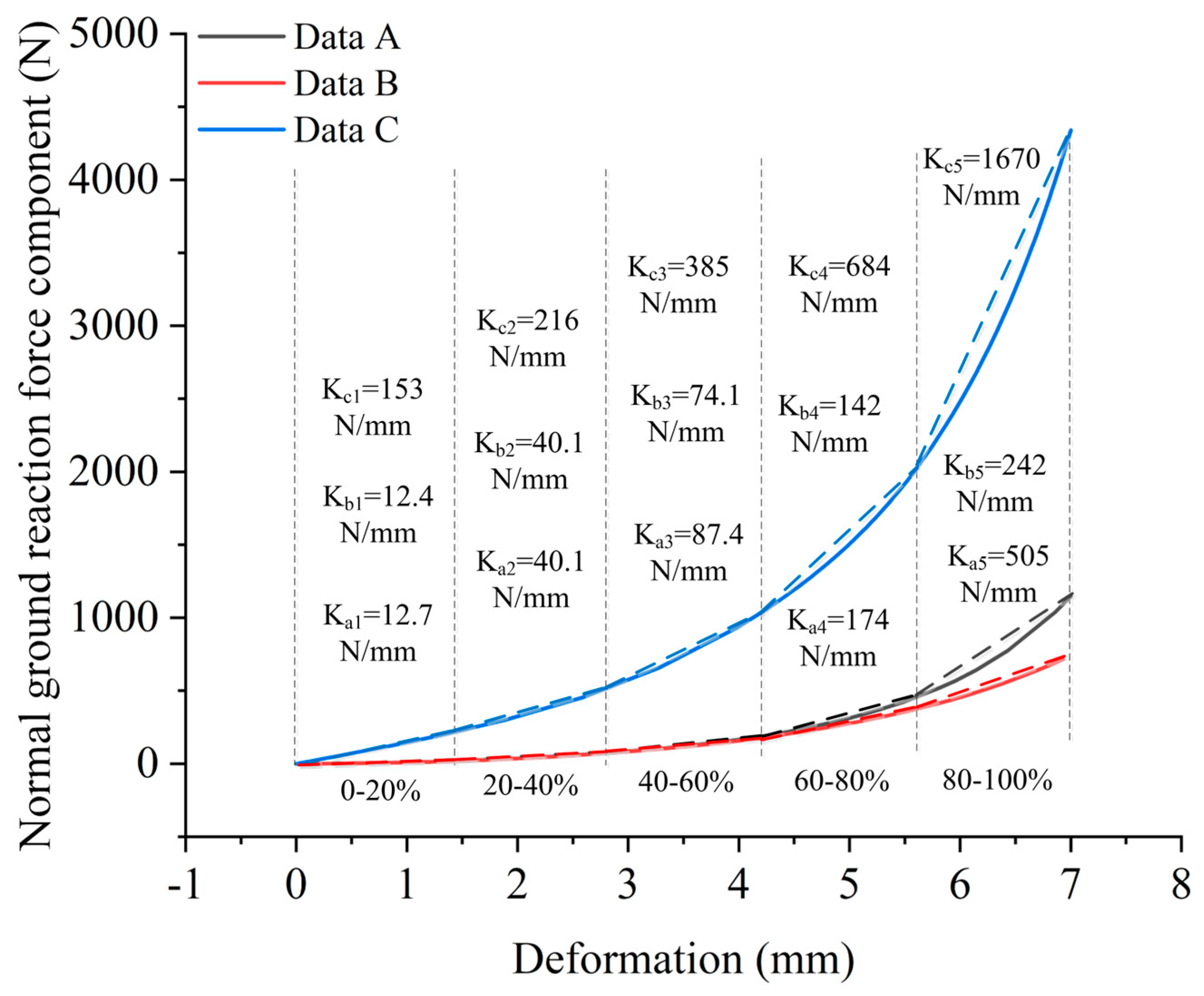
The relationship between the normal ground reaction force component and the model deformation of the three finite element models is shown in Figure 6. In this paper, the secant stiffness was calculated and analyzed based on the normal ground reaction force–deformation data of each model. All three models exhibit nonlinear normal ground reaction force–deformation behavior, and the evolution of the secant stiffness with deformation shows significant differences among the models. The secant stiffness of the pad model with viscoelastic material properties shows the most significant nonlinear change with deformation (Ka5/Ka1 = 39.7), while the secant stiffness of the cylindrical model with viscoelastic material properties changes relatively gently (Kc5/Kc1 = 10.9). The evolution characteristics of the secant stiffness of the pad model with linear elastic material properties lie between the two (Kb5/Kb1 = 19.5). The normal ground reaction force component of the three models all show obvious regional differences with deformation. All models show a gradual increase in ground reaction force and a slow upward trend in secant stiffness in the low deformation stage; in the high deformation stage, the ground reaction force rises sharply, and the secant stiffness increases rapidly. Moreover, the magnitudes of the changes in ground reaction force and secant stiffness within these stages vary among different model types and material property assignments. Compared with the viscoelastic cylindrical model, the pad models (linear elastic and viscoelastic) show more significant regional differences in the secant stiffness-deformation slope. The cross-sectional area gradient of the pad model is its core geometric feature. As the model height increases, the cross-sectional area (and corresponding volume) of the front region becomes smaller, while that of the rear region gradually increases.
Figure 6.
Normal ground reaction force component as a function of deformation for three finite element models. All models employed C3D4H elements. Specifically, Data A corresponds to the paw pad model with viscoelastic material properties; Data B denotes the paw pad model with linear elastic material properties; Data C represents the cylindrical model with viscoelastic material properties. Secant stiffness was calculated over five deformation intervals: 0–20%, 20–40%, 40–60%, 60–80%, and 80–100%, where the dashed lines indicate the secant stiffness for each interval.
3.4. Dynamic Simulation Analysis
Finite element dynamic impact simulations were conducted on the paw pad model and two comparative geometric models (cylindrical, truncated cone) under three vertical initial impact velocities applied to the bottom rigid plane: 0.2 m/s, 0.4 m/s, and 0.6 m/s. All models were assigned identical viscoelastic material properties and boundary conditions for consistent comparative analysis.
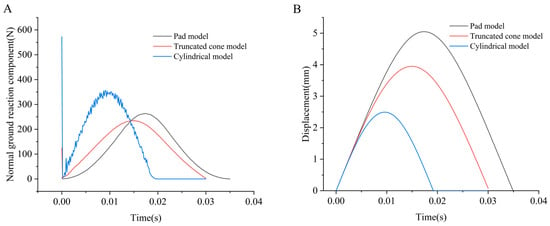
Figure 7 depicts the deformation contours of the paw model, truncated cone model, and cylindrical model at an impact velocity of 0.4 m/s. It can be seen that the paw pad model shows a more uniform deformation distribution (Figure 7A), while the simplified cone and cylinder models exhibit relatively larger local deformation at the contact interface (Figure 7B,C). These visual results help to illustrate the effect of geometric morphology on the mechanical behavior of the models. Temporal profiles of normal ground reaction force component and model deformation (quantified by vertical displacement of the bottom rigid plane) for the three models at an impact velocity of 0.4 m/s are presented in Figure 8. The normal ground reaction component and deformation profiles exhibited symmetric loading and unloading cycles for all three models at this velocity. At 0.4 m/s, peak normal ground reaction component values for the models in descending order were the cylindrical model (355.7 N), paw pad model (263.5 N), and truncated cone model (253.1 N). The paw pad model displayed a smooth temporal evolution of normal ground reaction component throughout the force-bearing process, while the truncated cone and cylindrical models generated an initial impact force at contact (124.8 N and 573.0 N, respectively). The cylindrical model and the truncated cone model exhibited a two-stage impact response. At an impact velocity of 0.4 m/s, the deformation magnitudes ranked in descending order were paw pad model (5.1 mm), truncated cone model (4.0 mm), and cylindrical model (2.5 mm). The paw pad model also exhibited a longer ground contact time (0.018 s) than the truncated cone model (0.015 s) and cylindrical model (0.01 s).
Figure 7.
Deformation contours of the three models under vertical impact loading: (A) Paw pad model; (B) truncated cone model; (C) cylindrical model. All models were subjected to the same loading and boundary conditions for comparison. The unit of S. Mises stress is MPa.
Figure 8.
Finite element simulation results at an impact velocity of 0.4 m/s. All models employed 10-node quadratic tetrahedron solid elements (C3D10M) and were assigned linear elastic isotropic material properties with an elastic modulus of 1 MPa and Poisson’s ratio of 0.49. (A) Relationship between normal ground reaction components and time; (B) relationship between deformation and time.
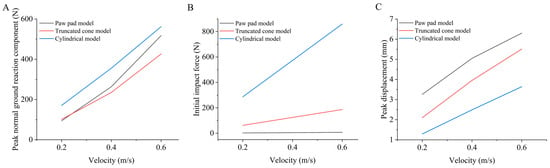
Peak normal ground reaction force components for the three models across all impact velocities are presented in Figure 9A. As impact velocity increased from 0.2 m/s to 0.6 m/s, the peak normal ground reaction component rose from 94.4 N to 517.4 N for the paw pad model, 101.2 N to 426.1 N for the truncated cone model, and 170.7 N to 561.8 N for the cylindrical model. The cylindrical model yielded the highest peak normal ground reaction component at all three velocities. The truncated cone model exhibited a higher peak normal ground reaction component than the paw pad model at 0.2 m/s, but lower values at both 0.4 m/s and 0.6 m/s. The cylindrical and truncated cone models generated an initial impact force at all velocities (Figure 9B). For the cylindrical model, the peak normal ground reaction component exceeded its initial impact force (286.5 N at 0.2 m/s, 573.0 N at 0.4 m/s, 859.6 N at 0.6 m/s). By contrast, the initial impact force of the truncated cone model (62.3 N at 0.2 m/s, 124.8 N at 0.4 m/s, 186.9 N at 0.6 m/s) was consistently lower than its corresponding peak normal ground reaction component. Additionally, the initial impact force of the paw pad model was below 10 N at all three velocities, which was markedly lower than those of the other two models.
Figure 9.
Comparative analysis of peak dynamic indicators across different initial impact velocities (0.2 m/s, 0.4 m/s, 0.6 m/s). All models were meshed with C3D10M. Consistent material properties were adopted for all models, linear elastic material with an elastic modulus of 1 MPa and a Poisson’s ratio of 0.49. (A) Peak normal ground reaction force component of the three models; (B) initial impact force of the three models; (C) peak vertical displacement of the three models.
Peak vertical displacement of the bottom rigid plane for the three models across all impact velocities is shown in Figure 9C. Peak displacement increased with rising impact velocity for all models; the cylindrical model had the smallest displacement at all velocities (1.3 mm at 0.2 m/s, 3.0 mm at 0.4 m/s, 4.7 mm at 0.6 m/s), the paw pad model the largest (2.9 mm at 0.2 m/s, 5.2 mm at 0.4 m/s, 6.7 mm at 0.6 m/s), and the truncated cone model had intermediate displacement values at all velocities.
Collectively, these dynamic simulation results demonstrate that the geometric configuration of the models significantly influences their impact response under vertical loading. The paw pad model, with its unique structure, achieves a more moderate peak normal ground reaction force component and larger deformation capacity compared to the cylindrical model, while maintaining a smoother force evolution and longer contact time than both comparative models, which is indicative of superior energy absorption performance during impact loading.
4. Discussion
This study systematically explores the synergistic effects of morphology and viscoelasticity on the canine paw pad’s cushioning and load-bearing performance through a combination of in vitro mechanical testing, MRI-based finite element (FE) modeling, and static/dynamic FE simulations. Notably, this research addresses a critical gap in existing literature, where most previous studies have predominantly focused on the viscoelastic properties of biological tissues to explain the nonlinear mechanical behavior of the paw pad, while largely neglecting the independent and combined contributions of its unique morphological structure.
Early investigations, such as those conducted by Alexander et al. (1986), utilized in vitro compression tests to characterize the stress–strain behavior of canine paw pad tissues, emphasizing the critical role of viscoelasticity in energy absorption and impact attenuation but failing to quantify or analyze the influence of morphological features [11]. Morphology-descriptive studies provided valuable basic anatomical data—such as the distribution of collagen fibers and adipose tissue, as well as paw pad thickness and surface area across different breeds—but lacked a mechanistic link between these structural features and the paw pad’s mechanical performance [12,13,14,15]. In contrast, the present study integrates both morphology and viscoelasticity, quantifying a strong linear relationship between cross-sectional area and thickness (R2 = 0.99) and verifying through FE simulations that the combination of this unique morphological feature and viscoelastic material properties enables the paw pad to achieve optimal cushioning and load-bearing performance.
The key results of this study further illustrate the significance of this morphology–viscoelasticity synergistic effect. Force–deformation curves demonstrate that the canine paw pad exhibits excellent mechanical properties, characterized by low initial stiffness to facilitate effective cushioning during the early stages of deformation, followed by a sharp increase in stiffness to provide robust structural support once a critical deformation threshold is reached. This dual mechanical response arises from two key structural and material features of the paw pad. First, a quasi-hydraulic structure formed by interwoven collagen fibers in the dermis and highly viscous adipose tissue in the subcutaneous layer, which can absorb large amounts of energy through deformation without sustaining damage [14]. Second, the paw pad’s arc-shaped overall morphology, which initiates ground contact at a single point and gradually increases the contact area during loading, thereby enhancing its cushioning efficiency. And the FE simulations further confirm these experimental findings. Through the finite element static analysis, the curve of the normal ground reaction force component and deformation of the paw pad model with viscoelastic material properties shows the best nonlinear characteristics. The nonlinear characteristics of the paw pad model with homogeneous and isotropic linear elastic material properties are also relatively obvious. The line elastic model with a linearly increasing cross-sectional area exhibits the best cushioning and load-bearing performance, while cylindrical models (with a constant cross-sectional area) show significantly larger peak normal ground reaction force components, making them unsuitable for cushioning applications. Truncated cone models, although having peak normal ground reaction force component values close to those of the actual paw pad model, generate harmful instantaneous impacts during ground contact, resulting in an unsmooth cushioning process. Notably, minor discrepancies between simulation results and in vitro experimental data were observed, which can be attributed to the lack of accurate material property data for canine paw pads—an issue likely stemming from the paw pad’s complex multi-component structure, consisting of viscoelastic adipose tissue, tough collagen-rich dermal tissue, and a hard outer stratum corneum.
Relative to previous research, this study offers several distinct advantages that enhance our understanding of paw pad biomechanics. First, its integrated research design, which combines detailed morphological characterization and viscoelasticity analysis, fills the existing gap of neglecting morphological contributions in viscoelasticity-focused studies, thereby providing a more comprehensive and accurate understanding of the paw pad’s biomechanical mechanism. Second, the adoption of MRI-based finite element (FE) modeling guarantees high realism and reliability, as MRI can effectively characterize the irregular morphological features of the soft tissues within the paw pad. Finally, this study provides quantitative and actionable findings for bionic design, clearly identifying key morphological and material factors governing paw pad performance and offering direct theoretical guidance for the development of bionic cushioning structures.
Despite these valuable contributions, the present research has several limitations that should be acknowledged and addressed in future work to further advance this field. First, the impact velocity used in dynamic FE simulations and in vitro mechanical tests was relatively low, which does not fully reflect the actual loading conditions experienced by the canine paw pad during natural locomotion—canines often move at varying speeds (walking, trotting, galloping), and higher impact velocities during landing may significantly alter the paw pad’s deformation mode and the synergistic effect of its morphology and viscoelasticity. This low velocity may have underestimated the role of morphology under extreme loading conditions, limiting the comprehensiveness of the findings regarding dynamic cushioning performance. Second, the FE model established in this study was simplified as a single-layer structure, which fails to accurately replicate the paw pad’s inherent hierarchical anatomical characteristics. Each of these layers has distinct material properties and morphological features, and the lack of interlayer interaction in the model may have led to deviations between simulation results and actual mechanical behavior, while also limiting in-depth exploration of how each layer contributes to the paw pad’s overall performance. Future research should address these limitations by incorporating higher impact velocities and developing multi-layer FE models, while also exploring whether human shock-absorbing structures (e.g., heel pads, buttocks) share similar linear cross-sectional area-thickness relationships, which could expand the broader applicability of the findings.
5. Conclusions
This study uses in vitro mechanical testing, MRI morphological characterization, and static/dynamic finite element simulations to explore the canine paw pad’s cushioning and load-bearing mechanisms, first quantifying the linear cross-sectional area–height gradient (R2= 0.99) as its core governing morphological feature. Results show that the paw pad exhibits nonlinear force–deformation behavior under quasi-static compression, where the linear gradient dominates the early compliant deformation while viscoelasticity enhances late-stage load bearing; dynamic simulations confirm its integrated gradient and single-point contact design outperforms simplified models. Simplified cylindrical and truncated cone models, by contrast, suffer from undesirable impact forces, highlighting the advantage of the paw pad’s natural design. This work fills the morphological mechanism gap in paw pad biomechanics, provides a validated bionic design paradigm for engineering buffers, and its limitations guide future research.
Author Contributions
Conceptualization, H.M.; methodology, L.Z.; formal analysis, L.Z.; investigation, H.M.; resources, L.R.; data curation, L.Z.; writing—original draft preparation, H.M.; writing—review and editing, L.Z.; project administration, L.Z.; funding acquisition, L.R. All authors have read and agreed to the published version of the manuscript.
Funding
This research was funded by the Key Research and Development and Promotion Special Project of Henan Province (232102311228), the Zhoukou Normal University High-Level Talents Research Project (ZKNUC2020013), and the Shandong Laboratory of Advanced Biomaterials and Medical Devices in Weihai (ZL202403).
Institutional Review Board Statement
All animal procedures were approved by the Institutional Review Board of Jilin University (approval code: 20140418, approved on 12 June 2013).
Informed Consent Statement
Not applicable.
Data Availability Statement
The data presented in this study are available in the article.
Acknowledgments
We thank the police dog training base of the Public Security Bureau of Jilin Province for their help and support in conducting the experiments.
Conflicts of Interest
The authors declare no conflicts of interest.
References
- Biewener, A.A. Biomechanics of mammalian terrestrial locomotion. Science 1990, 250, 1097–1103. [Google Scholar] [CrossRef] [Scilit]
- Whittle, M.W. Generation and attenuation of transient impulsive forces beneath the foot: A review. Gait Posture 1999, 10, 264–275. [Google Scholar] [CrossRef] [Scilit]
- Holzapfel, G.A.; Humphrey, J.D.; Ogden, R.W. Biomechanics of soft biological tissues and organs, mechanobiology, homeostasis and modelling. J. R. Soc. Interface 2025, 22, 20240361. [Google Scholar] [CrossRef] [Scilit]
- Ngo, H.H.P.; Andrade, R.J.; Lancelot, J.; Loumeaud, A.; Cornu, C.; Nordez, A.; Chatelin, S.; Gennisson, J.L. Unravelling anisotropic nonlinear shear elasticity in muscles: Towards a non-invasive assessment of stress in living organisms. J. Mech. Behav. Biomed. Mater. 2024, 150, 106325. [Google Scholar] [CrossRef] [Scilit]
- Wang, X.; Li, K.; Yuan, Y.; Zhang, N.; Zou, Z.; Wang, Y.; Yan, S.; Li, X.; Zhao, P.; Li, Q. Nonlinear elasticity of blood vessels and vascular grafts. ACS Biomater. Sci. Eng. 2024, 10, 3631–3654. [Google Scholar] [CrossRef] [Scilit]
- Kendall, K.; Fuller, K.N.G. J-shaped stress/strain curves and crack resistance of biological materials. J. Phys. D Appl. Phys. 1987, 20, 1596. [Google Scholar] [CrossRef] [Scilit]
- Mitsuhashi, K.; Ghosh, S.; Koibuchi, H. Mathematical modeling and simulations for large-strain j-shaped diagrams of soft biological materials. Polymers 2018, 10, 715. [Google Scholar] [CrossRef] [Scilit]
- Ker, R.F.; Alexander, R.M.; Bennett, M.B. Why are mammalian tendons so thick? Proc. Zool. Soc. Lond. 2010, 216, 309–324. [Google Scholar] [CrossRef] [Scilit]
- Biewener, A. Scaling body support in mammals: Limb posture and muscle mechanics. Science 1989, 245, 45–48. [Google Scholar] [CrossRef] [Scilit]
- Popli, R.; Mandelkern, L. Influence of structural and morphological factors on the mechanical properties of the polyethylenes. J. Polym. Sci. B Polym. Phys. 1987, 25, 441–483. [Google Scholar] [CrossRef] [Scilit]
- Alexander, R.M.; Bennett, M.B.; Ker, R.F. Mechanical properties and function of paw pads of some mammals. J. Zool. 1986, 209, 405–419. [Google Scholar]
- Chi, K.J.; Louise, R.V. Scaling and mechanics of carnivoran footpads reveal the principles of footpad design. J. R. Soc. Interface 2010, 7, 1145–1155. [Google Scholar] [CrossRef] [Scilit]
- Huaibin, M.; Zhuo, W.; Jing, L.; Zhihui, Q.; Luquan, R.; Lei, R. Biomechanical functions of canine metacarpal and metatarsal pads during locomotion: A comparative analysis. J. Bionic Eng. 2020, 17, 580–590. [Google Scholar] [CrossRef] [Scilit]
- Huaibin, M.; Jun, F.; Zhihui, Q.; Luquan, R.; Lei, R. How does paw pad of canine attenuate ground impacts? A multi-layer cushion system. Biol. Open 2017, 6, 1889–1896. [Google Scholar] [CrossRef] [Scilit]
- Mei, Y.; Wang, G.L.; Zhou, H.C.; Li, J.S.; Liu, C.Z.; Yu, K.Y. Investigation on the cushioning characteristic of cat paw pad in motion: A synergy of its histological structure and kinematic mechanical characteristics. Jpn. J. Vet. Res. 2021, 69, 19–30. [Google Scholar]
- Lu, W.; Zhang, Q.; Qin, F.; Xu, P.; Chen, Q.; Wang, H.; Scarpa, F.; Peng, H.X. Hierarchical network structural composites for extraordinary energy dissipation inspired by the cat paw. Appl. Mater. Today 2021, 25, 101222. [Google Scholar] [CrossRef] [Scilit]
- Lu, D.; Pei, B.; Xu, Y.; Hu, M.; Zhang, S.; Zhang, L.; Huang, X.; Wang, Y.; Wu, X. Hierarchical voronoi structure inspired by cat paw pads substantially enhances landing impact energy dissipation. J. Bionic Eng. 2024, 21, 1847–1861. [Google Scholar] [CrossRef] [Scilit]
- Campanelli, V.; Fantini, M.; Faccioli, N.; Cangemi, A.; Pozzo, A.; Sbarbati, A. Three-dimensional morphology of heel fat pad: An in vivo computed tomography study. J. Anat. 2011, 219, 622–631. [Google Scholar]
- Zidani, H.; Genah, I.; Lae, M.; Bousson, V.; Laredo, J.D. Adventitious bursitis in the plantar fat pad of forefoot presenting as a tumoral mass. J. Radiol. Case Rep. 2020, 14, 12. [Google Scholar] [CrossRef] [Scilit]
- Han, A.; Inoue, E.; Kikuchi, K.; Haikata, Y.; Tabira, Y.; Iwanaga, J.; Saga, T.; Kiyokawa, K.; Watanabe, K. Gross anatomical study of the subcutaneous structures that create the three-dimensional shape of the buttocks. Clin. Anat. 2023, 36, 297–307. [Google Scholar] [CrossRef] [Scilit]
- Ito, K.; Nakamura, T.; Suzuki, R.; Negishi, T.; Oishi, M.; Nagura, T.; Jinzaki, M.; Ogihara, N. Comparative functional morphology of human and chimpanzee feet based on three-dimensional finite element analysis. Front. Bioeng. Biotechnol. 2022, 9, 760486. [Google Scholar] [CrossRef] [Scilit]
- Clemente, C.J.; Dick, T.J.; Glen, C.L.; Panagiotopoulou, O. Biomechanical insights into the role of foot pads during locomotion in camelid species. Sci. Rep. 2020, 10, 3856. [Google Scholar] [CrossRef] [Scilit]
- El-Gendy, S.A.A.; Derbalah, A.; Abu El-Magd, M.E.R. Histo-morphological study on the footpad of ostrich (Struthio camelus) in relation to locomotion. J. Vet. Anat. 2011, 4, 77–97. [Google Scholar] [CrossRef] [Scilit]
- Zhang, R.; Ling, L.; Han, D.; Wang, H.; Yu, G.; Jiang, L.; Li, D.; Chang, Z. FEM analysis in excellent cushion characteristic of ostrich (Struthio camelus) toe pads. PLoS ONE 2019, 14, e0216141. [Google Scholar] [CrossRef] [Scilit]
- Ninomiya, H.; Akiyama, E.; Simazaki, K.; Oguri, A.; Jitsumoto, M.; Fukuyama, T. Functional anatomy of the footpad vasculature of dogs: Scanning electron microscopy of vascular corrosion casts. Vet. Dermatol. 2011, 22, 475–481. [Google Scholar] [CrossRef] [Scilit]
- Qian, Z.; Miao, H.; Shang, Z.; Ren, L. The foot-ground contact analysis of german shepherd dog based on normal walking, trotting and jumping gait. J. Jilin Univ. 2014, 44, 1692–1697. [Google Scholar]
- Cheung, J.T.; Zhang, M.; Leung, A.K.; Fan, Y. Three-dimensional finite element analysis of the foot during standing—A material sensitivity study. J. Biomech. 2005, 38, 1045–1054. [Google Scholar] [CrossRef] [Scilit]
- Budsberg, S.C.; Verstraete, M.C.; Soutas-Little, R.W. Force plate analysis of the walking gait in healthy dogs. Am. J. Vet. Res. 1987, 48, 915–918. [Google Scholar] [CrossRef] [Scilit]
- Chen, W.M.; Lee, P.V.S. Explicit finite element modelling of heel pad mechanics in running: Inclusion of body dynamics and application of physiological impact loads. Comput. Methods Biomech. Biomed. Eng. 2015, 18, 1582–1595. [Google Scholar] [CrossRef] [Scilit]
- Bright, J.A.; Rayfield, E.J. The response of cranial biomechanical finite element models to variations in mesh density. Anat. Rec. 2011, 294, 610–620. [Google Scholar] [CrossRef] [Scilit]



Disclaimer/Publisher’s Note: The statements, opinions and data contained in all publications are solely those of the individual author(s) and contributor(s) and not of MDPI and/or the editor(s). MDPI and/or the editor(s) disclaim responsibility for any injury to people or property resulting from any ideas, methods, instructions or products referred to in the content. |
© 2026 by the authors. Licensee MDPI, Basel, Switzerland. This article is an open access article distributed under the terms and conditions of the Creative Commons Attribution (CC BY) license.