Comparison of Selected Sensory and Physicochemical Indicators of Insect Powders and Flours During Storage
 , ,
, , 
 , and
, and 
Abstract
1. Introduction
2. Materials and Methods
2.1. Materials
2.2. Preparation of Samples for Analyses and Storage
2.3. Analytical Techniques
2.3.1. Physicochemical Properties of Flours and Insect Powder
2.3.2. Determination of Amino Acid Content in Insect Powders and Cereal Flours
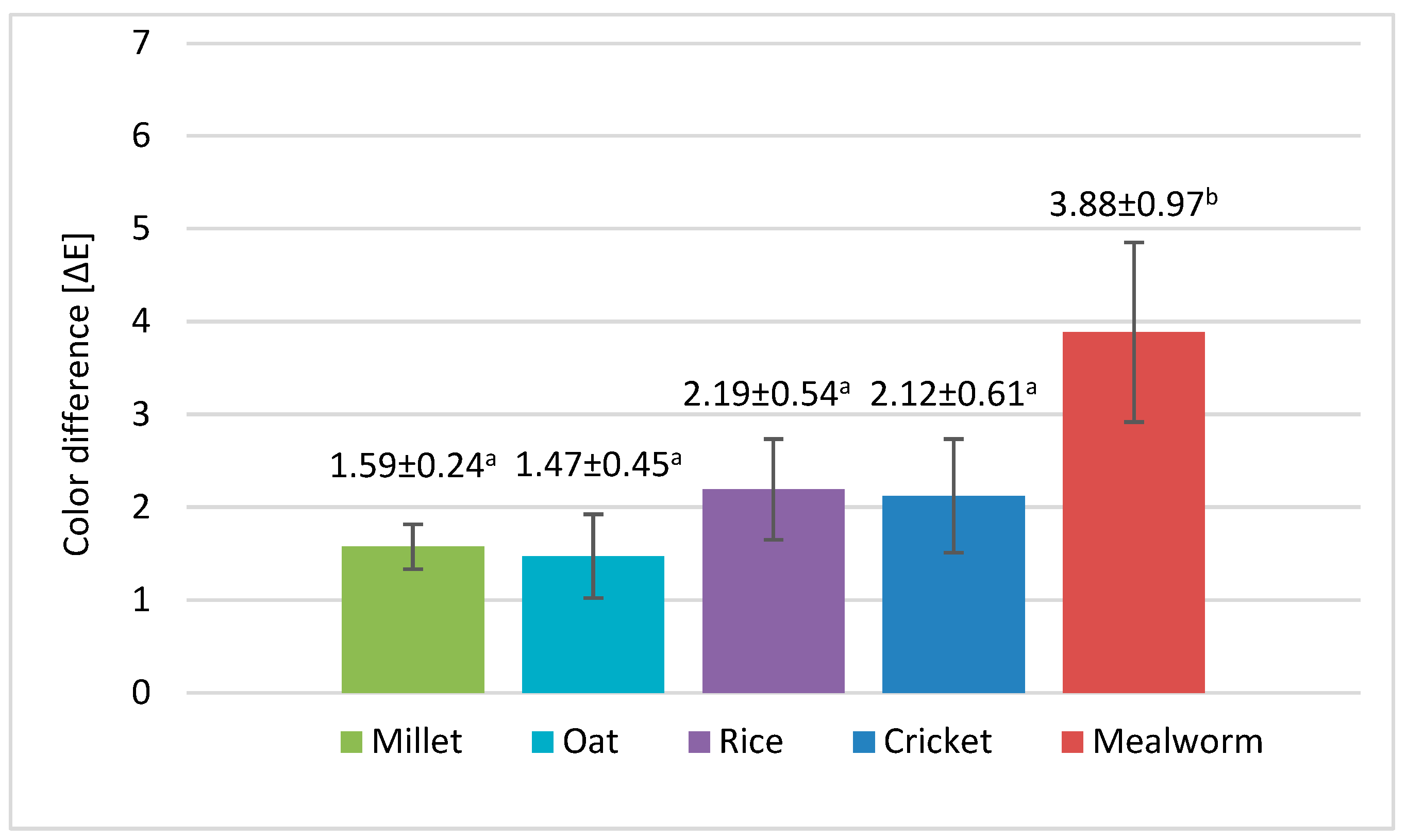
2.3.3. Color Measurement
- L0*, a0*, b0*—Color parameters of cereal flours and insect powders before storage (D0)
- L*, a*, b*—Color parameters of cereal flours and insect powders after storage (D120)
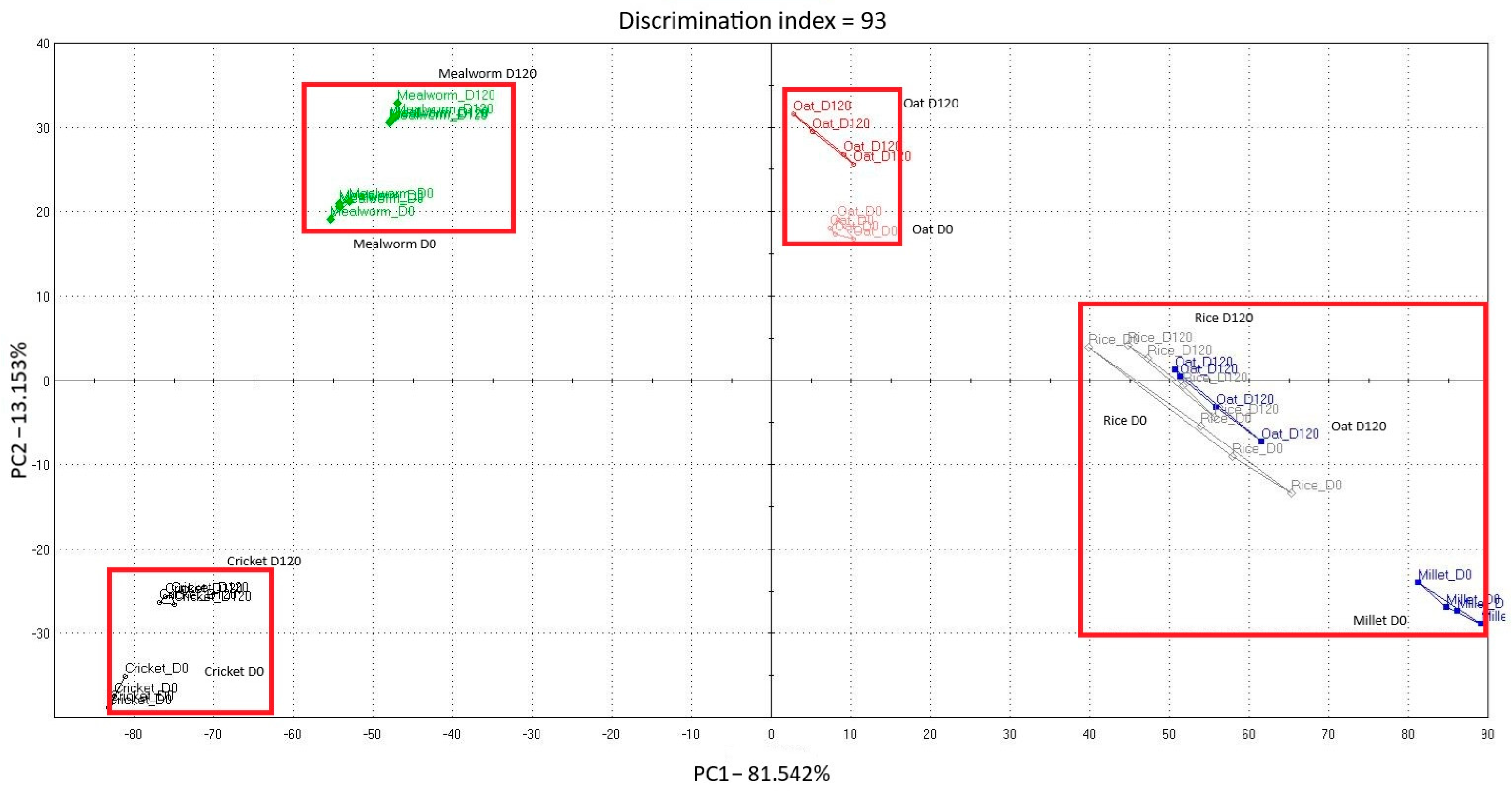
2.3.4. Instrumental Measurement of Volatile Compounds—E-Nose Analysis
2.3.5. Determination of the Content of Lead, Arsenic, Cadmium, and Mercury in Insect Powders and Cereal Flours
Sample Preparation and Extraction
Determination Conditions
2.4. Statistical Analysis
3. Results and Discussion
3.1. Physicochemical Properties of Flours and Insect Powder
3.2. Amino Acid Content in Insect Powders and Cereal Flours
3.3. Color Measurement
3.4. Instrumental Measurement of Volatile Compounds—E-Nose Analysis
3.5. Heavy Metal Content in Cereal Flours and Insect Powders
4. Conclusions
Author Contributions
Funding
Institutional Review Board Statement
Informed Consent Statement
Data Availability Statement
Conflicts of Interest
References
- Berners-Lee, M.; Kennelly, C.; Watson, R.; Hewitt, C.N. Current Global Food Production Is Sufficient to Meet Human Nutritional Needs in 2050 Provided There Is Radical Societal Adaptation. Elem. Sci. Anthr. 2018, 6, 52. [Google Scholar] [CrossRef]
- Aguilar-Toalá, J.E.; Vidal-Limón, A.M.; Liceaga, A.M. Advancing Food Security with Farmed Edible Insects: Economic, Social, and Environmental Aspects. Insects 2025, 16, 67. [Google Scholar] [CrossRef]
- Psarianos, M.; Aghababaei, F.; Schlüter, O.K. Bioactive Compounds in Edible Insects: Aspects of Cultivation, Processing and Nutrition. Food Res. Int. 2025, 203, 115802. [Google Scholar] [CrossRef]
- Khadijah, B. Diversity of Insect Products on the Global Market: A Reality Whose Halal Status Must Be Unravelled. 2025. Available online: www.researchgate.net/publication/390275568 (accessed on 2 January 2026).
- Liceaga, A.M.; Aguilar-Toalá, J.E.; Vallejo-Cordoba, B.; González-Córdova, A.F.; Hernández-Mendoza, A. Insects as an Alternative Protein Source. Annu. Rev. Food Sci. Technol. 2022, 13, 19–34. [Google Scholar] [CrossRef]
- Reed, M.; Norwood, B.F.; Hoback, W.W.; Riggs, A. A Survey of Willingness to Consume Insects and a Measure of College Student Perceptions of Insect Consumption Using Q Methodology. Future Foods 2021, 4, 100046. [Google Scholar] [CrossRef]
- Modlinska, K.; Adamczyk, D.; Maison, D.; Goncikowska, K.; Pisula, W. Relationship between Acceptance of Insects as an Alternative to Meat and Willingness to Consume Insect-Based Food—A Study on a Representative Sample of the Polish Population. Foods 2021, 10, 2420. [Google Scholar] [CrossRef]
- Khadijah, B.; Ahmad Khan, A.; Razid Sarbini, S. Comparative Nutritional Profile, Fatty Acid Composition and in-Vitro Antioxidant Properties of Flour Derived from Four Edible Winged Termite Species from Uganda. CyTA J. Food 2025, 23, 2544935. [Google Scholar] [CrossRef]
- Liceaga, A.M. Edible Insects, a Valuable Protein Source from Ancient to Modern Times. Adv. Food Nutr. Res. 2022, 101, 129–152. [Google Scholar] [PubMed]
- Devi, W.D.; Bonysana, R.; Singh, K.D.; Koijam, A.S.; Mukherjee, P.K.; Rajashekar, Y. Bio-Economic Potential of Ethno-Entomophagy and Its Therapeutics in India. NPJ Sci. Food 2024, 8, 15. [Google Scholar] [CrossRef]
- Puleo, S.; Fiore, A.; Sieghartsleitner, A.; Russo, G.L.; Grigor, J.; Di Monaco, R. Cricket Flour Integration in Biscuits: A Study on Formulation and Consumer Acceptance. J. Insects Food Feed 2025, 11, 2551–2564. [Google Scholar] [CrossRef]
- van Huis, A. Nutrition and Health of Edible Insects. Curr. Opin. Clin. Nutr. Metab. Care 2020, 23, 228–231. [Google Scholar] [CrossRef]
- Gantner, M. Potential Benefits of Insect Protein in Preventing Overweight and Obesity. Technol. Prog. Food Process. 2025, 1, 1–11. [Google Scholar] [CrossRef]
- Çabuk, B. Influence of Grasshopper (Locusta migratoria) and Mealworm (Tenebrio molitor) Powders on the Quality Characteristics of Protein Rich Muffins: Nutritional, Physicochemical, Textural and Sensory Aspects. J. Food Meas. Charact. 2021, 15, 3862–3872. [Google Scholar] [CrossRef]
- Carcea, M. Quality and Nutritional/Textural Properties of Durum Wheat Pasta Enriched with Cricket Powder. Foods 2020, 9, 1298. [Google Scholar] [CrossRef] [PubMed]
- Kosečková, P.; Zvěřina, O.; Pěchová, M.; Krulíková, M.; Duborská, E.; Borkovcová, M. Mineral Profile of Cricket Powders, Some Edible Insect Species and Their Implication for Gastronomy. J. Food Compos. Anal. 2022, 107, 104340. [Google Scholar] [CrossRef]
- Lu, M.-X.; Zhu, C.-X.; Smetana, S.; Zhao, M.; Zhang, H.-B.; Zhang, F.; Du, Y.-Z. Minerals in Edible Insects: Review of Content and Potential for Sustainable Sourcing. Food Sci. Hum. Wellness 2024, 13, 65–74. [Google Scholar] [CrossRef]
- Verspoor, R.L.; Soglo, M.; Adeoti, R.; Djouaka, R.; Edwards, S.; Fristedt, R.; Langton, M.; Moriana, R.; Osborne, M.; Parr, C.L.; et al. Mineral Analysis Reveals Extreme Manganese Concentrations in Wild Harvested and Commercially Available Edible Termites. Sci. Rep. 2020, 10, 6146. [Google Scholar] [CrossRef] [PubMed]
- Carriço-Sá, B.; Teixeira, C.S.S.; Villa, C.; Mendes, E.; Ferreira, I.M.P.L.V.O.; Mafra, I.; Costa, J. Protein Extraction from Edible Insects: Implications for IgE-Binding Capacity. Food Chem. 2025, 468, 142453. [Google Scholar] [CrossRef] [PubMed]
- Lampová, B.; Kopecká, A.; Šmíd, P.; Kulma, M.; Kurečka, M.; Ogrinc, N.; Heath, D.; Kouřimská, L.; Doskočil, I. Evaluating Protein Quality in Edible Insects: A Comparative Analysis of House Cricket, Yellow Mealworm, and Migratory Locust Using DIAAS Methodologies. LWT 2024, 213, 117062. [Google Scholar] [CrossRef]
- Akullo, J.O.; Kiage-Mokua, B.N.; Nakimbugwe, D.; Ng’ang’a, J.; Kinyuru, J. Color, PH, Microbiological, and Sensory Quality of Crickets (Gryllus bimaculatus) Flour Preserved with Ginger and Garlic Extracts. Food Sci. Nutr. 2023, 11, 2838–2851. [Google Scholar] [CrossRef]
- Ekpo, K.E. Nutritional and Biochemical Evaluation of the Protein Quality of Four Popular Insects Consumed in Southern Nigeria. Arch. Appl. Sci. Res. 2011, 3, 24–40. [Google Scholar]
- Ekpo, K.E. Effect of Processing on the Protein Quality of Four Popular Insects Consumed in Southern Nigeria. Arch. Appl. Sci. Res. 2011, 3, 307–326. [Google Scholar]
- Rumpold, B.A.; Schlüter, O.K. Nutritional Composition and Safety Aspects of Edible Insects. Mol. Nutr. Food Res. 2013, 57, 802–823. [Google Scholar] [CrossRef]
- Rumpold, B.A.; Schlüter, O.K. Potential and Challenges of Insects as an Innovative Source for Food and Feed Production. Innov. Food Sci. Emerg. Technol. 2013, 17, 1–11. [Google Scholar] [CrossRef]
- Nikkhah, A.; Van Haute, S.; Jovanovic, V.; Jung, H.; Dewulf, J.; Cirkovic Velickovic, T.; Ghnimi, S. Life Cycle Assessment of Edible Insects (Protaetia brevitarsis seulensis Larvae) as a Future Protein and Fat Source. Sci. Rep. 2021, 11, 14030. [Google Scholar] [CrossRef] [PubMed]
- Islam, M.; Kaczmarek, A.; Tomaszewska-Gras, J. Differential Scanning Calorimetry as a Tool to Assess the Oxidation State of Cold-Pressed Oils during Shelf-Life. J. Food Meas. Charact. 2023, 17, 6639–6651. [Google Scholar] [CrossRef]
- Sruthi, N.U.; Rao, P.S. Effect of Processing on Storage Stability of Millet Flour: A Review. Trends Food Sci. Technol. 2021, 112, 58–74. [Google Scholar] [CrossRef]
- Domiszewski, Z.; Szpicer, A.; Mierzejewska, S.; Wojtasik-Kalinowska, I.; Bińkowska, W.; Maziarz, K.; Piepiórka-Stepuk, J. Comparative Study of Lipid Quality from Edible Insect Powders and Selected Cereal Flours Under Storage Conditions. Appl. Sci. 2026, 16, 13. [Google Scholar] [CrossRef]
- AOAC 992.15-1992; Crude Protein in Meat and Meat Products. AOAC International: Rockville, MD, USA, 1996.
- AOAC Official Method 939.05; Fat Acidity—Grains Titrimetric Method. AOAC International: Rockville, MD, USA, 2013.
- AOAC 923.03-1923; Ash of Flour. Direct Method. AOAC International: Rockville, MD, USA, 2005.
- McCusker, S.; Buff, P.R.; Yu, Z.; Fascetti, A.J. Amino Acid Content of Selected Plant, Algae and Insect Species: A Search for Alternative Protein Sources for Use in Pet Foods. J. Nutr. Sci. 2014, 3, e39. [Google Scholar] [CrossRef] [PubMed]
- Mierzejewska, S.; Domiszewski, Z.; Piepiórka-Stepuk, J.; Bielicka, A.; Szpicer, A.; Wojtasik-Kalinowska, I. Analysis of the Impact of the Addition of Alphitobius diaperinus Larval Powder on the Physicochemical, Textural, and Sensorial Properties of Shortbread Cookies. Appl. Sci. 2025, 15, 4269. [Google Scholar] [CrossRef]
- Górska-Horczyczak, E.; Wojtasik-Kalinowska, I.; Guzek, D.; Sun, D.; Wierzbicka, A. Differentiation of Chill-stored and Frozen Pork Necks Using Electronic Nose with Ultra-fast Gas Chromatography. J. Food Process Eng. 2017, 40, e12540. [Google Scholar] [CrossRef]
- Wojtasik-Kalinowska, I.; Guzek, D.; Górska-Horczyczak, E.; Brodowska, M.; Sun, D.; Wierzbicka, A. Diet with Linseed Oil and Organic Selenium Yields Low N-6/N-3 Ratio Pork Semimembranosus Meat with Unchanged Volatile Compound Profiles. Int. J. Food Sci. Technol. 2018, 53, 1838–1846. [Google Scholar] [CrossRef]
- Althwab, S.A.; Alhomaid, R.M.; Ali, R.F.M.; Mohammed El-Anany, A.; Mousa, H.M. Effect of Migratory Locust (Locusta migratoria) Powder Incorporation on Nutritional and Sensorial Properties of Wheat Flour Bread. Br. Food J. 2021, 123, 3576–3591. [Google Scholar] [CrossRef]
- Aguilera, Y.; Pastrana, I.; Rebollo-Hernanz, M.; Benitez, V.; Álvarez-Rivera, G.; Viejo, J.L.; Martín-Cabrejas, M.A. Investigating Edible Insects as a Sustainable Food Source: Nutritional Value and Techno-Functional and Physiological Properties. Food Funct. 2021, 12, 6309–6322. [Google Scholar] [CrossRef]
- Ribeiro, J.C.; Marques, J.P.; Fernandes, T.R.; Pintado, M.E.; Carvalho, S.M.P.; Cunha, L.M. Effect of Blanching, Storage and Drying Conditions on the Macro-Composition, Color and Safety of Mealworm Tenebrio Molitor Larvae. LWT 2024, 191, 115646. [Google Scholar] [CrossRef]
- Mafu, A.; Ketnawa, S.; Phongthai, S.; Schönlechner, R.; Rawdkuen, S. Whole Wheat Bread Enriched with Cricket Powder as an Alternative Protein. Foods 2022, 11, 2142. [Google Scholar] [CrossRef]
- Bogusz, R.; Nowacka, M.; Bryś, J.; Rybak, K.; Szulc, K. Quality Assessment of Yellow Mealworm (Tenebrio molitor L.) Powders Processed by Pulsed Electric Field and Convective Drying. Sci. Rep. 2024, 14, 27792. [Google Scholar] [CrossRef]
- Kowalski, S.; Mikulec, A.; Mickowska, B.; Skotnicka, M.; Mazurek, A. Wheat Bread Supplementation with Various Edible Insect Flours. Influence of Chemical Composition on Nutritional and Technological Aspects. LWT 2022, 159, 113220. [Google Scholar] [CrossRef]
- Panda, J.; Chaudhary, G. Effect of Processing on the Nutritional and Organoleptic Characteristics in Proso Millet Flour. Agric. Assoc. Text. Chem. Crit. Rev. J. 2023, 11, 180–184. [Google Scholar]
- Udomsil, N.; Imsoonthornruksa, S.; Gosalawit, C.; Ketudat-Cairns, M. Nutritional Values and Functional Properties of House Cricket (Acheta domesticus) and Field Cricket (Gryllus bimaculatus). Food Sci. Technol. Res. 2019, 25, 597–605. [Google Scholar] [CrossRef]
- Tańska, M.; Browarek, J.; Ruszkowska, M.; Purkiewicz, A. Comparative Study on the Incorporation of Lesser Mealworm (Alphitobius diaperinus) and House Cricket (Acheta domesticus) Powders into Shortbread Cookies: Effects on Physical, Chemical and Sensory Properties. Pol. J. Food Nutr. Sci. 2024, 74, 280–292. [Google Scholar] [CrossRef]
- Jamal, S.; Qazi, I.M.; Ahmed, I. Comparative Studies on Flour Proximate Compositions and Functional Properties of Selected Pakistani Rice Varieties. Proc. Pak. Acad. Sci. B. Life Environ. Sci. 2016, 53, 47–56. [Google Scholar]
- Talens, C.; Lago, M.; Simó-Boyle, L.; Odriozola-Serrano, I.; Ibargüen, M. Desirability-Based Optimization of Bakery Products Containing Pea, Hemp and Insect Flours Using Mixture Design Methodology. LWT 2022, 168, 113878. [Google Scholar] [CrossRef]
- Rashed, M.S.; Pojić, M.; McDonagh, C.; Gallagher, E.; Frias, J.M.; Pathania, S. Structure-function Relationship of Oat Flour Fractions When Blended with Wheat Flour: Instrumental and Nutritional Quality Characterization of Resulting Breads. J. Food Sci. 2024, 89, 3347–3368. [Google Scholar] [CrossRef]
- Choi, I.-D.; Han, O.-K.; Chun, J.-Y.; Kang, C.-S.; Kim, K.-H.; Kim, Y.-K.; Cheong, Y.-K.; Park, T.-I.; Choi, J.-S.; Kim, K.-J. Hydration and Pasting Properties of Oat (Avena sativa) Flour. Prev. Nutr. Food Sci. 2012, 17, 87–91. [Google Scholar] [CrossRef]
- Siddiqui, S.A.; Wu, Y.S.; Vijeepallam, K.; Batumalaie, K.; Hatta, M.H.M.; Lutuf, H.; Castro-Muñoz, R.; Fernando, I.; Ibrahim, S.A. Alphitobius diaperinus Larvae (Lesser mealworm) as Human Food—An Approval of the European Commission—A Critical Review. J. Insects Food Feed 2024, 11, 61–100. [Google Scholar] [CrossRef]
- Amoah, I.; Cobbinah, J.C.; Yeboah, J.A.; Essiam, F.A.; Lim, J.J.; Tandoh, M.A.; Rush, E. Edible Insect Powder for Enrichment of Bakery Products– A Review of Nutritional, Physical Characteristics and Acceptability of Bakery Products to Consumers. Future Foods 2023, 8, 100251. [Google Scholar] [CrossRef]
- Rumbos, C.I.; Karapanagiotidis, I.T.; Mente, E.; Athanassiou, C.G. The Lesser Mealworm Alphitobius diaperinus: A Noxious Pest or a Promising Nutrient Source? Rev. Aquac. 2019, 11, 1418–1437. [Google Scholar] [CrossRef]
- González, C.M.; Garzón, R.; Rosell, C.M. Insects as Ingredients for Bakery Goods. A Comparison Study of H. Illucens, A. Domestica and T. Molitor Flours. Innov. Food Sci. Emerg. Technol. 2019, 51, 205–210. [Google Scholar] [CrossRef]
- Lucas-González, R.; Fernández-López, J.; Pérez-Álvarez, J.A.; Viuda-Martos, M. Effect of Drying Processes in the Chemical, Physico-Chemical, Techno-Functional and Antioxidant Properties of Flours Obtained from House Cricket (Acheta domesticus). Eur. Food Res. Technol. 2019, 245, 1451–1458. [Google Scholar] [CrossRef]
- Sriprablom, J.; Kitthawee, S.; Suphantharika, M. Functional and Physicochemical Properties of Cookies Enriched with Edible Insect (Tenebrio molitor and Zophobas atratus) Powders. J. Food Meas. Charact. 2022, 16, 2181–2190. [Google Scholar] [CrossRef]
- Djouadi, A.; Sales, J.R.; Carvalho, M.O.; Raymundo, A. Development of Healthy Protein-Rich Crackers Using Tenebrio molitor Flour. Foods 2022, 11, 702. [Google Scholar] [CrossRef]
- Awobusuyi, T.D.; Pillay, K.; Siwela, M. Consumer Acceptance of Biscuits Supplemented with a Sorghum–Insect Meal. Nutrients 2020, 12, 895. [Google Scholar] [CrossRef] [PubMed]
- Grobelnik Mlakar, S.; Turinek, M.; Jakob, M.; Bavec, M.; Bavec, F. Nutritional Value and Use of Grain Amaranth: Potential Future Application in Bread Making. Agricultura 2009, 6, 43–53. [Google Scholar]
- Belitz, H.-D.; Grosch, W.; Schieberle, P. Food Chemistry; Springer: Berlin/Heidelberg, Germany, 2009; ISBN 978-3-540-69933-0. [Google Scholar]
- Poutanen, K.S.; Kårlund, A.O.; Gómez-Gallego, C.; Johansson, D.P.; Scheers, N.M.; Marklinder, I.M.; Eriksen, A.K.; Silventoinen, P.C.; Nordlund, E.; Sozer, N.; et al. Grains—A Major Source of Sustainable Protein for Health. Nutr. Rev. 2022, 80, 1648–1663. [Google Scholar] [CrossRef]
- Finke, M.D. Complete Nutrient Content of Four Species of Feeder Insects. Zoo Biol. 2013, 32, 27–36. [Google Scholar] [CrossRef]
- Payne, C.L.R.; Scarborough, P.; Rayner, M.; Nonaka, K. A Systematic Review of Nutrient Composition Data Available for Twelve Commercially Available Edible Insects, and Comparison with Reference Values. Trends Food Sci. Technol. 2016, 47, 69–77. [Google Scholar] [CrossRef]
- Tang, C.; Yang, D.; Liao, H.; Sun, H.; Liu, C.; Wei, L.; Li, F. Edible Insects as a Food Source: A Review. Food Prod. Process. Nutr. 2019, 1, 8. [Google Scholar] [CrossRef]
- Jiménez-Pichardo, R.; Santos, E.M.; Lorenzo, J.M.; Agregán, R.; Fernández-López, J.; Sánchez-Ortega, I. Nutritional Quality of Edible Insects Protein. Food Sci. Process. 2025, 1, 5. [Google Scholar] [CrossRef]
- Nachtigall, L.; Grune, T.; Weber, D. Proteins and Amino Acids from Edible Insects for the Human Diet—A Narrative Review Considering Environmental Sustainability and Regulatory Challenges. Nutrients 2025, 17, 1245. [Google Scholar] [CrossRef]
- Bukkens, S.G.F. Ecological Implications of Minilivestock; Paoletti, M.G., Ed.; CRC Press: Boca Raton, FL, USA, 2005; ISBN 9781482294439. [Google Scholar]
- Hlongwane, Z.T.; Slotow, R.; Munyai, T.C. Nutritional Composition of Edible Insects Consumed in Africa: A Systematic Review. Nutrients 2020, 12, 2786. [Google Scholar] [CrossRef]
- Janssen, R.H.; Vincken, J.-P.; van den Broek, L.A.M.; Fogliano, V.; Lakemond, C.M.M. Nitrogen-to-Protein Conversion Factors for Three Edible Insects: Tenebrio molitor, Alphitobius diaperinus, and Hermetia illucens. J. Agric. Food Chem. 2017, 65, 2275–2278. [Google Scholar] [CrossRef] [PubMed]
- Jonas-Levi, A.; Martinez, J.-J.I. The High Level of Protein Content Reported in Insects for Food and Feed Is Overestimated. J. Food Compos. Anal. 2017, 62, 184–188. [Google Scholar] [CrossRef]
- Ritvanen, T.; Pastell, H.; Welling, A.; Raatikainen, M. The Nitrogen-to-Protein Conversion Factor of Two Cricket Species—Acheta domesticus and Gryllus bimaculatus. Agric. Food Sci. 2020, 29, 1–5. [Google Scholar] [CrossRef]
- Lampová, B.; Doskočil, I.; Šmíd, P.; Kouřimská, L. Comparison of Cricket Protein Powder and Whey Protein Digestibility. Molecules 2024, 29, 3598. [Google Scholar] [CrossRef] [PubMed]
- Muñoz-Seijas, N.; Fernandes, H.; López-Periago, J.E.; Outeiriño, D.; Morán-Aguilar, M.G.; Domínguez, J.M.; Salgado, J.M. Characterization of All Life Stages of Tenebrio molitor: Envisioning Innovative Applications for This Edible Insect. Future Foods 2024, 10, 100404. [Google Scholar] [CrossRef]
- Churchward-Venne, T.A.; Pinckaers, P.J.M.; van Loon, J.J.A.; van Loon, L.J.C. Consideration of Insects as a Source of Dietary Protein for Human Consumption. Nutr. Rev. 2017, 75, 1035–1045. [Google Scholar] [CrossRef]
- Jensen, L.D.; Miklos, R.; Dalsgaard, T.K.; Heckmann, L.H.; Nørgaard, J.V. Nutritional Evaluation of Common (Tenebrio molitor) and Lesser (Alphitobius diaperinus) Mealworms in Rats and Processing Effect on the Lesser Mealworm. J. Insects Food Feed 2019, 5, 257–266. [Google Scholar] [CrossRef]
- Boulos, S.; Tännler, A.; Nyström, L. Nitrogen-to-Protein Conversion Factors for Edible Insects on the Swiss Market: T. molitor, A. domesticus, and L. migratoria. Front. Nutr. 2020, 7, 89. [Google Scholar] [CrossRef]
- Stone, A.K.; Tanaka, T.; Nickerson, M.T. Protein Quality and Physicochemical Properties of Commercial Cricket and Mealworm Powders. J. Food Sci. Technol. 2019, 56, 3355–3363. [Google Scholar] [CrossRef]
- Hammer, L.; Moretti, D.; Abbühl-Eng, L.; Kandiah, P.; Hilaj, N.; Portmann, R.; Egger, L. Mealworm Larvae (Tenebrio molitor) and Crickets (Acheta domesticus) Show High Total Protein in Vitro Digestibility and Can Provide Good-to-Excellent Protein Quality as Determined by in Vitro DIAAS. Front. Nutr. 2023, 10, 1150581. [Google Scholar] [CrossRef]
- Rao, Q.; Klaassen Kamdar, A.; Labuza, T.P. Storage Stability of Food Protein Hydrolysates—A Review. Crit. Rev. Food Sci. Nutr. 2016, 56, 1169–1192. [Google Scholar] [CrossRef]
- Xiong, Y.L.; Guo, A. Animal and Plant Protein Oxidation: Chemical and Functional Property Significance. Foods 2020, 10, 40. [Google Scholar] [CrossRef]
- Domínguez, R.; Pateiro, M.; Munekata, P.E.S.; Zhang, W.; Garcia-Oliveira, P.; Carpena, M.; Prieto, M.A.; Bohrer, B.; Lorenzo, J.M. Protein Oxidation in Muscle Foods: A Comprehensive Review. Antioxidants 2021, 11, 60. [Google Scholar] [CrossRef] [PubMed]
- Estévez, M.; Xiong, Y.L. Protein Oxidation in Foods: Mechanisms, Consequences, and Antioxidant Solutions. Foods 2021, 10, 2346. [Google Scholar] [CrossRef]
- Long, R.; Huang, Y.; Dabbour, M.; Mintah, B.K.; Pan, J.; Wu, M.; Zhang, S.; Qin, Z.; He, R.; Ma, H. Physical Processing-Assisted PH Shifting for Food Protein Modification: A Comprehensive Review. Foods 2025, 14, 2360. [Google Scholar] [CrossRef]
- WHO. Protein and Amino Acid Requirements in Human Nutrition: Report of a Joint FAO/WHO/UNU Expert Consultation; World Health Organization: Geneva, Switzerland, 2007; Volume 935, 265 p. [Google Scholar]
- Wu, G. Functional Amino Acids in Nutrition and Health. Amino Acids 2013, 45, 407–411. [Google Scholar] [CrossRef] [PubMed]
- Brosnan, J.T.; Brosnan, M.E. The Sulfur-Containing Amino Acids: An Overview. J. Nutr. 2006, 136, 1636S–1640S. [Google Scholar] [CrossRef] [PubMed]
- Lamberts, L.; De Bie, E.; Vandeputte, G.E.; Veraverbeke, W.S.; Derycke, V.; De Man, W.; Delcour, J.A. Effect of Milling on Colour and Nutritional Properties of Rice. Food Chem. 2007, 100, 1496–1503. [Google Scholar] [CrossRef]
- Zielińska, E.; Pankiewicz, U. Nutritional, Physiochemical, and Antioxidative Characteristics of Shortcake Biscuits Enriched with Tenebrio molitor Flour. Molecules 2020, 25, 5629. [Google Scholar] [CrossRef]
- Haber, M.; Mishyna, M.; Martinez, J.J.I.; Benjamin, O. The Influence of Grasshopper (Schistocerca Gregaria) Powder Enrichment on Bread Nutritional and Sensorial Properties. LWT 2019, 115, 108395. [Google Scholar] [CrossRef]
- da Rosa Machado, C.; Thys, R.C.S. Cricket Powder (Gryllus assimilis) as a New Alternative Protein Source for Gluten-Free Breads. Innov. Food Sci. Emerg. Technol. 2019, 56, 102180. [Google Scholar] [CrossRef]
- Ribas-Agustí, A.; Martín-Belloso, O.; Soliva-Fortuny, R.; Elez-Martínez, P. Food Processing Strategies to Enhance Phenolic Compounds Bioaccessibility and Bioavailability in Plant-Based Foods. Crit. Rev. Food Sci. Nutr. 2018, 58, 2531–2548. [Google Scholar] [CrossRef] [PubMed]
- Jokinen, I.; Pihlava, J.-M.; Puganen, A.; Sontag-Strohm, T.; Linderborg, K.M.; Holopainen-Mantila, U.; Hietaniemi, V.; Nordlund, E. Predicting the Properties of Industrially Produced Oat Flours by the Characteristics of Native Oat Grains or Non-Heat-Treated Groats. Foods 2021, 10, 1552. [Google Scholar] [CrossRef]
- Mohd Azlie, N.A.; Jailani, F. Physicochemical and Functional Properties of Bario Rice Varieties as Potential Gluten-Free Food Ingredients. J. Gizi Dan Pangan 2024, 19, 227–234. [Google Scholar] [CrossRef]
- Kowalski, S.; Mikulec, A.; Skotnicka, M.; Mickowska, B.; Makarewicz, M.; Sabat, R.; Wywrocka-Gurgul, A.; Mazurek, A. Effect of the Addition of Edible Insect Flour from Yellow Mealworm (Tenebrio molitor) on the Sensory Acceptance, and the Physicochemical and Textural Properties of Sponge Cake. Pol. J. Food Nutr. Sci. 2022, 72, 393–405. [Google Scholar] [CrossRef]
- Perez-Santaescolastica, C.; De Winne, A.; Devaere, J.; Fraeye, I. The Flavour of Edible Insects: A Comprehensive Review on Volatile Compounds and Their Analytical Assessment. Trends Food Sci. Technol. 2022, 127, 352–367. [Google Scholar] [CrossRef]
- Marzoli, F.; Tata, A.; Zacometti, C.; Malabusini, S.; Jucker, C.; Piro, R.; Ricci, A.; Belluco, S. Microbial and Chemical Stability of Acheta domesticus Powder during One Year Storage Period at Room Temperature. Front. Sustain. Food Syst. 2023, 7, 1179088. [Google Scholar] [CrossRef]
- Orkusz, A.; Orkusz, M. Effect of Acheta domesticus Powder Incorporation on Nutritional Composition, Technological Properties, and Sensory Acceptance of Wheat Bread. Insects 2025, 16, 972. [Google Scholar] [CrossRef]
- Nielsen, M.M.; Hansen, Å. Stability of Vitamin E in Wheat Flour and Whole Wheat Flour During Storage. Cereal Chem. 2008, 85, 716–720. [Google Scholar] [CrossRef]
- Pop, F.; Mihalescu, L.; Voșgan, Z. Physico-Chemical Properties of Wheat Flour Varieties and Sensory Evaluation of the Obtained Bread. J. Agroaliment. Process. Technol. 2020, 26, 102–107. [Google Scholar]
- Qi, Y.; Wang, W.; Yang, T.; Ding, W.; Xu, B. Maillard Reaction in Flour Product Processing: Mechanism, Impact on Quality, and Mitigation Strategies of Harmful Products. Foods 2025, 14, 2721. [Google Scholar] [CrossRef] [PubMed]
- Bernardo, Y.A.A.; Conte-Junior, C.A. Oxidative Stability in Edible Insects: Where Is the Knowledge Frontier? Trends Food Sci. Technol. 2024, 148, 104518. [Google Scholar] [CrossRef]
- Gantner, M.; Król, K.; Piotrowska, A.; Sionek, B.; Sadowska, A.; Kulik, K.; Wiącek, M. Adding Mealworm (Tenebrio molitor L.) Powder to Wheat Bread: Effects on Physicochemical, Sensory and Microbiological Qualities of the End-Product. Molecules 2022, 27, 6155. [Google Scholar] [CrossRef] [PubMed]
- Chen, P.; Zhao, S.; Li, C.; Zhang, T.; Xing, Y.; Zhang, K.; Lv, J.; Zhu, W. Changes and Analytical Techniques in Volatile Flavor Compounds in Dried Agricultural Products: A Review. Foods 2025, 14, 3531. [Google Scholar] [CrossRef] [PubMed]
- Oni, J.; Enyinwa, P.; Oluwajuwon, T.V. Volatile Organic Compounds in Cereals: A Review of Research Trends and Analytical Techniques. Food Humanit. 2025, 5, 100738. [Google Scholar] [CrossRef]
- Reale, S.; Biancolillo, A.; Foschi, M.; D’Archivio, A.A. Characterization of the Volatile Profiles of Insect Flours by (HS)-SPME/GC-MS: A Preliminary Study. Molecules 2023, 28, 3075. [Google Scholar] [CrossRef]
- (EU) 2023/915; Commission Regulation (EU) 2023/915 of 25 April 2023 on Maximum Levels for Certain Contaminants in Food and Repealing Regulation (EC) No 1881/2006. European Union: Bruxelles, Belgium, 2023. Available online: https://eur-lex.europa.eu/eli/reg/2023/915/oj (accessed on 1 January 2026).
- (EU) 2022/188; Commission Regulation (EU) 2022/188 of 10 February 2022 Authorising the Placing on the Market of Frozen, Dried and Powder Forms of Acheta domesticus as a Novel Food under Regulation (EU) 2015/2283 of the European Parliament and of the Council, and Amending Commission Implementing Regulation (EU) 2017/2470. European Union: Bruxelles, Belgium, 2022. Available online: https://eur-lex.europa.eu/eli/reg_impl/2022/188/oj (accessed on 1 January 2026).
- (EU) 2021/882; Commission Implementing Regulation (EU) 2021/882 of 1 June 2021 Authorising the Placing on the Market of Dried Tenebrio molitor Larva as a Novel Food under Regulation (EU) 2015/2283 of the European Parliament and of the Council, and Amending Commission Implementing Regulation (EU) 2017/2470. European Union: Bruxelles, Belgium, 2021. Available online: https://eur-lex.europa.eu/eli/reg_impl/2021/882/oj (accessed on 1 January 2026).
- (EU) 1993/315; Commission Regulation (EU) 1993/315 of 8 February 1993. Laying down Community Procedures for Contaminants in Food. European Union: Bruxelles, Belgium, 1993.
- (EU) 178/2002; Regulation (EC) No 178/2002 of the European Parliament and of the Council of 28 January 2002 Laying down the General Principles and Requirements of Food Law, Establishing the European Food Safety Authority and Laying down Procedures in Matters of Food Safety. European Union: Bruxelles, Belgium, 2002.
- Malematja, E.; Manyelo, T.G.; Sebola, N.A.; Kolobe, S.D.; Mabelebele, M. The Accumulation of Heavy Metals in Feeder Insects and Their Impact on Animal Production. Sci. Total Environ. 2023, 885, 163716. [Google Scholar] [CrossRef]
- Aalami, A.H.; Hoseinzadeh, M.; Hosseini Manesh, P.; Jiryai Sharahi, A.; Kargar Aliabadi, E. Carcinogenic Effects of Heavy Metals by Inducing Dysregulation of MicroRNAs: A Review. Mol. Biol. Rep. 2022, 49, 12227–12238. [Google Scholar] [CrossRef]
- Akinleye, A.; Oremade, O.; Xu, X. Exposure to Low Levels of Heavy Metals and Chronic Kidney Disease in the US Population: A Cross Sectional Study. PLoS ONE 2024, 19, e0288190. [Google Scholar] [CrossRef]
- Czeczot, H.; Skrzycki, M. Cadmium–Element Completely Unnecessary for the Organism. Postępy Hig. I Med. Doświadczalnej 2010, 64, 38–49. [Google Scholar]
- Wei, Y.; Wang, X.; Sun, Q.; Shi, W.; Zhang, W.; Gao, X.; Li, Y.; Hao, R.; Dong, X.; Chen, C.; et al. Associations of Environmental Cadmium Exposure with Kidney Damage: Exploring Mediating DNA Methylation Sites in Chinese Adults. Environ. Res. 2024, 251, 118667. [Google Scholar] [CrossRef] [PubMed]
- Grau-Perez, M.; Pichler, G.; Galan-Chilet, I.; Briongos-Figuero, L.S.; Rentero-Garrido, P.; Lopez-Izquierdo, R.; Navas-Acien, A.; Weaver, V.; García-Barrera, T.; Gomez-Ariza, J.L.; et al. Urine Cadmium Levels and Albuminuria in a General Population from Spain: A Gene-Environment Interaction Analysis. Environ. Int. 2017, 106, 27–36. [Google Scholar] [CrossRef] [PubMed]
- Jalili, C.; Kazemi, M.; Cheng, H.; Mohammadi, H.; Babaei, A.; Taheri, E.; Moradi, S. Associations between Exposure to Heavy Metals and the Risk of Chronic Kidney Disease: A Systematic Review and Meta-Analysis. Crit. Rev. Toxicol. 2021, 51, 165–182. [Google Scholar] [CrossRef]
- Diener, S.; Zurbrügg, C.; Tockner, K. Bioaccumulation of Heavy Metals in the Black Soldier Fly, Hermetia illucens and Effects on Its Life Cycle. J. Insects Food Feed 2015, 1, 261–270. [Google Scholar] [CrossRef]
- van der Fels-Klerx, H.J.; Camenzuli, L.; Belluco, S.; Meijer, N.; Ricci, A. Food Safety Issues Related to Uses of Insects for Feeds and Foods. Compr. Rev. Food Sci. Food Saf. 2018, 17, 1172–1183. [Google Scholar] [CrossRef]
- Muhammad, A.; Auwal, Y.; Usman, A.H. Determination of Heavy Metals (Co, Cu,Cd,Fe, Pb, Zn) in Some Edible Insects and Fingerlings in Dutsin-Ma Town. FUDMA J. Sci. 2022, 6, 6–11. [Google Scholar] [CrossRef]
- Mlček, J.; Adamek, M.; Adámková, A.; Borkovcová, M.; Bednářová, M.; Skácel, J. Detection of Selected Heavy Metals and Micronutrients in Edible Insect and Their Dependency on the Feed Using XRF Spectrometry. Potravin. Slovak J. Food Sci. 2017, 11, 725–730. [Google Scholar] [CrossRef]
- Papastavropoulou, K.; Koupa, A.; Kritikou, E.; Kostakis, M.; Dervisoglou, S.; Roussos, A.; Perdikis, D.; Thomaidis, N.S.; Oz, E.; Oz, F.; et al. Study of the Effect of Feeding Tenebrio molitor Larvae during Their Rearing on Their Growth, Nutritional Profile, Value and Safety of the Produced Flour. Food Chem. X 2024, 24, 101838. [Google Scholar] [CrossRef]
- Wan, Y.; Liu, J.; Zhuang, Z.; Wang, Q.; Li, H. Heavy Metals in Agricultural Soils: Sources, Influencing Factors, and Remediation Strategies. Toxics 2024, 12, 63. [Google Scholar] [CrossRef]
- Chaney, R.L. Health Risks Associated with Toxic Metals in Municipal Sludge. In Sludge: Health Risks of Land Applications; Bitton, G., Ed.; Taylor & Francis: Ann Arbor, MI, USA, 1980. [Google Scholar]
- Dz. U. z 2016 r. poz. 1395; Regulation of the Minister of the Environment of 1 September 2016 on the Method of Assessing Land Surface Contamination. ISAP: Warsaw, Poland, 2016. Available online: https://isap.sejm.gov.pl/isap.nsf/DocDetails.xsp?id=wdu20160001395 (accessed on 1 January 2026).
- Ghanati, K.; Zayeri, F.; Hosseini, H. Potential Health Risk Assessment of Different Heavy Metals in Wheat Products. Iran. J. Pharm. Res. 2019, 18, 2093–2100. [Google Scholar]
- Zang, Z.; Liu, S.; Li, Y. Spatial Distribution of Cadmium and Lead in Wheat Grains and Their Environmental Driving Factors in Major Grain-Producing Areas, China. Ecol. Indic. 2025, 175, 113589. [Google Scholar] [CrossRef]
- Vrček, V.; Vinković Vrček, I. Metals in Organic and Conventional Wheat Flours Determined by an Optimised and Validated ICP-MS Method. Int. J. Food Sci. Technol. 2012, 47, 1777–1783. [Google Scholar] [CrossRef]
- (EC) 2009/1107; Regulation (EC) 2009/1107 of the European Parliament and of the Council of 21 October 2009 Concerning the Placing of Plant Protection Products on the Market and Repealing Council Directives 79/117/EEC and 91/414/EEC. European Union: Bruxelles, Belgium, 2009.
- 86/278/EEC; Council Directive 86/278/EEC of 12 June 1986 on the Protection of the Environment, and in Particular of the Soil, When Sewage Sludge Is Used in Agriculture. European Union: Bruxelles, Belgium, 1986.
- (EU) 2019/1009; Regulation (EU) 2019/1009 of the European Parliament and of the Council of 5 June 2019 Laying down Rules on the Making Available on the Market of EU Fertilising Products and Amending Regulations (EC) No 1069/2009 and (EC) No 1107/2009 and Repealing Regulation (EC) No 2003/2003. European Union: Bruxelles, Belgium, 2019.
- Wahab, M.F.; Jamil, D.M. Determination of Some Heavy Metals in Different Wheat Flour Brands in Sulaimani, Kurdistan Region—Iraq. Czech J. Food Sci. 2023, 41, 455–461. [Google Scholar] [CrossRef]
- Akoury, E.; Mansour, N.; Reda, G.A.; Dimassi, H.; Karam, L.; Alwan, N.; Hassan, H.F. Toxic Metals in Packed Rice: Effects of Size, Type, Origin, Packing Season, and Storage Duration. J. Food Compos. Anal. 2023, 115, 104920. [Google Scholar] [CrossRef]



| Millet | Oat | Rice | Cricket (Acheta domesticus) | Mealworm (Tenebrio molitor) | |
|---|---|---|---|---|---|
| Before storage (D0) | |||||
| Moisture [%] | 10.27 ± 0.04 e′ | 9.00 ± 0.08 c′ | 9.94 ± 0.12 d′ | 4.47 ± 0.06 a′ | 6.04 ± 0.02 b′ |
| Acidity [°] | 4.84 ± 0.05 d′ | 4.39 ± 0.09 c′ | 2.21 ± 0.01 a′ | 6.32 ± 0.08 e′ | 3.38 ± 0.06 b′ |
| Ash [%] | 1.077 ± 0.072 b′ | 1.475 ± 0.078 b′ | 0.372 ± 0.020 a′ | 4.290 ± 0.587 c′ | 4.448 ± 0.075 c′ |
| After storage (D120) | |||||
| Moisture [%] | 11.21 ± 0.08 D′′ | 10.31 ± 0.04 C′′ | 11.37 ± 0.09 D′′ | 4.81 ± 0.03 A′′ | 5.56 ± 0.03 B′′ |
| Acidity [°] | 5.56 ± 0.15 D′′ | 4.68 ± 0.07 C′ | 2.22 ± 0.02B A′ | 6.70 ± 0.16 E′′ | 3.82 ± 0.11 B′′ |
| Ash [%] | 1.070 ± 0.029 B′ | 1.467 ± 0.083 C′ | 0.467 ± 0.003 A′ | 4.430 ± 0.164 D′ | 4.510 ± 0.026 D′ |
| Before Storage (D0) | |||||||
|---|---|---|---|---|---|---|---|
| Protein [g/100 g] Amino Acid [g/100 g] | Rice | Millet | Oat | Cricket (Acheta domesticus) | Mealworm (Tenebrio molitor) | ||
| Kp = 6.25 | Kp = 6.25 | Kp = 6.25 | Kp = 6.25 | Kp = 5.33 | Kp = 6.25 | Kp = 5.33 | |
| Protein | 7.45 ± 0.93 a′ | 11.19 ± 1.33 ab′ | 16.60 ± 1.87 b′ | 76.77 ± 3.23 d′ | 65.47 ± 2.76 d′ | 59.31 ± 2.55 ′ | 50.58 ± 2.17 ′ |
| Aspartic acid | 0.40 ± 0.08 a′ | 0.26 ± 0.00 a′ | 0.68 ± 0.01 a′ | 4.51 ± 0.04 b′ | 4.41 ± 0.46 b′ | ||
| Glutamic acid | 1.14 ± 0.09 a′ | 2.08 ± 0.01 b′ | 2.16 ± 0.02 b′ | 7.71 ± 3.31 d′ | 6.56 ± 0.20 c′ | ||
| Serine | 0.31 ± 0.03 a′ | 0.60 ± 0.01 b′ | 0.46 ± 0.00 ab′ | 2.94 ± 0.12 c′ | 2.76 ± 0.07 c′ | ||
| Histidine | 0.15 ± 0.02 a′ | 0.21 ± 0.00 a′ | 0.22 ± 0.00 a′ | 1.73 ± 0.07 b′ | 1.95 ± 0.04 c′ | ||
| Glycine | 0.30 ± 0.05 a′ | 0.24 ± 0.00 a′ | 0.49 ± 0.00 a′ | 3.90 ± 0.16 c′ | 3.14 ± 0.08 b′ | ||
| Arginine | 0.51 ± 0.07 a′ | 0.31 ± 0.00 a′ | 0.65 ± 0.00 a′ | 4.62 ± 0.19 c′ | 3.24 ± 0.09 b′ | ||
| Threonine | 0.22 ± 0.03 a′ | 0.29 ± 0.00 a′ | 0.27 ± 0.00 a′ | 2.54 ± 0.11 c′ | 2.29 ± 0.05 b′ | ||
| Alanine | 0.40 ± 0.07 a′ | 1.21 ± 0.00 b′ | 0.48 ± 0.00 a′ | 7.88 ± 0.36 d′ | 4.41 ± 0.11 c′ | ||
| Proline | 0.31 ± 0.05 a′ | 0.80 ± 0.00 b′ | 0.55 ± 0.00 ab′ | 4.51 ± 0.20 d′ | 3.95 ± 0.11 c′ | ||
| Tyrosine | 0.24 ± 0.05 a′ | 0.34 ± 0.00 a′ | 0.28 ± 0.00 a′ | 4.24 ± 0.19 b′ | 4.20 ± 0.12 b′ | ||
| Valine | 0.42 ± 0.07 a′ | 0.55 ± 0.00 a′ | 0.53 ± 0.01 a′ | 4.70 ± 0.23 c′ | 3.61 ± 0.11 b′ | ||
| Methionine | 0.16 ± 0.03 a′ | 0.33 ± 0.00 b′ | 0.17 ± 0.00 a′ | 1.01 ± 0.05 d′ | 0.78 ± 0.05 c′ | ||
| Cysteine | 0.08 ± 0.00 a′ | 0.08 ± 0.01 a′ | 0.21 ± 0.02 bc′ | 0.18 ± 0.01 b′ | 0.25 ± 0.00 c′ | ||
| Isoleucine | 0.28 ± 0.05 a′ | 0.44 ± 0.00 a′ | 0.38 ± 0.00 a′ | 2.82 ± 0.14 c′ | 2.37 ± 0.07 b′ | ||
| Leucine | 0.55 ± 0.09 a′ | 1.40 ± 0.00 b′ | 0.76 ± 0.01 a′ | 5.10 ± 0.24 d′ | 4.27 ± 0.12 c′ | ||
| Phenylalanine | 0.37 ± 0.06 a′ | 0.64 ± 0.00 b′ | 0.54 ± 0.00 ab′ | 2.17 ± 0.11 c′ | 2.15 ± 0.06 c′ | ||
| Lysine | 0.25 ± 0.03 a′ | 0.14 ± 0.00 a′ | 0.39 ± 0.00 a′ | 3.73 ± 0.17 b′ | 3.38 ± 0.11 b′ | ||
| Tryptophan | 0.11 ± 0.00 a′ | 0.19 ± 0.00 a′ | 0.16 ± 0.01 a′ | 0.63 ± 0.02 b′ | 0.61 ± 0.06 b′ | ||
| After Storage (D120) | |||||||
|---|---|---|---|---|---|---|---|
| Protein [g/100 g] Amino Acid [g/100 g] | Rice | Millet | Oat | Cricket (Acheta domesticus) | Mealworm (Tenebrio molitor) | ||
| Kp = 6.25 | Kp = 6.25 | Kp = 6.25 | Kp = 6.25 | Kp = 5.33 | Kp = 6.25 | Kp = 5.33 | |
| Protein | 7.22 ± 0.23 A′ | 11.79 ± 0.51 B′ | 13.56 ± 0.93 B′ | 67.84 ± 1.39 D′ | 57.85± 1.19 D′ | 51.27 ± 0.94 C′ | 43.72 ± 0.80 C′ |
| Aspartic acid | 0.58 ± 0.02 A′ | 0.56 ± 0.03 A′′ | 0.88 ± 0.02 A′′ | 4.99 ± 0.22 C′ | 4.38 ± 0.19 B′ | ||
| Glutamic acid | 1.20 ± 0.02 A′ | 2.36 ± 0.03 B′′ | 2.33 ± 0.03 B′′ | 7.28 ± 0.29 D′ | 6.33 ± 0.06 C′ | ||
| Serine | 0.34 ± 0.00 A′ | 0.69 ± 0.01 B′′ | 0.57 ± 0.01 AB′′ | 2.91 ± 0.11 C′ | 2.80 ± 0.06 C′ | ||
| Histidine | 0.16 ± 0.00 A′ | 0.22 ± 0.00 A′′ | 0.25 ± 0.00 A′′ | 1.78 ± 0.06 B′ | 1.94 ± 0.04 C′ | ||
| Glycine | 0.33 ± 0.00 A′ | 0.26 ± 0.00 A′′ | 0.62 ± 0.00 A′′ | 4.15 ± 0.21 C′ | 3.13 ± 0.05 B′ | ||
| Arginine | 0.56 ± 0.01 AB′ | 0.35 ± 0.01 A′′ | 0.80 ± 0.00 B′′ | 4.53 ± 0.20 D′ | 3.14 ± 0.08 C′ | ||
| Threonine | 0.23 ± 0.01 A′ | 0.31 ± 0.00 A′′ | 0.36 ± 0.00 A′′ | 2.50 ± 0.09 C′ | 2.27 ± 0.05 B′ | ||
| Alanine | 0.40 ± 0.00 A′ | 1.17 ± 0.01 B′ | 0.55 ± 0.01 A′′ | 7.55 ± 0.34 D′ | 4.25 ± 0.03 C′ | ||
| Proline | 0.35 ± 0.00 A′′ | 0.86 ± 0.01 B′′ | 0.68 ± 0.00 AB′′ | 4.81 ± 0.23 D′ | 3.99 ± 0.10 C′ | ||
| Tyrosine | 0.27 ± 0.00 A′ | 0.36 ± 0.00 A′′ | 0.35 ± 0.01 A′′ | 4.35 ± 0.21 B′ | 4.35 ± 0.03 B′ | ||
| Valine | 0.39 ± 0.01 A′ | 0.51 ± 0.01 A′′ | 0.55 ± 0.01 A′ | 4.20 ± 0.20 C′ | 3.54 ± 0.01 B′ | ||
| Methionine | 0.18 ± 0.01 A′ | 0.35 ± 0.01 B′ | 0.21 ± 0.00 A′′ | 0.98 ± 0.03 D′ | 0.81 ± 0.01 C′ | ||
| Cysteine | 0.12 ± 0.00 A′′ | 0.14 ± 0.02 A′′ | 0.19 ± 0.00 B′ | 0.26 ± 0.00 C′′ | 0.33 ± 0.00 D′′ | ||
| Isoleucine | 0.27 ± 0.01 A′ | 0.41 ± 0.00 A′′ | 0.41 ± 0.00 A′′ | 2.51 ± 0.10 C′ | 2.30 ± 0.03 B′ | ||
| Leucine | 0.57 ± 0.01 A′ | 1.41 ± 0.02 B′ | 0.88 ± 0.01 A′′ | 4.90 ± 0.20 D′ | 4.12 ± 0.03 C′ | ||
| Phenylalanine | 0.37 ± 0.01 A′ | 0.62 ± 0.01 B′ | 0.60 ± 0.00 B′′ | 2.06 ± 0.07 C′ | 2.13 ± 0.03 C′ | ||
| Lysine | 0.25 ± 0.01 AB′ | 0.15 ± 0.00 A′ | 0.45 ± 0.01 B′′ | 3.44 ± 0.13 D′ | 3.15 ± 0.03 C′ | ||
| Tryptophan | 0.09 ± 0.01 A′′ | 0.15 ± 0.00 B′′ | 0.15 ± 0.00 B′ | 0.47 ± 0.01 C′′ | 0.54 ± 0.01 D′ | ||
| Millet | Oat | Rice | Cricket (Acheta domesticus) | Mealworm (Tenebrio molitor) | |
|---|---|---|---|---|---|
| Before storage (D0) | |||||
| CIE L* | 91.90 ± 0.36 c′ | 91.88 ± 0.62 d′ | 96.55 ± 0.19 c′ | 58.28 ± 0.37 b′ | 32.68 ± 1.27 a′ |
| CIE a* | 1.17 ± 0.10 b′ | 1.21 ± 0.07 b′ | 0.10 ± 0.09 a′ | 5.32 ± 0.14 c′ | 8.18 ± 0.83 d′ |
| CIE b* | 24.80 ± 0.46 d′ | 11.14 ± 0.33 b′ | 7.43 ± 0.13 a′ | 15.97 ± 0.93 c′ | 16.18 ± 2.13 c′ |
| Chroma ∆C* | 24.83 ± 0.46 d′ | 11.20 ± 0.33 b′ | 7.43 ± 0.12 a′ | 16.84 ± 0.85 c′ | 18.17 ± 1.87 c′ |
| Hue ∆H* [°] | 87.29 ± 0.24 cd′ | 83.82 ± 0.30 c′ | 89.19 ± 0.73 d′ | 71.52 ± 1.36 b′ | 62.92 ± 4.09 a′ |
| BI | 31.30 ± 0.58 b′ | 13.44 ± 0.49 a′ | 7.80 ± 0.10 a′ | 37.78 ± 2.13 b′ | 84.55 ± 13.38 c′ |
| After storage (D120) | |||||
| CIE L* | 92.32 ± 0.47 C′ | 93.31 ± 0.45 D′′ | 98.68 ± 0.61 E′′ | 57.80 ± 0.58 B′ | 32.79 ± 0.46 A′ |
| CIE a* | 1.18 ± 1.12 B′ | 1.08 ± 0.21 B′ | 0.21 ± 0.09 A′ | 5.26 ± 0.24 C′ | 7.15 ± 0.76 D′′ |
| CIE b* | 23.36 ± 0.33 E′ | 11.16 ± 0.27 B′ | 7.05 ± 0.25 A′ | 17.97 ± 0.56 D′′ | 12.54 ± 1.08 C′′ |
| Chroma ∆C* | 23.39 ± 0.33 E′ | 11.22 ± 0.26 B′ | 7.06 ± 0.25 A′ | 18.73 ± 0.54 D′′ | 14.47 ± 0.68 C′′ |
| Hue ∆H* [°] | 87.10 ± 0.28 CD′ | 84.46 ± 1.16 C′ | 88.29 ± 0.68 D′ | 73.67 ± 0.84 B′ | 60.18 ± 4.54 A′ |
| BI | 29.12 ± 0.41 C′ | 13.14 ± 0.28 B′ | 7.30 ± 0.18 A′ | 42.80 ± 1.58 D′ | 82.77 ± 4.54 E′ |
| IR * DB-5 | IR * DB-1701 | Compound | Sensory Descriptors | Millet | Oat | Rice | Cricket (Acheta domesticus) | Mealworm (Tenebrio molitor) | |||||
|---|---|---|---|---|---|---|---|---|---|---|---|---|---|
| D0 | D120 | D0 | D120 | D0 | D120 | D0 | D120 | D0 | D120 | ||||
| ALCOHOLS | |||||||||||||
| 629 | 725 | 1-propanol, 2-methyl | bitter | + | + | + | + | + | + | ||||
| 655 | 778 | n-butanol | alcoholic | + | + | + | + | ||||||
| 860 | 966 | (Z)-3-hexen-1-ol | fresh | + | + | ||||||||
| 895 | 1031 | 3-heptanol | green | + | + | + | |||||||
| ALDEHYDES | |||||||||||||
| 515 | 616 | 2-methylpropanal | fresh | + | + | + | + | + | + | ||||
| 564 | 661 | Butanal | green | + | + | + | + | + | + | + | |||
| 665 | 744 | 3-methylbutanal | almond | + | + | + | + | + | + | + | |||
| 790 | 822 | Hexanal | grassy | + | + | + | + | + | + | ||||
| 833 | 965 | Furfural | bread | + | + | + | + | + | + | + | |||
| 904 | 983 | Heptanal | fresh | + | |||||||||
| 942 | 1079 | Benzaldehyde | fruity | + | + | + | + | ||||||
| 1002 | 1153 | 2,4-Heptadienal, (E, E)- | hay | + | + | ||||||||
| 1036 | 1183 | Benzeneacetaldehyde | grassy | + | + | + | + | + | + | ||||
| 1048 | 1140 | (Z)-2-octenal | fruity | + | + | + | |||||||
| 1207 | 1291 | decanal | waxy | + | + | ||||||||
| 1227 | 1343 | (E, E)-2,4-nonadienal | cereal | + | + | + | + | + | + | ||||
| 1235 | 1494 | 4-octanolide | fatty | + | + | ||||||||
| DIOL | |||||||||||||
| 745 | 956 | Propylenglycol | caramelized | + | + | ||||||||
| ESTERES | |||||||||||||
| 628 | 705 | Izopropyl acetate | etheral | + | + | + | + | ||||||
| 726 | 822 | Ethyl isobutyrate | alcoholic | + | + | + | + | + | + | + | |||
| 733 | 767 | Ethyl propanoate | fruity | + | + | + | + | + | + | ||||
| 755 | 836 | Methyl 2-methylbutanoate | green | + | + | + | + | + | + | + | + | ||
| 789 | 863 | Ethyl butyrate | caramelized | + | + | ||||||||
| 807 | 854 | Propyl propanoate | fruity | + | + | + | |||||||
| 823 | 870 | Butyl acetate | sweet | + | + | + | |||||||
| 844 | 1031 | Ethyl 2-methylbutyrate | sweet | + | + | + | + | + | + | ||||
| 903 | 918 | Izoamyl acetate | fruity | + | + | ||||||||
| 1004 | 1081 | Z-3-Hexen-1-ol, acetate | green | + | + | ||||||||
| 1083 | 1162 | Pentyl butanoate | fruity | + | + | ||||||||
| 1115 | 1215 | Ethyl3-(methyl,thio)propanoate | fruity | + | |||||||||
| 1123 | 1153 | Ethyl heptanoate | fruity | + | + | + | + | ||||||
| 1171 | 1291 | Benzyl acetate | floral | + | |||||||||
| 1191 | 1235 | Ethyl octanoate | fruity | + | |||||||||
| 1212 | 1235 | ethyl octanoate | waxy | + | + | ||||||||
| KETONES | |||||||||||||
| 563 | 688 | Butane-2,3-dione | butter | + | + | + | + | ||||||
| 678 | 790 | Pentan-2-one | etheral | + | + | + | + | ||||||
| 703 | 809 | 2,3-pentanedione | almond | + | + | + | + | + | |||||
| LACTONE | |||||||||||||
| 1133 | 1346 | 5-propyldihydro-2(3H)-furanone | fatty | + | |||||||||
| ORGANIC ACIDS | |||||||||||||
| 636 | 779 | Acetic acid | acetic | + | + | + | + | ||||||
| 727 | 897 | Propanoic acid | acidic | + | + | + | |||||||
| 812 | 965 | Butanoic acid | butter | + | + | + | |||||||
| 836 | 1031 | 3-methylbutanoic acid | cheese | + | + | ||||||||
| 902 | 1084 | Pentanoic acid | acidic | + | + | ||||||||
| 1005 | 1183 | Hexanoic acid | fatty | + | + | + | |||||||
| PYRAZINES | |||||||||||||
| 926 | 984 | 2,6-Dimethylpyrazine | nutty | + | + | ||||||||
| 937 | 1020 | 2,3-dimethylpyrazine | cereal | + | + | + | + | ||||||
| 987 | 1104 | Trimethylpyrazine | green | + | + | + | |||||||
| 1029 | 1140 | Acetylpyrazine | bread | + | + | ||||||||
| 1110 | 1180 | Tetramethylpyrazine | hay | + | + | + | + | ||||||
| SULFUR COMPOUNDS | |||||||||||||
| 516 | 550 | Dimethyl sulfide | sulfurous | + | + | + | + | + | |||||
| 970 | 1020 | Dimethyl trisulfide | sulfurous | + | + | + | + | + | + | ||||
| TERPENES | |||||||||||||
| 912 | 918 | Alpha-pinene | aromatic | + | + | + | + | + | + | + | + | + | + |
| 971 | 991 | Beta-Pinene | hay | + | + | + | |||||||
| 986 | 1031 | Myrcen | sweet | + | + | ||||||||
| 1028 | 1083 | p-Cymene | fruity | + | |||||||||
| 1034 | 1079 | 1,8-cineole | sweet | + | + | + | + | ||||||
| 1047 | 1082 | Limonene | fruity | + | |||||||||
| TOTAL | 21 | 26 | 14 | 22 | 17 | 26 | 19 | 30 | 14 | 18 | |||
| Millet | Oat | Rice | Cricket (Acheta domesticus) | Mealworm (Tenebrio molitor) | |
|---|---|---|---|---|---|
| Pb | <0.010 | <0.010 | <0.010 | 0.036 ± 0.009 | <0.010 |
| As | <0.010 | <0.010 | 0.25 ± 0.05 c | 0.011 ± 0.002 a | 0.068 ± 0.013 b |
| Cd | 0.012 ± 0.003 a | 0.037 ± 0.009 b | 0.014 ± 0.003 a | 0.0046 ± 0.0011 b | 0.110 ± 0.03 c |
| Hg | <0.0010 | <0.0010 | 0.0018 ± 0.0003 | <0.0010 | <0.0010 |
Disclaimer/Publisher’s Note: The statements, opinions and data contained in all publications are solely those of the individual author(s) and contributor(s) and not of MDPI and/or the editor(s). MDPI and/or the editor(s) disclaim responsibility for any injury to people or property resulting from any ideas, methods, instructions or products referred to in the content. |
© 2026 by the authors. Licensee MDPI, Basel, Switzerland. This article is an open access article distributed under the terms and conditions of the Creative Commons Attribution (CC BY) license.
Share and Cite
Mierzejewska, S.; Domiszewski, Z.; Wojtasik-Kalinowska, I.; Szpicer, A.; Maziarz, K.; Piepiórka-Stepuk, J. Comparison of Selected Sensory and Physicochemical Indicators of Insect Powders and Flours During Storage. Appl. Sci. 2026, 16, 1379. https://doi.org/10.3390/app16031379
Mierzejewska S, Domiszewski Z, Wojtasik-Kalinowska I, Szpicer A, Maziarz K, Piepiórka-Stepuk J. Comparison of Selected Sensory and Physicochemical Indicators of Insect Powders and Flours During Storage. Applied Sciences. 2026; 16(3):1379. https://doi.org/10.3390/app16031379
Chicago/Turabian StyleMierzejewska, Sylwia, Zdzisław Domiszewski, Iwona Wojtasik-Kalinowska, Arkadiusz Szpicer, Karolina Maziarz, and Joanna Piepiórka-Stepuk. 2026. "Comparison of Selected Sensory and Physicochemical Indicators of Insect Powders and Flours During Storage" Applied Sciences 16, no. 3: 1379. https://doi.org/10.3390/app16031379
APA StyleMierzejewska, S., Domiszewski, Z., Wojtasik-Kalinowska, I., Szpicer, A., Maziarz, K., & Piepiórka-Stepuk, J. (2026). Comparison of Selected Sensory and Physicochemical Indicators of Insect Powders and Flours During Storage. Applied Sciences, 16(3), 1379. https://doi.org/10.3390/app16031379