Article

Pacing Profiles and Performance in 800 m Meeting Races During a New Technological Era: Influence of Wavelight Technology

by
Fernando González-Mohíno
,
Sergio Rodríguez-Barbero
*,
Marián Gómez
and
Juan José Salinero
Sport Training Laboratory, Faculty of Sport Sciences, University of Castilla-La Mancha, Av Carlos III s/n, 45071 Toledo, Spain
*
Author to whom correspondence should be addressed.
Appl. Sci. 2026, 16(3), 1378; https://doi.org/10.3390/app16031378
Submission received: 2 December 2025 / Revised: 25 December 2025 / Accepted: 28 January 2026 / Published: 29 January 2026
(This article belongs to the Special Issue Current Advances in Performance Analysis and Technologies for Sports)

Abstract

Background: Wavelight technology (WT) has recently been introduced in international track meetings as a pacing aid designed to enhance consistency and performance. This study aimed to analyze the influence of WT on mean race speed and pacing profiles in 800 m Diamond League (DL) races and to compare its effects between men and women. Methods: Official results from 800 m DL races held between 2018 and 2025 (excluding 2020) were examined. A total of 689 performances (364 men, 325 women) were included, of which 403 used WT. Split times, each 200 mm, were extracted and expressed relative to mean race speed (%RS). WT implementation was confirmed through official race broadcasts. Results: Mean race speed differed significantly across years in both sexes (p < 0.001), with faster performances in 2024–2025 for men and in 2025 for women. In years where WT and non-WT races coexisted, WT was associated with higher mean speed in both men (7.60 ± 0.11 vs. 7.54 ± 0.14 m·s−1; p = 0.007; small d = 0.47) and women (6.71 ± 0.09 vs. 6.67 ± 0.08 m·s−1; p = 0.023; small d = 0.40). Regarding the pacing profiles, WT increased %RS in the first split (106.0 ± 1.7 vs. 104.9 ± 2.8; p = 0.014) and decreased it in the last split (96.5 ± 2.5 vs. 98.4 ± 4.4; p = 0.006) in men, whereas women showed no differences between conditions. Conclusions: WT was associated with faster mean race speeds in DL 800 m races and with more homogeneous pacing in men. However, WT modified pacing strategy only in men—inducing a faster start and slower finish—while women maintained similar pacing profiles regardless of WT use. WT thus enhances absolute performance but does not influence effort distribution equally across sexes.

1. Introduction

The objective of athletics events is to complete the race in the fastest possible time by regulating the speed, named “pacing strategy” [1]. Previous studies have described pacing strategies in middle-to long-distance events, including 800 m [2,3]. Pacing behavior differs between championships (heats or finals), where race outcome is prioritized, and meeting races, such as the Diamond League (DL), where the goal is not only to win the race but also to achieve the best possible performance. One of the main differences compared to championships is the assistance of human or technological pacemakers to create fast conditions [4]. However, the 800 m event is typically characterized by a positive pacing strategy [2,5], with high early speeds followed by a progressive deceleration, particularly in men, highlighting the tactical importance of speed distribution [2,6]. The 800 m event represents a uniquely challenging discipline due to its combined aerobic–anaerobic demands and the strong influence of early-race speed on fatigue and final performance [7]. Therefore, analyzing pacing in the 800 m is scientifically relevant for understanding the physiological and strategic determinants of performance [1]. The second lap is generally slower than the first one [7], while the first 200 m split is the fastest one with progressively slower 200 m splits until the finish line in men, but not in women (more even pace) in meeting events such as the DL [2]. Sex-based differences in pacing behavior have been consistently reported in endurance events. Women typically adopt more even pacing strategies than men, potentially related to differences in fatigue resistance and differences in perceptual regulation of effort [3,8]. Although these studies have not used external pacing cues such as wavelight technology (WT), these factors suggest that men and women may integrate it in distinct ways, potentially leading to sex-specific responses during competition.
In 2020, WT was formally introduced in the international meetings (e.g., DL). This technology consists of an electronic pacing tool with several lights installed along the inner curb of an athletic track, moving at a pre-established pace [9]. For example, this technology was employed in the 10,000 m world record broken by Joshua Cheptegei in 2020, or in the world record of Letesenbet Gidey in 5000 m. WT enhances pacing regularity and facilitates sustained speed maintenance, particularly in longer track events where even pacing is crucial (see Figure 2 of Muniz-Pardos, et al. [10]). However, its specific impact on middle-distance dynamics—characterized by rapid speed transitions and substantial anaerobic contribution—remains largely unexplored. It is the case of the 800 m event, which, due to its markedly positive pacing strategy, could be more susceptible to alteration than more evenly paced events such as long-distance races. Traditionally, pacemakers have guided the field during the early stages of the race, typically covering the first 400 m of an 800 m event in accordance with the prescribed intermediate time. However, pacemaking is subject to human variability: pacers often deviate from the target pace, either accelerating too much at the start or failing to maintain consistency, which may reduce the likelihood of athletes achieving performance standards. WT represents an innovation that mitigates these limitations by offering a precise, constant, and visible pacing reference that pacemakers themselves can follow with higher accuracy, thus increasing the probability that the race unfolds at the desired pace. Importantly, once the pacemaker has withdrawn, WT remains active, providing the leading athletes with a continuous external cue of the optimal pace required to reach specific performance goals (e.g., records, qualification standards, or seasonal bests). While this technology has been positively received for its potential to facilitate record-breaking performances and improve race organization, it has also sparked debate regarding its impact on the “naturalness” of competition and on the historical comparability of results, since previous generations of athletes lacked access to such technologically enhanced pacing systems [10,11]. Although pacing strategies in 800 m races have been extensively described in elite competition, little is known about how externally imposed, technology-mediated pacing cues influence speed regulation in this event. In particular, the impact of continuous visual pacing feedback provided by WaveLight technology on pacing profiles—and whether this influence differs between men and women—has not been previously examined under real competition conditions.
Therefore, the primary aim of this study was to analyze the influence of WT on the mean speed and pacing profiles of athletes competing in 800 m DL races. A secondary aim was to compare the pacing profiles between races conducted with and without WT, considering differences between sexes. We hypothesized that races with WT will be faster and changed the pacing profile in a different way in both sexes.

2. Materials and Methods

2.1. Study Design and Data Sources

This observational study analyzed official results from DL 800 m meeting races from 2018 and 2025 (2020 excluded due to a low number of races), which were characterized using official results for the 800 m races in men and women. Overall race times and 0–200 m, 200–400 m, 400–600 m, and 600–800 m split times were obtained from the Omega Timing website (www.omegatiming.com, accessed on 1 November 2025) database and the official Diamond League website (www.diamondleague.com, accessed on 1 November 2025). Omega Timing serves as the official timekeeper for these competitions, providing the primary source of validated race results and split times. The official information reported by the event organizer on the Diamond League website was cross-checked against the corresponding data provided by Omega Timing to ensure accuracy and consistency across all recorded performances.

2.2. Data Extraction and Variables

All races with official split times were included. Exclusion criteria were missing or incomplete split times, marked disqualifications (DQ) or did not finish (DNF) results, and races where timing data were unavailable. The presence of WT in each race was determined by reviewing the official televised broadcast of each meeting. Two independent reviewers (F.G-M and S.R-B) visually inspected each race in full and independently recorded the presence or absence of WT. After completing their separate assessments, the reviewers compared their recordings to verify consistency. This independent cross-check confirmed complete agreement between both assessments, with no discrepancies detected. The use of WT varied according to race organization, competitive objectives, and the resources available at the host venue.
The final database contains 800 m race performances from Diamond League (DL) meetings, yielding a total of N = 689 performances (364 men and 325 women) with an average of 9.70 ± 1.34 athletes (9.84 ± 1.35 and 9.56 ± 1.33, for men and women, respectively) per race. Table 1 displays the number of performances of the DL races included in each year. Importantly, the number of 800 m events held within the DL circuit varies across seasons, as the league program is not fixed and not all meetings include this distance every year. Likewise, the host cities and athletics tracks where DL meetings are staged may change from season to season, resulting in some venues being included in certain years but not in others. Additionally, depending on the program designated by the organizers, each DL meeting may feature men’s events, women’s events, or both within the 800 m discipline. Only those races officially classified as “Diamond League” events for the corresponding year were included in the present study. All data were freely available in the public domain; therefore, no ethics committee approval was required. Of the total 689 performances, 403 were completed with the use of WT (185 men and 218 women), while the remaining performances were conducted without WT (179 men and 107 women).
From official records, we extracted: athlete identifier, sex, race date, race location, finishing time (s), and 200 m split times. Split times were transformed into segment speeds and then normalized to the mean race speed (%RS) using the formula:
%   R S = s e g m e n t   s p e e d m e a n   r a c e   s p e e d   ×   100  
The use of %RS for analyzing the pacing strategy has been employed previously, as it enables sex-based comparisons by normalizing split times to relative race duration, thereby eliminating confounding effects linked to different absolute finishing times [6,12]. Mean race speed was calculated as total distance (800 m) divided by official finishing time. This data procedure was performed using Microsoft Excel v16 for Mac (Microsoft Corporation, Redmond, Washington, DC, USA).

2.3. Statistical Analysis

All data are presented as means and standard deviations (mean ± SD). Data were assessed for normality and homogeneity of variances using Kolmogorov–Smirnov and Levene tests, respectively. As both assumptions were violated, differences between sexes and between races with and without WT were analyzed using the Mann–Whitney U test, while differences across years were examined using the Kruskal–Wallis test. For comparisons between WT and non-WT races, only the years in which both options coexisted (i.e., 2021–2023) were included in the analysis. Effect sizes (ES) were calculated using Cohen’s d for pairwise comparisons. Cohen’s d was considered trivial (<0.20), small (0.2–0.59), moderate (0.6–1.19), or large (≥1.20) [13]. The significance level was p < 0.05. All statistical analyses were performed using SPSS software version 29.0 (SPSS Inc., Chicago, IL, USA), and figures were generated using GraphPad Prism v10 for Mac (GraphPad Software, San Diego, CA, USA).

3. Results

3.1. Overall Mean Race Speed

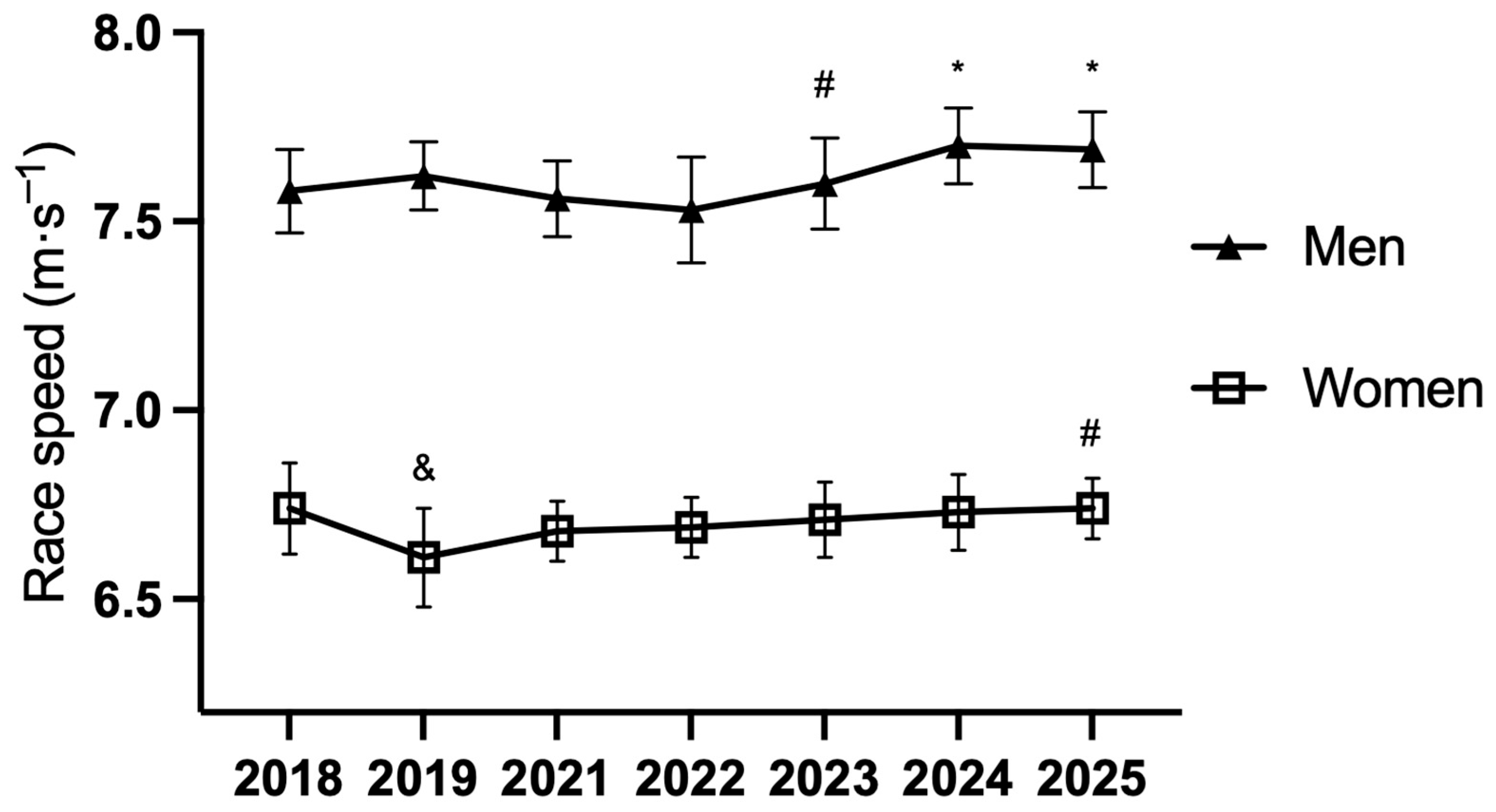
There were significant differences between years in both men and women (p < 0.001). In men, the mean speed was faster in 2024 (7.70 ± 0.10 m·s−1) and 2025 (7.69 ± 0.10 m·s−1) compared with all previous years (p < 0.05 in all cases), while 2022 was slower than 2023 (p = 0.004). In women, the mean race speed in 2019 (6.61 ± 0.13 m·s−1) was slower than in all other years except 2021 (p < 0.01 in all cases). Additionally, 2022 was slower than 2025 (p = 0.004) (Figure 1).

3.2. Wavelight Technology and Mean Race Speed

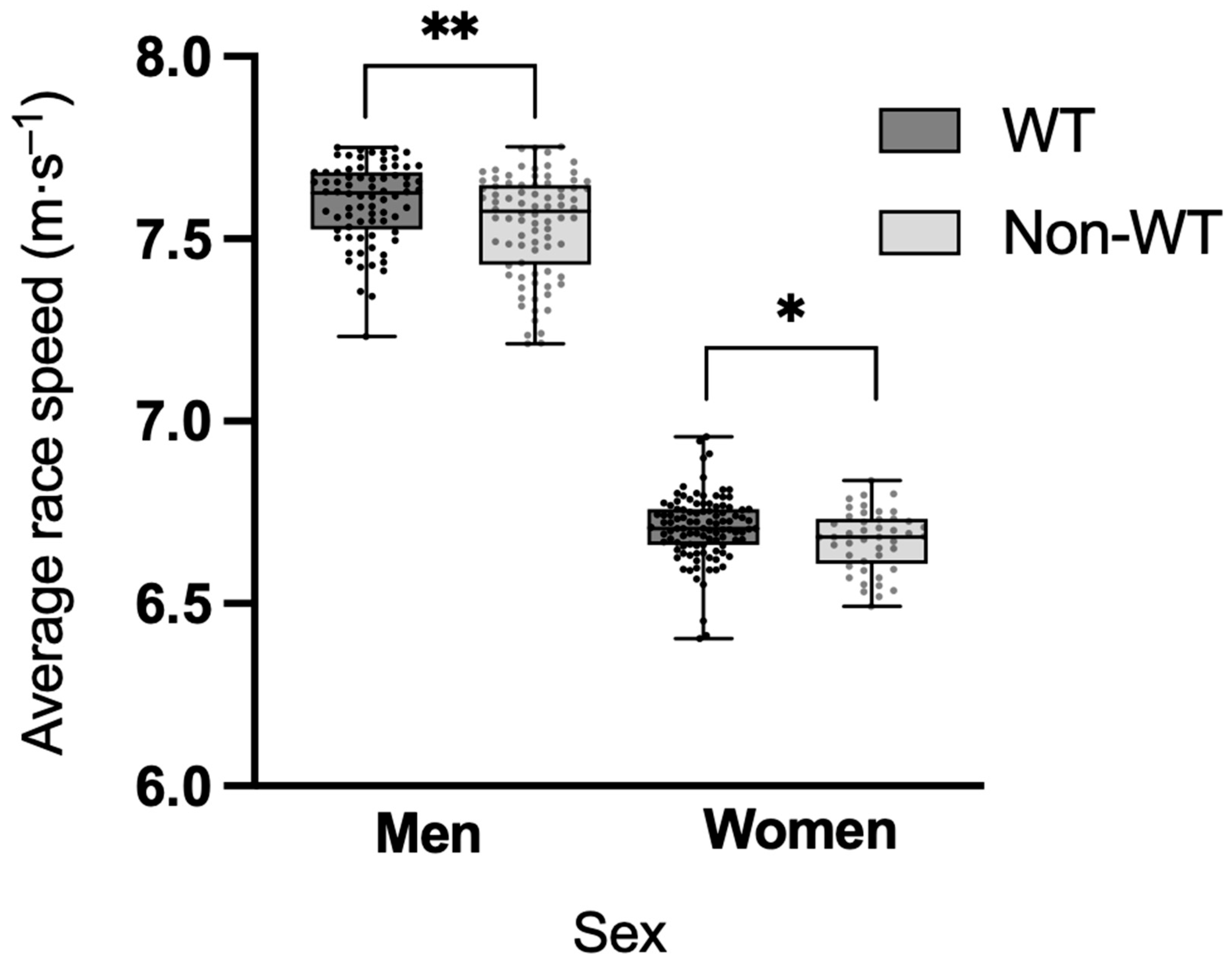
Analyzing only the years in which races with and without WT coexisted, men ran faster in WT races compared with non-WT races (7.60 ± 0.11 m·s−1 vs. 7.54 ± 0.14 m·s−1; p = 0.007; small d = 0.472), and the same pattern was observed in women (6.71 ± 0.09 m·s−1 vs. 6.67 ± 0.08 m·s−1; p = 0.023; small d = 0.401) (Figure 2). In addition, WT was associated with more homogeneous race speeds in men (Levene’s F = 6.0, p = 0.015), reflected in a lower interquartile range (0.158 in WT vs. 0.220 m·s−1 in non-WT races). However, in women, race-speed variability was similar between conditions (Levene’s F = 0.015, p = 0.903; interquartile range 0.100 in WT vs. 0.122 m·s−1 in non-WT races).

3.3. Wavelight Technology and Pacing Profiles

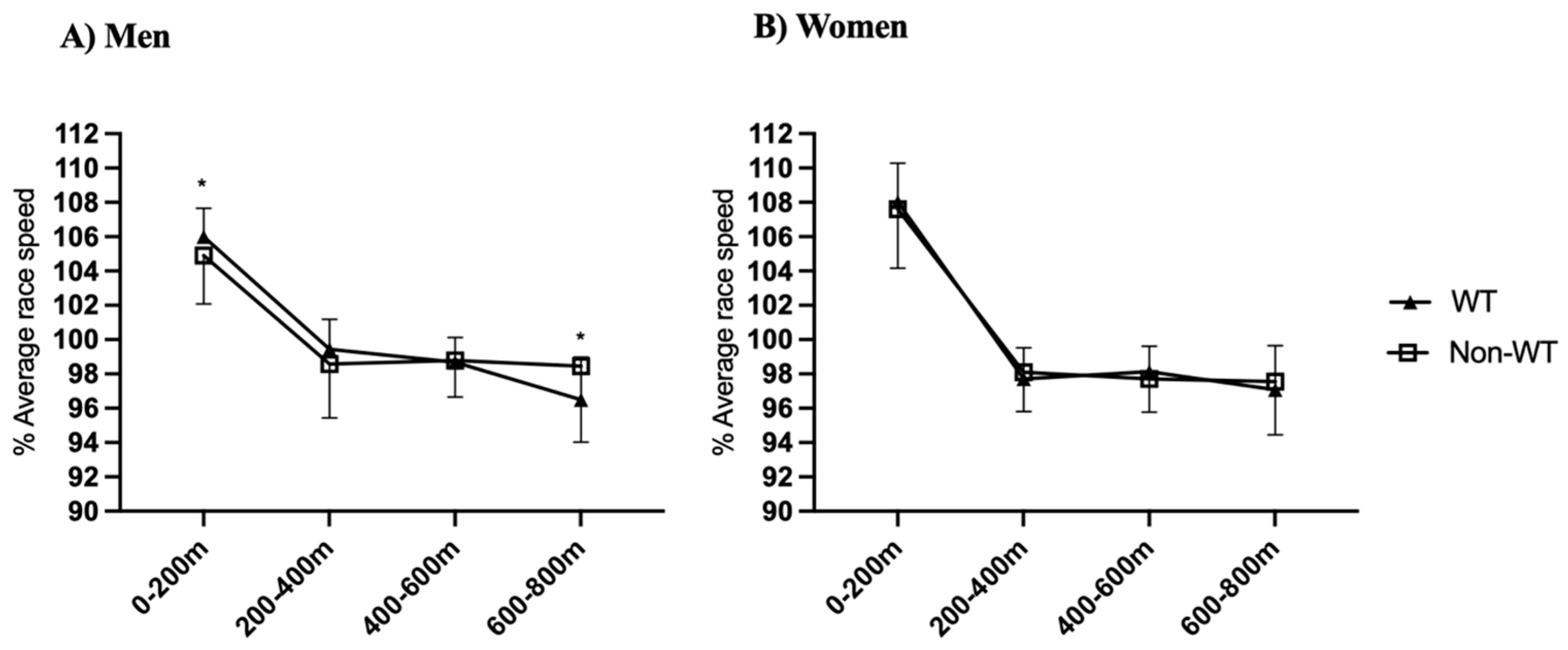
Overall, WT elicited significant differences in %RS in splits 1 and 4, increasing %RS in the first split compared to non-WT races (107.2 ± 2.3 WT vs. 105.8 ± 3.3 non-WT; p = 0.002, small d = 0.48) and reducing it in the last split (96.8 ± 2.6 WT vs. 98.1 ± 4.0 non-WT; p = 0.017, moderate d = 0.63). However, as shown in Figure 3, these differences were evident only in men’s races. In split 1, men showed a higher %RS with WT (106.0 ± 1.7 WT vs. 104.9 ± 2.8 non-WT; p = 0.014, small d = 0.47), whereas in the final split, %RS was lower with WT (96.5 ± 2.5 WT vs. 98.4 ± 4.4 non-WT; p = 0.006, small d = 0.54). In contrast, no differences were observed in women in any split (all p > 0.05).

4. Discussion

This study aimed to analyze the influence of WT on the mean race speed and pacing profiles of athletes competing in 800 m DL races, considering sex-based differences. We hypothesized that a system such as WT for accurately controlling running speed could be beneficial because the ability to achieve and maintain a predetermined target speed is a prerequisite for achieving optimal running performance [1,14]. Between 2018 and 2019, all 800 m races were conducted without WT. From 2021 to 2023, both WT and non-WT races coexisted. In 2024 and 2025, all races were held using WT (Table 1). Given the observational nature of this study, the present findings should be interpreted as associations rather than evidence of a direct causal effect of WT on pacing or performance outcomes. According to our initial hypothesis, WT did not modify pacing profiles similarly in men and women, as pacing alterations were observed only in men’s races (Figure 3). The main findings were that WT races were associated with faster performances than non-WT races for both men and women (Figure 2), WT races showed lower variability in mean race speed in men (Figure 2), and WT races exhibited faster starts and slower final splits in men’s races.
A possible association between WT use and higher absolute running speed was observed. Consistent with this, the use of WT was associated with a higher (0.6–0.8%) mean race speed (Figure 2), both in men’s and women’s races in the years where WT and non-WT races coexisted (from 2021 to 2023). Although the observed differences in mean race speed associated with WT were small in relative terms (0.6–0.8%), they may be practically meaningful in elite 800 m competition. For example, at the level of current world-record performances (1:40.91 in men and 1:53.28 in women), a 0.6–0.8% difference in performance would correspond to time differences of approximately 0.6–0.8 s. In highly competitive meeting races, such margins can be decisive for finishing position, qualification standards, or record-oriented performances.
Therefore, the increase in absolute speed in years 2024 and 2025 for men and 2025 for women could be partly attributable to the systematic implementation of WT (Figure 1). It is worth noting that, both in races with WT and in those without WT, human pacemakers are employed to set and maintain a high pace. According to previous studies, this pacing assistance can lead to a reduction in the athletes’ energetic cost and may provoke a VO2 decrease of approximately 4–6% [15,16]. However, races with WT were associated with faster performances, which may be partly explained by the presence of real-time pacing feedback. In the first part of the race, pacemakers themselves may be aided by the WT, as the projected pacing line offers an immediate and precise visual reference of the required speed, reducing the need to monitor intermediate split times manually. This could help them maintain a more stable and accurate pace during the early segments. Moreover, the WT may have been particularly helpful in the second half of the race, when pacemakers typically drop out from the front. At this stage, athletes must pace themselves without external human guidance, and the presence of WT may have been associated with sustained race speed by providing continuous, highly reliable visual pacing cues. Overall, these combined effects may partly explain the faster performances observed in WT races. In addition, the men’s races from 2021 to 2023 showed a more homogenous race speed with WT, whereas no differences were observed in women’s races. This aspect suggests that WT could help reduce the dispersion in final times among athletes, perhaps by externally helping runners focus on their target time. However, the only study that has used WT compared to drafting or self-selected pace found no significant differences in performance and in psychophysiological responses in distance runners during a 5000 m test, but drafting produced a large effect. Thus, the observed improvements in performance across the analyzed seasons should also be interpreted within the context of a broader technological and competitive evolution in elite athletics. In addition to the introduction of WT, recent years have been characterized by substantial advances in footwear technology, potential changes in training methodologies, race tactics, and qualification standards, as well as an increased emphasis on races designed to achieve fast times. Moreover, WT may be preferentially implemented in meetings and races specifically programmed for record-oriented performances, which could introduce a selection bias.
Regarding pacing profiles WT has been proposed as a tool that could be associated with more even pacing [17]. However, our results showed that, %RS in split 1 was significantly faster with WT (107.2 ± 2.3 WT vs. 105.8 ± 3.3% non-WT), while the last split was slower (96.8 ± 2.6 WT vs. 98.1 ± 4.0% non-WT). These results suggest that while WT may enhance overall mean race speed—both in men and women—the pacing strategy was only altered significantly in men’s races (Figure 3A). Although WT use was associated with more homogeneous pacing in men, a faster start and consequently, a slower finish was associated with a faster finishing time. However, further studies are needed to corroborate that this pacing strategy (or whether it can be considered optimal) leads to faster final times, as suggested in our study. The pacing profiles adopted in events lasting 40s to a few minutes are characterized by peak speeds attained in the early phase of the race [18], with a progressive deceleration until the finish line [7]. This imposes an immediate reliance on anaerobic metabolism, accelerating phosphocreatine (PCr) depletion and increasing glycolytic flux [7]. A faster PCr decline reduces the capacity to buffer changes in ATP turnover later in the race, contributing to early metabolic disturbance and marked accumulation of fatigue-related metabolites [19]. More specifically, in 800 m meeting races, the first 200 m split is typically faster than the following 200 m splits in both men and women. However, in men’s races the last three 200 m splits are progressively slower, whereas in women’s the remaining 200 m split times remain similar [2]. In the present study, WT was associated with a faster initial split and a slower final split in men, amplifying the positive pacing profile described previously–highlighting how an excessively fast start can compromise the athlete’s ability to maintain speed in the final 200 m–, whereas women maintained the pacing pattern previously reported [2]. A possible explanation could be the sex differences in the time perception between men and women [20]. This could lead women to be more conservative in endurance events [21] or that the pace pre-established by the organization is not as demanding as in the case of men. Alternative explanations may also account for the absence of WT-related pacing differences in women’s races. For example, differences in race organization or competitive objectives between men’s and women’s events could influence how athletes respond to external pacing cues. In addition, the preset speeds programmed in WT may differ systematically between sexes, potentially being less aggressive relative to women’s performance limits. Furthermore, women’s 800 m races often display a narrower performance density and more homogeneous pacing profiles, which could reduce the observable impact of external pacing aids. These explanations remain speculative and should be interpreted with caution.
These findings raise the question of whether a fast but not excessively fast WT-guided start could enable faster intermediate splits and consequently lower final times. Future research could explore dynamic WT systems that adjust pacing in real time based on athletes’ actual race speed or positioning, which may allow more flexible pacing strategies and reduce the risk of excessively fast starts in middle-distance events. This approach could be particularly beneficial in events such as the 800 m, where a pronounced positive pacing strategy often appears, but possibly less effective in longer events (e.g., 5000 and 10,000 m), where more even pacing is typically more beneficial [4].

4.1. Limitations and Future Research Directions

This study has some limitations. The main limitation relates to the possibility that the pre-established speed in WT races was higher than in non-WT races. However, the target speeds could not be verified due to missing information in the official results. Another limitation is the potential effect of advanced footwear technology spikes on middle and long-distance performance [22,23,24]. Additionally, whether races included human pacemakers and/or WT, athletes may not always have followed the intended pace, which could have influenced performance outcomes. Although the data were collected in settings with strong ecological validity, the design provides limited insight into the underlying mechanisms explaining the observed behaviors. On the other hand, repeated observations from the same athletes across multiple seasons may be included in the dataset, which could partially violate the assumption of independence of observations. Although this approach is common in large-scale performance analyses using publicly available competition data, future studies could apply mixed-effects models to explicitly account for within-athlete clustering. Additionally, future investigations in controlled environments are needed to determine the causal influence of WT on pacing strategies, as well as the interaction between WT and other performance-modifying factors. Finally, longitudinal analyses could help determine whether athletes progressively adapt their pacing strategies as WT becomes fully integrated into elite competitions.

4.2. Practical Applications

From a practical point of view, these results indicate that WT should be considered a technological aid associated with higher absolute speed in DL races. Coaches and race organizers may therefore use WT strategically to optimize race environments and increase the likelihood of achieving fast performances—particularly in competitive settings where precise pacing is critical for breaking records or achieving qualifying marks for major championships. However, as pacing profiles differed only in men’s DL races –with a faster initial and slower last 200 m– coaches and race organizers should assess whether this change in pacing profile is always positive or if it would be necessary to adjust the WT preset speed. Furthermore, coaches and athletes could use this type of technology in training, to adjust pre-set pace and ensure proper execution depending on the type of session. However, more research is needed in this regard.


5. Conclusions

This study highlights how WT influences the mean race speed in years where WT and non-WT races coexisted. Mean speed was higher in 2024 and 2025 for men compared to previous years, whereas only women in 2025 showed increases. However, WT use was associated with differences in pacing strategies in men’s DL races, but not women’s races. Therefore, although WT seems to contribute to faster absolute race speeds, this technology does not modify the distribution of effort equally between men and women. Future discussions on the regulation of pacing technologies should consider their potential influence on race dynamics across different events and competitive contexts.

Author Contributions

All authors contributed significantly to this manuscript’s final version. Conceptualization, J.J.S. and F.G.-M.; methodology, J.J.S. and M.G.; formal analysis, S.R.-B. and F.G.-M.; investigation, J.J.S. and F.G.-M.; resources, F.G.-M.; data curation, M.G.; writing—original draft preparation, S.R.-B. and M.G.; writing—review and editing, J.J.S. and F.G.-M.; visualization, F.G.-M. and S.R.-B.; supervision, J.J.S. All authors have read and agreed to the published version of the manuscript.

Funding

This research received no external funding.

Institutional Review Board Statement

The study was conducted in accordance with the Declaration of Helsinki. Ethical approval was not required for this study, as it was based exclusively on the secondary analysis of publicly available athletic performance records.

Informed Consent Statement

Informed consent was not required for this study, as it was based exclusively on the secondary analysis of publicly available athletic performance records.

Data Availability Statement

The datasets used and analyzed during the current study are available from the corresponding author upon reasonable request.

Acknowledgments

We would like to express our gratitude to the Omega and Diamond League websites for providing public and free access to the data used in this study.

Conflicts of Interest

The authors declare no conflicts of interest.

References

  1. Abbiss, C.R.; Laursen, P.B. Describing and understanding pacing strategies during athletic competition. Sports Med. 2008, 38, 239–252. [Google Scholar] [CrossRef]
  2. Filipas, L.; Ballati, E.N.; Bonato, M.; La Torre, A.; Piacentini, M.F. Elite male and female 800-m runners’ display of different pacing strategies during season-best performances. Int. J. Sports Physiol. Perform. 2018, 13, 1344–1348. [Google Scholar] [CrossRef]
  3. Renfree, A.; Gibson, A.S.C. Influence of different performance levels on pacing strategy during the Women’s World Championship marathon race. Int. J. Sports Physiol. Perform. 2013, 8, 279–285. [Google Scholar] [CrossRef] [PubMed]
  4. Casado, A.; Hanley, B.; Jimenez-Reyes, P.; Renfree, A. Pacing profiles and tactical behaviors of elite runners. J. Sports Health Sci. 2021, 10, 537–549. [Google Scholar] [CrossRef] [PubMed]
  5. De Koning, J.J.; Foster, C.; Lucia, A.; Bobbert, M.F.; Hettinga, F.J.; Porcari, J.P. Using modeling to understand how athletes in different disciplines solve the same problem: Swimming versus running versus speed skating. Int. J. Sports Physiol. Perform. 2011, 6, 276–280. [Google Scholar] [CrossRef]
  6. Casado, A.; Ranieri, L.E.; Hanley, B.; Foster, C.; Gonzalez-Mohino, F. Differences in pacing behaviour between global championship medal performances and world records in men’s and women’s middle- and long-distance running track events. J. Sprots Sci. 2024, 42, 358–364. [Google Scholar] [CrossRef]
  7. Tucker, R.; Lambert, M.I.; Noakes, T.D. An analysis of pacing strategies during men’s world-record performances in track athletics. Int. J. Sports Physiol. Perform. 2006, 1, 233–245. [Google Scholar] [CrossRef] [PubMed]
  8. Hanley, B. Pacing, packing and sex-based differences in Olympic and IAAF World Championship marathons. J. Sports Sci. 2016, 34, 1675–1681. [Google Scholar] [CrossRef]
  9. Emig, T.; Adam, G. Evolution of world running record performances for men and women: Physiological characteristics. Front. Physiol. 2024, 15, 1372092. [Google Scholar] [CrossRef]
  10. Muniz-Pardos, B.; Bekele, K.; Mayo, C.; Pitsiladis, Y. Technological advances in elite sport: Where does one draw the line? J. Appl. Physiol. 2024, 137, 646–648. [Google Scholar] [CrossRef]
  11. Grannetia, S.; Hoogkamer, W. WaveLight Technologies’ lights are the fair 21st century’s equivalent of the stopwatch. J. Appl. Physiol. 2024, 137, 652. [Google Scholar] [CrossRef]
  12. Casado, A.; Renfree, A.; González-Ravé, J.M.; González-Mohíno, F. Pacing profiles during world records in olympic track long-distance running events by men and women. Arch. Med. Deporte 2024, 41, 210–214. [Google Scholar] [CrossRef]
  13. Hopkins, W.G. A scale of magnitudes for effect statistics. In A New View of Statistics; Will G. Hopkins: Melbourne, Australia, 2002; Volume 502, p. 321. [Google Scholar]
  14. Foster, C.; Schrager, M.; Snyder, A.C.; Thompson, N.N. Pacing strategy and athletic performance. Sports Med. 1994, 17, 77–85. [Google Scholar] [CrossRef] [PubMed]
  15. Pugh, L.G.E. The influence of wind resistance in running and walking and the mechanical efficiency of work against horizontal or vertical forces. J. Physiol. 1971, 213, 255–276. [Google Scholar] [CrossRef] [PubMed]
  16. Davies, C.T. Effects of wind assistance and resistance on the forward motion of a runner. J. Appl. Physiol. 1980, 48, 702–709. [Google Scholar] [CrossRef]
  17. Taylor, J.; Atkinson, G.; Best, R. Paced to perfection: Exploring the potential impact of WaveLight Technology in athletics. Sport Exerc. Sci. 2021, 68, 8–9. [Google Scholar]
  18. Thompson, K. Pacing: Individual Strategies for Optimal Performance; Human Kinetics: Champaign, IL, USA, 2014. [Google Scholar]
  19. Febbraio, M.A.; Dancey, J. Skeletal muscle energy metabolism during prolonged, fatiguing exercise. J. Appl. Physiol. 1999, 87, 2341–2347. [Google Scholar] [CrossRef]
  20. Hanson, N.J.; Buckworth, J. Sex differences in time perception during self-paced running. Int. J. Exerc. Sci. 2016, 9, 514. [Google Scholar] [CrossRef]
  21. March, D.S.; Vanderburgh, P.M.; Titlebaum, P.J.; Hoops, M.L. Age, sex, and finish time as determinants of pacing in the marathon. J. Strength Cond. Res. 2011, 25, 386–391. [Google Scholar] [CrossRef]
  22. Alda-Blanco, A.; Rodríguez-Barbero, S.; Rodrigo-Carranza, V.; Valero, F.; Chico, P.; González-Mohíno, F. Influence of Running Surface Using Advanced Footwear Technology Spikes on Middle-and Long-Distance Running Performance Measures. Sports 2024, 12, 329. [Google Scholar] [CrossRef] [PubMed]
  23. Robbin, J.; Mai, P.; Helwig, J.; Willwacher, S. Does an analysis of the world top 100 track and road running performances provide an indication for the effects of super shoes and spikes? Footwear Sci. 2023, 15, S16–S17. [Google Scholar] [CrossRef]
  24. Needles, B.J.; Grabowski, A.M. Does running speed affect the performance improvements experienced by elite distance runners wearing advanced footwear technology spikes? J. Appl. Physiol. 2024, 137, 1690–1698. [Google Scholar] [CrossRef] [PubMed]
Figure 1. Mean and standard deviation of the race speed by year for men (n = 374) and women (n = 315). Differences from previous years were noted with *, differences from 2022 were noted with #, and differences with previous and following years except to 2021 were noted with &.
Applsci 16 01378 g001
Figure 2. Box-and-whisker plots display the distribution of average race speed (m·s−1) for men (n = 160) and women (n = 150) in which races with and without wavelight technology coexisted (2021–2023). Boxes represent the interquartile range (IQR) with the median shown as a horizontal line; whiskers indicate 1.5 × IQR, and individual points represent athlete data. * p < 0.05 and ** p < 0.01.
Applsci 16 01378 g002
Figure 3. Race-segment speeds (expressed as % of overall race speed) across four 200 m sections for men (A) and women (B) in which races with (WT) and without (Non-WT) wavelight technology coexisted (2021–2023). Values are mean ± SD. * p < 0.05.
Applsci 16 01378 g003
Table 1. Number of performances with and without wavelight technology per year in Diamond League 800 m races.
YearWTNon-WTTotal
201808484
201907373
2021261743
20226974143
20239638134
20241100110
20251020102
Total403286689
WT, wavelight technology.
Disclaimer/Publisher’s Note: The statements, opinions and data contained in all publications are solely those of the individual author(s) and contributor(s) and not of MDPI and/or the editor(s). MDPI and/or the editor(s) disclaim responsibility for any injury to people or property resulting from any ideas, methods, instructions or products referred to in the content.